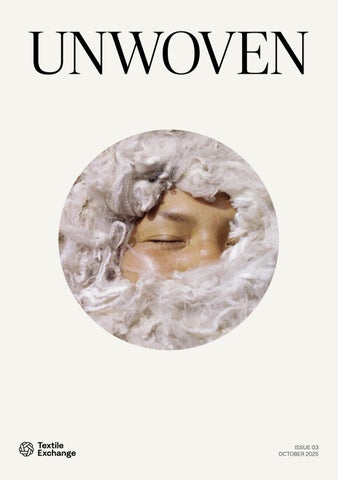
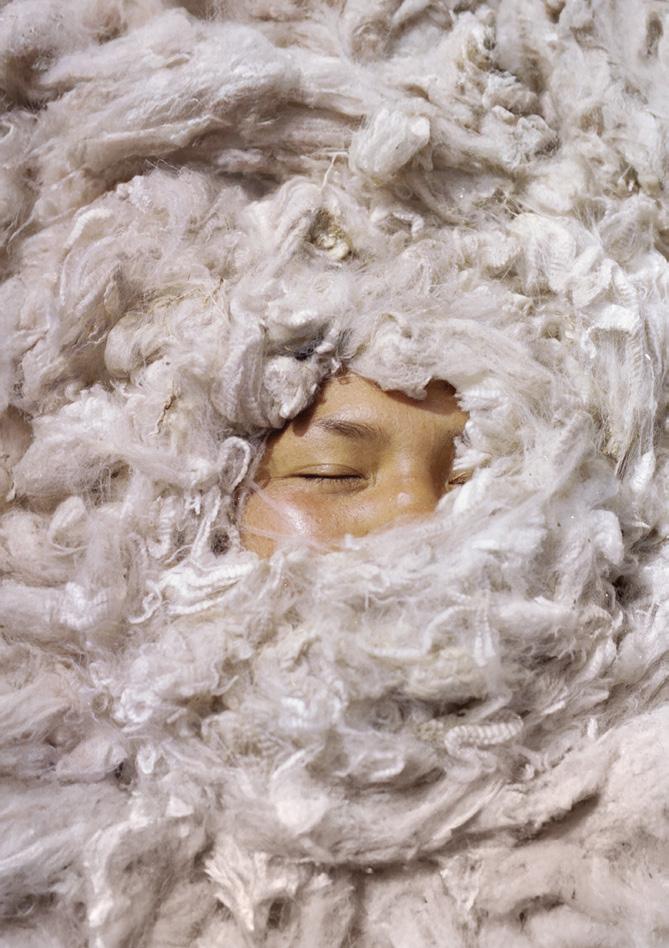
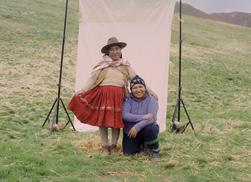
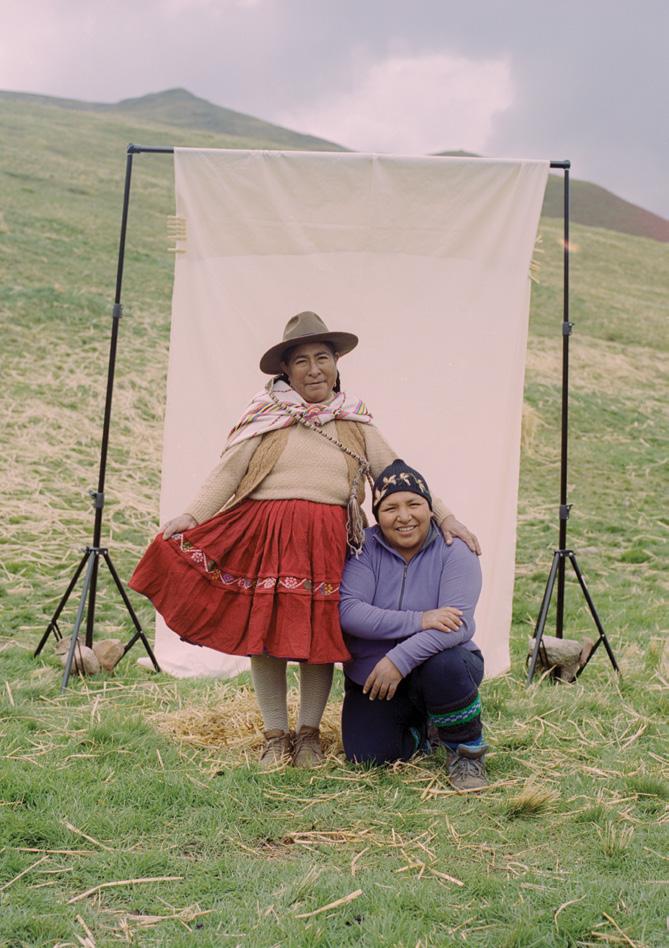
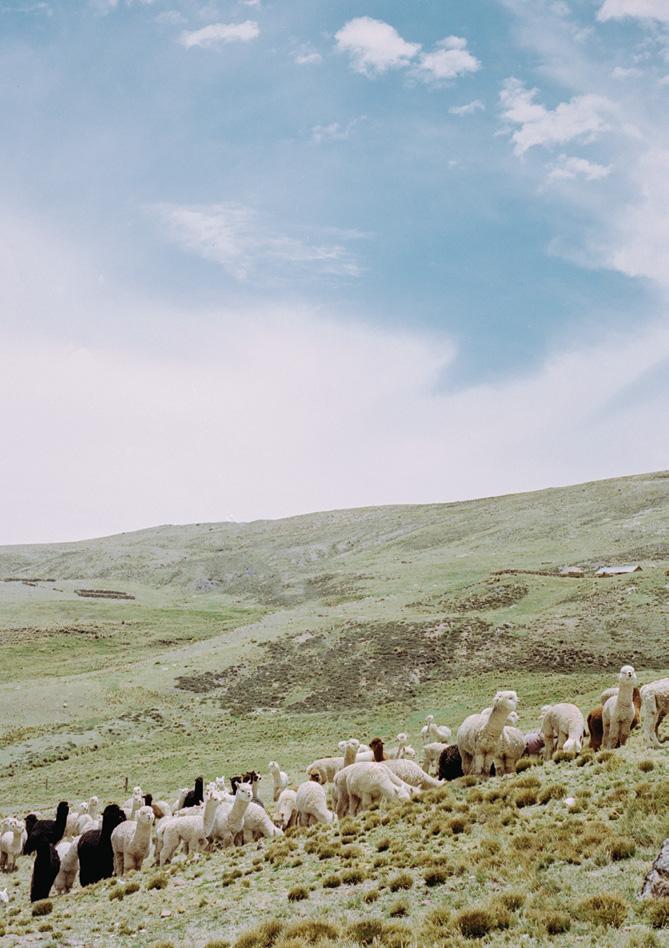
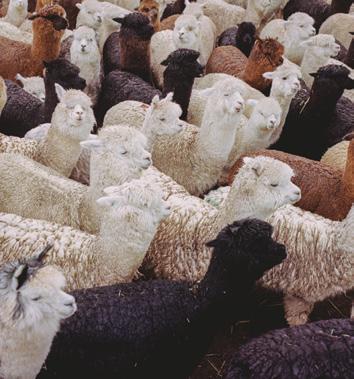
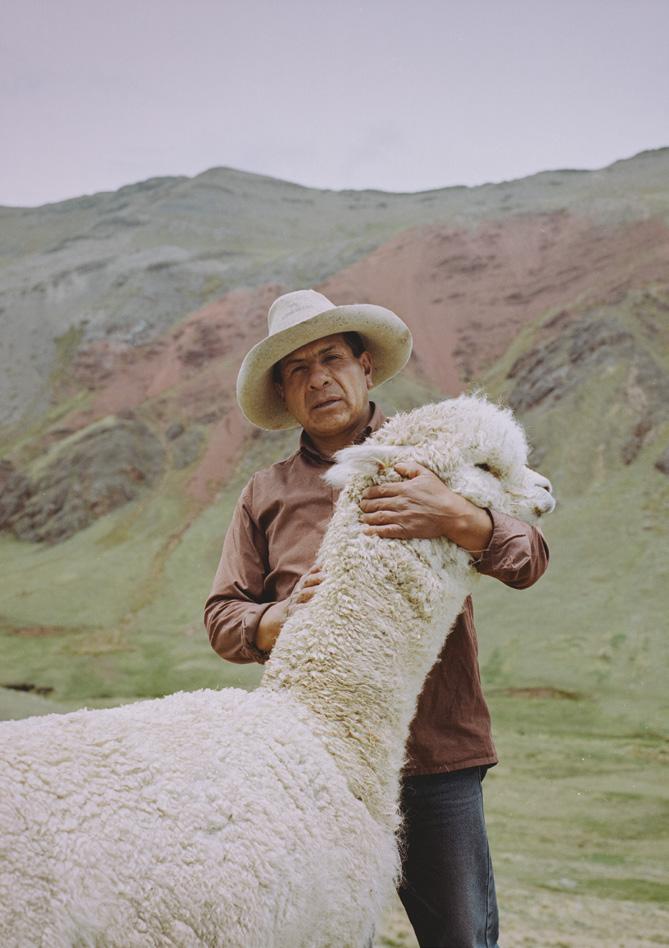
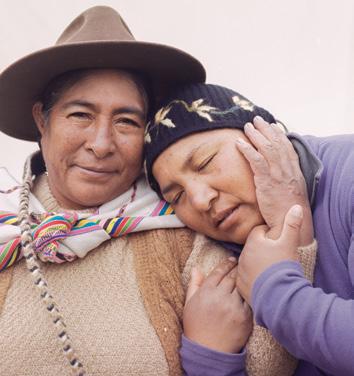
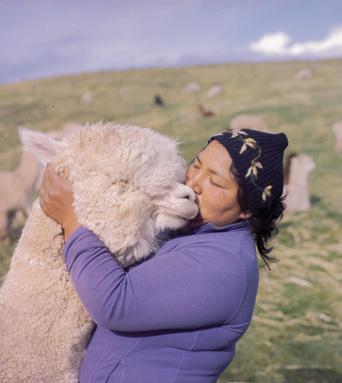
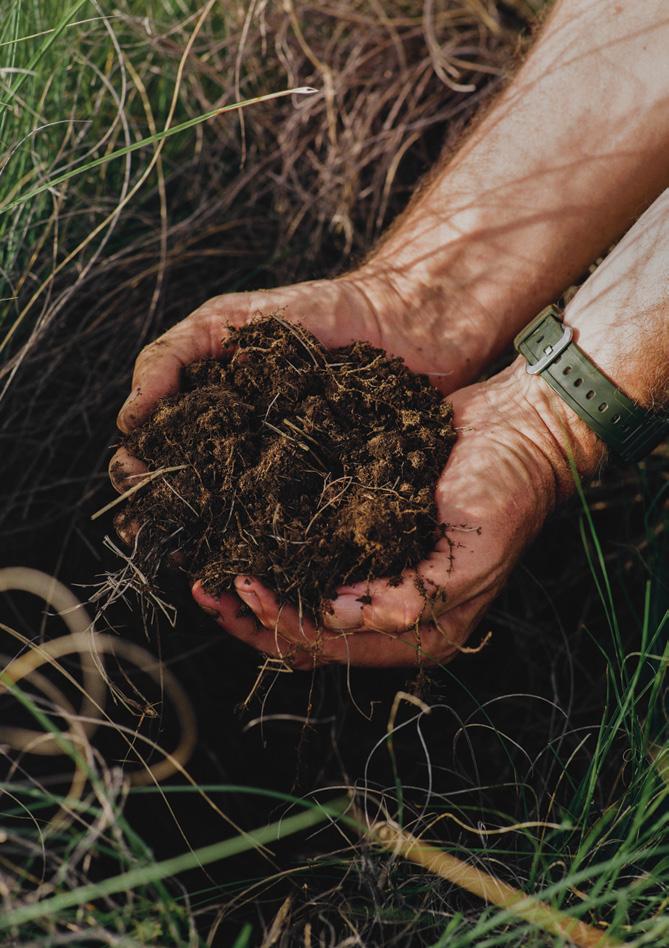
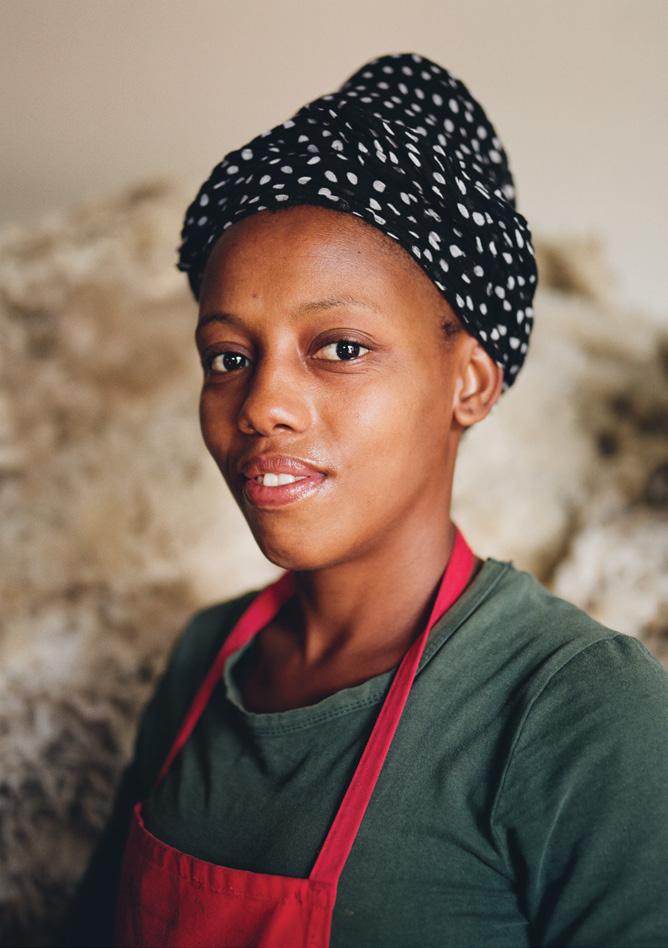
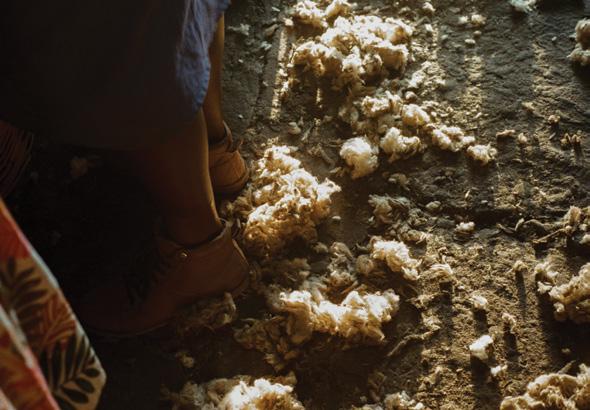
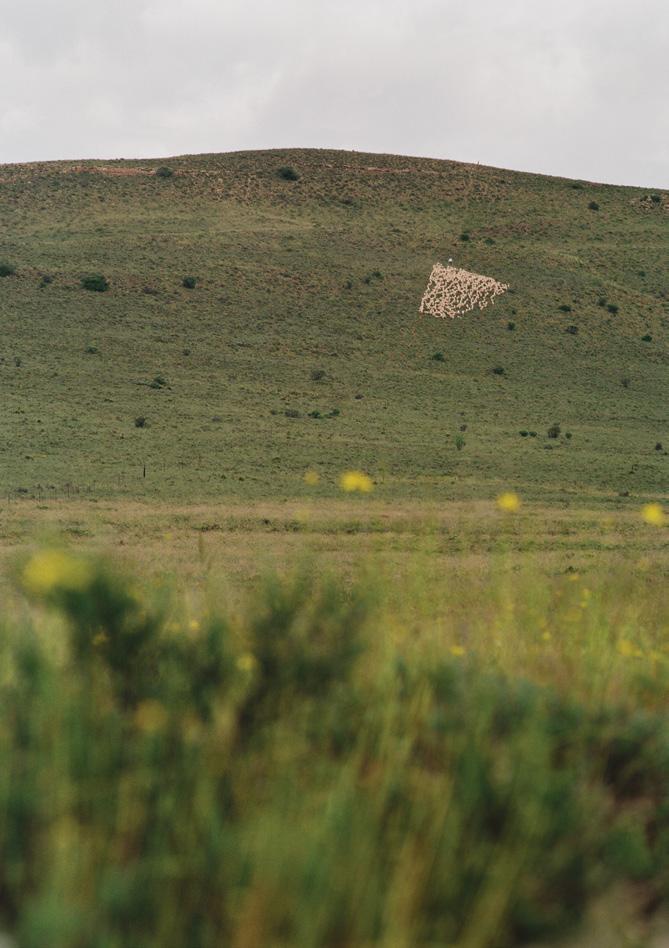
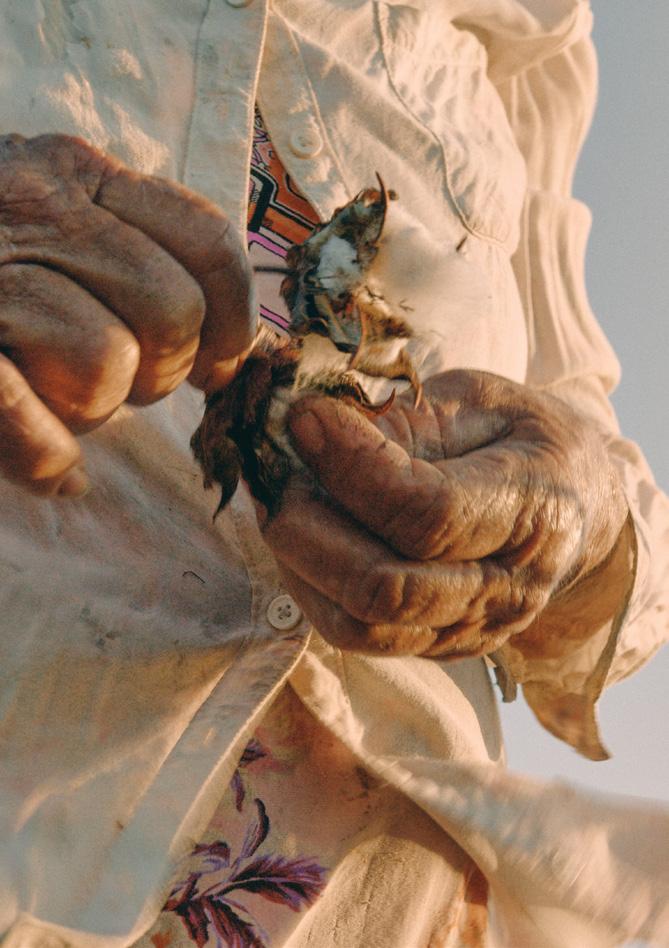
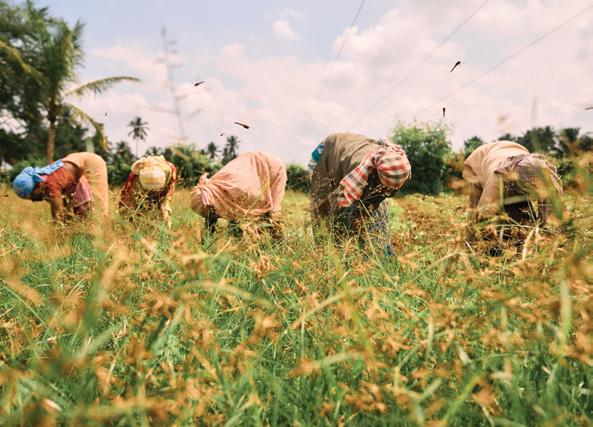
Above: A portrait of Evelyn Diaz, a Responsible Alpaca Standard–certified farmer in the Peruvian highlands, who carries forward a family alpaca farming legacy where care for animals and land go hand in hand.
Image by Alejandra Orosco
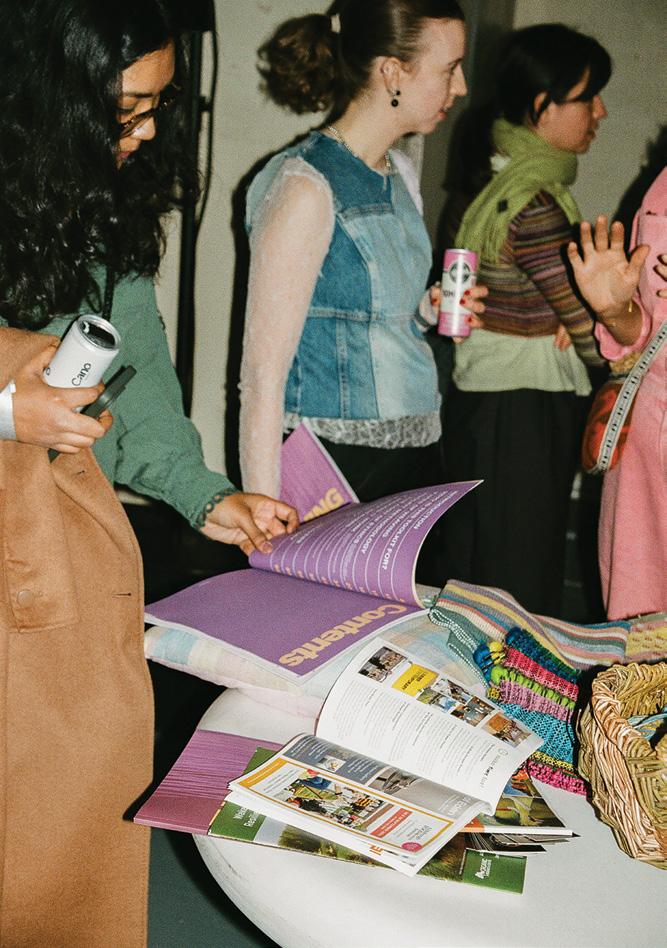
Unwoven is an editorial project by the non-profit organization Textile Exchange. It aims to pull apart and reconstruct perceptions of clothing and textiles today by deepening our understanding of the materials that make them, and the stories, questions, and concepts behind them.
Issue 3 explores the theme Local & Global, looking at how place-based knowledge and lived experience can inform and reshape global sustainability frameworks in the fashion and textile industry. This edition spotlights material producers and projects around the world, alongside commentaries on how local insights and reconnection to place might influence broader systems change. It unpacks the idea of adaptation, to environments, policy, and markets, as well as resilience, and how places have shaped solutions to pressing sustainability challenges.
The Women Who Bear the Burden of Fashion’s Overproduction Problem
AUSTRALIA
The Australian Wool Growers Bringing Dry Land Back to Life
FRANCE
How France’s Anti-Waste Laws are Boosting Small Repair Shops
SOUTH AFRICA
Solving The Ecosystem Regeneration Puzzle In South Africa
TÜRKIYE
How Cross-Sector Partnerships Made Recycled Cotton a Reality in Türkiye
GLOBAL
MAGNUM PHOTOS
Tracing the Origin Stories Behind the Global Textile Trade with Magnum Photos
TINA WETSHI
Asking Colèchi: What Does Local Mean for Fashion in a Globalized World?
ADITI MAYER
Connecting Ecology and Economics: Aditi Mayer’s Lessons from India’s Cotton Clusters
SOPHIE BENSON
Shining Light on Fashion’s Global Supply Chains
SOUTH AFRICA Solving The Ecosystem Regeneration Puzzle In South Africa
PERU
Preserving Peru’s Heritage One Alpaca at a Time
AUSTRALIA
The Australian Wool Growers Bringing Dry Land Back to Life
Tracing the Origin Stories Behind the Global Textile Trade with Magnum Photos
Puno, Peru
Accra, Ghana
Paris, France
Graaff-Reinet, South Africa
STORIES FROM ACROSS THE GLOBE
All around the world, individuals and communities have developed locally adapted systems for producing or recycling materials, regenerating land, and preserving cultural heritage. Each rooted in place-based knowledge, these are not isolated case studies but practical pathways showing how local solutions can strengthen global resilience.
Kahramanmaraş, Türkiye
Odisha, India
Madhya Pradesh, India
Mollerin, Australia
This section spotlights local, place-based responses to some of fashion’s sustainability challenges. From managing an influx of used clothing waste in Ghana, to using legislation to incentivize repair trades in France, to adapting regenerative agriculture in the arid landscapes of Western Australia, each story reveals how deep-rooted knowledge and lived experience are shaping new models for the future.
Local
PUNO, PERU
High in the harsh landscapes of Peru’s central Andes, alpacas have sustained families for generations—not just as a livelihood, but as part of daily life and identity. For farmer Evelyn Diaz, preserving that bond means safeguarding both her family’s future and a heritage under pressure from climate change, economic challenges, and shifting traditions.
Preserving Peru’s Heritage One Alpaca at a Time
“These animals are our guardians. They live closely alongside us—the people of the high Andes—and share the same ecosystems that sustain us all.”
To Evelyn Diaz, an alpaca farmer in Peru’s highlands, the animals she works with every day are not merely her livelihood—they’re part of the family. “Sometimes my husband jokingly tells me that my mother must be an alpaca,” she says with a giggle. “From the moment I opened my eyes, they’ve always been right there beside me.”
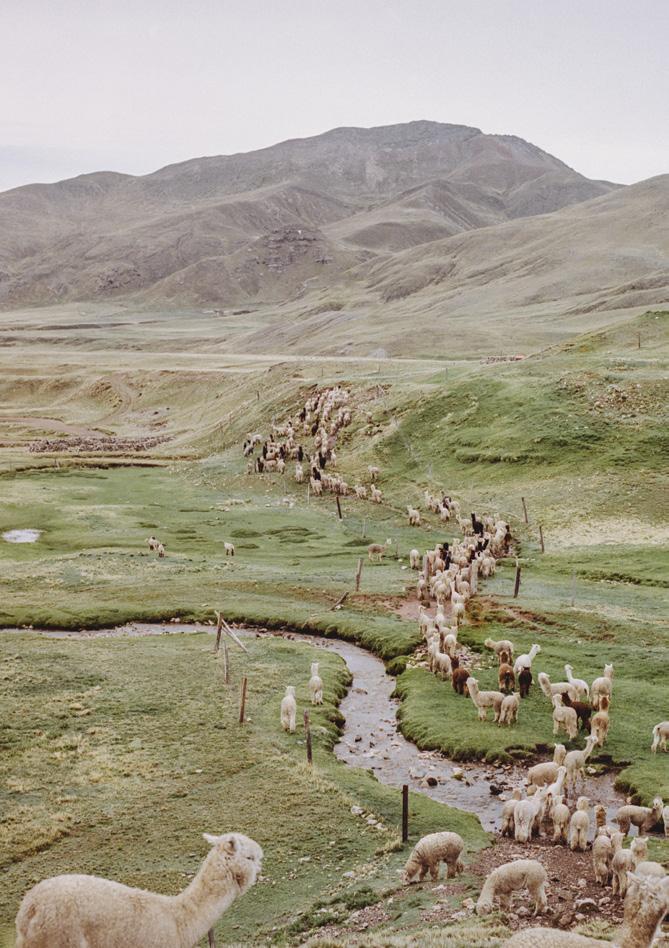
Evelyn’s family farm, Fundo El Nevado, sits high in the grasslands of the central Andes—a five-hour drive from the bustling city of Juliaca. At 4,500 meters above sea level in the puna, oxygen is thin and vegetation sparse. The changing climate is also making alpaca farming increasingly difficult. But after years in the city, Evelyn felt the call of home. Ten years ago, she decided to return to her childhood home to help preserve Peru’s alpaca farming tradition.
Today, the business she runs with her parents and husband is recognized by Textile Exchange’s Responsible Alpaca Standard, which ensures alpaca fiber is produced in a way that respects animal welfare, social welfare, and land health. It’s a philosophy that comes through clearly in the way Evelyn talks about her flock and the landscape they inhabit. “These animals are our guardians,” she says. “They live closely alongside us—the people of the high Andes —and share the same ecosystems that sustain us all.”
Words by Claudio Sala and Julia Webster Ayuso
Images by Alejandra Orosco
Evelyn’s parents, Máximo and Felicitas Diaz, began their journey here 40 years ago with fewer than 100 alpacas and a small inherited plot of land. At the time, they were considered subsistence farmers —a term Máximo rejects for suggesting mere survival rather than his entrepreneurial, growth-driven approach. Through smart decisions such as buying land from neighbors and growing
Above and left: The Diaz’s herd is certified to the Responsible Alpaca Standard, which incentivizes practices that protect animal welfare, social welfare, and land health.
their herd exponentially, they overcame the challenges of living in the region’s harsh climate with no public services. Over the years, they’ve become known for breeding high-quality alpacas, now their main source of income.
Over a breakfast of chaplas (Andean bread) and a quinoa and lamb soup, Felicitas, now 70, shared that the greatest hurdle in those early years was ignoring their neighbors' warnings about expanding their herd and land too quickly. “It was risky, they said,” she recalled with a knowing smile as she served the hearty threecourse meal. “But we didn’t listen, and we proved them wrong.”
The couple passed on their work ethic to their children. Evelyn, the eldest of five, stood out early on for her passion for alpacas and life in the puna. While her sisters dreamed of city life, she was up at 3am every day, helping her father with the daily tasks required to maintain a healthy herd—a routine that remains unchanged to this day. As she herded the alpacas, Evelyn explained that, like any other member of the family, the animals simply need constant love and care. “I just couldn’t stay away from them for too long,” she says.
When Evelyn and her sisters reached their teenage years, Máximo and Felicitas faced a tough decision. The puna wasn’t conducive to quality education, so they began splitting their time between the farm and the city. As the eldest, Evelyn often found herself acting as a parttime mother. “It was a huge responsibility,” she admitted. “During high school, I had to balance helping my parents manage the farm and taking care of my sisters. It wasn’t easy, but it taught me a lot.”
“With limited government support and few opportunities for alpaca farmers, many young people are losing interest in following their parents’ path.”
Her hard work and determination were reflected in her academic success. Thanks to her parents’ unwavering support, Evelyn became the first woman in her village to pursue a professional career, unsurprisingly choosing veterinary medicine.
While studying at the Universidad Nacional del Altiplano de Puno, she met her husband, Oscar Vilca, who shared her love for alpacas and llamas. After graduation, the couple returned to El Nevado with innovative ideas for improving herd management: new herding techniques, keeping records on each of the animals, and the introduction of Western medicine.
However, these modern approaches initially clashed with Máximo and Felicitas’s traditional methods. “It was like talking to the most stubborn wall you can imagine,” Oscar joked. “I only gave in to stop the headaches their constant nagging was giving me,” his father-in-law replied.
Their persistence eventually paid off. Mortality rates decreased, animal welfare improved, and the herd grew to over 2,000 alpacas. The family grew too: Evelyn and Oscar had two children. While Oscar fostered cooperation among neighboring farmers and collaborated with local governments to improve market access for alpaca products, Evelyn became a leading voice for alpaca farmers across Peru. Her ability to articulate the challenges farmers face—particularly women—caught the attention of Peruvian fashion designers and organizations eager to support initiatives that improve rural livelihoods, such as Meche Correa and Qaytu.
Above: For alpaca farmer Evelyn Diaz and her father Máximo (right), the herd represents more than livelihood—they’re part of the family.
Above: Evelyn and her mother Felicitas represent two generations of alpaca farmers united by their care for animals, land, and community.
Evelyn is quick to point out that their work is far from finished. “There’s still so much to be done,” she says, describing her projects to create entrepreneurship opportunities for women, which ran into traditional expectations around their role as homemakers. “With limited government support and few opportunities for alpaca farmers, many young people are losing interest in following their parents’ path.” This generational shift is a significant concern for the Diaz family and wider alpaca farming community, and Evelyn and Oscar are determined to bring it to the attention of industry stakeholders.
When asked about the greatest challenge she faces as a female alpaca farmer, Evelyn is unequivocal: “Being away from my kids.” Even 30 years after her parents faced the same issue, it’s still almost impossible to balance farming and providing a decent education for one’s children. “The only option is for them to live in the city with a relative while you travel back and forth from the farm,” she says. She makes the four-hour commute to and from the city and the farm almost daily, in order to see her children as much as possible.
Despite the difficulties of highland life, Evelyn says the bond she shares with her animals is her greatest source of hope. “As a mother, I know it’s thanks to them that I have an income and can provide for my children,” she says.
“Apparently, we raised them,” she says of the herd. “But if they could speak, they would say that they raised us.”
“Apparently, we raised them. But if they could speak, they would say that they raised us.”
Alpacas have sustained the Diaz family for decades—and in return, Evelyn continues to nurture them with constant love and respect.
Left:
ODISHA
AND MADHYA PRADESH, INDIA
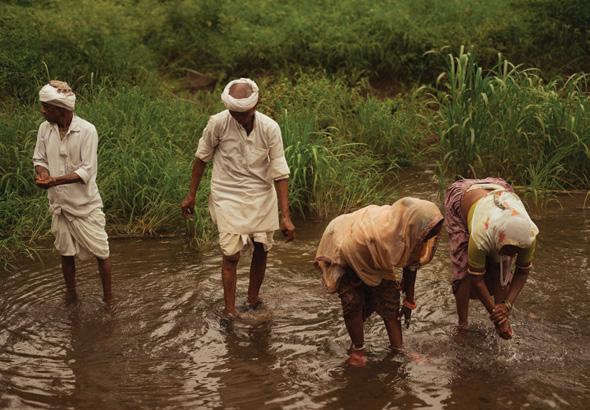
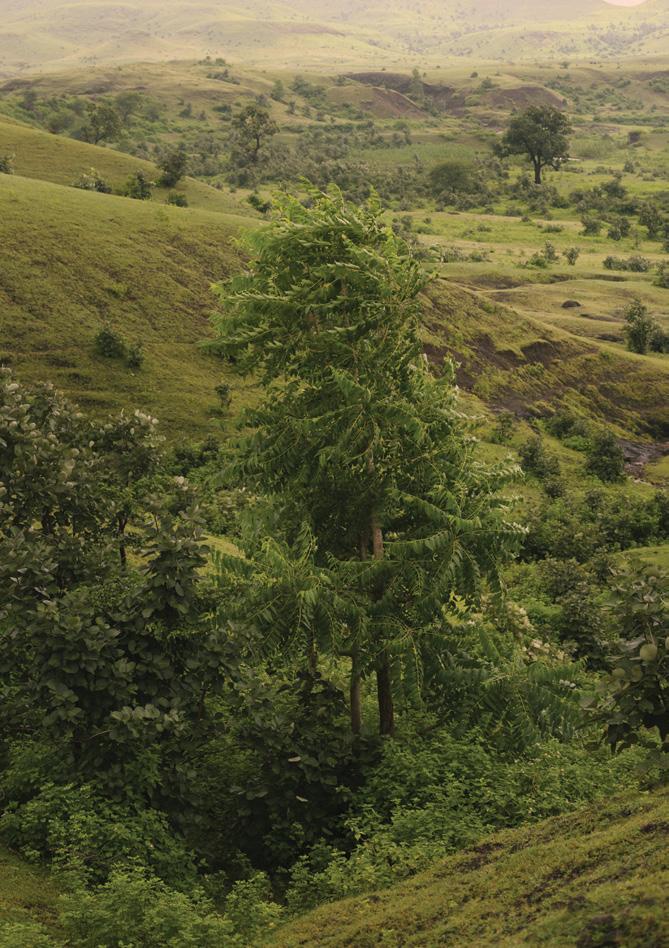
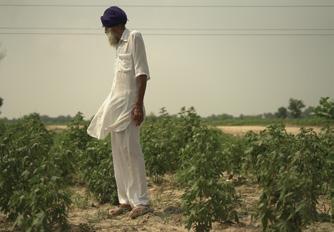
In the smallholder farming communities of Odisha and Madhya Pradesh, organic cotton is not just a crop—it is an inheritance, nurtured through ritual, tradition, and care for the land. With support from the Organic Cotton Accelerator and improved market access, this inheritance is finding its place in today’s supply chains.
At sunrise, Kamari village in Odisha hums to life. Birdsong mingles with the clatter of brooms sweeping mud courtyards. Mist clings to the paddy edges, while women move like clockwork through morning chores. High above, the koel sings, a reminder that a new day has begun.
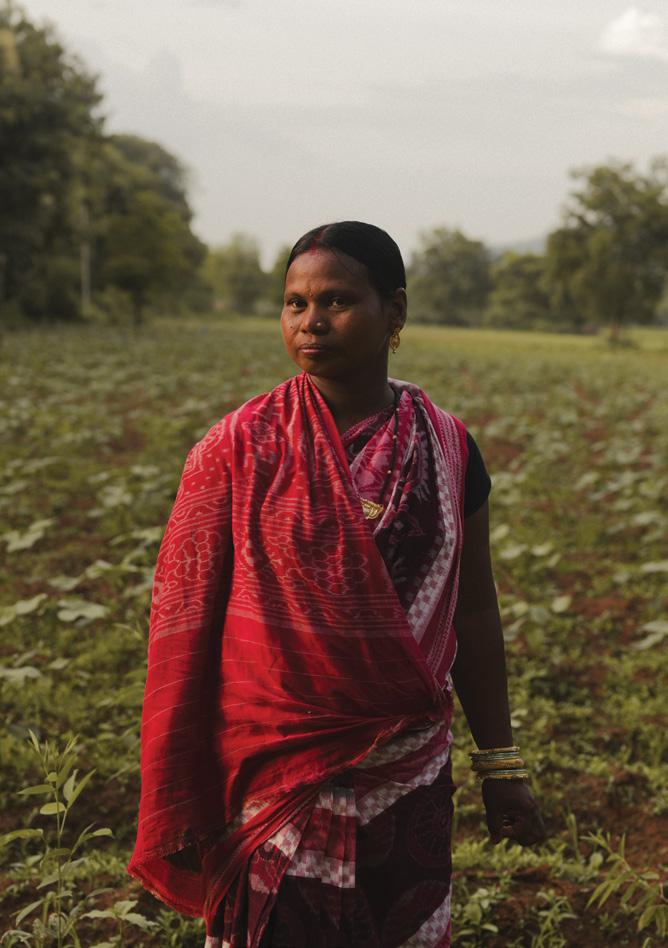
Annapurna Maji starts her day in the fields. A proud organic cotton farmer, she is also a board member of a farmer-producer organization. Annapurna is a community leader, a cultivator, and a firm believer in the regenerative power of traditional knowledge.
Across India, farmers like her are making the shift to organic with support from the Organic Cotton Accelerator (OCA). Working with Implementing Partners and actors across the supply chain, OCA is building a transparent, resilient, and farmer-centric organic cotton sector. Through its Farm Programme, the organization provides farmers with access to training, non-GMO seed, pre-financing, and a guaranteed premium for their organic cotton.
Inside the Smallholder Tribal Communities Growing Organic Cotton in India
Words by Rakshanda Bhat
Images by Priyadarshini Ravichandran
“My ancestors didn’t call it organic, it was just farming.”
The organization works with over 100,000 organic cotton farmers, most of them in India, but also in Pakistan and Türkiye, across more than 106,000 hectares of land. With reliable partnerships in the field, OCA also gathers data to demonstrate the benefits of organic cotton for farmers and the environment. The organization aims to go beyond measurement and reporting by empowering farmers and guiding continuous improvement in the global fashion, textile, and apparel industry.
With its support, farmers like Annapurna are earning more, farming in a way that protects their health, restores soil biodiversity, and secures the future of their land for generations to come. But it wasn’t always this way.
“When I first came to this village as a bride,” she recalls, “I was someone’s wife. I didn’t step outside much. My world was the kitchen. I didn’t imagine I would one day be leading farmers or speaking about organic cotton to visitors.”
“Organic is our tradition. Earlier, all farming was done without chemicals. We decided to return to that.”
She recalls the early years of farming with synthetic fertilizers. “The plants looked healthy, and the yield was high. But slowly, I began noticing things. My soil was hard. Earthworms disappeared. And people around us were falling sick more often.”
Noticing turned into questioning, which in turn led to action. For Annapurna, transitioning to organic practices was simply a return to the past. “My ancestors didn’t call it organic,” she smiles. “It was just farming. They used compost from livestock, they planted marigolds and bitter plants to deter pests, and they respected the seasons.”
Today, she recreates those methods in her own fields, preparing compost at home, applying leaf-based pest repellents, and intercropping cotton with pigeon pea to both feed her family and boost the soil health. She avoids synthetic inputs, chooses native seeds, and relies on natural solutions. “I used to spend thousands on fertilizers and pesticides,” she notes. “Now I spend time, not money, making what I need from what I already have.”
When she began organic farming, the change started. “At first, the yield dropped. But soon, I saw tiny life returning. Earthworms. Beneficial insects. The soil became soft again. Now, my yields are stable, my cotton is strong, and my land is alive.”
A similar story is unfolding in the village of Satrundi in Petlawad, Madhya Pradesh, where Maan Singh and Gaura Katara, a couple from the Bhil community, have been farming for over three decades. Over the last 15 years, they have returned to growing jaivik kapas (organic cotton) on their 2.5-acre plot, alongside maize, pigeon pea, green gram, mustard, okra, brinjal, and seasonal vegetables. The layout is intentional, thoughtful, and generous.
For the Kataras, before going organic, farming brought more stress than sustenance. Market-bought inputs such as chemical fertilizers and pesticides were costly and confusing. “We were told to spray something but didn’t even know what it was,” Maan Singh recalls. “It was expensive and didn’t always work.”
The decision to adopt an organic approach was in equal parts instinctual, ancestral, and economic. “Organic is our tradition,” Maan Singh reflects. “Earlier, all farming was done without chemicals. We decided to return to that.”
Thanks to OCA’s support, specifically the training from its field teams and help to access resources, their farm is nearly self-sufficient—from input-making to pest control. They began
Left: For Annapurna, organic farming has helped bring her land back to life—reviving soil and biodiversity while removing the need for expensive synthetic inputs.
using jeevamrit, a living preparation of cow dung, urine, jaggery, gram flour, and soil, along with fermented five-leaf extract for pest control. Seed treatments were made from ash and buttermilk.
“We prepare everything ourselves,” explains Gaura. “For pest control, we use neem, cow dung, buttermilk, and ash. We don’t have to spend money.”
“Now we understand the fields better,” Maan Singh adds. “We know what the soil needs. We know how to protect the crop.” Slowly, signs of their efforts began to show. They saw earthworms in the compost, bees returning to the bunds, and cotton bolls fuller than before. But the deeper change was personal. Household expenses fell, and a sense of fulfilment returned to the family. Their introduction of on-farm biochar, made from crop waste—which enriches the soil, improves water retention, and boosts long-term fertility—has become an example for neighboring farmers to learn from.
While cotton brings income, the rest feeds both them and the soil. Their fiber, now praised for its long length, fetches better prices too. With their profits, they recently bought seven bighas (approximately 4.4 acres) of additional land, increasing both their reach and their impact.
Higher farmer incomes create a more stable and resilient supply base, as farmers who thrive are less likely to exit farming or shift to other crops. Using on-farm inputs is one way to improve profitability, forming a strong foundation for long-term supply chain sustainability.
But for both Annapurna and the Kataras, the purpose of this approach extends far beyond their finances, connecting to their spirituality, heritage, and future legacy. It’s a reciprocal relationship —they give to the land, which gives back in return.
Before the first rains, Annapurna and her community perform puja to Dharani, their soil deity. “It’s a way to thank the land before we begin sowing,” she says.
“Only after we offer the harvest to the gods can we bring it into our home.”
Above: For Maan Singh and Gaura Katara of Satrundi village, farming is a way of life—woven into daily ritual.
Over in Satrundi, every morning, Gaura places a marigold garland near their Matavan grove, a sacred patch of forest they have never harvested from. “This land protects us, so we protect it,” she says, pressing her forehead to the soil.
Cotton cannot be harvested until Nawayi, a sacred offering of the first yield to the deities. This ritual is decided during Jatar, a gathering of elders and the village head, where communities cook, celebrate, and offer gratitude before receiving. “Only after we offer the harvest to the gods can we bring it into our home,” Gaura explains.
On these days, she wears her silver jewelry, using bangles, beads, and anklets as adornment and as her identity. Passed down through generations, these ornaments are slowly giving way to lighter metals, but the meaning holds.
Gaura now works with a women’s self-help group that experiments, shares, and documents traditional techniques, spreading resilience through conversation. As she took the lead in preparing bio-inputs, their costs dropped, and confidence grew. “We get capacity-building training from the team,” she says. “If we see a pest, we know what to do. We try it ourselves, and if needed, we ask for help.”
“Without women, farming cannot happen,” Annapurna adds. “Who touches the cow dung? Who makes the compost? It’s the women.” For her, it’s the women who hold the village together.
Annapurna even remembers her grandmother predicting the weather by instinct. “Now the rains are erratic. The climate has changed,” she says. “Back then, people used bullocks, not machines. They made their own oil from linseeds. They used castor oil in their hair and mud to clean their hands.”
For her, it’s this combination of honoring her ancestry while remaining committed to carrying this legacy forward that saw her stick with the organic approach. While her neighbors were skeptical of the initial lower yields, she saw the longer-term prospects. “I want my next generation to inherit land that can still grow food, not just money,” she adds.
“I even treat the soil like a child. I feed it. I protect it.”
“I even treat the soil like a child. I feed it. I protect it. I don’t burn plastic or throw waste in the fields. I collect polythenes and give them to the local community for safe disposal.”
The same is true for the Kataras, who already have three decades of farming behind them. Each morning, as Maan Singh readies the oxen and checks on the compost pit and biochar unit—newer additions to their farm, yet already part of the daily rhythm—he’s preparing to hand down this routine to generations to come. “We are teaching our children and grandchildren to farm this way,” Gaura shares. “So they also learn how to take care of the land.”
For farmers like them, organic cotton is both a livelihood and a legacy—a way of farming that restores the soil, strengthens communities, and carries forward the wisdom of generations. Sustaining this future depends not only on the hands that work the fields, but also on the commitments made beyond them.
"Without
Fair partnerships, patient investment, and reliable markets form the bridge between the quiet work of dawn and the lasting prosperity of these communities. Supporting this work is more than a transaction. It is standing alongside the people who rise before sunrise to greet the soil, preserving knowledge that has outlasted seasons and markets, and ensuring the land can keep giving abundantly to those who care for it.
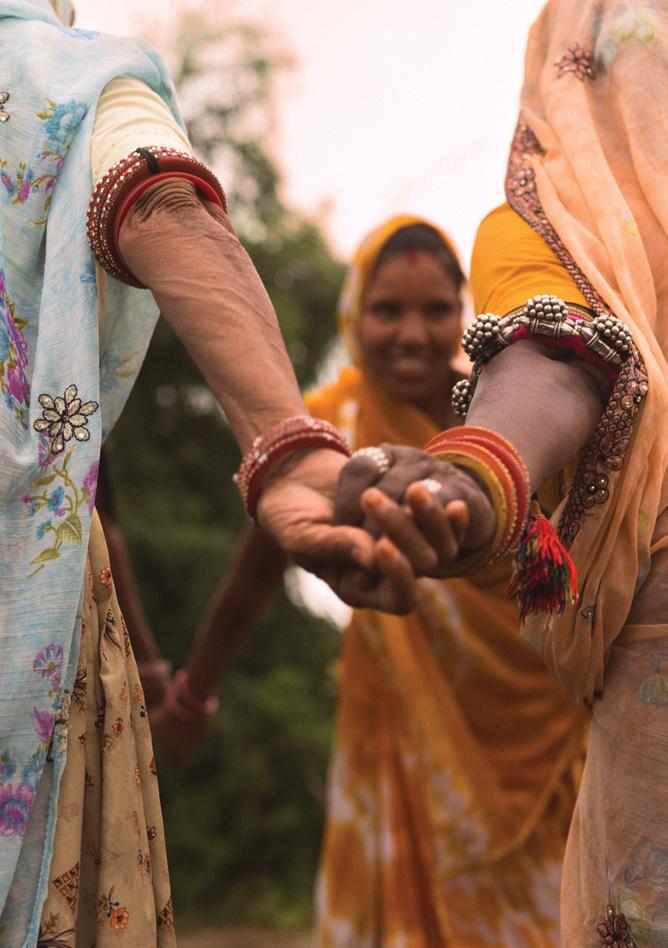
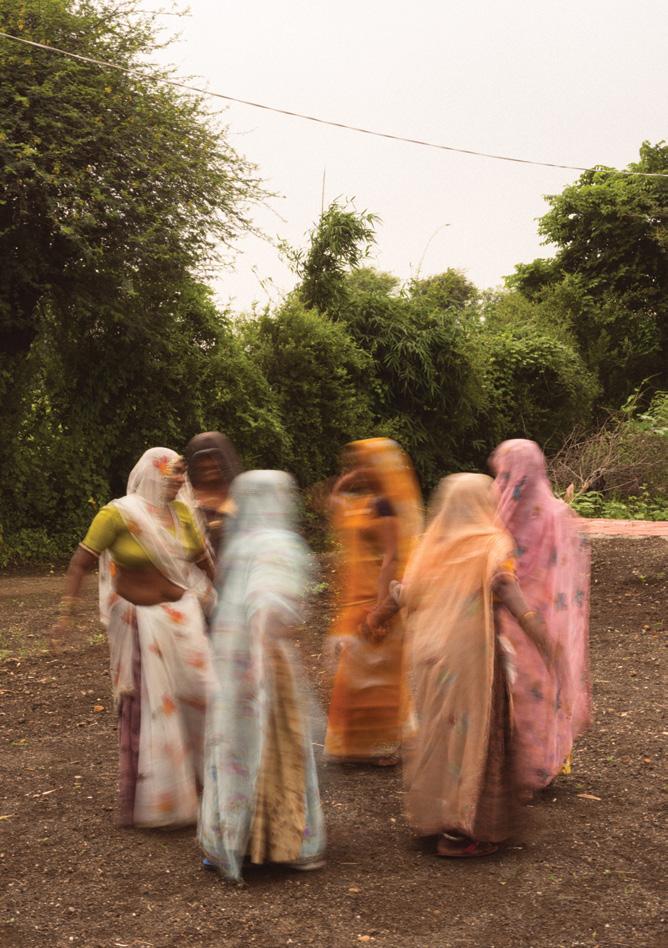
Left: Adorned with silver jewelry, the women of Satrundi in Madhya Pradesh celebrate their community and spirituality.
women, farming cannot happen,” says Annapurna, of Kamari village in Odisha.
Below and left: Amid the landscapes of Madhya Pradesh, daily rituals are part of the spiritual and agricultural rhythm for farmers like Maan Singh.
Special thanks to Action for Social Advancement and Vasudha Swaraj, OCA's Implementing Partners for their on-the-ground collaboration. Their work helps smallholder tribal communities in India grow organic cotton sustainably, preserving traditional knowledge and strengthening livelihoods.
ACCRA, GHANA
Kantamanto is more than a market. It is its own ecosystem, sustained by tens of thousands of people who sort, mend, and reimagine excess clothing discarded by the original consumers. But today, even this most innovative of systems is being pushed to its breaking point.
The Women Who Bear the Burden of Fashion’s Overproduction Problem
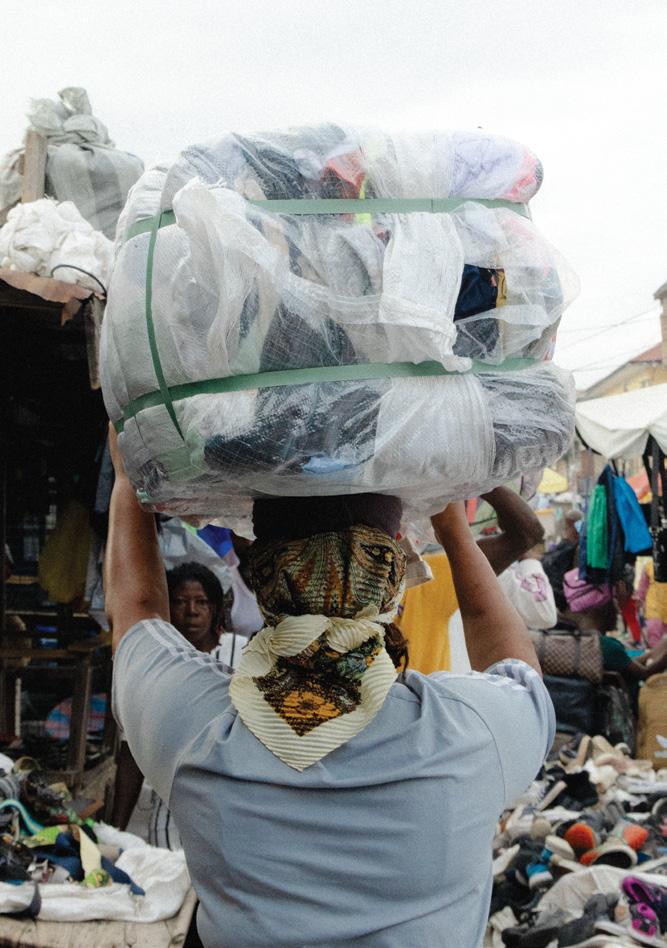
Rows of single-use t-shirts from marathons, conferences, and family reunions hang displayed on the stalls of secondhand clothing vendors that line one of the entrances to the world’s largest secondhand market, Kantamanto.
The image of these often context-specific objects, striking not only for their abundance but also for their absurdity in a new place where the messages they carry are unfamiliar, offers a prescient preview of the market.
Located in the heart of the business district of Accra, Ghana, Kantamanto is spilling over with fabric and materials, color, and activity. The Accra Metropolitan Assembly estimates that about 30,000 people earn their livelihoods in the market, working as traders, menders, upcyclers, leatherworkers, food vendors, and porters. Each person contributes to a remarkable infrastructure that has been organically built, adapted, and refined since the 1950s, when the secondhand clothing trade first took hold in Ghana. Together, they have created an ecosystem of care and ingenuity; they sort, repair, and bring new life to the excess clothing that is cast off from the Global North.
Words by Nana Akua A Mensah
Images by Faiza Salman and Tonia-Marie Parker
And yet, even with all this labor, the system is overwhelmed. Everywhere you look, there is fabric: towering piles on the side of the street, draped over the arms of traders on the move looking for customers, and bursting from bags in vendors’ stalls. The sheer volume of clothing arrives faster than Kantamanto’s workers can absorb it. What emerges is an integral community, led largely by women, who have innovated one of the most authentic circular economies in the world, persisting in the face of the unyielding excess of fashion’s waste.
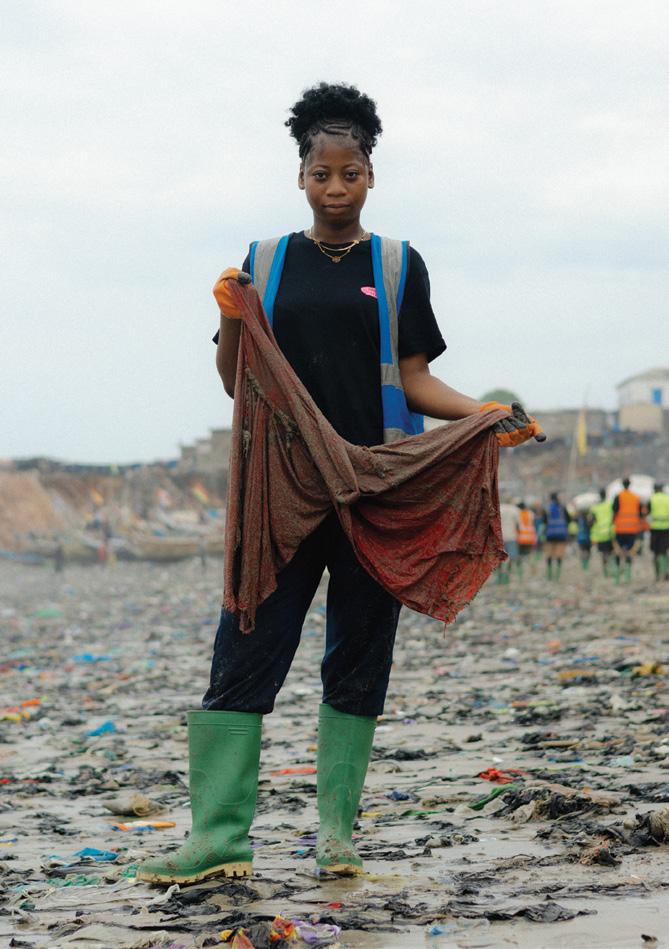
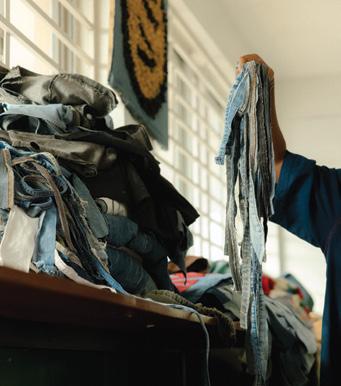
Right: Firdeis Issah, a Tide Turners crew member, holds up a piece of clothing found on the shores during the weekly beach cleanup.
An estimated 15 million garments passed through the Kantamanto market every week before the tragic fire that destroyed 60% of the market in January 2025, slowing down business. With the meteoric rise of fast fashion, the global fashion and apparel industry produces an ever-increasing number of new garments each year. The approach to fashion consumption has shifted dramatically over the last two decades: where clothing was once intended to be re-worn, cared for, and mended, it is now thought of as inherently disposable, made to be worn a few times—or sometimes never—and quickly replaced.
For many in the Global North, clothing donations are marketed as a socially positive act, extending the life of an item while unintentionally taking on the responsibility for where it ends up.
“When we opened the bales back then, the items were good quality. But now, out of every 100 items, 60 or 70 are unusable.”
But for clothing donations to have a net positive impact, there would need to be a clothing deficit—people or causes who need these items that are being donated. And yet, places like Kantamanto, where the clothing ends up, tell us a much more complex story.
“It is not like it used to be,” says Maame Rosina, a veteran retailer who has worked in Kantamanto for nearly 30 years. “When we opened the bales back then, the items were good quality. We could sell out of our stock completely. But now, out of every 100 items, 60 or 70 are unusable. It’s a waste problem, and frankly, it’s a waste of money that we can’t afford to lose.”
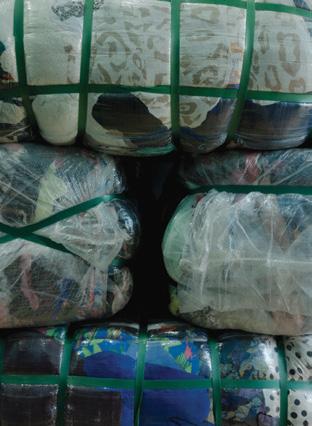
Ghana is one of the largest importers of secondhand clothing in the world, importing over 147,000 metric tons of secondhand clothing in 2023 according to UN Comtrade. These shipments of clothing are the raw materials for the bustling trade. Importers mark up the price of secondhand clothing bales shipped in from major exporting countries like the UK, the EU, and China, selling them to retailers like Rosina for an average of $200, with some bales such as children’s clothing sold for over $700 per bale. Retailers purchase the bales without first seeing the contents and they cannot contact the exporter or return a bad bale.
For decades, this gamble paid off. Enough of the garments inside the average bale were high-quality, durable, and easily resold. Such sales funded the repair or upcycling of the lower-quality items that would arrive in every bale. But today, the risk far outpaces the reward. Over half of the items in each bale are worth less than the cost to process them—including transport, storage, and sanitation. This shift is driving retailers into debt and threatening a collapse of one of the largest reuse and upcycling economies in the world.
Rosina reports that many women in Kantamanto take out loans to buy these bales. When the clothes inside are unsellable, they are left with debt, stress, and piles of waste clothing. “We pass the things we can’t sell to the younger men in the smaller stalls outside the market,” she explains. “But because the items are in such bad condition, they often can’t sell them either. So the clothes end up on the side of the road or in dumpsites.” At a time when the fashion industry generally supports the ambition to transition to a circular economy, the precarity of the global secondhand clothing trade in Kantamanto Market raises an alarm.
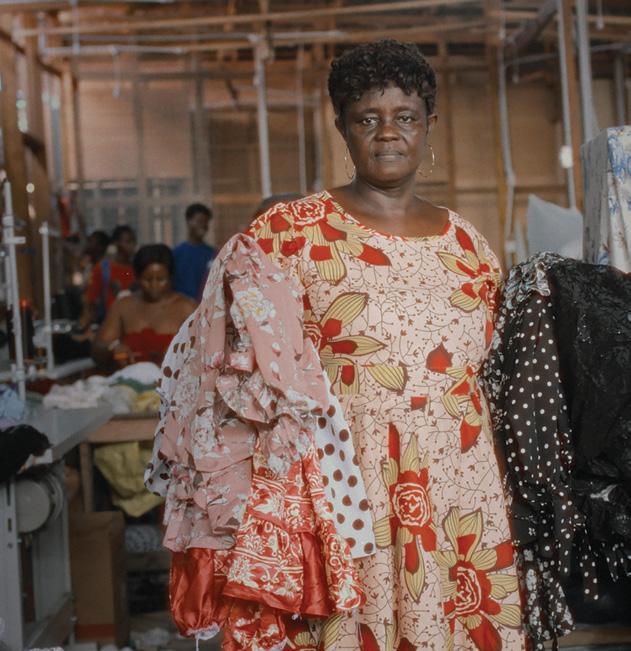
The Or Foundation supported women like Rosina to form the Kantamanto Women’s Association to give them a united voice. With membership from across the entire ecosystem of the market—resellers, tailors, upcyclers, food vendors, and porters— the association responds to a reality where women are the backbone of the secondhand trade, but lack access to retirement, welfare, or other protections. “When we first called a meeting to form the Association, we expected about a hundred people to attend,” Rosina recalls. “But the space was overwhelmed with women. You could see that we really needed this.”
For some, like Ruth Otoo, who has worked as an upcycler for 15 years, survival in Kantamanto means transforming secondhand clothing entirely. “When items in the bales are not good enough to sell, we find ways to reimagine them,” she says. “We turn them into kids’ clothes, napkins, or sheets to save them from going to waste.”
But even this ingenuity is being eroded. “The contents of the bales are so bad now that even what we can upcycle has reduced,” Ruth says. “And when the third-level resellers take these items, they try to upcycle them, but usually are unable to produce pieces that anyone wants to buy. So the clothes are dumped on the roadside, making their way into gutters or waterways. We were never affected by floods in Kantamanto before. But now, we are. And our beaches are so polluted that we can’t even enjoy a day there anymore. When you’re in the water, you’re surrounded by waste clothing.”
That waste is now showing up on Accra’s coastline, where The Or Foundation runs Accra’s largest beach cleanup program.
Above: Madam Gloria Asiamah, a member of the Kantamanto Women’s Association who has been a retailer in the market for over 15 years.
Every Tuesday, a team of 60 people, called the Tide Turners, alongside volunteers, gathers at Jamestown Beach in Accra to clear the shores of what waste they can. “We go to the beach every Tuesday, and we remove about 20 tons of waste clothing every week,” says Firdeis Issah, one of the women employed by Tide Turners. “We deserve to have clean beaches as a place to relax and spend time with our friends. But with the state of the water now, no one wants to spend time there.”
Firdeis Issah is part of a team that cuts the tags off the clothes collected from the beaches, an initiative designed to track and hold brands accountable for the waste they generate. She says she recognizes many of the labels: big-name brands from the Global North that wash to the surface in Accra’s waters.
Through their interactions with organizations like The Or Foundation, many women in the market are piecing together a clearer picture of where their labor sits in the global fashion system. “I have learned that only a fraction of clothing produced is resold in the Global North, with most ending up in markets like Kantamanto,” Rosina says. “So women like us are doing more work for the fashion industry than we are recognized for.”
And it is a Herculean task that these women shoulder. Over decades, they have built an economy of reuse, upcycling, mending, and remanufacturing—a true exemplar of circularity that the fashion industry could learn from. But they cannot continue to carry the weight of a broken system, however innovative their efforts.
The burden of excessive textile and clothing waste cannot rest solely with the women of Kantamanto. For the industry to move toward a fairer future, brands and producers must play their part in addressing the system’s imbalances by taking the responsibility for the end of life of their products—what happens to them once they have left the store. As Rosina puts it plainly: “These brands owe us. We work for them.”
“We go to the beach every Tuesday, and we remove about 20 tons of waste clothing every week.”
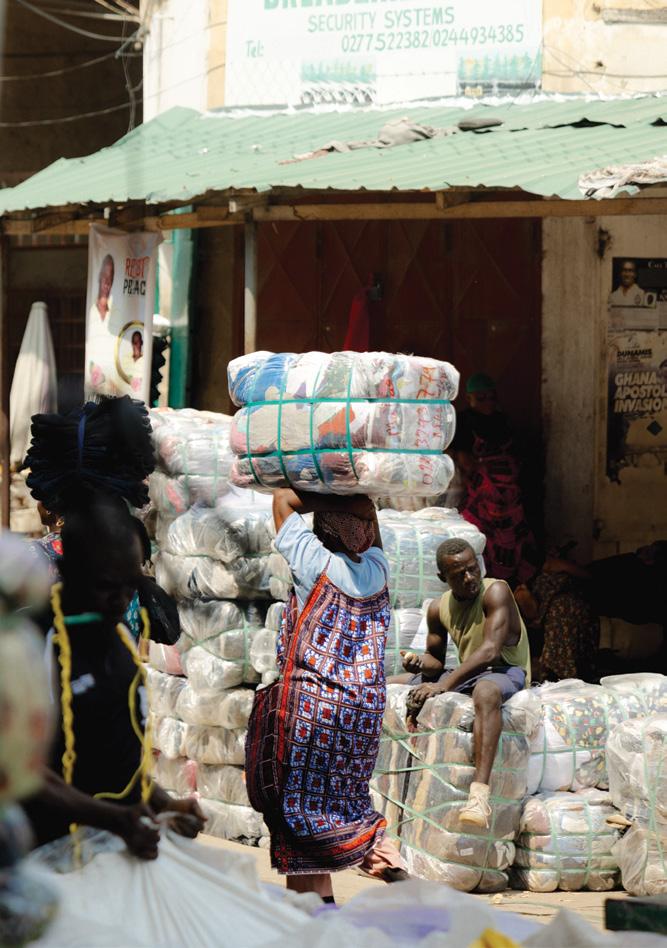
Right: A Kayayei (head porter) transports a clothing bale from the importers’ yard to the main Kantamanto market during market day.
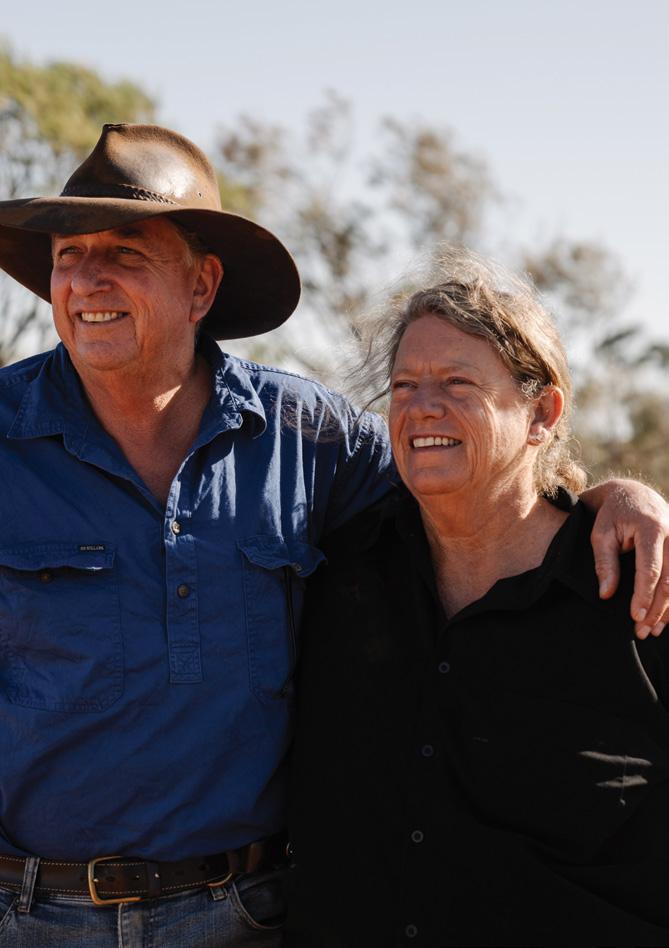
In the harsh, dry landscapes of Western Australia, Di and Ian Haggerty are proving that regeneration is possible even in the most challenging conditions. Their innovative approach to farming earned them the Ryan Young Climate Leader Award at the 2024 Textile Exchange Conference and is reshaping what’s possible for wool production in Australia.
The Australian Wool Growers Bringing Dry Land Back to Life
MOLLERIN, AUSTRALIA
Words by Megan Doyle
Images by Tristan McKenzie
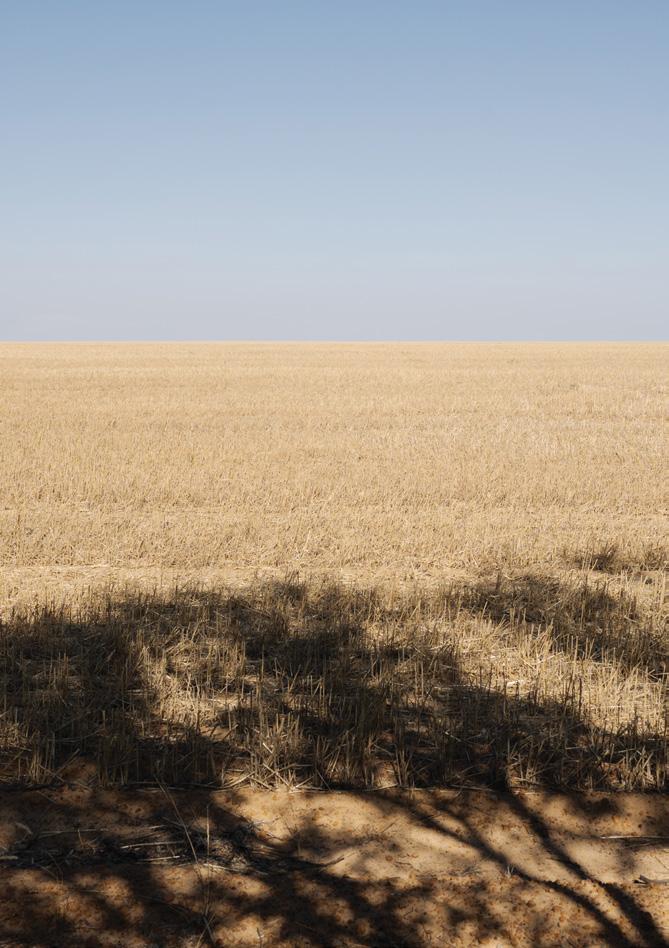
Western Australia’s Wheatbelt region sits at the heart of the state. It’s a harsh, brittle landscape. Three hours’ drive north-east from the capital of Perth, you’ll find 160,000 square kilometers of agricultural land where the vast majority of Western Australia’s wheat and half of its wool is produced—worth a combined production value of $6 billion AUD (just under $4 million USD). Scarce fields stretch far into the horizon, baking under expansive blue skies. It’s only the start of summer, but with the temperature hovering around 35°C (96°F), few living creatures are able to withstand the unforgiving heat that is typical of this time of year.
The landscape evolves as we approach our destination in Mollerin and arrive at Prospect Pastoral, a wheat and wool farm owned by Di and Ian Haggerty. Out of nowhere, we see brightly colored Australian Ringneck parrots flit past our car, zipping between tall gum trees that provide welcome shade along the roadsides. Crops of wheat ready for harvest stand tall and shiny, creating a golden mirage, while clusters of plush sheep laze about, almost camouflaged against the landscape.
It’s our first indication that the Haggertys are going against the grain in this part of the world, where they’ve been pioneering regenerative agriculture to the incredulity of the local farming community since 2001. The results are impressive, highlighting the possibilities of agricultural practices that bring environmental, financial, and health returns for land, people, and animals. It’s a seemingly radical mindset that has earned the Haggertys the Western Australians of the Year Award for 2025 and put them in the running to win the Australian of the Year in January 2025. However, there is still a long education process ahead of them— and other regenerative agriculture champions—to convince the wider farming world, investors, brands, and shoppers of their mission.
Both from conventional farming families, the Haggertys started out with just 1,630 acres of land in Mollerin. Over 30 years, they’ve gradually expanded to the 65,000 acres where they’ve developed
“And as you start to link a few farms together, you start to make a huge difference.”
Natural Intelligence Farming. It’s an agricultural framework that listens to the inherent wisdom of the land and animals, embracing the expertise of First Nations people, and working intuitively to restore and regenerate soils. “We never had the intention to keep buying land,” explains Ian during our visit. “But once you have that connection to country, like the First Nations people, land talks to you.”
Often, land comes to the Haggertys in poor condition. Since the 1970s, rainfall in the Wheatbelt has been on a steady decline, due in part to a heat dome sitting over the state that propels rain clouds away and increases the salinity of soils. “It became really obvious from the 2000s,” says Di. “There was quite a dramatic drop of about 30% in rainfall. Now, what used to be 300–325 millimeters of annual rainfall is probably about 200–250 millimeters.”
Over the years, the Haggertys have bought up semi-arid, seemingly unusable land around their farm, rapidly transforming dust bowls into fields where native plants like Mulla Mulla grow in abundance. They don’t use any fertilizers or pesticides, instead using a homemade compost brew that is diluted in water and sprayed onto crops, as well as strategic grazing that allows the sheep to fertilize the land with their own microbial inputs. The Haggertys also use Mulla Mulla as a cover crop to rejuvenate soil after a wheat harvest, as its large tap root can access nutrients deep in the earth. Most farmers would consider this plant a pest and spray it away during the summer months, but by leaving the land to its own devices, the Haggertys take a nature-led approach, with fascinating results.
Their landscapes have improved water infiltration and retention, holding more water for longer, so their plants are more resilient and adaptable to unpredictable rainfall from one year to the next. Additionally, “we're actually seeing rainfall patterns change,” says Ian. “Across 65,000 acres, we're affecting large water cycles now. I would like to take a bigger area, and to invite scientists in to start to measure our impact. And as you start to link a few farms together, you start to make a huge difference.”
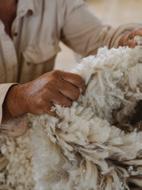
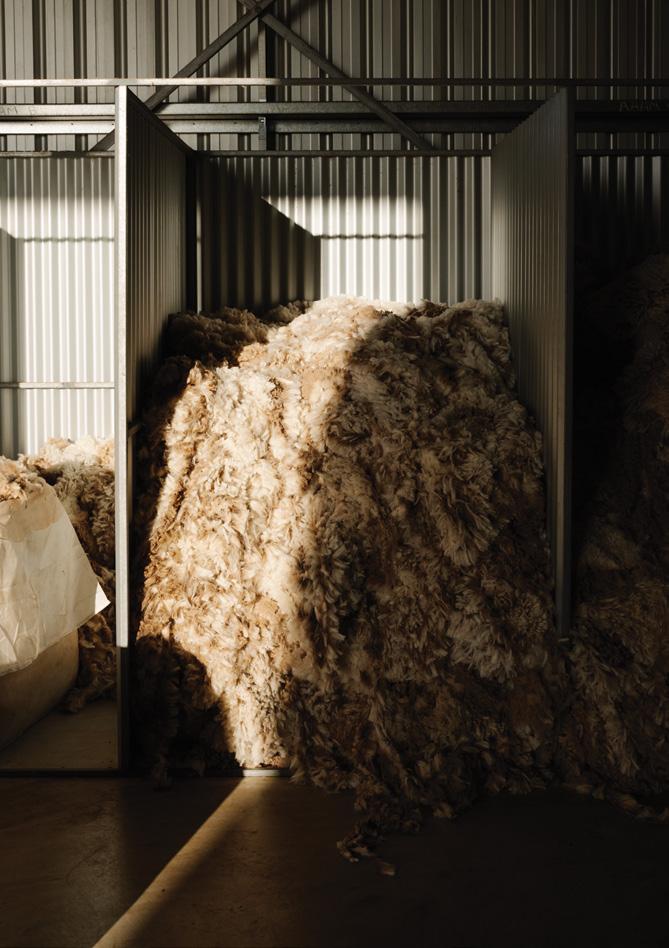
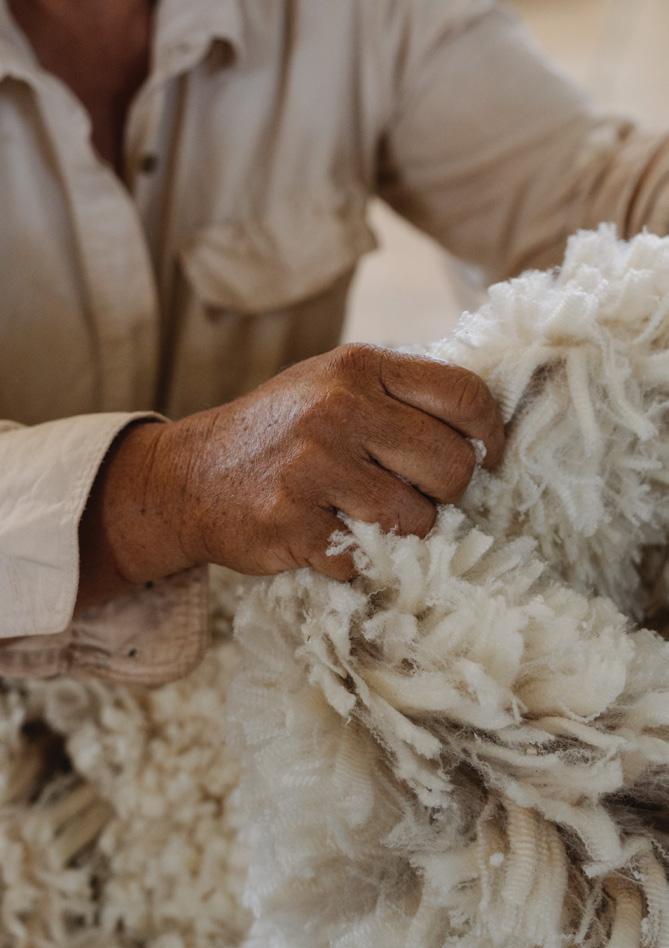
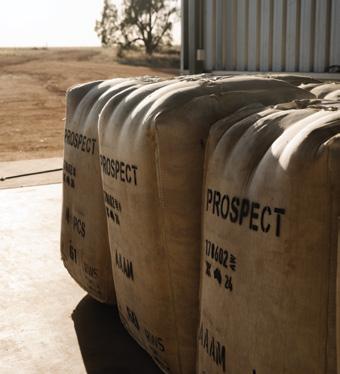
Right: Freshly sheared wool at Prospect Pastoral, where every bale meets the Responsible Wool Standard.
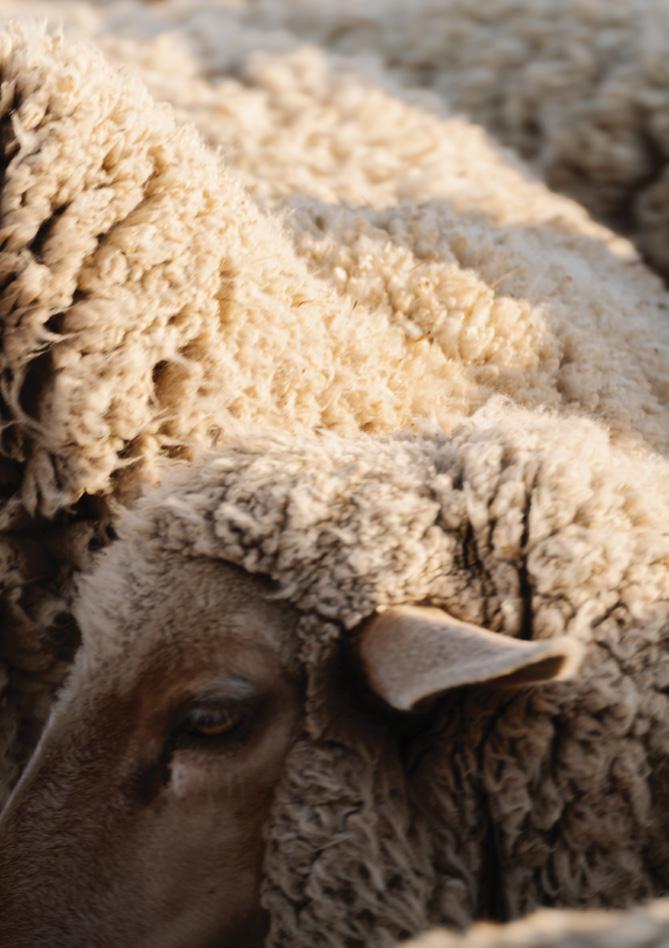
Shearing season is in full swing when we visit the farm, with a team of nine working at pace to shear 7,000 merinos over the month. Despite the team getting through around 300 sheep per day, the energy in the shed—from the shearers and sheep—is surprisingly calm. The Haggertys credit the microbially diverse crops that give the sheep a nutrient-dense diet, keeping them physically sated and mentally healthy. “We believe that the animals know better,” says Di. “We don't do time-controlled grazing; instead we use intuitive time grazing. Our landscapes are changing rapidly, and so we take our signals from the animals themselves.” When the paddock is rich in diverse food for the sheep, they’re better nourished, so they don’t need to graze as much.
This has a direct impact on the quality of their Responsible Wool Standard–certified wool, which Prospect Pastoral sells through NATIVA™ to brands like Stella McCartney. The amino acid profile in the formation of the wool follicle is one of the key factors that help to keep it soft and supple. It repels dirt and helps to prevent flystrike— the reason why so many Australian farmers still practice mulesing, a controversial procedure banned by the Responsible Wool Standard and not used by the Haggertys. “When you’ve got everything in the right ratio as nature intended it to be, and you’re not tampering with synthetic fertilizers, the amino acids are formed in the appropriate manner, and the quality is there,” says Di.
Finding the right ratio is a process of lifelong learning, and Di and Ian speak fondly of the collaborators, mentors, fellow farmers, and scientists who they’ve worked with across the years. Among those who have supported and contributed to the success at Prospect Pastoral are farmer and author Charles Massy; the Honourable Michael Jeffery, former Governor-General of Australia and founder of Soils for Life; Jane Slattery, with whom they co-founded Natural Intelligence Farming; and Heidi Mippy, a Noongar and Thiin-Mah Warriyangka woman who has spent time with the Haggertys exploring the First Nations connections to land.
Knowledge sharing is, after all, crucial to bringing more farmers on board with this way of life. “The common theme is humility. People recognized that there's so much going on, and that they’re part of it, but not the dictator of it. There's so much respect for everything else out there that's been around a lot longer than us,” says Di.
What is perhaps most striking about the Haggertys is the network of friends and family that are drawn to the farm. Many regional towns in the Wheatbelt have suffered from an ongoing population decline over the last 60 years, as young people move to larger towns or cities. Some regional towns, with their aging population, threaten to disappear altogether. In 1966, there were around 23,000 farms in the Wheatbelt, but that number had shrunk to 5,700 by 2022.
Di and Ian’s youngest son, Matthew, is now a director of the family business, while his high-school ex-girlfriend Rachel and her mother Bec also live and work on the farm, having spent time there during the pandemic and fallen in love with the work. 26-year-old Ragnor has come all the way from Estonia to harvest the Haggertys’ wheat this season, while their eldest son James, his wife, and their two young children are moving back to the farm after years in Perth. “I find some of the younger generation really incredible,” says Di, who is open and excited about inviting people onto the farm to pursue their passions— which one day could include grazing cattle and brewing beer with the wheat grown on-site. “They are coming up with new ways to do things. Perhaps they've seen some of the mistakes that have been made ahead of them, and they really want to appreciate our planet.”
Not everyone is inspired by and drawn to their way of life. If it were conventional, a farm this size would be spending more than $1.5 million AUD (approximately $1 million USD) on fertilizers each year. The Haggertys spend nothing, so multinational chemical companies aren’t exactly their biggest fans. They have also received pushback
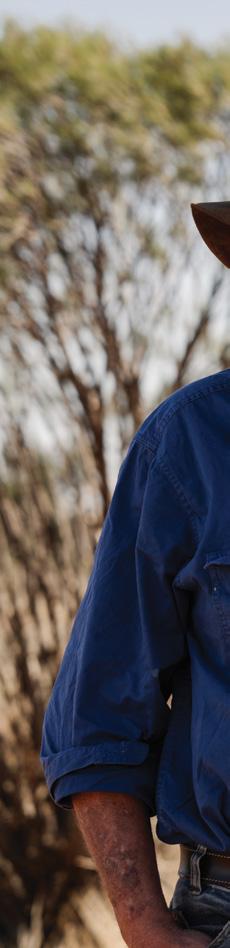
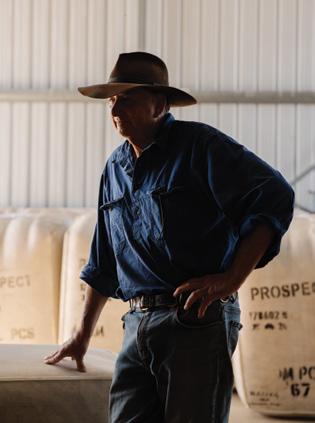
Above: Ian Haggerty has discovered that healthier sheep and more fertile land lead to premium wool.
from the wider farming community who view land as something to own, dominate, manipulate, and extract resources from, whether or not it responds positively, or it results in healthy soils and animals. “It's not their fault, they've been brought up in the system where you take the rote knowledge, and they're doing a really good job,” says Ian. “But we're about diversity. The only thing that makes your soil and your ecosystem work properly is diversity, it all has to work in unison.”
“There are some people who feel very threatened by what we do, but a lot of it comes down to the fear of risk,” believes Di. “Farmers tell us: when you’ve got it all figured out, then we'll do it. The financial situation for most farmers is so tight that they can't afford to take any risk.” Ironically, Di and Ian came to regenerative agriculture because they couldn’t afford not to. “The alternative was too costly—more and more machinery, more man hours,” says Di. “We’ve been so convinced by what we’ve seen and learned that we won’t be swayed by others' opinions.”
“The only thing that makes your soil and your ecosystem work properly is diversity, it all has to work in unison.”
While conventional farms take a financially driven approach to production, Prospect Pastoral has a different priority list. “We don't start with the money. We start with the ecosystem and the people, and the money comes in down the line,” says Ian. “If you get all those other bits right, the money will take care of itself.”
While the Haggertys aren’t driven by profit, they firmly believe that regenerative wool growers should be receiving higher premiums for what they consider to be a far superior merino to most, providing ecological and animal welfare benefits that aren’t accounted for on the commodity market. “The premium is still not truly a reflection of what’s going into these productions,” says Di. “When you lower the value of each unit that the earth is producing, then the only way the person on the land can maintain some profitability or livelihood is to produce more of the damn stuff—and that's what has thrown everything out of balance.” With a fairer distribution of financial returns on regenerative wool, Di believes that more young people will be drawn to the sector, expanding not only environmental benefits but reviving regional areas and driving the country’s strong wool industry in a more positive direction.
The fashion industry also needs to play its part in supporting farmers like the Haggertys. NATIVA™, the company responsible for connecting the Haggertys’ wool with the global textile trade, faces challenges in communicating and selling the true value of this fiber to brands. “Fashion brands need to understand that many regenerative efforts cannot be fully captured through conventional metrics or data,” says Maria Estrada, Global Director at NATIVA™. The profound changes Ian and Di have achieved are evident at the farm level but are difficult to quantify in figures. It is crucial for brands to recognize the immense value behind this work and to move beyond solely price-driven decisions.”
For their part, Di and Ian also travel the world meeting farmers, speaking at conferences, and sharing their story about regenerative agriculture. “The easy thing for myself and Di would be to sit back in our own little business and go along happily every day,” says Ian. “The hard thing is being out there, changing the narrative, and making things better, because you spend a lot of time and money doing those things. But isn't that what life is about?”
Right: The Haggertys don’t use any fertilizers or pesticides, instead using a homemade compost brew that is diluted in water and sprayed onto crops such as wheat.
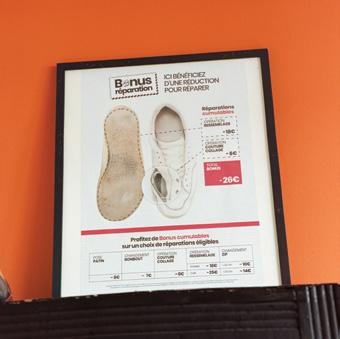
In France, the new Repair Bonus (Bonus Réparation) is making it cheaper for customers to mend their clothes and shoes while preserving a fading craft. Part of the country’s anti-waste law, the scheme is boosting business, attracting new customers, and showing how targeted policies can drive both sustainability and skilled trades forward.
How France’s Anti-Waste Laws are Boosting Small Repair Shops
PARIS, FRANCE
Words by Julia Webster Ayuso
Images by Erwann Petersen
In her cobbler’s workshop in Paris’s 18th arrondissement, Isabel Arnoult picks up a pair of black men’s Oxford shoes that need a new lease of life. It’s a simple fix: adding a protective rubber sole. The repair usually costs €30, but thanks to a government subsidy, the customer gets a €8 discount. “It’s a very common request, and for the customer, it’s very cost-effective,” she says.
Cobblers across France are finding renewed purpose in a shifting fashion landscape. Since the introduction of France’s anti-waste law for a circular economy (AGEC) in late 2023—which includes the Repair Bonus that allows people to claim back part of the cost of mending clothes and shoes—demand has surged.
Coordinated by the non-profit Refashion and funded by contributions from manufacturers and brands under an Extended Producer Responsibility (EPR) program, the discount is applied directly to the customer’s invoice at certified workshops or cobblers. It ranges from €6 for mending a tear in a garment to €25 for resoling leather shoes. The goal is to encourage people to repair and extend the life of their clothing and footwear, but it’s also helping to preserve valuable skills. In its first year, over 83% of the 826,000 repairs funded through the scheme were carried out by cobblers.
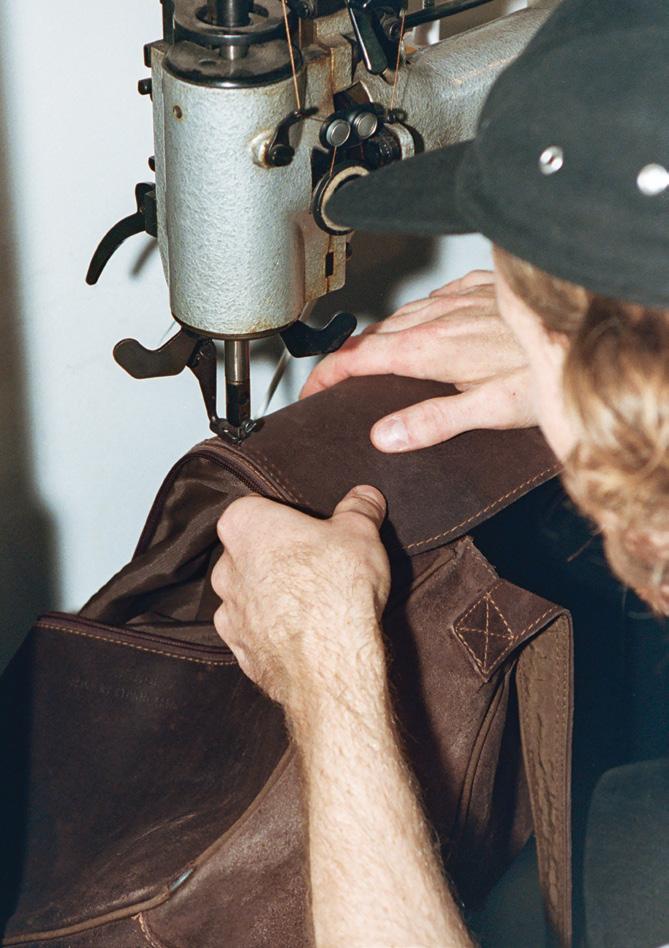
“I’ve definitely gained new customers because they heard about the Repair Bonus,” says Maximilien Mauriès, speaking over the hum of machines in his busy workshop, which occupies a picturesque blue shopfront in Paris’s Montmartre neighborhood. “It’s a small increase, but an increase nonetheless.”
“It’s very good news for us because it’s bringing in more work,” says Jean-Pierre Verneau, the president of the French Federation of Shoemakers and owner of a cobbler's shop in Le Mans. “On average, we’ve seen a 15 to 20% increase in revenue, which is significant.” Shoemaking, he explains, accounts for most of the repairs, since it’s a more technical trade than clothing alterations and requires specialist tools. “You can’t really DIY when it comes to fixing shoes.”
“Over the last few years, people have begun turning away from fast fashion and toward higher-quality shoes. And higher quality, by definition, means more repairs.”
France throws away around 700,000 tonnes of clothing each year—a problem that came to a head this past summer with protests from Le Relais, a major player in textile recycling, which warned that the system was “on the verge of collapse.” In response, the French government pledged €49 million in aid to support the collection and sorting of textile waste.
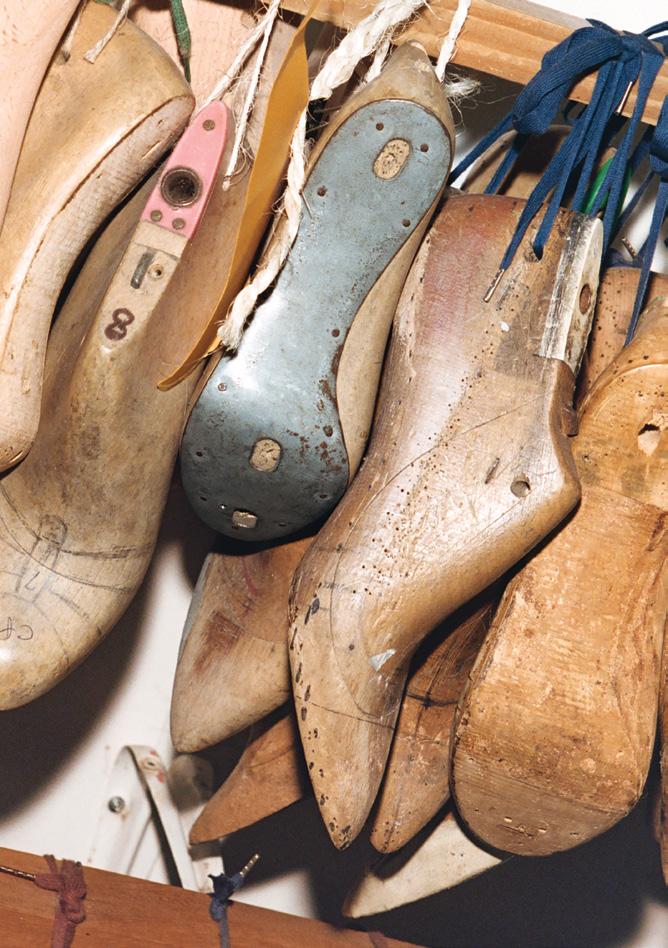
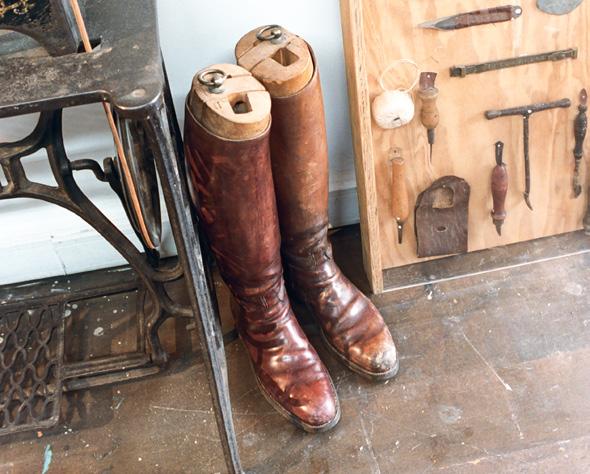
In a country known for protecting craftsmanship, shoemaking has become increasingly rare. In 1950, France had over 50,000 cobblers, making them a fixture on every street corner. But years of declining demand, fast fashion, and changing consumer habits pushed many to the brink—with some even turning to locksmithing and other trades to stay afloat.
“The French are still generally quite sensitive to craftsmanship, but shoemaking and repair trades have long been undervalued,” says Elsa Chassagnette, the Repair Fund Manager at Refashion, the non-profit that runs the scheme. “We’re working to restore their value in the context of a circular economy, where they take on new meaning. We want to show that having your shoes repaired is extremely eco-friendly.”
Today, the number of cobblers in France has dwindled to 3,500, but that number has remained stable for the past decade. “Customers are slowly becoming more eco-conscious,” says JeanPierre. “It’s been happening for a while, but the Repair Bonus has accelerated it. Over the last few years, people have begun turning away from fast fashion and toward higher-quality shoes. And higher quality, by definition, means more repairs.”
Since its launch nearly two years ago, around 700 cobblers have joined the Repair Bonus program—but not everyone is convinced. Some argue the system, which requires logging each repair and receipt into an app, is too time-consuming and not financially worthwhile. “It’s an added administrative burden; taking pictures of everything takes time,” says Isabel. The profession remains old-fashioned, and many shops are run by older artisans who are digitally inexperienced. “Unfortunately, many of our colleagues don’t even have a computer,” adds Jean-Pierre.
Right: A sign promoting the Bonus Réparation, which helps customers repair used items at a discount while supporting France’s cobblers.
In recent years, though, a younger generation has rediscovered the craft. Rather than closing down, many workshops are being taken over by younger shoemakers, and most new entrants to the trade sign up for the Repair Bonus right away, says Jean-Pierre.
An increasingly sustainability-focused clientele has also forced cobblers to adapt to new types of footwear. As sneakers become more expensive, repairing them has become a cost-effective option, and cobblers have learned to bring them back to life. French sneaker brand Veja, known for its responsible production practices with farmers in Brazil, has embraced the trade, opening repair-focused cobblers in France and beyond, including in its shops in Berlin, Madrid, and New York.
“Shoemaking is slowly coming back into fashion,” says Jean-Pierre. “There are plenty of cobblers eager to satisfy their customers and push the craft forward—after all, we’ve always been part of the circular economy.”
Governments around the world are watching closely as France’s Repair Bonus demonstrates how targeted laws can drive positive change in the textile industry. “The Repair Bonus is a world first,” says Elsa. “And it’s of great interest to our European neighbors. I’ve had lots of discussions with people from different neighboring countries about it.”
By making repairs cheaper for consumers and viable for small businesses, financial incentives not only encourage sustainable choices but could also offer a solution for preserving local crafts. Applied more widely to other areas of the fashion industry—from rentals to resale and recycling—similar measures could be key to making circularity feel as natural as buying something new.
“We’re working to restore their value in the context of a circular economy, where they take on new meaning.”
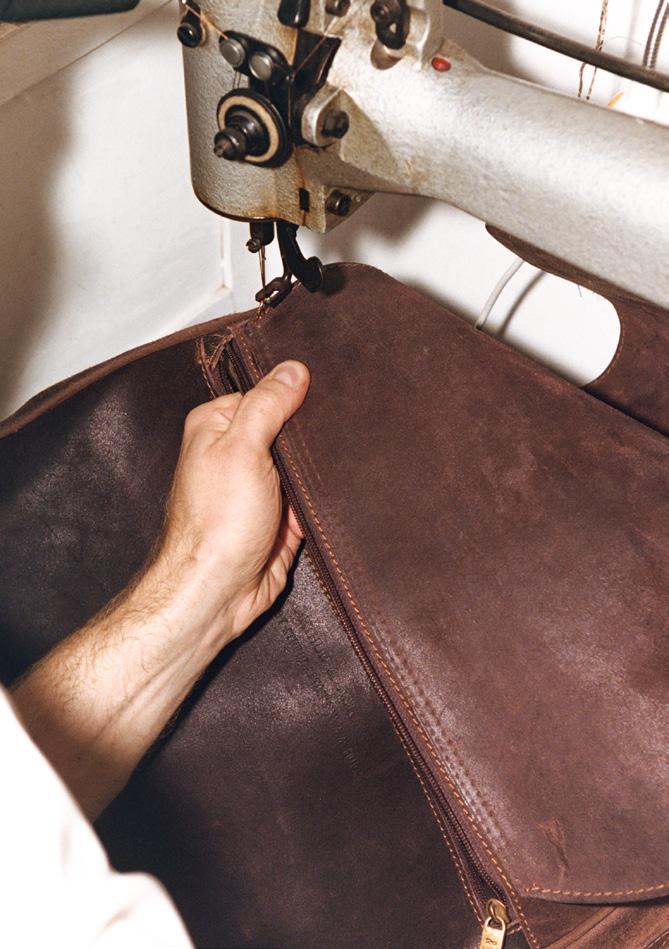
Left: Working with leather is slowly coming back into fashion, in part thanks to the new government incentives.
Solving the Ecosystem Regeneration Puzzle in South Africa
GRAAFF-REINET, SOUTH AFRICA
Words by Bronwyn Botha
Images by Carl van der Linde
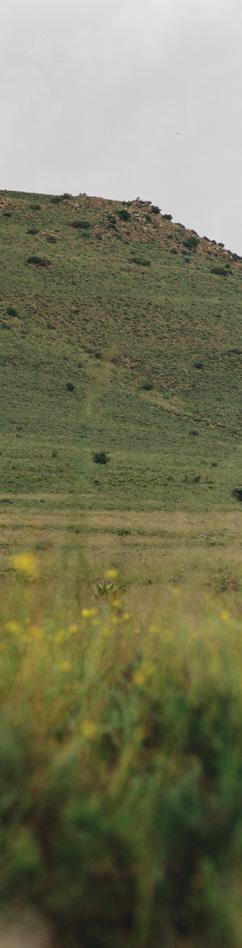
For South African wool farmer James Brodie, a locally adapted understanding of livestock and land management is helping regenerate his farm in the Karoo region. In doing so, he is building a resilient farming system that honors the landscape’s unique ecology.
At the gates of Doornplaats farm, the sounds of waking birds grow louder as the sun begins to rise. Down the undulating dirt road to the homestead, farmer James Brodie greets us with a warm South African welcome.
Here in the Karoo region of the Eastern Cape, just outside of the historic town of Graaff-Reinet, James farms with sheep, cattle, and a small herd of alpacas, which belong to his wife, Sandy. A fourth-generation farmer, he began his journey in regenerative agriculture long before the movement gained the traction that it has today. After taking on the farming enterprise from his father in 2003, he has been on a mission to build on the work that his great-grandfather began in 1896.
Adopted by the Brodie family, regenerative farming aims to bring depleted land back to life and support the long-term functioning of the surrounding ecosystem. The idea is that, as part of maintaining a healthy livestock business, farmers use their animals to help implement principles designed to improve the health of ecosystems and boost biodiversity.
“We’re all farming on degraded land to some extent and, unless we regenerate, we will continue to lose the battle against desertification,” James says, explaining his interest in the approach.
Over time, he has learned to use the animals’ behavior and grazing style to mimic the ecological processes that once shaped the local landscape. For centuries, South Africa’s rangeland ecosystems evolved under vast migrating herds of herbivores that followed the rains and kept just ahead of the predators that lurked behind. Those ecosystems depended on short periods of intense grazing followed by long periods of rest.
Today, there are far fewer animals on the Brodies’ land than the historic mass migrations of animals which would have likely grazed the entire farm in a single pass. But drawing on this ecological understanding, James uses an adaptive grazing management approach that considers the right intensity, type, and timing of grazing in each camp, followed by adequate periods of recovery. He rotates his herds of sheep and cattle all year round, using their movement to promote plant recovery in the growing season and remove dead vegetation in the dormant months.
When more disruption is needed for restoration, James turns to kraaling—a South African practice rooted in local tradition. This involves collecting his ewes and lambs in enclosures strategically positioned on bare ground patches. He leaves them here for a couple of nights before moving to a new area. Their hooves break up crusted soil surfaces while their dung and urine fertilize the area, giving dramatic results. When the rains arrive, once-barren patches burst to life with vegetation.
As he leads us through the farm, James points out patches of bare ground still in need of restoration, then proudly gestures to areas that are now filled with life thanks to his efforts. “I’m buying back more land with every bare patch of ground I regenerate,” he says with a smile.
As the wider veld recovers, it responds in kind. Like any ecosystem, it’s a puzzle made up of thousands of interconnected pieces that, if you are willing to work with them and patiently figure out which fits where, will reward you in ways you can't imagine.
Hardy pioneer species give way to more palatable climax grasses. Plant diversity improves. With more varied, nutrient-rich forage underfoot, the livestock get healthier, and yields increase. Thanks to James’s careful planning, there’s foliage for them to eat through both winter and summer, reducing reliance on expensive supplementary feeds.
Animals quickly learn the routine—they know that when one gate closes, the next opens onto greener and more nutritious grass.
“I’m buying back more land with every bare patch of ground I regenerate.”
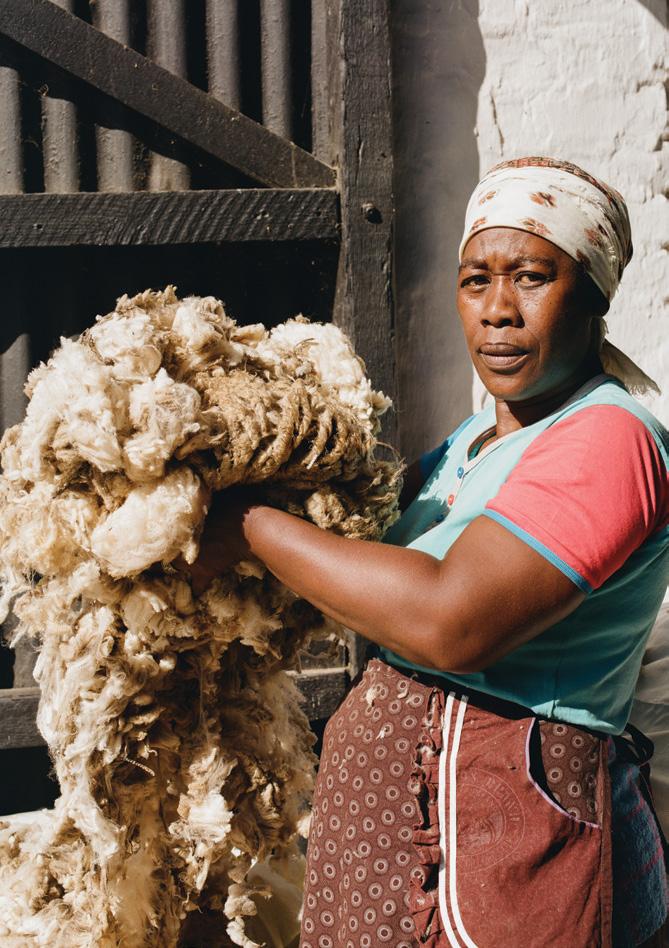
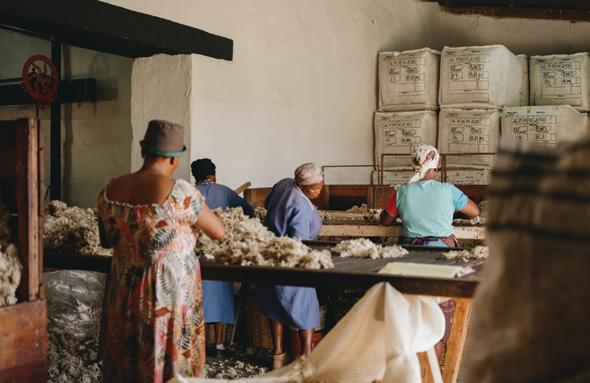
Left: During shearing season, a group of local women are paid to sort the wool at Doornplaats farm, gaining added financial independence.
His herds move calmly, with no prompt or pressure at all, into the next grazing area, minimizing handling stress. Regularly moving them helps to break up pest cycles and avoid problem areas during risky times too, decreasing the need for antibiotics and treatments.
Finding a balance of practices that unite the welfare of his animals with that of the land is key. “Everything we do starts with microbes,” he explains. “From the microbes in the soil to the ones in the guts of our animals—I call it microbes to market.”
“But you need to choose the right type of animal and balance the benefits of the veld with their health and production,” he adds, speaking to the importance of raising locally adapted livestock. “It should never come at their expense.”
The use of practices such as kraaling has also led to a marked decrease in predation. Gathered together and protected by an electric fence, the herd is less vulnerable to attacks. With the help of the alpacas, who guard the sheep flocks, these non-lethal predator control methods are part of a broader effort to build human–wildlife coexistence. By reducing vulnerability, they balance the financial toll of livestock losses while respecting the role predator species play in healthy ecosystems.
Together, these benefits help to build a circular model where money saved on external inputs and earned through higher quality wool and meat is invested back into the land, animals, and people. Improved ecological health leads to better products, better market opportunities, and ultimately a more resilient business—all of which are critical in the face of growing environmental and economic risks.
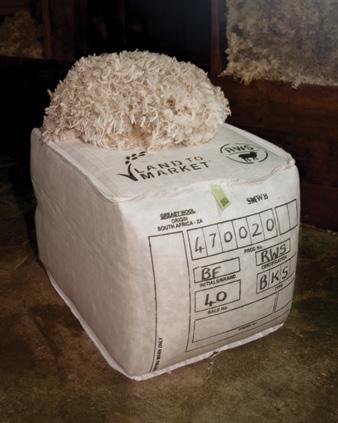
The Brodies’ approach is backed by two key schemes: the Responsible Wool Standard and the Savory Institute’s Land to Market program. More than just labels, these programs are a key part of their business model. Certification to the Responsible Wool Standard verifies land and animal welfare practices and provides access to a premium market. Meanwhile, the Land to Market program helps to recognize his achievements in regeneration in the market.
At Doornplaats, regeneration doesn’t stop with the soil, but extends into social outcomes through training, upskilling, and providing work opportunities that lead to social mobility too. James's permanent farm staff have grown into respected leaders in the regenerative space, often leading demonstrations and sharing knowledge with visiting farmers.
During shearing season, a group of local women are paid to sort the wool: wives and daughters of local farmworkers from Graaff-Reinet, Murraysburg, and neighboring farms, who gain added financial independence through this work. “The money we make supports our households and provides for our children, contributing to their school needs,” explains Janet, who leads the group. “It’s hard work, but we enjoy it—it’s much better than sitting idly at home.”
“You need to choose the right type of animal and balance the benefits of the veld with their health and production. It should never come at their expense.”
Left: James Brodie credits the varied, nutrient-rich forage underfoot for the improved health of his livestock and increased yields.
Above: The Brodies’ wool is certified under the Responsible Wool Standard, which verifies land and animal welfare practices, while the Land to Market program recognizes the farm’s regenerative achievements.
Beyond the farm gate, James has become a national advocate for regenerative farming. He supports a Regenerative Land Management training program run by Healing Hooves and is one of the hosts of the Regenerative Grazing Farm Tour run by The Regenerative Agricultural Association of Southern Africa (RegenAg SA). Through a partnership with SocioTech, he’s also working with more than 100 small-scale farmers across four South African provinces to improve land and livestock management and secure rural livelihoods.
“The biggest gap to bridge is the four inches between your ears,” he jokes, referring to the need for a mind shift from industrial farming towards a regenerative approach. He sees himself as a lifelong learner and believes he has only scraped the surface of these complex ecosystems.
Where to graze, for how long, and how long to rest, is an ever-evolving consideration in his adaptive management plan that he tweaks a little more with each season. He has put monitoring strategies in place to help measure the impact of his management. Every answer he gets opens up new questions to explore.
“What we have achieved on our land through regenerating ecological function and its impact on productivity was unimaginable when we started—and we are far from the end of this journey,” he smiles. Just when he thinks the land can’t get any better, it surprises him again. He never stops learning because nature never stands still —it’s always evolving, just like the farm.
“Its impact on productivity was unimaginable when we started—and we are far from the end of this journey.”
Combining technological innovation with large-scale production expertise, Säntis Textiles and Kipaş Textiles created the RCO100 system to transform textile waste into high-quality, garment-grade fiber. But it all started with a chance meeting and a challenge from PVH Corp. TÜRKIYE
How Cross-Sector Partnerships Made Recycled Cotton a Reality in Türkiye
KAHRAMANMARAŞ, TÜRKIYE
Words by Julia Webster Ayuso
Images by Sabiha Çimen
The journey to creating the first 100% recycled cotton begins —as is often the case with good ideas—not in an office, but through a chance encounter between two visionary leaders. Stefan Hutter, a textile engineer and founder of Säntis Textiles, was on a skiing holiday when he met fellow Swiss man Daniel Grieder, then CEO of PVH Corp (the parent company of Calvin Klein and Tommy Hilfiger), and the two quickly struck up a conversation about the future of the textile industry.
“Even though he’s been in the textile business for 40 years, my father never ventured into fashion,” says Annabelle Hutter, the Managing Director of Säntis Textiles in Switzerland, explaining that Säntis focused on technical fabrics. “Grieder came up with a challenge for him: could he create 100% recycled cotton for his brands?”
Cotton represents around 19% of global fiber production, but just 1% of it is recycled cotton, according to Textile Exchange’s 2025 Materials Market Report. However, the demand for recycled cotton is projected to almost double in 10 years, from $5.2 billion in 2023 to $9.8 billion by 2032.
Stefan, whose family has a long tradition in Swiss textile engineering, founded Säntis in 2005. The company, headquartered in Singapore with offices worldwide, already had some experience with recycled fabrics, but these were mostly technical fabrics for applications such as home furnishings—a far cry from the fine threads needed for garments. So in 2016, Stefan accepted the challenge.
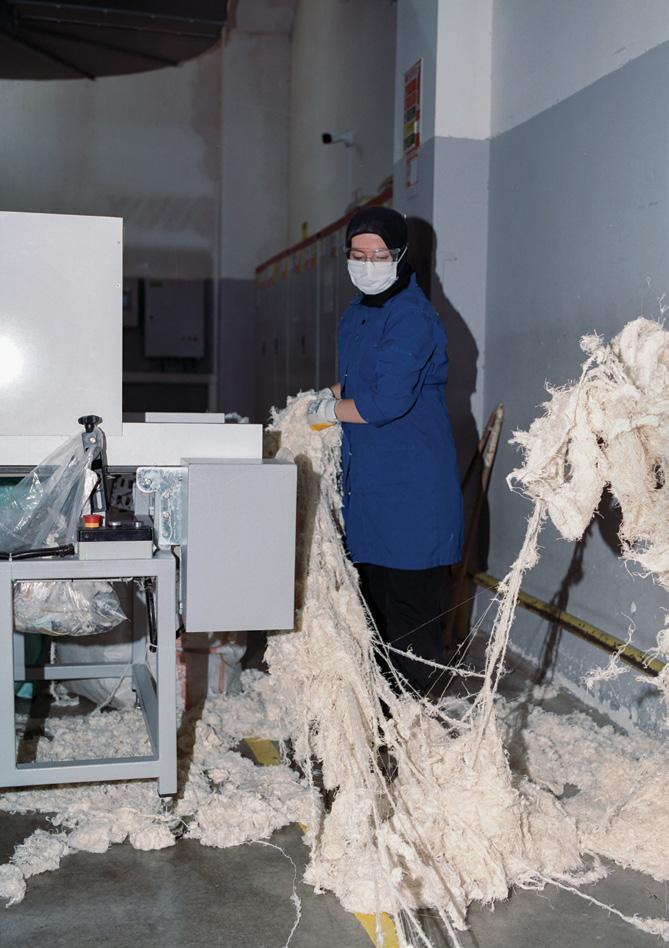
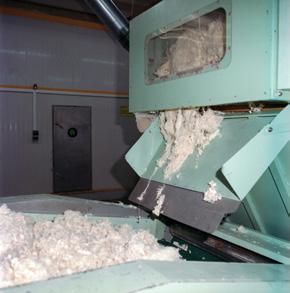
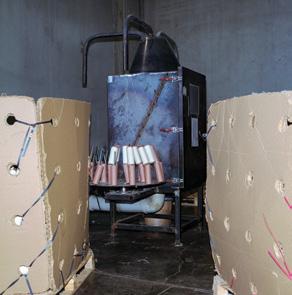
Without the help of outside investors, Stefan decided to invest his own profits into developing a machine specifically for recycling textiles in the garment industry. And after several trials in the company’s Chinese factories, the result was RCO100—a breakthrough system capable of turning industrial waste (such as fabric cuttings and yarn waste) as well as pre- and post-consumer garments sorted by color and composition, into high-quality recycled cotton.
Unlike existing machines, it produces longer fiber lengths essential for spinning, without the use of water or chemicals, and is specifically designed to create 100% recycled cotton and textile-grade fiber.
“There are other mechanical recycling machines, but they were all built decades ago and were designed for downcycling, never to handle textiles to make textiles again,” says Annabelle.
“The breakthrough is that we prioritize creating a fiber that can go back into making new textiles.”
“The breakthrough is that we prioritize creating a fiber that can go back into making new textiles.”
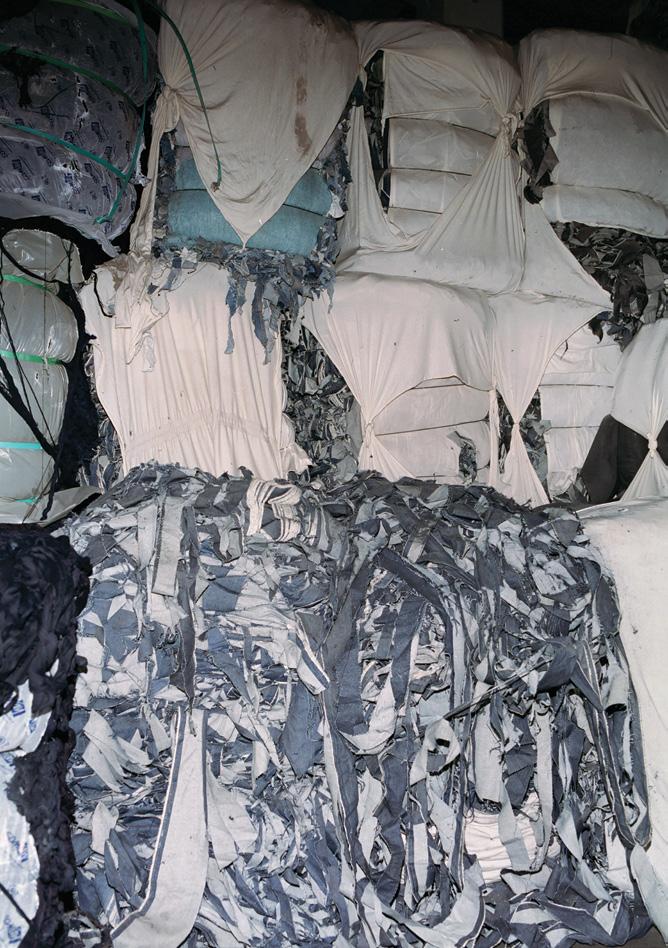
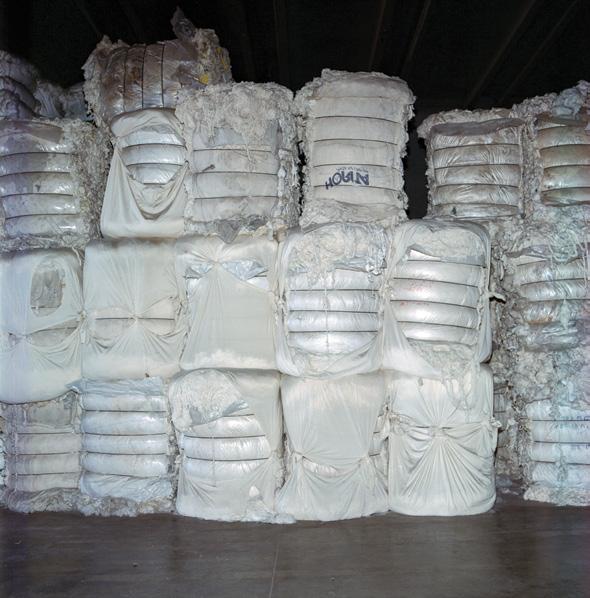
Right: Bales of shredded cotton at the Kipaș mill in Kahramanmaraş.
But technological innovation cannot solve the problem of textile waste alone. Stefan soon realised he needed a partner with the technical muscle and industry know-how to take the project from prototype to large-scale production. Kipaş Textiles, based in the Turkish city of Kahramanmaraş, emerged as a natural choice. With a production capacity of 80 million meters of fabric per year and 330 tons of yarn per day, it is Türkiye's and Europe’s largest integrated textile manufacturer. “Our expertise in spinning, weaving, and producing finished fabrics like denim allows us to process recycled fiber efficiently,” says Halit Gümüşer, Managing Director and Board Member of Kipaş Holding.
Türkiye is the world’s fourth-largest exporter of denim, known for its bright, smooth finish and strong cotton fibers, and Kipaș has been a driving force behind that reputation. “Türkiye holds a significant strategic position,” says Nicolas Prophte, a board member at the Denim Deal, a circular denim project launched in the Netherlands in 2020. “With a well-established textile industry experienced in recycling and spinning technologies, as well as decades of operation of numerous denim mills, the country boasts a solid foundation for advancing sustainable practices.”
Denim is also especially important for recycled cotton, explains Nicolas, who was the former VP of PVH Corp’s Denim Center. “It’s predominantly made from cotton fibers—around 98 to 99% —and because it is one of the most widely produced and worn fabrics globally, it generates considerable textile waste, from factory scraps to discarded jeans.” He adds that “denim fibers are usually of high quality and durability,” so even when recycled, they can still make high-quality yarns.
The ubiquity of denim across the fashion industry also helps. “It was also the friendliest [fabric] to introduce to a brand that had never done anything like that before,” says Annabelle. In 2021, Stefan was able to complete his challenge of providing 100% recycled cotton to Tommy Hilfiger. Since then, Kipaș and Säntis have produced around 300 tons of 100% recycled cotton every month.
“Our expertise in spinning, weaving, and producing finished fabrics like denim allows us to process recycled fiber efficiently.”
In February 2023, just as the RCO100 system was scaling up, a 7.8-magnitude earthquake devastated southern Türkiye, including Kipaș’s home city of Kahramanmaraş. Several factory buildings were heavily damaged, and many workers lost homes and loved ones. It took an immense effort to bring the factory back on track. “There was a very big dedication and sacrifice of our team,” says Halit. But far from slowing their ambitions, the disaster strengthened Kipaș’s commitment to building a better future. Having experienced firsthand the destructive force of a natural disaster, the company doubled down on its sustainability efforts. “We had to destroy some buildings and build new ones to make more sustainable processes available,” says Halit, adding that, as a result, “Kipaş is becoming much more sustainable and much more efficient.”
A year later, the collaboration reached another significant milestone. The RCO100 recycled canvas fabric caught the eye of Alexander McQueen, and gave rise to a Bird Tail Peplum Jacket in the label’s 2024 Autumn-Winter collection. It marked the first time RCO100 had been showcased on the catwalk.
Today, Säntis and Kipaș produce and sell everything from the recycled cotton fiber to the yarns and fabrics. Säntis even sells the RCO100 recycling machine itself. The first licensed machine manufacturer is Temsan, a company based in the same area as Kipaş, and Säntis has since commercially launched the machine to allow third-party manufacturers, from wool recyclers and garment manufacturers to yarn spinners, to buy it and recycle their own waste, whether it’s cotton, wool, or silk.
“It’s not for us to gatekeep all of this,” says Annabelle. “We need to be able to open up access to the industry, to have better quality recycled cotton fibers,” she says, knowing that doing so will require the exact spirit of multi-stakeholder partnership that they have now proven is possible.
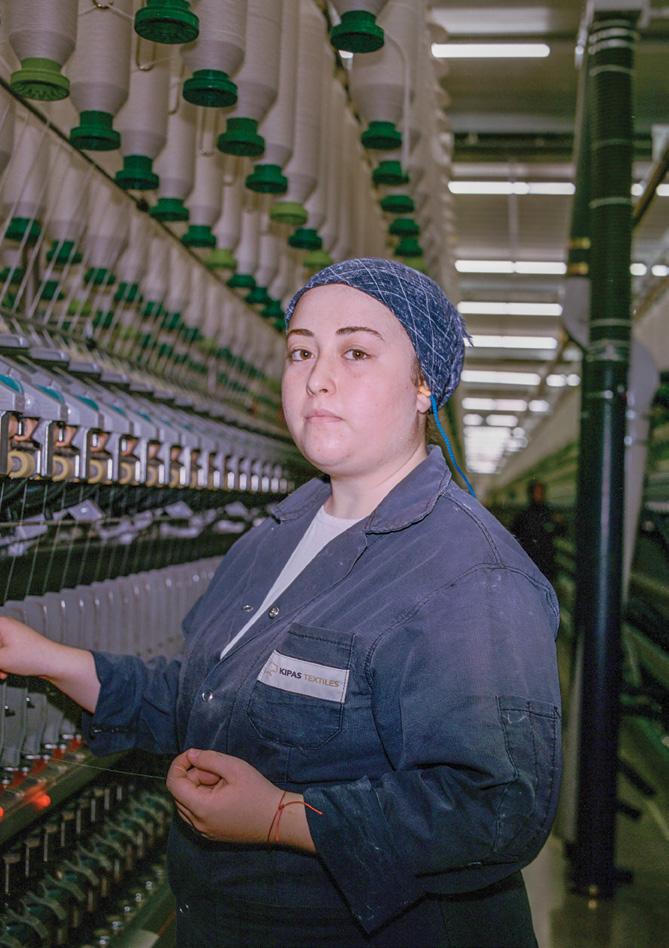
Above: The breakthrough of the RCO100 system is that it creates a high-quality cotton fiber that can go back into making new textiles.
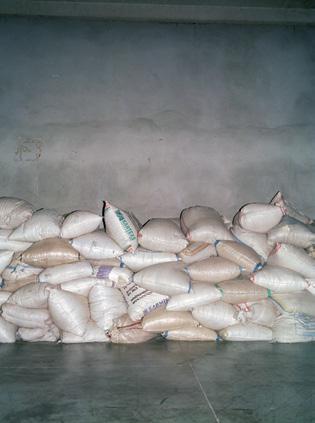
Above and right: Scraps of pre- and postconsumer waste wait to be recycled though the RCO100 machine at the Kipaș mill.
Global
This section features people and projects that confront the fashion and textile industry’s detachment from material origins, asking how a deeper recognition of place—particularly on the market side—might reframe sustainability challenges. It considers how engaging with local context and place-based nuance, whether through design, storytelling, or traceability technologies, can help shape global systems that are both ecologically responsible and economically resilient.
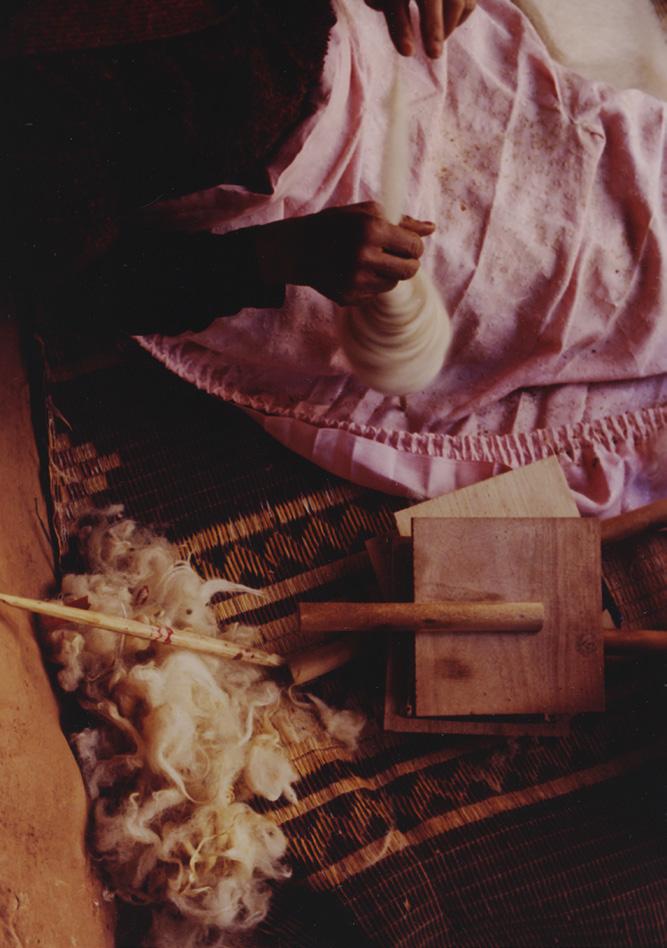
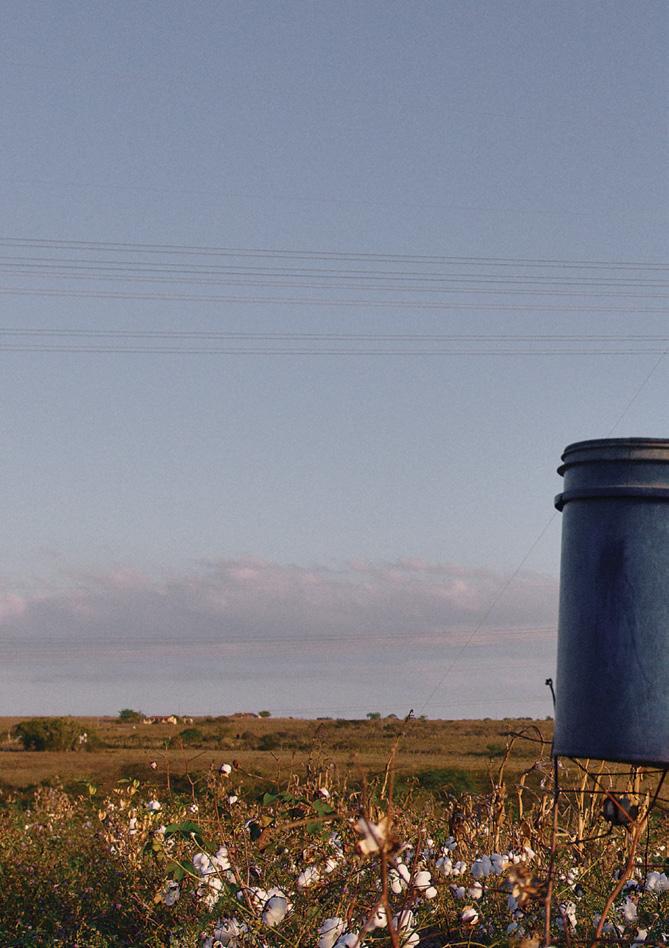
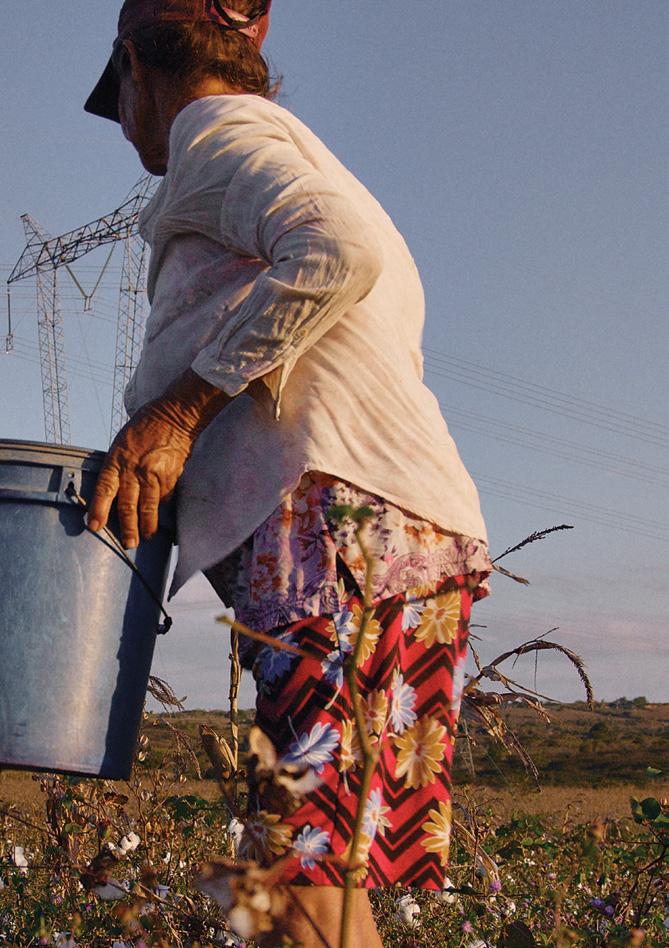
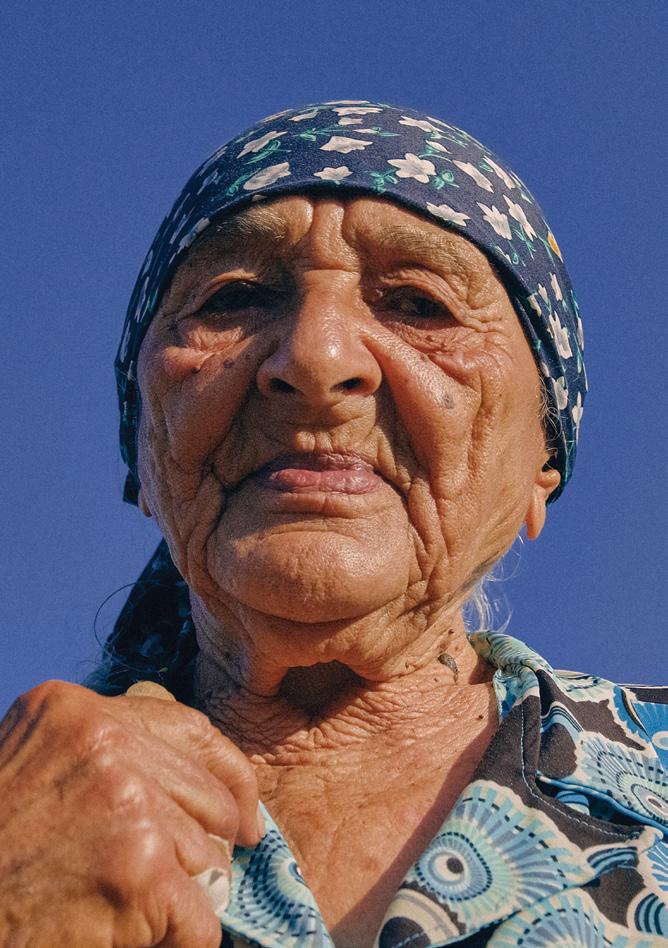
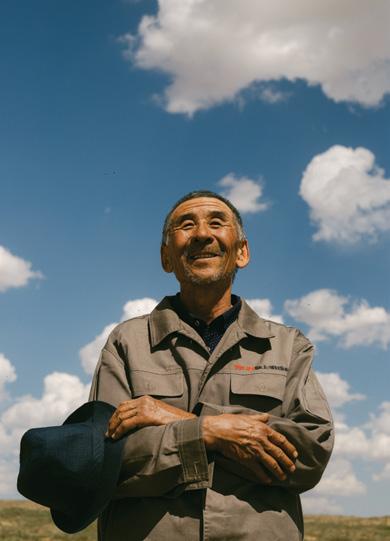
Every year, Textile Exchange teams up with world-renowned photography agency Magnum Photos to run an annual competition for emerging visual storytellers. The initiative aims to look behind finished garments and inspire a deeper connection with the people and places at their source.
Most people know the end of the narrative—the finished items that we buy and wear—but the origins of the materials that make them are often erased from the storytelling. Reframing these materials in their local settings helps contextualize their impact on people, places, and nature.
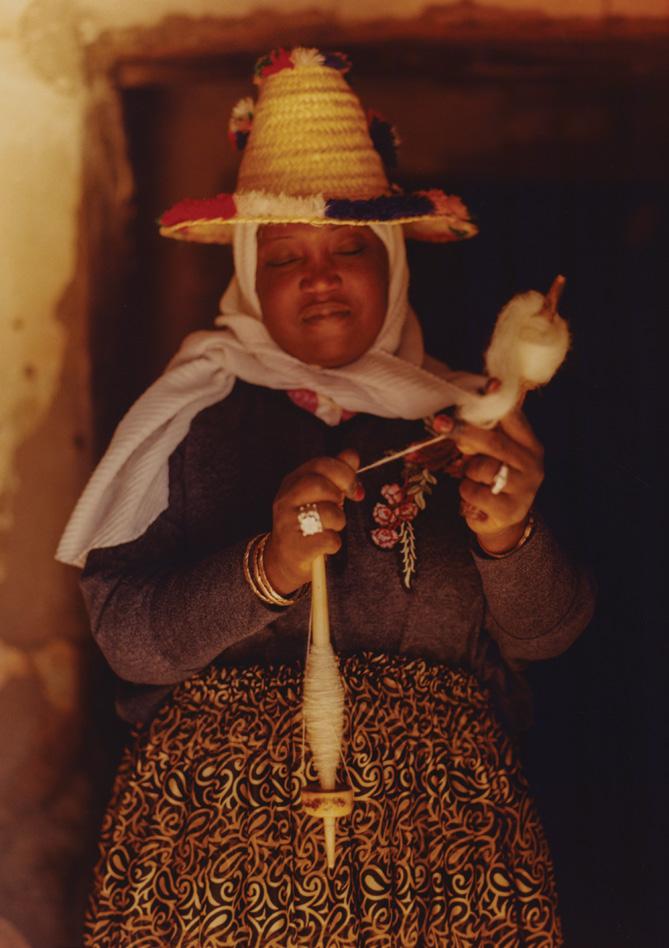
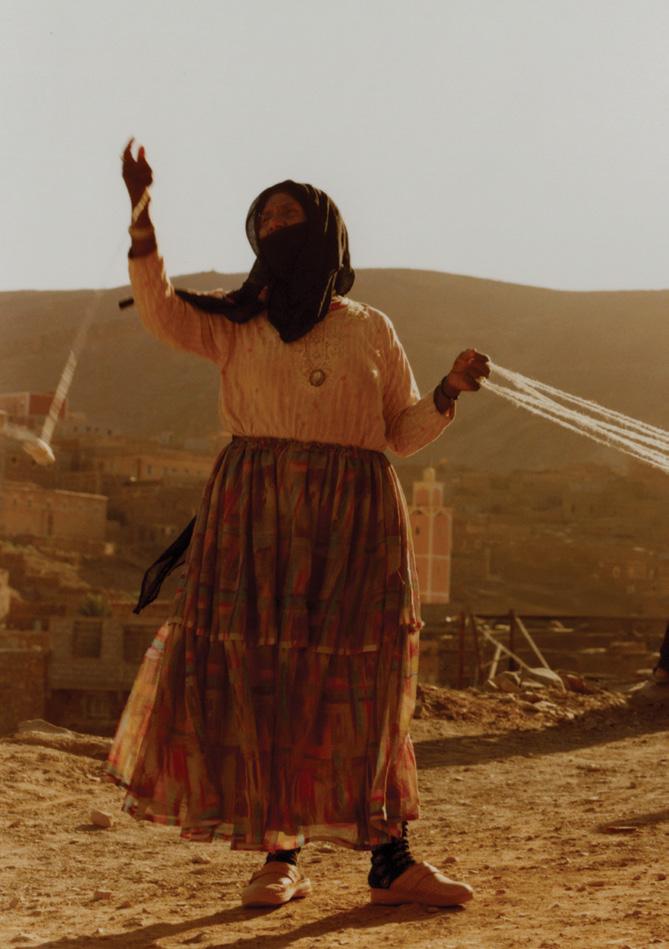
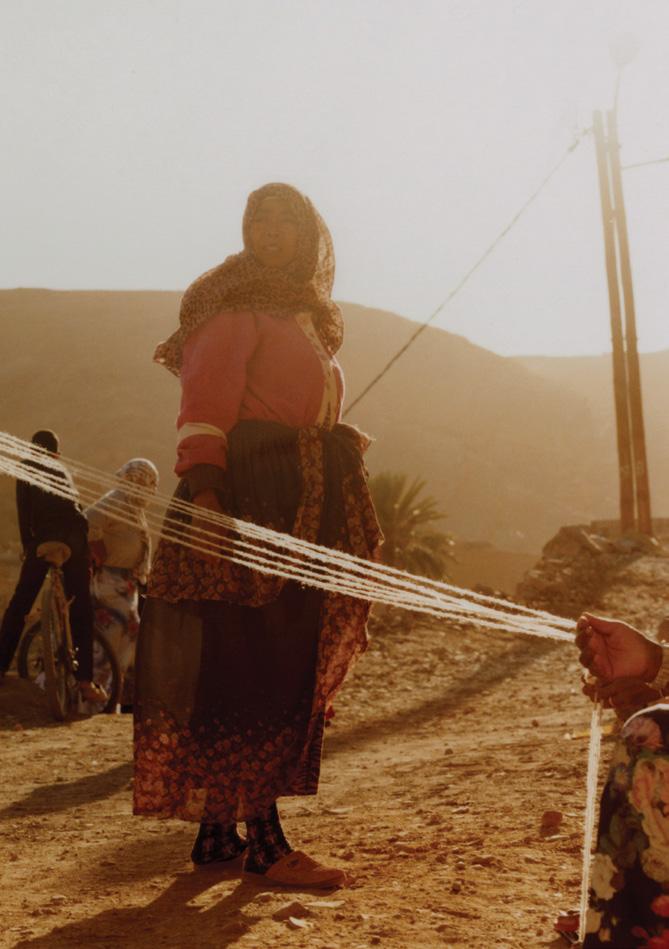
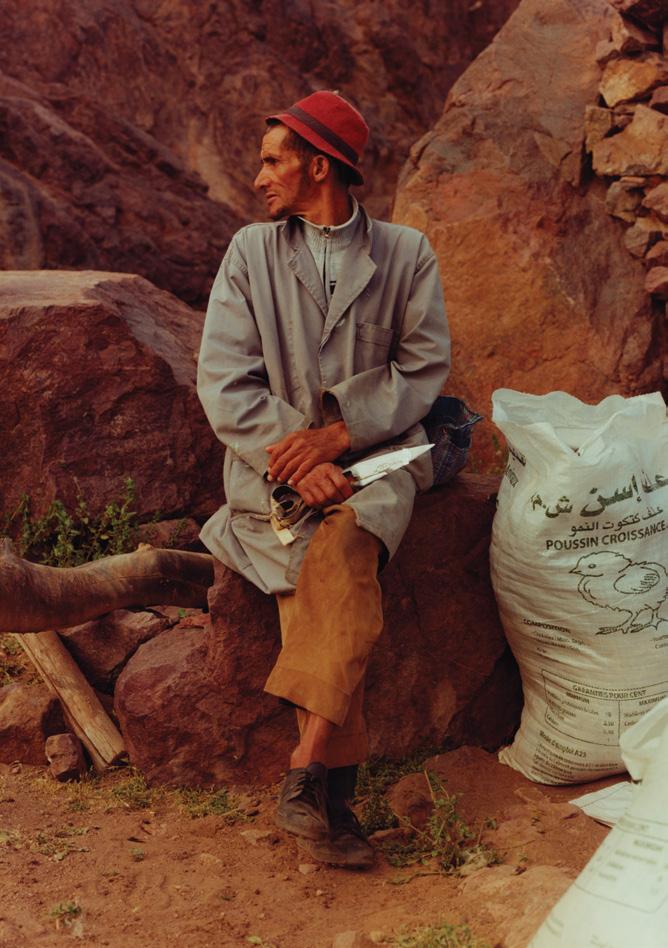
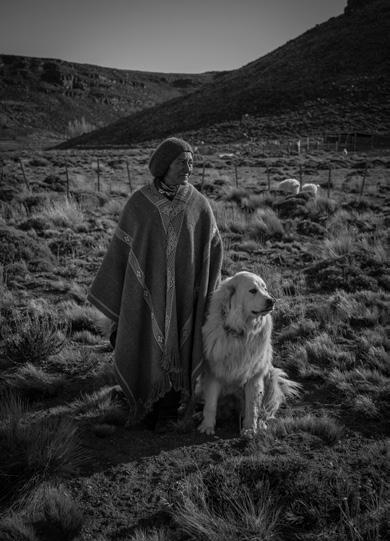
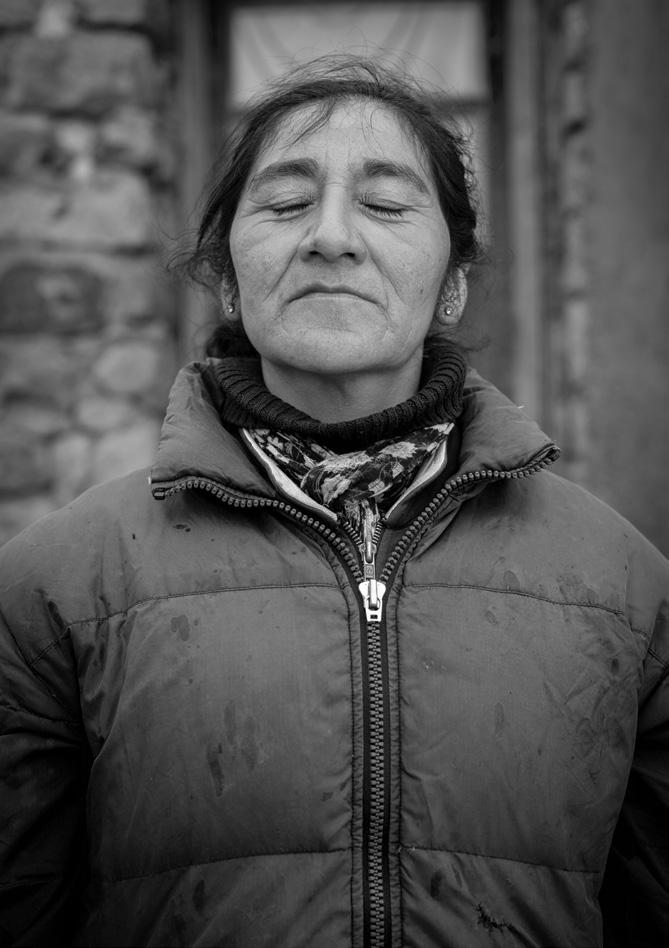
For the 2025 edition, 457 photographers from 77 countries shared their stories. The overall winner, Pierre Girardin, documents nomadic wool production in Morocco, tracing its journey from fiber to fabric against the backdrop of climate change. Runner up Cecília Bueno explores the lives of agroecological farmers in Northeast Brazil. Three highly commended entries take us further, capturing regenerative cotton farming in India, cashmere in Inner Mongolia, and wool in Argentina—examples of both traditional practices and progressive approaches shaping material production today.
Judged by
Claire Bergkamp (CEO, Textile Exchange)
Sabiha Çimen (Magnum Photographer)
Lorenzo Meloni (Magnum Photographer)
Sonia Jeunet (Education Director, Magnum Photos)
Olya Kuryshchuk (Founder and Editor-in-Chief of 1 Granary)
Aditi Mayer (Activist and Storyteller)
Jenny Walton (Artist and Writer, Jenny Sais Quoi)
Tracing the Origin Stories Behind the Global Textile Trade with Magnum Photos
PIERRE GIRARDIN WINNER
Based in Marseille, France, Girardin mixes abstract and figurative forms in his photography, experimenting with materiality and colour through laboratory work and varied reproduction processes. He is particularly drawn to the craftsmanship, ancestral knowledge, and evolving traditions that represent the deep relationship between communities and their environments. His work explores how these cultural legacies adapt or fade in a world of constant change and acceleration.
CECÍLIA BUENO RUNNER UP
Hailing from Brazil, Bueno is a photographer and filmmaker whose work explores the intersections between reality, memory, and imagination. For her, photography becomes not only a tool of documentation but a form of weaving: connecting gesture, land, and time into visual narratives that reveal how textiles embody care, endurance, and transformation.
SHEPHERDS AND WEAVERS OF MOROCCO
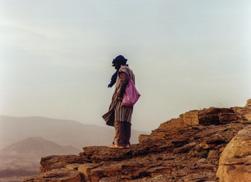
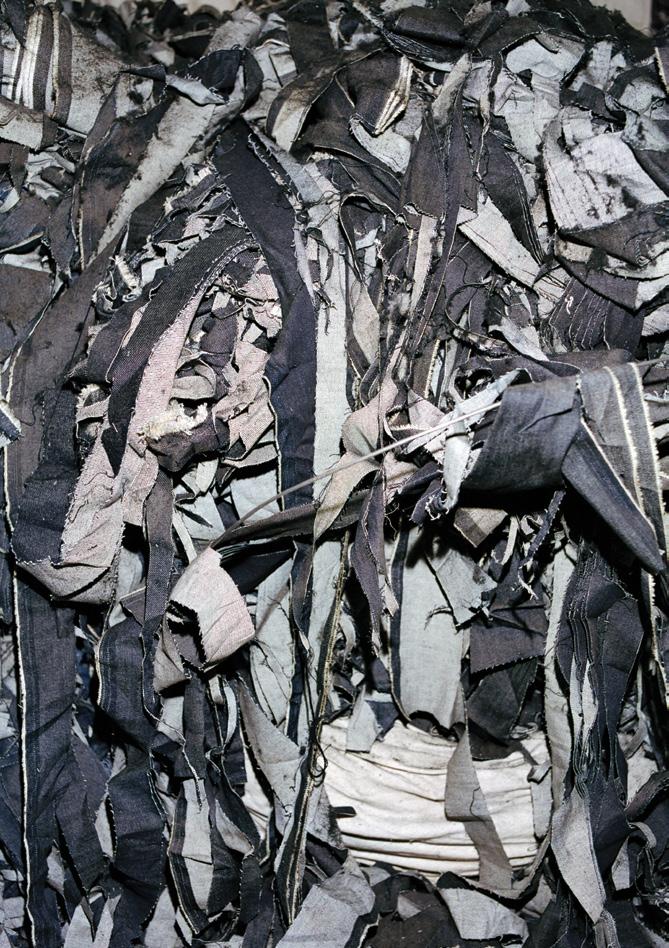
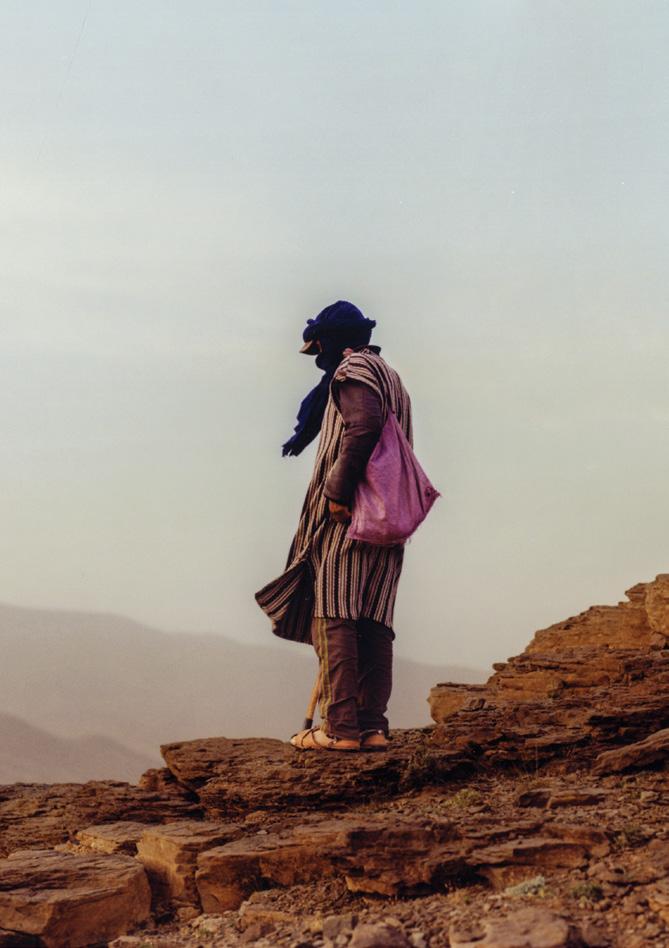
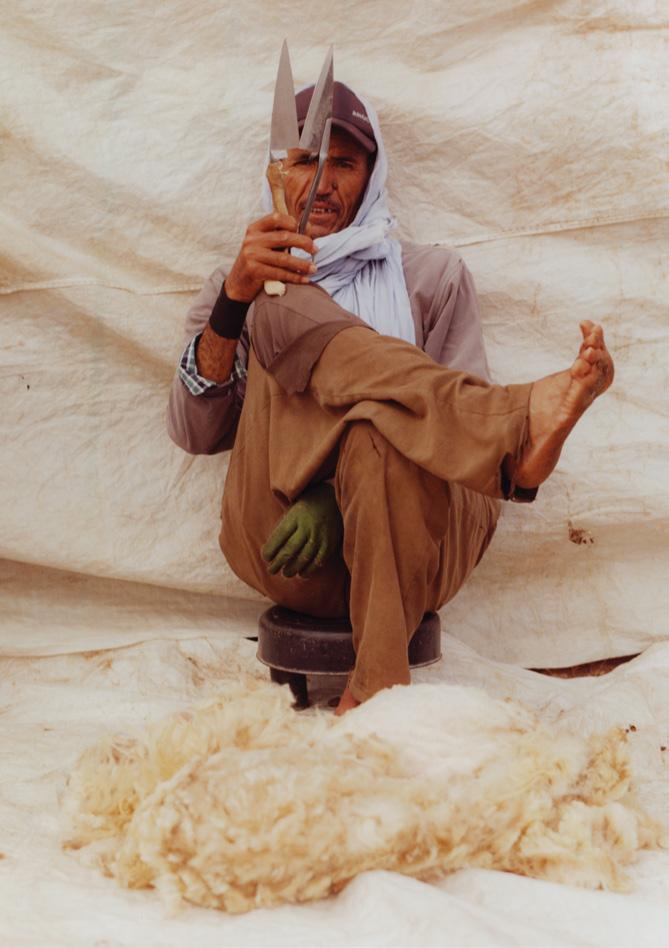
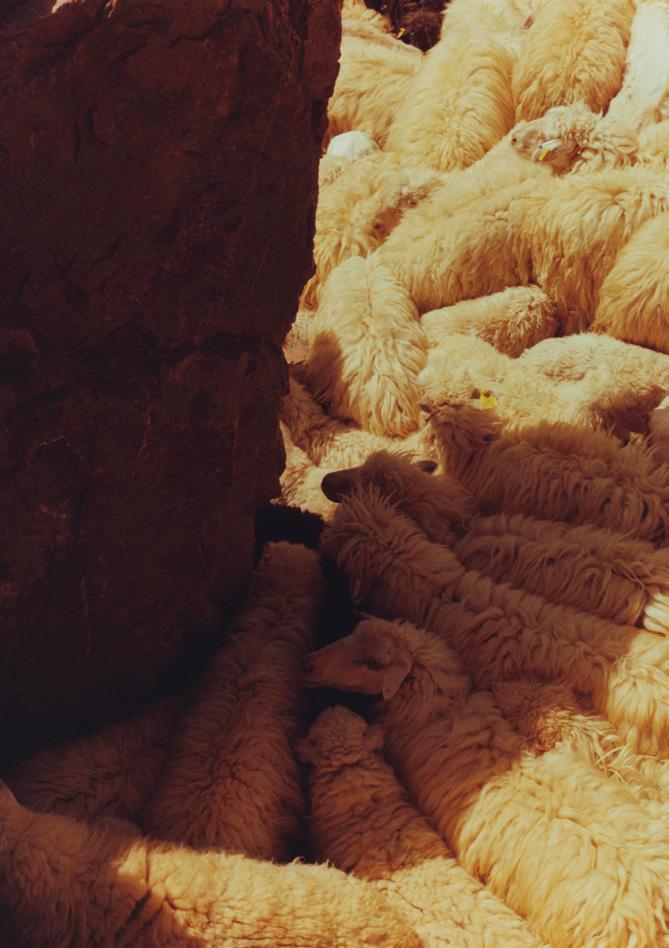
Girardin’s work follows the wool ecosystem in Morocco, from its nomadic producers to the talented craftspeople transforming the fiber. He starts with shepherds and livestock breeders in the Siroua region, documenting how climate change has led to water shortages and a lack of grazing land. His lens captures both the challenges of survival and the resilience of local cooperatives working to revive wool in traditional crafts. This takes him to a small village in Morocco’s Anti-Atlas region, inhabited mostly by women. It is known for weaving woollen veils and painting them using henna as a natural dye. While these women have historically been rendered invisible by craft merchants, Girardin shines a light on the weavers and the mastery they have over their craft.
WHITE GOLD: THE HANDS THAT WEAVE THE LAND
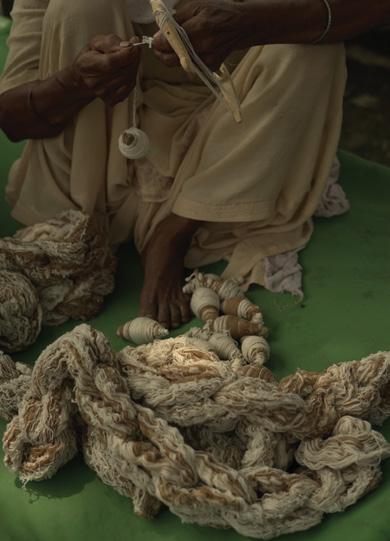
Bueno’s photo series documents communities of agroecological farmers in the Borborema Plateau in the semi-arid highlands of Paraíba, Brazil. The project follows the full cycle of organic cotton, from the sowing of ancestral seeds to the harvest, when the fields fill with what they call “white gold.” Agroecological farmers aim to restore balance to ecosystems while honoring traditional knowledge, through ancestral practices such as spinning, weaving and harvesting. By centring the narrative on those who grow cotton and their deep ties to the land, Bueno set out to shift the gaze from the final product in the fashion chain to the human, ecological, and emotional paths that precede it.
ASHISH CHANDRA HIGHLY COMMENDED
Mumbai-based Ashish Chandra has worked across advertising and editorial, though his main interest lies in documentary photography. His project Land Beneath Our Feet explores the world of regenerative cotton farming in Erode, Tamil Nadu, from the perspective of place, labor, and tradition. It traces the life cycle of cotton, using quiet, intimate images to capture both the agricultural processes and the human stories that emerge from them. His shots bring to life the work of Oshadi, a collective that grows cotton regeneratively and transforms it into finished garments through a localized supply system.
LEONIE
FREEMAN HIGHLY COMMENDED
Leonie Freeman is a London-based photographic artist with a deeply personal approach to portraiture. Her projects explore themes of identity, family, place, and relationships, through her practice built around patience and genuine connection. The Journey of Cashmere follows cashmere wool from goats in the grasslands of Alashan, Inner Mongolia, to a factory in Xian, to the finished knitwear products. Seeking authentic, intimate depictions of her subjects, Freeman was welcomed into the homes of goat farmers and their families throughout her journey.
GREGORIO IBAÑEZ HIGHLY COMMENDED
Argentinian lens-based artist Gregorio Ibañez explores the socio-cultural and environmental realities of his home of Patagonia through photography grounded in empathy and a deep respect for the land. His project Historias de Coexistencia: Isabel & Pirren centers on Isabel, a Mapuche sheep and goat herder, and Pirren, the dog that changed her life. Pirren’s influence extends far beyond helping Isabel drop her livestock losses to zero; thanks to him, she no longer perceives the wildlife around her as a threat, but rather as natural cohabitants of the environment.
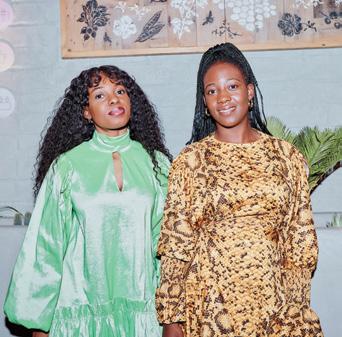
In a fashion system that spans the globe, people increasingly lose sight of the places, landscapes, cultures, and communities behind their clothing. Tina Wetshi cofounded research agency and collective Colèchi in part to encourage a new generation to reconnect with the roots of what they wear. Here, Tina shares her perspective, shaped by Colèchi’s ongoing research, as to the relevance of locality for fashion today.
Asking Colèchi: What Does Local Mean for Fashion in a Globalized World?
At Colèchi, we see the meaning of “local” as something that is constantly changing and evolving.
In today’s globalized world, it’s hard to imagine fashion supply systems one day retrofitting into the traditional, geographic definition of locality. That doesn’t mean that we can’t harness a stronger connection to place through what we wear, but it requires reconnecting to the larger story of how, and where, clothing comes to be. Too often, any trace of local influence is erased from fashion storytelling, creating a seemingly intentional indifference to the people and places behind it.
This concept and curiosity led my sister Piarvé and me to found Colèchi, a collective and research agency humanizing fashion through community and collaboration. After two years of research and exploration, we released a print journal, AGREENCULTURE, which explores the relationship between fashion and farming with contributions from growers, makers, designers, and more. We also dedicated our third annual summit, held in London in 2024, to the theme (G)LOCAL—creating space to examine how the fashion industry can ethically partner with and champion overseas relationships.
TINA WETSHI
Image by Katherine Chisham
TINA WETSHI
Both initiatives underscored the idea that local isn’t just about geography. Instead, the word encompasses a recognition of, and respect for, people, shared experience, and collaboration. It moves beyond location to encompass values and traditions.
One concept that stayed with me was raised by John Bertolaso, who cofounded the regenerative cotton and tech solution Materra. He sees the concept of fiber sovereignty as a crucial aspect of reclaiming local textile production.
“Our aim should be to start shifting the power dynamics from supply chain incentives centered around profits to benefits that might be more aligned with cultural and environmental values within the farming communities themselves.”
“Most of us are familiar with the concept of food sovereignty,” he explained at our summit. “Similar thinking applies to fibers. Ultimately, it's impossible to dissociate natural fibers from food because farmers who produce cotton and other crops are also typically food producers.”
He added that “our aim should be to start shifting the power dynamics from supply chain incentives centered around profits to benefits that might be more aligned with cultural and environmental values within the farming communities themselves.”
To tackle this problem, Materra is moving away from isolated supply chains and exploring local processing. By having a fiber spun, woven, and turned into textiles, it’s bringing the entire production process closer to the origin of the raw material, in turn building a deeper connection between the product and the community that creates it.
Another perspective shared at the summit came from Anila Preston, owner and farmer at Weekfield farm in Exmoor, United Kingdom, which is home to EKOALPAKA. The brand produces alpaca clothing and is able to provide buyers with full traceability. For her, locality is inseparable from the full process of creation, which starts with locally available raw materials.
“To truly understand locality is to learn the skills required to cultivate what is in your surroundings,” she shared.
If Anila sees locality in cultivating new skills, Madhu Vaishnav connects it to sustaining generational ones. Vaishnav is the founder of Saheli Women, a female social enterprise that sets out to economically empower women in Rajasthan, India, by working with them to sew and embroider garments. Their work, sold globally by brands such as ZAZI, carries the story of the women who made it.
For Madhu, art and craft are part of her community’s DNA. The women she works with have tailor-made blouses, and they have their own way to wear sarees and lehengas. Vaishnav describes a firsthand connection to craft, passed down through generations, that differs from the consumerist mindset of “I want more. I want the best. I want a new one. I want it next.”
Instead, material is tied to cultural expression and community. The Saheli Women embed clothing that goes on to be sold in the global market—complete with storytelling dedicated to its origins —with their local values, successfully transmitting these values on a global scale. In this case, it’s about finding partners that share a similar vision.
“To truly understand locality is to learn the skills required to cultivate what is in your surroundings.”
This idea extends into design as well. Take Phoebe English, fashion designer and head of her eponymous sustainable circular fashion studio. She aims to align design with the realities of our planetary limits, focusing on circularity and re-using pre-and post-consumer textile waste.
“The way fashion runs is very disconnected from nature and from the source,” she explains. “So, it's about trying to factor that in specifically at the design stage, and building it into the design process, rather than trying to shoehorn it in at the end.”
Instead of creating fashion based on what makes sense from an image perspective, she prefers to focus on a creative process rooted in the physical environment. In practice, this means looking at local waste and rooting her design process in what already exists.
“We're not just looking at a swatch card and choosing fabric that we like, ordering it, and then it just arriving,” she says. “We're really foraging across different waste streams.”
Through our ongoing research at Colèchi, one lesson stands out: even in the most globalized supply chains, all fashion is somehow shaped by the cultures and values of the places where it is made. It’s impossible to detach from its local roots, even if this narrative is too often erased from the final product.
Today, local is as much about holding tradition as it is about projecting meaning across distances. Once we recontextualize our clothing in its local origins, we gain a clearer understanding of its true impact on people, places, ecosystems, and communities. Only then can we begin to transform the negative outcomes of global fashion into mutually beneficial collaborations.
“The way fashion runs is very disconnected from nature and from the source. So, it's about trying to factor that in specifically at the design stage.”
Right: Sisters Tina and Piarvé Wetshi founded Colèchi with the aim of humanizing fashion through community and collaboration.
Image by Emily Lavarello
Through her work documenting India’s fashion systems from field to fabric, storyteller and activist Aditi Mayer observed firsthand how scaling local solutions requires both ecological integrity and economic viability. The learnings led to her founding The Artisan Archive—a platform built to document place-based textile traditions and boost their market access. Here, Aditi shares her perspective on how local systems, shaped by ecology and community, can be adapted and scaled.
Connecting Ecology and Economics: Aditi Mayer’s Lessons from India’s Cotton Clusters
ADITI MAYER
Images by Aditi Mayer
In 2021, I traveled around India as part of National Geographic’s Digital Storytelling Fellowship to explore the connections between fashion, farming, and social justice.
This was the start of a deep dive into how traditional, localized agriculture and craft systems are being challenged by industrialization and the loss of cultural knowledge. The experience, coupled with my ongoing research in the following years, highlighted the enduring relevance of local textile clusters and their potential as solutions to today’s ecological crisis.
At the same time, I saw that these systems could only be preserved by tapping that relevance into today’s markets. The most successful examples I observed were those where ecology, culture, and economics aligned. Unless procurement pathways and long-term financial commitments exist, local ecological intelligence remains economically fragile.
The story of cotton farming in the state of Punjab offers a clear example. Here, the fiber landscape shifted dramatically during India’s Green Revolution in the 1960s. Government policy and international aid pushed farmers away from locally adapted cotton varieties toward high-yielding hybrid seeds and chemical-intensive practices. Wheat and rice grew in popularity as cash crops, eventually resulting in ecological strain: falling groundwater levels, pesticide pollution, and a loss of resilience in farming systems.
In recent years, collectives like Trinjan—a women-led initiative named after the traditional spinning circles—have begun reviving locally adapted varieties of cotton in Punjab’s fields. Its work began by sourcing native seeds and persuading farmers to plant them in a landscape long reshaped by monocultures. Trinjan even set up a weaving school where young women could learn skills once passed down informally in the traditional trinjan. Here, spinning and weaving became acts of reclaiming cultural memory and rural livelihood.
“Scaling local successes globally means rethinking the economics of partnership —where brands share risk, guarantee procurement, and co-invest in the conditions that allow ecological knowledge to thrive as livelihood.”
Yet reviving a seed does not automatically revive a system. Without secure procurement or guaranteed purchase agreements, farmers still hesitate to commit larger plots to the native cotton. Much of the fiber risks stalling in storage, stranded between ecological success and economic uncertainty. Without policy to level the playing field, pivoting the wider system to locally adapted solutions remains a challenge.
That’s not to say that accessing wider markets isn’t possible, but it takes commitment from the buying side. Take the case of Kala cotton in Kutch, Gujarat. Following the 2001 earthquake that devastated the region, industries swept in and traditional farming and weaving collapsed.
But by 2009, the NGO Khamir had identified an anchor for revival: Kala cotton, a short-staple, drought-resistant variety nearly lost to history. Kala had been sidelined because industrial mills demanded longer staples suited to machine processing. But for arid Kutch, it was ecologically perfect. It thrived with little water and no chemical inputs.
Khamir partnered with organic farming groups like Satvik and mapped weavers who still remembered how to handle the coarser fibers. At first, farmers resisted. Government subsidies favored genetically modified cotton, and handpicking native varieties was labor-intensive. But as Kala’s drought resilience became evident, and as Indian designers like Archana Shah translated it into contemporary silhouettes, demand grew.
By 2017, decentralized supply chains linked smallholder farmers, spinners, and weavers. Brands like 11.11 and Urvashi Kaur adopted Kala cotton too, proving its environmental and economic viability. What looked obsolete in the eyes of industry became a prototype for adaptation under climate stress.
But if these local systems can be rebuilt successfully, why do they falter when translated globally? All too often, markets prioritize high yields and uniformity, not biodiversity or diversity, which leads to the proliferation of monoculture systems. Scaling local successes globally
Above: Aditi Mayer is a sustainability thought leader working at the nexus of social and environmental justice in fashion.
Above: Farmers cultivate locally adapted cotton varieties in Punjab, which are hand spun and woven.
means rethinking the economics of partnership—where brands share risk, guarantee procurement, and co-invest in the conditions that allow ecological knowledge to thrive as livelihood.
One positive example here is Oshadi, a collective in Tamil Nadu that brings together farmers, spinners, dyers, and weavers within one ecosystem, producing its own collections as well as garments for global brands. Founded by Nishanth Chopra, its name—meaning “plant” or “medicine” in Sanskrit—signals a commitment to working in rhythm with the land.
Unlike typical garment brands that begin at the cut-and-sew stage, Oshadi starts with the soil, by building a vertically integrated supply chain rooted in regenerative agriculture. In 2019, Nishanth partnered with Los Angeles–based brand Christy Dawn to convert 24 acres of farmland in the Erode district to regenerative practices. The risk was enormous. Genetically modified Bt seeds, promoted for decades, had locked farmers into annual seed purchases, chemical dependence, and volatile global markets. Abandoning that model meant risking both yield and income.
The breakthrough came through reimagining contracts. Christy Dawn agreed to finance farmer salaries during the transition, cover upfront input costs, and guarantee purchase of the cotton harvest at a fair price. This shifted risk away from the farmer—a rare inversion in a global industry that often pushes volatility onto those at the bottom. With that assurance, farmers could adopt regenerative practices like composting and crop rotation.
Over time, fields diversified. Alongside cotton, farmers grew food crops such as turmeric, pulses, and bananas, which improved soil health while feeding households and supplying local markets. Women, often excluded from cash-crop economies, entered both farm labor and value-add stages like spinning and dyeing. By 2021, Christy Dawn released its first Farm-to-Closet collection built on regeneratively grown cotton. By 2023, Oshadi expanded its model to multiple brand partners, proving it was not just an experiment but a replicable framework.
Oshadi’s success shows that to effectively scale local systems, the correct scaffolding is needed. Procurement guarantees, cooperative finance, and multi-year contracts are all needed to make ecological intelligence economically viable.
However, it’s important to remember that these lessons can only be transferred more widely if we stop confusing scale with sameness. Resilience lies in diversity, and global systems must translate rather than replicate. From water-thrifty cotton in arid belts to agroforestry in rainforest regions, place-based solutions cannot be flattened into one model.
“Because in the end, the truth is simple: what sustains the land must also sustain the people.”
“A local practice thrives when it is grounded in three dimensions of sustainability: the ecological, the social, and the economic.”
A local practice thrives when it is grounded in three dimensions of sustainability: the ecological, by being suited to local landscapes and conserving resources; the social, by preserving knowledge and community cohesion; and the economic, by providing dignified livelihoods and viable markets.
When these three align, a practice is more than sustainable —it’s scalable and regenerative too. As the wider industry, our role is to respectfully learn from place-based systems without erasing their integrity.
Because in the end, the truth is simple: what sustains the land must also sustain the people.
Shining Light on Fashion’s Global Supply Chains with Traceability Technology
“FibreTrace also empowers the growers of the fiber and the makers of the yarn —we bring the hands, lands, and the labor behind our textiles and clothing into the story.” SOPHIE
2025 Textile Exchange Conference sponsor
SOPHIE BENSON
Today’s fashion supply chains span continents, making verification of origin increasingly complex. FibreTrace is pioneering technology that embeds traceable markers directly into fibers, delivering real-time visibility from farm to finished garment. This level of granular tracking not only supports verification claims but also empowers brands to ensure authenticity at every stage of the supply chain. As the industry confronts demands for greater responsibility and transparency, could technologies like FibreTrace be key to building trust—and reconnecting us to the hands, lands, and labor behind our clothing?
“FibreTrace was born from a desire to bring honest transparency to the fiber industry,” says Danielle Statham, owner and founder of the traceability tool that tracks garments from fiber to final product and beyond. As the co-owner of an agricultural enterprise and a regenerative cotton farming program in her home nation of Australia, and one-time head of her own denim brand, Danielle is uniquely placed to see the roadblocks to traceability that dogged the fiber industry.
She had visions of using her own cotton in her denim line, but she knew that once the fiber left the farm to be spun into yarn, there was absolutely no guarantee she would receive it back. Due to the complex and global nature of the textile supply system, Danielle’s cotton would most likely be sent to a facility in Asia to be spun. There, it could be blended with fibers from other farms and countries, including those of lesser quality or grown to lower ecological standards, and she would have no way of knowing.
“In the cotton industry, despite years of sustainability claims, there was no verifiable—or affordable—way to prove the [country of] origin of a fiber once it entered a blended global supply chain,” Danielle says. This concern is echoed across the industry, the widespread lack of visibility making it near-impossible for brands and retailers to accurately address the environmental, social, and animal welfare impacts at the start of their supply systems. According to Textile Exchange’s Materials Benchmark, around 80% of fibers sourced by brands come from an unknown country of origin.
The solution, says Danielle, was simple but ambitious: what if you could physically trace the fiber itself? “Our focus is quietly powering traceability from within. It was non-negotiable to have a physical tracer attached to the fiber,” she says. Luckily, the answer was waiting to be found. Its roots weren’t in fashion, however, but currency.
“FibreTrace was born from a desire to bring honest transparency to the fiber industry.”
“Our focus is quietly powering traceability from within. It was non-negotiable to have a physical tracer attached to the fiber.”
FibreTrace uses luminescent pigment technology that was initially developed for paper-based anti-counterfeit purposes. The technology is similar to when money or sensitive documents like passports are held under a special light source to verify their authenticity. Applied to the fiber sector, it means inert, safe, and REACH-certified pigment IDs are embedded into the fiber at the raw material stage to be tracked throughout its life cycle. “Invisible to the eye, [they] carry a unique signature, almost like a recipe that could have individual names or locations added,” says Danielle.
“There were early iterations and trials to ensure the pigment didn’t affect the raw fiber specification or performance, dye uptake, or processing,” she continues. But after lab and field testing, a solution emerged that can withstand all the heat and processing associated with production, wearing, and washing.
A specially developed reader is used to scan the fiber at every stage, from spinning all the way to recycling, confirming the origin and authenticity of the fiber and recording its journey in real time. As every scanner is assigned to a user, the readers automatically send geolocation, time, and date stamp data to FibreTrace’s blockchain platform (or any traceability platform of choice), bringing together physical proof with digital tracking.
Above: FibreTrace embeds a traceable pigment into fibers, creating a scannable record that verifies their journey through the supply chain.
Image courtesy of FibreTrace
The amount of fibers sourced by brands that come from an unknown country of origin
The amount of fibers sourced by brands that come from a known country of origin
Though the technology emerged from a determination to create traceable, verifiable cotton, it can be applied to a host of fibers including recycled polyester, natural rubber, leather, recycled down, linen, and wool, verifying where they come from and the qualities and standards they adhere to—a must as the industry comes under pressure to back up sustainability and traceability claims with solid proof.
“Brands, manufacturers, and even regulators are increasingly asking, ‘how do we know this is real?’ Fiber verification is no longer optional; it is essential to make claims.”
Regulators are increasingly clamping down on greenwashing and calling for product transparency; campaign groups and activists are investigating brand claims and scrutinizing supply chains; brands are staking their reputations on preferred production systems and clean supply chains, expecting their suppliers to support their efforts; and consumers are calling for more information about where their clothes come from. “The definition of traceability has completely changed,” says Raffay Bin Rauf, Head of Sustainability at Sapphire Finishing Mills, Pakistan, which has worked with FibreTrace to roll out traceable yarns. “We’re doing more origin reporting. We need to offer the name of the farm, the ginner, the spinner, whereas before [we] would just report the processor,” says the mill’s Director Ismael Abdullah.
To meet such heightened demands, verification is key. “Brands, manufacturers, and even regulators are increasingly asking, ‘how do we know this is real?’” says Danielle. “Fiber verification is no longer optional; it is essential to make claims.”
But it’s not only brands who benefit from being able to stay compliant and back up their claims. FibreTrace’s tamper-proof technology protects the many suppliers who are also tasked with delivering on social and environmental fronts.
“For growers, it safeguards against mislabeling and ensures their fiber is credited appropriately and fairly. For mills and CMT [cut, make, trim] facilities, it provides assurance that the materials they are working with meet the standards and origins requested by their customers,” says Danielle.
“At FibreTrace, we see the need to go one step further and give the customer a strong element of trust in the story that is being told.”
It’s also a direct and physical acknowledgment of every place and pair of hands a garment has passed through, bringing the consumer closer to the making of what they own and underscoring the embedded value of time, skill, labor, and natural resources. New Zealand brand Maggie Marilyn, which has worked with FibreTrace to introduce traceable, local fibers into its collections, says a “made in” tag in a garment can only ever tell part of the story. “What matters is the hands that are touching the garment at every stage of the journey,” says founder Maggie Hewitt. “As long as consumers are unable to see how their garments are made, who they’re made by and under what conditions, they’re unable to hold brands to account.”
“At FibreTrace, we see the need to go one step further and give the customer a strong element of trust in the story that is being told,” says Danielle. “Trust is the emotional element within storytelling. It shows respect, and it values the customer. But FibreTrace also empowers the growers of the fiber and the makers of the yarn —we bring the hands, lands, and the labor behind our textiles and clothing into the story. If we are to advocate for a better system, we need to turn storytelling into truth-telling.”
The materials in our clothing and textiles are interwoven with a myriad of cultures, communities, systems, ecosystems, structures, questions, and concepts, as well as ways of thinking, working, and living. When we unravel this context, we can see the scale on which our everyday decisions can make a difference—and the extent to which materials really do matter.
MORE BY TEXTILE EXCHANGE
If you’d like to learn more about materials sustainability, discover our other publications.
REGENERATIVE AGRICULTURE OUTCOME FRAMEWORK
April 2025
Textile Exchange’s Regenerative Agriculture Outcome Framework aligns the fashion and textile industry on the holistic outcomes of regenerative agriculture. By focusing on tangible indicators within ecological, social, and animal welfare impact areas, it provides a pathway to recognize regenerative practices across supply systems.
GUIDANCE ON SCIENCE-BASED TARGETS FOR NATURE
February 2025
Textile Exchange’s Guidance on Science-Based Targets for Nature helps brands and retailers go beyond greenhouse gas emissions to set more holistic impact goals. It provides practical support for implementing the SBTN framework, specifically in relation to raw material production.