TEXAS TURFGRASS ASSOCIATION
Keeping Texas Green SINCE 1947
As we move into the summer season, I want to thank each of you for your continued support and commitment to the Texas Turfgrass Association (TTA). The second quarter has been a productive one for our industry, with members across the state working hard to advance turfgrass management practices, support our communities, and strengthen our profession.
One of the highlights of the year is quickly approaching Summer Trade Show and Conference
This event provides an outstanding opportunity for turfgrass professionals, suppliers, researchers, educators, and industry leaders to come together for networking, education, and the exchange of ideas. Attendees can expect informative educational sessions, the latest industry innovations showcased by our exhibitors, and valuable opportunities to connect with colleagues from across Texas.
I encourage all members to make plans now to attend and bring members of your team. In addition, we are pleased to welcome families to participate in the event. The conference offers a great opportunity to combine professional development with quality time spent enjoying the activities and hospitality planned throughout the weekend.
As our association continues to grow, your involvement remains essential to our success. Whether you are attending events, volunteering on boards and committees, supporting our educational initiatives, or simply sharing your expertise with fellow members, your contributions help strengthen the future of the turfgrass industry in Texas.
I look forward to seeing many of you in July and appreciate everything you do to support TTA. Have a safe and successful summer season!
Sincerely,
Brian Norton TTA President 2026
Welcome to Summer 2026
A great big thank-you to all of our exhibitors, sponsors, and members for being part of this year’s Summer Conference in the Woodlands, TX. One thing you will notice on our conference name badges this year is a “New Member” ribbon. Please take a moment to recognize and welcome our new members who have chosen to join TTA and become part of this association and professional industry. There is so much knowledge and camaraderie within this group, and I want every new member to feel welcomed right away!


Our Awards Program is also coming up, with submissions due in September. I encourage all members to consider submitting fields, landscapes, or golf courses that you feel are deserving of recognition. These awards are also a wonderful way to recognize the staff members who put in the hard work and dedication every day. I know many parts of Texas are struggling with drought, so maintaining fields and turf right now is one of the biggest challenges we face. If you are also working through staffing challenges, success with limited resources is especially worth celebrating. Please feel free to reach out to me with any questions. Award recipients will be announced at the Winter Conference in December.
Turfgrass Association has implemented a Texting System and we urge you all to opt in.
Texting - Join It!
Speaking of staffing, please remember that TTA offers a job board for all members. I try to keep job postings available for 60 days. If you have an open position, email it to me and I will make sure the opportunity is posted on our website as soon as possible.
Lastly, do not forget about our Winter Show in Frisco, TX, on December 15th and 16th, 2026. We hope to see many of you there!
Thank you to our Board of Directors, advisors, and sponsors for your continued work and support! God bless!
Warmest regards, Your Executive Director, Katie Flowers
Congratulations to the newest CPTMs!
Sergio Vasquez
Trevor Oakley - City of University Park
Jon Slate - City of Plano
Jose Diaz - SSC Service Solutions
Ruben Garcia - City of Lewisville
Zach Burney - Sulphur Springs Country Club
Thomas Garcia - SSc Service Solutions
Guillermo Sanchez Garcia
Treason Dyess - SSc Service Solutions
Gregg Gilmore - City of Jersey Village
Karen Rangel - Reeves County Golf Course
Kirk Parrish - Chambers Creek Golf Course
Next CPTM Lecture will be held is on December 15 at the Frisco Conference Center. Join us in December!
The Data-Driven Golf Course: New Technologies Transforming Turf
Management
Author - Samantha Wilson
The Data-Driven Golf Course: New Technologies Transforming Turf Management
Golf course superintendents and turfgrass specialists have long balanced science, experience, and observation to produce consistent playing conditions. In recent years, however, the next generation of technologies, from advanced soil sensors to digital course management platforms, is transforming how golf courses are managed.
Instead of relying primarily on visual observation and manual measurements, turf managers now have access to real-time data, precision monitoring tools, and digital analytics that help guide daily decisions. The result is not only improved operational efficiency, but also better turf quality and more consistent playing conditions for golfers.
Precision Agronomy Comes to Golf Courses
One of the most significant shifts occurring in golf course management is the move toward precision agronomy, a concept borrowed from modern agriculture that focuses on applying resources exactly where and when they are needed.
Continued on Page 12
Continued From Page 10
Today, a growing number of tools allow superintendents to monitor turf conditions at a level of detail that was previously difficult to achieve. Soil sensors installed throughout a course can continuously measure conditions such as soil moisture, temperature, and salinity, transmitting that information to cloud-based platforms for analysis.
Companies including Syngenta have partnered with technology firms such as Spiio to develop cellular soil sensors designed specifically for golf courses and sports turf. These systems continuously collect soil data and send it to digital dashboards that turf managers can access from a smartphone or computer. By monitoring soil conditions in real time, superintendents can identify early signs of stress and adjust irrigation or maintenance practices before turf health declines.
New Tools for Measuring Turf Conditions
In addition to permanent sensors, new handheld tools are helping turf managers gather more precise information about course conditions.In 2025, the United States Golf Association introduced the USGA Moisture Meter, a handheld device capable of measuring soil moisture, temperature, and salinity while automatically uploading the data into the organization’s digital course management platform.
The meter integrates with the USGA’s DEACON course management system, which allows superintendents to record and analyze data from multiple areas of the course. By collecting consistent measurements over time, turf managers can track trends and better understand how different sections of the course respond to weather, irrigation, and maintenance practices.
According to the USGA, tools like these help courses apply the same data-driven management strategies used in professional tournament preparation, where precise turf conditions are critical for consistent play.
Mapping Moisture Across Fairways
While handheld tools provide valuable spot measurements, some emerging technologies allow superintendents to measure soil conditions across entire playing surfaces. One example is the moisture-mapping technology developed by turfRad. The system can be mounted on maintenance vehicles and collects thousands of soil moisture readings as the vehicle travels across the course.
The collected data produces detailed color-coded maps showing exactly where soils are too wet or too dry. According to the company, a single pass across a fairway can generate thousands of rootzone moisture readings, giving superintendents a far clearer picture of soil variability across the property.
This level of detail allows irrigation systems to be adjusted more precisely. Instead of watering an entire irrigation zone equally, superintendents can target specific areas where moisture levels differ.
Improving the Golfer’s Experience
Although many of these technologies are designed to improve operational efficiency, they also have a direct impact on course playability. Firm, consistent turf conditions are essential for shot performance. Excessively wet areas can reduce ball roll on fairways and create softer putting surfaces, while overly dry areas may stress turf or produce uneven playing conditions.
Continued from Page 12
By maintaining more consistent soil moisture levels, precision monitoring tools help superintendents strike the right balance between turf health and playing quality. Moisture mapping technologies, in particular, can help eliminate wet spots and dry patches that affect ball roll and surface consistency.Better data also supports more informed decisions about mowing, rolling, and irrigation timing. Over time, turf managers can compare environmental data with maintenance practices to better understand how different conditions affect green speed, firmness, and turf performance.
The Future of the Digital Golf Course
Technology is rapidly becoming an integral part of golf course management. As sensors, analytics platforms, and automation tools continue to evolve, superintendents are gaining access to more powerful tools for monitoring turf conditions and guiding management decisions.Researchers and technology companies are already exploring advanced systems such as predictive models that analyze turf stress patterns and digital platforms that combine weather data, soil conditions, and course management records.
These innovations are helping superintendents combine their expertise and experience with realtime information and advanced analytics. While technology can provide valuable insights, it is the knowledge, judgment, and experience of turfgrass professionals that ultimately transform that data into exceptional playing conditions. Together, this combination of human expertise and advanced tools is becoming essential to maintaining the outstanding golf courses players expect.



In a state where heat, shade and heavy use all collide, finding a grass that can handle real conditions matters. That is exactly what Travis Sales set out to test in Texas. Sales, the Director of Parks and Recreation for the City of Rockwall, oversees everything from sports fields and playgrounds to irrigation across the park system. As he put it, “If it’s in a park, we manage it.” After retiring from a 32-year career with the City of Mesquite, he stepped right back into the work, retiring on a Friday and starting with Rockwall the following Monday in July 2017.
With more than 40 years in the industry, Sales has been heavily involved with the Texas Turfgrass Association (TTA) over the past two decades, including serving as past president in 2010 and 2014 and as a long-time board member. Through that involvement, he stays closely connected to new varieties entering the market and stresses the importance of trialing them in the field.
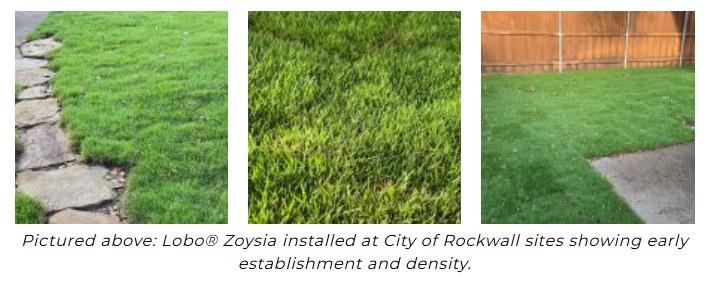
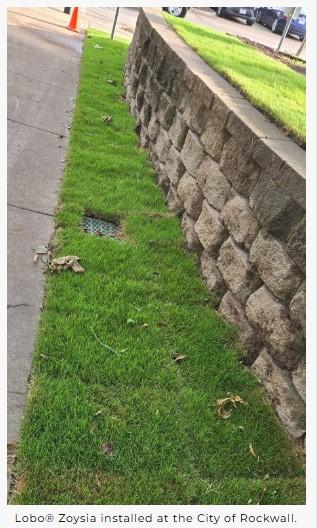
One of those is Lobo® Zoysia, a newer grass developed by North Carolina State University, released in 2021. Sales first heard about Lobo through TTA and conversations with Sod Solutions. “I decided to do some real-world testing,” he said.
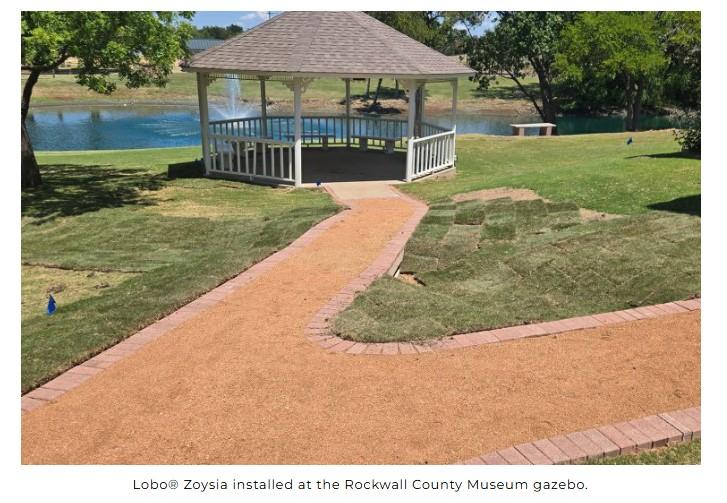
That testing includes multiple sites with very different challenges. Installations at the city’s historic museum include both full-sun and shaded areas, while the police station site is “almost 100% shade.” Another location sits under a large live oak where grass has struggled to grow in the past. All were sodded in July 2025 by Sales’ team using Lobo supplied by Murff Turf through Sod Solutions Professionals for sourcing and logistics. Early performance has stood out, even through recent swings in Texas weather, with temperatures ranging from the mid-90s one day to the low 60s just days later.
Continued on Page 18
Continued from Page 16
“The one thing I did notice about Lobo is that it rooted extremely quickly for a zoysia,” he said. “We were throwing down roots at the end of week one.” He added that the establishment paid off, with foot traffic within a few days of installation.
“Once it’s on the ground, you cannot dig through the canopy and touch soil; it is so thick,” he said, noting the density even affected mowing early on. He added they had to adjust mowing with a push mower and that it requires slightly more attention than bermudagrass.
Compared with previous grasses in these areas, Lobo is showing improved performance, especially in shade. “Some of the areas I’ve got it in get less than two to three hours of sun a day, and so far it’s doing great.” While zoysia does require some adjustment compared to bermuda, management has been straightforward with only minor changes, such as slightly higher mowing heights in shaded areas. Sales is now looking ahead to a full growing season, but early observations are strong.
He is also evaluating Cobalt Hybrid® St. Augustine alongside Lobo at the police station and said he has been very happy with its performance so far.
Sales has also begun sharing those early observations, recently speaking to more than 150 attendees at a Rockwall County course, Homeowners Guide to Landscaping, where he included Lobo Zoysia and its maintenance in the discussion. Hosted in partnership with the North Texas Municipal Water District and AgriLife Extension, the program focuses on practical tools and guidance for homeowners. Another session is scheduled for April 25.
Through that work, Sales emphasized the importance of continued education on turfgrass, especially as newer varieties improve drought tolerance and water-use efficiency. “It doesn’t have to be a water hog anymore like the varieties did in the past.”
Now managing several thousand square feet of Lobo, Sales is among the early end-users of the variety in Texas, with more insight expected as it moves through its first full growing season.
This article was written by Cecilia Johnson.