
4 minute read
Sod Solutions


Executive Board
Advertisement


The 2020 Summer Virtual Conference was the first time that TTA ventured into a digital platform and needless to say this event was a HUGE success!

Two days of Virtual education was provided for the members and the turn out was far better than we anticipated! Dr. Becky Grubbs, Dr. Chrissie Segars, Dr. Chase Straw, Dr. McCurdy , Maddie Reiter, Dr. Wherley, Kai Umeda, Janet Hurley and much more, allowed our TTA members to get their TDA credit during this world wide pandemic.
The biggest treat and surprise find was our Virtual DJ – David Osbourne who set the “Zoom Bar” high with entertainment and allowed our Sponsors to showcase their products. It was the first time you danced during a Zoom webinar and I hope we get to show case him again for our Members.

Thank you to our Sponsors, Members, Speakers, and DJ who helped bridge the education gap this summer with a Fun filled Zoom that set the bar in Virtual Education!






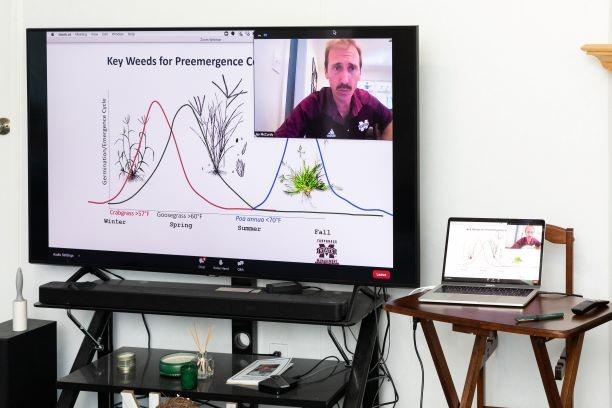
Using seedling emergence patterns to lings first emerge, through late spring until no furguide more effective annual bluegrass ther seedling emergence is observed. Weather stations at each location are simultaneously recording soil temperature and soil moisture data. This data (Poa annua L.) control will allow the team to develop comprehensive Annual bluegrass (Poa annua L.) is a troublesome winter annual weed found in many turfgrass systems throughout Texas. With the intermittent cool weather over the past several weeks, we have already begun to see annual bluegrass emergence in the College Station area. This means that appropriate fall pest management programs need to be chosen and implemented in a timely fashion to reduce the aesthetic and economic damage caused by this challenging weed. One critical aspect of effective pest management programs is understanding the biology of the pest in question, and for annual bluegrass specifically, understanding seedling emergence patterns can inform appropriate herbicide application timing. So, when does annual bluegrass germinate and for how long does that germination window last? Texas A&M is leading a nationwide study to investigate many aspects of annual bluegrass: its biology, resistance distribution and mechanisms, various control methods both conventional and alternative, and socioeconomic drivers of management decisions. As part of this large study, seedling emergence patterns of annual bluegrass are being monitored at seven locations across the country in multiple USDA hardiness zones1. In Texas, we are monitoring seedling emergence patterns in zones 8b (Location 1: College Station, on 9a (Location 2: Brenham, on a Latium clay soil with 3-5% slope) (Figure 1). The study, which is in its second of two years, captures the emergence pattern of annual bluegrass from fall, when seedemergence forecast models that will give turfgrass By: Andrew Osburn, Dr. Becky Bowling, and managers another tool in their arsenal for finetuning weed control programs from year to year. The first year of data collection is already comDr. Muthu Bagavathiannan plete and the preliminary results are discussed
a Zack fine sandy loam soil with 2-5% slope) and here. In the first year of this study, seedling emergence was monitored from mid-October 2019 to midMarch 2020 in both College Station and Brenham. Emergence patterns relative to soil temperature and soil moisture are shown in Figures 2 (College Station) and 3 (Brenham). Annual bluegrass emergence was first observed around mid-November in 2019 in both locations. This is in stark contrast to 2020 observations in which initial annual bluegrass emergence was recorded in mid-September in College Station. This variability across years demonstrates the importance of monitoring local weather conditions including soil temperatures and moisture in order to predict the germination of annual bluegrass rather than solely relying on a calendar. At peak emergence in 2019, soil temperatures were averaging 58° F and in College Station and 59° F in Brenham. However, the climate conditions leading up to these emergence events should be considered more important for promoting seedling emergence as soil temperatures and moisture content for the previous 10-14 days can be used as predictors for emergence flushes. The average temperature in College Station for the first 14 days in November was 55°F with a low of 40°F while Brenham had an average of 57°F with a low of 45°F. Traditionally, it is recommended that turfgrass managers make their first preemergence herbicide application in the fall when temperatures in the upper inch of soil drop to 70°F or below for 4 or 5 consecutive days.
