[ THE JOURNAL ]
VOLUME 51 NUMBER 5 SEPTEMBER/OCTOBER 2026
EDITOR'S LETTER September/October 2026 Volume 51, No. 5
www.ttha.com
Rocky Summer Gives Way to Calmer Fall?
S
ummertime kept us on our toes around here. First, the news broke that New World screwworm finally arrived in Texas. The first case occurred June 3 in a calf in Zavala County. At the time of this writing, USDA has confirmed 38 screwworm cases in Texas. Federal and state officials prepared for the screwworm arrival, and will continue doing everything possible to deal with the situation. Then, news broke in late June about a data breach in Texas Parks and Wildlife Department’s license system. TPWD reported information for more than 3 million Texas hunting and fishing license customers may have been exposed. TPWD is working with its license system vendor to shore up its security. Affected customers can receive one year of free credit monitoring by calling 844-959-7123, but you need to do so before Sept. 14. We had been so busy at TTHA headquarters preparing for the Hunters Extravaganza shows, we barely had time to catch our collective breath. But we’ve seen our hard work for the 50th anniversary of our Hunters Extravaganzas pay off. We’re grateful for everyone who came to spend time with us at each show, and hope you enjoyed yourselves, and carry that excitement into this hunting season. We’ve already started the process for the 2027 shows, and look forward to seeing everyone again. If you don’t want to wait until next summer, come join us in Dallas in January 2027 for our Outdoors Extravaganza. Dove hunters are in for a treat this season. For the very first time, opening day starts Sept. 1 in the South Zone. The Texas Parks and Wildlife Commission approved the change, and TPWD staff will collect public feedback to see how well it went for everybody. Another approved change: “Doe days” were expanded to a 16-day season beginning the second Saturday of General Season and closing the Sunday following Thanksgiving in Austin, Bastrop, Caldwell, Colorado, Comal (east of IH 35), DeWitt, Fayette, Goliad (north of U.S. Highway 59), Gonzales, Guadalupe, Hays (east of IH 35), Jackson (north of U.S. Highway 59), Karnes, Lavaca, Lee, Travis (east of IH 35), Victoria (north of U.S. Highway 59), Waller, Washington, Wharton (north of U.S. Highway 59), and Wilson counties. Get your copy of the 2026-27 Outdoor Annual so you’ll have the latest information on hand. Hunting gear writer John Goodspeed has been writing for The Journal since 2010. This issue will mark the end of his Journal contributions, because he’s decided to retire. John had previously been an outdoor writer for the San Antonio Express-News, so he’s earned the right to put down his pen and say goodbye to deadlines. Coincidentally, John’s wife, Marianne Odom, was one of my very first journalism professors when I attended San Antonio College. Enjoy your retirement, John. Despite the curveballs nature, and the economy, might throw your way, we hope you have an excellent hunting season. Be sure to make the most of it. Meanwhile, we’ll be here to keep sharing good stories with you. Don’t forget to share yours with us, too.
Official Publication of The Texas Trophy Hunters Association, Ltd.
654 Richland Hills Dr., Suite 160 San Antonio, TX 78245 210-523-8500 • info@ttha.com
Founder Jerry Johnston Publisher Texas Trophy Hunters Association President and Chief Executive Officer Christina Pittman • christina@ttha.com Editor Emeritus Horace Gore Editor Martin Malacara editor@ttha.com Executive Editor Debbie Keene East Texas Field Editor Dr. James C. Kroll Hill Country Field Editor Gary Roberson
South Texas Field Editor Wildlife Biology Consultant Jason Shipman Coastal Plains Field Editor Will Leschper Southwest Field Editor Jim Heffelfinger
Newsstand Consultants
JK Associates Joe Luca & Triva Bridges Graphic Designers Faith Peña Dust Devil Publishing/Todd & Tracey Woodard Contributing Writers Beckett Andrews, Daryl Ashford, John Goodspeed, Judy Jurek, Russell Ratliff, Brandon Ray, Zan Shafer, Eric Stanosheck, Rustin Thomas, Kelly Yarbro
Advertising Production Debbie Keene 210-288-9491 deborah@ttha.com
Events Manager Jennifer Beaman 210-640-9554 jenn@ttha.com
Sales Representative Tristan Summy 210-685-1205 tristan@ttha.com
Events Assistant Manager Natasha Delgado 210-512-8045 natasha@ttha.com
Marketing Manager Logan Hall 210-910-6344 logan@ttha.com
Membership Manager Valkyrie Myklebust 210-767-9759 valkyrie@ttha.com
Finance & Administration Manager Laura Garcia 210-512-4927 laura@ttha.com
Martin Malacara, Editor Texas Trophy Hunters Association
2 The Journal of the Texas Trophy Hunters | September/October 2026
To carry our magazine in your store, please call 210-288-9491 • deborah@ttha.com TTHA protects, promotes and preserves Texas wildlife resources and hunting heritage for future generations. Founded in 1975, TTHA is a membership-based organization. Its bimonthly magazine, The Journal of the Texas Trophy Hunters®, is available via membership and newsstands. TTHA hosts five Extravaganza® outdoor expositions, renowned as the largest whitetail hunting shows in the South. For membership information, please join at www.ttha.com or contact TTHA Membership Services at (877) 261-2541.
[ THE JOURNAL ] VOLUME 51 NUMBER 5 SEPTEMBER/OCTOBER 2026
101
CONTENTS
105 FEATURES Dr. Deer’s Prescription
90 | Dream Season Double By Jason Shipman
34 |
USDA Screwworm Fact Sheet
101 | Doves Make for
37 |
Dove and Duck Hunting Opportunities
19 |
By Dr. James Kroll
By Will Leschper
48 | 2026-27 Hunting Season
53 |
Delicious Cuisine By Judy Jurek
105 | Mule Deer are Not a
Hybrid Species By Jim Heffelfinger
Forecast
By Martin Malacara
112 | Up on a Stump By Jason Shipman
Putting the “Hunt” Back into Hunting
116 | Caracara Fun Facts By TTHA Staff
By Gary Roberson
85 | Riflescope Roundup for Fall
2026
90
37
By John Goodspeed
85
4 The Journal of the Texas Trophy Hunters | September/October 2026
53
CONTENTS
[ THE JOURNAL ] VOLUME 51 NUMBER 5 SEPTEMBER/OCTOBER 2026
10
30
44
COLUMNS 10 |
From The Field
71 |
Jr. Trophy Hunter Corner
14 |
Fence Posts
24 |
Connecting with Texas Parks & Wildlife
75 |
The Draw
28 |
Wildlife For Texas
122 | Moon Phases
42 |
Next Generation
123 | Kamp Kitchen
62 |
Muzzleloaders in the Hunt
124 | Hunt’s End
98 | Eye On Nature
66
66 | Must Haves
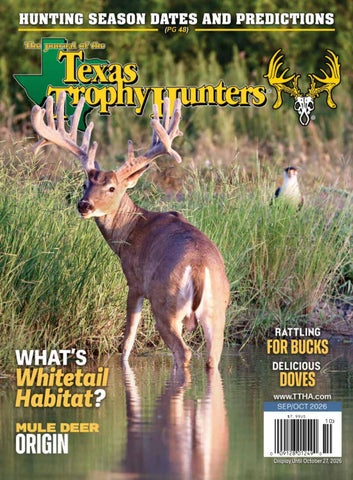
75 ON THE COVER Photo By: Marty Berry A buck in velvet and a caracara caught in the lens. Learn about caracaras on page 116.
MEMBER STORIES 30 | Ringing In The New Year By Russell Ratliff 44 | Excellent Deer-hunting
Adventures
By Beckett Andrews
80 | Fifty Years of Deer Hunting on
Shafer Mountain
By Zan Shafer
94 | Rough Canyon Aoudad By Kelly Yarbro
58 | Axis: A Bold Texotic Hunt By Daryl Ashford The Journal of the Texas Trophy Hunters, 1982 ISSN-08941602, is published bimonthly (a total of 6 issues) by The Texas Trophy Hunters Association Ltd., 654 Richland Hills Dr., Suite 160, San Antonio, TX, 78245; Phone (210) 523-8500. All rights reserved. Periodical postage paid in San Antonio, Texas, and Additional Mailing Offices. Subscriptions: $35 per year includes membership in TTHA. Phone (210) 523-8500. Advertising: For information on rates, deadlines, mechanical requirements, etc., call (210) 523-8500. Insertion of advertising in this publication is a service to the readers and no endorsement or guarantees by the publisher are expressed or implied. Published material reflects the views of individual authors and does not necessarily reflect the official position of the association. Contributions: should be sent via email to editor@ttha.com, or mailed to the Editor, Journal of the Texas Trophy Hunters, 654 Richland Hills Dr., Suite 160, San Antonio, TX, 78245. They must be accompanied by a self-addressed stamped envelope or return postage, and the publisher assumes no responsibility for loss or damage to unsolicited materials. Any material accepted is subject to revision as necessary in our sole discretion to meet the requirements of our publication. The act of mailing a manuscript and/or material shall constitute an express warranty by the contributor that the material is original and in no way an infringement upon the rights of others. Photographs can either be RAW, TIFF, or JPEG formats, and should be high resolution and at least 300 dpi. All photographs submitted for publication in “Hunt’s End” become the sole property of the Texas Trophy Hunters Association Ltd. Moving? Please send notice of address change (new and old address) 6 weeks in advance to Texas Trophy Hunters Association, P.O. Box 3000, Big Sandy, TX 75755-9918. POSTMASTER: Please send change of address to The Journal of the Texas Trophy Hunters, Texas Trophy Hunters Association, P.O. Box 3000, Big Sandy, TX 75755-9918.
6 The Journal of the Texas Trophy Hunters | September/October 2026
Breckenridge Fine Arts Center photos
WE ARE TTHA
[ THE JOURNAL ]
VOLUME 51 NUMBER 5 SEPTEMBER/OCTOBER 2026
Proof of Residency Requirements for Purchasing Hunting, Fishing Licenses In Effect Reminder: You might want to make sure your driver’s license is up to date and on-hand before you purchase a new hunting or fishing license in Texas this season. Effective Aug. 1, people wishing to purchase TPWD licenses must present an unexpired driver’s license or personal identification certificate at the point-of-sale. Visit tpwd.texas.gov/ business/licenses/online_sales/ for more information.
Breckenridge Fine Arts Center Hosts Trophy Hunter’s Exhibition The Breckenridge Fine Arts Center announces the return of its Trophy Hunter’s Exhibition, on display Oct. 20, 2026, through Jan. 13, 2027, at 207 N. Breckenridge Ave., in Breckenridge, Texas. Returning after a three-year hiatus, the exhibition will feature an impressive collection of trophy mounts from across Texas and around the world. Visitors will have the opportunity to view a wide variety of wildlife species while gaining an appreciation for the artistry, craftsmanship, and outdoor heritage represented by each piece. “We are excited to bring this exhibition back to Breckenridge,” said Robyn Brooks, Director of the Breckenridge Fine Arts Center. “The collection offers visitors a rare chance to see wildlife from around the world up close while appreciating the artistry and skill involved in creating these displays.” Call 254.559.6602 or visit BreckenridgeFineArt.org for more information. —courtesy Breckenridge Fine Arts Center
What’s YOUR YOUR Trophy TrophyExperience? Experience? Facebook
Tumblr
Twitter/X
Follow Us! www.TTHA.com
Send your story and photos to: Editor@ttha.com. THE VOICE OF TEXAS HUNTING ® | www.TTHA.com
7
T
run on cellular plans, and upload photos to apps that make them immediately accessible to the user. Cameras have improved along with the quality of the photos they take. Yet, there are still plenty of awful trail camera photos floating around out there every year, due in part to user error. Proper techniques employed when using trail cameras help to ensure better quality images. The most common mistake people make when using trail cameras is setting them up too far from the target area. Everyone wants to see all of the deer at the feeder, and in an effort to do so, they don’t get a good look at any of them. Nobody wants to look at photos and have to wonder what they’re looking at. Is that a split tine? Is that an extra point? Does he have 10 points? Additionally, looking through thousands of photos and having to zoom in on every single one of them is no way to live. Camera set-ups should be close. Approximately 10-12 feet works best for most models. Use posts for mounting if necessary, with the understanding the deer will become Author Photos
rail cameras have revolutionized the way deer are hunted. Hunting still has its challenges, but scouting has become easier. Busy schedules won’t allow the majority of people to spend as much time in the field as they would like. Trail cameras fill that void, and keep an eye on things 24 hours a day, 7 days a week. Today’s hunters have more information, and as a result, they manage their time more wisely, and in turn, can be more selective with their harvest. Technology has improved with time and so have trail cameras. The first trail cameras used 35mm film that had to be developed at a photo lab. Today’s digital cameras save photos on memory cards or
Setting cameras close to your targeted area is paramount for good photos. The majority of buck photos obtained are at night.
10 The Journal of the Texas Trophy Hunters | September/October 2026
Good, full-framed, broadside shots allow you to study the deer and estimate age.
accustomed to seeing the camera trap with time. Cameras ics and create problems, rendering future use unpredictable should be set waist high and facing north/south to avoid the and sketchy at best. sun. Look at the trails and where the heaviest deer traffic occurs These tips will enhance your experience and help to improve in the area to determine good camera locations. the quality of photos you get with trail cameras. You will have Set cameras perpendicular to where the deer will be standing a better product to show for your efforts. Some photos go viral at the feeder, water trough, or trail, in an effort to get fullthese days. Nobody wants to be the person sending out sloppy framed, broadside shots. If you’re running cameras on feeders, photos. Put a little extra effort into getting better pics and you’ll focus on one side of the feeder to get the best photos possible. be glad you did. Your friends will be too! Don’t forget to trim any vegetation that may get in the way, such as high grass or swinging limbs, and pay attention to what’s in the background. It’s not uncommon to have hundreds, if not thousands of photos to review when running cameras. Now that you have all of these great photos, you may wonder what to do with them. If you plan on keeping them, organization is key, and I would encourage organizing them into folders and labeling all photos accordingly. If using memory cards, reformatting is a must. Now, rinse and repeat the process. Finally, remember to bring trail cameras inside when finished using them. Whether intentional or not, leaving cameras out for an entire year in the sun and rain will reduce their life span. Over Trail camera technology has come a long way. Pictured is an example of one of the first time, the harsh elements take a trail camera models, a lasting relic of bygone days. toll on the housing and electronTHE VOICE OF TEXAS HUNTING ® | www.TTHA.com
11
[ THE JOURNAL ] VOLUME 51 NUMBER 5 SEPTEMBER/OCTOBER 2026
HUNTING NEWS
FENCE POSTS
NEWS ABOUT HUNTING, GUN RIGHTS, AND LEGISLATIVE ITEMS
New World Screwworm Arrives in Texas On June 3 the Texas Parks and Wildlife Department received confirmation of a detection of New World screwworm (NWS) in Zavala County. A sample collected from a three-week-old calf with an umbilical lesion was identified and confirmed as NWS by the National Veterinary Services Laboratory (NVSL) in Ames, Iowa. This is the first detection of NWS in Texas since northward progression from Central America was observed in 2023. TPWD is working closely with United States Department of Agriculture (USDA), Texas Animal Health Commission (TAHC) and other state officials in a joint incident response. TAHC has established an infested zone in the area, and animal movement restrictions are in effect to prevent further spread of the pest. “NWS can have devastating impacts on free-ranging wildlife populations and rural communities,” said Dr. David Yoskowitz, Executive Director of Texas Parks and Wildlife Department. “TPWD, in partnership with our state and federal partners, will work diligently to respond to suspected cases of NWS, and to urge the public to monitor and report signs of an infestation in warm-blooded animals.” “TAHC has been actively preparing for a resurgence of NWS for over two years,” said Dr. Bud Dinges, TAHC state veterinarian and executive director. “We are putting these preparations into action, and we encourage all animal owners and caretakers to continue to remain vigilant for the presence of larvae in animal wounds and immediately report
any suspicions.” According to the USDA, the U.S. food supply is safe. USDA’s Food Safety and Inspection Service (FSIS) ensures the nation’s commercial supply of meat, poultry, and egg products is safe and properly labeled. NWS do not infest fruits, vegetables, or other food sources such as grains and rice. NWS are larvae or maggots of the NWS fly (Cochliomyia hominivorax), that cause the painful condition NWS myiasis. NWS flies lay eggs in open wounds or orifices of live tissue. These eggs hatch into dangerous parasitic larvae, or maggots, which burrow or “screw” into flesh with sharp mouth hooks. NWS primarily infest livestock, but can also affect pets, humans, and wildlife including wild mammals and birds. Targeted releases of sterile NWS flies are being expedited to eliminate any reproducing populations in the area associated with the detection. When combined with enhanced surveillance, movement restrictions, prompt treatment of wounds, and education and outreach efforts, the sterile insect technique is a proven and effective tool for controlling and eradicating this pest. In addition to frequently monitoring animals, producers should implement enhanced management practices including keeping open wounds clean and covered. Animals infested with NWS should be immediately treated with an appropriate method under the direction of a veterinarian. If you suspect NWS in your livestock or domestic animals, contact the TAHC immediately and do not move any animals. A representative
14 The Journal of the Texas Trophy Hunters | September/October 2026
will advise you on current collection protocols for submitting suspicious maggots. Contact TPWD for wildlife infestation information and the Texas Department of State Health Services (DSHS) for human infestation information. Visit tpwd.texas.gov/huntwild/wild/ diseases/screwworm/ to learn more. —courtesy TPWD
USDA Takes Steps to Defend Against New World Screwworm The U.S. Department of Agriculture’s Animal and Plant Health Inspection Service (APHIS) confirmed the detection of a New World screwworm (NWS) in a bovine in Zavala County, Texas. The affected animal is a 3-week-old calf and larvae were identified in its umbilical area. “All models showed New World Screwworm entering the country in 2025; however, thanks to the hard work across the entire Trump administration and our industry, state, and local partners, we were able to buy time for this moment. Protecting our livestock industry is a national security issue of the utmost importance, and USDA is wasting no time in taking action,” said Dudley Hoskins, Under Secretary for Marketing and Regulatory Programs. “USDA invested heavily in the tools needed to eliminate NWS ever since cases started increasing in Central America and Mexico. The United States has defeated this pest before, and we will do it again.” USDA and Texas officials are taking immediate action to contain and eradicate NWS from the United States, following the strategies and actions outlined in the NWS Response Playbook.
HUNTING NEWS This includes: • Forming a unified Incident Command Team with the Texas Animal Health Commission and deploying response personnel to the area • Establishing a 12-mile infested zone around the detection and implementing quarantines, movement controls, and surveillance in this area • Expediting targeted release of sterile NWS flies by immediately deploying ground release chambers in the area, in addition to the 4 million sterile flies per week already being released aerially in the area • Increasing trapping for NWS flies along the border and just outside of the dispersal area • Implementing NWS surveillance and management strategies in wildlife • Conducting targeted outreach in the local area Additionally, USDA’s National Veterinary Stockpile stands ready to assist and will provide resources including treatments, equipment, and logistics support
[ THE JOURNAL ]
VOLUME 51 NUMBER 5 SEPTEMBER/OCTOBER 2026
the response as needed. USDA will continue to work with state departments of agriculture, animal health officials, industry, and producers to mitigate economic impacts of restrictions as much as possible, including negotiating with our trading partners to regionalize any trade restrictions on live animals, limiting them to defined geographic areas. Learn more about NWS at screwworm.gov. —courtesy USDA
Silver Lake Ranch Becomes Texas’ Second Largest State Park Texans will soon have a new place to explore the beauty of the Hill Country thanks to the acquisition of almost 54,000-acres in Edwards and Kinney counties. The property, which will become Silver Lake State Park, is Texas’ second largest state park behind Big Bend Ranch. “The opportunities to explore nature’s wonders are truly bigger in Texas,” said Gov. Greg Abbott. “With this new land acquisition across the Hill Country, Texans will have access to more than 50,000 acres of unique outdoor activities. This future state park will grant genera-
tions of Texans with a deeper understanding of the land that helps make our state the natural envy of the world.” The Moody Foundation gifted its ownership interest of Silver Lake Ranch, totaling 87.5 percent, to the Texas Parks and Wildlife Department. TPWD purchased the remainder of the property interest for $11.85 million with funds from the Centennial Parks Conservation Fund and Sporting Goods Sales Tax, both overwhelmingly approved and made available thanks to Texas voters. “This is an exciting addition to our state park system, and we are grateful to our partners at the Moody Foundation for their philanthropy and for bringing this slice of the Hill Country to the people of Texas,” said David Yoskowitz, Executive Director of Texas Parks and Wildlife Department. “Near one of the most popular state parks in Texas, Silver Lake is sure to become a destination for park visitors and be the backdrop of memories made for generations to come.” The property, historically used for sheep and cattle ranching, was previously owned by the Moody Foundation and the Libbie Shearn Moody Trust.
The Moody Foundation gifted ownership interest of Silver Lake Ranch to Texas Parks and Wildlife. The land will eventually become Silver Lake State Park.
THE VOICE OF TEXAS HUNTING ® | www.TTHA.com
15
[ THE JOURNAL ] VOLUME 51 NUMBER 5 SEPTEMBER/OCTOBER 2026
“The Moody Foundation is proud to help preserve this remarkable stretch of Texas Hill Country and make it accessible for generations to come,” said Moody Foundation Trustee Ross Moody. “Silver Lake Ranch represents the natural beauty, history and spirit of our state, and we are honored to make this gift to Texas Parks and Wildlife to ensure it remains protected and enjoyed by all Texans for years ahead.” Located about 150 miles west of San Antonio between Rocksprings and Uvalde, the property features steep canyons, rolling hills and miles of river frontage along the West Nueces River. Additionally, it’s home to 30-acre spring-fed Silver Lake, the property namesake. —courtesy TPWD
TPWD License System Compromised Texas Cyber Command recently detected a cybersecurity incident involving the Texas Parks and Wildlife Department license system vendor that handles the sale of hunting and fishing licenses. The investigation indicates that an unauthorized person or persons may have obtained driver license information, passport numbers (if provided), email addresses, phone numbers and residential addresses for more than 3 million Texas hunting and fishing license customers. Social Security numbers, dates of birth and financial information, including credit card details were not obtained from this incident. There is no evidence that customers under the age of 18 were involved or that any specific group was targeted. TPWD is working closely with the license system vendor to implement new safeguards and enhanced monitoring services. Immediate steps were taken to strengthen access controls for customer profile data, and additional security features will be added in the future. License sales will continue on schedule for August and the next license year. Affected customers are eligible to receive one year of free credit monitoring through Kroll. Customers can confirm their eligibility by contacting the dedicated call center at (844) 959-
HUNTING NEWS
7123. Enrollment deadline for free credit monitoring is Sept. 14, 2026. The call center is available from 8 a.m. to 5:30 p.m. Central Time, Monday through Friday, to answer questions about the incident or the services being offered. As a precaution, you should: • Actively monitor for the possibility of fraud and identity theft by reviewing your credit report and financial statements for any unauthorized activity. If you notice any unauthorized activity, you should immediately notify the relevant financial institution or credit bureau reporting the activity. • Check, freeze and monitor your credit. Contact the three major credit bureaus (Equifax, Experian and TransUnion) to freeze your credit. It’s free to freeze your credit, and it makes it difficult for identity thieves to open new accounts in your name. You can also place a free, one-year fraud alert by contacting any of the three credit bureaus. • Scammers may use personal information to impersonate companies or officials. Avoid clicking links or sharing personal details unless you are certain the request is legitimate. Call (844) 959-7123 for more information. —courtesy TPWD
Data Centers and Quail By Dr. Ryan O’Shaughnessy, Executive Director, Rolling Plains Quail Research Foundation The rapid expansion of AI and data centers across the Rolling Plains—particularly around Abilene—signals a profound shift in how this landscape is being used. While these facilities represent technological progress and economic investment, their unchecked growth in native rangelands raises serious concerns for quail and the ecosystems they depend on. Bobwhite and scaled quail are species finely tuned to the rhythms and structure of intact rangeland. They rely on a delicate mosaic of grasses, forbs, and shrubs that provide nesting cover, brood
16 The Journal of the Texas Trophy Hunters | September/October 2026
habitat, and protection from predators. When large tracts of land are converted for industrial development, this mosaic is fragmented or eliminated entirely. Unlike some wildlife, quail cannot easily adapt to altered landscapes dominated by pavement, buildings, and constant human activity. One of the most pressing concerns tied to data centers is water use. These facilities require substantial amounts of water for cooling, often drawing from the same aquifers and surface resources that sustain native vegetation. In a region already prone to drought and water scarcity, increased demand can reduce soil moisture and limit the growth of critical plant communities. For quail, this means fewer insects for chicks, less cover from predators, and diminished nesting success. Equally concerning is the pace and scale of development. When projects move forward without thoughtful land-use planning or ecological consideration, they can create a patchwork of habitat loss that compounds over time. Roads, transmission lines, and supporting infrastructure further fragment the landscape, isolating quail populations and making recovery more difficult. There is also the issue of indirect impacts. Increased traffic, noise, and light pollution, can disrupt normal wildlife behavior. Invasive species often follow development, outcompeting native plants that quail depend on. Over time, these cumulative pressures can tip the balance against sustainable quail populations in the Rolling Plains. This is not an argument against progress, but a call for balance. Strategic siting of data centers, water-use accountability, and conservation-minded planning can help ensure that economic development does not come at the expense of our natural heritage. The Rolling Plains is one of the last strongholds for wild quail, and its preservation requires foresight and stewardship. If we allow unregulated expansion to continue, we risk trading a resilient, wildlife-rich landscape for short-term gain. The future of quail—and the legacy of this region—depends on the choices we make today.
HUNTING NEWS SCI Applauds Expansion of Hunting, Fishing Opportunities on Public Lands Safari Club International applauds the U.S. Department of the Interior, U.S. Fish and Wildlife Service, and the White House for announcing expanded hunting and fishing opportunities across America’s public lands and waters, an important step forward in advancing the national commitment to Make America Beautiful Again through conservation, access, and responsible stewardship. The U.S. Fish and Wildlife Service proposal would open or expand more than 1,450 opportunities across 111 National Wildlife Refuges or National Fish Hatcheries in 32 states. “SCI applauds Secretary Burgum and
[ THE JOURNAL ]
VOLUME 51 NUMBER 5 SEPTEMBER/OCTOBER 2026
USFWS Director Nesvik for recognizing that hunters and anglers are among the nation’s leading conservationists,” said W. Laird Hamberlin, CEO of SCI. “We are especially grateful for the leadership of the White House in championing policies that drive the Make America Beautiful Again agenda—restoring access to our public lands, strengthening conservation outcomes, and reaffirming the vital role that sportsmen and women play in sustaining America’s natural legacy. Ensuring that the National Wildlife Refuge System remains accessible is not only critical to preserving our outdoor heritage, but also strengthens wildlife conservation funding, supports rural communities, and connects future generations to the outdoors.”
Elda Garza Dies at 84 The hunting community mourns the loss of the matriarch of the Muy Grande family. Elda G. Garza died June 29 after an unexpected illness. She was 84. Elda was married to Leonel “Muy” Garza, her high school sweetheart, and founder of the Muy Grande Deer Contest in Freer, Texas, for 61 years. “Muy” Garza passed away in 2022. The couple made Freer their home, where Leonel managed the Texaco-Center Circle Gas Station at the town’s main intersection. In 1965, Leonel founded the Muy Grande Deer Contest, and Elda faithfully stood Elda Garza beside him, supporting every one of his business endeavors for more than five decades. Together, they built not only a business, but a legacy that continues to impact generations of hunters, families, and the South Texas community. “Mom was the quiet woman behind the scenes who held our family together,” said Elda’s daughter, Imelda Sharber. “She loved my dad endlessly.” Elda dedicated her life to her family, her community, and her church. Elda served as a board member of the non-profit organization, Muy Grande Ministries, and was a member of the Catholic Daughters of St. Mary’s Catholic Church. To so many beyond her own family, she was simply known as “Grandma.” Elda leaves behind her four sisters, her five daughters, and numerous grandchildren and great grandchildren.
The USFWS proposal includes new and expanded access opportunities including the first-ever hunting or sport fishing opportunities at 14 refuges and three hatcheries. With this historic rule, over 95% of the National Wildlife Refuge System is available for hunting. “Policies that expand access while upholding science-based wildlife management are essential to the future of conservation,” said Jeff Meyerl, President of SCI. “SCI commends the Department and the White House for their strong, ongoing leadership in advancing Make America Beautiful Again—ensuring that America’s public lands remain accessible, productive, and conserved for generations to come.” SCI has long advocated for increased public access, state-led wildlife management, and policies that protect the rights of hunters and anglers while advancing sustainable-use conservation principles. —courtesy SCI
New Braunfels Man Accused of Poaching White-Tailed Deer Texas game wardens filed 74 charges against a New Braunfels man accused of illegally killing at least 13 whitetailed bucks in Comal, Hays, and Bexar counties between fall 2024 and late summer 2025. Darrell Maguire, 55, New Braunfels, allegedly poached deer over an 11-month period, often shooting the animals with a crossbow from his vehicle, removing only the heads and leaving the carcasses to waste. Game wardens arrested Maguire in September 2025 on wildlife and drug possession charges. While executing the search warrant of his residence, wardens recovered evidence they say linked him to multiple poaching scenes. Charges filed include: Hunting without landowner consent; Hunting whitetailed deer at night; Hunting whitetailed deer from a vehicle from a public roadway; Failure to retrieve and keep white-tailed deer in edible condition; Possession of a controlled substance (methamphetamines); Possession of marijuana. Maguire also faces multiple Class C Parks and Wildlife Code violations. The case remains pending.
THE VOICE OF TEXAS HUNTING ® | www.TTHA.com
17
By Dr. James C. Kroll
Author Photos
DR. DEER’S PRESCRIPTION
According to the author, modern forests often are as much an impediment to whitetail populations as a benefit. Today, approximately 737 million to 811 million acres of forest occupy the United States.
Managing Forests For White-Tailed Deer- Part I What is whitetail habitat?
D
id you know that whitetails may be the oldest, if not one of the oldest mammals in North America? They certainly are the oldest deer species. According to experts, the ancestors of whitetails came across the Bering Sea land bridge some 3-5 million years ago. The first whitetail-like species is only known by its teeth and was given the scientific name, Odocoileus brachyodontus; meaning “broad tooth,” which was assigned because of it having teeth designed to grind browse from trees and shrubs.
Contrary to what many people assume, the original habitat of whitetail ancestors was probably not dense forest. Fossil evidence and studies of associated plant communities suggest they evolved in a mosaic landscape consisting of woodland openings, shrublands, riparian corridors, savannas, and forest edges. Although there are size differences between subspecies, the average whitetail must have reachable forage within an area four feet above the ground (the “Deer Zone”). Yet, there is a THE VOICE OF TEXAS HUNTING ® | www.TTHA.com
19
The author said this hardwood stand was thinned down to 30 square-feet basal area per acre, and now it provides both mast and forage.
problem. The trees and shrubs eventually grow out of the reach of deer, closing in and cutting off sunlight. That clearly brings home that whitetails are not creatures of old growth, dense forests. Early successional habitats created by fire, floods, storms, and grazing animals. In other words, they evolved in environments rich in “edge” rather than vast, closed-canopy forests. This evolutionary history helps explain many characteristics of modern whitetails. They are primarily browsers, not grazers. They thrive where sunlight reaches the ground and stimulates the growth of shrubs, vines, forbs, and young woody plants. They readily use forest openings, regenerating timber, and disturbed habitats. They are also highly mobile, capable of moving between feeding areas, bedding cover, and escape cover across a patchwork landscape. One could argue that the ideal whitetail habitat today closely resembles the habitat in which their ancestors evolved—a diverse mix of food, cover, and edge rather than a uniform landscape dominated by either dense forest or open grassland. The breeding biology of whitetails is geared to exploiting a dynamic landscape forged by disturbances. In much of the whitetail’s range, forest disturbances respond with lush forage growth, reaching above the Deer Zone in 7-10 years, depending on climate. They have a litter size of two, which suits itself well to reaching maximum population density in this timeframe. So, in pre-historic times, I feel deer populations probably oscillated in an ebb and flow response to random disturbances across the landscape. If whitetails evolved in a world of edges, disturbances, and constantly changing vegetation, it should not surprise us that they often respond positively to habitat management practices such as timber thinning, roller-chopping, prescribed fire, disking, and other disturbances that recreate those conditions. In many ways, successful deer management is not creating something new—it is recreating the dynamic habitats that shaped the evolution of the whitetail deer in the first place Modern forests often are as much an impediment to whitetail
20 The Journal of the Texas Trophy Hunters | September/October 2026
populations as a benefit. Today, approximately 737 million to 811 million acres of forest occupy the United States, which accounts for roughly one-third of the country’s total land area. Much of this land is in old growth forest. How many of these forested acres are actively managed for wildlife habitat? In Texas, about 63 million acres of land can be classified as “forest,” 50 million of which are privately owned. How many of these acres are managed for wildlife? The answer to both questions is, “Not much!” There is a huge difference between active and passive management.
Real currency of deer management
Many people think deer management is primarily about deer. It is not. Successful deer management is largely about managing plants. As noted, whitetails are selective feeders. They consume hundreds of different plant species throughout the year. Their diets change seasonally, and they constantly seek the most nutritious foods available. They do not eat everything that is green, and they certainly do not thrive on scenery. A property’s carrying capacity is determined largely by how much quality forage it produces. When food production increases, carrying capacity increases. When food production declines, carrying capacity declines. The relationship is remarkably straightforward. If you want more deer, you generally need more deer food. If you want healthier deer, you generally need higher-quality deer food. If you want deer to use your property during daylight, you also need cover and security arranged in a way that makes them comfortable.
Most important habitat tool
Over the years I have become convinced that sunlight is one of the most under-appreciated tools in wildlife management. Sunlight drives plant growth. Plant growth drives forage production. Forage production drives carrying capacity. Many landowners focus on planting food plots while overlooking the
thousands of acres surrounding those plots. Food plots can be valuable tools, but native habitat usually produces far more total forage than any food plot program ever will. The key is getting sunlight to the ground. In forests, this often means reducing canopy closure through timber harvests, thinning operations, prescribed fire, or other forest management practices. When sunlight reaches the forest floor, remarkable things happen. Seeds that have remained dormant for years begin to germinate. Native forbs emerge. Blackberry, greenbrier, ragweed, pokeweed, young hardwood sprouts, and countless other deer foods become abundant. In many cases, habitat improvement begins long before the first bag of seed is ever purchased. It begins with a chainsaw, a forester, a burn plan, or a thoughtful decision to let sunlight do what sunlight was designed to do.
Why cover matters
Many people focus exclusively on food and overlook another critical habitat component: cover. Deer need places where they can feed, rest, escape predators, and avoid human disturbance. Ironically, the same sunlight that creates food often creates cover. As understory vegetation develops, deer gain both forage and security. This is one reason properly managed forests often support more deer than unmanaged forests. A deer standing in an open mature forest can often be seen from hundreds of yards away. A deer standing in a properly managed stand with abundant understory vegetation may disappear within a few yards. That security is extremely important to whitetails, especially mature bucks and does with fawns.
Disturbance not a dirty word
Another misconception among landowners is that nature should simply be left alone. In reality, many ecosystems evolved with periodic disturbance. Fire, storms, flooding, grazing, and other natural processes historically maintained habitat diversity
fully and strategically. Prescribed fire, timber thinning, selective harvest, disking, grazing management, and other practices can all stimulate plant communities and increase habitat quality when properly implemented. The goal is not destruction, it’s renewal.
Managing for diversity
The best deer habitat rarely consists of a single vegetation type. Instead, it contains a mixture of habitat conditions. Some areas provide bedding cover. Some areas provide browse. Some areas produce mast. Some areas offer travel corridors. Some areas provide openings and feeding sites. Diversity creates opportunity. A property with a variety of habitat conditions generally supports more wildlife than one dominated by a single condition. This principle applies whether the property is 50 acres or 50,000 acres. A good deer property should not look the same from one fence line to the other. It should contain edges, openings, thickets, mast-producing trees, young growth, travel cover, water, and secure areas where deer can live without being constantly disturbed.
Look through a deer’s eyes
One of the most valuable exercises a landowner can perform is learning to evaluate habitat from a deer’s perspective. When you walk on your property, stop periodically and ask yourself several questions. What is there for a deer to eat here? How much of it is within reach? How much sunlight reaches the ground? What cover is available? Can a deer move safely through this area? Would a doe raise fawns here? Would a mature buck feel secure here during daylight? The answers often reveal opportunities for improvement. If you can see 200 yards through a forest, a deer may not view that stand as secure cover. If the ground is bare beneath a closed canopy, the property may look impressive to people but offer very little to whitetails. If cattle have removed the most nutritious plants, deer cannot manufacture forage from good intentions. Habitat must be judged by what it produces, not simply by how it looks to us.
Final thoughts
The healthiest deer populations occur where landowners focus on producing abundant food, adequate cover, diverse plant communities, and secure places for deer to live. Before asking why deer are absent, first ask what the land is providing. This hardwood stand may have wilderness appeal, but other than acorns, there Because in the end, deer are simply is almost nothing in the deer zone, according to the author. responding to habitat. If you know your land, you will know your across the landscape. herd. And once you understand that relationship, the answers When these processes disappear, habitats often become less usually become clear. productive for wildlife. This does not mean every acre should In the November/December issue, I will teach you how to be disturbed. It means disturbance should be applied thoughtfully evaluate your forest habitat for deer in one afternoon. THE VOICE OF TEXAS HUNTING ® | www.TTHA.com
21
Pittman-Robertson Funding Vital to Texas
T
Author Photos
exas hunters remain the greatest conservationists of natural resources and game species—a fact rooted in actual numbers and hard data—specifically the billions of dollars that have been poured back into conservation efforts and habitat restoration through sporting goods taxes during the past century. Deer hunting and dove hunting in Texas alone pump billions of dollars across our state economy each year, and while that number includes valuable funds headed to local businesses and mom-and-pop shops, the federal taxes generated by the overall hunting industry end up going back into state coffers earmarked for needed resource protections and improvements. The U.S. Fish & Wildlife Service annually distributes revenue to each state’s wildlife agency through the Pittman-Robertson Wildlife Restoration program, with funds coming from excise taxes paid by manufacturers, producers and importers on rifles, shotguns, ammunition, archery equipment (11%) and handguns (10%). This applies to all commercial sales whether for hunting, sport shooting or home defense. The final funding tally for each state is based on land area and the number of hunting licenses sold—more than 1.2 million last year in Texas—which are both positives for the Lone Star state. This year’s total of more than $1 billion in disbursements includes almost $39 million coming to Texas, the highest appropriation in the country, as has been the standard in previous years. The total includes almost $34 Pittman-Robertson funding comes from taxes on rifles, shotguns, million for wildlife restoration and about ammunition, archery equipment and handguns. Hunters also help fund $4.65 million for hunter education programwildlife restoration through license sales. ming and initiatives. First and foremost, Pittman-Robertson funds allow the Texas The overall figure is down slightly from the Parks and Wildlife Department’s Wildlife Division to offer vital more than $42 million Texas received in 2025, but it certainly services and programs, including technical guidance to private will be put to good use through multiple important avenues.
24 The Journal of the Texas Trophy Hunters | September/October 2026
TPWD Photo
landowners who control roughly 95% of wildlife habitat in Texas, TPWD surveys and research for development of hunting regulations, operation and management of Wildlife Management Areas, and conducting research and developing techniques for managing wildlife populations and wildlife habitat. The majority of work conducted by TPWD’s Wildlife Division is eligible for reimbursement under Pittman-Robertson. For every dollar spent by the Wildlife Division on approved Pittman-Robertson projects, about 75 cents is returned to TPWD for wildlife conservation. In addition, Pittman-Robertson also helps provide invaluable funding for the state’s hunter education course instruction and programming, as well as shooting range construction and management. Without the Texas receives the highest Pittman-Robertson funding annually based on land federal funding to support them, these opsize and number of hunting licenses sold. The federal money allows the state portunities likely wouldn’t have the support to conduct multiple wildlife restoration initiatives as a result. needed to effectively operate. The Pittman-Robertson Wildlife Restoramentally impactful in building up wildlife management areas tion Act—named after supporters Sen. Key Denson Pittman and other land holdings across the state during the past of Nevada and Rep. Absalom Willis Robertson of Virginia and century. In 1945, Texas used the funding to buy 5,000 acres for signed into law by President Franklin D. Roosevelt in 1937— the state’s first wildlife management area, Sierra Diablo WMA. also has been a valuable resource in expanding public land The area in far West Texas today encompasses more than holdings in Texas. In addition to helping with direct wildlife 11,000 acres and is a stronghold for some of the last remaining conservation efforts and initiatives, Pittman-Robertson funddesert bighorn sheep in Texas. The native species had vanished ing has aided TPWD with the purchase of wildlife habitat that from the state by the early 1960s but is coming back across previously had been privately owned. The federal funding can West Texas thanks to restoration work that began at Sierra be used for that purpose, with the caveat that a 25% match Diablo and continues today. is made by the state or through private dollars when securing In 1948, Black Gap became the state’s second WMA and land. Without the federal funding, it’s nearly impossible at the Gene Howe and Kerr WMAs followed in 1950. Texas’ WMA state level to raise the adequate capital needed to secure those system, which now is composed of roughly 800,000 acres, was large tracts of the Texas landscape. almost all created with the help of federal wildlife restoration In that regard, wildlife restoration funding has been monufunding. The birth of some of the most groundbreaking wildlife work in Texas, involving multiple important species, can all be traced back to Pittman-Robertson, which has laid the foundation that all wildlife management operates on today. The Pittman-Robertson funding stream is vital to future success and it’s up to hunters to continue our support of state and federal initiatives that pump millions of dollars into efforts to maintain and improve our wildlife opportunities. It also is imperative to stay abreast of any encroachment on those funding streams, which has been discussed by legislators and other special-interest groups in recent years in regard The Pittman-Robertson Wildlife Restoration Act has been invaluable to diverting dollars for other projects. in providing funding to teach Texas youngsters hunter safety and The wildlife funds were earmarked for spetheir own personal stewardship role with wildlife. cific state intentions in Texas and should always stay that way. THE VOICE OF TEXAS HUNTING ® | www.TTHA.com
25
James E. Daughtrey Wildlife Management Area
P
The reservoir’s water provides valuable habitat to migratory bird species while hosting a wide variety of waterfowl. For purposes of waterfowl hunting, the lake itself is considered part of the WMA. “Choke Canyon Reservoir is currently at 7.2%. This is the lowest it has been since the reservoir’s creation in the 1980’s,” said TPWD’s Austin Killam, previous JDWMA biologist. “All boat ramps are currently closed except for launching kayaks.” The lake was last full in 2007 as average rainfall is 20-25 inches, but unfortunately that amount hasn’t been reached in recent years. Lack of rainfall is indeed a prime factor of declining levels but so are the cities of Three Rivers and Corpus Christi, drawing from Choke Canyon Reservoir for their water resources. Killam continued, “Drought has been a factor for reservoir water levels. Vegetation growth has been delayed but recent rains are greening up JDWMA. We’re still in drought conditions, behind on annual rainfall.” “However, with these rains, we hope to see an increase in wildlife food availability and cover. Timing wise, this is great for quail and turkey habitat and nesting cover while hopefully providing ample fawn cover as well,” Killam added. Texas range conditions everywhere vary year to year. Killam said South Texas can fluctuate more frequently and drastically than some areas. Overall, the WMA’s deer, turkey, quail, and Photos Courtesy of TPWD
rime low fence brush country located in McMullen and Live Oak counties is part of the James E. Daughtrey WMA. It belongs to the United States Bureau of Reclamation, with Texas Parks and Wildlife Department managing the wildlife resources. Encompassing typical wildlife habitat of the area, it’s part of the South Texas Ecosystem Project. The WMA has 4,400 acres between Three Rivers and Tilden, about 70 miles south of San Antonio. Including Choke Canyon Reservoir’s nearly 26,000 acres and additional state park land, The WMA’s expanse covers 34,000 acres or 48.39 square miles of Lone Star landscape. Its name memorializes Texas Game Warden James E. Daughtrey who died in 1978. He pursued an individual suspected of illegal night hunting in McMullen County when the individual ran headon into Daughtrey. Tragically, both were killed. In 1981, TPWD assumed responsibility of the land and lake that became James E. Daughtrey WMA. It occupies all perimeter land surrounding the lake, excluding dam operations and state park units. Considered a multi-use recreational area, it offers optimum drawn hunting opportunities for big game and walk-in hunting for waterfowl, dove, quail, and small game wildlife viewing. It’s home to white-tailed deer, wild turkey, javelina, bobcats, foxes, coyotes, feral hogs, and alligators as well as many avian and reptile species.
A Texas game warden poses by the official state record alligator taken from Choke Canyon Reservoir in May 2013. It measured 14 feet, 3 inches, and weighed 800 pounds.
28 The Journal of the Texas Trophy Hunters | September/October 2026
Author Photo
javelina populations remain strong. “Non-native feral hogs are unfortunately always plentiful,” Killam said, adding, “They negatively impact native wildlife by competing for food resources, damaging water sources, and sometimes predating on some native species.” Annual alligator surveys are normally performed, but Killam said water levels have made it difficult and unsafe to launch and navigate boats, so no surveys have been done the last two seasons. Alligator public hunts have also been suspended on the WMA, but TPWD believes its gator population is healthy and doing well. The official state record alligator came from Choke Canyon Reservoir on May 15, 2013. First time gator hunter Braxton Bielski, age 18, killed a 14-foot, 3-inch monster weighing 800 pounds. That record still stands today. The WMA is part of TPWD’s annual public hunting opportunities as well as the three Choke A Texas A&M University-Corpus Christi study is being conducted on Canyon State Park units. Most years see 14the WMA involving relocated Texas tortoises. 16 WMA hunts and 12-plus in the state park. Drawings are held for spots with standby openprove to develop into a most interesting project. ings occasionally occurring when paid hunters give advance As the author writes this article, many areas of South notice they will not appear as scheduled. Visit tpwd.texas. Texas have experienced intensely beneficial rains. But as algov/huntwild/hunt/public for more information. ways, some places don’t receive ample amounts while others Hunter success depends on many things. Weather is get too much at once. Rainfall in late spring-early summer always a factor related to wildlife movement and hunter helps bucks sprouting new antler growth while furnishing desire. Fair-weather hunters may not enjoy hunting during good forbs and browse for all deer but especially does with inclement or really cold conditions. Other dynamics are food availability, range conditions, animal preference, hunter fawns. As with many WMAs and Texas state parks, there’s much experience, and hunt antler or specific animal restrictions. wildlife to watch and photograph. While JDWMA access is Lady luck also plays into success but all are part of hunting, restricted at times, Choke Canyon State Park, located next with no guaranteed winner. door, offers the same wildlife habitat diversity, as well as As with most all WMAs, work is constantly being done to nature trails and campsites. improve and maintain habitat for multiple wildlife species. Bird watchers visit year-round as you never know what This includes brush work, possible prescribed burning, and herbicide treatment if necessary. Research projects and stud- species may be sighted. It’s always wise to call ahead to check visiting availability as some areas may be closed for ies also take place at various WMAs. According to Killam, JDWMA currently has a Texas tortoise endeavor taking place hunting, weather or other events. Camping reservations are easily done online or via phone for any Texas state park. with Texas A&M University-Corpus Christi. Previously displaced tortoises will be released into 1-hectare pens (approximately 2.471 acres), tracked and monitored for one year. Researchers hope to learn about Texas tortoise behavior, foraging habits, and acclimation to the area. If all goes well at the end of the year, enclosure fencing will be removed with tortoises becoming Wild Rio Grande turkeys such as this group of young jakes (gobblers) can permanent residents be seen at James Daughtrey WMA and areas across the Lone Star state. of JDWMA. This may THE VOICE OF TEXAS HUNTING ® | www.TTHA.com
29
Author Photos
The author’s wife, Lindsay, with her sevenpoint buck. She manages the property she and her sister inherited.
30 The Journal of the Texas Trophy Hunters | September/October 2026
I
was raised in Louisiana, where learning to respect firearms Sometimes we bring fishing gear to catch and release catfish is as natural as learning to tie your shoes. By the time I was from the 1-acre tank. When Lindsay first told me about a 8 years old, I had a BB gun, and not long after that, I tagged “tank” on the property, my Louisiana imagination pictured a along on hunting and fishing trips with my family. I never did giant metal oil tank full of water. Instead, I found what we’d get the chance to take a deer back then, but I shot my share of call a pond back home. It was just one of many reminders that squirrels and rabbits. I learned early that hunting isn’t about Texas and Louisiana may be neighbors, but we don’t always pulling a trigger. It’s about responsibility. speak the same outdoor language. That sense of responsibility followed me into a career in fedWe visit the ranch whenever we can. Lindsay grew up there, eral law enforcement, a path that eventually brought me to San Antonio. It’s where I met my wife, Lindsay. She’s a special education teacher by trade, but a land steward at heart. She and her sister inherited 80 acres of prime hunting land near Poth, Texas, and Lindsay manages it with the same patience and intentionality she brings into her classroom. One of our first dates was at the annual Hunters Extravaganza—an early indicator hunting isn’t just a hobby for her, but a way of life. Every year, without fail, she renews her Texas Trophy Hunters Association membership. I usually walk away with a hat, maybe a koozie, and a front-row seat to her passion. The expo has a rattlesnake pit, something that took me years to get used to. I used to hate snakes—every last one of them. Over time, and with Lindsay’s steady influence, that changed. “They’re part of nature,” she’d remind me. “Everything has a purpose.” These days, I still respect rattlesnakes from a distance, but I no longer see them as something to fear. They’re just another piece of the ecosystem we’re responsible for managing. Before deer season each year, our 9-yearold son Byron and I make a trip to the sporting goods section of the local big-box store. We stock up on deer corn, buck scents, and other necessities. Lindsay gives me a familiar list: buck bombs in various scents and attractant granules. One year, while I stood in the aisle comLindsay and Russell sharing a moment together. paring scents, someone had clearly tested one a little too generously. Byron wrinkled his nose and said, “Daddy, it stinks really bad here.” Experience has taught me to wear disposable gloves and the land is as much a part of her as anything. Often we sit and always stand upwind. Lessons learned the hard way. in the deer blind an hour before sunset, waiting for the feeder When we go to the ranch, it takes about 45 minutes to drive to go off, watching and listening. When we arrive, we mix some there, followed by 10 minutes of opening and closing gates. Our attractant with corn in the tailgate feeder and spread it while checklist rarely changes: a tailgate feeder for spreading corn, driving in front of the main feeder. We set off a buck bomb, binoculars, eye and ear protection, insect spray, and a 6-foot park the truck out of sight, and walk quietly to the blind. ladder. The ladder is used to refill the deer feeder, and I’d read Every deer season, I sit beside Lindsay and learn. I’ve never that it could also be used to load a deer into the truck more taken a buck or a doe myself—she usually does. It’s her paseasily. In the past, getting a deer into the truck bed had been a sion. She notices things I would miss: the way a deer walks, the struggle. I hoped this year would be different. posture that hints at age, or the subtle darkening of antlers that
THE VOICE OF TEXAS HUNTING® | www.TTHA.com
31
tells a longer story than the rack alone. This particular hunt took place on Jan. 2, just days before the season closed. With a babysitter watching Byron, we headed to the ranch and followed our usual routine. Lindsay mentioned the bucks were still in the rut, so I carefully set off a doe-inestrus scent. As soon as we settled into the blind, we knew it would be an unusual day. Nearly 20 turkeys appeared—more than Lindsay had ever seen on the property. Then a beautiful eight-point stepped out, followed later by an older seven-point that went to the feeder. My instinct is different than hers. Lindsay simply shook her head. “He’s young,” she said. “Good genes. He needs to keep living.” That’s game management, not just hunting. When the older buck finally presented himself, the decision was already made. Her shot was about 85 yards. The buck ran roughly 20 yards into the woods before going down. Lindsay, as always, felt that familiar mix of sadness and understanding. Killing an animal is never taken lightly, but it’s part of responsible land and wildlife management. Standing there afterward, the woods settled into a stillness
32 The Journal of the Texas Trophy Hunters | September/October 2026
that felt heavier than silence. The excitement faded, replaced by reflection. Lindsay rested her hand on my arm—not to celebrate, but to acknowledge the moment. She’s always insisted on that pause. Taking a life, even for the right reasons, deserves respect. Dragging the buck out of the woods taught me another lesson. On that day, I wore a Texas Trophy Hunters cap—and shorts. Lindsay always says, “On the ranch, if it doesn’t bite you, it will scratch you or stick you.” She was right. It took hours to remove cactus thorns from my legs. The TTHA koozie stayed at home, waiting for a celebratory beverage, after the work was done and the driving was over. She texted a photo to family and friends with the caption, “Ringing in the new year with a bang!” One of my buddies replied, “Looks like two trophies.” He wasn’t wrong. Because it was a warm Texas day, we decided to field dress the buck before driving to the local processor. Normally we let the processor handle it, especially on colder days. The ladder trick worked perfectly. We lifted one end onto the tailgate, then slid the rest into the truck bed with ease. At the processing facility, a few staff members were surprised by the method. I assumed it was common practice. Turns out I may have taught a hunting trick that day. In the coming months, Byron will have completed his staterequired hunter education course. When that time comes, he’ll sit side by side with his momma in the deer blind, learning the same lessons about patience, ethics, and responsibility that she’s taught me. I’ve already started him on gun safety with a BB gun, and Santa recently delivered a .22 rifle, topped with a scope. When youth season opens this fall, he’ll be ready to shoulder his momma’s .243. Maybe one day his photo will appear in the pages of Texas Trophy Hunters magazine. Maybe it won’t. Either way, he’ll understand hunting isn’t about antlers on a wall, it’s about respect for the land, the wildlife it supports, and the traditions we’re entrusted to pass on. And that’s a trophy worth more than any rack.
34 The Journal of the Texas Trophy Hunters | September/October 2026
THE VOICE OF TEXAS HUNTING ® | www.TTHA.com
35
When the dove action is hot, hunters may need little to no cover in their attempts to bag a limit.
Dove and Duck Hunting Opportunities Author Photo
By Will Leschper
Shutterstock Photo
Green-winged teal numbers have remained steady in recent seasons, not seeing extreme dips as with other waterfowl species, according to federal estimates.
THE VOICE OF TEXAS HUNTING ® | www.TTHA.com
37
T
he first shotgun blasts of Texas fall hunting seasons always have the same targets: mourning doves and whitewings. On Sept. 1, hundreds of thousands of hunters across the Lone Star state gather around sunflower fields, grain stubble and stock tanks for one of Texas’ most celebrated traditions. Before the echoes of opening-day dove season have faded, another opportunity arrives a short time later in the month as teal begin streaking across marshes, rice fields and wetlands from the Gulf Coast to the High Plains. The second volley, not far behind in September, is directed squarely at “pocket rockets” – blue-winged and green-winged teal – and if you’re lucky, their cinnamon-hued cousins. For many Texas sportsmen and women, September offers a unique hunting opportunity found in few other places in North America: the chance to hunt doves in the afternoon and teal the following morning — or even both in the same day!
September brings bevy of choices As with deer hunting in Texas, dove hunting is a major economic driver, particularly due to the fact it’s the first season to open fall and winter hunting frameworks. Federal estimates have shown that roughly a third of the more than 1 million dove hunters nationally are in Texas, and state estimates have shown those hunters pump around $500 million into dove hunting pursuits across the board in average seasons. Even in years with subpar production, the state still boasts exceptional numbers of birds. TPWD surveys estimated 35.9 million mourning doves and 11.7 million whitewinged doves in 2025. What makes September especially unique, however, is the overlap with teal season. Blue-winged teal are among the earliest migratory ducks in North America. Long before mallards and gadwalls begin arriving in significant numbers, teal are already moving through Texas on their way to wintering grounds in Mexico, Central America, and beyond.
Blue-winged teal are often the first waterfowl species that migrate south to Texas each year. The September early season offers a great opportunity for an economical and exciting hunt for all skill levels.
38 The Journal of the Texas Trophy Hunters | September/October 2026
That overlap creates a rare wingshooting opportunity. A hunter might spend dawn in a coastal marsh chasing teal, enjoy a midday meal of jalapeño poppers and grilled dove breasts from the previous afternoon’s hunt, and then return to a sunflower field for an evening dove shoot. The best combo hunt locales Some of the state’s best dove and teal opportunities occur in regions where agricultural lands intersect with wetlands. The upper Texas coast remains a solid destination. Rice country from Beaumont through Eagle Lake and toward Bay City provides ideal habitat for both species. Harvested grain fields attract doves while nearby marshes and flooded impoundments draw migrating teal. South Texas offers another excellent combination. Agricultural fields around Corpus Christi, the Brush Country and the Coastal Bend often hold strong dove numbers while nearby bay systems provide productive teal hunting. Even inland
Early teal tactics One mistake hunters may make is hunting early season ducks the same way they hunt birds in December or January. In reality, they behave differently. Early in the season, water availability can determine everything. September storm fronts, which happen like clockwork, may create temporary wetlands that attract large numbers of birds. Flooded pastures, sheet water in agricultural fields and freshly inundated
Author Photo
Small ducks, big action Ask experienced waterfowlers about teal season and one word comes up repeatedly: speed. Teal are among the fastest and most agile ducks in North America. Small flocks can appear suddenly, darting across the horizon and reaching decoys before hunters have time to react. Unlike later-season ducks that may circle repeatedly before committing, teal make quick decisions. Hunters typically find success by keeping decoy spreads simple and focusing on shallow water areas where birds can easily feed and loaf around.
Motion is especially important during warmer early-season conditions, and as with doves of all varieties, spinning-wing decoys can help attract the attention of passing birds just long enough to bring them close enough for the scattergun. One item that must be included on your checklist whether hunting doves, teal, or both, is a cooler. September temperatures climb into the 90s across the state, and unlike winter hunting, birds should be cleaned promptly and kept cool to preserve meat quality.
A good Texas dove hunt brings a smile to everyone, no matter how old you are! marshes often will outperform traditional hotspots. If you’re willing to scout frequently, you can discover productive
Shutterstock Photo
regions can offer outstanding opportunities. The Panhandle’s playa lakes, Central Texas stock tanks and portions of North Texas frequently host both dove concentrations and early migrating teal. Successful outfitters and guides often scout for both species simultaneously: A field filled with feeding doves may be only a short drive from a water source packed with teal.
THE VOICE OF TEXAS HUNTING ® | www.TTHA.com
39
areas before other hunters realize birds have shifted. By the same token, early migrants are focused on food. Rice fields, reliable wetlands and areas with abundant aquatic vegetation can become magnets for teal. Finding where birds are feeding is often more important than deploying a large decoy spread. In terms of decoys, smaller is certainly efficient and can be more productive for September teal. Birds have not yet experienced months of hunting pressure and often respond readily to smaller, more natural-looking groups of fake birds. In most situations, a dozen decoys placed strategically can outperform a spread three times larger – and it’s a whole lot easier! *** Few states offer the diversity of wingshooting opportunities found in Texas during the first months of fall. September begins with doves swirling over grain fields and teal racing across marshes. By October and November, larger migrations arrive and hunters turn their attention to the broad range of waterfowl species that winter across the state. The progression feels almost seamless. One weekend may start with a limit of mourning doves. The next may feature
STAY LEGAL ON EARLY COMBO HUNTS On all migratory game bird hunts, your shotgun must be plugged to a three-shell capacity. Some hunters likely forget to put a plug back into their firearms after hunting turkey, quail or pheasants, and this is something you can be sure all game wardens will check. If you set up a combo hunt during the annual early teal season in September, you may not use lead shot for teal. Make sure your lead loads that are legal for doves don’t get mixed in with nontoxic shot, which is the only legal method for harvesting waterfowl. Double dipping, shooting a limit of doves in the morning and then again in the afternoon, is a big no-no. In previous years, regulations prohibited dove hunting in the morning to avoid this problem altogether. The possession limit for migratory game birds remains three times the daily bag. The daily bag limit is 15 in the North, Central, and South zones, which may include no more than two white-tipped doves. Daily bag limit for teal is 6 birds in aggregate (blue-winged, green-winged, cinnamon teal). September wingshooting also carries specific hunting license requirements. A migratory game bird endorsement and HIP certification are required for doves while a federal duck stamp, in addition to the previous two, are needed for waterfowl hunts, including teal. a strap full of blue-winged teal. Before long, hunters are watching northern winds and waiting for the next front to push fresh ducks into their favorite marsh. It’s a uniquely Texas experience — one
40 The Journal of the Texas Trophy Hunters | September/October 2026
that provides nearly nonstop hunting opportunity from the first days of September through the heart of winter. For hunters willing to follow the migration, the season never really stops. It simply changes birds.
And Now I Know About Quail By Rustin Thomas
I
42 The Journal of the Texas Trophy Hunters | September/October 2026
Texas Brigades Photos
n the winter of 2024-2025, I stared out my window, dreaming of the warmer days to come. I imagined they’d be filled with late afternoons at the shotgun range, Saturdays hiking around our local 3D archery ranges, and maybe even some days spent exploring our local state parks and wildlife management areas. Then my mom called me to the living room to show me a website—the Texas Brigades website. I didn’t know it then, but life as I knew it would change. The next few weeks involved writing what felt like the longest essay I’d ever written (it wasn’t), and answering questions I’d never even asked myself. It seemed like years before the email finally came in, saying I’d been accepted. Then I had to step out of my comfort zone and seek sponsorship for my camp tuition. I was blessed to speak at a Top O’ Texas Quail Forever meeting. I felt nervous as I addressed the audience, but before I knew it, I’d been awarded a full sponsorship! I began counting the days until my parents would drive me four hours from home and drop me off for a week of adventure. During my week at Rolling Plains Bobwhite Brigade in Rising Star, Texas, we learned how to manage quail habitat and about quail conservation. Before you start picturing long days poring over textbooks in a nice, air-conditioned classroom, let me assure you, these camps are anything but that. Our days began at 5 a.m., and we stayed busy until midnight. Marching and cadences kept us awake while we Rustin spent last summer learning everything went from activity to activity in the summer sun and a few glorious about quail, and much more. rain showers. We were given many problem-solving challenges to face as a group, and learned something new each day. broomweed, so the quail chicks can We began by learning about Aldo Leopold’s Five Tools of Management. These are escape predators. fire, plow, axe, gun, and cow, and how each is still used today to manage land. From Plants like sand shinnery oak provide there, we started diving into quail ecology and learning how to manage their habitat. loafing cover, which provides shade for To manage habitat for quail, you have to first have a good understanding of their the quail. Escape cover is used by adult needs, of which there are only four: food, water, shelter, and space. quail to escape predators like hawks. Quail are omnivores that eat things like insects and seeds. Western ragweed, anFor example, tasajillo and lotebush make nual sunflowers, prickly pear tunas, tasajillo, saw-leaf daisy, prickly ash, and agarita great escape cover, however, they’re are all great sources of seeds for quail. While insects are only about 20% of an adult loaded with thorns, making most people quail’s diet, they can make up nearly 97% of a quail chick’s diet. Grasshoppers, want to remove them. Despite bobwhite wasps, crickets, aphids, flies, caterpillars, leafcutters, spiders, and beetles provide all quail being a relatively small species of the protein the young need to mature. In addition to their diet, we learned the three bird, they generally need quite a bit of ways quail get water: from their gut, from lakes, and from plant leaves. space, with an ideal ratio of one rooster In terms of shelter, quail need nesting cover, brooding cover, loafing cover, and to four hens per acre. escape cover. Many of the plants that provide food for the quail also provide some Aside from finding a habitat that prosort of cover. Grasses such as silver bluestem and woodies such as prickly ash are vides the basic needs previously listed, used as nesting cover. Brooding cover is usually an umbrella-like plant, like annual
and protection from predators, there are still more challenges bobwhite quail face. Two of these challenges are eye worms and intestinal worms. Eye worms are about the size of a toothpick in a human eye, in proportion to the quail, and can cause the birds to go blind. The intestinal worms, which come from eating grasshoppers, eat the things digested by the quail. The intestinal worms will go through the entire digestive system, all the way to the large intestine. These two types of worms cause significant trouble for the quail and can be a stressor to quail populations. At camp, we dissected several quail to understand how all of these systems work. My group saw an intestinal worm in one of the quail we dissected, which helped us understand the impact these worms have. After camp, I was also lucky enough to attend an “early-bird hunt” on the Rolling Plains Quail Research Ranch, where we saw more eye worms and cecal worms in a few of the quail we harvested, which highlights how common these worms are. I really appreciated learning about all these things, but also seeing the effects they have in real time through hands-on activities. Aside from the intestinal worms and typical predators, quail must also be wary of egg predation. Several animals that like to eat quail eggs. To see what critters threaten quail eggs, we learned how to set up dummy nests. Some of the animals that like to eat quail eggs are raccoons, skunks, coyotes, opossums, foxes, bobcats, turkeys, crows, hogs, and snakes. Each of these animals leaves behind a different “crime scene,” leaving clues as to what type of animal approached the nest. We learned what to look for when studying this scene in order to make an educated guess of what predator got to the nest. After learning all there is to know about bobwhite quail at camp, I can say my favorite part of camp was learning to track quail using a Yagi antenna by putting a VHF (very high frequency) tracker on the quail. This tied together the week’s worth of learning by getting hands-on experience tracking quail and learning how tracking can be used in habitat
Rustin also had time to sharpen his shooting skills.
Rustin learned how to track quail with radio equipment.
management. From just learning about Texas Brigades on the website to graduating from camp and going on post-camp hunts, I have made the best memories, and look forward to making more! Rolling Plains Bobwhite Brigade is always looking for more cadets to join each summer. I had a blast last year and encourage everyone to look into applying.
Texas Brigades is a conservation-based leadership organization which organizes wildlife and natural resource-based leadership camps for participants ranging in age from 13-17. Its mission is to educate and empower youths with leadership skills and knowledge in wildlife, fisheries, and land stewardship to become conservation ambassadors for a sustained natural resource legacy. Texas Brigades hosts 10 summer camps throughout June and July. The application period for camp runs Nov. 1 through March 15 of each year. Visit texasbrigades.org or call 210-556-1391 for more information. THE VOICE OF TEXAS HUNTING ® | www.TTHA.com
43
Author Photos
Beckett Andrews & Gerald Andrews (Papa) with the deer Beckett shot in 2025.
44 The Journal of the Texas Trophy Hunters | September/October 2026
S
pending time in the outdoors has always been a part of my life. I’m 10 years old and have spent every Thanksgiving of my life at my papa’s deer lease with my family and my cousins. My dad also likes to fish and so does my papa. There are a lot of ponds in the area where we live and I get to fish there too, usually with my older brother, Brady, who is 13. My first buck was an eight-point I shot with my dad from the BAD blind. It’s a pop-up blind near a feeder. Since I was only 6 at that time, I was usually playing with my Nintendo or my dad’s phone until a deer would show up and watch my dad, Brady, or Papa shoot it. My dad and I had just got out of the blind after not seeing anything and then a buck showed up. We got back in the blind, my dad set up the Bog pod rest, and I shot the buck after a short wait. That was a cool hunt because Brady shot his first buck, while hunting with Papa. Brady’s buck had more points, but mine was bigger. His buck had acorn tips on the ends of both beams. My older cousin, Tulley, shot a hog that same night while hunting by himself. We took a picture of Papa
with all three grandsons and what we shot that night. I love to hunt mostly with my dad, who’s a bowhunter. It’s hard for him to hunt with me in a pop-up blind, but sometimes he lets me be the shooter. My dad tells me he loves to hunt with me, too, but Papa will let me shoot bigger deer, and sometimes he needs to hunt with Brady. Brady does not like to get up in the morning, so I usually hunt with Dad or Papa in the morning and he hunts in the evening. Too bad for Brady, because I shot my three best bucks with Papa in the mornings! In November 2023, I shot my first wild pig. My dad and I were hunting in a blind we call the “Creek Bottom.” I don’t know how much it weighed because it was too heavy to lift. So, we dragged it into a bush where the coyotes could eat it. The 2022/2023 season was a good one. I shot a good management buck with my dad over Thanksgiving and my first 10-point with Papa in mid-February. Papa has an MLDP lease. My 10-point ran about 30-40 yards and dropped just a few yards from where my brother’s buck had dropped earlier in the deer season while hunting with our dad.
From January 2022, Papa and Brady Andrews (left) with Brady’s buck; Cousin Tulley Barretto with his hog (center); Beckett with his dad, Kevin Andrews (right) with Beckett’s buck. THE VOICE OF TEXAS HUNTING ® | www.TTHA.com
45
My cousin, Morgan, shot her first deer from the same stand We usually try to go to the lease as soon as Christmas break while hunting with Uncle Todd and Papa. Papa said we all had starts. The first morning we hunted, one of the two trophy to shoot a doe before we could shoot a buck. But Papa was so bucks showed up fairly early, and after he settled down, I shot glad she finally decided to hunt, he let her shoot a buck. She him. When I’m given the green light, I don’t take long. He did not want to shoot a doe. My dad also shot a buck that was didn’t run very far and we saw where he fell. at least 9 years old. He hunted it hard all year. In 2024 I shot a really big buck. Papa had hoped Morgan could shoot it over Thanksgiving, but the buck didn’t show up. She shot a nice ninepoint that had broken off its right G4. If the G4s had matched, it would have scored in the low to mid 140s. Papa had seen two real nice bucks at the Barn Blind. One was a main frame 10 that Papa thought was in the upper 150s, but he also thought the buck really could use another year. The other was an older 10-point that had a big dogcatcher kicker and a couple more small kickers. I’d never seen either buck. As it got close to sunset Saturday evening, a nice 10-point buck walked out. I asked Papa if I could shoot it. He told me, “No. If you shoot young bucks you can’t shoot big bucks. I think the one we want will show up in the morning.” I said, “Is it worth the risk?” He smiled and nodded “yes.” The next morning the buck we were looking for did show up fairly early. We let him calm down and feed until he presented the perfect target. When he did, I took the shot. Papa knew I had a good hit, but the buck ran off into the sage and disappeared in seconds. Papa asked, “Was it worth the risk?” I just grinned and nodded. At first, we got on the wrong trail. Papa was scrambling to find a tracking dog, but my dad got there and we Beckett with the deer he shot in 2024. soon recovered the buck. He’s a good tracker. The buck was awesome. Papa scored it over 150. The buck fell close to where Brady’s buck had fallen. We took Last year was also good to me. I shot a doe early in the photos by the same Spanish dagger. This buck was a 5x6, and season from a pop-up with my dad. Papa had seen two more had two scoreable non-typical points and 36 inches of mass. good bucks at the Barn Blind early this season and hunted over Papa scored him at 154. Thanksgiving with Brady, but neither buck cooperated. Papa I’m very lucky to be part of a family that enjoys the outdoors. really wanted Brady to get one of these bucks. One showed up, We all go to the lease whenever we can. My mom, Grandma, but never slowed down. Brady wanted to shoot something, so and Aunt Karen go, too. Thank God we live in Texas! Papa let him shoot a management buck.
46 The Journal of the Texas Trophy Hunters | September/October 2026
According to TPWD’s Blaise Korsekwa, the upcoming season is expected to be good in terms of harvest numbers and opportunities for quality bucks.
48 The Journal of the Texas Trophy Hunters | September/October 2026
tions. Please note, because of our unique deadlines, we’ve had to ask and receive their predictions in late May and early June. Much can change between June and September, like the amount of rain Texas does or doesn’t receive, but we’re sure you’ll find this article most useful.
Whitetail “Overall, the 2026-27 season is expected to be good in terms of harvest numbers and opportunities for quality bucks, said TPWD’s White-tailed Deer Program Leader Blaise Korzekwa. “Although some ecoregions may have missed out on adequate spring rainfall, hunters will still have plenty of opportunities to harvest a quality buck this season. Texas leads the nation in For 2026-27, the dove season opener for the South Zone will be Sept. 1. terms of number of deer hunters, annual harvest, and deer population. Even an average year in Texas is worth hunting, and those ormally, Texan hunters look forward to a bountiful landowners who properly manage the state’s natural resources hunting season across the state. However, this season brings something ominous on the horizon. A return of have shown year after year that their management can pay off.” Korzekwa added, “Following three above-average years of an old adversary from the insect world, the New World screwfawn recruitment, with an estimated 2025 fawn recruitment of worm fly, casts a long shadow across South Texas and the rest of the state. Wildlife officials from the U.S. Department of Agriculture, Texas Parks and Ecological Region 3.5 Age Group 4.5 Age Group 5.5+ Age Group Wildlife Department, and the Texas Animal Health ComBlackland Prairie 1166⁄8 1276⁄8 1310⁄8 mission, have marshaled their forces to bring this scourge Cross Timbers 1126⁄8 122 4⁄8 1263⁄8 under control as best as they Eastern Rolling Plains 1120⁄8 122 2⁄8 129 4⁄8 can. Sadly, the situation could get worse before it gets better. Edwards Plateau 98 7⁄8 1106⁄8 1176⁄8 Everyone should look to the aforementioned agencies, Pineywoods 1122⁄8 123 2⁄8 126 2⁄8 as well as The Journal, for the Post Oak Savannah 1122⁄8 1213⁄8 123 7⁄8 latest news updates about the screwworm situation. We recSouth Texas Plains 1072⁄8 1221⁄8 1310⁄8 ommend you should be vigilant and contact animal health Western Rolling Plains 113 2⁄8 1245⁄8 133 2⁄8 officials immediately if you Statewide 1086⁄8 118 5⁄8 123 7⁄8 suspect a case of screwworm. A screwworm infestation is a threat to the Texas whitetail This table lists the 21-year average estimated gross B&C scores by ecoregion, based on TPWD age and antler survey data collected each hunting season (2005-2025). population, ranching and livestock operations, wildlife 42%, the Texas deer population has climbed to over 5.64 milmanagement programs, and lion white-tailed deer. The severe drought conditions of 2022 hunting opportunities across the state. led to a decrease in the statewide population to 4.7 million, In the meantime, despite this new challenge to the huntbut exceptional fawn recruitment in recent years has led to ing community, we present a more positive outlook on the the current increase in population. The 2025 estimate of 5.64 upcoming hunting season. We’ve asked the professionals with million is roughly a 12.5% increase from the 2024 estimate TPWD for their unique insight, and to share their best predic-
N
THE VOICE OF TEXAS HUNTING ® | www.TTHA.com
49
of 5 million white-tailed deer. Consecutive years of above-average fawn recruitment helped boost the population and will aid in the age structure of Texas’ deer population for years to come. The 5-year-average statewide fawn recruitment is 40% and will yield an exceptional crop of mature bucks in the coming years.” “Texas has a strong white-tailed deer population that is still able to flourish in average conditions and can sharply rebound in years with great habitat conditions,” Korzekwa added. Korzekwa strongly urges hunters to monitor wildlife by using trail cameras and while hunting this season, due to the ongoing threat of the New World screwworm (NWS). “Any signs of an infestation should be promptly reported to their local TPWD biologist to allow for quick action by all agency partners to aid in the eradication of NWS in the area,” he said.
Doves Owen Fitzsimmons, TPWD’s Webless Migratory Game Bird Program Leader, spoke to The Journal in May, as he was still conducting dove surveys, which the department runs from May to mid-June. He said at the time that it’s too early to predict anything, but he added the dove numbers “are as TPWD’s Kevin Kraai says waterfowl success this season will hinge high as they’ve ever been in 20 years.” on how local habitat conditions evolve and how large-scale weather “We’ve had good carryover from last season,” patterns shape migration timing and bird distribution. he said. “But right now, this upcoming season depends a lot on the weather.” He said before Sept. 1, juvenile dove recruitment into the population dove nests.” plays a major role in that success and the overall season. He “We’re in peak breeding season, cranking into high gear,” he added the spring storms the state has experienced are a big said in late May. “A lot can change, but the numbers look good.” help with the drought conditions, but storms “wreak havoc on Fitzsimmons noted a regulatory change. This will be the first year with a dove season in the South Zone starting Sept. 1. “First time in history, and with that, there’s no longer a need for a special whitewing season,” he said. He added, “Historically the concern has been with mourning doves nesting in early September, but modern data indicates it’s not an issue.” TPWD will be asking for public feedback on this new start time for the South Zone, he said. Meanwhile, he added the full report of the dove surveys are available on TPWD’s website. “We’re on a couple year high with dove numbers,” he said. “Hopefully it’ll pan out.”
Waterfowl
TPWD’s Patrick Schutz says the Rolling Plains, Panhandle, and South Texas continue to be a bobwhite quail stronghold.
50 The Journal of the Texas Trophy Hunters | September/October 2026
Kevin Kraai, TPWD’s Waterfowl Program Leader, gave his prediction about the upcoming season for waterfowl: “Texas waterfowl hunters will once again head into fall with cautious expectations. As of early summer, final results from the 2026 May Waterfowl Breeding Population and Habitat Survey are still months away, and meaningful insights into continental duck abundance will not be available until late August. What we do know is that much of the Prairie Pothole Region (PPR), the engine that drives duck production in North America, remains locked in a long-term drought cycle. “Several duck
species have shown sustained population declines during this dry phase, and although a few localized pockets of improved habitat exist within the PPR, the broader landscape remains well below ideal conditions. As a result, substantial increases in duck numbers this year are unlikely, and continued declines for certain species remain a real possibility. “One clear indicator of these challenges is the status of bluewinged teal. Their population remains below the federal threshold required to authorize a 16-day September season. For the third consecutive year, Texas hunters will receive a nine-day early teal season. This shortened framework reflects ongoing production limitations across the northern prairies, rather than any lack of local habitat in Texas. “Conditions closer to home provide a more encouraging picture. Much of Texas entered the summer in significant drought, but recent widespread rains have delivered much-needed relief. These timely storms should spur the growth of moist soil vegetation and submerged aquatics, which are high value natural foods that can dramatically improve hunting when fall migration arrives. Long range forecasts hint at the potential for a wetter, cooler summer and autumn, which would further benefit habitat development across wetlands, marshes, and agricultural landscapes. “Still, expectations for the 2026–27 waterfowl season should remain measured. With continental duck production likely constrained and many species in the midst of prolonged declines, hunters may not experience spectacular numbers this winter. As always, success will hinge on how local habitat conditions evolve and how large-scale weather patterns shape migration timing and bird distribution. A few timely cold fronts and well-watered wetlands can make all the difference. For
now, cautious optimism, and flexible hunting plans, remain the most practical forecast Texas waterfowlers can embrace.”
Quail Patrick Schutz, TPWD’s Upland Game Bird Program Leader, said, “We observed good carryover numbers, despite the dry winter this year and freeze conditions in February. The Panhandle and Rolling Plains continue to be a stronghold for bobwhite, South Texas as well,” he said. “We’re getting reports of active nestings and broods.” He added the summer might be difficult in North Texas due to drought. “The north has been getting some rain, but needs consistent rain,” he said. But South Texas received 7-plus inches of rain in May, and has reports of active nesting and brood, even in early April. “We’ve had good reports of bird whistling,” he said, adding, “In South Texas, there’s been a climb in the numbers for the past 3-4 years.” “Coming out of last year across all regions, the scaled quail average was great, Schutz said. “The Trans-Pecos is still a stronghold for scaled quail.” He added the Trans-Pecos region suffered from extreme drought last year, but currently, the region has had less drought conditions. He has also seen improvement in the High Plains region. Schutz noted there’s been a slight increase in scaled quail farther south, but the region still has low numbers. Meanwhile, Schutz said the Edwards Plateau looks good because it hasn’t been in drought. Schutz recommends hunters take advantage of TPWD’s online resources. “Folks should take the opportunity to visit the TPWD website to find a District Biologist to ask more specific, local questions in counties of interest.
THE VOICE OF TEXAS HUNTING ® | www.TTHA.com
51
52 The Journal of the Texas Trophy Hunters | September/October 2026
PUTTING
The ‘Hunt’
BACK INTO HUNTING
Author Photos
Classic mature Hill Country whitetail buck rattled up in the pre-rut period.
BY GARY ROBERSON
THE VOICE OF TEXAS HUNTING ® | www.TTHA.com
53
A
s a youngster growing up in the ’60s, I read all the articles about hunting in Outdoor Life and Field & Stream magazines that I could get my hands on. I was getting into hunting, deer and predators, and wanted to learn all that I could to make me a more successful hunter. These periodicals were excellent educational tools as most of the hunting articles were “how to” or instructional. The “how to” articles remained popular through the early 90’s when the magazines changed more for entertainment, giving accounts of various hunts for trophy animals. When I first attended the Hunters Extravaganzas, one of the primary reasons I attended was to listen to the seminars. Murry Burnham would talk on calling critters, while other speakers would talk about calling deer, turkey, or elk, or luring them with various scents. The art of calling animals to the hunter was popular at the time, as hunters looked for a way to increase their odds of killing a trophy, be it a deer, elk, turkey or predator. In October 1992, the Texas Parks and Wildlife Department hosted the first annual Texas Wildlife Expo in Austin. While I remember a number of anti-hunting protesters, most of the 7,000 or so attendees were hunters, or folks who wanted to be hunters. Proving how popular deer calling was at the time, TTHA sponsored a World Deer Calling Championship, and attracted contestants from across the state. This competition became one of the highlights of the event as long as the Texas Wildlife Expo was held. Last year, the Texas Trophy Hunters Association celebrated its 50th anniversary. I thought it would be a good idea to bring back some of the “how to” articles that were so popular 30 years ago.
I believe it’s important to educate hunters about other ways to hunt deer, other than sitting in a blind and looking at a feeder. While it’s impossible to argue this hunting method is not effective, at times, it can be a little boring. I’ve been hunting whitetails for over 65 years. While most of the deer I’ve killed were hunted from a blind, the hunts I remember most are those when I “rattled up” a mature buck so close, I could see his eyelashes. Today, I do not sit in a blind when hunting a whitetail buck. I grab my rattling horns, my Marlin 336, and a pad
Gary rattling in Menard County, Texas.
54 The Journal of the Texas Trophy Hunters | September/October 2026
"I thought it would be a good idea to bring back some of the ‘how to’ articles that were so popular 30 years ago. I believe it’s important to educate hunters about other ways to hunt deer, other than sitting in a blind and looking at a feeder.”
tickle the tines together or grunt to the buck with a grunt call or natural voice. Look like a deer Remember, you’re imitating the sound of bucks fighting, so look like one. Instead of wearing camo from head to toe, I wear a solid brown or tan jacket or vest, while sitting in the shadows or shade, if possible. If you want to hold a buck’s attention or draw him closer, show him an antler. You have two decoys in your hands that can be employed with little effort. While sitting on the ground, I raise and turn the antler broadside to the deer, and rock it back and forth.
Michael Englemeyer Photo
Not many folks can rattle in an armadillo, but here’s proof it can happen. to put a little distance between my butt and the rocks and thorns. My favorite time to rattle is pre-rut, generally the week or 10 days before the rut is in full swing. It seems if I wait until the middle of the rut, most all of the mature bucks I’m hunting have found the company of a receptive doe, making it almost impossible to call them. Here are some helpful tips: Do some scouting I scout the area I will be hunting, looking for fresh rubs and scraps. I want to know where there are openings and how to set up on them, depending upon the direction of the wind. Unlike predator calling, I set up so the breeze carries my scent into the opening where I want the buck to appear. A buck can and will respond from any direction, but will end up directly downwind of the source of the sound that attracted him.
buck to be 30 steps. For this reason, I prefer shooting with iron sights because no magnification is necessary. Aggressive rattling Be aggressive when rattling. I start out by banging the antlers together and then twisting them together as two bucks would when pushing and trying to kill each other. I will do this until my hands get tired or I see an approaching buck. If a buck is charging into my calling, he will generally advance as long as he hears “the fight.” The silent treatment will generally cause him to stop as he tries to re-locate the sound. If I want him to move closer, I
Smell like one, too Save the metatarsal glands from a buck that’s been rutting. Put them in a freezer bag and freeze them so they can be used on numerous occasions. Place one or two of the glands just downwind of where you sit. The scent of another buck adds greatly to the realism of the situation. *** I hope you have an opportunity to get in the field this fall, no matter what or how you chose to hunt. If you have the opportunity to call a buck, I hope you do so. There’s nothing like tricking an animal in his backyard, and experiencing the excitement of putting the “hunt” back in hunting.
Lure ’im in Make him go to the middle of the opening as he tries get your scent. This should offer you enough time to judge the buck while presenting an open shot within 50 yards. Over the years, I estimate the average distance of the shot on a called Clint and Gary after he won the third World Championship Deer Caller at the Wildlife Expo in Austin. THE VOICE OF TEXAS HUNTING ® | www.TTHA.com
55
Author Photos
Mark Ashford (left) with his axis buck and his guide, Jandro.
58 The Journal of the Texas Trophy Hunters | September/October 2026
M
y dad, Mark Ashford, started hunting and fishing with my granddad, William Ashford, in the late 1950s. Spending time fishing at Lake Whitney and hunting in the Texas Hill Country, Dad remembers one time he and Granddad were walking down a trail, and he would kick a rock. Granddad would scold him and say, “If I can hear you, then the deer can hear you.” As Dad grew older, he hunted on the Triangle Ranch with Granddad, my mother’s dad, and other family members. Hunting was very much a family affair. Dad started taking my brother, sister, and me, to the lease at a young age. He always made sure to include us in his love of the outdoors. My love for hunting began around age 5. When I was old enough to stay quiet in the stand, he would take me with him. Let’s be honest, during many of those early hunts, I eventually found my way to the deer-stand’s floor for a nap, after having to wake up so early. Still, Dad always made sure to tap me on the shoulder anytime a deer stepped out. He always made sure to include me in things at the deer lease, whether that meant helping fill feeders or with anything else around camp. Like his father taught him, my dad also passed down to me the lesson of making sure to walk very quietly. When I kicked a rock or stepped on a twig, he would tell me the same thing: “If I can hear you, then the deer can hear you.” I know it doesn’t seem like anything big, but that’s a memory I think about every time I walk through the woods.
I took my first deer around the age of 9. From that moment on, I was hooked on hunting. Leases have come and gone over the years, but one thing that never changed, Dad was always my hunting partner. As I got older, we began hunting from separate stands. But whenever one of us took a deer, we always went to retrieve it together and celebrate. Now that I have children, I’m passing down the same love of the outdoors passed down to me. Those moments and memories are ones I will cherish for the rest of my life. For years, we made it a tradition to attend the TTHA Hunters Extravaganza. It’s our unofficial kickoff to the upcoming season. We would always pick up some new piece of gear or gadget, and spend hours looking at the specialty hunts. Year after year, we talked about booking an elk hunt, but life gets busy, and we never got a chance to make it happen. Unfortunately, Dad now has some heart limitations that no longer allow him to hunt at high altitudes, as well as climb up and down mountains. So, we decided to look at booking an exotic hunt in Texas. Last year at the show, we spent extra time talking with outfitters, probably annoying them with all our questions, before settling on an axis hunt at the G2 Ranch. We booked the hunt for early May, and once it was on the calendar, it felt like the day would never come. I’m pretty sure I drove my wife crazy, always talking about being so excited to go on our hunt.
Daryl with his own axis buck. THE VOICE OF TEXAS HUNTING ® | www.TTHA.com
59
Father and son with their guides, Jandro (far left) and Cody (far right). Both hunters were most pleased with their hunts.
We arrived at the ranch on a Friday afternoon, and driving through their beautiful front gate, we could hardly contain our excitement. We found our way to the main lodge and were greeted by our outstanding guides, Cody and Jandro. They gave a little tour of the amazing lodge and accommodations. After getting settled, we gathered our gear and headed out for the evening hunt. That afternoon, Jandro took Dad to a blind. They saw whitetail and some blackbuck antelope, but unfortunately, no axis deer. Cody guided me and took me to a blind with a 360-degree view where you could see for miles. We watched whitetail, aoudad, oryx, and several other exotic species, pass through. It was amazing to see so many beautiful animals. After several hours of watching the countryside, a group of axis deer emerged from the woods, about 300 yards away, and slowly made their way toward us. Cody helped me pick out one of the larger bucks in the herd, but they went behind a hill. Cody thought they were going away from us. Luckily, Cody spotted them coming over another hill about 100 yards away. I got my rifle ready, but the buck would not give a clear shot. I wanted to make sure I had a clear shot. After what felt like an eternity, the axis stepped into a clear shooting lane. I settled my nerves, squeezed the trigger, and took the shot from my Remington 7 Mag., the gun passed down to me from my granddad. The buck ran about 30 yards before falling. I was so excited! We knew the buck fell down, and we didn’t need to wait to retrieve him. We got out of the blind and made our way to the buck. I immediately took a picture and texted it to Dad to let him know. I shot a beautiful 31-inch buck. Cody took some great photos before we loaded up and headed back to the lodge for a fantastic meal for all the hunters. We all shared our hunting stories that evening before going to bed.
60 The Journal of the Texas Trophy Hunters | September/October 2026
Saturday morning, we woke up and ate a delicious breakfast before heading out for Dad’s hunt. Dad hunted in an elevated blind 10 feet off the ground. He saw aoudad, gemsbok, nilgai, and eland. We headed back to the lodge for some lunch and came up with a plan to get Dad an axis. We headed back out to the woods to locate the herd. We dropped Dad and Jandro off at a blind where we knew the herd would pass by. After a little while, a group of axis made their way across a sendero about 200 yards away. Three bucks stopped in the clearing as Jandro ranged one buck at 186 yards. Dad took a breath and squeezed off a shot from the 6.5 Creedmoor. The axis kicked and ran away. After getting the goahead, Cody and I headed toward Dad and Jandro to see if he was successful. As we pulled up to the blind, Dad and Jandro were getting out of the blind. They did not see the buck drop, so we had a little tracking to do. We found a blood trail, and after a while, I found his buck about 40 yards from where he shot it. I yelled out to let the others know. Being there as my dad walked up and placed his hands on his beautiful 33-inch axis buck is a moment I wouldn’t trade for anything. Sunday morning, we had another great breakfast, then headed over to the cold storage to take some photos with our trophies. I really appreciate having those photos of Dad and me together with our beautiful axis bucks. After photos, we headed back to the lodge to pack up and head home. It was sad to have to leave because we had so much fun hunting at the ranch. Dad is 79, and I am 45. We have shared so many great memories in the outdoors. Every hunt we have shared together, we both deeply cherish, and look forward to many more. I know Dad knows how much those years in the stand have meant to me, and now, I get to pass that same experience on to my children, sharing the knowledge and love for hunting my father shared with me.
NUNAVUT POLAR BEAR by Eric Stanosheck
T
Canada allows roughly 600 total polar bear permits annually, according to the author. Around 100 are offered for sale to nonresident hunters.
62 The Journal of the Texas Trophy Hunters | September/October 2026
he most extreme adventures we can go on are also the ones that test our gear and our resolve more than we know. Planning for a high arctic hunt is not a spur-of-the-moment decision. This trip had been in my plans for years, and I started to put everything in motion over a year ago. I contacted Gary Adams, owner of Canadian High Arctic Adventures, to figure out logistics. He has sent hundreds of hunters to the arctic and has one of the most extensive networks in the Inuit communities. Polar bears have become the poster child of climate extremists and have turned them into a political talking point full of misinformation. The reality of polar bear populations is best understood by those who actually live with the animals and the non-biased truth of their populations and climate. Polar bears numbered as few as 7,000 animals over 50 years ago, and with Inuit management and scientific based hunting regulations, the population is now in excess of 30,000 polar bears in the wild in the arctic regions. Canada allows roughly 600 total permits annually, with the majority going to Inuit communities across Nunavut and the Northwest Territories. Out of that number, maybe 100 are offered for sale to non-resident hunters who pay a significant amount for the permits, Inuit guides, and everything involved in the hunt. The financial support is critical to these isolated communities. When a bear gets taken, everything is used, including the meat, hide, organs, and even some bones. A typical bear provides hundreds of pounds of dense protein to the local families. Being prepared truly means life and death in the arctic. Extreme weather and temperatures require the best gear you can buy that’s specifically tested to withstand
Author Photos
If you choose to hunt polar bears, you better have the best gear you can buy that’s designed to handle 50-below-zero temperatures, with additional wind chill.
50-below-zero temps, with additional wind chill. When it comes to muzzleloader hunting, there are numerous considerations that never surface in my hunts in the Lower 48. First order of business was to find the right projectile that would perform consistently, despite the frigid temperatures. Sabots are guaranteed failure up there because you have inconsistent expansion and contraction between metal bullet and the plastic sleeve, causing pressure leaks and poor terminal velocities. Leading up to the hunt, I tested many options and finally landed on Federal B.O.R. Locks in 270 grain. Some may believe that’s a small projectile for a 1,000-pound dangerous animal, but the consistency in performance and accuracy of the load is incrementally more important. My gun also needed to be completely stripped of any oils and grease. Bare metal in and out keeps anything from freezing or seizing. Finally, I had to pack a “possibles” bag that had everything I could dream of needing to fix or replace. My hunt in September for caribou in Nunavut allowed me to have my powder and primers already in the province because it’s illegal to fly with them. The communities are very connected to each other, so I could have powder and primers passed along from one person to the next. My guides, Savik Kowmuk and Jonathan Pameolik, had them waiting
for me when I showed up in December. When I stepped off the plane in Arviat, it was colder that I can even explain. Fifty below zero is only a number, but it fails to explain the pain your body feels within seconds of the wind piercing the layers you’re wearing. That night, we got gear sorted and ready for the morning. Bears are plentiful up there, and we started seeing them before we even left the community on snowmobiles the next morning. All told, we saw eight bears the first day, and most of the sows had twins. Day 2 of the hunt was mostly the same, except bear sightings were more sparse. The coldest temperature snap Canada had seen since 1975 caused ice to form farther and farther into the bay. The ice was dangerous to us, but wasn’t an obstacle for the bears. By days end, we concluded most of the bears in that area were miles away, and we had no safe plan to reach them. As Jonathan, Savik, and I sat on the floe ice quickly eating our CupO-Noodles before it froze, I checked the weather. The temperature was -53°F with 35 mph winds. Brutal is an understatement. We ended up calling off the hunt and rescheduling for April/ May when the weather would be more predictable. On May 5, Savik and I were ready to find a bear to honor our friend Jonathan, who had tragically died in March.
Our days involved traveling up to 100 miles on the ice, searching for bear tracks each day with single digit temps and 17 hours daylight. May 7 started out with 40 miles of traveling with no bear sign before we stopped for lunch. After lunch, our fortunes quickly changed when we found a smaller set of bear tracks, which led us to seal carcasses spread across the ice and eventually to a monster set of tracks 11 inches across the pads. Traveling became more difficult because we were in the ice ridges, navigating pressure cracks. About 1:30 p.m., we finally spotted the bear and bailed off our machines to close the distance. At 146 yards, I settled my crosshairs and squeezed off the shot, which solidly connected. The bear seemed unbothered, except for his new found interest in Savik and me. By the time I could reload, the bear was 104 yards away, but my shot firmly hit his right shoulder. I immediately reloaded and shot the opposite shoulder, which slowed his advance. One more frantic reload and I settled in on the base of his neck at 45 yards. Silence settled upon the ice as he collapsed. In moments like this, there’s no margin for error with your muzzleloader or components. In that moment, it all came together on the adventure of a lifetime that ended with deep friendships and a muzzleloader world-record polar bear.
THE VOICE OF TEXAS HUNTING ® | www.TTHA.com
63
[ THE JOURNAL ]
VOLUME 51 NUMBER 5 SEPTEMBER/OCTOBER 2026
MUST-HAVES
Directional feeder
SpinTech’s Directional 300LB Stand-and-Fill Feeder throws feed exactly where you want it, in a controlled pattern instead of a full circle. Place corn to pull deer into your shooting lane and away from the road or fence line, or aim it off a pond bank or dock to feed fish. It’s one feeder with two jobs. At its core is SpinTech’s patented spinner, which seals shut the instant the motor stops, so no feed gets lost to wind, rain, or raccoons, and nothing is wasted between cycles. The complete galvanized system arrives ready to run. Stand-andfill height means no winching and no ladders. Program the schedule, walk away, and let it work season after season. Add a solar kit for a fully off-grid setup. Visit spintechoutdoors.com.
spintechoutdoors.com
Shooting tripod
javelinbipod.com
The SpringBok Tripod is a lightweight, highly versatile shooting support designed for rapid deployment. Using proprietary silicone technology reinforced with spring steel, it allows hunters to quickly transition from prone to standing without adjustments. Weighing just 1.7 pounds, it adjusts from 34 to 60 inches, offering stability across varied terrain. Its twistable head improves aim precision, while compatibility with the MagnaSwitch quick-detach system enables fast, secure rifle attachment and removal. Built from premium materials, it ensures durability in harsh conditions. Easy one-handed setup enhances usability. Adapters sold separately. Visit javelinbipod.com
66 The Journal of the Texas Trophy Hunters | September/October 2026
MUST-HAVES
[ THE JOURNAL ]
VOLUME 51 NUMBER 5 SEPTEMBER/OCTOBER 2026
realavid.com
Gun maintenance
Tri-Max CLP cleans, lubricates, and protects in a single step. Its advanced formula breaks down carbon, removes fouling, and leaves behind a protective barrier that resists rust and corrosion, ensuring consistent operation across all environments. Bore-Max Bore Foam is a powerful expanding foam that penetrates deep into the bore to dissolve stubborn fouling and residue, making barrel cleaning faster and more efficient. Foul-Out Gunk Blaster delivers high-pressure cleaning action to flush out carbon buildup and debris from hard-to-reach areas, restoring function without excessive scrubbing. Gun-Max Gun Oil provides smooth, longlasting lubrication that reduces friction and wear on critical components, helping firearms run cleaner and more reliably over time. Oil wipes round out the system, offering a fast, mess-free way to clean and protect firearms, leaving a thin, non-greasy protective coating. Gun-Max Grease is purpose-built for high-friction contact points like slide rails, bolt carriers, and locking lugs. Its thick, stay-put formula resists heat and pressure, maintaining lubrication where lighter oils can migrate. Visit realavid.com.
Crossbow scope
The X-Factor Crossbow Range-Finding Scope has a built-in angle-compensating laser rangefinder. The scope accounts for the ballistic drop, fine-tuned by arrow speed. Together, these technologies ensure deadly accuracy holds out to 100 yards. Hunters can measure a fixed point or actively track a target as it moves. The scope calculates and compensates for angles, providing accurate ballistics. A Speed Dial precision reticle calibrates the scope to the crossbow’s userentered arrow speed. Fine-tuning the optic to the crossbow is a simple turn of a dial with drop marks to 100 yards. Depending on the lighting conditions, hunters may also select red or green reticle illumination for optimal viewing and contrast. Visit BukOps.com.
BukOps.com THE VOICE OF TEXAS HUNTING ® | www.TTHA.com
67
MUST-HAVES
[ THE JOURNAL ]
VOLUME 51 NUMBER 5 SEPTEMBER/OCTOBER 2026
wildlife.com
Unscented deodorant
Scent Killer Gold Full Body Deodorant Spray is designed for full body odor control. This invisible, unscented spray helps hunters stay undetected in the field—from pits to feet. Formulated for long-lasting odor control, this deodorant spray is ideal for use before heading out into the woods. The 3.6-ounce aerosol spray can is convenient to pack, store and apply. Visit wildlife.com.
Deer-call trio
hunterspec.com
Hunters Specialties offers three new deer calls. The True Talker X3 now includes a built-in snort wheeze that allows hunters to quickly switch between realistic buck grunts, growls, and aggressive snort wheezes. Its compact design features upgraded HS-exclusive internals for efficient airflow, resulting in exceptional sound authenticity. A soft rubber back end offers precise airflow control, making subtle, close-range grunts easy to perform. The QuadGrunter X3 delivers ultra-realistic vocalizations across the full spectrum—from fawns and does to young bucks and mature bruisers. An intuitive O-ring system lets hunters quickly switch between those four distinct call zones, while subtle adjustments in tube length and direction increase variation and realism. Combining a rubber-coated barrel, upgraded HS internals, and expandable bellows, the BucGrunter X3 produces deep, guttural vocalizations. Versatile and precise, it mimics grunts, snorts, and wheezes, replicating natural deer communication to a T. Visit hunterspec.com.
Wide bowhunting blind
The Frontline Wide-Bottom Extreme Blind’s expansive, wide-bottom design easily accommodates up to three hunters and their gear without ever feeling cramped. Constructed from rugged 300-denier fabric in Mossy Oak Bottomland camouflage, it also features a waterproof roof engineered to withstand changing weather conditions in a variety of environments across the country, keeping hunters protected and focused when it matters most. With the Spider Hub frame system, the blind sets up and takes down quickly and easily. Visit Ameristep.com. Ameristep.com
68 The Journal of the Texas Trophy Hunters | September/October 2026
MUST-HAVES
[ THE JOURNAL ]
VOLUME 51 NUMBER 5 SEPTEMBER/OCTOBER 2026
Cozy chair cover
Designed to turn any seat into a cozy retreat, The Chair Blanket features a waterproof side to keep you dry and a soft, cozy fleece side for ultimate comfort. With its innovative stretch-to-fit design, it hugs your chair while covering the seat and arms—perfect for tailgates, sidelines, backyards, and beyond. Patented and women-owned, it’s the easiest way to stay warm, clean, and comfortable anywhere you sit. Visit thechairblanket.com. thechairblanket.com
Ammo can
The Flambeau Shotshell Ammo Can–Divided Edition is a compact, hard-sided ammo can built to accommodate a variety of shotshell sizes, including 3.5”, 3”, and 2.75” boxes. With the capacity to hold multiple boxes across 12- and 20-gauge configurations, it provides a streamlined way to transport and store essential loads. Removable quadrant dividers allow users to customize the interior layout. Whether separating loads by size, shot type, or purpose, the ability to configure the can into two or four compartments adds a level of organization that keeps gear accessible and ready. A water-resistant gasket helps shield contents from the elements, while a durable latch and lockable design provide added security during transport and storage. The stackable footprint makes it easy to integrate into existing gear setups. Made in the USA. Visit FlambeauOutdoors.com. FlambeauOutdoors.com
Flannel shirts
scentlok.com
ScentLok’s Flannel Long Sleeve has a soft yet durable 5.9 ounce cotton/polyester blend, offering all-day comfort and durability. It features button closures and convenient roll-up sleeve vents. Dual front pockets with top flap openings add style and functionality. Plus, the tear-away label ensures a smooth, irritation-free fit. Perfect for layering or as a standalone staple. ScentLok’s Campfire Flannel Long Sleeve also has a soft yet rugged 5.9 ounce cotton/polyester blend to deliver warmth and breathability. It features a classic button-front closure and rollup sleeve vents. Dual chest pockets with secure flap closures keep your essentials close at hand. A tear-away label eliminates irritation. Visit scentlok.com/logowear/ THE VOICE OF TEXAS HUNTING ® | www.TTHA.com
69
S
ince the first day my dad took me to South Texas, I’ve been interested in the javelinas that roam all over South and West Texas. These little guys are really cool, as they live their entire lives foraging and moving through the cactus and brush. They’re super tough to begin with, and can be quite feisty if you corner one or wound one. They have some really sharp teeth that could cut a leg wide open if you’re not careful. According to Texas Parks and Wildlife Department, javelina belong to the peccary family. Three species of peccaries range from the Southwestern United States south to central South America. The only species found in the United States is the collared peccary, or javelina. In Texas the javelina is found in the more arid or semi-arid parts of the state with most occurring in the South Texas brush country, the Trans-Pecos’ desert grasslands, and the Edwards Plateau’s oak-juniper woodlands. In Texas, they’re 18 inches tall at the shoulder, 3-4 feet in length, and weigh 35-60 pounds. Javelinas have always been a popular animal to hunt. Ninety-nine counties have a javelina season (see map). The North Zone season runs Oct. 1, 2026, through Feb. 28, 2027. The South Zone season runs Sept. 1, 2026, through Aug. 31, 2027. The bag limit is two per person per license year. In 2025, the Boone and Crockett and Pope and Young record books have included javelinas. Because of this, javelina hunting has become an even
Author Photos
Trophy (and Tasty) Javelina
Drake Cook with a javelina he arrowed. THE VOICE OF TEXAS HUNTING ® | www.TTHA.com
71
bigger deal, as people from all over have been reaching out to see how they can get on a hunt. According to Fair Chase magazine, “In December (2025), the Boone and Crockett Club Records of North American Big Game Committee approved the creation of the new category, and Pope and Young’s membership voted to approve the new category at their biennial convention in April. The Boone and Crockett Club will accept entries of any hunter taken animal as well as “picked up” or found individuals, and the Pope and Young Club will accept entries of animals taken with a bow and arrow. The scoring procedures, minimum entry requirements, and scoring sheets are available on the B&C and P&Y websites.” Spot-and-stalk hunting for javelina is my favorite method, and I like taking kids and new hunters on these type of hunts. Most of the time, Elisea Garcia with a javelina she shot. we’ll hunt with a bow as we spread corn on long stretches of South Texas senderos. We then glass Javelinas don’t have the best vision, but they do have a the spots over and over until we find a herd, or a single very good nose, and that’s what keeps them alive in most boar. After we locate one, we work the wind to our favor cases. Even though their vision is not the best, you have to and move into a good shooting distance for the hunter. Most remember they still can see, and sudden movements will of the time, especially with kids, we try to get within 20 send them fleeing into the brush. Once they get back into yards, which can be very challenging. the thick South Texas brush, you can forget keeping up with We also take kids rifle hunting for javelina, too. Getting them. They can flat-out scoot through all the underbrush and a young person on a spot-and-stalk with shooting sticks tunnels they’ve created for their escape routes. and closing the distance to 150 yards or less is the goal. It I’m often asked how javelina meat tastes, and if they’re sounds easy, but with any herd animal, it can be quite chalworth eating. The consensus from talking to different hunters lenging to trick them with all those eyes, ears, and noses in is javelinas aren’t very good to eat. However, I will tell you one group. The challenge is why we do it, and the kill is the they taste great. According to MeatEater, “The absolute best icing on the cake. way to eat a javelina is to turn it into pulled meat (stewed, crock-pot, or smoked) or ground into sausage (like chorizo). Because javelina is extremely lean, slow-cooking methods help break down the meat and retain moisture.” Just like anything else, preparing a javelina from the field to the table is critical. Immediately after taking a javelina, get the hide off the carcass so it can chill and get the musky scent away from the meat. A javelina has a distinct scent gland on its back. You must carefully skin this away immediately after killing it so the scent doesn’t contaminate the meat. After aging the meat for a few days in the walk-in cooler, you can see the very pretty white meat on the
A map of the 99 Texas counties that have a javelina season. Map courtesy of TPWD.
72 The Journal of the Texas Trophy Hunters | September/October 2026
A full body mount of a javelina depicts the excitement of the outdoors.
javelina that looks beautiful. We have cut tomahawks out of the ribs and backstraps, we have made sausage out of the hind quarters, and we have chicken-fried the backstrap. All of it is very good, if you spend the time to take care of the animal properly. By the way: It’s against the law to throw away a game animal, and a javelina is a game animal. You’re required by law to clean your animal and process it. You can get in a lot of trouble throwing a game animal away. You can get in a heck of a lot of trouble, too, if you do not take care of your animal properly. If it comes down to throwing away a javelina or not shooting, I’ll choose the latter. To display your trophy javelina, you can do really nice Euro mounts, or shoulder mounts to get the full effect of a javelina and its teeth. Or you can do a full body mount, which looks really impressive in any game room. When my two boys took their first javelinas, I did Euro mounts for them. They still have them in their trophy rooms today. If you’re looking for a really good time outdoors that’s not over-the-top expensive, look no further than a javelina hunt. Most people I know love the combo hunts for javelinas, hogs and predators. A really good combo hunt has yet to disappoint with all the critters you might run up against. If you like to fling a few arrows or run a few rounds through your rifle, this would be a great hunt for you. Just remember, the memories made in God’s great outdoors will live with you for a lifetime. So, get outdoors because you won’t be disappointed. Michael Marbach is the CEO of the Christian Outdoor Alliance, www. mycoa.org; 210-827-9802. COA’s mission is to guide youth and outdoorsmen to a relationship with Jesus Christ through experience in God’s great outdoors.
THE VOICE OF TEXAS HUNTING ® | www.TTHA.com
73
74 The Journal of the Texas Trophy Hunters | September/October 2026
Rams on the Rim
Bowhunting big rams in Palo Duro Canyon
Archery tactics that work Even though they can be hunted year-round, I find the primary rut from early September until early November is the best time to kill a big ram. In the fall, normally reclusive old rams join herds of ewes to breed. While spot-and-stalk is the traditional technique for mountain hunting, it’s a low odds tactic with bow and arrow. I’ve found success in another way. By setting feed troughs with corn and alfalfa in known travel corridors on mesas and canyon rims, rams can be ambushed from ground blinds. This tactic requires patience and monitoring the wind direction, but it’s very effective. Mature rams are tough animals. The biggest I ever put on
Author Photos
a scale weighed 340 pounds live weight. Thick hide and a stout bone structure will test arrow penetration. I recommend clients wait for only broadside or slight quartering away shot angles and aim for both lungs. I recommend stiff, 4mm shafts with extra weight on the front and a total arrow weight of 450-500 grains or more. Choose well-constructed, fixed blade broadheads. In recent years, I’ve seen the G5 Striker, Iron Will Single Bevel, Evolution Jekyll, QAD Exodus and the Slick Trick ViperTrick all perform well.
Jarrod Stone with his big ram from September 2025. The ram’s horns were 32½ inches long with 14-inch bases.
THE VOICE OF TEXAS HUNTING ® | www.TTHA.com
Author Photos
E
very fall, I guide a few bowhunters for free-ranging aoudad sheep in the red cliffs of Palo Duro Canyon. The steep canyon walls have been home to introduced aoudad, also called Barbary sheep, since the 1950s. According to the booklet, “The Aoudads of Palo Duro Canyon,” prepared by Texas Parks and Wildlife, “The first population in the Panhandle was established at the request of landowners who wanted a big game animal that would provide hunting recreation and income potential. The Texas Game and Fish Commission obtained 44 sheep from New Mexico in 1957-58 and released them in Armstrong and Briscoe counties. The aoudads quickly adapted to the rugged terrain of Palo Duro Canyon and developed into a huntable population within five years.” Today, in addition to the herds in Palo Duro Canyon, you can find free-ranging aoudads in the Caprock Escarpment of the lower Panhandle, the breaks of the Canadian River drainage, random places in the Hill Country and South Texas and the rugged mountain ranges across the Trans-Pecos. There is no closed season or bag limit. Landowners decide the management strategy for these hardy exotics. Demand is high for great hunting, so most landowners see the value in managing wisely. Guided hunts from top outfitters fetch anywhere from $6,000 to $11,000.
75
September success Guiding efforts start in September. First-time aoudad hunters and fellow Texans, Jarrod Stone from Midland and his buddy, James Edgerley from College Station, were my first clients. Fresh off a successful elk hunt in New Mexico, Jarrod was confident with his bow rig. While I flipped steaks and venison sausage on the grill, Jarrod and James shot arrows into foam at sunset. Our hunt would start the following morning. It was good shooting light when I looked to the west and saw crescentshaped horns bobbing over the oak brush. Three ewes with a big ram behind them were headed right for the blind. The wind was light and the sheep were nervous. I nudged Jarrod with my elbow and whispered, “He’s for sure a shooter!” The ewes were starting to leave, but the big ram paused at 16 yards. Jarrod’s Hoyt was at full draw. The 554-grain Easton FMJ arrow tipped with a QAD Exodus broadhead blasted through tan hide. The ram spun and disappeared through chest-high oak brush. We waited, then tip-toed out of the blind and checked the arrow. It was stained red, but with a questionable odor. I suspected the ram was slightly quartering to us, so the arrow exited further back than intended. I could see a few drops of dark blood in the sand where the ram spun out, but I knew from experience it was better to wait on such a hit. Hours later, we returned and found the big ram stone dead 180 yards from arrow impact. Indeed, the ram had been slightly quartering-to, so the arrow only hit one lung on entry. It was smart to wait, but the beast was likely dead before we ever got out of the blind. Jarrod seemed pleased with his first ram, and why not? It was huge. Both horns were 32½ inches long with 14-inch bases and the widest spread at 29½ inches. The old ram had long, thick chaps and leggings. Two days later, James arrowed his own heavy-horned Palo Duro ram with his Elite bow. It was a
The author and Dan Evenson with Dan’s first-ever aoudad ram from late September 2025.
Right: The author and Mike Woltering with Mike’s aoudad ram taken on the rim of Palo Duro Canyon in October 2025.
76 The Journal of the Texas Trophy Hunters | September/October 2026
Author Photos
The view from the rim of the Palo Duro Canyon in the Texas Panhandle. fine start to guiding season. Late September saw experienced bowhunters Dan Evenson and Mike Traub traveling to Texas from Wisconsin. The rut was at full speed now with head-butting, grunting and rams chasing ewes a common sight around the blinds. After several close encounters with big rams and the frustration of swirling winds, Dan got his chance. On Sept. 22 at 5:48 p.m. at the South Mesa blind, Dan zipped a Slick Trick ViperTrick through a big-bodied ram at 16 steps. Fearing the hit may have been too far back, we waited until the next morning to track. At sunrise we recovered the ram dead as disco only 100 yards away. Despite lots of time in the blind, Mike and guide Steven Tisdale never got a shot at a mature ram. Hopefully Mike will return to Texas soon for another try. October close encounters Next on the calendar were Mike Woltering and Josh Whittle from California. Josh wasted no time taking a heavy-
horned ram with his Mathews bow and an Evolution Jekyll broadhead on the evening of day one. His shot came at only 15 yards as a large herd visited the middle blind on Oct. 10. Josh’s ram had 13-inch bases with a widest spread of 30½ inches. Mike and I were seeing sheep, but nothing big enough until the afternoon of Oct. 11. At sunset, a large herd came to the blind and tortured us. A special ram I recognized from previous hunts was in the mob. That ram had “spots” or bald patches high on both shoulders where his long horns had rubbed a bald spot. The big ram stayed at the center of the herd, never offering a clear shot. At sunset, the entire herd trotted off to the cliffs. No shot. The following morning, the same ram we called “Spot” and his herd of 14 ewes and smaller rams were back. The same thing happened again. For no less than 40 minutes, the ram was surrounded. When the ram would finally stand in the clear, it was only for a moment before another animal would step behind him.
Twice Mike drew his bow, only to let down when another ram or ewe blocked the shot. All of this chaos unfolding at 20 yards or less. Finally, the herd seemed ready to leave. A few ewes wandered to the east and the old ram paused at 20 yards broadside in the clear. Mike wasted no time, quickly bringing his Hoyt to full draw, settling his pin and sending a wellplaced arrow tipped with a G5 Striker broadhead through the ram’s lungs. We found the scar-faced beast stone dead 80 yards away on the rim of a steep ledge. We both let out a sigh of relief over handshakes and smiles. Each of the ram’s horns were just shy of 31 inches long with 13½ inch bases. It was Mike’s second archery ram in back-to-back seasons. Mike and Josh had plenty of fresh stories to revisit on the long drive back to northern California. The beautiful Palo Duro Canyon and its bearded rams have a way of leaving memories that last long after the hunt is over.
THE VOICE OF TEXAS HUNTING ® | www.TTHA.com
77
Author Photos
L-R; David Simpson, Ardean Shafer, Ben Simpson, and Zan Shafer. Each hunter has made memories throughout the years at this special place.
80 The Journal of the Texas Trophy Hunters | September/October 2026
F
or half a century, my family and closest hunting partners have gathered in the rugged Jack Fork Mountains of southeastern Oklahoma — a wild, steep slice of the Ouachita range where oak ridges meet rocky hollows and the whitetails grow heavy-bodied and cagey. My father, Ardean Shafer, purchased this piece of ground in 1975 for one purpose: deer hunting. That first season we tent-camped, hauling gear in the back of old pickups and clearing brush by hand. A year later, my father, grandfather Gus Kirkland, and several hunting buddies raised a 30- by 40-foot cabin between two ridges on one of the few flat areas on this property. It’s still standing — now with knotty pine shiplap walls, creaking floors, and a wood stove that refuses to quit. Stories hang as thick as the antlers on the walls. One of Dad’s favorites — told every year around the dinner and poker table—was the tale of the monster buck that got away. He was hunting alone during the second weekend of muzzleloader season in the early ’80s, sitting in a spot he called “The Saddle,” when a wide 10-point buck slipped in to check his scrape. Dad wasted no time dropping his trophy to the ground. He straddled his kill, and using his favorite folding Buck knife, started to field dress the deer. Much to Dad’s surprise and horror, the “dead” buck suddenly exploded to life with Dad on his back and his favorite Buck knife still in the animal. They slid down the mountain together until Dad peeled off, watching in disbelief as the buck — and his prized knife — vanished into the timber. He told that story with a mix of heartbreak and laughter for the rest of his life. Dad was a serious hunter long before hunting culture went mainstream. In 1996, he entered three Shafer Mountain whitetail trophies in the Texas Trophy Hunters Association’s Fort Worth Hunters Extravaganza — and walked away with three awards, including Best Out-of-State Buck. Those mounts still hold pride of place in his trophy room, and they set a standard we strive to honor every season. Last year’s Oklahoma muzzleloader hunt carried extra meaning. It was our 50th season on the mountain, and our fifth without Dad. Every trip since his passing has felt like a tribute. But this trip, even more so. Opening week broke with a welcome cool front and dead-calm wind — ideal whitetail conditions in this rocky country. Trail cameras had been showing healthy herds, promising racks, and even a few black bears. Bears drifted into this region about 15 years ago, and although we’ve encountered and photographed plenty, we haven’t taken one yet. By 8:30 opening morning, my lifelong friend David Simpson tagged the first buck — a heavy 10-point. He and I have hunted on this mountain together since high school, and now his sons join each year, carrying on a tradition created before they were born. One of those young men, Ben Simpson, hunts from a wheelchair. He had an accident several years ago.
David Simpson with his muzzleloader buck. THE VOICE OF TEXAS HUNTING ® | www.TTHA.com
81
Ben refuses to miss a season, and has taken multiple trophy-class deer since. His perseverance fuels all of us at deer camp, and his grip-and-grin photos — not from this hunt, but meaningful nonetheless — remind every hunter what grit and passion can accomplish in the outdoors. His brother Blake passed up a tall 10-point the next morning — a decision only a patient hunter with confidence in his trail-camera intel can make. The giant he hoped for didn’t show this time. But on this mountain, we know every hunt writes the next chapter. My son Jeff had a chance at a wide eight-point in the same stand where my friend had killed the heavy 10-point the day before. A misfire cost him the shot, and the buck disappeared before he could reload. It’s a tough lesson to learn in muzzleloader season, where patience matters and second chances rarely come. Two days later, under a low sky and a whisper-light mist, I slipped into my stand before daylight. Not just any stand, but Dad’s stand. We built it for him three years before he passed, replacing his old ladder stand with an elevated box blind, allowing him to continue hunting for a little longer. Those were precious years. The woods awoke quietly, and a few does filtered through the timber. Moments later, a nice 10-point stormed into view, pushing does and bristling with rut energy. At 35 yards, the buck paused broadside. And just like that, another Shafer Mountain buck joined the family history. Fifty years on this mountain has given us more than racks and photos. It has given us time with fathers and sons, friends who became family, and memories stacked as thick as firewood. With muzzleloader season in the books, we counted the days to rifle season. Dad used to say, “Deer season isn’t a trip — it’s a tradition.” The season before Dad passed, he was too ill to make the trip. On opening evening, he called during dinner and asked to be put on the speaker. He told everyone what this mountain had meant to him, and asked that we continue to be stewards of the land and the cabin. We promised him we would. On Shafer Mountain, that tradition is alive and well. And Dad is still here with us in every hunt, in every story, and in every quiet morning in a stand where he once sat. Thank you, Dad.
Top: a large print of the 1996 Fort Worth Hunters Extravaganza deer contest winners. Ardean won three trophies at that show. Bottom: Ben and Zan with Ben’s buck..
82 The Journal of the Texas Trophy Hunters | September/October 2026
RIFLESCOPE ROUNDUP FOR FALL 2026 BY JOHN GOODSPEED
T
Prices range from the budget friendly at $99.95 for an air riflescope to $5,799, which includes a built-in rangefinder. Almost all of these models are fogproof, waterproof and shockproof. Many manufacturers include lifetime warranties. Abbreviations in this article include ED glass, or extralow-dispersion lenses that reduce chromatic aberration and enhance color, resolution, sharpness and contrast; HD, or high definition, which include special coatings or lenses; and FOV, short for field of view in feet at 100 yards. Multicoatings also can enhance resolution, cut chromatic aberration and provide color fidelity and edge-to-edge sharpness. Prices are manufacturers’ suggested retail prices.
Swarovski courtesy photo
he latest riflescopes answer the call for long-range precision and top-notch light gathering with increased main tube sizes up to 40mm and three with 56mm objective lenses. The magnification zoom ratio keeps increasing, too, with the highest being a whopping eight-power range at 5x40, while the top magnification of one hits 60-power. Two include built-in laser rangefinders. One straddles the line between long-range shooting and plain old hunting with a Christmas tree reticle and capped turrets instead of cap-less target turrets, which can be turned accidentally. Many feature first-focal-plane reticles that can be used for ranging at any magnification power. But the reticle changes in apparent size. Second-focal-plane reticles can be faster. But most have holdovers that only are accurate at the highest power.
THE VOICE OF TEXAS HUNTING ® | www.TTHA.com
85
Blaser USA blaser-usa.com B2 1-6X24 iC, $2,175 Designed for up-close and personal hunting and viewing with both eyes open, this model features a 6:1 zoom power. Ten engraved rings are included to cover a range of ammunition. Markings also can be applied to a blank ring. The turret can be locked at zero as well as a second preferred point of impact. The fiber-optic 4C reticle in the second focal plane is illuminated. Main tube diameter is 30mm. FOV is 131 feet to 328 feet. Eye relief is 3½ inches. Exit pupil is 9.8mm to 24mm. It is 10.74 inches long and weighs 20.8 ounces. Light transmission is rated at 94 percent during the day and 92 percent at night. The compact scope is built to handle the additional weight of an attached thermal unit. The scope is made in Germany with German optics. Burris OPTICS burrisoptics.com Veracity 5-25X50, $1,560 For 2026, Burris introduces the next generation of Veracity riflescopes in a complete redesign to enhance optical performance, refine ergonomics and include new features. The new series is available in three fivepower magnification ranges — the one pictured at right and 2.5-12X42 and 3-15X44, both $1,080 — with five reticle options in both firstand second-focal planes. Now more compact and streamlined, the second-generation Veracity sports multi-coated lenses and ED glass. The scopes also feature Burris’ new R.E.D. Industrial Design with the distinctive red ocular accent and aggressive, high-traction knurling on the turret caps and magnification ring. The main tube measures 30mm. FOV is 59.7 feet to 14.7 feet. Eye relief is 4.9 inches to 4.1 inches. Exit pupil is 9.8mm to 2.7mm. It is 15¼ inches long and weighs 28.1 ounces. German Precision Optics gpo-usa.com CENTURI 3-18X50i MOAi reticle, $779.99 GPO-USA designed this scope for shooters wanting a lot of features in a high-magnification ballistic scope. It sports a six-power zoom, double HD glass, illuminated MOA reticle, ¼-inch zero-stop locking turrets and a custom-engraved ballistic turret from Kenton industries. A magnification throw lever makes zoom changes fast. Features include a 30mm tube, 90-MOA elevation and windage adjustments and a parallax adjustment turret for 10 yards to infinity. It also boasts GPObright lens coating technology, PASSIONdrop hydrophobic lens coatings and SFPcapped ¼-MOA Zero-Stop reset turrets. FOV ranges from 41 feet to 7 feet. Eye relief is 4 inches. It measures 13.3 inches long and weighs 23.3 ounces. Provided accessories include a see-through bikini scope cover for both the objective and ocular lenses, an instruction manual, a zero-stop turret adjustment tool, a cleaning cloth and a CR2032 battery. Kahles kahles.at K540i CCW 5-40X56 Refined, $4,999 This long-range model was released in 2025, but it was completely redesigned for 2026 along with the K328i 3.5-28X50, K525i 5-25X56 and K318i 3.5-18X50. Prices begin at $3,549. They are now referred to as “Refined” models that feature the easier-to-read DLR (Dynamic Long Range) turrets with 10 MILS per revolution of elevation and windage. They have MIL-based 0.10 MIL click turrets with several MIL based reticles. The K540i sports a 36mm tube, first-focal-plane illuminated reticle, a revolution indicator, a top-mounted parallax adjustment. It also provides a whopping eight-power magnification zoom. FOV ranges from 33.4 feet to 4.2 feet. Eye relief is 3.6 inches. It measures 16 inches long and weighs 39 ounces.
86 The Journal of the Texas Trophy Hunters | September/October 2026
MANUFACTURER PHOTOS
Leica Sport Optics us.leica-camera.com/sport-optics PRS 5-30X56i PRB, $3,299 This new long-range model from Leica features a six-power zoom magnification, more than 100 MOA of elevation adjustment, a first-focal-plane Christmas tree reticle, adjustable zero-stop turret and up to 90 percent light transmission. The reticle features 2⁄10 MRAD wind holds and an open illuminated open dot circle called PRB, in honor of its designer Cal Zant of www. precisionrifleblog.com. Elevation adjustments go up to 32 MRAD. The zero stop function can be configured individually without tools. FOV ranges from 27 feet to 4.26 feet. Eye relief is 3.54 inches. Exit pupil is 9mm to 2mm. It measures 14.37 inches long and weighs 36.3 ounces. The PRS 5-30X56i PRB comes with a sun shade, throw lever, cleaning cloth, instructions and a CR2032 battery. Leupold & Stevens leupold.com VX-4HD 4-16X50 CDS-ZL2, $1,199.99 The new VX-4HD series bridges the gap between the VX-3HD and VX-5HD, offering optical performance and competition-inspired features. Designed for a variety of conditions, the lightweight riflescope’s core is the proprietary Elite Optical System, engineered for dawn-to-dusk light transmission, glare reduction and edge-to-edge clarity. A two-turn CDS-ZL2 elevation dial delivers precise tracking while the push-button ZeroLock ensures a dependable return to zero. A free custom dial matched to a cartridge’s ballistics is available. The line includes the 4-16X50 Illuminated FireDot Twilight Hunter shown here, the illuminated 3-12x50 ($1,099) and the illuminated 3-12X50 ($999.99). All three models are available with different non-illuminated reticles at lower prices. The 4-16X50’s FOV ranges from 25.1 feet to 6.3 feet. Eye relief ranges from 3.9 inches to 4 inches. It measures 13.3 inches long and weighs 20.8 ounces. Riton Optics ritonusa.com 5 PRIMAL 3-18X50 Crossover Scope, $999.99 The Crossover Scope term means that this model straddles the line between precision, long-range shooting and plain old hunting. To do that, the scope includes an optical system that manages light down to the last minute and capped turrets that hunters need to ensure the aim point isn’t accidentally turned. From precision shooting, the scope gets Riton’s Long-Range Hunter first-focal plane illuminated reticle. The Christmas-tree style reticle provides the flexibility of a duplex-looking reticle at lower magnifications and true long-range performance on higher magnifications. The 34mm tube aids optical performance while the 0.1 MRAD turrets provide precise adjustments. Adjustments go up to 25 MRAD. FOV ranges from 36 feet to 6.3 feet. Eye relief ranges from 8.5mm to 3.35mm. Exit pupil goes from 2.8mm to 7mm. It measures 14.76 inches long and weighs 32.45 ounces. Sightron sightron.com Snap Focus S6 10-60X56 ED MOA Field Target, $1,799.99 With up to a 60-power magnification, this scope could double as a spotting scope. The S6 field target scope is a premium choice for airgun, small-caliber field target and benchrest shooters. With “snap focus” parallax adjustment system, this model can quickly reduce parallax from 320 degrees to 270 degrees. Parallax adjustments range from nine yards to infinity. The riflescopes are available with or without magnetic focus wheel ($1,999.99). The large wheel slides onto the side parallax knob and attaches with a magnet for a fast adjustment. The optical system on a 34mm tube uses 15 Japanese lenses with two ED elements. With 1/4 MOA clicks, elevation goes up to 55 MOA and windage, 40 MOA. It is 16.7 inches long and weighs 33.6 ounces. MANUFACTURER PHOTOS THE VOICE OF TEXAS HUNTING ® | www.TTHA.com
87
Simmons Optics simmonsoptics.com Pro Target 3-9X40 Air Riflescope, $99.95 This riflescope with multicoated lenses offers crisp images in lowlighting conditions with an aggressive and rugged new design including textured magnification ring and capped finger-adjustable windage and elevation turrets. It is built on a one-inch aluminum main tube and the simple Simmons Truplex Reticle. The objective parallax is adjustable. FOV ranges from 38 feet to 13 feet. It measures 12.9 inches long and weighs 17.7 ounces. Elevation and windage adjustments are 60 MOA in ¼ MOA clicks. It comes with one-inch dovetail aluminum rings with stop pin, bikini lens covers and cleaning cloth. Steiner Optics steiner-optics.com ePredator 8 3-24X50, $3,432.99 With a real-time ballistics calculator and integrated Heads-Up Display, the ePredator 8 eliminates guesswork and on-the-fly calculations to provide easy turret adjustments for point-of-aim, point-of-impact precision. Its profile accommodates thermal clip-ons, while Steiner’s military heritage ensures optimal performance under challenging conditions. Bluetooth connectivity allows fine-tuning with the Steiner Connect app or pairing with the Steiner ePredator LRF 10X42 Laser Rangefinding Binoculars. Key features include a dimmable display in the upper-left field of view without distracting from the sight picture, fiber-dot reticle illumination in the second focal plane, HD lenses and precise mechanical clicks. Tube diameter is 34mm. Windage and elevation adjustments are ¼ MOA. FOV ranges from 44 feet to 5 feet. Eye relief is 3.7 inches. Exit pupil goes from 2mm to 8.5mm. It measures 15.1 inches long and weighs 34.46 ounces. Swarovski Optik swarovskioptik.com dS 4-24X50 P, $5,799 The third generation of the dS rangefinding riflescope now has a sixpower zoom at 4-24x instead of the five-power zoom of older models, such as the 5-25x. Other improvements include removing the smart phone control of settings, which now can be made in the scope, and the addition of a tracking assistant, which helps narrow down the area where the last shot hit the target. That feature recently was added to the EL Range binoculars. At the push of a button, the dS automatically calculates and displays the corrected aiming point, factoring in distance, angle, environmental conditions and ballistics. The main feature of the dS scope series has always been that, after laser ranging a target, a secondary reticle will drop to the correct spot to hold for hitting long-range targets. The scope can range up to 1,500 yards. The tube measures 40 mm. It is 15.55 inches long and weighs 38 ounces. Trijicon trijicon.com AccuPoint 1-8X24. $1,904 Developed with feedback from professional hunters from the Alaska to Africa, this new model is engineered to give big-bore rifle hunters versatility for any situation. The new Hunter Holds MOA reticle enables most dangerous-game cartridges to be zeroed at 50 or 100 yards while providing intuitive 50-yard holds out to 250 yards. It features a tritium and fiber-optic illuminated reticle without batteries. This system automatically adjusts brightness to match ambient light, while the patented manual brightness override gives users additional control when needed. With multi-coated, broadband, anti-reflective glass, it offers optical clarity and brightness. Tube diameter is 30mm. Windage and elevation adjustments are ¼ MOA with 100 MOA of travel. Eye relief goes from 3.3 inches to 4.1 inches. Exit pupil ranges from 3.05mm to 9.14mm. It measures 11 inches long and weighs 19.4 ounces.
88 The Journal of the Texas Trophy Hunters | September/October 2026
Vortex Optics vortexoptics.com Crossfire HD 6-18X50, $429.99 Built on a 30mm tube, this addition to the Crossfire HD line is equipped with the Illuminated Dead-Hold 2A BDC MOA reticle in the second focal plane. The reticle is designed for hunting at varying distances where holdover estimation matters. The illuminated center dot boosts accuracy in low light. Select glass elements deliver top-notch resolution, cut chromatic aberration and provide true color fidelity, edgeto-edge sharpness and increased light transmission. The turrets are capped. Parallax ranges from 10 yards to infinity. Tube diameter is 30mm. FOV ranges from 18.7 feet to 6 feet. Windage and elevation adjustments are ¼ MOA with 70 MOA of travel. Eye relief is 3.8 inches. It measures 13.9 inches long and weighs 23.2 ounces. It comes with a three-inch sunshade, neoprene cover, turret tool, lens cloth and a CR2032 battery.
THE VOICE OF TEXAS HUNTING ® | www.TTHA.com
89
90 The Journal of the Texas Trophy Hunters | September/October 2026
Author Photos
Travis Hunter ended his 20year quest for a giant mule deer last season when he connected with this brute.
A
sk any hunter what the buck of their dreams looks like and you’ll get a variety of responses. Some will seemingly be more realistic with their answers, while others will swing for the fence. Many hunters out there want to shoot a huge eight-point or a giant mule deer. Some are lucky enough to have both on their wall. Travis Hunter from Seguin managed to bag both last year—a huge mule deer and a giant mainframed eight—concluding what many would consider the ultimate dream season. Travis has been hunting his entire life. Early on, he tagged along with his parents before progressing on his own. Later in life, he raised his own family of hunters. Hunting is his favorite pastime, with fishing coming in at a close second. Both hobbies, however, come after a busy work schedule and family, of course.
Mule deer quest Mule deer are certainly one of the harder trophies to pursue in North America. Dandy mulies are found in challenging terrain and in general, just hard to come by. Hunting trophy mule deer can be a tough row to hoe, but like anything else in life,
Giant mainframed eight pointers like this are rare as hen’s teeth, and on every hunter’s bucket list.
overcoming adversity makes the success that much sweeter. Travis started hunting in earnest for a trophy mule deer about 20 years ago. “My dad had hunted on a few trips for mule deer when I was kid,” he said. “I never really had a desire to hunt game in other places like Africa, but I always wanted to get a big mulie. I knew it would be tough.” Travis’ quest led him to hunt in West Texas, New Mexico, Colorado, Wyoming, and Utah. “I passed on some solid deer along the way,” he said, “but I wanted a really big, mature trophy.” After years of hunting, Travis finally got rewarded for his efforts last season while hunting in Utah. “I have hunted in Utah the last few years,” he said. “The first time I went, I only saw seven or eight deer total. I’m not sure why I went back, but I decided to stick with it.” That decision would pay off for Travis. “The afternoon we arrived, we hustled and made time for a quick hunt before it got dark,” he said. “We found this great buck pushing some does around in a small clearing. I knew immediately I wanted to kill him. He looked really good to me, but we were not completely sure of his age.” Not wanting to rush things, the hunters elected to back off and leave the deer undisturbed. “We hunted another day and saw some nice deer in the 170-180 class, but my mind kept going back to the buck we saw the first day,” Travis said. On the third morning they were hunting around a pond when they ran into a group of deer. “It was the buck from the first day with his does. Only this time, the buck’s age was unmistakable,” he said. They knew this time they were looking at a fully-mature, trophy mule deer. As suddenly as the deer appeared, he disappeared into some cover. “I walked down the ridge a little way and was surprised to find the buck following a doe about 100 yards away,” Travis said. “He didn’t even pay attention to me!” Travis shouldered his .300 Weatherby and took the shot. The shot hit the buck solid, and he ran about 30 yards before falling in sight. An elated Travis quickly made his way over to the trophy he had waited so long for. “After worrying that it might not happen, I was relieved!” he exclaimed. “He was exactly what I had imagined, and I had not been that excited on a hunt in quite some time.” The big mule deer would measure at 205, and confirm what Travis had been thinking along. He had something special, as well as closure to his long quest for a trophy mule deer.
THE VOICE OF TEXAS HUNTING ® | www.TTHA.com
91
Giant eight-point surprise Coming off the heels of his Utah hunt, Travis returned to Texas and shifted his focus to big whitetails. After taking care of returning hunters and family members, half the season had come and gone. “It was mid-December and the rut was on,” he said. “We had been looking for a huge, mainframe eight-point that we had seen on the cameras.” Travis said the buck was special and everyone really wanted his dad, Phil Hunter, to get him. “The problem was that no one had seen him and we had spent a considerable amount of time searching,” Travis added. Phil put in over a dozen hunts for the deer while the rest of the family scouted. After what seemed like an eternity, the big buck finally made an appearance. “He showed up one evening
Travis and his dad, Phil.
chasing a doe at a stand we had been hunting the entire time,” Travis said with a laugh. They quickly made a plan to hunt the deer the following day. “We wanted to get him before he broke any points off fighting,” he said, “and we felt like we were running out of time
92 The Journal of the Texas Trophy Hunters | September/October 2026
and cutting it pretty close.” They decided to split up and hunt hard for the buck. Phil would hunt from the blind where the buck had been seen the day before, while Travis would hunt from the next closest blind, about a mile away. The morning hunt would yield no sightings and was rather uneventful. The evening hunt would be a different story. “I was sitting there watching a few deer when a doe came out with a nice typical following her around,” he said. “A few minutes later, I saw the big eight-point in the brush, but he did not come out into the road with the other deer.” A few minutes after that, the buck they had been looking so hard for finally stepped out. Travis let his dad know over the phone. Phil replied, “Shoot Him!” While all this happened, the buck disappeared into the brush. “I was beginning to think it was over, but he returned,” Travis said. This time only the front half of the buck’s massive body was exposed in the roadway while the other half remained concealed in the brush. “It was the half I needed to see,” Travis said, “and I decided to take the opportunity while I had it.” The crosshairs of the .270 settled on the buck’s shoulder. As the shot rang out, deer scattered everywhere, but the huge eight-point lay where he had stood. Travis called his dad and waited for him before taking a look. “My son, Cody, and my dad arrived, and we celebrated a bit before making our way over to the buck,” Travis said. “He was so much bigger than we had figured. It’s hard to put in perspective, but he was a lot of deer.” Travis added, “I was excited to have had the opportunity at such an impressive deer, and my dad was happy for me and for the success of the ranch!” Travis’ huge eightpoint had a couple extra kickers, but we won’t hold that against him. They just added a little extra character to an already amazing rack that measured 177 4⁄8. Travis humbly dismisses his success, and credits those around him as well as God, for his blessings. “The thought never entered my mind going into the season that any of this would happen, much less even be a possibility,” Travis said. A season like this will be hard for Travis to beat, but we know he’ll be out there trying. Who knows what will happen, because after all, he’s on a hot streak.
94 The Journal of the Texas Trophy Hunters | September/October 2026
Author Photos
Kelly with his aoudad, taken in a place he considers an oasis because he believes that place sustains life through precision.
T
he land north of Comstock, Texas, does not announce itself gently. Seven miles beyond the town, at Dead Man’s Pass Ranch just east of the Devil’s River in Val Verde County, the country opens into a hard, honest stretch of semiarid scrubland cut by deep canyons. It’s the kind of place where nothing survives by accident. Everything living there—be it man, plant, or animal—does so by awareness, patience, and resilience. I arrived in mid-January, to hunt from the 15th through the 18th, with the nights dropping into the low 30s and in the days climbing toward 60 degrees. The wind never fully rested, and at times, pushed steady at 14 mph, slipping through the canyons and brushing the mesquite and sotol with a constant dry whisper. This European mount of is aoudad country, and I had come to Kelly’s aoudad proudly test myself against an animal as alert and hangs on his wall. unforgiving as the land itself. I hunted with a professional guide, Jon Lomas. Though I hunted alone in the truest sense, with one rifle and one set abundance does not mean opportunity. Aoudad are intelligent, of decisions, Jon’s expertise mattered. He knows the land and wary animals. Any unusual movement, any sound out of place, the habits of the aoudad living there. We shared easy conversaand they were gone, flowing across the rock and scrub with tion, the kind that comes naturally when two men focused surprising speed and coordination. on the same purpose. There was no rush in him, and no need Their discipline made them even more difficult. The rams to fill the silence. Out there, silence was not empty. It was stayed tucked tightly in the center of the ewes, using the herd information. itself as protection. It was instinct refined by survival. They Our days began well before the sun rose over the rim of the watched while others fed. canyons, and they stretched long into the evening. Hunting They waited while others moved, and they fled as one group. aoudad is not a matter of simply finding animals. They were Jon and I watched this pattern repeat itself again and again. The coming in to the feeder at a place outside Del Rio, Texas, but
A scenic view of Rough Canyon. THE VOICE OF TEXAS HUNTING ® | www.TTHA.com
95
patience required to wait for a single ram to break from that formation pressed heavily on us, not because of frustration but because of the discipline it demanded. This took five outings for the right condition. The terrain did nothing to make patience easy. Every step through Rough Canyon had to be considered. The ground was littered with prickly pear cactus, agave lechuguilla, pin cushion cactus, mesquite scrub and sotol. There was no such thing as a careless stride. The land punished inattention. By the time the moment came, I was already fatigued. Not from the weakness of being 71 years old, but from the constant effort required to move deliberately, quietly, and without injury. The cold added another difficult layer. The temperature had dropped low enough so my hands struggled to stay steady. When I finally settled in behind the .300 Winchester Magnum, the wind pressed against me. Its chill crept through my gloves and into my fingers. Keeping the scope stationary took real effort. The rifle felt heavier than it had while on the range. The land had already taken its toll and the shot had not yet been fired. Then it happened. One ram, for reasons known only to instinct or chance, stepped away from the herd. He isolated himself near the rim of a cliff, just far enough to break from the protective pattern the others held. The ram ranged at 220 yards. It wasn’t a rushed moment, but it wasn’t a forgiving one either. I remember the sound of my breathing in my ears, the feel of the stock against my shoulder, and the way the world seemed to narrow down to that single animal standing against the edge of the canyon. I waited until everything aligned: breath, sight, picture, and resolve. The wind did not stop and the cold did not ease but clarity came anyway. I took the shot—one clean round.
96 The Journal of the Texas Trophy Hunters | September/October 2026
The ram fell as the canyon absorbed the sound, carrying it away on the wind. After the shot, no shouting or celebration broke the stillness. Jon and I looked at each other, both knowing what the moment meant. Respect follows immediately after success if the hunt is done right. The work was not finished. It never is. Retrieving the ram reminded me that nothing in Rough Canyon is given freely. With all our strength, Jon and I lifted the animal into the bed of the truck. Muscles burned and breath came hard. But there was satisfaction in the labor. Then Jon and I cheered and jumped up and down. It was the honest cost of the harvest, paid in effort rather than ease. I took a 3½-year-old ram with 22-inch horns, weighing around 165 pounds. Not a trophy size one, but a trophy to me, nonetheless. As the day wore on and the light softened, the land seemed to settle back into itself. The canyon walls caught the fading sun, and scrub cast long shadows across the rocky ground. What struck me most was not the harshness of the place, but its balance. Rough Canyon felt like an oasis not because it was gentle, but because it sustained life through precision. Everything there knew its role. Everything paid attention. By the end of the hunt, I felt something I had not expected so clearly: a feel of rejuvenation. The cold, the fatigue, the patience, and the discipline had stripped away noise and distractions. What remained was focus and renewal. Hunting at its core is not about domination. It’s about alignment with the land, with the animal, and with oneself. Driving out of the ranch, I carried more than the memory of a successful aoudad hunt. I carried the reminder that tradition endures because it demands something of us. Early mornings, long evenings, stillness, respect, and strength. Rough Canyon did not offer comfort, but it offered clarity. And in the desert, that is its own kind of oasis.
Marty Berry Photo
98 The Journal of the Texas Trophy Hunters | September/October 2026
his exceptional photo comes from our good friend Marty Berry. Besides being a whitetail maven, hunter, and rancher, Marty is a very talented wildlife photographer. We’ve featured his work on quite a few Journal covers through the years. Marty has learned the best place to capture wildlife on camera is to hang out near water, to see what “develops.” Marty sat near this tank on his ranch when he noticed this young coyote stopping by for a drink. About the same time, this young buck had left a cottonseed feeder and stopped by to investigate. What you can’t see, the buck had some friends with him. “He acted like he never saw a deer,” Marty said, adding the coyote started to show his teeth at about 30 yards away. A bit after Marty took this photo, he said the buck wanted “to try him on for size.” The buck stood his ground, and made the coyote run off. “It was a most interesting interaction between species,” Marty said. Marty has a video of this encounter on his Instagram page, @gloriosa_ranch, if you wish to follow it. Meanwhile, Marty will have his photos on display at the Art Center of Corpus Christi sometime in the near future.
THE VOICE OF TEXAS HUNTING ® | www.TTHA.com
Shutterstock Photo
Showdown at the Watering Hole T
99
Doves
Author Photos
The author’s canine Zuke sits proudly with the doves he helped his parents retrieve.
Make for Delicious Cuisine THE VOICE OF TEXAS HUNTING ® | www.TTHA.com
101
D
By Judy Jurek ove hunting in the Lone Star state is in a class like no other. Anticipation builds as hunters across our vast Texas landscape wait for the season opener to shoot BBs at fast flying, darting, and diving, mourning and whitewing doves. The dove season opener has become a popular tradition. Hunters make plans far in advance on when and where to pursue these aerial avians that taste oh-so-good. The money expended to do so may possibly make doves one of the most expensive meats to consume. But who cares? It’s the memories, camaraderie, and absolute fun of shooting shotguns that makes dove hunting the preferred game of thousands of hunters everywhere, not just Texas, as out-ofstate folks flock here, too. Doves are good dining fare. Dove hunting is popular as a lot of equipment is not required to participate. A hunting license, a place to hunt—public or private—a shotgun, and ammunition are the basics. Add a sitting stool, a cooler with water, a hat for shade, camouflage clothing, and perhaps a retriever to fetch downed birds. The daily limit is 15 birds. Hunting expertise (accuracy) ends your day quickly while those of us not-so-skillful shooters keep flinging lead. Many inexperienced novice hunters, regardless of age, are initiated into the hunting world on doves. Once the sun sets, a day’s hunt is over. Time to clean birds and decide how to cook them. As an avid dove hunter with too many hunting years behind me to count, and hopefully more ahead, I like breasting and picking the entire bird when cleaning. I believe most people prefer breasting because it’s certainly quicker and easier when you’re tired from a day’s excursion, and ready to relax. Simply pull the skin away from a dove’s breast, exposing the meat. Using sharp game shears, snip off the wings, pull the breast forward as you yank off the guts and legs. Poof—you’re done. Wash off the blood and feathers as well as any loose BBs. It’s ready to cook. When keeping the entire bird, pick off all the feathers. I pick the wings because I like nibbling them. If a wing is broken, I cut it off with the shears. Then I cut through the backbone to open it, snipping off the tail butt. Next, I pull out the
intestines but clean and keep the liver, heart, and gizzard. Yes, it’s more work, but giblets in gravy or soup adds much flavor. Doves are not big birds, so it takes a lot of them to make a good meal. Doves are served as appetizers before the main course. In size comparisons, mourning doves are slightly smaller than whitewings, with Eurasian (collared) doves being the largest. How do you cook doves? Like anything, there are dozens of ways. Much depends on what you, the cook, and the diner, desire. I believe the most popular dove-dining experience is roll-ups. A whole dove breast still on the bone features a slice of onion and jalapeño in the center with bacon wrapped entirely
102 The Journal of the Texas Trophy Hunters | September/October 2026
around it, secured with a toothpick. Bell pepper may be substituted for jalapeño. Grilling is the most prevalent way to cook roll-ups, especially when at camp after a great dove hunting day. However, dipping a roll-up in egg wash, dredging in seasoned flour, and deep frying is dang good grub, too. Deboning a breast into two individual pieces allows consuming them to be stretched a bit. Roll-ups can be made with one side, so you don’t have bothersome bone. Or dip breast pieces in egg wash, then in seasoned flour to lightly sauté briefly in olive oil. Drain, cool, and dip in raspberry chipotle mixed with barbecue sauce. Outstanding! Bite size duck breast is tasty like this, too! Doves are good in anything you cook,
Dove breast roll-ups are the most popular way to enjoy the doves taken while hunting.
DOVE HUNTING REMINDERS Hunters must have: ✔ a current hunting license with Texas Migratory Game Bird Endorsement and HIP Certification ✔ proof of Hunter Education, if born on or after Sept. 2, 1971; this includes out-ofstate hunters ✔ landowner permission. It’s best having written permission if you don’t own the land ✔ a plugged shotgun — dove hunters’ shotguns can only hold three (3) shells total
Dove and homemade drop dumplings are a stick-to-the-ribs dining experience.
usually using chicken, duck, or other meats. Many people dislike doves due to their dark meat, but that’s what makes it taste so flavorful. The texture is somewhat dense while easily dried out if overcooked or not in a dish with moisture. Dove and sausage gumbo is a hearty meal, as is dove and dumplings. Dove pot pie using dove breast with a dark gravy mixed with veggies makes a great meal. Dove rice soup is a staple at our house. My husband’s mother made it, and he carries forth the tradition. Boil whole doves and giblets in water with celery, onions, garlic, beef and chicken bouillon and black pepper. Cook for an hour, add one cup rice, boil another 10 minutes and turn heat off. Season with salt if needed at the end. Let it rest 30 minutes. Debone the dove meat and add to your bowl of soup or eat the dove separately. Your choice. It’s a rib-sticking meal, quite
satisfying and tasty. Begin with plenty of liquid, checking often, and add more if necessary. The number of birds or breasts you use for any recipe is up to you. Doves can also be put on skewers with vegetables for a shishkabob. And also ground up to create a pâté. Of course, deep frying a whole bird is a super good way to feast on them, too. Place onion and jalapeño inside the whole dove to roast over wild rice, Stovetop stuffing, homemade dressing, or your own creation. Drape bacon over the breast if not immersing into whatever to keep the bird moist. Think of one of your personal favorite recipes and try substituting with dove, whole or breast. Remember, dove meat will dry out so keeping it moist is important. Have fun dove hunting, hopefully getting your limit, and clean birds promptly. Bon appétit!
OTHER TIPS You cannot hunt near deer feeders or over baited areas. Your projectile (BBs) cannot cross a property line if you don’t own or have permission to hunt on the other side. Keep your birds separate from others while hunting and after processing. Label baggies with name, date, and number of birds in each bag. It’s illegal to “double dip” – get a dove limit in the morning, then hunt again in the same afternoon. Get a sunrise/sunset timetable. Download a free app for exact times where you hunt. Dove hunting begins 30 minutes before sunrise and lasts until sunset. Download the current TPWD Outdoor Annual app. It’s free and has all current game and fish regulations at your fingertips.
THE VOICE OF TEXAS HUNTING ® | www.TTHA.com
103
George Andrejko Photo
The mule deer is an icon of the West, and there are several theories about how it came to be.
W
hite-tailed deer and mule deer come from the same primitive deer ancestor that has been in North America for at least five million years, but those two species split from one another two to four million years ago. Even though we can easily tell them apart, they’re closely related in many ways and can still interbreed. Their hybrid
offspring have a lower survival than purebreds, but they’re seen occasionally. In some areas, they’re more common than others. Texas has been “ground zero” for much of the early research on whitetail-mule deer hybrids. We have learned a lot about hybridization between those two species through both close examination and genetic work. This hybridization is at the
THE VOICE OF TEXAS HUNTING ® | www.TTHA.com
105
heart of one theory about where mule deer came from. People have offered up different theories to try to explain how mule deer came to be. All theories are related to different groups of deer becoming different after being separated for long periods of time — usually during Ice Ages — and then coming back together. The scenarios proposed are all based on different information and attempts to explain some of the physical or genetic differences. No theory is perfect, but some have serious flaws that are hard to ignore. One such theory is the notion mule deer are a hybrid species that arose relatively recently from an evolutionary perspective. This theory is commonly recycled and discussed in deer circles.
Hybrid mule deer theory
Jesse Lim Photo
Deer carry two kinds of DNA. The first, nuclear DNA (nDNA) is found in the nucleus of each cell and offspring inherit it from their mother (50%) and father (50%). Mitochondrial DNA (mtDNA), on the other hand, is inherited only from your mother. Early genetic research found mtDNA is very similar in mule deer and white-tailed deer, but very different from black-tailed deer. This surprising genetic relationship wasn’t expected because black-tailed and mule deer are the same species (different subspecies) and they both differ from white-tailed deer in many important ways. This early genetic evidence spawned a theory, proposed by famous deer expert Valerius Geist, that blacktails and whitetails
This whitetail-mule deer hybrid buck represents a rare case where a hybrid survives to adulthood.
106 The Journal of the Texas Trophy Hunters | September/October 2026
split two to three million years ago, but that mule deer are a relatively “young” species, resulting from the hybridization of female whitetails and male blacktails. He theorized after the melting of the last glaciers, starting about 17,000 years ago in the late Pleistocene, the distribution of whitetails and blacktails came into contact with one another and they interbred. Geist based this theory on the fact that if mule deer were running around with very similar mtDNA as whitetails, they must have come from whitetail mothers and blacktail fathers. This theory may explain the why mule deer and whitetails have similar mtDNA, but there are many more reasons that make it very unlikely. The current geographic distribution of mule deer and whitetailed deer overlap in at least 21 Mexican and U.S. states and Canadian provinces. Where ever they occur together, they hybridize, but at a very low rate in the wild. Even in captivity when given unlimited food, water and protection from predators, hybrid fawns have a very low survival. Geist thought perhaps the extinction of so many predator species at the end of the Pleistocene allowed these hybrids to survive, but deer at the time still faced all the same predators they do today. The universally low survival of hybrid fawns from this mismatch of parents makes it unlikely they created a whole new species that came to dominate western North America. It’s thought most hybridization between these two species occurs from the more-aggressive male whitetails breeding passive female black-tailed or mule deer. Therefore, hybrids often
the opposite direction than we commonly see in nature, so this is another strike against it. To look at the genetic relationships closer, I worked with geneticist Dr. Emily Latch on a continent-wide genetic analysis of black-tailed and mule deer. We looked at nDNA from both parents and it showed mule deer and blacktails are very similar subspecies of the same species and clearly different from whitetails. If mule deer were the result of hybridization, their nDNA would be half whitetail and half blacktail. Nuclear DNA is mostly what determines physical appearance, but mule deer do not look like a cross between a blacktail and a whitetail. In fact, curiously enough, blacktails look very much like verified whitetailmule deer hybrid, but the genetic information tells us that is not possible. To come from blacktail fathers and whitetail mothers, would require widespread and very common hybridization between only blacktail bucks and whitetail does, then something that prevented the hybrids from breeding back to either of the two parent species and only breeding with itself for a very long time. After a flurry of whitetailBlacktails most likely split off from mule deer after being isolated along the coast and later blacktail hybridization to came back into contact with them after the glaciers melted. Image by Sue Boe. create mule deer during the Pleistocene, wouldn’t have mule deer or blacktail mothers (and their mtDNA). Hybrid we expect to find at least some mule deer to have ended up with blacktail mtDNA instead of whitetail? Hybridization offspring in larger female mule deer groups might experience always happens in both directions. Even though we don’t know higher survival than if they were in smaller whitetail groups. everything about where mule deer come from, there are a lot of Mule deer females are also more aggressive in protecting their reasons why hybridization could not have produced the mule fawns which would favor survival. But the hybrid mule deer deer. theory is based on a scenario where hybridization occurs in
THE VOICE OF TEXAS HUNTING ® | www.TTHA.com
107
So where did mule deer come from?
Scott McCorquodale Photo
It’s well known many species and subspecies differences we see today are because animal populations were separated by glaciers, or isolated from each other because of dramatic habitat
Black-tailed deer in the Pacific Northwest have an uncanny resemblance to hybrids between mule deer and whitetails, but they are not.
108 The Journal of the Texas Trophy Hunters | September/October 2026
changes that kept them apart. Physical isolation for long periods of time, like on opposite sides of a mountain range, is the most likely reason the mule deer/blacktail-type deer is different from white-tailed deer. Other research on genetic patterns showed, during the Ice Age, blacktails were trapped along the ice-free coastal areas in Washington and Oregon and expanded, mostly northward along the coast, after the glaciers melted. Black-tailed and mule deer then came into contact once again along the crest of the Cascade Range and other places in the Pacific Northwest. Despite having different mtDNA, the nDNA of blacktails and mule deer is very close to each other, and different from whitetails. People tend to like nice, neat stories with no loose ends or confusing facts, but we just don’t know everything about the origin of mule deer. There’s no way to reconstruct deer distributions in all the various glacial advances and retreats in the last five million years that whitetail, blacktail, and mule deer ancestors have been around. Hopefully future researchers will hand us more puzzle pieces to continue to put together a more complete picture. Thoughtful discussions like this should spark a deeper consideration of these relationships and all available information to keep us all learning together. In the end, it really doesn’t matter where they came from. We just need to work hard to make sure they’re here to stay.
110 The Journal of the Texas Trophy Hunters | September/October 2026
Road Trip Memories By Jason Shipman
W
Horace was a legendary wildlife biologist, outdoor writer, gun collector, and hunter. He was born on Oct. 21, 1933, and passed on Nov. 21, 2025. This October would have been his 93rd birthday. Horace swung a big loop, and everyone either knew him, or knew of him. He meant a lot to many people, and as such, we honor our friend and remember the times we shared. He left us with plenty of memories, his “Goreisms,” and humorous stories. Horace and I visited daily about all manner of things including writing projects, wildlife topics, and current events. We traveled often, and made road trips to work at the Hunters Extravaganzas, attend meetings or special Jason assisted Horace Gore with scoring deer events, and occasionally, for the Annual Deer Competition at the Hunters to go hunting. As you Extravaganza shows. could imagine, some of the fondest memories I have—and the best stories—happened on these road trips. The stories are numerous, and it’s rather difficult to narrow down a favorite. We found ourselves in all kinds of situations, mostly involving interactions with others we crossed paths with. Gaining access to most of the Hunters Extravaganzas we attended without passes was always interesting, and parking generally resulted in some sort of scene because we parked wherever we pleased. Author Photos
e all have special people in our lives. Throughout our lifetimes, people come and go for various reasons. Often times, careers, family, or busy schedules pull us in different directions and then, sometimes, the Lord calls us home. The time we have is precious, and the value of these relationships is absolutely priceless. When the chips are down, true friends are hard to come by. Even fewer of us get the opportunity to count a legend as a friend. That is what Horace Gore meant to me. And in addition to being a true friend, I am proud to say he was my mentor.
112 The Journal of the Texas Trophy Hunters | September/October 2026
Then there were fun times like when we convinced an entire room full of people who were enjoying breakfast that the Oakridge Boys had more No. 1 hits than anyone in the history of music. One story that stands out, which I’m frequently asked about, is the “church story.” So, I’m inclined to share it in a little more detail. Several years ago, we received an invitation from a mutual friend, Marty Berry, to attend the wedding of one of his daughters. It would take place in Corpus Christi, and would be a pretty fancy shindig. We graciously accepted, and made plans to attend the ceremony, the reception, the brunch, and basically the whole nine yards. The day came and we drove down to Corpus and arrived at the church a few minutes early. We walked in as the regular pre-ceremonial music played, and seating was getting pretty tight. It was crowded, but we found a spot and sat down. There was just enough room between me and the aisle for one more person. Horace helping Jason celebrate his 40th birthday at one of the shows. Everyone was dressed to the nines, and within a few minutes, an attractive lady walked in, looked around, and took the empty seat next to me. “Excuse me!” he said. She went on about her business and did I looked over at Horace sitting on the other side of me. He was not offer a reply. He was persistent, only this time a bit louder, paying rather close attention. He leaned over and tried to get as older people really don’t whisper. “Excuse me!” her attention. This time he got her attention, as well as about half of the people in church, with everyone turning to face him. “Yes sir,” she replied. Horace continued, “I’ve got to ask you a question.” He paused before continuing, “What’s a good-looking gal like you doing here all alone? I’ve got to know!” I was silently counting down to myself—“3-2-1”— and you could feel everyone in the church lean forward, waiting for the pretty lady’s response. She smiled and leaned over to say, “Because my husband’s the preacher!” With that, the entire church erupted into a roar of laughter. It created such a commotion and scene that you could no longer hear the music playing, and the wedding party appeared to see what exactly was going on. After the ceremony ended, and while we attended the reception, I think everyone else in attendance walked up to Horace to tell him how much they appreciated the comedic relief. It was a story for the ages—a classic—and one of his legendary performances. You can’t replace someone like Horace. He was one-of-a-kind, and I will do my best to make him proud, and carry on his legacy in the wildlife field. Sometimes, people don’t know what they have until Horace managed to keep himself, Jason, and everyone else, in it’s gone. I cherished our time together, and knew stitches with his colorful stories. what I had all along. I had a wise old friend and confidant—and good times.
THE VOICE OF TEXAS HUNTING ® | www.TTHA.com
113
Did you happen to notice the caracara on the front cover? Known as the crested caracara (Caracara plancus), it’s a large falcon native to South and Central Texas, and Central and South America. Often spotted walking on the ground or perched on fence posts, it’s frequently misidentified as a vulture due to its scavenging habits. Unlike most falcons, it often hunts and walks on the ground. It’s an opportunistic feeder that frequently scavenges roadkill, competes with vultures for food, and chases down small, live animals or large insects to eat. Caracaras thrive in open country, making Central and South Texas perfect habitat. They construct large nests in trees or tall shrubs. They’re frequently spotted in the San Antonio and Hill Country areas, as well as the coastal plains around Houston, Galveston, and the Bolivar Peninsula. They’re known for a distinct, chattery rattle sound, often thrown back with their head when calling. The word “caracara” is a South American indigenous word that describes the unique calling sound. They feature a strikingly distinct pattern with a white neck, a flat-topped black crest, and an orange-red face.
Mexican eagle myth The crested caracara is sometimes called the Mexican eagle, even though it’s not a true eagle. This comes from a 1960 proposal, offered by naturalist Rafael Martín del Campo, supposedly based on an analysis of Aztec imagery. According to him, the iconic “bird atop a prickly pear” image, as depicted on the Mexican flag and associated with the mythical founding of Tenochtitlan (now Mexico City), was a caracara, and not a golden eagle, as is traditionally depicted. But since at least the Spanish arrival to the New World, the golden eagle has been the bird permanently associated with the founding myth, featured prominently in Mexico’s national insignia, as well as being its national animal.
Species measurements The crested caracara has a total length of 20–26 inches and a wingspan of 47–52 inches. Its weight is 2–3.5 pounds. Individuals from the colder southern part of its range average larger than those from tropical regions and are the largest type of caracara. In fact, they’re the secondlargest species of falcon in the world by mean body mass, second only to the gyrfalcon. Sources: Texas Parks and Wildlife, San Antonio River Authority, Texas Breeding Bird Atlas, CRC Handbook of Avian Body Masses, 2nd Edition. Photos By Manjith Kainickara-Wikipedia; Mike’s Birds-Wikipedia
116 The Journal of the Texas Trophy Hunters | September/October 2026
Scan the QR code for a TPWD video, “Wild Things: Crested Caracara.”
First Quarter:
Sept 19 • Oct 19 MOON PHASES
SEPTEMBER/OCTOBER 2026
New:
Full:
Sept 11 • Oct 11
Sept 27 • Oct 26
Last Quarter:
Sept 5 • Oct 4
122 The Journal of the Texas Trophy Hunters | September/October 2026
Source: spaceweatherlive.com
Pumpkin Gnocchi with Wild Hog & Sage By Faith Davis
Serves: 12 Ingredients Gnocchi • 3 cans pumpkin purée • 690 grams flour (plus more for dusting counter) • 4 egg yolks • 170 grams grated parmesan • 60 grams olive oil • 10 grams salt
Tools Needed
Sauce • 2 lbs. ground hog (start sauce) • 1 tablespoon Italian seasoning • 2 onions, diced • 10 garlic cloves • 1 bag of kale • 5 cups chicken stock • 1 ½ cups Pinot Grigio
• Large Dutch oven/pot for boiling water • Slotted spoon • Gnocchi board • Large bowl • Flour shaker & sifter • Wooden flat spoon
• 2 cups heavy cream • 8 tablespoons sage • Pinch of ground nutmeg • salt/pepper/parm - for seasoning/serving
Directions • In a large mixing bowl, combine flour, grated parmesan, salt and mix well, form a well in the middle. In a separate bowl mix 2 cans pumpkin purée, eggs, and oil.
Pour these wet ingredients into the well and start mixing with a fork, gradually incorporating the dry until all is hydrated. Cover and let sit for 20 minutes. • Generously dust work counter with flour and pat dough out into a rough rectangle. Start cutting strips from the rectangle with a metal bench scraper. Roll strips into 1-inch diameter logs and cut into 1"x1" pillows of dough with the bench scraper. Roll them on a flour dusted gnocchi board or fork and rest on a floured/ parchment baking sheet (2). Get a large pot of salted water boiling and let gnocchi dry while making sauce. (Find a buddy if you can to cook gnocchi while reducing sauce.) • Cook gnocchi: Boil gnocchi in salted water for 4 minutes or until they float. Drain with a slotted spoon and place in a bowl tossed with light olive oil so they don’t stick. • Sauce: Brown sausage with onion and Italian seasoning in large Dutch oven. Add garlic and remaining can of pumpkin purée, cook 2 minutes. De-glaze pot with Pinot Grigio. Reduce for 7 minutes. Lower heat to medium, add stock, heavy cream, and sage to pot. Cook and medium/low and reduce for 7 minutes. • Fold in kale and cooked gnocchi, let the sauce reduce further until sauce starts to thicken. Add nutmeg, salt, and pepper to taste. Serve warm, topped with fresh grated parmesan.
Do you have a favorite Wild Game recipe that you would like to share with our readers? If so, please type or print recipe and send to:
Texas Trophy Hunters Association, ATTN: Editor | 654 Richland Hills, Suite 160 | San Antonio, TX 78245 | editor@ttha.com THE VOICE OF TEXAS HUNTING ® | www.TTHA.com
123
Hunt’s End
SARAH COOKE: whitetail eight-point (first buck) taken 11/15/25 in Webb County. GEAR: 6.5 Creedmoor. OUTFITTER: family ranch.
JENNA CHRISTIAN: whitetail 11-point taken 12/7/25 in Webb County. GEAR: Rifle. OUTFITTER: private ranch.
RANDY COSTA (PLM 283): whitetail 20-point with 22½-inch inside spread taken 10/4/25 in Lampasas County. GEAR: Wilson Combat AR-10, Hornady 120-grain CX 6.5 Creedmoor ammo, Leupold scope. OUTFITTER: self.
RYAN HELM: axis seven-point taken 11/30/25 in Gillespie County. GEAR: POF .308, 165-grain .308 Federal Sierra Matchking Gold Medal Match BTHP, Leupold scope. OUTFITTER: PawPaw.
124 The Journal of the Texas Trophy Hunters | September/October 2026
BRENT SCHUMACHER: whitetail 15-point with 15¼-inch inside spread, scoring 167 B&C, taken 9/28/25. GEAR: TenPoint crossbow. OUTFITTER: self.
EVARLEE TYSON: whitetail ninepoint (first deer) with 191⁄8 -inch inside spread, scoring 144 5⁄8 B&C, taken 12/7/24 in Collin County. GEAR: .243 Savage Axis, 95-grain Federal ammo, Nikon scope. OUTFITTER: Dad.
JOHN TREVIÑO: whitetail 12-point with 28 3/8-inch inside spread taken 10/30/25 in Frio County. GEAR: .30-06 Savage 111, Vortex scope. OUTFITTER: 7E Ranch. Net or Gross B&C Score (if known): State or County:
Email:
Phone Number: (
THE VOICE OF TEXAS HUNTING ® | www.TTHA.com
Send To: Hunt’s End, 654 Richland Hills, Suite 160, San Antonio, TX 78245
Comments:
Outfitter:
Weapon:
Sighting System:
Projectile:
OR EMAIL: HUNTSEND@TTHA.COM. PLEASE INCLUDE AS MUCH INFORMATION AS POSSIBLE.
Inside Spread:
Member ID Number:
)
Date Taken:
Species Taken:
Member’s Name (if different):
Adult Number of Points:
Youth
Hunter’s Name:
Please Circle One:
YOUR PHOTO COULD BE HERE! SEND US YOUR PHOTO FOR HUNT’S END!
LEIGHTON NEWMAN: whitetail eight-point taken 11/28/25 in Webb County. GEAR: rifle. OUTFITTER: family lease.
125
NOTE: Only TTHA members or immediate family may submit photos. Do not paperclip or staple photos, as this can damage them. Prints must be no larger than 4x6 inches and printed on photo-quality paper. Photos may also be emailed to HuntsEnd@ttha.com. If sent by email, please make sure to include all information from the form and limit your photo size to less than 5MB. Send a separate e-mail for each entry. No photos will be returned. Photos become the property of Texas Trophy Hunters Association.
[ THE JOURNAL ] VOLUME 51 NUMBER 5 SEPTEMBER/OCTOBER 2026
THE ROUND-UP
Texas Trophy Hunters Association Round-Up ads provide excellent exposure at a minimal cost. For more information on placing your ad in the Round-Up, please contact Debbie Keene at 210-288-9491 or deborah@ttha.com.
126 The Journal of the Texas Trophy Hunters | September/October 2026
CLASSIFIED
[ THE JOURNAL ]
VOLUME 51 NUMBER 5 SEPTEMBER/OCTOBER 2026
“MEMBERS ONLY” Benefit!
Don’t forget to use your free classified ad! It’s once per year and you must have an active membership in good standing. Send to:
TTHA Classified 654 Richland Hills, Ste. 160, San Antonio, TX 78245
You may fax your ad to (210) 523-8871, Attn: Debbie Keene or e-mail to Deborah@ttha.com. Send your ad in by September 4 to run in the next issue!
FREE CLASSIFIED ADVERTISING!
Available to current members of Texas Trophy Hunters Association only! Limit 25 words per ad. Each member may run 1 FREE ad in one issue per year. 25 word ads after FREE issue are $40 each. WE RESERVE THE RIGHT TO EDIT OR REFUSE ANY AD.
WHITETAIL & AXIS Hunts. Culls to Trophies. Lodging available. H.F. approximately 100 miles from San Antonio. Text or call (210) 633-6945. Blockerhuntingservices@yahoo.com. THE BLUE HERON FISHING CABIN Rental nestled by the Arroyo Colorado in Arroyo City, Tx. Two Bedroom 2 bath private lighted fishing dock. Call 956-3420113 for details. EXPERIENCE THE TRUE WEST. Trophy hunts, premier lodging, expert guides, and unforgettable memories at Dead Man’s Pass Ranch. To book your adventure call Mike McGee at 713-8514979. www.deadmanspassranch.com. FOR SALE BY OWNER - 875 acres in Jim Hogg County. Deer, quail, doves, electric, well, easy access. Same family over 100 years. $3700/acre. 832-364-7254. OWN A BUSINESS IN THE OUTDOOR INDUSTRY - We can help you sell your ag/ outdoor business or buy your dream business. Commission-only! Chip Miller, Senior Business Advisor (License #643275). Call or text: 512-677-7750. FOR SALE BECKEL WALL TENT, 15x18x9. Complete with stakes, steel frame and Wood Stove. Good condition. Ready to use. Lloyd Luco, 713-926-6709. AOUDAD HUNT! Hunt free ranging aoudad in Llano County. Hunts begin in late August thru late October, 2026. Nice accommodations. For additional info, email darrellsteffek@gmail.com. WARRIORS ON THE WAY. PTSD and Moral Injury Healing Pilgrimage for Combat Veterans on the Camino de Santiago. Application and 501c3 Donation Options at www. WarriorsOnTheWay.org. HUNT WEST TEXAS: NW of Abilene, Free Range Whitetails, Wild Quail (also
released Pheasant), Dove, Multiple Exotic Species. Individual or Corporate. www. saltforkranch.com or 325.518.4345. WILDLIFE EXEMPTIONS – Texas Rangeland Management provides Turn-Key Wildlife Services to keep your Property Taxes LOW! Contact Wildlife Biologist Sergio Morales: 210-526-1522 | www.TexasRangeManagement.com. HUNT SOUTH TEXAS Deer, Hogs, Turkey, Quail, Dove, Javelina, Varmints. 350 acres near Freer. Low fence. Fully equipped 3 BR, 2ba ranch house with satellite TV. Starting at 150.00 per person per day. Trophy buck, 2500.00. References. 361-947-0584. WILDLIFE & HABITAT Consulting. Commercial hunts available. Contact Certified Wildlife Biologist Jason Shipman 210-508-8447 or jasonashipman@gmail. com. BIG TIME HUNTS – World-Class adventures across Southern & Northern BC, Canada! Hunt Stone Sheep, Moose, Goat, Cougar & more. All-inclusive, guided packages. Book your hunt today! www.bigtimehunts.com | bigtimehunts@ gmail.com. S.M. FENCING, Welding and Bulldozing. Contact Shawn Mangham. 325-451-7120. WELDED STRUCTURES: Custom Clearing and Fab LLC handles metal buildings, welded structures, and livestock pens throughout the hill country and south Texas. Call Dustin Stareck 316323-7673. www.customclearingandfab. com. KEI VALLEY SAFARIS offering plains game in the Eastern Cape of South Africa. Package hunts or build your safari. Deep sea fishing, photo safaris, and park excursions available upon request. Keivalleysafaris@gmail.com. Keivalleysafaris.com.
THERMAL DRONE WILDLIFE SURVEYS by premier wildlife consulting firm Spring Creek Outdoors! Professional full time wildlife biologists. Contact matthew. nuernberg@gmail.com. RESERVE RANCH, a Sportsman’s Paradise near La Pryor, Texas offering full service hunts for Whitetail Deer, Red Stag, Dove and Quail to individuals and Corporate clients. www.reserveranch. com. JOIN THE MISSION! Support our veterans and first responders with outdoor adventures through Patriots First Outdoors. Donate or become a member today at www. patriotsfirstoutdoors.org. MAP MY RANCH specializes in developing printed maps for all your outdoor needs. We can create basic boundary maps, or those with customized features - locations of deer blinds, feeders, food plots, ponds, etc. Contact today to get started! www. MapMyRanch.com or 713-302-2028. HELP FEED THE HOMELESS – donate excess game animals to feed the homeless, orphans, and needy families. Go to www.trinityoaks.org “contact us” tab. S & D WHITETAILS – Limited hunts avail. Booking 2021 now. All native S TX deer from 140-230 class. Deer & Dove hunts Central TX. Over 7500 ac. 24-yrs experience. 5 Star rating. 325-642-7596. SPECIALIZED INSURANCE for outdoor recreation & hospitality businesses. Hunting & fishing lodges/preserves, guides, outfitters, ranges, & more. Comprehensive coverages incl. property, general liability, business auto. Contact Devin 361-208-4404 or devinp@jacobsweber.com.
THE VOICE OF TEXAS HUNTING ® | www.TTHA.com
127
[ THE JOURNAL ] VOLUME 51 NUMBER 5 SEPTEMBER/OCTOBER 2026
AD INDEX
JOURNAL ADVERTISERS FEATURED ADVERTISERS IN THE SEPTEMBER/OCTOBER 2026 ISSUE
Atascosa Wildlife Supply.........................23, 126
Hornady..........................................................12
TPWD Gear Up for Game Wardens...............126
B & B Taxidermy...........................................100
Jason Shipman.................................................61
TTHA Credit Card.........................................114
Bellville Meat Market place....................108, 126
Jerry Johnston..................................................74
TTHA Hunters Extravaganza Save the Date
Berry Whitetails...............................................13
Joel Tuck Engraving.......................................126
2027 .............................................................116
Big Time Hunts................................................40
Madubula, LLC..................................................5
TTHA Jr. Trophy Hunters................................73
Brask T-4 Ranch, LLC......................................93
Magnum Research Inc...................................104
TTHA Membership....................................27, 52
Briscoe-Cochina & Catarina Ranches..............52
Outback Feeders........................................78, 79
TTHA Merchandise.................................26, 126
Bruton Trailers.................................................36
Ranch King Blinds...................................IFC, 52
TTHA Outdoors Extravaganza..................8, 126
Capital Farm Credit...................................... 3
Remington.......................................................57
TTHA Platinum Life Membership.................117
Charco Marrano Ranch..................................110
Reserve Ranch..................................................51
TTHA PLM Listing................ 118, 119, 120, 121
Christian Outdoor Alliance..............................70
Safari Club International............................18, 52
TTHA Podcast...............................................109
Dullnig Ranch Sales.........................................56
Safe Gun Storage...........................................126
TTHA Storytellers......................................64, 65
Forager Outdoors............................................89
SCI-TV...........................................................111
TTHA We Want Your Story.....................84, 124
Fort Knox........................................................83
Spin Tech.........................................................33
VPI................................................................. 9
G2 Ranch....................................................... 1
Texas Hunter Products.....................................41
Waypoint TV................................................ 97
G2 Ranch/BBArcade.................................... 22
Texas State Rifle Association..........................122
West Texas Feeder Supply...................... IBC, BC
HB Hunting Products......................................47
The-Remote...................................................110
128 The Journal of the Texas Trophy Hunters | September/October 2026