


ver wonder why people refer to summertime as the “dog days?” The turn of phrase doesn’t come from dog lovers who worry about the summer heat being too stressful on their canine companions. The phrase originates in antiquity, from the time of ancient Greece and Rome.
Early stargazers observed the star called Sirus—known as the “dog star”—in the constellation Canis Major (big dog), rising to prominence in the summertime sky. It’s one of the brightest stars in the sky. Mistakenly, these stargazers and everyone else believed Sirus added to the heat from our own star—the sun, also known as Sol—to make the weather unbearably hot. The word Sirius comes from Latin, which came over from the ancient Greek word Seirios, meaning “scorcher.” What ancient folks didn’t know, Sirius is 8.7 light-years, or 51 trillion miles, away from Earth. There’s no way Sirius could have any effect on Earth’s weather.
Depending on who you ask, the “dog days” usually start anywhere from July 3 to Aug. 15, and last anywhere from 30 to 61 days. Will Leschper writes about the dog days and trout fishing on page 117. The dog days also coincide with our Hunters Extravaganza shows, which are a great way to stay cool and get ready for the upcoming fall and winter hunting season. They’re a great way to meet up with old friends to brag about past hunting seasons, look at the latest in hunting gear, and seek out those who can offer some sage advice on hunting.
Dr. James Kroll—Dr. Deer—is one such person willing to offer that advice. Gary Roberson, known for his predator hunting prowess, is another such person. These people offer their knowledge in every issue of The Journal, but there’s nothing like getting that knowledge in person. These elder statesmen of the hunting world were once like you, working at honing their hunting skills and knowledge.
My advice: Take advantage of the opportunity at receiving some of their mentorship. Gary has a few things to say about respecting elders and mentorship on page 94. Teaching and learning that knowledge creates a special connection that lasts a long time. Check it out.
Speaking of making connections, you might even get to meet yours truly at one of the shows this year. If you’ve got a good hunting story to share, I’d like to know about it. If you want to write about it for The Journal, I’ll be more than happy to share some writing tips on how best to do that. To those of you who enter your big buck into the Hunters Extravaganza Annual Deer Competition, come look or ask for me or Debbie Keene at the shows. We definitely want to share your big buck stories in the magazine.

Martin Malacara, Editor
Texas Trophy Hunters Association
Executive Editor Debbie Keene
East Texas Field Editor Dr. James C. Kroll
Hill Country Field Editor Gary Roberson
South Texas Field Editor Wildlife Biology Consultant Jason Shipman
Coastal Plains Field Editor Will Leschper
Southwest Field Editor Jim Heffelfinger
Newsstand Consultants JK Associates Joe Luca & Triva Bridges
Graphic Designers Faith Peña Dust Devil Publishing/Todd & Tracey Woodard
Contributing Writers
Saanvi Agrawal, Scott DeWitt, John Goodspeed, Kate Holzmann, Jennifer Hunter, Judy Jurek, Jack Orloff, Zeev Nederman, Brandon Ray, Ben Stevens, James Walters, Matt Williams
Advertising Production Debbie Keene 210-288-9491 deborah@ttha.com
Sales Representative Tristan Summy 210-685-1205 tristan@ttha.com
Marketing Manager Logan Hall 210-910-6344 logan@ttha.com
Finance & Administration Manager Laura Garcia 210-512-4927 laura@ttha.com
Events Manager Jennifer Beaman 210-640-9554 jenn@ttha.com
Events Assistant Manager Natasha Delgado 210-512-8045 natasha@ttha.com
Membership Manager Valkyrie Myklebust 210-767-9759 valkyrie@ttha.com
To carry our magazine in your store, please call 210-288-9491 • deborah@ttha.com



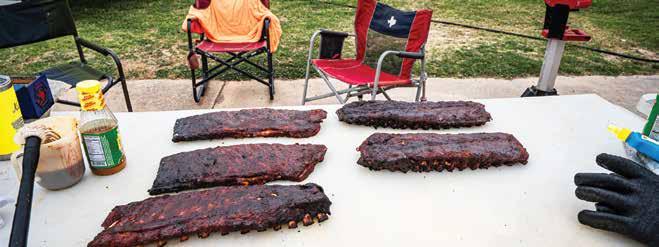
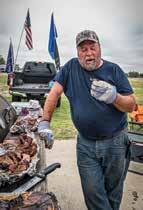
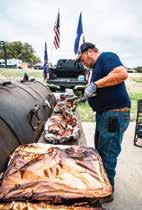
Barbecue is always a mouthwatering sight to everyone who enjoys a weekend of barbecuing delight.
Our annual Bucks & BBQ event hosted 49 barbeque-cooking teams vying for cash prizes at the National Shooting Sports Complex in San Antonio in late March. As always, everyone had plenty of food and fun. Go to page 8 to see who won Grand Champion, Reserve Grand Champion, and the rest of the winners.


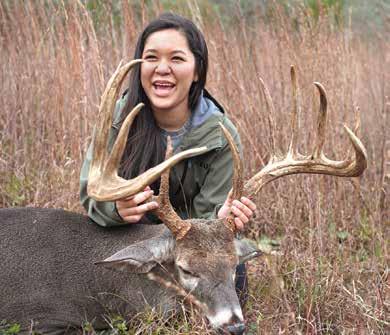
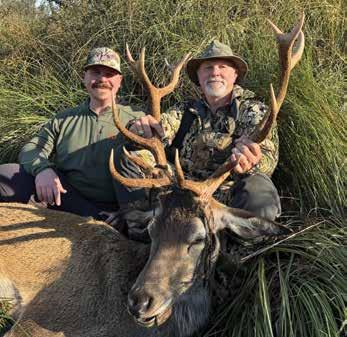
Here are two photos of the newest member in our TTHA family, Wayne Burr Pittman, born April 17. His mother, President & CEO Christina Pittman, and father, Matt Pittman, are the proud parents. Wayne joins his two older siblings, Ava and Gunnar. Welcome, Wayne!




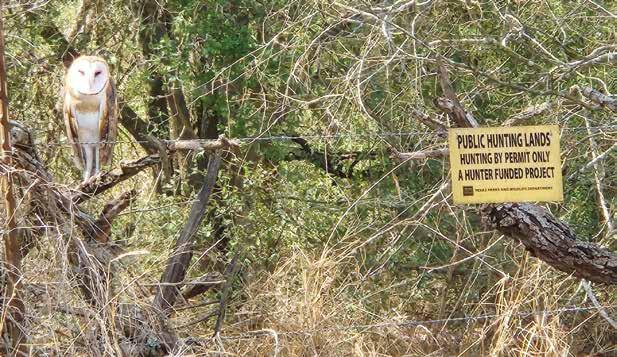
Texas Parks and Wildlife’s Las Palomas Wildlife Management Area is an umbrella term encompassing 18 units in the Lower Rio Grande Valley in deep South Texas. They range in size from the Baird Unit of 28 acres to the Arroyo Colorado Unit’s 900 acres. The various areas are located in Starr, Hidalgo, Willacy, and Cameron counties.
Due to multiple, continual changes in agriculture, industry, and human population, LPWMA units function with intent on preserving whitewing dove habitat. Having areas for song birds and other avian species to rest during migration is also an important part of these large and small properties.
TPWD’s Project Leader Jimmy Stout has been at LPWMA for 17 years. “Things have changed so much down here in the Lower Rio Grande Valley,” he said. “Loss of habitat is why we have so many small parcels, much of which is not open to the public. We are an intricate part of conserving natural environment in this area.”
Only nine of LPWMA’s

18 units are open to the public, with some of them allowing entry only on a portion of its entirety. One reason is for doves and other birds to remain undisturbed whether nesting or resting. Several units are contiguous while others are miles apart. Again, it’s about protecting habitat.
Stout said, “Our focus is on hunting, particularly whitewing doves. This part of Texas is historically known for its whitewings. It’s just a good area. We plant food plots to help the birds but also the hunters. We do offer a few deer and javelina hunts and we’re the only WMA offering chachalaca hunts.”
Chachalaca are pheasant sized birds found in deep South
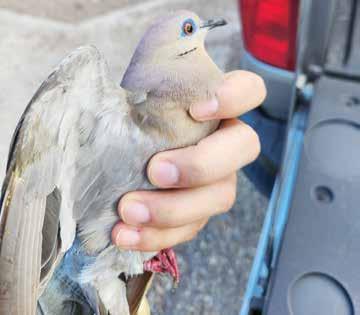
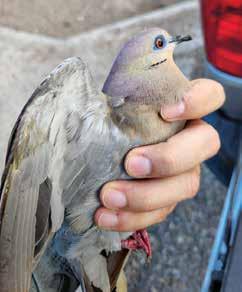
Banding birds such as this whitewing dove enable tracking migration when bands get reported.
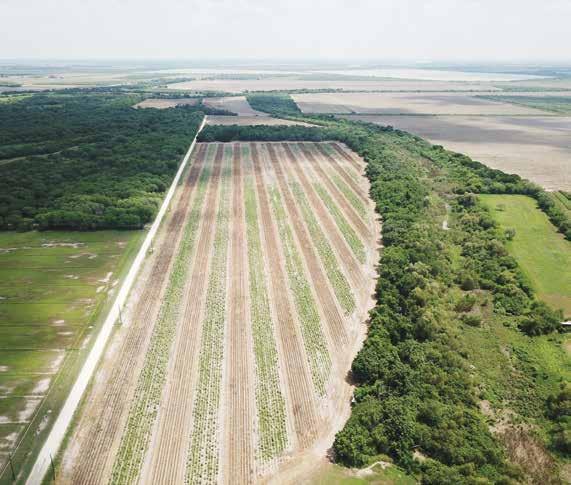
Several Las Palomas WMA units feature outstanding dove hunting due to TPWD planting sunflowers. This aerial photo is the Ebony Unit.
Texas and Mexico as well as Central and South America. A distinctive, raucous call some compare to a car alarm or strangled laugh distinguishes them from other birds. They feature long tails with mixed plumage of gray, brown, and white that offer great camouflage.
Chachalaca season generally runs late October into February with a limit of five birds per day. It’s not an easy hunt but a challenging one, according to several hunters. An Upland Game Bird Endorsement is required on your hunting license.
As with all WMAs within our TPWD system, research projects play important roles. The Lower Rio Grande Valley has many unique features with its usually mild climate. The citrus industry once dominated the landscape, but harsh freezes, hurricanes, and lack of water in certain areas have taken an immense toll. Thus, Las Palomas units’ habitat is vital to what’s known to many people as simply “The Valley.”
Every area needs a wildlife biologist. Ernesto GarciaOrtega fills that spot for LPWMA and the Lower Rio Grande Valley Ecosystem Project. As part of his duties, GarciaOrtega assists private landowners while also serving as an urban biologist.
When asked about research projects, Garcia-Ortega said, “There are no studies at the moment. We do have a bird bander who bands mostly song birds year-round. Raptors, doves, and other birds have also been banded. Snake fungal disease has been investigated while mosquito and kissing bug research has been conducted, too.”
Garcia-Ortega said Las Palomas units and private landowners participated in a javelina spatial ecology study by Texas A&M University. Its aim is to enhance understanding the collared peccary population dynamics and habitat usage. Many misconceptions exist surrounding this interesting animal. GPS collars, game cameras, roadside and helicopter survey methods are a few of the tools used for the research. One goal is to estimate javelina population numbers.
Dove hunting is a priority of the South Texas region, more specifically, whitewing dove hunting. Several Las Palomas units are for that specific purpose with the land farmed and

planted for dove hunting.
“Hunters must possess a Limited Use Permit or Annual Public Hunting permit to access our hunting areas. We plant sunflowers, milo, and other seed producing grains doves love for the birds but also to enhance hunter chances.” Barring a tropical storm or hurricane, hunters may easily limit out on a typical day’s hunt.
There are a few deer and javelina hunts offered by drawings with some standby positions occasionally open. As with any hunt, success is not guaranteed. Much depends on weather conditions, food source availability in the immediate area, and of course, hunter skill and knowledge of species being hunted.
Youth hunts on Las Palomas units often have the most success rate. TPWD’s online drawing system is posted during the summer with different deadlines for signing up. Details of all hunts offered with statistics on last year’s success rate are included to help hunters decide where and what to apply for chances at being selected.
Bird watchers find much to do at the Las Palomas units open to the public. The Arroyo Colorado unit has recorded 255 different bird species while the Ebony and Anacua units both had over 220 spotted. With over 100 species sighted are the Longoria, Tucker and Carricitas, all popular with those wishing to see multiple aerial flyers.
For dove hunters, bird watchers, and other nature enthusiasts, add Las Palomas WMA to your list of places to visit. Maps and directions may be found on TPWD’s website. Have fun and good luck.


You might want to make sure your driver’s license is up to date and on-hand before you purchase a new hunting or fishing license in Texas for the upcoming season.
Texas Parks and Wildlife Commissioners approved updated proof of residency requirements for residents, nonresidents, and foreign residents buying a recreational hunting or fishing license. The new requirement takes effect Aug. 1, two weeks before annual hunting and fishing licenses become available for purchase Aug. 15.
Per a TPWD press release, the intention is aimed at preventing fraud and misrepresentation for Texas residency status by ensuring individuals do not unlawfully obtain resident-prices, licenses, or benefits at the point-of-sale. People wishing to purchase TPWD licenses must present an unexpired driver’s license or personal identification certificate.
Residents of the District of Columbia and 19 other states including California, Colorado, Connecticut, Delaware, Hawaii, Illinois, Massachusetts, Maryland, Minnesota, Nevada, New Jersey, New Mexico, New York, Oregon, Rhode Island, Utah, Vermont, Virginia and Washington, will need to present an unexpired driver’s license or personal identification certificate that complies with the federal REAL ID Act of 2005, or an unexpired non-REAL ID compliant driver’s license or state identification certificate plus an unexpired United States of America passport or passport
card, U.S. military identification card, Texas license to carry a handgun, or an original birth certificate, or original U.S. government issued document of a child born abroad to U.S. citizens.
Residents of a foreign country must present a valid foreign passport and other documents required for entry into the United States.
The Texas Parks and Wildlife Commission has approved the following changes to 2026-27 Statewide Hunting and Migratory Game Bird proclamations:
Migratory
The South Zone dove hunting season structure during the first segment will include an earlier regular season opening date (Sept. 1 – Oct. 25), eliminate the Special White-winged Dove Days, and institute standardized daily bag limits and shooting hours across all days in the South Zone. The second segment will be Dec. 18, 2026, to Jan. 21, 2027.
Upland Game Bird Regulations
Chachalaca and quail hunting season dates were aligned (Nov. 1, 2026 – Feb. 28, 2027).
Matagorda and Wharton counties were closed to wild turkey hunting due to the decline in wild turkey populations in the area. Due to the overall decline in wild turkey populations across Texas, annual bag limits were changed to only gobblers and bearded hens in counties where either sex is currently allowed for wild turkey hunting.
“Doe days” were expanded to a 16-day season that begins the second Saturday of General Season and closes the Sunday following Thanksgiving in Austin, Bastrop, Caldwell, Colorado, Comal (east of IH 35), DeWitt, Fayette, Goliad (north of U.S. Highway 59), Gonzales, Guadalupe, Hays (east of IH 35), Jackson (north of U.S. Highway 59), Karnes, Lavaca, Lee, Travis (east of IH 35), Victoria (north of U.S. Highway 59), Waller, Washington, Wharton (north of U.S. Highway 59), and Wilson counties.
The definition of “muzzleloader” was defined to allow the use of new muzzleloading technology for the take of whitetailed deer.
Hunters hitting the field in the upcoming season should make note of these changes and follow all regulations set for species, tagging, bag limits, counties, season dates, means and methods. Hunters can check the Outdoor Annual for approved season dates for the 2026-27 season. —courtesy TPWD
The Texas Parks and Wildlife Department announced the 2026 winners of the Texas division of the Wildlife Forever’s Fish Art Contest. The contest is housed and administered by TPWD’s Texas Freshwater Fisheries Center (TFFC) in Athens.
Judges chose 14 out of 714 total entries to be featured in the 2027 Texas Fish Art Calendar and displayed in an exhibit at TFFC.
The Fish Art Contest is part of an international conservation education
program designed to foster youth interest in fish, fisheries and fishing. The program encourages K-12 students to submit original artwork of any fish and a creative writing piece (grades 4-12) about the participant’s fish entry, its
habitat or efforts to conserve it.
“The Fish Art contest is just one way in which we can help students connect with the outdoors,” said Darrel Malone, education and interpretation coordinator at TFFC. “As they research their chosen


fish species and begin to learn about its habitat, they begin to find a personal connection to their fish. This connection can help inspire the future stewards of our natural resources. The Fish Art Contest is more than just drawing a fish, it helps our youth to establish a bond with the outdoors.”
Students are placed into grade categories for judging, where their skills are more closely matched. The judges grade the art based on accuracy of the chosen species, accuracy of the habitat, and the artist’s creativity, to choose the winners for each grade category.
In the K-3 category, the winners are: First place, Jeremiah Lee of Dallas; second place, Franco Du of Flower Mound; third place, Nora Cheng of Austin.
In the grades 4-6 category, the winners are: First place, Candice Chen of Bee Cave; second place, Eva Huang of Austin; third place, Yueran Lang of Austin.
In the grades 7-9 category, the winners are: First place, Alice Zhang of Manvel; second place, Annabelle Yuan of Frisco; third place, Ivan Zaklyazminskiy of Frisco.
In the grades 10-12 category, the winners are: First place, Dalia Morales of Houston; second place, Eliza Chung of Bee Cave; third place, Adrienne Wang of Houston.
Additionally, the contest has a Special Species Award category that showcases a focused species or set of species. For the 2025-2026 contest year, the focus species was the paddlefish (Polyodon spathula). This year’s winner is Annabelle Yuan of Frisco, whose artwork was chosen from all entries and will be spotlighted at TFFC.
Texas has protected the paddlefish since 1977, recognizing it as an imperiled species in need of conservation attention. Paddlefish numbers began to dwindle in Texas rivers beginning in the mid-1900s primarily due to changes in its habitat. Paddlefish need expansive reaches of free-flowing rivers, rocky shoals, and specific river flow patterns to successfully reproduce. TPWD is currently partnering with universities, local nongovernmental organizations,
and other government agencies on population surveys, habitat improvements, and experimental stockings to help the species rebound.
The Mighty Minnow Award celebrates the creativity and talent of kindergarten participants in the K-3 age group. This special recognition gives the youngest artists a chance to be honored for their efforts and abilities, based on age-appropriate expectations. The Texas award went to kindergartner Haasya Doddapaneni of Frisco and will also be spotlighted at TFFC.
First place winners in each of the four age groups advanced to the national level and will compete against winners from other states.
Scholarships for the first, second and third place Texas winners are awarded as follows: grades 10–12 division scholarships are $1,000 for first place, $750 for second place and $500 for third place; awards in the 4–6 and 7–9 grade levels are $200 for first, $150 for second, $100 for third; in the K-3 division awards are $100 for first, $75 for second, $50 for third.
Scholarships for Texas winners are supplemented by the Friends of Texas Freshwater Fisheries Center.
Visit TPWD’s Flickr page to see the winning entries. Educators who wish to have their students enter the 2027 contest can find entry forms, rules, guidelines and more online at Texas Fish Art Contest — TPWD. Learn more at wildlifeforever.org.
On March 24, a federal district court entered a judgment enjoining California from enforcing a law that bans marketing firearms in “a manner attractive to minors.” SCI, along with coalition partners the Congressional Sportsmen’s Foundation, Sportsmen’s Alliance Foundation, and youth shooting club So Cal Top Guns, challenged the law in a case supported by the National Rifle Association of America.
The plaintiffs alleged concerns that the law would chill lawful and healthy
youth hunting and shooting activities.
Previously, the U.S. Court of Appeals for the Ninth Circuit held that California’s law violated the First Amendment by overly restricting lawful speech without advancing the State’s asserted goal of reducing gun violence by minors.
“SCI has twice celebrated court orders holding that California’s law is wrong, does not advance the state’s so-called public safety goals, and infringes lawful and protected speech. It is past time for California to admit its mistakes and stop restricting the rights of those who support hunting and shooting,” said W. Laird Hamberlin, Chief Executive Officer of SCI.
The district court approved a settlement agreement declaring that the California law is void in its entirety, barring California from enforcing the law, and requiring the State to pay nearly $500,000 in attorneys’ fees. —courtesy SCI
The Sport Fish Restoration and Boating Trust Fund is a cornerstone of the American System of Conservation Funding, delivering critical, dedicated funding to state fish and wildlife agencies for fisheries management, boating access, and safety programs. Congressional action is required every five years to maintain the Fund’s revenue streams tied to marine and small engine fuel taxes. The fund generated more than $790 million in fiscal year 2025 for fisheries conservation, boating infrastructure, and safety programs. Periodic reauthorization is required to sustain collections from fuel-based excise taxes.
Senators Dan Sullivan of Alaska and Maria Cantwell of Washington introduced S. 4250 to reauthorize the program through the Sport Fish Restoration, Recreational Boating Safety, and Wildlife Restoration Act of 2026. Last year marked the 75th anniversary of the Trust Fund, a critical component of the American System of Conservation Funding. Congressional Sportsmen’s Foundation (CSF), along with the Angling and Boating Alliance, continues to work closely with Congress to ensure the long-term
stability and success of this vital program for anglers, boaters, and the nation’s aquatic resources.
“The Sport Fish Restoration and Boating Trust Fund, together with fishing license revenues, serves as the cornerstone of state-led fisheries conservation across the United States,” said Taylor Schmitz, CSF’s Senior Vice President. “This uniquely American model has proven extraordinarily effective in sustaining aquatic resources and providing critical access. We commend Senators Sullivan and Cantwell, along with the bill’s original cosponsors, for their leadership in advancing the reauthorization and longterm protection of this vital program for future generations.”
Originally established in 1950 as the Federal Aid in Sport Fish Restoration Act, often cited as the Dingell-Johnson Act, the program was expanded in 1984 to include additional excise taxes on items such as marine and small engine fuels. Today, it’s widely recognized as an integral component of the most successful “user pays – public benefits” conservation funding models in the world. Through excise taxes on fishing equipment, trolling motors, and motorboat fuels, the Fund supports fisheries management, habitat restoration, boating access, and safety initiatives. Generating more than $700 million annually, the program is essential to ensuring state agencies can effectively manage and conserve aquatic resources for the benefit of anglers, boaters, and the broader public.
CSF looks forward to working with the bill’s sponsors, which also includes Congressional Sportsmen’s Caucus (CSC) Vice Chair Senator Gary Peters (Mich.) and CSC Members Senators Roger Wicker (Miss.), Tim Sheehy (Mont.), Marsha Blacburn (Tenn.) and Amy Klobuchar (Minn.) to ensure the successful reauthorization of this critical conservation funding mechanism. —courtesy Congressional Sportsmen’s Foundation
Sportsmen Score Big on House Passage of Four Congressional Sportsmen’s Foundation-Backed Bills
In mid-March, the U.S. House of Representatives passed four legislative
priorities for the Congressional Sportsmen’s Foundation (CSF): the Protecting Access for Hunters and Anglers Act, the Mitigation Action and Watermen Support (MAWS) Act of 2026, the PostDisaster Reforestation and Restoration Act of 2025, and the Save Our Sequoias (SOS) Act. Thanks to the active work of Members of the Congressional Sportsmen’s Caucus (CSC), the 119th Congress continues to deliver meaningful wins for America’s sporting community.
The Protecting Access for Hunters and Anglers Act (H.R. 556), led by CSC Member Rep. Rob Wittman, passed on a bipartisan vote. Additionally, the MAWS Act (H.R. 4294), led by Rep. Sarah Elfreth and Rep. Rob Wittman, passed the House on an overwhelming vote of 320-66 on March 17. The Post-Disaster Reforestation and Restoration Act of 2025 (H.R. 528), led by Rep. Brittany Pettersen and CSC Member Rep. Chuck Edwards, and the SOS Act (H.R. 2709), led by Rep. Vince Fong, Rep. Scott Peters, and CSC Co-Chairs Rep. Bruce Westerman and Rep. Jimmy Panetta, both cleared the House earlier in the week on voice votes.
“CSF thanks the Members of the Congressional Sportsmen’s Caucus for leading bipartisan efforts to advance critical legislation for hunters and anglers,” said CSF Senior Vice President Taylor Schmitz. “From protecting access to public lands and waters to addressing invasive species in the Chesapeake Bay to restoring forests after natural disasters and strengthening wildfire resilience for iconic landscapes, these bills represent meaningful progress for conservation and outdoor traditions. We look forward to working with CSC Members in the Senate to send this legislation to the President’s desk.”
The Protecting Access for Hunters and Anglers Act would require certain science-based triggers to be met prior to banning the use of any lead ammunition or fishing tackle on lands and waters managed by the Secretaries of Agriculture and the Interior. This legislation does not prevent federal or state govern-
ments from placing site-specific prohibitions on the use of traditional ammunition or tackle. However, any proposed ban must follow a scientific process and be consistent and approved by the respective state fish and wildlife agency.
The Mitigation Action and Waterman Support Act directs the Secretary of Commerce to establish a pilot program that adds an additional market pathway as a tool for controlling invasive blue catfish harvested from the Chesapeake Bay watershed. The program will support partnerships with seafood processors and the pet food and animal feed industries to expand utilization of this invasive species. The rapid expansion of invasive blue catfish in the Chesapeake Bay poses a serious threat to native species and the broader ecosystem, placing additional pressure on already stressed fisheries and iconic recreational and commercial resources like striped bass, red drum, blue crab, and oysters
The Post-Disaster Reforestation and Restoration Act of 2025 will support reforestation and restoration on federal and Tribal forest lands after “unplanned disturbances.” Recent wildfires, hurricanes, and other natural disasters underscore the need for proactive coordination to restore forests, including artificial regeneration, to support community recovery. The legislation will help the U.S. Forest Service address its extensive reforestation backlog. A similar provision was included in the Fix Our Forests Act (H.R. 471), which passed the House in January 2025 with strong bipartisan support.
The SOS Act will increase coordination among federal, state, Tribal, and local governments to restore forest health in giant sequoia groves. Limited in distribution to roughly 70 sites in California, this fire-adapted iconic species is increasingly threatened by standreplacing fires due to a lack of active forest management. The legislation will
increase giant sequoia resilience to high-severity wildfires by reducing hazardous
fuel loads and supporting the reforestation of stands destroyed by wildfires. Similar versions of the legislation were introduced in the last two Congresses.
CSF appreciates the dedication of the CSC Leadership and Members, as well as the other bill sponsors, for continuing to champion legislation that supports science-based natural resource management and improves access for sportsmen and women. —courtesy Congressional Sportsmen’s Foundation
The Congressional Sportsmen’s Foundation (CSF) announced March 25 that Pennsylvania Gov. Josh Shapiro has been appointed to serve a two-year term as the new Democrat Co-Chair of the Governors Sportsmen’s Caucus (GSC) –one of three caucus programs under the CSF umbrella.
Gov. Shapiro joined the GSC in 2025. That same year, he signed Act No. 36 into law, repealing the Commonwealth’s longstanding ban on Sunday hunting. Shapiro said, “Here in Pennsylvania, with the second-largest population of licensed hunters, we’ve taken steps — including repealing the outdated ban on Sunday hunting — to expand opportunities to spend time outdoors, support rural communities, and pass these important traditions to the next generation.”
He added, “Hunting and outdoor recreation support thousands of jobs and contribute over $1.6 billion to Pennsylvania’s economy each year, and I look forward to collaborating with governors across the country to deliver real results for sportsmen and women.”
“The Congressional Sportsmen’s Foundation thanks Gov. Shapiro for his willingness to serve as a leader of the bipartisan Governors Sportsmen’s Caucus.” said Brent Miller, vice president of policy for CSF. — courtesy Congressional Sportsmen’s Foundation

By Dr. James C. Kroll

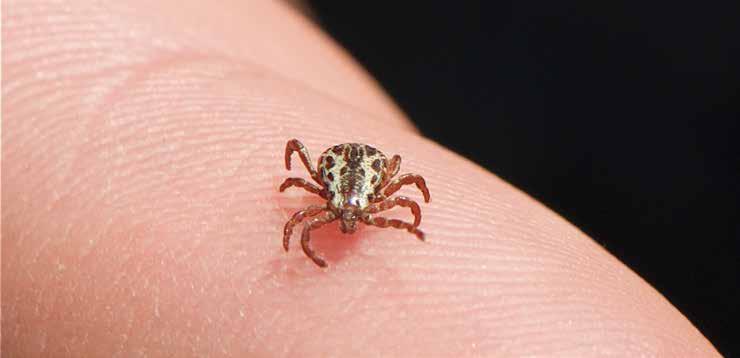
The American dog tick transmits Rocky Mountain spotted fever and tularemia to humans. It thrives in Texas.

Spend enough time in whitetail country and you learn quickly not all threats come with antlers or teeth. Some of the most consequential players in deer ecology are measured in millimeters, not pounds. Ticks—long viewed as little more than an annoyance—are now front and center in conversations about wildlife health, hunter safety, and even human diet. When I began my research career in 1973, organizing a new research program as The Institute for Whitetailed Deer Management & Research at Stephen F. Austin State University’s College of Forestry, I fully expected to encounter many challenges.
However, one of the challenges I never even considered was how many ticks lurked in the forests of eastern Texas. Growing up in Central Texas, I cannot remember ever finding a tick imbedded in my body as a child. East Texas turned out to be awash with these pesky creatures, and I quickly learned a single deer could harbor as many as 90-100 ticks, not to mention their “buddies,” deer keds. By the late 1980s, deer populations were at an all-time high, and so were ticks.
Tick species in the U.S.
White-tailed deer serve as critical hosts for many tick species, not just eastern Texas, but across the expanse of the United States and Canada. I quickly learned they’re far more than just a nuisance. These diminutive creatures can be quite dangerous. While deer themselves are often resilient to tick infestations, they’re commonly essential to the life cycle and distribution of ticks, which in turn carry a growing list of diseases affecting both deer and people.
As of today, six species of ticks infest the forests, brushlands and prairies of North America. Among these six, I found eight diseases and one syndrome attributed to ticks in North America: Lyme disease, anaplasmosis, babesiosis, Powassan virus, ehrlichiosis, tularemia, alpha-gal syndrome, Rocky Mountain spotted fever, and Rickettsia parkeri. In deer, heavy infestations can reduce body condition in deer and other ungulates, killing fawns in some cases.
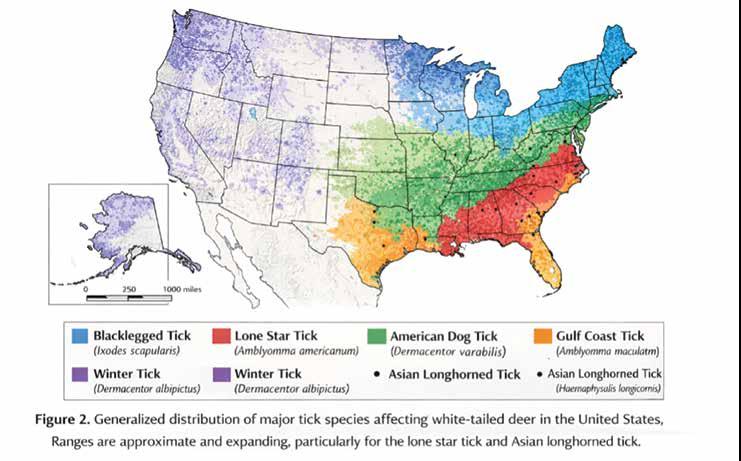
There are some tick species inhabiting the vast majority of the United States, as the distribution map shows (see page 21). Although all the aforementioned diseases are nothing to take

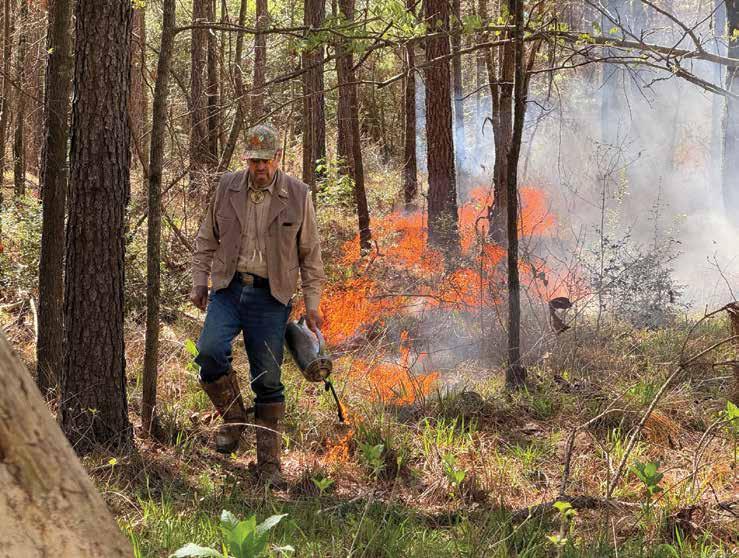
Dr. Kroll says prescribed fire controls ticks. Native Americans effectivley used this method.
lightly, the two that have come to prominence in the last three decades are Lyme disease and alpha-gal syndrome.
Lyme disease (named after the town of Lyme, Connecticut) is a bacterial infection (Borrelia burgdorferi) transmitted by infected black-legged ticks. Infection begins with the characteristic “bull’s-eye”rash around the tick bite, fever, headache, and fatigue. Left untreated with antibioltics, it can lead to chronic joint pain, inflammation of the brain (meningitis), nerve damage, and memory problems. It’s thought to reservoir in rodent populations, ironically deer mice.
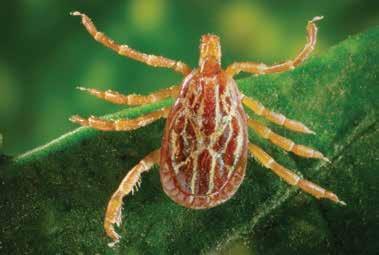
One of the most remarkable recent discoveries tied to ticks is alpha-gal syndrome—a condition triggered by bites from the Lone Star tick. This syndrome causes an allergic reaction to red meat and other mammalian products. Unlike traditional food allergies, reactions often occur several hours after consumption, making diagnosis challenging.
For hunters and land managers, this represents a direct and personal connection between time spent in the outdoors and long-term dietary impacts.
The only treatment to date is time. Some of the folks suffering from the disease may eventually lose the allergic reaction. I have a good friend who contracted this malady, and suffered for about 3 years, later, experiencing some relief.
Ticks represent a growing interface between deer, habitat, and human health. There are two practical approaches to “managing” ticks—protecting yourself from ticks when you’re in the woods, and on a broader scale, managing their hosts. Minimizing exposure to ticks is a must when you’re in the woods.
Use EPA-registered repellents containing 20% or more DEET, picaridin, or IR3535 on exposed skin. Use 0.5% permethrin to treat clothing, boots, and gear, but avoid direct skin contact. When you find an imbedded tick, use needle-nosed forceps to grip the tick as close to the skin as possible, and pull upward without twisting the tick. To avoid Lyme infection, keep an eye on the bite location for the “bull’s-eye” rash for 30 days. On a broader scale, tick populations can be tied to dense populations of deer and rodents. By manipulating population densities and habitats conducive to ticks, we can reduce risk. Ticks are not new on the scene for humans. Native Americans

were very familiar with ticks and regularly burned the forests, both to increase wildlife foods and to control pests such as ticks.
If your primary exposure is on your property: Since 2000, deer populations have pretty much saturated their range, and are at carrying capacity in most areas. Wildlife diseases and parasites often are “density-dependent,” meaning their impact is directly related to the density of the population. The solution can rest with proper deer population management through harvest, and habitat management.
The problem is that neither are in play in today’s world. Hunter numbers in some areas are declining, especially those where diseases such as Lyme is highest. And, what we call the wildland urban interface (WUI) is increasing dramatically, increasingly exposing humans and wildlife to co-exist. Support for prescribed fire is very low, creating both habitat for ticks and other pests, and increased wildfire danger.
Ticks are expanding across the landscape, and with them, the risks they carry. For today’s landowner or deer manager, understanding ticks is no longer optional. It is essential. The story of ticks and whitetails is not just about parasites, but about the broader ecological web connecting wildlife and people.



The purpose of the rifle for the modern hunter is to punch a properly constructed projectile deep enough, in the right location, to impact the vitals of the animal being hunted. Everything from 6mms like the .243 Winchester to the big thirties have been used for Texas whitetail, though we would hazard a guess that the medium bores have the biggest following.
The middle section of this caliber range is imminently suitable for the Texas hunter. With our normally less than monster deer, cartridges spawned by reworking the .308 Winchester case have proven extremely successful since their introduction starting in the mid-1950s. This class includes notable cartridges such as the .243 Winchester, .260 Remington and 7mm-08 Remington, right along with the .308.
Many of the newly designed cartridges have provided incremental improvements to legacy chamberings. The Creedmoor and PRC families are prime examples of this. Most of the case taper, long thought absolutely essential for feeding, has been blown out to almost straight walls. The resulting change in case geometry allows for more powder even in a shorter case. Shoulder angles have been increased to aid in efficient powder burn and to lengthen barrel life. Chambers have been redesigned to eliminate excess head space and tighten the throat. These barrels frequently have a faster twists to stabilize longer, heavier bullets. Accuracy, efficiency and energy have all been improved. What’s not to like?
Perhaps the best known and the most commonly used cartridge in this class is the 6.5 Creedmoor. The result of reforming a .30 TC case, ever so slightly shorter
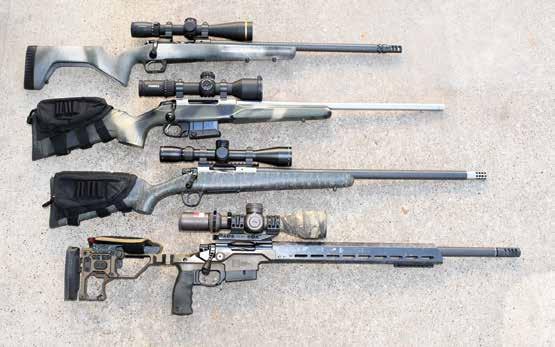
The data and the hunting pics for the article came courtesy of four great rifles: (top to bottom) a Springfield Armory Redline 6.5 CM, a Tikka T3X CTR 6.5 CM, a Christensen Arms Ridgeline 6.5 PRC, and a Christensen Arms MPR 6.5 PRC. The first three have taken more deer than the rest of the author’s battery combined. The last one is his long-range champ.
than .308 brass, it pushes a mediumweight 0.264-inch-diameter projectile downrange at medium velocities. I know, ho hum. My experience though, has been the whole product is considerably greater than the sum of the parts.
First, let’s look at the recoil. I’ve been teaching people how to shoot rifles for the last 16 years. Most of the time the students bring their own gear and get to learn with what they’re going to hunt with. Sometimes that’s not the case, and I’m asked to provide a rifle. Because excess recoil is very detrimental to the new shooter, I provide a Tikka T3X CTR in 6.5 CM. Recoil is very manageable at 12 footpounds of force, and then I mount a good Vortex PST II 3-15X44 scope on it. I know if there’s a problem, it isn’t the gear. Accuracy has never been an issue with
me from my 6.5 CMs. Both my Tikka and my Springfield Armory Redline will shoot sub-0.75-inch-groups on a bad day. The Tikka is a bit heavier and sits wonderfully on a bag for long range shooting. The Redline sports a 20-inch barrel and works great in a deer blind with my Dead Air Sandman-S suppressor attached.
In years past, we pseudo-preppers, who want cartridges that will fit AR-15 or AR10-length receivers with readily available factory ammo, would have been limited to .308 Win., .223 Rem./5.56mm, and a few others. Now you can add the 6.5 CM to that list. My shooting has led me to prefer Hornady ammunition for the 6.5 CM, both the 140-grain ELD-M (Extremely Low Drag — Match) for targets and the 143-grain ELD-X (eXpanding) load for hunting. An experienced reloader, I’ve a
tried 120- and 129-grain bullets along with heavier ones (156-grain Bergers). The 140s and 143s have given the best results for me on game, letting me take every deer I’ve shot with any 6.5 CM load.
I have seen where some would title the 6.5 Creedmoor the 6.5 “Needmore.” If you need more knock-down energy or better retained energy at longer ranges, by all means, select a bigger cartridge. I have a suggestion for that in a minute. But I wonder how many of the 6.5 CM naysayers have done actual comparisons to
other outstanding traditional cartridges. Curious, I ran projections for the 6.5 CM versus the well-known and highly regarded .270 Winchester in the latter’s most popular 130-grain load, looking at velocity and energy at the muzzle and at 100 yards, plus trajectory, and all those plus wind drift at 200 and 500 yards.
Muzzle velocity, as expected, was 360 fps higher for the .270 with a 130-grain bullet, and energy at the muzzle was nearly 400 foot-pounds greater than the 6.5 CM, but the trade-off was less recoil
energy for the shooter, a full 4.88 footpounds less. At 200 yards, things began going more the 6.5 CM’s way. Wind drift was less for the 6.5 CM in a 10-mph breeze, and the velocity gap began to close, as did energy. I would opine that few of us would thumb our noses at the .270 for thin-skinned game, and while the 6.5 Creedmoor stays behind the .270 in most areas of performance, the CM still has plenty of energy to humanely take a Texas whitetail at distances most shooters feel comfortable taking a shot.
Zero distance is 200 yards. Hornady factory velocities are with 24-inch test barrels. Downrange projections for drift were determined via the Applied Ballistics Quantum app, using velocities listed on the Hornady factory ammo boxes. Velocities are in feet per second (fps). Energies are in foot-pounds (ft.-lbs.) Drifts and drops are in inches (in.). Wind speeds are in miles per hour (mph). Drifts assume full-value 90-degree wind angle. Recoil energies were calculated assuming a Remington 700 CDL at 9.16 pounds and weighed powder charges.
But if you like/want/need a little more energy, perhaps something that could double as a good elk rifle, take a long look at the 6.5 PRC. Designed with the same improvements seen in the 6.5 CM, the 6.5 uses a necked-down .375 Ruger case instead of a .30 TC. It has a bigger boiler room and more energy as a result. It will do everything the 6.5 CM will do, but a little better. I used one of mine to score hits on a metal plate at a mile, so it’s slippery and has reach. Of course, it will have a bit more recoil at 16.96 foot-pounds — on par with the .270, but behind the guns, I can’t tell the difference — and ammo will not be quite as easy to find nor as affordable than the 6.5 CM.
In the tables, you can see that the .270 Win. is an extremely flat-shooting cartridge and that it beats both the 6.5 CM and the 6.5 PRC out of the gate. But experience also shows us that, especially with the advent of the modern range finder, velocity has become less of an issue. In fact, again in our experience, more shooters and hunters miss because of wind. The saying in the business is “elevation is science, wind is voodoo.” Both 6.5s top the .270 by a fairly large margin in resisting wind deflection, and they carry energy further downrange. In fact, at 500 yards,
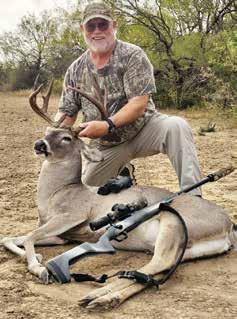
I’ve taken more deer with my Christensen Ridgeline 6.5 PRC than any other rifle in my safe. The most accurate long gun I own (except for dedicated match rifles), that 6.5 PRC has absolutely been nails with heavier bullets. The Hornady factory loads have performed extremely well, but mine have also done very well with Berger 153 Hybrid Target and 156-grain EOL reloads. It pushes a heavier projectile about 150 fps faster than the 6.5 CM, and the effect on game has been incredible.
the CM edges out the .270 in energy while having better drift results, and the PRC holds a 320-foot-pound energy edge way out there, and has nearly a full pie plate less drift in a 10-mph wind at 500 yards.
I actually scared a deer to death with it one time. We were on a cull hunt near Uvalde, assigned to take a number of mature does. I picked my animal, she turned broadside, I called a good shot, and she fell down. When she fell, she was muzzleon to me, and I sat there and watched her. Eventually, she lifted her left hind leg and then her neck. Wondering if I had hit her as hard as I thought, I anchored her with a second shot from front to back. When we quartered her out later, there weren’t any holes left to right. Just the two front to back. Yep, she fell down. I have witnesses! I don’t know if your 6.5 CM or 6.5 PRC will flash magic for you, but they’re certainly well worth considering for your hunting battery.


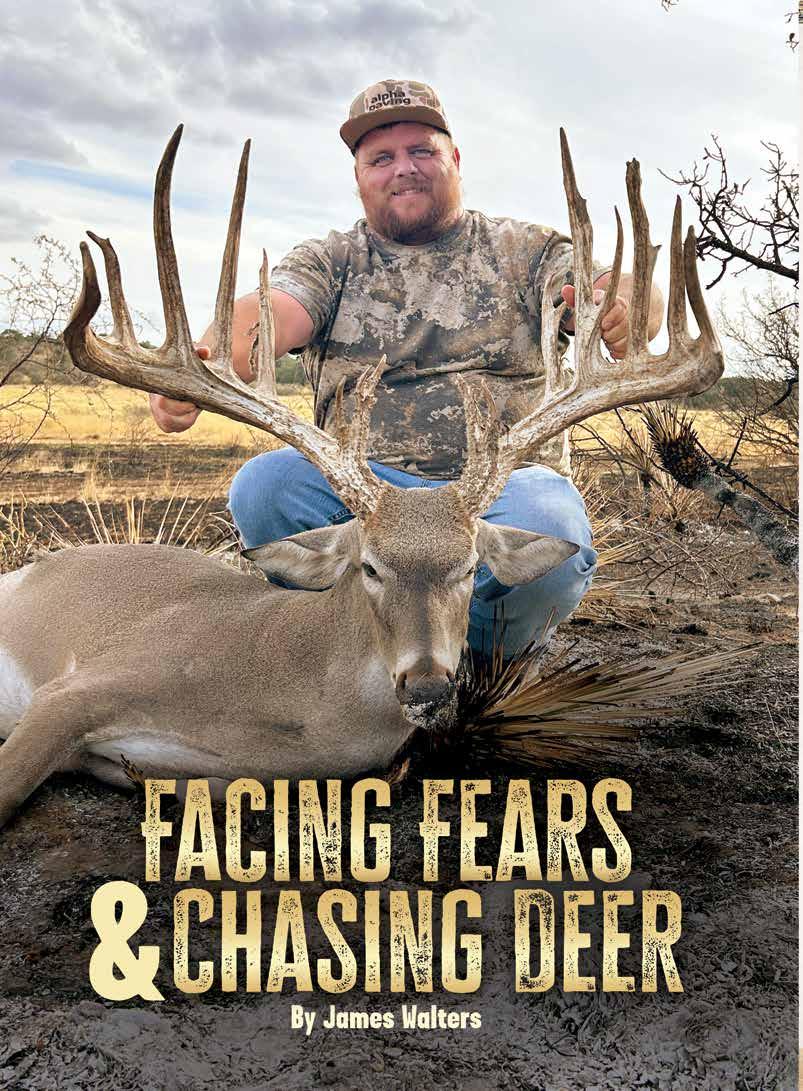
James finally fulfilled his dream of getting a big trophy buck. The path that led him to eventually taking his buck took a few unexpected turns.
When I was 20, I got my first tattoo. Not knowing what to get, I just wanted something cool. After thinking about it, I decided to get nothing other than the Texas Trophy Hunters logo. It was cool and I loved hunting, but had never killed any big buck. I only had dreams of killing one someday.
Years went by and I continued to hunt, gaining more experience and knowledge. My family size increased, too: two boys and two girls. My oldest son, Bubba, now 15, has grown to love the sport and goes with me every chance he gets.
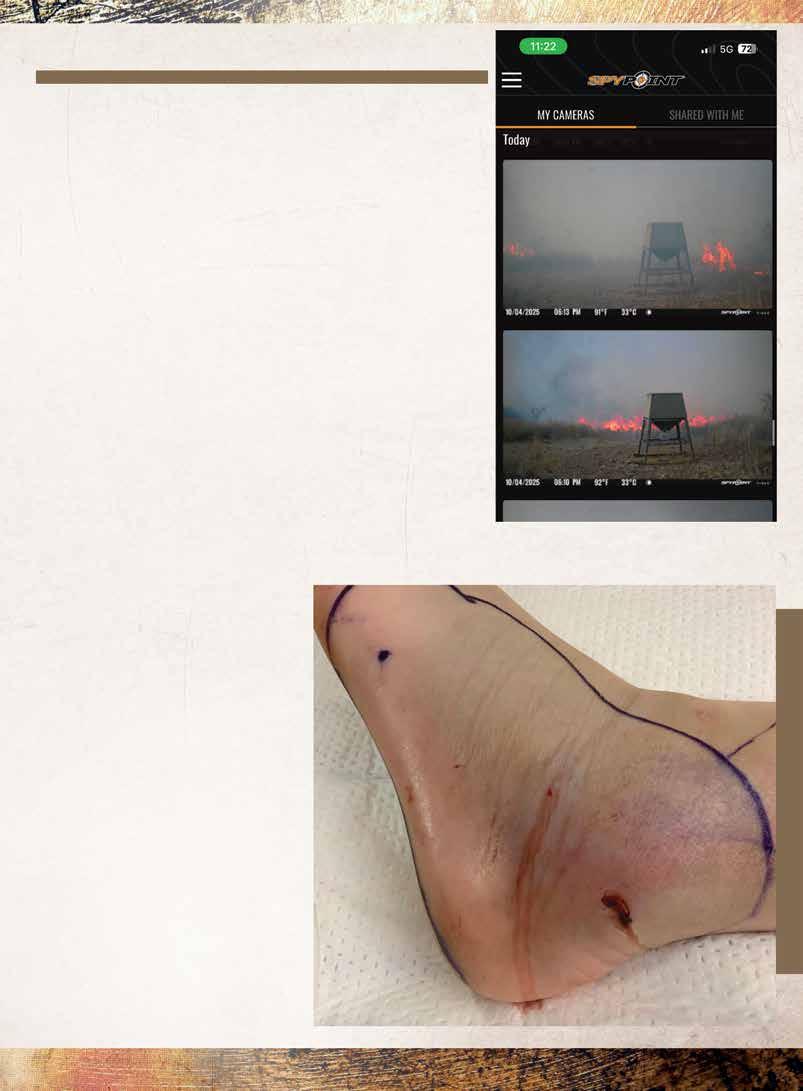
When he was 10, we had a deer lease in Richland Springs, Texas. We always had a great time with friends and family there. We had a great setup at camp with a concrete outdoor area and an outdoor bar. We had an old cooler for ice bags, like the ones that you see out in front of gas stations. At one point, the guys kept corn in it to keep it from getting wet. Bubba was walking by the cooler one day when a rattlesnake came out from underneath it and bit him in the ankle. He yelled when it did.
My friends and I ran over to him. We rolled down his sock, and could see the fang marks. Bubba, my wife and I took off in the truck right away. Thank God the ranch owner was there, yelling out at us, “Go to Brownwood. They have antivenom!” So, I set the GPS to Brownwood and my wife got on the phone with 911.
The 911 operator wanted us to pull over and wait for an ambulance. I told the operator to send it towards us and I would pull over when we saw it. We were driving up and down hills and the call kept dropping. My son was crying in the back seat, saying, “Dad, I don’t want to die!” So needless to say, I wasn’t stopping.
When we got to the Brownwood hospital, I ran in with my son in my arms, yelling, “He’s been snake bit!” They had me set my son down then they asked me to leave and go through a COVID check (this was 2020) and said I needed to go outside and through another door. My wife was already there getting checked in, but when I tried walking in the door, it was locked. They told us only one parent could come in and told me to go wait in the truck.
My wife called me and said they were going to fly him to Dell Children’s Hospital in Austin, so I started driving that way. Thank God they have some great doctors there! After a week and 60 vials of antivenom, he made a 100% recovery. Even after experiencing all of that, my son still loves to come hunting with me.
And that brings us to this year. We had a work weekend out at our new lease in between Mason and Fredericksburg. We worked all morning, ran into Mason for lunch and groceries, got back and had a short nap. Afterwards, we decided to go sit and see if a deer we had seen on camera would show up.
Bubba and I, along with my buddy Chris, were the ones to go out. I’d been dropped
off at the stand. With it being the first time this year that anybody decided to sit in the stand, I had to get everything situated and kill some spiders. I finally got settled in and I had time before the feeder went off, so got on my phone, looking at Facebook.
Soon, I heard something that sounded like deer running through the tall grass. I kept looking off to my left, but when I looked right in front of me, I saw 6-foot flames. I jumped off the stand and ran towards the fire, tripping and falling into cactus, throwing my phone. I jumped back up, found my phone, and called Chris. Bubba rushed back over to me as I tried to stomp out the fire. He called 911. I sent Bubba and Chris to go let the fire department onto the ranch.
By the time the fire department got there, the flames kept getting bigger, so they immediately called in for back up from surrounding cities and counties. They asked us to go back to the camp house for our own safety. Then we found out they
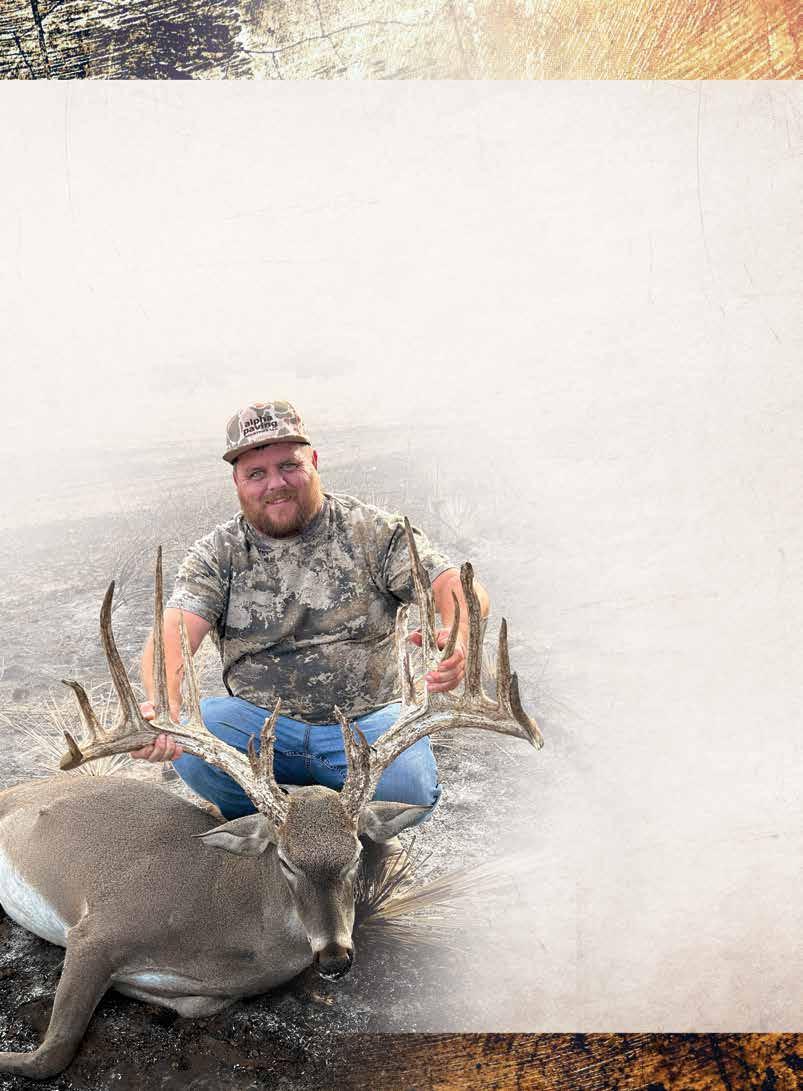
had to call in Texas A&M Forest Services. They brought in two bulldozers, a motor grader, and also called in air support.
The next morning the forest service had the fire 75% contained, and 100% contained that afternoon. The fire consumed 112 acres. Bubba and I joked that if it wasn’t for bad luck, we wouldn’t have any luck at all.
After a long day of fire, we ended that night with a birthday cake for Chris, as it was his birthday. Considering we were battling fires all day, we figured adding an ice cube to his cake would be good enough. We will have to say this birthday will be an unforgettable one for him.
Something about us being together at the deer lease meant things always ended badly. But little did we know our luck would change.
Two weeks later, we decided to press our luck once again, and return to the deer lease. That Friday morning, I had a skeet shoot for the YMCA Break The Bird charity event, and Bubba had football practice, two obligations we each had to attend. But at lunchtime, I got him out of school early and we headed to the lease. When we started our journey, I still had my dreams of that big buck, just like when I was 20 years old. After making several stops along the way, we had finally arrived, just in time to make the evening hunt.
We unloaded the truck, rolled the Polaris off the trailer, and headed back to the stand where the fire had started two weeks earlier. We got settled in the stand and began glassing. I stopped glassing and sat back, just enjoying watching my son glassing and talking about different deer that started funneling in.
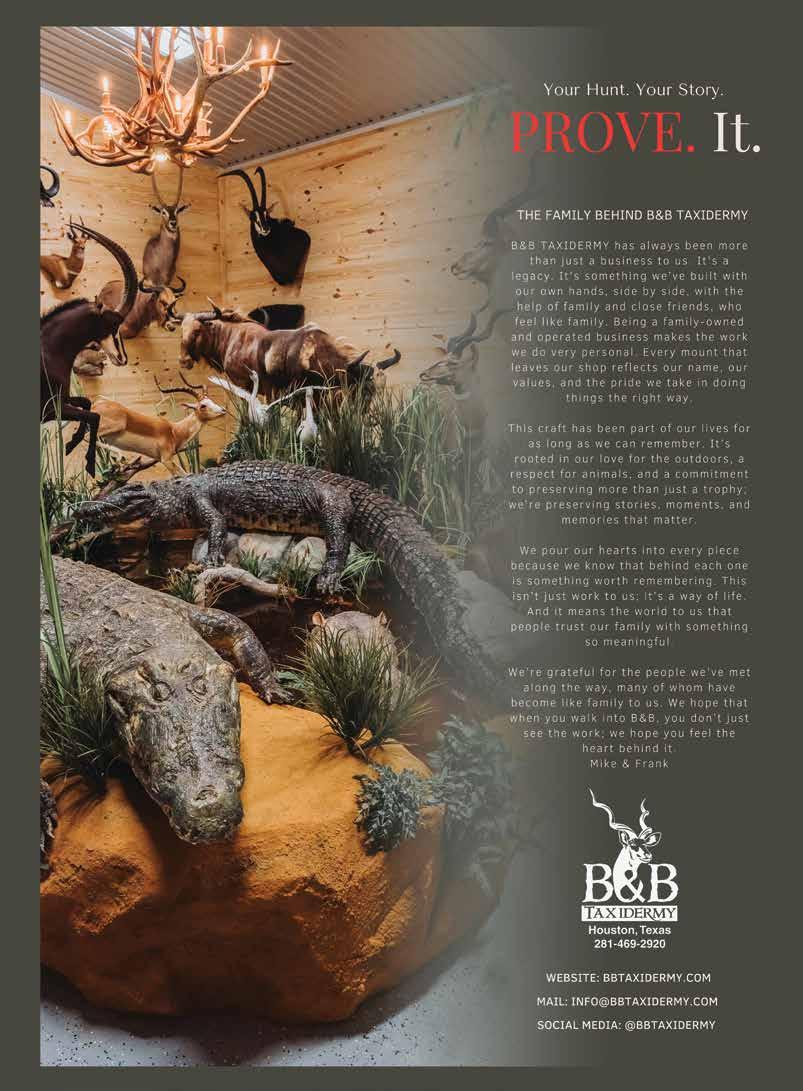
Then it happened. Bubba said, “Dad, there he is!” It was the deer of my dreams. This massive deer was just towering above all the other deer. It felt like an eternity as he worked his way around the feeder and wove his way through all the other deer until he came to the perfect spot, clear from all obstacles.
Then it felt like my heart stopped and my hands began to tremble. I steadied myself, and gently pulled the trigger. After that, Bubba’s hands went from plugging his ears to giving me the biggest hug and high fives! It was a great feeling having him with me at this moment after all we had been through together.
Hopefully, this will be another moment in his life he can look back on for the rest of his life. I smile when thinking about the story he’ll be able to tell when he’s older. It’s just the first part of our story, with many others to come.

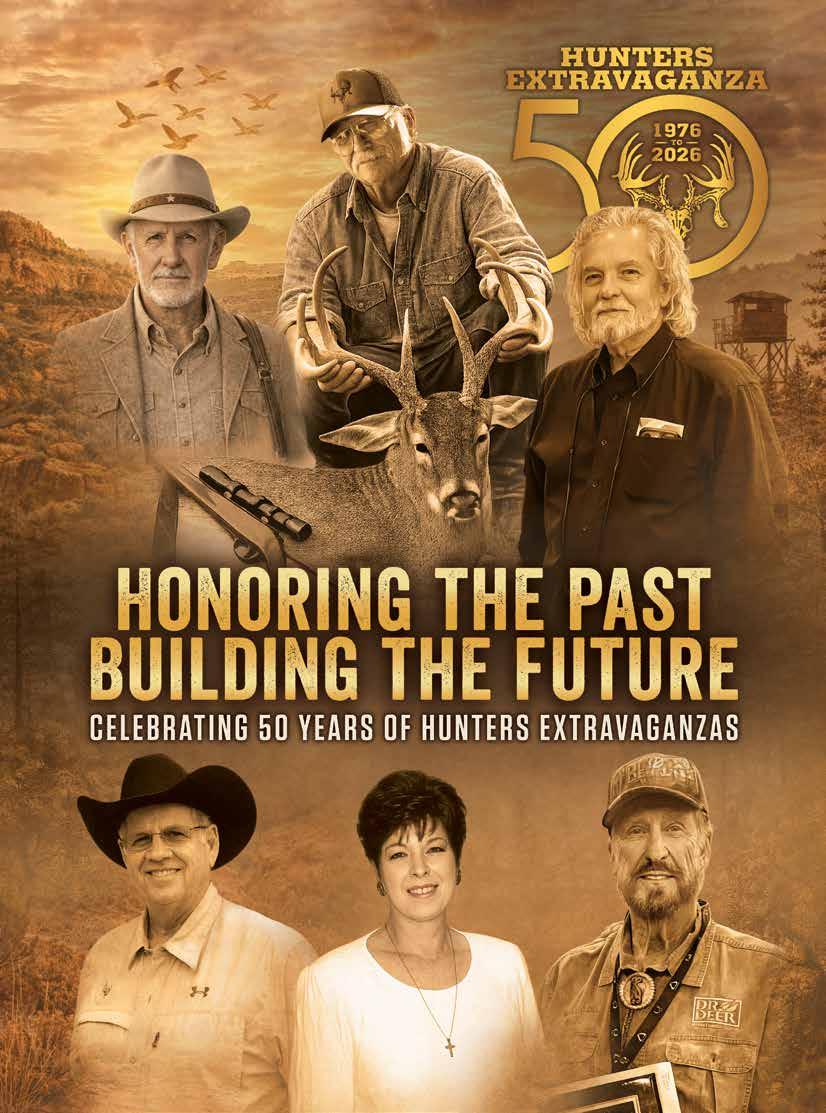
Fifty years ago, Jerry Johnston had a pretty good plan for a big “gettogether” for the members of his new hunting organization. He wanted an annual gathering for Texas Trophy Hunters Association members, as well as other hunters and whitetail enthusiasts. So he started his first hunter and whitetail “conference” at the El Tropicano Hotel in downtown San Antonio. Folks gathered to see the few exhibitors at that time, with deer heads, knives, and western art.
The event proved itself successful. The following year, Jerry held it at La Villita Assembly Hall, in the heart of downtown San Antonio. After the La Villita event, Fred Maly, a sports columnist for the old San Antonio Light, wrote, “The Texas Trophy Hunters gathering is not a conference—it is a ‘Hunters Extravaganza.’” The name stuck.
The event grew again and moved to the Henry B. Gonzalez Convention Center. Jerry began holding Extravaganzas in Houston, too, and then eventually in Fort Worth. Jerry had
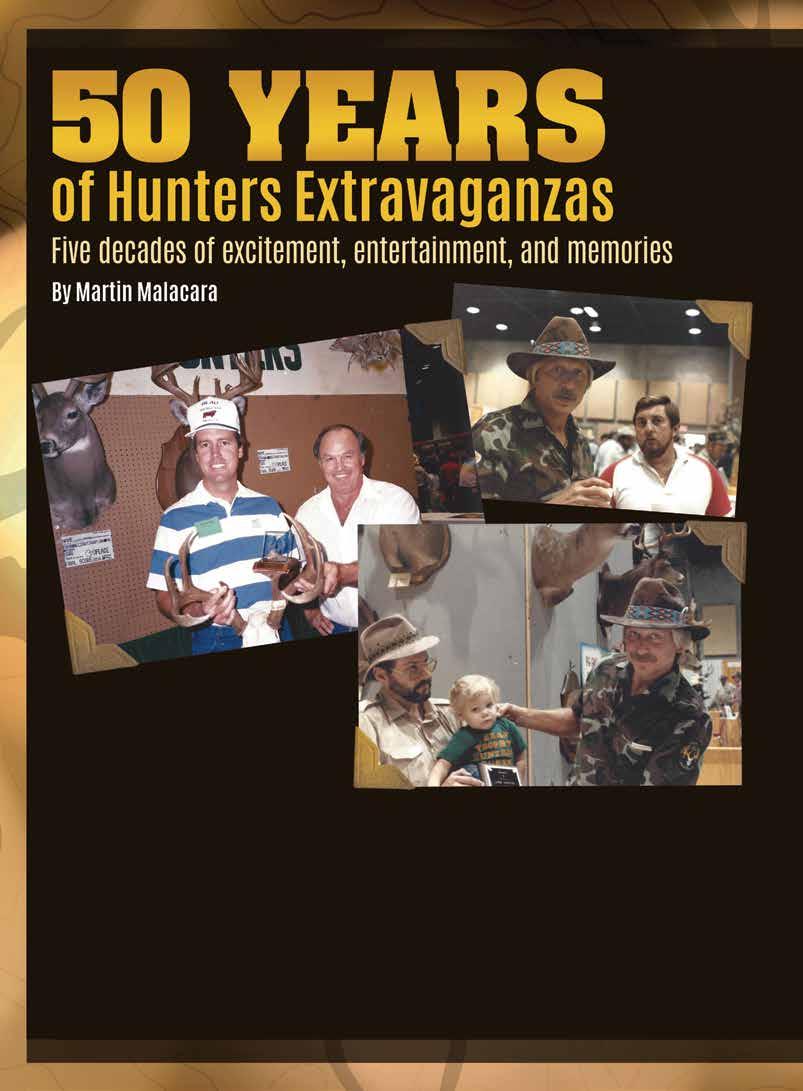
a new, tiny Texas Trophy Hunter friend.
invented the show’s formula for success, featuring vendors with the latest in hunting gear, attractions for the kids, and holding an annual deer contest open to all TTHA members. Jerry’s hard work paid off.
Someone who not only remembers those early days, but participated in those events since the La Villita show, saw firsthand the Extravaganzas’ evolution.
“I remember the first time I was asked by Jerry to come give a seminar at the Extravaganza. I arrived with my slide projector and a talk on aging bucks,” Dr. James Kroll, aka Dr. Deer, said. “I think it was the second Extravaganza, and although
it was huge like today, I was shocked to see how many people came.”
Kroll continued:
“I was hooked and came back year after year. I developed wonderful friendships with the families who were the pioneers of our industry. ‘Mom and Pop’ was the term we used then. We often talk about the famous hunters of whitetails, but neglect these pioneers who helped create a multi-billion dollar industry.
“Each year, on Friday, I would walk over to the front doors and look outside. The line would stretch from the front doors, around the building. When the doors opened, it was like the Oklahoma Land Rush!”
Judy Jurek, a contributing writer for The Journal, is another person very familiar with the early days of the Extravaganzas, albeit from a different point of view.
“Those first few years of the show, the hunting world was still very much a man’s sport, even if women did hunt. I just took snubs in stride, as I was the one who always called about getting on a deer lease. Many times, I was told bluntly, ‘No women allowed!’ or ‘Women only at Christmas,’ something to that effect.”
Jurek has been attending the shows since the early 1980s.
“I truly believe (former Hunters Extravaganza Director) Jennie Crowder and I were the only women present. Many men asked me what I was doing there, and when I’d reply I was a hunter, they’d laugh or scoff at me, even with (husband) Johnny by my side.
“It’s amazing how the shows have grown from just hunting and hunting related items—stands, camo, feeders, etc.—to having just about any and everything for anyone. The first ones were almost strictly hunting whitetails, doves, quail, turkey, squirrel, maybe a varmint or two, a few mule deer. Basically, Texas game. And mostly rifle and shotgun, too. One or two taxidermists. No celebrities or specialty displays, just all regular folks.”
“I’ve had the opportunity to exhibit at the Hunters Extravaganzas for 25 years, starting during my time as president and CEO of Sweeney Enterprises and continuing throughout my career with
Texas Hunter Products,” Chris Blood said. “Over that time, I’ve participated in more than 75 Hunters Extravaganzas, and they’ve consistently been among the most valuable and ‘must attend’ events in the outdoor industry. The Hunters Extravaganza provides a unique platform to connect directly with highly engaged, actively buying consumers, introduce new products, and build meaningful business-to-business relationships. The return on investment has been exceptional, and just as importantly, the shows create a great environment to meet face-to-face with customers we’ve built relationships with over Texas Hunter’s 70-plus year history.”
“The events are incredibly well run, family-friendly, and draw strong attendance not just from across Texas but from all over the country. I’m also proud that Texas Hunter Products was one of the original exhibitors at the events, and the first advertiser in the magazine - another testament to the strength and reach of the TTHA platform.”
Noted predator hunter Gary Roberson also attended the shows during the 1980s.
“In 1987, I recommended that Menard County exhibit at the Houston show

held at George R. Brown to promote the hunting in Menard County,” he said. “The county exhibited for a couple of years in Houston and then I purchased Burnham Brothers in 1991. I had helped Murry (Burnham) at the shows for a couple of years and exhibited on my own in 1992. This was also the first year that I did seminars on predator calling.”
Roberson’s favorite memories were when the San Antonio shows were held inside Freeman Coliseum. “On Fridays, anyone who was a member of TTHA got in free, just as we do today. I always wanted to have my booth in the ‘bucking chute’ area off the main floor of the Coliseum because that’s where so many old friends would gather to drink a few beers and visit. I looked forward to that Friday, as I would see South Texas ranchers that I would only see at the San Antonio Stock Show and Rodeo. It was kinda like old home week.
“While many of my old friends have passed and venues have changed, I still enjoy seeing friends who make an effort to stop by and visit. TTHA is a large fraternity of like-minded folks. The Extravaganzas give us the opportunity to meet at least once a year.”
To us, it’s every story shared and every tradition passed down within the TTHA family since our very first show. It’s a lifetime of hunting heritage and shared memories among people who possess a deep-rooted passion for the outdoors. For half a century, the Hunters Extravaganza has stood as the heart of Texas hunting tradition. As the “Granddaddy of All Hunting Shows,” this event remains the official kickoff to the season and the ultimate annual reunion for our community.
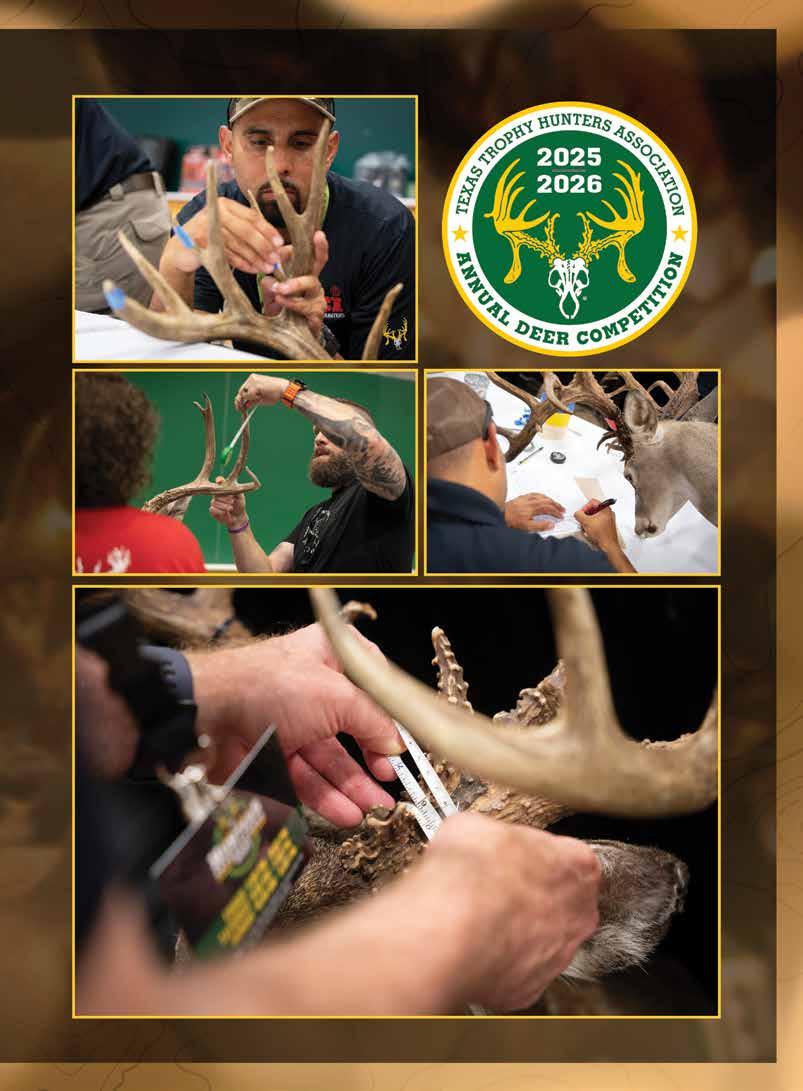
Year after year, hunters return to gear up for their next adventure, exploring the latest blinds, feeders, and equipment all under one roof. Beyond the gear, we bring the excitement with worldclass entertainment and attractions, including Gator Country, our legendary Annual Deer Competition, and up-close encounters in the Heart of Texas Snake Pit. We haven’t forgotten the next generation, either, with a Kids’ Corner packed with fun for young outdoorsmen and women. We’re celebrating our 50th year in a massive way across all three shows with huge giveaways, expert-led seminars, and exclusive perks for new and renewing members.
Make 2026 a year to remember and join us for this historic Golden Anniversary. —Jennifer Beaman, Events Manager







While the country celebrated its 200th birthday, three guys in California would found a little-known company—Apple Computer, a 14-year-old female gymnast would score a perfect 10 in the Olympics in Montreal, Canada, and a movie about a small-time fighter getting a chance at defeating the world champion hit theaters. That
movie, “Rocky,” would win Best Picture at the Oscars a year later. Meanwhile, a guy from South Texas—Jerry Johnston—would debut a hunting expo show in 1976 that would pioneer the hunting industry and endure for five decades. Take a look at a few snapshots from the Hunters Extravaganza through the years.





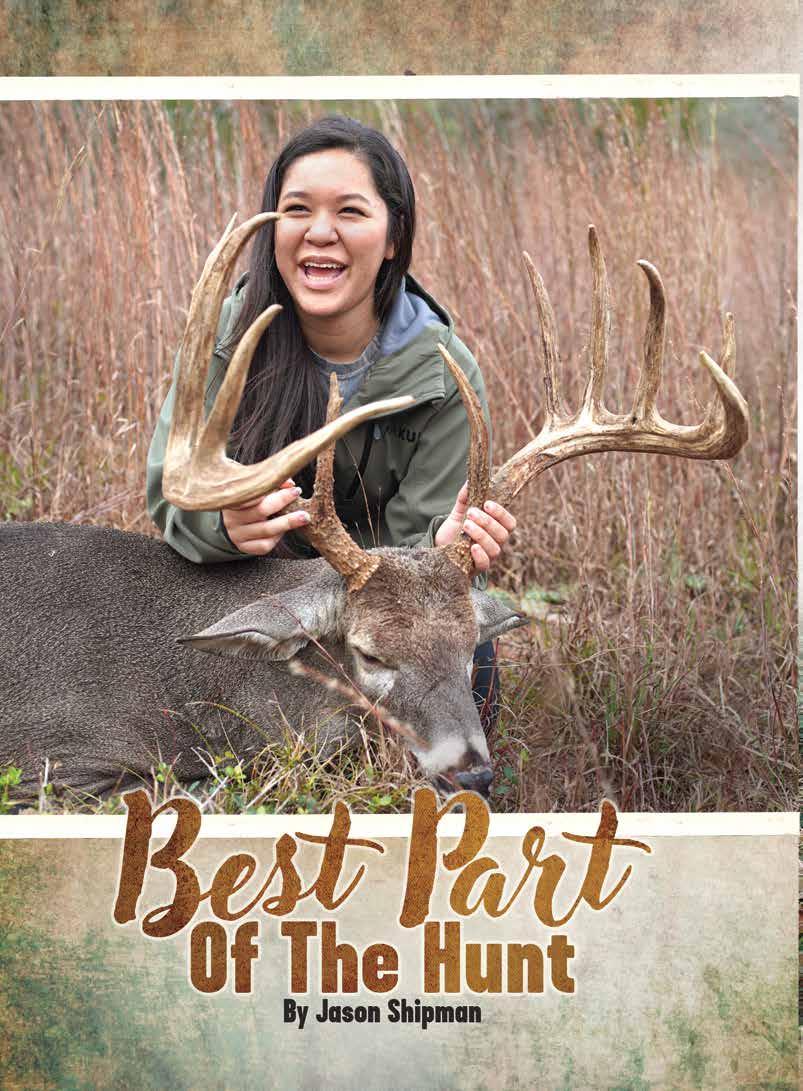
Lanie Poffenberger lives the everyday normal life of a teenager growing up in small town America. Bellville, Texas, is a quaint little town located about 30 miles northwest of Houston and is Lanie’s home. She enjoys reading, writing, riding horses, and of course anything outdoors related. Fairly typical of what you might expect, but Lanie is special and her story is unique.
Prayers were answered 15 years ago when Lanie was born and adopted by Marcus and Carrie Poffenberger. “We really wanted to add to our family and after many years of praying, God gave us Lanie,” Carrie said. “We adopted her at birth, and she has been such a blessing to us all.”
The Poffenberger family enjoys spending time outdoors. “We like to go hunting and fishing every chance we get,” Marcus added. “If we’re scouting, Lanie goes with Carrie, and if we’re hunting, she goes with me. Hunting and being a good shot have always come pretty easy for Lanie and she credits her Native American ancestry for being a natural. Hunting is something she really loves!” Lanie accompanied her parents on many hunts before taking her first buck when she was 12 years old. It was a small eight-point, but it was a start and she has taken several deer since.
The Poffenbergers have been fortunate to be able to hunt an amazing ranch for several years. “The ranch is a really special place, and its management program is incredible,” Marcus said. “We do our part with the management and have also been able to harvest some giant bucks during the process.”
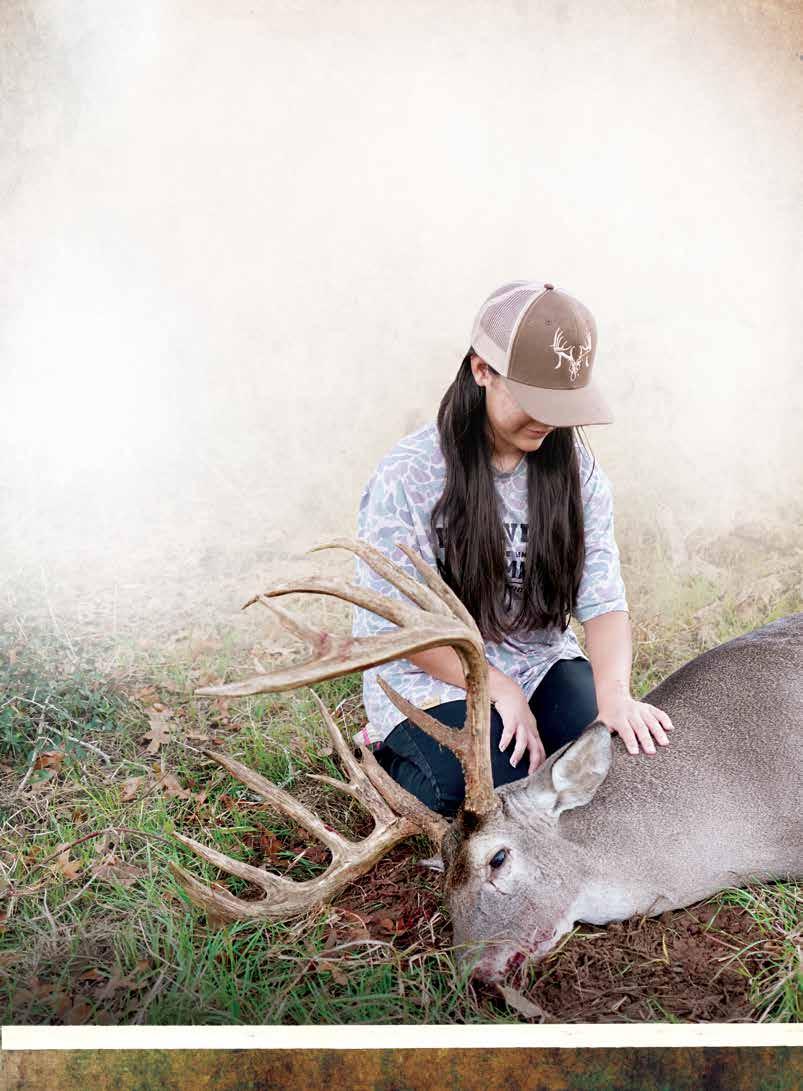
For several years the family watched as a huge typical buck matured. “He was a really special deer,” Carrie said. “He was beautiful, and I think all of us discreetly coveted him as a trophy!” The buck was at least 7 years old, and it was time to consider harvesting him.
“We knew the deer was special, and before the season Marcus and I discussed the possibility of Lanie hunting the deer,” she added. “It was probably a rather quick conversation, and likely best summarized as a special deer for a special person.” When Lanie found out she would be hunting the deer, she was excited, to say the least. “She was grinning from ear to ear and couldn’t wait to start hunting,” Marcus said.
The season finally opened, and the family spent the following three weekends at the ranch hunting. “Lanie and I were sharing plenty of quality time in the blind looking for her buck,” Marcus said. Despite their best efforts, the buck would just not cooperate. After several hunts, they occasionally felt discouraged and
perhaps even a bit disappointed, but they carried on and did not let it get in the way of having fun.
Time and perseverance were on their side, however, and Lady luck would shine on Lanie. “It seemed pretty easy when it happened, but we had to hunt so hard to get to that point,” Marcus said. One afternoon, the hunters unassumingly arrived at the blind and went about their normal routine of settling in for the hunt. “About 10 minutes before the feeder went off, a doe stepped out and the buck we were after was right behind her,” Marcus said.
Lanie readied her .243 Winchester and waited for the shot to present itself. They had plenty of time to prepare for the moment and very little instruction was necessary. “Lanie doesn’t waste time when it comes to shooting and she doesn’t get buck fever,” Marcus said. The big buck stood about 80 yards from the blind when he turned broadside. Capitalizing on the opportunity they had worked so hard for, Lanie squeezed the trigger and sent the bullet on its way. “Perfect shot!” Marcus exclaimed. The giant buck lunged forward before hitting the ground, remaining motionless.
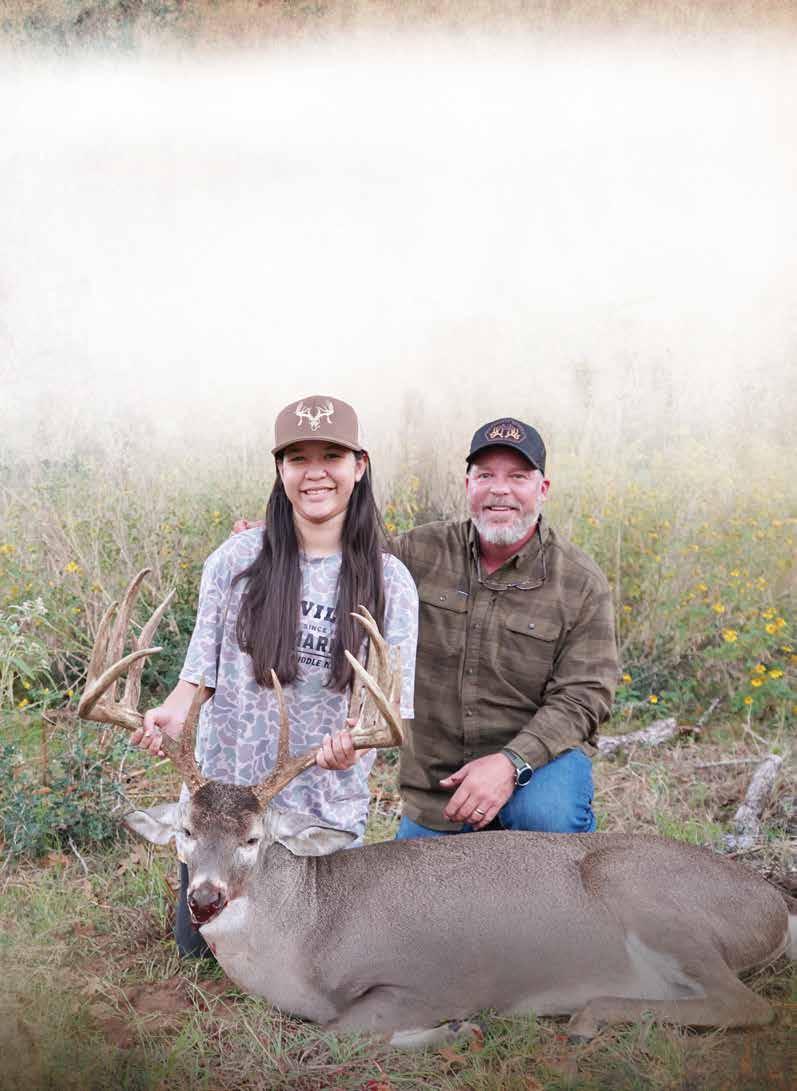
It was an emotional moment for the hunters, and they waited for the rest of the family before going to take a look at their trophy. “As we waited, we said a prayer of thanks and just really soaked in the moment,” Marcus said. The look of excitement and joy on Lanie’s face told the story as everyone arrived. “We were thrilled for Lanie. I think she understands how blessed we are. Not everyone gets the opportunity and it’s something that’s very sacred,” Carrie said. “It was really amazing to see her get the big deer and be celebrated!”
Lanie walked over and knelt down by her buck. “I couldn’t stop smiling as everyone congratulated me,” she said. “He was so big, and so impressive, that it was all really hard to believe!”
Lanie’s beautiful typical buck gross scored 188 3⁄8 . Stunning symmetry and excellent length quickly draw attention to the buck’s amazing rack. Lanie couldn’t be happier with her deer and is ready to go hunting again. We could all learn a lesson of importance as she sums up the experience insisting, “Shooting a trophy buck was wonderful, but the best part of the hunt was spending time with my dad!”

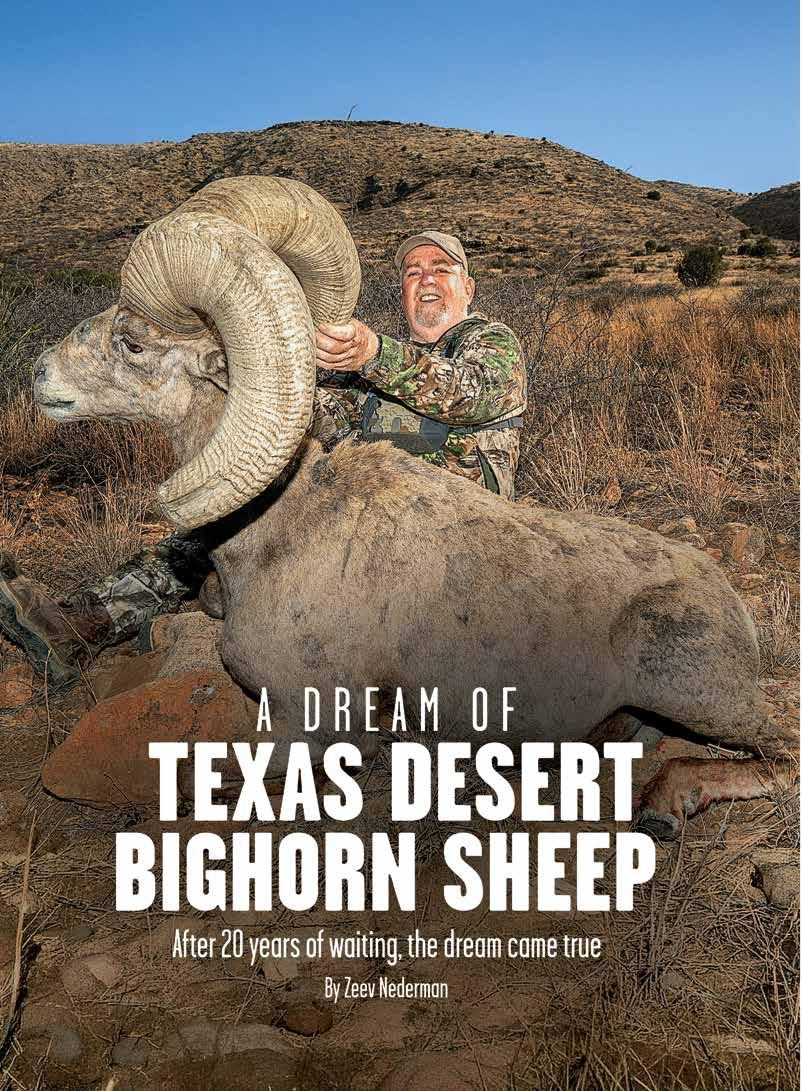
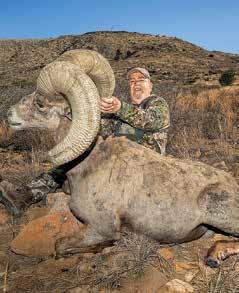
Zeev had drawn a permit from Texas Parks and Wildlife for a bighorn sheep hunt in November 2025. At first, he thought a friend had pranked him, but the permit was real and he took the ram four months later.
As a mountain hunter, I often ask myself: Why do we do this? I know the answer: “addiction.”
Sheep hunting is among the toughest pursuits in the hunting world. The hunt itself is physically demanding, the weather is unpredictable, and they live at the end of the trail. But always the greatest challenge is simply obtaining a permit.
The mountain states issue very few sheep permits, and only a small percentage go to non-residents. Other options: Canada, Mexico, governor’s tags, and tribal reservation permits, are available, but the cost can be overwhelming. Then you have the international sheep and ibex hunts. They are more plentiful, and in some cases, reasonably priced, but they really require a real appetite for adventure and travel. But the truth is, hunting prices have risen significantly over the years, and travel is simply not as enjoyable as it once was.
I was fortunate to begin this journey many years ago. Over time I had hunted sheep across North America and around the world, completed the North American Grand Slam of sheep, and later achieved a World Slam of sheep with additional 30 Capra animals. Even with all those experiences behind me, the Texas bighorn ram still felt more elusive than all of them.
Drawing a permit through the Texas Public Hunt System is not very difficult. Over the years, I have drawn permits for mule deer, nilgai and other exotics, and twice for alligator. Year after year, I applied for the Texas desert bighorn sheep hunt, knowing full well it’s one of the rarest and most coveted permits in Texas.
Then, in early November 2025, after 20 years of applying, I got a “notice of selection.” My first thought was one of my friends got creative with AI and pranked me. But after checking the Texas Parks and Wildlife Department website, it became a reality. I had drawn the coveted permit. After talking with TPWD personnel, the hunt was scheduled for early
March 2026 at Elephant Mountain Wildlife Management Area.
My wife, Sarah, and I headed from San Antonio to West Texas, carrying with me not just a rifle, but 20 years of hope and anticipation. Some hunts are about the trophy. Others are about the journey. This one was about both.
We spent a couple of days relaxing and enjoying the beautiful Alpine area before the hunt. By Monday, we arrived at Elephant Mountain WMA, where we met the team, and completed orientation and paperwork. After checking the rifle at the range. Everything was ready. The hunt had officially begun.
We were guided by TPWD biologists Cody McEntire and Josh Cross, with Montgomery Cain behind the camera. Several members of the team were already out scouting, and that very first afternoon we saw six rams and several ewes.
The Texas Parks and Wildlife Department offers three guided bighorn sheep hunt packages each year. Tag issuance is survey dependent and there’s no guarantee of three TPWD tags per year. One permit is issued through auction. The auction takes place at one of the hunting convention’s fundraising banquet dinners. The second permit is awarded through the Big Time Texas Hunts raffle, with tickets available online and through authorized vendors.
My permit was the third permit, awarded through the Texas Public Hunt System drawing, at $10 per application, with a loyalty point system in place. All hunts are conducted on Texas Wildlife Management Areas and are fully guided by TPWD biologists and staff. Food and lodging are also complimentary for both the hunter and one non-hunting guest. In addition to the TPWD hunt program, several ranches that get landowner tags from TPWD may offer them to hunters, but mostly through outfitters. —Zeev Nederman
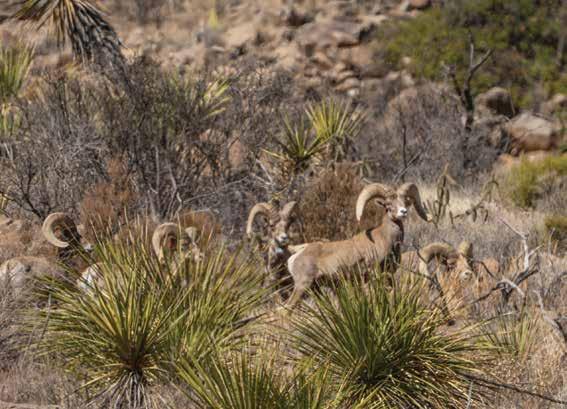

The next morning came early. With scouts already positioned around the base of the mountain, we began our ascent. Before long, we located a group of 10 rams, and the stalk was on. By the end of the second day, we had observed 23 rams. On the third day, we continued stalking several bands of rams. By late afternoon, we had already looked over 44 different rams.
At that point, I asked Cody if he thought we could relocate a “very heavy and broomed ram” we had seen the previous day. In Cody’s opinion, it was an excellent trophy ram, and over 10 years old. Cody got on the radio, and after speaking with Connor, Kevin, and Mark, the ram was located again.
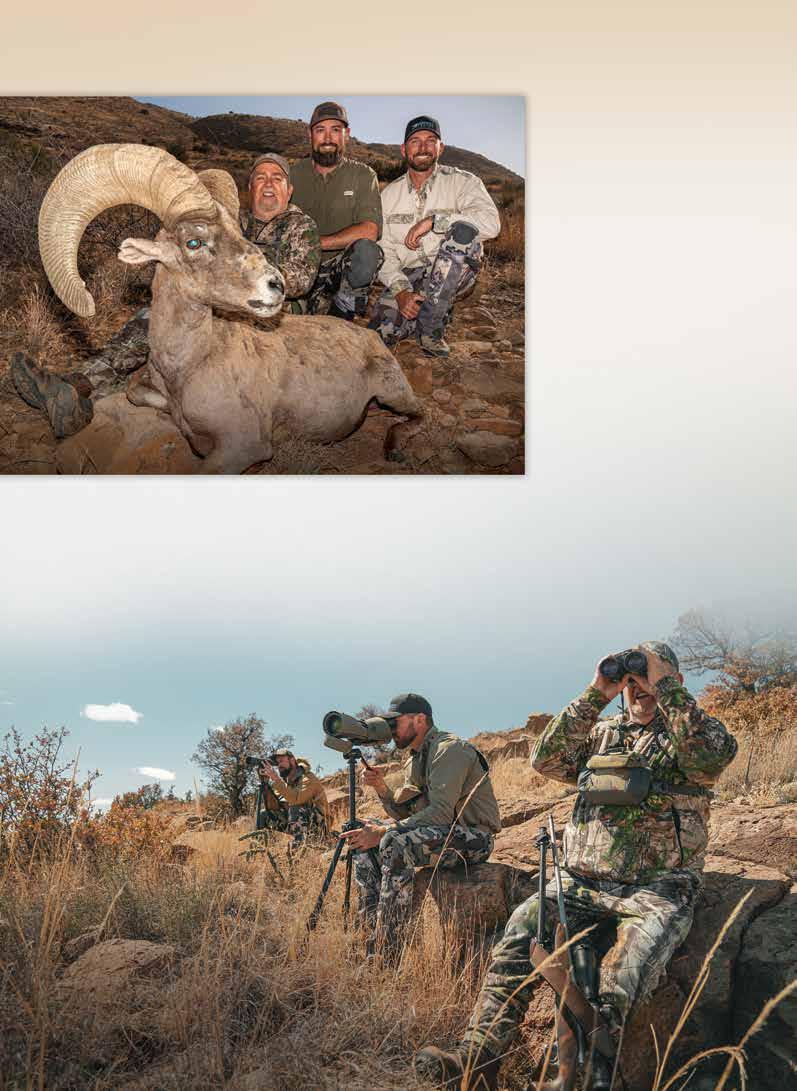
The stalk was back on.
We closed the distance to within 300 yards of the now nervous and alert rams. For several long minutes, everything seemed to stand still. I finally had a clear view of the ram. Twenty years of applying had come down to this moment. It took two shots, and the ram went down.
When we walked up to him, there was absolutely no ground shrinkage. The ram had 16-inch bases, and for a few moments we simply stood there, admiring this magnificent heavybroomed old warrior ram, aged 11-plus years old. It was everything I had hoped for. We took many photographs, and after the guides expertly skinned and packed the animal, we returned to the lodge.
That evening we celebrated with a great steak dinner shared with an outstanding team of men. It was truly a remarkable hunt in a beautiful, wild landscape. We had great guides, great cooks, excellent food, and a very comfortable lodge, making the experience even more memorable.
Sarah and I would like to once again thank the TPWD team, the Texas Bighorn Society, and everyone who made this incredible hunt possible.

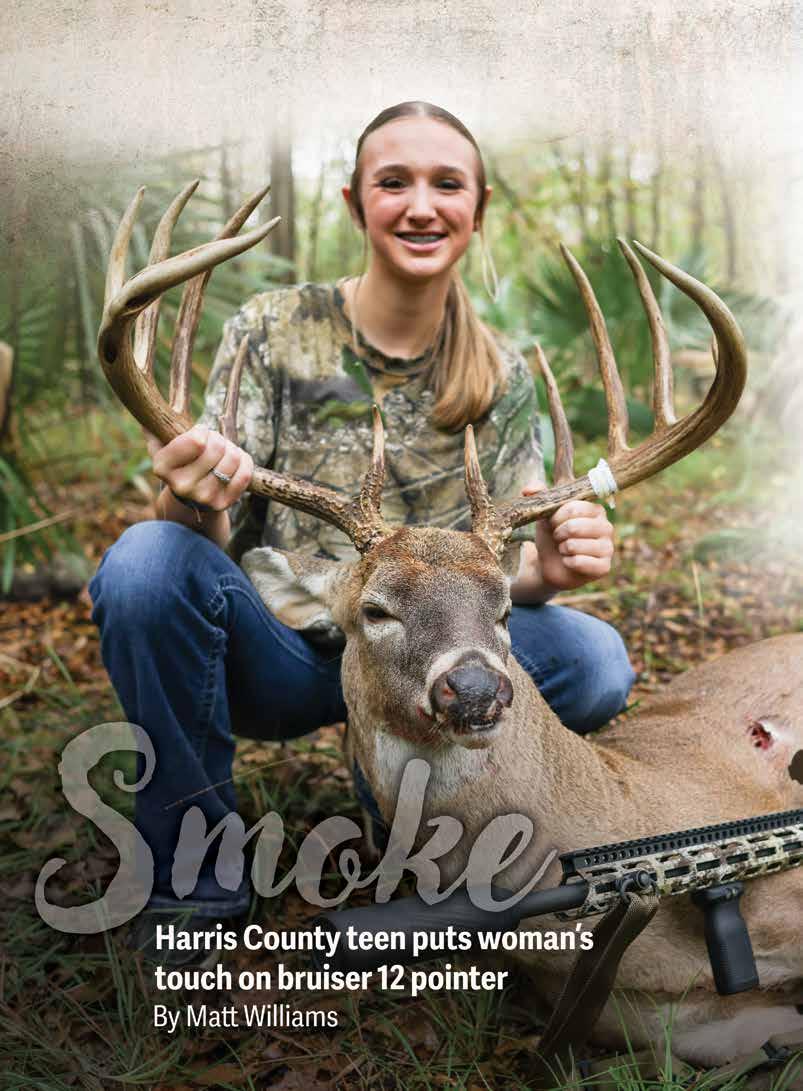
Ayouth hunter’s first buck often packs the goods for a pretty good story. Addi Loving’s tale is a doozie. Fittingly, so is the buck she calls “Smoke.” The story is especially noteworthy because it unfolded in the company of a longtime family friend and culminated with a bruiser of a whitetail taken along the San Jacinto river bottom within the distant shadows of downtown Houston, roughly 40 miles away.
Loving is 16-year-old junior at Crosby High School and works as a tour guide for Unlimited ATV Rentals. Her boss and hunting mentor is Chris Carroll of Longview, a 43-yearold veteran hunter who feels at home in the woods and knows a solid buck when he sees one. Carroll took Loving under his hunting wing this season and went the extra mile in hopes of helping her put her first buck tag on a shooter to be proud of. It took nearly a dozen sits to get the job done, but Loving eventually closed the deal on the morning of Nov. 22 with a handsome 12 pointer that is way more than respectable.
Think bull of the woods. With a net Boone and Crockett score of 164 7⁄8 , the buck is sure to be among the top free ranging Pineywoods typical whitetails reported to the Texas Big Game Awards this season and top buck from Harris County. The antlers gross 170 7⁄8 before deducts for lack of symmetry between the two sides; the net score is 164 7⁄8 Lance Tippett of Longview taped the buck for TBGA. “It was a really nice deer, by far the biggest I’ve ever scored,” Tippitt said. “You don’t see many typicals like that around here. He’s definitely one to be proud of.”
Most hunters will hunt for a lifetime and only dream of bagging a 170-inch typical, much less get lucky enough to cross paths with one and ultimately seal the deal. While Lady Luck was definitely in Loving’s corner that day, she made a lot of her own luck along the way. In Carroll’s opinion, Loving was like a model of persistence as she spent dozens of odd hours hunkered down in a ground blind — waiting and watching in hopes that a good buck might come her way. Her coach was at her side through it all, and they prayed for success more than once.
Among other details, Carroll made sure she role played every deer that passed by, bracing the rifle and scoping the vitals each time to ensure she would be ready at go when it counted. Translation: The chick can shoot and knows the drill.
“Addi definitely earned this deer, no doubt about it,” Carroll said. “She would have been perfectly happy with a basket-rack eight pointer. To come away with a buck like this is truly a blessing. She’s hooked now. She’s eaten up with it.”
Carroll added his partner is fully aware of the caliber of buck she tagged as her first deer and is grateful for the opportunity. “It was such a cool experience I’ll never forget,” she said. “I’ve always liked hunting, but I love it now.”
The quest for Addi’s first buck began in early November, when the two hunters began scouting an unsuspecting thicket in the far corner of their 400-acre lease near Crosby. Carroll had spotted the isolated area on an aerial map a while back, but never took the time to check it out until this season. What he found there was an isolated sanctuary cluttered with deer sign, mostly fresh rubs. Hog sign was non-existent.
“It was really thick in there — sort of a bottleneck,” he said. “A half dozen of the rubs were eye openers and two really good ones,” he said. “One of them was on an eight-inch tree and looked like something you’d see in Illinois or some of the other northern states. I felt like we were in his bedroom and we didn’t need to be messing around.”
The hunters erected a ground blind at the head of a dim shooting lane to take advantage of a prevailing southeast wind. They also scattered some corn along the lane and secured a non-cellular game camera to monitor the area. Carroll said they made about nine sits in the stand during the first two weeks of the season with no success. The biggest buck they saw or had pictures of was an 18-inch, eight pointer that Loving would have gladly shot had she got the chance. She said the eight pointer showed itself once, but quickly melted into the underbrush before she was able to get a clear shot.
The stars align
Shift to Nov. 22. The hunters arrived at the blind well before daylight. Four does showed up about 7:15 a.m. and eventually wandered off. Roughly 15 minutes later something shocking happened. Seemingly from nowhere, a giant whitetail neither of them were aware of merged from the thicket and came tooling into the shooting lane all alone.
Carroll knew right way they were looking at a mature whitetail. Interestingly, they later discovered a stellar video of the buck that was captured hours earlier, during wee hours of the night. “When a deer like that pops out at 110 yards you don’t need the binoculars,” he said. “He literally blew me away. I was antsy, but Addi seemed pretty calm. I definitely had buck fever worse than she did.”
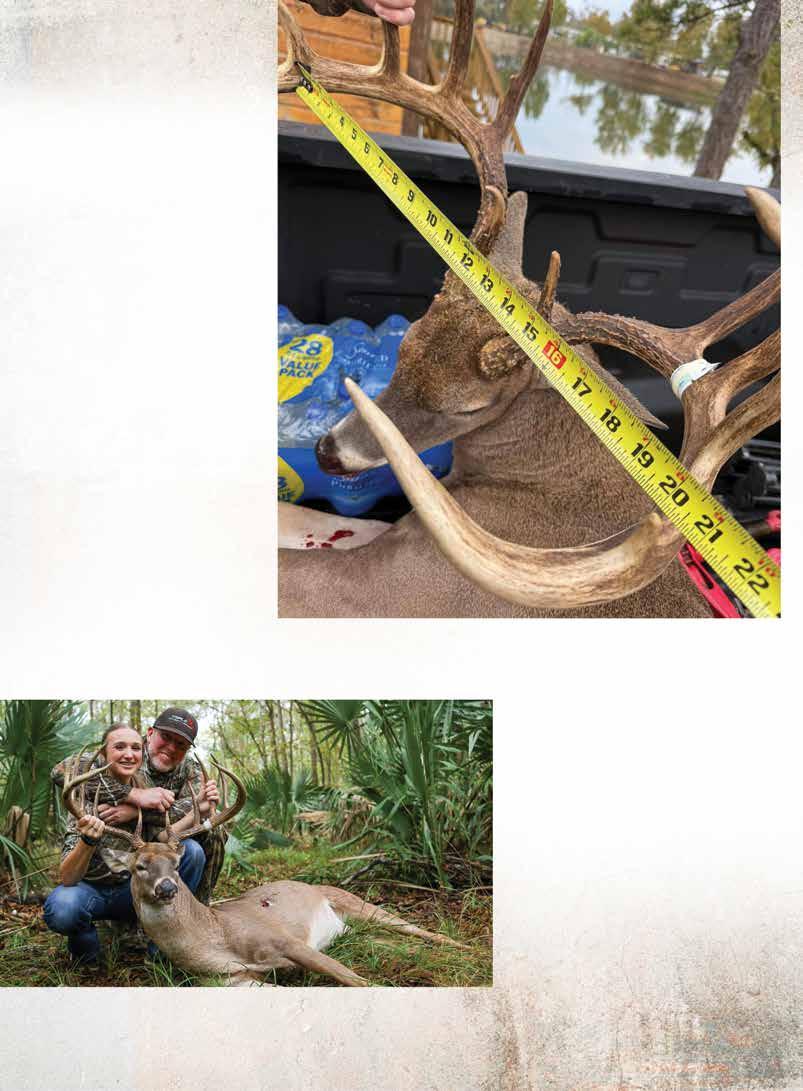
Loving remembers the moment Carroll gave her the green light to touch the safety on the .308. “He whispered ‘smoke him’,” she said. “That’s how I came up with the nickname ‘Smoke.” Loving’s shot was quick and right on the mark. She said the deer piled up in the dense thicket, about 50 yards away.
“Once I saw him, I was really excited — jumping up and down and screaming,” she said. The Harris County buck was certainly something to be excited about. Loving posted a really cool video of the season-long hunt for Smoke, along with the nighttime game camera footage of the buck, on her Facebook page. They’re worth checking out.
Loving and Chris Carroll spent much of the 2025-26 manning a ground blind deep in the heart of their Harris County lease. After nearly a dozen sits, the effort paid off with Loving’s first deer, a handsome 12 pointer with a net TBGA score of 1647⁄8.

Every Texas hunter has heard it—or said it: “If we’d just hunt them harder, we’d get ahead of these hogs.”
It sounds right. After all, Texas offers the most liberal hog hunting regulations in the country. There’s no closed season on private land, no bag limit, and landowners can authorize year-round take no matter if it’s the Pineywoods, the Panhandle or the Post Oak Prairie. Night hunting, thermal optics, catch dogs and Bowie knives, helicopters (aka “pork chopping”) — it’s all on the table.
So why, with all that firepower, are feral hog numbers still exploding?
Long story short, the numbers tell the story. Feral hogs aren’t just prolific in Texas — they’re biologically built to win. According to the Texas Parks and Wildlife Department, feral hog populations can increase by about 18% to 21% annually if left unmanaged. That’s not theoretical — that’s what their

reproduction supports in real-world conditions. TPWD data, in concert with other state and federal wildlife agencies, backs it up:
• Sows can begin breeding at only 6 to 8 months old
• They can produce multiple litters annually
• And each litter typically includes a minimum of 4 to 6 piglets, though they’re typically larger
That means a single sounder quickly turns into a much bigger problem in short time. TPWD emphasizes this reproductive rate is the core reason hog populations are so difficult to control. Now layer that over Texas-scale geography — millions of acres of ideal habitat — and you begin to see the issue: we’re not just hunting hogs in the Lone Star state, we’re racing their biology, and it’s not a fair sprint.
Here’s the real statistic that changes the conversation, according to TPWD: To reduce a feral hog population — not just
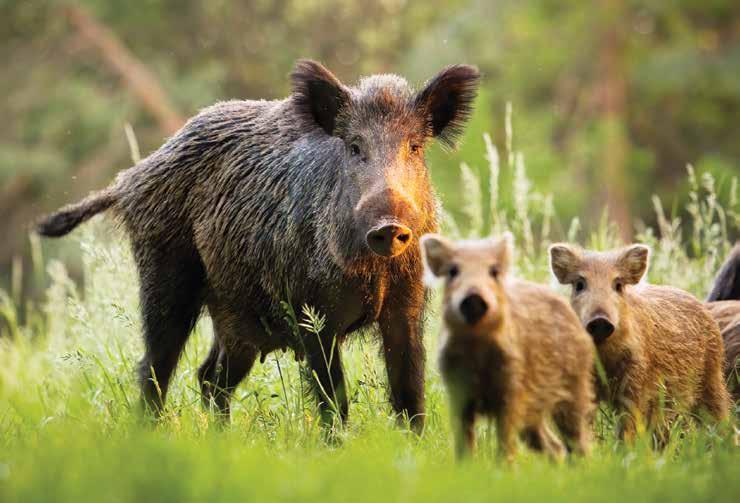
Texas’ feral hog population continues to expand despite hunting efforts statewide. The Texas Parks and Wildlife Department cites hunting as one component of a broad strategy to attempt to control the booming rise in wild pigs.

maintain it — you must remove roughly 60% to 70% of the entire figure every year. Anything less, and the population rebounds.
This is where the idea of “all hunting” starts to break down.
Even with year-round access and modern equipment, recreational hunting rarely achieves that level of sustained removal, especially across large properties or regions. TPWD notes that hunting pressure typically removes only a fraction of a population — and specifically not the right fraction.
Hunting absolutely removes hogs. But according to TPWD, it also introduces unintended consequences when used as the only control method:
It’s often selective — and not in a good way
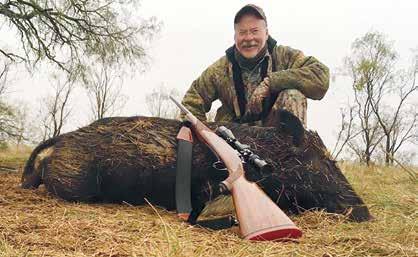
Hunters tend to target large boars. However, population growth is driven by sows, not “trophy” hogs. Leaving breeding females behind means the next generation is already on the way.
It changes hog behavior
Hogs are highly intelligent. Under pressure, they:
• Shift to nocturnal movement
• Avoid feeders and open areas
• Relocate to thicker, less accessible cover
Simply put, the more you hunt them, the better they get at avoiding you, which is similar to any species, be it Muy Grande whitetails, boss Tom turkeys, or bull sprig pintails.
It can spread the problem
TPWD notes hunting pressure actually can cause dispersal, pushing hogs into new areas and expanding their range — especially when sounders break apart under stress.
It rarely hits entire sounders
Killing one or two hogs out of a group doesn’t solve the problem. The remaining animals regroup, reproduce, and continue their destruction of the native landscape.
So—what if “all hunting” meant maximum effort?
Even then, the logistics don’t work in our favor. Texas has millions of feral hogs—they occupy private lands, brush country, wetlands, farmland and urban edges, and access varies widely—not all land is hunted equally. To consistently remove roughly two-thirds of that population through hunting alone would require unprecedented coordination, access and effort, far beyond what recreational hunting currently provides.
TPWD and its astute biologists are clear on this point: Hunting is effective for removing individual animals and reducing localized damage, but it’s not sufficient by itself for long-term, large-scale population control.
What actually works, according to biologists: Whole-sounder removal. The key concept TPWD emphasizes is this: we must remove entire groups, not just individuals.
Traditional hunting rifles are good for felling single pigs at a time but don’t make a dent in a large sounder. Trapping is the best way to remove large numbers of pigs from the landscape while aerial gunning also is beneficial.
This is where other methods outperform hunting alone:
• Corral traps can capture entire sounders at once
• Pre-baiting strategies condition hogs to enter traps together
• Remote-trigger systems allow operators to wait until all animals are inside
This approach targets the reproductive engine of the population — something hunting rarely achieves on its own.
TPWD makes one thing clear: There are no viable nonlethal, large-scale solutions for feral hog control. That means no relocation, no fertility control at scale and no natural predators stepping in. The only path forward is lethal removal done strategically, not just opportunistically.
And that’s where hunting still plays a vital role. If hunting alone won’t solve the problem, does it still matter? Absolutely.
Hunting remains:
• The most accessible control method for landowners
• A way to apply continuous pressure
• A tool to remove trap-shy or dispersed animals
• A critical part of integrated management plans
TPWD encourages hunting as part of a broader strategy — it just shouldn’t be the only strategy. So, will all hunting control feral hogs in Texas? No. Not even close — at least not by itself.
But here’s the more important truth: Without hunting, the problem would be even worse. Feral hog control in Texas isn’t a single tactic — it’s a campaign. It’s rifles and thermals.
It’s traps and coordination. It’s landowners working together across fence lines.
And it’s understanding that this isn’t a traditional hunt — it’s wildlife management at scale.
So keep hunting. Hunt them hard. Hunt them smart. Just don’t expect hunting alone to win the war on feral swine.


See these products and vendors at the 2026 Hunters Extravaganza Shows. Availability subject to change. See pages 40-41 for vendor listing.
MBRK Cabins are built for real ranch life, not retrofitted sheds, backed by the legacy of MB Ranch King Blinds. Designed “ranch tough,” each cabin features a proprietary steel floor system for true rodent-proof durability, a concrete foundation, and a full front porch made for wide-open views. Whether it’s a hunting retreat or a working ranch stay, these cabins are built to handle the elements and the lifestyle, year after year. Rugged, refined, and ready for the land you love. Visit mbrkcabins.com.


The ATN ThOR 6 Elite thermal rifle scope from ATN is a must-have for Texas hunters chasing hogs, coyotes, and trophy whitetails. Powered by a new 6th Generation 640×512 thermal core and SharpIR AI image enhancement, it delivers detection out to 3,650 meters with crisp, defined targets. A built-in laser rangefinder, recoil activated video, hot point tracking, and a ballistic calculator make every shot count. It has a magnesium housing, is rated IP67 waterproof, and runs up to 9 hours. Visit atncorp.com.

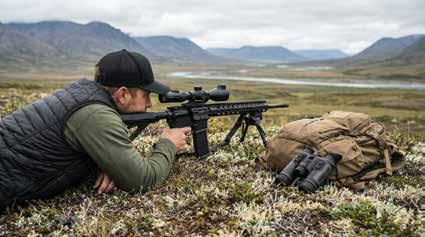
atncorp.com
Steph’s Toffee Shop handcrafts toffee in small batches in Friendswood, Texas, using carefully selected premium ingredients. Rich, buttery, and perfectly crisp, each bite delivers a decadent balance of flavor and texture you can truly taste. Whether you’re packing it for the road, sharing at camp, or gifting something special, this small-batch toffee is made to be enjoyed anywhere. One taste, and you’ll see why it never lasts long. Visit stephstoffeeshop.com.
stephstoffeeshop.com
FEROX’s Beast Adapter expands the capability of your bino harness or chest pack system. Built from lightweight, ultra-durable Tegris with foam padding for all-day comfort, it uses your existing harness straps as secure attachment points for holsters, knives, and essential field gear. Compatible with most major bino harness brands, it delivers a low-profile setup that keeps critical gear accessible without unnecessary bulk. Whether you’re hunting, scouting, fishing, or spending long days in the field, the Beast Adapter creates a streamlined, modular carry system built for real-world use. Visit feroxgear.com.
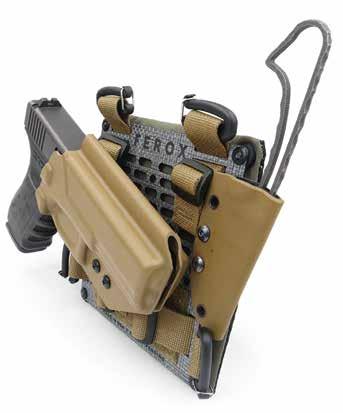
feroxgear.com
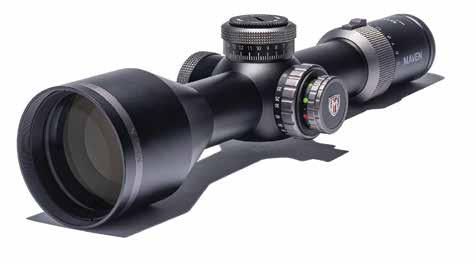
Maven Optics’ new RS4.2 5-30X56 FFP Riflescope is a precision-built optic engineered for shooters who demand absolute confidence at long range. Designed for competition, extended-range hunting, and tactical applications, it combines crystal-clear glass with a 5-30X first focal plane system, a locking 3-revolution elevation turret, capped windage, and an auto-off illuminated reticle. Rugged, repeatable, and purpose-built, it’s a riflescope designed to perform when precision matters most. Visit mavenbuilt.com.
Located in New Braunfels, Texas, Rust Meat Market & Game Processing provides full service. They have a wide variety of quality specialty meats, chicken, pork, market franks, heatand-eat entrees, jerky, dried smoked meats, cheeses, grilling appetizers, vegetables, gift boxes, party trays, and more. On-site butchers will customize your steak. Their game processing business is year-round. Whatever meat you bring them, that’s the meat you receive. Call 830-608-1910 or visit TheRustGamePlace.com.
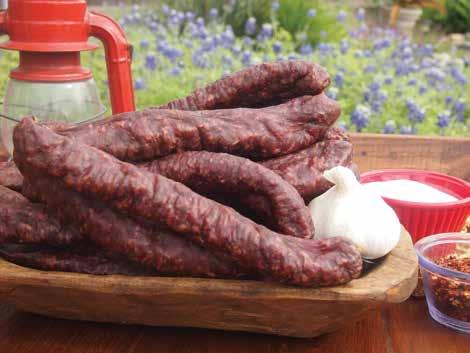
The Byrna CL (Compact Launcher) is the most compact less-lethal launcher in the world. The entire platform has been reimagined for maximum concealability and stopping power. Powered by compressed CO2, the Byrna CL shoots .61 caliber round kinetic and/or chemical irritant projectiles that can disable a threat from up to 60 feet away. No license, background check, or permit required. Legal in all 50 states. Visit rjselfdefense.com.
slowglow.com

The Maverick T-Post Trail Camera Mount from Slow Glow Hunting is built for hunters who demand reliable, no-fuss setups in the field. Designed to attach securely to a tree or T-post, Maverick Mounts feature a heavy-duty ball head and oversized tightening wheel for rock-solid stability and precise camera positioning. Built to easily attach to trail cameras, solar panels, and other accessories, its rugged construction and simple, adjustable design brings dependable performance in a year-round solution for every hunter. Visit slowglow.com.
The Dove Wrangler is a rugged, field-tested dove hunting accessory designed to keep your gear organized. Its compact 3-piece design assembles in seconds and packs easily for transport to and from the field. It features enough bird holders to carry a full Texas limit, along with a drink holder, shell box storage, cell phone holder, bottle opener, and a safe place to lean your shotgun while hunting. Designed and field tested in Texas, it delivers convenience, durability, and organization for dove hunters who want everything they need within reach. Visit 8gaugeoutdoors.com.
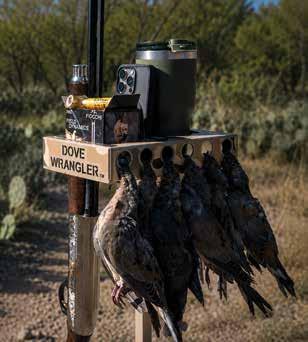


The end of whitetail season doesn’t mean hanging up your boots. Spring and summer in South Texas open the door to a whole new set of adventures — shed hunting, rattlesnakes, arrowheads, predator calling, hogs, and javelina. Cruising the senderos this time of year never gets old. And with a little planning, you can stack several of these pursuits into a single outing.
Javelina:
One of the most exciting developments in recent years for South Texas hunters is the official recognition of the javelina by the Boone and Crockett Club and Pope and Young Club. For years, the collared peccary has been a favorite for introducing kids to hunting — easy to find, fun to pursue, and a great first trophy on the bow or rifle. Now, they’ve earned a place in the record books, and hunters from across the country are taking notice.
As Boone and Crockett’s magazine announced, the Records of North American Big Game Committee approved the new javelina category, with Pope and Young’s membership following suit at their biennial convention. Both clubs now have scoring procedures, minimum entry requirements, and scoring sheets available on their websites. It’s added a whole new layer of excitement to an already great animal.
Javelina season is closed in the North Zone until Oct. 1. The South Zone remains open until Aug. 31. Only 99 counties have a javelina season. The bag limit is two per license year.
Shed season in South Texas is as productive as anywhere in the state, and roaming between wildlife feeding stations will put you on antlers fast. Those same stations, however, draw rats, mice, and birds — which means they also draw diamondback rattlesnakes. Snake activity peaks right alongside shed season, and the two pursuits overlap more than most people realize.
A few rules of thumb: Always wear snake boots, and before you reach down for that shed antler, take a long look around it first. More than once, hunters have found a big shed and a big snake in the same breath. Stay sharp out there.
Another pursuit that never loses its appeal — especially with kids — is hunting for arrowheads. Most of our searching happens along roads, fence lines, and dry washes, but some of the most rewarding finds have come from organized digs at Indian middens.
A midden, for those unfamiliar, is an archaeological site made up of ancient, accumulated debris from Native American habitation — shell piles, burned rock mounds, fire-cracked rocks, tools, and bones that paint a picture of daily life hundreds or even thousands of years ago. The digs
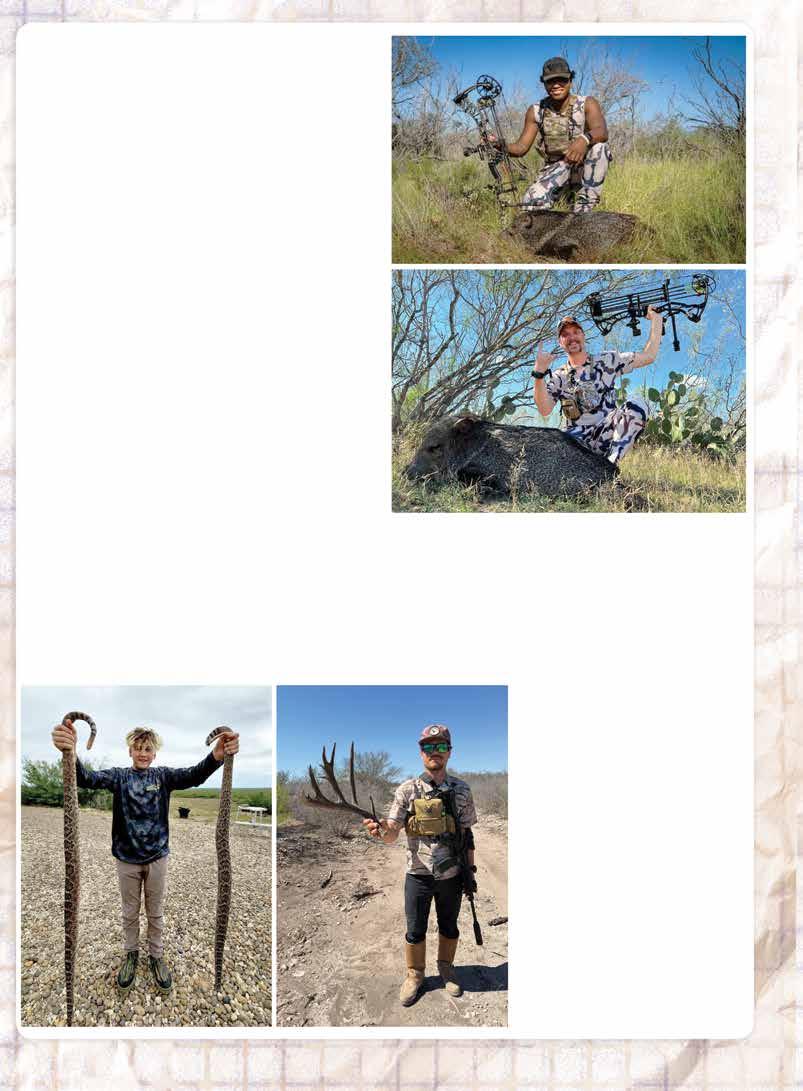
we’ve done have been purely for education and appreciation, not commercial purposes, and the arrowheads and artifacts we’ve found are proudly displayed on the walls of hunting camps.
For summer camps especially, there’s nothing quite like watching a kid’s eyes light up when they pull something out of the ground that someone made a thousand years ago. It puts the land in a whole new perspective.
If you haven’t spent a spring morning set up on a hillside with a predator call, you’re missing out on some of the most heart-pumping hunting South Texas has to offer. Coyotes and bobcats are year-round residents on the ranches we hunt and calling them in does double duty — it’s great population management and even better sport.
Wounded cottontail and jackrabbit distress calls are reliable producers for both species. Bobcats, in particular,
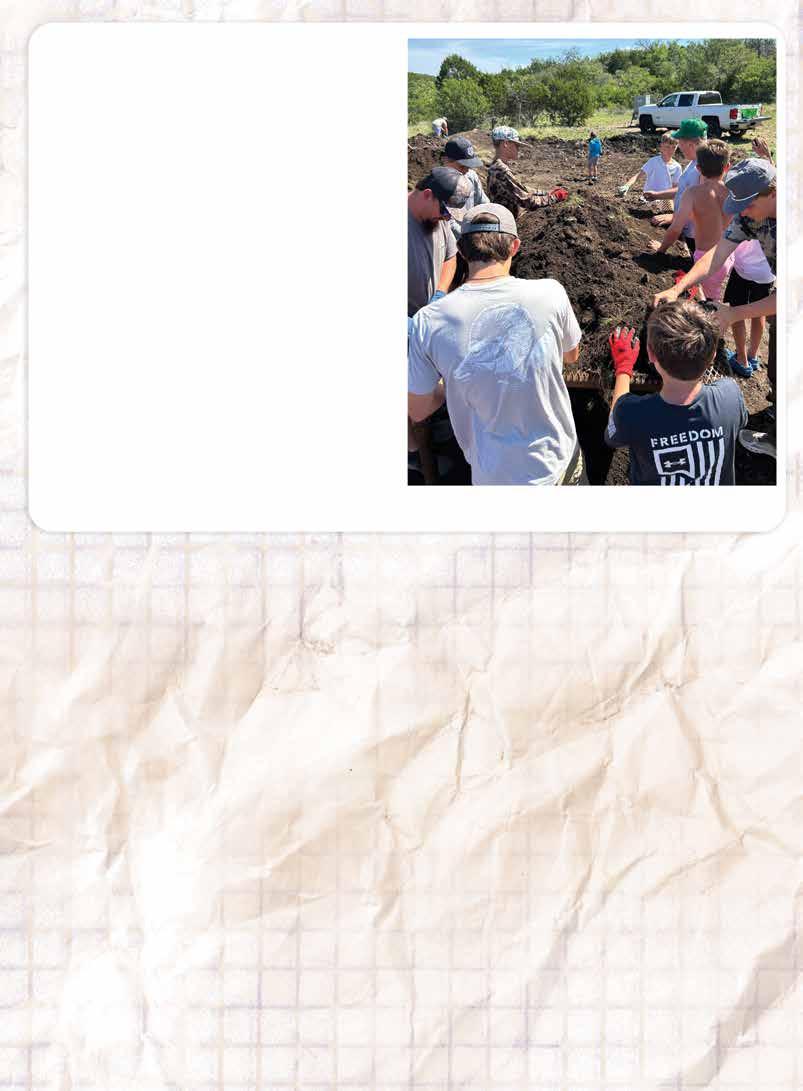
respond surprisingly well to woodpecker calls — something worth keeping in your toolkit. We also like to use a simple feather tied to a stick as a motion prop. It flutters in the wind, draws the predator’s eye away from the hunter, and buys you the critical seconds you need as things develop fast.
One tip I always pass along to younger hunters: Don’t be afraid to bark at an approaching coyote. It sounds counterintuitive, but it’ll often stop them just long enough for you to settle in and make the shot.
Just because the whitetail season is behind us doesn’t mean the field is closed. South Texas in the spring and summer is alive with opportunity, and every one of these activities is worth pursuing. That said, they all come with real safety considerations.
Predators will flee or fight when cornered. Rattlesnakes are common and can be deadly, and out here we’re often a long way from the nearest hospital. Take the right precautions, wear the right gear, and never head out alone. Bring a parent, a partner, or a group of friends — and go make some memories. The brush is waiting.
Michael Marbach is the CEO of the Christian Outdoor Alliance, mycoa.org; 210-827-9802. COA’s mission is to guide youth and outdoorsman to a relationship with Jesus Christ through experience in God’s great outdoors.

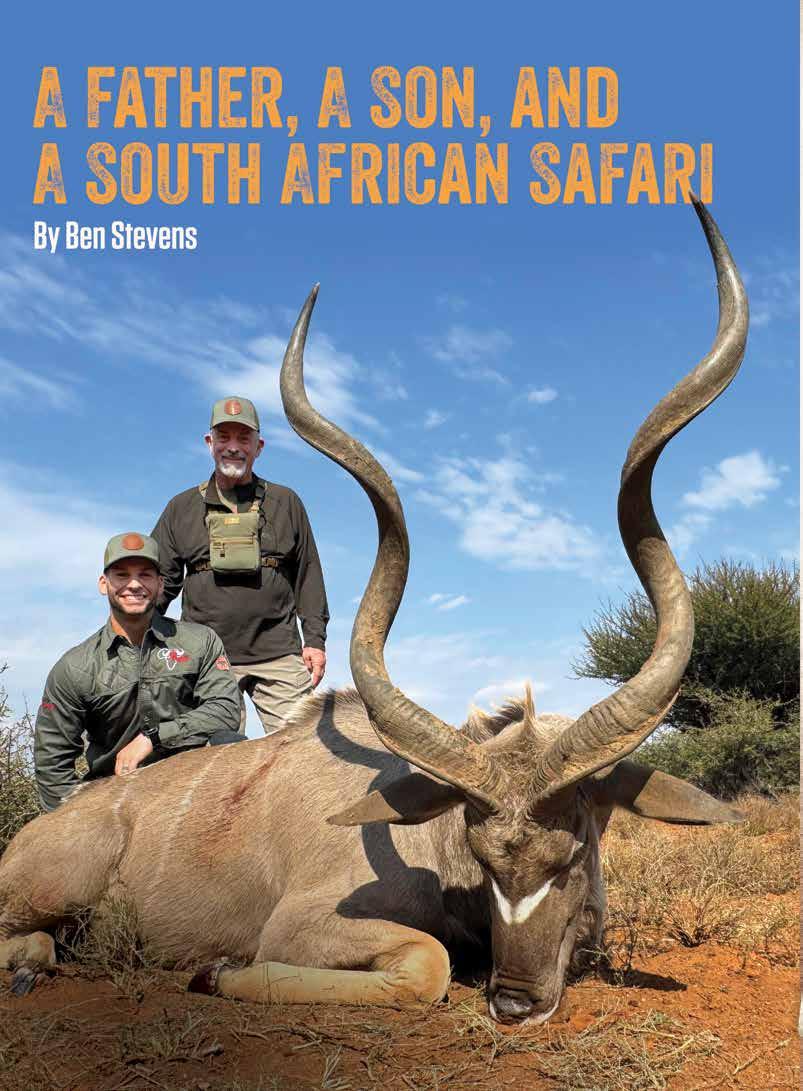
My father and I had always dreamed of hunting in Africa. Our time had come for that trip, which took over a year in the making. In the summer of 2024, we finally pulled the trigger and booked it. The anticipation was intense during the year leading up to the hunt—but not nearly as intense as when we finally made our way to Atlanta to board the 16-hour flight to Johannesburg.
This was our first long-haul flight, and I’ll admit I was nervous at first. But don’t let that deter you. Despite its length, the flight was smooth and far better than we expected.
After landing in South Africa, we headed to African Skies for an overnight stay before our short flight the next morning to Kimberley. This hotel is a popular transition stop for hunters en route to their hunting destinations. Upon arriving in Kimberley, we were greeted by our professional hunters (PHs), Stephen and Eben, from SB Hunting Safaris. From there, we began our journey to the concession.
Even just driving along the main road, I was amazed by the number of animals we saw. We encountered more species than we’ve ever seen on hunting ranches back in
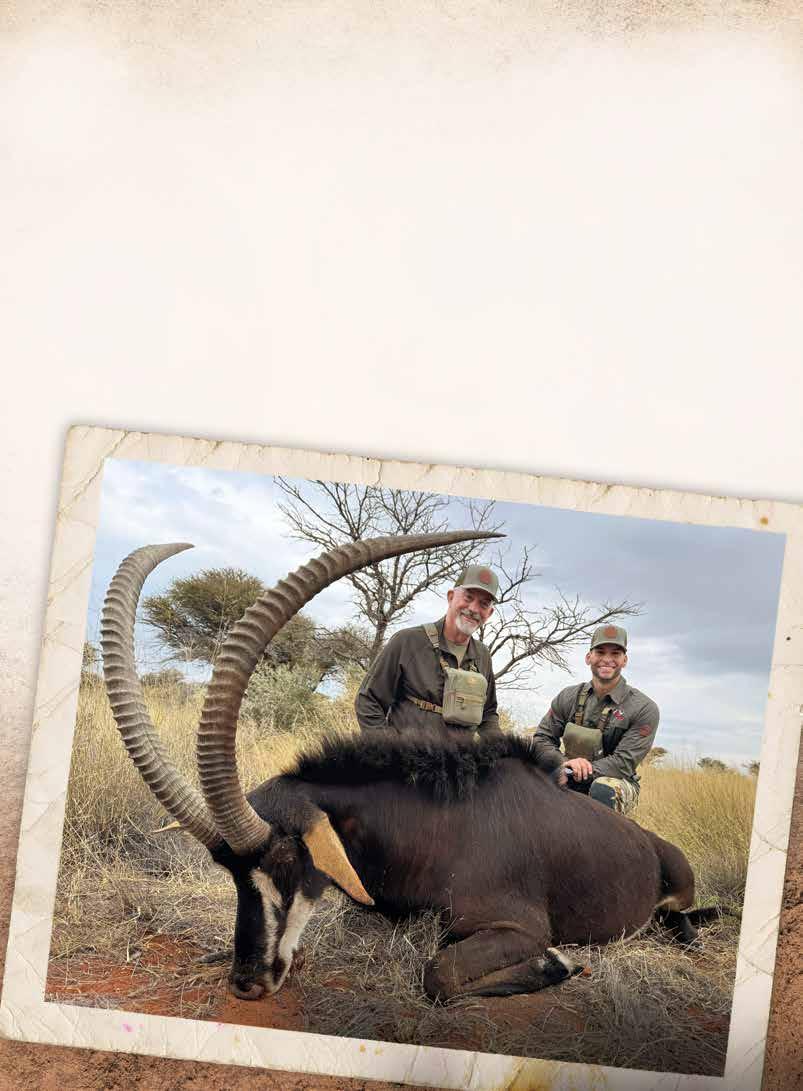
Texas—and we hadn’t even reached the property yet. Once we arrived at the lodge, we were shown to our rooms and served a generous brunch. We were heading to the field at 11 a.m. and wouldn’t return until evening.
It was time. The moment my dad and I had dreamed about for years was finally happening. Our first stop was the range to shoot the rifles provided by the PHs (highly recommended if you want to avoid the hassle of rifle permitting). We checked their accuracy and got a feel for the recoil, trigger pressure, and general comfort.
Once everyone was confident, we headed into the field. Within minutes, we were greeted by steenboks sprinting across the road and disappearing into the brush, followed by a female warthog and her two babies. Not 10 minutes later, we spotted a great bull kudu—my No. 1 target. I’ll never forget Stephen looking at me and saying, “Let’s go.” The stalk was on.
We made sure we were downwind of the kudu herd and used berms and bushes to make our approach. The kudu were walking away from us, and it felt like we just couldn’t close the distance. We kept them in sight—about 250 to 300 yards—as we moved slowly and carefully.
After 20–25 minutes, we lost visual contact, but Stephen knew the direction they were heading, and we continued our calculated approach. I’ll never forget reaching the point where we barely caught a glimpse of a young bull through a 20-foot opening in the brush. Stephen set up the sticks and told me to aim at that opening because the group would move through there, and we needed to be ready.
Not 2 minutes later, the big bull appeared, facing away from us, feeding on leaves and completely unaware of our presence. He stood there, not offering a shot, and I could feel my breathing and heart rate accelerating. Stephen put his hand on my shoulder and said, “Slow your breathing down and relax.” That helped tremendously.
Suddenly, some of the females began sprinting through the opening, clearly spooked. The big bull quickly lifted his head up, still facing away, watching them. Stephen whispered that the bull was about to move, and to be ready to shoot the moment he turned to the left. After what felt like an eternity, the bull turned and I squeezed the trigger. We heard the impact. As we walked to where the bull had stood, Stephen scanned with his binoculars and said, “He’s down!” I hadn’t seen him yet, but as I turned the corner and spotted him, I was overwhelmed with emotion. There I was, in South Africa, on safari with my dad, having just taken my dream animal. Holding the horns of that magnificent kudu was surreal. When I think of Africa, I think of kudu—and for that to be my first African animal was more than I ever imagined.
After taking the kudu, the day only got better. My dad got his top animal, a massive sable. He made a perfect shot, and I’ll never forget walking up to that sable and all of us being speechless. It was such a majestic animal—absolutely stunning. My dad and I looked at each other in disbelief, wondering how anything could top that moment.
I’d love to go into detail about every species we took after the kudu and sable, but this would turn into a multi-volume series. My father and I ended up taking 15 spectacular animals, ranging in size from springbok to an ancient eland. Each hunt had its own unique challenges—and just as many laughs, if not more.
This trip to Africa was truly a dream come true. The memories we made will last a lifetime. The landscapes were indescribable—sunrises and sunsets that looked like museum paintings. The sheer variety of wildlife we saw driving around couldn’t be matched by multiple zoos in America.
But above all, it was the people that made this trip unforgettable—from the fellow hunters on safari with us, to Stephen and Eben, to the incredible lodge staff, trackers, and skinners who ensured our trophies were perfectly cared for. Their hospitality and friendship are something I’ll carry with me forever. I had heard people say that when you leave Africa, you leave a piece of your heart there. Now I know exactly what they mean. The legendary continent holds a piece of mine—and I carry with me a lifetime of memories it gave in return.


Long before “Lord of the Rings” and long before Europeans found New Zealand, there were no mammals running around. No deer species or anything else with horns, no rodents, and no predators. The only native mammals were three species of bats. They did have a lot of flightless birds, including the most impressive giant moa at nine feet tall. The first human inhabitants arrived shortly before 1400 A.D. and in very short order ate all the moa to extinction. You can imagine that, with no edible mammals, nine-foot chickens would not last very long.
Europeans discovered New Zealand in 1769 and brought domestic livestock with them, but also longed for the familiar game animals of their homeland. They established “acclimatiza-

tion societies” whose job it was to bring in animals they liked from different parts of the world and release them in New Zealand to become acclimated.
As part of this effort, eight species of deer were released in the late 1800s including the red deer, which is basically Europe’s smaller version of our North American elk. The first red deer arrived from England and the Scottish Highlands in 1851. Around 1,000 red deer had been released by 1923. Today, red deer make up about 77% of all wild deer and 85% of farmed deer in New Zealand.
Today when we conduct translocations of wildlife, we worry if they will survive in their new home. For red deer, New Zealand was paradise with absolutely no predators and a very
productive mosaic of grassland, shrubland, and native forest. These introduced red deer rapidly grew in number and expanded across large parts of both the North and South Islands of New Zealand. Within a few decades of high reproductive rates, there was no stopping them.
Records at the time tell a story of widespread environmental damage as growing red deer populations browsed native forest understories and suppressed the regeneration of new trees by eating all of the young saplings. Their browsing and grazing effects started to completely alter the high elevation Alpine and forest ecosystems.
Throughout this period of red deer population expansion, New Zealand developed a hunting culture of its own. Where most people came from, wildlife like deer belonged to royalty and were not free for the taking. With overabundant red deer herds, New Zealanders enjoyed the opportunity to take their own meat and hunt at their leisure.
The first bounties on red deer were offered as early as 1906 by some local acclimatization societies, showing just how fast the deer population got out of control. By the 1930s the
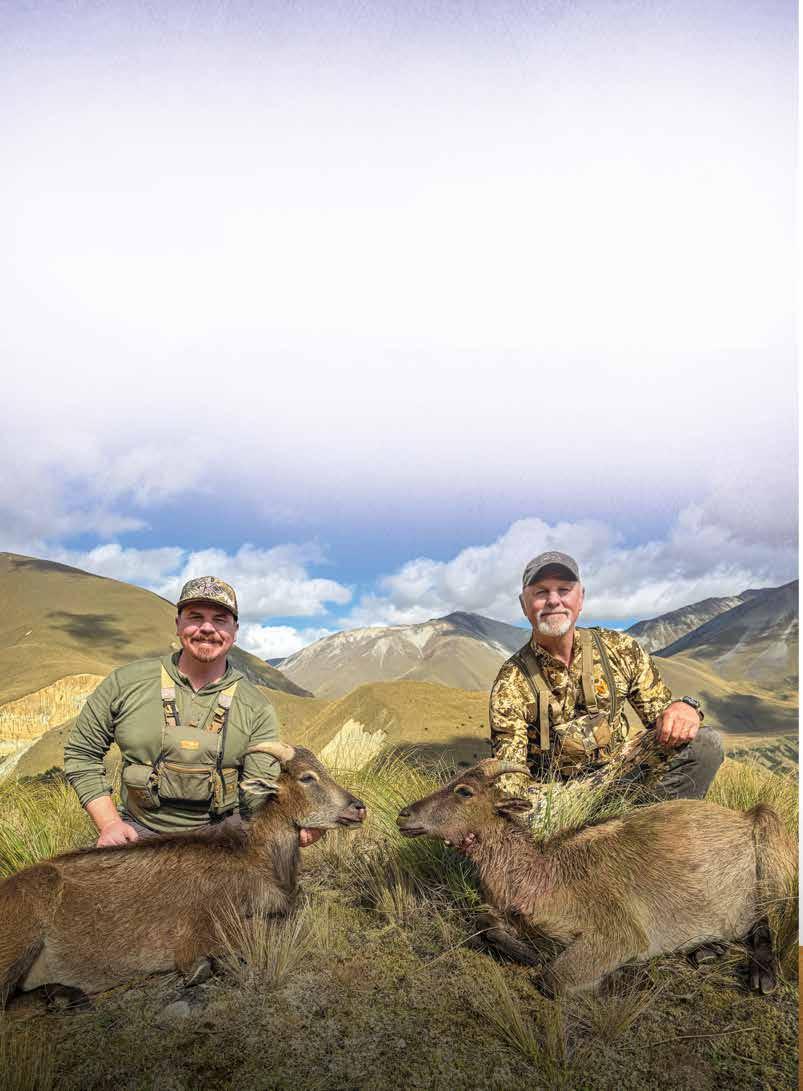
government recognized red deer as a pest species and started government deer culling programs. This era saw the rise of the government deer cullers who were paid a wage plus a bonus for each deer tail they turned in. Between 1932 and 1954 there were an estimated 1.5 to 3 million deer killed in New Zealand, but that was not enough.
Deer culling became a legendary occupation for rural New Zealanders and solidified a hunting culture among the population. During this period there was also conflict between those wanting to kill as many deer as possible to reduce ecological damage versus recreational hunters who didn’t want to see fewer deer on the landscape. A conflict that continues today with several species.
In 1961 the first helicopter arrived in New Zealand and deer cullers found they could shoot 100-200 deer per day from a helicopter in rough and rugged landscapes. Soon, helicopter teams worked the island over so hard they actually started to reduce the red deer population.
Increasing demand for venison worldwide, especially in Europe, kicked helicopter deer harvest into full gear, but this time
they were bringing out the carcasses. In the 1970s, venison prices peaked, which triggered what is sometimes referred to as the “venison rush.” Three-person crews worked remote and rugged terrain with a helicopter pilot, a shooter, and a “knife hand” to skin and gut the animals. The gutters would sometimes climb out on the skids and “ride the chain” down to the ground if it was too rugged to land. To speed things up, some gutters would connect the hind legs of red deer to the bottom of the chain and stand in the open rib cage of one as the pilot slung all of them out of the mountains. Legends were made but lives were lost. Between 1976-1982, there were 208 helicopter crashes killing 17 people and injuring another 40.
By the mid-1970s, deer were getting harder to find. This scarcity in the face of high venison prices triggered a transition to deer farming. In 1969, legislation allowed deer farming in New Zealand for the first time. Capturing live animals to stock deer farms was much more challenging and dangerous than just shooting them. During this time the net gun was invented which shoots a net over the deer. There are many stories (and even video) of New Zealanders jumping out of helicopters and onto the backs of running red deer to bulldog them to the ground. Once deer farms were well established, not only was venison exported, but velvet antler production and export to Asian markets became highly lucrative.
Today, New Zealand is the largest exporter of venison and velvet in the world with about 1,400 deer farms in the country. Outside of these fences, deer numbers continue to climb while hunter participation is declining. This trend does not bode well for the health of the habitat.
I recently traveled to New Zealand and witnessed local conditions firsthand. I accepted an invitation to be a keynote speaker at the International Deer Biology Congress, and my talk was about managing deer species in North America. My son Levi, director of the Caesar Kleberg Wildlife Research Institute North, which is based in Lubbock, also attended and gave a presentation on his own deer research. After the conference, we joined a friend who is a multigenerational New Zealander
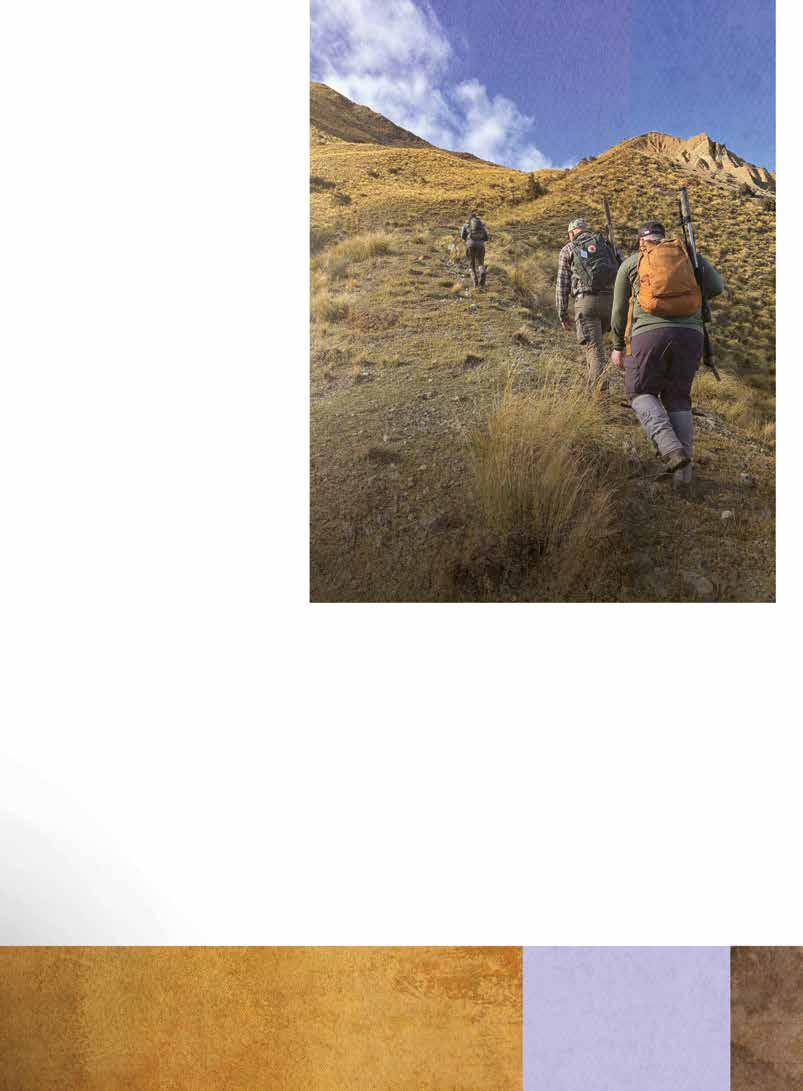
and a new friend from Sweden to do our part to control these invasive species.
We used our legs and lungs to climb high ridges and search for animals that were brought from scattered places around the globe 170 years ago. We successfully found and harvested red deer, Himalayan tahr, brushtail possums, wallaby, European hare, and European rabbits. Staying in one of the old deer hunting huts, we enjoyed tahr backstrap and beans wrapped in a New Zealand version of a tortilla.
I found it incredibly interesting to see such a different environment with beautiful scenic views distracting one from the obvious ecological damage from too many mouths on the landscape. In remote habitat, the trees and shrubs had obvious browse lines from too much browsing and very little recruitment of young saplings of valuable native plants. It seemed everywhere you looked plant and animal species were from someplace else and the native plants were doing their best to hold on.
Managing red deer and other exotic species in New Zealand consists mostly of trying to kill as many as possible with the realization that the terrain and remoteness would not allow over harvest or even stabilization of the populations without the return of massive helicopter operations.
Red deer remain an extremely important economic resource for the farmed venison and velvet industries and also for generating income from hunting programs. Despite being viewed as a pest, red deer are still an animal with high social and cultural significance for New Zealanders. Government calling programs are still in place, mostly to target specific conservation projects to protect sensitive habitats and native species. Hunters remain an important tool in population management
through a managed access system, but it’s very difficult to truly impact the wild free-ranging herds while their ecological impacts keep rising. But, that is not to say we shouldn’t all try if given the opportunity.
New Zealand is sprinkled with 100-year-old hunters’ huts that are still used today. The author spent a night in this one.

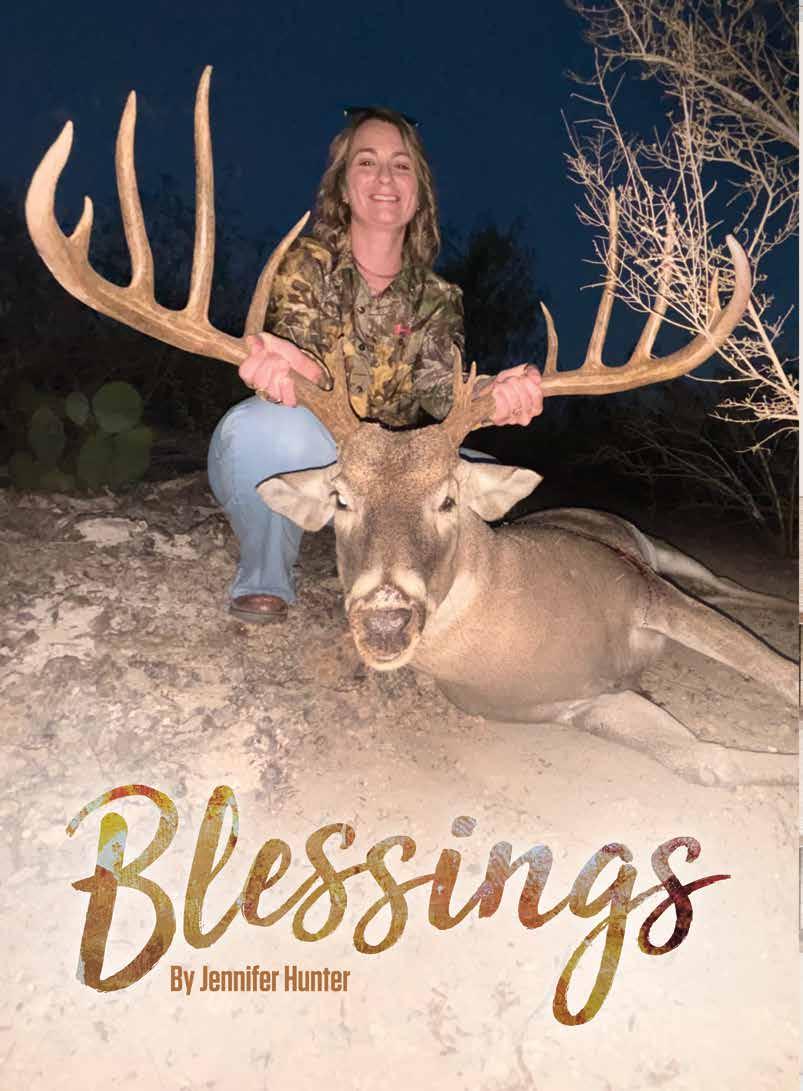
As the years pass, you begin to notice time differently. You reflect on the blessings God has placed in your life and within your family, and you realize while your children are growing older, so are you. Recently, my oldest son, Cody, turned 21. We celebrated at home with dinner, cake, and presents—simple things, yet full of meaning. It was that evening of fellowship that unknowingly set the stage for a moment I will cherish forever.
I married into a hunter family, though I did not grow up hunting myself. Still, I was never opposed to learning. Our family owns a ranch in Cotulla, Texas, just south of where we live. Over the years, busy schedules and high school sports limited our time there, but one tradition has remained unchanged—we always make time for Thanksgiving at the ranch.
During our celebration, my son turned to me and said, “Mom, you haven’t shot a buck in a long time. Why don’t you come with me and we’ll get one together?” I agreed, but the truth is, it wasn’t the hunt that convinced me. It was the promise of uninterrupted time with my oldest child.
The weekend before, my son had guided my best friend, Sarah, on her hunt. I had the opportunity to join them. Sitting quietly in the blind, watching God’s creation move naturally around us, was a gift in itself. Within 30 minutes, Sarah had taken a buck. It was a successful hunt and a meaningful experience for us all. Shortly after, my son’s
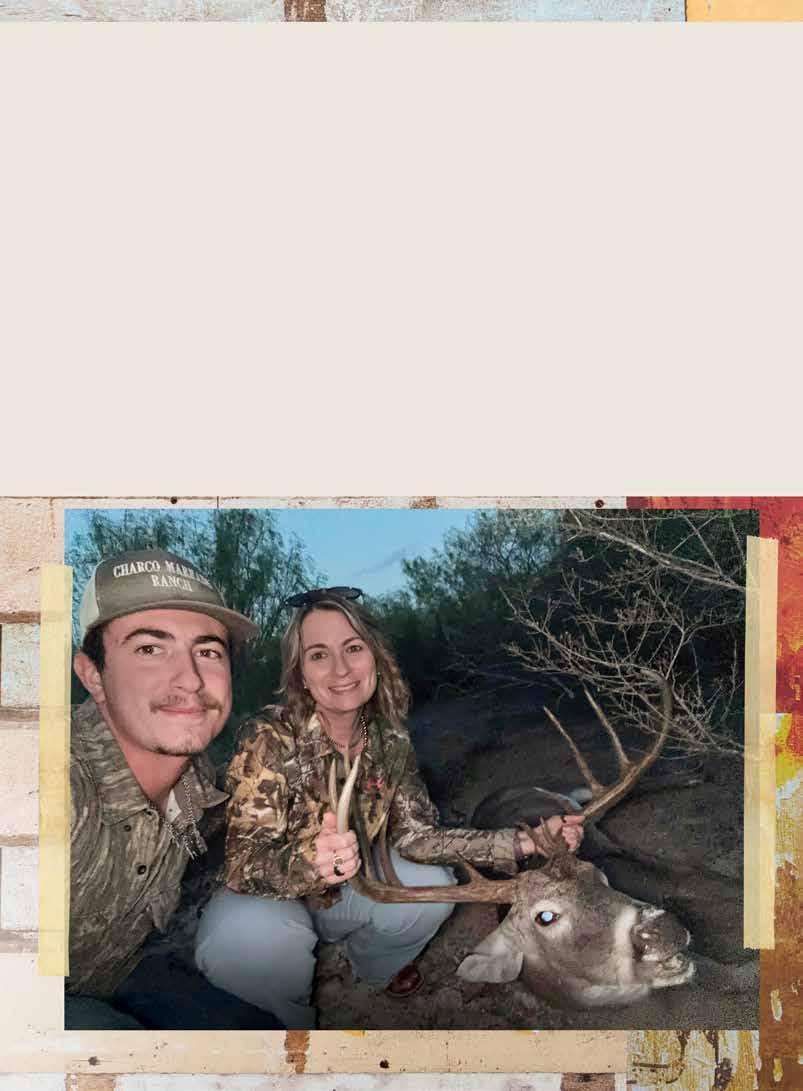
girlfriend, Hannah, also killed a buck, under his guidance. By then, I was convinced he truly was a good guide.
We waited until my daughter, Bri, returned home from college. She had just completed her first semester at the University of Mary Hardin-Baylor, and we left for the ranch together on Wednesday. We arrived in time for the hunt and enjoyed visiting with family we hadn’t seen in quite a while.
That afternoon, we left the ranch house around 3:45 p.m., stopping first to drop off two cousins at a nearby blind. Cody then helped me get settled in mine—opening windows, positioning the chair, and explaining where the deer would most likely appear. He spread corn and parked the truck down the road to avoid spooking anything. He brought my rifle and calmly walked me through the plan.
By 4:30, we were settled in. As we waited, conversation flowed easily. We talked about my daughter’s first semester of college, my younger son transitioning from football to baseball, and my kindergarten classroom this year. Then my son began sharing things about his own life. I listened quietly, understanding when your children grow older, you listen more than you speak. If they want advice, they’ll ask.
The feeder went off, and a few does appeared, but no bucks. Time passed. Then suddenly, my son lifted the curtain and whispered, “Mom, don’t move. The buck we’re after is here.”
My heart began to race. He guided me through each
step—positioning the chair, steadying the rifle, finding the buck in the scope. Being short, I had to adjust carefully, using a pillow for support. Without a gun rest, he steadied the rifle while reassuring me with quiet confidence.
When I finally saw the buck in the scope, I could feel my heart pounding. All I could focus on was how wide he was. It felt like an eternity as we waited for the right moment. My son spoke calmly, reminding me to breathe, to relax, and to squeeze the trigger when the time was right.
Then the moment came. “Mom, you’re good,” he whispered. “I’m going to grunt so he looks up.” The buck did—and I took the shot.
The buck ran. My son immediately leaned in, hugged me, and said, “Mom, you got him.” Doubt crept in, but he smiled and reassured me, “I saw it hit.”
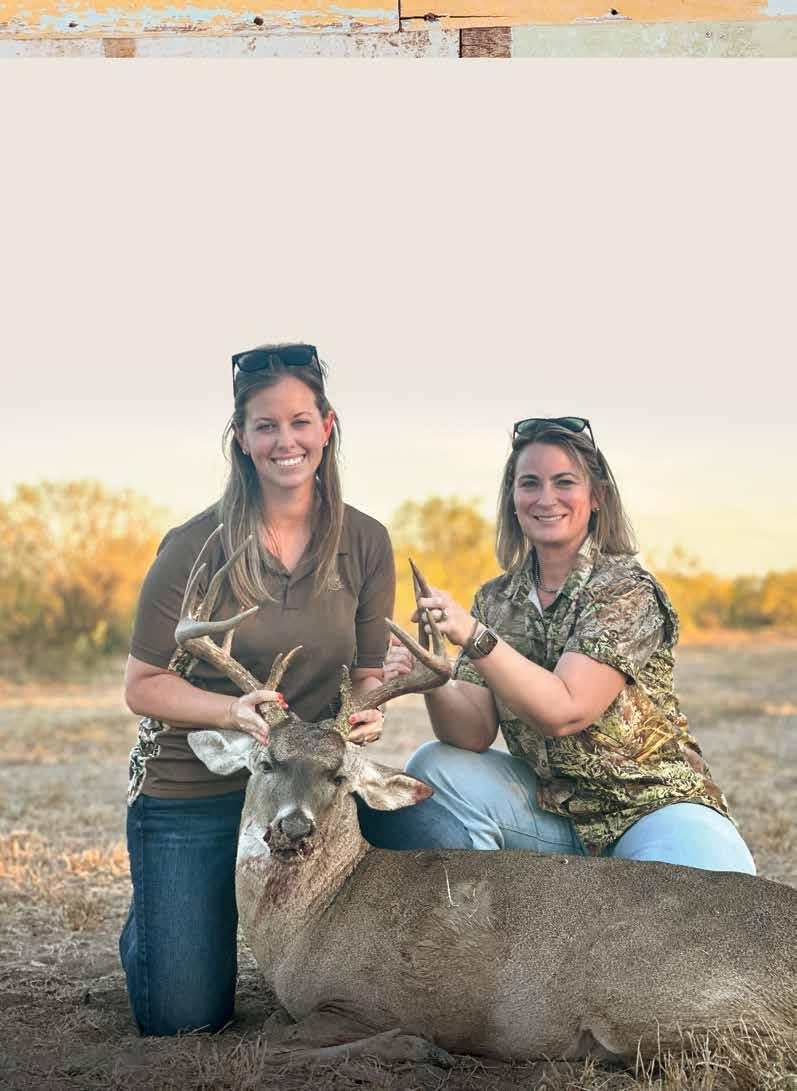
After waiting several minutes, we stepped out of the blind. He spotted blood and guided me carefully through cactus and mesquite, always walking just ahead of me. Then he stopped, turned, and said, “Mom, go ahead.”
There he was.
As I looked at the buck, I felt tears well in my eyes—not because of taking the buck, but because of the moment standing beside my son. In his smile, I saw the little boy he once was, and in that instant, my heart became full.
That hunt reminded me that hunting is not always about the kill. It’s about time well spent, lessons quietly taught, faith woven into shared experiences, and memories that stay with you long after the season ends.
It was, without a doubt, one of the greatest blessings of my life.
BY JUDY JUREK
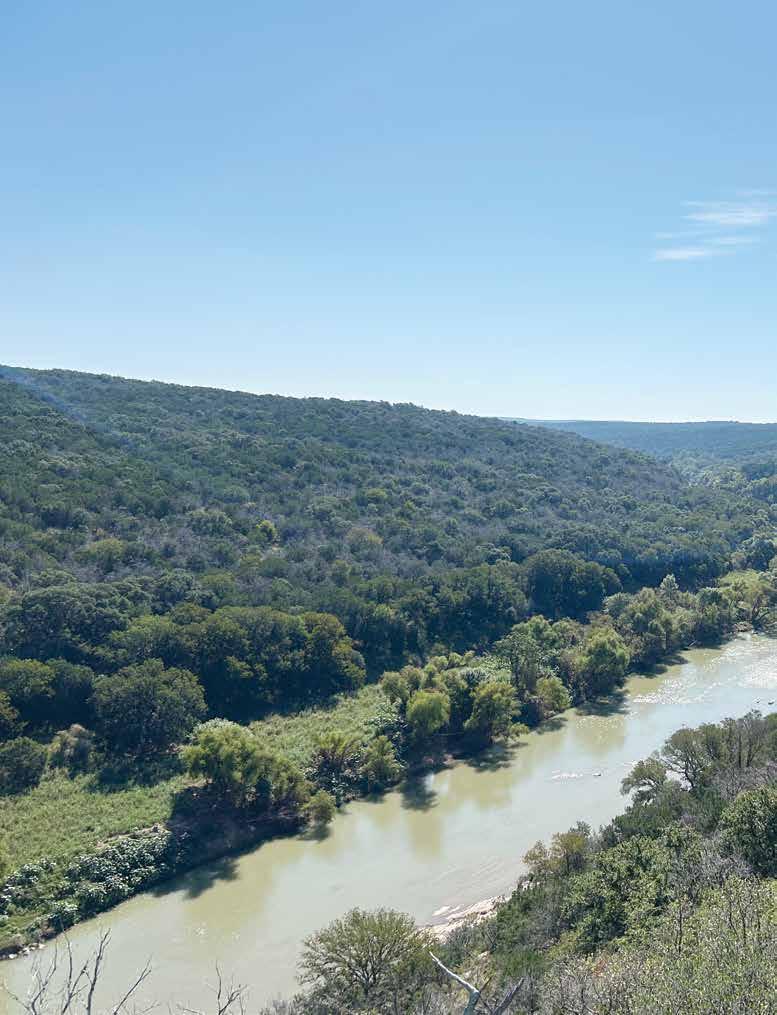
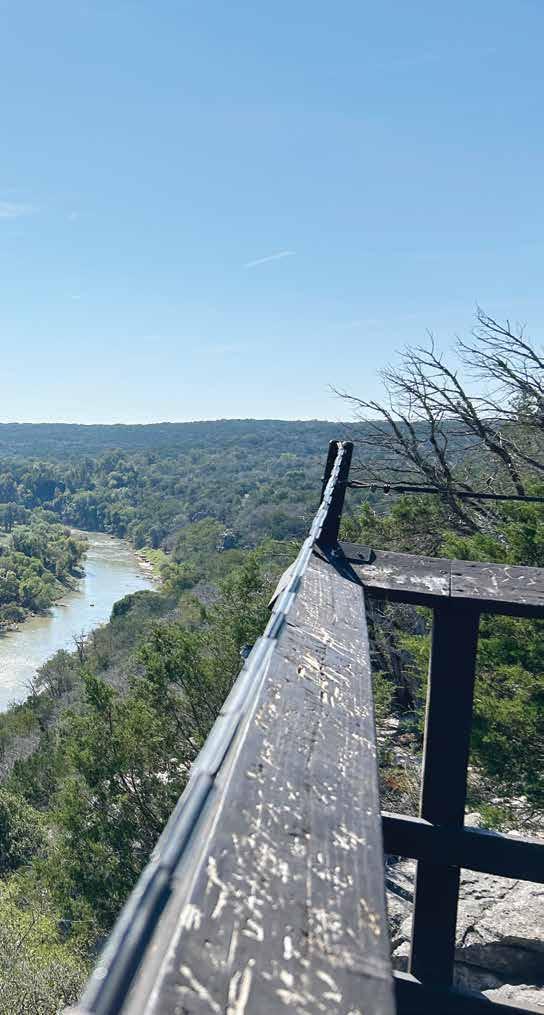
The cry “I GOT ONE!” rang out along the river as someone else hollered, “I’M HOOKED UP!” with a third voice exclaiming, “ME, TOO! WOW, THIS IS FUN!”
The day was bright with high cumulus clouds as a light wind blew around the bend in the Colorado River at the aptly named Colorado Bend State Park (CBSP). Fishing was the priority, as white bass had begun their annual run.
Somewhat similar to salmon, white bass migrate from reservoirs into rivers and creeks to spawn. It’s a great opportunity for anglers of all ages, all skill sets. Typically starting in late winter, white bass run through spring and sometimes into early summer. Many believe when the redbud trees bloom is the time to hit the water as the peak of the run takes place.
The white bass run can be exciting and quite fun. Many anglers, old, young, and in-between, shout with exhilaration bringing in fish after fish. The white bass limit is generous at 25 per day, and at least 10 inches in length. It’s not hard to fill your possession limit if conditions are right and an angler is halfway skillful.
Depending on the weather and river conditions, March and April draw many park visitors wishing to cast lines for white bass. Spring breaks vary, so crowds along the river bank, as well as boats in the water, also deviate between somewhat congested to quiet openness. May is also a popular month as temperatures are usually still pleasant without being downright hot.
Of course, many other types of fish in addition to white bass provide great action at CBSP. The river holds Guadalupe, largemouth, smallmouth, striped, and hybrid striped bass, channel, blue, and yellow catfish, various crappie species, buffalo, and alligator gar. Softshell and hardshell turtles may also be caught occasionally.
Much depends on your choice of bait and style of fishing. Fly fishing has gained in popularity over recent years, but anglers need much space and quiet areas to do this type of recreation. Setting out jug lines is a great way to catch catfish. Whether using a plain cane pole or fancy rod and reel, CBSP fishing offers much for fishermen and women regardless of age.
In addition to fishing, which is al-
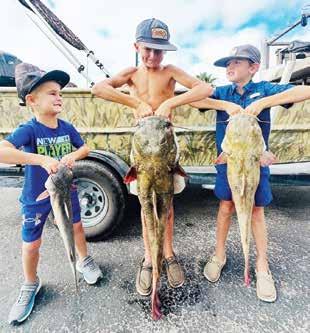
The young Riley brothers, avid fishermen, hoist their catfish after successfully setting jug lines.
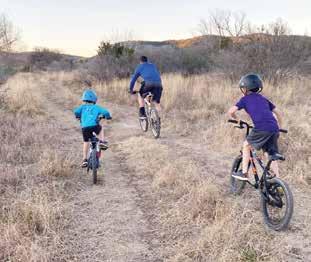
Mountain biking is immensely popular at Colorado Bend State Park as well as many other locations across Texas.
ways popular year-round weather permitting, there’s an array of things to see and do at this unique state park. There’s great expanse to explore and enjoy on more than 5,300 acres. The majority is located in San Saba County, with a portion in Lampasas County on the river’s opposite side from the main campgrounds. There’s no public access on the Lampasas side. Purchased in 1984, the park opened in 1987. It’s one of the most popular state parks in the Lone Star state. Much depends on your energy level as to what, how much, and how far you want to go. This state park offers many scheduled events by park staff at various times of
the year. Hikers, mountain bikers, and backpackers can find trails for all skill sets from beginner-easy to seasoned-difficult.
Scenic Gorman Falls, a 70-foot spring-fed waterfall, is a 3-mile round-trip hike over rocky, rough terrain and a deep descent near the falls. Spicewood Springs features waterfalls and pools for swimming, along with gorgeous views. Some trails along the river are much more easily navigated, but all hikers need to watch out for rattlesnakes.
Swimming is allowed in the river, although no lifeguards keep watch. There have been times when the park has been temporarily closed due to excessive rainfall in the area or the Colorado River flooding due to heavy rains upstream. CBSP’s 35 miles of trails drain well and are rarely closed, unless posted as such.
Camping is along the river bank with back-to-nature camping. CBSP is more primitive camping oriented, offering rustic hike-in sites for those wishing for more natural settings. Walk-in tent sites and drive-up sites for RVs offer water, but no electrical or sewer hookups.
Rigs more than 30 feet in length may have trouble negotiating sharp road curves to get to the camping area alongside the river. Those towing the average boat have no trouble. An open-air rinse-off shower is near the campground with composting toilets located near the main camping area and at one trailhead. Ready to explore the underground? The park offers wild cave tours. Guides furnish helmets, headlamps, and safety instructions for thrill seekers looking for a bit of something else. Adventure seekers can crawl, climb, and squeeze through undeveloped caves, explore larger chambers, or take the easiest routes suitable for kids and beginners.
Rescues are a part of CBSP park rangers’
Colorado Bend State Park is accessible from San Saba or Lampasas. Check online for the events schedule. Entrance fees are $5 daily for adults, while kids 12 and under are free. Call 325-628-3240 or visit tpwd. texas.gov/state-parks/colorado-bend for more information.
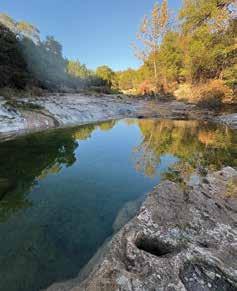
duties. Dehydration and heat exhaustion are the biggest problems for hikers and bikers. Slips, falls, and medical issues account for other life-saving endeavors. It’s not uncommon for air medics to arrive because that’s the fastest transportation way due to CBSP’s remoteness.
For kids, CBSP offers both above and below ground Ranger Programs to becoming a Junior Ranger. Tasks are provided, with badges earned for completion of assignments.
Campers are advised to keep food enclosed in raccoon-proof containers at all times, especially at night. The masked bandits will try to rob campers of edibles and are often quite successful. Be advised, too, there is no nearby store for supplies, so pack in everything you may need.
It’s always best to check weather conditions and make reservations. A portable weather-band radio is a good thing to have. Be sure to have your fishing license up to date.
Check out Colorado Bend State Park for your next outdoor adventure. It’s worth the effort and drive to get to it.

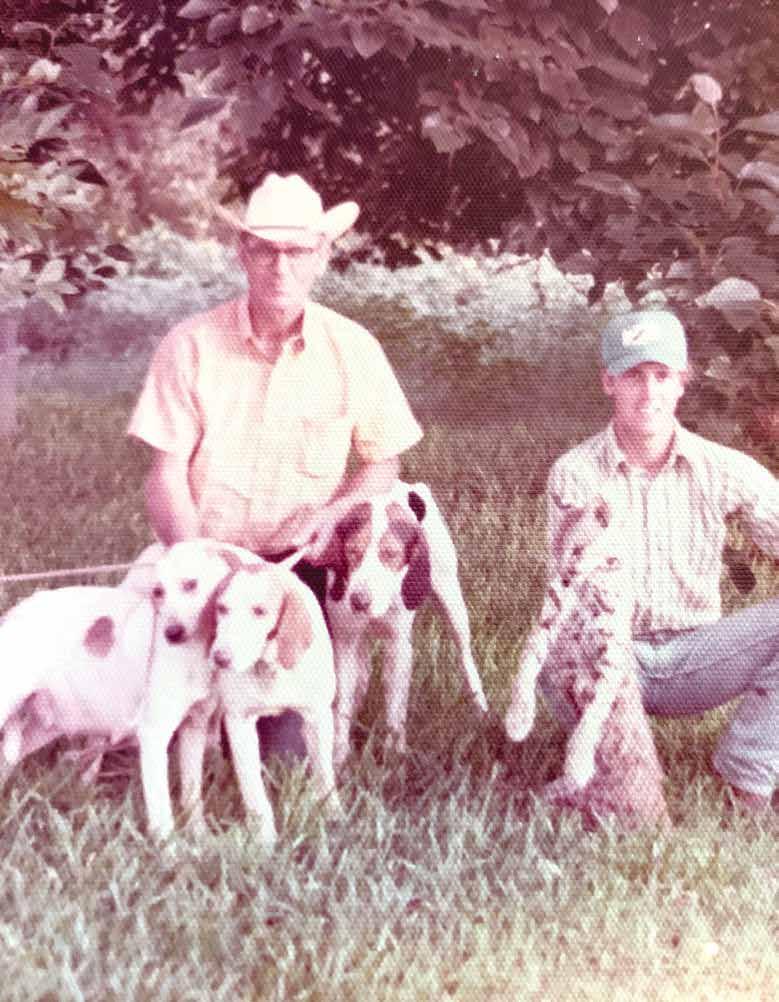
have much knowledge to offer
Hubert Yarbrough (left) and a very young Gary with a bobcat they caught with hounds near Devine. Gary was about 16 and attending Devine High School. Gary said Yarbrough was a patient man who knew a lot about dogs.
“In my opinion, knowing history is important because if you don’t know where you’ve been, you sure don’t know where you’re going. I tell folks when you’re hunting and make a mistake that costs you a trophy whitetail, elk, mule deer, turkey or coyote, it’s a learning experience. Getting advice from someone who has had the opportunity to make more mistakes than me is invaluable.”
On a Saturday in late March, I drove to Gonzales, Texas, to attend Horace Gore’s “Celebration of Life.” I first met Horace in about 1991 at the Shot Show when he walked the floor with my friend, John Jefferson. A couple of years later, Horace became editor of The Journal of the Texas Trophy Hunters, and he asked me if I would be interested in writing for the magazine. Through the years, Horace and I attended all the Hunters Extravaganzas, hunted together on occasion, and visited over the phone quite often. Horace became not only a friend, but he was also one my mentors due to our love of hunting, shooting, and Texas history. I respected Horace, not only for his knowledge and experience but he was my senior.
One of the chapters in my book, “Eyes Front,” is entitled “My Heroes Have Always Been Old Guys.” As most of you know, I began hunting at a very early age, killing my first whitetail at age seven while hunting alone. While hunting with buddies that were my age was entertaining, I soon realized there was nothing they could teach me, as I was more experienced. For this reason, I began hunting with gentlemen who were many years older and had years of experience in the woods. I grew not only to love them, but most importantly, I learned to respect them. Respect for elders is something the younger generation of hunters has forgotten, or perhaps was never taught.
BY GARY ROBERSON A uthor photos
I grew up in a Southern Baptist church, Black Creek Baptist Church. I rarely missed Sunday school where basic values were taught in scripture. When I think of Horace and so many other mentors, I am reminded of Ephesians 6:1, “Children obey your parents in the Lord, for this is right,” and Leviticus 19:32, “Rise in the presence of the aged, show respect for the elderly.” Today, sadly, I don’t see the young folks engaging with experienced hunters to gain knowledge. It appears they rely more on social media, podcasts, and online forums to find answers. Unfortunately, in most cases, the individual answering the question has little experience but is great at social media.
As I said earlier, Horace was a historian and the most
knowledgeable person I have ever known concerning Texas history. It seems that someone who’s interested in the past is also someone who will listen to someone with more experience. Unfortunately, many young hunters don’t care about history and surely don’t want to ask an old timer for advice.
In my opinion, knowing history is important because if you don’t know where you’ve been, you sure don’t know where you’re going. I tell folks when you’re hunting and make a mistake that costs you a trophy whitetail, elk, mule deer, turkey or coyote, it’s a learning experience. Getting advice from someone who has had the opportunity to make more mistakes than me is invaluable.
I cherish the many hours in the woods I was able to spend with my Great Uncle Dub Roberson, Hubert Yarbrough, Rob
Bush, J. Martin Bassinger, Murry Burnham, Phil Lyne, Larry Symes, and Horace Gore. When I reflect on these men, I realize all of them possess one quality, and that quality is respect for the game they pursued. Until you fully respect the trophy that you’re hunting, you will never be great at hunting.
My advice to the many young hunters I meet around the state at various hunting events is you should find that mentor. If possible, go hunting with them. If not, ask questions that only someone with years of experience can answer. Another thing I learned many years ago is that I never learned anything when my mouth was open. Listening and observing are the keys to making you a better hunter. This is true in whatever knowledge one wishes to obtain.
I believe we are at a time when so many
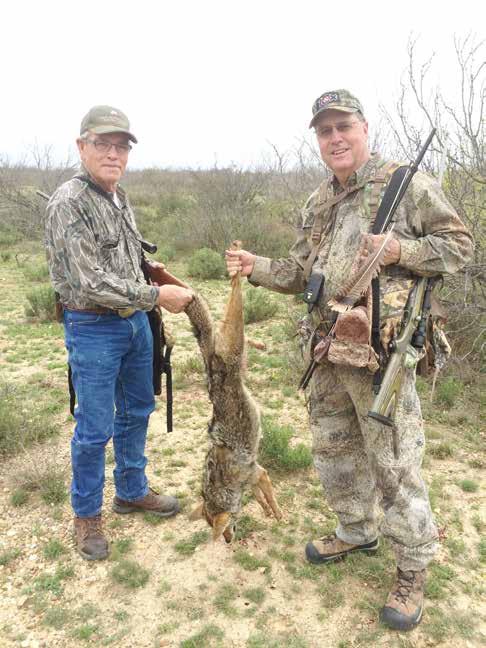
Phil Lyne (left) and Gary with a South Texas coyote. Gary said Phil is the best cowboy he ever saw, and a pretty good hunter as well.
people think new equipment and technology will make up for experience. This is true to some extent, as feeders, blinds, optics, night vision, improved calls, game cameras and suppressors have made huge changes in the way we hunt. While I can’t argue with some of these advances, I remain strong in the belief there is no substitute for hunting experience and knowledge of the game that we pursue.
At that Saturday memorial celebration, there were a number of great speakers who told stories of Horace Gore. Most of the stories were humorous. As many of you know, he was quite the character who faced life with a big grin and a loud laugh. However, I thought the words delivered by outdoor videographer Brain Hawkins really hit home with my relationship with Horace Gore and other mentors who have passed. Brian referenced the country song by George Jones, “Who’s Going to Fill Their Shoes?”
Horace’s passing is leaving a huge void in Texas hunting, from his days at Texas Parks and Wildlife Department to his years with the Texas Trophy Hunters Association. While I know he was one of my mentors, I expect that his absence will be felt by many others across Texas. Cherish your time with your hunting friends, because it doesn’t last forever.

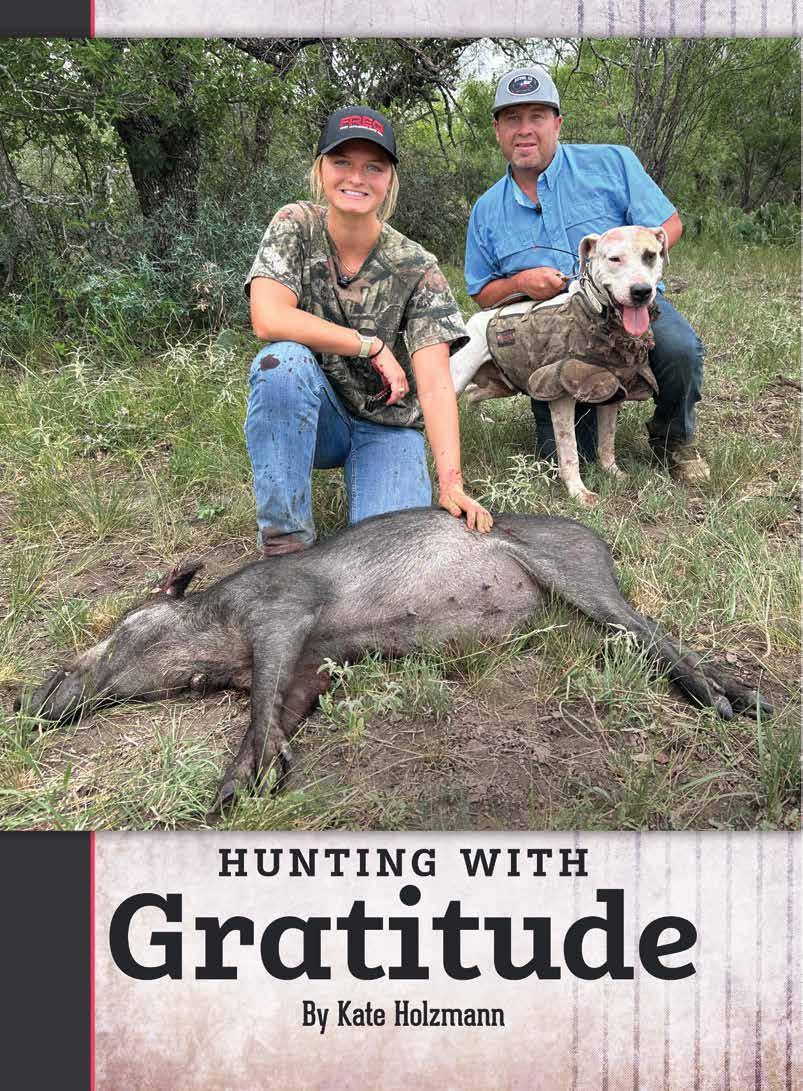
On the drive to Menard for my first time hunting with Gary Roberson, I found myself in the place I often fall back to when reflecting on my journey that has brought me gratitude. I didn’t grow up hunting. My dad worked cattle on our ranch in Cestohowa with my grandpa while I was growing up, but in the words of my late grandpa, there was no time for hunting when the cows paid bills. An automatic “yes sir” meant my childhood was focused on other things—refusing to tap out when my three older brothers tried WWE moves on me, running around the neighborhood with the boys next door, and club soccer.
I’d watch classmates go on hunts and remain fascinated by the pictures they’d bring back—sometimes helping my friend’s dad clean birds after he dove hunted—but that was about it. In high school, I was fortunate enough to kill my first buck in Cotulla, thanks to a relationship I was in at the time. That eventually ended, and when my mother sent me another screenshot of her cousin’s successful hog hunt on Facebook, my response this time was: “Just send me his number.”
One generous invite later, and the first glimpse of community that hunting creates went to the forefront of my life. I went spot-and-stalk hunting with my mom’s cousin, Bruce, and his friend Willie that night, and upon realizing that Willie lives and breathes to kill hogs, it marked the beginning of a friendship fueled by hunting, and continuing on for years. Some nights I’d drive home to San Antonio from College Station, texting Willie on the way: “You going out tonight?” meaning we’d make our rounds for the farmers, beginning in Elmendorf and hopping to Poteet, Cestohowa, and sometimes even Devine. Hunting until 2 a.m., I’d get my fair share of life lessons, family updates, story sharing, and if our friend Jacob was in the passenger seat, get crap for dozing off between properties. Being half their age means I can’t be tired—supposedly.
For the first three years of college, my life consisted of Aggie football, Texas A&M Club Soccer, an unfortunate amount of ACL tears and surgeries, and squeezing in a hog hunt anytime I made it back home. Tallying my fifth knee surgery at the ripe age of 21, my parents asked me to hang up the cleats for my upcoming final year. I turned my focus to my career while rehabilitating on the sidelines, taking real estate classes so I could get started in farm and ranch real estate. My senior year was still an empty canvas, so I decided by the end of the junior year to finally run for office in the Texas A&M chapter of TTHA. I secured the spot of Banquet Chair, getting to focus my leadership on raising money for Texas Hunt for the Cure, a non-profit that takes kids with life threatening and life-altering conditions on hunts. It’s
another example of hunting being so much more than a kill.
Becoming an officer meant I would work all three Hunting Extravaganza shows, and through this duty, I further connected to people who have become so important in my life, people who have cheered me on, mentored me, supported me, and shared their knowledge with me throughout my senior year of college and post-grad. I met Gary at the hunting shows, finding his booth each weekend and finding a spot on the floor, overstaying my welcome, and chatting his ear off. It’s a miracle he stayed in touch post-show.
After graduation, Gary and I were doing a typical checkin on life and real estate when I let him know I had started a company centered on sales and marketing in the outdoor industry. He expressed a need for help with a design, and after sketching out an idea, I graciously received the Gary and Deb stamp of approval. Two days later, Gary, knowing how much I love to hog hunt, invited me to appear on “Carnivore.” This was a different ballgame when I realized we’d be hunting with dogs—a method that often gets misconstrued and demonized. I trusted him, and we picked a date to go to Menard.
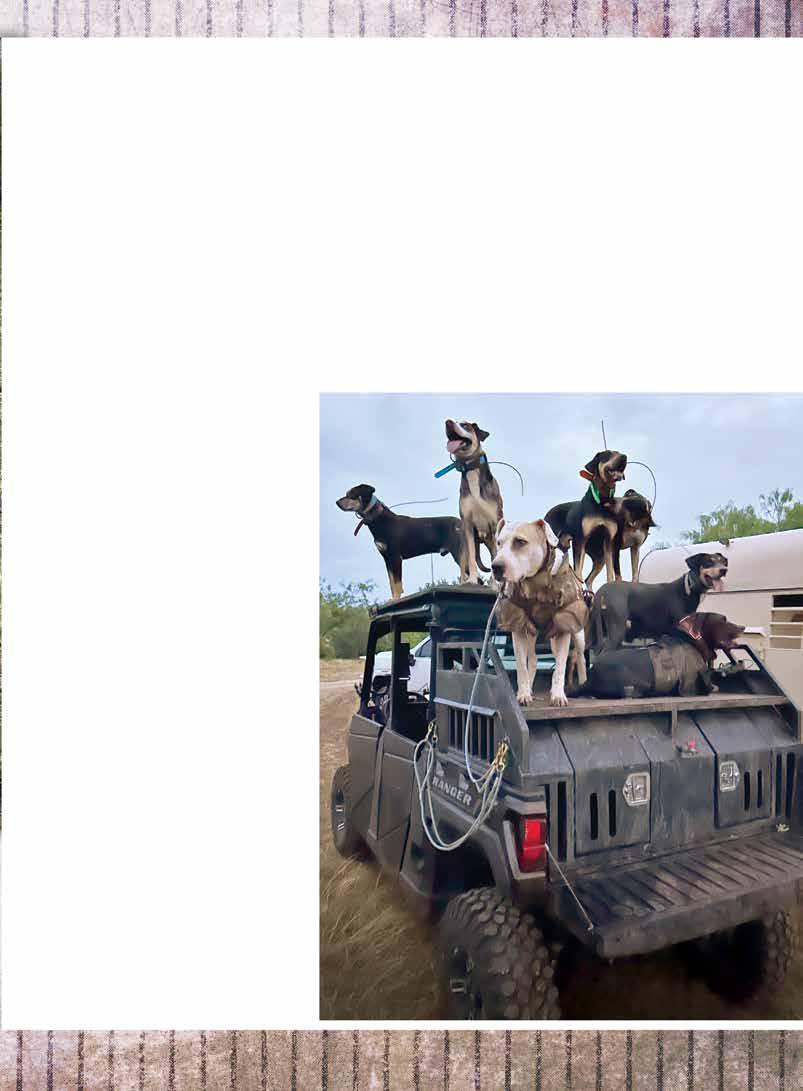
Rex’s hunting dogs have had their own version of hunting excitement.
The morning of the hunt began before the sun came up. While sipping our coffee at the kitchen table, my body was convinced we were fixing to plant ourselves in a blind and hunt whitetail. Hunting hogs had never been something I had to wake up for, but rather stay awake for. We loaded up in the truck to meet everyone else and head to the property.
After rallying the troops—seven bay dogs and two catch dogs—we set out on the ranch and drove until we stopped to let the bay dogs off to do their thing. We sat and watched the GPS, tracking the dogs’ collars and noticing which ones veered off and which directions they all ended up going. Most of the dogs circled back to us, so we decided to head out to a new spot. While en route, a small flash across my eyes was followed by “Oh, there’s one,” and some dogs ran to a hog that seemingly had no fight to put up.
Uninterested, the dogs left the scene and we approached the hog. Rex Bumpus, the owner of the dogs and avid hog hunter, picked up the small varmint by a back leg and told me to stab. I instinctually tried to grab the hog and was told to just stab, so stab I did, and within a few seconds, silence ensued. Still confused by the encounter with this sickly pig, we loaded up and drove again.
The second hog was a much more difficult feat, with prickly pear cactus blanketing the entire ground we attempted to stay upright on. The catchers dragged Clint to the bay dogs, releasing on a countdown of three while Rex and I followed. Forcing ourselves among the limbs and thorns, Rex grabbed the hog by the hind legs and I stabbed, the blood pouring onto my forearm and signifying prime placement. Rex released the dog’s teeth from the ears of the hog and we continued on.
We followed procedure as the morning carried on. Gary eventually asked me if I wanted to switch jobs with Rex. This duty was especially exhilarating, catching a kicking and screaming hog by the legs so Rex could stab. I enjoyed this role because I found it incredibly thrilling.
Our sixth hog took us for a run. Expecting it to escape
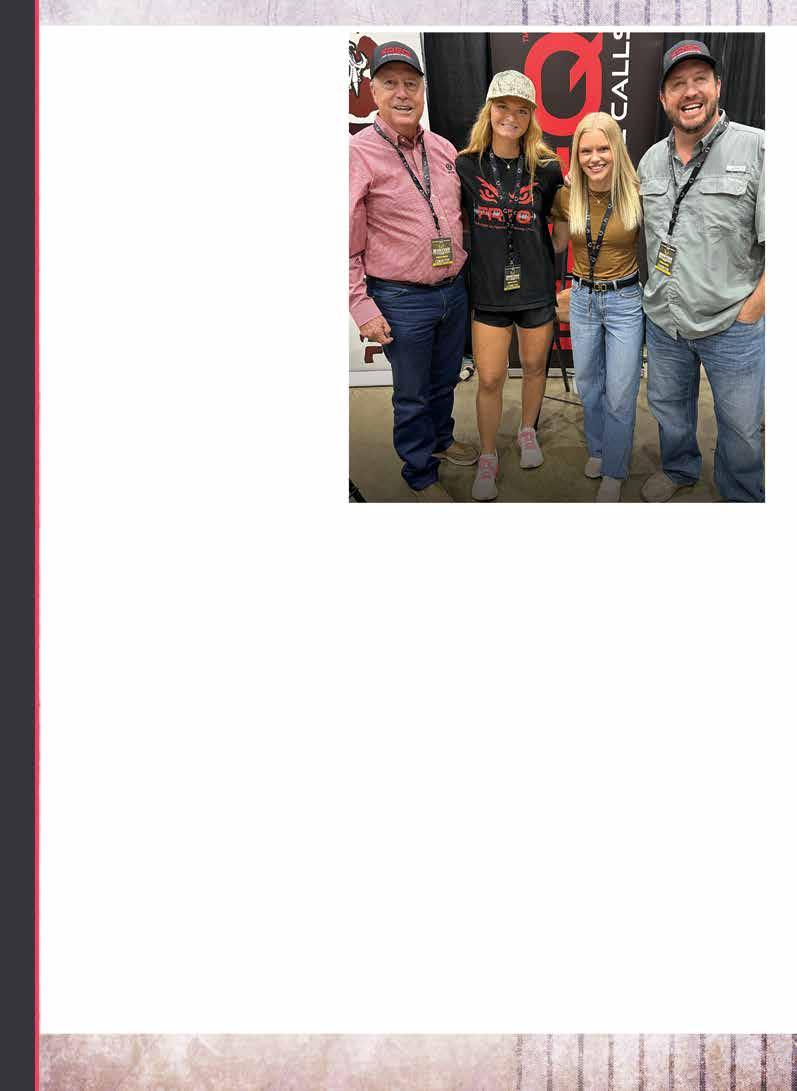
toward the water for safety, the hog ran the opposite direction and bayed up against a tank in a beautifully painful tasajillo shrub. With no choice but to lean my entire body against the plant to stab, I felt a 2-inch thorn enter my knee mid-stick. I watched for the signal blood pour and hobbled off to dig for the thorn I felt in my joint, with 90% of it submerged and my skin fully pinned down to my bone. I pulled out the thorn to find it bent, the same way my damaged tissues would bend the dry needles in physical therapy.
We finished our six-hour hunt with a total of seven hogs and a new favorite hunting memory. My body experienced a mix of pain—some caused by brutal Texas vegetation and the rest by laughing to tears with the guys. A new appreciation for the efficiency of hog dogs also existed, contrary to the misconceptions I’d heard through the years. With years of spot-and-stalk hunting hogs at night, I’ve witnessed how hogs can absorb six bullets and run off injured or go down after you pop ’em, only to get a second wind and run off while you’re rushing to slice them open. Using dogs was a clean kill and a quick, ensuring death on the spot.

I ended my hunting trip and circled back to the word “gratitude.” I felt gratitude for the doors God has closed in order to open others, for the people I’ve met along the way, the memories of each pursuit, and for those to come. The adrenaline might’ve faded with time, but for now, I’ll relive it when the show airs.

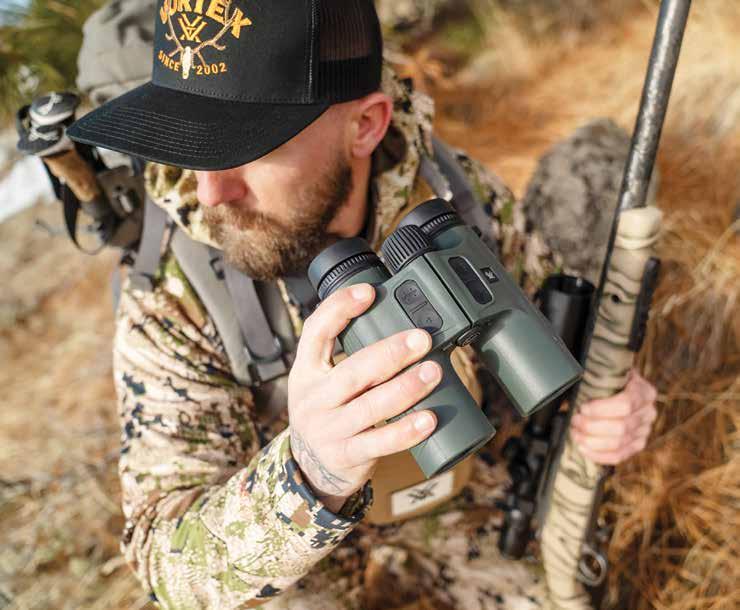
BY JOHN GOODSPEED
he latest models of binoculars and spotting scopes feature higher light transmission and are more compact, lighter and more powerful — including one 15-power binocular.
Innovations in lenses and coatings promise sharper resolution, edge-to-edge clarity and more light transmission and color fidelity while reducing glare.
Several rangefinding binoculars include ballistic calculators to provide pin-point accuracy. One includes a ground-breaking new feature by calculating the probability of an exact hit.
Another sets a milestone for premium compact spotting scopes with image stabilization that produces a shake-free view at high magnification even without a tripod.
One binocular model includes a smartphone adapter that at-
taches to an ocular lens to allow sharing photos and videos.
Many models feature a gas such as nitrogen to resist internal fogging, are waterproof and include a lifetime warranty.
Abbreviations in the article include ED glass, or an extra-lowdispersion lens, that reduces chromatic aberration and enhances color, resolution, sharpness and contrast, especially in low-light conditions; HD, or high definition, meaning special coatings or lenses; and FOV stands for field of view at 1,000 yards.
BAK4 prisms — also called BAK-4 or BaK-4 prisms — use a type of high-density glass containing barium krownate and are said to be the best type of porro prism because they produce clearer images.
Prices are manufacturers’ suggested retail prices.
& Cabela’s
basspro.com; cabelas.com
Intensity ED Compact
Cabela’s 10X42
Binoculars, $79.99
This affordable model comes with all the essential optical extras plus a harness system with a case and shoulder and waist
straps to keep the binoculars from bouncing when walking. Snap latches provide easy access to the binoculars and allow attachment to the harness system. The BAK4 roof prism with silver coating improves image clarity while the multicoated lenses
ensure maximum light transmission. The lightweight composite construction is rubber armored. They weigh 24.34 ounces and are 6.54 inches long. FOV is 336 feet. Eye relief is 16.1mm. Exit pupil is 4.2mm. Close focus is 14.76 feet. Included are a neck strap, lens covers and lens cloth.
The latest from GOVIEW is compact at 5.6 inches long and lightweight at 20 ounces, making it a good companion for outdoor adventures. Proprietary lens coatings provide brilliant images and colors that belie the affordable price. The glassfiber-reinforced plastic housing provides a robust foundation while reducing weight. The diopter adjustment ring and spacer are made of aluminum. The short hinge design improves ergonomics. It features a
BAK4 prism. FOV is 347.8 feet. Eye relief is 16.1mm. Exit pupil is 4.2mm. Close focus is 9.8 feet. The eyecups are twistup. It comes with a couple of innovative accessories. The CLOSR smartphone adapter clamps a smartphone to one of the ocular lenses to allow photos to be taken and shared with friends and family. Also included is a PORTR carrying strap with a click connection on both ends. It also can
be used with other products, such as cameras. Other accessories include lens caps, a leather-look carrying case and a lens cleaning cloth with an attached carabiner. It comes in two colors — Oak Green and Phantom Black, shown here.
PASSION HD 10X42, $1,049.99
This new model for 2026 expands the PASSION HD line with the popular 10-power magnification and more compact 42mm objective lens for a blend of size at 6.1 inches long, weight at 29.6 ounces and premium features. It features double-laminated HD objective lens with GPObright high-transmission coatings.
Light transmission is rated at 99.7 percent. Other features include a rubber-armored magnesium frame, an ergonomic magnesium micro-bridge, pop-up locking centerfocus diopter and aluminum locking eyecups. It features a BAK-4 Schmidt-Pechan prism. The PASSIONdrop lens coatings repel water, dirt and dust. FOV is 336 feet. Eye relief is 17mm. Exit pupil is 4.2mm. Close focus is 6½ feet. The binoculars come with a molded hard case, neoprene strap, lens covers and a cleaning cloth. PASSION APO 16-48X65 Spotting Scope, $839.99
This model was designed as a more compact alternative to last year’s APO 2060X85, $1,049.99, while maintaining top optics, robust construction and precision engineering. The apochromatic (APO) lenses virtually eliminate chromatic aberration while GPObright high-transmission coatings ensure quality light transmission. The rubber-armored magnesium body provides strength and weight reduction. The helical brass gear focus system offers smooth focusing, even with gloves on. A built-in sliding sunshade reduces glare. The locking rotational tripod base allows users to position the scope for maximum comfort and visibility. It measures 13.7 inches long and weighs 46 ounces. FOV ranges from 138 feet to 74 feet. Eye relief ranges from 20½mm to 18½mm.

The latest rangefinding binoculars from Leica display ballistic functions up to the maximum range of 3,226 yards in less than 0.3 seconds plus a groundbreaking new feature — the probability of an exact hit. This function, called the Shot Probability Analysis, displays the hit probability based on ambient parameters calculated by the on-board computer, which was developed in cooperation with the ballistics software specialist Applied Ballistics. The Applied Ballistics Elite program can connect to mobile devices via Bluetooth. The laser rangefinder factors in barometric pressure, temperature and terrain features. Measuring modes are scanning and single measurement. Enclosed in a magnesiumalloy housing, the optics are enhanced with Leica’s Perger-Porro prism system for color fidelity, contrast and sharpness. Light transmission is rated at 91 percent. High Durable Coating, or HDC, and AquaDura lens coating protect against water, dirt, scratches and abrasion. FOV is 342 feet. Eye relief is 16mm. Exit pupil is 4.2mm. Close focus is 16 feet.
The new Leica APO-Televid spotting scope series is the next generation of the company’s spotters, now refined for even sharper resolution, edge-to-edge clarity and color fidelity. Fluoride glass and apochromatic lenses maximize color-fringe suppression, while the High Lux Pro, or HLP, system enhances light transmission to about 87 percent, for bright, highcontrast images in any lighting condition.
The 25-50 wide-angle aspherical zoom eyepiece provides an expansive field of view with sharp imaging across the zoom range. The magnesium housing is rubber-armored. Close focusing is 9½ feet. It weighs 39.2 ounces. It uses four lens elements and the Schmidt prism system. The new series features an integrated ArcaSwiss/Manfrotto-compatible mounting foot compatible with common tripods. The APO-Televid 82mm objective kit with a 25-50 zoom eyepiece lists at $4,069.
Nikon Sport Optics nikonsportoptics.com
ProStaff P7 10X50, $269.95
5 PRIMAL 15X56 ED, $829.99
10X50 and 12X50 models join the ProStaff P7 and Monarch M5 lines with the increased objective lens diameters allowing more light-gathering capability and increased resolution. The ProStaff P7 12X50 is $279.95. The Monarch M5 10X50 is $389.95, and the 12X50 is $399.95. As with others in the ProStaff P7 line, these binoculars employ dielectric highreflective multilayer coating and phase-correction coating, with multilayer coatings applied to all lenses and prisms to enhance a bright, clear view. They also have an oil- and water-repellent coating that resists smudges and dirt. FOV for the P7 10X50 is 344 feet. Eye relief is 19.3mm. Exit pupil is 5mm. Close focus is 14.8 feet. It is 6.7 inches long and weighs 22.2 ounces. FOV for the P7 12X50 is 321 feet. Eye relief is 16.4mm. Exit pupil is 4.2mm. Close focus is 14.8 feet. It is 6.7 inches long and weighs 22.8 ounces.
Specs for the two Monarch models are similar.
With these binoculars’ 15-power magnification, a spotting scope may not be needed, although a steady hand will be. They are relatively small at 7.09 inches long and weigh 40.14 ounces. The 5 Primal ED series also are available in 8-power ($450) and 10-power ($699.99). All models are equipped with Riton’s ED glass, which delivers a clear image while limiting eye strain. The prisms are BaK4, made from barium crown glass, known for superior light transmission,
brightness and clarity. Light transmission is rated at 90 percent. Lens are multicoated including wide band and low-light enhancing coatings. The binoculars are constructed from rubber-armored magnesium-aluminum alloy for light weight and strength. FOV is 249 feet. Close focus is 8.2 feet.
This new model offers a wide FOV of 408 feet — more than most binoculars with a 10-power magnification. Sightron uses a field flattener to ensure image quality from center to edge. Phase-correction coating on the prism delivers a bright, highcontrast FOV. ED objective lenses provide crisp,
clear and sharp images without chromatic aberration. The lenses are multicoated on all surfaces ensuring a high light transmission rated at 90 percent. The housing features a lightweight magnesium die-cast construction with an elastomer coating for a secure grip. A large focus ring enables quick adjustments, even with gloves on. The twist-up eyecups are rubber. Eye relief is 18mm. Exit pupil is 4.2mm. Close focus is 6½ feet. They are 6.4 inches long and weigh 32 ounces.
$3,999
Swarovski is setting a milestone in premium compact spotting scopes with the AT Balance and the ST Balance 1435x50 straight spotter ($3,849) with image stabilization that produces a shake-free view at high magnification even without a
tripod. SWAROBALANCE image stabilization, used for the first time in a Swarovski spotting scope, reacts without hesitation to any movement. It can process more than 1,000 measurements per second and corrects the lens position accordingly. Light transmission for both models is rated at 88 percent while both offer an exit pupil ranging from 3.6mm to 1.4mm. Shortest focusing distance for both is 11.2 feet. FOV for the AT Balance ranges from 165 feet to 90 feet. It is 10.6 inches long and weighs 51.9 ounces.
TORIC 10X42 Eagle Ballistics
Laser Rangefinding Binocular, $1,949
This new model combines a rangefinding binocular with a ballistics calculator for long-range hunters and shooters plus it has a mode for bowhunters. The integrated
ballistic solutions work without internet or WiFi by connecting to the Eagle Ballistics App via Bluetooth and loading cartridge profiles. It was developed in partnership with James Eagleman, a 26-year Army sniper and master instructor and owner and designer of Eagle Ballistics. While it allows complex ballistic solutions, it also can be as simple as just providing the range. The binoculars feature SCHOTT hightransmission glass, ED lenses, flat multicoatings for increased light transmission, a stand-alone fire button and external wind buttons. FOV is 334 feet. Eye relief is 16mm. Exit pupil is 4.2mm. Close focus is 14 feet. They are 6 inches long and weigh 37 ounces. Rangefinding features include customizable OLED display settings, sensors for atmospheric conditions, MOA or MRAD options and bow mode. Ballistic app features include elevation and windage corrections, retained velocity at impact and flight time. continued on next page
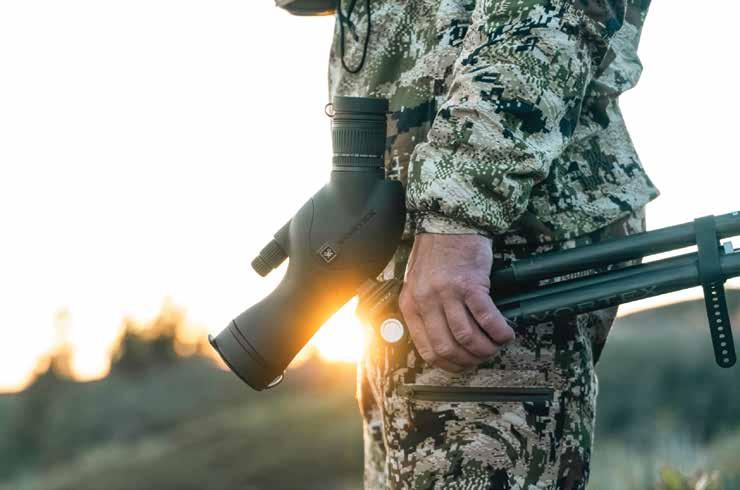
The TALON HD 10K series blends HD glass with extreme-range performance and ballistic data that can be used alone or
paired with Vortex Relay devices including the Impact 4000 Rail-mounted Laser Rangefinder, the GeoBallistics App and the ACE Ballistic Weather meter. The Talon series includes a 10X42 model ($3,499.99). The binoculars feature XR Plus lens coatings for clarity and low-light performance and Armortek coatings to protect exterior lenses from scratches, oil and dirt. FOV is 272 feet. Eye relief is 18½mm. Close focus is 25 feet. They are 7.2 inches long and weigh 46.8 ounces. Rangefinding features include five target modes, four ranging modes including a scan feature and a 10,000-yard capability for ranging shots, planning stages and stalks. Ballistic app features wind/drop solutions, environmental sensors, a set of pre-calculated ballistics for popular cartridges and the ability to program for specific loads.
The latest addition to the Viper HD spotting scope series rounds out the lineup with a model designed for portability. It features an HD optical system that delivers top-shelf resolution, cuts chromatic aberration and provides color fidelity, sharpness and increased light transmission. XR Plus lens coatings allow maximum
light transmission. At 27.8 ounces and 10.3 inches long, the removable eyepiece enhances the spotting scope’s packability. Armortek coatings protect exterior lenses. FOV ranges from 182 feet to 95 feet. Eye relief is goes from 16mm to 19mm. Close focus is 9 feet. The 11-33X50 also comes in a straight model for the same price. It is 11 inches long and weighs 27.4 ounces. The other specs are the same.

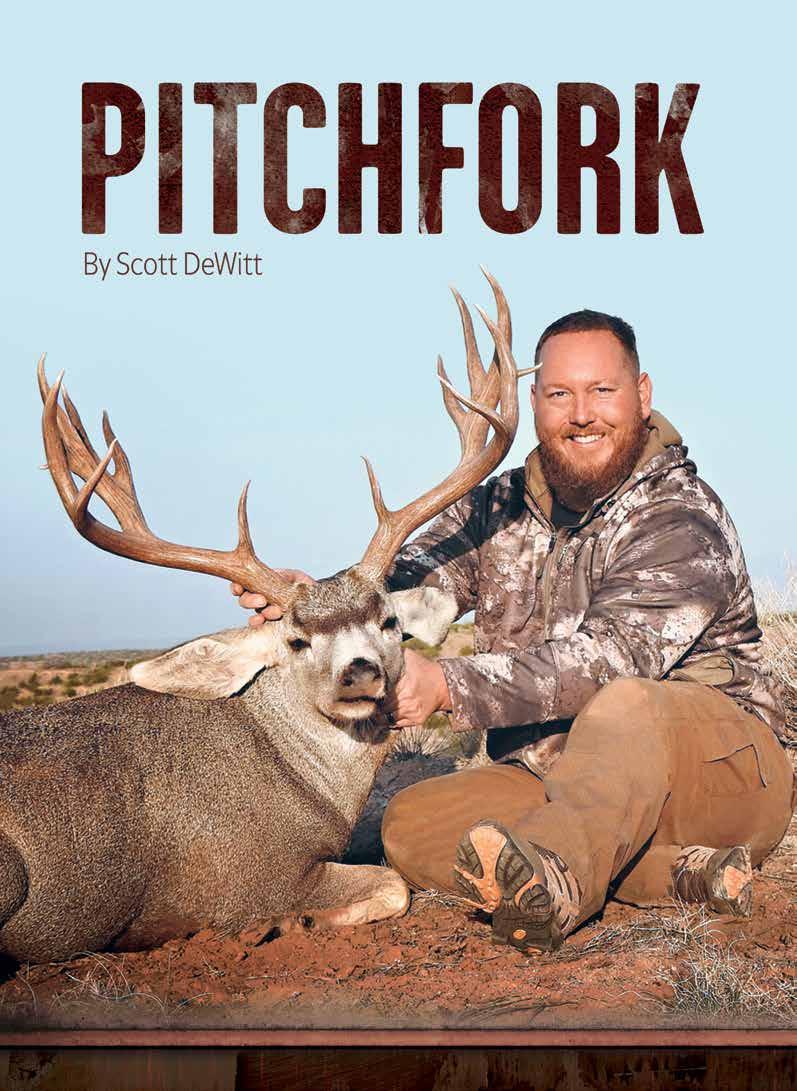
This story began in 2013, while I was deployed in Afghanistan. Like many soldiers far from home, I searched for something—anything—that could pull my mind away from the daily stress, uncertainty, and noise of deployment life. For me, that escape came late at night through an online hunting forum. It was a place where people shared stories, formed friendships, and conversations centered on land, wildlife, and traditions that felt grounding and familiar.
Through that forum, I connected with people from all over Texas. Most of them I had never met, yet we talked as if we’d known each other for years. One of those friendships stood out. His name is Marc, known online by the handle “Pitchfork Predator.” Over time, our conversations moved beyond hunting tactics and trail camera photos. Eventually, he extended an invitation that would change everything—an offer to hunt with him once I returned home from deployment.
At the time, I didn’t have lofty expectations. I just wanted to be back in the woods, breathing fresh air, and reconnecting with a life that felt normal again. But when I arrived for that first hunt, I immediately fell in love with the country, with its rugged and wild landscape, rolling hills, thick cedar breaks, wide mesquite flats, and deep canyons carved over generations. It was mule deer country in every sense of the word. By the time I left
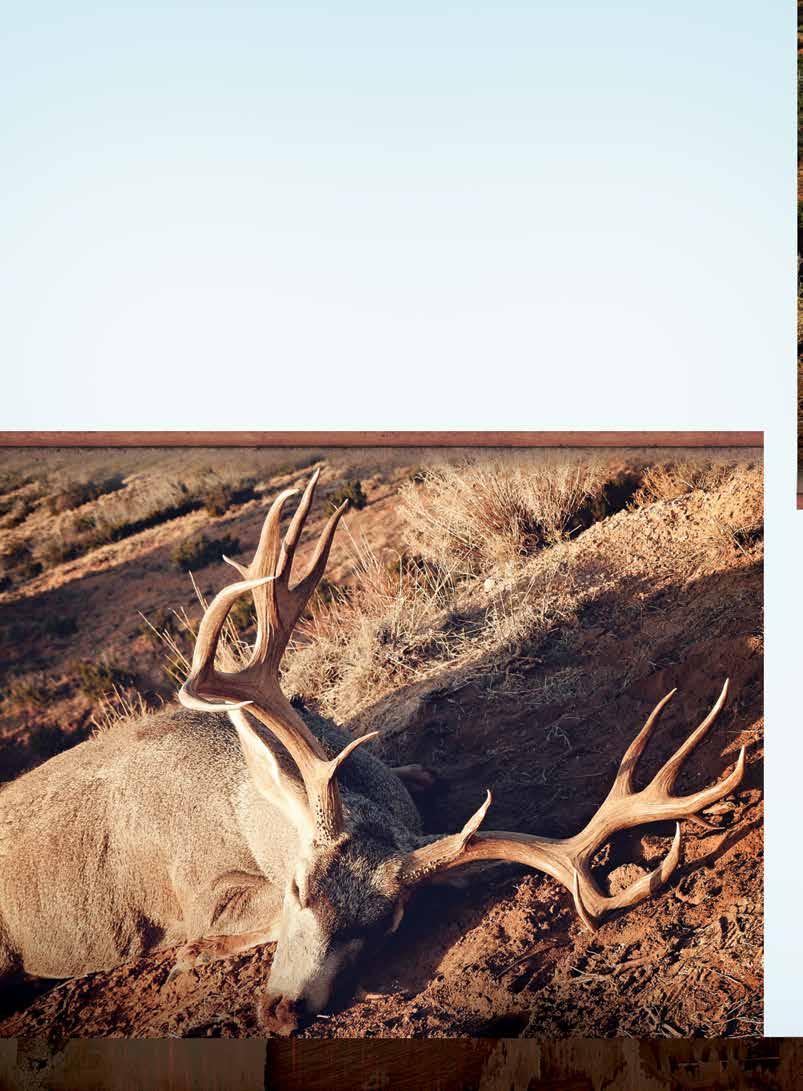
that trip, I knew this place would always draw me back.
Years passed, and Marc and I became close friends. By 2020, we were sharing the same lease and had spent countless days together in the field. Our approach to hunting had always been rooted in patience and respect. We believed in letting animals mature, allowing the land and the wildlife to reach their full potential before ever pulling a trigger.
That season, we made a deliberate decision to focus on mule deer. To do that, we set up an alfalfa pen in a remote canyon— an area that offered security, feed, and minimal pressure. It didn’t take long for mule deer to find it. At first, nothing truly special showed up.
Then, during opening weekend, Marc called me while I went to my stand. His voice was calm, but I could tell something had him excited. He told me he’d just seen a mule deer buck unlike any he’d ever laid eyes on. I turned around immediately and managed to catch a glimpse of the deer as he disappeared into a ravine roughly 400 yards away. I knew he was big, but I had no idea just how big.
A week later, Marc spotted him again in the same area. That was enough confirmation for us to act. We placed another alfalfa pen deeper in the canyon, right where the buck seemed most comfortable. Almost immediately, trail camera photos began
rolling in. That’s when it became clear—we were looking at something truly special.
This buck was massive, but what set him apart was his antlers. Instead of typical forks, both sides carried tridents, with kickers jutting straight out. He was a heavy, non-typical mule deer, yet incredibly symmetrical. The more I studied the photos, the more one image kept coming to mind. A pitchfork.
The name fit perfectly—bold, unmistakable, and unique. From that moment on, the buck had a name: “Pitchfork.” We decided not to bow hunt him. Pressuring a deer like that could push him out of the area entirely, and we weren’t willing to risk it.
When rifle season approached, we discussed who would get the first opportunity. I suggested flipping a coin or drawing cards, but Marc stopped me. Without hesitation, he told me the opportunity was mine.
Marc had already taken several outstanding animals over the years. He said he’d get just as much satisfaction watching me take my first mule deer as he would pulling the trigger himself. That kind of selfless gesture speaks volumes about the kind of friend he is. It’s something I’ll always be grateful for.
Rifle season opened on Nov. 21. My 8-year-old son, Jaxton, and I arrived a couple of days early to refresh the alfalfa and check cameras. With the rut approaching, I was nervous. A buck like Pitchfork could disappear overnight, roaming far and wide in search of does. Every hour felt heavy with anticipation. While driving in to refill the pen, we rounded a corner, and Jaxton suddenly froze. His eyes were wide as he quietly asked, “Dad—is that him?” I looked over and saw Pitchfork bedded
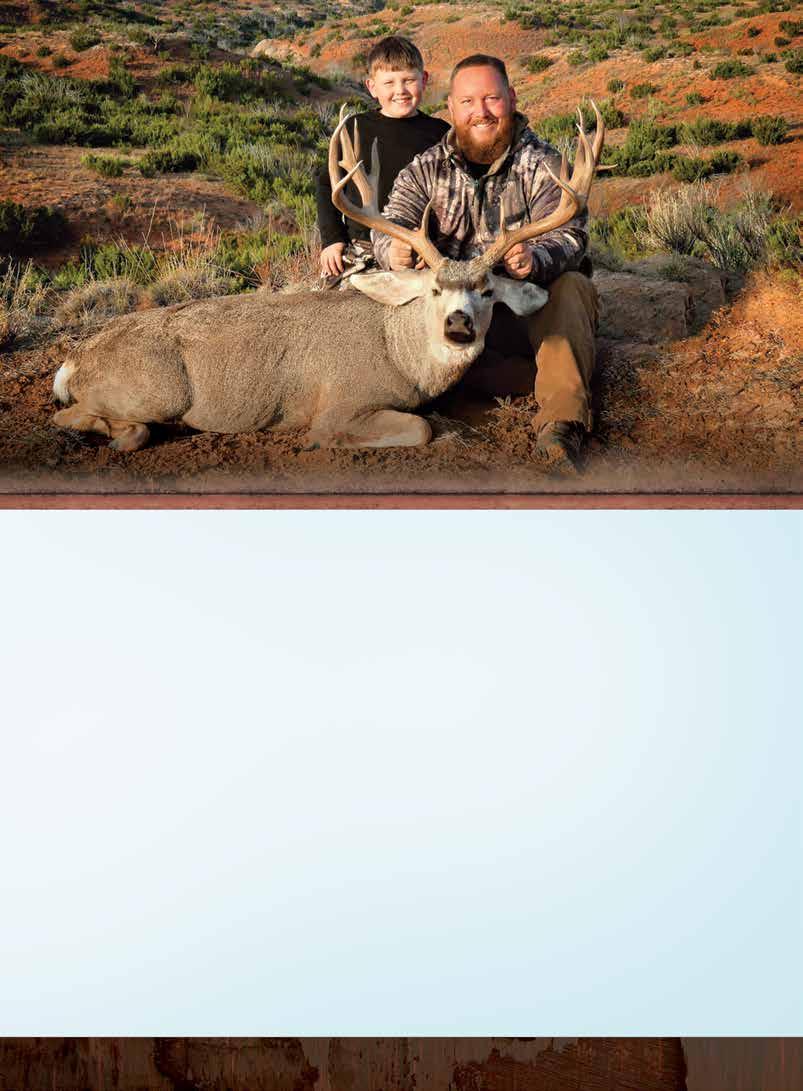
beneath a cedar just yards away. I stopped the vehicle.
The buck stood up calmly, glanced toward our direction, and walked off without concern. Once he disappeared, we finished our work and set up the pop-up blind. That evening, my phone lit up with trail camera photos of Pitchfork back in the pen. The pattern was holding.
Opening morning, Jaxton and I slipped into the blind well before daylight. As the sun began to rise, Pitchfork ate. I made the decision not to shoot him inside the pen, choosing instead to wait for a cleaner opportunity. That choice nearly cost me everything. Two rival bucks showed up, and Pitchfork chased them off, disappearing over the hill.
Twenty long minutes passed. Then, antlers crested the skyline. I whispered to Jaxton to start recording because my hands began to shake. Pitchfork stepped into the open, stopped to shred a small bush while marking his territory, and finally moved into a clear lane. I steadied my breathing, squeezed the trigger, and watched him go down.
What followed was pure emotion—laughter, shouting, and big hugs inside the blind. Taking a deer like that is rare. Sharing the moment with my son made it unforgettable. Jaxton captured the entire hunt and some incredible photos afterward, memories we’ll carry forever.
Pitchfork scored 1923⁄8 , the largest buck I’ve ever taken. I may never take a bigger one—and I’m perfectly fine with that. The memories, the friendship, and the time spent with my son are worth far more than any number. Every day, I still glance at those antlers and remind myself how fortunate I was to cross paths with a deer named Pitchfork.
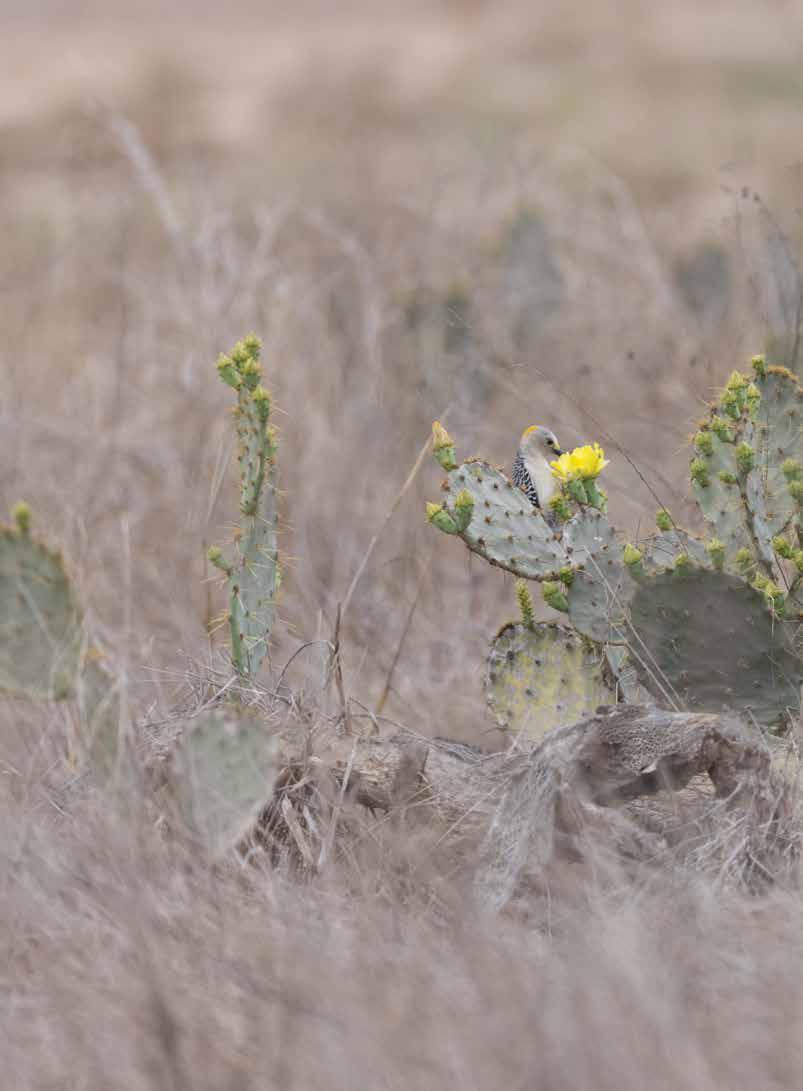

This gorgeous picture comes from wildlife photographer Jaime Rodriguez, which he shot on the Cantu Ranch in Duval County. Jaime said:
“I pulled off along the edge of a sendero, put the truck in park, and shut off the engine. The quiet settled in. In the distance, green jays called out, while a pair of curious scissor-tailed flycatchers land in a nearby mesquite. As I glass down the sendero, a greater roadrunner darted back and forth, locked in its own hunt. Then something catches my eye—a golden-fronted woodpecker, feeding on the sweet nectar of a blooming prickly pear.
“It’s the kind of shot I’ve always envisioned—not necessarily the woodpecker, but a moment like this. Slowly, I raise my camera to the window and begin to shoot, careful and steady. The soft clicks stack up—one after another—until I’ve taken nearly 20 frames.
“Later, reviewing the images at home, I zoomed in on the woodpecker and noticed something I hadn’t seen before: a tiny spider resting on the yellow petal of the prickly pear bloom. A small detail, easily missed, yet somehow just as important as everything else. And in that moment, I’m reminded why I keep coming back—grateful for the quiet beauty and endless life that define South Texas.”

My day starts early. I open the chicken coop, gather eggs, and feed barn cats and donkeys. My country home sits 30 minutes from the city lights. Sometimes I go for days without seeing another person. When a neighbor passes on the highway, a subtle
lift of the finger off the steering wheel means hello. The solitude afforded by a rural life means deer hunting opportunities are close.
Mule deer water by the barn at sunset. Sometimes they wander through my front yard and nibble weeds by my life-

sized pronghorn target. Mule deer are close, but to hunt whitetails takes more effort. It means a 30-minute drive down a bumpy, steep canyon road to a wooded creek bottom.
The golden leaves of the cottonwoods in the fall are like a siren’s song calling
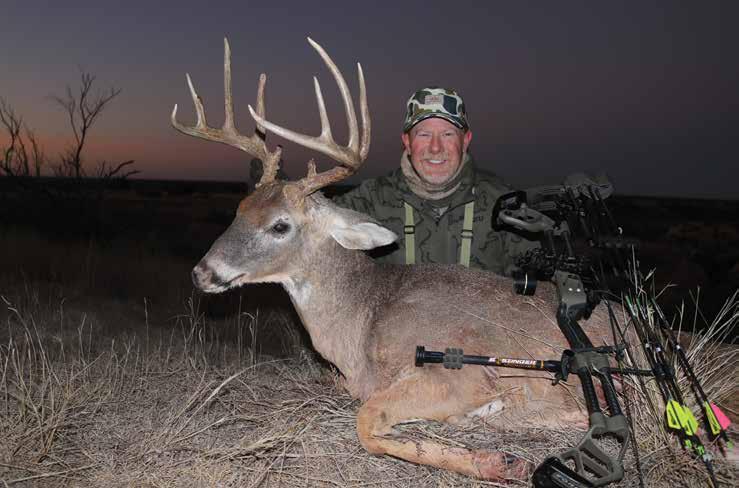
Brandon with the 11-point buck described in the article. The typical 10-point had a split right brow tine. He shot the buck, aged by tooth wear at 8.5-plus years old, on Dec. 20, 2025 near a Panhandle river corridor.

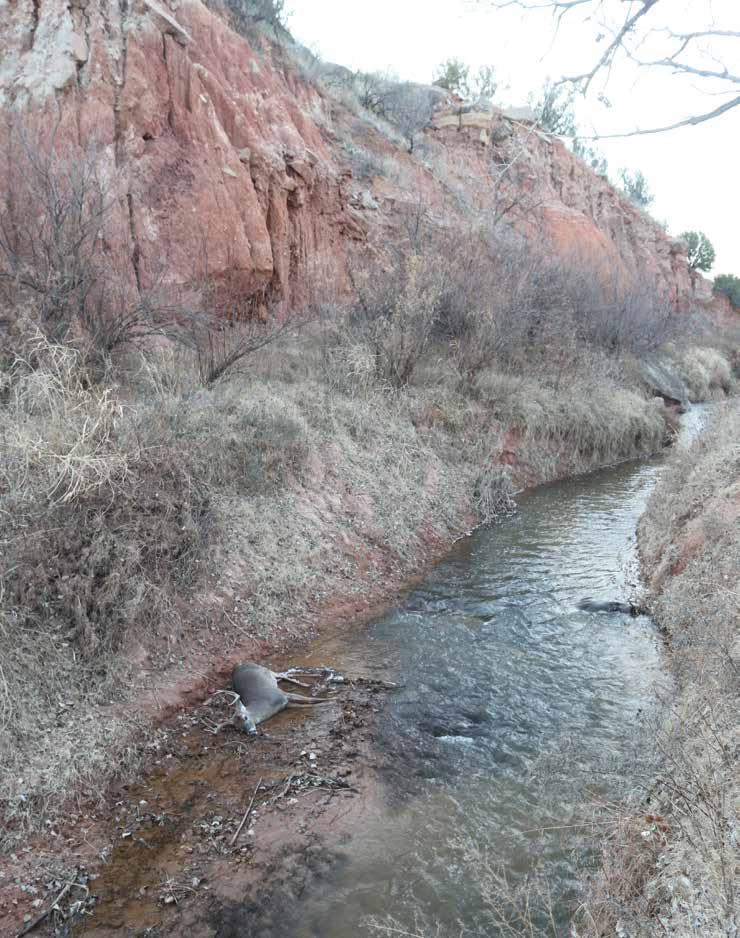
The old 11-point died in this creek on a cold afternoon in December, making the recovery wet and slippery up the steep riverbank.

me to big racks on the creek. The trek is hard on man and equipment. Hunting solo doesn’t have to mean a backcountry adventure with camp on your back. For most bowhunters, it means deer hunting near home.
Solo hunting means you make all the decisions. That’s exciting and gratifying when it pays off. When it doesn’t work, there’s no one to blame but yourself. When you find a fresh rub or beat-down game trail, you make the decision alone on where to set up.
Last fall, I checked cameras on the creek and found an old buck moving in daylight in late December. With that information, I made the decision on which blind to hunt and the wind direction I needed. No one else made the choice for me. It was rewarding when that choice later paid off.
Some hunters fear being alone. Hunting alone doesn’t necessarily mean loneliness. I find comfort in all the wild things around me. The trees, the clouds, and the wind sit with me.
Deer, quail, songbirds, and even a hawk overhead keep me company. Hunting solo means no chatter from others when observing nature. Hunting solo means more room in the blind! Last fall, I sat for deer 25 times. I hunted alone 21 of those sittings.
Need a new blind setup? You’ll be doing all of it by yourself. Need the feeder filled or camera batteries replaced? That’s on you, too.
There’s no guide or buddy to call to do the dirty work if you hunt alone. When a buck hits the ground, it’s on you to get it gutted, loaded and processed in a timely manner. As a former Eagle Scout, I always liked the motto “Be Prepared.” Carry multiple flashlights, headlamps, extra batteries, rope, water, fire starter, first aid kit, spare tire, jack, and tools for your truck. Be independent, but don’t be dumb.
Last fall, I scouted for new sign and a fallen log connecting both sides of the creek was tempting as a bridge across to keep my feet dry. But the log wasn’t totally stable. If I fell it might mean a broken leg or worse. Smartly, I walked through
A close-up of a fresh rub. Hunting solo means finding and interpreting sign like this on your own.
the creek to the other side and got my feet wet. It wasn’t worth the risk. Always make sure someone knows where you’re hunting in case there’s an emergency. My phone is always in my backpack.
Last year, I did the necessary work early. I filled the feeder on the creek in August. I set multiple trail cameras. I put a short tripod at one crossing on the north end, trimming the shooting lanes with brush pruners. On the south end, I rebuilt an old ground blind by cutting cedar branches, grass and broomweeds. A T-post and some slick wire helped keep the brush in place for a sneaky, dark hideout under the sagging limbs of a twisted cedar.
I’d been aware of the old 11-point for a couple of years. Every year, one and sometimes both of his brow tines were split. I never saw him in person in 2024, only on a trail camera. In 2025, he was on multiple trail cameras sporadically again, but mostly in the dark.
It was late December when he started to move in daylight. On the afternoon of Dec. 17, I had an encounter with him right at dark. He was facing me, a bad angle, and it was borderline too dark to shoot. Bummer. Almost. I waited for the wind direction I needed, then on the af-
ternoon of Dec. 20, I sat in the brushedin ground blind on the south end of the creek, hoping for a second chance. It was earlier than expected, 3:50 p.m., when the mature 11-point came down a ravine from the north. He was accompanied by a smaller eight-point. When the old buck passed my blind at 16 yards, my arrow zipped through the ribs. The buck trotted slowly toward the creek and out of sight.
His reaction puzzled me. Hunting alone, it was up to me to sort it out. I found the arrow, stained red after a pass through. On hands and knees, I searched for more blood.
I found very little sign. After an hour, I finally found a splotch of red the size of a fist about 80 yards from where I hit the buck. That gave me his line of travel, right towards the creek and under several large cottonwood trees. Moving slowly, I found more red specks on fallen leaves.
I found him 180 yards from arrow impact, dead as a stone. When I peeked over the riverbank, he lay in the creek. A surge of excitement shot through me. Both relief and a feeling of, now what do I do?
I waded across the cold creek, water filling both my boots. Next, I gutted the buck to reduce his weight, then struggled to pull him up the slippery, steep riverbank. Retrieving a long rope from my pickup, I pulled him up the bank by his antlers. I even set up a tripod and camera, snapping a few images with a self-timer.
I hefted the buck into the truck bed as daylight was fading. Mine were the only hands that touched him. I was as tired as I’d been in a long while, but I also felt very alive. The typical 10-point with a split brow tine had worn back teeth that indicated he was 8½-years-old or older. I have one of his sheds from two years earlier as a bonus.
Hunting solo is freedom. In the words of Theodore Roosevelt, “The free, selfreliant, adventurous life … the chase is among the best of all national pastimes: it cultivates that vigorous manliness …”. Sometimes it takes a lot of effort, but when the work pays off and a fine buck is wearing your tag, the feeling of accomplishment can’t be matched.


BY WILL LESCHPER
Any day spent on the water along the Texas Gulf Coast is worth the effort in making memories that will last a lifetime.
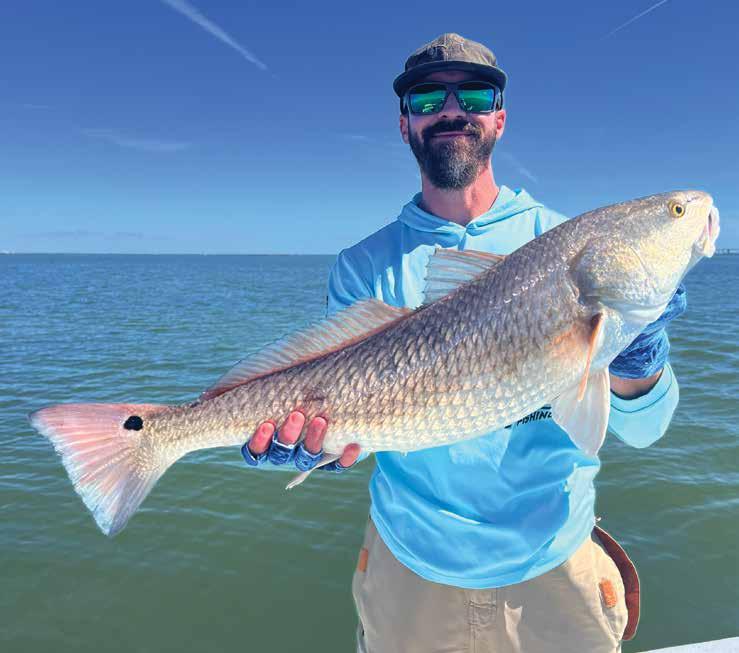
You can’t overlook the opportunity to catch hefty redfish this time of year, too. The author caught this slot red on a paddletail plastic in less than 2 feet of water.
By the time July and August settle over the Texas coast, the heat stops being a backdrop and becomes the entire story. The bays warm into the upper 80s, the wind teases just enough to keep you guessing and the water takes on that slick, heavy calm that feels more like a test than an invitation.
For some anglers, this is when rods get leaned in the corner. But for those who understand mid-summer trout patterns, the dog days aren’t a shutdown—they’re a shift. Speckled trout don’t disappear when the water heats up. They reposition with purpose.
The most consistent summer anglers key in on areas where shallow structure sits close to deeper water, especially when there’s any kind of tidal movement. That combination is critical this time of year. Shallow zones still serve as feeding grounds, but the nearby depth offers a quick escape from rising temperatures. Add moving water into the equation, and you introduce oxygen and bait — two things that keep trout active even when the heat is working against them, and you.
That’s why locations such as reefs, spoil banks, jetties and
even the open surf become so important. These areas give trout options, and in the dog days, options are everything. If a spot doesn’t offer both feeding access and relief from the heat, it’s unlikely to hold fish for long.
Timing, of course, becomes just as important as location. Summer trout don’t feed on your schedule — they feed when conditions line up. More often than not, that means low light and moving water. The best bite typically happens late at night, carries into the early morning and fades quickly once the sun climbs. Trout slide shallow under the cover of darkness and linger just long enough after sunrise to take advantage of cooler water before easing back into deeper, more stable conditions.
Miss that window, and the day can quickly turn into a grind.
One of the biggest lessons from dog-day trout fishing isn’t about where to fish — it’s about how long to stay. On summer reefs, it can take time for fish to settle in and begin feeding after you arrive. Noise, boat wakes and even crunching a shell under your boots can push fish off temporarily. But if you stay quiet and let the area “reset,” the bite often develops. That patience separates consistent anglers from frustrated ones.
With hundreds of miles of Gulf shoreline, enjoying a day at the beach can be more than just catching a tan. When conditions allow, the surf becomes one of the most underrated summer trout patterns on the Texas coast for land-based anglers. Calm winds and clean, green water open up opportunities to wade sandbars and guts where trout push bait into predictable lanes. Early mornings in the first gut can produce explosive topwater action, and as the sun rises, fish often reposition into slightly deeper troughs. It’s a simple progression, but one that consistently produces when the surf lays down and the tides cooperate.
Instead of running miles offshore and running up your fuel bill if you’ve got a boat, hang a right or left at the jetties and look for bird and bait fish activity. The trout won’t be the only prime species looking to cash in on all that commotion. “Working the birds” never fails, which is true no matter if you’re fishing the Gulf or any of our bay systems.
Back inside the bays, structure becomes the entire game. Jetties create current breaks and immediate access to deep water, making them reliable during strong tidal movement. Spoil banks along the Intracoastal offer a similar dynamic, with shallow humps dropping quickly into deeper channels. Reefs and shell pads, particularly those near deeper basins, act as feeding stations when bait is present. In all of these scenarios, the same truth holds: if there’s no bait and no current, there’s no reason to stay.
Lure choice in the summer follows a familiar progression, but success hinges more on presentation than selection. Early in the morning, when trout are shallow and active, topwaters can still draw aggressive strikes. As the bite softens, twitch baits and soft plastics become more effective, especially when worked slower and closer to the bottom. Summer trout are surrounded by food, which makes them selective. Getting their attention often comes down to subtle changes in retrieve — pauses, speed adjustments and small bursts of erratic movement can make the difference between a follow and a strike.
If you’re a newcomer to Texas saltwater fishing, only make a trip or two down the coast each year or are trying to put youngsters on fish, you simply can’t go wrong with using live or dead shrimp under a
Any day on the bay during the summer is a good one, but it’s also a great day when you find a school of hungry speckled trout.
popping cork. Some anglers consider catching a trout or redfish on anything other than plastic to be blasphemy, but at the end of the day, use whatever you feel most comfortable and sure with. There’s a possibility you may run into a hardhead hole but it’s also a guarantee you will also entice a hefty redfish or black drum if they’re around. With the current trout bag limit set at three fish per day in a 15- to 20-inch slot, and one fish over 28 inches per year with the proper tag, summer is all about the bonus fish, too. Anglers can keep three reds per day in a 20- to 28-inch slot, and an additional one over 28 inches with the proper tag, as well as five black drum per day in a 14to 30-inch slot. The drum family isn’t as skittish in the summer shallows and heat, which can make for a great day should your trout efforts hit a snag.
Mid-summer also forces anglers into a decision: chase numbers or chase size. The same structure that produces steady action will typically yield solid, keeper-sized trout, especially when bait and current are present. Trophy fish, on the other hand, often play a completely different game. Bigger trout will sometimes hold in surprisingly shallow water, even in the heat,
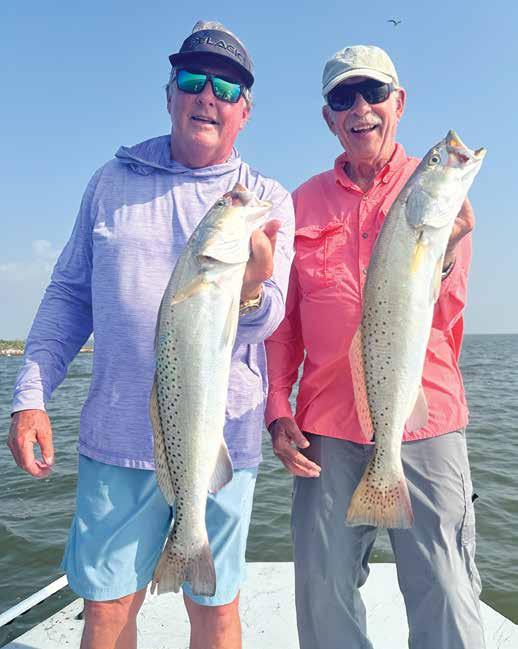
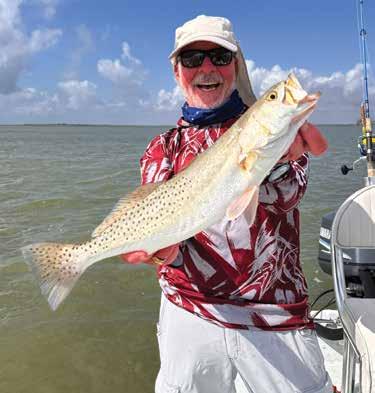
but they become lethargic and far less willing to chase. Targeting them requires patience and precision, sometimes involving repeated casts to the same fish. It’s a slower, more deliberate approach —
The Texas speckled trout fishery underwent largescale regulation changes as a result of the historic freeze of 2021. The overall fishery has bounced back in recent years with anglers currently able to keep three fish per day in a 15- to 20-inch slot limit and one fish over 28 inches per year.
one that rewards discipline over volume. That same patience carries over into how you fish an area. In the heat of summer, trout tend to group tightly around small, specific zones. A slight change in
bottom composition, a subtle current seam or a concentrated pocket of bait can hold multiple fish in an otherwise quiet stretch of water. When you get a bite, it usually means something. The anglers who consistently find success in the dog days are the ones who recognize that signal and stay put long enough to capitalize on it.
There’s also an overlooked advantage to fishing through the heat: fewer people are willing to do it. As temperatures rise, some anglers shift offshore or simply wait for cooler months. The bays can see less pressure, and the fish that remain accessible often behave more naturally. For those willing to endure early mornings and long, hot days, the payoff can be worth it.
Mid-summer trout fishing along the Texas coast isn’t about comfort, and it’s rarely about luck. It’s about understanding how heat reshapes the environment and adjusting accordingly. When you fish where shallow meets deep, pay attention to tides and light, adapt your presentation, and stay patient when you find life, the dog days stop feeling like an obstacle. They start feeling like an opportunity.



By Saanvi Agrawal
Ihad the best week of my summer last July. I had the amazing opportunity to be a cadet at Ranch Brigade and experience one jam-packed week of learning about the Texas beef industry. When we arrived there, Mr. Farley, the camp coordinator, told us, “By the end of the week, the people sitting around you will become your best friends, and you won’t want to leave them.” Sure enough, by the end of the week, I felt proud and protective of my fellow cadets, and I didn’t want to leave them.
Going to Ranch Brigade pushed me out of my comfort zone in so many ways, but I’ve learned you can only grow and evolve in uncomfortable positions. When I arrived there, I soon realized I was one of few cadets who had never interacted with livestock, one of two that had brown skin, and the only one there who didn’t eat beef at a beef camp.
Coming from a family who looks away when we pass the meat section at the grocery store, I initially felt quite intimidated as we examined the different body parts of a dead bovine, witnessed our instructor castrate a live bull, and learned about the different prime cuts on a carcass. But the more I saw and the more I learned, the more intrigued I became, and I began to appreciate the importance of keeping cattle healthy and strong, because their health influences every part of the process, up until the end product.
The best, and scariest, thing about camp was we never knew what was next. Sometimes, we would load up in the bus to head to roping practice, and other times, we would march in tandem to the chuckwagon for breakfast and story

Saanvi, a vegan, learned a non-beef eater can appreciate caring for livestock, the importance of sustaining beef production, and protecting and sustaining the land.
time. Coming into Ranch Brigade, I had no idea how to rope, and I had never met a sheep, much less sorted one. However, by the end of camp, I had learned how to rope a mechanical steer, too, as a lefthanded person! Sheep sorting became my favorite ranch activity because it was almost meditative. One momentary lapse in focus could mean that one sheep, or
two or three, escaped from right in front of you.
Ranch Brigade taught me nuances because not all beef ranchers are the same. Even among our instructors, some raised their beef for a feedlot finish, while others raised their beef grass-fed. Some called themselves hippie ranchers and blended conventionality with new ideas,
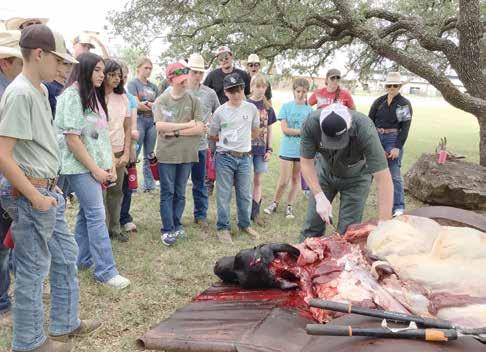
while others championed vertical integration and were in charge of their beef from birth to fabrication. What was universal among all our instructors, though, was a belief in the value of sustainable beef production: economical, ecological, and enjoyable. They all believed in the value of maintaining soil health, planting native vegetation, and not over-stocking the land because in the end, their ranch can only be successful if the land on which it resides is healthy and cared for. And they all believe in the value of educating the next generation to care for the land and raise beef in a sustainable manner. For me, this was inspiring because I realized there is space to champion sustainability within every industry, even the beef industry.
Saanvi and other cadets sharing a bonding moment.
Saanvi had fun learning how to properly use a lasso. She surprised herself because she’s a lefty.
You may be wondering if by the end of the week, I, the vegan at beef camp, had become a beef lover. And though the answer to that would be no, I had become a beef industry lover. In that one week, I learned more about ranching than a college student would have learned in a month, because I learned from instructors who were so passionate about sharing the importance of sustainable beef production and truly caring for the livestock. I learned even though I have different values and beliefs than others, I can align my values with theirs to find common ground. I can see myself being an advocate for sustainability within the beef industry and working alongside ranchers who care about sustaining and protecting the land.

Texas Brigades is a conservation-based leadership organization which organizes wildlife and natural resourcebased leadership camps for participants ranging in age from 13-17. Its mission is to educate and empower youths with leadership skills and knowledge in wildlife, fisheries, and land stewardship to become conservation ambassadors for a sustained natural resource legacy. Texas Brigades hosts 10 summer camps throughout June and July. The application period for camp runs Nov. 1 through March 15 of each year. Visit texasbrigades.org or call 210-556-1391 for more information.

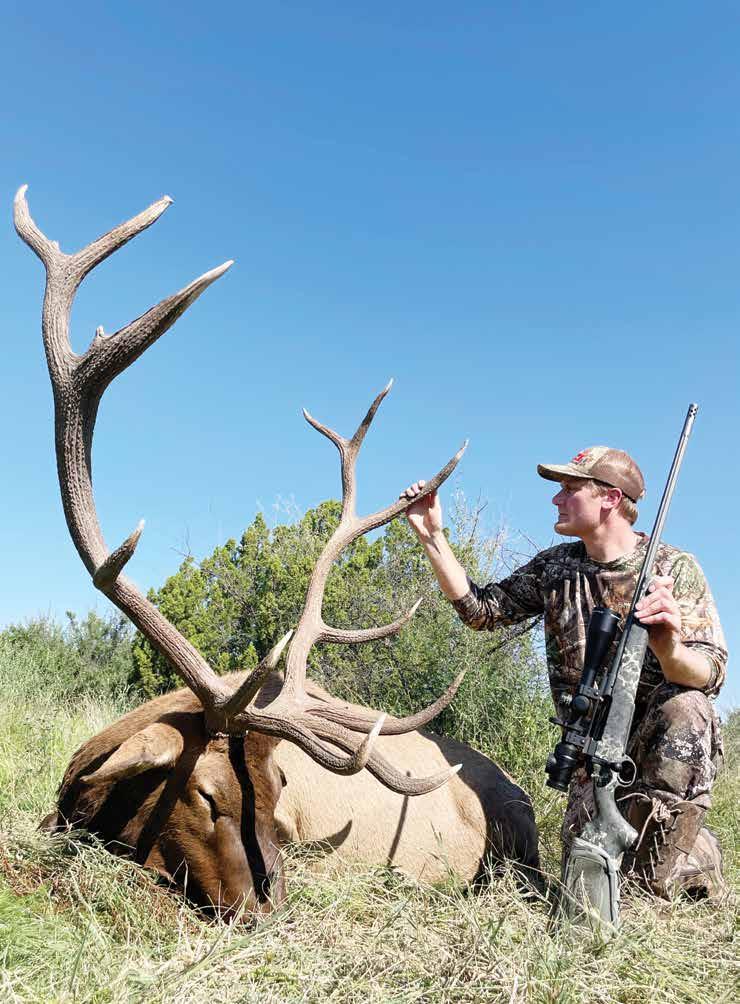
BY JACK ORLOFF
The flats were thick and difficult to maneuver but provided excellent cover for the final stalk.
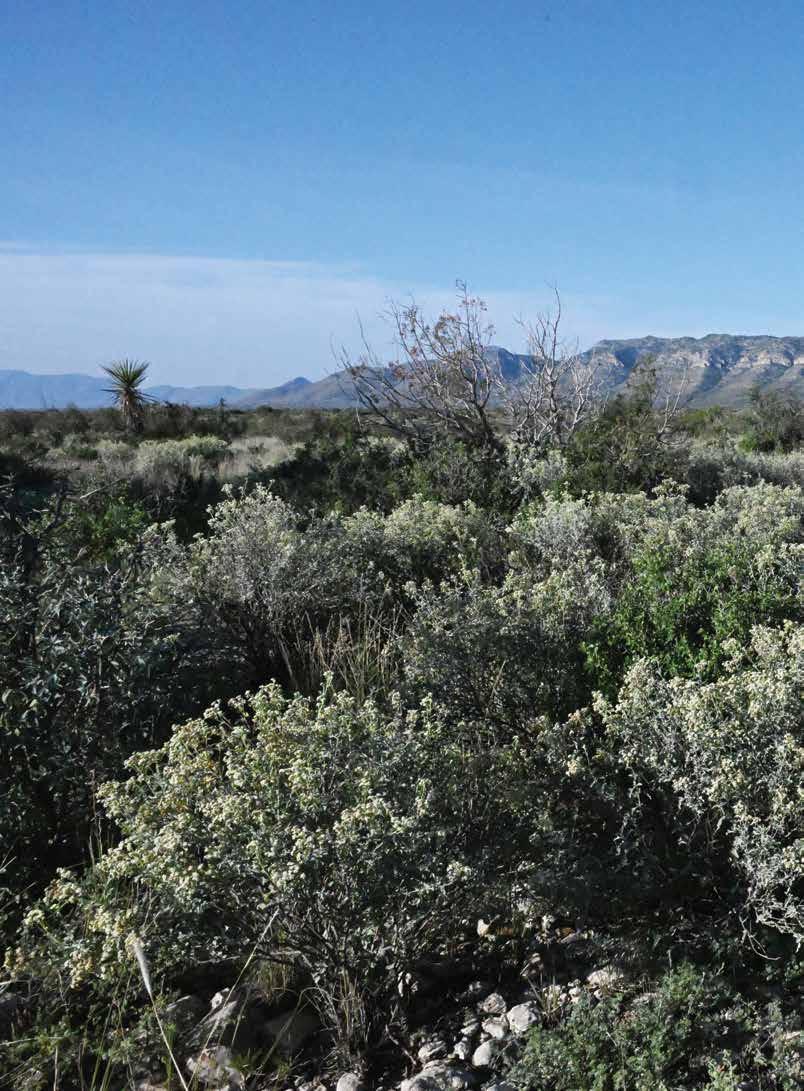
As the sun rose while pulling into the gate, the high-pitched sound of Texas bugling bulls could be heard throughout the valley. Guide Clayton Kibbe spotted a bull right away in the distance, but after giving him a good look through his binoculars, he was quick to turn him down, as he was not the age class we were after. Parts of West Texas can be exceptional locations to call-in free-range Rocky Mountain elk. And one of the best parts about it is that you can even hunt during the rut with a rifle.
I was new to the idea of hunting elk in Texas, so going into a September hunt last year, I had no idea what to expect. I was hunting on the A.S. Gage Ranch in the Trans-Pecos region near Marathon, Texas. The ranch, which was one of the largest cattle ranching operations in the state based on acreage, was founded in 1883 by Edward L. Gage, a native of Vermont who organized the Presidio Live Stock Company. These days, the ranch remains a working cattle ranch, with portions of the property lying within the Glass and Del Norte Mountains.
Since 2003, Wildlife Systems, Inc., has been taking conservation and management efforts here to the next level. They only allow a handful of mature bulls to be hunted each year so that younger bulls reach full potential. Elk once inhabited much of the plains region of the western United States in the winter, then would migrate to more forested areas in summer. These days, due to things like human land use practices, they have been forced into year-long habitation in the mountains of the Western states like Wyoming,
Montana, Idaho, Colorado and Arizona.
According to Texas Parks and Wildlife, historical evidence indicates elk may have been present over much of Texas. But by the late 1800s, only the Guadalupe Mountains had a wild herd. In the 1920s, many Rocky Mountain elk were re-populated in the Trans-Pecos region and these days, free-ranging elk are found over a large portion of West Texas.
“It’s a totally different experience out here than other places to hunt elk out West,” said Mike Lassig, who has been guiding for 19 years. “Elk are not considered a game animal here in Texas, so we are able to hunt them during the rut with a rifle, which is unique,” he said. “In some of the Western states on public land, you could blow a cow call to a bull, and he’s gone,” he added. “You blow a cow call to these bulls out here, and you better be on the sticks ready to shoot. They are not call-shy at all.”
Elk are considered exotics in Texas. You don’t need to buy a tag like you do in some other states, but you still need a hunting license to hunt exotics in Texas. These elk are as big as many in the more famous Western states. “I tell hunters they can expect 300- to 320-class bulls on most of the ranches we are hunting on, with an outside chance of a 340, 350, and occasionally a 370 or 380,” Mike said. “If there are good rains, bulls can reach the 340s. If it’s a drought, you’re looking at 280s to 290s. It’s all related to rainfall out here, but it can produce tremendous bulls, even up to 400 inches,” he added.
On Day 1, guide Clayton, friend Eddie Stevenson, his son Wesley and I loaded into a pickup truck and made our way
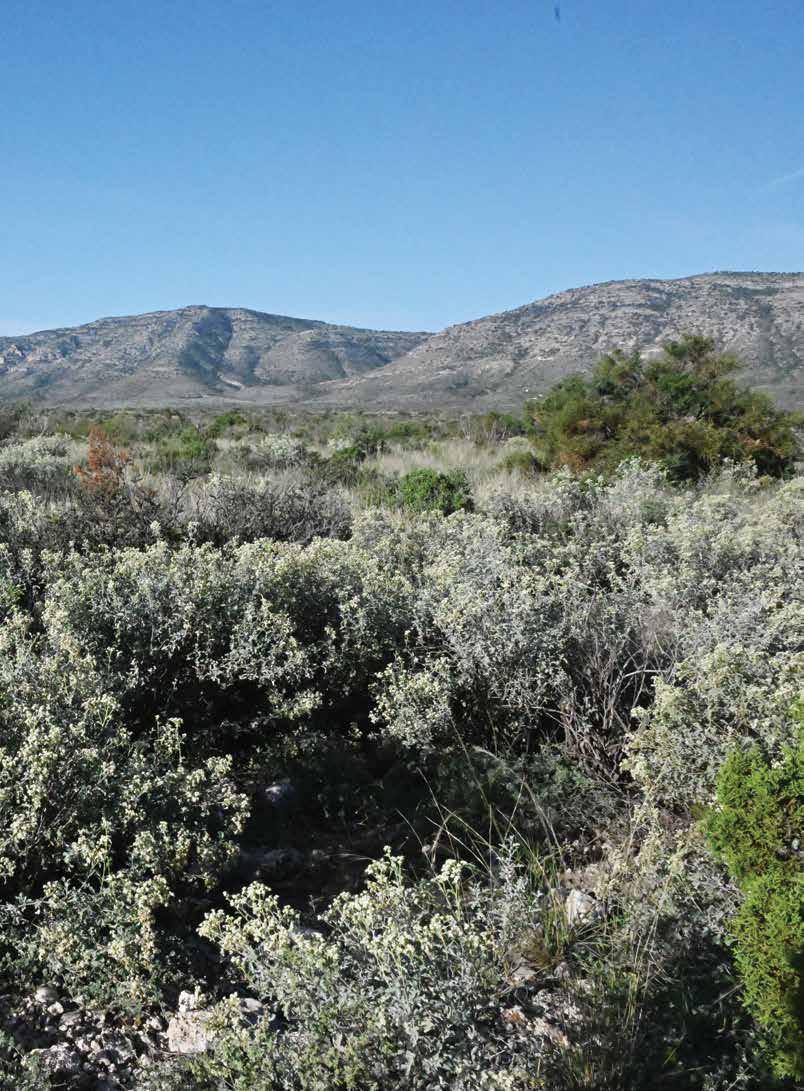
down the highway, a few minutes from camp to the Gage Ranch. We made our way through the flats and then up the rugged and rocky roads that led into foothills, which were covered in mesquite, juniper and cactus. The vast Chihuahuan Desert stretched almost as far as the eye could see, eventually giving way to steep mountains with gorgeous rocky cliffs. The landscape was surprisingly greener than I had thought, thanks to some rain over the previous weeks.
Now and then, Clayton would stop the truck, get out and call, using his bugle to locate elk. We would glass the mountains and hills in search of big bulls. If we saw a good bull, we would conduct a stalk to get closer to determine if he was a shooter. “We try to look for bulls that are 300 inches or better,” Clayton said while driving up another bumpy road to glass.
Although we saw a plethora of elk that day, we never were able to find a mature bull. So, we made our way back to camp, had some fantastic meatloaf for dinner and listened to a success story of one of the other hunters, Ian Doran of Trijicon, who had taken a fine bull that morning with guides Mike and Ted Simpson. Trijicon sponsored the hunt so we could see their optics in action.
On Day 2, we woke up to coffee and breakfast by chef Rhonda Eckert. The guides discussed the day’s plan and decided we should try out another part of the ranch. Just like the day before, as we pulled into the gate at sunrise, the sound of bugling bull elk greeted us. Hearing a bugling elk in the wild has to be one of the most extraordinary things I have ever experienced. Their dialogue is unique and highpitched, almost like a scream.
After about an hour of glassing, we spotted a few decent bulls early in the flats but decided to keep moving in search of a bigger mature bull. As we made our way down the road, we scanned the area meticulously. Clayton suddenly stopped the truck. “Did you hear that? It sounded like one or two bulls,” he said.
But this part of the ranch was thick and flat, so we were unable to gain elevation and couldn’t see anything in the dense brush. We got out of the vehicle, and Clayton decided we should move on foot into the thick stuff to get a better look at what was in there. Not in my wildest dreams would I have expected what would happen next!
Eddie, his son Wesley, cameraman Jose Ramirez, and I stayed in a tight line behind Clayton as we made our way into the thick mesquite maze. When we finally got to a small clearing, we stopped and Clayton let out a cow call. A bull responded right away, and he sounded close. Clayton motioned for us to take cover behind some brush as he set up the shooting stick and told me to get ready.
As I placed the rifle on the shooting sticks — a Springfield Model 2020 Boundary chambered in .300 PRC — I began to shake with excitement. I looked through the Trijicon AccuPoint 3-18X50 scope and tried to find the bull in the brush but couldn’t. Then, the bull let out another loud bugle before slowly stepping out, walking right at us. I tried to calm my nerves as he made his way closer before stopping in front of us at 12 yards.
“Should I take the shot?” I whispered. “No, he’s a young
6x6, not very wide. He’s not what we are looking for,” Clayton said. We stood still in a standoff with the bull for about 3 minutes before he eventually caught our wind. We continued forward slowly in a tight line, weaving our way through the tall grass, catclaw and mesquite.
Once we reached another small opening, Clayton set up the shooting sticks for me while continuing to cow call. Suddenly, another 6x6 bull came running to our right and stopped at about 20 yards. He was a good bull, but it was so thick I did not have a clear shot.
We remained still, but eventually he caught our scent and moved off. So, we continued forward. The action was nonstop. We were covered in elk in every direction. Clayton heard another bugle in the distance that he wanted to check out.
As we made our way forward, the bull continued to bugle and began to sound close. My heart was racing, and my hands were sweaty as we got within 30 yards of the bugling bull but still had no eyes on him. “I think he’s bedded down over there behind those junipers,” Clayton whispered as he put up the shooting sticks. As we got set up on the bedded down bull, out of the corner of my eye, I noticed antlers moving through the thicket to my left.
It was yet another bull who was curious and wanted to check out what all the commotion was about. I had the rifle facing towards the bedded down bull and couldn’t move as the 5x5 stared us down for a few minutes before eventually winding us and moving off. We had now had three close encounters and had yet to pull the trigger.
Our hunting party continued to wait patiently, hoping the bedded-down bull would eventually get up to give us a chance to take a shot. After a few minutes, I could tell Clayton was getting antsy. “I don’t think he’s going to get up on his own. We are going to have to push him out of his bed,” Clayton said.
“Push him out of his bed?” I imagined getting too close and having to defend myself from a 700-pound animal. “Come on,” Clayton said as we slowly crept forward to where
the bull was bedded. When we got to about 10 yards from him, the bull let out a piercing bugle.
Clayton’s eyes got wide, and he quickly motioned us to retreat to where we were originally set up. The five of us ran back, and I got set up on the sticks behind some mesquite. Clayton continued to cow call from behind me.
I first noticed a cow making her way right to left through the thicket about 20 yards. Then, I looked behind her to see giant antlers weaving through the mesquite and juniper. As the cow made her way through, the bull was right on her tail. I could now see his massive head and neck, but the vitals were still blocked by all the brush.
“When you get a clear shot on his shoulder, kill him,” Clayton whispered. The bull slowly moved forward and stopped to look at us at 17 yards, providing a small window to his shoulder through the brush. I placed the crosshairs on the bull’s shoulder and slowly squeezed the trigger. At the crack of the rifle, the big bull jumped back and ran into the thicket where he had been bedded with his cow.
“Did I hit him?” I asked nervously of the viewers behind me. “You smoked
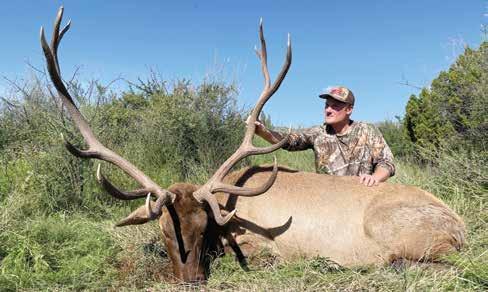
him,” Eddie said with a big smile on his face. We waited a minute or two, then began tracking the big bull who had run into some thick thorns and brush. After a few minutes, we finally found the expired bull just 40 yards from where the shot was taken.
“To get a bull elk and to be able to call them in and get them in close, and the experience of the bull bugling up close like that, it’s just so exciting for a hunter and makes them come back again and again,” Mike said. I ran my hand along
Jack Orloff admires his first bull elk.
the big bull’s side and up his antlers, taking in every detail of the incredible animal lying before me. It was my first bull elk, which was a beautiful, wide, mature 6x6 with a small kicker off his right G4. Now, whenever I think of Texas, a big bull elk closing the distance is on my mind.
Editor’s note: Jack is the associate editor of Safari Club International’s publications. His article originally appeared in Safari Magazine.






By Martin Malacara
Imaginea world where you find your livelihood dwindling day by day. Fewer and fewer of your fellow, like-minded friends and relatives remain to pass along their knowledge to the next generation. The old world and old ways struggle to keep the sacred heritage and tradition alive in a new world where people view such things with either disdain or indifference. Yes, we’re talking about hunting, but would it surprise you
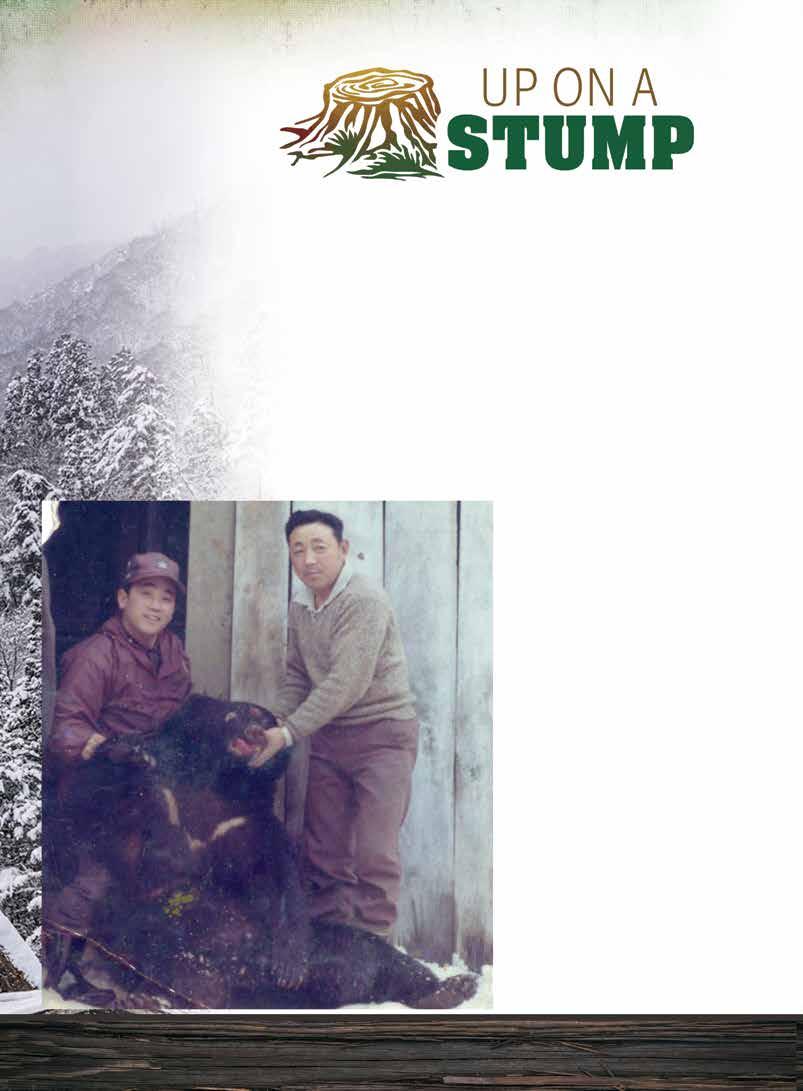
which part of the planet we’re talking about?
A certain group of Japanese people have a bit in common with Western hunters. These people, the Matagi (pronounced mah-tahgee, with a hard “g” as in “go”) live in the Tohoku region in northern Japan. The word “matagi” means “hunter” in their dialect, and they consider themselves stewards of the natural world. They’re well-known bear hunters and also fish and hunt other game as a matter of survival.
Some Matagi believe their culture goes as far back as 10,000 years, according to author David McElhinney, with their origin handed down via oral storytelling. He writes:
“The common origin story in Matagi lore is that a 9th-century hunter, with the wonderfully alliterative name Banji Banzaburo, helped a gongen (the incarnation of a god) defeat a mountain spirit in central Japan. The gongen then granted Banzaburo a hunting license, the first of its kind, allowing him to hunt beasts on any mountain in the archipelago. Banzaburo took his license north to Dewa Province, comprising modern-day Yamagata and Akita prefectures (districts), where he became the progenitor (father) of the Matagi. The area where he is believed to have resided, around Mt. Moriyoshi, remains a heartland of Matagi culture; it’s said the heads of Matagi communities here still carry a handwritten copy of Banzaburo’s divine license.”
However, according to historians, the Matagi culture more realistically goes back to around the 16th century.
Because of their belief, the Matagi hold a great reverence to the land, the animals, and
Matagi with a Japanese black bear, 1966, in Kamikoani, Akita Prefecture, Japan.
the whole of nature itself. In this sense, they’re not much different than the average Texan landowner. Both understand the importance of conservation and stewardship. The difference comes in how the Matagi view hunting. They view it as a spiritual duty to maintain the balance of nature, rather than a sport.
As stated earlier, the Matagi are well-known for their bear hunting, specifically, the Japanese black bear. They’re experts in tracking them, and hunted them with spears. The spear tip has a hole in the base, which allows for removal from the spear shaft. It’s used as a hunting knife, known as the Matagi Nagasa.
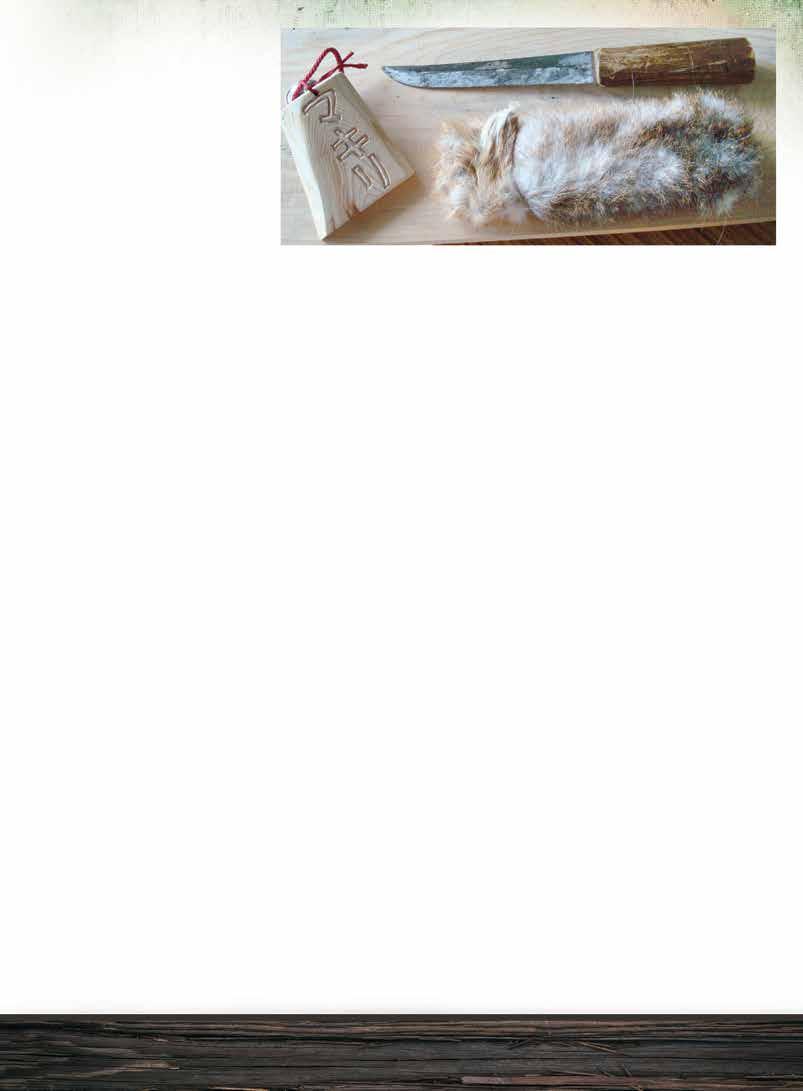
The makiri is another knife the Matagi use. It’s a traditional Japanese fisherman’s knife, characterized by a single-beveled, curved blade typically used for dressing fish, cutting ropes, and woodcarving.
For many years, the Matagi would hunt bears in groups. The groups helped track the bears and navigate the rough terrain. Later, the introduction of massproduced modern rifles and reloadable ammo took the place of the spear as the main bear-hunting tool. This took place right before World War II.
As such, the need for group hunting for bears diminished. Oddly enough, this led to a decline in Matagi hunting culture. This was just the first crack in their culture, allowing for the modern world to affect it. More cultural changes in Japan would come post-World War II and in the following century. Hunting in Japan now is highly regulated. The Japanese black bear is only available to hunt with a special permit, because it’s been deemed endangered by environmentalists. Matagi can no longer hunt the Japanese serow, a goat-antelope, because it’s a protected animal. The permits are too expensive for some Matagi, around 19,000 yen, or $121 at the time of this writing.
Besides the permits, which have to be renewed every three years and only valid in a specific prefecture, they’re also required to purchase insurance to cover hunting accidents. Even more burdensome, as well as expensive, is applying to receive a license to have a weapon from Japan’s National Public Safety Commission. In 1975, there were 518,000 hunting license holders. In 2014, the number dropped to 194,000. In the case of the Matagi, the hunters aged over 60 amounted to 9% of the
Works cited (all QR codes send you to a website or video):


“Matagi: The Last Bear Hunters of Japan.” David McElhinney, Sep. 29, 2025

total four decades ago. They make up more than 66.5% now.
Because the Matagi cannot hunt year-round, they’ve had to find jobs as woodcutters or in farming to sustain a living. Another factor: the Matagi are ageing out of hunting. If they disappear, a tremendous amount of knowledge about their culture and their hunting skill will be lost to time.
In 2016, anthropologist Scott Schnell organized a conference at the University of Iowa, to discuss the struggle of hunter cultures like the Matagi – caught between the old and new worlds – to keep their legacy alive. Two members of the Matagi community were invited to speak about their culture. They emphasized the Matagis play a fundamental role in Japanese society, not only as protectors of local ecosystems but also as advocates of healthy coexistence between rural and urban life, working in continual communion and harmony with nature.
Japan has had struggles with bears encroaching on cities and other urban settings, and attacking people. Wild hogs also roam in areas surrounding the Fukushima Daiichi nuclear power plant, which suffered a meltdown of three reactors due to an earthquake and tsunami in 2011. Hunting has been the only effective way to deal with the bears and hogs. But new hunters are sorely needed, and those, like the Matagi, who have that hunting knowledge, must pass that knowledge—and culture—down to the next generation, before it’s too late.
“Japan’s 400-YearOld Bear Hunt Is Sacred—and Controversial.”
Alexandra Genova, Nov. 14, 2017
Want to learn more? Watch “Matagi: Yamagata’s Spiritual Hunter-Gatherers—Journeys in Japan.”

“Matagi hunters in danger of extinction.”
Alex Rodal, Oct. 20, 2017






By Faith Davis

Directions

• 4 cups whole milk
• 2 cups unsalted butter
• 4 tablespoons active dry yeast
• 1/3 cup sugar
• 2 teaspoons Kosher salt
• 12-16 cups all purpose flour
• 8 tablespoons olive oil
• 12 egg yolks (reserve whites)
• Measuring cups
• Sifter
• Kitchen scale
• Mixer

• 3 wild hog links
• 2 cups shredded cheddar
• 8 eggs (plus reserved whites)
• 5 jalapeños, sliced
• Saran Wrap/parchment paper
• Baking sheets
• Pastry brush
• Over medium heat, warm milk and butter until just melted (let cool).
• In a stand mixer fitted with a paddle attachment, mix together yeast, sugar, salt, and 21/4 cups of flour (you can reach in the bowl and whisk it with a fork, too). Pour in milk mixture and gently mix on low. Let rest 30 minutes covered.
• Beat together oil and egg yolks in a bowl. Slowly mix into flour mixture until incorporated. Slowly add in remaining flour until soft but not sticky. Knead on medium for 10 minutes until supple and smooth.
• Place dough in oiled bowl, cover and rise until doubled (about 1 hour).
• For filling: Dice hog links into small dice and sauté in a pan with jalapeños until browned, add in the eggs and reserved egg whites (leave 1/3 cup of egg whites to brush on kolaches before baking) and scramble until it is ALMOST cooked through but still a little wet (the eggs will continue to dry out when baked inside the kolaches). Let cool and mix in the shredded cheddar, continue to let cool in a bowl, partially covered, in the fridge while the dough rises.
• Punch down dough and divide into 32 pieces using a kitchen scale to get evenly weighed pieces. Roll into balls, flatten into disks, and fill with 75 grams of filling. Place on baking sheets with floured parchment paper, cover and let rise 45 minutes or refrigerate overnight.
• Preheat oven to 375 degrees (if refrigerated, let kolaches warm on oven while preheating).
• Brush each kolache with remaining egg whites and bake 17 minutes if unchilled, or 20-30 minutes if chilled.
Do you have a favorite Wild Game recipe that you would like to share with our readers? If so, please type or print recipe and send to: Texas Trophy Hunters Association, ATTN: Editor | 654 Richland Hills, Suite 160 | San Antonio, TX 78245 | editor@ttha.com
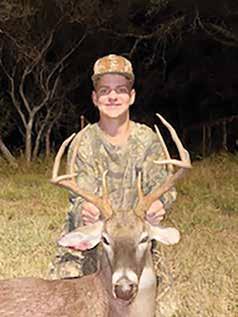
TYLER POOLE: whitetail nine-point with 144/8 inside spread, scoring 1163/8 B&C, taken 10/28/25 in Mason County GEAR: Bowtech amplify; Rage Hypodermic.
OUTFITTER: Jared Poole (dad)
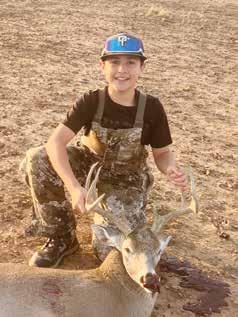
HAGEN: whitetail nine-point taken 11/26/25 in Tom Green County GEAR: rifle.
OUTFITTER: grandfather (family ranch).
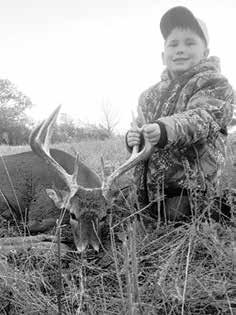
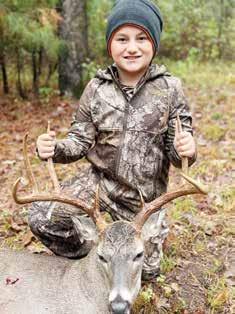
OUTFITTER: Dad.
TREY NORMAN: aoudad with 28-inch horns taken 9/18/25 in Llano County. GEAR: rifle.
OUTFITTER: Darrell Steffek.
JERRY VILLARREAL (PLM No. 255): whitetail 21-point with 15-inch inside spread, scoring 1895/8 B&C, taken 10/11/25 in Zavala County.
GEAR: .270 WSM, 150-grain ammo. OUTFITTER: Cactus Flat Ranch.
TOM HUSBAND: mule deer 13-point with 20-inch inside spread taken 11/24/24 in Childress County.
GEAR: Ruger .308, Leupold scope. OUTFITTER: Red River Farms.
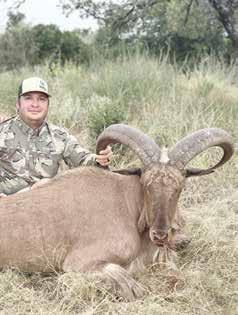
COLTON WEILER: aoudad with 30-inch horns taken 9/3/25 in Llano County. GEAR: rifle.
OUTFITTER: Darrell Steffek.
NOTE: Only TTHA members or immediate family may submit photos. Do not paperclip or staple photos, as this can damage them. Prints must be no larger than 4x6 inches and printed on photo-quality paper. Photos may also be emailed to HuntsEnd@ttha.com. If sent by email, please make sure to include all information from the form and limit your photo size to less than 5MB. Send a separate e-mail for each entry. No photos will be returned. Photos become the property of Texas Trophy
Association.






Don’t forget to use your free classified ad! It’s once per year and you must have an active membership in good standing. Send to:
654 Richland Hills, Ste. 160, San Antonio, TX 78245
You may fax your ad to (210) 523-8871, Attn: Debbie Keene or e-mail to Deborah@ttha.com. Send your ad in by July 7 to run in the next issue!
Available to current members of Texas Trophy Hunters Association only! Limit 25 words per ad. Each member may run 1 FREE ad in one issue per year. 25 word ads after FREE issue are $40 each. WE RESERVE THE RIGHT TO EDIT OR REFUSE ANY AD.
WARRIORS ON THE WAY. PTSD and Moral Injury Healing Pilgrimage for Combat Veterans on the Camino de Santiago. Application and 501c3 Donation Options at www. WarriorsOnTheWay.org.
THE BLUE HERON FISHING CABIN Rental nestled by the Arroyo Colorado in Arroyo City, Tx. Two Bedroom 2 bath private lighted fishing dock. Call 956-3420113 for details.
FOR SALE BECKEL WALL TENT, 15x18x9. Complete with stakes, steel frame and Wood Stove. Good condition. Ready to use. Lloyd Luco, 713-926-6709.
AOUDAD HUNT! Hunt free ranging aoudad in Llano County. Hunts begin in late August thru late October, 2026. Nice accommodations. For additional info, email darrellsteffek@gmail.com.
HUNT WEST TEXAS: NW of Abilene, Free Range Whitetails, Wild Quail (also released Pheasant), Dove, Multiple Exotic Species. Individual or Corporate. www. saltforkranch.com or 325.518.4345.
OWN A BUSINESS IN THE OUTDOOR INDUSTRY - We can help you sell your ag/ outdoor business or buy your dream business. Commission-only! Chip Miller, Senior Business Advisor (License #643275). Call or text: 512-677-7750.
WILDLIFE EXEMPTIONS – Texas Rangeland Management provides Turn-Key Wildlife Services to keep your Property Taxes LOW! Contact Wildlife Biologist Sergio Morales: 210-526-1522 | www.TexasRangeManagement.com.
HUNT SOUTH TEXAS Deer, Hogs, Turkey, Quail, Dove, Javelina, Varmints. 350 acres near Freer. Low fence. Fully equipped 3 BR, 2ba ranch house with satellite TV. Starting at 150.00 per person per day. Trophy buck, 2500.00. References. 361-947-0584.
WILDLIFE & HABITAT Consulting. Commercial hunts available. Contact Certified Wildlife Biologist Jason Shipman 210-508-8447 or jasonashipman@gmail. com.
MACS MOBILE GUN CARE in DFW - Expert Cleaning/Maintenance, and Premium Accessories with Install for Top Tier Firearms. All at Your Front Door! Book Now: CLEANMYGUNS.COM.
BIG TIME HUNTS – World-Class adventures across Southern & Northern BC, Canada! Hunt Stone Sheep, Moose, Goat, Cougar & more. All-inclusive, guided packages. Book your hunt today! www.bigtimehunts.com | bigtimehunts@ gmail.com.
S.M. FENCING, Welding and Bulldozing. Contact Shawn Mangham. 325-451-7120.
WELDED STRUCTURES: Custom Clearing and Fab LLC handles metal buildings, welded structures, and livestock pens throughout the Hill Country and South Texas. Call Dustin Stareck 316-323-7673. www. customclearingandfab.com.
KEI VALLEY SAFARIS offering plains game in the Eastern Cape of South Africa. Package hunts or build your safari. Deep sea fishing, photo safaris, and park excursions available upon request. Keivalleysafaris@gmail.com. Keivalleysafaris.com.
WANTED: A WHITETAIL HUNTER/Private Plane Owner that loves to hunt trophy deer. I have 1300 acres in the Flint Hills of Kansas. 512.365.8205 OR 512.970.5477.
THERMAL DRONE WILDLIFE SURVEYS by premier wildlife consulting firm Spring Creek Outdoors! Professional full time wildlife biologists. Contact matthew.nuernberg@gmail.com.
RESERVE RANCH, a Sportsman’s Paradise near La Pryor, Texas offering full service hunts for Whitetail Deer, Red Stag, Dove and Quail to individuals and Corporate clients. www.reserveranch. com.
JOIN THE MISSION! Support our veterans and first responders with outdoor adventures through Patriots First Outdoors. Donate or become a member today at www. patriotsfirstoutdoors.org.
MAP MY RANCH specializes in developing printed maps for all your outdoor needs. We can create basic boundary maps, or those with customized features - locations of deer blinds, feeders, food plots, ponds, etc. Contact today to get started! www. MapMyRanch.com or 713-302-2028.
HELP FEED THE HOMELESS – donate excess game animals to feed the homeless, orphans, and needy families. Go to www.trinityoaks.org “contact us” tab.
S & D WHITETAILS – Limited hunts avail. Booking 2021 now. All native S TX deer from 140-230 class. Deer & Dove hunts Central TX. Over 7500 ac. 24-yrs experience. 5 Star rating. 325-642-7596.
TEXANS ARCHERY CLUB wants to expand our state’s archery range infrastructure. Looking for local partners/ land to expand our network. www. TexasArchery.info. 501c3.
SPECIALIZED INSURANCE for outdoor recreation & hospitality businesses. Hunting & fishing lodges/preserves, guides, outfitters, ranges, & more. Comprehensive coverages incl. property, general liability, business auto. Contact Devin 361-208-4404 or devinp@jacobs-weber.com.