


s we step into a new year, I can’t help but reflect with immense pride and gratitude on what an incredible milestone year we’ve had together. In 2025, we celebrated 50 years of Texas Trophy Hunters Association—a half century of hunters helping hunters, preserving traditions, and honoring the legacy that built this great organization.
We marked this historic year with five unforgettable trade shows across the great state of Texas—Dallas, Midland, Houston, Fort Worth, and San Antonio—where thousands of members, partners, and outdoor enthusiasts came together to share stories, products, and passion for the hunting lifestyle. Each event was a reminder of the strength of our community and the deep roots TTHA has established throughout Texas.
Our membership growth for the year was inspiring. Not only did we welcome new members into the fold, but we also saw a strong continuation of existing members renewing and staying engaged. This loyalty and dedication are the heartbeat of our association.
In January 2025, we also launched the Texas Trophy Hunters Foundation, our 501(c)(3) non-profit arm dedicated to supporting the next generation of hunters and conservationists. Through our Foundation, we hit the ground running by raising funds and awarding $20,000 in scholarships to deserving students pursuing careers in wildlife, conservation, and the outdoors. These efforts ensure our hunting heritage and values will remain alive and strong for generations to come.
As we turn the page into this new year, our celebration continues, this time marking 50 years of the legendary Hunters Extravaganzas. You’ll see some exciting updates and refinements to our shows and programs, all with one goal in mind: to make your experience as a TTHA member better than ever.
Our focus this year is simple: to refine, strengthen, and grow. We will continue improving every facet of what we offer — from our events and publications to our membership programs and partnerships — all while expanding the TTHA family.
I encourage every member to help us continue this momentum by inviting a friend, a neighbor, or a family member to join. Together, we can ensure that the next 50 years of Texas Trophy Hunters are even greater than the first.
Thank you for your support, your passion for the outdoors, and your dedication to the Texas hunting tradition. The best is yet to come.
With gratitude,

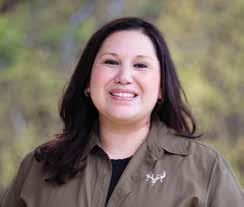
Christina Pittman, President & CEO Texas Trophy Hunters Association
Executive Editor Debbie Keene
East Texas Field Editor Dr. James C. Kroll
South Texas Field Editor Jason Shipman
Hill Country Field Editor Gary Roberson Associate/Online
Newsstand Consultants JK Associates Joe Luca & Triva Bridges
Graphic Designers Faith Peña Dust Devil Publishing/Todd & Tracey Woodard
Contributing Writers
John Geiger, John Goodspeed, Seth Johnson, Judy Jurek, Lee Leschper, Brent Mccuiston, Kyle Seipp, Eric Stanosheck, Matt Tyree, Elizabeth Yates
Advertising Production
Debbie Keene 210-288-9491 deborah@ttha.com
Sales Representative
Tristan Summy 210-685-1205 tristan@ttha.com
Marketing Manager Logan Hall 210-910-6344 logan@ttha.com
Finance & Administration Manager
Laura Garcia 210-512-4927 laura@ttha.com
Events Manager Jennifer Beaman 210-640-9554 jenn@ttha.com
Events Assistant Manager Natasha Delgado 210-512-8045 natasha@ttha.com
Membership Manager Valkyrie Myklebust 210-767-9759 valkyrie@ttha.com
To carry our magazine in your store, please call 210-288-9491 • deborah@ttha.com
TTHA protects, promotes and preserves Texas wildlife resources and hunting heritage for future generations. Founded in 1975, TTHA is a membership-based organization. Its bimonthly magazine, The Journal of the Texas Trophy Hunters® , is available via membership and newsstands. TTHA hosts five Extravaganza® outdoor expositions, renowned as the largest whitetail hunting shows in the South. For membership information, please join at www.ttha.com or contact TTHA Membership Services at (877) 261-2541.
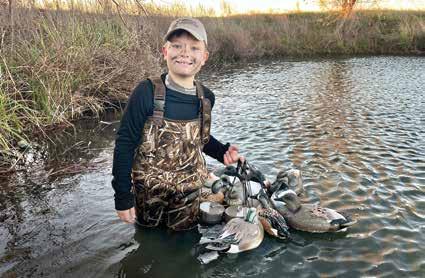
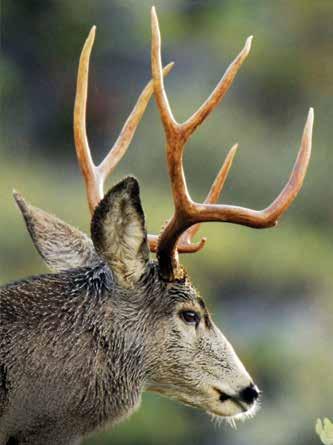
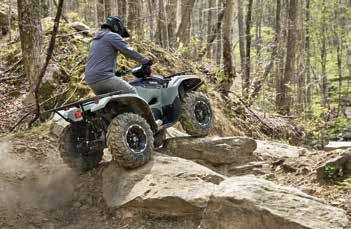
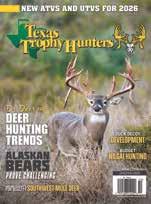
The Journal tries to keep things on its pages invigorating. To that end, we introduce two new columns aimed right at our readers. “Connecting with Texas Parks & Wildlife,” written by Will Leschper (see page 34), will give folks a bit more insight into the state agency, as well as more pertinent hunting informa-


tion. “College Chapter Tales” will give the spotlight to individual members of our TTHA College Chapters, where they’ll share their stories every now and then. They’ll also spread goodwill about their organization, as well as advocate for more folks to get involved with hunting (see page 10).

ogan Hall, TTHA’s marketing manager, spent a weekend in late October lending a hand to the good people with Operation Orphans. The non-profit organization provides children with unique and wonderful outdoor experiences by sponsoring hunting and fishing trips in the Texas Hill Country, since 1960. In many cases, this is the first real such experience these children have been able to do. Logan will have more to share about them in a future Journal issue, but you can offer assistance right now. Visit operationorphans.org to learn how.


I’m a student at Texas A&M University studying agriculture economics, with plans to graduate in 2027. I’m also a member of the Texas A&M Chapter of the Texas Trophy Hunters Association, and serve as one of the chapter’s current banquet chairmen. In high school, I was an active Future Farmers of America member, participating in stock showing, and competitive judging teams such as wildlife evaluation. All my life I’ve been an avid hunter in Texas. My passion as a hunter derives from my father. Since I was a toddler growing up in Spring Branch, my dad always brought me along on his trips to
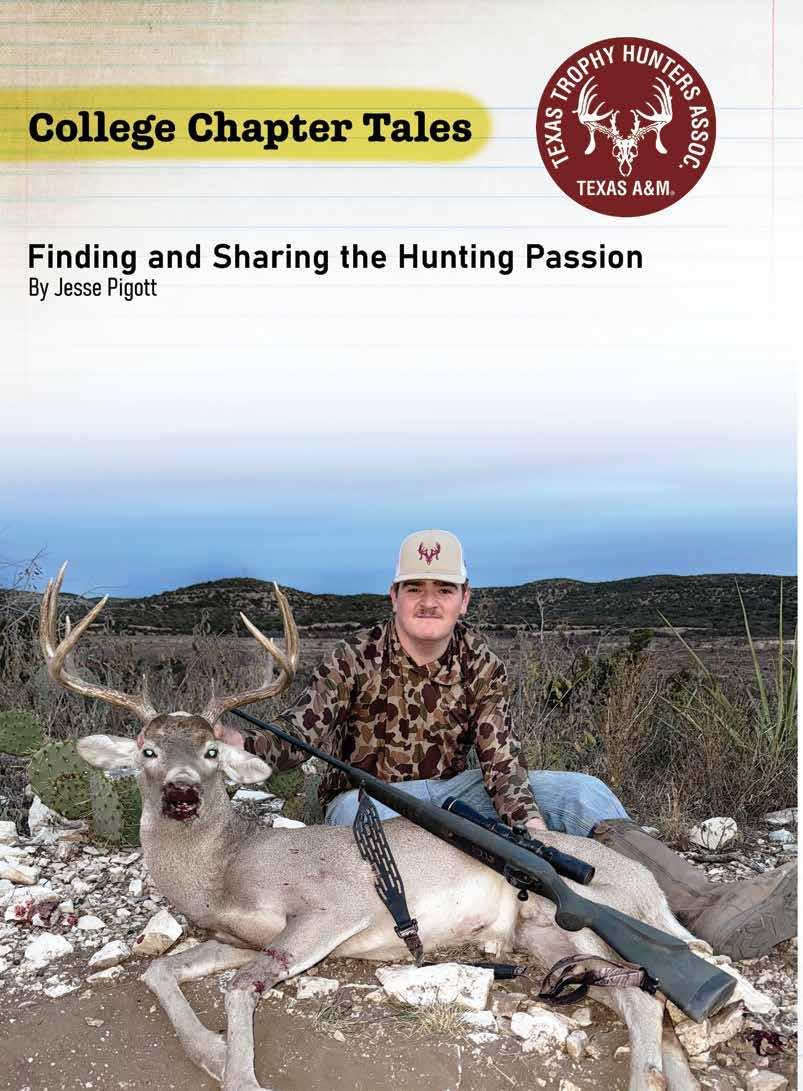
the ranch. He saw my passion for the pursuit and the happiness that a hunting trip brought me. Shortly after, he purchased a lifetime license through Texas Parks and Wildlife Department for me, and the rest is history.
Being a hunter all my life has taught me countless life lessons. I have learned firsthand that hunting isn’t just a pile of birds or a big whitetail hanging on the wall. It means spending early mornings and late nights investing blood, sweat, and tears. I have always believed hunting is what you make of it. If you put in the long hours and have the passion of the pursuit,
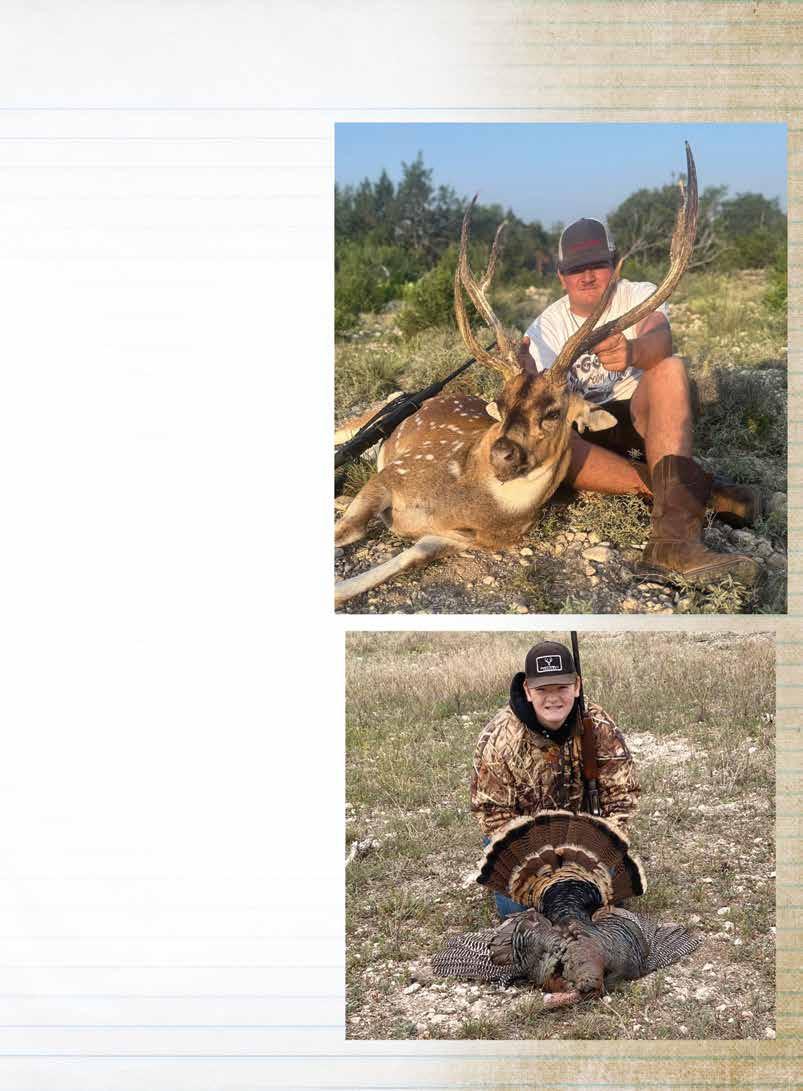
then you are liable to have good results. Hunting has never been about the kill for me. It has been about being in God’s creation and escaping from the busy world we live in. There’s a sense of tranquility that comes from sitting in a deer stand with your cell phone turned off and enjoying the fruits of your labor.
My most interesting hunting story happened this past year. Where we hunt, whitetails don’t grow to be very big, due to rough terrain and lack of water in the region. I had been chasing a shooter buck for the past 4 years, but never found one mature enough to take. On an afternoon hunt over Christmas break, and after a day of work around the ranch, I finally made it to the deer stand, wearing nothing but a dingy white T-shirt and blue jeans.
I finally had the biggest deer I had seen on the ranch, come out about 25 yards from me. He caught wind of me, and we got into a 20-minute staring contest. I’m sure my bright white T-shirt was not helping. Eventually, he made his way into the brush. As he left, I took off my shirt and repositioned. Another 20 minutes passed by, and he came back, but this time, at about 250 yards. It was then where I was able to make a clean shot, wearing only a pair of dirty blue jeans.
I believe hunters play the biggest role in conservation across the state. If hunting was not as popular as it is today, population control would be a huge issue. Having open seasons for whitetail, turkeys, and migratory birds is beneficial to habitats across the state. Hunters also control invasive species, and assist in the containment of diseases such as CWD. Hunters and conservation go hand in hand, and I am thankful to live in a state where we are able to participate.
My goals for hunting in the future are to continue my passion for the outdoors and help spread the word on how great hunting can be for kids and young adults. This is why I made it a goal of mine to become an officer for Texas A&M-TTHA, to keep the younger generations involved, and provide opportunities for them to do so.
My advice for younger generations is to go outside. In our ever-changing world, it seems that hunting and outdoorsmanship are slowly dwindling. I truly believe millions of youth across the state are longing for a passion. I believe hunting can become that passion for them, just like it became for me.
Interested in starting a chapter at your school? Contact Valkyrie Myklebust: valkyrie@ttha.com.


TPWD Announces Habitat and Angler Access Program Projects for 2026-27
The Texas Parks and Wildlife Department has chosen 11 new projects to be supported by the Habitat and Angler Access Program (HAAP) during its 202627 funding cycle. Launched in summer 2021, the Habitat and Angler Access Program is primarily funded by the purchase of freshwater fishing licenses.
As its name suggests, the program restores and enhances freshwater fish habitats and improves and expands bank and shoreline-based angler access on public creeks, rivers, ponds and lakes throughout the state. HAAP enables cooperation between TPWD fisheries biologists and local partners to make fishing better for all Texans.
Texas boasts an abundance of highquality fishing opportunities within its 6 million acres of public waterways. These waters support recreational opportunities for 2 million licensed anglers who spend an estimated $9 billion annually on fishing-related expenditures, resulting in a statewide economic impact of $14 billion annually. Sportfishing is big business in Texas, supporting an estimated 78,040 jobs.
“The Habitat and Angler Access Program offers us a tremendous opportunity to support much-needed fish habitat enhancement initiatives and shorelinebased access developments, improving conservation of fisheries resources and quality of angling for Texans,” said Michael Homer, Habitat and Angler Access Program Coordinator.
This is the third round of projects supported through the Program, all of which
are expected to be completed by August 31, 2027. The next request for project proposals will be announced in spring 2027 for the 2028-2029 funding cycle. Projects selected to be funded and completed during 2026-2027 are:
• Kirby Reservoir Multiuse Pier Project
• Fort Phantom Hill Reservoir Multiuse Pier Project
• San Antonio Cassin Lake Fish Habitat Improvement Project
• City of Big Spring Comanche Trails Pier Project
• Lake Stamford Anchor Marina Crappie House Replacement
• City of Coleman Memory Lake Habitat and Access Project
• Lake Brownwood Fish Habitat Project
• City of Grapevine Settler’s Park Angler Access Project
• City of Muenster Paddling Access Project
• Lady Bird Lake Habitat and Access Project
• Garner State Park Habitat Improvement Project
Examples of project components supported by the Program include installation or improvement of fishing piers, installation of dock lighting, stabilization of banks and shorelines, and installation of erosion control features.
Other project components include planting of native aquatic vegetation, restoration of riparian and shoreline buffers, deployment of artificial fish attractors, and the construction of launches for kayaks, canoes, and other small watercraft
for the purpose of fishing access.
For detailed information about the projects being supported during 2026-27, visit the Habitat and Angler Access Program projects web page or send an email to FishGrants@tpwd.Texas.gov.
—courtesy TPWD
Operation Game Thief (OGT), Texas’ wildlife crime-stoppers program, has launched Tip411—a new mobile app, text line and online web form that makes reporting wildlife crimes more accessible than ever. Whether in the field, on the water, or scrolling on a phone at home, anyone can now report suspicious activity in seconds.
“Protecting Texas wildlife and our natural resources is a shared responsibility,” said Col. Ron VanderRoest, TPWD law enforcement director. “This new system makes it easier than ever for the public to speak up and make a difference while staying completely anonymous.”
The free Operation Game Thief App, available now for iOS and Android, allows users to submit tips, photos and videos directly to Texas game wardens by texting 847411 (Tip411) with the keyword “TXOGT” followed by the tip information and applicable photos or videos if available. Anonymous web tips can be submitted through the Operation Game Thief—Texas Parks & Wildlife Department website. Reporting by phone is also available 24 hours a day, seven days a week by calling 800-792-GAME (4263).
“If you see something, say something. It could be the one tip that stops a
poacher or saves someone from injury on the water,” VanderRoest said. “You spot it, we stop it. These new reporting methods make it fast and easy to do the right thing.” —courtesy TPWD
The Mexican Federation of Shooting and Hunting (FEMETI) and Safari Club International advise hunters on both sides of the US-Mexico border to be alert for signs of New World screwworm infection in any wild game they might harvest this hunting season and to take action to help stop its spread.
New World screwworm, (Cochliomyia hominivorax) is a flesh-eating parasite. Screwworm adult flies infect livestock and other warm-blooded animals, such as deer, by laying their eggs in open wounds or around body openings such as the nose, ears, or genitalia. Previously eradicated from the United States, Screwworm was recently detected near the Texas border, leading the U.S. to resume a sterile-fly release program and suspend imports of cattle, bison and horses from Mexico.
Screwworm presents an immediate and present threat to domestic livestock industries in both Mexico and the U.S. While detection and treatment are relatively simple for livestock, that is not the case for wildlife species. For this reason, Mexico’s General Directorate of Wildlife, under the Secretariat of Environment and Natural Resources, together with the National Service of Health, Safety and Agro-Food Quality (SENASICA), are coordinating with the Animal and Plant Health Inspection Service (APHIS), under the USDA, to request that all hunters carefully inspect harvested game animals for any signs of infection. If you find suspicious lesions or the presence of larvae on an animal you harvest in Mexico, immediately report it to SENASICA at 800-751-2100 or on WhatsApp 5539964462. In the U.S., contact the National Preparedness and Incident Coordination Center at fad. prep.comments@usda.gov. or your state’s area veterinarian in charge. Also, hunters are urged to carry a
small container to collect larvae. They can be handled safely, as a larva by itself cannot infect you unless it is placed inside a wound. Importantly, do not allow the larvae to fall to the ground where it will borough, become pupae and emerge a fly to lay thousands of eggs and continue the cycle.
For updates on the spread of New World Screwworm, visit the websites of SENASICA, the USDA, and Texas A&M AgriLife Extension —courtesy SCI
Do you know that in Texas, vehicle theft is the No. 1 way criminals gain access to firearms? Many of these guns are later used in violent crimes—making safe storage more important than ever. If you decide to keep a gun in your car, you need to know how to store it safely. And that doesn’t mean hiding it in your glove box. Learn how to safely store your guns at all times at SafeGunStorageTexas.com.
In early October, Pennsylvania Gov. Josh Shapiro became the 28th active member of the Governors Sportsmen’s Caucus. Created in 2009, CSF formed the GSC to protect and advance the interests of sportsmen and women, while shaping policy that is designed to enhance professional fish and wildlife management., the GSC is a bipartisan network of governors who share information across state lines and beyond political lines in support of the Congressional Sportsmen’s Foundation’s mission to protect and advance hunting, angling, recreational shooting, and trapping.
GSC members also work closely with the respective state legislative sportsmen’s caucuses organized through the bipartisan National Assembly of Sportsmen’s Caucuses (NASC). Together, these two programs represent an unprecedented network of pro-sportsmen elected officials. While many of CSF’s policy victories are won through close coordination with NASC-member caucuses, the GSC has historically played a pivotal role in pushing pro-sportsmen
and women’s policy across the finish line while stopping anti policies at their final hurdle.
Most recently, Gov. Shapiro signed Act 36 of 2025, which repealed the longstanding prohibition on Sunday hunting, an issue CSF worked tirelessly on for 15 years. Gov. Shapiro also continues Pennsylvania’s longstanding representation on the GSC, directly following former Pennsylvania Gov. Tom Wolf.
“I have so much respect for Pennsylvania’s hunters and sportsmen who continue to uphold this important tradition all across our Commonwealth. Hunting helps protect our Commonwealth’s natural resources, and gives folks a chance to connect with friends, family, and community. It’s a rich part of Pennsylvania’s history – and I’m looking forward to honoring that tradition by being a member of the Governors Sportsmen’s Caucus,” Shapiro said. —courtesy Congressional Sportsmen’s Foundation
The Boone and Crockett Club commends action by the Senate Agriculture Committee to pass the Fix Our Forests Act (S.1462), introduced by Sens. John Curtis (R-UT), John Hickenlooper (D-CO), Tim Sheehy (R-MT), and Alex Padilla (D-CA), by a bipartisan vote of 18-5, taken in late October. The following is a statement by Boone and Crockett Club CEO Tony A. Schoonen:
“The Boone and Crockett Club applauds the bipartisan passage of the Fix Our Forests Act out of the Senate Agriculture Committee today and supports swift passage by the full Senate. This legislation would allow the Forest Service to accelerate active forest management on our national forests—reducing the risk of severe wildfires, improving big game habitat, and creating jobs in rural communities. Active forest management such as harvesting trees, thinning dead and dying trees, creating fuel breaks, prescribed and managed burns, and creating defensible spaces are all effective tools to reduce wildfire
threats and improve wildlife habitat.
“The Boone and Crockett Club has a long history with wildland forest management. In the early 1900s, we worked to develop and pass legislation that created the National Forest System and the U.S. Forest Service to manage these forests. This has continued into the 21st century, working with Congress and federal land management agencies to create new tools—including the creation of Good Neighbor Authority, speeding up project review, and fighting frivolous litigation—so that the Forest Service and its partners can get to work improving our forests and preventing catastrophic wildfire.” —courtesy Boone and Crockett
The U.S. Senate passed the Wetlands Conservation and Access Improvement Act, which extends and reauthorizes the interest earned on funds held in the Federal Aid to Wildlife Restoration Fund (Pittman-Robertson) to continue to be available for the North American Wetlands Conservation Act (NAWCA).
“The Pittman-Robertson Wildlife Restoration Act is an essential pillar of American conservation efforts,” said Ducks Unlimited CEO Adam Putnam. “Duck hunters are among the most passionate conservationists on the planet, and their investments sustain wetlands, wildlife, and the future of waterfowl. Thank you to our friends in Congress for ensuring that hunters’ investments continue to support the North American Wetlands Conservation Act, where they can go right where they belong – onto the landscape to restore habitat that benefits waterfowl, other wildlife, and our communities.”
The Federal Aid in Wildlife Restoration Act of 1937, also known as the Pittman-Robertson Act, imposes an 11% excise tax on ammunition, firearms, and archery equipment. Funds generated from this tax are then distributed to state game and fish agencies for conservation and restoration projects for wildlife and their habitats, hunter education, and other wildlife-related recreation. NAWCA is a non-regulatory, incentive-based
voluntary wildlife conservation program that stimulates public-private partnerships to protect, restore, and manage wetland habitat for migratory birds and other wildlife.
The bipartisan Act was originally introduced in the House of Representatives by U.S. Reps. Jeff Hurd of Colorado and Sarah Elfreth of Maryland.
“This bill supports hunters, improves wetland health, and ensures future generations can enjoy the outdoors. It expands hunting opportunities and delivers real benefits for conservation efforts across the country,” Hurd said. “I’m honored to get this win for our hunters, wildlife, and America’s outdoor heritage.”
“The Wetlands Conservation and Access Improvement Act of 2025 is a critical continuation of funding from hunting sales to wildlife restoration efforts. In Maryland alone, this program has conserved over 58,000 acres of wildlife habitat through over $16 million in North American Wetlands Conservation Act funding. I’m grateful my colleagues in the Senate have moved forward this crucial piece of legislation so we can ensure generations of sustainable sportsmanship opportunities to come,” Elfreth said. —courtesy Ducks Unlimited
A Final Rule has been published by the Commerce Department’s Bureau of Industry and Security (BIS) regarding US travelers taking firearms abroad. Just before the government shutdown, the Trump Administration published the revised rule, which rescinds most of the limitations imposed in an “Interim Final Rule” that had been implemented in May 2024 by the Biden Administration.
The Interim Final Rule was quietly posted last year and included prohibitions on traveling with firearms to a list of countries, plus a limit on the number of firearms an individual may travel with for personal use to three in total. Furthermore, BIS planned to restrict how long US travelers could have a firearm abroad and require them to submit information in the Automated Export System (AES). That system is designed
for commercial exports by businesses and not for individuals traveling with personal property.
Now under the Trump Administration, BIS has reviewed and amended the restrictions, dropping the prohibition to a list of countries that included some hunting destinations and the plans to implement time restrictions and require AES filings. So, sportsmen will continue using the Customs Border Protection (CBP) Form 4457 to declare firearms for international travel, and they may continue planning extended hunting travel without any time limits.
However, BIS decided to keep the three-firearm limitation. Traveling hunters are free to take any combination of rifles, shotguns or handguns for international hunts, but they can total no more than three. That limitation is already in effect and traveling hunters should abide by it to prevent issues when leaving the US to hunt abroad. —courtesy SCI
Safari Club International (SCI) joins the European Federation for Hunting and Conservation (FACE) and other partners in welcoming the European Parliament’s decision to not call for a ban on importation of hunting trophies. The European Parliament has adopted a resolution ahead of the upcoming CITES 20th Conference of the Parties. For the first time in over a decade, the Parliament rejected calls for trophy import bans.
The European Commission and other international organizations have acknowledged that legal and sustainable wildlife trade offers multiple benefits to conservation, livelihoods, local economies, and support enforcement efforts to combat illegal activities.
“SCI congratulates our friends at FACE who worked to ensure the European Parliament’s resolution did not include a ban on trophy imports,” said SCI CEO W. Laird Hamberlin. “FACE’s message that regulated hunting is part of the solution—not the problem—resonated with the members of Parliament.” courtesy SCI

By Dr. James C. Kroll

Ikilled my first buck in 1963. I was just a teenager who spent my early days hunting my two grandfathers’ farms east of Waco, Texas. Game to me in those days was doves, quail and rabbits. Squirrels were off limits because my family thought they were for “looking,” not eating. My firearm was a J.C. Higgins 20-gauge bolt action that served me well for small game.
My nemesis was a particular jackrabbit that always managed to stay out of range. That ended one Christmas, when my parents gave me a bolt action .22 open sight rifle. When it was over, I regretted taking him out of the game, but at least two more jackrabbits had replaced him. Jackrabbits were abundant in those days, but no one I knew ate them, in spite of my grandmother loving to cook possum.
Deer hunting was for faraway places. Our neighbors—all World War II vets—had camper pickups they drove to the Hill Country, South Texas, or Colorado to hunt with their buddies who also were veterans. I dreamed of getting to hunt deer when I got older. My biology teacher, Mr. Victor Rippy, gave me my first chance.
Mr. Rippy had a day lease at Hunt, Texas, where he and a buddy went every December for a three-day hunt. He invited me, if I could muster up the $50 fee the rancher charged for the hunt. I mowed lawns all summer to get enough money to make the trip, and purchased a surplus M1 Garand, chambered in the .30-06 Springfield (7.62x63mm) cartridge, from a
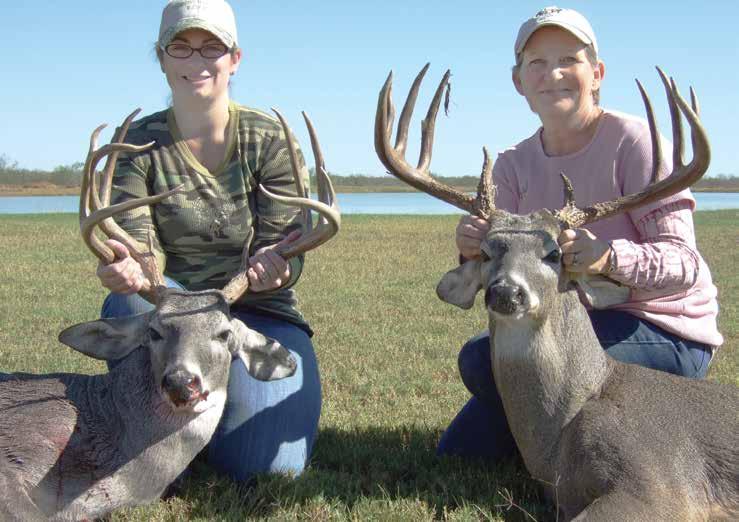
Through the years, hunting became a family experience and later developed into a unique culture.
hunting magazine, that arrived coated in Cosmoline.
I shot my first buck, a nice one, on that hunt. I’ve given Mr. Rippy the credit for starting my deer biology career. As each of you, it was the hunt I will always remember, and can recall every moment of that hunt. Along the way, I somehow lost the antlers in one of my many moves. I regret to this day not having them.
Our family soon became interested in deer hunting, and we acquired a lease at Willow City, Texas, owned by a bachelor named, Mr. Ellet or Elliott. He was deaf in both ears and wore two old time hearing aids that whistled when you talked to him. He had a friend who had ridden in Buffalo Bill’s Wild West Show and had some of the strangest ammunition I have seen. That was our first lease and each of us had to pay the usual $50, but we got to hunt the entire season.
We camped in tents, had great times, and even spent Thanksgiving there. I had moved up to a bolt action .243 by that time, and still have it to this day. Later, the family members got too busy to keep the lease, and we let it go. By then I was in college and too busy to hunt anyway.
After graduating with a Ph.D. in wildlife science, I moved to West Virginia to teach and coach. It was my first experience with the public hunting Mr. Rippy had grown up with. On opening morning, I received a memorable lesson.
I had scouted out a great place up a “holler,” for my first day. There was a skiff of snow on the ground—a marvelous morning. But, just at first light, I heard rifles being loaded. A

few minutes later, bullets whizzed by and I crawled out to my car and left. At the “filling station” in the small town of Salem, trucks started showing up about 9 a.m. with an array of deer carcasses, mostly yearling bucks and does. Needless to say, that experience made a lasting impression.
Why am I telling you these stories? It was just one period in over 100 years of deer hunting in America. Deer were not hunted when I was young, because no deer were around where I grew up. We had to travel long distances to find a place to hunt.
As populations grew from the restoration days, each geographic region developed its own style of hunting. When I arrived in East Texas in 1973, deer hunting was primarily done with dogs, or by driving the roads and shooting any buck that crossed a woods road. By the 1980s, things had changed and much of the timberland was tied up in hunting clubs, populated by families just like us at Willow City. A culture had developed, where old and young gathered at the hunting club (lease) each year to camp out and enjoy a family experience. Much earlier in South Texas, men leased ranches to hunt trophy deer, and the family was invited during certain times.
One by one, states became populated with deer, and hunters developed their own unique culture suited to that region. Bowhunting became popular in states where only shotguns were legal and gun seasons were set to be after the rut. In the Midwest, where farming was king, hunters were taking huge bucks, and non-resident licenses were in hot demand. By the
turn of the 21st century, bowhunter numbers had increased to over 4 million of the then 15 or so million hunters.
During this time, we saw deer hunting approach maturity, with segmentation into hunting weapons and styles. Bowhunters further fragmented into “traditional, string bow and wheel bow,” weapons. Later, the unthinkable happened. Crossbows became legal in many states, and the “true” bowhunters were livid.
Whether traditional or mechanical, the race was on for faster bows, breaking the 400 ft/second barrier. Traditional broadheads gave way to all sorts of fancy mechanical tips, each touted to be more lethal. Rifles and calibers, too, have always been the source of great disagreement. Writers like my friend, John Wooters, and Jack O’Connor could make or break a new rifle or caliber with a single column in a gun or hunting magazine.
The two greatest magazines ever published about deer hunting are The Journal of the Texas Trophy Hunters and North American Whitetail. These two magazines can be credited with the popularity of trophy buck hunting. They revealed to hunters for the first time, monster bucks exist throughout North America, spawning a new trend where one or two hunters traveled to hunt with outfitters claiming to have the biggest bucks. These hunters represent yet another demographic in the maturation process of deer hunting.
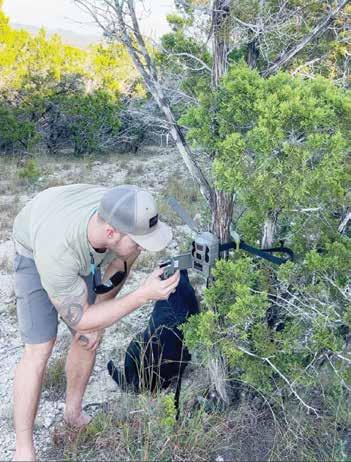
The greatest emerging trend has been technology, which quickly followed the increased popularity of deer hunting. Faster bows, faster cartridges, better camo, scent killers, deer calls, and more recently, the trail camera. I was involved in the development of the trail camera, and we created it as a deer management aid, rather than a hunting aid.
The most striking trend in deer hunting today centers on use of high technology to find and kill bucks. At first, trail cameras were used just to see what was out there, and if you were lucky, a good buck to “target.” You had to load them with film, and wait for the prints to come back to see what you had on your place. Then came cell phone technology that allowed you to see instantly what’s moving around your land.
I’m amused when I talk to someone at the Hunters Extravaganzas and their phone dings. They immediately stop and look at their phone for an update. A related emerging trend is using Artificial Intelligence and computer linking to find and track
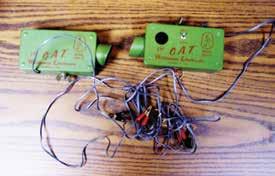
In the 1970s, the author used this simple system to monitor deer movements. Now, one can use GPS technology.
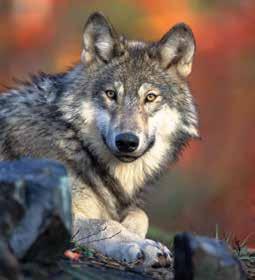
With hunter numbers decreasing, state agencies are turning to “re-wilding” of wolves to take up the slack in deer management.
specific bucks on your property, not unlike the side sonar systems now used by fishermen. Drones with thermal capability are the latest trend, improving recovery of wounded deer, but also finding deer in their escape habitat.
So, at this point in deer hunting history, the most popular game animal is the white-tailed deer, and deer hunting has segmented and matured into firm interest groups. I’m encouraged one of these groups includes folks returning full circle to where we began: families hunting together on the land. Purchasing land just for hunting has been a significant trend since 2000. That turned deer hunting and management into a 365-day affair, with the emergence of the “hunter-manager” over the “hunter-consumer.” Hunting for trophy bucks is not the primary goal, rather for the “trophy experience.” Participation by women has been an encouraging trend, and their numbers slowly increase with time.
As for challenges on the horizon, we’re dealing more and more with diseases that have emerged as deer populations have saturated the entire range. EHD is without doubt the greatest danger to the future of deer hunting. This means deer hunters are chasing a boom-and-crash population cycle.
We continue to lose hunters in geographic regions where the family hunting camp existed for over 100 years. Why?
A “new” hunter lives in the woods, whose populations are booming—top carnivores like wolves, bears and lions. Hunters and landowners killed out wolves long ago, because they were too much like us. We never learned to co-exist. With hunter numbers decreasing, state agencies are turning to “re-wilding” of wolves to take up the slack in deer management. So perhaps the greatest emerging trend I see in deer hunting is, in some regions, two types of hunters will clash—people and wolves.
Sure, our favorite recreation has become more and more complex. Serious issues also exist on the near horizon. Yet, I have profound faith in spirit of the deer hunter and the white-tailed deer. There are memories still to be harvested from the deer woods and brush.


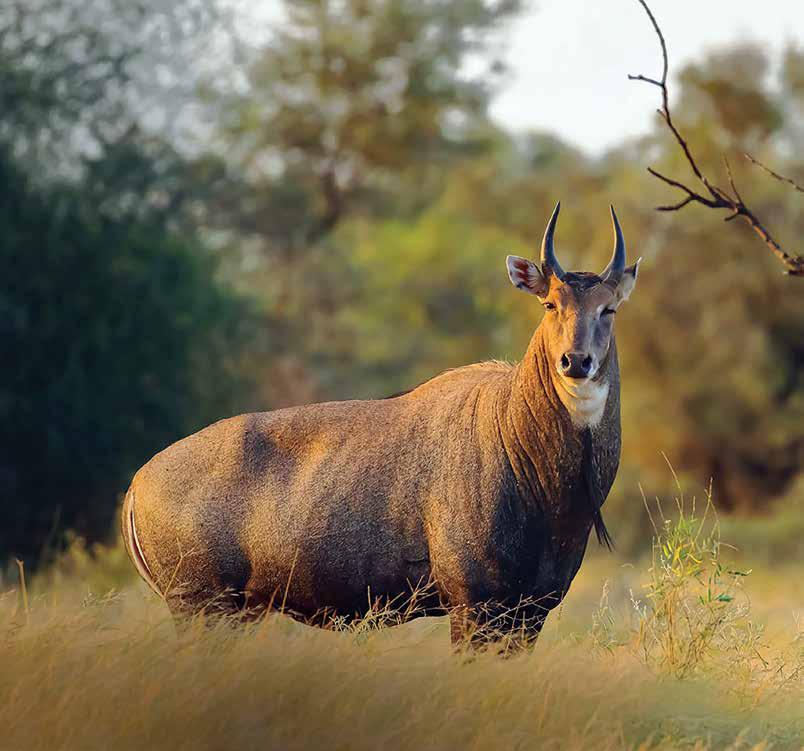
Despite their size, nilgai are quite elusive afield.
By Horace Gore
Agnes Ann “Aggie” Goodman shifted her position on the passenger side of the pickup so the fore end of her 7mm Mauser lay steady against the sandbag and rearview mirror. She had the 2-minute Lee dot in the 6-power Leupold scope centered on the nilgai’s shoulder.
This was Aggie’s first nilgai hunt, and she didn’t want to foul up her shot at a “blue bull.” She pushed the safety off and waited, as she thought about what Jack had told her: “Put the bullet square into the bull’s shoulder, and right through both lungs.”
The old bull stood near some scrubby live oak, which would give him quick escape. His dark body formed a silhouette against the oaks, offering Aggie a broadside shot. She thought this would
be her only shot—albeit a long one. Aggie had been practicing at a 250-yard target and had been scattering the bullets in a 6-inch group—good enough to kill a Kenedy County nilgai bull.
The bull looked at the truck, but had not bolted. Aggie had confidence, knowing Jack had sighted the handloaded 160-grain Nosler in for a long shot, 3 inches high at 100 yards, “dead-on” at 250 yards, and 6 inches low at 300 yards.
Jack Morgan, Aggie’s “soon-to-be,” had guessed the distance at about 250 yards, a safe distance for the lone nilgai bull. The ranch had limited hunting, and the nilgai were not exceptionally wild at a safe distance. Jack looked at the bull through his binoculars as he said, “Put
the dot high on the bull’s shoulder.”
Aggie had a steady rest on the sandbag as her finger felt the trigger. She took a deep breath and slowly squeezed it for the one, and probably only shot at the distant bull. The 7mm roared and Aggie lost sight of the antelope, as she bolted another round and put the safety on.
Jack had his binoculars on the nilgai as it wheeled in the loose sand and ran—with tail high in the air—veering toward the scrubby live oaks. Jack felt good about the shot, knowing a bull hit well through the lungs often throws up his tail and runs until his air plays out. The bull went through the live oaks and disappeared behind a grassy knoll. Jack took Aggie’s trembling hand, and they waited.

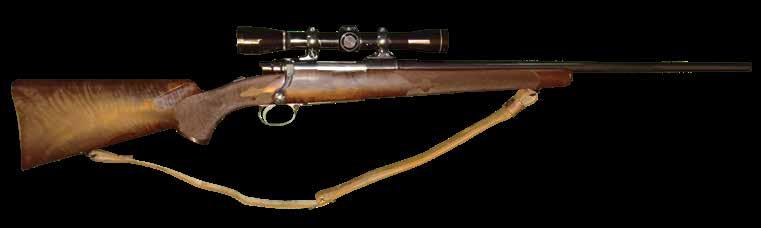
The idea of a nilgai hunt had started when Aggie’s grandfather had given her his custom 7mm Mauser as a college graduation present. The old man had carried the Mauser from the Rockies to Mexico over the years, taking all manner of big game. He knew Aggie wanted the Mauser, and now she had it.
The rifle was exquisite, with French walnut wood, fine checkering, aftermarket tang safety, and light 22-inch barrel. The 6-power Leupold scope had a 2-minute Lee dot on thin crosshairs. This meant the dot covered 2 inches at 100 yards, and 6 inches at 300 yards.
Aggie’s grandad loved the old Mauser and had talked about shooting 140-grain Hornady spire points at deer, pronghorns, and hogs, but preferred the 160-grain Nosler for aoudad and elk. She had heard him say with a grin, “My Mauser and 160-grain Noslers would kill an elephant if the sun was right! I’m sure it will do well on a bull nilgai.”
Now, Aggie hunted nilgai with her beloved Jack and Gramp’s old Mauser, with his handloads of 160-grain bullets at 2,650 fps. Jack was not new at nilgai, having taken a good bull on one hunt and a fat cow on another. He knew the ins and outs of nilgai hunting and had put Aggie on this big bull that ran hell bent for leather after she put a 7mm Nosler bullet through both lungs.
Aggie and Jack sat in the pickup wondering how far the bull would run before collapsing. Jack had guessed the horns at 8 to 9 inches—good for an old bull that could weigh 500 pounds, or more. But Aggie wasn’t interested in the horns, just the unique hunt with her new gifted 7mm Mauser.
The nilgai antelope they hunted in South Texas are native to India, and many animals were brought to American zoos in warmer climes after World War
I. The San Diego Zoo had an excess of nilgai in the mid-1920s, and the King Ranch bought some to stock the ranch for meat consumption—not trophy hunts. Nilgai meat is outstanding, but now the big antelope are prized as exotic trophies.
Jack started the pickup and began the drive up the incline. The truck almost stalled in the deep sand, but Jack finally got to harder ground. Aggie leaned as far as she could against the windshield, and sighed with relief when she saw the big, dark bull laying in the grassy flat 100 yards ahead.
Jack stopped the truck a few yards from the bull and surprised Aggie with a kiss as he remarked, “Good shot, Babe!” Both were excited as they got out to check where Aggie’s bullet had hit the bull, and to measure the horns. Jack called back to ranch headquarters for help in getting the big bull back to the skinning shed.
Aggie watched as Jack spread his hand on the short, black horns. “Close to 9 inches,” Jack surmised as Aggie ran her finger up one horn and felt the sharp point. “Are these real horns—not like pronghorns?” she asked. Jack assured her they were real as he felt the Nosler bullet under the hide, where it had lodged after going through both shoulders.
“The difference in your nilgai’s horns and a world-record is about an inch,” Jack joked as they sat in the truck waiting for the ranch cowboys to come and load the big antelope. Everyone would have a lot of work ahead. A mature bull takes a lot of effort to load, hang, gut, skin, and cut up for the freezer.
Before long, a flatbed truck came down the sendero and backed up to the nilgai. Two ranch hands got out and put four thick, wide boards together
from the ground to the truck bed, and then turned the bull’s rear towards the boards. The electric winch whined as the cable attached to the hind legs pulled the big animal up the boards and onto the truck bed. Aggie heard the cowboys talking, “Muy bien! El es un gran toro.” She knew enough Spanish to know they were admiring her nilgai.
“We couldn’t have gotten the bull out of the pasture without the boards and winch, could we?” Aggie asked as the cowboys drove away with her nilgai. “Not hardly,” Jack quipped. “Nilgai hunting ain’t for the weak and feint hearted.”
Aggie could hardly believe how long a bull nilgai is when you pull it up by the hind legs for gutting and skinning. “That bull is twice as long as I am tall,” she remarked as Jack and the cowboys got out the knives and saw. An hour later, two large chests with meat were iced down, and the cape and head were ready for the taxidermist.
“I like his blue hide and the whitetipped ears and cheek spots,” Aggie said as she rubbed her fingers through the coarse hair of the cape. “If he had been closer, I would have shot him in the white spot,” she bragged as she touched the large white area on the bull’s neck. Jack remarked as Aggie admired her trophy, “Not much for horns, but hell to shoot and put on the ground.”
Aggie had found the big tuft of hair below the white spot on the nilgai’s neck, and remarked to Jack, “He’s got a beard like a turkey!” Jack just smiled, as he rubbed some dirt on his Buck knife blade and wiped it clean on his pant leg. They had started the hunt early and the sun was below the edge of the skinning shed. Jack glanced over at Aggie—her red hair gleaming in the evening sun as she sat admiring her new rifle. It had been a good day.

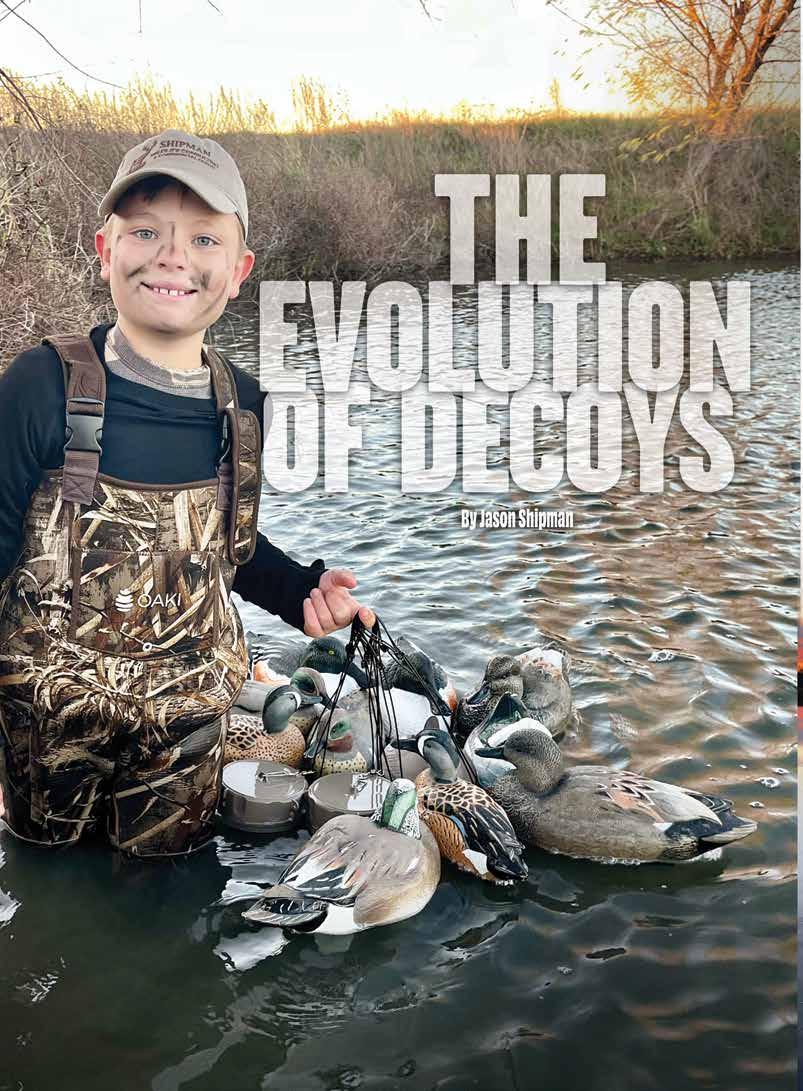
Stop and consider for a second just how far we’ve come in the last 200 years. It wasn’t that long ago when we would have been riding horses instead of driving our pickup trucks. Like everything else, hunting has changed too. Today we are inundated with options on everything from camouflage patterns to gun calibers. There are gadgets for everything, and technological advances have taken things to a whole new level. We call it progress, and considering where we came from, times are indeed good.
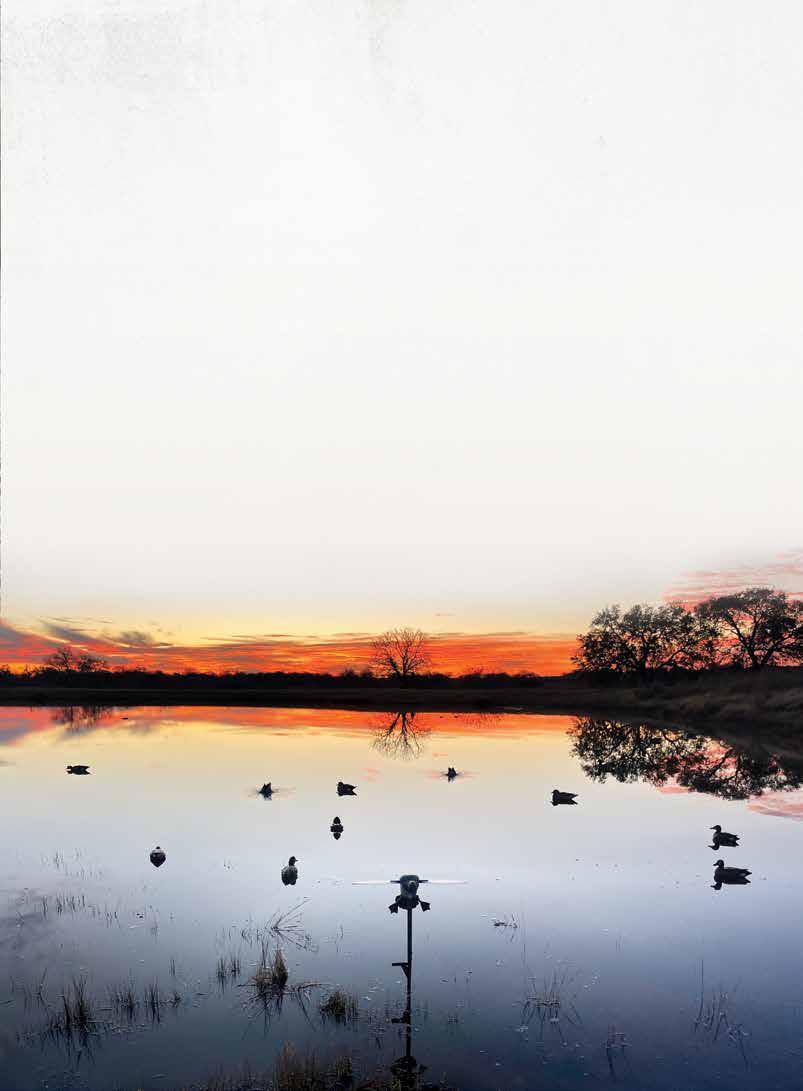
One thing that has changed in the hunting world considerably over the years is decoys. Hunters use decoys in a number of different hunting situations. Decoys are often used in coordination with some sort of calling method to hunt predators, spring turkeys, and of course waterfowl. When utilized correctly, decoys can enhance the hunt and contribute greatly to success in the field.
Despite the various applications for decoys, the one that stands out in most minds is waterfowl hunting, and it’s hard to imagine hunting without them. Picture for a moment trying to hunt geese in a huge field or hunting ducks in the bay without a big spread. Decoys and waterfowl hunting go together like peanut butter and jelly, and it just doesn’t feel right having one without the other.
The history and coinciding evolution of waterfowl hunting decoys is really fascinating. Decoys have been around longer than you might think. Their use has been documented as far back as 2,500 B.C. when clay replicas of birds were used by
the Egyptians for hunting. It’s reported that Native Americans constructed decoys using reeds, sticks, feathers, and other natural materials.
The word “decoy” dates back to the 17th century. It’s derived from the Dutch translation “de kooi,” which means “the cage.” and references early methods of capturing ducks using cages. It wasn’t until the early 1800s that decoys were fashioned from wood carvings. These wooden decoys are traditionally what we consider today the “historic” decoys.
In the beginning they were hand carved, and every carver had their own style or flair, so to speak. Some were rather plain, while others displayed intricate detail and were more like works of art. Today these older wooden decoys are highly sought after as collector’s items or antiques.
Around the early 1900s, the manufacture and mass production of decoys started. In the beginning they were made of various materials including canvas, cork, and papier mâché. After World War II, around 1950, new designs and innovations were made to decoys and manufacturers began to make them out of molded plastic. Since that time, numerous companies now produce decoys of all species of fowl featuring various lifelike poses and elaborate paint schemes. Additional decoy options found today include different sizes ranging from normal to oversized, flocked for increased realism, and foam filled for longevity.
Newer to the decoy world, the advent of motion decoys arrived in the 1990s. These decoys include battery operated
ripplers, spinners, and flickers. Motion decoys basically incorporate two different concepts. Flickers or spinners focus on creating the strobing wing pattern visual of birds in flight. They create the illusion of birds landing or moving in a setup.
Ripplers are used to make movement on the surface of the water and are great for calm days. Ripplers are an adaptation based on the concept of what older waterfowlers used, and were referred to as jerk cords. Jerk cords are nothing more than several decoys in a spread tied together so that the connecting string can be pulled or jerked manually or mechanically to produce both motion and water movement. Motion decoys are still relatively new to the scene but are a real game changer. The concept is simple, and the movement catches the eye of incoming birds and adds realism to spreads.
Based on personal experience, I like to incorporate a variety of decoys in my spreads, and generally include several species along with motion decoys to draw attention on the water. Scouting is important to determine what kind of birds are in the area, as well as what they are doing. The No. 1 goal is to make the spread look as realistic as possible. I like a combination of different species and usually set them out in a “U” or “J” shaped pattern with either a crosswind or the wind at my back. A variety is encouraged because some birds including divers such as buffelheads are decoy specific. I generally try to group up different species in my spread. For ex-
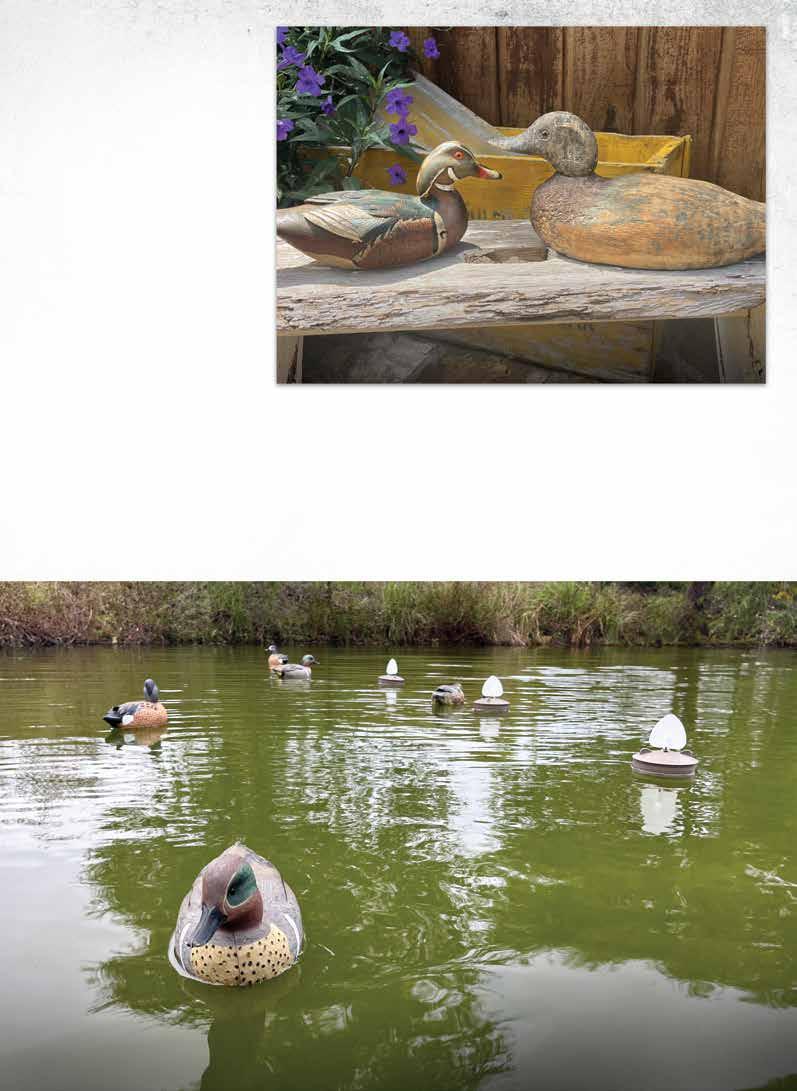
ample, placing teal to one side and pintails to the opposite side. As a rule of thumb, I like foam filled decoys for their durability. On bigger water I prefer larger, magnum sized decoys and generally opt for more decoys in my spread.
What will future hold for the world of decoys and waterfowl hunting? Who knows. Considering the history, it will be interesting to see what lies ahead. The sky is literally the limit, and ingenuity will find a way. One thing is certain: Creative minds will always be at work while waiting for birds in the duck blind.
By John Geiger
Cody Johnson surely seems at home on stage playing his country music hits for tens of thousands of fans.
But the Texas-born-and-raised good ol’ boy seeks out a solitary deer blind when he’s on his own time.
“I can remember hunting with Dad years ago with my .30-30,” Johnson said. “At 14, I had learned hunter safety and proven I could handle my gun. Dad told me to go hunting by myself, and I got a doe that day. I will always enjoy hunting by myself or with family if I can.”
As a hunter, if you’ve ever heard the song “Dirt Cheap,” you’d remember the lines, “All them huntin’ seasons freezin’ in a Jon boat. Me and him, double-barrel and a two-stroke.”
And his latest hit, which got him two awards at the 2024 Country Music Awards, “Till You Can’t,” talks about bass fishing and family.
“Cody’s a humble guy, very down to earth,” said Mark Maunder, a guide who has hunted with Johnson. “He’s a hunter, but he enjoys the outdoors, too, not just the killing part. That’s important for me as a guide. I like being around people like that, and that’s the way Cody is.”
Cody Daniel Johnson was born in 1987 in Sebastopol. Rabbits, squirrel
While Cody may entertain tens of thousands of fans at a time, he still isn’t far from his family’s hunting roots.
and birds often filled the pot of the small family who lived along the Trinity River. His dad caught catfish on trot lines and jugs in the Trinity. Fishing and hunting weren’t about trophies but putting meat on the table.
“It was a small town,” said Johnson, who was taking a break from the concert circuit recently. “When deer season was getting close, you knew it. Everyone would be filling feeders, cutting lanes and getting the wasps out of the stands.”
“There’s a common thread that runs through all of the people who come to my shows,” he said. “They are country music fans, and we all grew up hunting. Our dads, grandpas or uncles took us out to the woods and taught us about the animals and their behavior. The outdoors will always be a special place to us.”
But now, hunting is taking on a more important spotlight in his own life. He realizes the lifestyle is not a given and sees that hunters need to support and defend their rights.
“I never put that side of me — the hunter — out there that much for the fans. But I realize they need to see it,” he said. “We need to be preaching this culture, to evangelize to anyone who will listen. I do not want hunting to go away.”
Cody’s wife and two girls now mean the world to him, and they also love hunting and the outdoors. One of his daughters took an axis deer doe with a .28 Nosler. She wanted the doe mounted. It’s hanging in her bedroom now with a princess tiara on its head, said Johnson with a laugh.
Cody’s wife, Brandi, is also a big hunter and took her first elk last year in New Mexico.
Hunting is important to this fam-

Cody with guide
Mark Maunder and friend and rodeo champ Patrick Smith.
ily and for future generations of Johnsons, he said.
To do what he can for hunting’s future, Johnson has been talking more about his hunting, posting more about it and his adventures on social media, YouTube and other mediums. That means something when someone has more than 2.2 million followers on Instagram. At some point soon, he plans to post the story of his most amazing hunt to date.
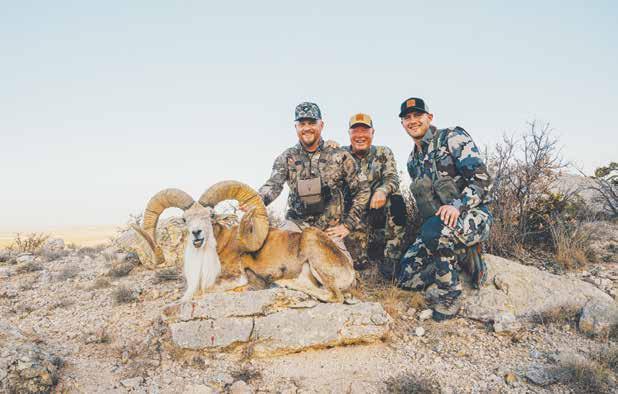
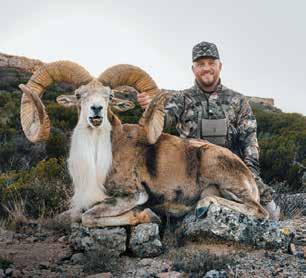
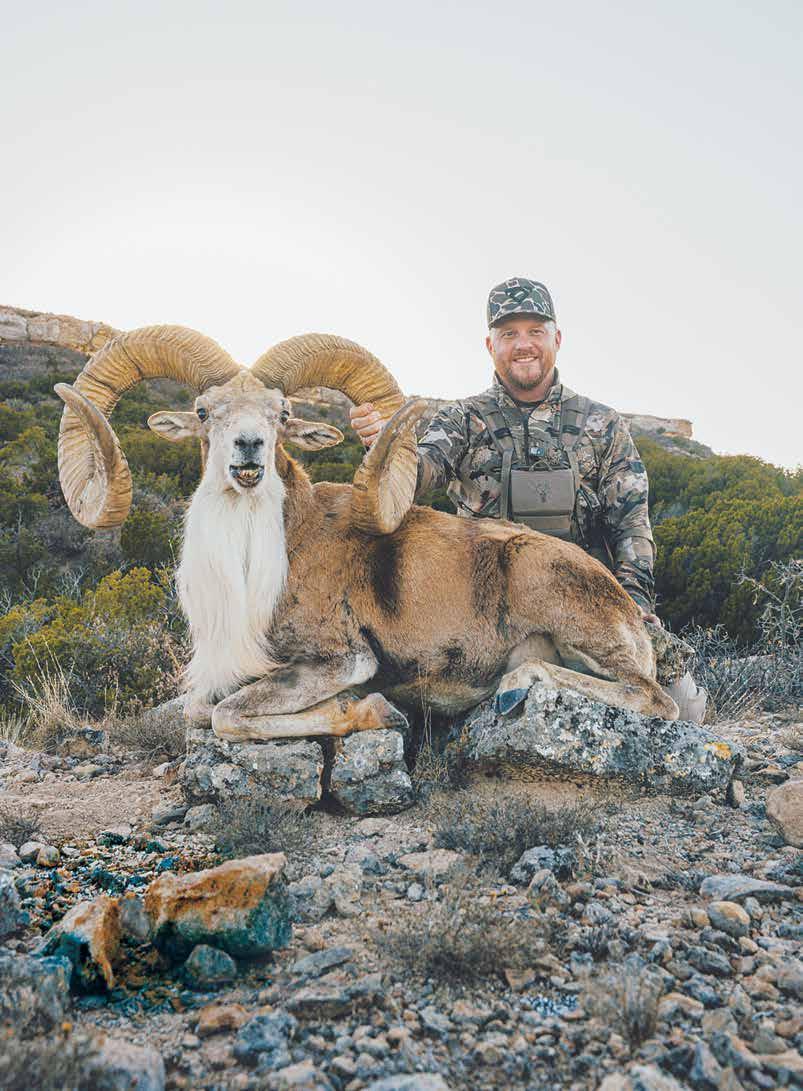
Earlier this year, he took a worldrecord Transcaspian urial in Texas. It’s now firmly in the No. 1 spot in the Safari Club International Record Book.
It all started when Johnson took Brandi on that New Mexico hunt. As he was sitting on a big hill, glassing with the guide and fellow Texan, Chet Pharies, they started talking about other big-game animals. Johnson said how cool it would be to hunt markhor, and Pharies said, “We can do that on my ranch in Texas.”
Brandi got an elk, and Cody got the invite to hunt at Pharies’s Covered S Ranch, southeast of Lubbock. Johnson stayed in touch with Pharies and guide Maunder, and they started sending him trail cam shots of markhor.
Then another animal made an appearance on the cam: a fine stud of a urial.
“Once I saw that ram, I totally pivoted,” said Johnson.
Spoiler alert: Like a lot of things in Johnson’s life, luck was definitely on his side, and it turned out better than anyone could have imagined. That’s just the way it is with Johnson.
The February hunt started regularly enough. They glassed from a high vantage and scanned the rugged canyon country.
Pretty soon, they spotted a urial. But it was about 500 yards away, bedded on
the point of a mesa. If it stood and went left, they’d never find him. It stood and, you guessed it, walked to the right, right at the hunter.
It went over a draw between them, vanished and then showed up again 200 yards away. Johnson put his crosshairs on him, but Maunder said, “It’s not him.” It was a younger ram, not the stud.
Maunder heard some rocks rolling to their left, so they hiked up to the top of a draw, got the wind in their faces and glassed. Within minutes, they heard something coming at them.
It got closer and closer until suddenly, a world-record-class Transcaspian urial was 10 yards from the muzzle of Johnson’s favorite rifle, “Trusty Rusty,” a Browning X-Bolt in .30-06.
“His eyes got huge, and he froze.” Johnson said. “It was the biggest ram I had ever seen in my life. You can’t make this stuff up!”
The ram was majestic in every sense of the word. He had a long, silky blonde bib, from his chin to the ground. The winter coat was full. The horns were astounding, with 11-plus-inch bases and nearly 50 inches of length.
Johnson was stunned, but he had the wherewithal to pull the trigger. With one shot to the chest, the ram tumbled.
“Coming from a kid who shot squirrels and doves to put meat in the freezer, holding a world record in my hands was amazing. Some people hunt their whole
lives and never get to get this feeling. I was so grateful.”
The official score of the urial was 1815⁄8 inches. His age was estimated at 15-16 years. It’s a massive ram by anyone’s standard.
It topped the previous record by more than 6 inches. It’s the No. 1 Transcaspian urial in the Estate Category in the SCI Record Book, according to Duane Aubuchon of the Safari Club International Record Book Department.
And as it would turn out, the next day, Johnson shot a fine markhor on the ranch. Talk about a great start to the 2025 hunting season!
Cody and his band are booked up every weekend through the end of the year. He also has a few hunts in mind in Montana, Wyoming and maybe even Africa.
But what he is really looking forward to is time on his family’s Madisonville ranch.
His daughters love to hunt, and he has a baby boy on the way.
“I’ll be around the ranch a lot with the family. I’ll be on the tractor, too, cutting the milo before dove season, and getting the whitetail food plots in shape,” said Johnson. “And I’ll be getting the wasps out of the blinds.”
John Geiger is managing editor of Safari Magazine.

What does the future of waterfowl hunting in Texas look like? It depends on who you ask.
The good old days certainly are gone. That’s not an indictment on opportunity or the toiling of any singular individual.
Times have simply changed—for a variety of factors. That’s especially true for hot spots such as the High Plains and Rolling Plains, and for sure, the prairies west of Houston where hunters could always count on burning through shells throughout the late fall and early winter with what always seemed to be an excess of waterfowl.
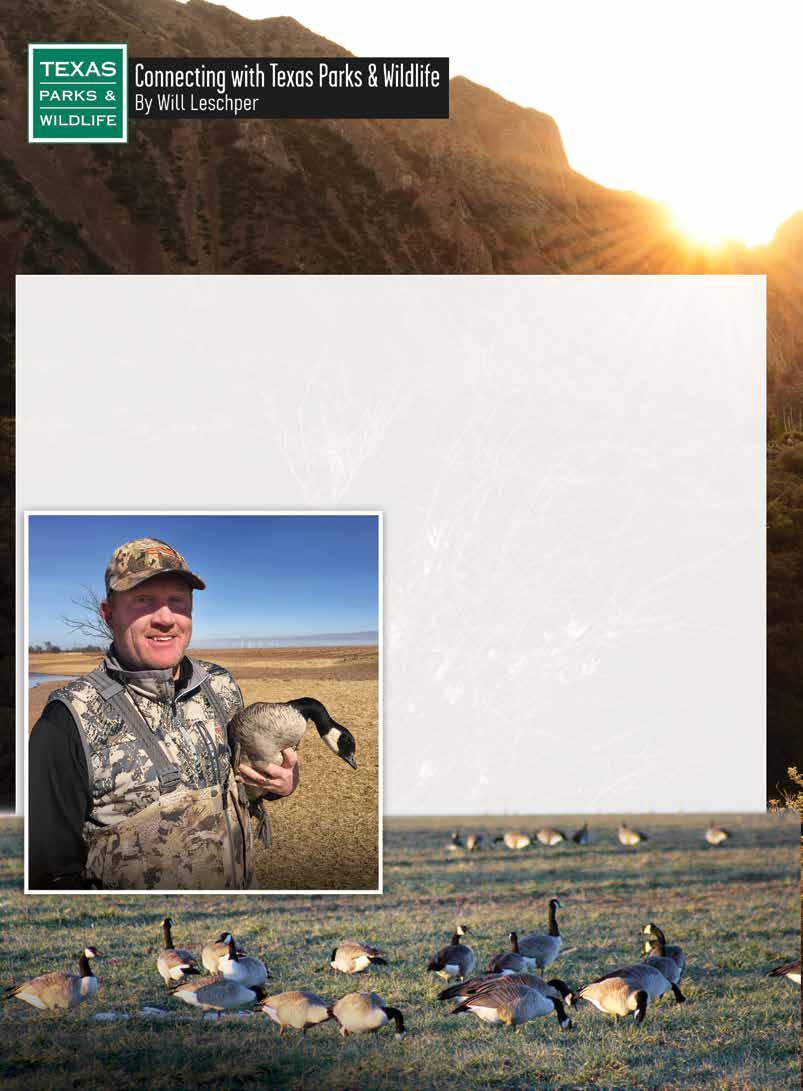
Today, things are simply different. The Texas landscape has changed dramatically, in addition to water and land-use practices that have altered what always have been prime duck and goose habitat.
Make no mistake, Texas will always be prime waterfowl habitat whether it’s the playa lakes of the Panhandle or the sweeping salt flats of the Laguna Madre. Ducks and geese will always fly south for the winter – hopefully en masse – and there will continue to be huntable figures of all species that have made it through another year, according to discerning biologist estimates.
That being said, in looking at this year’s frameworks, we’ll be right on par with previous seasons. That means plenty of huntable birds, but it’s also a far cry from the best days of years past. This year’s federal duck count yielded right at 34 million birds, almost the same figure as 2024. In terms of history, the federal estimate showed a record of almost 49 million just over a decade ago.
Long story short, Mother Nature has made things difficult for waterfowl in terms of breeding opportunities, and it comes back mostly to changing water and habitat.
In looking at the future of duck and goose hunting in Texas, it’s easy to be cynical. Waterfowl hunters also are eternal optimists…and you must be to be a good duck and goose chaser.
Kevin Kraai, Texas Parks and Wildlife Department’s Waterfowl Program Leader, is always among the optimistic crowd. It’s a tall task to try and predict a general outlook based on multiple data points, but as stated before, Texas is prime duck and goose country.
Looking at this season, in particular, there will be an increased opportunity for pintails as what has been a one-bird daily limit is now three, a major change for one species that’s among the most sought. According to state and federal biologists, a recent analysis confirmed pintails are more numerous than the U.S. Fish and Wildlife Service May Waterfowl Breeding Population and Habitat Survey detected. Last year’s count showed 1.975 pintails in the estimate while this year’s figure checked in at 2.239 million.
“Texas hunters can anticipate another strong waterfowl season, though overall success will depend on local water availability and the timing of cold fronts,” Kraai noted. “The new fall flight models also indicate the potential for a greater sustainable harvest compared to previous models.”
Kraai, who has been a Texas waterfowl biologist for more than two decades, has pointed to numerous factors affecting duck and goose hunting, making it a moving target. TPWD became the first state to cut the light goose conservation order in last year’s frameworks, a huge alteration due in large part to changing migration and habitat patterns for what had been a supremely destructive base of snow geese dating back before the 2000s.
Kraai and other researchers provided in-depth commentary over the summer on just how much the light goose situation has changed.
According to their findings:
• Researchers believe there were just over 4 million adult midcontinent light geese during the early 1990s. The population grew exponentially during the 2000s, peaking at around 20 million by 2007. The rate of population growth was so extreme that biologists worried that feeding behaviors of hyperabundant light geese would irreparably damage fragile Arctic and subarctic ecosystems, threatening other populations of wildlife.
• Population modeling, coupled with observations of worsening goose impacts on breeding areas, prompted the U.S. and Canadian governments to pass legislation in 1999 that provided unprecedented opportunities to harvest light geese outside of the normal frameworks of the Migratory Bird Treaty Act. Known as the light goose conservation order, its primary objective was to decrease adult survival rates to reduce and maintain light goose populations at acceptable levels. Federal, state and provincial managers collaborated to develop population and harvest rate thresholds that would be used to monitor whether the conservation order was effective.
• Although harvest rates and total harvest increased immediately following implementation of the order, the levels were insufficient to slow the growth of midcontinent light geese. The population continued to increase over the next decade, but that trajectory changed in the early 2010s, as researchers documented consecutive years of population decline. The decline has continued unabated, with around 6 million adult light geese estimated in the midcontinent population as of 2022. This equates to a 70% decline from its peak, and it represents the steepest decline of any North American waterfowl population in recent history.
the actual time hunters spend in the field.

When discussing this year’s outlook – and those of any succeeding year – there are certain things that can make or break
“When we have really dry years, we actually record better waterfowl harvests and higher success rates because with less water on the landscape the birds don’t have as many places to go. Looking back at years with better moisture, we had lower success rates and birds just had more locations to go where they could avoid hunters,” Kraai notes. “Additionally, in drier years, bay hunters on the coast tend to have a better season.”
In looking at the other issue that has determined “hunter success” in recent years, Kraai noted that ducks and geese simply wise up as the season progresses. Juvenile birds typically are the first ones to be taken while the older ones quickly learn the game.
“We have strong evidence from a bunch of different data streams pointing toward distribution of waterfowl being highly correlated to the amount of hunting pressure they’re receiving,” Kraai said. “We’re also seeing large duck numbers in places where they were absent. Waterfowl also are utilizing nontraditional habitat including locations like stock ponds in Central Texas and up into the Rolling Plains with effluent water. They were built for other reasons and now ducks are taking advantage of them. That means those waterfowl can get out there and not be harassed very much at all.”
Long story short—there will be plenty of waterfowl this year and every other year in Texas. Mother Nature has simply made them harder to lock down. At the end of the day, that’s why it’s called hunting!
Kevin received a B.S. in Range and Wildlife Management from Texas Tech University and a M.S. from Texas A&M University-Commerce in Wildlife Biology. Kevin started working for TPWD at Cooper WMA in 1998, moved on to Assistant Regional Waterfowl Biologist in 2001, Statewide Assistant Waterfowl Program Leader in 2003, and has been the Statewide Waterfowl Program Leader since 2010.
Among his duties, Kevin:
• Oversees setting of annual waterfowl hunting regulations in the state of Texas
• Co-chairs Texas Parks and Wildlife Department’s Migratory Gamebird Technical Committee
• Represents the State of Texas on the Central Flyway Waterfowl Technical Committee
• Coordinates the federally required Harvest Information Program (HIP) for the state of Texas
• Provides coordination and leadership in planning, implementation and modification to the HIP with the Department License Section and Point-of-Sale contractors
Kevin’s research projects have included:
• Northern pintail body condition on the Texas coast and northern pintail movements study using GPS telemetry
• Mid-continent greater white-fronted goose movements study using GPS telemetry
• Mottled duck movements study using GPS telemetry in the South Texas Brush County
• Cackling goose movements study using GPS telemetry in the Southern High Plains


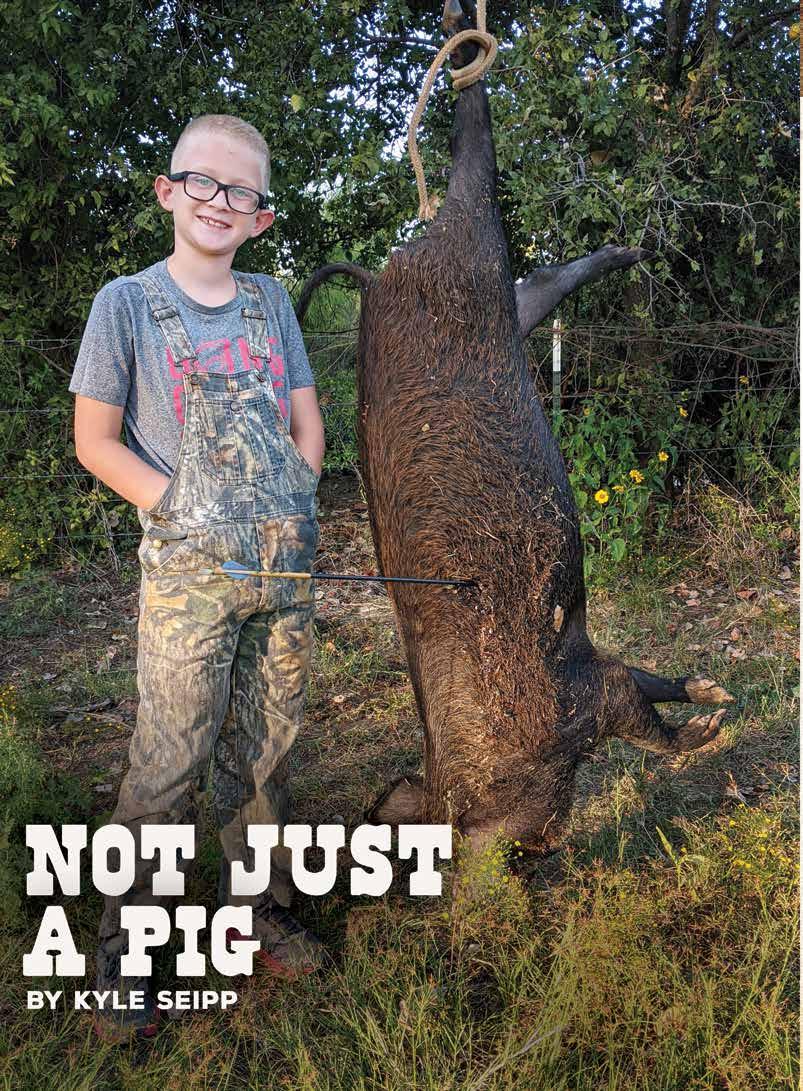
Benjamin practiced as much as he could so he could have a successful hog hunt.
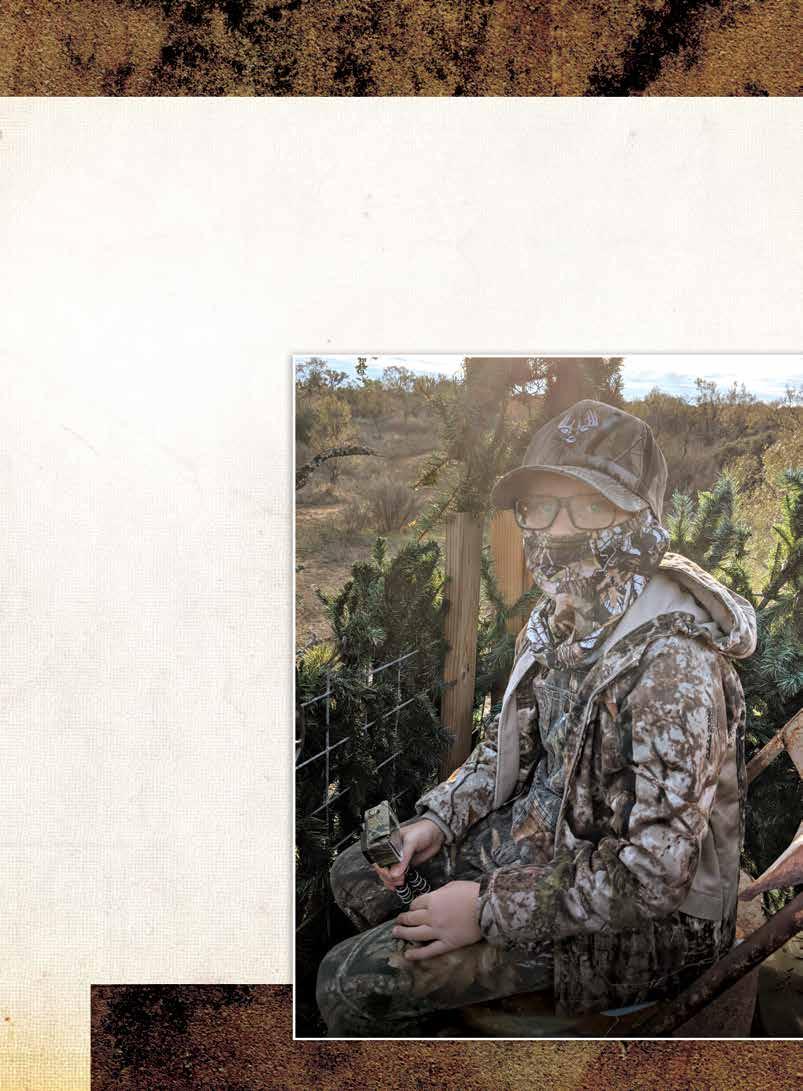
Many years ago, after I dove headfirst into archery, I read an article by the late Dwight Schuh that really resonated with me. It would be many years before it truly became internalized to me. To my dismay, the paper copy of the article itself, “Just a Doe,” did not successfully survive through three moves, two new shops, and my incredibly poor cataloging. However, the sentiment cycles through my mind almost anytime I think of hunting.
When I say I dove headlong into archery, what I really mean is from the first arrow I set loose at a pig in Mason County in 2001, I knew I’d never have the money to get into any trouble, nor the time, because every waking moment and nickel would be invested in this sport. I’ve gone through three bow presses, tens of thousands of arrows, superglues, and too many bows to count. My two sons had no clue what they were born into, just an inkling that dad really likes archery.
Naturally I wanted to take them both immediately to the deep end with me, but in the grand scheme of learning the sport, it takes small steps, good form, and frankly, confidence in a moment to have your wits intact for 4 to 7 seconds of precision. To that end, they’re both on the front end of their tens of thousands of arrows, and now as they’re getting much older and larger, my feed bill has increased dramatically. But so has their appetite to try bowhunting.
In our house, archery is not just in October in Texas, it’s year-round. We’re fortunate in our current home location because we’re near some fantastic 3-D archery courses and clubs where we can map out a full 12 months of club shoots, ASA tournaments, and practices to keep our practice regimen high. Between these clubs and our own backyard work, we spend a lot of time flinging and chasing arrows and every moment seems to be getting purer and purer.
If you’re considering archery, check out your local shop and get some recommendations for a setup, and even one of the aforementioned clubs around the state. I believe it takes a village to help, and these clubs provide a great opportunity to connect with someone in the sport and learn through association while strengthening your form and confidence. When
we talk about practice, it’s about executing the first shot. Yes, the shot is important, but so is the draw and the sit.
When my oldest son, Benjamin, really leaned in, his goal was to get his first animals with a bow. So, we sat. And sat. And sat some more.
Benjamin was already accustomed to being in the tree, seeing the animals up close, and managing his noise and movement. However, with the bow in his hand, it was absolutely amazing to witness him truly “seeing” the animals up close again for the first time and almost breathlessly trying to position himself purposefully for the shot. By choice and by volume, I elected for him to shoot a pig with his bow first, and in our area of Texas, the shot opportunity is high.
Although we did have three successful spot-and-stalks that ended in dusty arrows rather than bloody arrows, for this particular hunt, we opted for a pecan tree near our creek that has two ladder stands, set at three o’clock and four o’clock in the tree, giving us the perfect chance to be 16 feet high, but on the same level. This particular setup is actually on the road itself, but the road is cut through some extremely thick white
brush, cactus, persimmon, and mesquite, making it the main thoroughfare for everything.
As fate would have it, the pigs did show up, just from a different direction than we had planned and set up for. This meant Benjamin had to stand and turn 170 degrees opposite from where he was facing. In the setup for the moment, he held it together fantastically.
In my haste to pack for this particular hunt, I was more worried about Thermacells than camera blocks, batteries and cleats. My attempt to capture YouTube quality video was thwarted momentarily until I could rig the action cam in a reverse-view mode, and take the shot picture with my smartphone. Blurry pictures aside, from the reverse-view camera, you can clearly see his focus in the moment for him as he settled his nerves down with his pre-shot sequence.
Although the hunt story truly is not mine to tell, a father’s prerogative allows me to tell just this part. He knew when the arrow made contact, with the solid hit and the spill of a small amount of blood, that it had happened. His practice time when the weather was hot and when it was cold, the time he spent listening and tuning small portions of form, and the endurance required of him to sit time and again, and bounce up after a miss, had paid off. It was a pig hunt he hoped for, and it had come down to four successful seconds of precision.
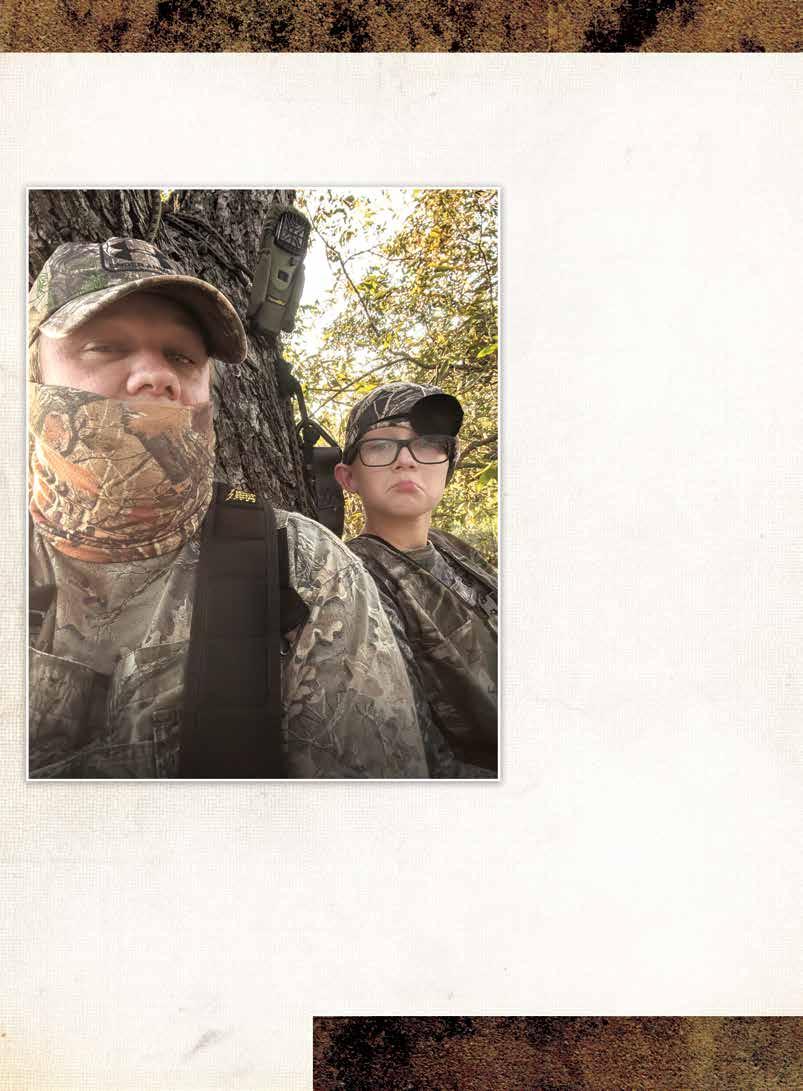

After some time, we followed the blood trail through some of the thickest brush on our property. And much like the hunt, he was still in the moment of seeing the blood trail as though it was the first time, not even the slightest bit deterred by the brush and cactus I silently cursed. While I lamented the need for additional time in the skid loader for brush control, my father, his Opa, texted us to ask if we shot a big pig. While we were on the front end of the blood trail, Opa had managed to be on the correct end of the blood trail, the back end.
In this moment, I could not help myself but smile again at the realization of Dwight’s words many years ago. The hunt was certainly never about me, and truth be told, I rather prefer this role of cameraman, when I remember to bring all the right tools. As we caught up to this particular animal, the arrow still intact, that whimsical thought hit me plainly. This is not just a pig.


“R”
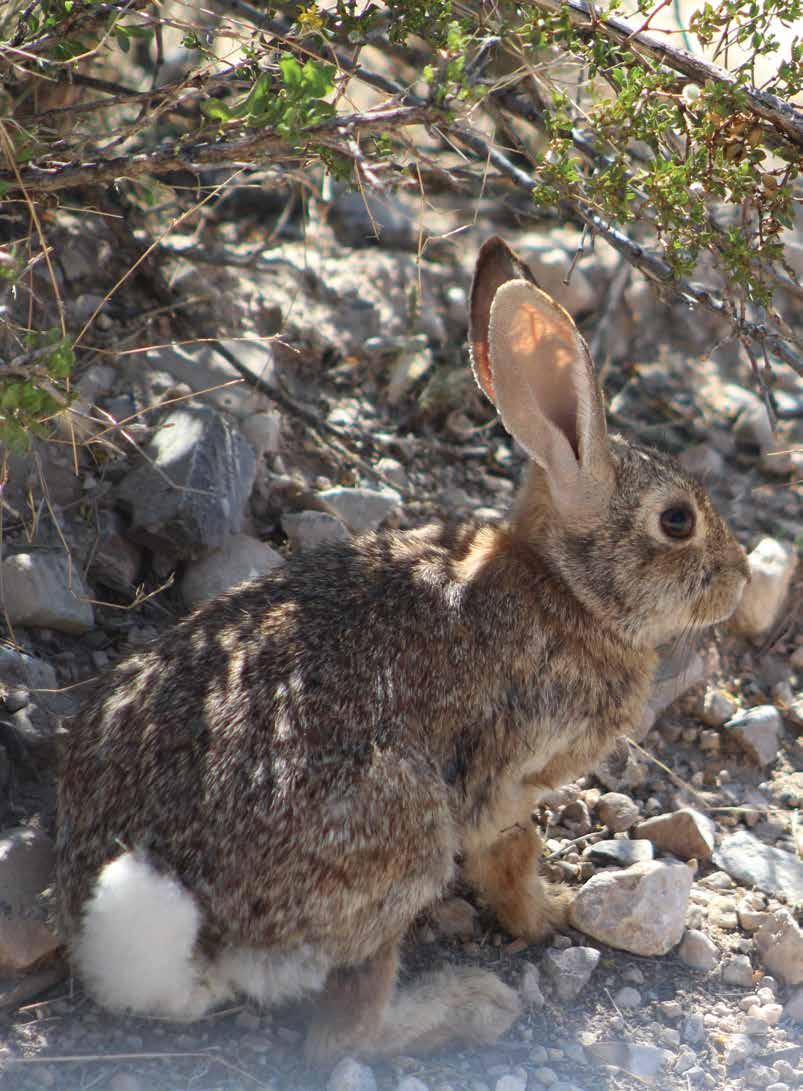
No wonder this soft haired rabbit is called a cottontail. Looks just like a cotton ball stuck on its rear.
By Judy Jurek
Rabbit. Bunny. Cottontail. Cute little furry critter that hops but can run fast. Whatever you desire calling it, the letter ‘R’ stands out for rabbit in the wildlife animal kingdom. The desert cottontail is one of the most common rabbits across the central United States down into deep Mexico. It’s what we have here in Texas.
There are various types of cottontails including mountain (Northwest US), Eastern (central and eastern US into Canada), and Appalachians found throughout states hosting that mountain range.
Swamp and marsh rabbits live from Texas along the Gulf Coast and inland somewhat all the way up the East Coast to Virginia. Brush rabbits are found on the West Coast in northern California.
Jackrabbits aren’t rabbits but hares, much larger and different, but for the sake of this article I’m including them as rabbits because we’ve got ’em here in Texas. Some jackrabbits can weigh up to 10 pounds, stretching out 2 feet or more in length. And they’re good to eat, too, but more on that later.
A jackrabbit’s long ears are what usually catch attention. They have the ability to flatten those ears and crouch low to the ground trying to blend into surroundings. When disturbed, their quick speed, like cottontails, enables them in escaping danger. Their ears thermoregulate, thus making them adaptable for hot climates.
There are a few differences between jackrabbits and cottontails. Size is one factor. Jacks prefer open areas with sparse growth, while cottontails desire more cover. Jackrabbits are somewhat solitary, less social than cottontails who may burrow together. Leverets are baby jackrabbits, born with their eyes open, capable of running quickly after birth.
Cottontails are born bald with closed eyes, usually four or five birthed together, possibly as many as eight. It’s believed less than 50% of cottontail young make it out of the nest. Nest robbers include skunks, raccoons, and snakes while predators such as coyotes, hawks, and owls catch rabbits outside a burrow. Whether feral or domestic, cats and dogs go after rabbits, too.
The 2025 spring and summer rains across central Texas brought a population surge of both cottontails and jackrabbits to many areas. Improved food sources, water, and cover from places having experienced drought conditions most certainly helped, thus enabling fun rabbit hunts for interested parties.
Rabbit hunting was once a rite of passage for many kids growing up. Years ago, gun safety was taught at home, along with sharpening shooting skills to put food on the table and protect the homeplace from varmints. Sadly, not so much these days.
Not only does rabbit hunting improve shooting ability, it enhances eye coordination in picking out a camouflaged cottontail or jackrabbit against brush or whatever cover is being hunted. It teaches stealth movement and patience. Not paying attention, being too noisy or too quick to move often results in a rabbit hightailing it to safety.
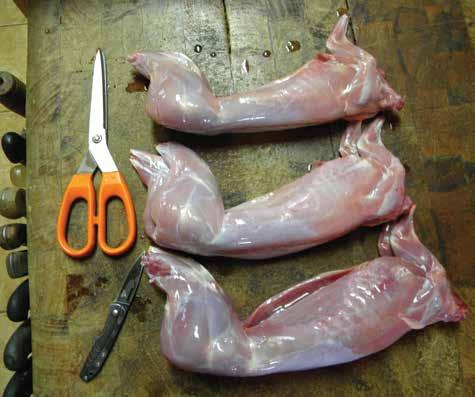
Three cottontails cleaned with a pocketknife and shears are ready for cooking. Fried rabbit is hard to beat.
Growing up in the country, rabbit hunting helped hone my young shooting skills. A one lane dirt road nearby was slightly overgrown, except where vehicles traveled. A railroad track ran alongside it, supplying thick cover while pastures opposite the tracks provided good rabbit habitat as well. Late evenings, cottontails would sit in the tire lanes. After learning to shoot rabbits with a shotgun, I graduated to a .22 open-sight rifle. My dad taught me to try head shots so no meat would get damaged and made cleaning less messy. If I had poor aim, my shot was a clean miss. Of course, it was then and still is illegal to hunt from a roadway, but in the 1960s, no one lived anywhere around, so it was where and how we hunted rabbits.
After marrying John, we lived in a place surrounded by vast farmland. We’d drive crop turn rows or dirt farm paths with permission to hunt cottontails. Being young and poor, we ate lots of rabbits, and still enjoy them today. An occasional swamp rabbit was a bonus because they’re larger than a cottontail. Once common around Matagorda County before flooding became widespread, it’s been years since I’ve seen a swamp rabbit. Many people hunt rabbits with shotguns and that’s fine. I don’t like BBs in my meat, although birds are the exception. I’m all about not damaging meat in whatever species I hunt, large or small. Head shots aren’t pretty, but dropping animals in their tracks and having no blood trail search improves hunting success.
large parasite under the skin. If not checked immediately, the worm exits the dead rabbit. If you have more than one, you don’t know which one had it. This usually happens during warm summer months, which is why many hunters only chase rabbits in fall and winter.
Proper care after a kill is important, but small game like rabbits, squirrels, and birds need prompt attention for good taste. Many people believe there are only certain times of the year to hunt, kill, and eat rabbits.
Not me!
After the kill, I immediately run my hands down the rabbit’s belly and back. If I feel a big lump, it’s possibly a wolf worm, a
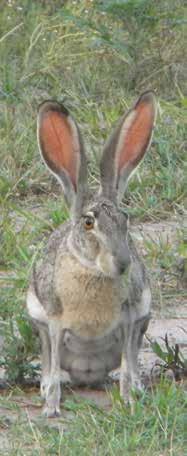
Jackrabbits are not very attractive creatures when studied in detail, but they provide ample and good eating when properly prepared.
Rabbits are easy to clean, only requiring a sharp pocketknife. I also use game shears to easily cut off legs and heads. Skinning jackrabbits is a bit tougher due to their size and the hide being thicker. Take your time and try to keep fur off the skinned meat. Rinse well.
The heart, liver, and kidneys are good, too, or cut them up, adding trachea and lungs for your canine or feline. Raw or cooked, use them—your pets will love you more.
Cut-up cottontail, rolled in seasoned flour and deep fried, is hard to beat. Fried lightly for a crust, and put in a Dutch oven filled with gravy a few hours in the oven will have you licking your fingers as the meat falls off the bones. Slowly pit-barbequing a whole rabbit is mighty tasty, too, just keep it moist with basting. Butter is good. Let your imagination guide you.
Jackrabbit is usually a tougher meat than cottontail. To this wild game cook, jacks are much sweeter than cottontail or penraised rabbit. Roasting helps make it more tender, but I prefer grinding jackrabbit into chili meat. Fixed alone or combined with an equal amount of ground venison or beef, it makes for outstanding chili.
To hunt rabbits, all you need is a hunting license, choice of weapon with ammunition, permission to hunt property, and a good pocketknife. Dress comfortably, bring a few baggies and a cooler to put your rabbits in when cleaned. It doesn’t hurt to pack a water container to wash your hands when cleaning in the field.
If you ever experienced rabbit hunting as a youth or young adult, recall the memories you made. Think about our future hunters regardless of age. Become a mentor, teaching the art and skill of chasing furry critters hopping and running. Go get you some!

By Horace Gore
Fair Chase is a description of hunting defined by the Boone and Crockett Club as giving a game animal “a fair chance to elude the hunter.” They define the variables of fair chase, but the bottom line is “give the bird or animal a chance to escape the advantages of the hunter.” Texans seldom discuss “fair chase,” because fair hunting in Texas is common to a variety of game. I’ve heard hunters say, “Everything I hunt has more than a fair chance.”
Most states have descriptions of fair chase in their hunting rules and regulations. States with public lands usually have more regulations defining fair chase and safety. Texas is a unique state with 99% private property, where someone owns the land you’re hunting on, and you need permission to hunt. This makes hunting in Texas different, and safer, from any other state in the union.
Private property rights have a wide variety of advantages to Texas hunters. They can lease hunting land; they know who is hunting private land and where; they can set their rules for hunting; and with MLD permits, they can set their own bag limits for deer, and they can set their own rules for fair chase.
Most Texas hunters I’ve hunted with have no reason to violate Texas rules of fair chase. The only question comes from high fences, and I have never been able to tell any difference in hunting behind a high fence and hunting open range. The use of feeders, trail cameras, high blinds and bait makes fences a moot question.
I’ve hunted all over Texas and other states, and I find it
unusual to get into a situation that violates fair chase. How can hunting pronghorns in the Panhandle or West Texas violate fair chase? The same is true with mule deer in Wyoming or Utah. It’s difficult to violate fair chase when hunting whitetails in Texas. The use of baiting, trail cameras, high-drive blinds and shooting out the pickup window are legal and common.
We can sprinkle milo on ranch roads and go back to cash in on a good quail supper. We can put corn in wire cages on the creek, and go back for a good squirrel stew or fried squirrel and gravy. We bait deer and turkey, and we shoot thousands of doves coming to water holes, or to water that we have created by letting the water trough run over. We even legally shoot hogs at night.
When you’re sitting in a blind, near a feeder and a trail camera that has shown a good buck coming to the feeder, is this violating fair chase? If so, thousands of Texans violate fair chase every year. Is checking several trail cameras to find where the big buck is spending his time a violation of fair chase? If so, thousands of Texas hunters violate fair chase every year. If you kill a good buck from a high-drive on the ranch road, have you violated fair chase? If so, hundreds of hunters in South Texas violate fair chase every season.
Hunters like to hunt where every hunting situation is “fair chase” based on state rules and regulations. That’s why thousands of out-of-state hunters come to Texas every year, and Texas is known far and wide as a hunting state where everything is fair chase except on Saturday night.

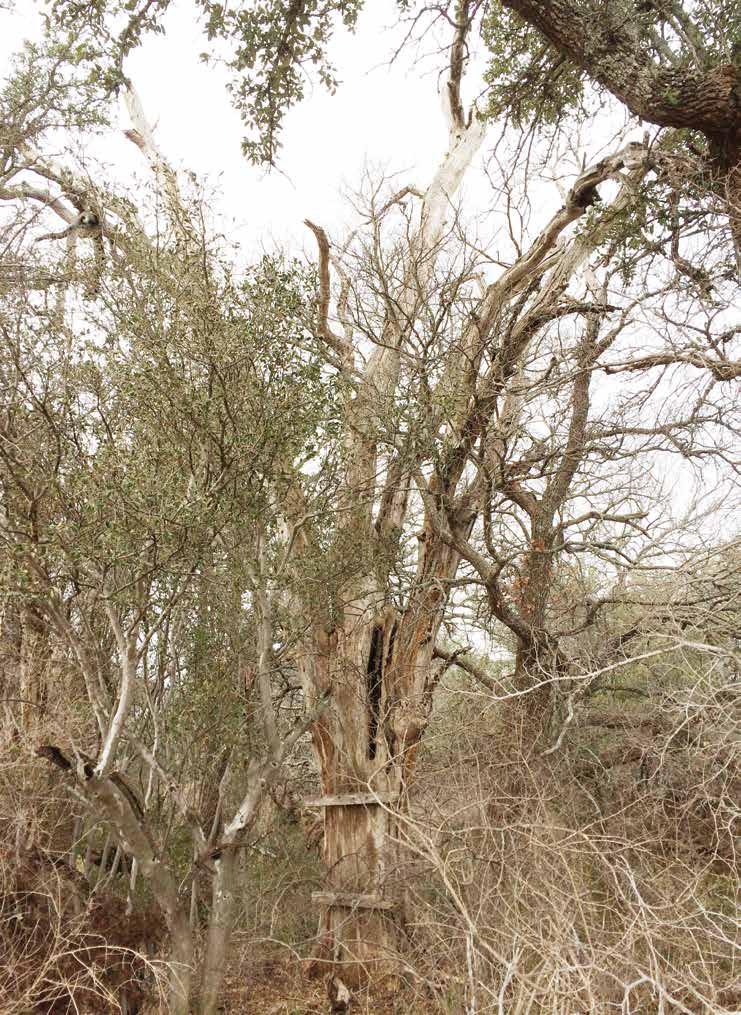
Back in the 1960s, deer blinds usually consisted of 2x4s attached to tree limbs. At one point, this tree was a makeshift blind.
By Gary Roberson
Ibegan hunting whitetails on the family ranch in southern Medina County in 1960 when there were very few deer due to screwworms. Because of the shortage of deer, there weren’t many hunters around Black Creek other than Popeye and Red Haas, cousins, Ron and Jon Outlaw and about a half dozen lease hunters from San Antonio that hunted on our ranch.
Hunting blinds and feeders were almost nonexistent. If there was a blind, it was usually a few 2x4 boards nailed up in the “fork” of a tree, overlooking a trail or water source. The first deer feeder I remember belonged to Popeye Haas. It was a wooden yellow and red Coke crate that Popeye would sprinkle corn into. He said the deer could get their muzzles into the squares to eat the corn, but it was too small for cattle. I’m betting that the ’coons loved this feeding system. A short time later, Red showed me a five-gallon metal bucket he had drilled with about a 1-inch hole in the bottom where he suspended a mesquite switch about a foot and a half long. By running the larger end of the switch through the hole for a couple of inches and then suspending it, a breeze moving the switch would allow kernels of corn to drip onto the ground. It was not until the late 1960s when I saw a battery-operated deer feeder.
The first “box” blind I ever saw with sides and a roof was an old phone booth the Haas boys wired to a big live oak tree. While the phone booth offered a little protection from the weather, it offered little else. This is where they had the Coke crate.
Most everyone shot a Winchester 94 with iron sights. Telescopic sights were extremely rare but could be found in a hunting camp with hunters from the city that had more disposable income than we did. No one wore camouflaged clothing. Hunters who returned from the war had the best hunting apparel. Their government issued green wool jackets, shirts and pants were not only warm, but the earth tone colors blended in with most habitats.
I don’t mean to offend anyone, but
I believe the hunters in the time of my youth had better woodsman skills than today’s hunters. Not only were they born and raised in a rural environment, they also had to get close to game because of the inferior hunting equipment.
When I attend the Hunters Extravaganzas, I’m amazed with the number and quality of hunting blinds. Not only will they keep you and your companions warm and dry, but they also offer extremely stable platforms from which to shoot.
Deer feeders come in all shapes and sizes and can be programmed to feed as much as you want whenever you want. This is a good thing because those old wooden Coke cases have become popular with antique collectors.
While camouflage is not needed when hunting from one of these blinds, multiple camo patterns are available to match about any habitat. This is especially important when calling turkeys and predators.
Hunting optics continue to improve, not only binoculars and riflescopes, but night vision. While hunting game animals is illegal after dark, the popularity of predator and hog hunting has exploded partially because of this technology.
Who needs to spend time in the woods scouting anymore? Game cameras can do this 24 hours a day, document what they see with a photo or video, and some models can send live shots if you want to see live action. Today, much more practical and comfortable hunting blinds are found all across the state.
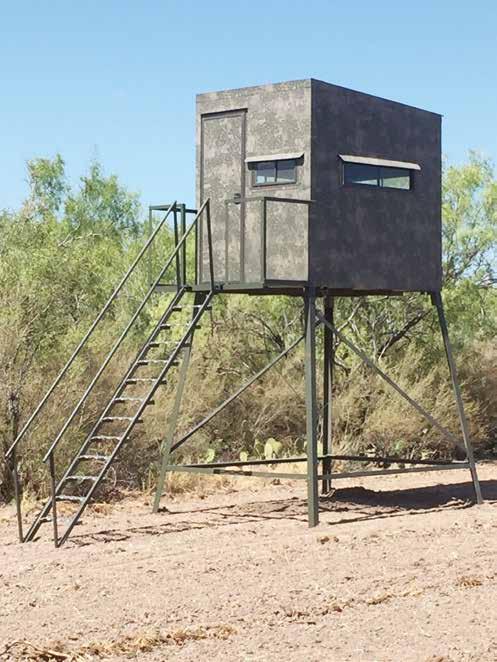
With all the advancements in hunting, I asked myself, where do we go to genuinely improve our chances of success? I think the answer is simple: scent elimination.
Today, there are a variety of scent elimination products on the market. Most are laundry detergents or liquid that can be sprayed on your clothing, boots, hands, and headgear. I have tried many of these products and while I believe they help reduce my body odor, none of them are completely effective.
Modern riflescopes have made iron sights obsolete. The only thing left for hunters to improve—according to the author—is scent elimination.
While I have never used one of the Ozonics scent eliminating generators, all reports have me convinced they may be the most effective product on the market at this time. The device produces ozone, which attaches to bacteria (scent molecules) and oxidizes or neutralizes them, preventing deer or other critters from smelling the hunter.
When hunting, I prefer to spot-andstalk or call. If I’m deer hunting, my favorite method is rattling antlers, but if I’m hunting predators or turkeys, I’m going to be calling. Unfortunately, packing around an ozone generator does not fit my chosen hunting methods.
If I did not have to be concerned with wind direction when rattling whitetails
or calling coyotes, stand selection would become much simpler. I keep the sun over my shoulder, stay in the shadows, and use the terrain to my advantage. When calling coyotes, I find myself passing up stands where everything was perfect except for the wind.
In this day when we have so many great innovations and improvements to make us better hunters, one would think scent elimination would be an easy fix. Critters have three basic senses that they depend on for survival: vision, hearing, and most important, olfactory. It seems we have found ways to overcome two of these senses, but if someone can find a way to mask all human odor, we will be almost unstoppable.
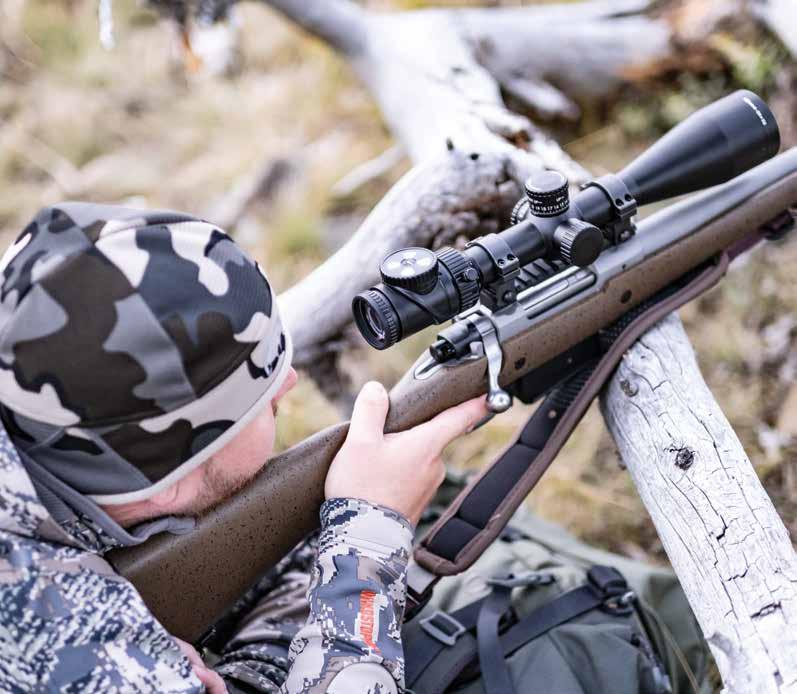

Since I was I boy, I have dreamed about hunting in Africa. As I became a young man, I read books written by President Theodore Roosevelt, Ernest Hemingway, Robert Ruark, John Taylor, and Craig Boddington. I longed to go to Africa, to see what that frontier looked like, and have my own safari adventure. Little did I know I would eventually get my chance.
My son Marshall would accompany me, as well as a good friend and mentor, Wayne Morgan. Wayne is a U.S. Marine Corps veteran, and I’m an Army veteran. We returned to our roots, with preparation to include hiking in boots, and marksmanship training, shooting our rifles off tripod sticks from the standing position, which is the norm in the African bush. We booked our hunt with Big Game Hunting Adventures. June came and we arrived in Johannesburg, South Africa, where Johan, our PH, met us at the airport. He’s a mountain of a man, 6 feet 6 inches, and solid. Johan is also a military veteran, and it felt like we had our own personal security having
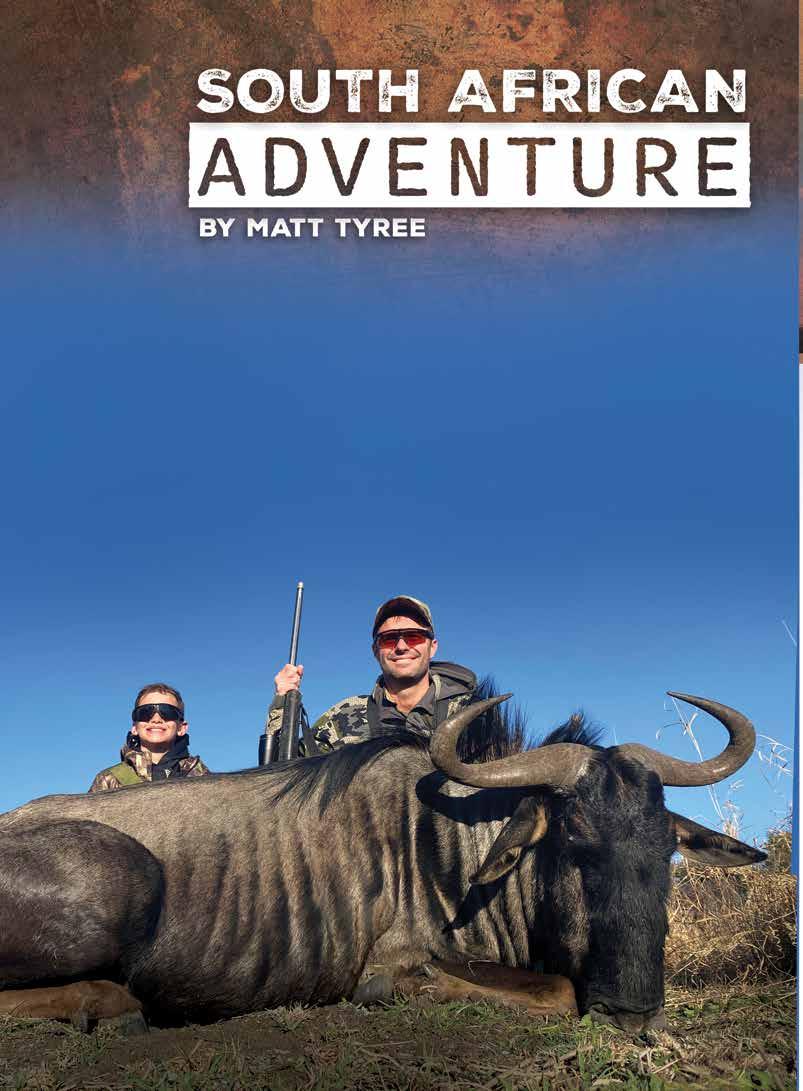
him with us. We retrieved our rifles and hit the road, and a few hours later, we arrived at camp right at lunchtime.
The main lodge was huge, and the cottages for guests were good sized as well. All the buildings have a traditional thatched roof. It felt so authentic. All the camp staff greeted us at the truck and carried our bags and pelican cases for us.
We ate bacon-burgers and fries for lunch, and then headed to the rifle range to see if the TSA had abused our rifles and optics. Wayne and I both confirmed zero without difficulty. We were both shooting America’s favorite big game cartridge, the .300 Win. Mag. We had heard stories for years about how tough the game in Africa is, so we intended to find out.
Riding in the back of their Toyota Landcruiser was great. It has seats, gun racks, tools, everything you need while out hunting. Also, sitting in an elevated position looking over the cab gives you an excellent point-of-view for spotting game. Riding the dirt trails slowly, the turbodiesel powered vehicle was very quiet, twisting and turning across the savanna.
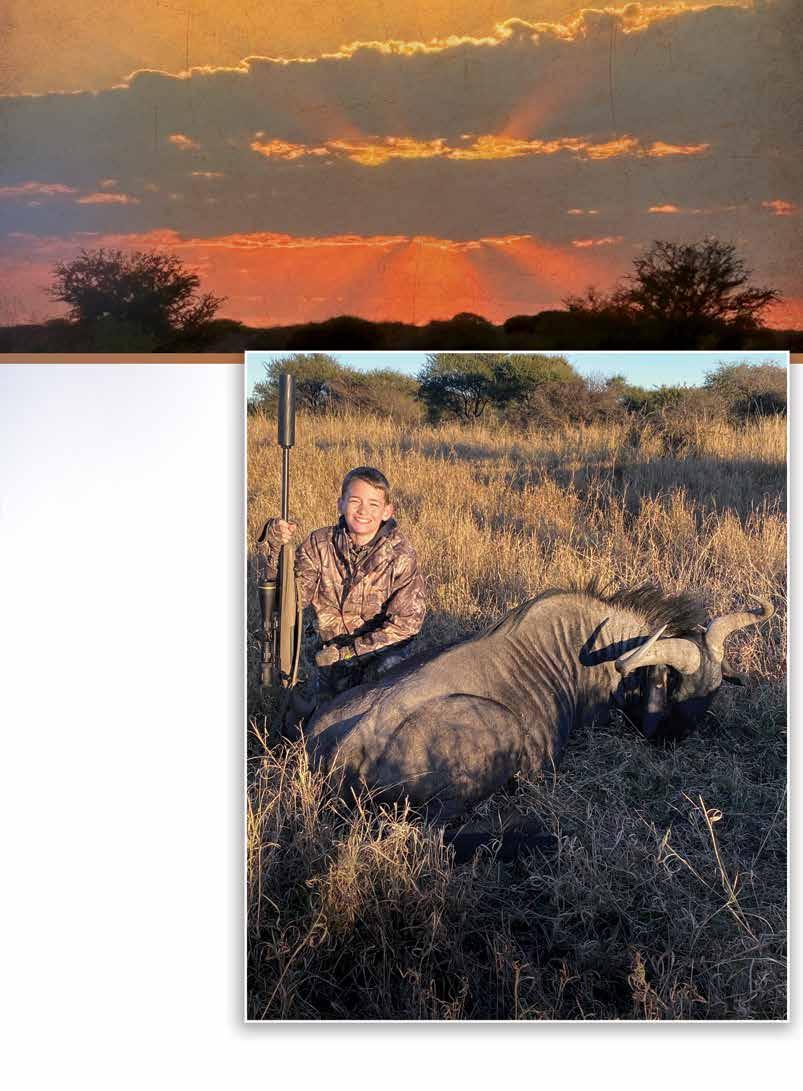
The Limpopo province is beautiful and full of big game. Impala bounded through the bush constantly. They were fast and did not stop to give us a chance for a shot. They remind me of the abundant and fast pronghorn antelope I hunted in Wyoming.
Philemon, our tracker, has 33 years of tracking experience. He spotted some blue wildebeest up ahead on the right almost 500 yards away. While I tried to pinpoint their location, he told Johan, “There’s a good bull in the herd of 15 that we need to stalk.” Johan turned off the ignition and the vehicle glided silently to a stop.
Philemon exited the vehicle, retrieved the shooting sticks, and checked the wind. Johan gave me a nod, and I climbed down with my rifle in hand. “Come on, there’s a bull wildebeest in there with your name on it,” he said. “Let’s go see if we can sort him out.” I smiled and nodded.
Philemon and Johan said a few words and looked at the ground as they watched which way the dust blew. We headed out single file, with Philemon in the lead carrying the shooting sticks, Johan carrying his .416 Rigby in his right hand in case of trouble, and then myself. We were walking as silently as possible, moving from bush to tree, keeping concealment
between our hunting party and the herd of wildebeest. I suddenly noticed Philemon and Johan both stood still.
Johan’s left hand was behind him at the small of his back, giving me the infantry hand signal for freeze. I did as commanded. The wind had shifted, and we changed our course slightly but continued the pursuit. This reminded me of the foot patrols I did in Afghanistan years ago, being as silent as possible with rifles in hand, and no speaking whatsoever.
We made it to a large bush 100 yards away from the herd. We also saw impala and blesbok on the savanna. I hoped all those extra eyes and noses would not detect us. Philemon set up the shooting sticks and took a step to the left.
Johan’s left hand beckoned me forward. I stepped up and silently laid the Remington across the sticks. The herd bull was big and obvious. I focused on the point of the bull’s shoulder as he stood broadside, looking absolutely massive.
Time slowed down. I thought to myself, “Have I done enough preparation? Did I study anatomy and shot placement enough? Did I practice on shooting sticks enough? Did I hike enough miles so that I am not out of breath at this very moment?”
The rifle was steady, the Vortex scope was clear, and I was ready to see who was tougher, the wildebeest or the Swift Scirocco bullet running over 3,000 fps. I released my breath slowly and pressed the trigger. During recoil I cycled the bolt as I had practiced over the last several months, should a rapid follow-up shot be necessary. I could not see the bull in the scope.
I wondered if I missed and he ran off. Johan slapped me on the back and said,
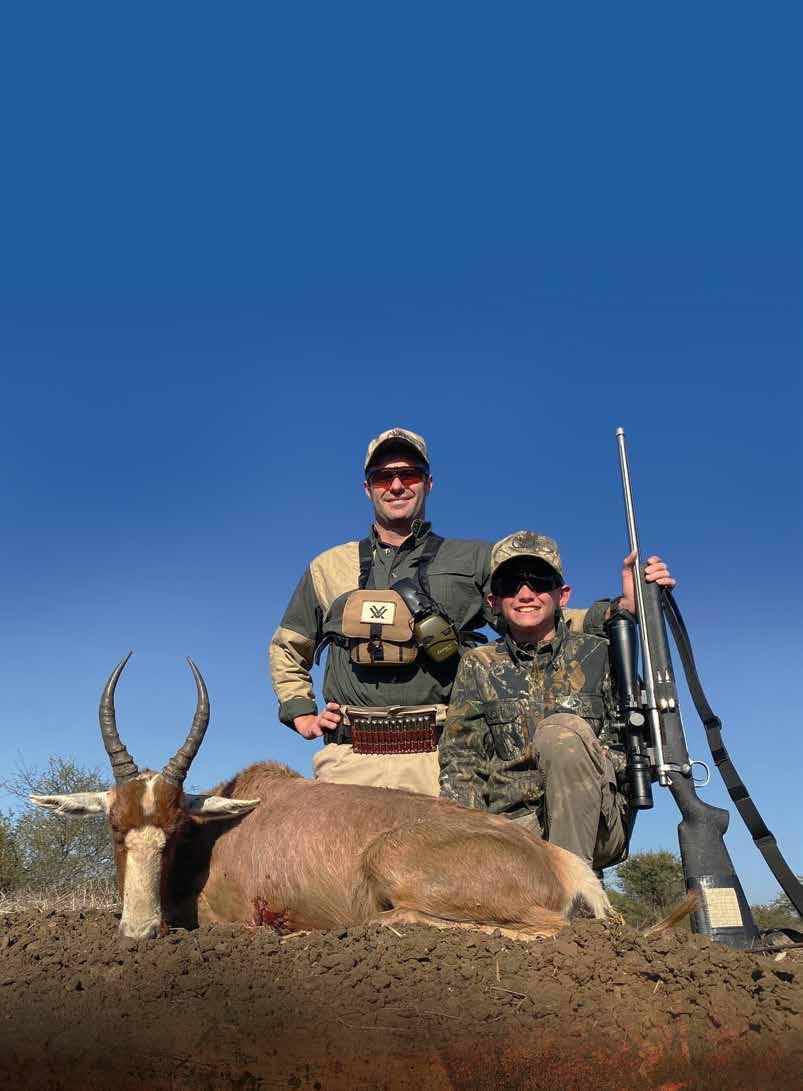
“Great job! You really walloped him!” The bull was already down, which was why I couldn’t see him. He had gone 2-3 yards, and then he toppled over.
We began to approach my trophy. The other wildebeest had already begun to run off following the sound of the rifle. It was pleasant to watch them amble off in their own unique way. Johan and Philemon let me walk first and enjoy the moment.
When you live in Georgia and are use to shooting whitetail deer, walking up on a bull blue wildebeest is quite impressive. His horns were wide and swept downward and then hooked up towards the sky. The muscles were thick and dense. Johan told me the bull weighs 250 kilograms, which is about 550 pounds.
A mini photoshoot ensued and was enjoyed by all. Afterwards, four of us tugged and pulled and grunted to eventually get the wildebeest into the truck bed. At the lodge, the skinners allowed me to pull my Buck 110 from its leather pouch and split the animal open. I had this knife since I was a teenager and taking it to Africa was very special to me.
We had fresh wildebeest backstraps grilled on an open fire for dinner. The camp staff were allowed to take home meat to their families, and it would feed them for weeks. Sitting at the fire, listening to jackals outside the camp, and telling stories of the day’s hunt, was surreal. I finally arrived at the last frontier.


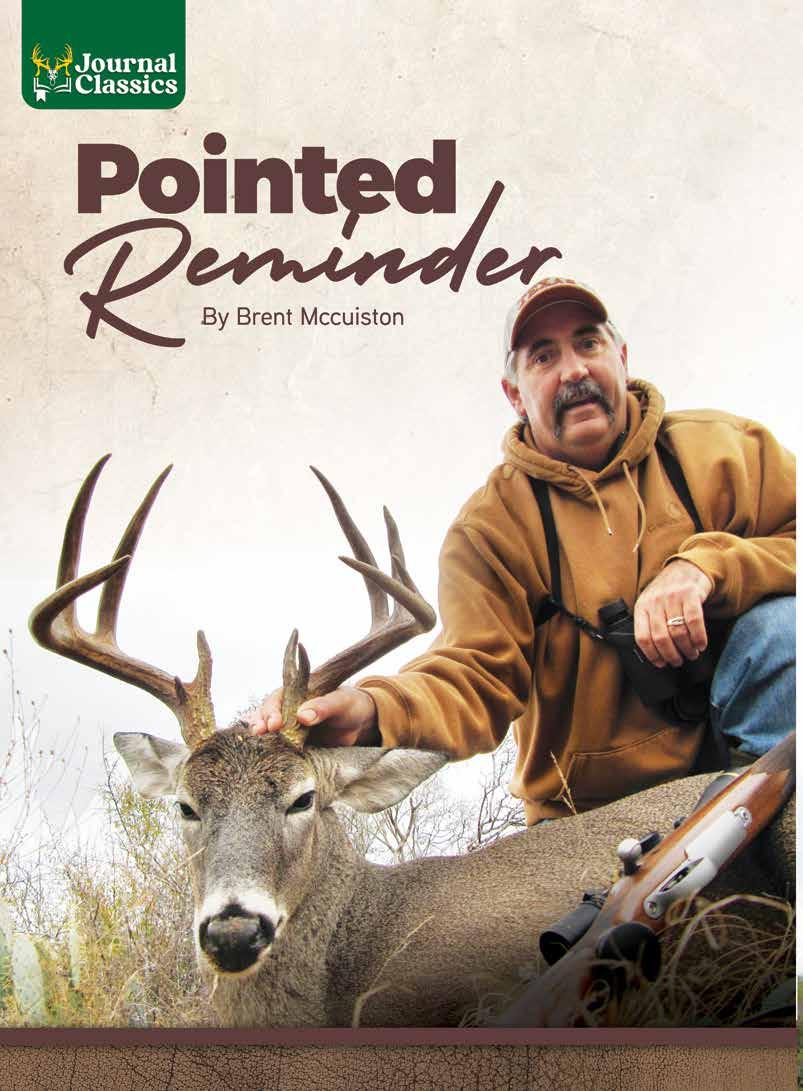
Brent tries to instill the hunting ethics he’s learned the hard way to his students in the Reagan High School Chapter of TTHA. Because of his work, he earned TTHA Member of the Year honors, as well as his own trophy hunt.
Editor’s Note: This story comes from our September/October 2011 issue. The lessons learned within the story still ring true today. Enjoy.
We have a choice on what we do with the mistakes we make. We’re all going to make them. Some will be big, some small, and most will not result in any consequences to others. However, the mistake made on a Coleman County Ranch five years ago has motivated me into the direction that I have chosen as a hunter and a teacher. In the big scheme of life, the mistake was small, and the consequences were minor in relation to the major problems of the world; however, I will never forget pulling that trigger when I knew it was wrong.
My dad had passed down his rifle, which I used on my first hunt to kill my first buck, a mule deer. Former high-school classmates who wanted to get me involved in hunting offered the invitation. At the time, my profession and lifestyle did not lend itself to a hunting hobby. However, making the change to golf coach allowed more time to do some things that I didn’t have time for while coaching football. That hunt with Don Wood and Randy Wilson produced a nice mule deer, a great “first buck” by anybody’s standards. I was officially addicted, and I couldn’t wait to get the next one on the wall.
Following that hunt, I got the fever to purchase my own rifle. I was proud of the .30-06 that my dad had given me; however, I wanted to “build my own.” The man most responsible for the mule deer hunt graciously continued to invite me to another ranch in Coleman County for the whitetail experience. During one of those hunts, he allowed me to use his .25-06 to kill a turkey.
I enjoyed the feel of that gun, and found out that this caliber would be a good whitetail gun. I asked a million questions to anyone I knew about the right brand, scope, and specs I needed. I followed every direction that my brothers-in-law gave me about proper break-in procedure. A box of shells later, I was ready and couldn’t wait to get to Coleman to show off my new rifle and put it to good use.
My wife and I received an invite to Coleman the very next weekend, and we quickly accepted. We arrived early enough to get in the blind on Friday afternoon. The gentleman who had extended it was very specific and clear in his instructions: “Don’t shoot any bucks.” Don had put a tremendous amount of time, energy and money into this property and deer herd, and he took great pride in growing the biggest, natural Texas bucks possible. Does and hogs were available, but no bucks could be taken.
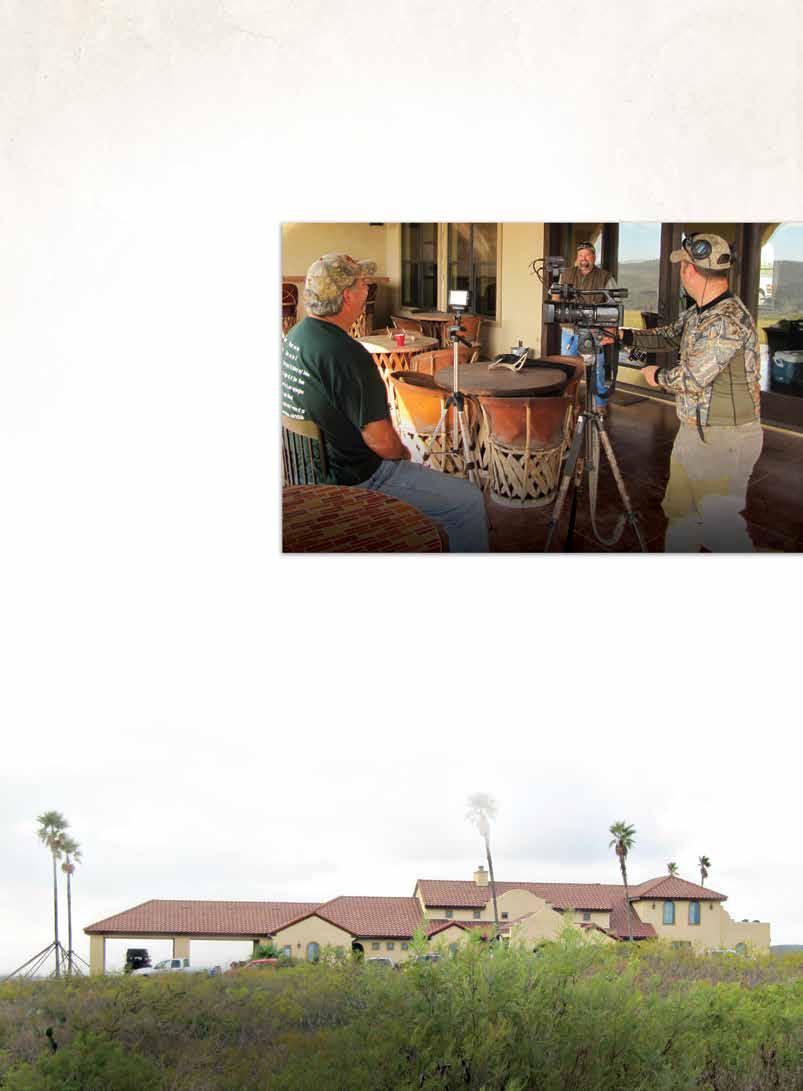
Wendy and I went to our assigned blind. Even at 45 years of age, the excitement of hearing the feeder go off and what might be seen was very real. When the feeder went off, deer began to appear out of nowhere. Most were does and young bucks.
We both enjoyed watching them and discussing sizes and ages, as I was working hard to learn about aging deer on-thehoof and scoring antler size. And then it happened. I could have sworn that I saw a bush moving. It was the biggest buck that I have ever seen.
The buck jumped in the feeder pen as if he owned it. My hand immediately reached for the new .25-06. My wife quickly reminded me about “the rule.” All I could hear was my heart racing and all I could feel was the adrenaline rushing through my veins.

I distinctly remember telling my wife, “Don would want me to shoot this buck; he is huge!” I was justifying taking this animal every way that I could. I counted points, got lost at 12 and knew there were more. This non-typical buck was, in my mind, “mature.”
One deep breath, another deep breath, a squeeze on the trigger, and down went the buck. Wendy and I celebrated, hugged, high-fived, and shared a genuine excitement for what just happened. I remember grabbing my cell phone and calling Don with the great news. “Don, I made an executive decision. I just shot the biggest buck you have ever seen!”
After a really long silence, and another really long silence, Don responded with, “Great, I hope he is what you want.”
Translation: “Better enjoy this one because that is the last animal you will shoot on this ranch.”
The realization of what I’d done hit me like a 2x4 between the eyes. I had just betrayed the trust and unselfish friendship Don had given to me through this great sport. I had just upset the long and tedious process of management. I had just done something that I was told specifically NOT to do.
I was embarrassed, ashamed and every other emotion that one can feel in a situation like this. Also, I had just put my wife in a very tough position. I could not remember feeling more uncomfortable during the duration of the weekend. And deservedly so.
I did not possess the power to revive the buck and send him out to spread his awesome genetics. All I could do was offer the most sincere apology I could muster, which felt very hollow. There was no joy in the picture sessions. There were no highfives as other lease members came to check out the 155 Boone and Crockett buck. Just looks of, “What were you thinking?” I paid for the mount to be hung in the lodge, donated the meat to Hunters for the Hungry, and tucked my tail between my legs and drove home.
So, how do you turn a negative into a positive? I started The Reagan High School Chapter of the Texas Trophy Hunters Association. I educate every member not to make the same mistake.
Our chapter is the first high-school chapter among several collegiate chapters. We’ve taken field trips, had guest speakers on many hunting topics, and raised money for City Kids Adventures. We are a “give back” organization. Our goal is to
make our sport better because we are a part of it. We’re in the process of raising enough money to start an endowed scholarship for our members and hopefully members of other high school chapters, much like the FFA and 4-H organizations.
Our members will be educated hunters on ethics, safety, and conservation. They will hopefully not make the same mistake that I did. I owe a huge debt of gratitude to family members and friends who have been supportive and encouraging our high-school chapter, especially our principal, Bill Boyd, for sticking his neck out and allowing us to start this program at the high-school level.
Because of our success with our high school chapter, I was fortunate enough to be chosen as TTHA Member of the Year. I was surprised by this announcement made in front of my chapter members, faculty, administration, family and friends at one of our monthly chapter meetings. An even bigger surprise: I would go on a trophy hunt and have the opportunity to shoot up to a 165 Boone and Crockett deer!
All I heard was 165 B&C. All I thought about from that moment until the hunt began just after Christmas was 165 B&C All I could think of was getting in “the club” where my friends were members: the “big deer club.” I did not have to have the best deer in the club; I just wanted to be in it.
Up to this point, the 115 to 125 B&C bucks that I had taken were just not going to make it. I was able to take a nice cull buck on a South Texas ranch that measured 137 with two broken brow tines. Winn Adami, the first president of our TTHA Reagan Chapter, invited me on that hunt. I will be forever grateful to Winn and his dad Tres for that experience, but a 160-class deer was now the standard that I had set for myself and was incredibly excited to exceed it.
The Monte Cruz ranch just out of Uvalde graciously hosted our hunt. The hunt was filmed for TTHA’s television show on The Outdoor Channel. I could not wait to be “that guy” on TV who shot the deer of a lifetime and celebrated with his guide and fellow hunters back at the lodge. I had discussed with my wife how I would have the mount done and where it would be placed in our house for all to see. This was truly the opportunity of a lifetime, and I was going to take full advantage of it.
The afternoon of our arrival was a typical South Texas after-
noon, warm and hazy. After a red-carpet welcome, we drove to the area we would be hunting. Our guide set us up in the blind and fed the area. My heart rate was way up: TV cameramen, my own guide, what more could anyone ask for?
The deer beat our guide back to the blind and hunting area. They began to appear one after another. Most were young and small, but not Hill Country small; these were big-bodied deer! Finally, a very mature buck appeared, and my first thought was, “I’m going to get this done now. Then, I will have the rest of the week to shoot a cull buck, does, and do some varmint hunting.”
As the mature buck came into full view, it was obvious that he was not in the “trophy class,” but would make a great cull buck nonetheless. I was given the green light to take him. It was still early in the afternoon, and I did not want to keep the 160-class deer I was looking for from coming in. About the time I had decided to take the old cull, he left and went in search of greener pastures and hotter does, as the rut was in full swing. We left the blind with great expectations of the hunts to come.
Still convinced that I would get the chance to shoot that 160-class deer, we continued to hunt the next three days in search of the trophy deer of my dreams. Between hogs and oil field work, warm temperatures and just plain bad luck, it never happened. Deer after deer were just too young, too small, or just not what we were looking for. I would tell my guide, “That deer can spell the ‘L-o-s,’ but not ‘C-a-z-a-d-o-r-e-s.’”
I was committed to obtaining a jacket or being prepared to take a management deer and move on. Then on the last night of the hunt, a nice nine-point stuck his head out and made me reach for my gun. It was obvious that he was not a 160-class deer, but would have been far better than the deer that I eventually took. However, we let him walk. He was a 4½-year-old deer that would be really good for somebody else in the future.
Only one hunt left on the morning of the last day. Charlie, my guide, was just as frustrated and yet determined as I. We were not giving up. We left the lodge that morning confident and excited.
Charlie chose a location where he had seen large numbers of deer and some large bucks. Once again, there were deer waiting for us as we set up in the blind. The “old man” from the first day stuck his head out. I was still holding out; I was still convinced that the next deer to stick his head out would be “the one.”
At 9:30, it finally happened: a nice management buck stuck his head out. However, I was frustrated, and I did not feel the excitement I expected to feel. We did not celebrate the way we might have. We had to work hard to find the positive things about this deer.
He had good mass, split brow tines, and some character not often found, but he was not that 160-class deer that I went to get. I took a good shot with the .300 WSM. The quality of the deer herd will improve as a result of taking out this deer, something I was glad to do. Afterwards, I was proud that I withstood the “don’t miss” pressure from the members of our high school chapter.
I’ve seldom felt the disappointment and anger that I felt on the drive home from the ranch. The realization that I had developed a sense of entitlement and fallen into a trap had caused me to not fully enjoy the hunt that was so graciously presented to me. I had allowed myself to do what I swore that I would never do. I had allowed myself to do what I tell the members of our high-school chapter not to do.
I got caught up in the “numbers trap” of taking a big buck, rather than allowing myself to fully enjoy the experience of a lifetime. There’s no way that we could have afforded everything provided. Yet, I had allowed my disappointment of killing a “lesser” buck to overtake the experience of the hunt, learning, meeting new people, making new friends, and sharing in one of the best sports afforded to mankind.
So I’m still learning from my mistakes. I’ve learned that there are no guarantees in hunting, even if you have the privilege of hunting where people pay big money to hunt. I’ve learned how hard it is to manage and take care of a place that will raise the kind of bucks that make anyone’s dreams. I have learned to appreciate the hunting experience no matter how big the Boone and Crockett score is.
I think the lessons learned from these two experiences will be a far greater value. I’m going to use the mount of the split-tine buck in much the way football teams use whatever icon they have leading them onto the field. The simple act of all team members touching it serves as a reminder for what they play for, whom they play for, and why they play the great game of football. That mount will be proudly displayed where I will be reminded of these lessons every time I walk out the door in pursuit of that infamous 160 class deer.
by Eric Stanosheck
Central Canada barren-ground caribou have been on my list to hunt for many years. I was finally able to make this hunt a reality, thanks to a few friends who had an extra spot in camp. Getting up there was a two-day journey, as was getting home. I took two planes to get to Winnipeg, Manitoba, and then an eight-hour drive to Thompson, Manitoba, followed by flights in two separate bush planes to finally land on Baralzon Lake.
As a muzzleloader hunter, this type of travel will require making connections and planning well ahead of time to make sure you’ll have powder and primers in camp because you can’t have them in your luggage at all on a commercial flight. Since I had this hunt booked a year ago, I started connecting dots to get powder immediately. David, the manager of the first lodge we would land at to switch bush planes, would be at a Bass Pro Shops about a month before we hunted. He was my one chance to get powder into the remote barren lands. I would pick it up from him and have it on my person for the last float plane ride to tent camp. However, Bass Pro wouldn’t hold it for an extended amount of time. So, as we got closer, I called to verify availability, and David locked in my supplies.
Once in camp, I hit the bench to sight-in, as this was
a new primer/powder combination. I learned quickly it burned hotter than what I’d been shooting at home. After a quick vertical adjustment, my T/C Omega was driving tacks at 100 yards. This hunt had two hunters per guide, so I loaded up with Rob Bult, an archery hunter from Michigan, and our guide J.C. Ollie. We would take a boat anywhere from 30-45 minutes from camp and then start hiking. Our game plan was stalking any big bull we saw, and then I would hold up at 100-150 yards while Rob would crawl in closer with his bow. I would be the cleanup shooter if he wasn’t able to make the shot or get in close enough.
We spotted our first big bull 3 miles from shore, and made a great stalk. Rob was at 41 yards when the bedded bull spooked and ran towards me. At 73 yards, the bull stopped to look back towards Rob, then I took a hard quartering-away shot to anchor the bull. The 250-grain sabot pushed by 150 grains of powder made it through the entire length of his body diagonally from his hind quarter.
After field dressing and hanging the meat, cape, and horns in the shade,
we decided to push on and see if we couldn’t end the day with a double on the even bigger bull we had spotted 2 miles farther away from the lake. In Nunavut, hunters are allowed two caribou tags each.
The second stalk was dicey. The wind changed and eight other bulls joined the lone bedded monster caribou. Once we were in range, I offered Rob my muzzleloader because we knew this was a Boone & Crockett bull. If he couldn’t close the distance with his bow, we wanted to make sure we killed this bull.
Rob sat with my T/C Omega for 25-30 minutes, waiting for the bull to stand. When he did, Rob had no clear shot opportunity before the bull bedded back down, facing straight away. After this frustration, Rob decided to crawl in with only his bow, which he did, to 71 yards before the bull spotted him and started moving. Rob drew and released, grazing the rump due to gusting crosswinds.
Knowing Rob’s shot wasn’t fatal, I squeezed the trigger and unleashed a cloud of white smoke across the tundra before the bull could leave. At 141 yards hard quartering towards me, I
knew the bullet did enough damage to tag our second bull of the day. After a quick photo session and butcher job, we loaded up our packs with this bull and hiked back to the first bull, and then loaded him on top of our already heavy packs. The pack loads we carried were massive, and the 5 miles across the squishy tundra and boulders was excruciating with all the weight, but the three of us got both bulls and all our gear back to the boat in one load.
That night the northern lights danced over the lake. We enjoyed boiled caribou tongue with mustard. None of us were brave enough to sample the raw liver, raw fat, and green stomach contents snacks our Inuit guides devoured.
On the third day, Rob used my muzzleloader to make a perfect shot on an incredible caribou bull with the biggest shovels we’d ever seen. Those were the only bulls our Inuit guides had ever seen shot with a muzzleloader. In fact, the concept of a muzzleloader was so foreign to them that I enjoyed educating them on the components and functions of shooting my gun. A few of them were so intrigued, I let them shoot it on the bench on the beach.
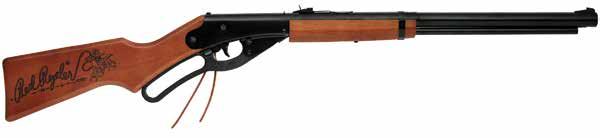
Daisy Outdoor Products is excited to release the first shooter training tool that blends digital game play with actual shooting with your Daisy BB gun. This system is an easy-to-set-up augmented reality gaming system designed for air guns (it comes with a Daisy Red Ryder). The Daisy Smart Target System uses a specialized target stand/system and your smartphone or tablet to animate the many monster targets. When the player makes a shot on the target, it’s displayed and automatically scored on your device.
The target stand quickly calibrates to your tablet or smartphone, allowing you and your friends to play several different games within the system. If the shooter hits the monster on the target, your tablet shows the animation, and it reacts and is automatically scored. The game reinforces gun safety while improving marksmanship in a fun and exciting way. Visit daisy.com.
Walker’s Suppressor Earbuds come in two styles: one with and the other without Bluetooth 5.3 Low Energy (LE) connectivity. They’re efficient at canceling potentially damaging noises, while enhancing desired environmental sounds, and, in the case of the Bluetooth-style buds, even relaying audio from cell phones, tablets, and other devices.
The Suppressor BT Earbuds reduce power consumption while avoiding congested channels to minimize interference. They deliver up to 36 hours of total use per charge. Users can rely on them for up to 5 hours of audio streaming, 5 hours of sound enhancement, or 13.5 hours’ runtime in Standby mode.
Visit WalkersGameEar.com to learn more.

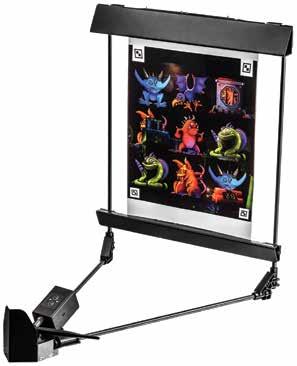
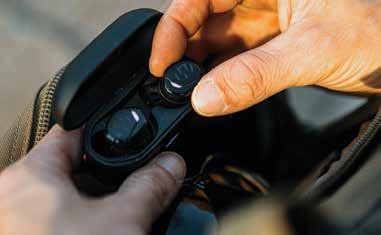
THAW introduces the new 2K Rechargeable Hand Warmers. These redesigned hand warmers relieve fingers and fit easily in a pocket, so they’re always within reach. The double-sided heating design will heat the user’s full grip, and also have simple one-button controls. They heat up to 113ºF and last up to 4 hours. Each hand warmer also features an integrated LED light to illuminate tasks without fingers freezing in the cold.
Visit thawgear.com.
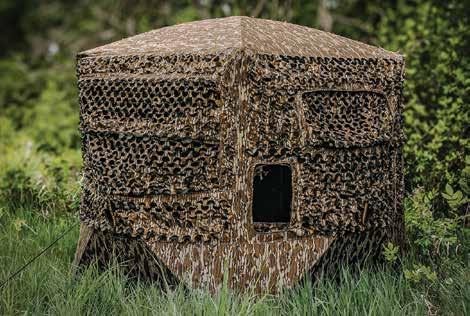
GoMuddy.com
Muddy’s new Carnage Die Cut Ground Blind offers textured, die-cut fabric that blends seamlessly and naturally into the environment. See-through Evo-mesh sliding curtains provide each window with additional concealment. A 180° panoramic shooting window creates generous shot opportunities for as many as three adult hunters, while the main gunport and two dedicated bow windows expand visibility even further, giving hunters a near-complete view of their surroundings and the flexibility to react the moment a shot presents itself, regardless of angle. Visit GoMuddy.com.
alpsoutdoorz.com
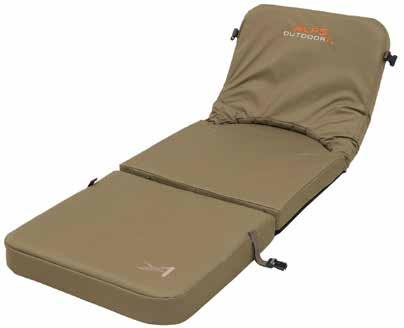
Centered on delivering mobility, comfort, and rugged construction, ALPS OutdoorZ’s Migrator Field Chair and Field Blanket are atop the waterfowl concealment category. Prioritizing lightweight construction and comfort, the Field Chair sports contoured shoulder straps and a compact tri-fold design for comfortable, efficient carry. The Field Blanket conceals in a functional and compact mobile package. Custom-cut arm holes allow an intuitive fit, channeling your focus on the hide and finishing birds, instead of fighting your cover or blind. From mobile waterfowlers to those seeking the best hide, the new Migrator products place hunters comfortably on the “X,” no matter its location. Visit alpsoutdoorz.com.
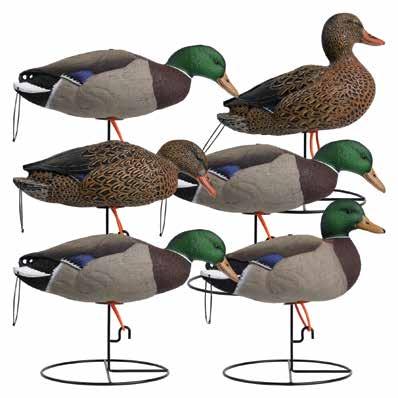
Hardcore’s Rugged Series Full Body Mallard Duck Decoys offer ultra-realistic postures and anatomical features, detailed paintjobs, and exceptional movement at a fair price, plus they are incredibly durable. Slightly over-sized to give them more “pop”, these full bodies are way ahead of the flock when it comes to realism and effectiveness. Hardcore’s ultra-durable FowlFlex technology ensures the decoys are not just tough, but virtually indestructible. Groundbreaking TruMotion 2.0 bases and field stake harnesses the gentlest breeze to infuse your decoy spread with astonishing realism. Includes 4 Drakes (1 active, 3 feeder), 2 Hens (1 active, 1 feeder), 6 TruMotion 2.0 Bases & Field Stakes. Visit hardcorewaterfowl.com/products/ rugged-series-full-body-mallard-decoys/
NEBO’s Poppy Puck is a compact 2-in-1 puck light and lantern designed for maximum versatility. It’s a rechargeable, pocketsized version of NEBO’s classic Poppy lantern, now featuring an improved pop-up design that allows the light to be angled in any direction. With two light sources and five versatile modes, it offers convenient, hands-free illumination supported by folding hanging hooks and a strong magnetic base. The lantern also features a natural candle-like flicker mode for comforting, ambient lighting. It also has 300 lumens; a 6-hour runtime; is USB-C rechargeable; and aircraft-grade aluminum construction. Visit NEBOlights.com.


Built for shooters who demand strength without bulk, the Kinetic 2 pistol bag is over-engineered for everyday carry and range days alike. Crafted from 450D Ripstop Nylon with a steel wire frame tough enough to shrug off 100+ pounds of crush force, this bag takes the abuse while keeping your gear pristine. It has EVA padding, PP-reinforced panels, Mil-Spec nylon webbing, and lockable YKK zippers, and external hook & loop Velcro. It easily secures two full-size pistols with optics and lights, plus 6 dedicated mag pockets that swallow up to 7-inch sticks. Designed in Texas. Dimensions: 14.5” x 11” x 4.5”. Visit condition1.com.
Fort Knox’s Protector Safe gives hunters and homeowners a secure place for firearms, documents, and valuables. Made in the USA by a family-owned company building safes for over 40 years. It uses a reinforced steel body and multi-layer door to resist pry attacks and heat. The locking system secures multiple points around the door for a tight seal, and the fire-rated interior helps safeguard contents in an emergency. Adjustable shelving and door storage let you organize long guns, handguns, and optics in one cabinet, making it a durable, long-term security upgrade for home, ranch, or lodge. Customize yours today at FTKNOX.com.

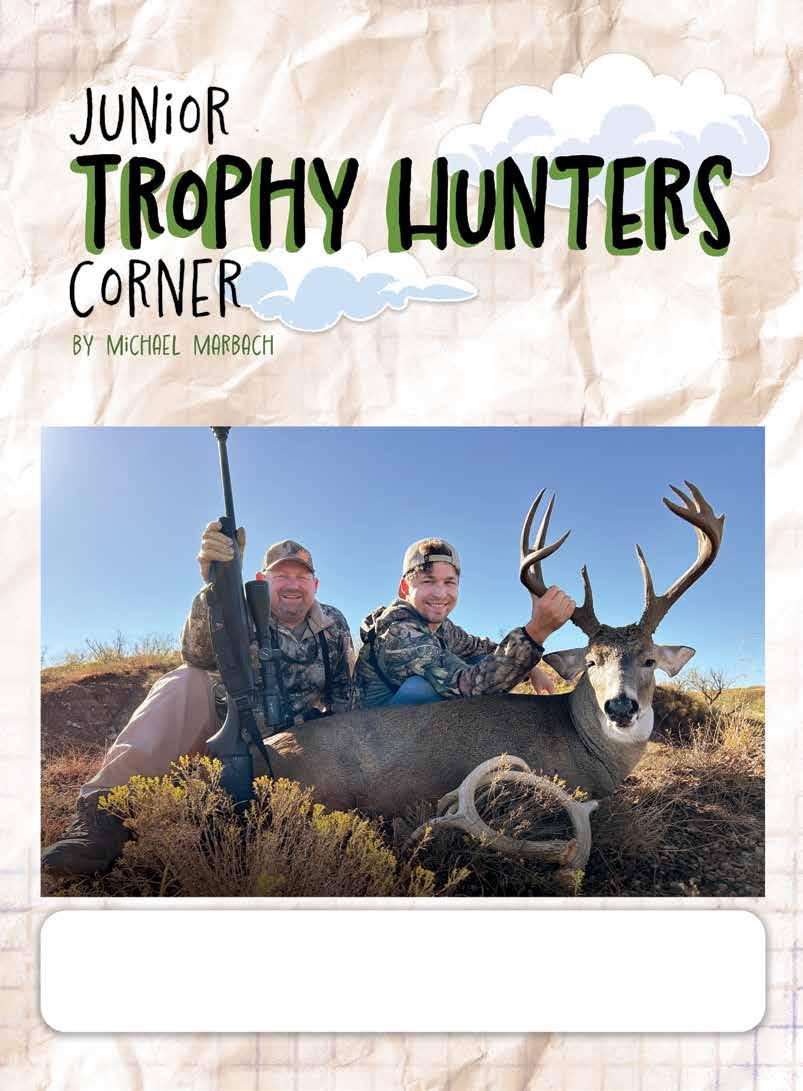
Better science has helped improve determination of a deer’s age. How? Keep reading the story.
As a kid growing up in and around the outdoors, your first thought when your dad said, “Get your stuff. We’re going on a hunt,” was to get your butt in the truck. You did not care what you were hunting or where you might be going, but you were excited to do something that you love. As a kid, I did not care how old
a deer was or how big it was. I wanted to know if I could shoot it, and if we were going to make sausage out of it. Wow, things have evolved in the hunting industry and look at how strict we have become with managing our wildlife. There are a lot of positives to strict management, as we are killing bigger deer on a more consistent basis.
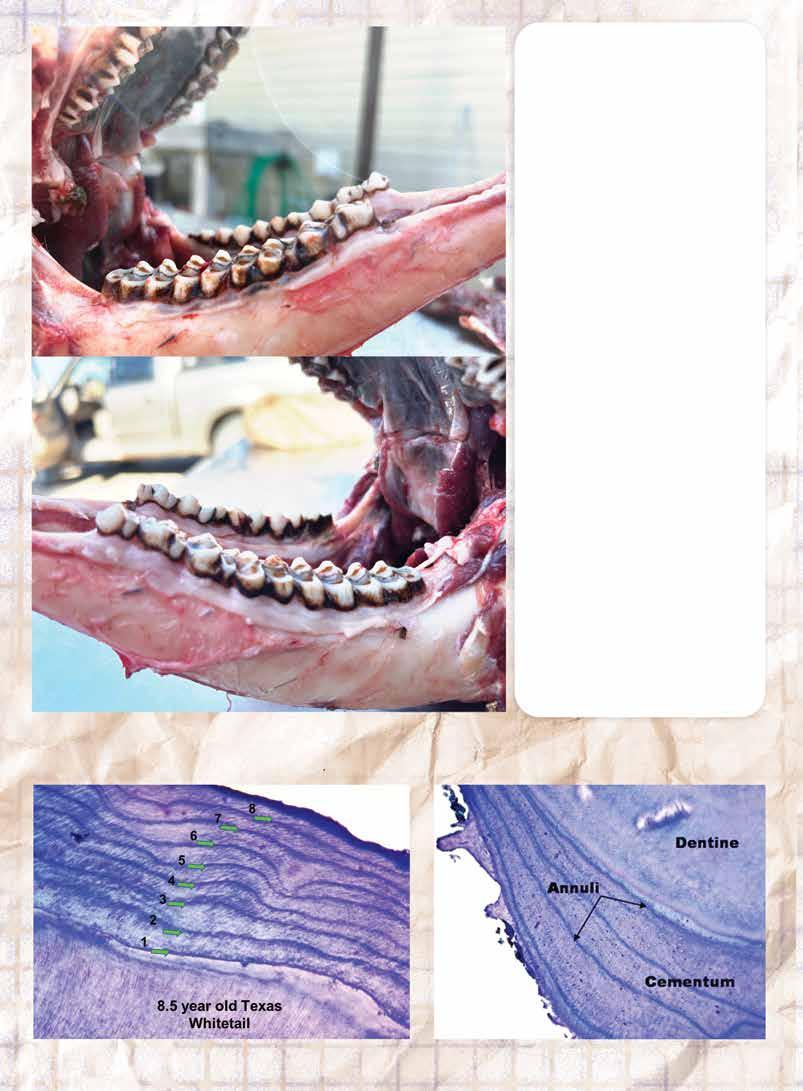
Given the rise in our deer herds, it’s a great time to be a kid. We have a lot of does to take out each year and having a bunch of kids to help you is a great way to go. It’s a great opportunity to hone those shooting skills and also a great time to learn to take the critter from the field to the table.
The other thing that has changed in a very big way is aging deer, so you can grow these animals to their full potential. It takes all kinds of methods to help you with aging. It starts with knowing, for the most part, the animals that range on the property you hunt. We run game cameras, sit for hours observing, and making sure we feed appropriately to get the animals to reach their full potential.
As our management practices have evolved, so have the ways we age whitetail deer. The days of looking at tooth wear are passing us by as an aging tool. For one, it’s out of date and very inaccurate, or so science tells us.
According to the Quality Deer Management Association:
“Aging whitetail deer by tooth wear is considered unreliable for precise ages, especially for older animals, due to subjective factors like diet, soil grit, and individual variation affecting tooth wear rates. While relatively accurate for young deer (fawns and yearlings), the wear and replacement method becomes increasingly inaccurate with age. A more accurate, but labor-intensive, method is the cementum annuli (CA) analysis of a cross-sectioned incisor, which counts growth rings like tree rings.”

Cementum annuli analysis has become the new industry standard for aging deer. Though it involves more time and lab work, it can help you with your aging goals. It’s a more scientific approach, but it does take time and money. It’s much easier to look at the tooth wear and formulate your opinion, but over time, we have disproven this approach to deer aging.
For kids and their parents who watch numerous deer and talk about their age, it’s also helpful to keep photo records of your deer. If you’re lucky enough to see them as 1- or 2-year-old bucks and watch them grow up, the photos can show you how they mature from year to year. I personally do this through game cameras and time taking pics while in a deer blind. You will know better than anyone the age of your herd and which bucks may be on the hit list from year to year.
Aging deer by the jawbone was invented in 1949, and for many years, it served as the method of choice. In the beginning, the sample numbers of deer aged by the teeth were low, but managers did what they could to try and increase the age at which deer were taken. Here we are 75 years later, and the science has caught up dramatically. In my opinion, I’m grateful we can learn and be more accurate with our deer herds.
Michael Marbach is the CEO of the Christian Outdoor Alliance, mycoa.org; 210-827-9802. COA’s mission is to guide youth and outdoorsman to a relationship with Jesus Christ through experience in God’s great outdoors.

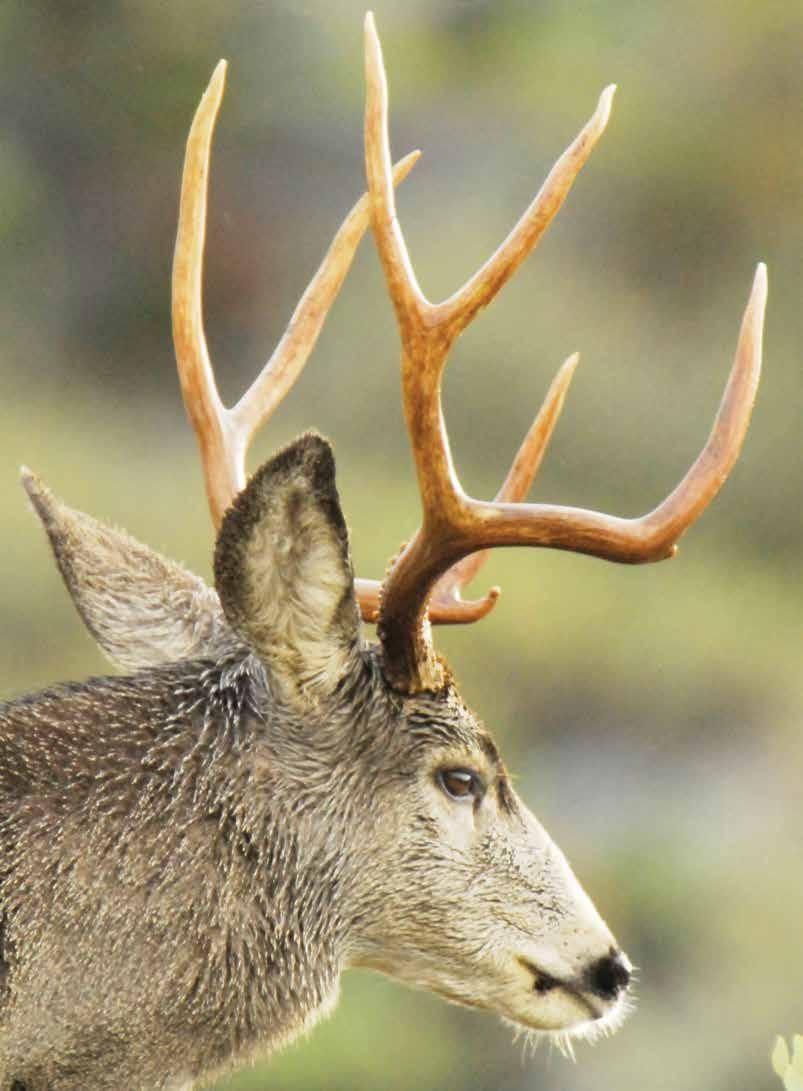
Desert mule deer thrive in years with average or above average rainfall to grow the nutrition they need for their large 4x4 antlers.
By Jim Heffelfinger
It’s obvious the antler quality of mule deer isn’t the same every year, nor is it the same in all parts of mule deer range. Some years are anticipated as “good” years and they do not disappoint. Other years surprise us and leave us scratching our collective heads and wondering, “What happened?” The factors that come into play each year to make a good or bad antler year are complex. Many biological and environmental variables are constantly changing
and have to align perfectly to have one of those boomer—or “Booner”—years where tremendous bucks seem to come out of nowhere. Some of the same factors driving annual fluctuations in antler quality also cause geographic differences throughout mule deer range.
Mule deer, and their black-tailed deer cousins, live in the Sonoran Desert with 4 inches of annual rainfall, and also the Pacific coastal rainforests with 200 inches of rain. With that diversity in conditions, it’s not surprising we see a
lot of variation in body size, coat color, antler size, behavior, and other things. Mule deer in the Southwest are generally lighter in color and smaller in body size than those in the forested north. Antlers are always related to the size and health of the body that carries them around.
We all understand the basic building blocks to producing trophies, but outside of captivity, we lack the complete management control necessary to put it all together on command. Managers can try to manipulate free-ranging herds for older age and maximize habitat quality, but the remainder has to be left up to factors beyond their control. These uncontrolled environmental factors can contribute greatly to fluctuations in antler quality.
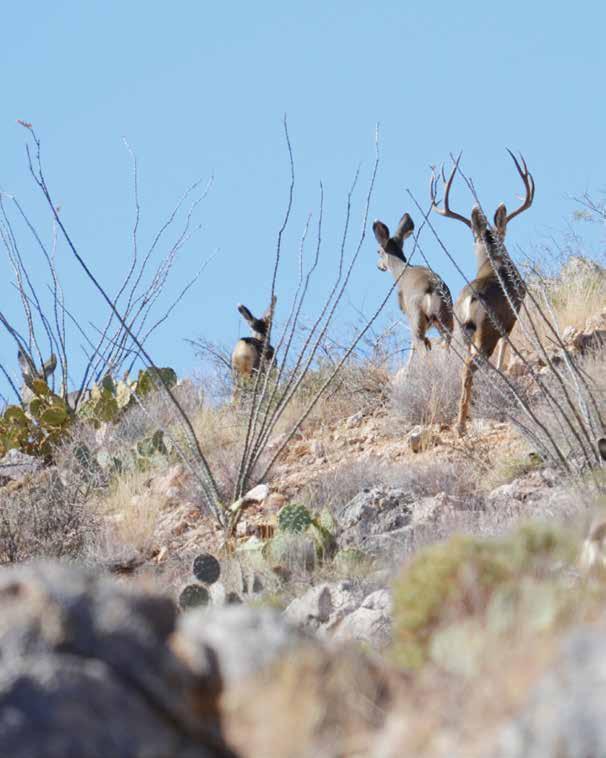
Antler size in mature bucks depends so much on the overall nutritional level available to them. Desert deer diets are usually at their highest nutritional quality after the summer and fall/ winter rainy periods. These rains, especially during the typically mild winters, create a flush of forbs (weeds) that provide the deer population with high levels of energy, vitamins, calcium and phosphorous. This sets the stage for fat deer going into the dry summer months when deer nutrition is at its lowest in this region. In dry years, the lack of winter and early spring rains creates poor body condition and antlers
It’s harder to grow a giant mule deer in the arid southwestern deserts, and yet nature often finds a way.
Hunters in the Southwest know that quality mule deer exist, but at a lower density, which means extra effort is required.
suffer because there is not enough extra nutrition left to apply to antler growth.
Shrubs are a big part (75%) of annual deer diets and provide a good source of protein. The importance of shrubs lies in the fact that they do not dry up and blow away like all the little forbs do. Because of that, shrubs are the consistent staple that support deer through the dry times and because of that, habitat management goals should focus on this component. In the Southwest, persistent drought may cause deer to rely on limited shrubs for too long and excessive browsing can result in overuse of those food resources and that may affect deer nutrition in the future.
tiny racks. They have just grown from fawn to yearling size in nine months and that didn’t leave any more building blocks to grow fancy antlers. Deer in the Southwest live in an environment with limited, and wildly fluctuating, nutrition so it makes sense to adopt a conservative approach and not automatically pour a lot of energy into big antlers and then suffer later in the body department.
The same conditions that create better antlers in some years work in a subtler way to create differences in antler size in different parts of mule deer range. Annual differences in antler quality are variable based on nutrition available that year, but geographic differences are more consistent and related to the average amounts of rainfall and the type of vegetation that grows there. After a while, deer gradually adapt to the overall conditions they get exposed to, and a species or subspecies fine tunes itself for the local environment. It’s harder to build a giant desert mule deer rack in the desert because the raw materials are lacking, or at least less available than in more productive places.
Antlers are considered “luxury items” because they don’t get nutrition until after the deer has satisfied its basic needs to maintain and grow its body each year. This is part of the reason yearlings have
Nutrients are harder to come by in the Southwest, and so we see it reflected in the body and antler size of the deer living there. Southwestern deer nutrition is at the mercy of annual rainfall amounts and timing. Winter rain not only fuels females to produce more and healthier fawns, but it also provides the nutrition for bucks to begin antler development on a strong footing in the spring. Summer rains offer a flush of forbs from the abundant seed back lying dormant in the soil. During this time, deer take advantage of the flush in nutrition to help finish fawns to a heavy weight and complete the antler cycle in the Southwest.
The variable nutrition in the Southwest also affects the sheer number of bucks coming up through the age ranks. A single year – or consecutive years – of drought and failed fawn crops will leave a noticeable gap in the age structure of the buck population. Antler size peaks at five to seven years of age, so ideally you have consistent waves of buck fawns
being born each year and moving their way through the age structure. It takes five years to grow a 5-year-old buck, so if you’re missing a few cohorts of fawns you will most certainly lack 5- to 7-year-old bucks in that many years. This is a problem mostly unique to producing quality mule deer in the Southwest. In northern states, only a freakishly harsh winter will have a similar effect if it kills most of a fawn crop.
Storms are usually exactly what we’re looking for in the Southwest to consistently produce quality mule deer. Although storms are not common in the desert, rainfall is what drives the nutrition in any natural southwestern system. It’s harder to create a giant mule deer with the building blocks available in the Southwest, but we still see incredible giants come out of arid southwestern deserts like Sonora. When the desert experiences the right conditions to blossom, it can be a very productive, but short-lived, environment. There isn’t much we can do about the timing of those fertile periods, but we can be ready for them by managing for an older buck age structure, maximizing habitat quality, and by practicing good range management to take advantage of it when it comes to us.
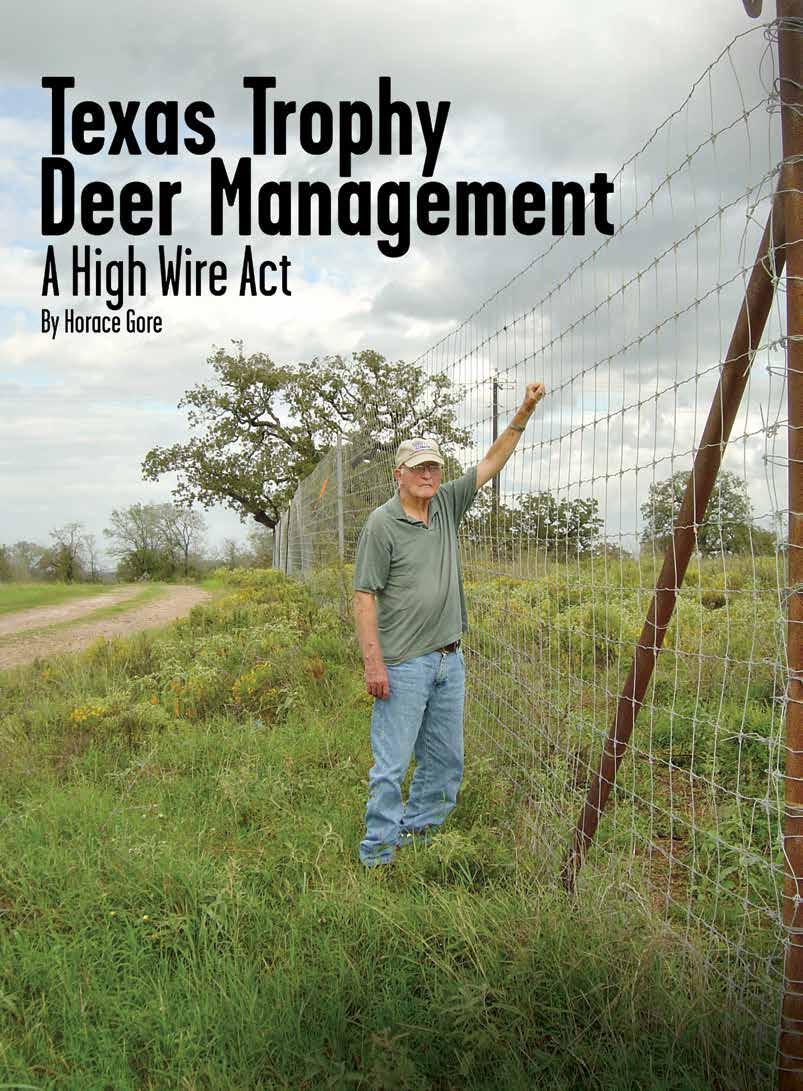
Texas deer management has evolved into a high-wire act. Deer-proof fences dot the landscape in many parts of the state. For nearly 70 years, they have been a part of Texas whitetailed deer management. In fact, there is a dedicated following who think that high fences are the answer to a rancher’s dream for trophy bucks.
The recipe for quality deer is simple: put up a high, deer-proof fence around your property, control the deer population by harvesting a certain percentage of both sexes, eliminate inferior brood stock and reap the rewards of good management by taking high-quality bucks every year.
Dyed-in-the-wool trophy deer hunters all over the world are familiar with Texas’ style of high fence deer management. It sounds rather simple—maybe too simple. But trophy bucks are a real product of such management, and these trophies come with a high price tag for both deer and the management technique.
Let’s look at a ranching situation in Brown County from which a high fence evolved. Treldon Cutbirth is a Brown County rancher and a friend for 50 years. I’ve been very familiar with his operation all of those years.
The ranch south of Brownwood was originally 4,200 acres of excellent deer habitat. However, there were practically no deer in the area until the Texas Game and Fish Commission stocked about 100 deer there in 1950. The deer did well, and by 1960 the herd had expanded to a point of needing doe permits to help control the heaviest populated ranches.
Until the early ’60s, no economic return was coming from the deer in Brown County, and many ranchers considered the “new” deer population a hindrance to ranching. Most of the deer hunting was done by family and friends.
In the ’70s, hunting became popular as the deer herd expanded its range, and trespassing became a serious problem. When the Cutbirth Ranch was divided in the mid-’70s, Treldon’s half of the property was partially leased to some local hunters and deer began to be profitable to the ranch, but trespassing was still a problem.
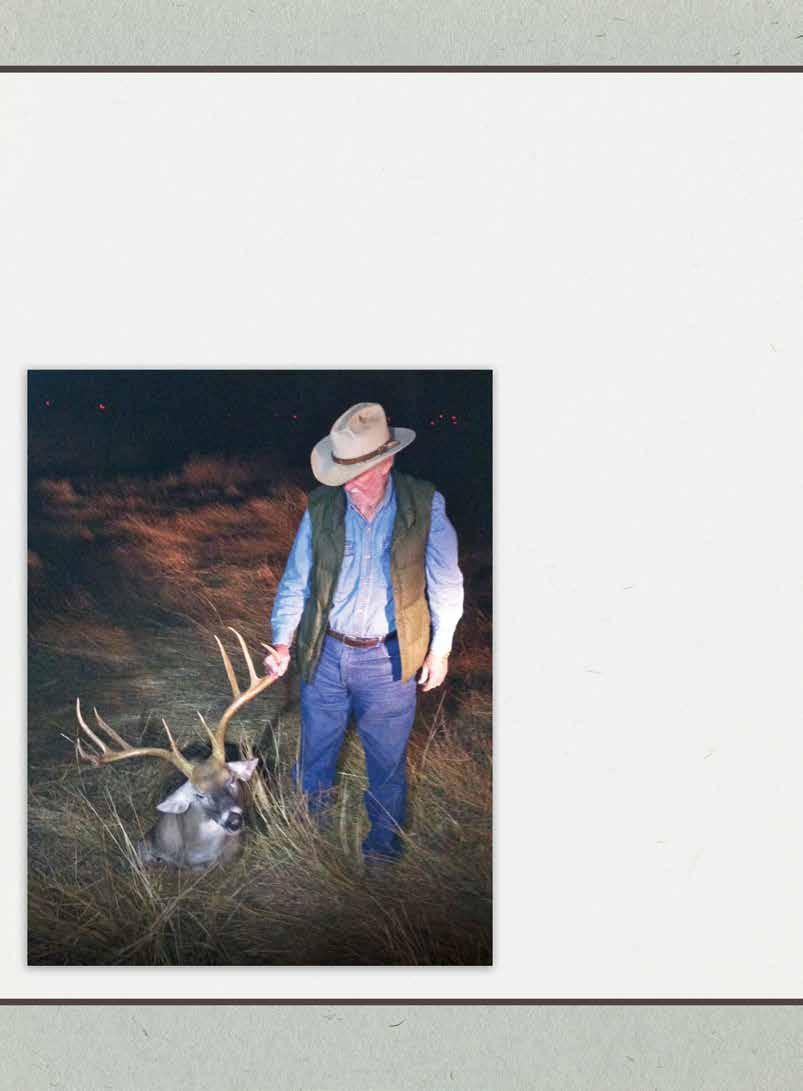
According to Texas Parks and Wildlife records, over 50 bucks were being taken each year by several small places on the north side of the ranch. The fence line was yellow from all the corn that was scattered to lure deer from the Cutbirth Ranch to the smaller ownerships.
The economics of deer hunting, and the need for better (older) bucks, caused the ranch to make a major decision in 1986. The exterior ranch fence needed replacing, and Treldon decided to high fence 2,060 acres of the ranch. His goal was to try to eliminate the trespassing, control the deer herd to about 250, and to get his bucks into older age classes.
After the high fence had been completed, the ranch began to offer short-term “package” hunts. Such hunts required highquality bucks for discriminating hunters who were paying top dollar. Before the fence, a good buck for the ranch was a 10-point typical scoring about 120 Boone and Crockett (B&C). A few years after the fence was up, and the deer could be managed, the best bucks were scoring in the high 150s B&C.
To date, the high fence has accomplished all of the goals set by the ranch, and deer quality has greatly improved. The ranch owners are quick to note that the Parks and Wildlife Department has made improvements in the trespass laws, which makes a poacher think twice before crossing the fence or killing an illegal deer.
Today, the Cutbirth Ranch is leased to a local firm that handles all the hunting. Without the high fence and the quality deer herd, it’s unlikely that the ranch would be as successful with its deer management program.
Actually, there is no magic involved in high-fence deer management. Let’s pick this high wire act apart and examine the rancher’s side of deer-proof fences and the trophy whitetails they want to produce.
Game-proof fences have been around in Central Texas since 1930. Most of the original high fences were erected to hold a variety of exotic animals in the Edwards Plateau. Many of the fences were poorly constructed and could hardly be called gameproof. By the late ‘50s, there were probably less than 200,000 acres under high fence in Texas, the largest being the 78,000-acre Y.O. Ranch near Kerrville.
Deer-proof fences, at $10,000 per mile, are obviously not cheap. Let’s say that a rancher decides to fence 2,000 acres with a property boundary of nine miles. The fence is contracted at $9,000 per mile, with another
$5,000 for an elaborate entrance. We’re talking $86,000, not a small expense for the average rancher. Now consider that most deer-proof ranches enclose much more than 2,000 acres—sometimes 10 times that much. So, high-fence deer management is synonymous with money.
A deer-proof fence can produce dynamic results in many instances. When deer movement is controlled, the number of bucks can be increased by 30 to 40 percent, and the age structure can be maintained to produce some fantastic bucks. For this reason, there is a continual increase in the number of high fences going up today. Up until about 20 years ago, most high fences were in the Edwards Plateau and South Texas. Now, there are high fences all over the state.
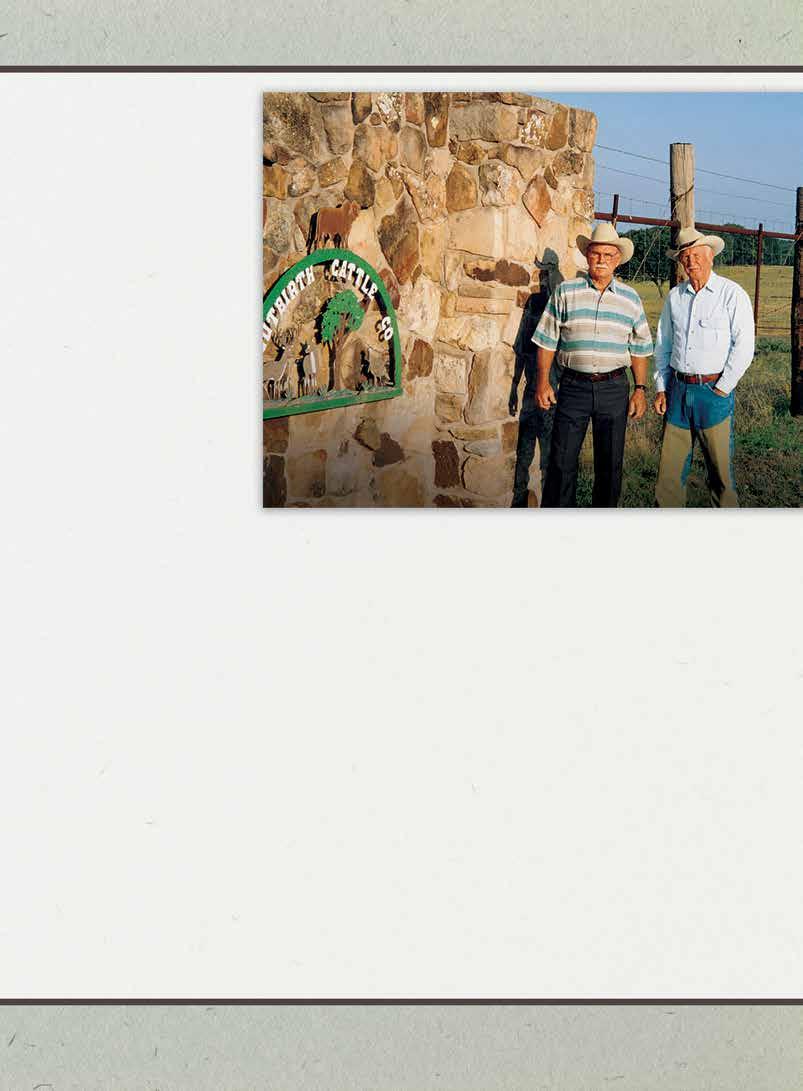
The author with his friend Treldon Cutbirth just outside Cutbirth’s
The author says Cutbirth’s deer management program would not have been as successful without the high fence.
What is the deer management philosophy that drives this desire for high fences? From my experience of being a wildlife biologist for 50 years, I think there are at least four reasons why landowners erect high fences.
First, they want to prevent “their” deer from ranging onto the neighboring properties, where they stand a good chance of getting killed. A trophy buck that will gross 140 B&C is usually 5 years old or older. The dominant bucks may range over 2,000
a pickup. For this reason, landowners who can afford it erect high fences around their larger ranches to protect the deer from the neighbors. Then, as the protected bucks reach maturity, they are harvested as trophies inside the high fence.
A second reason ranchers have high fences is the desire for deer quality. They want to improve their deer by maintaining a herd that is equal to the habitat. No amount of deer harvest can control a deer herd under a low fence if the food source is adequate. Every time a deer is harvested, another takes its place from the neighbors. The solution: a high fence to keep out unwanted deer. A drastic measure, but it works—at least in principle.
A deer-proof fence can produce dynamic results in many instances. When deer movement is controlled, the number of bucks can be increased by 30 to 40 percent, and the age structure can be maintained to produce some fantastic bucks. For this reason, there is a continual increase in the number of high fences going up today.
to 6,000 acres during the breeding season.
In Texas, there are many more small ownerships than large, and small acreages are subjected to heavy hunting pressure. A buck that lives partially on a small acreage during the first week of the deer season usually leaves the place in the bed of
A third reason for deerproof fences is poaching. Hunters who would take an illegal deer, either across the fence or at night, often focus their attention on larger ranches where deer are numerous. A poached buck can be dragged under a barbed-wire fence with ease. A deer can also be pushed or thrown over a low net wire fence, and the poacher can easily climb over low fences.
With a high fence, the situation is quite different. Poaching through a high fence almost always requires cutting a hole in the fence to retrieve a deer. Cutting a fence can get a poacher jail time and a heavy fine. A high fence is a definite deterrent to poaching.
A fourth reason for high fences involves small ranches of a few hundred acres where the owner wants to raise as many quality deer as possible, even if feeding is required. Such an operation cannot be successful without a high fence and a feeding program.
The manager usually buys deer from a game breeder who has a quality breeding program. A very good brood buck with large antlers and body size might cost more than the new Cadillac in the garage!
So, the investment in fence, deer and feed may be rather high, but considering the trends in hunting, and the egos that need salving, I think we’ll see more deer-proof fences, regardless of the costs.
Do high fences affect deer genetics? Not in a noticeable way, if the enclosure is large enough to maintain as many as 150 to 200 deer. One “new” buck entering a breeding group of deer every third generation is enough to prevent inbreeding. Most high fences are not completely deer-proof, and deer sometimes come through washed out water gaps or literally jump over the high fence.
Is a high fence necessary to manage a deer population and produce quality bucks? Of course not. Cooperatives can be formed between landowners to manage and protect deer, and limit the harvest of bucks to promote quality. Several co-ops in Texas and other states have been successful in managing deer.

The big difference in a co-op and a high fence is that the landowner with the fence knows where his deer are; the co-op member relies on his neighbors to follow the rules, and he hopes that the deer are somewhere on the co-op land. It’s a big difference, and unacceptable to some landowners who want to be more precise with their deer management.
Economic returns are only a by-product of high fences. Most landowners are more interested in protection of bucks to maturity, promoting deer quality and curtailing poaching and trespass. If these three factors could be erased from deer management, we’d likely see less deer-proof fences.
But, as in the Cutbirth Ranch situation in Brown County, these problems won’t go away. In fact, we will see high fences to solve deer management problems as long as landowners can afford to build them.
Are high fences impacting Texas deer herds? I think not, at least detrimentally. But high fences may be affecting deer hunters. My guess is that less than 20 percent of the total deer range in Texas is presently behind a high fence, and many of these fences are not totally deer proof.
However, in certain areas of South Texas, high fences may be taking up 25 to 30 percent of the deer range. Fortunately, these fences confine deer to large ranches with little or no affect on the deer’s lifestyle.
There’s very little middle ground on the subject of high fences. You either like them or you don’t. Actually, I’ve hunted for years on both high-fenced and low-fenced ranches. When I’m in a blind, or riding a high rack, I never even think of the fence. If I see the right buck, I couldn’t care less how high the fence is. I suspect most deer hunters would feel the same way.
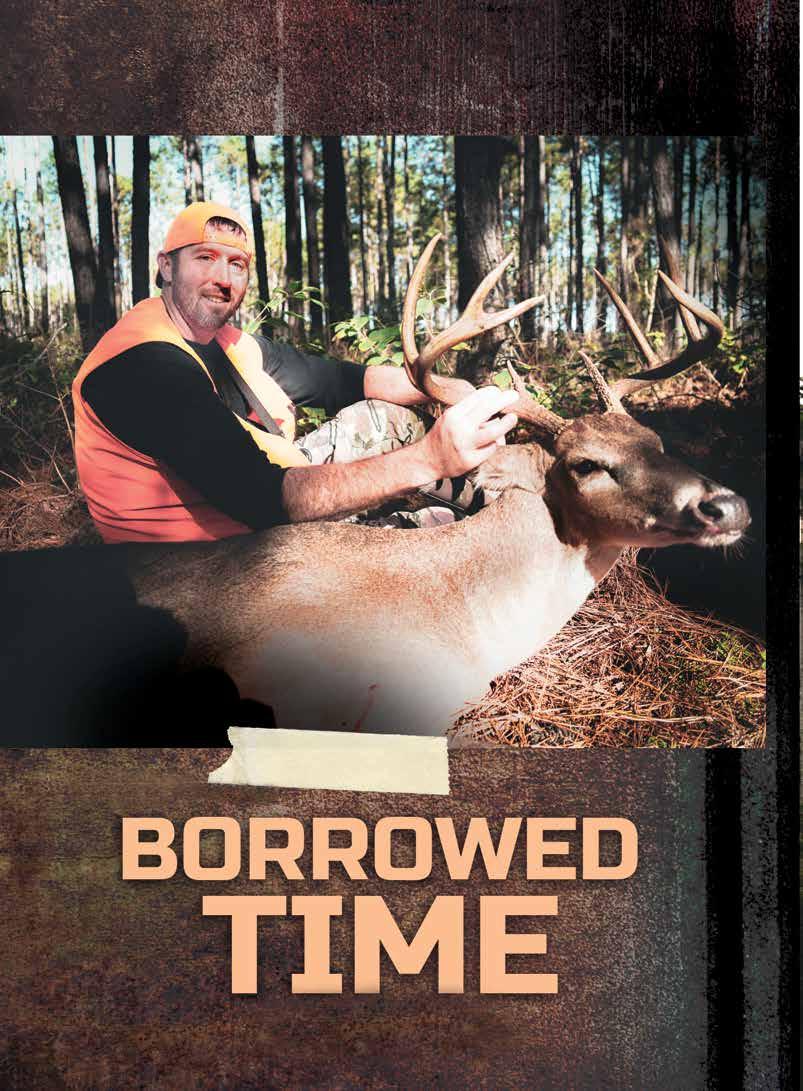
By Seth Johnson
Iwas as high as I could get in this long leaf pine thicket. The interior was thick with switchgrass, greenbrier, and tall vines. The cover was too thick for brush busting but perfect for a weary old buck. Just after daybreak, I catch the movement of tines moving slowly through thick cover. As I leaned out in my saddle, I caught a glimpse of the biggest public land buck I had ever encountered in Texas.
The 2024-2025 season presented some unique challenges. As an outdoor videographer, I had committed to two assignments this year in Kansas, as well as Alabama. This would require me to give up some prime dates of the Texas whitetail season. My plan was to rely on historical knowledge and trail camera intel to keep me in the game throughout the year. I was fortunate enough to take a bow buck back in October, so I was already considering this a successful season. However, as November rolled in and the morning
temperatures were dropping, I found myself struggling to stay in the deer stand.
As I returned from Kansas where I had the privilege of watching other hunter’s dreams come true, I had hopes of finding my own dream buck back home within the tall East Texas pines. As I unpacked from a seven-day adventure and began to gear up for my own, I realized I had no idea where to start. It was Nov. 20, and I had not set foot in the woods in over 10 days. As I scrolled my camera intel, the pictures revealed a lackluster state of insight on deer movement, and no indications of rut activity.
This seemed unusual for this time of year. I thought, something must be different. I set out for a morning scout to try and see what the deer were doing in one of my favorite areas. I realized the hot sign just wasn’t there. The trails weren’t beat down, and the activity was scarce.
I had a hard time believing the deer had left the property, so I circled around to scout a different area that I had only
passed through a few times. As I worked my way around the edge, I noticed a flurry of scrapes that began to appear. One, two, three, and what ended up being a total of seven scrapes within 100 yards or so. From here, I wanted to start backtracking the trails to find more interior edges or signs of browse that indicated the deer were spending time in the area.
This time of year, it is after all, all about the does. I did in fact have two trail cameras with me in case I decided I wanted more intel on the area. I found a steep ditch that had several trails crossing across the ditch head which led into a vast greenbrier thicket. I found a perfect tree to set up a trail camera and waited anxiously for what the woods would reveal.
Although I didn’t get a chance to hunt that day, I felt good about the scout from the day before. The deer had shifted across the property into some thicker cover, and it was likely the bucks would use this cover as well, or would check the doe groups nearby. This area had been burned the year before and had flourished with the heavy rains this summer. With one day available before I had to return to work, I decided it was time to dive in.
My plan was to make my way into that interior edge and get as high as I could to see down into the thicket I had scouted a few days before. Thankfully, I had marked a potential tree for a stand in the days prior. Waking up at 3 a.m., I headed out to try my luck. That all-toofamiliar feeling of not tagging a buck rolling into December contributed to the realization that things would only get harder from here.
As I settled into the saddle, I questioned my decision to bring my bow and rifle on this hunt. I wanted the opportunity with my bow. But working with borrowed time, I didn’t want to have to watch a giant walk by at 80 yards and disappear into the fog. It didn’t take long before two does appeared in the timber edge and were working their way towards the thicket. Unfortunately, my wind wasn’t exactly perfect and they began to circle around and move away. This was a bad sign, but with the rut, anything can happen.
Adjusting my beanie to shield my ears from the morning cold, I saw the movement of tines in the thick cover. It appeared only for a moment, and then disappeared. As I focused in, I relocated the buck about 40 yards away. His tines snagging
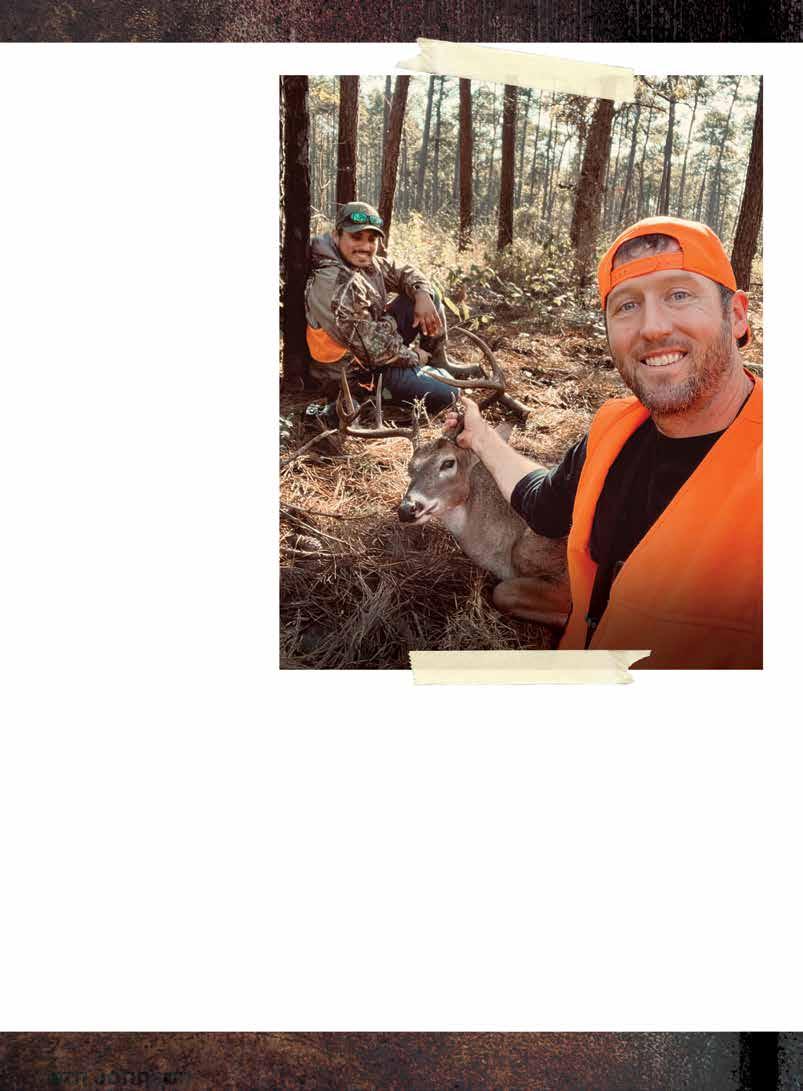
on the vines as he slowly works his way through the thicket.
Picking up my rifle, I braced against the side of the towering pine. I forced myself to be patient for a better shot, as the buck seemed undisturbed in the thick brush. When I saw my best opening, I took the shot. The buck barreled forward about 30 yards before crashing into a pile of beauty berry.
I called my hunting partner, Rudy, and told him I had just shot my biggest public land buck ever. It was still early, the sun just beginning to warm the landscape, and my friend was on his way. I waited for Rudy to arrive and we set out to retrieve the buck together. As we approached the deer, the distinct crab claw on his right beam provided a familiar feeling.
I had pictures of this buck earlier in the year. We sat with the sun on our face and talked about the morning hunt, reminisced about my history in that location and marveled at the buck before us. In a year that seemed to rely on borrowed time, I tagged my best public land buck to date. The best part is I was able to share it with friends.
By Will Leschper
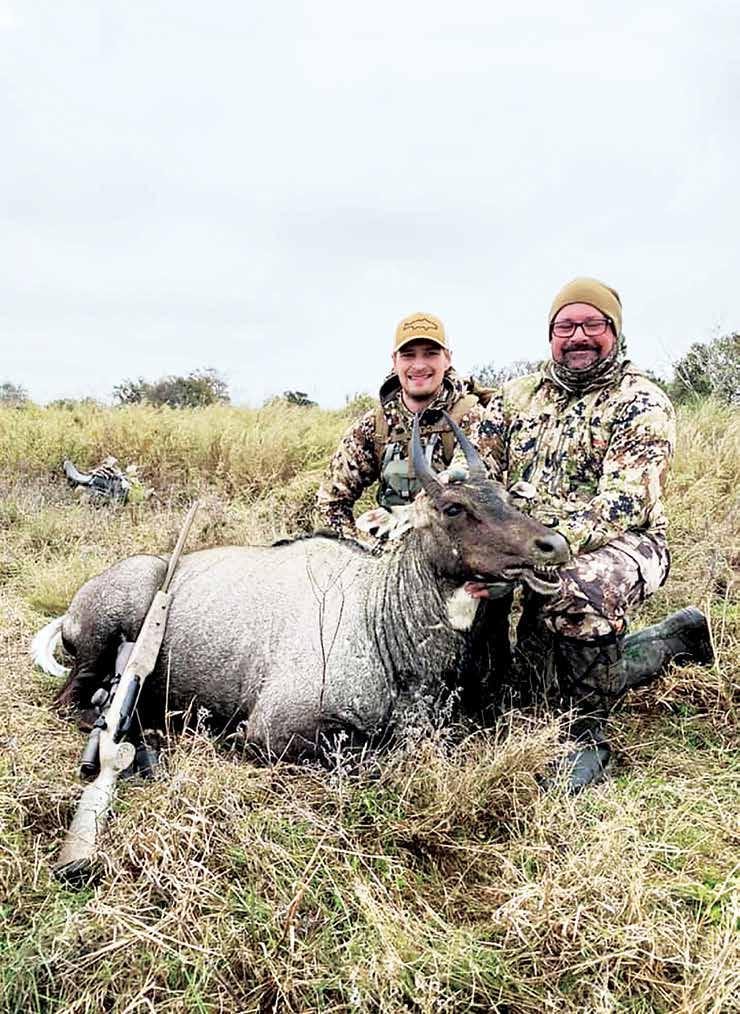
Stout cartridges are necessary for nilgai, and good shot placement is vital.
Nilgai hunting in Texas is downright exceptional. Outside of their native haunts in southern Asia, there’s no place with more “blue bulls.” And, in truth, there are now more nilgai in the Rio Grande Valley than in their original homeland, providing a thriving population of wary game animals that can eclipse 600 pounds or more and are simply top-shelf table fare.
That being said, as with every other hunting pursuit in the Lone Star state, having too much of a good thing tends to get pricy. The cost of any hunt has continued to rise, especially for what could be dubbed a “hunt of a lifetime.” Nilgai certainly qualify as that bucket-list excursion for a vast majority of big game hunters in Texas and across the country, and there are numerous outfitters who target the wiliest of antelope species across a majority of the year.
Due to the private nature of most land in the Lone Star state, the cost of nilgai and other “exotic” pursuits are akin to almost any other hunting option requir-
ing the average hunter to ante up more than it took may have taken in the past. That’s simply the nature of the world we live in.
You certainly can find nilgai stocked on high-fence tracts across the Hill Country and into South Texas. That being said, there are ways to pursue a hunt for less, including one approach that’s been around about as long as we’ve been pursuing any number of wild game species. Here’s a look at how you may be able to bag a nilgai on a budget in South Texas.
Because Texas is more than 95% privately owned, your initial approach may be to book a guided hunt with an outfitter, which could run multiple thousands of dollars just for the chance to bag a bull. That’s certainly the way most Rio Grande nilgai are killed. Nothing wrong with that at all, and all things considered, most guided nilgai hunts have supremely high success rates, largely due to landowners and discerning guides
investing time and effort into making sure antelope of all shapes and sizes are on the landscape they’re hunting.
However, the Texas Parks and Wildlife Department does offer a “hunting lottery” for nilgai hunts through its online public drawing system.
The two “public places” in Texas where you can expect to find plenty of nilgai are the Lower Rio Grande Valley National Wildlife Refuge which consists of multiple tracts west and south of the Raymondville area and the Laguna Atascosa National Wildlife Refuge which includes tracts adjoining the Lower Laguna Madre.
To be specific, the areas included in the federal public hunting program that is administered through the draw conducted by the Texas Parks and Wildlife Department are part of the main portion of the Laguna Atascosa NWR and the Laguna Atascosa NWR Bahia Grande Unit, as well as the Lower Rio Grande NWR La Sal Del Ray Unit, Lower Rio Grande NWR Tecolote Unit, Lower Rio Grande NWR East Lake Unit, and Lower Mature nilgai bulls are much larger than South Texas whitetails, weighing more than 600 pounds in many instances.
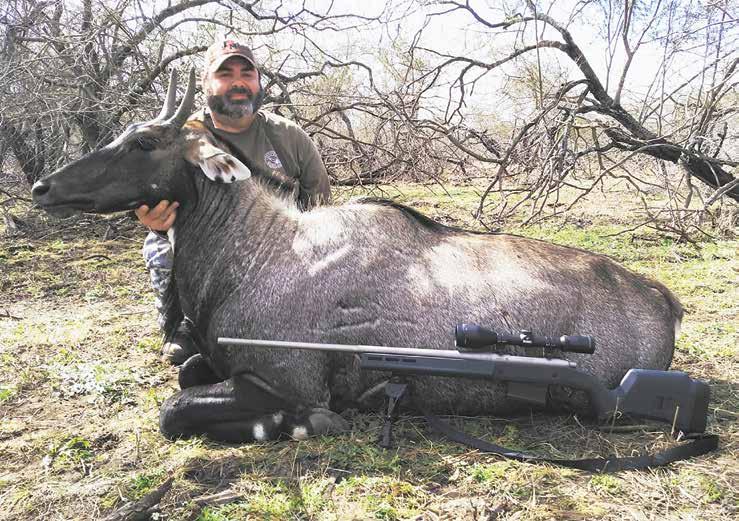
Rio Grande NWR Teniente Unit. Each of these areas offer separate public hunt drawings each year for exotic permits, which is an increase over the original nilgai hunting opportunities that existed even a decade ago.
While most of the nilgai hunts are rifle-only, there have been archery-only excursions added in recent years as more overall hunts have been added to the national wildlife refuge systems in Texas. You pay a fee for each entry and you’re able to put in for hunts at some great locations, including wildlife management areas. There certainly is competition for any public hunt drawing, but this is one avenue TPWD continues to be at the forefront of conservation efforts.
Another drawing open to the public thanks to TPWD is the Nilgai Antelope Safari hunting package that’s offered through the Big Time Texas Hunts program. The hunt is provided by Wildlife Systems Inc., which has been running exotic hunts in South Texas for decades, and allows the winner to bring a guest who can take part in the multi-day experience. Previous winners have killed the exact definition of a big blue bull, all for entering a $9 drawing per entry that goes back into conservation efforts in the Lone Star state.
If you’re lucky enough to be drawn, consider it vital in reaching out to those who know what they’re talking about in all regards: guns, gear, tactics, lodging, etc. You may even get someone to share a GPS coordinate if you’re persistent!
Tag up with a buddy (or two)
Nilgai offer a challenging hunt, plain and simple. You could make a case they’re the hardest game to hunt (and kill) in Texas. That’s especially true on large swaths of the Wild Horse Desert that are seemingly inhospitable for human encroachment. Nilgai are right at home in an environment where they can thrive and have no known natural predators. Nilgai, much like every other antelope species, rely on sight to detect anything they deem to be a threat. Hunting the open country of South Texas
equates to a much different experience than most deer hunters face.
The typical nilgai hunt is done safari style, trekking around in a four-wheel drive or UTV until either a herd of animals or a single bull is spotted, and then disembarking and pursuing on foot. Another approach is spot and stalk, which usually involves hiking over great distances, sometimes measured in miles at the end of a day.
This is where teaming up can be not only fun but also in some cases vital to success and securing a chance at a steady shot. As noted before, the private hunting option for blue bulls in Texas has continued to go up in greenbacks. That typically has a higher ratio for success than going the public route if you happen to be the lucky guy or gal who gets their name chosen and must then adopt the DIY approach.
If you play your cards right – and have a buddy or two interested in sharing the cost – you just might end up with a shared “bucket list” hunting memory you’ll never forget. Splitting an overall expense that can run into the thousands of dollars between two or three folks certainly brings the average down on what could bring a meat yield of hundreds of pounds of what is best described as equivalent to being the tastiest, lean beef you’ll ever enjoy.
Ask around (and play your cards right)
Times have certainly changed on the Texas hunting landscape. Even a gen-
eration ago, it was common and even encouraged, to ask landowners for permission to hunt on their tracts regardless of it was scrub bush, farmland or suited to conducive hunting. Perhaps it worked back then and perhaps it never did, but you don’t know if you don’t try. That’s especially true, even in this day and age.
Hunting for any species certainly doesn’t look the same as it did even a decade ago for a variety of reasons, including monetary ones. There’s big value in everything from exotics and turkeys to deer, ducks and geese, but one thing I’ve always found to work in any situation is courtesy. That means while you’re in the field or trying to get into the field.
Nilgai don’t mind fences much, and with such a hefty South Texas population that’s only expanding, the hefty critters can now be found across hundreds of thousands of acres of some of the most desolate-looking country imaginable. Some of that landscape certainly may be leased out for hunting but there are plenty of areas that aren’t and undoubtedly hold good numbers of traveling nilgai. There’s absolutely nothing wrong with asking whoever happens to own a parcel of land if they’d be willing to let you hunt. That’s especially true if you’re looking to find a massive antelope on a budget.
You’d be surprised how hospitable some landowners are if you’d be willing to pitch in with things that need to be fixed. That extra toil could end in the hunt of a lifetime if you’re willing to help!
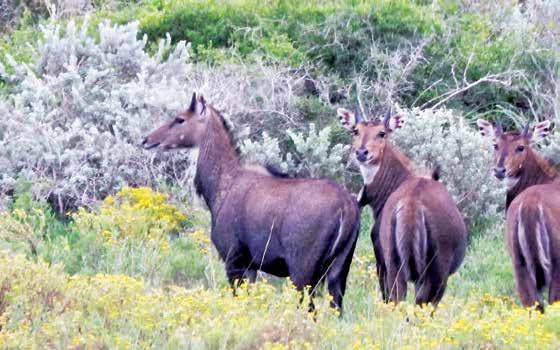

BY JOHN GOODSPEED
Many of this year’s all-terrain vehicles and utility terrain vehicles, or side-by-sides, are designed new from the ground up or receive such enhancements as more storage for personal items and cargo.
One manufacturer adds to stealth, billed as the world’s first mass-produced electric ATV while another refines amphibious vehicles that can tackle land and water.
An additional company celebrates 40 years of building ATVs with retro design touches on a venerable model.
A special package for hunters adds 18 accessories to increase capability, comfort and vehicle protection.
Manufacturers’ suggested retail prices are listed, but may not include extras, special packages or delivery and other fees.
www.argoxtv.com
Frontier 650 Scout 6x6, $15,399
While Argo does make ATVs, there is nothing new in the pipeline for 2026 — but the Frontier 650 Scout 6x6 makes up for it. Several of Argo’s ATVs seat two passengers, and this one does, too. While it can tackle land and rough terrain, it’s also amphibious and more compact that other Argo models that can float. The one-piece lower body can cruise over snags, stumps and outcrops in swamps, ponds and rivers. There also are side seats in the rear cargo area. The front steel rack provides room for more gear. Powered by a V-Twin engine and finished in TrueTimber Prairie camo, the 6x6 is propelled by an InstantTorque Clutch and a transmission that operates like skid steer for maneuverability with zeroradius turns. It comes with a 2,500-pound winch, brush guard, steel rims and low-pressure 24-inch tires with a paddle design.
www.can-am.brp.com/off-road

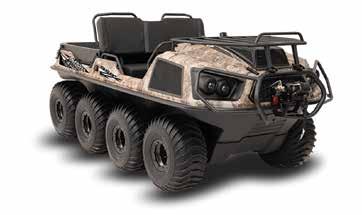
The big brother of the Frontier series features a similar but larger one-piece lower body that also makes it amphibious. Powered by a 950cc V-Twin engine, it also features an InstantTorque Clutch but with an Admiral transmission that uses dual differentials. Braking force is applied to the differentials for steering for a different driving experience and a zero-turn radius in low range similar to a skid steer. The eight 25-inch, low-pressure tires with chevron treads increase power in thick mud and propulsion in water. The nine-inch bead-lock steel rims ensure the tires stay mounted. Dressed in TrueTimber Prairie camo, it comes with steel front rack, 3,000-pound winch, brush guard and a rear cargo box.
Billed as the world’s first mass-produced electric ATV, this new model exudes stealth. The crunch of rocks is muffled with noise-reducing XPS Recon Force tires. It also features optimized suspension and a low-noise cooling system. Powered by the same modular Rotax EPower power pack as the electric motorcycles and snowmobiles from Bombardier Recreational Products — BRP — it delivers 47 horsepower and 53 poundfeet of torque with up to 50 miles of range and speeds up to 50 mph. It also has three ride modes — normal, sport, work — and charges from 20 percent to 80 percent in 50 minutes using the on-board 240-volt Level 2 charger. Suspension is similar to a gasoline-powered ATV with double A-arms front and rear. Ground clearance is 12 inches. It can carry 120 pounds on the front rack, 240 pounds on the rear and can tow 1,830 pounds. The lithium-ion carries a five-year, 12,427-mile warranty.
The Defender series gets a groundup overhaul for 2026. The new HD11 999CC inline three-cylinder Rotax ACE engine delivers 95 horsepower and 70 pound-feet of torque. A new continuously variable transmission (CVT) and pDrive primary clutch are designed to improve low-speed power and reliability. The threeseater Limited sits about in the middle of the line, which includes ones with no doors, half doors, full doors and four doors. The Limited package decks it out automotive style with an HVAC system, hard top and glass all around. The package includes a rear camera, 10.25-inch touchscreen display, a 4,500-pound winch, mud flaps and floor mats. Ground clearance is 14 inches. The cargo box can hold 1,000 pounds. It can tow 2,500 pounds.
For 2026, the FourTrax series returns with the Rancher, Foreman and Foreman Rubicon, all designed in Ohio and manufactured in North Carolina. The midsize Rancher is available in four trims. The one shown here in TrueTimber Atera Camo is the top trim. DCT is the automatic dual-clutch transmission. IRS stands for independent rear suspension, which has more than eight inches of travel and nine inches of ground clearance. The electric power steering, or EPS, is speed- and torque-sensitive and reduces steering effort and kickback through the handlebars. Other models in the Rancher line are the two-wheel drive in Hero Red or Black Forest Green ($6,249), the 4x4 ($7,349) in the same colors plus TrueTimber Atera Camo ($7,849), and the 4x4 Automatic DCT EPS ($8,599) in Hero Red, Black Forest Green and Slate Gray.
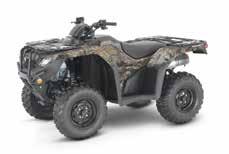
The Brute Force line returns with four new trims including the one pictured here, which includes a front brush guard, hand guards, TrueTimber Strata Camo bodywork and a Warn VRX 25-S Powersport Winch. The other trims are the 750 ($10,999), 750 EPS, ($11,499) and the 750 SE ($13,299). Each model is powered by the 749cc V-Twin engine and includes a 4.3-inch color display. Front and rear suspensions are double wishbone with front travel at 6.9 inches and rear, 7.4 inches. Ground clearance is 9.6 inches. The front rack can carry 88 pounds while the rear can pack 176 pounds. Towing is rated at 1,250 pounds.
For the new model year, the midsize side-by-side Pioneer 700 series gets more storage compartments for personal items and cargo, a USB-C port, Kenda Mastodon tires and enhanced debris-penetration protection. The Pioneer 700 Forest, which comes in TrueTimber Atera Camo, also features a Honda winch, a larger steel front bumper and EPS. Like all Pioneer 700s, it is powered by a 675CC engine and automatic transmission. Both ends of the suspension are independent double wishbone. Front travel is 7.9 inches; rear, 9.1 inches. Ground clearance is 10.4 inches. The bed can hold 1,000 pounds. It can tow 1,500 pounds. The six trim levels in the 700 series are three two seaters and three with four seats.
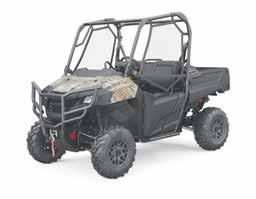
The top Mule in the line features a 993cc diesel engine that produces 24 horsepower and 38.3 pound-feet of torque. Other features include speed-sensitive EPS, a tilt steering wheel, a steel cargo bed, CVT transmission and an electrically selectable 2WD/4WD dual-mode rear differential with a locker. It also boasts the Trans Cab system that converts from single-row seating to double row. The cargo bed can hold 999 pounds as a three-seater and 350 pounds with six people. The front and rear suspension is double wishbone and can travel 8.7 inches. Ground clearance is 10.2 inches. It can tow 2,000 pounds. It comes in Super Black.
www.kubotausa.com
Sidekick, $15,299
The Sidekick is Kubota’s proven side-by-side, but now it can be equipped with the Marksman Package, which is outfitted with 18 accessories to boost capability, vehicle protection and shelter from the elements. The package includes a sport roof, a flip-up windshield, side mirrors and three six-inch LED roofmounted work lights for the front and rear, a 3,500-pound Warn VXR winch and an extender on the steel cargo bed, which can hold 1,000 pounds. Items for vehicle protection
www.polaris.com
Sportsman 570 Premium 40th Anniversary Edition, $10,199
Polaris is celebrating 40 years of ATVs with the Sportsman 570 Premium 40th Anniversary Edition, a limited release with premium paint and badging with 1990s-inspired graphics. The Premium models, inspired by the 1996 Sportsman 500 that laid the foundation for today’s 570 lineup, also come with a 3,500-pound winch. The special edition trim also includes 26-inch Duro tires on 14-inch aluminum wheels, front CV guards and active descent control. Standard 570 features include EPS, on-demand fourwheel drive, 8.2 inches and 9.5 inches of front and rear suspension travel, respectively, and up to 270-pounds of front and rear rack carrying capacity. Ground clearance is 11.5 inches. Accessories include heated seats and new fender flares.
include A-arm guards, front skid guard, brush guard and tail lamp guards. The Sidekick line’s 851cc engine produces 54 horsepower and 48.7 pound-feet of torque through a CVT transmission with a limited-slip front differential and a locking rear. Top speed is 40 mph. Ground clearance is 9.4 inches.
The compact two-seater comes with a dump box that can carry 300 pounds, a 2,500-pound winch and plenty of maneuverability with a 73.2-inch wheelbase and a 13.5-foot turning radius. Powered by a 567cc, 28 horsepower engine, it can tow up to 1,500 pounds. Ground clearance is 10 inches. Updated features, colors and graphics are incorporated across the 2026 Ranger lineup. The XP 1000 line gets new 29-inch Pro-Armor XTerrain tires and NorthStar models offer an enclosed cab with an HVAC system. The General XP lineup, starting at $17,999, returns in Sport, Premium and Ultimate trims in two- and four-passenger configurations. The Ultimate ($31,999) includes Ride Com mand, a GPS off-road mapping system with more than 1.3 million miles of trails and features displayed on a seven-inch screen, and an upgraded Rockford Fosgate Stage 3 audio system.
The Rugged Package takes the KingQuad 750AXi to a new level by including an LED light bar for added low-light visibility and front and rear bumpers constructed with steel tubing welded into angular shapes and coated with a black wrinklefinish powder-coating that matches the steel racks. Also new is the Armored Blue Gray bodywork and black aluminum
wheels. The 722cc single-cylinder engine is tuned to deliver stout low- to mid-range torque. The Quadmatic CVT transmission provides an advanced engine-braking system. Ground clearance is 10.2 inches. It can tow up to 1,322 pounds and includes a ball mount, a hitch pin and an R-clip.
continued on next page
www.yamahamotorsports.com
The aluminum wheels complement plastics painted in Moss Grey/Tactical Black while the XT-R package includes a 2,500-pound Warn winch and exclusive graphics. Geared for low-speed cruising, quiet operation and midrange power, the 686cc engine features a high-mounted air intake that keeps water, mud and debris at bay. Power goes to the 25-inch Maxxis tires through the Ultramatic transmission, a CVT system backed by a 10-year belt warranty. Protected by a fulllength composite skid plate, the independent double-wishbone suspension front and back allows up to 9.1 inches of travel in the rear. Ground clearance is 10.8 inches. The steel cargo racks with a wrinkle paint finish can pack 110 pounds in the front and 198 pounds in the rear. It is rated to tow 1,300 pounds.
This three-seater with a suntop includes a handhold, padded headrest and a three-point seatbelt for all. Driver aides include EPS, an adjustable seat, a digital instrument panel with an LCD display for information at a glance and a dash-mounted shift lever and parking brake. The drive system allows switching between two-wheel drive, limited-slip four-wheel drive and fully locked differential four-wheel drive. The throttle and brake pedals are designed for comfort. It is powered by the same 686cc engine and Ultramatic CVT transmission as the Kodiak 700. The independent double-wishbone suspension front and rear can travel up to 8.1 inches. Ground clearance is 11.8 inches. The 600-pound steel dump bed features rails with integrated mounting points for installing Yamaha accessories. It can tow up to 1,500 pounds.
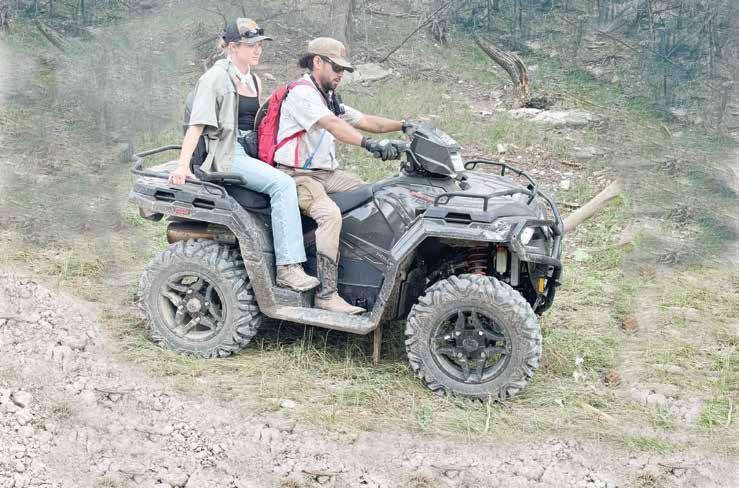






By Elizabeth Yates
As a student from Sugar Land, Texas, I have attended three Texas Brigades camps over the last two summers. In 2024, I was a cadet at the Waterfowl Brigade in Garwood, Texas. In 2025, I returned to the Waterfowl Brigade as an Assistant Leader, and I also attended the Coastal Brigade in Anahuac, Texas, as a cadet. No matter what position I hold, Texas Brigades summer camps are always a blast!
In July 2025, I had the opportunity to lead a flock of five cadets at the Waterfowl Brigade at the Pintail Hunting Club in Garwood, Texas. My flock had to learn to work as a group for many activities, but we also had fun together and made countless lifelong memories. By the end of the week, we were treating each other like we had been best friends for years.
In my experience, marching is the activity that fosters the most teamwork and camaraderie amongst flocks at camp. Everyone has to move together, yell together, and stop together. If one person is offbeat, it can disturb the rhythm of the whole group. Beginners typically catch on fast, but not without the help of the older, more experienced cadets who step up and lead the group. As an Assistant Leader, I witnessed one of the cadets in my flock—without being asked—work individually with the other cadets who were struggling to improve their form and give them confidence in their marching abilities. It was beautiful to watch the whole flock improve as one cadet blossomed into a leader. The entire flock also bonded over writing cadences. We sat at dinner every night and
brainstormed ideas together. We got to know each other, cracked jokes, and shared lots of laughs. My fondest memories of camp often involve marching and cadences.
One of my favorite activities at Texas Brigades camps is nature journaling. Cadets have allotted times to journal, usually at sunrise and sunset. Cadets are encouraged to write or draw whatever is on their mind or what they observe
around them. The intention of dedicated moments for journaling is to promote observation skills, reduce stress and anxiety, and provide a quiet time for reflection.
At sunset and sunrise, there’s no shortage of beauty in the natural world. Personally, I love challenging myself with writing a poetic description of my surroundings. Doing so sharpens my writing skills and helps me appreciate
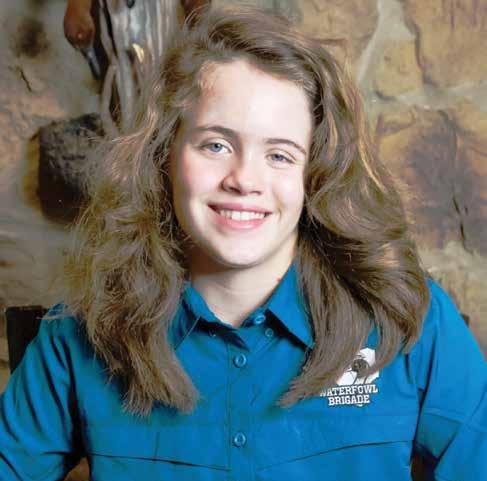
the outdoors more. I also enjoy journaling because it allows me to put away the world and see the bigger picture in many situations. It can help reset my mind and eliminate my stress. Whether I’m tired, bored, anxious, or happy, there’s always something to journal about.
Texas Brigades camps are known for being action-packed and fun. However, they are also academic. At camp, quite a bit of time is spent in the classroom learning about conservation. But Brigades camps don’t leave it at that.
Cadets also spend a large portion of their time in the field doing hands-on activities. For me, the true learning takes place when I step outside and get my hands dirty. At Waterfowl Brigade, we were tasked with creating a moist-soil management plan for a plot of land after we learned about management goals and techniques.
At Coastal Brigade, we got to go out on Galveston Bay and pull oyster dredges

and shrimp trawls behind a boat. We also dissected fish and planted sea grass. At both camps, the field activities enriched my education the most. Those experiences are the ones I will never forget.
Finally, Texas Brigades camps would not be the same without the amazing instructors who teach us about conservation and wildlife management. They’re all knowledgeable and experienced in their fields, and many of them are experts at certain topics. Each instructor brings something unique to the table. Some instructors are good at species identification while others are wetlands experts and wildlife management pros. Others are also skilled at wa-
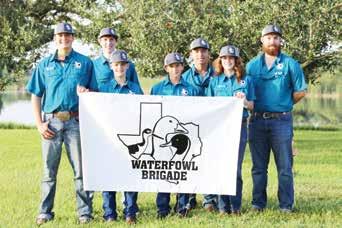
terfowl banding and population surveys. At the Coastal Brigade, we even had two game wardens come speak to us about their jobs. The diversity of knowledge amongst the instructors allows for deep discussions over a broad range of subjects. No matter what you’re interested in, there’s something for everyone at Texas Brigades!
Texas Brigades is a conservation-based leadership organization which organizes wildlife and natural resource-based leadership camps for participants ranging in age from 1317. Its mission is to educate and empower youths with leadership skills and knowledge in wildlife, fisheries, and land stewardship
to become conservation ambassadors for a sustained natural resource legacy. Texas Brigades hosts nine summer camps throughout June and July. The application period for camp runs Nov. 1 through March 15 of each year. Visit texasbrigades.org or call 210-556-1391 for more information.

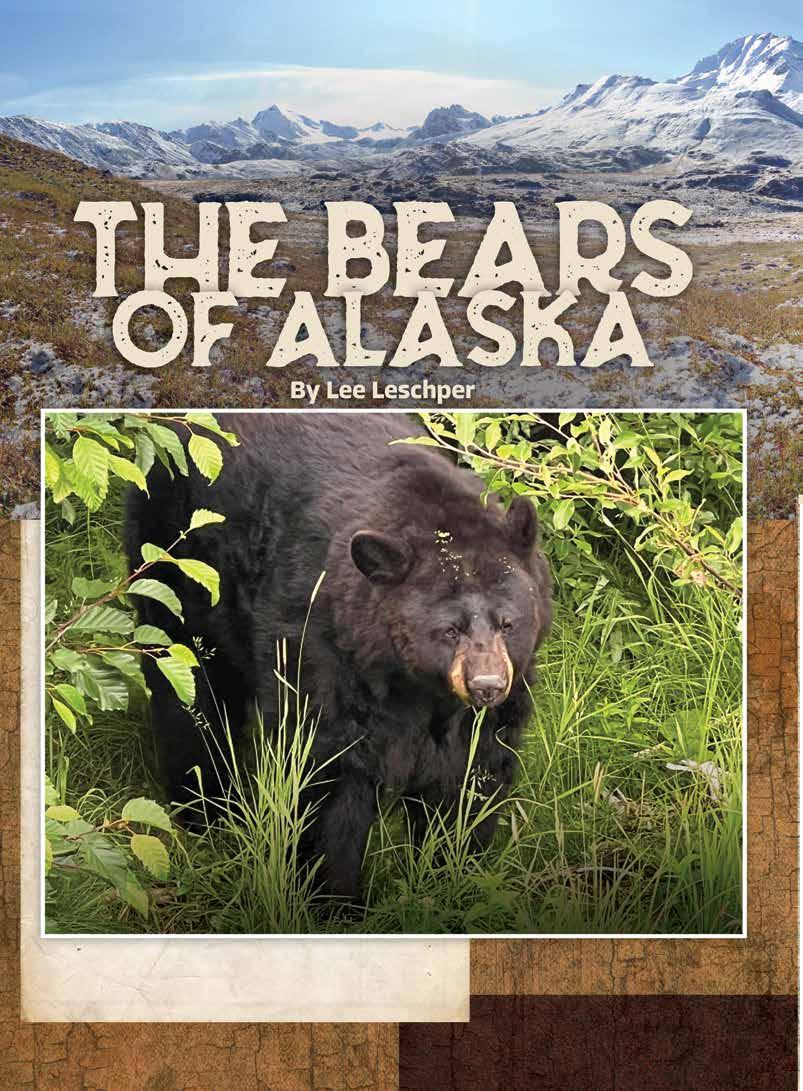
“There’s a bear!”
There are few words outdoors that carry more excitement, urgency or sometimes panic. Whether it’s your first or just first time today, any encounter with old Ursus in the woods, it’s an adrenaline-charged moment as old as our cave dwelling ancestors. While there are bear hunting opportunities in the Lower 48, as Alaskans call the rest of the country, for serious bears by the numbers and the biggest bears, you have to look north to Alaska.
Alaska has at least 40,000 brown and grizzly bears and more than 100,000 black bears. There’s no census done and those numbers are estimates. But certainly, Alaska has a plenty of bears.
About 1,450 browns get taken by hunters each year, including some now taken over bait. The state relaxed regulations for baiting grizzlies to try to eliminate moose killers. Each spring, many grizzlies will turn to a diet of exclusively moose calves for 30 to 60 days.
Brown and grizzlies are the same species, varying in size because of the country they live in. Brownies live within 75 miles of tidewater. Beyond that line, the bears are considered grizzlies.
Because brownies grow to huge dimensions on a steady diet of salmon, they can grow to more than 10 feet squared, length plus width, divided by two. They can weigh more than 1,000 pounds and are the largest land predator in North America.
A 10-foot bear is in the class of a 25-inch whitetail or a 40-inch wild sheep. They exist but are rare beasts. I’ve been blessed to hunt both species often and can assure you, every mature bear is a trophy. Especially in an alder jungle at hand shaking distance!
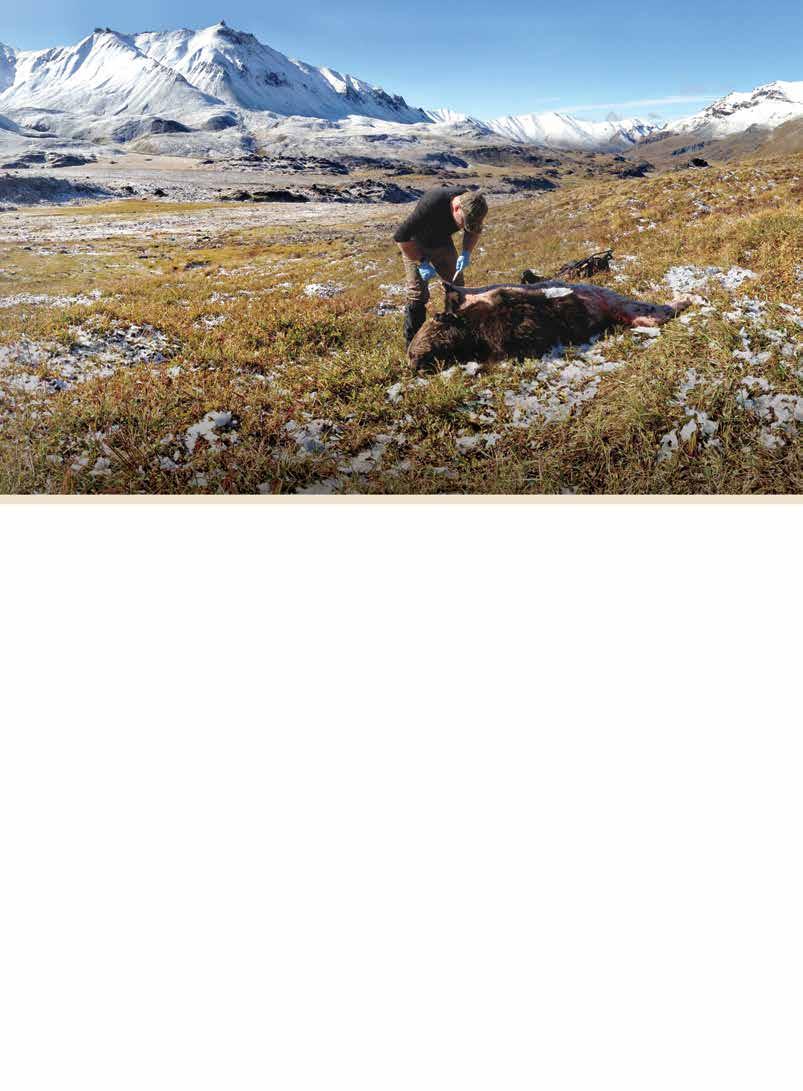
Big bears are where you find them. Admiralty Island in Southeast Alaska has more brown bears than anywhere on Earth, but because it gets more hunting pressure, many smaller and immature bears get taken there. Highly-regulated Kodiak Island has lots of bears and many are true giants. Kodiak bears for some reason also have genetically larger heads, hence scoring well in the record books. There are also big bears throughout the Alaska Range.
Why do we hunt bears?
Certainly, they are an amazing trophy. And they give us reason to explore some of the most beautiful, rugged country on the planet. There’s also the excitement of hunting for something that will fight back.
While we don’t consider bears a primary food staple, black bears can be quite edible, even tasty, if they’ve gotten fat eating mountain blueberries. Brown bears are seldom eaten in Alaska, although many Alaska Natives relish a fat old grizzly. Of course, they also relish fermented walrus flipper. I ate the first brown bear I shot in Alaska, and it was edible, but not something I’d plan for my regular diet.
Perhaps we hunt bears because they’re hunters, too.
Is bear hunting dangerous? There’s an element of risk, because they’re well equipped to do harm, and are several times bigger than we are. A wounded bear is dangerous until it’s dead. Most mauling victims aren’t hunters, but unsuspecting hikers or fishermen who surprise a bear protecting a food cache or cubs.
There’s far more danger from the small planes and boats you’ll travel in. And the monsoon-hurricane-blizzard weather Alaska dishes out. A famous hunter this year tagged a nice southeast brown bear with a bow, but almost died of hypother-
mia getting back to camp after a rainy night, skinning in the dark, and hiking out through flooded streams.
But as you read this, there’s still time to plan an Alaska bear hunt for this fall. A non-resident needs to hire a licensed guide, or hunt with an immediate relative who’s a resident, to hunt brown bears in Alaska, as is required to hunt Dall sheep or mountain goats. Non-residents can hunt black bears without a guide, and because of that, and the lower cost of a tag, I always recommend black bears for the first Alaska bear hunt.
With or without a guide, there are some basics to remember. To hunt bears, you’re really hunting groceries. Bears are omnivorous opportunistic vacuum cleaners.
Regardless of season, they’re going for the groceries, either recovering from hibernation or preparing for hibernation. Their life is really divided into a few stages—hibernation; out of hibernation and starving; eating all the riches of Alaska summer; and fattening up for hibernation.
Alaska has spring and fall bear seasons, and for each, the bears will be in a different place. Each time a new food source comes into prime, the bears come with it. When the bears first come out of the den in the spring, the menu is greens: new grass, skunk cabbage for a tonic, sweetened occasionally by a winter-killed moose or dead whale.
In late May, moose calves are being born and the bears, especially grizzlies, turn into ravenous predators that can and
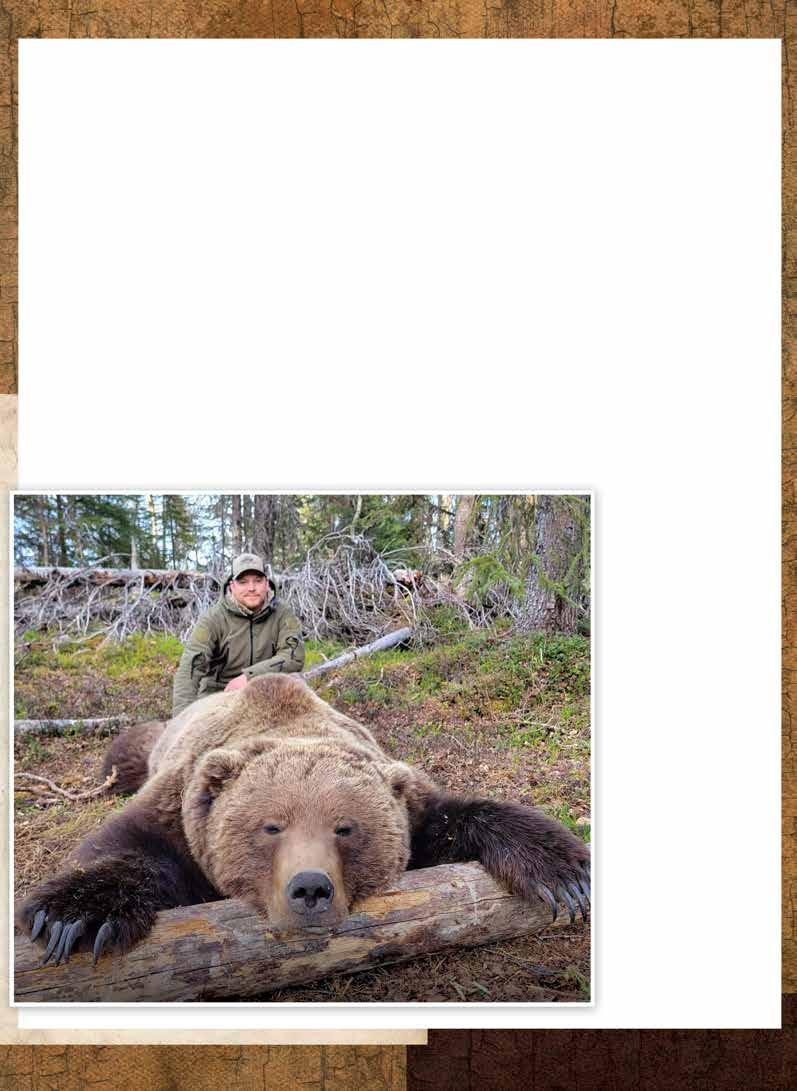
will kill a calf every day. Grizzlies have chased moose calves through my Anchorage yard more than once. One killed a couple calves right in my yard several springs ago.
Through the summer, bears become true omnivores, eating everything. Come fall, they shift to spawning salmon, especially the brown bears. As the first frost hits the high country, they’ll also gorge on wild fruit, especially blueberries. But for the giant coastal brown bears, it’s the late summer and fall runs of calorie-rich sockeye and silver salmon that helps them grow huge.
Hunting an alder-choked salmon stream is an adrenalinecharged adventure. Visibility is often only a few feet. The air is heavy with the smell of rotten salmon. Every creek is filled with dying and spawning salmon. And every splash around the next corner might be a feeding grizzly. When you spot that bear, ideally before it’s spotted you, you have brief moments to judge the bear and decide whether to make a shot, before it decides the issue for you.
Perhaps the most important lesson about bears is they’re all individuals. Some are timid giants, some are bullies, some have schizophrenic split personalities, which one minute means timid and the next minute means enraged. You can never be sure which bear you will meet.
An absolute fact with bears is each one has a personal space, within which they will all fight. It might be 10 feet or 100 yards but when you get too close, you better to ready to fight. Because so much of Alaska is alder thickets, rain forest and dark timber, you can easily be within a bear’s too-close zone without even knowing it, until it’s too late. Which is somewhat the joy and excitement of hunting them.
One other aspect of fall bears—they do start to smell like old fish.
A dear friend was stationed in Alaska after World War II. With a fellow solder, he went afield one fall to bear hunt.
When his wife met the returning hunters back at the dock, they were proudly packing a big brown bear hide and head. She took one whiff of the bear and bear hunters, stinking to high heaven of rotten salmon, and made all three ride on the outside bumpers all the way home!

The entrance to Black Gap WMA is clearly announced as well as the route to headquarters.
Its name comes from a distinct feature in surrounding landscape. The noticeable break cutting through two dark mesas where the Sierra del Carmen and Serranías del Burro mountain ranges intersect is known as Black Gap.
Texas Game and Oyster Commission (now Texas Parks and Wildlife Department) originally acquired 54,000 acres in far West Texas’ Brewster County in 1948 from the Combs Cattle Company. Subsequent land additions now encompass 105,708 acres forming the Black Gap Wildlife Management Area, the state’s largest WMA.
Black Gap borders Big Bend National Park on its northwestern boundary while sharing approximately 25 miles of Rio Grande River with Mexico’s state of Coahuila. Some of the lowest Chihuahuan Desert elevations are located within Black Gap. It’s home to one of few re-established herds of desert bighorn sheep, which adds to its uniqueness.
Similar to all WMAs, Black Gap is primarily a research facility with demonstration projects to aid natural resources for both public and private lands. Much has been learned over three quarters of a century studying plant, wildlife, rainfall and all else on its acreage. Like most WMAs, various long or short-term projects take place important to ecology and education.
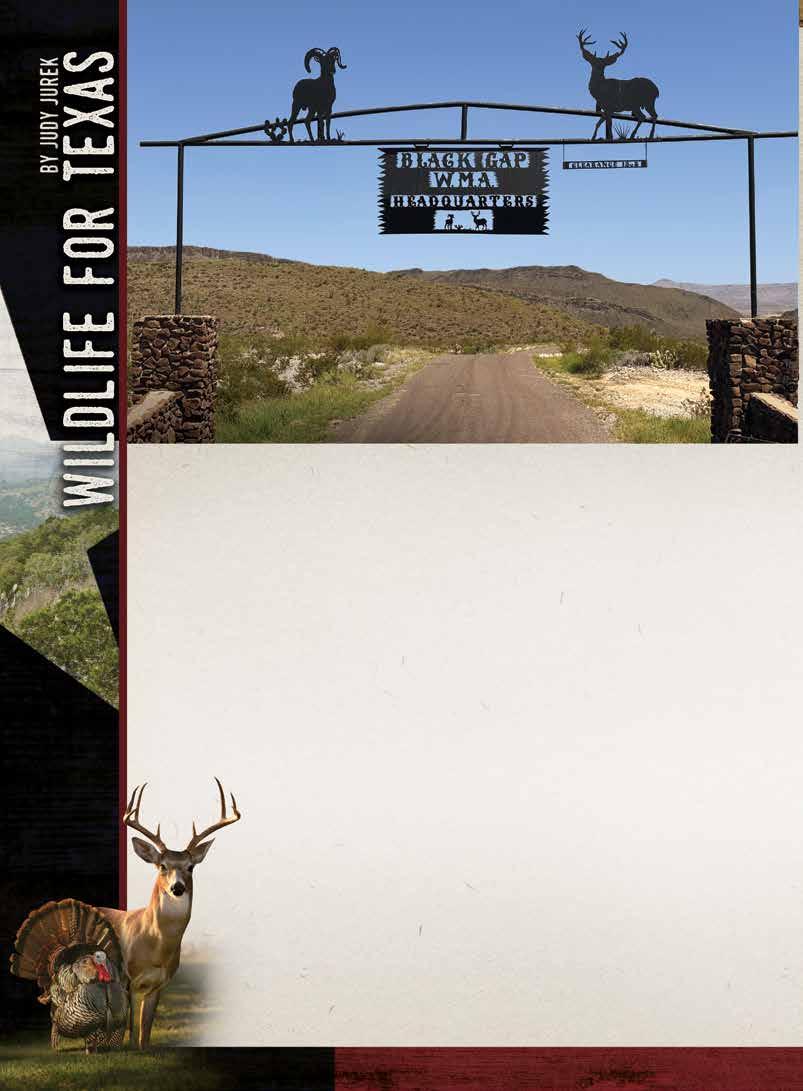
TPWD Area Biologist Travis Smith manages Black Gap WMA. “I did my internship with TPWD here and fell for the place. Its peace, quiet, and expanse drew me into it,” he said. “I worked as a technician and when a biologist opening was posted, I went for it. Been here my entire 18-year career.”
Smith said despite its 11-inch average rainfall, the biggest challenge is the remoteness and area size, especially when equipment needs repair. With a chuckle, Smith added, “We’re not close to anywhere, or anything. Marathon and Alpine are the nearest towns, but they’re not close.”
Back in the late 1800s, this country was used to raise sheep and goats, and a few cattle. The desert mountains supported a native bighorn sheep population, freely hunted to reduce competition with domestic livestock. In 1903, hunting and killing bighorn sheep was outlawed.
By the 1940s, the West Texas area had been overgrazed and overhunted due to few surface water areas. The mule deer population was very low and it was estimated only 150 bighorn sheep were alive in 1941.
From 1949-1951, 300 mule deer were trapped near Sanderson and released on the WMA to help the native population. By 1955 there were approximately 900 mule deer, so the first public hunt took place. Research conducted in 1957 to 1966 involving seasonal mule deer movement and utilization of artificial water sites proved instrumental for the future.
Efforts to re-vegetate areas have taken place over the years. Water is the most essential limiting factor in this desert territory. The 1950s decade-long drought helped realize water importance to everything in this region. Artificial water catchments called guzzlers were tested and proved vital. Three designs include slickrock, concrete, and conventional.
Today, Black Gap hosts 64 manmade water sources, many built and donated by the Texas Bighorn Society. These guzzlers are invaluable to all wildlife but especially the bighorns, black bears, and mule deer. Native and migrating bird species as well as small game and reptiles use them, too.
Beginning in 1957, 16 bighorn sheep were brought from southwestern Arizona to Black Gap. A special 427-acre pen was built to contain them for studies. By 1970 there were 68 sheep with 20 being released in 1971 to open range.
Predation, nutritional stress, and disease affected Black Gap bighorns. The last native desert bighorn ewe was seen in the Sierra Diablo Mountains in 1958. In 1977, six sheep were imported from Mexico for herd supplementation. The last free roaming Black Gap sheep were seen in 1985.
Between 1994 and 2000, bighorns were transplanted from Nevada and Elephant Mountain WMA. Today the bighorn sheep population appears to be doing well. Numbers are estimated around 140 in 2025, by the time of this article being
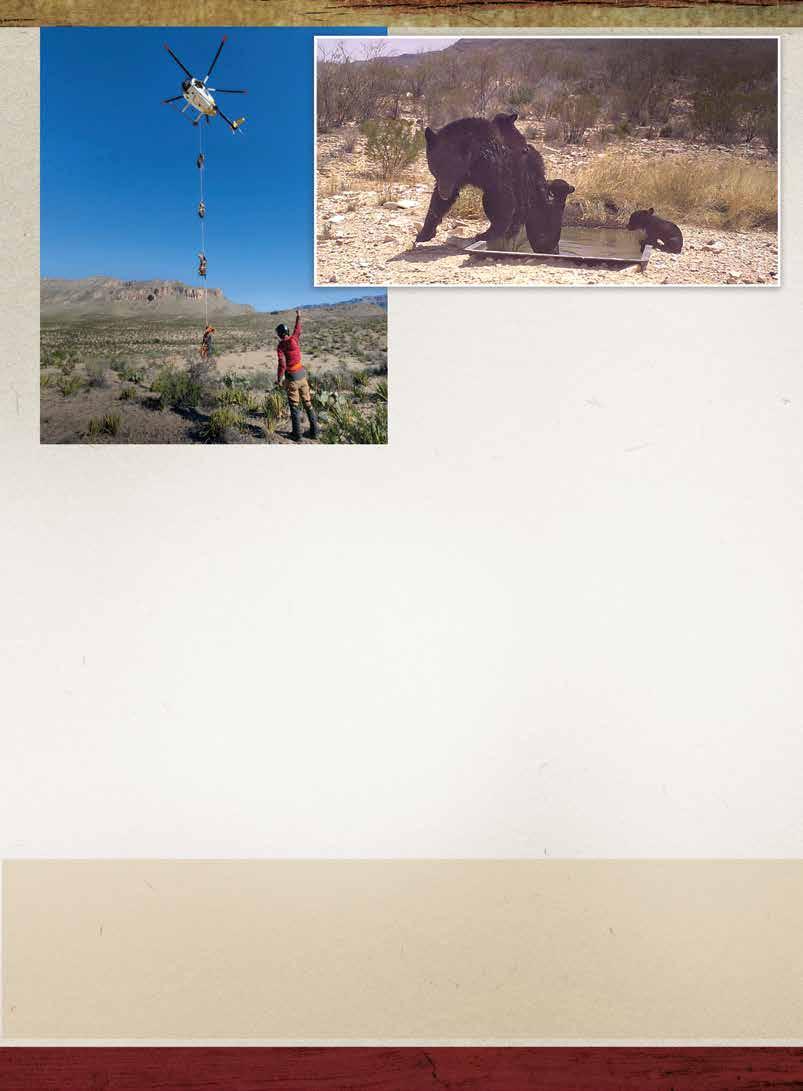
written. Their range has expanded into Big Bend National Park and surrounding private properties both in Texas and Mexico.
Non-native aoudad, escapees from game ranches, have proven adaptive all across the Lone Star state. Similar to feral hogs, their population has exploded, becoming a menace in many areas to wildlife and domestic livestock. Aoudads compete with bighorn sheep for habitat, and are a threat due to being vectors of M.ovi (Mycoplasma Ovipneumoniae), a deadly pneumonia.
Black Gap tries to control aoudad numbers. As part of the WMA studies, Texas Tech University monitors water resources to see if they may be primary sources of disease transmission as well as infection.
As for the WMA’s other species, Smith said, “We have a healthy black bear population. We’re happy to report they seem to be doing well. The Borderlands Research Institute has been conducting bear research here and other places. Our mule deer population is good.”
“Javelina and predators (coyotes and bobcats) are scattered throughout Black Gap and offer hunting opportunities along with mule deer. With an Annual Public Hunting Permit, we host duck, dove, and scaled quail hunts. For bird watchers, we’re a long way from civilization but we have lots of unusual birds at various times of the year.”
Black Gap offers hiking and horse trails, but doesn’t allow off-road vehicles. Canoeing and kayaking the Rio Grande is very popular, although the river’s water level may fluctuate due to rainfall or drought, resulting in some adventures better than others. For stargazers, the entire West Texas area is most protective of their dark sky reputation. Witnessing it firsthand is an experience all its own. So make plans and head out for an adventure at Black Gap WMA.
There is one campsite at the WMA headquarters. Access to Maravillas and Horse Canyons, the Rio Grande and headquarters campsite is restricted, and only available March 1 to Aug. 31.
Visitors must bring their own water, pack out all trash, and camp only in designated sites. Campfires must be in provided fire rings, with only “dead and down” wood allowed to be collected as firewood. Bring your own food, first-aid supplies, and sunscreen. A basic car repair kit for emergencies is recommended.
Horses are allowed in designated campsites and must be haltered on a lead; portable pens recommended for overnight stays. All horses must prove negative on a Coggins test. Bring water for horses or plan to water in the river. Be aware of venomous snakes, insects, mountain lions, black bears, and flash flooding. Cell phone service is very limited or non-existent.
For information on public hunting for ducks, dove, quail, predators, javelina and mule deer (archery and gun), visit tpwd.texas. gov/huntwild/hunt/ or call 432-376-2216.



Igot an e-mail a while back from a fan of Texas Trophy Hunters who had watched our TV show featuring Al Brothers and me, titled “Legends.” The show centered around two old friends who have known each other for more than a half-century. We went to Texas A&M together, worked in the business of wildlife management together, and have hunted all of the big game animals of Texas together—for well over 50 years.
The e-mail read, “To the Editor: I just watched you and your buddy (Al Brothers) in the latest show ‘Legends.’ You guys are terrific together and very watchable. I’m interested in that cowboy hat you had on. It had a metal star and feather on the band, and two vent holes on both sides. Please tell me the maker and style number/name on your hat. Thank you and keep hunting strong.” Chris.
I felt humbled someone had shown an interest in the hat I wore on the TV show. Actually, it’s a very prized possession that I have worn every winter for more than 40 years. It is a beaver felt 3-inch High Brim hat made in Victoria, Texas. Al Brothers traded the hat to me in 1968 for something of value (I can’t
remember what).
At the time, the hat was worth about $25, but today, after many years of wear and tear; after memorable hunts for deer, antelope and elk; after trips to wildlife conferences all over the South and Southwest; a jaunt to the Boone and Crockett Club black tie dinner in New York City; my retirement party with my Texas Parks and Wildlife friends, and a few moonlit nights on the backroads of Texas, that hat is priceless. Even Donald Trump doesn’t have enough money to buy my old hat!
I grew up in East Texas wearing a hat in high school. I’ve worn a felt “cowboy” hat all my adult life. A hat is part of the Texas trifecta—boots, hat, and a pocketknife. I’d feel naked without them. However, the hat in question by the person who sent the e-mail is a special hat, and its origin and style needs explanation.
As I said before, I got that hat from Al Brothers in 1968 and wore it as it came in the box for several years. It started showing some wear in about 1975, so I decided to give it some character by putting a leather hatband on it, adorned with
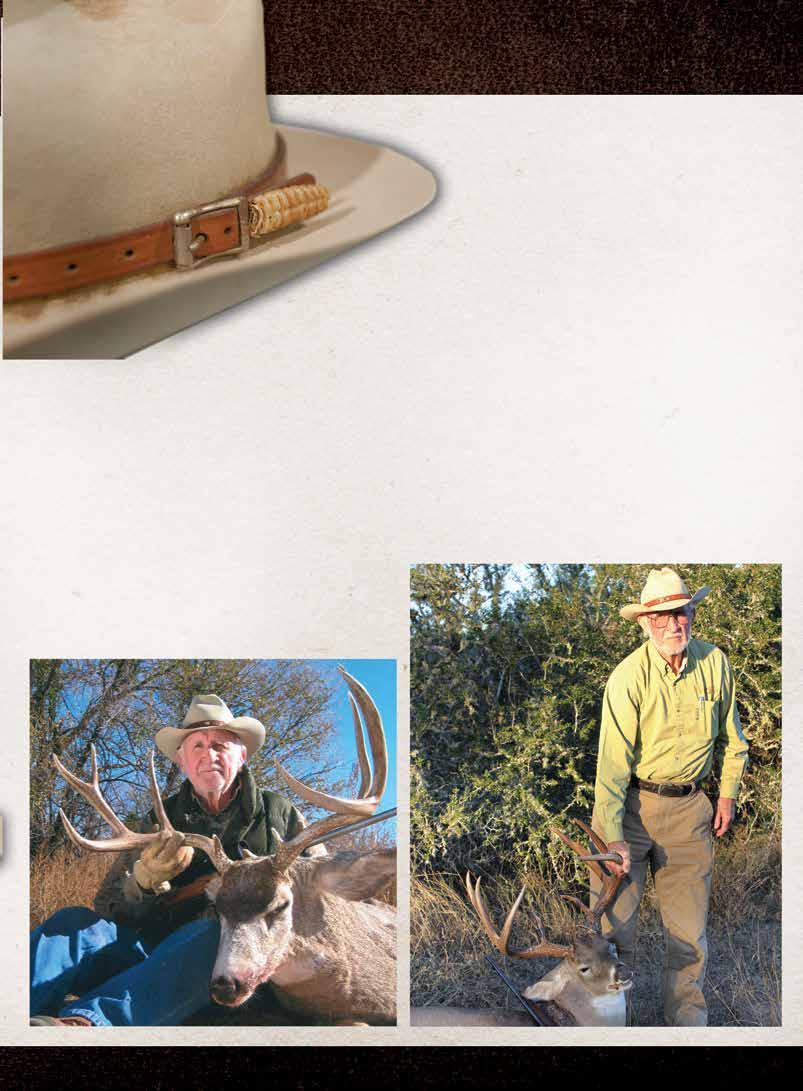
some rattlesnake rattles and a “gold” star, which was a commemorative piece from the Lone Star Brewery in San Antonio. The leather band was originally a deer collar for attaching a small bell to a deer. It was salvaged from a deer research study, circa 1955, on the Gus Engeling Wildlife Area near Palestine, Texas. I “dolled” up the band by punching small holes and adding a “silver” buckle. The diamondback rattlesnake rattles came from a large snake that met its demise near Sweetwater, Texas, while I was working as a wildlife biologist in that area of the state in the mid-sixties. On the TV show, our inquirer thought the rattles were a feather, and the hat has no vent holes. He probably mistook old sweat spots for vent holes.
My habit of wearing a western hat was influenced by several friends through the years, namely Hank Williams and Bill (Pancho) Villa, when I attended high school. I admired Hank for his songs and his hat. Mr. Bill Villa (we didn’t dare call him Pancho to his face) was my biology teacher and admired friend in high school. We quail hunted together on weekends, and Bill always wore a Dobbs felt hat. Watching him handle his hat around ladies and other places showed me when to put a hat on, and when to take it off.
I wore a brown felt hat at Texas A&M, and when I graduated and went to work for the Texas Game and Fish Commission (now called Texas Parks and Wildlife Department), I was assigned to work with Clyde Holt at Decatur, Texas. I was young and impressionable, and Clyde was 45 when we met. We
worked together for several years, and he became the surrogate father. He was an inspiration to me—probably more than anyone else in my life. I walked like him, talked like him, dressed like him, and wore a western hat like he did. I even tried to smoke a pipe like he did, but that was too much. I gave up on that pipe and stuck with my cigars. Many other friends influenced my “hat wearing” habit. My old boss in Waco, Allie Lewis, wore a Stetson Open Road. My friends Watt Matthews of Albany and Charlie Schreiner of the Y.O. Ranch at Mountain Home had hats with years of wear that could have told many a tale if hats could talk. Dr. James H. “Red” Duke has a felt hat that’s older than mine. I’ve seen him wear it with a tux at high-level functions. It’s just something you do in Texas.
I’ll end this treatise on old hats by suggesting to my e-mail
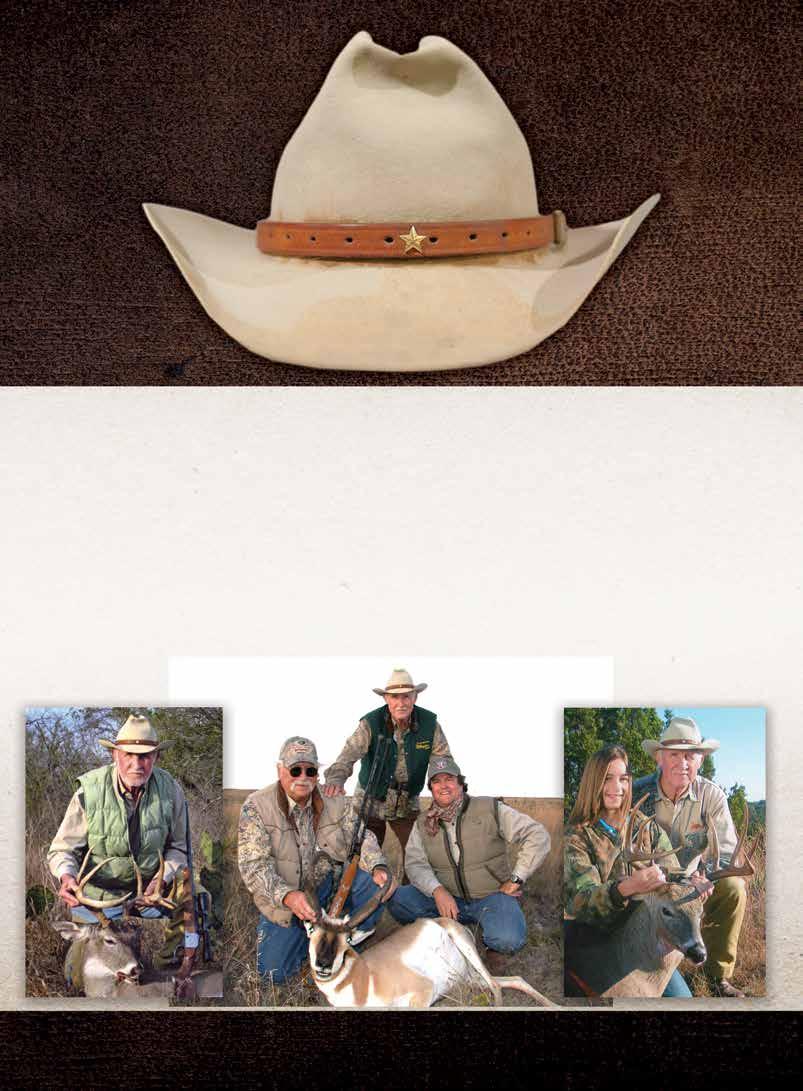
friend that I appreciate his desire to own a hat like mine, but to have one JUST LIKE MINE is impossible. The 40-plus years of wear; the countless big game and quail hunts; the thousands of miles of travel over most of the South, Southwest, and New York City, cannot be duplicated. Oh, he could find an old deer bell collar, punch holes in it, and put on a silver buckle. But attaching rattlesnake rattles to a hatband is not easy to do, and the secret method that I used is MINE. The Lone Star Brewery of San Antonio, where I got the “gold” star for the hatband, exists no more.
I have many hats, but my old High Brim is priceless. I wear it on most occasions when I feel that my years as a Texas Aggie, wildlife biologist, Journal editor, and all-around good guy aren’t enough. Up to now, the old hat has pulled me through in style.

by Horace Gore
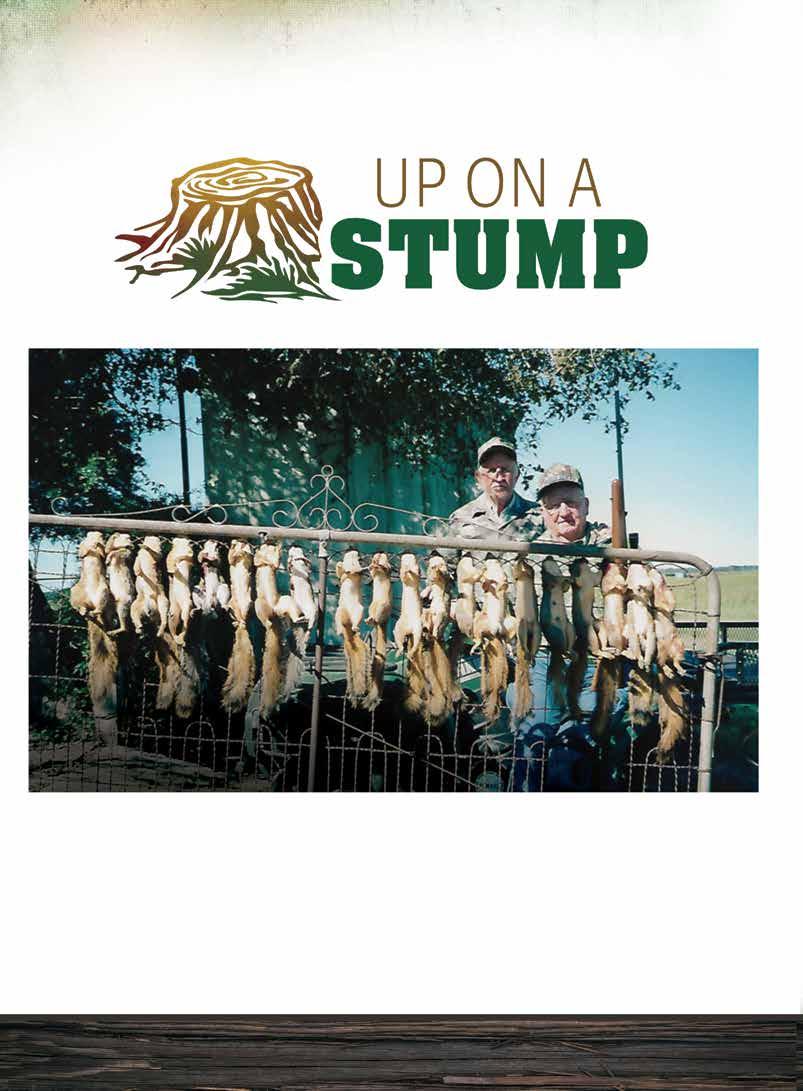
It takes a much better hunter to kill 10 squirrels with a .22 rifle than to kill a 10-point buck with a .30-06—Goreism
Squirrel hunting in Texas has become a lost art. Most hunters who talk about hunting squirrels with their favorite .22 rifle are over 50 years old. Oh, yes! You hear lots of talk about deer hunting, or dove hunting, or even turkey or quail hunting, but seldom do you hear a squirrel hunting story. I guess you could say squirrel hunting went the way of skating rinks, kite flying, moonshine, and sweet Garrett snuff.
When Ike Eisenhower was president, there were a lot of squirrel hunters, mostly east of the Brazos River. This story is about two squirrel hunters who have hunted together for 60 years. They grew up in very different lifestyles, one in the flat woods of northeast Texas, and the other along the Guadalupe River in Gonzales County. One had friends and relatives to take him hunting; the other had Jim Tiller. I speak of my close friend, Al Brothers, and yours truly. I consider us to be two of the best squirrel hunters in Texas.
Al grew up hunting squirrels in the Guadalupe River bottom east of Gonzales. His folks spent a lot of time overseas with an oil company, while Al and his twin brother, David, lived with relatives and went to school in Gonzales. Their only claim to fame early in life was burning down the barn when they built a good fire on a cold, windy winter day.
Al had friends who squirrel hunted and he started floating the San Marcos and Guadalupe rivers, shooting squirrels on both banks, at an early age. He claims to have killed his first buck with a borrowed .30-30 when he was 12, but I suspect he
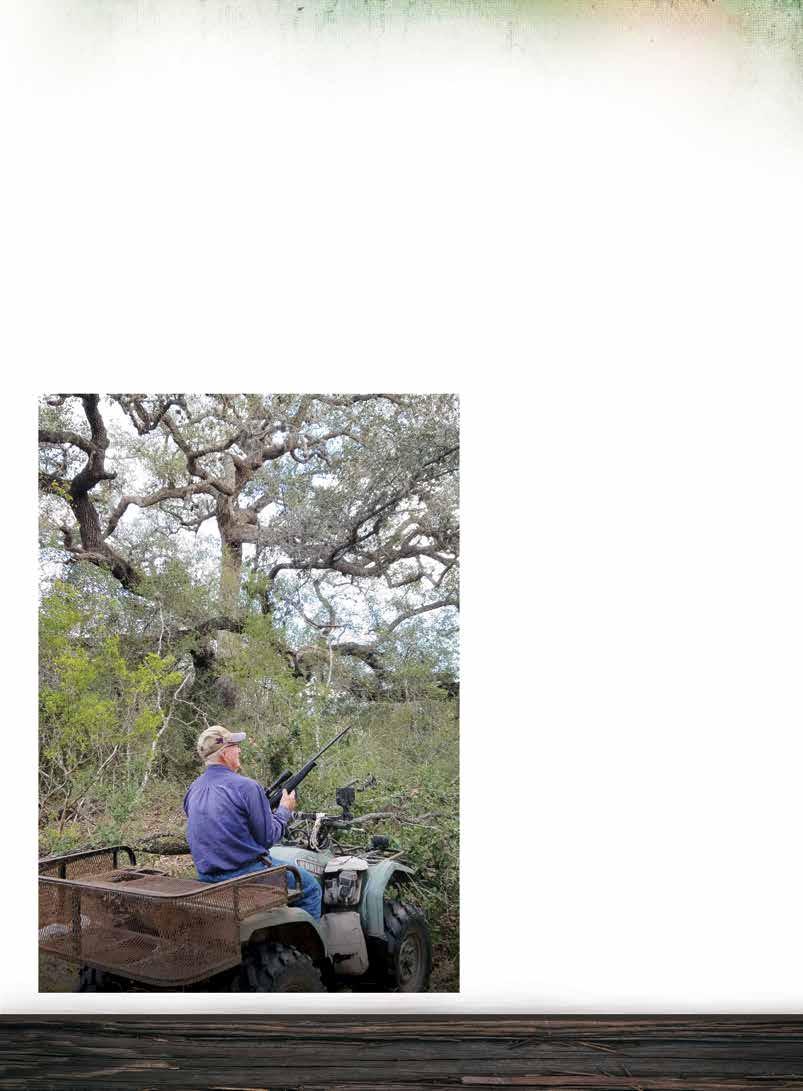
may have killed a doe or two with his .22 when he was squirrel hunting. Al doesn’t have an illegal bone in his body, but he might take advantage of a good situation.
I grew up in Bowie County in northeast Texas, not far from the Red River. The area is generally flat with a lot of creeks and plenty of squirrels. There were no deer or turkey, and squirrel hunting was the thing. Two favorite places to go for a three-to-four-day squirrel hunt were the Sulphur River bottom and Anderson Creek, just to the south of Hooks, now a part of Wright Patman Lake. Two species of squirrels frequented these two spots: fox and grays.
Jim Tiller got me interested in hunting squirrels. He was retired, about 65 years old, and hunted squirrels with dogs. When I was about 13, I would go with Mr. Tiller and “turn” the squirrels for him, as the dog barked that a squirrel was up the tree. I made a lot of noise and shook vines or anything that would cause the squirrel to go to the other side of the tree trunk. Jim would be ready, and when the squirrel turned his way, he would “roll it out.” He let me shoot a few squirrels, and I can thank Mr. Tiller for getting me into the woods and teaching me how to hunt.
If you think sitting in a warm deer blind by a feeder is hunting, I invite you to go after squirrels in high timber with a .22 rifle. You’ll find that this is real hunting, requiring not only patience and shooting skill, but a good knowledge of the woods and the game you’re after. It may bring you to your knees! I’ve said many times that it takes a better hunter to kill 10 squirrels with a .22, than to kill a 10-point buck with a .30-06.
Al and I first met at Texas A&M University in 1958. He was in his second year as a wildlife science student and a Corps cadet. I had been out of the Army for about a year, transferring from Texarkana Junior College on the GI Bill and was also enrolled as a wildlife student. We grew to be close friends at A&M, and we’re still close today.
Hunting and guns, along with other minor things have kept Brothers and me together as friends for all these years. At A&M, we soon found a connection that has lasted for 60 years—wildlife and hunting. We’ve never had an argument or a cross word—pretty good for 60 years, don’t you think?
Al and I got closer with our squirrel hunting when I moved from Austin to the Kokernot Ranch in Gonzales County. The ranch house was less than a mile from where Al had killed his first buck. I lived on the ranch for 22 years, and during that time, Al and I hunted squirrels on the Guadalupe River every chance we got. Fox squirrels were most common, but right along the river, gray squirrels were a part of the game. June was a good time to hunt when the anaqua fruit was ripe. Squirrels go crazy over anaqua berries.
As a rule, a good hunt for us would be three or four squirrels in a morning hunt. Al hunted on a fourwheeler because of being injured in a helicopter crash
in 1976. I was on foot and could cover ground not accessible to Al on the four-wheeler. However, Al was a patient hunter and could shoot a squirrel in the head at 50 yards with his Anschutz .22 and Leopold scope. He often brought in more than I did, all shot in the head! At that time, my favorite squirrel rifle was a Winchester bolt action 69A with a 2½ power Weaver scope. At squirrel shooting distance, it would make a ragged hole out of three shots.
hunt two mornings.
The rest of this story may make Brothers and me out to be game hogs. But let me assure you that even though we some-
I grew up in Bowie County in northeast Texas, not far from the Red River. The area is generally flat with a lot of creeks and plenty of squirrels. There were no deer or turkey, and squirrel hunting was the thing. Two favorite places to go for a threeto-four-day squirrel hunt were the Sulphur River bottom and Anderson Creek, just to the south of Hooks, now a part of Wright Patman Lake. Two species of squirrels frequented these two spots: fox and grays.”
I recall one spring when the anaqua was especially good and squirrels were thick as fleas on a coyote. Al came up for a two-day hunt on the neighboring ranch where Al grew up that belongs to the Turk family. Gen. Sam Turk went to A&M with us back in the day. The ranch has a lot of anaqua in a situation that is good for Al on his four-wheeler. We would
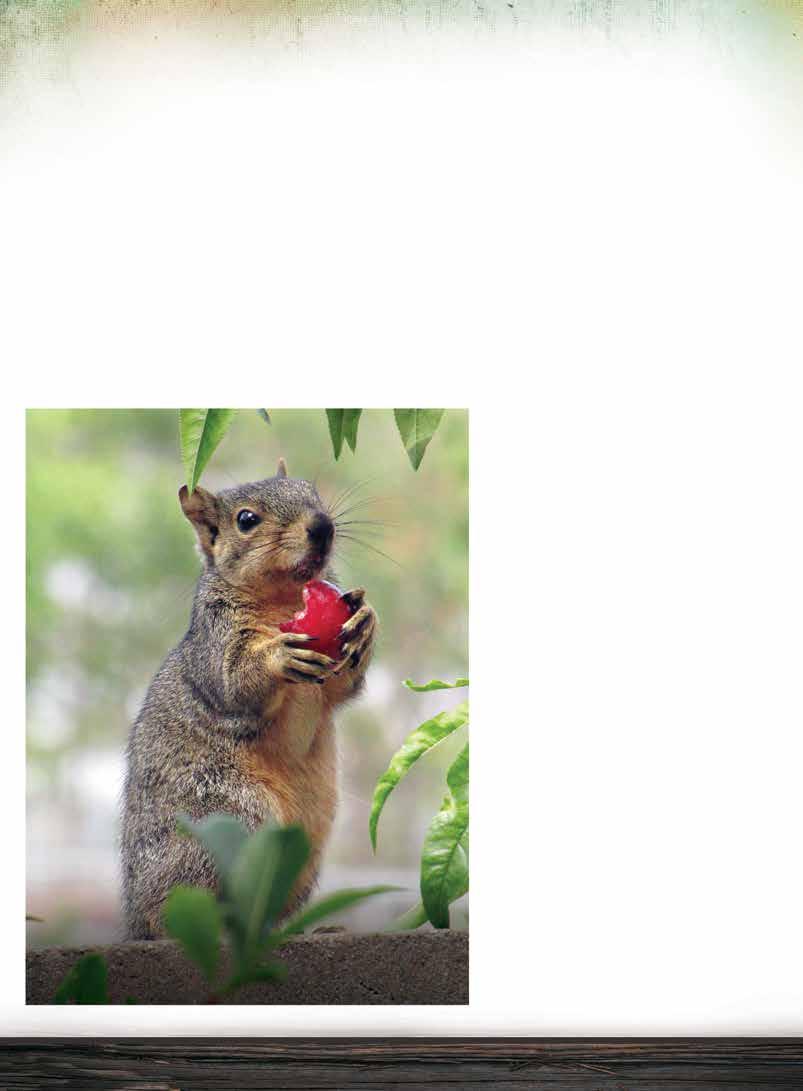
times got lucky and killed a good many squirrels, not a one was wasted. We have eaten squirrels every way you can think of: fried, barbequed, stewed, dumplings, grilled, squirrels ‘n’ gravy, just to name a few. We never set a limit and did all of our hunting where there was no bag limit. We just hunted as long as the wind was still, and squirrels were jumping.
The first morning I left Al in an open flat with lots of anaqua, and I went into a thick slough that had some anaqua around the edges. We were not too far apart, and I could hear Al’s Anschutz crack every now and then. I soon found fox and gray squirrels in the slough timber, and I had a happy time chasing both. When the smoke cleared, I was carrying 11 fox and gray squirrels in my bags on each hip.
Al had been shooting all morning, and I knew he had a good batch of squirrels. What I didn’t know was how many. When we got to the ranch house and counted, we each had 11, or a total of 22 squirrels to skin. We finally got them all cleaned and put in the fridge and sat around talking about that being our best squirrel hunt together in all the years. Al reminded me most of his were shot in the head, while most of mine were gut-shot.
The next morning, we were back on the Turk ranch, in generally the same areas where we had killed 22 squirrels the previous morning. Again, I chased gray and fox squirrels, while Al saw mostly fox on the flat. We hunted until about 9, when the wind got up, and met for the count. Al had 11 squirrels scattered over the four-wheeler, and I pulled 11 fox and grays out of my bag. We had killed another 22 squirrels for the second morning in a row—44 squirrels in two days!
“This has got to be a county record,” Al said. “Maybe a state record,” I replied, knowing it was more likely a world record. And by the way, that was our record. We killed and ate a lot of squirrels after those hunts, but never again shot 44 squirrels back to back!






• 4 lbs. lean chili-ground or hamburger VENISON
• 2 cups chopped onion
• 2 cloves garlic minced or ½ tsp garlic powder
• 1 tsp ground oregano
• 1 tsp cumin seed
• 3 full tbsp chili powder
• 3 cups (or more) water

• Sear meat completely in Dutch oven or deep iron skillet or pot. Add onion and garlic and cook and stir for 5-6 minutes. Add remaining ingredients; blend well and bring to boil.
• If chili needs thickening, stir in a tbsp of flour in ¼ cup hot water.
• Reduce heat to Low and simmer for 2 hours, adding water if needed.
• Let chili set for 30 minutes to one hour before serving.
• Reheat if necessary.
Serve in bowl with saltine crackers or over a plate of cooked spaghetti—don’t knock the spaghetti till you’ve tried it! Good chili needs something cold to drink. Serves quite a few!
- HG
Do you have a favorite Wild Game recipe that you would like to share with our readers? If so, please type or print recipe and send to:
Texas Trophy Hunters Association, ATTN: Editor
654 Richland Hills, Suite 160
San Antonio, TX 78245
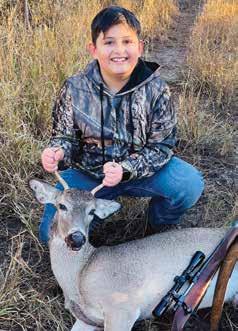
CASON DE LOS SANTOS: whitetail spike taken 1/11/25 in Duval County. GEAR: rifle OUTFITTER: family ranch.
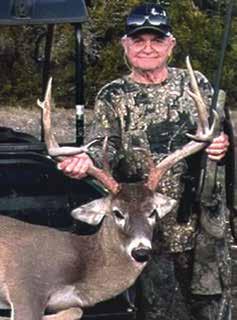
LARRY HENSLEY: whitetail 13-point with 18½-inch inside spread, scoring 156 6⁄ 8 gross B&C, taken 12/26/24 in Burnet County.
GEAR: 6.5 PRC, 143-grain ELD-X ammo, Vortex 6-18X44 scope. OUTFITTER: Lane Imkin, Matt Kruger.
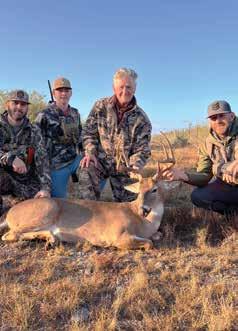
SKEET SMITH: whitetail shot 12/22/24 in Duval County. GEAR: rifle. OUTFITTER: self.
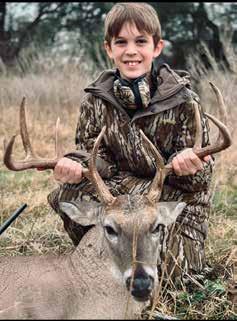
WES MCDONALD: whitetail 10-point (first big buck) with 20-inch inside spread taken 1/3/25 in Comanche County.
GEAR: Savage Axis .243, 100-grain ammo, 3-9X Bushnell scope. OUTFITTER: Dad.
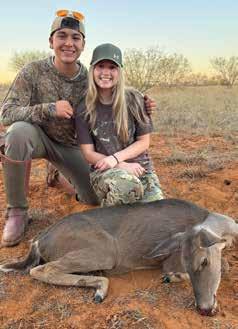
DANIKA CHAVEZ: whitetail doe (first deer) taken 12/3/24 in Webb County. GEAR: rifle.
OUTFITTER: Drew Bonilla.
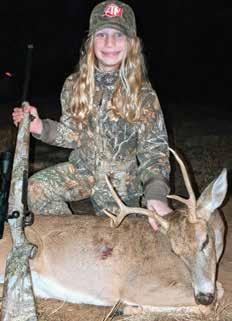
HADLEY GRACE FULLER: whitetail seven-point taken 12/8/24 in San Saba County.
GEAR: Savage 110 bolt action, .223 shooting Winchester 64-grain Xtreme Point ammo. OUTFITTER: Dad (family ranch).
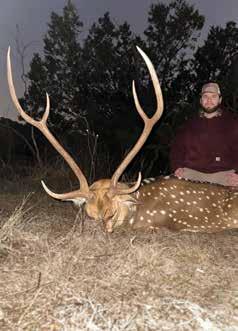
TYLER MONROE: axis with 34½inch beams shot 1/5/2025 in Llano County.
GEAR: 6mm Creedmoor. OUTFITTER: self.
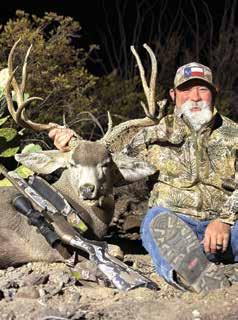
BENNIE RODRIGUEZ: mule deer with 19½-inch inside spread taken 12/12/24 in Brewster County.
GEAR: Browning BAR MK3, .270 caliber ammo, Leupold VX-3HD 3.510X50 CDS -ZL scope. OUTFITTER: self.
NOTE: Only TTHA members or immediate family may submit photos. Do not paperclip or staple photos, as this can damage them. Prints must be no larger than 4x6 inches and printed on photo-quality paper. Photos may also be emailed to HuntsEnd@ttha.com. If sent by email, please make sure to include all information from the form and limit your photo size to less than 5MB. Send a separate e-mail for each entry. No photos will be returned. Photos become the property of Texas








Don’t forget to use your free classified ad! It’s once per year and you must have an active membership in good standing. Send to:
654 Richland Hills, Ste. 160, San Antonio, TX 78245
You may fax your ad to (210) 523-8871, Attn: Debbie Keene or e-mail to Deborah@ttha.com. Send your ad in by January 5 to run in the next issue!

Available to current members of Texas Trophy Hunters Association only! Limit 25 words per ad. Each member may run 1 FREE ad in one issue per year. 25 word ads after FREE issue are $40 each. WE RESERVE THE RIGHT TO EDIT OR REFUSE ANY AD.
WILDLIFE EXEMPTIONS – Texas
Rangeland Management provides TurnKey Wildlife Services to keep your Property Taxes LOW! Contact Wildlife Biologist Sergio Morales: 210-526-1522 | www. TexasRangeManagement.com.
WANTED: A WHITETAIL HUNTER/Private Plane Owner that loves to hunt trophy deer. I have 1300 acres in the Flint Hills of Kansas. 512.365.8205 OR 512.970.5477.
MACS MOBILE GUN CARE in DFW - Expert Cleaning/Maintenance, and Premium Accessories with Install for Top Tier Firearms. All at Your Front Door! Book Now: CLEANMYGUNS.COM.
HUNT SOUTH TEXAS Deer, Hogs, Turkey, Quail, Dove, Javelina, Varmints. 350 acres near Freer. Low fence. Fully equipped 3 BR, 2ba ranch house with satellite TV. Starting at 150.00 per person per day. Trophy buck, 2500.00. References. 361-947-0584.
TECOMATE PLOTMASTER 600. Includes: Dual Disc Harrow, Chisel Points, plow & Sweep Points. Used once $4450. Call Bill Hohertz 830-305-4009 or tresluna49@ icloud.com.
WILDLIFE & HABITAT Consulting. Commercial hunts available. Contact Certified Wildlife Biologist Jason Shipman 210-508-8447 or jasonashipman@gmail. com.
S.M FENCING, Welding and Bulldozing. Contact Shawn Mangham. 325-451-7120.
RUGGED EDGE BLADES - a husband & wife Veteran owned company offering beautiful, quality Damascus knives at a reasonable price. Whether you’re out on a hunt, or at the campsite cooking, we have the perfect knife for you. Backed with lifetime warranty and #1 customer satisfaction! Find us at www. ruggededgeblades.com or give us a call at 682-239-0137. Rugged Knives for Rugged Adventures.
WELDED STRUCTURES: Custom Clearing and Fab LLC handles metal buildings, welded structures, and livestock pens throughout the hill country and south Texas. Call Dustin Stareck 316-323-7673. www. customclearingandfab.com.
SPECIALIZED INSURANCE for outdoor recreation & hospitality businesses. Hunting & fishing lodges/preserves, guides, outfitters, ranges, & more. Comprehensive coverages incl. property, general liability, business auto. Contact Devin 361-208-4404 or devinp@jacobs-weber.com.
THERMAL DRONE WILDLIFE SURVEYS by premier wildlife consulting firm Spring Creek Outdoors! Professional full time wildlife biologists. Contact matthew.nuernberg@ gmail.com.
TXN HOME SERVICES - America’s Toughest Gutter Guards with Leaf Blaster Pro. Built to last. Proven to protect. 40-Year Warranty. Gutters that got you covered. 346-460-9199 | TXNHomeServices.com.
BIG TIME HUNTS – World-Class adventures across Southern & Northern BC, Canada! Hunt Stone Sheep, Moose, Goat, Cougar & more. All-inclusive, guided packages. Book your hunt today! www.bigtimehunts.com | bigtimehunts@gmail.com.
HILL COUNTRY ADVENTURES offers quality trophy exotic hunts on family land. First class lodging and meals. Visit us at: hillcountryadventuresllc.com or call: 337368-4686.
AMERICAN FEEDER - Fish Feeders. Catch and grow larger, healthier fish. All new aluminum fish and deer feeders from American Feeder. Visit http://www. american-feeder.com for details.
RESERVE RANCH, a Sportsman’s Paradise near La Pryor, Texas offering full service hunts for Whitetail Deer, Red Stag, Dove and Quail to individuals and Corporate clients. www.reserveranch.com.
JOIN THE MISSION! Support our veterans and first responders with outdoor adventures through Patriots First Outdoors. Donate or become a member today at www. patriotsfirstoutdoors.org.
MAP MY RANCH specializes in developing printed maps for all your outdoor needs. We can create basic boundary maps, or those with customized features - locations of deer blinds, feeders, food plots, ponds, etc. Contact today to get started! www. MapMyRanch.com or 713-302-2028.
VETERANS CREED OUTDOORS Team Texas. Outdoor Trips for Veterans and First Responders. Find us on Facebook on our page and group.
HELP FEED THE HOMELESS – donate excess game animals to feed the homeless, orphans, and needy families. Go to www. trinityoaks.org “contact us” tab.
LIMITED EDITION Book. SCI Past President Craig L Kauffman takes the reader on hunting adventures around the world. Signed copies $57. Call 717-917-8173.
THE LONE STAR Bowhunters Association. Preserving and Promoting bow hunting in Texas since 1974. Join today at www. lonestarbowhunter.com. Take a kid hunting.
KEI VALLEY SAFARIS offering plains game in the Eastern Cape of South Africa. Package hunts or build your safari. Deep sea fishing, photo safaris, and park excursions available upon request. Keivalleysafaris@gmail.com. Keivalleysafaris.com.
S & D WHITETAILS – Limited hunts avail. Booking 2021 now. All native S TX deer from 140-230 class. Deer & Dove hunts Central TX. Over 7500 ac. 24-yrs experience. 5 Star rating. 325-642-7596.
TEXANS ARCHERY CLUB wants to expand our state’s archery range infrastructure. Looking for local partners/land to expand our network. www.TexasArchery.info 501c3.