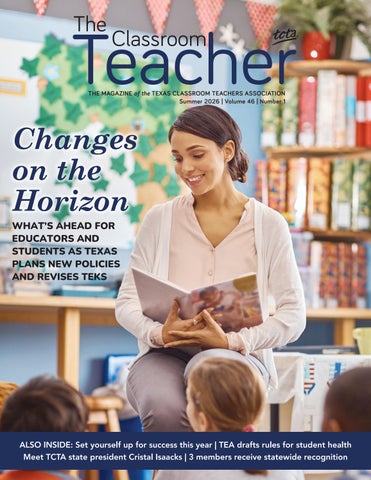
THE MAGAZINE of the TEXAS CLASSROOM TEACHERS ASSOCIATION Summer 2026 | Volume 46 | Number 1
Changes on the Horizon WHAT’S AHEAD FOR EDUCATORS AND STUDENTS AS TEXAS PLANS NEW POLICIES AND REVISES TEKS
ALSO INSIDE: Set yourself up for success this year | TEA drafts rules for student health Meet TCTA state president Cristal Isaacks | 3 members receive statewide recognition
EXECUTIVE DIRECTOR’S MESSAGE
You’re making a difference
T
raveling through Texas for TCTA’s summer leadership workshops is one of my favorite parts of the job. I always love a road trip — getting a little alone time in the car, listening to a good audiobook, and driving through the variety of landscapes in our beautiful state. But more significant than the relaxing drive is the energy generated by reconnecting with local leaders and meeting members who are choosing to take on leadership roles with TCTA for the first time. It’s also a great way to learn more about what’s happening in classrooms and on campuses. Conversations during our workshop lunch breaks inevitably turn not to summer vacations and pop culture gossip, but to curricula and materials, testing issues, classroom highs and lows, and changes coming to campuses. I always learn about programs I wasn’t familiar with, and about how state laws and rules are actually being implemented in your school districts. And I marvel at your commitment to your students, even during your “three months off ” (if only!). Those of us on the TCTA staff who handle the legal and legislative sections of the workshops are painfully aware that our presentations aren’t particularly uplifting. It is a priority for TCTA to keep members informed, and that often means we are updating you on current issues we’re concerned about, and problematic policies already in place that we’re hoping to address in the upcoming legislative session. There are several issues that school employees need to keep an eye on, including the new “enhanced” TIA program (call us if your district is considering this), potential TRS changes (see page 5), state takeovers, a general erosion of teacher autonomy, and school funding problems. But the new laws on reporting teacher misconduct are at the top of the list. Changes in reporting requirements have more than tripled the average monthly number of reports to the State Board for Educator Certification, and our staff attorneys have been taking more calls than ever from affected employees. Thousands of teachers have been caught up in the tangle of these new laws, and without going into detail here, I would encourage you to look into this issue if you’re not already aware of it. Our recent Tuesdays with TCTA videos (at tcta.org/twt) are a great place to start (and get CPE credit while you’re at it). These topics tend to change the energy in the room, and we always want to keep spirits high. This summer we introduced a new feature at our workshops, asking a state leader from each area to talk about what being part of TCTA and the leadership structure has meant to them. These educator-to-educator comments got to the heart of what TCTA strives to do for our members, and emphasized how joining the leadership team can give you new skills, new experiences, more information, and even a few items to add to your resume. A newer member of our Advisory Council mentioned a book during her leadership remarks that had made an impact on her, encouraging her both as a teacher and a leader. She drew a connection between the theme of the book and what teachers are doing every day to make a difference in the world. I jotted down the title and author and downloaded it when I got to my hotel that evening. When I started reading, I could see why the book had resonated with her. The book is The Small and the Mighty by Sharon McMahon (a former teacher herself). She tells the stories of a dozen unsung heroes in American history. Some names might be familiar, but most are unknown or forgotten, and all played a crucial role in shaping our country. They were imperfect, they struggled, and they Continued on page 23 2
tcta.org | 888-879-8282
Texas Classroom Teachers Association PO Box 1489, Austin, TX 78767-1489 Office hours: 8 a.m. to 6 p.m., weekdays Phone: 888-879-8282 Fax: 512-469-9527 Website: tcta.org
2026-27 Board of Directors President Cristal Isaacks, Levelland President-Elect Thomas Evans, Abilene Immediate Past President Vivian Burleson, Northside Budget Angela Reyes, Muleshoe Curriculum & Instruction Melanie Hoyt, Pottsboro Governance Sharron Wood, Deweyville Legislation Brec Espinoza, Brownwood Membership Velma Sanchez, Pharr-San Juan-Alamo Professional Rights & Responsibilities Erick Hurtado, Edcouch-Elsa Teacher Personal Services Omar Esson, Killeen
Staff Contacts
Executive Director Ann Fickel Attorneys Michael Currie Julie Leahy Paige Williams Kaylan Dixon Smith Derrell Coleman Sydney Leverette Barrett J. Hollingsworth Communications M. Clare Haefner Legislation Paige Williams Pamela McPeters Quinn McCall Kaylan Dixon Smith Ann Fickel Membership Persie Tynes Services Corporation Jan Lanfear Contract Attorney Lindsay Gustafson Senior Policy Consultant Holly Eaton
About TCTA
The Texas Classroom Teachers Association is an independent association for Texas teaching professionals that was founded in 1927. TCTA is based in Austin and is the only statewide teachers association that limits active-level membership to those directly involved in classroom teaching or teaching support.
CONTENTS
Summer 2026 | Volume 46 | Number 1
DEPARTMENTS
2
14 | On the Cover
Executive Director’s Message
4
TCTA News & Notes
5
Member Accolades
Changes on the Horizon THE MAGAZINE of the TEXAS CLASSROOM TEACHERS ASSOCIATION Summer 2026 | Volume 46 | Number 1
Changes on the Horizon WHAT’S AHEAD FOR EDUCATORS AND STUDENTS AS TEXAS PLANS NEW POLICIES AND REVISES TEKS
9
Legal Notes
10
Washington Watch
ALSO INSIDE: Set yourself up for success this year | TEA drafts rules for student health Meet TCTA state president Cristal Isaacks | 3 members receive statewide recognition
On the cover: iSTOCK | PeopleImages
From new literary lists and social studies TEKS revisions to a new TEA strategy to provide reading intervention for third graders who failed to meet expectations on the spring 2026 STAAR test, changes are on the horizon in Texas schools. The agency is also implementing revisions to the funding formula for special education, switching to an intensity-based model. Meanwhile, state lawmakers are seeking recommendations from educators ahead of the 2027 legislative session on classroom instruction, teacher support and educational outcomes. Here’s a look at what’s ahead.
FEATURES
6
12
Meet three outstanding TCTA members who were state finalists for H-E-B’s 2026 Excellence in Education Awards.
TCTA’s 2026-27 state president always wanted to be a teacher. Her love of learning and passion for helping students and her fellow educators are evident from the moment you meet her.
In the Classroom
11
Set Yourself Up For Success The beginning of the school year is filled with decisions. But some of the most important choices you’ll make this month have nothing to do with lesson plans.
Meet Cristal Isaacks
Save the Date!
Join us for TCTA’s Centennial Celebration at our 2027 Convention on Feb. 5-6 in Austin. Find more info this fall at tcta.org/convention.
THE CLASSROOM TEACHER (ISSN-0279-2494) is the official publication of the Texas Classroom Teachers Association (TCTA), providing news and opinions in the interest of education excellence. All contents are copyrighted and may not be reproduced without the publisher’s permission. The views and opinions contained in this publication are not necessarily those of the publisher. Copyright © 2026. Publication schedule is quarterly. Annual membership dues for TCTA are $175, $5 of which is allocated to a one-year subscription to THE CLASSROOM TEACHER. Subscriptions for nonmembers are available for $10 per year. POSTMASTER: Please send changes of address, articles and/or photographs to: Editor, THE CLASSROOM TEACHER, PO Box 1489, Austin, Texas 78767-1489. TCTA is located at 700 Guadalupe, Austin, Texas 78701. PERIODICALS POSTAGE PAID AT AUSTIN, TEXAS.
Summer 2026 | THE CLASSROOM TEACHER
3
TCTA NEWS & NOTES
SBEC debates inclusion of National Board Certification as automatic TIA designation The State Board for Educator Certification met July 24 to discuss whether to continue National Board Certification status as a route to earn money through the Teacher Incentive Allotment program. SBEC did not take a final vote on the matter, but conducted a preliminary discussion of a report that reviews the National Board’s alignment with Texas standards and laws as required by House Bill 2, the omnibus school finance bill passed in 2025. Currently, holding National Board Certification automatically qualifies a teacher for the lowest TIA designation and the accompanying stipend. Early in TIA’s existence, many school districts encouraged teachers to seek National Board Certification as a more direct route to earning a designation. Now, the vast majority of Texas districts participate in TIA and have created their own systems to earn designations, but many teachers outside of core subjects still cannot earn a designation under their local plan. A handful of legislators and members of the State Board of Education raised concerns in 2025 about certain examples of exemplary teaching given in the National Board standards that reference diversity, equity, and inclusion, and sought to remove National Board Certification as a route to TIA designation for that reason. As a compromise, the Texas Legislature placed the burden of that decision on SBEC. It has until Dec. 31, 2026, to make a determination. If no such determination is made, National Board Certification as a route to TIA is revoked by default. The report listed only a handful of potential conflicts, primarily in examples provided for the standards. TEA portrayed the report as stating the National Board standards are incompatible with Texas expectations and suggested that the National Board make adjustments to its standards to comply. It was also implied that SBEC would be required to revoke National Board Certification as a route to a TIA designation if there are any discrepancies. TCTA testified that this is not the case and appealed to the
specific language in statute that charges SBEC with deciding the fate of National Board Certification as an automatic route to a TIA designation. TCTA supports National Board Certification as a route to earning a TIA designation and will continue to advocate for its inclusion. SBEC has two more scheduled meetings before the deadline, and TCTA will advocate for National Board Certified Teachers at every opportunity.
TCTA provides input at House hearings ahead of 2027 session TCTA 2025-26 State President Vivian Burleson testified about the state’s cellphone ban in schools during a May 11 House Public Education Committee meeting. Burleson shared results from TCTA’s spring survey of members, which showed that the ban is overwhelmingly popular with educators. Teachers reported increased engagement from students and said that students in the cafeteria are actually speaking to each other again. Despite these positive outcomes, many teachers reported that policy enforcement has noticeably increased their workload, and that a lack of administrator support can make these bans untenable. Some have faced complaints from parents who want to contact their children at any time. On June 1, the committee held a hearing to discuss ongoing implementation of House Bill 2, the comprehensive school finance bill from the 2025 legislative session. The influx of nearly $8.5 billion to Texas schools last year was not enough to stop districts from making tough cuts, many school officials told lawmakers. The committee also heard testimony on efforts to increase teacher recruitment and retention across the state. TCTA provided written testimony to the committee with several suggestions: •
Continue improving salary growth for all teachers rather than relying primarily on performance-based pay.
•
Fully fund and implement the statewide teacher working conditions survey required by HB 2012 (83rd Regular Session). Continued on page 20
Share your success with us!
Were you chosen as your campus teacher of the year? Did you win an award or receive grant funding? Email communications@ tcta.org and tell us about your recognition so we can share it in The Classroom Teacher. You may be one of the next members we feature in the magazine. 4
tcta.org | 888-879-8282
TCTA NEWS & NOTES
TRS pension study due by Sept. 1
Recommendations could include structural changes The Teacher Retirement System of Texas soon will complete a pension plan design study required by the Texas Legislature. The study, due by Sept. 1, 2026, is expected to compare the current TRS defined benefit pension with alternative retirement plan designs, including a cash balance plan. The good news is that nothing is changing right now. The study itself does not change anyone’s retirement benefits, and no legislation has been filed to alter the TRS pension. However, the report is expected to help shape retirement discussions ahead of the 2027 legislative session, with bill filing beginning in November. The issue is also expected to receive attention this summer. The House Committee on Pensions, Investments and Financial Services has been directed to study the financial condition and long-term sustainability of TRS and is expected to hold an interim hearing in August. TCTA will be monitoring both the committee’s work and the TRS study closely.
What is a cash balance plan? Unlike the current TRS pension, which provides a guaranteed monthly benefit based on years of service and salary, a cash balance plan works more like an individual retirement account. Contributions are credited to a personal account that earns a guaranteed rate of interest, and the amount in that account determines the retirement benefit. In general, the more years a teacher spends in the classroom, the more valuable the current defined benefit pension becomes compared to a cash balance plan. One example of a cash balance plan is the model adopted by the Employees Retirement System for most state employees hired on or after Sept. 1, 2022. When ERS made that change, current employees and retirees remained in the traditional defined benefit pension, while only new hires entered the cash balance plan. If lawmakers were to consider a similar approach for TRS, current teachers and retirees would likely
be grandfathered into the existing pension, with any new plan applying only to future hires.
TCTA supports the current pension structure TCTA strongly opposes replacing the TRS defined benefit pension with a cash balance plan. The current defined benefit pension rewards educators who dedicate their careers to Texas students by providing a predictable monthly retirement benefit for life based on years of service and salary, not the balance of an individual retirement account. Investment risk is pooled across the pension system rather than shifted to individual educators, giving teachers greater retirement security and a guaranteed source of retirement income they cannot outlive. A cash balance plan works differently. Benefits are tied to an individual account that earns guaranteed interest credits and is converted to an annuity at retirement. While that structure may be more attractive to employees who leave public education after only a few years, it generally provides a less valuable retirement benefit for career educators. For teachers who spend 25 to 30 years in the classroom, a cash balance plan could lower retirement income by 25% or more compared to the current defined benefit pension. Just as importantly, a strong defined benefit pension is one of Texas’ most valuable tools for recruiting and retaining highquality educators. Teachers are far more likely than many other professionals to spend their careers in their chosen profession. They deserve a retirement system that recognizes and rewards that long-term commitment. Weakening retirement benefits for future educators would make it even more difficult to recruit and retain the next generation of teachers. Read more about the TRS July board meeting at tcta.org/ latest-education-news.
MEMBER ACCOLADES TCTA congratulates four members who earned recognition in their districts during the 2025-26 school year: •
Melanie Hoyt was named Elementary Teacher of the Year in Pottsboro ISD. Hoyt is the Curriculum & Instruction director on TCTA’s Board of Directors.
•
Denise Jannise of Anahuac ISD earned National Board Certification. She also received a grant from the Anahuac ISD Education Foundation to expand the school store her entrepreneurship students started, and she was named Teacher of the Year at Anahuac High School.
•
Dillman Pre-K teacher Leah Spears was named Elementary Teacher of the Year in Muleshoe ISD.
•
Nurse and CTE adviser Sharon Riegel of Muleshoe High School was named Staff Member of the Year in Muleshoe ISD.
Summer 2026 | THE CLASSROOM TEACHER
5
IN THE CLASSROOM
Helping Students Grow TAMI BHADAI KINDLES CHILDREN’S INTEREST IN SCIENCE
6
tcta.org | 888-879-8282
Courtesy of Tami Bhadai
T
ami Bhadai wanted to work in a museum. In college at UT-Pan American, now UT-Rio Grande Valley, studying anthropology and biology, she felt drawn to teaching and found her purpose — teaching young students to love science as much as she does. After 22 years in the classroom at Cesar Chavez Elementary in Pharr-San Juan-Alamo ISD, she’s switching campuses this fall to teach in the Science Lab at Dr. William Long Elementary in PSJA. The transition comes after she was named a state finalist in the Lifetime Achievement category for elementary school teachers in the 2026 H-E-B Excellence in Education Awards, recognition that initially left her speechless. “I worked for H-E-B throughout college, so it was huge honor to be nominated and rewarded in this way,” she said. The accolades didn’t start or stop there. Bhadai was named the 2025 Campus Teacher of the Year at Chavez Elementary and went on to be honored as the district’s Elementary Teacher of the Year. She also spent part of this summer at the Teacher Innovator Institute at the Smithsonian’s National Air and Space Museum in Washington, D.C., a distinguished national program that brings together top educators from across the country. She joined a cohort of 30 teachers to learn from leading experts in aerospace science, history and technology. Through immersive, hands-on learning and behind-the-scenes museum access, participants explore how to integrate STEAM (science, technology, engineering, arts, and mathematics) education into the classroom. “I am deeply honored to represent our district,” Bhadai said. “This opportunity reflects the dedication of our entire community, and I am excited to bring back what I learn to benefit our PSJA students.” Planning to implement more STEAM programming for fourth and fifth graders in PSJA through the multiyear professional development she’ll gain from the Smithsonian’s teacher institute, Bhadai already extends learning beyond the classroom and is known for creating engaging, hands-on learning experiences that inspire curiosity and critical thinking. She created the Growing Gardeners Club at Chavez, which was selected as the National Junior Master Gardener Group of the Month in February 2026, and also started a FFA Junior group, which she said may be the only one in the Rio Grande Valley for elementary-aged students. “I hope this experience helps me get grants to expand opportunities for my students,” she said, adding that many of the children she’s engaged in the clubs over the years have gone on to careers in science and related fields. “One student with autism realized he was a great presenter, impressing several teachers from other states during a webinar.” Another learned responsibility through caring for animals. Bhadai approaches each year with the mentality that she will learn and grow alongside her students, and she encourages other educators to do the same, especially those who are new to the
TAMI BHADAI “It’s not something I ever expected. I know what I do is good, but I know there are other educators out there working every day to be the best and do whatever they can for the kids. But they picked me and I thought, ‘Wow!’” 2026 H-E-B Excellence in Education Lifetime Achievement Elementary state finalist Current job: Fourth and fifth grade science, Dr. William Long Elementary, Pharr-San Juan-Alamo ISD in Region 1 TCTA member since 2025 Education: Bachelor of Science in Anthropology and Master’s degree in social sciences, University of TexasPan American (now UT-Rio Grande Valley) Certifications held: Bilingual Generalist-Spanish (EC-4), Generalist (EC-4), Master teacher TIA designation
classroom. “I know some teachers go into this career and realize, ‘this is not what I thought it was,’ and they leave the profession because of all the red tape involved with documentation, paperwork, grades … it can be overwhelming,” she said. “But it is something that you get better at, you get faster at. You just need to learn a system that will help structure your day.” It’s a hard profession, she added, but the rewards are worth it. “When you see the results and the students’ success as they grow, there’s nothing in the world like it,” she said. “Without teachers, we wouldn’t have all the other careers.”
IN THE CLASSROOM
Answering the Call
ANGIE REDWINE INVESTS IN HER STUDENTS’ FUTURE
Courtesy of Abernathy ISD
F
or Angie Redwine, teaching is a calling that goes beyond the classroom. “It’s about investing in students, supporting their growth, and making a positive impact on the school and the community for years to come,” she said. Redwine has definitely made an impact after more than 30 years in the classroom teaching mathematics. She was honored as a statewide finalist in the Lifetime Achievement Secondary category of H-E-B’s 2026 Excellence in Education Awards. This fall, she begins her 32nd year in education, teaching AP Precalculus, Algebra 2 and Honors Algebra 2 at Abernathy High School in Abernathy ISD, which is north of Lubbock. She’s also the Student Council sponsor, UIL coordinator for the high school, freshman class sponsor and serves on the homecoming committee. “What I love most about being a teacher is helping students discover their strengths, believe in themselves, and find their passion in life,” she said. “I also love investing in the families of our small community, building relationships that extend beyond the classroom and strengthen the future of our town. Watching my students grow in confidence, overcome challenges, and realize their potential is the greatest reward and the reason I love coming to work every day.” The support Redwine receives from her colleagues goes a long way in helping her stay motivated when challenges arise. “We all work together as one team, supporting and encouraging each other to do what’s best for our students. That strong sense of teamwork, along with the support of my family, helps me stay focused on making a positive impact on student learning and growth.” Family support also led Redwine into teaching as she followed in her mother’s footsteps. “Growing up, I watched her pour her heart into her students — teaching, encouraging, and caring for them with so much patience. Her passion for learning, and the way she truly believed in the power of education, made a lasting impression on me,” Redwine said. “She showed me that teaching isn’t just a job — it’s a calling, something that can change lives and open doors.” Redwine adds that teaching is more than a career — it is an opportunity to inspire, encourage and change lives every day. Her advice to other educators is to “Lead with your heart, believe in every student’s potential, and remember that the small moments of kindness, encouragement and dedication often leave the greatest lasting impact. And don’t forget to have
ANGIE REDWINE “Being a finalist means joining a group of outstanding educators who share a deep passion for teaching and a commitment to making a difference in the lives of their students. It is an incredible honor to be recognized among such inspiring teachers, and it motivates me to continue growing, learning and creating meaningful opportunities for every student who walks into my classroom.” 2026 H-E-B Excellence in Education Lifetime Achievement Secondary state finalist Current job: Math teacher, Abernathy High School, Abernathy ISD in Region 17 TCTA member since 1995 Education: Bachelor’s degree, Texas Tech Certifications held: Secondary Mathematics (6-12), Master teacher TIA designation
fun and laugh with your students — those joyful moments help build meaningful relationships and create memories that last a lifetime.”
You could be the next H-E-B Excellence in Education winner The H-E-B Excellence in Education program awards cash grants to finalists, winners and their schools. It honors teachers, counselors, principals, school boards, school districts and early childhood facilities. Nominations for the 2027 Excellence in Education Awards close on Sept. 30, 2026. Go to heblovesteachers.com/nominate to learn more or to submit a nomination. Summer 2026 | THE CLASSROOM TEACHER
7
IN THE CLASSROOM
Driven By Purpose
RICHARD EMBRICK SHARES ENGINEERING EXPERIENCE
8
tcta.org | 888-879-8282
Courtesy of Richard Embrick
R
ichard Embrick left the business world after a successful career because he wanted to make a lasting difference in the lives of young people. “I realized my greatest passion wasn’t building products — it was building people,” he said. “I wanted to create a classroom where students could discover their talents, develop confidence, and learn that failure is simply part of the journey to success.” Embrick has always believed that the best learning happens when students are actively creating, designing, experimenting, and solving real-world problems. “Every day, I have the privilege of helping students see themselves as engineers, innovators and future leaders. Watching a student accomplish something they never thought they could do is what inspires me to keep teaching.” Leaving the corporate world in 2009, Embrick began his second act as a science teacher, bringing robotics and engineering programs to Houston area school districts. This year, his 18th in the classroom, he serves as the engineering and principals of manufacturing (robotics) teacher at Wright Junior High School in Lamar CISD. “I have the opportunity to inspire students through engineering, robotics, coding, design challenges and hands-on problem solving,” he said, adding that he also serves as the CTE department head, TSA sponsor and the JHS PLC Lead Engineering teacher in the district. He also created STEMbrick Academy in 2018 with long-time educator Daniel Doremus. The nationally recognized program connects students with science, technology, engineering and math programs to help them learn to problem solve, predict trends and think for themselves in a fun environment. The program has been adopted by several schools in the Houston area, including Lamar CISD. It also led to Embrick’s recognition as one of the top STEM teachers in the country. “I love seeing students realize they are capable of doing things they never thought possible. Whether they’re designing a robot, building an invention, programming a drone, or collaborating to solve a difficult problem, I enjoy watching their confidence grow. I want every student to leave my classroom believing they can become an engineer, inventor, entrepreneur, or leader,” he said. His drive to help students succeed led to Embrick’s selection as a state finalist in the Leadership Secondary category of H-E-B’s 2026 Excellence in Education awards. Calling the recognition an incredible honor, he added, “It represents not only the work I’ve done in my classroom but also the support of my students, colleagues, administrators, family, and community.” He’ll use the prize money from H-E-B to purchase additional robotics equipment, engineering materials, coding technology and other classroom resources, adding it to the grant funding he’s received over the years.
RICHARD EMBRICK “I’m grateful to be recognized alongside so many outstanding educators across Texas who dedicate themselves to making a difference every day. I won the H-E-B Excellence in Education Rising Star award in 2017 and this is the second time I have been a finalist for the Leadership award. Having been on the stage multiple times is a testimony for the work I am doing for students in Lamar CISD and in the great state of Texas.” 2026 H-E-B Excellence in Education Leadership Secondary state finalist Current job: Engineering and principals of manufacturing (robotics) teacher, Wright Junior High School, Lamar CISD in Region 4 TCTA member since 2023 Education: Business degree from Central Texas College, bachelor of science from Texas A&M University, multiple engineering certifications from the University of Houston—Clear Lake and the University of Texas in Tyler, and robotics certification from the Carnegie Mellon Robotics Academy. Certifications held: Science (4-8); English as a Second Language Supplemental (4-8)
“My goal has always been simple: inspire students to dream Continued on page 20
LEGAL NOTES
iSTOCK | miniseries
TEA works on rules for parent notification
A
head of the 2026-27 school year, the Texas Education Agency has been working on rules to implement a portion of Senate Bill 12 requiring notification to parents about services related to a student’s mental, emotional, or physical health or well-being. The law known as the Parental Bill of Rights and authored by Sen. Brandon Creighton passed during the 2025 legislative session. It codifies a parent’s absolute right to direct their child’s education and requires school boards to make all information about these rights available to parents each school year. To comply with this requirement as the law took effect on Sept. 1, 2025, TEA created a form that details parental rights and options, including the right to withhold consent for or exempt the parent’s child from certain activities and instruction, related to: • Courses of study and supplemental services • Instructional materials and library materials • Health education instruction • Instruction regarding sexual orientation and gender identity • School options, including virtual and remote schooling • Immunizations • Gifted and talented programs • Promotion, retention, and graduation • Grade, class rank, and attendance • State standards and requirements • Data collection practices • Health care services, including notice and consent • Special education and bilingual education • Grievance procedures SB 12 also requires school districts to post each course’s syllabus or instructional plan online. Teachers must provide this information to district administration and the parent of
each child in their classes at the beginning of each semester. School districts must obtain parental “opt-in” consent for physical, psychiatric, or psychological services, screenings, and assessments at the beginning of each school year. Without explicit consent, school nurses and staff are generally barred from providing treatment, including administering nonemergency medication, with exceptions for first aid, such as offering bandages or checking a student’s temperature. TEA has spent the past year working on rules and model guidelines for districts to comply with the portion of SB 12 that requires TEA to “adopt a procedure for school districts to notify the parent of a student enrolled in the district regarding any change in services provided to or monitoring of the student related to the student’s mental, emotional, or physical health or well-being.” TEA released a draft of those rules in June, including definitions that distinguish between what is considered healthcare or health-related services and monitoring and what falls under general caretaking and first aid. TCTA has been involved in the process, submitting comments on the proposed rules to ensure compliance with SB 12. In the proposed rules, TEA defines health-related services and general caretaking in the following ways: • Health-related services are short-term, non-invasive activities designed to promote a student’s mental, emotional, or physical health or well-being but are not considered a health-care service. Health-related services are different from health-care services in that they are typically designed to promote healthy student behaviors and not considered formal, clinical, or therapeutic methods that rise to the level of health-care services. Some examples include school counseling services Continued on page 22 Summer 2026 | THE CLASSROOM TEACHER
9
iSTOCK | YayaErnst
WASHINGTON WATCH
House panel OKs bills to transfer Education Department duties to other federal agencies
I
n July, the U.S. House Education and Workforce Committee marked up and passed 10 bills, mostly on party-line votes, that codify the transfer of federal education programs to other agencies in an effort to legally dismantle the Education Department. Chairman Tim Walberg (R-MI) called the creation of the Education Department, “a politically motivated mistake” that originated as a mission of the National Education Association in 1979. He pointed to decades of declining national test scores among K-12 students and dissatisfaction among college graduates who say the value of their degrees did not hold up in the workforce as evidence of department failure. Ranking Member Robert Scott (D-VA) contended that other federal agencies lack the expertise to implement education programs and that the current interagency agreements are illegal and burdensome. The package of bills included 10 of the 14 interagency agreements (IAAs) the department has used to transfer
10
tcta.org | 888-879-8282
programming to other agencies. It does not include the IAAs for the Office for Civil Rights or the Office of Special Education and Rehabilitative Services. The package now moves to the House floor for full consideration with timing of that vote to occur in the fall.
Fiscal Year 2026 appropriations
Fiscal Year 2026 (FY26) appropriations were finalized across multiple bills enacted between November 2025 and April 2026, including the Department of Education’s funding bill on Feb. 3. Federal agencies generally gain access to annual appropriations within 36 days after a bill is signed into law. However, by early summer, the Department of Education had not yet received its
full FY26 apportionments, leaving roughly $2 billion for programs on hold. For clarification, an appropriation is a legislative act by Congress that approves a specific amount of money for a government agency or purpose, while an apportionment is the executive branch’s subsequent distribution of those funds to an agency to carry out those programs. Under the Trump administration, the Office of Management and Budget (OMB) has intentionally delayed the funding Congress approved for education, with Title programs, special education, education research and formula grants all showing missing or incomplete apportionments. If OMB does not release FY26 funds by Sept. 30, the funds will technically expire and could be returned to the Treasury Department. That outcome will no doubt produce lawsuits against the executive branch for impounding or withholding congressional Continued on page 23
PLANNING AHEAD
Set yourself up for success SMALL DECISIONS NOW CAN PAY OFF ALL YEAR
T
he beginning of the school year is filled with decisions. Which classroom routines will you establish? Which lessons need to be revised? What supplies still need to be purchased? Which students may need extra support from day one? Those decisions matter. But some of the most important choices you’ll make this month have nothing to do with lesson plans. August is one of the few times during the year when you can step back and think beyond the next grading period. It’s an opportunity to make intentional decisions about your career, your finances and your workload before the school year is in full swing. Many teachers spend countless hours preparing for their students. Spending even a little time preparing for yourself can pay dividends throughout the year.
When you’re focused on getting through the first few weeks, it’s easy to postpone thinking about where you want your career to go. But career growth usually happens one opportunity at a time. If you’ve considered becoming a mentor teacher, department chair, instructional coach, curriculum specialist or administrator, think about what experiences you can gain this year that move you in that direction. That might mean volunteering for a campus leadership committee, mentoring a new teacher, serving on a district workgroup or presenting at a professional conference. Even taking on a project outside your normal responsibilities can help develop leadership skills and broaden your experience. Beginning with the 2026-27 school year, districts participating in the state’s new mentorship partnership program may receive funding to support structured mentoring for new teachers, including mentor stipends of $1,000 or more. Beyond the financial
iSTOCK | makyzz
YOUR CAREER: Think beyond this school year
benefit, mentoring can strengthen your instructional practice, develop leadership skills and make a meaningful difference for educators just entering the profession. Don’t overlook leadership
opportunities through your professional associations. TCTA members can serve as campus Faculty Representatives, help lead a local Classroom Teachers Association, or represent fellow Continued on page 21 Summer 2026 | THE CLASSROOM TEACHER
11
Passion & Purpose TCTA STATE PRESIDENT CRISTAL ISAACKS STRIVES TO MAKE EDUCATION BETTER FOR STUDENTS, STAFF
C
ristal Isaacks always knew she would be a teacher. While in high school in Muleshoe ISD in West Texas, she was part of a program that allowed her to visit younger students, and she loved making a difference in their learning. It’s a feeling she still loves after nearly four decades as an educator, and that love is evident from the moment you meet her. “Teaching has changed over these 40 years because the state always mandates certain things, but the concept of true teaching — challenging, questioning, inspiring, encouraging, and believing in every child — has never changed,” she says. A proud Red Raider, Isaacks graduated from Texas Tech in 1987 and went right into teaching, accepting a full-time position at Roscoe Wilson Elementary in Lubbock two weeks into her first semester of student teaching at another Lubbock ISD elementary school. After three years in Lubbock, Isaacks accepted a job in Levelland ISD, a small town a few miles west of Lubbock, where she’s been ever since. Her early career was spent in the classroom, teaching first and third grade before one of her sisters encouraged Isaacks to get a Master of Library Science, which she earned in 2004 from Texas Woman’s University. Isaacks now serves as Levelland ISD’s library coordinator, helping the district’s five campuses in any way she can. “My days are always different,” she says. “Sometimes I am actually teaching or reading in the libraries; other times I’m helping with acquisitions or book orders.” She also seeks out new library programming to increase circulation and writes library policies and presents them to the Levelland ISD Board of Trustees. “I make sure each library is following policies and SB 13 requirements,” she says, adding that she also helps with the district website, coordinates security badges and does public relations and social media for the district. She’s also the spelling bee chair and heads up the annual Battle of the Books. With so many years in the classroom, Isaacks has no shortage of success stories and fond memories. She especially enjoys when students return as parents to tell her about the difference she made in their lives. One who stands out is Ashley Leaks, who says Isaacks helped her believe in herself and set her on a path to success. “Some of the greatest ministries happen inside classrooms, where educators pour into more than a student’s education,” Leaks says. “They sow seeds of faith in the potential God has placed within each student.”
12
tcta.org | 888-879-8282
The first in her family to graduate from college, Leaks is now an academic advisor at the Rawls College of Business at Texas Tech University, where she helps business students navigate their own educational journeys. She’s also a smallbusiness owner committed to giving back through local scholarships and community involvement as she raises her three children. “I am living proof that the kindness, consistency, and belief of a caring educator can become an important part of the trajectory of a student’s life,” Leaks says. “I know that who I am today is the result of God’s grace and the many people He has placed along my journey, and I am grateful that Mrs. Isaacks has been one of those people from nearly the beginning.” Isaacks says she’s incredibly proud of Leaks’ journey, especially watching her become such a loving, wonderful mother. Family is very important to Isaacks. Her husband of 37 years, Paul, is a fifth-generation cotton farmer and their son, Kane, is continuing that legacy alongside his wife, Taylor,
Photos courtesy of Cristal Isaacks
TCTA State President Cristal Isaacks, second from left, received the Levelland Chamber’s Hero Award in 2025. She’s pictured with fellow Levelland ISD librarians and TCTA members Pam Alexander, Mixie Clowe and Tiffany Harkins. BELOW LEFT: Isaacks and other Levelland CTA members provide breakfast to welcome new teachers to the district as each school year starts. It’s one of the many ways she reaches out and provides support to her colleagues. and their two children, Ivy and Atlas. Cristal loves spending time with her grandkids on the lake, and it should come as no surprise that one of her favorite hobbies is reading. Isaacks also volunteers in the community, serving as president of the Levelland Chamber of Commerce and a member of the Lions Club. “You know the saying, choose a job you love and you won’t have to work a day in your life. That fits me to a T,” Isaacks says. “I love my job. I still get to be with children, and I get to mentor and teach students as well. I fill in for librarians and love visiting libraries to read to and teach LISD students. No day is ever really the same for me as I might be half a day on one campus, and then the rest of the day on another campus.” Regardless of which campus she finds herself working on each day, her goals are the same as they were 39 years ago. “Teach well. Pay attention to your students. Self-evaluate. Figure out why a lesson didn’t go well, and then fix it the next day,” she says. “Challenging, questioning, inspiring, encouraging and believing in every child has never changed and should never change. But educators can always do better!” Striving to make education better is one of her goals as TCTA’s 2026-27 state president, a role she calls a longtime dream. “There are too many mandates for testing children,” she says when asked to name issues she’d like the state to tackle. “We test them to death. When in the classrooms and the libraries, and when teaching summer school, I can
see students know the answers, that they understand, that they comprehend, but when they sit down in front of the computer to show what they know on a test, there is a huge breakdown! What students know and what they show they know are two different things.” She also hopes to see more funding for public education, including pay raises for all educators, and says she’ll speak up and speak out as often as she can when the new session starts in 2027. Beyond being an advocate, Isaacks is excited for the year ahead and the opportunity serving as TCTA president brings to get to know more members. “I have a genuine love for people and Texas educators and the incredible work they do every day for students,” she says. “One of the greatest joys of this role is being able to connect, network and build meaningful relationships with educators from every corner of our state. I look forward to listening to their stories, celebrating their successes, learning about the unique challenges they face and finding ways we can continue to strengthen our profession together. “Our educators are some of the most passionate, dedicated and inspiring people I know. I am honored to represent them, advocate for them and work alongside them as we continue building an even stronger Texas Classroom Teachers Association. Together, we’ll connect, grow, support one another and ensure that every educator knows they have a voice and a professional family in TCTA.” Summer 2026 | THE CLASSROOM TEACHER
13
Changes are on the Horizon
F
rom new literary lists and social studies TEKS revisions to a new TEA strategy to provide reading intervention for third graders who failed to meet expectations on the spring 2026 STAAR test, changes are on the horizon in Texas schools. The agency is also implementing revisions to the funding formula for special education, switching to an intensity-based model. Meanwhile, state lawmakers are seeking recommendations from educators ahead of the 2027 legislative session on classroom instruction, teacher support and educational outcomes. We take a look at what’s ahead.
R
evisions to the curriculum in any subject inevitably produce spirited debates on what merits changes to better prepare students for life after graduation. While science and mathematics have taken center stage in the past, recent changes to Texas’ English and social studies standards have ignited more controversy than any other subject in the past decade. These changes throw teachers into the middle of yet another curriculum upheaval and leave them to incorporate new topics into their lessons and discard those that no longer conform to the TEKS. In June, after a series of contentious meetings, the State Board of Education approved a list of required literary works as well as significant changes to the social studies curriculum.
REQUIRED LITERARY WORKS
For the first time, the TEKS will include specific literary works to be taught in each grade level. Many other states have produced lists of recommended literary works, but Texas is the first to put forth such a list as a requirement. The reading lists will be phased in beginning with the 2030-31 school year. Americans are reading less than in decades past, partially attributable to the rise of short-form digital media and increased reliance on personal devices for information and interpersonal communication. Facing pressure to increase performance on state assessments, many school districts have abandoned reading novels as a class to focus on more explicit test preparation. These worrying trends and other factors served as motivation to create a list of required literary works for Texas public schools. Nobody can deny the importance of fostering a lifelong love of reading in our students, but deciding which literary works can best do so is a difficult task. Early drafts of the list from TEA included far too many works per grade level to effectively cover and drew criticism that teachers would have no agency in deciding appropriate works for the wide variety
14
tcta.org | 888-879-8282
of students they teach. The SBOE heard these concerns and cut the list down to about 40% of its original length to address those concerns. (See the blue box on pages 15 & 17 for excerpts from each grade level and find the full list with this story online at tcta.org/magazine.)
BIBLE PASSAGES
The list for each grade level includes passages from the Christian Bible. Proponents of including Bible passages expressed their support for creating a common cultural foundation for students, explaining that our nation was founded on Judeo-Christian principles. Without sufficient knowledge of the Bible, they claimed, students might not understand fundamental aspects of our country and government. Opponents challenged that defense as cover for proselytizing in public schools and claimed that the Bible’s persistent presence in the curriculum would infringe on parents’ unique rights to direct their children’s religious upbringing. In the end, the Bible passages survived in the final draft.
TECHNICAL CONCERNS
During the debate on the list of required literary works, SBOE Vice Chair Pam Little (R-Fairview) questioned whether the literary works on the list would have to undergo the same quality and suitability review process required for approved high-quality instructional materials (HQIM). Including these works in the TEKS could imply that they are of a high enough quality to merit the designation despite not having survived the HQIM gauntlet. Additionally, every other instructional material submitted for consideration as HQIM so far has been a product from a publisher, not an existing Continued on page 16
iSTOCK | PeopleImages
EXCERPTS FROM SBOE-APPROVED K-12 LITERARY LISTS FIND THE COMPLETE LIST FOR EACH GRADE LEVEL WITH THIS STORY AT TCTA.ORG/MAGAZINE KINDERGARTEN • “Blueberries for Sal” —Robert McCloskey • “The Cat in the Hat” — Dr. Seuss • “Chicka Chicka Boom Boom” — Bill Martin Jr. and John Archambault • “The Very Hungry Caterpillar” — Eric Carle • “You Are Special” — Max Lucado FIRST GRADE • “Abuela” — Arthur Dorros • “Amelia Bedelia’s First Day of School” — Herman Parish • “A Beautiful Day in the Neighborhood” — Fred Rogers • “Jonah and the Whale” — Book of Jonah 1:1-5, 10-17, 2:10 • “The Legend of the Bluebonnet” — Tomie dePaola SECOND GRADE • “America Is…” — Louise Borden • “Bluebonnet at the Alamo” — Mary Brooke Casad • “The Courage of Sarah Noble” — Alice Dalgliesh • “David and Goliath” (excerpt from “The Children’s Book of Heroes”) by William J. Bennett (editor) • “Moses: When Harriet Tubman Led Her People to Freedom” — Carole Boston Weatherford THIRD GRADE • “Abraham Lincoln” (excerpt from “A Book of Americans”) by Stephen Vincent Benét and Rosemary Benét • “Charlotte’s Web” — E. B. White • “George Washington” (from “A Book of Americans”) by Stephen Vincent Benét and Rosemary Benét • “Icarus and Daedalus” (excerpt from “Classic Myths to Read Aloud: The Great Stories of Greek and Roman
•
Mythology”) by William F. Russell “Stuart Little” — E.B. White
FOURTH GRADE • “Brave Irene” — William Steig • “Dreams” — Langston Hughes • “Number the Stars” — Lois Lowry • “Treasure Island” (Classic Adventures) by Robert Louis Stevenson (adapted by Jacqueline Dembar Greene) • “The Necessity of Humility (Luke 14:7-11)” — New International Reader’s Version: New Testament FIFTH GRADE • “Casey at the Bat” — Ernest Lawrence Thayer • “The Colonization of Texas: Missions and Settlers” — Stephanie Kuligowski • “The Lion, the Witch and the Wardrobe” — C. S. Lewis • “The Mayflower Compact” — William Brewster, William Bradford, Edward Winslow • “Sam Houston: A Fearless Statesman” — Joanne Mattern SIXTH GRADE • “Across Five Aprils” — Irene Hunt • “The Gettysburg Address” — Abraham Lincoln • “All Creatures Great and Small” — James Herriot • “The Power of the Dog” — Rudyard Kipling • “A White Heron” — Sarah Orne Jewett SEVENTH GRADE • “The Diary of a Young Girl” — Anne Frank, translated from Dutch by B.M. Mooyaart Continued on page 17 Summer 2026 | THE CLASSROOM TEACHER
15
Continued from page 14 literary work. In an earlier meeting, Little expressed deep concerns about thousands of corrections requested by TEA to the state’s Bluebonnet curriculum. Adoption of the new list of required literary works will likely require Bluebonnet to undergo a lengthy and costly rewrite to incorporate these works right after thousands of other edits were approved. A handful of works on the list have also been out of print for some time. Member Will Hickman (R-Houston) attempted to remove those works from the list for that reason, but without much success. Other members reassured him that publishers would likely jump at the chance to put these works back in print if they end up being required reading. Teachers and school districts also expressed concerns about the potential costs of acquiring literary works for their students. While some of the storybooks required in lower grades might only necessitate one copy per classroom, the novels listed in middle school and above would require one copy per student, perhaps even one per student per year if a teacher expects their students to annotate.
STATE TESTING
The only way the state can ensure a student has mastered the TEKS is through assessment. As the new list of required literary works is included in the TEKS, it is officially fair game for inclusion in future state assessments; TEA demurred when asked how exactly knowledge of a particular literary work might be tested. Will students be asked plot details of the required works much like a reading quiz? Will passages in the assessment be replaced exclusively by passages from the required works? Will students be expected to reproduce certain interpretations of the certain interpretations of these works? These questions have yet to be answered. The existing STAAR test will be phased out soon and replaced with three shorter tests: one in the first few weeks of the year to establish a baseline for students’ knowledge, another in the middle of the year to check progress and provide formative information to help teachers adjust instruction, and a summative assessment at the end of the year that will function much like the current STAAR. As with many of the other questions surrounding how required literary works will be assessed, it is unclear if any required literary works will appear on the beginning and middle-of-year exams in any capacity.
SOCIAL STUDIES TEKS
The state’s social studies curriculum also went through one of the most significant changes in recent memory. While standards in each subject are typically reviewed on a ten-year cycle, the last attempt at changing the social studies standards in 2022 failed, pushing the process back to recommence in 2025. Work groups consisting of teachers, professors, and other qualified members of the public are typically convened
16
tcta.org | 888-879-8282
iSTOCK | Youngoldman
to debate changes to the TEKS. These groups work with a content advisor appointed by SBOE to oversee their deliberations. During this round of TEKS reviews, content advisors took a much more hands-on role in communicating with the SBOE and, in some cases, minimized the opinions of the work group participants. SBOE members from both parties appeared frustrated with the process at times. During their deliberations on individual TEKS, members often appealed to the content advisors’ expertise to support their desired changes or attack the accuracy of proposed changes from other members. In most cases, the content advisors answered the members’ questions with far more detail than one would expect in the TEKS, only occasionally injecting their opinion about what should or should not be included. James Combs-Lay, a history teacher and TCTA member in Houston, participated in one of the work groups and expressed concerns with a lack of transparency in the process and the quality of the SBOE’s final product. In describing the changes, he stated that “[m]ost topics are… taught just once, and then not meaningfully revisited for years, or at all. There’s no prior knowledge to build from anymore; every topic is new information every year.” One of the major structural changes to the curriculum is that history is presented chronologically from third grade onward instead of spiraling topics between school years. As such, some early grade levels feature hundreds or thousands of years of history while later grades attempt to cover hundreds of years of American history in a single year. Combs-Lay also explained that these changes could incur significant costs on school districts already struggling to scrape by. The changes require school districts to purchase new curriculum, and could also strand teachers who were previously trained to teach a certain course or grade band because their sequence of courses no longer functions in the same way. Further, educator preparation programs would Continued on page 18
K-12 LITERARY LISTS Continued from page 15 • • • •
“The Shepherd’s Psalm (Book of Psalms, Chapter 23)” — King James Version: Hebrew Bible/Old Testament “The Outsiders” — S. E. Hinton “Mother to Son” — Langston Hughes “The Road Not Taken” — Robert Frost
EIGHTH GRADE • “The Giver” — Lois Lowry • “Harrison Bergeron” (excerpt from “Welcome to the Monkey House”) — Kurt Vonnegut • “O Me! O Life!” — Walt Whitman • “To Everything There is a Season (Book of Ecclesiastes, Chapter 3)” — King James Version: Hebrew Bible/Old Testament • “Night” — Elie Wiesel NINTH GRADE • “Animal Farm” — George Orwell • “ I, Pencil” — Leonard E. Read • “ Ozymandias” — Percy Bysshe Shelley • “Great Expectations” — Charles Dickens • “Parable of the Prodigal Son (Book of Luke, Chapter 15, Verses 11-32)” — English Standard Translation: New Testament 10TH GRADE • “The Tragedy of Julius Caesar” — William Shakespeare • “The Raven” — Edgar Allan Poe • “The Inferno” — Dante Alighieri • “The Book of Job (Book of Job, Chapters 1-7,11,14,19,28,38-42)” — New International Reader’s Version: Hebrew Bible/Old Testament • “I’ve Been to the Mountaintop” — Martin Luther King Jr. 11TH GRADE • “Fahrenheit 451” — Ray Bradbury • “What is Capitalism?” (excerpt, Section 1 from “Capitalism, The Unknown Ideal”) — Ayn Rand • “The Scarlet Letter” — Nathaniel Hawthorne • “Adam and Eve (Book of Genesis, Chapters 2 and 3)” — New International Reader’s Version: Hebrew Bible/ Old Testament • “We Wear the Mask” — Paul Laurence Dunbar 12TH GRADE • “Hamlet” — William Shakespeare • “The Love Song of J. Alfred Prufrock” — T. S. Eliot • “Pride and Prejudice” — Jane Austen • “The Definition of Love (Book of 1 Corinthians, Chapter 13)” — English Standard Version: New Testament • “‘Hope’ is the thing with feathers” — Emily Dickinson
Teacher-driven commission appointed
G
ov. Greg Abbott announced this summer the creation of a new commission to inform education policy discussions. The Texas Classroom Commission is made up of current and former teachers and tasked with developing recommendations ahead of the 2027 legislative session for classroom instruction, teacher support and educational outcomes, according to a news release. “Texas teachers know what their students need to succeed,” Abbott said in a statement announcing the new commission in early July. “The Texas Classroom Commission will bring together exemplary public school educators to identify innovative solutions that help students succeed, improve the learning environment in classrooms, and strengthen our schools.” The commission will focus on bolstering classroom instruction, supporting teachers, improving the learning environment, and ensuring Texas students are prepared to succeed. It’s recommendations will be sent to Gov. Abbott, the Texas Education Agency, and the Texas Legislature ahead of the 90th Legislative Session, which starts in January. Former classroom teacher Courtney Boswell MacDonald of Kerrville, who currently chairs the State Board for Educator Certification, will lead the Texas Classroom Commission.
PREVIOUS TASK FORCE
The commission will play a role similar to that of the Teacher Vacancy Task Force, which was created in 2022 to provide input to lawmakers ahead of the 2023 session. The task force’s recommendations in February 2023 included funding for significant teacher pay raises; enhancing total compensation for educators by reducing the cost of healthcare; providing incentives and support for hard-to-fill positions, such as special education and bilingual education; improving training and preparation for paraprofessionals and others seeking teaching certification; expanding mentorship and teacher leadership training opportunities; and providing access to high-quality instructional materials. TCTA will monitor the new committee’s discussions and provide updates on its recommendations ahead of the 2027 session. Summer 2026 | THE CLASSROOM TEACHER
17
Texas switches to intensity-based formula to fund special education
Continued from page 16 also need to adjust the way in which they prepare teachers to account for the changes in the social studies sequence. So far, the SBOE has only completed its revisions for the K-8 curriculum; standalone high school courses will be edited at a future meeting. These curriculum changes will be phased in beginning in the 2030-31 school year.
LOOKING FORWARD
With the latest set of curriculum revisions mostly in the rearview mirror, it now falls to teachers and curriculum departments to make sense of the changes and find the best way to present the standards to students. No Bluebonnet
18
tcta.org | 888-879-8282
iSTOCK | FG Trade Latin
F
inding the appropriate staff to provide special education services has always been a challenge for school districts. Given federal requirements, there is little wiggle room on providing services to students, and some students require more attention than others. In response to the increasing number of students identified with disabilities across the state and the difficulty in finding appropriate staff to accommodate those disabilities, the Texas Legislature enacted a major change in how special education services are funded at the state level beginning with the 2026-27 school year. Previously, school districts received state funding based on what instructional setting a student with a disability is placed in and what proportion of the day they spend in that setting. In some cases, this would entitle a district to a small amount of support for students with exceptional needs, leaving the school district to pay for the rest of that student’s support to comply with federal law. Special education advocates have asked for years for the state’s funding model to more accurately reflect the needs of individual students rather than simply considering what kind of classroom they learn in. In the 89th legislative session in 2025, the Texas Legislature passed House Bill 2 and Senate Bill 568, which combined to create a new intensity of services model for special education funding. Under this model, students are placed into tiers of intensity depending on a variety of factors, including the nature of required supports, whether or not the provider of those supports needs a specialized credential, requirements on student-teacher ratios when providing supports, and how much specialized equipment or technology is needed to support each student. These factors are considered to support
the students’ ability to access curriculum and instruction, potential behavior issues that result from their disability, their ability to communicate, and their capacity to function independently. Taken together, these factors provide significantly more specificity in how students fit into the special education service model and will likely provide much more support to school districts that struggle to pay for appropriate services for their students with special needs. The Texas Education Agency recently deployed an online tool for parents and districts to provide a clearer picture of how much support the state will provide for special education students. Districts are still making sense of the new funding model, but advocates have welcomed the change and hope that it will have a positive impact for students across the state. ONLINE EXTRA: Find more about TEA’s funding model at https://tinyurl.com/wcuptcba.
curriculum currently exists for social studies, nor are there any approved social studies HQIM products. The next major TEKS review will be for mathematics, last reviewed in 2012. The SBOE has already convened an ad hoc committee to conduct preliminary research into potential changes to the mathematics curriculum, and their recommendations will be presented at a future SBOE meeting. For future curriculum reviews, get involved early if you want to participate in the process. The more teachers get involved, the better the end result will be. Despite the outsize influence of TEA content advisors in the latest round of curriculum changes, teachers should always push to be the leading voice in curriculum for Texas students.
PASS grants to give students extra support with reading
T
he Texas Education Agency is launching a program this fall to help third graders who are struggling with reading. The Parent Access to Supplemental Supports, or PASS, program offers $400 grants to parents of third graders who did not pass the STAAR reading exam. Texas lawmakers created the program in 2025 as part of House Bill 2. PASS will be open to students in Texas public schools, including charter schools, who scored “did not meet grade level” on the 2026 STAAR third grade reading test, even if they advanced to fourth grade. About 27% of the state’s third graders (around 103,000 students) would qualify, according to data from TEA. Parents will be able to apply for funding through the PASS portal (pass. tea.texas.gov) this fall. During a State Board of Education meeting in June, Education Commissioner Mike Morath said third grade is the point where students should stop learning to read and begin reading to learn. Education researchers also say third grade is a critical milestone for reading because students who are behind at that point are unlikely to catch up. Parents can use the funding to pay for tutoring services through programs like Sylvan Learning, or through a marketplace TEA plans to set up this fall to connect families with teachers and certified specialists, such as dyslexia therapists, to hire for private tutoring. The creation of the PASS program comes as spring 2026 STAAR scores showed third graders’ performance fell by 1 percentage point in reading, with 49% meeting grade level, down from 50% in spring 2025. While fewer third graders are approaching grade level (73% compared to last year’s 76%), 24% are mastering reading skills (up from 22% in 2025). STAAR reading scores for students in
iSTOCK | lakshmiprasad S
grades 4, 5 and 6 were flat in spring 2026 compared to 2025, with 52%, 57% and 54% meeting grade level, respectively. Seventh graders’ scores improved 2 percentage points to 54% meeting grade level and eighth graders’ scores rose 3 percentage points to 59%. Math scores rose for grades 4-8 and remained flat for third graders in spring 2026. Morath said the 2026 results “demonstrate both the progress Texas students are making and the work that remains ahead of us.” High schoolers continued to show gains in the percentage of students meeting grade level in all end-of-course subject areas and among all student groups. Biology, English I and English II continued their upward trajectory, with student performance in spring 2026 surpassing pre-pandemic levels. U.S. History also posted gains, with 70% of students meeting grade level. In Algebra I, 54% of students met grade
level, representing a 7 percentage-point increase from spring 2025. “These results reflect the hard work of Texas students, educators and families and demonstrate that focused instruction and high expectations continue to produce positive outcomes for students across our state,” Morath said when scores were released in June. “These results may also be reflective of the legislature’s ban of cellphone use in classrooms, so that students are better able to stay focused on their schoolwork while at school.” This school year will be the last time students take STAAR exams. A new through-year testing program takes its place in 2027-28. Known as the Student Success Tool, it will test students at the beginning, middle and end of the year. TEA has until Feb. 15, 2027, to provide the Texas Legislature with a transition plan and an update on the status of the new assessment program. Summer 2026 | THE CLASSROOM TEACHER
19
TCTA NEWS & NOTES Continued from page 4 •
Reduce administrative barriers to certification while maintaining high professional standards.
•
Increase teacher planning time and support staffing consistent with recommendations from the Teacher Vacancy Task Force.
•
Expand access to student behavioral and mental health supports to improve classroom conditions.
Commissioner Mike Morath and state leaders in July, focusing on part of the state’s school finance system known as recapture or “Robin Hood.” Texas courts have repeatedly found recapture in compliance with the state constitution — in 1995, 2005 and 2016 — but Midland is seeking relief as funding shortages are causing the district to close campuses. With many other school districts facing the same problem, others could sign on to the lawsuit.
Read more about the hearing and other legislative news ahead of the 2027 session at tcta.org/capitol-updates.
15 districts to pilot T-TESS refresh during 2026-27
Midland ISD files lawsuit to challenge school funding
The Texas Education Agency has chosen 15 districts to pilot a refreshed version of the Texas Teacher Evaluation and Support System during the 2026-27 school year before statewide implementation in 2027-28.
A new legal challenge to Texas’ school funding system renews questions about what methods state leaders should use to ensure students in low-income districts and those attending campuses in more affluent communities receive an education on a level playing field. Midland Independent School District voted to sue Education
T-TESS 2 includes 12 dimensions and maintains four domains: Instructional Preparation, Instructional Delivery, Learning Environment, and Professional Practices and Responsibilities. TEA says the rubric streamlines and clarifies expectations, reduces redundancy, and incorporates research-based instructional practices.
Connect with TCTA on social media and join the conversation! Facebook facebook.com/ texascta
Instagram instagram.com/ texascta
YouTube youtube.com/ texascta
X x.com/ texascta
Pinterest pinterest.com/ texascta
IN THE CLASSROOM Continued from page 8 bigger, think creatively, and believe that they can accomplish extraordinary things no matter who they are or where they come from,” he said. In the classroom, Embrick strives to ignite a lifelong passion for STEM. 20
tcta.org | 888-879-8282
“Seeing former students succeed and hearing how something they learned in my classroom influenced their future reminds me why this work matters,” he said. While teaching has its challenges, Embrick said it’s important to “never underestimate the impact you have on your students.”
“The lessons they remember most are often the ones that made them feel valued, challenged and inspired,” he said. “Don’t be afraid to try new ideas, take risks, and create memorable learning experiences. Your enthusiasm and belief in your students can change lives in ways you’ll never fully realize.”
PLANNING AHEAD Continued from page 11 educators as delegates to the annual Representative Assembly at Convention. Members also may pursue statewide leadership by serving on the Advisory Council and Board of Directors. These roles strengthen the profession while providing valuable leadership experience and opportunities to build relationships with educators from across Texas. One practical habit that many educators wish they had started earlier is keeping a record of professional accomplishments. Save documentation of presentations, committee work, grants, leadership roles, awards and successful initiatives throughout the year. When it’s time to update your resume or apply for a new opportunity, you’ll be glad you did.
YOUR FINANCES: Plan now
The beginning of the school year is also a natural time to review your financial picture. If your district approved salary increases or you’ve accepted additional duties that include a stipend, think carefully about how you’ll use the extra income. One strategy financial professionals often recommend is directing part of any raise into savings before increasing monthly spending. Even a small automatic contribution to savings or retirement each paycheck can grow significantly over time. It’s also important to review your employee benefits. Health insurance options, voluntary benefits and wellness programs sometimes change from year to year, yet many employees simply reenroll without comparing their choices. School districts across Texas, including those participating in TRS-ActiveCare and those offering local health plans, continue to face rising health care costs driven by higher provider prices, more expensive prescription medications and increased use of health care services. TRS-ActiveCare premiums for 202627 will increase by about 10% or less, depending on your region, and districts may choose to absorb those additional costs or shift a greater share to
employees. Understanding your options during enrollment can help you select the coverage that best meets the needs of you and your family. If your district offers a 403(b) or 457(b) retirement savings plan, the beginning of the school year is often the easiest time to start or increase payroll deductions. A 403(b), available in nearly all Texas school districts, functions much like a private-sector 401(k), although districts rarely provide matching contributions. Some districts also offer a 457(b) deferred compensation plan, which has separate contribution limits and can provide additional flexibility. In 2026, employees may contribute up to $23,500 to a 403(b) and another $23,500 to a 457(b), with additional catch-up contributions available for many employees age 50 and older. If you’re considering opening a 403(b), don’t assume all plans are alike. Investment options and fees vary considerably among providers. Before enrolling, review your district’s approved vendors through your human resources office or benefits portal, and compare fees and investment options carefully. Texas educators are fortunate to participate in the Teacher Retirement System defined benefit pension plan that provides eligible public education employees with a guaranteed monthly lifetime annuity upon retirement. The annuity is calculated by multiplying your years of service, a 2.3% multiplier, and your average salary of your highest five years. But many mistakenly assume that a TRS pension alone will meet all of their retirement needs, which is rarely the case. Approximately 96% of Texas public school employees do not participate in Social Security through their school employment. Building personal retirement savings alongside your TRS pension can provide greater financial security in retirement.
YOUR WORKLOAD: Protect your time before your calendar fills up Every school year brings new opportunities — and new requests. Would you serve on this committee?
Would you sponsor this student organization? Could you coordinate this event? Many of these opportunities are worthwhile. Some provide valuable leadership experience or allow you to work with students in different ways. Others simply add more responsibilities to an already demanding schedule. Before saying yes, consider whether the opportunity aligns with your professional goals or is something you genuinely enjoy. It’s equally important to establish healthy work habits early in the school year. Texas law provides some important protections during the instructional day. Classroom teachers are generally entitled to at least a 30-minute duty-free lunch and a minimum of 450 minutes of planning and preparation time every two weeks in blocks of at least 45 minutes. State law also limits when districts may require teachers to submit lesson plans if adopted instructional materials already include detailed instructional guidance. Outside the instructional day, however, there are far fewer statewide protections. Expectations for meetings, extracurricular responsibilities and afterhours work are generally determined by local district policy or your employment contract. That makes it even more important to be intentional about your time. Many experienced teachers establish routines early. They set aside specific times to respond to emails, protect planning periods whenever possible and avoid letting work consume every evening and weekend. While no teacher can eliminate afterhours work entirely, creating reasonable boundaries early often leads to a more sustainable school year. Small habits established in August have a way of becoming routines by October. The school year will be busy. It always is. But spending just a little time at the beginning of the year thinking about your career goals, financial well-being and workload can help you make the most of the opportunities and avoid some of the pitfalls that lie ahead. Summer 2026 | THE CLASSROOM TEACHER
21
LEGAL NOTES Continued from page 9 related to mental or emotional health that do not rise to the level of therapy; first-aid; and specialized health-related instruction. • General caretaking is noninvasive actions to address minor student claims of feeling unwell or adult observations of a student being physically unwell, such as cleaning spills or other accidents, offering a change of clothing if necessary, and providing support that an adult would typically provide to support a child’s expressions of being unwell. Some examples include responding to in-the-moment emotional behavioral challenges by actions such as inquiring about a child’s well-being, attempting to calm a student if they are crying, or defusing a situation where a student is observably angry. TEA’s proposed rules aim to clarify the difference between health-related
services, which generally require parental consent, and routine caretaking activities that teachers, nurses, and other school staff perform every day. This distinction is important because it helps educators understand when parental consent is required and when they can continue providing routine support to students with confidence. TCTA will continue participating in the rulemaking process to advocate for clear, practical guidance that protects educators. The proposed rules also would require schools to notify parents within one school day, or as soon as feasible, if a student discloses information indicating an adverse change in the student’s mental, emotional, or physical health or well-being. TCTA has concerns about this provision because its broad language could require notification for a wide range of student behaviors, making the rule difficult to interpret and apply consistently across campuses. These are just two of many proposed rules implementing SB 12. TCTA is
actively reviewing each proposal and will continue working with TEA to ensure the final rules provide clear expectations and minimize unintended burdens on educators. In the meantime, educators should focus on complying with SB 12 by following district procedures. At the beginning of each school year, districts must obtain parental consent for the health-care and health-related services offered on campus. Before providing a student with any nonemergency healthcare or health-related service, verify that the required parental consent has been obtained. Educators should also follow district procedures for notifying parents of any changes in services provided to, or monitoring of, a student’s mental, emotional, or physical health or well-being. This article is not a substitute for legal advice. TCTA members with questions should call 888-879-8282 to speak confidentially with a staff attorney.
BACK-TO-SCHOOL CHECKLIST PLAN/REVIEW LESSONS PREPARE CLASSROOM
RENEW MY TCTA MEMBERSHIP UPDATE ADDRESS ON FILE WITH TEA
The rules for the State Board for Educator Certification require that an applicant for or holder of an educator’s certificate maintain his or her educator profile with a current mailing and email address. The applicant for or holder of an educator’s certificate must update his or her educator profile within 45 calendar days of the effective date of any change. TCTA recommends that certified educators periodically check their profile to confirm that the information listed is current. This will ensure that any communications sent by TEA are correctly received in a timely manner. Go to tealprod.tea.state.tx.us to log in, view and update your TEAL Profile. 22
tcta.org | 888-879-8282
EXECUTIVE DIRECTOR’S MESSAGE Continued from page 2 fell — and they rose, and they persisted in working toward a greater good, something larger than themselves. Every educator should be able to relate to these unsung heroes. I have yet to meet a teacher who hasn’t persevered through obstacles, or one who works in public education for selfish reasons. As we enter a new school year with new challenges and new opportunities, every person working with students should hold this thought in mind: you are making a difference. That may be a cliché, but a cliché can also be true. You might never know how a word of kindness or encouragement, or an innovative new lesson, or even a firm but fair reprimand had a lasting impact on one of your students. I credit my fourth grade teacher, Mrs. Jennings, whom I can still picture reading James and the Giant Peach aloud to the
class, for my love of books. Ms. Bickley somehow made high school Latin fun, and her vocabulary lessons boosted my SAT and GRE scores (and still help me solve the NYTimes crossword puzzles). Mr. Miller taught government, and though I’d never been particularly interested in the subject before, his class was so engaging that I later chose to major in political science, eventually leading to a lifelong career in public education policy. In short, I wouldn’t be the person I am today without those teachers. I’m only one person whose life was positively affected by educators. You will reach hundreds, maybe thousands, of children throughout your career. When you’re feeling discouraged, unimportant or powerless, remind yourself of the contributions you’re making, not only to those individual students but to the lives they themselves will one day influence. No one has a larger impact on the world than a teacher.
WASHINGTON WATCH Continued from page 10 appropriations. In a June congressional hearing, OMB Director Russell Vought argued his team is “trying to assess what funding is being spent on” and whether it aligns with the Trump administration’s priorities and executive orders. This action violates Article I of the U.S. Constitution and the Impoundment Control Act, according to recent federal court rulings and legal experts. For example, the Education Department’s Institute of Education Sciences (IES) receives a two-year window to spend its annual budget rather than the standard one year. For FY25, $289 million, more than a third of the budget, remains unspent and at risk of expiring by Sept. 30. That figure includes roughly $135 million for education research and $49 million for education statistics. Roughly 85% of the $77 million designated for special education, approximately $65.5 million, will likewise go unspent if it remains unapportioned by Sept. 30, which seems likely amid a lack of federal notices on grant competitions. Critics argue that the withholding of funds from the IES can lead to gaps in knowledge, support and progress for
students, teachers and schools and that parents and students will pay the ultimate price. By the end of July, over 100 organizations and numerous members of Congress made inquiries with Education Secretary Linda McMahon requesting the lawful allocation of FY25 and FY26 funding for the Education Department, per congressional direction. The implementation of various operational disruptions is considered by many insiders to be designed to remake the education sector into a more conservative version driven by the current majority party.
Supreme Court ruling
The Supreme Court’s ruling in West Virginia v. B.P.J., decided June 30 and consolidated with Little v. Hecox, addressed the contentious question of whether schools may legally determine eligibility for women’s and girls’ sports based on biological sex without violating either Title IX or the Equal Protection Clause of the 14th Amendment. The Court held that neither doctrine prevents states from restricting female school sports teams to biological females. The ruling does not create a nationwide ban or make participation illegal everywhere; instead, it rules that individual states
may choose to restrict transgender girls from female school sports teams without violating federal law. Texas has a ban in place, passing legislation in 2023 that requires student-athletes to play on sports teams that correspond to the sex listed on their birth certificate, and that the certificate athletes present must have been issued near the time of birth. The Court reasoned that biological males generally possess physical advantages that raise fairness and safety concerns in athletic competition. Under the ruling, schools may maintain separate teams where selection is based on competitive skill or where the activity is a contact sport, such as soccer, basketball or football. Transgender student-athletes are the population directly impacted because they may now be legally excluded from participating where these policies exist. School administrators and athletic directors now have clear legal precedent to enforce their state or school policy. The Court also emphasized that athletics is a distinct context and that its reasoning does not automatically extend to restrooms or other sex-separated spaces. This article is provided by Van Scoyoc Associates, TCTA’s retained lobby firm in Washington, D.C. Summer 2026 | THE CLASSROOM TEACHER 23
Texas Classroom Teachers Association
PERIODICALS POSTAGE PAID AT AUSTIN TEXAS
PO Box 1489 Austin, TX 78767-1489 888-879-8282 | tcta.org Return Service Requested
“You never know what will happen each year. With the new reporting requirements, one out-of-context or misheard remark or one rumor started, and you will be glad you are a member. I chose TCTA because of my co-workers who were already members. I have stayed because of the amazing organization, having a voice, and having a statewide community of support.” — Kimberly Villarreal, North East ISD
MAKE SURE YOU’RE COVERED! Renew your membership by Sept. 30 to avoid a lapse in coverage and ensure you receive a copy of the 2026-27 Survival Guide in October.
Make The Educated Choice® — renew online at tcta.org or call 888-879-8282. Encourage your colleagues to join TCTA and earn unlimited cash back with our newly expanded Take 2 member referral program. Earn $25 for every two eligible new or lapsed returning First-Time Active members who sign up and provide your member number or name on their application. Earn $10 for every two eligible new or lapsed Associate members. The program ends Nov. 30 and checks will be mailed in December. Find full program details at tcta.org/take2.