Q3
2025/2026
QUARTERLY REPORT
He reo tō te wai, He reo tō te tangata, Kotahi tonu te whakapapa Whakakotahitia!
i
2025/2026
Contents
ii
2
Executive Summary
3
He maimai aroha
5
Wai Māori around the motu
9
Operational performance against annual plan
16
Financial performance against plan
Q3 Report
Karakia Ko Rangi, Ko Papa, ka puta ko Rongo, ko Tane Mahuta, ko Tangaroa, ko Tumatauenga, ko Haumietiketike, ko Tawhirimatia. Toko te Rangi ki runga, ko Papa ki raro. Ka puta te ira tangata ki te whai ao, ki te ao marama. E Rongo, whakairia ake ki runga, kia tina! Tina! Hui e, taiki e!
iii
2025/2026
Executive Summary This is Te Wai Māori’s quarter three (Q3) report to iwi against the 2025/26 Annual Plan and covers the period 1 April to 30 June 2026. As with our previous quarterly reports, this report has been developed to give regular insight into the work the Trust undertakes on behalf of the beneficiaries of the Māori Fisheries Settlement, including Mandated Iwi Organisations. Tēnā koutou katoa, We are pleased to present to you our first report of the 2025/26 financial year.
This year’s work programme supports the strategic priorities and long-term outcomes detailed in the Trust’s Annual Plan. These include:
+ Enhancing the health and wellbeing of indigenous fisheries and their habitat + Enhancing the recognition and status of indigenous species Providing better opportunities for the participation of iwi and hapū in resource management decision making processes as they relate to freshwater fisheries and habitat
+ Promoting and sharing indigenous fisheries expertise, knowledge and understanding + Increasing the quality and range of information to iwi and hapū on freshwater fisheries and habitat + Supporting iwi and hapū capacity and capability in freshwater fisheries. As always, we welcome your feedback on the structure and content of our reporting.
Nāku noa, nā
Rawiri Faulkner
Chair, Te Wai Māori Trust
2
Q3 Report
He maimai aroha Ko te tangi o ngā manga iti, o ngā manga nui, huihuia mai ngā wai, ngā ngaru pukepuke kia tupu te puna roimata ki roto i ahau e. Ko te reo aroha o Te Wai Māori e tangi ake nei. It is with great sadness that we acknowledge the recent passing of Ian Ruru. Ian had been a director
on Te Wai Māori since 2019 and had made a significant contribution to the mahi of Te Wai Māori Trust. His deep understanding of Wai Māori as both a practitioner and governor was invaluable and highly
respected right across Te Ao Māori, science, local government and the broader community. Ian was a
staunch advocate for the taiao and was unwavering in his commitment to enhance our understanding of the importance of taonga species, particularly tuna.
Ian will be dearly missed by all of us at Te Wai Māori, and within the broader kāhui of Te Ohu Kaimoana. We extend our deepest condolences and aroha to Ian’s whānau at this challenging time. Moe mai rā e te rangatira, i tō moenga roa.
3
BANDED MUDFISH CREDIT: ANGUS MCINTOSH ECOLOGYLIVE.NZ
Q3 Report
Wai Māori around the motu Te Rūnanga o Te Rarawa This quarter, the Trust supported Wai Ora recipients, Te Rūnanga o Te Rarawa, to complete
their funded project. Their project, which is part of a broader kaupapa at Te Rūnanga o Te Rarawa focused on environmental restoration in their rohe, sought to establish an eco-hydrological
characterisation of Waimimiha to inform a holistic restoration approach that would re-balance the
wai āta rau (waterbodies) of Te Oneroa-a-Tōhe (90 Mile Beach). Waimimiha is a rare coastal sequence of interconnected ecosystems, comprising dunes, wetlands, and freshwater dune lakes that function as a single living system. It is a site of significant cultural and spiritual importance to Te Rarawa,
serving as an important mahinga kai for both freshwater and marine species, and as the kāinga of the taniwha, Paraweta, who patrols the western seaboard.
The project team at Te Rūnanga o Te Rarawa facilitated a hīkoi and onsite wānanga at Waimimiha, bringing together representatives of the Rūnanga, community members, and technical specialists to build a shared understanding of the site through the integration of mātauranga-a-iwi, local
knowledge, scientific expertise, and direct environmental observation. Participants walked through
the dunes, wetlands, and lake margins to observe the condition of the system and discuss its history, challenges, and restoration potential. A key insight from the hīkoi was the recognition of Waimimiha
as an interconnected coastal system, where the health of the dunes, wetlands, lakes, and moana are
intrinsically linked. The assessment also identified that while historic land management has impaired ecosystem connectivity and degraded some ecological functions, Waimimiha retains significant ecological values and the essential components needed to support whole-system restoration.
To conclude the project, the team produced a comprehensive report outlining a long-term, adaptive
pathway for restoring Waimimiha. The report confirms that holistic restoration of the site is conceptually feasible and recommends a phased, system-based approach that prioritises reconnecting natural
hydrological and ecological processes, particularly water flow and sediment movement, rather than
relying solely on structural interventions. The proposed restoration plan is designed to improve water quality, strengthen habitat for native flora and fauna, enhance climate resilience, and reconnect
people with place, while using ongoing monitoring and adaptive management to respond to changing environmental conditions and remaining knowledge gaps.
LAKE WAIMIMIHA NORTH. DENSE RAUPŌ (TYPHA ORIENTALIS) REEDBEDS FRINGE THIS PART OF THE LAKE (MIDGROUND) WITH GRAZING LAND UP TO THE MARGINS (RYAN, C., 29/01/2026) (PDP, 2026).
HIGHER, ERODING MARRAM GRASS DUNES ON THE PROPERTY JUST SOUTH OF WAIMIMIHA, WITH DAMAGE FROM VEHICLES (RYAN, C., 29/01/2026) (PDP, 2026).
5
2025/2026
Fish Futures Working Group hui with Te Arawa Lakes Trust spray operations The Fish Futures Working Group (FFWG) held a two-day hui at Lakes Lodge Ōkataina, Lake Ōkataina, Rotorua on 18-19 June 2026.
The hui included a lakeside kōrero with Te Arawa Lakes Trust kaimahi regarding their aquatic weed
management programme for Lake Ōkataina, which began in 2022. The Trust uses the herbicide Diquat dibromide to control invasive weeds such as lagarosiphon, elodea, egeria, and hornwort which grow
rapidly and form thick beds of weed that reduce available habitat for taonga species like freshwater kōura and smother native aquatic plants. These native aquatic plants are important for the lake’s
ecosystem as they increase biodiversity, provide habitat for native fish and invertebrate species, and improve oxygen levels in the water.
The spray operations have resource consent from Bay of Plenty Regional Council and during our
noho there was a 24-hour rāhui in place for control operations in a small area adjoining the lodge
that prohibited swimming, food collection and water consumption (signage is erected at spray sites and there is a communications protocol in place to ensure the public is aware of spray operations). The control of invasive weeds is important in restoring the mauri of this lake and others. The Trust
has used its own innovative features which include submerged spray nozzles on the Trust’s boat that
allow application below water, which is far more effective than aerial spray. Diquat can be toxic when concentrated but is highly diluted by the time it is used and is non-toxic to fish species.
6
TE ARAWA LAKES SPRAY OPERATIONS KAIMAHI AND BOAT
LAKE ŌKATAINA, ROTORUA
LAKES LODGE ŌKATAINA, ADJOINING LAKE ŌKATAINA, ROTORUA
GIANT KOKOPU CREDIT: ANGUS MCINTOSH ECOLOGYLIVE.NZ
Q3 Report
Operational performance against annual plan 1. Enhance the health and wellbeing of indigenous fisheries and their habitat Fish Futures Research Programme
and flood damage to both the Tauānui and
Tūranganui awa. Severe weather events have significantly impacted instream habitat, with huge plumes of sediment, and large tracts
of land and debris continuing to move through the catchment. Roads, bridges and other
infrastructure have also been destroyed and the
The Fish Futures Working Group (FFWG) held a
Lake Ferry Road bridge at the Tūranganui has
on 18-19 June 2026. The hui was hosted by Te
continues and staff and management are
two-day hui at Lakes Lodge Ōkataina, Rotorua
been washed out twice since February. Monitoring
Arawa Lakes Trust, and it included a catch up
liaising with Cawthron regarding next steps.
with kai mahi to discuss spray operations for
invasive weeds in the Rotorua lakes, time spent
Hydroelectric power stations peer review and summary report
discussion on themes that will inform the group’s
As noted in earlier updates the Trust
reflecting on the FFWG process to date, and a
key recommendations. The hui concluded with a
session with rohe partners, Te Arawa, Arowhenua and Murihiku on the draft report prepared by
Kāhui Legal looking at their key priorities for their rohe and the various mechanisms available to help progress them.
commissioned Vaipuhi Freshwater Consulting
Limited to prepare a report focussed on safe tuna passage at hydroelectric power stations. The
report is now being reviewed by NIWA. The peer review will include a summary of key findings and a stand-alone table of upstream and
At the conclusion of the hui, Tihini Grant took
downstream mitigation options (with outlined
which is a historic pā with palisades and a
applied at different sites.
the roopu for a guided hīkoi to Te Koutu Pā,
pros and cons) that can be picked up and
carved gateway. Situated on Te Koutu point on
2026 October Sustainability RoundThis quarter,
the eastern shoreline of Lake Ōkataina, the area
was damaged by the Tarawera eruption in 1886 but still has many intact remnants, including kumara pits.
2. Enhance the recognition and status of indigenous species Over abstraction case study The water abstraction case study with Rangitāne o Wairarapa is still underway. In this quarter,
local whānau have continued to monitor flows
the Trust began working alongside Te Ohu
Kaimoana to provide feedback on the October
2026 Sustainability Round. A sustainability round entails a review of catch limits set for selected
stocks in line with the purpose of the Fisheries Act 1996 (to allow for their sustainable utilisation).
This occurs twice annually. Feedback on these
options will help to inform the Minister for Oceans and Fisheries’ decision on any changes for the
upcoming fishing year beginning on 1 February 2027. Submissions on these proposals will be
received by Fisheries New Zealand through to 24 July 2026 at 5pm.
9
2025/2026
3. Providing better opportunities for the participation of Iwi and hapū in resource management decision-making processes as they relate to freshwater fisheries and habitat Resource Management and other Reform The Trust continues to respond to legislative
reform that impacts Māori rights and interests in
freshwater fisheries. In late June, a joint response was prepared with Te Ohu Kaimoana on the
Conservation Amendment Bill. The response, in
opposition to the Bill, noted the following concerns: + A change in function in section 6(ea)
that directs DOC to recognise economic
opportunities on public conservation land (PCL) and enable use and development “to the greatest extent practicable”
represents a fundamental departure from the current conservation framework and could compromise freshwater taonga species and their habitat,
where the Crown is only required to meet
elements of an existing settlement “to the
greatest extent possible” and within a limited two-year window,
+ A transfer of decision-making power from
the New Zealand Conservation Authority and
Conservation Boards (in new sections 6B and 6M) to the Minister, so that the Minister is only required to “consider” their input, and;
+ A repeal of sections 6 to 8 of the Marine
Reserves Act 1971, which will fundamentally
change the way marine reserves and marine
protected areas will be planned and managed in the pending National Conservation Policy Statement (NCPS) and Area Plans.
4. Promote and share indigenous fisheries expertise, knowledge and understanding. Māori Freshwater Fisheries Conference Preliminary planning continues for the next Māori Freshwater Fisheries Conference which will be
+ A change in the way that Treaty principles
held in the rohe of Ngāti Kahungunu. The event
4. The new section 4A lists a number of
November at the Toitoi Hawke’s Bay Arts & Events
are interpreted and administered in section
is scheduled to take place on the 3rd and 4th of
procedural requirements that the Crown is
Centre in Hastings.
required to undertake when managing PCL
+ A revamped Part 3B concessions regime that
5. Supporting Iwi and hapū capacity and capability in freshwater fisheries.
groups a limited ability to provide written
2026 Wai Ora Funding Round
no ability for these groups to decline or refuse
the Wai Ora Fund application to the SmartyGrants
that narrows the way that section 4 operates and the Crown’s associated duty of care to its Treaty partner,
diminishes Māori participation by giving Māori
10
+ A new approach to Treaty settlement redress
comment on concession applications, but with
This quarter, the Trust continued work to transition
an application,
platform for the 2026 funding round. This included
Q3 Report
reviewing and refining the application form to
Mahuta ki te Hauaauru to develop and execute
applicants and to ensure that it supports a
taonga species with a primary focus on tuna.
improve the clarity of information sought from consistent and efficient assessment process.
Configuration and testing of the SmartyGrants platform also took place to prepare the
application portal for the opening of the 2026
ongoing assessments of Tahaaroa Lakes and Raukawa Charitable Trust + This project seeks to facilitate four wānanga held at different marae across the Raukawa
funding round.
takiwā. The wānanga will provide an
Wai Ora Fund
upheld and shared, creating space for whānau
environment where mātauranga ā-Raukawa is
This quarter, the Trust continued to support 11
to reconnect with their identity, whenua, and
recipients: Lake Taupō Forest Trust, Tahaaroa
tuna, kēwai, and watakirīhi, each wānanga
Zealand Māori Council, Rohe Innovations Ltd,
and hands-on practice to support whānau
Pāhauwera Development Trust. The Trust also
whenua and awa.
active Wai Ora projects. 2025 funding round
awa. Centred around the taonga species,
Lakes Trust, Raukawa Charitable Trust, New
will weave together cultural knowledge
Te Kōmiti Nui o Ngāti Whakaue and Ngāti
to strengthen their roles as kaitiaki of their
continued to support Te Waiau Mahika Kai Trust and Ngātiwai Trust Board Trust from the 2024
funding round, and one project from the 2023
funding round: Ngāti Kahungunu Iwi Incorporated. The Trust supported Te Rūnanga o Te Rarawa to successfully deliver their Wai Ora 2025 project
and Hokonui Rūnanga Floriculture Limited and Te Rūnanga o Ngāti Mutunga to complete the final milestones of their 2024 projects
Wai Ora Project : Project Summary 2025 Funding Round
New Zealand Māori Council + The purpose of this project is to enable
rangatahi from hapū across Rotorua to
participate in water monitoring and the
restoration of the Waiohewa and Puarenga streams. The rangatahi involved are
associated with the NZQA accredited ‘Tiaki Te Taiao’ training program run by the NZ Māori
Council that seeks to enhance the capacity of Māori to protect, monitor and restore waterways and habitats.
Lake Taupō Forest Trust
Ngāti Pāhauwera Development Trust
+ The project aims to build on technical
+ The focus of this project is to identify, protect
monitoring already undertaken by Lake Taupō Forest Trust to weave in cultural values, hapū-
led knowledge, and intergenerational learning to protect and uplift both the species of Kōaro and ancestral relationships with wai. At the
centre of this project is a drive to maintain a
strong emphasis on tikanga-based monitoring and mātauranga-led learning. Tahaaroa Lakes Trust + This project progresses on existing kaupapa
to build the capacity and capability of Ngaati
and restore īnanga spawning sites in the rohe
of Ngāti Pāhauwera through activities such as fencing, managing vegetation and removing barriers to fish passage. This project is a
continuation of their Wai Ora 2022 project. Rohe Innovations Ltd + This project will deliver a four-month Tuna Heke (trap and transfer) program and a supporting adult and Kura wānanga series focused on
awa health, tuna ecology, and community-
led freshwater monitoring. This initiative aims
11
CANTY MUDFISH CREDIT: ANGUS MCINTOSH ECOLOGYLIVE.NZ
Q3 Report
to support the safe migration of mature tuna
develop a machine learning AI tool to identify
schemes on the Rangitāiki River while building
Pihapiha Kanakana (Mataura falls).
past the Aniwhenua and Matahina hydro
the capacity of whānau and hapū as kaitiaki of freshwater taonga.
Te Komiti Nui o Ngāti Whakaue + The purpose of this research project is to
support Ngāti Whakaue whānau to connect
to their awa, to understand the role that kākahi play in the environment and to consider the
kanakana during their migration up Te Au Nui Te Waiau Mahika Kai Trust + The project aims to enhance wetland habitat in the Jericho Valley by developing wetland
ponds for kōura on the valley floor, planted up
with native wetland species. This will enhance mahinga kai values in the area and provide a future opportunity for Ngāi Tahu whānui
role that kākahi has in a contemporary setting
to sustainably harvest this taonga species.
whānau, hapū and iwi to share mātauranga
Mahika Kai Trust are also creating a wetland
including lifecycle, habitat, collection,
Jericho Stream.
for Ngāti Whakaue. This project will enable
In addition to the wetland ponds, Te Waiau
Māori and mātauranga tuku iho of kākahi
forest (kahikatea) and riparian planting along
preparation and historical care and use
of the taonga to enhance iwi knowledge and understanding.
Te Rūnanga o Te Rarawa + This project centres on developing an eco-
Ngātiwai Trust Board + The purpose of this project is to restore and
conserve repo (wetlands) within Te Ākau Roa
o Ngātiwai, integrating traditional mātauranga Māori with modern environmental practices.
hydrological characterisation to guide
This project aims to enhance the health and
unique freshwater dune lake and repo system
significant cultural, historical, and ecological
targeted restoration efforts for Waimimiha, a
wellbeing of these ecosystems, which hold
that is a culturally and ecologically significant
value to Ngātiwai.
site for Te Rarawa.
2023 Funding Round
2024 Funding Round
Ngāti Kahungunu Iwi Incorporated
Te Rūnanga o Ngāti Mutunga
+ Hapū, whānau and marae will sample water
+ The purpose of this project is to reconnect
quality, measure quantity, and assess ecology/
and engage Ngāti Mutunga whānau with their
habitat, and species presence and abundance
and to re-establish whānau relationships
through 12 wānanga.
traditional fishing knowledge and practices
in the Paritua and Karewarewa catchments
with mahinga kai sites, practices and taonga
Tiaki Wai Fund
expression of Te Mana o Te Wai.
This quarter, the Trust continued to support three
species within their rohe as a practical Hokonui Rūnanga Floriculture Limited
+ This project is a continuation of the Hokonui
Rūnanga Kaupapa Taiao Artificial Intelligence programme. This programme sets out to
Tiaki Wai projects. Projects by Te Kūpenga Hou Ltd, Te Maru o Ruahine Trust and Rora Mihi Ltd remained in progress. The Trust is working on
entering into a funding agreement with Te Rua o Mahara Wairarapa.
13
2025/2026
Tiaki Wai Project: Project Summary and Activities FY25-26 Rora Mihi Ltd + The purpose of this project is to restore cultural practices that are centered on tuna and
kaitiaki responsibilities over the whenua in
Matapihi, Okiwi Bay, Marlborough. This will be
done through wānanga with whānau to learn,
observe and implement cultural monitoring in line with the māramataka. Te Rua o Mahara Wairarapa + This project seeks to restore the mauri of the
Ūpokokirikiri Stream. The stream is an īnanga spawning ground which holds significant
cultural and spiritual value to mana whenua of the rohe. The rōpū will remove pine trees and
plant out the streambanks with locally sourced native plants that support indigenous fish habitat. FY24-25 Te Maru o Ruahine Trust + This project seeks to protect the health
and abundance of freshwater tuna within the Pourewa awa by utilising the mauri
compass framework, traditional methods and environmental monitoring tools and
empowering Ngāti Hauiti to exercise their right as kaitiaki. FY23-24 Te Kūpenga Hou Ltd + This project seeks to understand and develop a
pathway to achieve a healthy kōaro population in the rohe of Ngāti Tūwharetoa.
14
KAKAHI CREDIT: ANGUS MCINTOSH ECOLOGYLIVE.NZ
2025/2026
Financial performance against plan The following table summarises each area of work identified in the 2026 annual plan by comparing actual to budgeted expenses for the year to date. These figures have not been audited.
Te Wai Māori Finance Report to 31 March 2026 YEAR-TO-DATE ACTUAL
BUDGET
FULL YEAR
VARIANCE
BUDGET
Projects Responding to legislative reform
10,516
4,194
6,322
5,592
Indigenous Freshwater Species
27,567
39,150
(11,583)
52,200
Targeted Research
12,129
19,640
(7,511)
26,520
Māori Freshwater Fisheries Conference
966
10,000
9,034
40,000
Supporting iwi and hapu through
-
-
-
-
Wai Ora
171,756
215,619
(43,863)
289,992
Tiaki Wai
23,403
37,877
(14,474)
50,000
Wai Māori Scholarship
-
-
-
30,000
MfE Essential Freshwater
-
-
-
15,795
Outreach and Relationship Building
2,440
6,666
(4,226)
10,000
TOTAL Expenditure
248,778
333,146
(84,368)
520,099
and policy
freshwater funding
(Tangata Whenua) Fund
16
Q3 Report
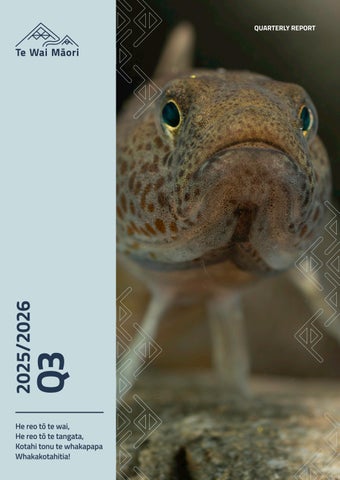
FORNT COVER UPLAND BULLY CREDIT: ANGUS MCINTOSH ECOLOGYLIVE.NZ BACK COVER GIANT KOKPU CREDIT: ANGUS MCINTOSH ECOLOGYLIVE.NZ
17