Q2
2025/2026
QUARTERLY REPORT
He reo tō te wai, He reo tō te tangata, Kotahi tonu te whakapapa Whakakotahitia!
i
2025/2026
Contents
ii
1
Executive Summary
3
Wai Māori around the motu
6
Operational performance against annual plan
10
Financial performance against plan
Q1 Report
Karakia Ko Rangi, Ko Papa, ka puta ko Rongo, ko Tane Mahuta, ko Tangaroa, ko Tumatauenga, ko Haumietiketike, ko Tawhirimatia. Toko te Rangi ki runga, ko Papa ki raro. Ka puta te ira tangata ki te whai ao, ki te ao marama. E Rongo, whakairia ake ki runga, kia tina! Tina! Hui e, taiki e!
iii
GIANT KŌKOPU CREDIT: CREDIT ANGUS MCINTOSH ECOLOGYLIVE.NZ
Q1 Report
Executive Summary This is Te Wai Māori’s quarter two (Q2) report to iwi against the 2025/26 Annual Plan and covers the period 1 January to 31 March 2026. As with our previous quarterly reports, this report has been developed to give regular insight into the work the Trust undertakes on behalf of the beneficiaries of the Māori Fisheries Settlement, including Mandated Iwi Organisations. Tēnā koutou katoa, We are pleased to present to you our first report of the 2025/26 financial year.
This year’s work programme supports the strategic priorities and long-term outcomes detailed in the Trust’s Annual Plan. These include:
+ Enhancing the health and wellbeing of indigenous fisheries and their habitat + Enhancing the recognition and status of indigenous species Providing better opportunities for the participation of iwi and hapū in resource management decision making processes as they relate to freshwater fisheries and habitat
+ Promoting and sharing indigenous fisheries expertise, knowledge and understanding + Increasing the quality and range of information to iwi and hapū on freshwater fisheries and habitat + Supporting iwi and hapū capacity and capability in freshwater fisheries. As always, we welcome your feedback on the structure and content of our reporting.
Nāku noa, nā
Rawiri Faulkner
Chair, Te Wai Māori Trust
1
Q1 Report
Wai Māori around the motu Fish Futures Symposium 2026 ki Temuka The final Fish Futures symposium was held in Temuka in Te Waipounamu from 3 March to 5 March.
The purpose of this huihuinga was to gain insight into Arowhenua as rohe partners in the Fish Futures research programme, to celebrate five years together, and to reflect on how kaupapa will be carried
into the future. The activities of the symposium reflected aspirations to build and foster relationships,
share research learnings and inspire new ideas and opportunities. In attendance were a wide range of people with expertise ranging from the University of Canterbury Masters and PhD students, through to
Cawthron Institute freshwater ecologists and representatives from Arowhenua, Murihiku and Te Arawa. Prior to the formalities of the symposium officially commencing at Arowhenua marae in Temuka, the rōpū were fortunate enough to have been taken directly from Christchurch airport to Ōtūwharekai.
Ōtūwharekai or the Māori Lakes, are a group of small, shallow lakes located in inland Canterbury, that are renowned for their ecological significance and cultural importance to Ngāi Tahu. It is difficult to
articulate the true extent of the beauty and serenity experienced when taken to a wāhi as special as
Ōtūwharekai. Our guide and local kaumātua of Arowhenua, Matua Karl Russell shared with us pūrākau of the sites cultural and ecological significance, including its historic and contemporary importance as a site for mahinga kai and as the main highway for travel between the east and west coasts of Te Waipounamu.
Following on from our excursion to Ōtūwharekai, the rōpū were welcomed on to Arowhenua Marae,
with ahi kā calling the ope on through the waharoa into Te Hapa o Niu Tīreni whare. Presentations from mana whenua followed with Matua Karl, alongside John Henry and Sally Reihana (cultural consultants
representing Aoraki Environmental Consultancy Ltd) exploring different Kaupapa Taiao within their rohe, including kōrero on the implications of resource management reforms on their mahi in their roles as cultural impact assessors at Aoraki Environmental Consultancy Ltd. To conclude a fulsome day, the Fish Futures hikoi rōpū comprising rohe and research partners of the programme, recounted their
recent trip to Canada, in which the rōpū spent invaluable time with the First Nations people, building relationships and exploring the different streams of Taiao mahi currently underway.
3
2025/2026
The second day of the symposium began with parakuihi and a session on brainstorming ways in which people relate to freshwater fish. In this session, the Fish Futures research leads presented
their findings and posed questions to the wider rōpū to explore and understand the connections between people and freshwater fisheries. Shortly after, symposium attendees were privileged
enough to peruse the pātaka and māra kai adjacent to the marae, as well as to watch, listen and learn as ahi kā explained the process and tikanga, both historic and contemporary, surrounding the preparation of hāngi. After much discussion around kai, gratefully lunch followed to prepare the rōpū for an in-depth wānanga on predicting future freshwater outcomes. The rōpū then set out on a hikoi to explore Huirapa/Ōpihi prior to the final wānanga of the day on the topic of co-developing new fish management strategies.
The final day started early with packing, tidying the wharenui and parakuihi. The last session of
the huihuinga focused on continuing fish futures kaupapa into the future. One final kai o te rānui
and karakia closed out the symposium. Being the final Fish Futures symposium, much discussion
included reflections on the enduring relationships built and the vast lessons learnt in the five years since the Fish Futures programme was established. The foundations of this kaupapa have been laid, what matters next is how this mahi will inform future kaupapa that realises the aspirations and priorities of the programme’s partners, particularly Arowhenua, Te Arawa and Murihiku.
4
Q1 Report
5
2025/2026
Operational performance against annual plan 1. Enhance the health and wellbeing of indigenous fisheries and their habitat Fish Futures Research Programme The annual Fish Futures Symposium hosted by
events, and regional council flood protection
practices, both of which have contributed to the
destruction of instream and riparian habitat and increased (suspended and settled) sediment.
Monitoring continues and staff and management are liaising with Cawthron regarding next steps.
Arowhenua whānau was held in Temuka in early
Hydroelectric power stations peer review and summary report
researchers, rohe partners and officials involved
The Trust has commissioned Vaipuhi Freshwater
March. The symposium brought together all across the wider programme.
Consulting Limited to prepare a report that
A hui of the Fish Futures Working group also
for safe tuna passage at hydroelectric power
took place in Ōtautahi ahead of the symposium to discuss progress across key workstreams, including research priorities and upcoming deliverables. The rōpū reflected on recent
submissions and responses to Government
reforms, as well as emerging challenges such
as biosecurity threats and the impacts of severe weather on freshwater ecosystems. The hui provided an opportunity to align on final
outputs for the programme and next steps,
including policy brief dissemination and future governance considerations.
2. Enhance the recognition and status of indigenous species
identifies best practice consent conditions
stations. It is intended that this could be used by
iwi and hapū for use in future hydroelectric power stations consenting rounds. It draws heavily on the Department of Conservation report (dated 2022) on tuna passage provisions at selected hydroelectric power stations, which included a stocktake of current resource consent
conditions and mitigation actions. The report
is now being peer reviewed by NIWA. The peer review will include a summary of key findings and a stand-alone table of upstream and
downstream mitigation options (with outlined pros and cons) that can be picked up and applied at different sites.
It is noted that there has been a recent shift in
the legislative landscape for hydroelectric power
Over abstraction case study
stations. This includes the extension of resource
The water abstraction case study with Rangitāne
of Consents) Amendment Act), and the likely
o Wairarapa is well underway. In this quarter,
local whānau continued to monitor and record
data (flow, depth, temperature and observations)
consent terms (Resource Management (Duration approval of long-lived infrastructure as part of current and future fast-tracking.
for both the Tauānui and Tūranganui awa.
Hokonui eDNA iwi collective project
months has meant that it is almost impossible to
a collaborative multi-iwi project facilitated
Continuous rainfall events over the summer
This quarter, the Trust continued to support
determine the impacts of water abstraction on
by Hokonui Rūnanga focused on kanakana
instream habitat for indigenous fish species as
the flows have been so high, and irrigators in large 6
have related to the impacts of extreme flooding
part have been turned off. The primary issues
monitoring. Hokonui Rūnanga has worked
closely with the Cawthron Institute to develop
and successfully trial a kanakana-specific eDNA
Q1 Report
assay. The assay was developed in response to limitations with existing tools for detecting
kanakana. Following trials undertaken in 2024
that showed strong results, the method is now to be rolled out and tested more widely. The initial rollout includes 300 samples across
approximately 100 sites. Replicates are to be
distributed to other iwi across Aotearoa, including: + Ōraka Aparima Rūnaka + Te Rūnaka o Awarua + Arowhenua Rūnaka + Te Āti Awa ki Whakarongotai
noted that the proposed changes would: + Minimise the role of Māori in the new resource management system. The Māori Part 2
provisions will be removed and replaced by goals that have no hierarchy and the
RMA’s obligation for decision-makers to
“take into account” the principles of Te Tiriti will be removed.
+ Unduly narrow the “guiding principle” which prioritises the enjoyment of property rights.
+ Expand activities without resource consent. Less than minor effects will generally not
+ Ngāti Tawhirikura
be controlled at all, which will increase the
+ Ngāti Maru.
the environment.
Each will receive a sampling kit, guidance, and access to centralised laboratory analysis and reporting. The project enables consistent and
comparable data collection while supporting iwiled monitoring at a local level.
Hokonui Rūnanga are supporting coordination, communications, logistics, and kit preparation, working closely with both Te Wai Māori and
Cawthron to ensure smooth delivery across all iwi involved.
3. Providing better opportunities for the participation of Iwi and hapū in resource management decision-making processes as they relate to freshwater fisheries and habitat Resource Management and other Reform
likelihood of cumulative adverse effects on + Dilute Māori interests in freshwater fisheries, including diluting existing environmental protections like Te Mana o te Wai.
+ Limit the role of Māori in consenting/permitting processes. Māori will only be notified if the
effects are more than minor and they are an affected party.
+ Impact iwi and hapū freshwater rights and interests. Proposed permits can function
as proprietary interests and allocations will continue despite Māori freshwater rights and interests remaining unresolved.
+ Create uncertainty around the functions of regional councils..
4. Promote and share indigenous fisheries expertise, knowledge and understanding.
The Trust continues to respond to legislative
reform that impacts Māori rights and interests
Māori Freshwater Fisheries Conference
in freshwater fisheries. In February, staff lodged
Preliminary planning continues for the next
a response opposing the Planning and Natural
Environment Bills, which will repeal and replace
Māori Freshwater Fisheries Conference which will
the RMA. The Environment Committee held
be held within the rohe of Ngāti Kahungunu.
The event is scheduled to take place on 3rd and
hearings during March and is due to report back to Parliament in late June. The Trust’s response
4th November at the Toitoi Hawke’s Bay Arts & Events Centre in Hastings.
7
2025/2026
5. Supporting Iwi and hapū capacity and capability in freshwater fisheries. Wai Ora Fund This quarter, the Trust continued to support 13 active Wai Ora projects. 2025 funding
round recipients: Lake Taupō Forest Trust,
Tahaaroa Lakes Trust, Raukawa Charitable Trust, Waiohewa Māori Committee, Rohe
Innovations Ltd, Te Kōmiti Nui o Ngāti Whakaue and Te Rūnanga o Te Rarawa. The Trust is
working on entering into a funding agreement
with Ngāti Pāhauwera Development Trust from the 2025 Wai Ora funding round. The Trust also continued to support projects from the 2024
funding round: Te Rūnanga o Ngāti Mutunga, Te Waiau Mahika Kai Trust, Hokonui Rūnanga
Floriculture Limited, and Ngātiwai Trust Board,
and one project from the 2023 funding round:
for funding by the board and work was
undertaken to enter into funding agreements with two rōpū: Rora Mihi Ltd and Te Rua o Mahara Wairarapa: + Rora Mihi Ltd
Rora Mihi Ltd sought Tiaki Wai funding to
restore cultural practices for their whānau
that are centered on tuna and their kaitiaki
responsibilities over their whenua in Matapihi, Okiwi Bay, Marlborough. This will be done through wānanga with whānau to learn,
observe and implement cultural monitoring in line with the māramataka. The proposed activities of the project include creating
traditional hīnaki to capture and release tuna, sharing pūrākau about tuna and gathering kōrero from kaumātua regarding the
whakapapa of tuna and other taonga species. + Te Rua o Mahara Wairarapa
Te Rua o Mahara Wairarapa sought Tiaki Wai
Ngāti Kahungunu Iwi Incorporated.
funding to restore the mauri of the Ūpokokirikiri
Tiaki Wai Fund
ground which holds significant cultural and
This quarter, the Trust continued to support three Tiaki Wai projects, including one that
was completed from Ngāti Tamaterā Treaty
Settlement Trust. Projects by Te Kūpenga Hou Ltd and Te Maru o Ruahine Trust remained in
8
progress. Two new projects were also approved
Stream. The stream is an īnanga spawning spiritual value to the mana whenua of the
rohe. The rōpū aim to use Tiaki Wai funding to remove the pine trees and plant out the streambanks with locally sourced native
plants that support indigenous fish habitat.
2025/2026
Financial performance against plan The following table summarises each area of work identified in the 2026 annual plan by comparing actual to budgeted expenses for the year to date. These figures have not been audited.
Te Wai Māori Finance Report to 31 March 2026 YEAR-TO-DATE ACTUAL Income
BUDGET
VARIANCE
FULL YEAR BUDGET
1,363,442
1,001,454
361,988
2,002,908
Responding to legislative reform
5,670
2,796
2,874
5,592
Indigenous Freshwater Species
27,619
26,100
1,519
52,200
Targeted Research
3,370
12,760
(9,390)
26,520
Māori Freshwater Fisheries Conference
966
-
(966)
40,000
Wai Ora
107,558
142,746
(35,188)
289,992
Tiaki Wai
16,266
24,252
(7,986)
50,000
Wai Māori Scholarship
-
-
-
30,000
MfE Essential Freshwater
(325)
15,795
(16,120)
15,795
Outreach and Relationship Building
2,440
3,333
(893)
10,000
Governance
72,762
69,476
3,286
156,228
Operations
264,739
327,140
(62,410)
607,781
TOTAL Expenditure
501,064
624,398
(125,275)
1,284,108
SURPLUS
862,378
377,056
485,322
718,800
Expenditure Projects and policy
Supporting iwi and hapu through freshwater funding
(Tangata Whenua) Fund
Operations
10
Q1 Report
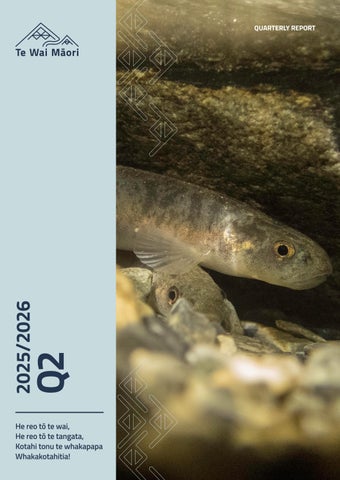
FORNT COVER GALAX ANOMULUS CREDIT: CREDIT ANGUS MCINTOSH ECOLOGYLIVE.NZ BACK COVER UPLAND BULLY CREDIT: CREDIT ANGUS MCINTOSH ECOLOGYLIVE.NZ
11