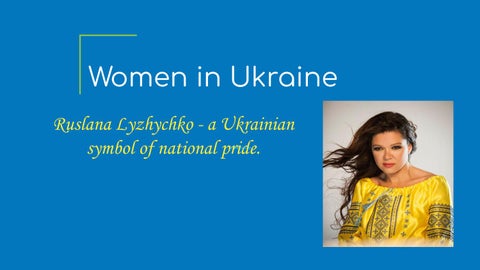
Women in Ukraine Ruslana Lyzhychko - a Ukrainian symbol of national pride.
The feminist voice -
An example how to ‌.
be a woman, free and independent; use a voice to sing, to promote and speak out; love your homeland; ďŹ ght for human rights; be committed; support democratic processes and be active
Ruslana Lyzhychko was born on the 24 May 1973 and was raised in Lviv, in the ancient capital of Galychyna. She graduated from Lviv Lysenko Conservatory. She is a song writer, singer, composer, conductor, activist, producer and arranger of her videos.
Ruslana
She attended an experimental music school at the age of four and fronted various bands in her teens before graduating as a conductor and classical pianist. After winning the Slovyanskyi Bazar song competition in 1996 she worked on her own Christmas TV special and recorded her debut album.
Inspired by her father’s Hutsul’s heritage, her third release, Dyki Tantsi (Wild Dances), was a concept album, fusing traditional ethnic instruments with contemporary dance rhythms, of which the self-composed title track was chosen to represent Ukraine at the 2004 Eurovision song contest.
In May 2004 she won the 49th European music contest “Eurovision”.
The same 2004 year she was awarded the honorary title “People’s Artist of Ukraine”, became “Person of the Year”, received the award “Prometheus Prestige”, “World Music Awards”. In autumn 2004 she actively supported the democratic processes in Ukraine, known as the Orange Revolution. In 2006 she became Member of Parliament in Ukraine.
In spring 2007 the singer goes to great charity tour of Germany (all collected money transfers to children’s hospitals). In cooperation with OSCE Ruslana becomes UN Goodwill Ambassador and begins a campaign to combat modern slavery. In February 2007 she performs at the Vienna Forum on human trafficking and presents a single social “Not For Sale” as officially recognised by UN campaign anthem .
Ruslana became a prominent figure in the Euromaidan movement in Ukraine. For more than 4 months she completely stopped the concert activity and spent nights on Independence Square in Kyiv which became the centre of protest. As a symbol of people power, peace and freedom she established holding up flashlights while singing the Ukrainian national anthem. In January 2014 she testified at the European Union’s European Economic and Social Committee which contributed to a resolution in support of Ukrainian civil society. She also travelled throughout Europe to increase international support and awareness of events in Ukraine.
Social Commitment With her project Wild Energy Ruslana supports the use of renewable energy. She regards the energy of sun, the water and the wind as an energy independence. Ruslana wants to make people aware of the dangers of climate change. Ruslana has also staged numerous charity concerts beneďŹ tting Children’s hospitals.
Ruslana and children: Rhythm of the Heart
Ruslana has won several awards in recognition of her leadership and bravery including the Secretary of the State’s International Women of Courage Award and the Atlantic Council’s 2014 Distinguished Humanitarian Leadership Award. She was also named Forbes Magazine’s one of the 10 most influential women in 2013, the UNICEF Goodwill Ambassador in Ukraine to combat human trafficking, the winner of the 2004 Eurovision Song Contest. She received the International Republican Institute’s Freedom Award, established in 1995 to honour individuals who have worked to advance freedom and democracy.
The voice of people The feminist voice When you love your country and are not indifferent.