“
When you learn how to run an aquaponic system, it helps you understand your place, your own planet Earth a little better, and what your role is. SAM FLEMING 100 Gardens executive director and co-founder
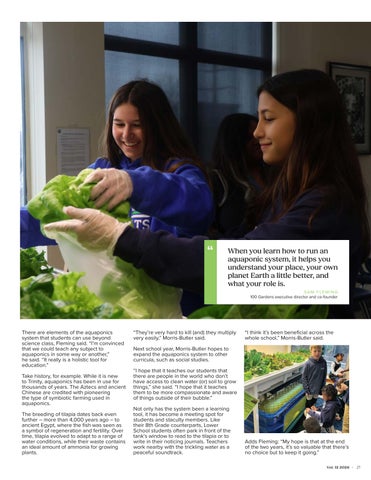
There are elements of the aquaponics system that students can use beyond science class, Fleming said. “I’m convinced that we could teach any subject to aquaponics in some way or another,” he said. “It really is a holistic tool for education.” Take history, for example. While it is new to Trinity, aquaponics has been in use for thousands of years. The Aztecs and ancient Chinese are credited with pioneering the type of symbiotic farming used in aquaponics. The breeding of tilapia dates back even further – more than 4,000 years ago – to ancient Egypt, where the fish was seen as a symbol of regeneration and fertility. Over time, tilapia evolved to adapt to a range of water conditions, while their waste contains an ideal amount of ammonia for growing plants.
“They’re very hard to kill (and) they multiply very easily,” Morris-Butler said.
“I think it’s been beneficial across the whole school,” Morris-Butler said.
Next school year, Morris-Butler hopes to expand the aquaponics system to other curricula, such as social studies. “I hope that it teaches our students that there are people in the world who don’t have access to clean water (or) soil to grow things,” she said. “I hope that it teaches them to be more compassionate and aware of things outside of their bubble.” Not only has the system been a learning tool, it has become a meeting spot for students and staculty members. Like their 8th Grade counterparts, Lower School students often park in front of the tank’s window to read to the tilapia or to write in their noticing journals. Teachers work nearby with the trickling water as a peaceful soundtrack.
Adds Fleming: “My hope is that at the end of the two years, it’s so valuable that there’s no choice but to keep it going.” Vol. 12 2026
· 21