No.12
06/2021
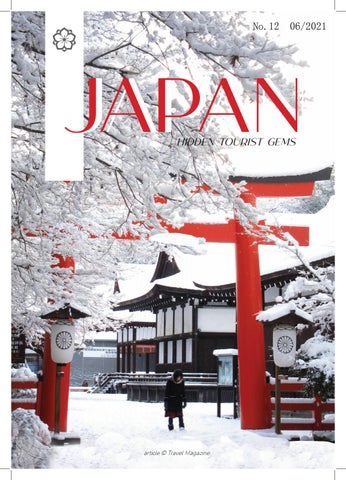
JAPAN hidden tourist gems
article © Travel Magazine
A world heritage
the Countryside Fairytale
Shirakawa(白川村)
Shirakawa is famous for its thatched roof houses (gassho-zukuri). This is the only place where you can still find these historical houses. They were built to withstand some of the heaviest snowfall in Japan. The clear waters from the surrounding mountains have helped cultivate the best green tea plantations outside of Kyoto. Shirakawa is also home to the famous Sato Tono cypress tree, which is renowned for its strength and amazing aroma.
The Shirakawa-go (白川郷, Shirakawagō) and neighboring Gokayama (五箇山) regions line the Shogawa River Valley in the remote mountains that span from Gifu to Toyama Prefectures.
Declared a UNESCO world heritage site in 1995,
they are famous for their traditional gassho-zukuri farmhouses, some of which are more than 250 years old.
Gassho-zukuri means “constructed like hands in prayer”, as the farmhouses’ steep thatched roofs resemble the hands of Buddhist monks pressed together in prayer. The architectural style developed over many generations and is designed to withstand the large amounts of heavy snow that falls in the region during winter. The roofs, made without nails, provided a large attic space used for cultivating silkworms. Ogimachi, Shirakawa-go’s largest village and main attraction, makes a good day trip from Takayama, or a stop on the bus journey between Takayama and Kanazawa. The best way to experience the town, however, is to stay overnight at one of the farmhouses, many of which now serve as minshuku. Gokayama is a little more difficult to access and requires a change of buses in Ogimachi. Less developed and less crowded than Shirakawa-go, its villages are smaller, more intimate and with less intrusion from modern buildings. Gokayama’s nicest villages are Suganuma and Ainokura.
“ It lights up almost like a fairytale scenery in the winter “
Best time to visit: January and February are best, but make sure to reserve your spot ahead of time!
Hotspring with the
purest water in japan
In Japan, Gero has been praised as one of the “three best hot springs of Japan”. The others are Arima and Kusatsu. Without the experience of hot spring of Gero, you will not be able to get the wonders of hot springs in Japan.
Gero(下呂市) Gero is a fairly large town with over 35,900 people, and is one of most famous onsen hot spring towns in Japan. It’s considered to have the purest water in Japan, so many people visit this town for its rejuvenating qualities. Gero is a fairly large town with over 35,900 people, and is one of most famous onsen hot spring towns in Japan. It’s considered to have the purest water in Japan, so many people visit this town for its rejuvenating qualities.
Located in the middle of the hill overlooking the city, Yunoshimakan is surrounded by rich natural forest. You can enjoy yourself in traditional wooden architecture ,the sprit of the good old hospitality and the wonderful hot spring culture of Japan.
The Gero Onsen is located in the center of Gifu Prefecture. It is about 280km from Narita International Airport., 250km from Kansai International Airport, 120km from Central Centrair International Airport. In addition, it is just about 150km from Mt Fuji, one of Japan’s newest world heritages. Visiting Gero on the way to travel around Japan is very easy.
Yunoshi makan Yunoshimakan is a long-standing ryokan (Japanese-style inn) in Gero Onsen. The ryokan was established in 1931 and has had the honor of accommodating the previous Emperor Showa and the current Emperor Akihito. The more than 80-years-old wooden structure in a traditional sukiya-style took three years to be built by artisans of Hida, who are local artisans famous for their skillful techniques. The building is designated as a National Tangible Cultural Asset. Since the hotel stands in the great forest, each room commands a view of natural beauty. Guests here can experience the real Japan by staying at this historical main building surrounded by nature. Our ryokan is the best choice for those who want to touch and sample the ambience of real Japan.
Xerianis delluptatem faccabo repudicipsae deliquo dissecepera ad ulpa voloreprem. Ignam sequid magnihillate
“ beauty-enhancing hot spring water “
The garden surrounding the ryokan building was designed in harmony with several centenarian Japanese cypresses and cedars that have grown here naturally. Each season offers various scenic beauties such as green leaves and beautiful flowers. Guests can enjoy strolling around the woods and bird-watching in the trekking course behind our building. This Western-style hall was built as an entertaining hall in 1931, when Yunoshimakan was opened. It is a modern-style building from the Taisho era (1912-1926). Later, the dancehall was renovated into a bar called “Club Moonlight,” which continues to fascinate people. Please spend your time roaming the halls and various old rooms such as the ballroom, sunroom, and billiard room.
One Of
Japan’s loveliest best-preserved Historical Cities
Kanazawa (金沢市)
Often compared to Kyoto (though significantly smaller than the ancient capital), Kanazawa is renowned for its impeccable geisha and samurai districts, the iconic Kenrokuen stroll garden, and its wonderful cuisine – including some of Japan’s highestquality seafood.
Kenrokuen (兼六園) in Kanazawa is justifiably classified as one of Japan’s “three most beautiful landscape gardens” alongside Mito’s Kairakuen and Okayama’s Korakuen. The spacious grounds used to be the outer garden of Kanazawa Castle and were constructed by the ruling Maeda family over a period of nearly two centuries. Opened to the public in 1871, Kenrokuen features a variety of flowering trees which provide the garden with a different look for each season.
“ one of Japan’s most beautiful landscape gardens ” On pellore pellacearum quo odignatur alignatium vendant, cuptatur auda ad moluptas
The name Kenrokuen literally means “Garden of the Six Sublimities”, referring to spaciousness, seclusion, artificiality, antiquity, abundant water and broad views, which according to Chinese landscape theory are the six essential attributes that make up a perfect garden. A stroll around Kenrokuen will help with understanding this landscape theory as the grounds are teeming with water features, bridges, teahouses, trees, flowers, stones, viewpoints and hidden nooks to discover. Water is diverted from a distant river by a sophisticated water system constructed in 1632 to feed Kenrokuen’s various streams and ponds including the two main ponds in the garden, Kasumigaike and Hisagoike. The over two-meter tall Kotojitoro Lantern, uniquely built with two legs instead of one, stands at the northern bank of Kasumigaike Pond and is an iconic symbol of Kenrokuen. In addition, a fountain below Kasumigaike Pond is one of Japan’s oldest, and is powered by the drop in elevation from the pond which causes water to shoot out 3.5 meters high. Meanwhile, nearby Hisagoike Pond features a small waterfall.
In spring, visitors can see plum blossoms in the southern end of the garden as they bloom around mid February to the end March, just before the cherry blossom season begins. Cherry trees, which usually bloom around Kenrokuen around mid April, which can be found along the streams through the northeastern side of the garden. There are also other varieties of flowers that grow in the garden during the warmer summer months when visitors can expect to see a lot of greenery as well, lorem ipsum.
kenroku en
In autumn you can see fall colors, which are mainly provided by the cherry and maple trees and usually change colors from around mid November to early December. The orange and red maples are mostly found near Yamazakiyama on the garden’s eastern side near the Kodatsuno Gate. In the same general area, visitors will find a large bronze statue of a legendary prince, called the Meiji Monument. The statue is dedicated to the soldiers who died in the Seinan War, a civil war that followed the Meiji Restoration.
Travel magazine Is rehente con et occus rest hillend emolendantem re vol