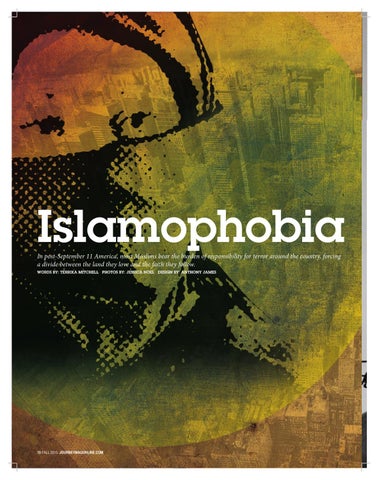
Islamophobia In post-September 11 America, most Muslims bear the burden of responsibility for terror around the country, forcing a divide between the land they love and the faith they follow. WORDS BY: TERRIKA MITCHELL PHOTOS BY: JESSICA NOEL DESIGN BY: ANTHONY JAMES
)$// -2851(<0$*21/,1( &20
ajr Hassan, a second-year professional pharmacy student at Florida A&M University, is brown-eyed, brown-skinned and Southern-born like most students on campus. As the Atlanta native stood in line at a hometown supermarket, she was reminded of her differences. A middle-aged man who observed her attire commented on their religious differences rather than their racial similarities. He questioned if she was “one of those Muslims.” Almost entertained, Fajr laughed and replied “yes.” “You know they hate them nowadays!” she remembers the stranger snapping at her. People tend to doubt her race though, because she is Muslim and adheres to typical dress for American Muslim women. She is draped in a cloth wrapped around her head revealing only her face and “modest” attire that conceals her figure. Fajr says others do not acknowledge that her race and religion are separate. “When people wear their hijabs like this, there’s very little to convince somebody that you’re black,” she says. “People don’t make the distinction. There are a lot of African-Americans who are Muslim, maybe their style would have people think they’re from an African country or wanting to embrace the African culture.” Still, she equally embraces her race as well as her belief in Islam. “I don’t want people to think that Islam means a certain race or that you’re from a certain place in the world,” says Fajr, who is Sunni by sect (or denomination). “Race has absolutely nothing to do with the founding belief of Islam. You can be both.” Even in a city inhabited with so many African-Americans, Fajr feels she’s considered just one of “them”— an outcast. She is all too familiar with the obvious and disguised prejudice from non-Muslims. “I’m used to every look and every glance,” she says. “I know who’s looking at me, how they’re looking at me and what they’re thinking across the room, and I’m not even looking at them.” Decades ago some people may have been on defense against Fajr because of her race. Now, she feels it’s due to her religion, and the violent nature many Americans believe it manifests. Raised by parents who converted to Islam from Christianity after marrying, Fajr says she made the final decision to continue in the religion. “I’d say, maybe around 14 was the first time my dad asked me, ‘What do you want to do?’,” she recalls. “And it’s a decision I make every day I wake up, so it didn’t stop then.” Unfortunately, Fajr says her religious commitment left her rejected and shunned, even from members of her own community. “You have Arabs who look at African-American Muslims as being less than,” she says. “It’s really because most black Muslims don’t speak Arabic so they’ll (Arab Muslims) think they’re missing out on something. It’s important for me to stand up and let other Muslims know I’m African-American and true to my faith.” Fajr, though, fluently speaks English and Arabic, the official language of Islam. But even as she battles scrutiny from fellow Muslims, Fajr seems to face more opposition from the rest of America. She says non-Muslims’ lack of understanding of Islam has resulted in a long-time separation in America. The September 11 attacks only “brought it closer to home” for her. “A lot of people think (Islamophobia) began with September 11,” she explains. “That kind of attitude was there way before Sept. 11. I know this because I was born way before Sept. 11 and I’ve still had that negative reaction. I’ve had people just outright come and say something nasty to me.” Fajr says she is not easily offended by other’s negative opinion of her religion. She is motivated by many aggressors to avoid stereotyping one person’s attitude on Islam to all Americans. “It’s hard not to generalize sometimes but it’s something that you have to actively be aware of and be conscious of how you are approaching the world,” she says. “I can’t go around thinking that everyone is going to attack me so I have to get them first.”
F
-2851(<
“
I can’t go around thinking that everyone is going to attack me so I have UP HFU UIFN mSTU
)$// -2851(<0$*21/,1( &20
“
According to islamophobia.org, “...irrational fear or prejudice toward Islam and Muslims� is Islamophobia. Despite Fajr’s run-ins, Islamophobic attitudes among non-Muslims in America may be on the decline based on an August 2010 Pew Forum on Religion and Public Life poll— “Public Remains Conflicted over Islam.� The Pew Forum poll of more than 1,000 American adults showed that 30 percent were favorable in their opinion of Islam, while 38 percent of citizens admitted to an unfavorable viewpoint in the survey. However there was an almost 10 percent increase in participants who were unsure in their judgment of the religion compared to an August 2009 poll. The Forum’s poll results also show that 42 percent of participants voted that Islam “does not encourage violence more� in comparison to other religions. Contrarily, 35 percent believe that it is “more likely than others to encourage violence.� Attitudes surrounding recent controversies targeting America’s Muslim community may contribute to varied outlooks. Americans everywhere actively objected the Park51 renovation, slugged the ‘mosque near Ground Zero’, and the Rev. Terry Jones’ threat to burn a Quran as part of a 9/11 remembrance. The conflicts broadcast from these areas exposed the otherwise ignored anti-Muslim slant in this country. U.S. citizens recall the Sept. 11 attacks as initiating the country’s active al-Qaida-centered War on Terrorism. Record amounts of U.S. troops journeyed the Middle East, while their civilian counterparts were up in arms as well. Muslim extremists who have levied attacks on America “in the name of Allah� have become infamous poster-people for their religion. In response to September 11, experts like Susan M. Akram propose that most Americans may project an aggressive patriotism on the Muslim public. Akram authored “The Aftermath of September 11, 2001: The Targeting of Arabs and Muslims in America� for Arab Studies Quarterly in 2002. “Several types of anti-Arab racism and violence can be discerned,� Akram wrote. “The third is a form of jingoist hostility and violence usually associated with international crises involving U.S. citizens.� Arabs only make
up 25 percent of America’s Muslim population, according to a Faith Communities Today report. African-Americans ranked No. 2, making up 33 percent of the Muslim community in the states. Consequently, apparent black Muslims may be experiencing a high rate of prejudice throughout the country. Aslam Abdullah, editor of The Muslim Observer— a newspaper established to offset corporate media’s coverage of Muslims— says Muslim Americans are attacked for their religious beliefs. However, he says the prejudices are not for valid reasons. “Islam is a religion and America is a country,� the 10-year editor says. “The tension is between Muslims and right-wing Christian evangelists. They believe that anyone who is not like them will end up in hell. They are creating hateful conditions.� Abdullah argues that mainstream media coverage of Muslim opposition promotes irrational ideologies and groups like FSC. He says, “the media is playing up these groups and their accusations,� which intensifies uneasy relationships. “The media is not giving a fair chance to Muslims to explain their positions,� the editor says. “In the last 10 years, the media has projected and presented Islam as an uncivilized religion other than trying to develop an understanding. Muslims are as much opposed to terrorism as anybody.� Abdullah says issues of domestic abuse, gay/lesbian/bisexual bashing, and unemployment due to outsourcing lack media coverage while corporate media sensationalize for ratings. The Florida Security Council is an anti-Muslim organization operating under the premise that Islam is a violent religion. They believe that under Shariah law, Muslim extremist “want to kill Americans.� Shariah law guides all aspects of Muslim life from daily routines, familial and religious obligations, and financial dealings. The “state-based, private non-profit organization� seeks to counter Muslim extremists, especially in America, by ending their ongoing conflict in Israel with Jewish extremists. Executive director Tom Trento argues, nonetheless, that the FCS operation is not based on religion but national security against those in compliance with the Muslim law. He says the law calls for total Islamic rule, but American Muslims “are more
*Models used in these photos have no relation to this story. *
lenient in their interpretation of the law.” “Most Muslims in America do not comply with Shariah,” he says. “They tend to assimilate peacefully into American society and do not pose a threat to national security.” Trento and Abdullah agree that the average American attitude of Islam is also a result of Muslim presence in the area. Abdullah says cities with a diverse population of Muslims generate increased religious tolerance. Ultimately, he says this affects the interaction because residents are informed and understand the religion more. “If they are in places like California, Las Vegas, New York or Detroit, where there is a mixed population and Muslims are in large numbers, the relationships are definitely much better than places where Muslims are in small numbers,” he says. With a meager 0.6 percent of Americans being Muslim, according to the CIA’s World Factbook, their prominence is scarce in most U.S. cities. In 2009 the U.S. Census Bureau reported an estimated population of more than 250,000 people in Leon County. With only two local mosques— one on Bragg Street near FAMU’s campus— Tallahassee’s moderate Muslim population is evident. Nonetheless, they cannot escape the brunt of religious attacks. Several religious leaders throughout the city have unified to form interfaith ministries to combat issues like Islamic prejudices. Tallahassee Equality Action Ministry (TEAM) has a primary goal to eradicate religious as well as social injustices. Local ministries include Bethel AME, St. Eugene Catholic Church, Temple Israel and Unitarian Universalist Church according to TEAM’s website, teamtally.org. “We are open to all congregations of 20 or more. We’re also welcoming of all faiths,” says the Rev. Robin Gray, Pastor of Unitarian Universalist Church of Tallahassee. She is also vice president of the ministry. Gray notes that the group has not responded to any anti-Muslim aggression primarily because local mosques have not joined the organization. However, Imams, Muslim religious leaders, actively participate in the area-wide interfaith clergy.
“We are preparing for September 2011 to take a proactive rather than reactive approach against anti-Muslim prejudices because we suspect there will be some backlash,” Gray says. She says strangers have approached her seeking her opinion on national news regarding Muslims. She is relatively unmoved by hostile approaches but says she welcomes any questions nonMuslims may have about the religion. “I think the awareness started out by people wanting to know as much about their “enemy” as possible,” she says. “That’s what I love, when people are forced to understand. People are going to look. I wish they would just ask me questions.” Legitimate questions hardly stand a chance considering recent comments made by public figures, such as Bill O’Reilly of FOX News and Juan Williams, a former news analyst for National Public Radio. Williams, who was fired by NPR for commenting on his unease at the sight of an “apparent Muslim in traditional robe” in the airport, was later hired by FOX News. Fajr sympathizes with friends who endure harassment as a result of associating with her. She says, “they may not be as used to the attention” as she is. “You know Bill O’Reilly said Muslims killed us in 9/11?” Fajr says, mim-2851(< icking a comment made to a friend of hers. Fajr, though, is not discouraged and remains grounded in her faith. She encourages fellow followers of Islam to stand strong in their faith. “It just makes me want to advocate even stronger for people to understand what Islam is and what it’s not,” she says. “I hope that other Muslims will feel the same way and not feel ashamed because Bill O’Reilly attacked you on TV.”
-2851(<