TERRA AZUL
Table of Contents
Our Year in Overview - 1
Contents
Statistics of 2023 - 5 Wildlife Observations - 13 Part 1: Cetaceans - 13 Part 2: Marine birds - 23 Part 3: Other marine life - 26 Social Responsibility - 28 Education Initiatives - 28 Sustainable Practices - 29 Connecting with research - 30 Responsible Wildlife Interactions - 31 Steering Cultural Legacy - 32 Our 2023 Team - 34 Image Index - 40 Acknowledgements - 42
Azores Whale Watching & Wildlife Tours TERRA AZUL™ | ANNUAL REPORT 2023
Dear and beloved clients, partners, authorities, and friends, As we bid farewell to the enchanting waves of another whale watching season, it is with great joy that we unfold the captivating story of TERRA AZUL's 2023 voyage — a narrative woven with threads of service excellence, sustainability, and heartfelt community engagement. TERRA AZUL's 2023 season was a triumph in excellence, recognized globally and locally. From prestigious awards in the tourism industry to community engagement, our commitment to sustainable whale watching creates a narrative of inspiration. Join us for another season of discovery and gratitude as we continue our extraordinary journey with the whales of the Azores. With sincere gratitude, Miguel Cravinho, CEO TERRA AZUL - Azores Whale Watching
Azores Whale Watching & Wildlife Tours TERRA AZUL™ | ANNUAL REPORT 2023
Our Year in Overview With Miguel Cravinho, CEO Celebrating Accomplishments For the fourth consecutive year, our hearts swell with pride as we accept the 2023 Travelers' Choice TripAdvisor Award. This recognition speaks volumes about the magic we create during our whale watching escapades in the Azores Ocean — a testament to the lasting smiles we leave on the faces of our cherished clients. On the global stage, we stand tall as a Responsible Whale Watching Operator, a distinction proudly bestowed upon us by the World Cetacean Alliance (WCA) for the second consecutive term. As the pioneering Azorean whale watching company to receive this award in Portugal, we remain firm in our commitment to nature and sustainable practices. Closer to home, the Portuguese Association for Business Ethics (APEE) has honoured us as a role model of sustainability and ethical principles. TERRA AZUL is the sole Azorean company recipient of this prestigious national prize — a humbling recognition of our dedication to environmental education, social inclusivity, diversity, and the pursuit of happiness for all. We were also awarded with the World Travel Guide 2023.
Sailing Through Time Rooted in our commitment to community and heritage, we continue to support the historical whaleboat Senhora de Fátima. This majestic vessel, restored in 2010 under our social responsibility project, stands as a livingmuseum and symbol of our dedication to conserving local maritime culture. It remains the only active sailing and rowing “bote baleeiro” in São Miguel Island — a poignant testament to the remarkable shift from whaling to ecotourism.
Azores Whale Watching & Wildlife Tours TERRA AZUL™ | ANNUAL REPORT 2023
01
Our commitment to education reached new horizons during this season. We had the privilege of introducing 100 local students to the wonders of ocean and conservation topics, through immersive experiences on our whale watching tours. Collaborations with the Centro de Ciência Viva of Açores and the S.O.S. Cagarro Campaign underscore our unwavering dedication to marine life preservation and environmental education.
Venturing into the Depths of Knowledge TERRA AZUL's commitment to advancing knowledge took flight through partnerships with local research projects, such as Monicet (University of the Azores) and various PhD programs led by Fadia Al Abbar (Azores Delphis), Sadie Hale (SEATIMES), and Stéphanie Suciu (Moniceph). These collaborations deepen our understanding of local marine ecosystems, illuminating the intricate tapestry of life beneath the ocean surface.
A Bold Horizon Unveiled This season marked a milestone with the introduction of our state-of-the-art 11-meter RIB, a fantastic new boat crafted by the skilled hands of the national boatbuilder Searib’s. With a capacity for 28 passengers and 2 crew members, she blends speed performance, comfort, energy efficiency, and safety — a testament to our unyielding commitment to delivering unparalleled responsible whale watching adventures.
Azores Whale Watching & Wildlife Tours TERRA AZUL™ | ANNUAL REPORT 2023
02
A Wall-Hanging of Genuine Thanks To our exceptional team — our beating heart — comprising dedicated commercial and front-office staff, skilled skippers, qualified onboard guides, and attentive lookouts (the vigias), we extend a heartfelt thank you. Their collective efforts propelled us through a season with zero incidents that covered an oceanic distance equivalent to Earth's circumnavigation — a testament to their perseverance and competence. This special recognition extends to our invaluable volunteers and interns from around the world, and our freelancers who brought passion and professionalism to every voyage. Their passion and love for the ocean, and commitment to our mission, have left an indelible mark on TERRA AZUL. Thank you, Guy, Diane, and Stefanie (France), Ricardo (Cape Verde), Sandra (Spain), Astrid (Sweden), Martin (Germany), and Lisa (Netherlands), as well as our local freelance skippers Nuno, Francisco, and David.
Anticipation on the Horizon As we stand on the edge of the upcoming season, our commitment stands unwavering. We aim to raise even more our sustainability standards, elevate our clients’ experiences, and deepen our bonds with the local community. Our mission reaches beyond providing unique marine encounters; we aspire to nurture a profound understanding of ocean literacy among the younger generations.
In Gratitude to the Gentle Giants of the Sea Last but not least, our deepest gratitude flows to the whales, dolphins, marine birds, sea turtles, and fish of the Azores. Their graceful presence allows us to thrive as a successful business, providing employment for our dedicated team and supporting their families, and contributing to the promotion of Vila Franca do Campo, São Miguel Island.
Azores Whale Watching & Wildlife Tours TERRA AZUL™ | ANNUAL REPORT 2023
03
Looking back on the year 2023, our journey has been nothing short of extraordinary. We navigated the vast expanses of the “Azorean Sea” on 223 days, covering an impressive 25,162 nautical miles. Additionally, we spent 156 days discovering the beauty and history of São Miguel island. Each of these days presented a unique opportunity to bring people closer to the wonders of nature. In this way, we shared our passion and knowledge with visitors from 61 different nationalities!
Statistics of 2023
Whale Watching in Numbers Most of our voyages were destined for whale and dolphin watching. In this context, we were fortunate to experience over 1,300 encounters, involving 18 different cetacean species. Overall, we accomplished a success rate of 97% to see dolphins and 64% to see whales, with an average of 2-3 cetacean species per tour. However, our most diverse tours saw up to 5 different species! What species we see, where and when depends on a complex interplay between the animals’ needs and a multitude of environmental, trophic and anthropogenic factors. As we delve into the statistics of 2023, we gain insights about the presence of cetaceans in Azorean waters and notable changes therein.
Toothed Whales and Dolphins Common dolphins (Delphinus delphis) are routinely named the most abundant cetacean in the Azores. In 2023, they consolidated their top position with 435 encounters (n). Sperm whales (Physeter macrocephalus) — the most frequently sighted whale species in our region — came in second with 224 encounters. Social units of females with immature whales (the “family groups”) were most common, but we also had several observations of large solitary males. The seasonally abundant Atlantic spotted dolphins (Stenella frontalis) followed closely in numbers with 221 encounters. In 2023, they were found almost year-round, except in February, March and April. They were, however, most abundant between June and September. Bottlenose dolphins (Tursiops truncatus; n=119) and Risso's dolphins (Grampus griseus; n=82) were also common during our tours. The statistics for the five species above closely paralleled those recorded in 2022.
Azores Whale Watching & Wildlife Tours TERRA AZUL™ | ANNUAL REPORT 2023
05
The toothed whale assemblage was completed with the presence of occasionalrare species, in the form of short-finned pilot whales (Globicephala macrorhynchus; n=31), striped dolphins (Stenella coeruleoalba; n=26), orcas (Orcinus orca; n=15), false killer whales (Pseudorca crassidens; n=7), and beaked whales (n=19). The year was specially extraordinary for orca sightings, considering how sporadic such sightings normally are. Less than 50% of the beaked whale sightings could be identified to the species level. Blainville's beaked whales (Mesoplodon densirostris) were identified most often (n=4), followed by Sowerby's beaked whales (Mesoplodon bidens; n=2), northern bottlenose whales (Hyperoodon ampullatus; n=1) and a very rare sighting of Gervais’ beaked whales (Mesoplodon europaeus; n=1).
Baleen Whales Although the spring of 2023 passed without a genuine spring bonanza, we had more baleen whale sightings than the year before. Between January and May, we recorded 56 observations. Most of these involved blue whales (Balaenoptera musculus; n=32), but we also saw fin whales (Balaenoptera physalus; n=11), sei whales (Balaenoptera borealis; n=4), and humpback whales (Megaptera novaeangliae; n=11). The year 2023 continued the trend of the last few years, with lower sighting rates of fin whales. In addition, we had more baleen whale encounters in summer-autumn, with emphasis on sei whales. Between June and September, we recorded 65 sei whale encounters, plus humpback whales (n=8; until mid-June), Bryde's whales (Balaenoptera edeni; n=15) and a lone fin whale (n=1).
Sei whales and Atlantic spotted dolphins
Azores Whale Watching & Wildlife Tours TERRA AZUL™ | ANNUAL REPORT 2023
06
Cetacean Species in 2023 Which species did we see most frequently? (%) Sei whale
5%
Beaked whales (1%) Humpback whale (1%)whale (1%) Bryde's
Sperm whale
17%
Fin whale (1%) Blue whale (2%) Killer whale (1%) False killer whale (1%) Short-finned pilot whale (2%) Striped dolphin (2%)
18 species Atlantic spotted dolphin
17% Common dolphin
33%
Risso's dolphin
6%
Bottlenose dolphin
9%
Number of Encounters by Species
Azores Whale Watching & Wildlife Tours TERRA AZUL™ | ANNUAL REPORT 2023
07
Top 5 Dolphin Sightings in 2023
Summer-Autumn 5 - Short-finned pilot whale
Year-round
4 - Risso's dolphin
Year-round Year-round 3 - Bottlenose dolphin
Summer-Autumn
1 - Common dolphin
2 - Atlantic spotted dolphin
Top 5 Whale Sightings in 2023 5 - Bryde's whale
Summer-Autumn
4 - Humpback whale
2022 n i s g Year-round htin g i S n i Top 5 Whale olphSightings in 2022 D 5 p To 1 - Sperm whale
Spring
Spring
3 - Blue whale
Spring / Summer-Autumn 2 - Sei whale
Azores Whale Watching & Wildlife Tours TERRA AZUL™ | ANNUAL REPORT 2023
08
2023 Seasonal Variation of Species Sightings Winter (Jan-Feb-Dec)
Spring (Mar-Apr-May)
Summer (Jun-Jul-Aug)
Autumn (Sep-Oct-Nov)
Sperm whale Common dolphin Atlantic spotted dolphin Bottlenose dolphin Risso's dolphin
Striped dolphin Short-finned pilot whale False killer whale Killer whale Blainville's beaked whale Sowerby's beaked whale Northern bottlenose whale Gervais’ beaked whale
Blue whale Fin whale Sei whale Humpback whale Bryde's whale
Azores Whale Watching & Wildlife Tours TERRA AZUL™ | ANNUAL REPORT 2023
09
Distribution of Whale Sightings São Miguel island
N
Sperm whale Unidentified beaked whales Blainville's beaked whale Bathymetric dataset: GEBCO Compilation Group (2022) GEBCO_2022 Grid
Northern bottlenose whale
(doi:10.5285/e0f0bb80-ab44-2739-e053-6c86abc0289c)
Gervais’ beaked whale
Distribution map 1. The deep waters towards the southeast of São Miguel island are good for deepdiving whales! Most of our sperm whale observations occurred “close to home” in waters over 500 metres deep.
São Miguel island
N
Blue whale Fin whale Sei whale Bathymetric dataset: GEBCO Compilation Group (2022) GEBCO_2022 Grid
Bryde's whale
(doi:10.5285/e0f0bb80-ab44-2739-e053-6c86abc0289c)
Humpback whale
Distribution map 2. Sei, humpback and Bryde's whales were more likely to be found closer to shore than blue and fin whales. Most baleen whale sightings took place on the southeastern side of São Miguel island, where a fair number of individuals found opportunities to feed.
Azores Whale Watching & Wildlife Tours TERRA AZUL™ | ANNUAL REPORT 2023
10
Distribution of Dolphin Sightings São Miguel island
N
Common dolphin Bathymetric dataset: GEBCO Compilation Group (2022) GEBCO_2022 Grid
Atlantic spotted dolphin
(doi:10.5285/e0f0bb80-ab44-2739-e053-6c86abc0289c)
Striped dolphin
Distribution map 3. Small delphinids were abundantly sighted in our area of operation. In comparison to Atlantic spotted dolphins and striped dolphins, common dolphins were much more likely to be observed close to shore. Striped dolphins were seen in waters deeper than 500 metres.
São Miguel island
N
Bottlenose dolphin Risso's dolphin Short-finned pilot whale Bathymetric dataset: GEBCO Compilation Group (2022) GEBCO_2022 Grid
False killer whale
(doi:10.5285/e0f0bb80-ab44-2739-e053-6c86abc0289c)
Killer whale (orca)
Distribution map 4. Short-finned pilot whales were found far from shore this year, in waters deeper than 750 metres. In some cases, they associated with bottlenose dolphins and Risso's dolphins, with observations of both competitive and apparently neutral interactions.
Azores Whale Watching & Wildlife Tours TERRA AZUL™ | ANNUAL REPORT 2023
11
Wildlife Observations In the Heart of Nature's Theatre We are in the heart of the North Atlantic Ocean, circa 1,360 km west of Portugal's mainland. Here, nine volcanic islands rise up from the Mid-Atlantic Ridge: the Azores. It is one of the world's biodiversity hotspots, and a leading destination in sustainable tourism. Where the lush volcanic land meets the ocean, we are greeted by an astonishing variety of marine life. Join TERRA AZUL's journey, and discover our 2023 highlights off São Miguel island!
Part 1: Cetaceans Winter of Diversity Like the natural world, our winter season runs at a slower pace. Yet, it is a beautiful time to visit the island of São Miguel. We are often asked if winter is also good to see whales and dolphins? Well, the answer is yes! There are several cetacean species that can be seen year-round. Good examples of this are the sperm whale, common dolphin, bottlenose dolphin, and Risso's dolphin. These four species typically form the majority of our sightings at this time of year. However, January and February gave us slightly different results in 2023: ORCAS joined the top 4 ranking! Especially February got us swooning over these “Sea Pandas”. Dreams came true when we saw one breaching from the water, and some days later, we found ourselves on cloud nine again, surrounded by multiple orcas peacefully resting alongside the boat. The first two months of the year were also more diverse than expected! Besides the five species above, we saw three species of baleen whale and four more species of dolphin. There was no doubt the year started off strong!
Azores Whale Watching & Wildlife Tours TERRA AZUL™ | ANNUAL REPORT 2023
13
Blainville's beaked whale (Mesoplodon densirostris)
Head and pectoral fin of a killer whale (Orcinus orca) — February 2023.
Breaching killer whale (Orcinus orca) — February 2023
Classic sperm whale (Physeter macrocephalus) fluke-up dive — February 2023.
Azores Whale Watching & Wildlife Tours TERRA AZUL™ | ANNUAL REPORT 2023
14
Striped dolphins
False killer whales
Spring in Full Swing As February faded away and March peaked around the corner, we started seeing more and more cues that spring was on the way. It was the start of our “baleen whale season”. The Azores Islands are a wellknown passage point for several species, including blue, fin, sei and humpback whales. However, there are years in which we encounter more baleen whales than in others. It depends a lot on food availability. Though we recorded more baleen whales in springtime than we did the year before, there was again no talk of a bonanza. The blue whales, however, did not disappoint! There were plenty of observations and the highlights were on par with 2023's humpback whale acrobatics. We got the grandeur of fluke-up dives, and the cuteness of curious calves!
Toothed whales also became more numerous in springtime. There were sightings of sperm whales, common dolphins, bottlenose dolphins, Risso's dolphins, striped dolphins, Atlantic spotted dolphins, short-finned pilot whales, false killer whales, orcas (oh yes!), and one mysterious, unidentified beaked whale (Ziphiidae sp.). There were a good deal of toothy spectacles, but coming (quite literally) face-to-face with false killer whales was...humbling! These large dolphins can grow up to an impressive length of 6 metres, dwarfing even the tallest human and chunkiest bottlenose dolphin.
Azores Whale Watching & Wildlife Tours TERRA AZUL™ | ANNUAL REPORT 2023
15
Blainville's beaked whale (Mesoplodon densirostris)
Blue whale (Balaenoptera musculus) fluking before diving — April 2023.
Humpback whale (Megaptera novaeangliae) acrobatics — May 2023.
False killer whale close-up (Pseudorca crassidens) — April 2023.
Azores Whale Watching & Wildlife Tours TERRA AZUL™ | ANNUAL REPORT 2023
16
Sperm whales
Killer whale
Northern bottlenose whales
In the Summer Spotlight The summer of 2023 was one to be treasured, with amazing weather and marvellous cetacean encounters. We observed an abundance of whales and dolphins, including northern bottlenose whales and other beaked whale species. The sei whales proved to be truly stellar, particularly in July. They were the stars of a marine bonanza! Think: surface-feeding whales surrounded by frenzies of spotted dolphins and seabirds. Another whale that got quite a bit of attention this year was the Bryde's whale. Bryde's whales are easily overlooked, because of their striking resemblance to sei whales. Nevertheless, we successfully identified several of them between July and September. This was based on the presence of three rostral ridges and small differences in dorsal fin shape,
skin colouration, and behaviour. In some cases, they were travelling and feeding almost “incognito”, blending in with the more common sei whales. Shifting our focus away from the baleen whales, we were equally (if not more) smitten with our iconic sperm whales. We witnessed the birth of a precious newborn baby, melted at the sight of a sperm whale napping next to us, and we were blown away by a breaching sperm whale bull — a behaviour rarely observed in mature males. Finally, we saw orcas twice more, in June and July. On one of the days, we had the youngster of the pod swirling next to our boat. It turned out she was completely mesmerised by a pilot fish!
Azores Whale Watching & Wildlife Tours TERRA AZUL™ | ANNUAL REPORT 2023
17
Blainville's beaked whale (Mesoplodon densirostris)
Breaching sperm whale bull (Physeter macrocephalus) — June 2023.
Fast travelling striped dolphins (Stenella coeruleoalba) — August 2023.
Sperm whale (Physeter macrocephalus) lobtailing upside-down — June 2023.
Azores Whale Watching & Wildlife Tours TERRA AZUL™ | ANNUAL REPORT 2023
18
Autumn Comes Winter... As autumn and winter came around, our tours became a dance with the weather. The ocean revealed a quieter abundance of cetaceans. Taking any chance to go out to sea, we warmly embraced sightings of sperm whales, a variety of dolphin species, and two baleen whales. Despite their cryptic nature, beaked whales also added a layer of excitement. We experienced curiosity-driven close approaches by Blainville's beaked whales, with great photos as a result.
One individual was matched to a sighting in 2022 and an earlier sighting in 2023! We also shared fleeting moments with Gervais’ beaked whales in September. This species is one of the rarest cetaceans in the region, with only one other confirmed sighting off São Miguel island! As the year came to a close, nature had one more surprise in store: false killer whales — a species loved and appreciated by all our crew!
Short-finned pilot whale
Gervais’ beaked whale
Blainville's beaked whale
Azores Whale Watching & Wildlife Tours TERRA AZUL™ | ANNUAL REPORT 2023
19
Blainville's beaked whale (Mesoplodon densirostris)
Bryde's whale (Balaenoptera edeni) powering through the waves — September 2023.
Blainville's beaked whale (Mesoplodon densirostris) close-up — September 2023.
Atlantic spotted dolphin (Stenella frontalis) leaping from the water — September 2023.
Azores Whale Watching & Wildlife Tours TERRA AZUL™ | ANNUAL REPORT 2023
20
Views from the Vigia Did you know our vigias (spotters on land) are at the helm of finding the whales and dolphins for our tours? Their expert techniques are a “remnant” of the old whaling days, accentuating the long-lasting link between Azoreans and whales! Of course, they use powerful binoculars and radios nowadays. If you wish to learn more about the Azorean heritage and the transition from whaling to whale watching, come visit us! We bring Azorean history and tradition to you through our beautifully restored traditional whaleboat “Senhora da Fátima”, the whale lookout point “Vigia da Furada”, and the work of our vigias! In 2023, Filipe and Nicole (our vigias) dedicated approximately 1,000 hours each to meticulously observing the ocean. When combined, this represents an astonishing amount of time, completely devoted to locating whales and dolphins. Fun fact: these hours are equivalent to watching “Free Willy: The Movie” a staggering 1192 times! While our vigias operated from various points along the south coast, they most frequently worked out of Ponta Garça. The bulk of our cetacean sightings took place between Caloura and Ribeira Quente.
São Miguel island
N
Bathymetric dataset: GEBCO Compilation Group (2022) GEBCO_2022 Grid (doi:10.5285/e0f0bb80-ab44-2739-e053-6c86abc0289c)
Azores Whale Watching & Wildlife Tours TERRA AZUL™ | ANNUAL REPORT 2023
22
Wildlife Observations Part 2: Marine Birds Leach's storm petrel
The Azores Islands are internationally recognised as an important destination for marine birds. The archipelago provides nesting habitats for several species, with shearwaters, terns and storm petrels standing out as noteworthy breeders. The region's nutrient-rich waters additionally draw seabirds in search of feeding opportunities. Occasionally, rare species are spotted, carried by strong winds and substantial storms during their migratory journeys.
Brown booby
Barolo shearwater
Most Abundant Species The Procellariformes (derived from the Latin word “procella” meaning “storm”) are a group of pelagic birds that live in the open sea. They have a special tube in their beak to get rid of excess salt. The emblematic Cory's shearwater (Calonectris borealis) or “Cagarro” is one species, that is seasonally abundant in the Azores, hosting around 75% of the European population. Between February and March, Cory's shearwaters began to arrive in great numbers. The species remained abundant between April and October, which represents an important time for breeding, egg incubation and chick care. In this period, we regularly witnessed the birds engaging in feeding activities near dolphins and large predatory fish. We also found the species scavenging opportunistically on dead squid at the surface. Many individuals moved away from the southeast coast of São Miguel by October, initiating the start of their migration to South Atlantic wintering grounds.
Azores Whale Watching & Wildlife Tours TERRA AZUL™ | ANNUAL REPORT 2023
Yellow-legged gull
Atlantic puffin
23
Interestingly, we continued seeing quite a few groups of Cory's shearwaters rafting and feeding near the coast until the very end of the year (more so than in 2022). Common terns (Sterna hirundo) were also frequently observed. Recognisable by their distinctive “black helmets” and reddish beaks, these migratory birds made their presence known from April to midOctober. They were sometimes found on pieces of wood or buoys from large ships, taking a break during fishing trips away from the nest.
Common tern
Observations of yellow-legged gulls (Larus michahellis) occurred daily and year-round. Ths species has adapted to live in environments heavily influenced by human presence, such as the fishing harbour in Vila Franca do Campo. Here, they exploit unlimited sources of anthropogenic food, such as discards of fish. The Islet of Vila Franca do Campo located nearby is another place where the species can be reliably observed. The yellow-legged gulls were the only seabirds in our area that remained abundant during the winter months.
Black-legged kittiwake
Cory's shearwaters
Azores Whale Watching & Wildlife Tours TERRA AZUL™ | ANNUAL REPORT 2023
24
Special Visitors and Shorebirds Throughout the year, we had the opportunity to see several beautiful visitors. Among the diverse species within the group of Procellariiformes, we sighted Bulwer's petrels (Bulweria bulwerii), Manx shearwaters (Puffinus puffinus), Barolo shearwaters (Puffinus baroli), great shearwaters (Ardenna gravis), Leach's storm petrel (Hydrobates leucorhous), sooty shearwater (Ardenna grisea), and northern fulmar (Fulmarus glacialis). Additionally, we saw several members of the order of Charadriiformes, including black-legged kittiwakes (Rissa tridactyla), great skuas (Stercorarius skua), and a juvenile Atlantic puffin (Fratercula arctica). We even had an unexpected sighting of a juvenile brown booby (Sula leucogaster) in March.
Shorebirds were regularly observed on the Islet of Vila Franca do Campo and in the harbour nearby. As in 2022, we confirmed the presence of ruddy turnstones (Arenaria interpres), sanderlings (Calidris alba), whimbrels (Numenius phaeopus), and little egrets (Egretta garzetta) foraging between the rocks. We thoroughly enjoyed the sight of a whimbrel testing its luck, hunting a crab on the Islet of Vila Franca do Campo! We even spotted a purple sandpiper (Calidris maritima), and a special visitor, the “red knot” (Calidris canutus). Finally, in the marina of Vila Franca do Campo, we encountered two visiting wading birds: the great blue heron (Ardea herodias) and the horned grebe (Podiceps auratus).
Red knot
Horned grebe
Little egret
Eurasian whimbrel
Azores Whale Watching & Wildlife Tours TERRA AZUL™ | ANNUAL REPORT 2023
25
Wildlife Observations Part 3: Other Marine Life When exploring the wonders of marine life, loggerhead sea turtles (Caretta caretta) often steal the spotlight. Beyond their aesthetic appeal, these turtles play a crucial role in regulating Hydrozoan populations, including the colourful Portuguese man o’ war (Physalia physalis). In 2023, we recorded a total of 41 loggerhead sea turtles, with the majority spotted between April and November. Portuguese man o’ war were a common sight during the spring months, with another small wave of sightings noted in mid-June. Our marine excursions also granted us glimpses of large fish species. Among these were two sicklefin devil rays (Mobula tarapacana), blue sharks (Prionace glauca), ocean sunfish (Mola mola), swordfish (Xiphias gladius), tunas, and Bennett's flying fish (Cheilopogon pinnatibarbatus). These animals added a thrilling bonus to our sea tours.
Loggerhead sea turtle
Portuguese man o’ war
Sicklefin devil ray
Ocean sunfish
Azores Whale Watching & Wildlife Tours TERRA AZUL™ | ANNUAL REPORT 2023
26
Social Responsibility Science, Education & Sustainability Not only does TERRA AZUL provide unforgettable marine wildlife experiences, we also recognise the profound importance of social responsibility. Our commitment is anchored by three pillars: educating about the ocean and its inhabitants, practicing sustainable tourism, and engaging in scientific efforts. These pillars highlight our dedication to benefitting the local community, conservation of marine life in the Azores, and the health of our planet!
Education Initiatives In 2023, we engaged in a spectrum of educational activities, catering to audiences from local communities to international visitors. The aim: to foster a deeper understanding of cetaceans, the delicate balance within marine ecosystems, and the importance of conservation efforts. Our multifaceted education programme consists of organising workshops, attending conferences, engaging the public on social media, and creating educational videos. Moreover, high-quality education is a key element of our guided wildlife tours, for which we use miniatures, hydrophones and other tools. Workshops - Throughout the year, we organised workshops at our base for local children, in collaboration with the School of Vila Franca do Campo, the Nautical Club of Vila Franca do Campo, and ExpoLab. We even welcomed students from Wesleyan University, Connecticut (USA) in January, to improve their knowledge about whaling. Unfortunately, adverse sea conditions made it challenging to organise sea excursions for these groups. An open-to-public workshop “Whale Poop Ambassador: Whales as Ocean Engineers” with Frank Zanderink and Moniceph took place in August. Lastly, we promoted the S.O.S. Cagarro campaign and the conservation of Cory's shearwaters (and other marine birds) through SPEA's yearly presentation at our base.
Azores Whale Watching & Wildlife Tours TERRA AZUL™ | ANNUAL REPORT 2023
28
Seminars and other events - TERRA AZUL actively participated in various seminars, demonstrating our strong interest in scientific and environmental topics. We took part in the environmental citizenship seminar titled “Uma Gota de Iniciativa, Um Mar de Soluções” at Escola Secundária Antero de Quental in Ponta Delgada. In May, we presented at the “Beyond Whale Watching” seminar in Ponta Delgada. We showed how TERRA AZUL contributes to marine wildlife research, ocean literacy, and the local community. Meanwhile, Sadie Hale (SEATIMES project) - one of our scientific collaborators - talked about her aims to study the changing relationships between humans and whales. Last but certainly not least, we participated in the project “De Fenais a Fenais: Cultura Matriz do Desenvolvimento Local”. This included the “WhaleTales Storytelling” workshop in Fenais da Luz, featuring the presence of Anniken Førde (UiT The Arctic University of Norway) and Camilla Ilmoni (The Whale project, Norway). Presentations - We extended invitations to our scientific collaborators — Azores Delphis Project, Moniceph, Monicet and SEATIMES — which came to present and discuss their projects at our base. They provided informative updates about their valuable work. Media and educational materials - On the media front, there were developments too. Firstly, we concluded the preparations and filming for our next series of WhaleZone.TV episodes. Secondly, a strategic plan was devised to leverage our social media platforms as tools for promoting ocean literacy and environmental awareness. Thirdly, our steadfast commitment to ongoing research projects allowed us to integrate cutting-edge insights into our educational curriculum. By incorporating the latest scientific discoveries into our materials, we elevated the quality and relevance of our educational programmes. Lastly, we proudly hosted the premiere of the documentary “Priolo — The Jewel of the Azores”, directed by Pablo Varona Fiestras and Daniel Rodriguez Foley!
Sustainable Practices Throughout 2023, TERRA AZUL upheld its commitment to a trajectory of environmental sustainability. Our proactive stance is evident in the achievement of existing and new accreditations — such as “Cartilha de Sustentabilidade dos Açores” and “Programa Bandeira Azul”, being an active member of “Associação Empresarial para a Sustentabilidade dos Açores”, and receiving a prestigious award from “Associação Portuguesa de Ética Empresarial”. These accreditations serve as important tools for developing and implementing more effective strategies to reduce our environmental impact. Meanwhile, the stability in our consumption of resources suggests a steady course in the company's operations. In relation to community engagement, we organised two beach cleanups. These initiatives not only contribute to the cleanliness of the immediate surroundings, but also raise awareness about environmental protection. Altogether, TERRA AZUL is focused on long-term sustainability, with a willingness to adapt and evolve its practices in response to new information and changing conditions.
Azores Whale Watching & Wildlife Tours TERRA AZUL™ | ANNUAL REPORT 2023
29
Connecting with Research At TERRA AZUL, each tour is regarded as a “research opportunity”, driven by the belief that understanding fosters appreciation. After all, one cannot love what one does not know. Our contribution to scientific collaborators exists in the form of collecting sighting data, photos for photo-identification, and biological samples. Monicet - In 2023, we submitted 756 records of cetacean sightings to the Monicet platform. This is less than expected due to changes and development issues with the platform. As a founding member, our collaboration with Monicet (University of the Azores) dates back to 2009. We have contributed thousands of sighting records over the years, which are readily available to the scientific community. Moniceph - For Moniceph, we gathered 9 cephalopod remains, 1 sperm whale skin sample, 4 samples of sperm whale faeces (of which 2 during dedicated research trips). Suciu & Azevedo (2024; Moniceph) reported that most cephalopod remains belonged to the seven-arm octopus (Haliphron atlanticus). However, one specimen was identified as a jewel squid (Histioteuthis corona). Analysis of the sperm whale skin and faeces samples will be carried out in the near future — we are looking forward to Moniceph's findings! Azores Delphis and SPEA - After several interesting field seasons, Fadia Al Abbar and the Azores Delphis Project shifted attention towards processing and analysing data. Nonetheless, we continued our support to the project by providing a zodiac and lookout hours for the last 3 research trips. For our collaboration with SPEA (Arenaria Project), we surveyed (shore)birds at the Islet of Vila Franca do Campo in January. Later in the year, our guides joined the S.O.S. Cagarro campaign, to patrol and rescue fallen Cory's shearwaters around the marina and fishing harbour of Vila Franca do Campo. SEATIMES and Visitor Contributions - By collecting data and promoting the projects of our collaborators, we were able to raise awareness amongst our visitors and the public. The spark of being part of something bigger inspired some to donate, resulting in € 67,46 for Monicet and € 46,80 for SPEA. Our visitors were also invited to support our newest collaborator: PhD research fellow Sadie Hale from the SEATIMES project. Sadie's research interests are focused on how culture mediates encounters with whales, and expectations of them, in different social contexts. In 2023, she collected 94 online questionnaires and conducted in-depth interviews with around 10 TERRA AZUL staff members and 15 visitors. She also joined a bunch of whale watching tours, talked to another dozens of visitors, and took countless notes about the Azorean whaling history and culture. These results and the engagement of our visitors underscore the impact that each individual can have. We can all make the world a better place by making small steps in our lives. Everyone can contribute to the understanding and conservation of wildlife, and we invite YOU to join this meaningful journey!
Azores Whale Watching & Wildlife Tours TERRA AZUL™ | ANNUAL REPORT 2023
30
Responsible Wildlife Interactions Responsible wildlife interactions lie at the heart of our operations. We strive to minimise negative impacts on the animals and the marine environment, while providing an educational and enjoyable experience for visitors. It is our responsibility to act sensibly, in harmony with local regulations and international guidelines. Responsible Whale Watching - Besides following the regional legislative decrees for cetacean tourism, TERRA AZUL voluntarily adheres to international best guidelines. Since 2019, we have been partners with the World Cetacean Alliance (WCA) — the world's largest community of stakeholders working to protect cetaceans and their habitats. In 2020, we were the first company in Portugal to be certified as a WCA Responsible Whale Watching Operator. This certification is awarded to companies that operate to the highest standards of care for local wildlife, sustainability, and customer experience. The year 2023 was also a big year for us. We invested a great amount of time in coaching our crew, promoting the WCA amongst our visitors, and transitioning to the “WCA Approved” Status (see: https://worldcetaceanalliance.org/wca-approved/). Moreover, the Azores was awarded the Whale Heritage Site status! This project was led by the Ocean Azores Foundation, of which our CEO Miguel Cravinho is a board member. 4th Bienal das Baleias - October brought us to the “4a Bienal das Baleias” in Lajes do Pico. Attending this event was a must as the future of cetacean tourism is high on TERRA AZUL's agenda. The seminar focused on two themes: the impact of swimming-with-dolphins activities, and the carrying capacity for whale watching, in the Azores. Apart from our physical and online presence, we were proud to see two of our former head guides presenting to the audience: Dr. Arianna Cecchetti and Dr. Lorenzo Fiori. Swimming with dolphins - Our vision about responsible ecotourism also extends to our swimming-with-dolphins activity. Over the years, we have shaped the activity with the best interests of the dolphins in mind. For example, we 1) focused our in-water encounters on three species only: common, bottlenose, and Atlantic spotted dolphins - removing Risso's and striped dolphins from our list, 2) extended our briefings to emphasise education and awareness, 3) reduced our availability to a maximum of 2-3 tours per week, and 4) continued to support research on the subject. We also adopted a behaviour-based approach and a non-refund policy — we do not attempt to swim with dolphins if there are nursery groups, nor if we see signs of stress or avoidance. Moreover, the educational value is the most fundamental element of this tour. Since swimming with dolphins is a sensitive activity, we are currently subjecting it to further re-evaluation.
Azores Whale Watching & Wildlife Tours TERRA AZUL™ | ANNUAL REPORT 2023
31
Steering Cultural Legacy Anchored in front of our Whale Watching Base, TERRA AZUL proudly presents the meticulously restored 1945 traditional Azorean whaleboat, "Senhora de Fátima," with its original SG-98-B working registry. Beyond a full-restoration project, it symbolises our commitment to preserve the island's cultural maritime heritage. “Senhora de Fátima” was revived in 2010, through TERRA AZUL's social responsibility initiative. It is currently the only active whaleboat in São Miguel's waters. “Senhora de Fátima” attracts tourists with interest in the transition from whaling to contemporary ecotourism. Additionally, it serves as an exceptional catalyst for sports, culture, and community engagement, while carrying the legacy of whaling times. Since 2014, the company proudly sponsors the Azorean Whaleboat Class Association, offering members the possibility of sail and rowing training, and competing in local regattas and festivals. These activities involve three rowing teams (two women's and one men's) and a dedicated sailing crew, comprising a total 35 individuals. By utilising this “living museum” as a dynamic platform, we bind Azorean spirits with the vastness of the ocean. Our sponsorship is not just about supporting sports, it is an investment that enriches our local community. Welcome aboard our voyage of commitment – where every ripple narrates a story, and every oar strikes a chord of unity!
New Year on the Horizon While our mission to educate, inspire and preserve continues to be our guiding fource, we eagerly anticipate the next season. We look forward to amplifying the impact and reach of our educational initiatives, and elevating the experiences of our visitors. Moreover, we are excited to cultivate new partnerships and deepen our bonds with existing partners and the local community. In tandem, sustainability and responsible wildlife interactions remain a top priority. As we express our gratitudes for the achievements of 2023, we begin the new year with optimism, enthusiasm, and a resolute determination to make a positive impact. See you in 2024!
Azores Whale Watching & Wildlife Tours TERRA AZUL™ | ANNUAL REPORT 2023
32
Our 2023 Team Our employees, volunteers and interns are the heart and voice of TERRA AZUL. Their dedication and enthusiasm were the driving force behind this year's amazing tours. Meet the 2023 team!
Sanne Bakkers Head Guide (Dutch, English), Scientific-Technical Director 325+ hours at sea, favourite species: killer whale (orca) / beaked whales Favourite moment in 2023: This year was all about killer whales: being surrounded by a pod of six resting orcas (less than 5 metres away from the boat), seeing one breaching...dreams came true this year! Also, seeing a sperm whale bull hurling out of the water...wow!!
Alexandra Pires Guide (Portuguese, English, French, ~Spanish), Head of Sustainability 370+ hours at sea, favourite species: blue whale / humpback whale Favourite moment in 2023: When a sperm whale appeared very close to the boat, went under it, and then dived showing its majestic tail! And of course, the humpback whale breaching!
Marylou Feat Guide (French, English, Portuguese, ~Spanish), Head of Education 425+ hours at sea, favourite species: blue whale Favourite moment in 2023: During a glassy tour, a juvenile sperm whale came to our boat, suddenly fell asleep very close, putting himself in the vertical sleep position. After a few minutes, he woke up slowly and dove. The magic of trusting and accepting our presence at this exact time.
Azores Whale Watching & Wildlife Tours TERRA AZUL™ | ANNUAL REPORT 2023
34
Sandra González-Campos Volunteer Guide (Spanish, English) 360+ hours at sea, favourite species: Atlantic spotted dolphin Favourite moment in 2023: When suddenly, from far away, a juvenile sperm whale approached the boat. Less than 2 metres from my face, the whale turned around the boat and fell asleep. I shared that moment with my best friend from Spain, who was onboard too. I will never forget it.
Astrid Hesseborn Ingeström Volunteer Guide (Swedish, English, Japanese) 165+ hours at sea, favourite species: Atlantic spotted dolphin Favourite moment in 2023: Fulfilling my childhood dream of seeing killer whales, or the time that a couple of sperm whales swam next to our boat. These moments will stick with me for life. What I will miss most is the fantastic team and amazing colleagues, both human and animals!
Ricardo Almeida Mendes Volunteer Guide (Portuguese, English) 190+ hours at sea, favourite species: killer whale Favourite moment in 2023: It is not easy to choose, but I guess it was not even on a tour. It was the photo session day with all the team, and after, the chilli dinner with the team at the warehouse. It might be a small team, but an amazing family!
Diane Rodriguez Volunteer Guide (French, English) 160+ hours at sea, favourite species: sperm whale Favourite moment in 2023: Every encounter with wild animals is amazing, but the one that will stick with me forever, up to the point of getting a tattoo, is the birth of a newborn sperm whale during the tour.
Guillaume (Guy) Choquert Volunteer Guide (French, English) 145+ hours at sea, favourite species: sperm whale Favourite moment in 2023: There are a lot — always with sperm whales — but my favourite moment was on my last tour ever during the internship. We saw a baby sperm whale breach twice, super close to the boat. We thought (hoped) this specific baby was “Sunday” — the one of which we witnessed the birth. Anyways: sperm whales are the best. Period.
Azores Whale Watching & Wildlife Tours TERRA AZUL™ | ANNUAL REPORT 2023
35
Martin Gagstetter Volunteer Guide (German, English) 110+ hours at sea, favourite species: Atlantic spotted dolphin Favourite moment in 2023: My favourite moment was when a sperm whale approached the boat and played with the hydrophone!
Stéfanie Zanaret Volunteer Guide (French, English) 20+ hours at sea, favourite species: common dolphin Favourite moment in 2023: The first time I encountered a sperm whale was amazing! The baby sperm whale jumped very close to our boat, in between two big waves!
Lisa van Haaster Guide, Internship (Dutch, English, German) 20+ hours at sea, favourite species: humpback whale / Atlantic spotted dolphin Favourite moment in 2023: With a huge pod of Atlantic spotted dolphins, listening to their communication with our hydrophone — such a loud and incredible noise coming from them! Also, going in and out of the marina, looking at the islet or open sea, made me feel butterflies.
Jorge Amaral Head Skipper 480+ hours at sea, favourite species: humpback whale Favourite sighting in 2023: Humpback whales breaching!
Tiago Batista Skipper / Media Manager 660+ hours at sea, favourite species: sperm whale Favourite sighting in 2023: The encounter with a juvenile killer whale playing very close to us around the boat.
Azores Whale Watching & Wildlife Tours TERRA AZUL™ | ANNUAL REPORT 2023
36
Daniel Paiva Skipper 465+ hours at sea, favourite species: baby sperm whale Favourite moment in 2023: Baby sperm whales jumping many times during a tour.
Nuno Pimentel Seasonal skipper 335+ hours at sea, favourite species: Risso's dolphin Favourite moment in 2023: Five sei whales riding close to the boat!
Filipe Ferreira Vigia (lookout) 1166 hours in the lookout, favourite species: pilot whales Favourite moment in 2023: Humpback whales jumping very close to the coast!
Nicole Pereira Vigia (lookout) 1060 hours in the lookout, favourite species: humpback whale / Risso's dolphin Favourite moment in 2023: Humpback whales very close to the coast, and false killer whales also very close to the coast.
Francisco Garcia Photographer / Social Media Manager Favourite species: Atlantic spotted dolphin Favourite moment in 2023: My favourite moment was seeing the northern bottlenose whales quite close to the boat.
Azores Whale Watching & Wildlife Tours TERRA AZUL™ | ANNUAL REPORT 2023
37
Stephanie Almeida Director of Operations Favourite species: killer whale
Andreia Costa Assistant of Operations Favourite species: seahorses
Andreia (Andie) Costa Front Desk Representative Favourite species: fin whale
Carlos (Sr. Carlinhos) Realejo All-Round Employee Favourite species: yellowfin tuna
Ruben Cabral B2B Sales Manager Favourite species: Risso's dolphin
Azores Whale Watching & Wildlife Tours TERRA AZUL™ | ANNUAL REPORT 2023
38
Filipe Sousa Business Developer Favourite species: Atlantic spotted dolphin / beluga
António Brás Chief Financial Officer (CFO) Favourite species: bottlenose dolphin
Miguel Cravinho Chief Executive Officer (CEO) 480+ hours at sea, favourite species: common dolphin Favourite moment in 2023: In August, when we received our brand new “state-of-the-art” whale watching boat, completing a fleet of four boats. The boat was produced in Viana do Castelo, north of Portugal, by our longtime shipyard partnership. This 38' feet customised design and settings were the result of more than 20 years of experience in the industry, offering safe, comfortable and amazing tours. Together with our 12 metres boat, customised for birdwatching, swimming with dolphins and private tours, they do not escape the eye in the ocean. This is our yellow fleet!
Would you like to be part of the team and see your picture here also? Contact info@azoreswhalewatch.com, or apply directly via jobs@azoreswhalewatch.com
Azores Whale Watching & Wildlife Tours TERRA AZUL™ | ANNUAL REPORT 2023
39
Image Index Contributions by Francisco Garcia: Page 2 - TERRA AZUL zodiac off the south coast of São Miguel Page 4 - Pod of porpoising common dolphins Page 6 - Atlantic spotted dolphins swimming alongside two sei whales Page 12 - Breaching humpback whale Page 15 - Three false killer whales surfacing for air Page 16 - Humpback whale acrobatics Page 16 - False killer whale close-up Page 17 - Two Atlantic spotted dolphin mother-calf pairs Page 17 - Northern bottlenose whales Page 19 - Breaching short-finned pilot whale Page 19 - Gervais’ beaked whale with characteristic striping on the back Page 19 - Blainville's beaked whale with food remains in beak Page 20 - Bryde's whale powering through the waves Page 20 - Blainville's beaked whale close-up Page 23 - Leach's storm petrel in flight Page 23 - Brown booby in flight Page 23 - Barolo shearwater in flight Page 23 - Yellow-legged gull catching a fish meal Page 24 - Black-legged kittiwake in flight Page 25 - Red knot on the Princess Ring islet Page 25 - Little egret preparing for flight Page 25 - Horned grebe in the marina of Vila Franca do Campo Page 25 - Eurasian whimbrel catching a crab Page 26 - Head of a loggerhead sea turtle Page 27 - TERRA AZUL zodiac in front of the Princess Ring islet Page 28 - Workshop: “Whale Poop Ambassador: Whales as Ocean Engineers” Page 31 - TERRA AZUL zodiac departing on a tour Page 33 - TERRA AZUL zodiac heading to the Princess Ring islet
Azores Whale Watching & Wildlife Tours TERRA AZUL™ | ANNUAL REPORT 2023
40
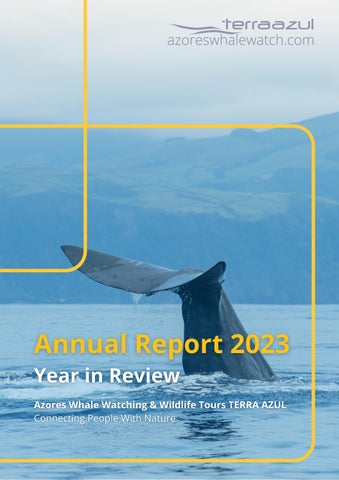
Image Index Contributions by Sanne Bakkers: Cover image - Classic sperm whale tail Page 14 - Head and pectoral fin of a killer whale Page 14 - Breaching killer whale Page 14 - Classic sperm whale fluke-up dive Page 15 - Leaping striped dolphins Page 16 - Blue whale fluking before diving Page 17 - Two adults supporting a newborn baby sperm whale Page 18 - Breaching sperm whale bull Page 18 - Fast travelling striped dolphins Page 18 - Sperm whale lobtailing upside-down Page 20 - Atlantic spotted dolphin leaping from the water Page 21 - Risso's dolphin jumping with belly facing the camera Page 23 - Juvenile Atlantic puffin Page 24 - Common tern resting a large buoy Page 24 - Cory's shearwaters fighting for cephalopod remains Page 26 - Portuguese man ‘o war floating at the surface Page 26 - Sicklefin devil ray underneath the surface Page 26 - Ocean sunfish swimming at the surface
Contributions by Marylou Feat: Page 17 - Skipper Tiago recording a killer whale next to the zodiac
Azores Whale Watching & Wildlife Tours TERRA AZUL™ | ANNUAL REPORT 2023
41
Acknowledgements
We would like to thank all for being an integral part of TERRA AZUL's extraordinary journey. Our achievements would not have been possible without your involvement, and we eagerly anticipate welcoming you aboard for another season of discovery, appreciation and shared joy!
Authors Sanne Bakkers, Scientific-Technical Director Statistics of 2023, Wildlife Observations (Part 1: Cetaceans), Social Responsibility (Connecting with Research, Responsible Wildlife Interactions)
Marylou Feat, Head of Education Social Responsibility (Education Initiatives), Our 2023 Team
Alexandra Pires, Head of Sustainability Social Responsibility (Sustainability Practices)
Sandra González-Campos, Intern (Science Assistant) Wildlife Observations (Part 2: Marine Birds, Part 3: Other Marine Life)
Miguel Cravinho, CEO Foreword, A Year in Overview, Steering Cultural Legacy
Design and lay-out: Sanne Bakkers. Photos: Francisco Garcia, Sanne Bakkers, Marylou Feat
Contact Marina de Vila Franca do Campo, Loja 4, 9680-187, São Miguel, Azores, Portugal
www.azoreswhalewatch.com info@azoreswhalewatch.com Bookings: +351 913 453 030
MT 39/2009 REG/VAT PT512070423 RNAAT 131/2015
Azores Whale Watching & Wildlife Tours TERRA AZUL™ | ANNUAL REPORT 2023
42