Te Rau Ora
Library Life
From the Factory Floor to the Library Floor
Designed for Possibility: Tauranga's New City Library
Issue 512 • October Whiringa-ā-nuku 2026 • ISSN 1176-8088
The Lines of Defence Keeping Wikipedia Reliable
Contents | Rārangi Take
9
03
From The Editor | Nā Te Kaitātari
04
From The President | Nā Te Tumuaki
08
Features | Ngā Tohu • • • • •
25
29
From the Factory Floor to the Library Floor LIANZA Professional Recognition: 2026 LIANZA Fellows The Lines of Defence Keeping Wikipedia Reliable Holding Space: Creating a Grief Café in a Public Library Growing With Purpose: Three Members, Three Professional Development Journeys
Newsboard | Pitopito Kōrero • Celebrating Hastings’ Inspiration and Ashburton’s Teen Sub Box Success • When the Future is Uncertain, Where Do You Start? • Rediscovering Edith Jessie Carnell: A Pioneer of British and New Zealand Librarianship • Former Banned Book A Way of Love Republished for the First Time Since 1959 • Remembering Irene Johnson (1934–2026) • From Future-Proofing to Fit-for-Purpose
38
Regular Columns
39
• Library of the issue: Designed for Possibility: Tauranga's New City Library • Can Gen AI Critically Assess Gen AI? • AI in Practice: Bringing a LIANZA Values Lens to AI • Climate Action: Green Libraries, Global Ideas • Freedom of Information: Insights from the First Year of Reporting in the Library Challenges Register • History Corner: Book Ban Pressure Groups • Tertiary Profile: Twenty-Five Years of Library Service Finishes with Quarter of a Century Study
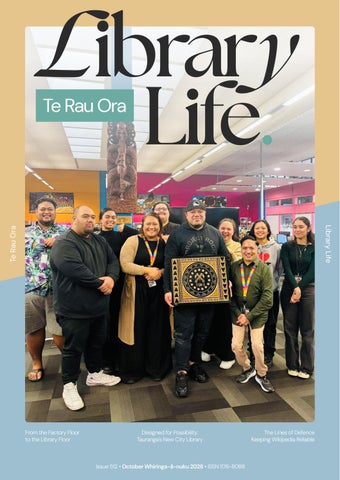
Cover image
Design & Layout
Editorial statement
Ian and his team celebrating his 10 years
Jess Buchanan-Smith,
Te Rau Ora Library Life is the digital
in libraries, 27 July 2025. Image credit
LIANZA Office & Design Manager
magazine of New Zealand’s Library and
Ōtara Library staff.
Information Association Te Rau Herenga Web
Editor & Advertising Vik Ermes,
o Aotearoa. Providing a voice for the views and news on issues relating to the
lianza.org.nz/resources/te-rau-ora-
GLAMIR sector. You may use material
library-life/
found in this publication in accordance
LIANZA Communications Lead
with the Creative Commons Attribution
comms@lianza.org.nz
CC BY-SA 4.0
4.0 CC BY licence for any purpose if the
LIANZA Media Kit available on request
ISSN 1176-8088
original creator is acknowledged.
From the Editor | Nā Te Kaitātari Poipoia te kākano kia puāwai. Nurture the seed and it will bloom. There's something about kōanga (spring) that makes us pay attention to growth. Maybe it's all the colour suddenly appearing after winter. Maybe it's the longer days. Or maybe it's the reminder that before anything blooms, someone has quietly put in the work. Working on this issue of Library Life (my first!), I found myself thinking about all the different ways growth shows up in the library and information profession. Not just through qualifications and courses, although those certainly matter. I'm talking about the growth that comes from saying yes to a new opportunity, taking on a challenge or sharing what you've learned. You'll find plenty of that in these pages.
There's Ian, who spent years working as a landscaper before finding his way into librarianship. His story reminds us that careers rarely move in straight lines. We also hear from Lilly, Chrissy and Bronwyn about what professional growth has meant for them. The journeys of these three wāhine toa are all different, but each highlights the value of investing in yourself and staying curious. Their stories may be the nudge you're looking for. This issue also celebrates LIANZA Fellows Kim Tairi and Jane Wild. Between them, they've contributed an extraordinary amount to libraries, their communities and the profession. Growth isn't only about people, of course. It shows up in our libraries, our organisations and the profession itself. From the opening of Tauranga's new library to conversations about green libraries, AI and insights
from a year of the Challenges Register, this issue explores what it means to keep evolving while remaining grounded in our purpose. And because even the best gardens need a plan, we're also looking ahead. Mark takes us behind LIANZA's 2026-29 Strategy and the thinking that will help guide the association over the next three years. This issue marks a new beginning for me too. It's my first Library Life as editor, and I want to say a heartfelt thank you to everyone who contributed. Library Life exists because members generously share their experiences, ideas and challenges with one another. I hope you'll come away with a fresh idea, a new perspective, or perhaps the confidence to plant a seed of your own. Vik Ermes Communications Lead
Share your mahi and news! Email comms@lianza.org.nz
Editorial
Putanga 512 • Te Rau Ora • lianza.org.nz
3
From the President | Nā Te Tumuaki Kia ora tātou, (This column is brought to you by my overuse of brackets (parentheses) as a literary device). In August, I introduced the new LIANZA strategy 2026-2029 via a webinar. Thank you to all who attended. If you didn’t, a recording is available via the events and recordings section of your LIANZA portal or on the LIANZA YouTube channel. For those (probably most of you) who won’t go and seek that recording out, a copy of the strategy is available in this issue, and I’d like to share some context on how we got there. The strategy was built on a number of coordinated, significant strategic shifts that had already started over the last 18 months, under the leadership of the previous Council.
Editorial
We were responding to some clear long-term trends for LIANZA: Membership numbers and income were dropping steadily, and engagement was also down. We were (and still are) doing excellent mahi for our sector, and we were not in financial difficulty, but the downward trends were clear. The longer-term outlook wasn’t healthy, and it needed to change. These strategic shifts saw us: •
investing in professional development by placing the Te Tōtara workforce capability framework at the heart of a new digital CPD pathway. Developed to turn the framework into a practical tool for professional growth, the CPD pathway, together with CertLIANZA, helps members demonstrate their development and achieve professional certification.
Putanga 512 • Te Rau Ora • lianza.org.nz
•
creating the new enhanced institutional membership category, which has proven hugely popular: We’ve grown from 800 personal members to 3000 members. That’s so many more people getting direct access to LIANZA opportunities and events.
•
providing additional support to our communities and committees to help them deliver events for members, both online and locally.
•
creating a new Professional Development and Events Lead role (and even enticed Paula back from her travels for the role), to support all of this activity.
•
creating a new partnership and sponsorship framework.
4
•
changing some of our governance arrangements to provide some stronger continuity of leadership as a new governing Board.
These were deliberate choices we, as a Board, made. Choices that prioritised investing in growth, transformation and our members, over austerity. These, alongside our largestever response to a member survey in recent times (your responses), which highlighted professional development, connection and advocacy as the key focus areas, have significantly shaped our new strategy. They also set us up well to deliver, embed and improve what we have built, support a significantly larger membership, and ensure members and organisations gain real value from LIANZA.
Editorial
In my May column, I said the Board is focused on producing a strategy that balances aspiration, achievability and sustainability (especially financially). I’m confident we’ve done that and delivered a strategic document that also outlines the challenges and interests of working in this wonderful profession now, and in future years. We’re now focusing on bringing the strategy to life – and that belongs to all (3000) of us. I encourage you all to engage with your local LIANZA regional community to connect with your peers, learn from each other and be part of the wider LIANZA whānau.
together to implement the strategy, my fellow Board members and I would be happy to come and speak at a community event. Ngā mihi,
Mark Crookston LIANZA President
If (you haven’t had enough of strategy talk yet and) you’d like to learn how we can work
Putanga 512 • Te Rau Ora • lianza.org.nz
5
LIANZA STRATEGY 2026-2029 Vision: A thriving library and information sector Purpose: To strengthen the library and information profession through connection, development, and advocacy Commitment: We commit to being an exemplary Tiriti o Waitangi partner and to honour mātauranga Māori and te ao Māori
OUR FOUR CORE PRIORITIES
1
PROFESSIONAL JOURNEY AND WORKFORCE DEVELOPMENT
Support a strong, skilled, and sustainable workforce across all career stages.
2
SECTOR CONNECTION AND MEMBERSHIP
Build an engaged, connected, and inclusive professional community across the library and information sector.
Support the member professional journey across all career stages
Deliver clear member value and improve the member journey
Embed CPD, CertLIANZA, and Te Tōtara as recognised markers of professional capability alongside RLIANZA
Strengthen and enable member engagement and participation across regional, SIG, digital, and hybrid networks
Recognise and support members entering the profession through diverse pathways
Support peer, organisational, and cross-sector connection
Support emerging professionals and strengthen career pathways that encourage sector retention
Improve equitable access and participation through evolving membership models
Strengthen leadership capability across the sector
3
SECTOR LEADERSHIP, ADVOCACY AND PROFESSIONAL IDENTITY
Strengthen LIANZA’s role as a trusted national voice for the library and information sector. Define and lead clear sector priorities and positioning Influence government, policy, funding, and sector positioning Strengthen the evidence base for advocacy and decision making Increase recognition of the profession and its contribution to society
4
SUSTAINABLE AND ADAPTIVE
Ensure LIANZA is financially resilient, strategically aligned, and equipped for long-term impact. Transform and diversify revenue streams
FUTURE FOCUSED PRIORITY
5 FUTURE-READY LIBRARY AND INFORMATION SECTOR Position LIANZA as a leader in future capability, foresight, and innovation across the sector. Identify emerging trends, risks, and opportunities
Support future workforce capability, and emerging technologies, including AI
Lead sector conversations about the future of libraries and information services
Broaden strategic partnerships and commercial opportunities Strengthen governance, leadership, and organisational capability Embed Te Tiriti commitments across governance and operations
OUR HORIZON APPROACH CURRENT HORIZON 2026 - 2029
EMERGING HORIZON 2027 - 2031
FUTURE HORIZON BEYOND 2030+
Embedding, aligning and growing core capability and value
Build on our foundation to take a more aspirational future-focused leadership role
Shaping a thriving, future-ready library and information sector
Imaging your archives for over 35 years
Cultural Heritage Digitisation
Microfilm
Audio Visual Digitisation
Collection Management Software
Your trusted partner in heritage digitisation and online collection management. 0800 696 719 www.micrographics.co.nz
SCAN QR CODE TO LEARN MORE
Features | Ngā Tohu
Putanga 512 • Te Rau Ora • lianza.org.nz
From the Factory Floor to the Library Floor A personal journey into libraries, leadership and community. I never grew up thinking I would work in libraries.
Lessons from sport
In fact, if you had told the younger version of me that I would eventually spend more than a decade in libraries and become the manager of the very library I visited as a child, I probably would have laughed.
Sport played a major role in my upbringing. Dad coached us in rugby and touch rugby, and martial arts was also a big part of our family life.
Growing up, my understanding of work came largely from my old man. Like many Pacific families who came to New Zealand, factory work was a big part of our world. When my brothers and I became old enough, we worked alongside Dad during school holidays and whenever we had the opportunity. Those were long days. Sometimes we would be getting up around two in the morning to start work at three. At the time, we probably thought Dad was being hard on us. Looking back, I understand what he was trying to teach us. "I brought you to work so that you learn never to work in this place." He wasn't disrespecting factory work. Far from it. He had worked incredibly hard to provide for our family. What he meant was that he wanted his children to understand hard work while also recognising that there were opportunities available to us that he had worked hard to create. That work ethic stayed with me.
Rugby became a big part of my younger years, and I was fortunate to play representative rugby for Auckland and at New Zealand age-group and secondary-school level alongside players who would go on to become some of the country's best. Coaching and club leadership followed. Looking back, both sport and coaching taught me a lot about leadership before I ever called it leadership. It taught me lessons that would later shape my approach to leadership: teamwork, discipline, how to perform under pressure, how to win and lose, how to trust the people around me, and the importance of serving something bigger than yourself. Trying to figure out what I wanted to be I didn't have a clear career plan when I left school and started studying, partly because I was trying to work out what I actually wanted to do. After studying a range of subjects, including horticulture management, applied management and human resource management, I spent several years working in landscaping and turf care.
Ian, 10 years in libraries. Image credit Ōtara Library staff.
Features
Putanga 512 • Te Rau Ora • lianza.org.nz
9
I also worked with community organisations and Auckland Council on waste minimisation projects, which involved going into schools, churches and community groups. Looking back, that was probably one of my earliest realisations that I enjoyed working with people and communities. But I returned to landscaping because it was comfortable. Eventually, comfort became the problem. So, I did something that was probably a little risky. I left.
This time, I applied anyway. I knew very little about libraries, but I knew Ōtara. I knew community. I had networks, community experience, management experience and qualifications from other sectors. Somehow, I made it through the process and at the final interview I was asked why they should choose me over the other candidate, who already had library experience. My response probably carried more confidence than I actually felt. "You'd be a fool not to give me this role. This is my community. I know how my community works." And somehow, they gave me the job.
Applying for something I wasn't (I thought) qualified for
What have I got myself into? About a month later, I saw an advertisement for the manager position at Ōtara Library; and I applied almost for fun. Catherine White, someone I knew and respected from growing up in Ōtara, had held the position for more than 25 years. The advertisement talked about library experience and library qualifications. I had neither. But I remembered something I had noticed over the years: Pasifika and Māori people can sometimes meet four out of five requirements, focus on the one they don't have, and decide not to apply.
Then came day one. I very quickly realised I was way over my head. I was around 30 years old and suddenly managing staff who had spent 10, 15, even 20 years working in libraries. My first thought was: "What am I supposed to teach these people that they don't already know?" I didn't understand the terminology. I didn't properly understand the Dewey Decimal System. I didn't understand the systems, processes and responsibilities that sat behind what the public saw.
Ian and his team celebrating his 10 years in libraries, 27 July 2025. Image credit Ōtara Library staff.
Ngā Tohu
Putanga 512 • Te Rau Ora • lianza.org.nz
10
Like many people outside the profession, I assumed libraries were mostly about issuing books, returning books, and shelving books. I could not have been more wrong.
I quickly discovered that library staff become all sorts of things, depending on who walks through the door. On any given day we might be digital navigators, programme facilitators, educators, community advocates, problem-solvers, youth workers, informal counsellors or simply a trusted person willing to listen. The more I learned, the more I realised libraries are not primarily about collections. They are about people.
Everything the job description says we aren't, we somehow become at some point because people come to libraries with real lives and real needs. That completely changed how I saw the profession.
The footprints One experience from those early days changed how I understood leadership. During my whakawhanaungatanga into the role, a kaumatua shared a story about a group escaping danger by travelling across the water at night. Their leader walked ahead, and when the tide went out, there were large footprints across the seabed. Within those footprints were the smaller footprints of the people who followed. The kaumātua related that image to my team. The big footprints represented the years of knowledge and experience already within the staff around me. The smaller footprints represented all of us learning and moving together. "I don't always have to lead from the front. Sometimes I can lead from the back." That story helped me understand that leadership is not about knowing everything. Sometimes leadership is about creating the conditions for others to contribute their expertise. Feeling like an Impostor
Learning a different kind of hard work The other adjustment was personal. Until then, hard work had always meant physical work to me. Professional leadership introduced me to another kind of exhaustion: Mental pressure, difficult conversations, accountability, decisions, staff performance, community expectations, serious incidents. There were days I seriously considered going back to landscaping or factory work because those environments were familiar. But then I would remember those early mornings working alongside my dad. I had always wanted the opportunity to do something different. Why would I go backwards simply because the new challenge was uncomfortable?
Features
For a long time, I carried some form of imposter syndrome. I came into a profession where, at the time, I saw very few people who looked like me, particularly Pasifika men. I was also entering a profession where qualifications, professional registration and years of library experience carried considerable mana. I understood why people questioned me. I questioned myself. It took some time and some experiences, but eventually I realised something important:
I wasn't in those rooms despite where I came from. I was there because of where I came from.
Putanga 512 • Te Rau Ora • lianza.org.nz
11
The people who helped me stay
I learned that if we become irrelevant to the communities around us, eventually they will stop needing us. So we have to keep listening.
I didn't do any of this alone. Gill Pannell played an enormous role in my development as a manager, while mentors such as Mack Leala helped me navigate the profession and deepen my understanding of library service. Others, including Richard Misilei and Kim Taunga, also played important roles throughout my career. And then there was my team.
"It wasn't enough that I lived in the community. I had to work in the community to understand it." That experience reinforced an important lesson for me: community knowledge is not something gained once and kept forever. Communities change, needs change and expectations change. Listening has to be ongoing.
They probably saw something in me before I properly saw it in myself. Living somewhere doesn't automatically give you its trust.
Libraries changed my understanding of community
You have to earn that.
Coming from outside the traditional library pathway eventually became one of my strengths. I didn't arrive with a fixed idea of what a library had to look like. I began asking what our community actually needed. Sometimes that meant books. Sometimes it meant digital support, literacy, learning programmes or practical pathways. Sometimes it meant moving furniture and collections aside and allowing the library to become an entirely different kind of community space.
The back-room experience My connection with Ōtara Library began long before I worked there. During school holidays, mum would take us to the pools, into town for fish and chips, and then to the library to borrow books. Catherine White would encourage us to read and sometimes help tidy around the library or put books away. Every now and then there might be some chocolates or lollies as a reward.
Ian's team celebrating Tongan Language Week, August 2026. Image credit Ōtara Library staff.
Ngā Tohu
Putanga 512 • Te Rau Ora • lianza.org.nz
12
One day, after finishing a book, I watched her disappear through the staff door behind the desk.
"I think libraries chose me."
I became fascinated.
I love serving people.
I asked if I could see what was behind it.
My journey into libraries showed me that there is no single pathway into the profession. Communities benefit when library staff bring different experiences, perspectives and ways of leading.
She replied: "Unfortunately, no. You have to work at the library if you want to see the back room." My imagination ran wild. Years later, I became manager of that same library. I was finally taken through that door. And imagine my disappointment. No room full of lollies. Just books.
I love the fact that on a difficult day I can walk out of my office, talk to someone in the library, and immediately be reminded why we are here. Libraries need people who have a heart for people. Skills can be learned and knowledge can be gained, but genuine service, curiosity and commitment to community remain at the heart of great library work. So if somebody is looking at a library position today and thinking I don't have the right background for that, my advice is simple:
A caretaker, not an owner Today, I see myself less as the owner of this role and more as its caretaker. I sometimes compare it to the All Blacks jersey. You don't own the jersey. You wear it for a period, look after it, and hopefully leave it in a better place for whoever wears it next. That's how I feel about Ōtara Library.
Apply anyway. Don't let the one criterion you don't have make you forget everything you do have. I never imagined becoming a library manager. I certainly never imagined becoming a "library person". But this profession has taught me far more than I could ever have brought into it myself. It has humbled me.
Libraries chose me People sometimes ask why I chose to stay in libraries for more than a decade. I'm not sure I chose libraries.
I've stayed because I love people.
It has changed how I understand leadership, community and service. And, most importantly, it has helped create a better man.
Ian Toki is the Manager Community Places at Ōtara Library, Ōtara-Papatoetoes and has been a librarian since he applied for that role 11 years ago.
Ian, 10 years in libraries. Image credit Ōtara Library staff.
Features
Putanga 512 • Te Rau Ora • lianza.org.nz
13
Professional Recognition: 2026 LIANZA Fellows Every year, LIANZA recognises professional excellence and honours the contributions made by its members to the library and information profession in Aotearoa New Zealand. A Fellowship is the highest level of professional attainment awarded by LIANZA. It is awarded to a personal member of the association who has demonstrated outstanding leadership, teaching or research, made a significant contribution to LIANZA, held library or information management positions for at least 10 years and as a result made a significant contribution to the advancement of librarianship and information management. We’re delighted to announce this year’s LIANZA fellows Jane Wild and Kim Tairi. Kim's Fellowship recognition is particularly noteworthy. Having applied for an Associateship, the LIANZA Professional Registration Board determined that her achievements and contribution to the profession warranted the association's highest honour. This exceptional recognition has only occurred once before in LIANZA's history, reflecting the extraordinary impact of Kim's leadership and service to the profession.
Kim Tairi Over a distinguished career spanning senior leadership roles in both Aotearoa New Zealand and Australia, Kim Tairi has made an outstanding and sustained contribution to the library and information profession through her leadership, service, scholarship, and advocacy for more equitable and inclusive approaches to knowledge, learning and research. Since 2016, as University Librarian at Auckland University of Technology, Kim has provided visionary leadership for one of Aotearoa New Zealand's major academic library services. She has led significant organisational revitalisation, strengthened
Ngā Tohu
services and staff capability, and overseen the ongoing development of collections, spaces and digital services to meet the evolving needs of students, researchers, and academic communities. Her leadership combines strategic insight, innovation, and a strong commitment to people, hauora and professional growth. Kim has been a pioneering Indigenous leader as Aotearoa New Zealand's first Māori University Librarian whose influence extends beyond her institution. Through her professional practice, scholarship and public engagement, she has championed kōrero about the indigenisation of libraries, Te
Putanga 512 • Te Rau Ora • lianza.org.nz
Tiriti o Waitangi-honouring practices, culturally responsive services, Indigenous knowledge systems and equitable access to knowledge. Her role as Kaihautū Tiriti (Treaty Strategy) at AUT reflects the breadth of her leadership and commitment to embedding partnership, equity and cultural responsiveness in organisational practice and development. Kim's contribution to the profession has been substantial at both national and trans-Tasman levels. Through leadership roles with CONZUL, CAUL, VALA, and Open Access Australasia, and as a champion of both Te Rōpū Whakahau and LIANZA, she
14
has helped shape professional practice, collaboration and strategic direction across the sector. As Chair of CONZUL, she has advanced Indigenous leadership and Te Tiriti-responsive approaches within university libraries. Her leadership in open scholarship has strengthened awareness of the value of open research and equitable access to knowledge throughout the region. Under Kim's stewardship, AUT's Te Mātāpuna has become recognised for its relational and inclusive approaches to service design and library user experience. Kim and her team are recognised internationally for their thought leadership and regularly present across Australasia.
A charismatic, relational leader, Kim embodies valuesled authentic leadership. She embodies outstanding, empathetic leadership grounded in Te Tiriti o Waitangi practice across policy, planning, and operations, guided by integrity, fairness and aroha. Kim is known and respected for her warmth, authenticity, inclusiveness and generosity of spirit. Leading with both confidence and humility, she brings people together around shared purpose, empowers colleagues to thrive and consistently uplifts the mana of those around her. She is a role model and mentor for emerging professionals and Māori leaders, encouraging others to step into leadership roles and
strengthening the profession for future generations. In short, Kim shines within the library sector when giving weight to her team.
Kim Tairi – LIANZA Associateship
Kim has led her teams through reorganisations, growth, COVID-19; stimulated inventive change within budget and now applications of generative AI to support student success and library operations. The innovative AUT rangahau portal Tuwhera, an award-winning, sector-leading tool for research visibility and impact, went live a decade ago when Kim joined AUT and has become essential to the university's research profile. Under her leadership, Kim's team continues to innovate in service design, recently launching Ako Atawhai Inclusive Learning Service to support neurodiverse tauira and those with English as an additional language.
leadership grounded in Te Tiriti o Waitangi practice across policy, planning and operations, guided by integrity, fairness and aroha.[i]
Kim Tairi, Waikato, Ngāti Korokī, is the University Librarian at Auckland University of Technology. Kim is Aotearoa's first indigenous University Librarian in 150 years. After many years developing and leading academic libraries in Australia, Kim has brought home proven expertise in strategic planning, people and change management, governance and leadership. Kim has served as Chair of CONZUL, as board chair of Open Access Australasia, two terms as president of VALA and currently represents LIANZA and Te Rōpū Whakahau as trustee on New Zealand Book Awards Trust; our champion representing Aotearoa's literature.
Features
Recognised through honours including the inaugural CAUL Indigenous Leader Award in 2023, Kim has made a sector-changing contribution to librarianship through her sustained achievements in library leadership, open scholarship, Indigenous leadership, Te Tiriti-honouring practice and professional service. She is eminently deserving of recognition as a Fellow of the Library and Information Association of New Zealand Aotearoa (LIANZA).
A commitment to lifelong learning, particularly related to te reo Māori and tikanga, informs her life and work. In short, Kim shines within the library sector when giving weight to her team. He aha te mea nui o te ao? He tangata, he tangata, he tangata. [i] Katene, S. (2010, 2) Modelling Māori leadership. MAI Review. https://www.journal.mai.ac.nz/ maireview/article/824
A charismatic, relational leader, Kim embodies "Doing the right thing at the right time for the right reason" demonstrating outstanding, empathetic
Putanga 512 • Te Rau Ora • lianza.org.nz
15
Jane Wild Over a distinguished career spanning more than four decades, Jane Wild has made an outstanding and sustained contribution to the library and information profession through her leadership, curatorship, scholarship, advocacy, and commitment to protecting and promoting the documentary heritage of Aotearoa New Zealand. Across senior roles at Auckland City Libraries, Auckland Libraries, the University of Auckland, and the Alexander Turnbull Library, Jane has helped shape the stewardship and use of nationally significant heritage collections. As Auckland Research Centre Manager, Research Centres Manager, Manager Heritage Collections, Principal Curator Rare Books, and Library Manager for Creative Arts & Industries and Special Collections, she combined deep subject expertise with strategic leadership, strengthening collections, services, staff capability and research access. Jane has been a leading advocate for access to documentary heritage. As acting inaugural editor of the National Register of Archives and Manuscripts, and later through her special collections leadership, she helped introduce practices that transformed engagement with rare and unique materials. These included establishing a dedicated
Ngā Tohu
manuscripts position and reading room, advancing professional conservation capability, enabling more open access to important Māori manuscript resources, and supporting the development and digitisation of INZART. Her work has consistently connected preservation with use, ensuring that collections are safeguarded, interpreted, researched, and shared. Her influence extends well beyond the institutions in which she has worked. As Chair of the UNESCO Memory of the World Aotearoa New Zealand Trust, Jane has supported recognition of unique documentary and cultural heritage taonga through the New Zealand register. Through service to the Auckland Library Heritage Trust and as a trustee with responsibility for the documentary heritage of the Mackelvie Collection, she has fostered partnerships, funding, scholarship, and public access. Jane received a NZ Institute of Architects President’s Award for her work with architectural archives. Her extensive professional networks and collaborative approach have advanced the standing of documentary heritage nationally.
digitisation initiatives, publications, podcasts, blogs, and documentary projects, she has brought rare books, manuscripts, and other heritage materials to life for researchers and wider communities. Throughout her career, she has also been a generous and trusted colleague and mentor, recognised for her intellectual curiosity, meticulous care, creativity, customer focus, and willingness to share her knowledge. She has strengthened institutions, services, and people, and encouraged emerging professionals to value and sustain the “long game of librarianship”. Through her sustained achievements in documentary heritage leadership, special collections, research access, public engagement, professional service, and mentorship, Jane Wild has made a significant and lasting contribution to the advancement of librarianship and information management in Aotearoa New Zealand. Her influence is national in scope, and she is eminently deserving of recognition as a Fellow of the Library and Information Association of New Zealand Aotearoa (LIANZA).
Jane’s contribution as a curator-scholar and public communicator has been equally substantial. Through exhibitions, symposia, talks, oral histories, close encounters with rare materials,
Putanga 512 • Te Rau Ora • lianza.org.nz
16
The Lines of Defence Keeping Wikipedia Reliable As one of the world’s most visited websites, Wikipedia is a first stop for millions of people seeking information every day, and its content's reliability rests entirely on citations. This makes the platform a natural ally for librarians, the ultimate guardians of reliable sources, who know where the facts live and how to find them. Created with the goal of making knowledge open to all, Wikipedia plays an important role bringing together accessible information and professional curation. However, in today’s internet landscape, it's becoming harder to tell what’s real and what isn’t. It’s easy to find information on any topic, but it can be difficult to determine how reliable it is. Algorithms can elevate incorrect information that drives engagement, eventually pushing it into search results, AI responses or your Facebook feed. Wikipedia, on the other hand, relies on a human-led moderation system which prioritises verifiability and consensus. Wikipedia’s first line of defence is the individual awareness of the editors contributing content to the encyclopaedia. Every edit made to Wikipedia must comply with core content policies: •
Verifiability: Readers must be able to check that the information comes from a reliable source. If a claim cannot be attributed to a credible, published third-party source, it can be removed from Wikipedia immediately.
•
Reliable sources: Not all sources are equal. Self-published blogs, social media posts, biased outlets, or dubious tabloids are explicitly banned or restricted as sources on Wikipedia.
•
Neutral point of view: Content must represent all significant viewpoints fairly, proportionately, and without editorial bias based on published reliable sources. Fringe theories or outright conspiracy theories are either excluded or explicitly framed as such.
While these guidelines keep Wikipedia credible, incorrect or unreliable information can still be added, whether through bad actors or genuine mistakes. Wikipedia has several layers of protection for monitoring edits as they are made. Automated bots and filters handle most vandalism Bots use machine learning algorithms trained on millions of edits to instantly revert obvious vandalism, profanity or spam within seconds of publication. Abuse filters automatically flag suspicious edits, such as mass text deletion or the addition of known blacklisted URLs, for manual review by human editors.
Wikipedia edit-a-thon at Auckland Museum, January 2026 by Sophie Sparrow, CC BY-SA 4.0.
Features
Putanga 512 • Te Rau Ora • lianza.org.nz
17
Articles can be protected when needed When an article becomes a target for coordinated disinformation campaigns or edit wars (e.g. elections, breaking news, sensitive political topics), administrators can lock the page: •
Semi-Protection: Prevents newly created accounts or unregistered IP addresses from editing.
•
Extended Confirmed Protection: Requires editors to have had an account for at least 30 days, and to have made 500 edits, before they can modify the page.
•
Full Protection: Prevents all edits except by vetted administrators.
Community governance and human moderation are vital At its core, Wikipedia’s strongest defence is its global network of active volunteer editors, who all play a role in protecting the encyclopaedia from unreliable information. This moderation involves: •
Watchlists: Editors are notified of changes to articles on their watchlist, with some of the most prolific editors maintaining watchlists of thousands of articles. Whenever an edit is made to an article on their list, they are able to quickly review the exact line-by-line change.
•
Talk pages: Behind every article is a “Talk” page where editors debate sources, framing, and neutral phrasing. Content isn’t determined by a majority vote, but by who presents the strongest arguments grounded in policy and high-quality sources.
•
Dispute resolution: If an edit war breaks out, the dispute escalates through formal channels, culminating in the Arbitration Committee, a community-elected body that
acts as a judicial court to issue sanctions, ban disruptive editors, or restrict edits on specific topic areas. Breaking news and high-profile individuals can be prime targets for disinformation, requiring some specific protocols: •
Current event banners: Warning banners alert readers that an article describes a developing event and that information may change rapidly or be unreliable.
•
Biographies of living persons (WP:BLP): Wikipedia enforces strict rules regarding living individuals. Any controversial, unsourced, or poorly sourced material about a living person must be removed immediately without discussion to prevent defamation and harm.
•
Deprecation lists: The community regularly debates the reliability of news platforms, and sources deemed consistently unreliable are added to an automated filter that alerts or stops users from adding them as citations.
There are many parts working behind the scenes of Wikipedia to keep knowledge safe. Wikimedia Aotearoa New Zealand is the local chapter of the Wikimedia Foundation. It supports people and organisations to improve and increase contributions to Wikipedia and related projects through events, training and partnerships. We are currently seeking expressions of interest from individuals and organisations to deliver collaborative projects in 2027/2028. Find out more at wikimedia.nz/partner-with-us.
Sophie Sparrow is the Marketing and Communications Coordinator for Wikimedia Aotearoa New Zealand.
Ngā Tohu
Putanga 512 • Te Rau Ora • lianza.org.nz
18
Holding Space: Creating a Grief Café in a Public Library Libraries are often described as the heart of a community. People come to us for books, information, technology, learning, warmth, safety, and connection. Increasingly, they also arrive carrying loneliness, stress, trauma, and grief. Libraries are often described as the heart of a community. People come to us for books, information, technology, learning, warmth, safety, and connection. Increasingly, they also arrive carrying loneliness, stress, trauma, and grief. Last year, following significant personal loss in my own life, I became more aware of how many people around me were quietly grieving while trying to keep functioning as normal. Grief was everywhere, yet there were few places where people could speak honestly about it without feeling too emotional, too much, or under pressure to “move on.” From that awareness, our library began a Grief Café. For library and information professionals, the Grief Café offers a practical example of how libraries can support community wellbeing while staying within clear, non-clinical boundaries.
can gather over a hot drink, listen, reflect, and speak openly about grief in all its forms. Some participants have lost loved ones; others are grieving major life changes. Many simply need a place where they do not have to pretend they are okay. What makes libraries uniquely suited to this kind of initiative is that they already operate as trusted, non-judgemental community spaces. People often enter libraries carrying far more than the visible reason that brought them through the door.
A grief café extends the library’s role as a place of belonging and human connection.
The Grief Café is not counselling or therapy. It is a gentle, community-based space where people Community Grief Tree. Image supplied.
Features
Putanga 512 • Te Rau Ora • lianza.org.nz
19
Our sessions are intentionally simple. We usually begin with a gentle reflection, poem, quote, or discussion prompt related to grief. From there, conversation unfolds naturally. There is no pressure to speak: some people share deeply, while others simply listen. Both are welcome. Over time, I have watched participants form meaningful connections with one another. People who arrived feeling isolated began recognising themselves in other people’s stories. The room became a place where tears, laughter, silence, exhaustion, and hope could exist together without explanation. Hosting a grief café has also challenged some assumptions about what library work can look like. While libraries have always supported literacy and lifelong learning, they also support emotional and social wellbeing every day through connection, inclusion and community care. Programmes like this build on those existing strengths in a deeply human way. The experience has shown us that emotional wellbeing work in libraries does not need to be complex to be meaningful. What matters most is clarity of purpose, consistent boundaries, and a setting where people feel safe to arrive as they are. For libraries considering a similar initiative, it is important to keep the model simple and sustainable. Clear boundaries matter: a grief
café is peer support and community connection, not clinical intervention. It is also helpful to have information available about professional support services if participants need additional assistance. Some practical things that helped us included creating a calm and welcoming physical environment, using gentle promotional language, allowing participants to attend casually without commitment, accepting silence as part of the conversation, and understanding that emotional honesty can coexist with warmth, humour and hope. What has surprised me most is how deeply people value having a space where they do not need to minimise their grief for the comfort of others.
Libraries cannot remove grief from a community, but they can help ensure people do not carry it alone.
For public libraries, initiatives like this remind us that community care can sit alongside access to information, learning, and literacy. When handled with care, simplicity, and clear boundaries, a grief café can become another way libraries help people feel less alone.
Louise Allen is the Ringa Hapai / Service Representative at Hillcrest Library, Hamilton, and started the Grief Café.
Images supplied.
Ngā Tohu
Putanga 512 • Te Rau Ora • lianza.org.nz
20
Growing With Purpose: Three Members, Three Professional Development Journeys What does professional growth actually look like in practice? For one LIANZA member, it meant recognising she had become the expert others turned to for advice. For another, it meant identifying a skills gap and deliberately seeking opportunities to address it. For a third, it helped support a journey into leadership and a long-held career goal. The LIANZA CPD Pathway was designed to help members take a more intentional approach to professional development by providing a framework for planning, recording and reflecting on learning. But as these three members discovered, the value isn't just in collecting points or completing reflections. It's in what those activities reveal about your growth, aspirations and professional potential. We spoke to Lilly, Chrissy and Bronwyn about their experiences on the pathway, what they have gained, and why they would encourage others to give it a go.
Recognising the learning you're already doing One of the most common misconceptions about professional development is that it is only possible when we find extra time for courses, qualifications or formal training. For Chrissy, one of the pathway's biggest revelations was discovering how much learning was already happening in her day-to-day work. When she joined the pathway, she was working as a Senior Library Assistant in Children and Youth Services while studying towards a Bachelor of Library and Information Studies. She wanted to move into a more senior librarian role but knew there were gaps in her professional knowledge that she wanted to address. "I joined LIANZA because I recognised that professional development could help me build confidence, develop new skills, keep up with changes in library and information services, and become more intentional about my learning."
Chrissy West is a Librarian, Children and Youth Services at Upper Harbour and Hibiscus and Bays at Ngā Pātaka Kōrero o Tāmaki Makaurau – Auckland Libraries. Image supplied.
Features
Putanga 512 • Te Rau Ora • lianza.org.nz
21
What surprised her most was not only the amount of professional development available, but how much she was already doing. "I was surprised by how quickly the CPD points added up. I was already attending webinars, participating in hui, reading professional articles and studying. I didn't need to do more. I just needed to recognise the learning that was already taking place." That process of reflection changed how she viewed professional development altogether. "It isn't just formal courses or assessments. Webinars, reading, professional conversations, hui and reflecting on experiences all contribute to learning." Finding the gaps and filling them For Lilly, the pathway provided something slightly different: a way to identify areas where she wanted to grow and create a plan to get there. Having previously found the RLIANZA process valuable, she was attracted to the pathway's structure and its connection to a recognised professional body.
a record of the new programmes and initiatives I was trialling in my library." The Te Tōtara capability framework proved particularly valuable. As she reflected on her capabilities, Lilly realised there was one area where her experience was limited. "After reviewing the framework, I realised my cataloguing and collections management experience was limited." Rather than seeing this as a weakness, she used it as a roadmap for her development. "The LIANZA CPD pathway helped me identify that gap and actively seek out learning opportunities, including connecting with experienced colleagues, attending LIANZA webinars and completing specialist training." Over time, the pathway became less of a separate activity and more closely integrated with her daily work. "It initially added value to my work, but over time that has become more evident, to the point where what I do for the pathway overlaps with my day-to-day work."
"I was looking to identify areas for growth, broaden my knowledge of the sector and create Lilly Morrow Howden is a Customer Service Officer – Multiskilled at Te Kaunihera o Te Hiku o te Ika | Far North District Council. Image supplied.
Ngā Tohu
Putanga 512 • Te Rau Ora • lianza.org.nz
22
For Lilly, one of the greatest benefits has been having a structured record of her learning and a deeper reflective practice.
encompasses most of. Other areas highlighted where I needed to spend more time and develop new skills."
"The pathway has deepened my natural reflective practice and provided a comprehensive record of my learning."
Professional development opportunities helped broaden her perspective and challenge her thinking.
Growing confidence and leadership
"The LIANZA webinars are amazing. It's wonderful to hear what other libraries are doing across Aotearoa. I always leave feeling inspired and grateful to work in this field."
When Bronwyn joined the pathway, she had a clear goal. She was around 18 months into her role and was focused on securing a senior role. "That had been my goal when I joined the organisation I work for and I was very clear about my ambition." The pathway appealed because it was specifically designed for the library and information profession. "There are limited options and few providers, so I jumped at the chance to engage in something specific to my role." As she progressed through the framework, she discovered that it could do more than recognise learning. It could help identify where she wanted to grow next.
An Introduction to Leadership course has also encouraged her to think deeply about the kind of leader she wants to become, while joining Te Rōpū Whakahau has provided professional and cultural support as a wahine Māori working in libraries. "Joining Te Rōpū Whakahau has been huge for me, both personally and professionally. Through it I've found encouragement, connection and mentorship." Most importantly, she believes the pathway has strengthened her confidence. "Professionally, I am more confident. I enjoy a challenge and I'm much more comfortable asking the hard questions and putting forward ideas." Since joining the pathway, Bronwyn has achieved the senior role she was working towards.
"In some areas of the framework progressed quite quickly because that's what my role Bronwyn Ratahi-Smith is the Kaitātari Whare Pukapuka Apitihanga Mātāmua | Senior LibraryPlus Officer at Te Kaunihera ō Taranaki ki Te Tonga | South Taranaki District Council. Image supplied.
Features
Putanga 512 • Te Rau Ora • lianza.org.nz
23
Becoming the expert
professional development you're already doing."
While each member's journey has been different, all three spoke about increased confidence and a stronger sense of professional identity.
"You just have to start. You might be surprised by how much you're already learning."
For Chrissy, there was one moment that crystallised just how much she had grown. Reflecting on her work supporting rangatahi involved in Muffin Magazine, she realised her perception of her own role had shifted. "Previously, if rangatahi wanted to grow the profile of their magazine, I would have connected them with the right person who could help." Then came the realisation. "I realised I wasn't just the person connecting people with expertise. I had become the person with expertise." For many library professionals, that moment may feel familiar. Growth often happens gradually, making it easy to overlook until you stop and reflect. That's exactly what the LIANZA CPD pathway encourages members to do.
And for Bronwyn: "Give it a go. If you don't try, you'll never know, and you might be surprised to discover how much of what you already do fits within the framework." She believes reflection is one of the most valuable aspects of the experience. "The key is the reflections. Be honest with yourself. There are no wrong answers. It's about understanding what you've learned and what you're taking away from the experience." A framework for growth The LIANZA CPD Pathway doesn't ask members to do more. Instead, it encourages them to recognise, reflect on and build from the learning they are already doing.
What they'd say to others
For Lilly, it provided structure and highlighted new opportunities for growth. For Chrissy, it strengthened confidence and professional identity. For Bronwyn, it helped map a pathway towards leadership and career progression.
We asked what advice they would give to members considering the CPD pathway, and all three shared a similar message: don't wait.
Their stories are different, but they share a common theme: professional growth becomes far more powerful when it is intentional.
Lilly's advice is straightforward:
As Bronwyn puts it:
"I'd thoroughly recommend it. The CPD Pathway provides a framework to record your professional development and have that learning recognised. It's a great tool to have in the kete."
"Learning is infinite. There's always a goal, big or small, that we can work towards."
Chrissy encourages people to start by recognising the learning they are already doing. "Don't wait until you have time for a formal qualification or course. Start by recognising the
With thanks to Lilly Morrow Howden, Chrissy West and Bronwyn Ratahi-Smith for generously sharing their experiences and reflections. Their stories demonstrate the many different ways professional development can support growth, confidence, connection and career progression across the library and information profession.
Find out how the CPD Pathway works www.lianza.org.nz/members/member-cpd-pathway/
Ngā Tohu
Putanga 512 • Te Rau Ora • lianza.org.nz
24
Newsboard | Pitopito Kōrero
Country Library Service. Photograph - Evening Post, 2 December 1938, p.9. CC BY-NC-SA.4.0.
Putanga 512 • Te Rau Ora • lianza.org.nz
Celebrating Hastings’ Inspiration and Ashburton’s Teen Sub Box Success A programme inspired by Hastings Libraries has quickly become one of Ashburton Library's most successful teen engagement initiatives. After hearing Hastings librarians share their Teen Sub Box programme in 2025, I was excited to adapt the idea for our community in Ashburton. The Hastings idea was so strong that there was no need to reinvent the wheel; we simply adapted a programme that was already working brilliantly. We started with just three teens enrolled in our first month. Within a couple of months, that number had grown to 15, and we now have 22 enthusiastic 12–18-yearolds taking part, with an average age of 15. Following the Hastings model, each box includes three library books, a snack and a themed craft activity. I try to match the craft to the theme of the box, with activities ranging from felt badges through to laser-cut iris boxes for teens to assemble. We are very fortunate to have
an amazing makerspace in Ashburton, which has opened even more creative possibilities for what we can offer.
books, engage with library services, and stay connected with the library in a fun, personalised way.
A particularly valuable aspect of the programme is the feedback process. When the boxes are returned, participants complete book review forms and rate each title out of five stars. This feedback has become not only a way to highlight teen voices, but also a way to use their ratings to create displays that showcase our teen collection through the eyes of the young people reading it.
Most importantly, the programme highlights the value of sharing ideas across the library sector. By adapting a successful initiative developed by Hastings Libraries, we’ve been able to create a programme that is resonating strongly with local young people. A huge thank you to Hastings for generously sharing their programme with us! It’s been wonderful to see our teens embrace the boxes, enjoy the surprise element and connect with the library in a fresh and exciting way.
The Teen Sub Boxes have proven to be a great way to encourage teens to try new
Anna Mattson is the Youth Librarian at Ashburton Library and started the Teen Sub Box programme in April 2025.
Image credit Stacey Broadbent.
Pitopito Kōrero
Putanga 512 • Te Rau Ora • lianza.org.nz
26
When the Future is Uncertain, Where Do You Start? Using the Circles of Control to help library leaders navigate change It’s Monday morning. You arrive at work to find an email announcing a review of your organisation’s structure. There are few details, and no clear indication of what it might mean for your library. By 9.30am, two members of your team have asked whether their roles are at risk. Someone wants to know if a planned project should still go ahead. Your manager has asked you to confirm which priorities the library can continue to deliver, and the team is already stretched. You don't have the answers. You may not even know who does. It’s tempting to spend the day chasing information, trying to anticipate what might happen or reassuring people that everything will be fine. But what if, instead, you took a step back and asked: Where can we actually make a difference? Focus on what you can influence The Circles of Control offer a simple way to think about uncertainty. They help distinguish what is outside our
control, what we can influence, and what we can directly change or do. I recently worked with a public library leadership team facing organisational uncertainty and competing priorities. Rather than trying to tackle everything at once, we stepped back and looked at where the team was putting its energy, what it could influence and what it could actually change. This helped leaders identify work that could be paused, delegated or approached differently, and focus on the things where it could make a meaningful difference. Instead of spending time speculating about potential restructure outcomes, the team redirected its attention to maintaining core services, supporting staff wellbeing and strengthening relationships with decisionmakers. The wider uncertainty hadn't disappeared, but the team had a clearer sense of its priorities and where to direct its efforts. The work that matters before change arrives The same principle came through in a recent discussion about local government reform.
One example highlighted the value of relationships, trust, shared understanding, and credibility built over time. When change came, those foundations created more opportunities to collaborate and influence what happened. Both examples point to actions library leaders can take now. We may not control the decisions being made around us, but we can build relationships, make sure the library's contribution is understood, and strengthen the capability and confidence of our people to respond to change. We can also stay informed and reconnect with our purpose, using it to guide our priorities. Library leaders who invest in relationships, visibility and capability before a crisis are better positioned when change arrives. Where will you focus your energy? The Circles aren't about accepting that nothing can be changed. They're about being deliberate with the energy, time and attention we have.
Library leaders who invest in relationships, visibility and capability before a crisis are better positioned when change arrives.
Newsboard
Putanga 512 • Te Rau Ora • lianza.org.nz
27
Think about the uncertainty facing your own library. •
What are you spending energy on that you can't change?
•
Where might you have more influence than you realise?
•
Who do you need to build a relationship with before you need them?
•
What capability would help your team respond to whatever comes next?
•
Are you clear about the purpose you're working towards, and are your current priorities helping you deliver it?
•
How can you stay informed about developments that could affect your library?
•
What could you do now that would be useful whatever happens?
strengthening relationships, developing people, staying connected to community needs and being clear about purpose. Those investments pay off whether change comes or not. The organisation's future may be uncertain. Where we choose to focus our energy doesn't have to be.
When uncertainty arrives, library leaders often look for information, certainty and answers. Yet the most valuable work may be elsewhere:
Denise Wilson works with library leaders and teams to make sense of complexity, navigate change and turn ideas into action. She brings together strategy, leadership, capability development and community insight to help libraries move forward and deliver impact. Denise also hosts the Let’s Talk Libraries! podcast.
Pitopito Kōrero
Putanga 512 • Te Rau Ora • lianza.org.nz
28
Rediscovering Edith Jessie Carnell: A Pioneer of British and New Zealand Librarianship Many New Zealand library and information professionals will recognise Edith Jessie Carnell's name through the LIANZA Edith Jessie Carnell Scholarship. Yet few may be familiar with the pioneering librarian whose work helped shape the development of public libraries in both Britain and New Zealand. Research undertaken as part of Carnforth Library's 90th anniversary celebrations in Lancashire, England, has provided an opportunity to rediscover Carnell's remarkable career and international legacy. Although she was highly regarded during her lifetime, much of her contribution has faded from public memory in the United Kingdom. Her story deserves renewed recognition, not only because of her professional achievements but also because many of the values she championed remain relevant to librarianship today: equitable access to information, professional development, community engagement, and strong public library services. Carnell’s career offers a vivid example of how local practice, professional advocacy and international exchange helped shape public library development in the mid-twentieth century.
Early career and Carnforth Library Born in Devon in 1906, Carnell entered librarianship at 16 as an articled pupil at Exeter City Library. Her rise was rapid: she became Assistant Librarian within three years, and, in 1930, the first full-time librarian at Bognor Regis. Lancashire was her next major step. In 1935 she was appointed Assistant in Charge of Morecambe and Heysham Libraries, a post originally advertised for a man and at a higher salary because of its demanding nature. Carnell secured both the role and the higher rate.
When Carnforth Library opened in September 1936, it came under Morecambe’s supervision, making Carnell its first head librarian. It was a golden era for libraries in Britain, and Carnell thrived. She gained her Library Association Honours Diploma in 1937, published a book based on her thesis the following year, and chaired the Lancashire County Library Staff Guild. She was also a confident public speaker and a strong advocate for free public library services, a commitment that shaped her next career move. A new chapter in New Zealand
At a time when senior library positions were still largely dominated by men, her appointment reflected exceptional professional recognition for a woman librarian.
In October 1939, shortly after the outbreak of the Second World War, Carnell left Lancashire to take up a liaison role between the New Zealand Library Service and the Country Library Service.
Plaque marking opening of Carnforth Library in September 1936, installed in 2026 as part of the 90th Anniversary project. Image supplied.
Newsboard
Putanga 512 • Te Rau Ora • lianza.org.nz
29
The position placed her at the forefront of efforts to expand access to public library services throughout rural New Zealand and her impact was significant. Travelling widely, she worked with rural councils and committees, encouraging them to move away from subscription-based models and adopt free, ratessupported public libraries. During her tenure, 25 libraries moved from subscriptionbased services to free, publicly funded library provision. At a time when equitable access to information remained uneven across rural New Zealand, this marked a
significant step in developing a national public library network. Building the profession Carnell’s influence extended beyond public library development. In 1942, Carnell became Assistant Director of the Country Library Service, helping establish New Zealand’s first training courses for librarians. This work contributed to the professionalisation of librarianship and supported the development of a skilled workforce capable of meeting the needs of a growing public library sector. That same year she joined the New Zealand Army Education
and Welfare Service as a subaltern. There she worked under Captain Archibald Dunningham, one of the most influential figures in New Zealand library history and a key architect of modern public library development. A legacy that endures Carnell resigned in 1944 during a visit to Britain. She worked briefly for the British Council’s Books Department, published another book on librarianship, and spent the remainder of her career in international library work. She retired back to Devon in 1966 and died in 1983. Many contemporary librarians know Carnell's name through the Edith Jessie Carnell Scholarship, established
Opening of Carnforth Library, 17 September 1936. Photograph: Lancashire Archives and Local History.
Pitopito Kōrero
Putanga 512 • Te Rau Ora • lianza.org.nz
30
Carnell's career offers a remarkable example of how librarians contribute far beyond managing collections.
by Archibald Dunningham through a bequest made after his death. The scholarship recognises Carnell's contribution to New Zealand librarianship and reflects the respect she earned from colleagues who witnessed the impact of her work firsthand. Yet the scholarship also serves another purpose. It helps keep alive the memory of a librarian whose career demonstrates the influence that one individual can have on professional practice, public access to information, and the development of library services.
Through advocacy, education, leadership and community engagement, she helped shape the future of public libraries in two countries.
Through advocacy, education, leadership and community engagement, she helped shape the future of public libraries in two countries. Nearly a century after she began her career, her influence continues to be felt across the New Zealand library sector. The rediscovery of her story in the United Kingdom is a timely reminder that the history of librarianship is rich with individuals whose contributions deserve renewed recognition. Edith Jessie Carnell was one of those individuals: a pioneering librarian whose legacy truly spanned continents.
Carnell's career offers a remarkable example of how librarians contribute far beyond managing collections.
Thanks to the Carnforth Library heritage project, Carnell’s legacy in the UK is now being rediscovered too. The project is the first to document Carnell’s achievements in detail for a British audience and to connect her early career in Lancashire with her later influence on public library services in New Zealand. Global Link, a small charity in Northwest England, has worked with local volunteers to research Carnforth Library’s history with a grant from the National Lottery Fund. The findings have been shared via school workshops, exhibitions, an Open Day and a small book telling the library’s story.
The Carnforth Library 90th Anniversary project (2025-2026) worked with a group of Carnforth volunteers to research the library's heritage, including Carnell.
Carnforth Library 90th Anniversary - book cover. Image supplied.
Newsboard
Putanga 512 • Te Rau Ora • lianza.org.nz
31
Former Banned Book A Way of Love Republished for the First Time Since 1959 The first new edition of A Way of Love by James Courage was published this September for the first time since 1959. The new edition was published by Lurid Editions, a small publishing house focused on republishing queer and feminist books at high risk of being lost to time. This edition contains an afterword by Otago University’s Chris Brickell and an introduction by historian Peter Parker. A Way of Love is a “slice of life” novel, set in 1950s London, where Courage also lived after leaving New Zealand in 1922. It is believed to be the first gay novel written by a New Zealander, and it tells the story of a relationship between Bruce, an architect, and his younger partner, Philip. It gives an insight into the lives of gay men prior to decriminalisation, with loneliness being one of its key themes. Courage had his own complicated relationship with his sexuality as captured in his diaries. At the publication of A Way of Love he expressed that “I feel as though I had thrown myself, as a homosexual, on the hostile mercy of the world: committed myself irretrievably to perdition…”.
In 1961, A Way of Love was banned in New Zealand under the Indecent Publications Act 1910 after police found it in a private book collection and seized it. Unfortunately, it is unknown when the ban was lifted, as under the Indecent Publications Act 1910 no single organisation was making censorship decisions; thus, there are no official records of individual books banned during this period. This legislation was replaced with the Films, Videos, and Publications Act 1993, which can ban a book under the “objectionable” category. In recent years, book challenges and bans have risen both abroad and locally. In New Zealand, challenges recorded since the launch of the library challenges register
in 2025 show that 74% of challenges encompass age appropriateness and LGBTQIA+ themes, consistent with global trends reported in the U.S., Australia and Canada. The 2025 documentary The Librarians explores this phenomenon and the drivers behind it. The rise in book bans and challenges reminds us of the importance of upholding freedom of access to information, and we applaud Lurid Editions for bringing this silenced book back into circulation with this new edition. It was published just ahead of this year’s Banned Books Week, which took place from 4 – 10 October, and we encourage you to celebrate your freedom to read with A Way of Love by James Courage.
LJ Jennens is a member of the Standing Committee on Freedom of Information and a Cataloguing Services Librarian at Whangarei District Libraries.
Image credit Lurid Editions
Pitopito Kōrero
Putanga 512 • Te Rau Ora • lianza.org.nz
32
Remembering Irene Johnson (1934–2026) Library leader, mentor, advocate and friend Sometimes, there are unsung heroes whose influence extends far beyond their immediate circle, whether it’s the difference they made to the lives of people they served or the people they worked alongside. Irene Johnson was a hero, though she would never claim it herself. A pioneer of bicultural library practice, a champion of professional development, and a mentor to countless library workers, Irene helped shape both the people and practices that continue to influence libraries today. Colleagues remember her as a thoughtful leader, a generous mentor, and an unwavering advocate for community-centred library services. A mentor who saw potential From Bronwyn Bauer-Hunt, Operations Manager Te Pewhairangi Bay of Islands Department of Conservation, Former Libraries and Information Services Manager, Far North District Council
Newsboard
Irene clearly understood the role libraries could play in promoting and upholding biculturalism, not only through their collections but also through the services they provided within the library and out in the community. She recognised early the importance of building genuine relationships with mana whenua, seeing this as an essential foundation for meaningful and respectful practice. Irene’s approach as a mentor and coach was positive, inclusive and generous. She encouraged staff who showed an interest to grow both professionally and personally, creating space for people to ask questions, build confidence and develop their own understanding. She had a gift for recognising potential in others, and she was the first person to see that in me. Her support through library school gave me encouragement, confidence, and practical experience at a formative stage in my career.
Putanga 512 • Te Rau Ora • lianza.org.nz
"She was the first person to see that potential in me."
With Irene’s guidance, I entered the profession in the early 1990s, when biculturalism in libraries was still emerging. Our many conversations, along with her support during the early years of Te Rōpū Whakahau, deepened my interest in Te Tiriti and gave me the confidence to carry that learning into my first management role. I was honoured to remain her friend in the years after I left, and it is fair to say that Irene’s awhi continued well beyond our time working together. While Bronwyn remembers Irene's personal mentorship, Kim Taunga reflects on the leadership and advocacy that influenced the wider profession.
33
A champion for libraries and communities From Kim Taunga, FLIANZA, LIANZA President 2022, Head of Community Delivery South, Auckland Council Libraries Irene Johnson employed me in my first qualified librarian role in 1992 at the Manurewa Library, just as I was finishing my studies at Victoria University of Wellington. Irene was a founding member of the LIANZA bicultural special interest group. She was an advocate, an ally and a champion for library services for whānau Māori. She encouraged her team and colleagues across the profession to understand te ao Māori and the principles of Te Tiriti o Waitangi. She strongly advocated for employing more kaimahi Māori whilst acknowledging and understanding her role as someone who did not whakapapa Māori.
“She was an advocate, an ally and a champion for Māori Services in libraries.”
Former colleagues remember a staunch library professional and a leader who was acutely aware that community engagement was key to a successful public library service. Awarded an NZLA Associateship in 1989, Irene was also a huge supporter of continuing professional development. She was a just and dedicated library leader who would always allow her team to experiment and share their own ideas and led her team with clarity and encouragement.
our profession and to the many people whose careers she helped shape. Our heartfelt condolences to her children, Mark and Kim, and her wider whānau. Further reading •
Irene Johnson, oral history, 2017
•
Irene’s retirement 1995
Many librarians from Manukau Libraries and the wider library profession remember Irene with great admiration, appreciation and aroha. Irene made a lasting difference to Bronwyn Bauer-Hunt (left) with Irene. Photo supplied by Kim Taunga.
Pitopito Kōrero
Putanga 512 • Te Rau Ora • lianza.org.nz
34
Advertorial
From Future-Proofing to Fit-for-Purpose Rethinking (digital) preservation in an age of growing digital collections Librarians, archivists and collection managers often describe the tension between the physical management and kaitiaki (guardianship) responsibility for their institutional collections and the need to provide public access. Although digitisation since the late 1990s has allowed some original, precious material to be digitised and stored away, the tension around access and physical care has continued. It remains a key consideration when scoping digitisation projects. This is because every handling event, even the process of digitisation, introduces some level of risk to an original object. Whether it is a tightly bound volume with a brittle spine, an oversized map requiring careful positioning, or a fragile glass plate negative, digitisation inevitably places a degree of stress on collection materials. However, with
expert handling, these risks can be managed, leaving another challenge: ensuring the digital surrogate accurately represents the original item as a trusted research resource. A good digital surrogate contains enough visual detail and information to meet the needs of current and future researchers, almost eliminating the need to handle the original item again. To achieve this, several organisations have developed digitisation guidelines, such as those produced by the Federal Agencies Digital Guidelines Initiative (FADGI), establishing the range of quality levels achievable with available technology as part of a strategy to future-proof digital assets. These guidelines recommend file output size (in pixel dimensions) and emphasise resolution, tonal fidelity,
Digital collections have grown enormously, and we are all richer for the opportunity to access important primary research material directly.
reproduction scale and image performance in relation to the original object. In this context, terms like Preservation Master (PM) and Modified Master (MM) have specific meanings. A Preservation Master generally refers to the pertinent-tothe-original highest-quality archival image retained from the digitisation process, prior to post-capture modification and the creation of derivative access or production files. Over the past decades, digital collections have grown enormously, and we are all richer for the opportunity to access important primary research material directly. Whether this relates to a genealogy project, an interest in our early history or ensuring appropriate care for institutional records, as just a few examples, this data tsunami has created an unforeseen burden: the cost of hosted data storage. How do
Some institutions no longer manage thousands of images but hundreds of thousands, or even millions, prompting a review of long-term storage protocols.
Whanganui Collegiate School glass plate negative collection (1881–1922), held at Whanganui Regional Museum. Photograph: NZMS.
Newsboard
Putanga 512 • Te Rau Ora • lianza.org.nz
35
Preservation remains the goal, but institutions increasingly recognise that different materials warrant different levels of capture, storage, and ongoing management.
organisations meet digitisation guidelines for appropriate quality, look after the digital files indefinitely and pay for cloud storage? The numbers are significant. When NZMS opened its Auckland branch in 2012, our original 60MP medium format camera produced a Preservation Master TIFF (PM TIFF) file of approximately 340MB. Today, images from our 150MP medium format cameras are more than two and a half times the size. Some institutions no longer manage thousands of images but hundreds of thousands, or even millions, prompting a review of long-term storage protocols. For example, a collection of 100,000 PM TIFF images from a 150MP camera would require 90 terabytes of storage before redundancy, backup copies, preservation metadata and ongoing management costs
are factored in. And we are not touching on the impact of audio-visual files, which are even larger. As a result, collection managers are increasingly reviewing longterm storage protocols and considering digital stewardship as part of their broader kaitiaki responsibilities. One institution responding to this challenge is Te Ao Mārama Tauranga City Libraries. As Tauranga City Libraries Heritage Specialist Harley Couper explains: “The implications of data storage costs led us to adopt a process that supports genuine archival preservation – treating these digital surrogates as the successor to the originals they could eventually become – while at the same time managing the long-term financial implications of an expanding digital collection.”
Harley outlined a workflow whereby the library creates a lossless compressed version of the Modified Master it receives for use in long-term preservation (meaning the file size is reduced without any loss of original data). To ensure requirements are met, Harley draws on compression standards accepted by the US Library of Congress, the UK National Archives and the National Library of New Zealand. Collection managers are also asking more nuanced questions when scoping initial specification requirements. For example, where previously photographic items may have been captured on a mediumformat camera at very high resolution (resulting in larger files), they may now review based on the importance of the collection or the overall quantities involved. The question may become: Could
Rolled plans. Photographed by Josh O'Rourke, NZMS Solutions Consultant.
Pitopito Kōrero
Putanga 512 • Te Rau Ora • lianza.org.nz
36
resources be better allocated toward expanding access to more material rather than creating exceptionally large files for all material? For certain collections, rare manuscripts, culturally significant taonga, fragile bound volumes, large maps and artwork, and glass plate negatives continue to justify the highest practical capture standards. In these cases, the PMs serve not only as a surrogate for content but also as a record of physical condition, production techniques and material characteristics that may hold future research value, not least because some originals are more friable and subject to decay.
However, in many cases, organisations that previously took delivery of three files per image (PM, MM and an access file like a PDF) as was once customary, may no longer take the PM. And where the primary value lies in the information being conveyed rather than evidence contained in the physical characteristics of the original item, collection managers may determine that a lower capture specification can still meet preservation and access requirements. This does not necessarily represent a lowering of standards. Arguably, it reflects a more strategic approach to stewardship. Preservation remains the goal, but institutions increasingly
recognise that different materials warrant different levels of capture, storage, and ongoing management. The challenge facing libraries and archives today is therefore not only future-proofing with high-resolution images but also monitoring the potential impact of long-term data storage costs. Balancing preservation ambitions against the practical realities of longterm digital management now includes increasingly thoughtful decisions about where the highest levels of preservation effort will deliver the greatest value.
Alison Barnett is the Northern Regional Manager at NZMS. During over 20 years working in the GLAMIR sector, Alison has seen firsthand the impact of increasing digital storage costs on digitisation project specifications.
Illuminated book recording the gift of the RE8 aircraft “Nottingham” to New Zealand, 1917. Collection: Air Force Museum of New Zealand. Photograph: NZMS.
Newsboard
Putanga 512 • Te Rau Ora • lianza.org.nz
37
Regular Columns
Putanga 512 • Te Rau Ora • lianza.org.nz
Library of the issue
Designed for Possibility: Tauranga's New City Library For several years, Tauranga's city library operated without a permanent home in the city centre. Services continued, collections remained available and staff adapted to temporary spaces while plans for a new library took shape. Now, with the opening of He Puna Manawa, Tauranga once again has a purpose-built city library in the heart of the city. As the first completed building within Te Manawataki o Te Papa, the civic precinct known as the "heartbeat of Te Papa", the library is both a destination in its own right and the beginning of a wider transformation of the city centre. For library professionals, its significance extends beyond the opening of a new building. It reflects many of the questions shaping contemporary librarianship: how libraries support creativity alongside collections, civic participation alongside information access, and local identity alongside future-focused services.
Designed for a changing role The new library has been designed around the many ways communities now use library spaces.
Alongside collections and reading areas, visitors will find a climate-controlled archive, dedicated research facilities, public technology, community rooms, a café, sensory spaces and areas designed for tamariki and rangatahi. Flexible spaces support everything from workshops and meetings to cultural events and learning programmes. Accessibility was a key consideration throughout the project, with council working alongside accessibility consultants and community representatives to create a space for people of all ages, stages and abilities.
The result is a library that acknowledges a simple reality: libraries today are expected to support far more than borrowing and reading. Creating opportunities A standout feature is a maker space equipped with 3D printers, laser cutters, vinyl printing equipment and other creative technologies. Alongside it, the Imagination Station provides a dedicated space for storytelling, performances, school visits and family programmes.
Image supplied by Tauranga City Council.
Regular Columns
Putanga 512 • Te Rau Ora • lianza.org.nz
39
Regular Columns
40
These spaces speak to a growing focus across the sector on participation and learning. The significance lies not in the technology itself, but in the opportunities it creates. A young person experimenting with design for the first time. A community member developing a new skill. A learner discovering interests they may not otherwise have encountered. As Joanna Thomas, Libraries & Community Hubs Manager, has observed, the vision is to create a place where imagination, creativity and learning can flourish and where community members can explore new possibilities.
Reflecting place and identity The library is equally notable for the way it reflects Tauranga's cultural identity. Developed in partnership with mana whenua, the broader Te Manawataki o Te Papa project seeks to reconnect the city centre with the stories of the people and place that shaped it. The library's design draws on the principles of Wai, Ahi Kaa and Paparanga Ngahere, helping embed local narratives throughout the building and precinct. For a profession increasingly focused on creating libraries that are rooted in their communities, the project offers a strong example of cultural
storytelling expressed through the built environment. Bringing the space to life Yet for all its architectural, cultural and technological features, the building itself is only the starting point. Libraries become meaningful through what happens inside them, the life that will gradually fill them: children discovering favourite books, learners developing new skills, whānau attending programmes, researchers exploring local history, community groups gathering and visitors finding a place where they feel welcome.
"Libraries are about so much more than just books. They provide opportunities to explore, to create, to discover. It’s a great place to connect, to learn and to be part of. It also gives children a chance to develop and get a love of reading.” Tauranga Mayor Mahé Drysdale
Image supplied by Tauranga City Council.
Regular Columns
41
Those moments are what transform a public building into a public institution. The architecture creates the opportunity. Staff create the experience. Communities give it purpose. More than a building Libraries across Aotearoa are increasingly being designed as places for connection, creativity and civic life as well as access to information. In that context, He Puna Manawa offers a compelling example of what becomes possible when those ambitions are built into a library from the outset.
Its archives, community spaces, sensory areas, maker facilities and research services reflect the expanding role libraries play in contemporary communities. The project also contributes to important conversations around sustainability, accessibility, cultural partnership and the role of libraries as civic anchors. After years of planning and anticipation, Tauranga has gained a central city library designed for the future: sustainable, accessible, culturally grounded and deeply connected to the life of its city. It is a significant addition to Aotearoa's growing collection of contemporary library spaces.
The value of the project lies not only in what has been built, but in the thinking behind it. It demonstrates what can happen when community aspirations, cultural partnership, sustainability and evolving service models are considered together from the outset. As libraries across Aotearoa continue to rethink their role in civic life, He Puna Manawa offers both inspiration and a reminder that great library design is ultimately about creating opportunities for people to learn, create, connect and belong.
"He Puna Manawa is a place for people to learn and connect, and we hope everyone who comes through these doors feels a sense of welcome and belonging." Otamataha Trust Chair Puhirake Ihaka
Image supplied by Tauranga City Council.
Regular Columns
42
"The building can be beautiful, and the books can fill the shelves, but it is the people who give a library its character. It is the child asking a librarian where the dinosaur books are. It is someone recommending their favourite novel to a stranger. It is people sitting together at an event, listening to one another. These are the things that make a library a library.” Head Prefect of Tauranga Girls’ College Aiza Mustasam
Regular Columns
43
Can Gen AI Critically Assess Gen AI? In my last article “How to sift through the crap: Becoming your own filter in the age of generative AI” (Library Life, June 2026), I argued that generative artificial intelligence (Gen AI) is not a source of information but a tool that generates responses based on patterns in data. I encouraged readers to check Gen AI information against reliable external sources, pause before accepting claims at face value and verify evidence through independent investigation. This next article is in response to recent developments in the Gen AI field – which, as we all know, is evolving at breakneck speed. Two months after writing my last article, most Gen AI tools now cite source material in their responses. Although this is a somewhat positive development, traceable citations and source links coming from Gen AI still stem from one source – the internet – where, as we all know, information can range from reliable and accurate to outright deception. As if the Gen AI field wasn’t overwhelming enough, having time to sit down during a regular workday to do a “quick” assessment of multiple Gen AI sources based on my revised SIFT and CRAP methodology has proven to be somewhat of a misnomer. It can be done; I’ve done it multiple times, but recent staff cutbacks and resource restrictions (aka time) are making it harder. In addition, our customers are keen on immediacy and free stuff – quick (and free) results that at least get them somewhere rather than nowhere. So, although I will continue to advise that taking your time to work through a critical assessment of information, especially if you are a researcher or student, is paramount to a robust outcome, if needs must (and the tool to make things quicker is literally at your fingertips), why not use Gen AI to critically assess Gen AI, especially those traceable citations? It’s a crazy idea, I know. But I’m game, so here we go… Help me Copilot The first thing I did was ask Copilot (my default search engine at work) to help me create a scoring rubric using my revised SIFT and CRAP methodologies (you can read more about them in the June 2026 Library Life issue).
Regular Columns
We worked out that the “S” (or STOP) in SIFT needed to be measured by looking for any acknowledgement of uncertainty by the AI tool itself. Here’s the SIFT/CRAP scoring rubric: SIFT Criterion
Score 1
Score 5
Stop
No acknowledgement of uncertainty
Full acknowledgement of uncertainty
Investigate source
No source discussion
Thorough source analysis
Find better coverage
No comparison
Multiple corroborating sources
Trace claims
Unsupported claims
Claims traced to original source
Criterion
Score 1
Score 5
Currency
Outdated
Fully current
Reliability
Errors present
Highly accurate
Authority
Weak sourcing
Strong authoritative sourcing
Purpose
Unclear/biased
Clear and balanced
CRAP
Next, I asked Copilot to help me create a Gen AI evaluation template comparing the following three (and free) Gen AI platforms: Gemini, DuckDuckGo and ChatGPT. Both the rubric, evaluation template and my revised SIFT the CRAP brochure are now available on the Waitaki District Libraries website. I also had to decide upon a prompt, and because scams are one of the main concerns among my digital help customers, and Stuff.co.nz had
44
recently written an article on this, I chose the prompt: “Is the Johnson Sisters’ online store from Hastings, New Zealand, legitimate?” Because speed was the number one consideration in my experiment, I kept all three prompt searches within a 10-minute window, so I acted quickly and fed my single prompt into Gemini, then ChatGPT, and finally DuckDuckGo. I then cut and pasted all three responses into Copilot for an assessment using the scoring rubric and evaluation template we created. And here is what Copilot generated (within seconds). AI Evaluation: SIFT and CRAP methodology (ranking Gemini, DuckDuckGo and ChatGPT out of a maximum of 40 criterion points) Prompt: “Is the Johnson Sisters’ online store from Hastings, New Zealand, legitimate?” SIFT Results Criterion
Gemini
DuckDuckGo
ChatGPT
Stop
5
4
5
Investigate the source
5
2
4
Find better coverage
5
2
4
Trace claims
4
2
3
Total (/20)
19
10
16
Criterion
Gemini
DuckDuckGo
ChatGPT
Currency
5
3
4
Reliability
5
3
4
Authority
5
2
4
Purpose
5
4
5
Total (/20)
20
12
17
Overall Results AI Tool
SIFT
CRAP
Total
Rank
Google Gemini
19
20
39
1
ChatGPT
16
17
33
2
DuckDuckGo AI
10
12
22
3
Copilot starts reasoning Copilot even went so far as to justify its ranking results by writing out its reasoning, which is too long to include here, but you can try it yourself if you copied this experiment. The human-in-theloop message here, of course, is remembering that Copilot is also a Gen AI tool, and its assessment needs critical scrutiny too. Again, it’s useful to repeat that Gen AI is a useful starting point for evaluation, while still exercising your own professional judgement and independently checking important information. For my own daily practice, I might advise that this quick assessment is only a starting point to help people begin evaluating information – it’s a bit like the advice we give to school children when they first start exploring a topic: go to a simple, factual and fast source first (e.g. an encyclopaedia, be it online or hard copy), then build from there – always keeping up a healthy regard for the robustness of your sources. If you’d like to see the responses from each Gen AI platform before they were scored and evaluated, please contact Debbie Ewen.
CRAP Results
Debbie Ewen is a librarian at Waitaki District Libraries.
Regular Columns
45
AI in Practice
Bringing a LIANZA Values Lens to AI As AI tools become embedded in search engines, workplace software and educational environments, library and information professionals are increasingly being asked to make decisions about their use. The latest AI in Practice kōrero, hosted by the LIANZA Standing Committee on Artificial Intelligence (AI), explored how LIANZA's values can help guide those decisions. The session explored LIANZA’s values of Whakaute | Respect, Whakamana | Empowerment, Mana Taurite | Equity, Whakapono | Trust, Mahitahi | Collaboration and Kaitiakitanga | Guardianship as a lens for thinking about AI and working through some of the tensions it creates. At the beginning of the session, the values were described as a possible compass. They may not provide all the answers, but can help us navigate, use and shape AI with purpose, judgement and care, for our organisations and the communities we serve. LIANZA President Mark Crookston, Director Digital at the National Library of New Zealand and Archives New Zealand, and Victoria Passau,
Regular Columns
Online Cenotaph & Enquiry Services Manager at Auckland War Memorial Museum and a member of the LIANZA Standing Committee on AI, brought different perspectives from their work. When AI draws on our collections Mark turned a familiar AI question around. For libraries holding significant documentary heritage, we need to consider not only how we use AI, but also how AI is using the information and collections we make available. This creates some challenging values questions. Mark discussed the responsibility to provide access to information alongside responsibilities
to protect and care for it. In relation to mātauranga Māori, he drew on the Waitangi Tribunal’s Ko Aotearoa Tēnei report on the Wai 262 claim and its recognition of the tension between protecting mātauranga Māori and maintaining access, particularly for Māori. He later connected this with Kaitiakitanga | Guardianship and Mana Taurite | Equity. If AI systems are accessing our collections, does that help or hinder our objectives around access? How do we navigate the tension between guardianship and equitable access? And whose voices might be amplified or silenced as AI increasingly mediates access to information?
46
Mark also encouraged library and information professionals to continue learning about AI and to bring their professional perspectives into conversations happening within their organisations. LIANZA’s values can help us ask questions that might otherwise be overlooked, including whether equity has been considered. Why our expertise matters Victoria brought the discussion closer to everyday interactions with people seeking information. People are increasingly arriving at information services with AI-generated summaries and expecting those answers to be accurate. Victoria described the role information professionals can play in helping people unpack where information has come from, which sources have been selected and what might be missing. She illustrated this with examples where AI-generated
Regular Columns
overviews drew on information from Auckland War Memorial Museum’s Online Cenotaph but combined it with other sources or generated inaccurate information, including details about a different person. The result can appear authoritative while being only partly grounded in the original collection record. When records concern people’s lives, whānau and military service, what may seem like small errors can have real significance. Her contribution highlighted the continuing relevance of skills already embedded in library and information practice.
Reliable metadata, authority, context and professional judgement matter when people are trying to assess and understand information in an AI environment.
Victoria also offered another way to think about this
change: AI as a new audience for our information. If people increasingly encounter collection material through AI rather than arriving directly at our catalogues and websites, how can attribution, context, care and human judgement travel with that information? Rather than seeing information professionals simply as consumers of AI, her reflections highlighted the information and expertise the profession contributes to this changing information environment, and the confidence we can bring to helping people navigate it. Where values collide Participants were also asked which LIANZA values they found most challenging to apply when using AI. Of 114 respondents, Whakapono | Trust was selected by 72%, followed by Kaitiakitanga | Guardianship at 52% and Mana Taurite | Equity at 32%. The wider kōrero reinforced that applying values to AI is rarely straightforward.
47
Participants discussed working within organisational policies and expectations, copyright and information responsibilities, varying levels of AI literacy, and working with people whose attitudes towards AI may range from enthusiasm to significant concern. Environmental impact also emerged in the discussion. This prompted consideration of how an organisation’s sustainability commitments and values might influence decisions about technology procurement, infrastructure and partnerships. Environmental responsibility can also encourage us to be deliberate about when AI genuinely adds value and to develop the skills to use these tools effectively, rather than assuming AI is necessary for every task. Tension was a constant thread through the kōrero. Access may need to be considered alongside guardianship. The opportunities AI offers may sit alongside environmental costs or concerns about reliability. Organisational requirements may not resolve every professional or ethical question. People and communities will also bring different perspectives to what responsible use looks like. Responsible practice includes recognising tensions, considering different perspectives and making deliberate decisions about when and how AI should be used.
Bringing a LIANZA values lens to AI The LIANZA values do not replace organisational AI policies, privacy and confidentiality requirements, copyright and licensing obligations, professional responsibilities or applicable rules. They offer one lens for working through complexity alongside those requirements. When considering an AI tool, a values lens might prompt us to ask: Who is affected? Whose information or knowledge is involved? Who benefits, and who might be disadvantaged? What perspectives or context could be missing? What are the environmental implications? What does my organisation require? And is AI actually the right tool for this task? AI is changing the information environment, but many of the questions it raises are not new. Trust, authority, access, stewardship and equity have always been central to library and information practice. We may not always have the answers, but identifying tensions, asking good questions, bringing diverse perspectives into the discussion and applying professional judgement are valuable skills in themselves.
information quality, provenance, access, ethics and trust. These are areas where library and information professionals already bring expertise. Further reading Wai 262: Ko Aotearoa Tēnei: A Report into Claims Concerning New Zealand Law and Policy Affecting Māori Culture and Identity, Waitangi Tribunal. LIANZA Standing Committee on Artificial Intelligence: information about the Committee, its purpose and its work supporting the library and information sector to engage with AI confidently, ethically and effectively. Trustworthy AI in Aotearoa: AI Forum New Zealand’s principles for trustworthy AI. AI use disclosure: Generative AI was used to support transcript review and as a drafting and editing aid. The article was written, reviewed and verified by the author.
As AI becomes embedded in workplaces and public services, organisations increasingly need people who understand
Erin Cairney is the LIANZA AI Committee Chair and Customer Success Manager, AI Solutions at Thomson Reuters.
Regular Columns
48
Climate Action
Green Libraries, Global Ideas This year I had the honour of serving on the reviewer panel for the IFLA Green Library Awards alongside library professionals from across the globe. As library professionals, we often become focused on our own institutions, communities, and challenges. The reviewing process offered a rare opportunity to step back and see how libraries across different cultural contexts are responding to some of the biggest issues facing both our sector and the world today. The IFLA Green Library Award recognises libraries that demonstrate commitment to environmental sustainability and the United Nations Sustainable Development Goals (SDGs). While the awards celebrate outstanding projects, one of their greatest strengths is creating a global platform for sharing ideas, inspiration and approaches to sustainability. What does reviewing shortlisted award applications involve? Reviewers of the Green Library category assess entries against a range of criteria, including scope of sustainability, community engagement and
marketing, carbon footprint and operational routines, green library services and education, social sustainability and alignment with the SDGs. The process required careful reading and reflection on how effectively each project met the award criteria. Some projects demonstrated impressive outcomes through significant funding and resources, while others achieved remarkable change with very modest means. One of the biggest challenges, if I’m honest, was resisting the urge to write “I love this idea!” in my reviewer comments for every application I read. That, and not awarding bonus points to libraries who included pictures of their library cat in
the application. Trends emerging from the 2026 entries Although the shortlisted entries represented a diverse range of institutions and communities, several common themes emerged. However, one hot topic was noticeably absent from almost all applications: AI. Given the level of discussion about AI across the sector, I expected at least some applications to reference initiatives related to AI, whether that meant exploring its potential, developing policies for its use, or deliberately choosing not to adopt it given its impact on the environment.
IFLA Green Library Awards Ceremony, IFLA WLIC 2026. Image provided by Conference Organisers of the IFLA WLIC 2026.
Regular Columns
49
A key theme across all shortlisted applicants was sustainability starting in the office. Common initiatives included reducing energy consumption, using energyefficient equipment and recycling rainwater. Some libraries were able to invest in more niche or expensive ideas, such as adding solar panels to their buildings, promoting events using only digital posters, and adding gardens around the library to restore microclimates.
nobody was left behind in terms of access. This included one library focusing on reaching rural communities, another working on providing services that offer cost savings for university students and many dedicating spaces for cultural heritage. As someone who works in a school library, I must give special mention to the library in China where teenagers make up 45% of their visitors – getting teens reading is no small task!
Another theme across entries was a commitment to education. Among the more achievable and replicable actions were promoting eco lifestyles, starting an environmental justice book club and creating green champion initiatives to encourage staff to step up. Some libraries came up with solutions that uniquely matched their institution: a maritime literature room and online eco workshops. There were also several more traditional commitments through environmental literacy programmes and antidisinformation campaigns.
While many applications focused on major projects, there were easy wins shared that could be taken and run with by even the smallest libraries:
Working together and forming partnerships was essential to many of the initiatives shared. Beyond the standard cross-library collaboration and working with local schools, communities and broader staff in faculties, one project that stood out to me was reworking the way they used interloaning systems to ensure books travelled in the most direct way, given one of the least environmentally friendly things you can do with a book is putting it on a plane. Many applicants also discussed ways they addressed inequality, so that
Regular Columns
•
Running outdoor reading activities
•
Promoting the SDGs through the Week 17 campaign
•
Embedding sustainability in policy, goals and governance
•
Starting a sustainability corner or shelf in the library
Aotearoa New Zealand on the international stage One highlight from the awards was seeing a library from Aotearoa included among the longlisted entries with the project: Sustainability Case Study from the National Library of New Zealand. Having a project from Aotearoa represented in an international field is no small feat. It highlights the innovative and valuable work happening within our sector and demonstrates that initiatives developed in
Aotearoa have relevance and resonance for our industry as a whole. Have you been working on a Green Library initiative in your library? If you’re thinking of applying next year, here are some of my suggestions for putting your best foot forward with your application: •
Tell your story using both qualitative and quantitative data to illustrate the impact.
•
Share how the initiative impacted the wellbeing of your community, and what you did to reduce inequality by reaching those often not reached by library services.
•
Things assumed to be “the norm” in Aotearoa could be completely different to how things are across the globe. Explain everything: the context matters – reviewers across the world will appreciate your explanation.
And who knows? The next award-winning project might come from Aotearoa New Zealand! Have you been working on a Green Library initiative? Do you have a thriving seed library you are bursting with excitement about? Share your story with the LIANZA Standing Committee on Climate Action at climate@lianza. org.nz.
50
Rami Library Turkey One of the libraries that stood out to me most was the Rami Library in Istanbul, Türkiye. Rami Library occupies the restored Rami Barracks, built in 1828 and formerly used for military and educational purposes. Restoration began in 2014, transforming the barracks into the contemporary library complex seen today. While it is the largest library complex in Europe, covering an area roughly equivalent to 100 rugby fields, it’s hard to comprehend its size without looking up photographs. IFLA announced this library as the winner of the IFLA Green Library/Grand Scale Project Award at IFLA World Congress in Busan in August. Rami Library inevitably brought to mind Wellington's ongoing demolition-versus-
strengthening debate, familiar to anyone following the city's earthquake-prone buildings. Decision-makers (and, judging by the comments section of The Scoop, many Wellington residents) have strong views about balancing the costs of repair work to preserve often historical buildings with the economic and historical cost of demolition. To me, Rami Library is an example of an institution that faced a similar dilemma and pulled off a remarkable adaptive reuse project that honours the site’s historical value while producing a modern, fit-for-purpose library.
inspiration comes from Türkiye, China, Finland or closer to home in Aotearoa, there is no shortage of ideas waiting to be tailored for every library. The full list of award winners and runners-up is available on the IFLA website.
The applications reminded me that libraries of every size have a role to play in creating more climate-conscious communities. Whether the
Kay Stodart is the co-chair of LIANZA’s Standing Committee on Climate Action, and Assistant Librarian at Te Kura Library.
Rami Library, Türkiye. Image provided by Rami Kütüphanesi.
Regular Columns
Putanga 512 • Te Rau Ora • lianza.org.nz
51
New LIANZA members Welcome to all our new LIANZA members! A warm welcome, too, to the new members who have become part of the LIANZA community through the new Enhanced Institutional Membership. Abi Beatson Angela Davis Angela Holland Anleena Villella Anne Eddy Branka Bogdan Carolyn Roberts Danielle Stark Geordy Muir
Irene Chen Isabella King Jessica Saul Kelly Mataira Krystel Avis Kylie Law Madison Pine Marilou Balinsat Miriam Rasmussen
Navneet Kalidhar Tara Pond Nell Ewens Tracy Robinson Nerissa Cottle Vera Li Rebecca Watson Virginia Cabreana Robyn Baker Selina Foote Congratulations to all LIANZA members Sheridan Gray who have recently gained or revalidated Sue Colyer their LIANZA Professional Registration Taila Roth
New RLIANZA members Congratulations to all LIANZA members who have recently gained or revalidated their LIANZA Professional Registration. Anne Eddy Annette Keogh Annie Chong Athan Somasundram Bridget Barnard Catherine Early Cecilia Wong-Cornall Chrystal Wairepo Dany Miller-Kareko Elisabeth Balderston Emma Addington Felicity Benjes
Georgina Bowley Heather Jackson Heather Mackie Helen Ho Izzy Zhang Jemma Philpott Justene McNeice Karina Balea-Raitz Kat Cuttriss Kirsty McNeill Louise Mercer Lucy Tsun
Lynn Tao Madison Pine Marilyn Portman Matty Shams Merrilyn McDonald Miaomiao Dong Natalie Smith Neha Bhatia Nicole Frew Rachael Jamieson Relda Matthews Rhys Thorn
Rochelle Sy Sarah Hann Sharmaine Ford Sharon Cornwall Stephanie McKenzie Sue Waldmeyer Tamara Jones Wanda Gornik
From left, library kaimahi: Sueyon Kim, Emily Flaws, and Sage Deen. Image credit Hao Zhang
Regular Columns
52
Freedom of Information
Insights from the First Year of Reporting in the Library Challenges Register What challenges are New Zealand libraries facing when it comes to intellectual freedom and access to information? Until recently, much of what we knew came from stories and local experiences shared by people who work in libraries: stories of challenged books, complaints about displays, objections to Pride events, and concerns about access to information. To better understand the scale and nature of these incidents, the LIANZA Standing Committee on Freedom of Information (FOI) launched the Challenges Register in May 2025, creating the first national dataset on challenges to library collections, displays, programmes and events. The register's first year of reporting provides a valuable snapshot of the intellectual freedom landscape in libraries across Aotearoa. The findings reveal emerging trends, highlight unique local areas of concern, and provide an evidence base to support advocacy, professional development, and the ongoing defence of free access to information. Collections remain the main target Book collections are the primary focus ;<=><?@of AÿCD>@complaints ÿEF and challenges.
012345ÿ748ÿ9215 1
Nearly 70% of reports concerned items within library collections, while smaller proportions related to displays, events, or other activities. Public libraries accounted for most reports. This aligns with trends observed by library associations overseas, where public libraries continue to experience the greatest volume of challenges to collections and programming.
with relatively little repetition. Some overseas library associations see organised groups circulating lists of books to challenge, and those titles dominate their reporting. Reporting in the Challenges Register from Aotearoa showed a broad range of challenged material reflecting themes, issues, and current events. However, the co-occurrence of multiple different council libraries reporting identical challenges around Roblox and the Epstein files suggests a degree of community coordination.
The register contains KLMNJDÿOJMPQHÿLQKtitles, ÿNRMSSJHTJÿUÿVWKIMXSJ approximately 62GHIJunique
ÿ ÿ !ÿ" # $ÿ% & ' $ ÿ $ & ( # %ÿ ) * +',-./0 +',-./0ÿ1% #$ 2 3 # 1 #ÿ4 ! 5 1 *ÿ ÿ ** 5 1 *ÿ ÿ6 5 # , $ ÿ # , $ ÿ # ÿ1% #$ 2 7 6 2$ ) * 8 9 *2* & & : %
Reason for challenge
Figure 1: Table showing count of reports by reason for why it was challenged for 1 May 2025 – 30 June 2026.
53
Regular Columns
RIIYPD<<MWKIMXSJZNQ[<MYY\IVY]^GH_`abcd<YMTefMgdE; Tk=X
_<?
Children's content remains at the centre of debate
A uniquely Aotearoa perspective
The strongest trend within the data concerns age-appropriate content for children and young people. Approximately three-quarters of reported challenges involved concerns about age appropriateness, LGBTQI+ themes or both. More than half related specifically to content intended for children or teenagers.
One of the most valuable outcomes of the register has been its ability to identify challenges unique to our local context. Several reports relate to te reo Māori, New Zealand history, Māori-Pākehā colonial relations, and library activities involving mātauranga Māori. Challenges included complaints about bilingual communications, objections to cultural programming and concerns about the presentation of historical events. Gathering local data reflects the social, cultural, and political contexts that shape intellectual freedom issues in Aotearoa’s libraries and enables us to respond according to our own local context.
Again, this reflects patterns seen internationally. Discussions about children's access to information continue to dominate contemporary censorship debates, particularly where topics relating to gender identity, sexuality or social issues are involved. However, the New Zealand data also shows that controversies are often shaped by current events. Challenges relating to Roblox content, concerns connected to the Epstein files, discussion of the GazaIsrael conflict and complaints regarding Pride-related activities all appeared in the reporting period. Libraries, as community institutions, inevitably reflect the broader social conversations taking place around them.
Regular Columns
How library staff are responding It's great to see evidence of strong professional practice being demonstrated in the reports. Most libraries chose to retain challenged items or make decisions informed by their collection management policies. The data also offers useful insight into where challenges occur. While in-person complaints remain common, more than half of reported challenges are handled online through email, web forms, formal correspondence or other written channels. This has practical implications for professional development. Supporting staff with response templates, communication guidance and de-escalation skills may be as important as developing collection management expertise.
Figure 3: Gaelic, C. (2024). Moving Forward From Our Past. Kaimai Books. Challenged over its depiction of early colonial relations between Māori and Pākehā.
Figure 2: Allen, P. (1999). Mr McGee and the Biting Flea. Penguin. Challenged because it depicts nudity in a children’s book.
and bookstores in Hamilton reported vandalism against biographies of women of Māori or Pasifika descent.
These challenges are occurring within our broader contemporary backdrop of censorship attempts. In 2025, Whitcoulls issued a “do not sell” directive towards an issue of Folly magazine due to its use of offensive language,
The report also raises the contentious issue of internal censorship. Professional development around librarians’ commitment to intellectual freedom needs to be ongoing.
As people working in libraries, we need to reflect and discuss the intersection of our personal values, professional ethics and collection management responsibilities.
54
Looking ahead
Building visibility through reporting Between May 2025 and June 2026, the register received 81 reports. While this number represents only a portion of actual incidents occurring across the country, it provides the first national dataset on library challenges to a degree meaningful enough to derive insights. Our research with other international library associations told us that awareness of the register matters. Reporting of challenges often increased after promotional activities such as presentations at the LIANZA conference or major sector events, after webinars delivered to library communities, and professional publications. Registers rely on library workers knowing they exist and understanding their value to produce useful data. Continued promotion will be essential to get a fuller picture of censorship pressures and challenges nationwide.
The first year of reporting confirms that challenges to library collections and services remain a reality for library workers across Aotearoa. It also demonstrates the resilience and professionalism with which many staff respond. Just as importantly, the register has begun to generate evidence to inform professional development, policy guidance and advocacy. The FOI committee is using these themes to strengthen the Freedom-to-Read toolkit, identify what professional development offerings we can develop and determine where targeted outreach is needed.
freedom of access to information, and standing firm against censorship attempts, often in the face of difficult interactions. Together, we remain committed to ensuring library services provide access to a diverse range of books and information for us all. We especially want to thank all library staff who have reported challenges to the register, and we ask all library staff to report any challenges your library has experienced.
For the first time, librarians in Aotearoa have a shared national picture of challenges to access, collections and intellectual freedom. That picture is already helping the profession move beyond anecdote and toward evidence-based understanding of the issues facing libraries today. The committee would like to acknowledge the work of all library workers in upholding the freedom to read and
Marlies Zyp - van der Laan is the Chair of LIANZA’s Standing Committee on Freedom of Information Committee and Team Leader Online Researcher Services Research and Heritage Services at Ngā Pātaka Kōrero o Tāmaki Makaurau Auckland Council Libraries.
Regular Columns
55
History Corner
Book Ban Pressure Groups I was lucky enough to attend a recent screening of the acclaimed 2025 documentary The Librarians, which follows librarians in the United States fighting book bans and censorship. The film reveals the insidious tactics well-organised groups use to challenge and, in effect, ban books. Unfortunately, censorship, challenges, and book bans are evergreen topics, it seems, but this provides a good excuse to look at some groups in Aotearoa New Zealand that have tried to have books banned. Society for the Promotion of Community Standards One of the longest-running has been The Society for the Promotion of Community Standards (SPCS), which was founded in 1970 by Patricia Bartlett and only removed from the Charities Register in May of
this year after its legal entity as an incorporated society had ceased to exist. Patricia Bartlett One of the most famous names in the history of censorship in Aotearoa is former nun Patricia Bartlett, who became a household name in 1970s New Zealand. Winner of the Dominion newspaper’s 1971 ‘Man of the Year’ award, Bartlett was a tireless campaigner and challenger of publications. According to her biography (A stand for decency by Carolyn Moynihan), published by SPCS, Bartlett stood against the “social changes of the later 20th century: not only pornography but abortion, contraceptive indoctrination of the young and homosexual law reform.”
These are the final two lines of Bartlett’s biography on Te Ara by Barbara Brookes, “She made an indelible mark on a generation of New Zealanders. While most did not share her beliefs, many admired her tenacity in upholding her particular vision of moral society.” Bartlett rose to prominence in 1970 by bringing a petition to Parliament containing 49,000 signatures seeking a tighter definition of indecency. After that, she founded SPCS, and in 1971 launched a second petition seeking amendments to the Indecent Publications Act. Bartlett had found a nemesis in Gordon Tait, President of the New Zealand Booksellers Association. In response to the 1971 petition, Tait is quoted in The Press saying, “Every month, more people in New Zealand subscribe to the rather colourful magazine “Playboy”
Patricia Bartlett with her cat in her office. Photograph taken circa 15 April 1992 by Evening Post staff photographer Phil Reid.
Regular Columns
56
than there are signatures to all the petitions for amendment to the Indecent Publications Act. There are 26,486 signatures on the petition – and almost 30,000 subscribers to the magazine.” Tait gave a pair of lectures in 1979, later published as a pamphlet, The Bartlett syndrome: censorship in New Zealand, in which he describes receiving abusive phone calls and even a bomb threat to his home during this time. A disturbing parallel to what was seen in the American documentary. Concerned Parents Association The Concerned Parents Association (CPA) began with the initiative of Jean and Martin Viney, an English couple settled in Christchurch. According to interviews in Josephine Bowler’s PhD thesis, they formed a local network that included Peter Clements, who became CPA president, and established links with the leaders of the textbook censorship campaign in America. The CPA was mostly active in the 1970s and 80s, although this group seemed more focused on school curricula than on banning books. Coincidentally, Dr Martin Viney was my high school science teacher in the 1990s; I don’t
recall him having any problems with the science curriculum. The CPA helped SPCS with the campaign against Down under the plum trees, which was “the society’s most significant victory in the book arena (Moynihan, p.111).” Down under the plum trees, a sex instruction manual for teenagers published in 1976, was classified as indecent in the hands of persons under 18 years by the Indecent Publications Tribunal. SPCS members then complained about the book being on display in bookshops. As a result, London Bookshop in central Wellington was convicted in May 1978 of openly exhibiting the book to underage persons.
Listen •
Watch •
The Librarians film trailer.
•
Patricia Bartlett speak at an Indecent Publications Tribunal meeting.
Read •
The Bartlett syndrome: censorship in New Zealand / Gordon Tait [1979]
•
Censored: a short history of censorship in New Zealand / Paul Christoffel (1989)
•
The New Zealand controversy over the Johnson report: the context of the Report of the Committee on Health and Social Education, Growing, Sharing, Learning (1977) / Josephine Bowler (2005)
•
A stand for decency: Patricia Bartlett & the Society for Promotion of Community Standards, 1970-1995 / Carolyn Moynihan (1995)
Family First New Zealand Celebrating their 20th anniversary this year, Family First NZ were founded in March 2006 by Bob McCoskrie. This group’s most notable challenge to date came in 2015, when they secured an interim restriction order on Ted Dawe’s award-winning novel Into the River. Family First asked The Film and Literature Board of Review for a review, objecting to the book's sex scenes, offensive language and references to drug-taking. The book was then resubmitted and the ban lifted and Into the river was classified as unrestricted.
Louise LaHatte (LIANZA President 2017/18) speak to Ted Dawe about the controversy surrounding the book.
Andrew Henry (RLIANZA) is the Curator of Auckland Collections based at the Central City Library in Tāmaki Makarau.
Regular Columns
57
Tertiary Profile
Twenty-Five Years of Library Service Finishes with Quarter of a Century Study Jan Irvine retired from Open Polytechnic in July 2026, after 25 years as a Library and Information Studies (LIS) lecturer.
Research findings
Her final piece of research surveyed library and information studies alumni from the last quarter of a century to find out how useful their skills and knowledge have been in the workplace.
Information professional skills received the most responses. This included information seeking, information literacy, research, analytical skills, metadata (understanding and use), and developing new services.
Open Polytechnic started offering the LIS programme in 1998 and invited 3700 past students to participate in the survey in 2024. “We were delighted by the response,” Jan says. There were 552 participants, a 14.9% response rate.
The research asked about both transferable and core skills and knowledge.
Communication and people/ interpersonal skills were the next highest for the libraryfocused participants, while leadership and people/ interpersonal skills were the next highest for the Records, Archives and Information Management (RAIM) participants. The research found that the top five transferable skills
and knowledge across all job types were: information literacy, time management, information seeking, written communication and problemsolving. “The real-world impact of this research extends beyond informing one organisation’s curriculum development,” Jan says. “By drawing on alumni perspectives from 25 years, our study provides evidence of which core and transferable skills and knowledge remain valuable across changing roles, technologies, and career trajectories.” According to Jan, whilst it is often assumed that a qualification in library and information studies is careerspecific, the findings of the research reveal a broad range
Jan Irvine. Image supplied
Regular Columns
58
of core and transferable skills, highly relevant to contemporary workplaces and life. “The findings demonstrated the breadth and relevance of transferable skills developed through LIS education, including among alumni now working outside the information professions,” Jan says. Practical applications for LIS programmes “Our findings enable more informed decision-making about what should be prioritised within constrained curricula; what can reasonably be learned in the workplace; and where continuing professional development might be most appropriate.”
Regular Columns
The research contributes to discussions about curriculum responsiveness, lifelong learning, and the shift towards heutagogical (learner-centred, self-determined) approaches in professional education.
and Knowledge of Information Professionals. They provide valuable industry insights into the most useful skills and knowledge alumni gained from their qualifications to inform future curriculum planning.
“As LIS programmes around the world grapple with rapid technological change, the findings provide empirically grounded insights to support curriculum redesign and alignment between education providers, professional associations, employers and practitioners,” Jan says.
The article was a real team effort, with Jan, a Senior Lecturer in the LIS programme at the time, starting research in 2022. Jan was supported by Pam Bidwell, Senior Lecturer, Amanda Cossham, now the Research Development Leader, and others in the LIS team.
The final research results were published in the conference issue of JALIA: Journal of the Australian Library and Information Association: Looking to the Past to Inform the Future: Core and Transferable Skills
The research on this topic is ongoing, with two more related articles in development. To find out more about the LIS programme go to the Open Polytechnic website.
59
TAKE YOUR TE TŌTARA WORKFORCE CAPABILITY JOURNEY TODAY! Wondering what’s the best way forward for your continued learning and development? Take a look at Te Tōtara Capability Framework, developed by the sector - for the sector. Take your own journey, a team leader journey or a strategic journey.
Your Journey
Team Leader Journey
Strategic Journey
Rachel Fisher (Matamata Piako Libraries) says “Te Tōtara gave me a framework to work off rather than my own self-created framework. And if everyone has the same framework, then expectations are clear. People have a clear pathway to grow.”
Step through the process here: https://lianza.org.nz/professional-development/te-totara-workforce-capability/ View case studies and video recordings to hear others' experiences using this tool
Te Rau Herenga O Aotearoa A thriving library and information sector lianza.org.nz