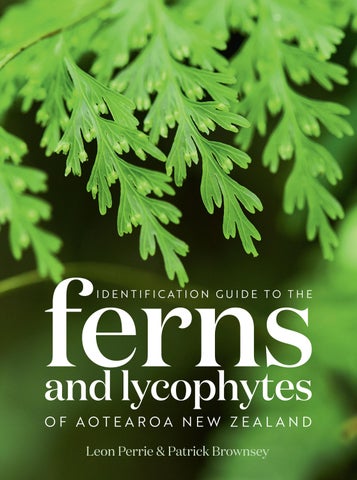
home to over 200 native species of ferns and lycophytes. They are among the most distinctive inhabitants of our forests and are also found in urban, coastal and alpine environments.
W W W .T E P A P A P R E S S . C O . N Z
Leon Perrie & Patrick Brownsey
From tiny filmy ferns to the tallest tree ferns, this book is the definitive visual guide to identifying and understanding these iconic plants of Aotearoa.
ferns and lycophytes
AOTEAROA NEW ZEALAND is
Leon Perrie & Patrick Brownsey
Blechnum fluviatile, page 107.
Deparia petersenii subsp. congrua, page 136.
Leon Perrie & Patrick Brownsey
Asplenium bulbiferum, page 77.
Contents Introduction 9 About this guide 11 Steps to identifying a fern or lycophyte 16 Illustrated glossary 19 Guide to genera 31 Species scan 43 Species profiles 63 Appendices 270 Acknowledgements 274 About the authors 275 Index 276
Lecanopteris pustulata, page 187.
9
Introduction Ferns and lycophytes in Aotearoa New Zealand Aotearoa New Zealand is internationally acclaimed for its unique flora, with the prominence of ferns a feature of many of our quintessential landscapes. Such is the conspicuous presence of ferns that ‘Fernland’ was an early colloquial name by British settlers for New Zealand. Today, ferns are cultural and commercial icons of Aotearoa, particularly the ponga silver fern (page 129), which is the country’s national nature emblem alongside the kiwi. In wetter forests, tall tree ferns fill the sub-canopy and filmy ferns clothe the ground, trunks and branches. Other species perch or climb on trees, and ground ferns can be abundant and diverse. When forest is disturbed or even cleared, be it by slips or fire or machinery, ferns such as the mamaku tree fern (page 130) and rārahu bracken (page 238) can play a prominent role in its recovery. Other species of ferns and lycophytes are specialised for wetlands, the coast or alpine areas. There are even ferns that prefer drier, open environments, and some indigenous species flourish within urban areas. With 204 species, ferns and lycophytes comprise about 8 percent of the indigenous vascular flora of Aotearoa. That number of species is low compared to the typical biological richness of tropical regions. The likes of Fiji and Solomon Islands are home to many more species than Aotearoa despite their much smaller landmasses. However, about 44 percent of the indigenous ferns and lycophytes in Aotearoa are endemic, found only here. This high endemism stands Aotearoa apart from its Pacific island neighbours (although New Caledonia, another part of the otherwise largely submerged continent of Zealandia, closely follows). The remaining 56 percent are also indigenous to other lands, particularly south-eastern Australia, reflecting proximity and the somewhat similar temperate climate. Many species are indigenous to both Aotearoa and Tasmania, Victoria, or southern New South Wales, with our ferns embodying a strong trans-Tasman relationship. Although ferns and lycophytes have an ancient fossil record, it seems that most of the living species in Aotearoa are derived from ancestors that arrived only after the landmass had geologically separated from the rest of Gondwana. This is supported by genetic studies of relationships combined with the global fossil record, and it explains why there are so many species shared by Aotearoa and elsewhere – their populations
16
STEPS TO IDENTIFYING A FERN OR LYCOPHYTE Finding reproductive structures on fertile fronds or stems is key in fern and lycophyte identification. Generally, larger plants are more likely to be fertile. Identification is usually best done while looking at a whole plant. A magnifying glass or hand lens is recommended to aid in successfully identifying reproductive structures. Can you locate a fertile frond or stem? Yes
See Illustrated glossary pp. 19–28 for details on fertile fronds and stems
No
Is it a tree fern over 2m tall?
See Guide to genera pp. 32–40
Identify the shape and position of the sori or other reproductive structures and check the other Yes listed characteristics. Did you find a match?
Yes
It will be a Cyathea or Dicksonia
No Yes
Can you check another frond or stem on the same plant or find a similar looking plant that is fertile in the area?
No
See Species scan p. 51 to find a match See Species profiles pp. 126–131 and pp. 137–140
See Species profiles pp. 64–266
No
Check the species within a genus to compare against the images and diagnostic characteristics. Can you Yes find a matching species?
See Species scan pp. 44–61
Can you narrow down the possible species by comparing it to the pictures?
No
No
Yes
It may not be possible to identify the fern or lycophyte species at this time. You could upload a photo to www.iNaturalist.nz and the community may be able to assist you.
See Appendix 1 p. 270
Congratulations, you have identified your fern or lycophyte. Yes
Check against species in other genera of the same family. Did you find something? No
Dicksonia fibrosa, page 137.
20
Illustrated glossary
Frond and its parts
lamina
costae rachis midvein
pinnae
stipe
Illustrated glossary
division (see the eFloraNZ). They are not used here, which means some leeway needs to be allowed when using this character. The degree of division given in the guide is generally the maximum shown by a frond. ‘Divided 2–3 times’ means that the maximum division of a species varies between divided twice and divided thrice. ‘Fronds divided twice (barely three times)’ denotes that a species has mostly twice divided fronds but some parts will be divided thrice if closely inspected. undivided
divided once
divided twice
Frond division
Primary, secondary, tertiary, etc. are terms describing the degree of division. See entries for costa and pinna. Fronds can have dimorphic fronds, when different-looking sterile and fertile (spore-bearing) fronds are produced. This occurs in most Blechnum species. sterile frond
fertile frond
Dimorphic fronds
divided three times
21
36
Guide to genera
SORI CIRCULAR OR SHORT, AND AWAY FROM LAMINA MARGIN
Arthropteris » Fronds divided once, on creeping rhizomes that usually climb. » Laminae glabrous. » Sori just inside lamina margins. » Indusia absent.
Pyrrosia » Fronds undivided, small, spread along creeping rhizomes, usually climbing. » Laminae with star-shaped hairs, dense and whitish on underside. » Sori in several ill-defined rows. » Indusia absent.
Lecanopteris » Fronds usually lobed once, spread along creeping rhizomes, often climbing. » Laminae mostly glabrous, but rhizomes with scales. » Indusia absent.
Christella » Fronds divided once with secondary lobing, tufted although rhizomes may creep. » Laminae with hairs. » Basal veins of adjacent secondary lobes joining. » Indusia kidney-shaped.
Polypodium » Fronds divided once, spread along creeping rhizomes; not climbing. » Laminae mostly glabrous, but rhizomes with scales. » Indusia absent.
Cyclosorus » Fronds divided once with secondary lobing, spread along creeping rhizomes. » Laminae with scales and obscure hairs. » Basal veins of adjacent secondary lobes joining. » Indusia kidney-shaped.
Loxogramme » Fronds undivided, usually small, tufted, but rhizomes with proliferous roots. » Lamina glabrous. » Indusia absent.
Thelypteris » Fronds divided twice, spread along creeping rhizomes. » Laminae with scales and obscure hairs. » Lamina veins free. » Indusia kidney-shaped.
Notogrammitis * » Fronds undivided except one species divided up to two times, usually small, tufted or spread along creeping rhizomes. » Lamina with hairs or glabrous. » Indusia absent.
Pakau » Fronds divided once with secondary lobing, tufted. » Laminae seemingly glabrous. » Basal veins of adjacent secondary lobes joining. » Indusia absent.
Guide to genera
37
SORI CIRCULAR OR SHORT, AND AWAY FROM LAMINA MARGIN CONTINUED Cyathea » Fronds large, divided 2–4 times, with scales, tufted and usually on a trunk; underside green or white. » Indusia variable, partially or completely enveloping sori, or absent.
Rumohra » Fronds divided 2–3 times, spread along creeping rhizomes, often climbing. » Fronds with scales. » Indusia round.
Cyrtomium » Fronds once-divided, tufted. » Fronds withs scales, mostly on stipe. » Indusia round.
Cystopteris » Fronds divided 1–3 times, small, on short-creeping rhizomes. » Laminae mostly glabrous. » Indusia hood-like, partially covering sori from one side.
Dryopteris » Fronds divided 2–3 times, tufted. » Fronds with scales. » Indusia kidney-shaped.
Dicranopteris » Fronds forking, mostly without lamina segments below the forks. » Lamina segments > 4mm long. » Many sori per lamina segment, with 7–12 sporangia per sorus. » Indusia absent.
Lastreopsis & Parapolystichum » Fronds divided 3–5 times, tufted to spread along creeping rhizomes. » Fronds with hairs. » Indusia kidney-shaped.
Sticherus » Fronds forking, with lamina segments below most forks. » Lamina segments > 4mm long. » Many sori per lamina segment, with 3–5 sporangia per sorus. » Indusia absent.
Polystichum » Fronds divided 2–3 times, tufted. » Fronds with scales. » Indusia round, or absent in one species.
Gleichenia » Fronds mostly forking. » Lamina segments < 3mm long. » One sorus per lamina segment, with 2–4 sporangia per sorus. » Indusia absent.
Azolla
Frond with irregular branching
Irregularly shaped fronds
A. pinnata, roots with rootlets (left); A. rubra, without rootlets (right)
Matting pond surface
Azolla rubra retoreto, Pacific azolla SALVINIACEAE
Distinguished by its aquatic habitat; free-floating fronds with irregular branching; and roots without fine rootlets. Becomes red in the open. Grows on slow-moving water surfaces, where it can form extensive mats. Previously known as Azolla filiculoides, but that species is confined to the Americas. Frond length: 5–40mm
Indigenous to Aotearoa New Zealand, Australia, Indonesia and Japan.
99
100
Blechnum
Fronds tufted
Rhizome scales uniformly brown
Fleshy sterile fronds with sessile pinnae, and shorter fertile fronds
Blechnum banksii Austroblechnum banksii shore hard fern BLECHNACEAE
Distinguished by its strongly dimorphic, tufted fronds divided once; fleshy, narrow sterile fronds with sessile pinnae; and uniformly brown rhizome scales. The fertile fronds are shorter than the sterile fronds. Grows at the coast, on exposed rocks or among other vegetation. Compare with Blechnum chambersii, B. durum and B. membranaceum. Previously known as B. blechnoides. Frond length: 25–500mm
Indigenous to Aotearoa New Zealand and possibly Chile.
Lastreopsis
Fronds
Frond upperside hairy
Indusia small; frond underside hairy
Frond underside with old sori
Lastreopsis velutina velvet fern DRYOPTERIDACEAE
Distinguished by its tufted fronds divided 3–4 times, with a dense covering of soft hairs on both surfaces; and small, kidney-shaped indusia. The frond is velvety to the touch. Grows on the ground in forest and scrub, usually in drier sites such as hillsides. Compare with Parapolystichum species. Frond length: 240–960mm
Endemic to Aotearoa New Zealand.
185
186
Lecanopteris
Sori round or oval, without indusia
Frond deeply once-lobed
Rhizome with spreading orangebrown scales
Lecanopteris novae-zealandiae Microsorum novae-zealandiae, Zealandia novae-zealandiae POLYPODIACEAE
Distinguished by its bright-green, once-lobed fronds with netted veins, spread along thick, creeping rhizomes (diameter usually > 4mm) that have spreading, orange-brown scales; and large round or oval sori without indusia. Grows as an epiphyte, usually within upland forests. Frond length: 150–900mm
Endemic to Aotearoa New Zealand.
Trichomanes
265
Fronds
Lamina segments with single, unbranched veins
Rachis winged
Fronds tufted from rhizome
Trichomanes strictum Abrodictyum strictum erect bristle fern HYMENOPHYLLACEAE
Distinguished by its tufted, narrowly elliptic, medium-green fronds usually divided three times; winged rachis; narrow, mostly glabrous lamina segments with entire margins and a single, unbranched vein; and tubular indusia, often with a long projecting bristle. Grows in forest on the ground, often in wetter, colder sites. Frond length: 65–350mm
Endemic to Aotearoa New Zealand.
266
Trichomanes
Segments with many-branched veins
Tubular indusia, with long bristle (mature)
Epiphytic on trunk of tree fern
Trichomanes venosum Polyphlebium venosum veined filmy fern HYMENOPHYLLACEAE
Distinguished by its light-green fronds divided 1–2 times, spread along creeping rhizomes; stipe not winged and rachis mostly not winged; mostly glabrous lamina segments with entire margins and many-branched veins; and tubular indusia. Grows in forest, usually as an epiphyte, especially on tree fern trunks, but rarely on banks and rocks. Frond length: 25–165mm
Indigenous to Aotearoa New Zealand and Australia.
Azolla pinnata, page 98.
Appendices Acknowledgements About the authors Index
IDENTIFICATION GUIDE TO THE FERNS AND LYCOPHYTES OF AOTEAROA NEW ZEALAND RRP: $50 ISBN: 978-1-99-116555-8 PUBLISHED: August 2024 PAGE EXTENT: 280 pages FORMAT: Flexibind SIZE: 230 x 170mm
FOR MORE INFORMATION OR TO ORDER https://www.tepapa.govt.nz/about/te-papa-press/contact-te-papapress