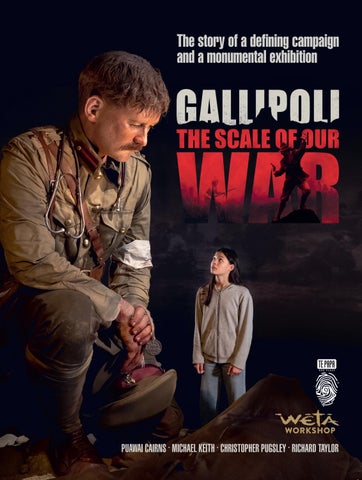
The story of a defining campaign and a monumental exhibition ‘These were ordinary people who went into extraordinary circumstances and had to find in themselves the strength to endure.’ – Richard Taylor, Wētā Workshop
Why were New Zealanders at Gallipoli, and what did they endure? This illustrated exhibition companion details the human scale of the Gallipoli campaign and goes behind the scenes to tell how the exhibition was made. It takes readers up close to the remarkable giants of the exhibition and the stories of those who vividly convey the scale of our war.
CAIRNS · KEITH · PUGSLEY · TAYLOR
One of Te Papa’s most memorable and popular visitor experiences, Gallipoli: The Scale of Our War combines the creative artistry of Wētā Workshop with the museum’s expert historical research.
ddddd3ddddddddddddddddd
d dddddd dddddd
www.tepapapress.co.nz
PUAWAI CAIRNS · MICHAEL KEITH · CHRISTOPHER PUGSLEY · RICHARD TAYLOR
The story of a defining campaign and a monumental exhibition
PUAWAI CAIRNS · MICHAEL KEITH · CHRISTOPHER PUGSLEY · RICHARD TAYLOR
CONTENTS 6 9
He tangata, he tipua An almost magical power Ngā tipua o mua Pillars from our past
14
Te atamira o Tū Reimagining a theatre of war
56
106
Ko Aotearoa me te emepaea New Zealand and empire Ngā tāngata māori nō Aotearoa Ordinary New Zealanders
144
Ngā Tamatoa a Tūmatauenga The chosen heroes of Tūmatauenga
164
Ngā kōrero nō Karipori Stories from Gallipoli
196
Ngā matarahi The murals
214–32
Ngā whakaahua Image credits • He tuhinga anō Further reading • Ngā kaituhi About the authors • Ngā kaimahi Exhibition credits • He kuputohu Index
He tangata, he tipua An almost magical power Courtney Johnston and Arapata Hakiwai Tumu Whakarae and Kaihautū, Te Papa ‘I felt a weight in my lower chest as I learned about the stories and suffering of the people, witnessed their rage and despair sculpted on their faces, and felt the ground tremble under my feet. I was immersed by this, and now feel much more sympathy towards these people.’
A
Handwritten message left on one of the commemorative paper poppies in the final gallery of Gallipoli: The Scale of Our War
different way. By partnering with Richard Taylor
ny historical anniversary is an opportunity – and an obligation – to both understand where we have come from, and to consider how we
might want to move forward. In 2014, the commemoration of the centenary of Aotearoa New Zealand’s part in the First World War, therefore, posed a significant question for Te Papa. How should the national museum bring people together around this major event in our history? And how could this be done in a way that would contribute to our collective understanding, in the twenty-first century, of Gallipoli and of our involvement in overseas wars? We realised this particular challenge, already on a short timeframe, needed to be met in a and Wētā Workshop, we were able to bring the immersive vividness and strong character focus of cinematic storytelling to the classic physicality and detail of a history exhibition. We are incredibly proud of the result. It is a superb example of talented creative people with passion, skill and dedication coming together. Gallipoli: The Scale of Our War could not be a heavy exhibition of facts and figures and black and white images. Nor could it be a glib or glossy encounter that swept audiences through but left
6
Arapata Hakiwai and Courtney Johnston outside the exhibition entrance in 2022 with Te Papa Tour Guides (from left) Anna Sheffield, Roger Gascoigne and Rangimoana Taylor.
‘It is hard to tell the story of an army with intimacy.’ Richard Taylor, Wētā Workshop
TE ATAMIRA 1 O TŪ REIMAGINING A THEATRE OF WAR Michael Keith
I
t was 2013. The centenary of the First World
collaboration between a leading public institution
War was coming up, and here was the challenge:
and a highly successful private company – with
how would Te Papa, the national museum of
the accompanying brand recognition – would, it
Aotearoa New Zealand, mark the significance of
was thought, attract support from funders like the
this anniversary? An exhibition, obviously, would
Lotteries Commission.
be core business for the museum. But in amongst
They were right, and in 2014, with funding
the flurry of commemorations of that long-ago
in place, the Te Papa Board appointed Wētā
event, how to create a museum experience that
Workshop’s Richard Taylor as creative director
would make a special impression on its twenty-
for the project. Te Papa designer Ben Barraud was
first-century audience? How to represent a seminal
appointed team leader on the museum’s side. And
piece of history in ways that engaged today’s
with eight months to opening, one week before
generations, especially the rangatahi, the young
Anzac Day in April 2015, the highly experienced
people, yet honoured the generation who lived
freelance project manager Sue Harrop took the
through it? How to do storytelling with impact,
reins to deliver the exhibition on time and within
gravitas and pathos, respectful of the past and
budget, handling a pair of mighty organisations
meaningful for the present and future?
that had never been in harness together.
Te Papa’s leadership decided that the museum would benefit from another range of creative expertise to produce an engaging experience of
Why Gallipoli? In the vast arena of the First World
this kind. Wellington-based Wētā Workshop, the
War, the Allied attempt to knock the Ottoman
internationally renowned player in the film indus-
Empire out of contention was a modest campaign
try, with credits and Oscar wins for blockbuster
– and a failed one at that. But as the annual
successes such as The Lord of the Rings trilogy, was
commemorations of Anzac Day remind us, the
the obvious choice – as an audience drawcard,
campaign had a focus and magnitude for Australia
as well as for its skillset. The exhibition was an
and New Zealand that went far beyond its military
ambitious project that needed special funding. A
significance. And research undertaken by Manatū Taonga the Ministry for Culture and Heritage had found that the New Zealand public’s prime interest in the First World War was Gallipoli and understanding its place in the history of this nation
OPPOSITE Creative director Richard Taylor of Wētā Workshop adds the final details to the large-scale figure of Lottie Le Gallais during the installation of the exhibition at Te Papa.
16
at war. Military historian and Gallipoli expert Dr Christopher Pugsley, the exhibition’s historical
3
2
1 6
1 THE GREAT ADVENTURE
2 ORDER FROM CHAOS
3 STALEMATE
4 CHU
Lieutenant Spencer Westmacott
Lieutenant-Colonel Percival Fenwick
Private Jack Dunn
Maori
4
5
ATE
4 CHUNUK BAIR
5 SAYING GOODBYE
6 WESTERN FRONT
Dunn
Maori Contingent machine-gun section
Staff Nurse Lottie Le Gallais
Sergeant Cecil Malthus
(1) The fibreglass body of Lottie Le Gallais is partially mounted. (2) Le Gallais’ bespoke shoes are fitted. (3) The bottom half of Percival Fenwick is dressed and mounted on the display base. (4) Head of costume, Alistair McDougall, adjusts Spencer Westmacott’s tie.
2
1
2
3
4
ABOVE The completed diorama of the SS Maheno. FROM TOP RIGHT Details of the deck and interior cabins.
INSET MAP DETAIL OVERLEAF
After a failed naval attempt on 18 March 1915, the Anzacs made the northernmost of a series of landings to seize the Gallipoli peninsula and allow warships access through the Dardanelles Strait and on to the Sea of Marama. The Anzacs landed north of Gaba Tepe. The British 29th Division landed on a group of beaches in the south. The French Expeditionary Force sent a regiment ashore at Kum Kale. The ships of the Royal Naval Division made a diversionary attack (feint) at Bulair.
‘The whole of the scrubby slope opposite to us is
FULL OF SNIPERS, dead shots.’
Lieutenant-Colonel William Malone
heavy casualties. Overly ambitious, the move
200–300 metres. The open ground among the
lacked both planning and coordination and the
scattered trees was covered in wild daisies, which
soldiers’ bravery could not compensate for poor
the New Zealanders referred to in their letters as the
planning by the New Zealand commanders.
‘daisy patch’. Fifty years later Cecil Malthus of the
The severe losses caused a drop in morale and
Canterbury Infantry Battalion (see page 140) would
a breakdown in cohesion among the battalions
write a classic account of his Gallipoli experience
that suffered most. This was particularly so for the
that included this terrible day. ‘Hugging the ground
Otagos, who carried out the attack. As Private Peter
in frantic terror we began to dig blindly with our
Thompson wrote in his diary, ‘My regiment was lit-
puny entrenching tools but soon the four men
erally cut to pieces, and although we charged several
nearest me were lying one dead two with broken
times, we were unable to gain any ground under
legs and the other badly wounded in the shoulder.’
such a terrible fire … At the first roll call … in my
The Australians suffered a similar fate in an
platoon, 14 out of 50 answered.’ The Anzacs’ failed
equally forlorn attack during that afternoon. After
attack on Baby 700 confirmed for Hamilton that it
suffering 835 casualties that day, and 2800 since the
was necessary to relieve the Australians and New
25 April landing, the New Zealanders were now only
Zealanders with a British advance from Cape Helles.
1700 strong. At half-strength, Malone’s Wellingtons were the strongest of the four battalions.
8 May: Krithia, Cape Helles
The disaster of Krithia demonstrated the inability of British and Anzac commanders to adapt
On the night of 5–6 May the 2444 men of the
their thinking in order to overcome the growing
New Zealand Infantry Brigade and the 2568-strong
strength and complexity of the Ottoman defences.
2nd Australian Brigade were transferred from
They seemed to consider that bravery alone was
Anzac Cove to Cape Helles. Facing Krithia on 8 May,
sufficient, but it was not. Malone was scathing in
at 11am, the New Zealanders were ordered to attack
his criticism, telling Johnston that a night advance
from 500 metres behind the British front line.
would have been far more effective and led to far
The Ottomans, prepared and dug in, caused heavy
fewer casualties.
casualties even before the men reached the British front trenches, and any advance beyond this was stopped by enemy machine-gun and rifle fire after
Meanwhile, inside the Anzac perimeter, men from the Royal Naval Division replaced the New Zealand Infantry Brigade within Godley’s NZ & A Division. These were surplus stokers, sailors and marines, many of them mere boys with very little infantry
OPPOSITE New Zealanders in the trenches on Second Ridge at Quinn’s or Courtney’s Post. In the background, a sniper takes aim through the mirror on a periscope rifle, guided by his spotter, who is using a periscope camouflaged by hessian sacking. In the foreground, two recent arrivals have their photo taken for family at home. The soldier on the left holds a Long Tom rifle with fitted bayonet.
training. Captain Jesse Wallingford, who was described as ‘our wolf who never sleeps’, held them together by placing his machine guns in support and hand-picking fifty of the best shots from the recently arrived New Zealand reinforcements to work in pairs as snipers among the inexperienced sailors. On 12 May the Royal Marines were relieved by
83
A KEEN OBSERVER OPPOSITE PAGE, CLOCKWISE FROM TOP LEFT Spencer Westmacott at a Territorial Force camp in Auckland in 1914, before war broke out; sketch of a New Zealand soldier on the Western Front, 1916; sketch of the Auckland Infantry Battalion landing at Anzac Cove, 25 April 1915; sketch of soldiers at the British Army tactical school on the Western Front, 1916. THIS PAGE, CLOCKWISE FROM TOP LEFT Studio portrait taken at the time of Westmacott’s marriage to volunteer-nurse Jean Patricia Campbell, September 1918; portrait at the easel, painted by James Cook, a fellow student at Canterbury College School of Art, c.1920–25; with the Otorohanga Battalion of the Home Guard; on the main street of Ōtorohanga, c.1940s.
ABOVE Lieutenant-Colonel William (George) Malone outside his dugout at the top of Walker’s Ridge, in April or early May 1915. A bayonet driven into the sandbags serves as a useful hook and an ammunition box provides shelving for a toothbrush and mug. RIGHT A letter from Malone to his daughter, Norah, from Egypt, 1915. After his death, she added the words ‘He is dead now, Daddy is dead now’.
The Commanders Lieutenant-Colonel William George Malone was one of the outstanding New Zealand leaders in the Gallipoli campaign. British-born, he had followed his brother out to New Zealand in 1880, served in the Armed Constabulary and was at the sacking of Parihaka in 1881. Through hard work, he became a lawyer-farmer in Stratford and was a keen Territorial soldier. Although he was not represented as one of the exhibition’s giants, he is everywhere. His image can be seen at the entrance, pistol in hand, wearing the lemon-squeezer hat he introduced when commanding the 11th Taranaki Regiment in 1911. Malone insisted it be worn by the Wellington Battalion on Gallipoli, and it was adopted as the official headdress of the NZEF in August 1916. Today it is the official headwear of the New Zealand Army. Selected by Godley to command the Wellington Battalion, at fifty-six, Malone, tall and solidly built, was the oldest man in the battalion, but assessed himself as ‘fit, hard & well’. He had spent many years reading military history and strategy and achieved a lifelong ambition by going to war, and was determined to make his men the best in the force. During training in Egypt, he drove his battalion mercilessly and weeded out those who did not meet his standards. On Gallipoli his leadership was critical in preventing the Anzacs from being driven back into the sea in the late-April battle for Walker’s Ridge. His rebuilding of Courtney’s and then Quinn’s Posts in early June was the turning point in securing the defence of the Anzac perimeter. Malone fought for building materials and basic comforts for his men as fiercely as he fought the Ottomans. His diaries chart a growing disenchantment with impractical British regular officers, and a growing love for those
ABOVE Hat badge of the 11th Taranaki Rifles of the New Zealand Territorial Force. BELOW A bronze next of kin memorial plaque (also known as a ‘Dead Man’s Penny’), designed by Edward C Preston and made by the British Ministry of Munitions between 1919 and 1921. Mrs Ida Malone was one of 1.35 million people in the British Empire who received this plaque after losing a loved one in the war.
under his command. The clash of wills between Malone and BrigadierGeneral Francis ‘Earl’ Johnston, his New Zealand
173
19 DECEMBER 1915. The last night of the evacuation from Anzac and Suvla. The lights are still on as the last New Zealanders silently embark the troopships in the shadow of the landmark known as the Sphinx. Sergeant Joe Gasparich of the Auckland Battalion remembered how he and the men felt: ‘We could not understand two things: one was withdrawing in front of an enemy and the other was leaving our cobbers behind. You don’t know how that hurt the blokes.’
GALLIPOLI: THE SCALE OF OUR WAR Puawai Cairns, Michael Keith, Chris Pugsley and Richard Taylor RRP: $35.00 ISBN: 978-1-99-115095-0 PUBLISHED: December 2022 PAGE EXTENT: 236 pages FORMAT: Limpbound SIZE: 250 x 190 mm
FOR MORE INFORMATION OR TO ORDER https://tepapa.nz/BookGallipoli
The story of a defining campaign and a monumental exhibition ‘These were ordinary people who went into extraordinary circumstances and had to find in themselves the strength to endure.’ – Richard Taylor, Wētā Workshop
Why were New Zealanders at Gallipoli, and what did they endure? This illustrated exhibition companion details the human scale of the Gallipoli campaign and goes behind the scenes to tell how the exhibition was made. It takes readers up close to the remarkable giants of the exhibition and the stories of those who vividly convey the scale of our war.
CAIRNS · KEITH · PUGSLEY · TAYLOR
One of Te Papa’s most memorable and popular visitor experiences, Gallipoli: The Scale of Our War combines the creative artistry of Wētā Workshop with the museum’s expert historical research.
ddddd3ddddddddddddddddd
d dddddd dddddd
www.tepapapress.co.nz
PUAWAI CAIRNS · MICHAEL KEITH · CHRISTOPHER PUGSLEY · RICHARD TAYLOR