CapitalTrees_TEXT.indd 2
25/07/25 1:04 PM
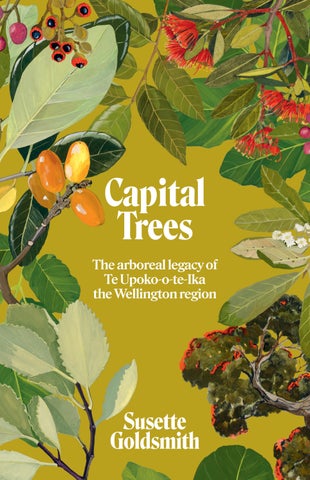
Capital Trees The arboreal legacy of Te Upoko-o-te-Ika the Wellington region
Susette Goldsmith
CapitalTrees_TEXT.indd 3
25/07/25 1:04 PM
CapitalTrees_TEXT.indd 4
25/07/25 1:04 PM
Contents Introduction / 7 Part One Purposeful Comings Together 15 Part Two Native Trees and Fake Native Trees 95 Part Three Natural Monuments 157 Afterword / 239 Tree List / 248 Glossary / 252 Notes / 254 Further Reading / 266 About the Photography and Illustrations / 268 Image Credits / 269 Acknowledgements / 270 Index / 272
CapitalTrees_TEXT.indd 5
25/07/25 1:04 PM
66
CapitalTrees_TEXT.indd 66
Hard beech, Fuscospora truncata, collected by Eleanor Burton, 1 January 2018, Queen Charlotte Sound. Te Papa (SP106650)
25/07/25 1:05 PM
‘derives from many different kinds of sources, including everything from museum specimens collected in
the 18th century and 19th century to DNA barcodes and smartphone photos recorded in recent days and weeks’.40 The information is open and free to anyone curious to know more about the diversity of life on our planet. It also provides invaluable data for scientific research, restoration and conservation strategies, education and climate change studies. The Te Papa herbarium is similarly accessible online.41 The shift from Museum Street to Buckle Street was overseen by the director of the time, Walter Reginald Brook Oliver. The photographs of native beech, northern rātā, pōhutukawa, karaka and rimu specimens on pages 65, 124, 125, 148 and 215 are from Te Papa’s herbarium and were collected by Oliver. An enthusiastic plant specimen collector for more than fifty years, on his death Oliver left his private natural history collections to the museum, including 6000 sheets of herbarium specimens. Many other well-known and not so well-known plant specimen collectors have helped to swell the herbarium’s holdings, none more famous than English scientist Joseph Banks and Swedish botanist Daniel Solander. When James Cook anchored the Endeavour at Tūranganui-a-Kiwa Poverty Bay in 1769, the trees of Aotearoa came under intense European scrutiny as passengers Banks and Solander began work collecting species of plants to take home. They continued to add to the collection in the northern parts of both islands. 67
CapitalTrees_TEXT.indd 67
25/07/25 1:05 PM
When the Endeavour reached Tōtaranui Queen Charlotte Sound, the collection had grown so large
that it was becoming difficult to preserve, and time was spent ashore drying paper and specimens. Banks bequeathed his collections to Robert Brown, his curator and librarian, and they were later deposited in the British Museum.42 In 1895, the museum sent duplicate specimens to Wellington to assist botanist Thomas Kirk to prepare a new flora, The Students’ Flora of New Zealand and the Outlying Islands (1899), because Joseph Hooker’s popular Handbook of the New Zealand Flora (1867) was out of date. Herbaria hold historical and contemporary records of the diversity and distribution of trees and their ecological and evolutionary responses. This material enables scientists to track changes over time, and contributes to decision-making regarding conservation as we face climate change. Today, Te Papa’s collection includes specimens of 313 species that were collected in Aotearoa by Banks and Solander. The photograph on page 64 shows beech specimens collected in Queen Charlotte Sound by Banks and Solander in 1769–70, the photograph on page 65 shows a beech specimen collected by Oliver in 1931, and on page 66 is a photograph of beech specimens collected by Wellington botanist Eleanor Burton in 2018. Te Papa’s herbarium continues to grow.
68
CapitalTrees_TEXT.indd 68
25/07/25 1:05 PM
Claiming the Wilderness as a Garden While the New Zealand Tree Register, the various councils’ tree registers and Te Papa’s herbarium are the most prominent contemporary catalogues of Wellington’s trees, two nineteenth-century tree lists compiled in Lower Hutt are also worthy of note. Rather than protection of Aotearoa’s ngahere, as artist Sharpe would advocate, these Pākehā settlers’ lists promoted the establishment of a new and exotic tree heritage like the one they had left behind on the other side of the world. The first list is contained in the ‘Essay on the Cultivation and Acclimatization of Trees and Plants’ by politician and farmer Alfred Ludlam, which was written for the 1865 New Zealand Exhibition and published in volume one of the Transactions and Proceedings of the Royal Society of New Zealand three years later.43 This was not a list prepared for the purpose of protecting trees but instead, based on about twenty years of gardening at Waiwhetū, it offered advice to Ludlam’s ‘fellow settlers’ in Wellington on the trees and other plants ‘from different parts of the world’ to introduce to their gardens. Ludlam was born in 1810 in County Down, Ireland, and spent time in the West Indies before arriving in Aotearoa in 1840. He was a foundation member of the Wellington Horticultural Society formed in 1841 and was later elected to both the provincial government and the 69
CapitalTrees_TEXT.indd 69
25/07/25 1:05 PM
CapitalTrees_TEXT.indd 94
25/07/25 1:05 PM
Part Two
Native Trees and Fake Native Trees
CapitalTrees_TEXT.indd 95
25/07/25 1:05 PM
CapitalTrees_TEXT.indd 118
25/07/25 1:05 PM
119
CapitalTrees_TEXT.indd 119
400-year-old rātā in Ōtari-Wilton’s Bush.
25/07/25 1:05 PM
at the unveiling, it’s a ‘reminder of the untold misery and horror and was created to remember the victims
of the inconceivable catastrophe of the twentieth century’.31 Other art works are displayed on the creamcoloured walls of the west corridor beneath the duck-egg blue ceiling and above the ruby-red carpet, but none has the impact of the tapestry. Flandern hangs opposite the stern portraits of the exclusively male members of the twenty-third (1928–31) and twentyfourth (1931–35) Parliaments. The tapestry is so much more. It deserves its own room.
204
CapitalTrees_TEXT.indd 204
The United Kingdom memorial, Whakaruruhau Shelter, at Pukeahu National War Memorial Park.
25/07/25 1:05 PM
I returned to Pukeahu several times to gain an overall impression of the space and how people use it, and to
understand how (or if) the commemorative trees of Pukeahu collectively contribute to our remembering and reflecting on ‘this country’s experience of war, military conflict and peacekeeping, and how that experience shapes our ideals and sense of national identity’. On one day, members of the Army Band were rehearsing and marching in Anzac Square in preparation for Armistice Day; cyclists made detours around the musicians and a small, informal crowd gathered to watch and listen. On another day, two lovers were entangled within the Belgian wreath. At the eastern end of the park, beside the Queen Elizabeth II Pukeahu Education Centre, which was once the Home of Compassion Crèche building, a tour group was examining the small orchard of heritage apple, pear and plum trees planted as a tribute to Catholic nun Suzanne Aubert. On each day there were cyclists and walkers passing through the park this way and that, visitors to the city inspecting the memorials, and readers, dreamers and picnickers sitting on the grassy terraces where gardens once provided for the nearby pā. At the same time and far away, Israel and Hamas were at war, so were Russia and Ukraine, and Pukeahu, in the sunshine, seemed a good space in which to contemplate war, peace, sacrifice and what it means to call Aotearoa home. They may be a disparate lot, these commemorative trees – an arboretum of very different species – but they’re stitched together within the park 205
CapitalTrees_TEXT.indd 205
25/07/25 1:05 PM
CapitalTrees_TEXT.indd 246
25/07/25 1:05 PM
Tree List Glossary Notes Further Reading About the Photography and Illustrations Image Credits Acknowledgements Index
CapitalTrees_TEXT.indd 247
25/07/25 1:05 PM
CAPITAL TREES: The arboreal legacy of Te Upoko-o-te-Ika the Wellington region RRP: $40 ISBN: 978-1-99107209-2 PUBLISHED: October 2025 PAGE EXTENT: 280 pages FORMAT: Limpbound with jacket SIZE: 198 x 128 mm
FOR MORE INFORMATION OR TO ORDER https://www.tepapa.govt.nz/about/te-papa-press/contact-te-papa-press