6
•
T e m p l e
U n i v e r s i t y
S c h o o l
o f
M e d i c i n e
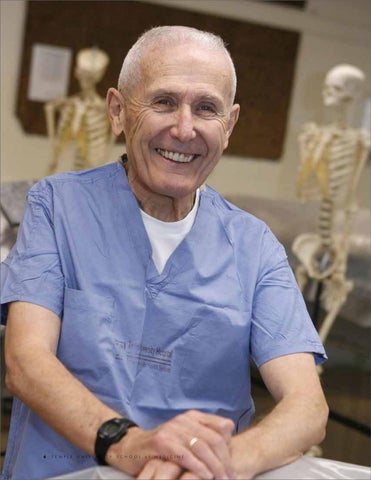
IMPRINTS of Temple Medical School By Carson D. Schneck, MD ’59, PhD ’65
When you drive north or south on North Broad Street, you cannot help being startled by the striking architecture of the Medical Education and Research Building of Temple University's School of Medicine, and the array of Temple Health Science Center buildings stretching four blocks along Broad Street, towering above North Philadelphia. If you enter these buildings, you'll be further impressed by the high-tech facilities available for education and patient care. Our physical facilities make very favorable imprints, but the most potent and lasting imprints we have to offer are our people imprints, the imprints that we make upon those we educate. While we often think of ourselves as self-made, we are really amalgams of the imprints made upon us by other people. Obviously the seminal imprint upon each of our lives was provided by our parents. Their DNA and their behaviors and circumstances played a major role in shaping our personality, knowledge base, habits, attitudes and prejudices. In childhood, we were further imprinted by our neighbors,
teachers and friends. College stretched our minds further, and we can all recall those special professors, coaches and advisors who helped mold us into who we are today. At Temple University School of Medicine, it was the faculty and support personnel who exposed us to the diverse and exciting world of medicine, helped us sort through the plethora of choices for our future life's work, and facilitated our achievement of the MD, MS, and/or PhD degree. They accomplished this not only by the transmission of didactic medical information, but also by the contagion of their enthusiasm. They were the role models and motivators for our early medical growth. Some of our faculty got to know us personally, demonstrating real concern for our personal and professional growth during medical school and beyond. After graduating, we continued being imprinted by our postgraduate mentors, our colleagues, patients, spouses, children and others close to us. Imprinting is life-long and can be very subtle. We learn new facts, new
ways of thinking about or applying those facts, new procedures and new attitudes by formal instruction or by example, by reading, by watching television, by attending lectures and professional meetings. The things we learn become our facts, our procedures, our attitudes, our personality traits. We use them so routinely that we don't even remember from whence or whom they came. Imprinting is clearly a two-way street. Throughout our lives, we too imprint on our parents, spouse, children, friends, and patients. We all have the potential to imprint in positive and negative ways. When each of us leaves this world, we leave nothing behind of greater substance than the imprints we have made on others. Think about it: those imprints, positive or negative, have the potential to cascade down through many generations … possibly ad infinitum. I'd like to take a look at some of the history of Temple University School of Medicine and its people to see what kinds of imprints have been made on us and the world around us. I want to
TEM P LE
MEDICINE
w i n t e r
2 013
•
7
share how some of my Temple experiences affected me, with the hope that it might motivate you to dust off some of your medical school experiences in the context of the difference they might have made in your life. But first, a primer on the people and circumstances whose imprints resulted in the establishment of Temple University School of Medicine. Absent these, there would be no school to make imprints on us.
In the Beginning
In 1882, Russell H. Conwell, Pastor of Grace Baptist Church, started holding classes in some of the church rooms of the Baptist Temple on Broad Street to provide higher educational opportunities for children of working class families. By 1888, when the number of students had expanded to several hundred, the school was chartered as Temple College, presumably because many classes were held in the Baptist Temple. Temple lore has it that the owl was chosen as the college᾽s mascot because so many classes were held at night to accommodate students who worked during the day. In 1891, a small private hospital known as the North Philadelphia Hospital had
8
•
T e m p l e
U n i v e r s i t y
S c h o o l
o f
M e d i c i n e
closed as a result of financial distress. With no nearby hospitals in a large area of North Philadelphia, Conwell's congregation raised $1,000 for a down payment on two large double houses on the northeast corner of Broad and Ontario Streets, then took out a $14,000 mortgage to cover the rest of the purchase price. The buildings were transformed into a 20-bed hospital and dispensary by l892, which Conwell called Samaritan Hospital, because its major clientele were the indigent, a role that hasn't changed much over the past 120 years. Imprints can be passed down through many generations! In 1901, the Department of Medicine of Temple College was established by Dr. Conwell. The program became the nation’s first five-year night and weekend MD program. It contained the same number of total hours as four-year day programs, enabling students with day jobs to attend medical school. Imprints! Temple’s was the first coeducational medical program in Pennsylvania. In 1906 the first two women to be granted MD degrees in Pennsylvania graduated from Temple. The University of Pennsylvania, founded in 1765, did not even admit women until 1913. Jefferson, founded in 1824, did not admit women until 1960. Philadelphia’s elder medical schools were a little late in recognizing the potential of women in medicine. So began Temple Medical School's long history of inclusivity and diversity. Imprints!
In 1903, W. Wayne Babcock, MD, was named Temple Chair of Surgery and Professor of Obstetrics and Gynecology, positions he held until 1944. He wrote 300 articles and the most noted surgery textbook of its time, “Babcock's Principles and Practice of Surgery.” Written before the days of surgical subspecialties, it was a complete text of surgery that included all of the present surgical subspecialties—even anesthesiology. Dr. Babcock developed Babcock's sump drain, rib spreader, thoracic trochar, costal periosteotome, nerve clamp, vein spreader, equipment for spinal anesthesia, and several dozen other surgical instruments. He also introduced spinal anesthesia to America, developed stainless steel sutures, and was the first to describe the abdominoperineal colorectal resection (pull-through procedure). While I never met Dr. Babcock, when I look at the Babcock Surgical Clinic portrait hanging in the Medical Education and Research Building and see four surgeons who directly imprinted me with Babcock’s teachings, it reinforces my opinion that imprints act transgenerationally. In 1907 Temple College became Temple University, and Temple College’s Medicine Department became Temple University School of Medicine. At the same time a four-year day MD program was established. The 1911 graduating class of Temple University School of Medicine contained 18 students. Two were women. Another was William N. Parkinson, MD ’11, (surgically trained by Babcock), who in 1929 became Temple medical school’s longest-serving (til 1959 when I graduated) and probably most influential dean. For most of those 30 years, “Parky,” as he was affectionately and somewhat fearfully known, ran the medical school with an iron hand, with no associate or assistant deans or financial officers—only
a secretary. He hired the faculty and interviewed most of the medical school applicants. He was the CEO, CFO, personnel committee, admission committee, promotion committee, etc. Older faculty tell stories about wanting to attend a scientific or clinical meeting and being sent to the dean’s office by their chair to see if funds were available. After giving you his obligatory hard time, Parky would gruffly ask “what’s it gonna cost,” then reach in his pocket, pull out a roll of bills, peel off some and give them to you. The word in the corridors was that Parky had two pockets, one for revenues and one for expenditures. This story may have been a bit of an exaggeration, but it makes the point that in everyone’s mind Parky was in charge of Temple Medical School. To Parky, I am eternally grateful because he brought to Temple most of the faculty who made substantial imprints on me.
My Beginnings with Temple Greats
After graduating from Muhlenberg College, I became a first-year medical student at Temple in 1955. At that time, the curriculum was department-based, and my first department in medical school was anatomy. The anatomy courses—gross anatomy, histology, embryology and neuroanatomy—were taught nearly all day Monday through Friday, and Saturday mornings from Labor Day through the third week in January. John Franklin Huber, MD, PhD, was the chair of anatomy and
director of the 300-hour gross anatomy course. He had arranged the schedule so that the related histology and embryology course subjects were temporally integrated with the dissection. The neuroanatomy course was taught a couple of weeks in December and during three weeks in January. Dr. Huber was an internationally known anatomist who discovered the bronchopulmonary segmental subdivision of the lung’s lobes, which permitted pulmonary resection of less than a lobe. The model of personal decorum, Dr. Huber believed that to be a successful educator, you must get to know each student personally. He deeply cared that each student succeed, and took the time to carefully monitor the progress of each student through the anatomy course, and in some cases, throughout their medical careers. Dr. Huber made many substantial imprints on me. Dr. Huber had arranged weekly radiology and clinical correlation lectures that were temporally correlated with the dissection. W. Edward Chamberlain, MD, radiology chair, gave most of the radiology correlation lectures. As freshmen, little did we know how internationally famous he was. We just loved his enthusiasm, the way he kept us on the edge of our seats waiting for the next “pearl” to drop. Later, when I was a young faculty member, Dr. Chamberlain’s research lab was on the 6th floor of the Old Medical School right behind my office, and I kept poking my head in to see what
“I am eternally grateful to Dean Parky because he brought to Temple most of the faculty who made substantial imprints on me.”
TEM P LE
MEDICINE
w i n t e r
2 013
•
9
was going on. More substantial imprints on a student and young faculty member. I was witness to some of Dr. Chamberlain’s research. He developed many important advances in plain film radiology, including the fluoroscopic image intensifier that considerably improved resolution. He also developed biplane fluoroscopy, which is still widely used today. So widely acclaimed were his contributions that the Radiological Society of North America, the largest organization of radiologists in the world, named their keynote lectureship the W. Edward Chamberlain Lecture. Dr. John A. Kolmer presented all of the weekly clinical correlation conferences when I was a student. These were case presentations correlated with the anatomy then being dissected. He had achieved worldwide recognition for his research in serology and immunology, then relatively new branches of medicine. He had founded the Institute of Public Health and Preventative Medicine in 1912. A world-renowned immunologist before immunology became a premier research area, he developed a polio vaccine in 1934. He also developed the Kolmer complement fixation test for syphilis. But even more impressive was the passion he put into his case presentations.
a sore on my penis.” After examining the lesion, Dr. Kolmer told the young man, “It looks like you’ve got syphilis. We’re going to have to do a blood test.” Aghast at the presumptive diagnosis, the young man blurted out, “I must have picked it up on a toilet seat.” Wagging his finger at the class upon relaying the story, Dr. Kolmer said, “I gave that young man my sternest look (which was very stern) and told him that’s one hell of a place to take a woman.” By example, Dr. Kolmer imprinted me with the importance of passionate teaching. By the end of my first semester in medical school, I was pretty convinced that Temple had some of the best teachers and researchers in the world. I started considering a career in medical academics. It sure looked like fun.
Freda & our Family
In the second semester of my first year, we had biochemistry and physiology. Immediately following final exams, I married the love of my life, my wife Freda. Though we were raised a half a block apart, I didn’t get to meet her until near the end of high school. We dated all through college. Freda has been an intimate part of my Temple experience. For more than 60 years she has been at my side (holding
“Freda has been an intimate part of my Temple experience. For more than 60 years she has been at my side.” He evoked a similar passion in his students. He told us about a young man who was the son of a wealthy sociallyconnected family from the Main Line who came to see him at his office. When he asked the young man what his problem was, the young man leaned over and whispered, “I’ve got
10
•
T e m p l e
U n i v e r s i t y
S c h o o l
hands) at every student and faculty function. She’s helped with my research projects in the dissecting room, served as a control subject for many of my ultrasound and MRI imaging projects (despite claustrophobia in the MRI), and she’s typed the manuscripts for many of my publications. We have two
o f
M e d i c i n e
daughters we’re very proud of, both Temple graduates: Deborah, MBA, a budget analyst for Montgomery County, Maryland, and Stephanie, MD, a pediatric orthopedic surgeon in Pittsburgh. Both daughters served as controls for some of my imaging studies. In these ways, and many others, my family has been imprinted with my Temple experience.
More Legends
Another faculty member who not only imprinted me personally, but also left giant imprints on medicine, was O. Spurgeon English, MD, chair of psychiatry. “Spurge” had established the nation’s first clinic for psychosomatic medicine and wrote the definitive textbook on the topic. His work greatly influenced our clinical curriculum. For example, in the Internal Medicine Clinic when we saw a patient we not only had to take a medical history, but also a complete psychiatric and social history. Then we had to meet with an internist, psychiatrist and social worker to review our histories. The mantra of that day was “treat the patient as a whole.” It was called holistic medicine. Another impressive imprinter was Harry E. Bacon, MD ’26. He edited Temple’s first Skull yearbook in 1926. Trained by Babcock, he became a pioneer in colorectal surgery and founded the American Board of Colon and Rectal Surgery. His patient clientele was as impressive as he: kings, heads of state, famous people from every walk of life. He received numerous medals from countries whose heads of state had their cancers or hemorrhoids operated on by him. He was kind of a gruff guy, who thought that the emphasis on holistic medicine was overdone. So he developed a mantra of his own that appeared in some of the later Skulls: “Treat the patient as a hole.”
Other world-famous Temple faculty members included Chevalier Jackson, MD, and his son, also named Chevalier. The elder Jackson is considered the founder of American bronchoesophagology and developed much of the early instrumentation. He established the Jackson Bronchoesophagology Clinic at Temple, which attracted patients from all over the world. He initiated the longest running CME course in American medicine, the Jackson Bronchoesophagology Course, which was carried on for 321 courses by his son, the latter dozen or two of which I had the privilege of helping to teach. To make these lectures relevant, I had to learn something about bronchoesophagology. Imprints! Frank H. Krusen, MD, chair of PM&R, established the nation’s first Department of Physical Medicine and Rehabilitation at Temple in 1925. He wrote the first textbook of physical medicine and rehabilitation. He founded and became the first president of the American Board of Physical Medicine and Rehabilitation. After a hiatus of nearly 30 years, he returned to Temple in the early 1960s and established the largest PM&R residency program in the nation at Temple and our thenaffiliated Moss Rehabilitation Hospital. That’s when I began teaching a 51-year-long Thursday evening course in musculoskeletal anatomy and kinesiology to his residents and fellows as well as to the orthopedic surgery residents. To make that course relevant, I had to learn a lot of rehabilitation medicine and orthopedic surgery. Imprints! John Lachman, MD ’43, chair of orthopedic surgery, was a role model’s role model in every aspect of his life. He was a consummate clinician, a meticulous surgeon, and to his patients a walking placebo effect. He was the innovator of the Lachman test and sign for cruciate ligament injury and
established the nation’s first medical school-based sports medicine clinic. J. Robert Willson, MD, chair of obstetrics and gynecology, edited the leading American obstetrics and gynecology text. He was president of both the American Board of Obstetrics and Gynecology and the Association of Professors of Obstetrics and Gynecology. He had assembled a department of outstanding people in every subspecialty. One of his faculty, Terry Hayashi, MD ’48, made an especially strong imprint on me. He would meet with the students on obstetrics at 7 a.m. daily with an assigned topic and reading material, then present related clinical problems that we had to solve using basic science and clinical information. He told us nothing. We had to do the teaching, with only a little guidance from him when we got off track. He reminded me of a philosophy professor I had in college who taught completely by using the technique of Socratic dialogue. After getting over the threat of being called on, we came to enjoy being involved in our own education rather than being transcribers of lectures. My classmates and I
John Franklin Huber, MD, PhD and
came to wonder why all medical education couldn’t be taught that way. A major imprint on me.
The Student Becomes a Teacher
Since the end of my first semester, I had periodically talked to Dr. Huber about my interest in academic medicine, and he had always been encouraging. At the end of my third year at Temple, I told Dr. Huber that I thought I wanted to join the anatomy faculty, but that I wanted to do my internship and get my Pa. license to keep my options open. He was delighted and encouraged me to talk to Parky about a faculty appointment. Parky assured me of a faculty appointment, and picked up the phone and got me an early internship appointment (there was no match in those days). After my internship, I
TEM P LE
MEDICINE
w i n t e r
2 013
•
11
Honor Carson Schneck with a gift to to the Carson Schneck Endowed Scholarship Fund. See page 36 for details.
My experience in teaching clinical anatomy at Temple (with huge personal imprints) led to hundreds of invitations to do visiting professorships all over the United States in various clinical specialties, hundreds of hours of lectures at national and international clinical meetings, and thousands of hours of lectures at board review courses for various clinical specialties (a huge personal payback).
joined the full-time anatomy faculty in 1960. We all taught gross anatomy (300 hours), histology and neuroanatomy in a classic lecture/lab format, and I had to work hard to stay ahead of the students. From 1961 to 1965, I completed my PhD in anatomy under Dr. Huber on a part-time basis while maintaining my full faculty load. My thesis investigated the mechanical etiology for the prenatal development of the collagen fiber architecture of the articular cartilages, ligaments, tendons and menisci of the rabbit knee. J. Robert Troyer, PhD, was another member of the anatomy faculty who made strong imprints on me as a young faculty member. He imprinted me with several important tenets of teaching: no matter how often you’ve given a good lecture or lab, it can always be improved; be continually innovative in the content and methodology of your teaching; and to be effective, education must be fun.
12
•
T e m p l e
U n i v e r s i t y
S c h o o l
In 1960 I voluntarily started teaching that Thursday evening dissection course in functional and surgical anatomy of the musculoskeletal system to PM&R and orthopedic surgery residents, plus a Monday evening head and neck course to the neurology, neurosurgery, ENT and PM&R residents at the request of their department chairs. These courses continued for 51 years. In 1968, the head and neck course became a neuroanatomic basis of neurologic diagnosis course. To make these courses clinically relevant, I read many clinical texts and papers in all these subspecialties. Over the years I have also taught dissection courses and given many lecture series to Temple residents in radiology, general surgery, ob/gyn, urology, colorectal surgery, ophthalmology, cardiology, gastroenterology and rheumatology. All of these courses were taught with no remuneration and only because I loved teaching at the postgraduate level.
o f
M e d i c i n e
In 1969, after Dr. Huber had appointed me director of the gross anatomy course, a major curricular change was mandated. We were going from department-based courses to organ system courses. To make room for the organ system courses, all the basic sciences had to reduce their hours by at least half. That meant cutting the gross anatomy course from 300 to 140 hours. This was the impetus for me to teach gross anatomy using the Socratic dialogue technique. We eliminated all lectures and anatomy texts except the Netter Atlas. These were replaced by Temple Gross Anatomy Notes integrated with common medical applications that I had learned from my clinical experiences and the postgraduate medical courses I had been teaching. The medical applications provided clinical motivation for learning the anatomy. Some of the lectures were replaced by small-group clinical problem-solving conferences based on actual clinical cases that I abstracted from the files of the radiology library. In these
conferences the faculty presented clinical problems relevant to the cases that the students could solve using only the anatomic information they had just learned. The students were called upon to solve the problems. I scripted the conferences so that each of the four simultaneously given conferences were similar. Teaching a course without lectures or a standard text and then calling on individual students to solve problems was an intimidating experience for most students. However, they adapted well, because since 1969 the students have evaluated the gross anatomy course as one of the highlights of their medical school experience on both their freshman and graduation evaluations. In the late 1960s I also performed and reported three studies on the collagen fiber arrangement for the transmission of auditory stresses through the middle ear.
Middle Years
In the 1970s and ’80s, inspired by one of the most influential ultrasound pioneers and teachers, Dr. Barry Goldberg, who was on staff at an affiliated hospital, I wrote a number of ultrasound papers and chapters, and coauthored an ultrasound text. I also taught in hundreds of ultrasound courses that he sponsored. In the 1980s Temple and Drexel entered into a cooperative teaching and research agreement, under which Drexel mechanical engineer Sorin Siegler, PhD, and I published half a dozen papers on the mechanical characteristics of the ankle, and I taught in the Drexel Biomedical Engineering Program. In 1982 I wrote a paper explaining the mechanical basis for the detailed anatomy of the lumbar spine, which fortuitously became the basis for the proper placement of lumbar screws and plates.
“Temple, as they say, has been an amazing ride. Since my first day on campus 58 years ago, the school and its people have deeply imprinted my life.” For the next few years, this got Freda and me invited to spine meetings all over the world, all expenses paid. Later I wrote additional papers and chapters on the spine. In the 1980s Temple purchased the world’s first mobile MRI unit from Fonar, an MRI company established by Dr. Raymond Damadian, who built the first MRI unit and published the first MRI papers. It was inside a trailer parked on the sidewalk on Broad Street in front of nuclear medicine. Because it was new technology, its safety and effectiveness had to be proven to the FDA. So the Fonar physicists and engineers were always at Temple. It was at this time that one of Temple’s musculoskeletal radiologists, Mamed Mezgarzadeh, MD, and I collaborated on a half dozen seminal MRI papers that demonstrated the usefulness of MRI in visualizing the normal anatomy and pathology of the musculoskeletal system. We developed the protocols and diagnostic parameters for MRI imaging of the anatomy and pathology of the elbow, wrist, hand, carpal tunnel syndrome, knee, ankle and foot. These papers resulted in invitations to do a number of visiting professorships and to write a number of textbook chapters. The Fonar scientists were very interested in our applications of MRI to the musculoskeletal system. Since they were preparing a major commercial exhibit for the RSNA meetings in Chicago in December, they invited me to spend weekends during the preceding fall at
their facility in Amityville, NY, to label some of their never-before-seen MR images. It was a very exciting time. In the intervening years, I’ve published several dozen other papers and chapters on various organ systems, many in the imaging literature. In 1986, because of my imaging publications and the hundreds of hours of teaching I did in the Radiology Department, I was given a secondary appointment as professor of radiology. And I would continue doing all that I was doing—a labor of love—for another 27 years.
Imprints are Forever
Temple, as they say, has been an amazing ride. Since my first day on campus 58 years ago, the school and its people have deeply imprinted my life. With my retirement at the end of the Fall 2012 semester comes a sense of awe for Temple’s myriad imprints. Imprints of time, events, teachers, students, colleagues, patients—imprints of a million varieties. Some that shaped us, some that have been shaped by us. I enjoy thinking about how these imprints will resonate out across time to influence people we will never even know and events and discoveries that we cannot even imagine.
TEM P LE
MEDICINE
w i n t e r
2 013
•
13
conferences the faculty presented clinical problems relevant to the cases that the students could solve using only the anatomic information they had just learned. The students were called upon to solve the problems. I scripted the conferences so that each of the four simultaneously given conferences were similar. Teaching a course without lectures or a standard text and then calling on individual students to solve problems was an intimidating experience for most students. However, they adapted well, because since 1969 the students have evaluated the gross anatomy course as one of the highlights of their medical school experience on both their freshman and graduation evaluations. In the late 1960s I also performed and reported three studies on the collagen fiber arrangement for the transmission of auditory stresses through the middle ear.
Middle Years
In the 1970s and ’80s, inspired by one of the most influential ultrasound pioneers and teachers, Dr. Barry Goldberg, who was on staff at an affiliated hospital, I wrote a number of ultrasound papers and chapters, and coauthored an ultrasound text. I also taught in hundreds of ultrasound courses that he sponsored. In the 1980s Temple and Drexel entered into a cooperative teaching and research agreement, under which Drexel mechanical engineer Sorin Siegler, PhD, and I published half a dozen papers on the mechanical characteristics of the ankle, and I taught in the Drexel Biomedical Engineering Program. In 1982 I wrote a paper explaining the mechanical basis for the detailed anatomy of the lumbar spine, which fortuitously became the basis for the proper placement of lumbar screws and plates.
“Temple, as they say, has been an amazing ride. Since my first day on campus 58 years ago, the school and its people have deeply imprinted my life.” For the next few years, this got Freda and me invited to spine meetings all over the world, all expenses paid. Later I wrote additional papers and chapters on the spine. In the 1980s Temple purchased the world’s first mobile MRI unit from Fonar, an MRI company established by Dr. Raymond Damadian, who built the first MRI unit and published the first MRI papers. It was inside a trailer parked on the sidewalk on Broad Street in front of nuclear medicine. Because it was new technology, its safety and effectiveness had to be proven to the FDA. So the Fonar physicists and engineers were always at Temple. It was at this time that one of Temple’s musculoskeletal radiologists, Mamed Mezgarzadeh, MD, and I collaborated on a half dozen seminal MRI papers that demonstrated the usefulness of MRI in visualizing the normal anatomy and pathology of the musculoskeletal system. We developed the protocols and diagnostic parameters for MRI imaging of the anatomy and pathology of the elbow, wrist, hand, carpal tunnel syndrome, knee, ankle and foot. These papers resulted in invitations to do a number of visiting professorships and to write a number of textbook chapters. The Fonar scientists were very interested in our applications of MRI to the musculoskeletal system. Since they were preparing a major commercial exhibit for the RSNA meetings in Chicago in December, they invited me to spend weekends during the preceding fall at
their facility in Amityville, NY, to label some of their never-before-seen MR images. It was a very exciting time. In the intervening years, I’ve published several dozen other papers and chapters on various organ systems, many in the imaging literature. In 1986, because of my imaging publications and the hundreds of hours of teaching I did in the Radiology Department, I was given a secondary appointment as professor of radiology. And I would continue doing all that I was doing—a labor of love—for another 27 years.
Imprints are Forever
Temple, as they say, has been an amazing ride. Since my first day on campus 58 years ago, the school and its people have deeply imprinted my life. With my retirement at the end of the Fall 2012 semester comes a sense of awe for Temple’s myriad imprints. Imprints of time, events, teachers, students, colleagues, patients—imprints of a million varieties. Some that shaped us, some that have been shaped by us. I enjoy thinking about how these imprints will resonate out across time to influence people we will never even know and events and discoveries that we cannot even imagine.
TEM P LE
MEDICINE
w i n t e r
2 013
•
13