T E M P L E U N I V E R S I T Y C O L L E G E O F P U B L I C H E A LT H
Temple Public Health FALL 2021
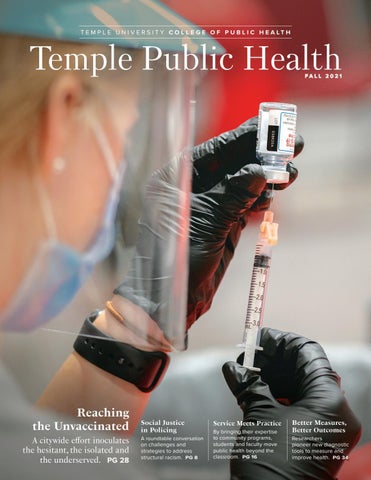
Reaching the Unvaccinated A citywide effort inoculates the hesitant, the isolated and the underserved. PG 28
Social Justice in Policing A roundtable conversation on challenges and strategies to address structural racism. PG 8
Service Meets Practice By bringing their expertise to community programs, students and faculty move public health beyond the classroom. PG 16
Better Measures, Better Outcomes Researchers pioneer new diagnostic tools to measure and improve health. PG 34
The COVID-19 testing site at Temple’s Aramark Student Training and Recreation (STAR) Complex.
DEAN’S NOTE
Public health seeks the common good— but as the pandemic has demonstrated, public health measures are not always understood or embraced by the public. At the outset of the pandemic, the race to develop a vaccine was considered the endpoint. Much to health professionals’ and policymakers’ surprise, the vaccine has been met with considerable resistance. That’s why we in the College of Public Health developed RapidVax, a vaccine delivery protocol designed to make getting inoculated as obstacle-free as possible, and subsequently took part in vaccination efforts. Our students were present to administer some of the first doses of vaccine in Philadelphia, and the college has organized clinics, first to vaccinate the campus community in the early spring and then working throughout the city to bring the vaccine directly to communities. The RapidVax initiative is driven by a mission to bring vaccination opportunities directly to where people live and work; our approach is to listen to concerns and tailor our messaging to address the needs of specific communities in the hopes of countering misinformation, instilling trust and expanding access to the vaccine. The success of RapidVax demonstrates that we can overcome resistance to vaccination; the result of these efforts, both on individual lives and throughout the community, is immeasurable. Our cover story explores the development and success of RapidVax and follows the exhausting and laudable work undertaken by those who implemented it (page 28). This year’s magazine also includes stories of impact beyond the pandemic, including a look at three projects at the intersection of practice and service. These
Temple Public Health are just a small sample of the many ways our students, faculty and staff use their expertise to directly benefit others (page 16). Especially during times of pandemic, it can be easy to forget the meaningful change one can bring on an individual level, and these stories remind us of this crucial component of our field. We also highlight and explore the noless-important work that so rarely earns wide recognition: that of designing the tests, assessments and standards that shape how we diagnose and treat disorders, injury and disabilities (page 34). A number of these tests have been created by our researchers, and the story of their development is a behind-the-scenes look at unsung work. Our college is shaped by the understanding that public health includes both population health and individual health; we know that health and well-being are a complex interplay between biology and one’s physical, social and economic environments. Beyond the pandemic, there are other crises: for example, a worsening epidemic of gun violence, the dislocation and health impacts resulting from climate change, and complications brought on by an aging population. Much like with the COVID-19 pandemic, solving these issues will not be simple, and we may yet again find ourselves surprised by a misleading endpoint. But public health is a field that depends on hope—the belief that it is not only possible to improve conditions for ourselves, our neighbors and those all over the world; it is imperative. If we have learned nothing else from COVID, we know that responding to these crises calls for an interdisciplinary, unified response. We look to our future public health, healthcare and social service workers to answer this call. Within this magazine you will find numerous examples of just that. I hope that you enjoy reading these stories, and I encourage all reading this magazine to share their thoughts about the magazine and our direction overall. The input of our entire community is vital to the future of the college, and your feedback is greatly appreciated. In good health,
D E AN
Laura A. Siminoff, PhD E XE C UT I VE E D I TO R
Lisa Litzinger-Drayton M AN AGI N G E D I TO R
Christopher Sarachilli D E SI GN M AN AGER
Abby Musial ASSI STAN T E D I TO R
Caitlin McHale PHOTO GR APHE R
Andrew Thayer WR I T E R
Don Steinberg C HI E F D E VE LO PME NT O F F I C E R
Natasha de Luna natasha.deluna@temple.edu B OAR D O F VI SI TO R S
Mary E. Ammon, MSW Christopher M. Barnett, JD David R. Devereaux, MBA** Barbara B. Ernico, MEd** Nancy E. Fawley, MSLS Thomas Gordon, MBA Lovell Harmon, MS, MBA Veronica Hill-Milbourne, BSN, MS, JD* John J. Kirby, OTR, MBA Doranne Lackman, PT Brian W. Lindberg, BSW, MMHS Barbara P. Mastriano, PhD Gregg Mohrmann, MPHA Ravi Rajan, MD R. Christopher Raphaely, JD, Esq. Ellen Schwartz, MA Matthew Shelak, MBA Pamela Tyranski, BSN, MBA Susan Wayne, MSW * Chair ** Emeritus
Contact us Bell Building (Tech Center), 3rd Floor 1101 W. Montgomery Ave. Philadelphia, PA 19122 215-204-5200 cphmarketing@temple.edu
Laura A. Siminoff Dean Laura H. Carnell Professor of Public Health
CPH.TEMPLE.EDU
1
S TAT E O F R E S E A R C H It’s my great pleasure to update you on the research and scholarship of our faculty and students over the past year. They have risen to the numerous challenges presented to all of us. As of summer 2021, our researchers submitted approximately 10 percent more grant applications for extramural funding and received approximately 10 percent more awards as compared to last year. Several members of our faculty have received grants to study the impact of COVID-19 on their existing areas of scholarship, while other investigators received new grants to support important areas of research largely independent of the pandemic. I’m particularly pleased to share that six faculty members from five of our eight academic departments currently have prestigious early-career development awards from the National Institutes of Health—including one who called me with the news as I was finalizing this letter! These faculty members, along with 13 others, participate in the college’s Early Research Career Development Group, designed to provide regular and consistent mentoring for early career success. Their accomplishments have been so very impressive, and their talents, abilities and passion for their work greatly enrich our entire research community. Other initiatives have matured this past year. The Office of Research Administration’s Friday Seminar Series moved to a virtual format and witnessed a growth in attendance of approximately 20 percent. The college’s Research and Evidence Based Practice Day, the showcase event of National Public Health Week each April, enjoyed another record number of submissions from our undergraduate and graduate students. Other National Public Health Week events, including a panel discussion on gun violence in Philadelphia and the impact of the social determinants of health in underserved communities, had robust virtual attendance and provided rich educational opportunities for our students and faculty. CommonHealth, the college’s journal showcasing the scholarship of our students and faculty, is now in its second year. This initiative was joined this past year by CommonVoice, a podcast highlighting ongoing work in the college, and CoffeeTalk, a monthly professional development seminar for graduate students. In 2020, we also learned that faculty and graduate student researchers from our College of Public Health, along with other researchers across Temple University, ranked fourth in the world with regard to the number of scholarly publications in Surgery for Obesity and Related Diseases, the flagship journal of the American Society for Metabolic and Bariatric Surgery. This remarkable accomplishment highlights our substantial contributions to the prevention and treatment of obesity, one of our country’s most impactful and enduring public health challenges. In summary, research in the College of Public Health continues to grow with respect to its breadth and depth, even despite the challenges of the pandemic. Many of these accomplishments are highlighted in the pages that follow. Looking to the next few years, faculty and students of the college will have numerous opportunities to continue to partner with our colleagues from other schools and colleges across the university and country to improve the health and well-being of all. I eagerly look forward to seeing what comes next. David B. Sarwer Associate Dean for Research Professor, Department of Social and Behavioral Sciences Director, Center for Obesity Research and Education
2
TEMPLE PUBLIC HE ALTH
Contents 4 College News 8 Social Justice in Policing 11 Solutions Grants and new projects
16 Service Meets Practice By bringing their expertise to community programs, students and faculty move public health beyond the classroom.
22 Impact Publications and findings
28 Reaching the Unvaccinated
A citywide effort inoculates the hesitant, the isolated and the underserved.
28
34 Better Measures, Better Outcomes
Researchers pioneer new diagnostic tools to measure and improve health.
38 Alumni News
16
34
TempleCPH temple_cph TempleCPH
8
CPH.TEMPLE.EDU
3
IN THE NEWS “The pandemic has really shone a spotlight on public health, what it is and why it’s important. I’m so excited that young people are answering the call.” Laura A. Siminoff, dean, on the increased interest in public health-related degree programs at the College of Public Health and beyond amidst the pandemic. THE PHILADELPHIA INQUIRER
“I had one gentleman say to me that he was getting vaccinated because we came to him, showed him we cared and made him feel treated with dignity.” Susan VonNessen-Scanlin, associate dean for clinical affairs and interprofessional education, on the impact of the college’s collaboration with the Philadelphia Housing Authority to vaccinate vulnerable residents. DIVERSE ISSUES IN HIGHER EDUCATION
“She knows her body, her mind … better than anybody else. She’s putting not only her body first and her mind first, but she’s putting her safety first.” Leeja Carter, associate professor in the Department of Kinesiology, on U.S. gymnast Simone Biles’ decision to prioritize her mental health over Olympic competition. CNN
“It may take some time for people to get comfortable, engaged, and tuned in during in-person work meetings, school or even among friends.” Jeni Stolow, assistant professor in the Department of Social and Behavioral Sciences, on readjusting to post-pandemic life. THE WASHINGTON POST
“We have not given this group, who are a very critical workforce, enough attention and enough respect for the really critical job that they’re doing.” Philip McCallion, director of the School of Social Work, on the struggles home healthcare workers experienced during the pandemic. WHYY
4
TEMPLE PUBLIC HE ALTH
COLLEGE NE WS
COLLEGE OF PUBLIC HEALTH CLIMBS IN U.S. NEWS & WORLD REPORT RANKINGS
Health Outbreaks course explores COVID-19 and its implications Temple’s General Education program is designed to broaden undergraduate students’ exposure to arts, sciences, history and contemporary issues. So it was timely for the College of Public Health to create “Health Outbreaks, Epidemics and Pandemics: The Case of Coronavirus,” a GenEd class about COVID-19 and its implications, beginning in spring 2021. “This class isn’t just about COVID-19 itself; it’s also about the perfect storm of events that led us to where we are today, and that’s what makes this ideal for a GenEd course,” says Krys Johnson, assistant professor of epidemiology and biostatistics, who co-instructed the course with Philip McCallion, professor and director of the School of Social Work. “We lay the foundation for understanding what public health is and what it does, travel through previous pandemics and epidemics, then assess how what we learned or didn’t learn from the past applies to COVID-19 now.” Students from performing arts, political science, business, media and public health have been able to share their perceptions of what has happened so far in the COVID-19 pandemic. “One thing that was very attractive to us was the opportunity to do something across multiple disciplines,” McCallion says. “We look at the science of COVID-19, its origins and how it spreads. And we also examine what this means for society. What are the implications for different groups in the population? What’s happening in different countries, and what can we learn from that?” A goal of the class is to separate fact from fiction about COVID transmission, masks and vaccines. “We have tried to be upfront about dealing with myths that are out there,” McCallion says. And, he adds, there’s been an opportunity to learn from the students. “One assignment is asking groups of students to come up with what they think would have been better ways to message the concerns about the virus. How do we encourage people to be vaccinated?” There are plans to continue offering the Health Outbreaks course, even beyond the pandemic. (It also fulfills a requirement of the college’s Public Health Contact Tracing Training program.) Offering the course again presents its own challenge, as the subject is a rapidly moving target. “There will be a next pandemic, which we discuss toward the end of the course; the point is to know and to do better the next time around,” says Johnson.
The College of Public Health was ranked No. 41 among the nation’s schools and programs of public health in the 2022 edition of U.S. News & World Report’s Best Graduate Schools, climbing five spots since the previous ranking in 2019. This year, 188 schools and programs of public health were included in the ranking, placing the College of Public Health in the top 25 percent of public health institutions nationwide. The new ranking comes at a time of rapid growth for the college, as students are applying to public health programs at a higher rate than ever before, and the COVID-19 pandemic has created a newfound understanding of the importance of public health in the public eye. The college’s comprehensive response to the pandemic was immediate, including a regular video series featuring expert discussions on the latest updates; the creation of a contact tracing training course; a number of research studies exploring the pandemic’s impact across multiple domains; and vaccination clinics on campus and in the community. “Our students and faculty have shown that the public health, social services and clinical fields are essential—and not only in times of crisis,” says Laura A. Siminoff, dean of the College of Public Health. “I am continually impressed, yet never surprised, by the strength and dedication of our community. What makes us stand out is our ability to work together as researchers, educators and clinicians across multiple disciplines.” The U.S. News ranking follows recent increases for the speech, language and hearing science program (No. 25), the master of occupational therapy program (No. 23) and the doctor of physical therapy program (No. 38).
CPH.TEMPLE.EDU
5
Fisher named associate editor of ‘Frontiers in Public Health’ Jennifer Orlet Fisher, professor in the Department of Social and Behavioral Sciences and associate director of the Center for Obesity Research and Education, was named associate editor of the journal Frontiers in Public Health. Fisher, whose work focuses on the development of eating behavior during infancy and early childhood, will oversee peer review for articles in the journal’s new Public Health and Nutrition section and help the publication build a collection of manuscripts that focus on population-level nutrition. “I’m most excited about the fact that it’s a new section of this journal, devoted to public health nutrition, which is a relatively new field in nutrition,” Fisher says. “It’s a field that uses applied perspectives to design programs, systems, policies and environments for addressing population-level nutritional issues and reducing disparities in at-risk populations.” Frontiers in Public Health is a multidisciplinary open-access journal that publishes online. Fisher also has served as coexecutive editor at Appetite, a scholarly journal dedicated to the study of ingestive behavior, and has been on the editorial board of Nutrition Reviews. Fisher has served as co-chair of the national Healthy Eating Research panel, a program of the Robert Wood Johnson Foundation that is developing scientific guidelines to encourage healthy eating behaviors among children ages 2 to 8. The Obesity Society also honored Fisher with its Oded Bar-Or Award, a lifetime achievement accolade recognizing significant contributions to pediatric obesity research. “It’s serendipitous that this comes at a time when the College of Public Health is launching its new master of public health in nutrition/registered dietician program, which is one of the few in the country to have a public health nutrition focus, specifically on urban populations,” Fisher says. “We currently have a number of nutrition courses at Temple, but offering an accredited graduate program brings new attention and training opportunities to this important area of public health.”
Hyde honored as fellow of Society for Social Work and Research Cheryl Hyde, associate professor in the School of Social Work, was named a fellow of the Society for Social Work and Research, an honor bestowed on researchers who have earned distinction by advancing, disseminating and translating research that addresses social work practice and policy and who “promote a diverse, equitable and just society.” Hyde examines social work from a big-picture level, exploring public policy, systemic oppression, how people collectively mobilize to pursue change, and the real-world demands of the social work profession itself. One course she teaches is Legislative Advocacy, helping students understand how to build cases for promoting change. Another is Grassroots Mobilization, about how people organize to build awareness of social issues. In all her courses, she wants her students to appreciate what it’s like to be a social worker in the real world, she says. That includes understanding the employment issues involved in thriving as a social work professional. “I don’t want my students to go into their professional lives thinking everything is just going to line up perfectly because they have this master’s degree,” Hyde says. “Economic and political forces out there are often undermining human service work, so they need to learn how to be their own best advocates.” Her teaching and research also helps students appreciate the economic conditions and systemic issues their clients may be dealing with. “I think helping social workers understand the economic conditions within which they work, within which their clients are surviving, is important,” she says. “So I might bring a transcript from an interview into my class to sort of say, ‘What is this person telling me? What implications does this have for you developing as a social worker?’ Those are things that I use my research to get the students to think about.”
6
TEMPLE PUBLIC HE ALTH
DOCTORAL RESEARCH EARNS APHA RECOGNITION
Nursing textbooks recognized as ‘book of the year’
Two textbooks from Mary Terhaar, professor and chair of the Department of Nursing, have been selected as 2020 books of the year by the American Journal of Nursing. Translation of Evidence Into Nursing and Healthcare and Clinical Analytics and Data Management for the DNP, both co-authored by Terhaar, received first-place honors in their categories from the journal. Both books are aimed at enhancing doctor of nursing practice education, which has lacked dedicated textbooks specific to the degree. For many years, educators in fledgling DNP courses had been “borrowing textbooks from other disciplines or appropriating books that really didn’t meet the need,” Terhaar says. “There’s a lot of variability in the way that people offer the degree. These books are intended to try to get more rigor, to make sure that the work that DNPs do is well-targeted and impactful.” The Translation textbook describes methods for bringing nursing science into practice and offers many examples of successful execution of projects. “You start with a problem, and you go to the literature to see what evidence is available to help to solve it,” Terhaar explains. “The trick is to figure out from this mass of evidence, what fits a particular practice setting? And then you figure out how to apply it to get a better outcome.” The Analytics text covers selecting the best sources of data from the world of operations, as opposed to the world of research. “It’s how to use messy clinical data to test the impact of the interventions that you translate,” Terhaar says. “You have to ask: what’s the most reliable, most specific source of data that will tell me if this intervention was effective? How do I structure an analysis plan that will help me to see a difference? How do I find the signal amidst a lot of noise?” Both textbooks have been printed in multiple editions and adopted in nursing degree programs across the country.
The American Public Health Association named Temple researcher Aisha Bhimla winner of the Best Student Poster Presentation award (in the Physical Activity section) at October’s APHA Annual Meeting. Bhimla, who earned her PhD in kinesiology at the College of Public Health, is a postdoctoral fellow at the Center for Asian Health in Temple’s Lewis Katz School of Medicine. At last year’s virtual APHA conference, Bhimla presented research about how the physical activity of Asian Americans in urban environments is affected by the way they perceive the characteristics of their neighborhoods. The poster research is a portion of her PhD work, which she completed to earn her doctoral degree from the college. “This kind of research has been done in other populations, in other parts of the U.S., but there’s a lack of representation of Asian American participants in these studies,” Bhimla says. Her study included a survey of Asian American immigrants in neighborhoods throughout Philadelphia, most of whom were well-educated, low income-earning and not native English speakers. They were asked how they perceived the safety, aesthetics, accessibility and other aspects of their neighborhoods. Those perceptions were correlated with how much they walk or ride bicycles, either for functional transportation or recreation. The study found that neighborhood perceptions regarding walkability can limit or promote physical activity in a predominantly Asian American immigrant population. The findings, Bhimla says, are similar to other urban populations, with the exception that perceived neighborhood walkability was not associated with active transportation (such as walking to work) in this sample. The findings could be used to inform environmental and policy strategies to increase physical activity in these neighborhoods and improve the overall health of residents.
CPH.TEMPLE.EDU
7
Social Justice in Policing A roundtable conversation on challenges and strategies to address structural racism.
8
TEMPLE PUBLIC HE ALTH
On October 26, 2020, Philadelphia police fatally shot Walter Wallace Jr., a 27-year-old Black man, after his family had called for an ambulance because he was having a mental health crisis. Wallace, who had a history of such episodes, held a knife. The killing set off angry protests in the city. It also spurred conversations about the intersection between structural racism in policing and the often inadequate way that cities handle emergency response to mental health situations. In January, a panel of Temple faculty and guest experts discussed these issues in a video webinar kicking off the College of Public Health Alumni Association Diversity, Equity and Inclusion Committee’s new speaker series addressing health equity and social justice. The “Cultural Competency to Structural Competency: Actions to Address Structural Racism” panel was moderated by Mark Salzer, director of the Temple University Collaborative on Community Inclusion of Individuals with Psychiatric Disabilities. He was joined by Temple graduate Keris Jän Myrick, co-director of the Mental Health Strategic Impact Initiative, a mental health policy think tank, and Evan Figueroa-Vargas, a program analyst at the Philadelphia Department of Behavioral Health and Intellectual disAbility Services. The following are excerpts from the conversation, edited for length.
Mark Salzer: Last October, Walter Wallace Jr. was shot and killed by Philadelphia police officers. Mr. Wallace was a Black man who was experiencing a mental health crisis. Such shootings, sadly, happen far too often across the country and raise the specter, again, of structural racism in our behavioral health system. What comes to mind when you think about the killing of Walter Wallace Jr.? Keris Jän Myrick: You know, when I show up as an African American, sometimes my complexion is somebody else’s complication. There’s already things imposed on people’s belief about what I can do and how I can do it. Add a diagnosis onto it, and it’s kind of like a double bind. Add gender onto it, and it’s a triple bind. We have to understand the interplay, and then how does that work within the system? When a mental health emergency comes up, who do you call? You call 911. You call for an ambulance. But as soon as it’s understood that it’s mental health, the regulations say bring the police. And there’s fear when we know the police are coming to support someone in a mental health crisis who’s an African American male. Why is there only one response, 911 and police? Evan Figueroa-Vargas: The first word that comes to mind is preventable. Another word that comes up for me is traumatic. It’s traumatic not only for Walter Wallace Jr. and his family, but for his immediate neighborhood, for people who watch these videos online. Quite frankly, calling 911 is not always going to be the best go-to option. Unfortunately, what ends up happening is that as our children grow up in these communities, they become desensitized, and they begin to accept these traumatic events as the norm, as the way the police treat people of color, as the way things are in “the hood,” and that is unacceptable. You know, people do overcome mental health challenges, substance disorder challenges. The notion that people don’t get better, they need to be locked up, or put away, I push back against those ideas. Thinking that people are “crazy” and will continue to be for the rest of their lives is absolutely absurd.
thinking about how people may have a mental health condition, a struggle with emotional distress and trauma. And there are times when that struggle is severe. MS: There is a police shooting of a person in mental health crisis, one report said, every 36 hours. The rates are definitely higher than average for people of color. If I had a family member in crisis, I would not think twice as a white person to call 911. But I do know that many people of color have concerns. What are the alternatives? What are the solutions? KJM: We have 988, which is newly passed federal legislation. So 988 will become the number people can call when a behavioral health crisis is present, and you might need some extra support. It’s not in play everywhere yet. There are some areas where it works, and some areas where it doesn’t. When you’re talking about structural things, every state can pull together a 988 system that will work for the state and also work for people of color. EFV: In Philadelphia, if you call the mobile crisis outreach team (215-685-6440), they will come out and assess the situation and get your loved one to their care. If you are considering dialing 911, there’s a special unit here in the city of Philadelphia you can ask for, officers who have been trained in mental health first aid, and there’s some additional specialized training that Philadelphia police officers can take to be able to respond to certain situations. MS: What are some of the issues that you believe are at the crux of structural racism in behavioral health systems? EFV: President Biden said we have never fully lived up to the founding principles of this nation, that all people are created equal and have a right to be treated equally throughout their lives. Not all individuals have the same access to resources. We see where individuals only access
MS: People with mental health issues are like everyone else, no different. Same hopes, dreams and desires. It’s easy to start othering people with mental health issues as being somehow different. KJM: There’s also othering within mental illness, because there’s mental illness and then this thing called SMI, serious mental illness. This is where understanding the structure comes in. Who decides what’s SMI? The state does. And if you go state to state, it may differ which diagnosis may be categorized as serious mental illness. I think the term is a misnomer. But it starts to have a sense of “this is the way things will always be, you will always be ‘seriously mentally ill,’” rather than
CPH.TEMPLE.EDU
9
behavioral health treatment and resources when they come into negative contact with the criminal justice system. Someone may not have an ID, or they might not have transportation or other resources to be able to enroll into the behavioral health system. But, tell you what, when you’re arrested, when somebody calls 911 and you’re arrested, they provide free transportation. You don’t need an ID. You become involved with the criminal justice system, and you access the behavioral health system that way. Once you are booked and identified in the behavioral system, it might be easy to get in. But I can assure you that it is extremely difficult to work your way out of that system. Anybody who has been arrested, anything from a misdemeanor to a felony, that can follow you around for years to come, decades to come. MS: I was really struck by that observation that many people of color, their first entry into the behavioral health system is through the criminal justice system. That’s just very clearly not the right way to do things. What do we need to do to have that not be the first contact? EFV: When we historically look at behavioral health providers, we typically look at these facilities being in Center City Philadelphia, operating 9 to 5. If I had my way, I would make services available in the heart of the community, where the need is. And have these operate around the clock. People typically don’t go into crisis from 9 to 5. People don’t tend to withdraw and contemplate entering substance use disorder treatment from 9 to 5. These are thoughts people have around the clock. So we need to make sure that we have access points at every corner of the city and across the nation. KJM: Speaking truth here, we have to understand some of the structures and policies that have us sitting where we are today. Why is it that we can’t have these 24-hour kinds of systems where people are? Are there policies around that? And generally, yeah, there are. We have to get at those policies, and those regulations or legislation, to almost force the system to be responsive to the community needs. A lot of community needs are preventative in nature. What I love about public health is how do you go at the prevention, to impact people’s health and well-being way early on? A lot of times, we’re trying to kind of fix things at the back end, versus really working much more proactively at the front end. MS: One of the things that we’ve talked about is coming up with solutions by talking to people who are affected by the system. Why is lived experience important for addressing structural racism and other forms of oppression in behavioral health?
10
TEMPLE PUBLIC HE ALTH
KJM: Asking people who have been through it to help design it, we call that human-centered design. Some of the struggle we have with doing this is once you’re given that diagnosis of a mental health condition, there’s some perception of your capacity. Like, “oh, yeah, that’s nice, go away, I’m not going to fix that.” That’s why peers have to be involved in not just providing the support to people, but also informing some of the changes that need to happen. And when we look at our provider force, whether they’re public health advocates, social workers, psychiatrists, psychologists, it’s important they just don’t treat people but should also be looking, as a part of their education, at how you address the systematic structural issues. EFV: I would also include having lived experience with the criminal justice system. I think it’s important for people with lived experience to gain a seat at the table, finding employment within the behavioral health system, where policies are being shaped. In the past I sought treatment for substance use disorder. I was told that my condition was not bad enough, I guess, because I was only using prescription pain medication. After six failed attempts to enter into rehab, I ended up arrested on some misdemeanor charges. And when I stood in front of the judge, they allowed me to access inpatient treatment, outpatient treatment and case management. They provided transportation. That’s why it is important for me with lived experience to work in the behavioral field. It’s the motivation behind me becoming a social worker, to fix a broken system. There is absolutely no reason why I should have stepped foot inside a jail cell or come into negative contact with the police for me to be able to access the treatment that I needed. MS: What are some ways that people with lived experience, people of color, can actually influence and change the system? EFV: I think that when we’re creating spaces, say a wellness center, or spaces to help people get better, we should include not only people with lived experience, but many members of the community who are aware of things such as the culture, history of trauma, systematic oppression, that can all be addressed when we’re developing programs. It’s important to educate and train people in the community to work at these sites and take an active role. That encourages others to walk into these resources. When you look at the Latinx community, there’s a huge stigma, it’s very hush-hush for us to talk about mental health challenges. But if I see a buddy of mine who’s accessing the services, a buddy of mine who’s working there, the odds that I’m gonna walk into that place and access these resources go through the roof.
SOLUTIONS
Can ‘legal care’ complete the healthcare picture? It is well-established that social and structural determinants like housing conditions, employment and immigration status impact physical and mental health and contribute to health disparities between different populations. But health and social service workers aren’t always equipped to address these issues. With a medical-legal partnership, or MLP, the expertise of a lawyer is added to the healthcare team, integrating care for the patient in one place and helping clinicians, case managers and social workers address structural problems that may affect health. “Our healthcare infrastructure is built to address health needs. But this looks at the individual as a whole, addressing health-harming legal needs and social issues that may be exacerbating health concerns,” says Omar Martinez, associate professor in the School of Social Work. Martinez is leading a new three-year study funded by the National Institutes of Health exploring an MLP implementation program that his team created to help people living with HIV. HIV is a disease embedded in social and economic inequity, he says, and even simple medication adherence can require confronting legal barriers. Health centers do employ case managers who coordinate services beyond just clinical care, but gaps remain, and coordination between a patient’s medical care and legal aid may be weak. The study will also include cost-benefit analysis to support sustainability of the model. Martinez previously led an extensive exploratory study, funded by the National Institute of Mental Health, canvassing MLPs across the country to identify best practices, interview people living with HIV, and analyze outcomes. That work led to development of the Organizational Partnership for Healthy Living (OPAHL), a training program designed to help healthcare organizations integrate “legal care” into their services for people living with HIV. The current study is giving the OPAHL program a trial run building from existing partnerships, including the Philadelphia AIDS Consortium (TPAC). Martinez is joined by a multidisciplinary research team including researchers in biostatistics, social work, and health economics; public health advisors; representatives from TPAC; and nonprofit medical-legal services providers. In addition, the project is endorsed by a number of prominent leaders and professionals from the Philadelphia Mayor’s Office of LGBT Affairs, the Department of Public Health, the Pennsylvania Commission on LGBTQ Affairs, and legal aid groups. “With the help of attorneys to apply for benefits,
appeal wrongful denials, and advocate for their clients, more patients can overcome these barriers and get the care they need to maintain their health and improve their quality of life,” says Robin Davison, executive director of TPAC. “And this benefits the individual, their families and their communities.” “It’s a system change,” Martinez says. “Let’s say there is an undocumented trans woman living with HIV. As a result of having legal aid, that trans woman could adjust her immigration status, and the attorney could also petition for a legal name change. There’s an affirmation and empowerment that could potentially impact a positive mental health outcome. And adjusting her status enables her to work. So the legal intervention could translate to positive health outcomes. Those are issues that the medical provider is not equipped to address, but the attorney is.” According to Martinez, medical-legal partnerships have been underutilized in HIV interventions, and their impact hasn’t been studied widely. The study will test the feasibility, acceptance and outcomes of the OPAHL package, allowing his team to refine the package and ultimately disseminate it more widely.
CPH.TEMPLE.EDU
11
A ‘CO LLA B O RATO RY ’ F O R A PH AS I A R E S E A R C H Communication Sciences and Disorders professor Nadine Martin was awarded a grant from the National Institutes of Health to build a cloudbased library of specialized information, increase access to her Temple laboratory’s pioneering test battery for individuals with aphasia, and establish an online “Collaboratory” where aphasia researchers from different institutions can conduct studies together. “The aim is to advance aphasia research by helping researchers build better studies, increase numbers of participants, and share their findings and measurements,” says Martin, a Laura H. Carnell Professor of Communication Sciences and Disorders, who heads Temple’s Aphasia Rehabilitation Research Laboratory. “Aphasia is a complex syndrome, and we have learned a lot about its neural and cognitive basis to create effective diagnostic and treatment approaches,” Martin says. “But there are mechanisms we don’t fully understand about the loss and recovery of language. The opportunity for scientists to collaborate will enable aggregation of data from many small laboratories and promote consistency of study methods and measurements.” Martin’s lab previously developed TALSA, the Temple Assessment of Language and ShortTerm Memory in Aphasia, a battery of language and communications tests that researchers can use to evaluate individuals with aphasia. TALSA’s innovation is that, more than prior tests, it explores the role of short-term memory as a pathway or impediment to language access. “It incorporates
12
TEMPLE PUBLIC HE ALTH
the newest ideas about what aphasia is, and it can produce more sensitive results as a diagnostic tool,” Martin says. The new grant appends a five-year, $2.5 million NIH grant that Martin’s lab received in 2017 to create a streamlined, webbased version of TALSA that takes it beyond the research realm to put in the hands of speech pathologists, who will be able to use it to evaluate and treat patients. While development of that clinical version of TALSA continues, the new grant, through the NIH’s Office of Data Science Strategy, adds creation of the online research-sharing platform, built around TALSA. The new cloud-based platform will contain multiple elements. It will make available the full TALSA test and a database of results. It will also include a section on research and education, with forums and libraries of aphasia-related documents and publications. “Then there’s what we’re calling a ‘Collaboratory,’ a space where laboratories can collaborate on projects,” Martin says. “In treatment research, that’s really important, because it can be hard to get enough participants in treatment studies to give them scientific value.” “It’s the idea of having all these data that we’ve accumulated in various studies over the years in a cloud-based online resource,” explains research assistant Kevin McCaffery. “We have the TALSA in there as the hub. It’s a huge test, thousands of items long. Maybe somebody wants just one subtest from it, say to run during an MRI. They can sign into this space, extract that test, conduct a study, and then add the data back to the database, where it will be available to other researchers. That’s the kind of setup that’s perfect for collaborative research and open science.”
Read more about the development of TALSA and other assessments on page 34.
Community-partnered study aims to reduce recurrence of child sexual abuse Researchers in the College of Public Health have partnered with the Philadelphia Children’s Alliance (PCA) to fund and help lead a project aimed at reducing recurrence of child sexual abuse. PCA is Philadelphia’s only child advocacy center, providing forensic interviews, victim services, trauma-focused therapy and other services for thousands of children with suspected abuse or neglect that has been reported to the police or the Department of Human Services. School of Social Work faculty members Julia Kobulsky, Carolina Villamil Grest and Bernie Newman will work with PCA to pull important insights from its years of case data. “Recurrence of child sexual abuse is a significant problem, children we see who then come back after another episode,” says Paul DiLorenzo, PCA’s interim executive director. “We have a lot of data that could help identify risk factors and protective factors to reduce recurrence. But we realized it was a more complicated question than we were equipped to answer.” Kobulsky, an assistant professor of social work, says, “We’re really interested in translating this into practice. We want to understand risk and protective factors, but also get to a place where we can talk about improving interventions.” She is co-principal investigator along with Khushbu Patel, a forensic interviewer at PCA. PCA and Temple had established a relationship through the College of Public Health’s Office of Community Engaged Research and Practice, and they united for this pilot study through the college’s annual Community Driven Research Day held in February. It’s a citywide event designed to facilitate collaborations between researchers and community-based organizations that have research needs, particularly in areas around health; community organizations present their research needs in poster sessions, and they can partner with one of the city’s multiple academic institutions that participate in the event and fund the projects they select. The study will examine more than 4,000 cases referred to PCA in 2013 and 2014 and follow them for recurrence through 2020. “The reality is that about 20 percent of those kids keep popping up. We need to be able to figure out from the data, what are the red flags? What can our interviewers look for when a kid comes through our doors?” DiLorenzo says. Because of the large number of children served by PCA, the researchers believe their findings will have statistical power, enabling subgroup analysis—clues that can help
PCA identify patterns. Are there family factors that stand out? Community factors? How does recurrence associate with the perpetrator’s relationship to the child, out-ofhome placement type, or criminal case resolution? “There are just so many gaps in knowledge, even though it’s not the first study about child sexual abuse recurrence,” Kobulsky says. “We think we can learn a lot about the problem.” The hope is that the findings can help at the public policy level and also translate to direct interventions. The data insights will supplement the working expertise that PCA’s practitioners, its medical and mental health partners, and the Department of Human Services put to use to help every child. “You can see some red flags intuitively in the moment,” Patel says. “But it will help to put some real analysis to it. Right now a lot of child advocacy centers aren’t tracking this.”
CPH.TEMPLE.EDU
13
WET trial enters next phase of study investigating rates of well water illness A new study aims to explore illness-causing microbes in residential well water in multiple counties around Philadelphia. The $3.6 million study, called the Wells and Enteric Disease Transmission (WET) Trial, is funded by the National Institutes of Health and will run for the next four years. It will give owners of private wells an opportunity to improve the cleanliness of the water their families use and participate in research aimed at making drinking water safer for everyone. “We’re hoping to better understand if drinking well water can cause illnesses in children that can include diarrhea, fever, even respiratory problems. We want to know if treating well water can prevent these illnesses,” said Heather Murphy, director of Temple’s Water, Health and Applied Microbiology (WHAM) Lab and an adjunct research associate professor of epidemiology and biostatistics, who is leading the study. Thousands of families in the counties surrounding Philadelphia get their household water from private wells. Environmental regulations protect public drinking water systems, but public safeguards don’t apply to these privately owned wells, where water quality testing is the responsibility of individual owners and the
14
TEMPLE PUBLIC HE ALTH
prevalence of waterborne diseases can threaten residents’ health. The multiyear study will equip participating households, all of which include children under the age of 4, with free wholehome ultraviolet well water treatment systems. Families will live as they normally do, and researchers will look at how often the children get sick. All participants will respond to weekly text messages and occasional questionnaires. Some will be asked to submit stool, saliva and water samples to be tested for specific microbes. Private well water is a particular focus of Temple’s WHAM Lab, which studies microbiological contamination of water supplies and the impact on public health. Well water is vulnerable to environmental microbes that arrive from a number of sources, including agriculture and septic systems. Private wells are also not limited to rural areas—they are often used by families in suburban and rural subdivisions. These subdivisions are putting homes closer together, sometimes bringing septic systems and wells closer together. Germs from septic systems can move into people’s wells. In agricultural areas, where there is a greater concentration of animals, feces can more easily contaminate well water. “More frequent severe weather events can also help these contaminants move around our environment,” said Murphy. “We want to provide guidance and support for those who are concerned and would like to get their water treated.”
COULD A BETTER UNDERSTANDING OF FINANCIAL ABUSE HELP PREVENT IPV DEATHS? Financial problems are a known risk factor for intimate partner violence (IPV), which affects millions of people annually in the United States. Financial dependence on a partner can be a barrier to leaving an abusive relationship, and abusers may also control a romantic partner by using strategies such as employment sabotage and economic control. IPV can lead to suicidal ideation and homicide; approximately one in five homicide victims are killed by an intimate partner. Laura Johnson, assistant professor in the School of Social Work, is leading a project to examine the indicators of financial insecurity and abuse most associated with IPV that results in suicide or homicide, with the aim of helping service providers intervene more effectively to prevent IPV-related deaths. Supported by funding from the American Public Health Association via the Centers for Disease Control and Prevention, Johnson’s team will analyze data from the National Violent Death Reporting System, a database that pulls together medical examiner and law enforcement reports on homicides and suicides from 39 states, the District of Columbia and Puerto Rico. These reports also include financial factors such as job problems, eviction or the loss of a home, and arguments over property or money. Financial abuse by a partner, unless it involves an offense such as fraud, is not a crime, Johnson points out, but it is associated with IPV perpetration. Countries including the U.K. and Australia are beginning to work with their banking systems to address financial abuse, she says. But in the U.S., “there isn’t really an overarching law that addresses financial abuse in relationships,” she says. “We know that financial abuse leads to post-traumatic stress disorder and depression, but there have been far fewer studies looking at it in terms of suicide and homicide,” Johnson says.
CONNECTING EARLY SPINAL CORD INJURY TREATMENT WITH LONG-TERM OUTCOMES Between 250,000 and 500,000 people worldwide suffer a spinal cord injury (SCI) each year. These are life-changing injuries—only about one third of patients recover enough to return to work. Research has suggested links between the type of injury, methods of acute care, and rehabilitation outcomes, but there remain gaps in connecting specific early treatment events to long-term patient outcomes. A study led by Shivayogi Hiremath, assistant professor in the Department of Health and Rehabilitation Sciences, will apply new methodologies to examine patient data, seeking links between treatment and recovery that could inform acute care approaches to SCI and improve long-term outcomes. “If we can show relationships, we can go to trauma centers and highlight variables that might help them focus on certain types of care,” Hiremath says. Temple is partnering with Thomas Jefferson University and Virginia Commonwealth University in the two-year study, funded by a $331,040 grant from the Eunice Shriver National Institute of Child Health & Human Development. Hiremath and the research team will link data from the National Spinal Cord Injury Model Systems database and the Pennsylvania Trauma Systems Outcomes Study database. These databases provide complementary information, allowing researchers to connect SCI cases from early “acute-phase variables”—such as the cause of an injury, the type of trauma and the process of care—through inpatient rehabilitation facilities and reintegration into the community. The research team is adapting machine learning algorithms to analyze and compare the datasets in search of useful and previously undiscovered connections. Patient records will be linked “probabilistically” between the databases, matching characteristics such as age, sex, year of injury, and length of hospital stay, rather than using identifiable information such as names or social security numbers. This allows patients to be traced from acute hospital stays to one year post-discharge from inpatient rehabilitation facilities without using any personal information. Researchers hope the results can improve clinical decision-making and improve long-term quality of life after spinal cord injury.
CPH.TEMPLE.EDU
15
SERV ICE MEE T S PR AC TICE
PACT book group builds supportive space for those with aphasia
16
TEMPLE PUBLIC HE ALTH
In previous semesters, the College of Public Health’s book group for people with aphasia had chosen two lively novels to read: one about a widow who joins the CIA, and the other about a bookstore owner who receives a mysterious package. But this year’s choice, the nonfiction Identity Theft: Rediscovering Ourselves After Stroke, felt much more personal to group members. The book’s author, former Stanford University professor Debra Meyerson, like members of the group had suffered a stroke amid a successful career. She uneasily accepted a new reality of life with aphasia, a communication disorder that can impair a person’s ability to speak, read, write and process incoming language. For people with aphasia, the intellect remains intact; vocabulary isn’t necessarily lost, but a pathway to access it is damaged. The impact is more than physical. It can cause isolation, depression, and a “painful longing for what once was,” Meyerson writes in the book, which her son helped her put on paper. “Eventually we all come to appreciate that many of the qualities we have defined ourselves by are now threatened by our loss of capabilities.” Temple has long provided free speech clinics to adults and children through the College of Public Health’s Speech-Language-Hearing Center. These sessions provide personalized speech therapy to people from the local community and give CPH’s speech pathology students
experience working with clients in meaningful clinical settings. The Philadelphia Aphasia Community at Temple (PACT), led by associate professor Gayle DeDe, grew out of that program, supplementing clinical sessions with discussion groups centered around topics like art, music, spirituality, aphasia advocacy and books. “The idea behind the groups is really conversational treatment,” said Francine Kohen, an instructor in the Communication Sciences and Disorders Department who runs the PACT book group sessions. “Most of these people have had individual speech therapy to work on the impairment. But when they’re out in the real world with their families, their friends, spouses, coworkers, it’s harder. This is an opportunity to generalize things that they’ve learned. The idea is to help them participate in conversations again.” As any language learner knows, immersion in real-life discussions is different from working on exercises. The members of the book group sometimes need to employ strategies they have learned to access words and build sentences. They might deliberately speak one syllable at a time or recite a few letters before recalling a word. But the way they inspire one another to share ideas seems to tap into their language stores more organically. The group also is a way for its members to keep books in their life. “There’s nothing worse for a person who reads who can’t read,” said group member Denise Mendez, a PhD and former head of math curriculum for a public school district. “Because of the stroke, my comprehension is, you know, I mean I’ve got four college degrees. It’s not like the intellect is jacked up. It’s the…brain part of it.” The book group convened virtually in June to discuss a chapter of Meyerson’s book concerning the human need to be socially engaged. Meyerson describes having been reluctant to join a weekend getaway with longtime friends after her stroke, feeling she would be a burden. College of Public Health speech, language and hearing science master’s students Kirite Arindell, Sabrina Popa and Gabrielle Giangrasso had prepared discussion topics to supplement a study guide created by Meyerson’s Stroke Onward organization. Some people in the book group also had used an audio version of the book as an aid. The students were volunteers, embracing the chance to augment their speech therapy training by interacting with the group in a less formal way. Arindell started with a prompt: “Deborah was saying that many stroke survivors find it difficult to re-enter the social side of life. Maybe because of a physical limitation, a feeling of embarrassment, feeling like a bother to others, struggling with depression. Did any of these reasons apply to you?”
The women talked about moving past that “painful longing for what once was” that Meyerson’s book described. “I’m not there yet,” said Cheryl Padgett, a career schoolteacher. “Two years ago, I would cry all the time. I’m not crying and all that. But I’m still like...when she said ‘the old Deb,’ I said ‘yes, sometimes I still think that I am the old Padgett.’ And sometimes I’m on the phone, and in person, and they still think I’m that person. But I know I’m not. I’m not there yet, guys, for real.” Kohen took the opportunity to interject some advice from the book. “What I was gonna say,” she said, “is one of my favorite parts of this chapter is two words—she said she allows herself sometimes a five minute ‘pity party.’” The women nodded and laughed a little at the idea. “We’ve all been there, and it’s day by day,” said Christine, a career engineer before her stroke. “You have your moments when you feel sad for yourself. But the next day, you pull yourself up.” Christine told the others about her hesitance to reconnect with work acquaintances. “They knew me as a leader, a boss lady, then my stroke happened, and I couldn’t even put together a sentence,” she said. Finally she decided to attend a conference where she knew she’d run into old colleagues. She was hoping to get professional development credits to keep her engineering license active. “I think that was a big turning point for me. Because I saw people who approached me and said, ‘I’m so glad to see you here,’ and they move on. I saw some pity in their eyes. So I entered social life with that conference, and I got my credits. But I decided this year, I’m not going to renew,” Christine said, and her voice started to crack. “I’m not going to be an engineer anymore. Because I can’t. I can’t do it.” Then she pulled herself together quickly and laughed through tears. “But I’ve been doing a lot of other, better things.” The meeting hour flew by quickly. “Every week we touch on emotionally heavy content, but I think just the intensity of that day made it more of an emotional experience,” student clinician Popa said afterward. “You would think that these people have had opportunities before to talk about these things, but they really never have,” Kohen observed. “Sharing their stories is kind of new. I think that’s part of the emotion that you’re seeing.” “I especially like to see how they support each other in those moments,” student clinician Giangrasso said. “They all have such positive attitudes. And they do a great job of asking permission, like, ‘Can I share a similar story? Can I offer some comedic relief?’”
CPH.TEMPLE.EDU
17
iByte4Health uses media and technology to combat childhood obesity
18
TEMPLE PUBLIC HE ALTH
“High-tech” solutions to broad public health issues don’t always need the most advanced technology. Sometimes a simple approach meets the community’s needs best. A team at the College of Public Health earned the grand prize in a competition aimed at using technology to combat childhood obesity for their project, iByte4Health, which sends daily text messages and video links to parents. “We thought, people are on their phones all the time. Text messaging is a really easy way to reach people,” says Gina Tripicchio, assistant professor in the Department of Social and Behavioral Sciences, who led the prize-winning team. “Other teams were developing phone apps, but we know a lot of people don’t really like apps, so we started with messaging and really built it out.” The U.S. Health Resources & Services Administration (HRSA) launched the Preventing Childhood Obesity contest to inspire “innovative, technology-based solutions” to help low-income families sustain healthy eating practice. Temple’s team won the $125,000 grand prize after garnering other funding awards in earlier phases of the competition. Since 1980, childhood obesity rates for 2- to 19-yearolds have tripled, according to HRSA, with rates of obesity in 6- to 11-year-olds more than doubling, and rates of obesity in 12- to 19-year-olds quadrupling. The
HRSA’s Maternal and Child Health Bureau launched the Preventing Childhood Obesity challenge in 2018, noting that “while existing apps and tools address individual behaviors, such as exercise and nutrition, their uptake in underserved communities is limited because they are not tailored to the needs, challenges and barriers to healthy weight in these communities.” Separately, Tripicchio and others in Temple’s Center for Obesity Research and Education (CORE) already had been hearing from care providers they work with about the need for approaches to obesity risk and healthy eating. “Our pediatric primary care providers came to us and said, ‘We have an obesity problem. We really want solutions that we can offer to our families,’” she says. “A lot of parents have challenges around feeding their kids. It’s not always about weight status. They’re interested in learning how to improve the health of their children.” The HRSA contest rolled out in three phases, each ending with prize money divided among projects selected to continue development. The Temple team’s strong proposal in 2018 made it one of 10 recipients of $10,000 in the first phase. After its pitch explaining the project’s development in more detail to HRSA officials, Temple was one of five second-phase winners, receiving $25,000 to build out the platform and the content designed to encourage and inspire healthier eating. The $125,000 grand prize will fund further development. “All the phase one and two work informed the research,” Tripicchio explains. “We talked to parents, to our behavioral health counselors, trying to figure out what we want this to look like. Should we combine text with pictures and videos to address varying levels of literacy? What are parents’ key concerns? Let’s make those the topics of each of the videos.” Now a fully functional interactive platform, iByte4Health is a six-week text messaging program focusing on obesity prevention. Parents and children are screened for obesity risk during well visits or other visits, and behavioral health counselors can connect them to the iByte4Health program. Each week is a separate module based on a theme: snacking, physical activity, sleep, sugary drinks, fruits and vegetables, and cooking at home. The terms “obesity” and “overweight” aren’t part of the messaging. Each week begins with a link to an animated video on YouTube, in which “Blueberry the Blue Jay” presents evidence-based information about the week’s targeted health behavior. The illustrations are done by Anna Woolslager, now a graduate of the bachelor of science in public health program. In all, 13 Temple students have worked on the project over the three phases; an outside tech firm developed the text messaging platform. Parents set goals related to each weekly theme, such as “cook one new recipe this week” or “add one fruit or
vegetable to one snack.” Daily text messages throughout the week add tips and information to support the week’s goal and help parents troubleshoot common challenges. Some of the messaging is interactive, asking parents if they have met the goal yet and offering automated guidance tailored to their responses. For the third phase, the system was pilot-tested by parents with children ages 2 to 9 in two Philadelphia pediatric care clinics. Overall, those families reported high acceptance of the program, along with signals for increasing children’s physical activity, more parental monitoring of children’s snacks, and less eating while watching TV. The aim is to have the platform iByte4Health become more widely adopted. “It’s been a small group of parents so far, but they loved the program,” Tripicchio says. “They said it was helpful, and they were really engaged, which is the most important thing. If we can keep people engaged, there’s potential for longer-term behavioral change and impact.”
Animated videos include information on healthy snacking, cooking and more to help families make evidencebased nutrition decisions. Credit: iByte4Health
CPH.TEMPLE.EDU
19
Graduate occupational therapy students deliver custom-designed adaptive devices.
Despite COVID challenges, OT students deliver adaptive devices
20
TEMPLE PUBLIC HE ALTH
Five-year-old Eli has a rare and severe condition called Cornelia de Lange syndrome that limits him in multiple ways. He is nonverbal and has difficulty communicating. He needs support to stand. His condition created a challenging assignment for the Temple graduate occupational therapy students who chose to custom-build helpful adaptive devices for Eli as their semester-long project in the hands-on Assistive Technology class. “I had in my mind what kind of equipment would most benefit Eli, but I wanted the students to figure it out themselves,” says Colleen Carroll, Eli’s occupational therapist, who worked with the class. The students interviewed his parents over Temple’s privacy-securing telehealth video platform, she says, and “met with me as his occupational therapist, to get an idea of what the physical therapist and I work on with him during our sessions. They asked a lot of great questions.” The students suggested building for Eli a supportive Mickey Mouse-themed chair for tabletop activity and a stander (a box to aid his standing) resembling a Buzz Lightyear rocket ship. These would help stabilize him while he could work on tasks with his therapists, or just sit and watch TV. “It was exactly what I had been thinking,” Carroll says. Understanding assistive technology is an important part of occupational therapy education. Obtaining or improvising equipment, to augment therapy or make everyday tasks easier for individuals, is part of the
job for an OT practitioner, says Cynthia Abbott-Gaffney, the Temple assistant professor who teaches the class. But COVID forced students in Abbott-Gaffney’s Assistive Technology class to switch things up considerably. Student assessments of individuals in need and interviews with clinicians and families normally done in person were conducted remotely by telehealth video. Ordinarily, in designing the custom-made equipment, the OT graduate students receive multidisciplinary input, partnering with colleagues in Temple’s College of Engineering and Tyler School of Art and Architecture. “Usually we have access to a metal shop, a wood shop. This time, we had to use our classrooms in the STAR building, where we imported necessary power equipment and building tools,” Abbott-Gaffney says. “We had to be in full PPE. There could only be 13 students in a classroom, and no one could go in and out of anyone’s classroom. I livestreamed myself from one room into the others.” In past years, the class has built adaptive devices for children at the HMS School for Children with Cerebral Palsy in Philadelphia. But due to health precautions, that changed, too, and the fall class created equipment for adults at Inglis House, a long-term disability care facility in Philadelphia, and children like Eli who work individually with area occupational therapists. The class was able to deliver gear to Inglis House in person, at the end of the semester just before Christmas. Equipment included a decorated foldaway workstation for a 9-year-old girl who felt frustrated performing schoolwork at home and a wheelchair-mountable iPad holder. “There was an individual who did not have use of the upper extremity, only finger use, and he wanted to be able to access his television,” Abbott-Gaffney explains. “The only way that this individual can change the channel usually is to wait for the nurse. So they made a side desk that allows him with one finger to access the remote through his iPad.” For Eli, the occupational therapist hoped for something that would support him standing so she and the physical therapist could work on tasks such as his fine motor skills, trunk rotation and movement involving crossing his midline (moving a body part to the other side of the body). Eli’s family had visited Disney World in 2019, “and I saw pictures and video of him, and how happy and excited he was there,” says Carroll. “The students totally surprised me with the Mickey Mouse chair and the Buzz Lightyear stander.” Because of his condition, Eli’s feelings can be hard to read. “He doesn’t make a lot of eye contact. It may seem to somebody that he doesn’t acknowledge you’re in the room. But I’ve been working with him long enough that I know he knows,” Carroll says. “It was the same thing when he went into the chair and the stander. He started feeling it, tapping it like a drum. He was moving his head all around, looking at it. And you could tell, he knew it was new, and he was interested.”
CPH.TEMPLE.EDU
21
IMPAC T
To improve language learning, look beyond socioeconomic status Children from low socioeconomic status households tend to show lower levels of language and communicative skills than those from higher SES homes at the group level. But these group-level findings provide limited information about the individual strengths and needs of families. A broad generalization suggesting low SES as a predictor of poor language learning can lead to stereotyping and obscure which parental interactions with children really do make a difference. A new study from the Department of Communication Sciences and Disorders seeks to get past socioeconomic status as a predictor of language learning and isolate factors that are more directly modifiable than SES when parents and caregivers are helping children learn language. “On an individual level, socioeconomic status is not a clinical indicator. Just because a child is in a home that would qualify as low SES does not mean necessarily that they are getting low-quality early language experience,” says Rebecca Alper, assistant professor of communication sciences and disorders and director of the Language, Literacy and Learning Lab, who led a team of students and colleagues in conducting the study. “I really think this paper has implications not only for practice and future research, but also from a social justice standpoint.” The paper, “Change the things you can: Modifiable parent characteristics predict high-quality early language interaction within socioeconomic status,” was published in the Journal of Speech, Language and Hearing Research. Co-authors include current and former College of Public Health students Molly Beiting, Julia Jaen, Omer Levi, Michaela Peel and Catianne Robinson. “We know that early language interaction with children is super important for longterm academic, life and health outcomes,”
22
TEMPLE PUBLIC HE ALTH
Alper explains. “What we’re trying to do is to identify modifiable components that predict and support these high-quality interactions.” Mothers in low-income homes were surveyed to measure their self-efficacy (personal belief in their ability to impact their child’s growth and learning) and developmental knowledge (for example, knowing chronological age expectations for their child in different areas). Children’s language skills were assessed, and mothers’ everyday language interactions with children were observed via videos. The study found children whose mothers had high parenting self-efficacy tended to have higher language scores, but only when mothers also had high developmental knowledge. The data also revealed that mothers with higher self-efficacy responded more frequently to their children’s communication attempts than those with lower self-efficacy. “We actually know a fair bit about what makes for high-quality language interaction,” Alper says. “We think about whether it is responsive to what the child is saying, doing or interested in. For instance, if the child is pointing at a dog, and the parent says, ‘Oh, yes, there is the brown dog who lives next door. His name is Fido,’ that would be responsive. If the parent says, ‘No, we have to get in the car,’ that would not be a responsive utterance.” “So when we’re supporting parents in interacting with their children, we need to look at variables associated with interaction quality that we can actually do something about,” Alper says.
Mobile health apps found to be more effective with ‘supportive accountability’
A College of Public Health study shows the benefit of a hybrid approach to smoking cessation that combines a mobile health app for quitting smoking with targeted human support. Stephen Lepore, chair of the Department of Social and Behavioral Sciences, and Bradley Collins, professor of social and behavioral sciences, led the study. Their findings, published in JMIR mHealth and uHealth, showed that “nudging from somebody that they trust” directly inspired some people to use the app more and derive more value from it. “Sometimes we want to make technology the answer for everybody,” says Lepore, who also directs Temple’s Social and Behavioral Health Interventions Laboratory. “What we see is, often in lower income families with lots of stress and chaos in their life, that doesn’t always easily translate. How can we take advantage of technology to reach people who typically are not going to see a therapist or counselor to change their behaviors? They might be willing to try something that’s connected to their phone, respond to a text message, and benefit from gentle reminders.” Those gentle reminders from trained health counselors are known in the field as “supportive accountability,” and the study shows it can make a difference to supplement a helpful phone app. The study uses data from the researchers’ Babies Living Safe and Smokefree (BLiSS) trial, which targets mothers who smoke and live in predominantly low-income and minority neighborhoods in Philadelphia. Mothers participating in the trial were given tutorials for using a modified version of QuitPal, a smoking cessation app created for the National Cancer Institute. Prior experience has shown that mobile apps for quitting smoking can be effective when people use them, but “app abandonment” is problematic. Hundreds of thousands of smokers download cessation apps every month, but research has shown that approximately one-fifth of smoking cessation apps are abandoned after one use, and over half within a month. Following through requires ongoing self-motivation and isn’t always a priority. That’s where the supportive accountability enters—here in the form of phone calls from health counselors. The counselors were able to examine dashboards of results for each participant, seeing whether they were keeping up with usage and then being able to focus on meaningful issues. “A large part of counseling around smoking cessation starts with identifying your triggers,” Lepore explains. “If you’re smoking half a pack a day, maybe you don’t always know where and when and why it tends to happen. So you start figuring it out, and you can start to sensitize the person to what their triggers are. Then you can give a really tailored intervention.” In the analysis, participants used the app a greater proportion of the days following counselor advice than they did in the days preceding it. Smokers with no plan to quit boosted their use of the app after counselor calls to a higher degree than those who had intentions to quit smoking, suggesting that the telephone coaching most influenced those with the least motivation. There remain technical barriers in low-income populations, Lepore notes. “People are sharing phones, there are service interruptions, they run out of minutes,” he says. It’s important to be able to understand those issues in addition to the health coaching. “Apps are great, but only if people use them,” Lepore says. “What’s great about this kind of program is that it translates to what exists.” Most states already offer free telephone cigarette quitlines, and some quitlines are combining mobile apps with phone counseling. “But what’s the best way to do that? What we’re trying to say is: You may have a great app, but if you want to use it successfully in this population, here’s what you need to know.”
CPH.TEMPLE.EDU
23
Recovery from job-loss injury is more than physical When a person leaves a job due to a serious injury, the resulting mental health issues, like depression or post-traumatic stress, can endure longer than the physical ones. A study by Aimee Palumbo, assistant professor in the Department of Epidemiology and Biostatistics, examined the connection between returning to work and mental health outcomes in Black men in Philadelphia recovering from serious injuries. The research, published in the journal Injury, found not returning to work after injury to be strongly associated with depression and posttraumatic stress disorder (PTSD). Men in the study who had not returned to work after traumatic injury had 2.7 times greater odds of poor mental health than men who had returned to work. Palumbo drilled down on the returnto-work information that was gathered as part of a separate study from researchers at the University of Pennsylvania, where she completed her postdoctoral work. She found that returning to work, type of insurance, and experiences of racism factor into mental health and recovery after traumatic injury. Many of the men in the study were economically vulnerable to begin with: Seventyfive percent of those who reported incomes reported their annual household income to be below the median income for Philadelphia, with 51 percent reporting income below $20,000. That may contribute to why not returning to work was associated with poor mental health. Men in the group who had public insurance or no insurance had worse mental health
24
TEMPLE PUBLIC HE ALTH
outcomes than men with private insurance. Those who reported substantial experiences of racism in and out of the workplace were less likely to have returned to work at the time of the study’s follow-up. The study asked the men questions about their experiences of racial discrimination, including whether others thought they couldn’t handle a job, if they had been treated unfairly by bosses or coworkers, or if others hinted that they must be lazy. Forty-one percent of the men reported having experienced substantial racism prior to the injury; just 10 percent reported never experiencing racism. “You can see how those perceptions might shape somebody’s willingness to return to work when they are not fully recovered,” Palumbo says. The findings suggest that approaches to optimize recovery after injury should go beyond physical rehabilitation: Engagement with mental health services and considerations of structural factors, such as financial stability and the impact of experiences with racism, could be useful components of post-injury care.
For those who have bariatric surgery procedures, increasing physical activity post-surgery is an important component of maintaining weight loss. But patients don’t always engage in enough physical activity to receive the full benefits of the surgery. A study led by Sara Kovacs, assistant professor in the Department of Kinesiology, examined what factors influence participation in physical activity among people who have had bariatric procedures. The research found the strongest predictors of increased physical activity were an increased “fitness orientation,” a change in social support from friends, and a change in selfreported weight. These findings suggest ways that clinicians can design interventions for before and after bariatric surgery to help ensure long-term success. “What we aimed to do was take factors associated with physical activity in general populations and see if those relationships still stood in this unique population who’d undergone bariatric surgery,” Kovacs explains. The findings of the study, which Kovacs performed in conjunction with the University of Pittsburgh, were published in Surgery for Obesity and Related Disease. The study included 82 patients who had undergone bariatric procedures. They provided information on physical activity and selected psychosocial constructs, or influencing factors, before and after their surgery. “When I have talked to patients who’ve undergone bariatric surgery, they absolutely indicate that they’ve increased their physical activity,” she says. “But sometimes it’s an insufficient amount. There’s still additional physical activity that needs to be incorporated into their lifestyle. So we’re looking for interventions that could help, to make sure these procedures are as valuable as they can be, enhance weight loss outcomes, and ultimately improve people’s health.”
Patients hospitalized for influenza may have increased risk of heart attack and stroke
Physical activity and long-term bariatric success
Patients hospitalized for influenza had increased odds of heart attack and stroke in the following weeks and months, according to a study led by epidemiologist and assistant professor Erin Kulick. Kulick and collaborators from Columbia University established the connection after analyzing the large New York Statewide Planning and Research Cooperative System (SPARCS) database, which includes about 98 percent of all hospitalizations in the state. Published in the journal BMC Public Health, the study examines 33,742 hospital patients in the database identified as having suffered an ischemic stroke—the type when blood flow to the brain is restricted—and 53,094 who had myocardial infarction (MI), or heart attack, in 2014. Those patient records were checked for any hospitalizations for influenza-like illness (ILI) during the year prior to the cardiovascular event, in various time windows from 15 to 365 days prior. Equivalent time windows were examined for each patient for the previous two years, to function as control data and allow comparison of odds. ILI events in the 15 days prior were associated with a 39 percent increase in odds of ischemic stroke. Hospitalization for ILI over the prior 365 days was associated with an almost 70 percent increase in odds of stroke. The findings for heart attack were a little different: the effect of ILI hospitalization on MI was strongest in the 15 days prior, increasing the odds of having a MI by 24 percent. These findings indicate possible differences in mechanism behind the risk of stroke compared to the risk of MI after ILI, Kulick said. The study also looked at whether these relations differed across a series of demographic factors. Among individuals living in rural areas, the risk of ischemic stroke following ILI was higher in the first 90 days as compared to individuals living in urban areas. The association between ILI and myocardial infarction varied across race, with whites having significantly higher ILI-associated MI across all time periods. While further research is needed to understand elevated risks of cardiovascular events after influenza, the study does offer some guidance for doctors. “Clinicians should be aware when they have higher risk patients with influenza that the risk of having a stroke or heart attack is significantly higher,” Kulick said.
CPH.TEMPLE.EDU
25
The social impact of COVID-19 on people with ASD COVID-19 increased the difficulty of social participation and community integration for individuals with autism spectrum disorder (ASD), limiting their transportation options and ability to access needed services, according to a study from the college’s REACH (Research, Engagement and Advocacy for Community Participation and Health) Lab. “This population has far more barriers already,” says Beth Pfeiffer, lab director and associate professor of health and rehabilitation sciences, who led the study. When public transit systems and agency-provided transportation options were suspended during the pandemic, “they became totally dependent on caregivers to get them anywhere. None of the participants reported any type of travel provided by a social or human services agency to ensure their essential needs were being met during this time period.” Social interaction was curtailed across society during COVID, but the disruption of daily routines, community participation and access to services has a potentially magnified impact for people with ASD. Many rely on inhome visits or community groups that were put on hold during the pandemic, and many may be less able to adapt to online video alternatives. At the time the pandemic broke out in March 2020, the REACH Lab already had a study in place examining the activity of a small number of young adults (average age 23.5) with ASD. All lived with parents; most held
26
TEMPLE PUBLIC HE ALTH
part-time employment outside the home that they were able to travel to independently. That study had equipped participants with a phone app employing GPS to track their movement, including travel to workplaces, health services and recreational locations. They also completed daily online reports about their destinations, activities and modes of transportation. Data had been gathered prior to COVID restrictions, in January and February of 2020, “so we could take those same participants and look at them once the pandemic started, and restrictions were put in place, to make a comparison,” Pfeiffer explains. The study measured one pre-COVID two-week period in early 2020, and two twoweek periods during the lockdown. For all the participants, the number of trip destinations, as well as travel modes, were substantially reduced during a two-week period during COVID and only increased minimally in a later two-week period during COVID. All of the study participants had significant reductions in total destinations, time out of home, range of travel and distance traveled.
A trauma-informed approach to neighborhood well-being
The idea of applying trauma-informed thinking has begun to take hold when it comes to community policing, medical care and other interactions that people have with the infrastructure in place to serve us. How about “trauma-informed neighborhoods”? Krista Schroeder, assistant professor of nursing, proposed this concept in a commentary paper published in the journal Preventive Medicine Reports, co-authored by associate dean for research David Sarwer and researchers from Temple’s Department of Geography and Urban Studies, Emory University, and Penn State. The idea is to translate tenets of trauma-informed care to the physical, built environments where people live. “Traditionally, trauma-informed approaches have been applied more in individual or family-level interventions or in organizational settings like schools or child welfare agencies. But those principles haven’t been widely translated to the physical neighborhood environment,” Schroeder says. “We know that neighborhoods impact health. They also can impact the well-being of individuals who have experienced trauma.” For example, Schroeder explains, one principle of caring for people who have experienced trauma is promoting the feeling of safety during counseling or other interventions. “So if we want to think about a trauma-informed neighborhood, what promotes a feeling of safety?” Schroeder asks. “There’s growing attention to how widespread trauma is, particularly in certain communities, and this is a way to think about how the physical environment can promote health, at a higher level of ecology than trauma is traditionally thought of.” Trauma-informed neighborhoods could address individual and community trauma by introducing new ways of thinking at the literal brick-and-mortar level. “We’re talking about, really, the physical setting. If you live in a gentrifying neighborhood, and there’s loud jackhammering construction at 7 a.m., what does that mean to someone who is distressed by loud noises?” Trauma-informed care grew out of recognition of the need to understand a person’s life experiences in order to deliver effective care. It has been seen as a way to improve patient engagement, treatment adherence and health outcomes. Trauma takes many forms, including exposure to abuse, neglect, discrimination, violence or other adverse experiences. There has been prior writing about “therapeutic landscapes,” but conceptualizing the idea of neighborhoods as trauma-informed is useful new terminology, as it can bring established principles of dealing with trauma to neighborhood planning. The paper suggests that urban design and public policy planners incorporate trauma-informed thinking more routinely, and “it’s important to get the community’s input on what that would look like from their perspective,” Schroeder says. A trauma-informed built environment could complement the incorporation of trauma-informed approaches in policing, healthcare and other services.
CPH.TEMPLE.EDU
27
Students join community leaders to make vaccination easier and more accessible in Philadelphia’s Kensington and Strawberry Mansion neighborhoods.
REACHING T H E U N VAC C I N AT E D A citywide effort inoculates the hesitant, the isolated and the underserved. It was an almost-back-to-normal Saturday in the park in May, at Mander Playground in North Philadelphia’s Strawberry Mansion neighborhood. Kids swung on swings and slurped water ice. A DJ played hip-hop as entrepreneurs sold wares at tables along the busy 33rd Street sidewalk—and a team of Temple faculty and students dispensed COVID-19 vaccines. Tyrone Williams, the outreach specialist for Strawberry Mansion Community Development Corp., paced the playground court with a wireless microphone, rallying his neighbors to get vaccinated and trying to dispel myths that were holding people back. “We’re coming for you, COVID. We’re gonna rumble!” Williams shouted. “Rumors are getting people killed. ‘I heard’ is getting people killed. We need to get rid of the confusion.” A week earlier, Williams had gone on a talk show on the city radio station WURD-900 to promote the free vaccine event along with Sarah Bauerle Bass, a College of Public Health faculty member specializing in how public health messaging can reach varied audiences. Before that, Williams and Tonnetta Graham, president of the Strawberry Mansion group, had walked the site with Susan VonNessen-Scanlin, associate dean of clinical affairs and interprofessional education in the College of Public Health, as they planned logistics for streamlining the vaccination process outside the Mander recreation center building. Flyers for the vaccine event were emailed and handed in person to hundreds of neighborhood residents. “No ID. No waiting. No hassle. No appointment needed,” the flyers assured. Members of the community, including the ones giving out pretzels and water ice, were prepped to answer questions and point people in the right direction. Public health students from Bass’s Risk Communication Lab greeted visitors, asked them if they’d been vaccinated, and directed those interested toward the vaccine pavilion area. Dozens of people got their shots that Saturday,
delivered by professors from Temple’s School of Pharmacy and by VonNessen-Scanlin, who is a nurse practitioner. “We’re getting a lot of the people who looked and watched and waited to see what was going to happen,” Graham said. “We’re getting them vaccinated now.” Vaccine day in Strawberry Mansion was just one piece of the College of Public Health’s citywide push to reach residents in undervaccinated areas of Philadelphia. Beginning in January and stretching through summer, a multi-departmental team led by CPH administered thousands of vaccines. It began on campus with the university’s own frontline workers, instructors and students. The campaign expanded to an extensive city-funded program that created vaccination days inside dozens of Philadelphia Housing Authority low-income residences, enabling senior citizens with mobility issues to receive vaccines right where they live, and helping the vaccine-hesitant in those locations feel comfortable moving past their uncertainty.
CPH.TEMPLE.EDU
29
Then, under another City of Philadelphia grant, CPH partnered on community-based vaccine programs with more than a dozen organizations that deliver services in different parts of the city, including Strawberry Mansion Community Development Corp., Prevention Point Philadelphia, the Church of the Advocate, the Ahmadiyya Muslim Community, and the Indochinese American Council. It was all designed to improve public health in the region by getting more people vaccinated. Epidemiologists estimated that reaching about 70 percent of the population with at least one vaccine would approach the kind of herd immunity that could keep COVID-19 case counts shrinking instead of growing. Thanks to persistent outreach by CPH and other organizations, Philadelphia did hit that milestone in June, even though just a few months earlier the city’s vaccination rate had looked troublesome, below 50 percent. Data was showing that Black Americans, while disproportionately hit by COVID, were being vaccinated at rates well below white Americans, likely due to a mix of factors including access to care in some neighborhoods and historically rooted distrust of the medical system. No population-wide thresholds could be reached without those harder-toreach individuals. So the challenge CPH took on was crucial: moving beyond the early recipients who had eagerly signed up and lined up, reaching the hesitant, the isolated and the underserved. The need to boost vaccination numbers became vital as spring and summer arrived. People were eager to return to pre-pandemic routines, even as COVID variants were on the way, potentially igniting new waves of pandemic. Social distancing and masking restrictions began to be lifted. Medical experts called it a race against time: vaccines versus the variants. So it was with urgency that CPH partnered with community groups to figure out the best ways to inoculate harder-to-reach people across the city. In Strawberry Mansion, community organizers thought the best approach would be a spring celebration, a chance for neighbors to reunite after the long pandemic winter. “We didn’t want it to be like playing taps, all doom and gloom. We wanted it to be upbeat. Get vaccinated, have yourself some refreshments, listen to the music,” Williams said as he oversaw the ceremonies on that Saturday in May. He was already thinking about a lively theme for the next vaccine day, four weeks later, when some people would return for their second doses. “I’m thinking karaoke vaccines,” he said.
Researchers in the College of Public Health had begun thinking about COVID-19 vaccines before they existed, as the pandemic raged in mid-2020. In a study that would be published in Frontiers in Public Health, researchers led by Bass surveyed people in New York, Miami and San Francisco and saw early signs that hesitancy might become an obstacle when COVID-19 inoculations became available. Prior research into vaccine reluctance had focused mostly on parents’ willingness to have their children vaccinated. The Bass study provided insight into what was ahead. COVID vaccine avoiders had lower education and income levels, were more likely to ignore COVID-19 news, and were less satisfied with their health and their access to healthcare. One promising aspect of that study was that just 13 percent of respondents said they wouldn’t get vaccinated at all. But by December, with vaccines a reality, national hesitancy had grown deeper. A Kaiser Foundation survey indicated 27 percent of the public saying they probably or
30
TEMPLE PUBLIC HE ALTH
definitely wouldn’t get COVID-19 vaccines, even if they were free and deemed safe by scientists. That made it critical to reach and persuade as many of the undecideds as possible. When the Pfizer-BioNTech vaccine became available in December, nursing students from the College of Public Health were among the first Philadelphia healthcare providers to deliver them. Student nurses, whose prior training included working in flu clinics, joined Temple University Hospital nurses and CPH faculty at the hospital to assist in vaccination of 250 front-line employees. Temple had received 1,950 doses of the vaccine in the first week of its availability, part of a batch of around 15,000 arriving in Philadelphia. “To be there as a student nurse felt like being a part of history,” said Allie Torregrossa, a nursing student who helped check in and screen recipients before taking her turn administering vaccines. Those first shots were a momentous enough occasion that they were administered on a stage in the hospital’s Erny Auditorium, with local and national media, including The New York Times and The Washington Post, capturing the event. In January and February of 2021, while most staff worked
remotely, the college transformed its administrative offices into an improvised clinic. Nursing students and faculty vaccinated about 900 educators, front-line staff such as Temple police officers, and students with clinical placements in the community. “It shows how we can get vaccines to large numbers of the public in spaces that are relatively modest, using experienced student trainees overseen and supplemented by faculty,” Laura A. Siminoff, dean of the College of Public Health, said at the site. By late February, the Federal Emergency Management Agency (FEMA) had set up a mass vaccination site at the Pennsylvania Convention Center in downtown Philadelphia, and the Black Doctors COVID-19 Consortium offered shots to seniors and other qualifying residents who lined up at the Liacouras Center. But CPH saw itself in a different role: going out into communities, accommodating people who weren’t willing or able to travel to those large sites. That would reach thousands of people who might not be served otherwise and elevate vaccination totals in the city toward needed goals in ways that the centralized sites couldn’t. The on-campus clinics were an opportunity to road-test CPH’s vaccine delivery protocol, labeled RapidVax, a set of practices designed to make getting vaccinated as obstaclefree as possible. VonNessen-Scanlin put the protocol together, combining her experience as a nurse practitioner with her business background, which includes an MBA from Penn State, time as CEO of Rutgers Community Health Center, and expertise in the kinds of process-improvement methodologies that businesses use. “I started thinking about the workflow,” she explained. “What’s most important in terms of safety and quality? How do we need to staff it so you’ve got quick throughput? We want to respect our consumers, not make them wait in lines. Give them a red carpet experience.” Siminoff, who coined the term RapidVax as a brand identity for the vaccine effort, recognized the College of Public Health’s unique ability to mobilize a healthcare workforce that could hit the ground running. “At Temple we have schools training nurses, social workers, epidemiologists, physicians, pharmacists, even athletic trainers who can give vaccines,” she said. “Because the U.S. health system is so fractured, we have to use everything at our disposal to get the population vaccinated.” While the City of Philadelphia launched its “Vax Up, Philly!” advertising campaign to combat vaccine hesitancy, CPH complemented that effort by bringing its RapidVax approach into dozens of Philadelphia Housing Authority residences, up to three locations per day. The PHA work was all hands on deck, staffed by CPH students and faculty, pharmacy faculty and students, and PHA housing managers. VonNessen-Scanlin herself would arrive at Temple University Hospital at 6:30 a.m. to begin most of those long days, picking up the day’s allocation of vaccines. One Wednesday morning in April she picked up three boxes of Moderna vials, enough for 300 doses, and stowed them with ice packs in a soft black cooler bag. She’d return any unused vials to the hospital at
day’s end. Then she headed over to the Vaux Community Health Center in the Sharswood neighborhood to gather syringes, emergency boxes, Band-Aids, gloves, cotton balls, swabs, iPads for recordkeeping, and sharps disposal buckets. “I have it down to a science,” she said, loading the supplies into her car, before driving to set up well-organized vaccine pods in community rooms at three different PHA apartment complexes. One stop was Gladys B. Jacobs Manor, a midrise building with 80 units for older tenants. Recipients of second doses included 101-year-old Virginia Smith. “It’s so much more convenient for our seniors to have the vaccines right here. This is a blessing. They just come down on the elevator,” said Judy Mitchell, vice president of the building’s resident council. “I waited and waited to get this because I’m not able to stand in those long lines you see on TV,” said Betty Smith, another resident. VonNessen-Scanlin felt Temple’s persistence was starting to pay off. “You know, when we started this in February, there was a lot of hesitancy,” she said. “Now that we’re going back to sites, people are coming forward and saying, ‘I wasn’t ready when you came in the first time, but I want to be vaccinated.’ So we’re giving some first doses as well as the seconds.” At a North Philadelphia clinic, Raymond Wicks said he’d been putting off getting vaccinated “for quite a while,” citing past experiences of African American men “with vaccinations like syphilis back in the day, experiments that they did at Holmesburg Prison back in the day.” But he saw his family
CPH.TEMPLE.EDU
31
members take vaccines, “and they told me that I could take the Johnson & Johnson shot, and get it done in one day where I didn’t have to come back. The convenience of it all, and being so happy to see people out after the last year that we had—I said, ‘Well, I feel safe with it being through Temple University, and I thought, let me take a chance with it, you know?’” But hesitancy and access issues remained. In April, Philadelphia’s Department of Health indicated that approximately 345,000 of the city’s 1.5 million residents were fully vaccinated. The FEMA Convention Center site made national news when 4,000 doses it had of the Pfizer vaccine nearly expired, unused. FEMA and the city initiated “street teams” at grocery stores and other locations encouraging people to get vaccinated. Soon organizations across the city were offering incentives. SEPTA offered its employees $100 for proof of vaccination. The Phillies offered game tickets. Krispy Kreme gave away donuts. The need to understand and address underlying causes of the hesitancy was vital, and the College of Public Health received a grant from the city to do that. The college’s Office of Community Engaged Research and Practice connected with some of Philadelphia’s most prominent social service organizations in a program to custom-tailor vaccine events in their communities. Each organization not only understands the concerns of the neighbors it serves, but it also has their trust, making it well positioned to inform and persuade the hesitant. As part of the effort, Bass worked with the community groups on surveys to gather attitudes toward vaccines, with an eye toward creating messaging to address specific worries and counter misinformation. In a Zoom meeting, leaders from the community organizations expressed a variety of concerns. Groups representing immigrant communities, including those who are undocumented, said members might be concerned with how their names would be registered. Some group leaders wanted to create and publicize special vaccine events; others wanted to piggyback on existing programs. Prevention Point Philadelphia, a harm reduction organization in the city’s Kensington neighborhood, had been hosting a free lunch distribution called “Step Up to the Plate” that attracted close to 600 people a day since before the pandemic began.
32
TEMPLE PUBLIC HE ALTH
“Adding vaccines to our meal program was a natural choice,” said Jose Benitez, Prevention Point’s executive director, who received his master of social work from Temple in 1989. “We told Temple, we already have a crowd. So let’s just figure that out.” Soon after, vaccines were added to the menu at Prevention Point’s boxed-lunch distribution, held in a Philadelphia Parking Authority lot in Kensington that is nicknamed the “Love Lot” as a locale for outdoor social services and art programs in the neighborhood. College of Public Health master’s student Tarah Organtini and recent graduate Hanane Mohamed greeted visitors arriving for lunch: “Hello! Are you interested in getting vaccinated today?” Some said yes; some said they’d already been vaccinated. Those who said no were offered a fact sheet explaining the vaccines and their side effects. Every touchpoint potentially helps sway the undecided. On the way to the food tables, a second group of students in gray RapidVax T-shirts asked people who were carrying flyers if they had any questions. Under a canopy beyond the food, Temple public health and pharmacy faculty and students registered people and administered vaccines. “We needed a low threshold, so that no one feels like there are obstacles to get vaccinated,” Benitez explained as he watched familiar faces arrive. “So you don’t need an ID, you don’t need an appointment, you don’t need proof of address. You just show up and say, ‘I want to get vaccinated.’” Two elderly Vietnamese women who spoke little English were interested in receiving vaccines, and two of the Temple pharmacy students staffing the registration table, Maria Nguyen and Dalena Truong, answered questions in Vietnamese. “She wanted to know if it hurts,” Nguyen said. “And she didn’t know it was just one shot with the Johnson & Johnson. She asked, ‘Are you sure about that?’” The restored availability of the one-shot Johnson & Johnson vaccine was “hugely important” in the community that Prevention Point serves, Benitez said. The Kensington neighborhood has drawn national attention as the epicenter of the city’s opioid crisis, and there is extensive homelessness. “Given the population that we primarily serve, having one-and-done is so much easier logistically,” Benitez said. “For our folks, sometimes there are no addresses. People are living on the street or in one of our shelters here who really need vaccinations.” Temple’s RapidVax vaccine program would supplement the Love Lot lunch twice a week, offering hesitant people time to mull it over and come back later. Bass observed as several people who took lunch slipped away to the sidewalk, choosing not to head over to the vaccine area. “That’s okay,” she said. “Maybe they will next week.”
BETTER MEASURES, BETTER OUTCOMES Researchers pioneer new diagnostic tools to measure and improve health. You’ve heard of the Rorschach inkblot test and the Myers-Briggs Type Indicator, but what about TALSA, the Temple Assessment of Language and Short-term Memory in Aphasia? How about PSEQ, the Participation and Sensory Environment Questionnaire? Across the public health disciplines, College of Public Health faculty members are putting their expertise to work developing assessment standards like TALSA and PSEQ. Every field in health has assessments designed to quantify and qualify the human experience of illness, discomfort, ability and disability. These diagnostics can become as useful as stethoscopes and X-ray machines in evaluating patient needs, and they’re essential tools in clinical studies, too, allowing researchers to standardize measurements. “If you don’t have a good measurement tool in the clinic, you might not be targeting the right interventions. And in research, you need to be able to pinpoint the outcomes that an intervention is really changing,” says associate professor Beth Pfeiffer. Her clinical research team in the Health and Rehabilitation Sciences Department created PSEQ as a way to better understand sensory impacts on children who have autism spectrum disorder and aid their caregivers. Published measurement tools like these, as with journal articles, textbooks and presentations, are one way in which academic researchers contribute to the canon of knowledge in their fields and influence patient care. Creating effective assessment tools requires investigators to combine their analytical prowess with what they learn from hands-on clinical work with patients. When they’re associated by name with a particular institution (as TALSA is with Temple) or with individual researchers, these widely embraced tools can even bring a dose of prestige or immortality to their creators (his out-of-fashion inkblots may be the only reason anyone remembers Swiss psychiatrist and klecksographer Hermann Rorschach). But how are these standards developed? How do they become broadly accepted? And how do you get your name on one? “You need lots of outreach. Lots of education. How to get clinicians to adopt the test is the tricky part,” says Nadine Martin, professor of communication sciences and disorders and head of the Aphasia Rehabilitation Research Laboratory.
Martin has led the creation and development of TALSA, a test that is on its way to becoming a standard of care that speech pathologists worldwide can use to diagnose the millions of people who have aphasia. Aphasia is a language disorder, caused by stroke or brain injury, that can impair a person’s ability to speak, read and write, and process incoming language. The intellect remains intact, and vocabulary isn’t necessarily lost, but the pathway to access it is damaged. TALSA is a series of language tests that assess the strength of a stroke survivor’s verbal short-term memory—specifically, their ability to hold and compare words in their heads. Martin’s team created the TALSA test battery for aphasia researchers in 2008. Aphasia researchers at more than a dozen universities across the United States and overseas have used it. Now Martin’s team is adapting it for use in clinical care settings, because a patient’s performance in the TALSA test can provide a fine-grained diagnosis and suggest directions for individualized therapy. Since 2017, Martin’s team has been working with a five-year, $2.5 million grant from the National Institutes of Health to adapt it into a version that speech pathologists can use to diagnose patients. The development process has involved building a shortened version that clinicians can administer using a web-based interface on a touch screen tablet. It’s crucial that a new assessment is seen as valuable enough for clinicians to add it to their diagnostic battery with clients, in session time that may be restricted by insurance coverage limits. “We’re piloting it in clinics,” Martin says. “A next stage would be to distribute it more widely and get clinicians to agree to use it, to help it become a standard in the field.” In many cases, new assessments fill gaps where prior health evaluations are insufficient or have become outdated. TALSA lets clinicians “catch up with the current theoretical framework” in the field, says Wendy Greenspan, project manager for the clinical TALSA version in the Communication Sciences and Disorders Department. Pfeiffer says her team, working with children who have autism spectrum disorder and their caregivers, saw the need for measurements that could lead to more targeted interventions. Children who have ASD may have hypersensitivity to sensory input like loud sounds, and
CPH.TEMPLE.EDU
35
that can affect their participation in daily activities. “Parents were always talking about differences in sensory processing and how much it impacted participation,” Pfeiffer says. That led her team to develop the PSEQ sensory environment questionnaire for caregivers to complete, checking boxes to indicate the impact of factors like lighting, touch or auditory stimuli on a child’s participation in activities such as eating at a restaurant. “Most of our interventions target reducing hypersensitivity, using strategies in the environment where we can modify things,” Pfeiffer says. After an intervention, “people might say, ‘Oh gosh, my child is so much easier.’ But how do you measure ‘easier’? You know something is working, but we didn’t have anything to measure it. Our hope is that these tools allow us to measure change over time.” It can take years to develop survey questions that capture real-life situations, then numerically score answers in a manner that can lead to useful action—and lead to outcomes that caregivers and patients really seek. “It’s not obvious how you measure sensory processing or participation or effort,” Pfeiffer says. “We spent a lot of time talking with families and caregivers about what matters to them.” Once a test is functional and tested, the next step is making it available to the world. Developers of assessments can spread the word to other professionals via academic channels like published studies and conference presentations. Pfeiffer’s team makes printable versions of the PSEQ assessment available to the public online. “I probably could have approached a publisher and worked with them, but I really wanted something available to clinicians and parents that was free to access and easy to use,” Pfeiffer says. Academic and medical publishers can do the work of marketing an assessment, pushing it into use in clinicians’ offices. The TALSA developers may partner with an established publisher, which would charge a fee for use of the test. “Because it’s a web-based test, there needs to be somebody maintaining it,” Greenspan explains. “There needs to be somebody at the other end of an 800 number who can help when your username doesn’t work.” Another route is to publish through government agencies. The NIH publishes many assessments via its online PROMIS (Patient-Reported Outcomes Measurement Information System) platform. It’s a collection of hundreds of health measures, available for free online, that focuses on capturing “patient-reported outcomes,” assessments that patients, in particular those with chronic conditions, make about their own health and healthcare. These assessments may simply involve a patient filling out a survey about their condition on a computer tablet in the clinician’s waiting room. This patient input supplements physical exams and imaging tests that doctors may administer, and it goes beyond clinicians’
36
TEMPLE PUBLIC HE ALTH
own observations. Understanding what patients really feel can help make interventions more targeted and useful, and potentially more cost-effective. College of Public Health faculty members have contributed numerous grant-funded patient-reported outcomes to PROMIS, including a measure of fatigue in children with Crohn’s disease. The demand for these patient-centric measures is expanding. In recent years, the Food and Drug Administration has funded patient-reported outcomes to be used in clinical trials of new drugs and devices. So if a pharmaceutical company needs to measure fatigue or pain or other effects in a trial, it can use an essentially off-the-shelf, FDA-approved measurement tool. Assessments that are published on PROMIS tend to get functional titles like “PROMIS Numeric Rating Scale v1.0 - Pain Intensity 1a.” They aren’t branded with the names of individual researchers or schools. But there is a history of widely used assessments being named for the universities where they originated, such as the Minnesota Multiphasic Personality Inventory, a psychometric test of adult personality developed by University of Minnesota faculty. In naming TALSA, Martin followed that tradition. So did the Temple University Community Participation Measure, a 26-item measure available to clinicians that helps a person with a mental health disability indicate self-directed participation in the community. It was developed in the College of Public Health’s Collaborative on Community Inclusion, where Pfeiffer works. But attaching a person’s name to a health measure, a la Myers, Briggs or Rorschach, happens more rarely. Pfeiffer is leaving her name off the titles of the PSEQ and PES assessments her team developed. “This was a collective effort of a lot of people,” she says. “And I wanted the tools to be named so people could understand what they’re measuring. None of these constructs are simple. If I tried to tack my name on, it might just sound more complicated.” The “name brand” assessments aren’t just famous, they’re often lucrative. The Myers-Briggs Co. was reported to take in $20 million a year from the MBTI and related products, which are used by more than 88 percent of Fortune 500 companies. “But profits aren’t a motivation for us as clinical researchers,” says Martin. “Our priority is to improve tools for healthcare professionals, so people who need health services can get the right therapies and the best outcomes.”
TH E NA MES Behind
the Assessments
Some of the best-known health assessments essentially have their own brand names, which recognize individual creators or the research institutions where they were developed.
Rorschach Inkblot Test Swiss psychiatrist Hermann Rorschach published 10 inkblots in 1921 as a “form interpretation test,” after he’d seen children, playing a game called Klecksography in a psychiatric hospital, give different interpretations of meaningless inkblots. Attribution of meaning, he theorized, could reveal one’s neuroses or psychoses. Clinical use of the test peaked in the 1960s, but today its name may be invoked most frequently as a metaphor for anything that inspires diverse interpretation.
Myers-Briggs Type Indicator Katharine Cook Briggs and her daughter Isabel Briggs Myers published their personalitycategorization questionnaire in the 1940s, based on the works of Carl Jung. It was aimed at helping women entering the wartime workforce find the most suitable jobs. The Myers-Briggs Type Indicator today is considered scientifically questionable, but it’s given to an estimated 2 million people a year, largely for employment screening.
Wong-Baker FACES Pain Rating Scale Donna Wong, a pediatric nurse, and Connie Baker, a child life specialist, met at a hospital in Tulsa, Oklahoma, and co-developed the WongBaker FACES Pain Rating Scale, which lets children or other patients refer to simple face illustrations to indicate the level of pain they feel.
Harvard Step Test Lucien Brouha was a Belgian rower who competed in the 1924 Olympics. His later work in fitness measurement landed him at the Harvard Fatigue Laboratory, which researched military physiology during World War II. His pioneering cardiac stress evaluation required a subject to step up and down on an elevated platform until fatigued.
Minnesota Multiphasic Personality Inventory This widely used psychometric test of adult personality was developed by University of Minnesota faculty in 1943. The MMPI-2 today is a 567-item questionnaire that asks subjects to indicate “true” or “false” to statements including “I like to cook” and “When I am with people I am bothered by hearing very strange things.”
Cohen-Mansfield Agitation Inventory Swiss-born gerontology researcher Jiska CohenMansfield developed this assessment in which caregivers rate the frequency with which persons with dementia manifest agitated behaviors. The CMAI is used for clinical purposes and research worldwide.
CPH.TEMPLE.EDU
37
ALUMNI NE WS
AT GR A DUATIO N, ST U DENTS R E M I N D E D O F L E S S O N S LE AR NE D DU RING LIF E IN PA N D E M I C After more than a year of remote and hybrid learning, and with students wearing masks and seated six feet apart, the College of Public Health was finally able to recognize graduating students at an in-person, physically distanced graduation ceremony this May at Geasey Outdoor Field Complex on Temple’s Main Campus. More than 700 students in the College of Public Health and School of Social Work Class of 2021 were recognized; students who were unable to attend, or felt uncomfortable doing so, were able to submit photographs in order to be recognized in a slideshow of all the graduates. Students from the Class of 2020— who participated in a virtual celebration last year, but could not graduate in person due to the COVID-19 pandemic—also were given the opportunity to walk in this year’s ceremony. After the college ceremony, the university officially conferred undergraduate, graduate and professional program degrees to the Class of 2021 with an online celebration. The ceremony included a mix of in-person and remotely recorded components in order to limit the number of people on site. In online videos, each of the three speakers addressed the unmistakable role the pandemic has played in students’ education— and how it will shape their future careers. “This pandemic has been a hardship and a tragedy, but I believe that what you have learned through this crucible will make you better and
38
TEMPLE PUBLIC HE ALTH
more effective practitioners, researchers and educators,” said Laura A. Siminoff, dean of the College of Public Health. “It will bring the compassion, vision and understanding of the kind that usually takes many years to develop.” Keynote speaker Dr. Rachel Levine, assistant secretary for health in the U.S. Department of Health and Human Services, stressed the skills students have strengthened during the pandemic. “You have faced a life-altering pandemic, and you have stepped up to help,” she said. “COVID-19 tested many of your skills early, especially one skill that you will always need: adaptability.” In the student address, Laryssa Banks, a graduating bachelor of science in health professions student, reflected on the many trials faced by the Class of 2021: “There are so many historical moments that we have witnessed over the past four years, but it has made us stronger, tougher and, I hope, more compassionate,” she said. Throughout the day, students were reminded of the importance of the public health, social services and healthcare disciplines in light of the pandemic. “The circumstances of the pandemic underpin the important work that we do at the College of Public Health and the important work that all of you will do…So much depends on you, society’s future health workforce,” said Dean Siminoff. Dr. Levine advised that students, despite the pressure of working in a field “right now at the center of the universe,” remember their own care, as well. “You are being called to do more sooner and with training by fire, so please remember to take care of yourself, too.”
What’s next:
G RADUATES FROM TH E CLASS OF 2 02 1 LOO K TO THE FU TU RE
For the Class of 2021, graduation year was different than expected: Students took classes online, interviewed for jobs remotely, and walked in graduation six feet apart. But while the year was extraordinary, so were the students, who demonstrated exceptional perseverance in the face of this year’s challenges. We spoke with six graduates to find out what’s next.
Mark Rey
Aaron Wasser
Samantha Smith
BS in public health
BS in nursing
MPH in epidemiology
“I will be continuing my education at Temple for a master of public health in health policy and management.”
“I worked last summer as a nurse extern at St. Luke’s in Bucks County—they offered me a job after I graduate, which is exciting, so I will be going back there after I pass my registered nurse boards.”
“I’m starting a PhD program in the fall at the University of Buffalo in epidemiology. I’m hoping to become a cancer epidemiologist.”
Alexandra Ruth
Erin McCole
Hiba Atif
MPH in epidemiology
BS in health professions
BS in public health
“I’m going to be working as a research project manager at the College of Public Health’s Department of Epidemiology and Biostatistics. That will be for at least one year, depending on grant renewals, but I would eventually like to get my PhD in epidemiology.”
“I am going to be in physician assistant school at the Lewis Katz School of Medicine. I am hoping to work as a PA with Spanish-speaking communities in Philadelphia, as I did a lot of volunteer work at clinics around the area.”
“After graduation, I am moving to Los Angeles, and I’m going to UCLA for my master’s in public health and epidemiology.”
CPH.TEMPLE.EDU
39
LEADERS IN DIVERSI T Y, C H I LD WE LFA R E NAMED TO Gallery of Success College of Public Health alumna Sandra Davis, CPH ’91, and School of Social Work alumna Kimberly Ali, SSW ’99, have been named this year’s inductees into Temple University’s Gallery of Success, which honors alumni who have used their experience at Temple to make an impact in their field. Davis and Ali will be honored on the Gallery’s website and as part of a display in the lower level of Mitten Hall.
Sandra Davis, CPH ’91 Sandra Davis is associate professor and assistant dean for diversity, equity and inclusion (DEI) at the George Washington University School of Nursing. Under her influence and leadership, George Washington University was awarded the Higher Education Excellence in Diversity (HEED) award, which recognizes colleges and universities that demonstrate an outstanding commitment to diversity and inclusion. A leading expert in diversity, equity and inclusion in both academia and public health, Davis works to improve DEI initiatives locally and internationally. She consulted with Riverside College in Bacolod, Philippines to discuss DEI with faculty and students. Nationally, she is working with the American Association of Critical Care Nurses to enhance DEI in academic nursing and the nursing workforce; she also is working with the National League for Nursing Strategic Action Committee to integrate social determinants of health in nursing curricula. Locally, she conducted a heart-healthy participatory action research study for middle school students in Washington, D.C., so their voices could be heard within their communities through photography, critical analysis and writing policy briefs. Davis also serves as a director-at-large for the College of Public Health Alumni Association and chair of the inaugural Diversity, Equity and Inclusion Committee, which provides strategic counsel and service in the development, advancement and promotion of alumni-centric diversity, equity and inclusion programming and initiatives. Davis earned a BS in nursing and doctor of podiatric medicine from Temple. She also earned a PhD from Drexel University, an MS in nursing from the University of Pennsylvania, and a BA from Wellesley College.
Kimberly Ali, SSW ’99 Kimberly Ali is commissioner for the City of Philadelphia Department of Human Services. In this role, she oversees both child welfare and juvenile justice operations, including the child abuse hotline, child abuse prevention, juvenile justice diversion efforts, and Philadelphia’s juvenile detention center. Ali began her career with the City of Philadelphia as a social worker for the Department of Human Services. She has held leadership positions including director of provider relations and evaluation of programs, as well as operations director for ongoing services in the Children and Youth Division. Most recently, she served as deputy commissioner for child welfare operations. During her tenure with the City of Philadelphia, Ali has been credited with helping lead significant progress at the Department of Human Services. She works to improve outcomes for children and families across both the child welfare and juvenile justice systems—including reducing the number of children in placement by 1,400; ensuring that more children are placed with their families; connecting families to prevention services to safely divert them from the Department of Human Services; and increasing community-based alternatives to detention. Ali earned her BA in criminal justice and her MSW from Temple.
40
TEMPLE PUBLIC HE ALTH
Alumni show how public health can help pharmaceuticals Matt Phillips spends a lot of time researching infectious diseases and the impact that vaccines can have on patient outcomes. “Who is getting sick? How long are they out of work when they get sick? How much does it cost to care for them?” asks Phillips, who earned his undergraduate and master’s degrees in public health at Temple. He sets up studies to investigate. “It’s finding the value of a vaccine that we could introduce into society to help these patients.” Alexandria Kachurak, who also earned undergraduate and graduate degrees at Temple, including her MS in epidemiology, helps to manage the quality of studies to ensure they are conducted to meet rigorous standards. Phillips and Kachurak both work at Merck, a $48 billion pharmaceutical company known for its vaccines and oncology drugs. Public health graduates often look first at public service organizations, nonprofits, government health departments, and careers in academic research. But as public health becomes a larger component of the economy and more visible in society, nearly every company today is involved in public health to some degree. At pharmaceutical companies, where innovation is backed by studies aimed at understanding patient outcomes and social determinants of health, public health training is in high demand. “Public health degrees are valuable in our field because they’re broad,” Phillips explains. “They cover a lot, and they’re skills-based. There’s public education, communication, evaluation, planning—all skills you’re taught in undergrad through your degree program. I think that’s why most of our team is made up of people who have a bachelor’s or master’s in public health.” Phillips was working as a research coordinator at the University of Pennsylvania when a colleague from
grad school, who was a contractor for Merck, reached out to him about applying for an open position. “I sort of laughed it off and said, ‘no thanks, I’m not really interested in working for the pharmaceutical industry, that’s not why I got a degree in public health,’” he admits. He says he took the job interview “just for the interview practice.” Then the meeting opened his eyes: “I had great conversations with some of the team and realized they were like-minded people.” Kachurak had switched from studying macroeconomics to public health at Temple, interned at the nonprofit Food Trust in Philadelphia, and worked for six years at Temple’s Center for Obesity Research and Education. She managed studies on children’s nutrition at Temple but wasn’t sure she was ready to commit to a doctoral program to advance her career in academia. Phillips reached out about an open position, and she saw a jump to the private sector as a different way to put her experience to work. At Merck, Phillips and Kachurak work in outcomes research in the Center for Observational and Real-world Evidence. The work offers them a chance to put public health research to use impacting patient outcomes, they say. “When most people think about research at a pharmaceutical company, their first thought is clinical trials,” Phillips says. Outcomes research is more like public health research, he says. It focuses on the clinical, economic and humanistic burden of the medicines and vaccines that the company is developing. Kachurak, as a senior specialist and quality manager, helps make sure studies are in compliance. “There are so many regulations and company policies that need to be followed to ensure that our studies are being conducted with the highest quality,” she says. “One of my responsibilities is to make sure that studies are following those guidelines,” says Kachurak. “Our science needs to be both rigorous and compliant.” Although they took unconventional paths to get into the corporate world, both noted that they thrive in the environment. “There is no typical day. That’s what we really enjoy most about our jobs,” Phillips said.
Alexandria Kachurak
Matt Phillips
CPH.TEMPLE.EDU
41
GI VING BACK to push research forward When Judith Fullerton earned her PhD in health education at Temple in 1981, she was one of the first two people to graduate with a doctorate from what is now the College of Public Health. She had arrived to study as a clinical midwife, but an unexpected Temple fellowship gave her an extra year to explore statistics and assessment techniques. During that time, she developed a measurement tool that she used in her dissertation. Over a career of more than 50 years, Fullerton used expertise she gained in that grant-funded extra time to advance the measurement of reproductive health outcomes and apply evidence-informed practices in maternal and child health. In 2000, Fullerton received the American College of Nurse-Midwives Hattie Hemschemeyer Award (its highest individual honor), and in 2006, the National Perinatal Association gave her its highest honor, the Stanley Graven Award, in recognition of a lifetime of work. “The opportunity that I was given from a universitywide research fellowship changed the trajectory of my professional endeavors for the rest of my life,” Fullerton says. “I absolutely want to provide that opportunity to others. That’s why, when I became able financially to begin paying back, and paying forward, it was the Visionary Research Fund that I selected in which to place my funds.” Temple’s Visionary Research Fund was established in 2013, aimed at supporting master’s and doctoral students in research that builds knowledge about health, well-being and opportunities for their communities. We caught up with some recent Visionary Research Fund recipients to ask about their projects.
TH E MECH ANICS OF E XE RCISE Soongook Hong, PhD | Kinesiology Exercise improves vascular health by preventing cardiovascular diseases. But how does that work? Soongook Hong is exploring the biological signaling mechanisms that underlie the protective role of exercise. His research got down to the molecular level and the role of different blood flow patterns in rendering endothelial (blood vessel) cells more or less susceptible to vascular disease. “We observed that mice subjected to exercise training showed more intact endothelial mitochondria, with healthy endothelial cells, compared to sedentary mice,” Hong says. “Collectively, our data have shown how regular exercise might be beneficial for us to prevent vascular diseases.”
BA RRIERS TO T RANS HE ALT H SUPPORT Patrick Kelly | Public Health Patrick Kelly, now on staff in CPH’s Risk Communication Lab, has done pioneering research into the health landscape for transgender individuals, who may be denied access to equitable health services. For his MPH project, he focused on how people of trans experience engage with aesthetic non-surgical injectable procedures (NSIPs), typically administered facially to complement other gender-affirming procedures. Due to societal barriers, individuals may be treated by unlicensed practitioners administering non-FDA approved materials, leading to harmful outcomes. “Simply put, I am interested in the health decisions people make when they are unable to access and navigate health systems,” Kelly says.
42
TEMPLE PUBLIC HE ALTH
S ENS ORY INP UTS AND BALANCE CONT ROL Lei Ma, PhD candidate | Neuromotor Science Lei Ma is using high-tech tools to understand how sensory input affects balance, with the goal of reducing falls in older adults and patients. His ongoing study in the college’s Motion-Action-Perception Lab employs virtual reality goggles, motion capture and electroencephalography (EEG) to measure how the brain resolves sensory conflicts. In one test, participants wear VR goggles while they stand on a rocker board. “By measuring how their postural sway and their brain wave patterns change, it may help us understand how attention affects the neural processes underlying sensory integration and balance control,” Ma says. Understanding what kinds of instructions might help people maintain balance with imperfect sensory input, he says, can help physical therapists design more effective interventions.
BIOMARKERS FOR VISUAL-VESTIBULAR MISMATCH Doaa Saud ALSharif | Neuromotor Science Visual-vestibular mismatch (VVM) is a chronic dizziness that occurs, sometimes after a concussion, when an individual’s vestibular (inner ear/balance) system tells their brain something different from what their visual system perceives. There’s no ideal physical measure of VVM, and no perfect treatment. Doaa Saud ALSharif’s dissertation research explored whether involuntary responses of the autonomic nervous system could be neurophysical biomarkers for VVM, potentially leading to better diagnosis and treatment. “The goal was examining the potential to find biometric tools to identify people with visual vestibular mismatch and improve their condition,” she says. Now that she has earned her doctorate, ALSharif hopes to use her Temple expertise to build a research lab in Saudi Arabia.
DISORDERED EATING AMONG STUDENT ATHLETES Ksenia Power, PhD | Kinesiology The Visionary Research Fund helped Ksenia Power complete her dissertation project—studying disordered eating and compulsive exercise in collegiate studentathletes—to begin a career teaching as an adjunct professor. Prior research indicated that up to 49.1 percent of student-athletes engage in disordered eating and compensatory behaviors, with up to 7.1 percent reaching the threshold of formal psychiatric diagnoses. Power’s doctoral study aimed at helping coaches and mental health professionals spot at-risk athletes. “The main purpose of my study was to provide practical guidelines on how to identify individuals who suffer from disordered eating behaviors in a timely manner, which would help us prevent the development of clinical eating disorders,” she says.
CPH.TEMPLE.EDU
43
Y OUR SUP P OR T IS V I TAL T O OUR S T UDEN T S ’ FU T UR E S The College of Public Health is preparing the next generation of researchers, practitioners, policymakers and clinicians to solve health’s complexities for a better tomorrow. Our thriving and diverse community is guided by a commitment to social justice and the belief that health is a human right.
44
TEMPLE PUBLIC HE ALTH
Your gift to the College of Public Health provides essential resources for scholarships, student emergency support, new educational technology, cuttingedge research and more. This means our students will have the tools they need today to become tomorrow’s health leaders. Further your impact with our matching gift challenge! Now is a great time to support academically talented students through scholarships. Thanks to the generosity of the college’s Board of Visitors, when you make a gift or pledge of $10,000 or more, we’ll direct a matching gift of 10 percent of your gift’s value (up to $10,000) to the College of Public Health Scholarship Fund. Your gift will also ensure entry into Temple’s prestigious Conwell Society. Make an impact today by returning the enclosed prepaid envelope with your gift. To explore more giving options, contact Natasha de Luna, chief development officer, at natasha.deluna@temple.edu or 215-204-8624, or make a recurring gift at cph.temple.edu/giving.
CPH.TEMPLE.EDU
41
1101 W. Montgomery Ave. 3rd Floor Philadelphia, PA 19122
Take the Next Step I N Y OU R C A R E E R The College of Public Health now offers the following graduate degrees fully online: Master of Public Health Master of Social Work MS in Health Informatics MS in Recreational Therapy Clinical Doctorate in Occupational Therapy Doctor of Athletic Training L E A R N M OR E AT C P H . T EMP L E. EDU /ONL INE