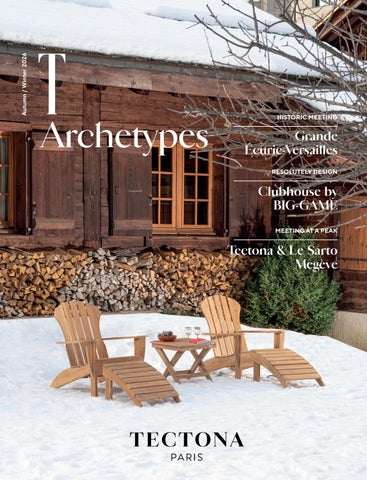
Autumn / Winter 2026
Archetypes
HISTORIC MEETING
Grande Écurie-Versailles RESOLUTELY DESIGN
Clubhouse by BIG-GAME MEETING AT A PEAK
Tectona & Le Sarto Megève
E D I TO R I A L
Archetypes The new edition of T Magazine features a selection of furniture that are archetypes of Tectona’s distinct identity. Each piece reflects our know-how, whether with wood or aluminium. Our exacting standards guarantee the exceptional longevity of our furniture pieces, their resistance to weather conditions and to repeated use. Design. It’s in the warm ambiance of an Alpine chalet where we decided to present Clubhouse. This collection, designed by BIG-GAME, is available in two versions, teak or aluminium. Every item in the collection —stackable chair and armchair, tables with leg assembly reduced to the bare minimum— adapts to small spaces. With its ease of handling, Clubhouse is as suited to the great outdoors as to contemporary interiors. History. For fifty years, Tectona has been entering museums, parks and gardens of great heritage value. In particular, our benches blend in so naturally at these cultural venues that they seem to have been there since the beginning. Case in point: the Grande Écurie-Versailles bench, fruit of the partnership between the Château de Versailles and Tectona, can be found along the visitor routes of the famous Château. The craftsmanship evokes the stylistic influence of the famous firm Jacob-Desmalter, which supplied several European palaces over the 18th century. As in the original, mortise-and-tenon joints are used to provide the required sturdiness to this furniture item, full of history and also on sale in our stores and online. Harmony. Several architects call on Tectona to fit out hotels. This was the case in Megève, where the Le Sarto chalet was transformed by Iconic House into a hotel. The chalet, designed in 1941 by the young architect Henry Jacques Le Même, has conserved its remarkable Art Deco architecture
and can host fifteen guests. Outside, sun loungers from the Camarat collection surround the swimming pool. Comfort is key: the backrest has five reclining positions; moreover the lounger has two wheels so can be moved about with no effort. Iconic. In 2026, Tectona participated in the world-renowned RHS Chelsea Flower Show. The Tectona stand, designed by British landscape design practice Taylor Tripp, symbolised the brand’s particular relationship with English gardens. In the early 1970s, the first furniture pieces launched by Tectona were inspired by those of English gardens. Over thirty years, the landscapes created by Taylor Tripp have reflected the evolution of gardens, increasingly in favour of plants adapted to new climate conditions and greater biodiversity including protection of small fauna associated with gardens and respect of soils. Here, the simple form of the terracotta pot Classico blends in discreetly with the lush mixed-border. Inspiration. The Japan-inspired collection adopts the characteristic design of bamboo “thatches”, canes in the form of hollow tubes, divided by knots. Bamboo lends itself equally to the luxuriance of a conservatory or to a mineral garden. The collection, in black or white powder-coated aluminium, is an invitation to a moment of tranquillity and comfort, whether by the generosity of its seats, wide and deep, or the curvature of its backrest and armrests. The cushions are available in two colours: green with black piping or white with white piping. Our favourites. At our final snow-covered stop, we have selected furniture that encourages passers-by to slow down and partake in serene moments.
3
C U LT U R E
Grande Écurie -Versailles, heritage reinvented By Marie Farman
Visitors to Versailles, a symbol of French heritage, will encounter many Grande Écurie-Versailles benches. Tectona designed the benches from historical models and they blend in seamlessly with the opulence of the Château. Whether in a gallery or before a sculpture, Grande Écurie-Versailles benches are the perfect accompaniment when you want to pause a moment to relax, to chat or to contemplate a work of art. Simple and understated, they add to the overall experience.
5
6
C U LT U R E
WHEN HERITAGE INSPIRES CONTEMPORARY DESIGN The design of the bench was inspired by two oak models from the early 19th century belonging to the historic collections of the Château and the former royal stables. Their lines evoke the stylistic influence of furniture maker JacobDesmalter, supplier to palaces from the mid-18th century. Several generations have passed since the originals appeared and Tectona are happy to bring them to the modern era with a contemporary reinterpretation. To be precise, the challenge was not to replicate the heritage models, but to extend their history, to foster a dialogue between the two eras and to design a version better adapted to use by the general public. This is an undertaking that Tectona are familiar with, having already served other cultural venues, such as Musée Rodin, Musée Picasso, the gardens of the Château de Chambord, and Villa Medici. This type of furniture has to blend into its surroundings, withstand the passage of time and provide timeless simplicity.
AT THE NEXUS OF HERITAGE AND CREATION A key part of development was to capture the essence of the original benches and to study their fabrication techniques – these tasks were entrusted to Tectona’s Normandy workshops under the watchful eye of workshop head JeanYves Grandfils, recipient of a Meilleur Ouvrier de France award. Some aspects of the originals were left alone; elsewhere, subtle creative touches were made. For example, we retained the tapered legs that formed part of Jacob-Desmalter’s decorative repertoire. Along with the traditional mortise-and-tenon joints, which were a guarantee of exceptional stability two centuries ago and still are. However, the velvet of the seat was replaced by wood, a necessary change to endure continuous use by the general public. The bench is also available in solid teak for exterior use. From these adaptations emerged Grande Écurie-Versailles, a sober and contemporary bench subtly impregnated with classicism. The prowess resides in its apparent simplicity and the judicious changes, which belie the level of rigour involved. The bench is therefore in its element at the Château de Versailles, where its appearance harmonises perfectly with its surroundings while affirming its presence. The story of the Grande Écurie-Versailles bench extends beyond the estate of the Château. It is also available to private individuals, instore and online – why not bring a slice of France’s heritage to your home?
GRANDE ÉCURIE-VERSAILLES BENCH In Imperial teak 183 × 48 cm
7
L E T ' S TA L K D E S I G N
Lightness is a style By Antonella Galli
Clubhouse, a favourite for all seasons With the new version in aluminium, the Clubhouse collection of tables and seating — by the Swiss trio BIG-GAME — pushes the envelope even further for versatility. Being compact, light, refined and comfortable, it is equally at home on small balconies or in large spaces, and adapts to different tastes via customisable hues.
GENESIS IN WOOD, EXPANSION IN ALUMINIUM Is elegance compatible with functionality? Is it possible to reduce volume and optimise comfort at the same time? These were the challenges faced by Elric Petit, Grégoire Jeanmonod and Augustin Scott de Martinville, founders of the famous Swiss studio BIG-GAME. In 2018, their Clubhouse collection for Tectona swept away any doubts. The chairs, armchairs and tables combine aesthetics and ergonomics; they are easy to move and store, adorned with slim cushions that perfectly embrace the contours of the seats. The pieces have been designed for all exteriors: the collection passes seamlessly from urban terraces to hanging gardens, from the mountain to the coast. The collection was born in solid teak, with painstaking work by woodworkers guaranteeing robustness and aesthetics, and Clubhouse has now entered a new phase, with the unveiling of the all-new aluminium version this year.
9
L E T ' S TA L K D E S I G N
A TRANQUIL FORCE One of the biggest pros of the collection is its perfect stackability. This characteristic is amplified by the natural lightness of aluminium, which also has proven resistance to the elements.@ A simple glance demonstrates the relevance of the design: the new version in metal has not sacrificed any of the charm of the original. In fact, metal better highlights the sober sleek lines that have made the collection a success. Colour has not been overlooked either. The anthracite grey aluminium can blend in with a large colour palette thanks to the cushion fabrics, thereby meeting the demands of architects and individuals. Clubhouse multiplies possibilities: on the one hand, the visual modernity of aluminium, on the other hand the reassuring warmth of teak. Two expressions that bring outdoor spaces to life even in winter, whether on the patio of a snow-covered chalet or looking out to sea — for the ever-growing contingent of holidaymakers choosing a seaside resort out of season.
IN PHASE WITH THE ENVIRONMENT This collection, designed to foster conviviality and with an authentic style, has the rare ability to blend into very different settings. Notably it was selected to fit out the patios of suites at hotel Zannier Île de Bendor, a private refuge infused with the Provence spirit inaugurated in May of this year on the famous private island opposite Bandol.
STACKABLE ARMCHAIR In aluminium
64 × 50 cm
Another decor, another ambiance: Clubhouse is also present in Zug, Switzerland, in the vast outdoor area of the Italian restaurant Più, where the Bindella family delights its clients with the tasty specialities of Venetian cuisine. A veritable test of character for the collection, which proves once again that a great design can adapt to all requirements.
STACKABLE CHAIR
STACKABLE CHAIR In teak
51 × 48,5 cm
10
SQUARE TABLE
RECTANGULAR TABLE
In aluminium
In aluminium
50 × 47 cm
70 × 70 cm
140 × 70 cm
STACKABLE ARMCHAIR
SQUARE TABLE
RECTANGULAR TABLE
In teak
In teak
In teak
60 × 48,5 cm
70 × 70 cm
140 × 70 cm
In aluminium
11
O U R P L AC E S O F E N C H A N T M E N T
Megève,
or natural elegance By Frederic Brun Photographs by Mr. Tripper
For the chalet Le Sarto in Megève, a new addition to their private collection of rental homes under the Iconic House banner, Thibaud Elzière and Robin Michel opted without hesitation for the Camarat collection in teak in Tectona’s signature style.
LE SARTO: A SITE BEQUEATHED In winter, nature presents herself in a bridal gown. In the sunny season, she opts for green attire. Pure in the morning but often pink in the evenings, Mont Blanc dominates the situation. It’s easy to see why Megève has been called the pearl of the Alps. This is the fairytale setting for Le Sarto, a residence built in 1941 by Henry Jacques Le Même. Le Sarto sits on a rocky base and its facade in amber wood, judiciously punctuated with green decorative elements, narrows to a point over three storeys. Le Sarto is a mountain chalet but unlike the other ones. It is a symbol of a refined art of living in contact with the mountain and orientated around varied activities offered throughout the year. It combines the functionality and elegance of the Art Deco style with the design principles established by Henry Jacques Le Même. The architect, originally from Nantes, discovered Megève in 1925 – he was not yet thirty years old but he fell in love with this mountain village and would go on to profoundly shape its identity. In the course of his prolific career, he completed nearly 900 projects throughout France, including collaborations with Jacques-Emile Ruhlmann, but he never left the charming resort that Baroness Noémie
de Rothschild was transforming into a mountain paradise. It was her who commissioned Le Même for his first Alpine project, a modern chalet evoking traditional local farms to blend in with the local culture and landscape, and an interior fitted with the mod cons of the day. The architect conceptualised what would become the template for the “skier’s chalet”. The basement is set aside for domestic chores and a ski room for waxing and storing. Service rooms are located on the ground floor, while the first floor is for luxuriating on terraces and in living rooms, which are often accessible from the exterior and have a fireplace. To bathe these rooms in sunlight and to offer panoramic vistas – what Le Même called “the science of landscape” –, large windows and glazed doors were made possible by use of modern reinforced concrete, concealed behind authentic panelling. Bedrooms and bathrooms nestle in the loft. “Henry Jacques Le Même invented a new way of living in the mountain. Le Sarto is part of this heritage,” underlines Robin Michel, a co-founder of Iconic House who has also become a specialist in the architect’s work since carrying out a complete renovation of this extraordinary house.
13
O U R P L AC E S O F E N C H A N T M E N T
THE PEAK OF RELAXATION
SENSE OF HOSPITALITY
Le Sarto, covering 650 m², offers the intimacy of a private residence combined with the services of a luxury hotel. It can host up to 15 people in 7 en suite bedrooms and a dormitory for children. It also features vast living areas and even a cinema room. To restore the house to its initial glory, the Iconic House team recreated the decor to closely match the original, adding their own subtle modernising touches, and placed many ceramics and oversized furniture pieces as Henry Jacques Le Même used to design them. There are works of art and creative pieces throughout. Wood is omnipresent. Around the swimming pool, sun loungers in teak from the Camarat collection, representing Tectona’s signature style for nearly five decades, invite onlookers to pause for a while and enjoy the sunshine – the sun lounger mattresses are made of a fabric that is weatherresistant and dries rapidly. On the terraces, large teak tables and their armchairs, also by Tectona, presage family lunches outdoors and suppers under the stars.
The philosophy underlying the hotel offer Robin Michel has created with his brother Thibaud Elzière since 2021 is that architectural masterpieces exist to be lived in and to create joyful moments and lasting memories, rather than merely to be seen. To make the experience for guests as smooth and as unforgettable as possible, Iconic House personnel are busy behind the scenes. “Our houses have house managers, housekeeping teams, talented chefs. It’s this type of experience that our clients remember and that contributes to the magic of their stay, beyond the sheer beauty of the location alone. This is definitely the most complicated part to manage, but it’s also the part that makes the difference,” explains Robin Michel. Some of Iconic House’s other venues include L’étoile des Baux, a Provence-style residence in Bauxde-Provence, Les Bords du Lac in Hossegor, Le 1550, a chalet in Courchevel, but also Villa Junot, a rare private mansion in the Art Deco style in the heart of Paris, in Montmartre.
For Robin Michel, collaborating with Tectona was an obvious choice. “We had already worked together on previous projects. Not only are the furniture pieces of remarkable quality, but the reactivity and the guidance from the Tectona teams were invaluable. We have to be effective. For every new project, we have to think about every aspect of the house, including the most practical ones. Behind the aesthetic quest and the desire to create a welcoming ambiance, there is also research on all functional aspects related to usage and maintenance. With Tectona, we were able to immediately make the most well-adapted choices taking into account the climate constraints in this mountainous region and requirements related to everyday use and maintenance of the outdoor furniture, for the swimming pool, the garden and the terraces,” explained the co-founder of Iconic House.
Following the extensive renovation, Le Sarto now hosts an indoor swimming pool, a hammam, a sauna, a yoga studio and a fitness centre featuring stylistic details evoking with subtlety the sanatorium designed by Henry Jacques Le Même on Christomet, opposite Megève. The only downside of Le Sarto is having to leave!
CAMARAT SUN LOUNGER 200 × 64 cm
DUXFORD SQUARE COFFEE TABLE 50 × 50 cm
14
15
G A R D E N S W E LOV E
Taking the long view By Caroline Donald Photographs by Joanna Kossak
Be it working on a historic site or a new build, Taylor Tripp, the English landscape designers who created the Tectona and Italian Terrace stands at the RHS Chelsea Flower Show 2026, share their values of conjuring a timeless sense of place
PUTTING THE GARDEN FIRST Occasionally, Nick Tripp and Richard Taylor of Taylor Tripp are presented with a wish list by a potential client: swimming pool, tennis court, outdoor kitchen, garages etc. “If they don’t even mention plants or the garden, then we are not for them,” says Nick. Fortunately, most of the owners who approach the Hampshire-based company believe that such features should be integrated into a design that has the garden at its heart. “They understand wine and opera, and all the finer things in life, which includes a beautiful English country garden,” says Nick. Many are drawn to the idea of what he describes as “the craft of gardening” – a landscape that offers beauty, seasonality and a connection to its surroundings, as well as a comfortable setting for family life. That Taylor Tripp dressed the Tectona and Italian Terrace stands at the 2026 RHS Chelsea Flower Show – one of the highlights of the English summer social season - was therefore a perfect fit.
PLANNING FOR THE LONG TERM Taylor Tripp has spent the past 30 years creating landscapes across southern England, their work encompassing deep herbaceous borders alive with pollinators, sweeping lawns studded with topiary, productive kitchen gardens and orchards threaded with paths winding through long grass, all designed to feel as though they have always belonged. “It’s not about fashion, it’s about creating a dream,” says Nick, and many of their clients see themselves as custodians as much as owners, investing in landscapes that will mature and improve long after they have gone.
Oakley Manor garden designed by Taylor Tripp
17
G A R D E N S W E LOV E
Although the team also designs for new builds, many of the properties are historic, and the "bones" – paths, hedges, vistas, borders - of the garden already exist. Rather than sweeping away the past, they prefer to work in layers, respecting earlier interventions and understanding why the landscape they inherited was designed in a particular way. Walls that are centuries old, mature trees, established vistas and garden “rooms” can be assets rather than obstacles. “You are respectful of who came before because to trample all over it isn’t really that intelligent; often things have been done like that for a reason,” says Nick. “The planting may change, fashions change, but the underlying structure should still work.”
RIGHT PLANT, RIGHT PLACE Long before wildflower meadows and biodiverse habits became fashionable, Richard was incorporating them into his designs. Trained in environmental science and, later, landscape architecture at the University of Sheffield, where he studied under the influential planting designer Nigel Dunnett, he has always believed in working with nature and this has been at the core of Taylor Tripp’s work. Much of what is being discussed these days as sustainable gardening is about understanding a site and working with it, rather than trying to impose schemes that will not thrive without large amounts of time-consuming care. The practice follows the simple principle: right plant, right place and both men are sceptical of over-engineered solutions, particularly extensive watering systems. “If you prepare the ground properly, once an area is established, you don’t really need lots of irrigation everywhere,” says Nick. Soil that has been moved during groundworks is conserved and reused where it is needed for hungry plants, such as in productive areas and hard-working herbaceous borders, while the thin chalky natural terrain of where many of their projects are situated is perfect for wildflower meadows. Climate change is also influencing their planting choices. “There’s definitely plants that we can now use as a result of a warming climate,” says Richard, citing tender salvias, gaura and other species that increasingly thrive over English winter without protection. Yet, while plant palettes may shift, Taylor Tripp’s philosophy remains unchanged: gardens should work with the landscape, support wildlife and improve with age. Trends may come and go, but the essence of a successful English country garden endures: good bones, thoughtful planting and, above all, a timeless sense of place.
18
Classico terracotta pot
OUR KNOW-HOW
Bamboo,
elegant & timeless By Alyette Debray
Bamboo was born in Asia thousands of years ago, arrived in Europe in the 19th century, and has since become a classic in the decorative arts. Its long stems rise on the horizon like stilts, having at their extremities evergreen foliage in soft green hues. When the air blows, even gently, the stems gently bump into one another, perceived from afar as a soft and soothing rustling. Without a doubt, bamboo has character. In gardens, bamboo’s rhizomes burrow deep into the earth, and they emerge as shoots in unexpected places — this feat is not always appreciated by the garden’s owners!
ANCIENT TRADITION Bamboo bends without breaking. In Asia, it symbolises wisdom and inner strength. “In China and Japan, this plant is much more than a mere raw material,” explains Laurence Vauclair, specialist in bamboo and rattan furniture of the 19th century, antique dealer with a stall at the Paul Bert section of the Saint-Ouen flea market and a gallery in Paris (rue de Beaune, 7th arrondissement). “Since time immemorial, bamboo is omnipresent, in gardens… And elsewhere. Over there, it incarnates an entire way of living, a state of mind”. They use it for decoration, in the manufacture of furniture but also houses and scaffolding. Even today, botanical structures cover facades undergoing renovation — these are decidedly more attractive than the steel skeletons that encase Parisian buildings!
19TH CENTURY CONSERVATORIES After trading posts were established in Asia, bamboo arrived in Europe in the mid-19th century. “Firms such as Perret & Vuibert, renamed Maison des Bambous in the 1890s, invented a new way of working with bamboo and adapted their creations to Western tastes by offering more-refined objects. Following the Great Exhibition of 1851, bamboo furniture became extremely fashionable. Demand exploded. You would find them in high-society salons — the pinnacle of chic was to receive guests in your conservatory with these famous pieces in bamboo,” adds Laurence Vauclair. “ The French, English but also Americans —home of the highly reputable firm Heywood Brothers— went wild for this touch of exoticism, a veritable invitation to travel”.
Presentation of the Lelièvre fabric collection at La Pagoda, in collaboration with Galerie Vauclair and Maison Tectona, as part of Paris déco Off 2026. ©Arthur Minot
21
OUR KNOW-HOW
A TIMELESS MATERIAL Bamboo has never really gone away. “Bamboo has always had its fans. Pieces with ‘root’ legs are highly sought-after, as are small cabinets that combine bamboo with panels either lacquered or with rattan straws,” adds the expert, who has the gift of being able to track down these rare pieces. Countless designers and decorators have made use of this material. In Italy, in the 1970s, Gabriella Crispi or the studio Vivai del Sud. In France, Madeleine Castaing. But it’s worth pointing out that the hollow stems are dry and hard, rebellious and capricious. It takes a certain know-how to work bamboo. You start by heating it, then placing it in large arches to shape it. Outdoors, it is fragile and, contrary to popular opinion, it does not age well. “For this reason, many firms have worked other woods or brass like bamboo, to create an illusion.”
AN HOMAGE COLLECTION This was the starting point for Tectona, who set out to give a modern spin to a material that has been a classic in the decorative arts for more than 150 years. The Bamboo line in aluminium borrows from Japanese bamboo traditions, and replicates the knots that give the exotic wood its cachet. The aluminium tubes are soldered then machined to give them a certain finesse. Tectona artisans then add rings, which replicate bamboo ribs, one by one to the tubes. The current Bamboo collection consists of chairs, armchairs, table and coffee table with tabletop in either grey Hainaut limestone or white Carrare marble. The collection was first offered in black, and is now also available in white, an homage to Californian furniture of the 1960s/1970s. Any of these pieces can, on request, be customised in other colours. In 2027, the Bamboo family will grow with the addition of a new sun lounger and a side table.
FOOTREST
LOW ARMCHAIR
2- OR 3-SEATER SOFA
73 x 73 cm
79 x 82 cm
152,5 x 82 cm / 226 x 82 cm
RECTANGULAR COFFEE TABLE With aluminum table top or with table top made of gray Pierre Bleue du Hainaut marble or white Carrara marble 116 x 63 cm
22
23
C L A S S i C C O N T E M P O R A RY
Our autumn - winter
selection
!
1800 collection Here, the 1800 Collection invites you to create a warm and convivial atmosphere, perfect for sharing moments while facing snowy landscapes. The rectangular table seats up to 8 guests. The chairs and armchairs, with refined lines inspired by the Directoire style, combine lightness, comfort, and distinction.
01.
RECTANGULAR TABLE
CHAIR
180 x 90 cm
44 × 55 cm
Available in : Blue -grey
ARMCHAIR
BRIDGE ARMCHAIR
56 x 53 cm
57,5 × 56 cm
Matt black
02. Camarat Sun lounger Designed for terraces, this teak sun lounger blends refined design with outstanding comfort. Its backrest, adjustable to five positions, invites moments of relaxation facing mountain landscapes, making the most of every ray of sunshine.
CAMARAT SUN LOUNGER 200 x 64 cm
DUXFORD SQUARE COFFEE TABLE 50 × 50 cm
25
03.
C L A S S i C C O N T E M P O R A RY
Goa collection The extremely minimal design of Goa is a masterpiece of equilibrium that highlights the woodworking talent within Tectona. The lines, simple and obvious, intersect without jarring visually while also concealing the astute mechanism providing two reclining backrest positions.
GOA LOW ARMCHAIR
GOA TWO-SEATER SOFA
73 x 84 cm
129 x 84 cm
GOA FOOTREST
DUXFORD RECTANGULAR COFFEE TABLE
65 x 65 cm
100 x 60 cm
04. EXETER DAYBED SET
Exeter daybed set
236 x 88 cm
DUXFORD SQUARE COFFEE TABLE 50 × 50 cm
Comprising a corner unit, a central unit, and a footstool, this teak daybed set stands out through the purity of its design. Its clean lines integrate gracefully into any space. Simple and self-evident, Exeter perfectly symbolizes the delicate balance between "classic" and "contemporary".
27
C L A S S i C C O N T E M P O R A RY
05. 1800 Bench Its mere presence is enough to bring a touch of elegance to its surroundings. Inspired by the neoclassical style of the French Directoire period, the 1800 Bench is equally at home outdoors as it is in an interior living space. Crafted from aluminum, its graceful silhouette is enriched by understated decorative details that celebrate the purity of its design. The 1800 Bench is available in two finishes: black and blue grey.
1800 BENCH 160 x 53 cm
Available in : Blue -grey Matt black
06. Exeter lounge After a snowshoeing or skiing excursion, there's no better place to pause and enjoy the beauty of the landscape. The deep, gently angled seats, combined with subtly reclined backrests, invite you to relax and unwind for hours.
SOFA
LOW ARMCHAIR
180 x 70 cm
70 x 70 cm
RECTANGULAR COFFEE TABLE 120 x 90 cm
Find Tectona ! France
Stores Paris 36 rue du Bac 75007 Paris +33 1 47 03 38 05 paris@tectona.fr Saint-Rémy de Provence 7 avenue Albin Gilles 13210 Saint-Rémy de Provence +33 4 32 62 05 05 saintremy@tectona.fr
Switzerland
Spain
Italy
Vallauris 3015 chemin Saint-Bernard 06225 Vallauris +33 4 92 96 92 29 vallauris@tectona.fr
Order www.tectona.fr info@tectona.fr +33 1 47 03 05 05 36 rue du Bac, 75007 Paris
Contract Marion Guéroult mg@tectona.fr +33 7 86 34 21 99 Mireille Vosgien PACA region m.vosgien@tectona.fr +33 6 84 95 99 42 Magali Durbesson Région Rhônes-Alpes m.durbesson@tectona.fr +33 6 31 86 82 31
Store
Order
Contract
Nyon Avenue Viollier 4 1260 Nyon +41 22 700 10 10 suisse@tectona.ch
www.tectona.ch suisse@tectona.ch +41 22 700 10 10
Roberto Bolzoni rb@tectona.ch +41 79 322 84 31
Store
Order
Contract
Madrid Calle de Claudio Coello 22 28001 Madrid +34 91 781 18 45 madrid@tectona.es
www.tectona.es madrid@tectona.es +34 91 781 18 45
Mar Izquierdo mizquierdo@tectona.es +34 627 57 93 12
Store
Order
Contract
Milan Via della Moscova 47/A 20121 Milan +39 02 65 34 23 milano@tectona.it
www.tectona.it milano@tectona.it +39 02 65 34 23
Massimo Bufi m.bufi@tectona.it +39 351 39 69 798
Order
Contract
www.tectona.pt portugal@tectona.pt +35 19 22 27 92 60
Mariana Abreu Lima ml@tectona.pt +351 922 279 260
Order
Contract
www.tectona.fr usa@tectona.fr +33 1 47 03 05 05
Mariana Abreu Lima ml@tectona.pt +351 922 279 260
Portugal
United States
Florida Allison Vaughn a.vaughn@tectona.fr 001 772 882 5749
All countries
Online
Order
www.tectona.fr info@tectona.fr
Phone +33 1 47 03 05 05
© Tectona 2026 Full or partial reproduction is prohibited.
31
www.tectona.fr