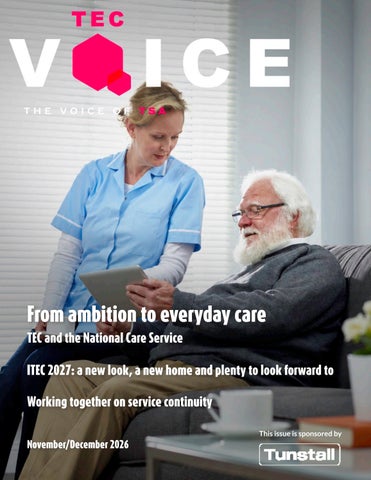
From ambition to everyday care TEC and the National Care Service ITEC 2027: a new look, a new home and plenty to look forward to Working together on service continuity This issue is sponsored by
November/December 2026
The voice of Technology Enabled Care
Keeping you in the loop... Stay up to date with what’s happening in the TEC sector with all the latest news from our valued members, including all of the latest developments and views from IRIS IoT, Age Impulse, The Key Safe Company, Cognitive Systems and many more.
Alyson Scurfield OBE
Visit our Member News page here for more, and remember to bookmark the page!
TSA Chief Executive
As we approach the end of another busy year for our sector, I’m feeling optimistic about the opportunities ahead and what we can achieve together in 2027. First up, some very exciting news! I’m absolutely delighted to reveal in this issue more of our plans for ITEC 2027, which promises to be our biggest conference yet! With a brand new look, a fantastic new home in Liverpool and partners joining us from across the globe, we’re bringing together the people, ideas and innovations shaping the future of technology enabled care. I can’t wait to welcome you all. Turn to page 6 for a first look at what’s in store. As we look ahead to 2027, we’re also making important progress in strengthening the national case for TEC and developing practical tools to support wider adoption. Our National Sector Support Group has held its first engagement with the Casey Commission, sharing our recently published interim briefing on the role of technology in transforming adult social care. This is an important opportunity to influence the direction of reform and strengthen the evidence and economic case for TEC. Alongside this, our Housing Commission is moving into an exciting new phase. Following months of 2
evidence gathering and sector engagement, we’re developing a practical Blueprint to help housing providers adopt more proactive and preventative approaches to care and support. With the final Blueprint and supporting tools due in January, both programmes demonstrate how our sector is coming together to make a stronger case for TEC and help organisations turn ambition into action. Read more about our work with housing providers on page 5. This focus on prevention and quality is also gathering momentum internationally. Following the recent Connected Health and Safety conference, we’ve been continuing conversations about proactive care and the standards needed to support it. We’ve also begun discussions with the European Social Network, representing social care leaders across 27 European countries, to explore opportunities for greater alignment on quality assurance and standards. This is an exciting area of work, with real opportunities for UK TEC organisations to share their expertise internationally. Closer to home, it was wonderful to hear that so many of you attended our recent Advancements in Technology event at Bolton Wanderers Football Club. By all accounts it was a fantastic day! The turnout was incredible, and everyone was struck by the passion, knowledge and enthusiasm in the room. Bringing our sector together to share ideas, challenge thinking and learn from one another is
so important. A huge thank you to everyone who joined us and contributed to such a brilliant event. Turn to page 14 for highlights from the day.
and contingency planning during and beyond the switchover. Turn to page 4 to read more about the work we’re doing to support our sector.
Of course, there’s one issue where time is now particularly pressing: the analogue to digital switchover.
Finally, as this is our last TEC Voice of 2026, I want to say a huge thank you to our members, partners, colleagues and everyone working across health, housing and social care. Your hard work, commitment and passion continue to make such a difference to people’s lives, every single day.
The 31 January 2027 deadline is fast approaching, and too many analogue systems remain in use. I’m incredibly proud of the huge amount of work TSA has undertaken alongside our partners since 2017 to support the sector through this transition. But we know there is still much to do, and we cannot afford to put people who rely on these services at risk. We’re continuing to work closely with government, telecoms providers and sector partners on the challenges ahead, including service continuity
I wish you and your families a very Merry Christmas and a happy, healthy New Year. I look forward to working with you all in 2027!
3
Sector News
TSA News
TSA working with national partners on telecare service continuity ahead of digital switchover
Starting 2027 With Confidence: Is Your Housing Service Ready for the Year Ahead?
With the 31 January 2027 digital switchover deadline fast approaching, TSA is continuing its work with national and local government partners to address the challenges facing telecare services, particularly where analogue systems remain in use.
These are complex challenges involving multiple organisations, and discussions are ongoing to establish what a coordinated approach could look like. The move to digital infrastructure is one of the most significant changes our sector has faced. While considerable progress has been made, we know that some organisations, particularly those managing housing-based telecare and grouped living schemes, still face challenges in completing their migration. Ensuring that people who depend on these services remain safe and supported is an absolute priority.
Working together on service continuity Building on our extensive work supporting the sector through the analogue to digital transition, TSA is working with Partners in Care and Health (PCH) and other sector partners to consider the continuity arrangements needed during and beyond the switchover. This work is focused on developing a shared understanding of the remaining risks, identifying where additional contingency planning may be needed and considering how organisations can work together to minimise disruption to essential telecare services. An important part of these discussions is understanding how potential service interruptions could be identified, what practical measures might help protect people who rely on telecare, and how responsibilities for responding to incidents could be coordinated.
4
Planning beyond the deadline Although 31 January 2027 remains the key milestone, the transition presents challenges that extend beyond a single date. Changes to telecommunications infrastructure will continue over time, and organisations still relying on analogue equipment or interim arrangements may face ongoing risks to service reliability and continuity. This makes it particularly important that the sector continues to understand and manage these risks throughout the transition. The work with PCH, LGA and other partners is intended to inform how these challenges might be addressed collectively, recognising the different responsibilities of telecommunications providers, local authorities, housing organisations and TEC service providers. In the meantime, organisations must continue progressing their digital migration plans, working closely with suppliers and telecommunications providers, and reviewing their own arrangements for maintaining safe and reliable services. TSA remains committed to representing the sector throughout this critical period, with the safety and wellbeing of people who rely on technology enabled care at the heart of our work.
As 2026 draws to a close, housing providers will be thinking about their priorities for the year ahead. The January 2027 digital switchover is approaching, alongside growing expectations for resident safety and service quality. With competing priorities and limited resources, the new year is a chance to review services, identify improvements and make a clear plan for the months ahead. But knowing where to begin, or what needs the most attention, can be a challenge.
Taking Stock and Planning Ahead
TSA Is Here to Help
Whether you are reviewing services, considering new technology, looking at risks or exploring how data could help you make better decisions, understanding your current position is an important first step.
At TSA, we understand the challenges facing housing providers and the importance of practical decisions that put residents first.
That might mean checking the safety and reliability of existing systems, finding gaps in services, exploring ways to prevent problems or making sure future investment benefits residents. It could also mean reviewing how services are run, who makes decisions, or how new services and equipment are bought and introduced. Whatever the priority, asking the right questions now can help you make better decisions throughout 2027.
Through our independent consultancy support, we help organisations understand their options, identify risks and opportunities, and turn plans into action. Our support can start with a conversation about a challenge or include a service review, planning, procurement and implementation. Every organisation has different pressures, priorities and resources, so we tailor our support to your needs. If you have a project in mind, want reassurance about your current services or are unsure where to start, please get in touch.
TSA Consultancy Services Find out more at: www.tsa-voice.org.uk/consultancy-services/ or email: consultancy@tsa-voice.org.uk
5
A new home for ITEC For the first time, ITEC is moving to The Liverpool Experience Campus.
It is an important move for an event that has grown year after year. Liverpool gives us more space for the conference programme, more room for delegates to meet and connect, and our biggest exhibition yet. We are expecting more than 1,400 delegates, with four stages, over 100 speakers and an exhibition bringing together organisations from across TEC, health, housing and social care.
ITEC 2027
a new home, a new look and plenty to look forward to
The new venue has also given us the opportunity to develop a completely new visual identity for ITEC 2027. It is a fresher, bolder look for the conference and one that reflects both the scale of the move to Liverpool and the broader audience ITEC now brings together. You will see much more of it across our website, social channels and event materials as March gets closer.
Baroness Tanni Grey-Thompson returns as Conference Chair ITEC 2027 is continuing to take shape, and there is plenty more we can now share as we look ahead to Liverpool on 9 and 10 March. In the last edition of TEC Voice, we introduced Care in a Changing World, with People, partnerships and innovation shaping the future of health, housing and social care setting the direction for the conference. Those themes will run across four stages at ITEC 2027. Our Plenary Stage will bring together high-profile speakers and the wider conversations affecting care and support, while the Innovation, Impact and Partnerships stages will look more closely at technology, people, leadership, culture and the practical realities of delivering change. Now, we can share much more about what ITEC 2027 will look and feel like. 6
We are delighted to welcome Baroness Tanni Grey-Thompson back as Conference Chair after the fantastic contribution she made to ITEC 2026
OneTanni of Britain’s most successful One of Britain’s most successful Paralympians, Baroness Grey-Thompson won Paralympians, 11 Paralympic gold Baroness Tanni Grey-Thompson won 11 Paralympic medals before going on to play a prominent role in public life. As a crossbench peer, her work has covered gold medals before going on to play a prominent disability, health, welfare, sport and a wide range of wider social issues. role in public life. As a crossbench peer, her work
Her warmth, insight and ability to bring different voices the conversation made a real impact ona hasinto covered disability, health, welfare, sport and last year’s conference, and we are delighted that Baroness Tanniof Grey-Thompson will be back with us in wide range wider social issues. Liverpool. Her warmth, insight and ability to bring different voices into the conversation made a real impact on last year’s conference, and we are delighted that Baroness Tanni Grey-Thompson will be back with us in Liverpool.
7
The Gala Dinner and ITEC Awards return This week has also seen the launch of the ITEC 2027 Gala Dinner and Awards. The Gala Dinner will take place on the evening of 9 March at the Titanic Hotel Liverpool, bringing delegates, speakers, sponsors and colleagues together after the first day of the conference for an evening of networking and celebration. Entries are also now open for the 2027 ITEC Awards, recognising the people and organisations making a difference through technology enabled care. Categories span innovation, leadership, service transformation, workforce development, digital skills, rising talent and international TEC, with the winners announced at the Gala Dinner.
Delegate bookings are also now open, so if you are planning to join us in Liverpool, book your place now. There is still plenty more to reveal between now and March, from speakers and sessions to the organisations and ideas that will fill our new Liverpool home.
ITEC 2027 is gathering pace. The exhibition is nearly full, the Awards are open, Baroness Tanni Grey-Thompson is returning as Chair and Liverpool is ready to welcome the biggest ITEC yet.
We cannot wait to see you there.
Sponsored by:
The exhibition is almost full Interest in exhibiting at Liverpool has been exceptional, with more than 75% stand spaces already sold and only the final few spaces now remaining. If your organisation is considering exhibiting at ITEC 2027, do not delay in securing your place. The final few additional sponsorship opportunities are also available for organisations looking to build a wider presence around the conference. To discuss exhibiting or sponsorship, contact: events@tsa-voice.org.uk.
8
9
ITEC Conference
From ambition to everyday care: TEC and the National Care Service
The real test of a future National Care Service will be what changes for people in their everyday lives. In November, TSA published The Role of Technology Enabled Care in a National Care Service, an interim briefing prepared for the Casey Commission through our National Sector Support Group. It sets out recommendations for making technology enabled care (TEC) a more consistent part of adult social care, with a particular focus on fairer access, prevention, workforce skills and better commissioning. But what might that look like in practice? Imagine someone becoming less confident at home. Perhaps they have had a fall, their family is worried, or a care worker has noticed a gradual change in their routine. Will they be offered the right support early enough? Will the people assessing their needs understand what TEC could offer? And will there be a reliable service behind that technology when they need help? These are practical questions, and they deserve a place at the centre of the national debate. With the Government setting out its ambitions for a National Care Service and Baroness Casey’s independent commission due to report in summer 2027, there is a real opportunity to shape how care is organised. 10
We already know TEC’s potential. More than two million people across the UK are supported by TEC, with services helping people retain their independence, feel safer and stay connected to support. Across the sector, there are examples of technology working well alongside skilled professionals and personal care. But access remains inconsistent. Two people with similar needs can receive very different support depending on where they live, how local services are commissioned or whether TEC is even discussed during an assessment. This matters particularly as care moves towards earlier intervention and stronger neighbourhood services. The Government’s recent proposals for neighbourhood-based home care commissioning focus on more familiar care workers and noticing changes sooner. Research published for the Casey Commission has also highlighted how fragmented responsibility for adult social care has become. Both developments underline the importance of designing services that work together around people. TSA’s briefing, informed by an independent evidence review from the Social Care Institute for Excellence, work with Colligo Labs and engagement across the
sector, identifies several opportunities to address these challenges. TEC should be routinely considered when people are assessed, when their care is planned and when arrangements are reviewed. Professionals should have the skills and confidence to discuss it meaningfully, while commissioners consider the whole service, from identifying a need to providing an appropriate response. We also need a clearer understanding of what works. Independence, safety, reassurance and quality of life are important outcomes in their own right. Financial benefits matter, but a stronger and more consistent evidence base is needed to understand long-term impact and share learning between services. For local authorities, housing providers, care organisations and health partners, the implications go beyond procurement. Achieving better outcomes will require workforce development, good-quality services, sensible use of data and investment in
approaches that help prevent needs from escalating. Funding arrangements must also recognise that the organisation investing in prevention may not be the one that benefits financially. This work is being supported through TSA’s National Sector Support Group, a three-year programme funded by Alcove, Access Group, Careium, Chiptech, Legrand Care, Taking Care and Tunstall Healthcare. Together, the partners are supporting the development of stronger independent evidence, clearer sector messaging and practical commissioning guidance. A fuller report, including further economic analysis, is planned for March 2027. As the National Care Service takes shape, we have a chance to make earlier, more joined-up support an expectation rather than an exception. TEC has an important part to play, and our sector has the experience to help make it happen. Find out more: https://caseycommission.co.uk/ 11
Sector Development
A failed alarm could cost lives. Social landlords must act now. By Debra Edwards, lived experience adviser As a wheelchair user, I lived in local authority supported housing for several years. After falling ill with lupus and rheumatoid arthritis in 2012 and then having my spine rebuilt, I wasn’t able to work as a midwife any longer or live the life I’d had before - and supported housing gave me back a sense of independence. One thing that made a difference during that time was telecare. In the early days, I fell a lot and when I pressed my alarm someone would always come, lift me back up, make me a cup of tea or get help if I’d hurt myself. But from early next year, that response, which for me was always there, will no longer be guaranteed for many older and disabled individuals.
From early next year, that response, which for me was always there, will no longer be guaranteed for many older and disabled individuals. For decades, telecare has worked through people’s landlines. That copper phone network is very old now, and on 31 January 2027 it’s being switched off. The problem is that lots of telecare systems are still analogue - designed to work through landlines - so they won’t work reliably over broadband. And for people who depend on their personal alarms, like I did, they might press the button and find that no one comes. Let me explain what that would feel like. Imagine you’re unsteady on your feet, and you slip. Lying on the floor, you’ve bruised yourself, maybe broken 12
A version of this article was first published in Inside Housing in October 2026, at: https://www.insidehousing.co.uk/
And it’s not just telecare. Many critical systems in supported schemes, things like fire alarms, lifts and door intercoms, also run through landlines. Their reliability will be affected too, once the copper network is switched off.
This is where I get angry. Many residents don’t know about the danger their landlords are putting them in. It feels so wrong that the professionals who are supposed to be supporting them are making really bad decisions on their behalf.
As a former supported housing resident, I can’t understand why councils and other social landlords have failed to deal with an issue that could affect so many people’s lives. I understand that money is tight and they have multiple priorities, but I’d love to sit down with the heads of supported housing at every organisation that hasn’t yet upgraded their telecare and ask them what was more important than keeping older and disabled people safe in their homes.
Why should it take a near miss or someone actually dying before action is taken? I thought social landlords were meant to be proactive, thinking about the future of their homes and their residents, rather than reacting only when something dreadful happens. There needs to be clear accountability when an alarm is pressed, and no-one responds. Does that sit with the telecare company, the council’s equipment manager, the monitoring centre, the housing officer? The resident lying on the floor doesn’t care whose role it is, they just need someone to help.
Older and disabled people have the same right as everyone else to feel safe and secure in their own homes. They should be able to trust that when they need help, the systems designed to protect them will work. something, it’s getting cold and you need help. It takes loads of energy to hit the button on your alarm and then you wait. It doesn’t connect, there’s silence and you realise you’re completely on your own.
This isn’t a time issue. Since 2017, TSA has been telling organisations that the switchover is coming. The deadline was originally set for 1 January 2025, but it was extended to 2027.
It’s shocking to think that supported housing, the part of this sector with the most vulnerable residents, is in fact the most unprepared for the digital switchover.
In recent years, as the switchover took place in some areas, two people died when their personal alarms failed. This prompted the government to launch an action plan to protect the two million people who rely on telecare, yet the majority of supported housing is still unprepared with many telecare users unprotected.
Research from TSA, the advisory body for telecare services, shows that only 30% of supported, extra care and retirement schemes run by councils and housing associations have upgraded their telecare systems to digital.
I hear the sector talking about ‘tech migration’ and ‘upgrades’ and ‘budgets’ but what about ‘people’ and ‘lives?’ What about dignity and respect? Residents like me want to live ordinary lives in the homes we love. We want to feel happy and secure. That can’t happen if the alarms we rely on fail when they’re pressed.
I’m a champion for my local authority’s continuous improvement group. We’re some of the lucky ones: our social landlord has upgraded all supported housing telecare systems in my area. It’s crazy that this isn’t the norm across the UK. Older and disabled people have the same right as everyone else to feel safe and secure in their own homes. They should be able to trust that when they need help, the systems designed to protect them will work. My fear is, come 31 January 2027, for some residents that support simply won’t be there. Councils and housing associations need to act now, before a failed alarm costs another life. 13
Sector Development
Looking back at Bolton: exploring the future of technology enabled care On 10 November, colleagues from across health, housing, social care and technology joined us at Bolton Wanderers Football Club for Advancements in Technology: Supporting people, strengthening services and improving lives. It was fantastic to see such a strong turnout, with the conversations throughout the day reflecting the knowledge, enthusiasm and commitment across our sector. The programme explored both the possibilities of emerging technology and the practical realities of making it work for people. Professor Richard Harding considered what the next wave of innovation might bring, while Ottilie Jones shared how technology can support independent living. Sessions from Careium and Access explored connected care and better information sharing, while Prima Housing highlighted opportunities to connect NHS and social housing data. TSA’s Julie Stone also discussed the importance of building workforce confidence and skills. Throughout the day, interactive discussions gave delegates opportunities to share experiences, challenge existing
approaches and consider how innovation can deliver meaningful benefits for people. The event also provided an opportunity to introduce TSA’s new briefing on the role of technology enabled care in a future National Care Service. A huge thank you to our speakers, sponsors Access and Careium, and everyone who joined us. Days like these are a valuable reminder of the passion, expertise and willingness to collaborate across our sector.
Missed a session? Explore the presentations from Bolton on our website.
A D V E R T I S I N G
Join Us in TEC Voice Align your brand with TEC Voice, the only dedicated publication in TEC, and engage a dedicated, receptive audience that can transform your business. Secure your space today and connect with leaders shaping the future of Technology Enabled Care.
Contact Us marketing@tsa-voice.org.uk With an engaged readership and limited, high-value advertising opportunities, your message will reach those making impactful decisions. Don’t miss this exclusive chance to be part of TEC’s only dedicated magazine! 15 *statistics calculated between 1st January and 20th November 2026
The industry and advisory body for technology enabled care
Embedding quality, safety and innovation in technology enabled care
TEC Services Association Address: Suite 8, Wilmslow House, Grove Way, Wilmslow, Cheshire, SK9 5AG Telephone: 01625 520 320 TSA: www.tsa-voice.org.uk TEC Quality: www.tecquality.org.uk