08
14
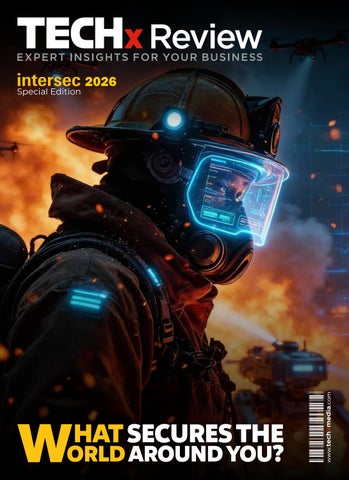
THE WORLD’S PREMIER SECURITY, SAFETY & FIRE PROTECTION EVENT
INSIDE: VEEAM’S $1.7B BET ON SAFE ENTERPRISE AI
26
COMPUTECENTRIC TO DATACENTRIC: THE 2026 SHIFT
AI SECURITY IMPERATIVE
THE END OF TRADITIONAL CONSTRUCTION
42
44
THE INTELLIGENCE OF INTEGRATION
38
6
January 2026
www.techxmedia.com
36
28
32
MTC, THE STORAGE POWERHOUSE
TRUSTED IDENTITY IN ACTION
THE FUTURE OF PHYSICAL SECURITY IN 2026
TIERED BACKUP, MAXIMUM PROTECTION
THE MOVESPEED MANIFESTO
QUANTUM THREATS AND THE UAE RESPONSE
48
52
56
www.techxmedia.com
January 2026
7
INTERSEC
THE WORLD’S PREMIER
SECURITY, SAFETY & FIRE
PROTECTION EVENT 8
January 2026
www.techxmedia.com
“SCALE DEPTH AND DIVERSITY POSITION INTERSEC 2026 AS INDUSTRY BENCHMARK.”
His Highness Sheikh Mansoor Bin Mohammed Bin Rashid Al Maktoum
As Dubai prepares to welcome the global security, safety, and fire protection community for Intersec 2026, the event promises to set a new benchmark in scale, innovation, and strategic impact. Entering its 27th edition, Intersec is no longer just an exhibition, it is a fully integrated ecosystem where governments, industry leaders, innovators, and first responders converge to address the most pressing safety and security challenges of our time. Dishan Isaac, Show Director of Intersec at Messe Frankfurt Middle East, has been at the helm of this evolution, guiding the event through nearly three decades of growth and transformation. “I have the privilege of leading Intersec at a time when it is truly at the forefront of global security, safety, and fire protection innovation,” he says.
www.techxmedia.com
January 2026
9
INTERSEC
The Intersec Story
Intersec began its journey in 1999 in Dubai, during a period when the UAE was rapidly advancing its infrastructure, safety systems, and technological capabilities. “Over the years, the event has evolved from a product-focused exhibition into the world’s leading platform for safety, security, and fire protection,” Isaac explains. From its earliest editions, Intersec has brought together government authorities, international manufacturers, technology innovators, cybersecurity leaders, first responders, and academia, a truly cross-disciplinary approach that was unprecedented at the time. Across 26 editions, Intersec has mirrored the sector’s evolution, transitioning from fragmented, siloed disciplines to a unified ecosystem. Today, it remains the only global event to integrate national security, cyber resilience, commercial security, fire and rescue, and occupational health and safety under a single roof. This holistic approach reflects the modern reality: security and safety are interconnected, requiring comprehensive strategies that span physical, digital, and operational domains. A key aspect of Intersec’s heritage is its long-standing collaboration with UAE authorities, particularly the General Command of Dubai Civil Defence and the Security Industry Regulatory Agency (SIRA). Their strategic support has helped position Intersec as an essential meeting point for international decision-makers, while also elevating Dubai as a global hub for safety and security innovation. Isaac notes, “The patronage and guidance from these authorities have ensured that Intersec is not just a trade show, it is a strategic platform advancing both national and global security priorities.”
DISHAN
ISAAC
January, the time of the event, has become a defining moment in the global industry calendar. Intersec marks the first major global gathering of the year for security, safety, and fire protection sectors. It is the stage where
SHOW DIRECTOR INTERSEC
10
January 2026
www.techxmedia.com
governments set new agendas, brands unveil cutting-edge technologies, and the industry aligns on priorities for the year ahead. The event’s impact on the region is evident: the UAE was ranked the safest country in the world in 2028, a reflection not just of national commitment, but also of platforms like Intersec that foster collaboration, innovation, and operational excellence.
The growth trajectory is also supported by a more sophisticated content strategy, spanning cybersecurity, surveillance and physical security, homeland security, fire and rescue, and occupational health and safety. Intersec has become the central platform for organisations to benchmark innovation, align with best practices, and forge long-term partnerships.
A Global Stage Like Never Before
The Power of Partnerships
Intersec 2026 is set to be the largest and most internationally representative edition in its 27-year history. This growth is driven by unprecedented demand and the rapid transformation of the security, safety, and fire protection sectors. Isaac reveals, “We are targeting 50,000 visitors this year, building on last year’s performance and supported by deeper government participation, enhanced buyer engagement, and a stronger international presence.” On the exhibitor side, Intersec will welcome over 1,400 companies from more than 60 countries, occupying 67,000 square meters of exhibition space, spanning 13 halls and more than 1,500 square meters of outdoor demonstrations. International participation is a hallmark of the event: 82% of exhibitors are expected to come from outside the UAE, with strong representation from Europe, Asia, North America, and the wider Middle East. Meanwhile, 40% of visitors are projected to be international, reinforcing Dubai’s status as a gateway for global business. A new initiative, the Hosted Buyers Programme, will bring 100 pre-qualified procurement leaders directly to the show, facilitating high-quality business opportunities through interest-based matchmaking and a direct path for solution sourcing. This combination of scale, international representation, and buyer engagement ensures that Intersec is not just a showcase, but a strategic platform where commercial, operational, and regulatory priorities intersect.
www.techxmedia.com
Partnerships have always been the backbone of Intersec’s success. For the 2026 edition, these relationships are more pivotal than ever. The event continues under the patronage of His Highness Sheikh Mansoor bin Mohammed bin Rashid Al Maktoum, reaffirming its alignment with the UAE’s national priorities in resilience, public safety, and future-ready infrastructure. Isaac highlights the role of key government collaborators. “Deeper engagement with the Dubai Supreme Committee of Crisis and Disaster Management and the Dubai Ports and Borders Security Council shapes both the direction and the content of the show. These partnerships ensure that our programme remains relevant, aligned with regulatory developments, and reflective of real operational needs.” The involvement of SIRA and Dubai Civil Defence goes beyond advisory input. Both authorities are curating experiential zones and live activations, allowing visitors to witness how regulation, readiness, enforcement, and innovation intersect in operational settings. This hands-on approach helps attendees understand compliance frameworks, risk management strategies, and the practical application of cutting-edge technologies. A new development for 2026 is the Memorandum of Understanding with UXE Group, focused on urban security, digital twins, and next-generation command-and-control systems. UXE’s immersive activation will offer live demonstrations and digital experience layers that align with Dubai’s vision for smart, resilient cities. January 2026
11
INTERSEC Global associations also shape Intersec’s content and credibility. Partners including NFPA, IOSH, ASFP, BSIA, BSIF, and ASSP contribute to certification pathways, conference programming, and professional development opportunities, elevating the quality of discourse and ensuring alignment with international standards. For exhibitors, this ecosystem signals that Intersec is not just a marketplace, but a platform for evaluating innovation against operational, regulatory, and resilience priorities.
A Playground for the Future
Intersec 2026 introduces several new and expanded features aimed at addressing pressing capability gaps across the safety, security, and fire protection sectors. The Innovation District is one of the flagship initiatives, providing a cross-sector platform for government, industry, research institutions, and high-potential startups. The district will host dedicated innovation showcases and future-focused panel sessions, bridging the gap between R&D communities and procurement priorities. The SIRA Hub emerges as a physical and digital gateway for global business, offering guidance on licensing, regulation, compliance, and market entry, particularly for international companies seeking a foothold in Dubai. The Control Room Innovation Theatre explores cognitive operations, unified command centres, operator wellbeing, and human-factor engineering, areas critical for modern, data-driven operational environments. Similarly, the Access Control Theatre expands to address the convergence of digital and physical identity, biometrics, cloud-based access, and the integration of cybersecurity with physical security.
12
January 2026
Cybersecurity gains prominence through the enhanced InCyber Briefing, covering regulatory compliance, adversarial AI, postquantum readiness, cyber metrics, and supply-chain resilience. These programmes equip leaders with frameworks to manage accelerating digital risks in a market projected to reach US$1.29 billion by 2030.
The Intersec Awards
The Intersec Awards are more than a ceremony, they are a yearround engagement platform. In 2026, 17 categories across fire protection, security, cybersecurity, and team excellence will be evaluated by 23 international experts. Over 50 innovations will be showcased live on the show floor, allowing jurors to assess solutions in real time. Isaac explains, “The Awards celebrate leadership, innovation, and resilience while fostering a connected global community.”
Content Strategy
Intersec 2026 has structured its content to create measurable connections between conferences and the exhibition floor. All content theatres are embedded within their respective product zones, allowing attendees to seamlessly translate insights from sessions into real-world solution evaluation. Advisory committees ensure alignment across national security, critical infrastructure, cyber risk, fire safety, and occupational health, while data analytics track visitor movement, dwell time, and engagement, quantifying ROI for exhibitors and attendees alike.
Preparing for What’s Next
Intersec invests in anticipating industry shifts rather than reacting to them. Key focus areas include national security, border protection, crisis management, cyber-physical convergence, AI-enabled systems, workforce wellbeing, and integrated decision-
www.techxmedia.com
making. Startups, R&D groups, and emerging technology providers are integrated to accelerate innovation adoption. Collaboration with regulators strengthens certification pathways, procurement clarity, and operational interoperability.
Expanding Global Reach
Intersec’s reach is expanding into Africa and South Asia, with growing interest from India, Nigeria, and Morocco. The event provides structured support for first-time country pavilions, including targeted marketing, matchmaking, and introductions to high-value buyers and government stakeholders. Dubai’s position as a neutral, globally connected hub continues to attract participation from these regions, reinforcing Intersec’s credibility as a platform for regional market access and global benchmarking.
Security, Fire, and Health: Sector-Specific Growth
Security: AI-driven video analytics, converged SOC platforms, and smart city IoT solutions are experiencing the fastest growth. The International Security Leaders’ Summit anchors thought leadership, while dedicated innovation stages focus on access control, command and control, and cybersecurity integration. Fire Protection: Passive fire protection receives significant emphasis through dedicated programming such as Passive Fire Day, technical sessions on AI-driven fire prediction, high-risk industrial safety, energy storage systems, and mission-critical data centres. NFPA participation brings technical depth and regionally tailored frameworks. Workplace Health & Safety: Moved to Sheikh Rashid Hall, the sector highlights connected PPE, wearables, AI-enabled risk prediction, and human-centred safety technologies. Sessions focus on evolving regulations, workforce competence, psychosocial risk, and organisational wellbeing, supporting both compliance and operational resilience.
Intersec as a Unified Ecosystem
Intersec 2026 represents a pivotal moment for the global safety, security, and fire protection community. With new features like the SIRA Hub and immersive activations by Dubai Civil Defence, the event exemplifies experience-led engagement, demonstrating regulation, readiness, and innovation in real time. Across the show, national security, cybersecurity, commercial security, fire protection, and health and safety converge into a single ecosystem, reflecting the integrated, collaborative approach needed to manage modern risks. For exhibitors, buyers, and decision-makers, Intersec 2026 is not just an event, it is a strategic platform shaping the future of global security and safety. As Isaac concludes, “The scale, depth, and diversity of Intersec 2026 set a decisive benchmark for the industry, uniting innovation, operational excellence, and global thought leadership in one transformative experience.”
www.techxmedia.com
January 2026
13
LEADERS ON THE FORNTLINE
INSIDE: VEEAM’S $1.7B BET ON SAFE ENTERPRISE AI REHAN
JALIL FOUNDER SECURITI AI
14
January 2026
www.techxmedia.com
“AI WITHOUT TRUSTED DATA IS A RECIPE FOR DISASTER.”
ANAND
ESWARAN CEO VEEAM
www.techxmedia.com
January 2026
15
LEADERS ON THE FORNTLINE
When enterprises talk about artificial intelligence today, the excitement is often shadowed by fear. As organizations push toward Safe Enterprise AI, the promise of transformative insights, faster decision-making, and efficiency is matched by concerns around trust, governance, and control. AI is only as reliable as the data it runs on, and nearly 90% of enterprise AI initiatives fail because data is untrusted, fragmented, or inadequately governed. Enter Veeam’s $1.728 billion acquisition of Securiti AI, a move widely viewed as the defining acquisition of the AI era. TECHx Media sat down with Anand Eswaran, CEO of Veeam, and Rehan Jalil, founder of Securiti AI, now Veeam’s President of Security and AI, to unpack how this union is set to create the industry’s first unified platform for safe, governed, and resilient enterprise AI.
When AI Meets Real-World Data Chaos
“AI without trusted data is a recipe for disaster,” Anand opens, setting the tone. “There is no AI without data security, and there is no trust in AI without data resilience.” The challenge is enormous: enterprise data is sprawling, siloed, and unstructured. From customer records and healthcare data to proprietary operational insights, the information powering AI is often scattered across thousands of systems. Adding AI into the mix amplifies risk, if governance, privacy, and compliance are not meticulously enforced, the results could be catastrophic. The solution? A single, unified platform that provides visibility, security, compliance, and recovery across all layers of enterprise data, primary and secondary, structured and unstructured, on-premises and cloud.
The $1.728 Billion Move That Shook the Industry
Rehan Jalil recounts the origin of the acquisition: “We were on our path to
16
January 2026
raise funding when Anand reached out. The conversation clicked, our visions aligned perfectly. More importantly, the market desperately needed this capability. By joining forces, we could accelerate our go-to-market strategy and take the combined companies to heights we couldn’t have achieved alone.” Eswaran adds perspective: “This isn’t just the biggest acquisition of recent times in monetary terms. It’s historic because it addresses the core challenge enterprises face in adopting AI safely and at scale.”
Building a Unified Platform: Visibility, Security, and Resilience
At the heart of the Veeam-Securiti AI integration is a platform designed to see everything, secure everything, and recover anything. Enterprises now gain: y Unified visibility across all forms of data, enabling real-time understanding of AI pipelines. y Zero-trust security and continuous governance to ensure compliance with local and international regulations. y Clean, granular recovery of datasets, embeddings, and model weights, even if AI mishaps occur. “Think of AI as a Ferrari engine,” Anand explains. “It’s powerful, but without wheels and brakes, it’s dangerous. Our platform is the governance system, the steering, and the braking mechanism that allows organizations to safely race ahead with AI.”
Safe AI: Beyond Compliance, Toward Trust Safe AI is more than technical compliance; it’s about trust, human rights, and precision.
Rehan emphasizes: “If AI generates an answer and gives it to the wrong person, you’ve leaked sensitive information. Safe AI ensures that data is used appropriately, outputs are authorized, and human rights are preserved.”
Key mechanisms include:
y Identity and policy travel with data
www.techxmedia.com
throughout its lifecycle, from creation to backup to AI pipelines. y Automated enforcement of rules, ensuring no breach or unintended data exposure occurs. y Precision recovery for AI errors or poisoned models, avoiding blunt interventions like “kill switches” that could erase months of work. Eswaran elaborates, “Precision is everything. Mistakes will happen, agents may act unpredictably, models may fail, but the ability to undo bad actions without erasing progress is what makes AI adoption safe.”
Tangible Benefits for Enterprises
Adopting AI has always been a balancing act: enterprises risk data leakage if they proceed recklessly, or fall behind competitors if they don’t use AI at all. The Veeam-Securiti AI platform removes this dilemma: y Automated governance and compliance across global frameworks like DORA, NIST, HIPAA, and local regulations in 144 countries. y Comprehensive data visibility for structured, unstructured, primary, and secondary data. y Zero-trust security for AI pipelines. y Rapid recovery and resilience, undoing errors with surgical precision. Imagine a hospital using AI to predict patient outcomes. This platform ensures sensitive health data is never exposed while providing AI-driven insights instantly, a real-world example of safe AI in action.
Seven Days to Proof: A Live Demo That Wowed the Industry
In a remarkable demonstration, just seven days after the acquisition announcement, Veeam showcased: y End-to-end visibility of live and backup data in a single knowledge graph. y Real-time detection of mishaps caused by AI agents. y Precise, clean recovery of data, pipelines, and model weights, executed in seconds. “The speed and completeness of
www.techxmedia.com
integration rarely happen in mergers,” Anand notes. “Engineering synergies, cultural alignment, and a shared productfirst mindset have allowed us to deliver a fully functional, unified platform almost immediately.”
The Future of Enterprise AI
With Securiti AI’s 600 employees joining Veeam, the combined platform is poised to define the future of AI-driven enterprise data management. Key advantages going forward: Enterprises can adopt AI confidently, without fear of breaches, misuse, or compliance violations. y Companies gain a unified command center for visibility, governance, and recovery. y Safe AI adoption is no longer aspirational, it’s operational, measurable, and precise. Rehan sums it up: “Our mission is accelerating safe AI at scale. This platform is the vehicle to achieve it.” Eswaran adds, “Enterprises now have control over their data and can adopt intelligent systems securely and confidently. The era of AI without trust is over.”
By the Numbers
y $1.728 billion acquisition completed. y 600 Securiti AI employees join Veeam. y Platform now serves 550,000+
customers, including 82% of the Fortune 500. y 90% of enterprise AI projects fail without trusted, governed data.
The Era of Trusted AI Begins The Veeam-Securiti AI acquisition is more than a transaction, it’s a blueprint for the future of AI in enterprises. By merging resilience, security, governance, and AI trust, Veeam has created the world’s first platform that enables safe, scalable, and confident AI adoption.
Enterprises no longer need to choose between risk and innovation. With Veeam and Securiti AI, safe AI is not just possible, it’s here. January 2026
17
TRENDS & OUTLOOK
THE STORAGE SHIFT 2026
As we approach 2026, the global storage landscape is undergoing a profound transformation, driven by an unprecedented surge in data creation. The rapid rise of generative AI, the proliferation of high-value data, and the expansion of enterprise and surveillance environments are fuelling demand for greater storage capacity, improved efficiency, and enhanced reliability. For Toshiba and its partners, these trends present both significant opportunities and challenges as the industry adapts to the new era of data growth.
18
January 2026
www.techxmedia.com
AI and Hyperscale - The Engines of Storage Demand
The main driver of storage demand in 2026 is the explosive growth of AI workloads, alongside the continued expansion of cloud computing and IoT. The International Data Corporation’s market forecasts indicate that global data storage requirements will reach nearly 20,000 exabytes by 2029, almost double the capacity needed in 2028. Advancements in both generative and agentic AI are generating vast volumes of data that must be stored, processed, and retained for regulatory or analytical purposes. According to TrendForce, supply shortages for nearline HDDs have led to lead times stretching from a few weeks to a year. While some cloud service providers are considering SSDs, particularly QLC SSDs, for cold data storage, HDDs remain indispensable for cost-efficient online data storage, typically backup files and archival data. In the data centre environment, HDDs and SSDs serve complementary, not competing, roles. SSDs deliver superior speed for workloads requiring rapid random read/write operations, while HDDs offer a significantly lower cost per terabyte, making them ideal for large-scale sequential storage and archiving. Using SSDs solely for data archiving would be an inefficient use of resources. AI applications rely on massive volumes of data, with SSDs handling processing and HDDs handling archiving.
Surveillance and AI: New Demands, New Solutions
The surveillance market is undergoing a rapid transformation, driven by the integration of AI-powered video analytics and the increasing demand for high-resolution, always-on monitoring. These advancements are creating new requirements for storage solutions, demanding not only greater capacity but also higher performance and reliability to support real-time analytics and long-term data retention. Toshiba’s recently introduced S300 AI HDDs are purpose-built to meet the rigorous demands of modern surveillance environments. Available in capacities ranging from 8TB to 24TB, these drives deliver sustained transfer speeds of up to 309MB/s, ensuring smooth capture and playback of high-resolution video streams. With a robust annual workload rating of 550TB and an impressive mean time to failure (MTTF) of 2.5 million hours, the S300 AI is designed for 24/7, mission-critical operation. Crucially, the drives support up to 64 camera streams and 32 AI analysis streams simultaneously, making them ideal for large-scale, AI-driven surveillance systems that require both high throughput and reliability. By combining high capacity, performance, and durability, the S300 AI HDDs provide a
www.techxmedia.com
January 2026
19
TRENDS & OUTLOOK
comprehensive storage solution that empowers organisations to fully leverage the benefits of advanced video analytics and meet the challenges of next-generation surveillance.
HDDs Still Dominant and Evolving
Despite ongoing innovation, the industry’s reliance on the established 3.5-inch SAS/SATA HDD standard remains strong. This standardisation supports long-term, stable infrastructure investments and simplifies upgrades and integration, making it difficult for alternative form factors and interfaces to gain traction. Gartner forecasts that by 2026, HDDs will represent 68% of total shipped capacity, with most shipments being high-capacity, 3.5inch nearline HDDs tailored to the needs of cloud and enterprise data centres. On the technical front, while technologies such as multi-actuator drives, NVMe or Ethernet interfaces for HDDs, and shingled magnetic recording (SMR) have been introduced, they have yet to achieve widespread adoption. Toshiba continues to invest in R&D and manufacturing to deliver higher-capacity drives with improved energy efficiency and reliability. A recent breakthrough is Toshiba’s verification of 12-disk stacking technology, which combines Microwave-Assisted Magnetic Recording (MAMR), enabling 40TB-class HDDs in the standardised 3.5-inch format by 2027. This innovation involves new dedicated components in the stack and the replacement of traditional aluminium substrates with glass, resulting in improved mechanical stability and in-plane accuracy, higher density, and greater reliability. Toshiba is also investigating the integration of 12-disk stacking with next-generation Heat-Assisted Magnetic Recording (HAMR) for even higher capacities.
Environmental Responsibility and Energy Efficiency
Sustainability will remain a core priority for data centre operators and storage vendors. As the number of data centres grows, so does the scrutiny of their energy consumption and environmental impact. Energy efficiency is a key design priority in HDD development; modern HDDs typically draw about 9 to 10 Watts, regardless of the capacity. As capacities increase, the actual power-per-terabyte drops from 1W/TB for 10TB drives to less than 0.4W/TB for 24TB drives. Future generations are expected to push this ratio even lower. To achieve these gains, Toshiba leverages helium-filled enterprise drives to minimise friction and power consumption. Helium, being roughly one-seventh the density of air, allows platters to spin with less resistance and generate less heat. Toshiba’s HDD Innovation Lab in Düsseldorf, Germany, provides benchmarking and power
20
January 2026
analysis services, helping partners optimise storage configurations for performance and energy efficiency. Recent lab reports show that modern HDD systems can achieve active power draws under 600W for 60-bay JBODs, with efficient cooling and high throughput.
Benchmarking, Testing, and Knowledge Sharing
As storage architectures become more complex and data demands continue to rise, the need for expert guidance and rigorous validation is greater than ever. In 2026, Toshiba’s HDD Innovation Lab is set to become an indispensable resource for customers and partners navigating this rapidly evolving landscape. The HDD Innovation Lab’s expertise in evaluating and optimising HDD setups for SAN, NAS, and surveillance applications will be critical as organisations seek to maximise performance, energy, and reliability. By providing proof-of-concept testing, benchmarking, and energy-consumption analysis, the HDD Innovation Lab enables customers to make informed decisions and deploy storage solutions tailored to their unique requirements. Through loan samples, live demonstrations, and the publication of detailed lab reports, the facility fosters a culture of knowledge sharing and innovation. Its collaborative approach ensures customers have access to the latest insights and best practices, making it an essential partner in the journey toward nextgeneration storage. Looking ahead, the importance of the HDD Innovation Lab is only expected to grow. With anticipated growth in data centre deployments and the increasing complexity of storage environments, expansion of the facility is a strong possibility.
Challenges and Opportunities
The storage industry in 2026 is adapting to unprecedented levels of demand and innovation. As data volumes continue to soar, the ability to deliver scalable, sustainable, and reliable storage will be crucial. HDDs remain the backbone of cost-effective, longterm storage and will continue to play a vital role in the evolving storage landscape. Toshiba remains committed to advancing high-capacity, energyefficient HDDs, through ongoing R&D investment, increased production capacity, and customer-centric storage solutions via its HDD Innovation Lab. Breakthrough technologies such as 12-disk stacking and advanced recording methods will enable new levels of density and efficiency, paving the way for next-generation storage solutions that meet the requirements of tomorrow’s datadriven world.
www.techxmedia.com
PRODUCT ZONE
SMALL BIZ NETWORKS, SMARTER WITH D-LINK DBR
Today’s always-connected world demands that reliable networking
Employees expect seamless Wi-Fi, customers expect secure guest
cafés and retail boutiques to growing startups and satellite offices,
constant troubleshooting. Meanwhile, cyber threats continue to
be accessible to all, not just large enterprises. From neighbourhood small businesses now depend on fast, secure, and easy-to-manage networks to stay competitive. Yet many of these organizations
operate without dedicated IT teams, making complexity, downtime,
grow more sophisticated, making security an essential, rather than optional, component of any network.
and security risks serious concerns.
The DBR Series was built with these realities in mind. Rather than
Recognizing this gap, D-Link, a global networking solutions brand,
difficult to manage, D-Link focused on creating purpose-built
has introduced its latest DBR Series, designed specifically to meet the needs of small business environments with fewer than 100
users. The lineup includes the DBR-700 business router and the
DBR-X3000-AP smart access point, offering a complete networking
solution that balances enterprise-grade reliability with consumer-
adapting enterprise products that are often overpowered and
solutions that deliver exactly what smaller environments need.
This includes simplified setup, intuitive management interfaces, and robust protection for sensitive business data.
Every product in the DBR Series reflects D-Link’s long-standing
friendly simplicity.
commitment to Made-in-Taiwan quality, a mark that represents
With the rise of hybrid work, cloud-based applications, and
reliability. Taiwan’s globally respected technology ecosystem has
connected devices, small businesses are under increasing
pressure to deliver stable connectivity without ballooning costs or technical complexity. The DBR Series aims to solve these
challenges by delivering performance, security, and centralized control in a form factor that is approachable even for nontechnical users.
22
access, and owners expect systems that “just work” without
trusted engineering, precise manufacturing, and long-term
long been associated with innovation and durability, and this
heritage is evident in the thoughtful design and build quality of the DBR lineup.
DBR-700: Business-Class Routing Without the Complexity At the heart of the DBR Series is the DBR-700 business router,
Designed for the Reality of Modern Small Businesses
designed to serve as the backbone of a modern small business
Small businesses today face a unique networking dilemma.
role in determining network stability, speed, and security.
January 2026
network. While routers are often overlooked, they play a critical
www.techxmedia.com
The DBR-700 is equipped with 2.5G WAN/LAN interfaces, allowing it to handle faster internet connections and heavy data traffic
with ease. Whether it’s cloud-based point-of-sale systems, video conferencing, or large file transfers, the router ensures smooth, low-latency performance even during peak usage hours.
One standout feature is its support for multiple WAN connections,
which enables automatic failover and intelligent load balancing. In simple terms, this means the network can automatically switch to a backup internet connection if the primary one fails, minimizing
downtime. For small businesses where even a few minutes of lost connectivity can impact sales or productivity, this feature offers invaluable peace of mind.
The DBR-700 also includes a fiber port, making it especially
suitable for environments that require long-distance connectivity. Hotels, campuses, warehouses, or parking facilities can extend
reliable network access without needing additional equipment, maintaining signal quality across larger spaces.
Security That Works Quietly in the Background For many small business owners, cybersecurity can feel
www.techxmedia.com
intimidating or overly technical. The DBR Series takes a different approach by embedding advanced protection directly into the network, without requiring constant oversight.
The DBR-700 supports secure VPN connections, enabling encrypted remote access for employees working from home or across
multiple branch locations. This is particularly valuable for hybrid
work setups, allowing staff to securely access internal resources as if they were in the office.
Beyond remote access, the router includes enterprise-grade
security features such as an SPI firewall, intrusion prevention
systems (IPS), and URL filtering. These tools help protect against malicious traffic, unauthorized access, and harmful websites, reducing risks while maintaining productivity.
What makes these features especially appealing is their
accessibility. Through a clean, user-friendly web interface,
January 2026
23
PRODUCT ZONE
administrators can monitor
connectivity is expected but
network activity, manage settings,
security cannot be compromised.
and apply policies without
When paired with the DBR-700
deep technical knowledge. This empowers small businesses to
router, the access point becomes
relying on external IT support.
ecosystem. Administrators can
part of a centrally managed
maintain strong security without
authenticate users, monitor
performance, and manage multiple
DBR-X3000-AP: Smarter Wi-Fi for Busy Environments A powerful router is only half of the
networking equation. To ensure consistent, high-
access points from a single dashboard,
maintaining visibility and control across the
quality
X3000-AP smart access point.
A Scalable Solution That Grows With the Business
Featuring Wi-Fi 6 dual-band technology, the DBR-X3000-AP
Small businesses may start with a single router and access point,
wireless coverage, the DBR Series is complemented by the DBR-
delivers faster speeds, lower latency, and improved performance
in environments with many connected devices. This is particularly important in today’s workplaces, where laptops, smartphones, tablets, smart displays, and IoT devices often operate simultaneously.
The access point also supports Wi-Fi Mesh and fast roaming,
ensuring users experience smooth connectivity as they move
throughout the space. In practical terms, this means no dropped video calls, no frozen payment terminals, and no frustrating
One of the defining strengths of the DBR Series is its scalability. but as they grow, their networking needs inevitably expand.
The DBR ecosystem is designed to scale smoothly, supporting
additional access points and devices without requiring a complete overhaul.
This makes the solution well-suited for a wide range of use cases,
including retail chains, educational institutions, hospitality venues,
healthcare clinics, and satellite offices. Regardless of industry, the DBR Series provides a foundation that can adapt to changing demands.
reconnections as employees or customers move between rooms.
One Connection, Infinite Possibilities
Installation is designed to be flexible and straightforward. With
innovation, D-Link continues to focus on solution-oriented design
Power over Ethernet (PoE) support and mounting options for both ceilings and walls, the DBR-X3000-AP can be deployed discreetly
in offices, classrooms, retail stores, or hospitality venues without complex cabling.
Built-In Protection for Guests and Staff Alike Wireless security remains a major concern, especially in
environments that offer guest Wi-Fi. The DBR-X3000-AP addresses
this with WPA3 Personal and Enterprise encryption, ensuring strong protection against unauthorized access.
Guest Wi-Fi isolation allows businesses to provide internet access
to visitors without exposing internal systems or sensitive data. This is ideal for cafés, clinics, and co-working spaces where customer
24
entire network.
January 2026
With more than three decades of experience in networking
that bridges the gap between enterprise capability and everyday usability. The DBR Series reflects this philosophy by delivering
secure, high-performance connectivity in a package that small businesses can confidently deploy and manage.
By combining the DBR-700 business router with the DBR-X3000-AP smart access point, D-Link offers a complete, future-ready
networking solution that empowers businesses to operate efficiently, securely, and without limits.
As digital transformation accelerates, reliable connectivity becomes the backbone of success. With the DBR Series, D-Link reinforces its brand promise of “One Connection • Infinite Possibilities,” helping
small businesses stay connected, protected, and ready for what’s next.
www.techxmedia.com
AXIS IN FOCUS
THE INTELLIGENCE OF INTEGRATION As Intersec continues to shape the future of security and safety across the region, Axis Communications steps forward with a clear focus on intelligent, integrated innovation. In this conversation with TECHx Media, Rudie Opperman, Regional Manager, Engineering and Training, MEA at Axis Communications, outlines how the company is advancing AI-driven solutions, smart imaging, and open platforms to meet evolving regional demands, while reinforcing Axis’s long-standing commitment to the Middle East as it approaches 20 years of presence in the UAE.
What are some of the key technologies that Axis Communications will be showcasing at the 2026 edition of Intersec? What were the drivers behind the decision to launch these solutions? For Axis, addressing the region’s security and safety needs starts with unified integration reinforced by a high degree of innovation. Axis solutions are open and intelligent, enabling seamless integration with other systems and processes, while maintaining integrity and the expected standards in cybersecurity practices. By placing Axis technologies at the centre, customers gain a reliable, purpose-built solution validated to perform across any application or industry. At this year’s Intersec Dubai, we’re proud to showcase new technologies for smart traffic management, stadiums and arenas, and critical infrastructure, featuring advances in thermal imaging, radar, and cutting-edge fusion cameras. We’ll also present our expanded IP audio portfolio, including our newest display speakers and cloud-based audio solutions. In the IoT zone, we’ll highlight our air-quality sensors and demonstrate how Axis smart devices can generate actionable data and visual dashboards, empowering faster, more informed decision-making. What impact do you see Axis solutions having on the security industry over the next few years? The power and impact of Axis solutions lie in their ability to not only fulfil fundamental safety and security functions, but also deliver added value to the people and businesses that use them. Over the past five years, we have seen and made incredible strides in intelligent network technology. The age of AI and machine learning has yielded security and surveillance solutions that not only protect people, assets, and infrastructure, but also unlock information and insights that contribute to greater efficiency
26
January 2026
levels, strengthened security postures, and optimised operations. In the coming years, by focusing on key areas like video and edge analytics, we will continue to see major advancements that make intelligence a cornerstone of every organisation and industry. The coming years will also see industries like critical and public infrastructure, oil and gas, and transportation prioritise solutions that offer high degrees of scalability. For example, the world’s cities and urban areas are growing at a rapid pace. Thus, planners and officials need solutions that can grow as well, whether they’re used to monitor the environment, count people and vehicles, control crowds, or deter illegal activities or unwanted behaviour. All of these solutions need to work together, be installed easily, and integrate seamlessly with existing networks and systems. That need for interoperability and connectivity will become more essential, and those qualities, along with our commitments to product durability, cybersecurity, and sustainability, are what set Axis apart from other brands and vendors. Intersec is Axis’ flagship event in the region, can you tell us why the event is so important to the company? Intersec Dubai has always been a highlight on our event calendar, and its value as an industry platform for our business has never been greater. Serving as a convergence point for brands, experts, policymakers, business decision-makers, and industry partners, Intersec illustrates the criticality of collaboration and how, by engaging with one another, we’re able to address some of the world’s most pressing safety and security challenges. On top of that, it is a platform like no other when it comes to showcasing innovation. Visitors at Intersec have the opportunity to experience Axis technologies and discover how they, along with the
www.techxmedia.com
Axis brand, play a critical role in transforming businesses and people’s lives. Being on the ground alongside our customers, network partners, and event delegates goes a long way towards cementing Axis’s place in the global security landscape. In 2026, we celebrate 20 years of Axis in the UAE, which serves as our regional headquarters for the entire MEA region. We have long been invested in the overall growth of the region, and we are proud to have played a valuable part in that growth. At the same time, use cases and industries in the region have been critical in shaping Axis technologies and informing our strategic priorities, especially since the region is home to some of the world’s most ambitious smart city, urban management, and critical infrastructure projects and initiatives. By continuing to prioritise and invest in the region, Axis is helping to fulfil its vision of a smart, secure, and sustainable future.
RUDIE
OPPERMAN REGIONAL MANAGER ENGINEERING & TRAINING, MEA AXIS COMMUNICATIONS
www.techxmedia.com
January 2026
27
STORAGE FRONTIER
MTC, THE STORAGE POWERHOUSE Data is expanding at extraordinary speed, and the ability to store, access, and move information efficiently has become a defining factor for innovation. From artificial intelligence to cloud platforms and digital content ecosystems, today’s most advanced technologies rely on one core foundation, high performance memory and storage infrastructure. At the center of this evolution stands Memory Technology Corporation (MTC), a leading vendor driven distributor shaping the region’s storage landscape through long standing global partnerships, deep market expertise, and a forward looking vision for growth. With more than 28 years of industry experience, MTC continues to play a vital role in enabling organizations across the Middle East and North Africa to adopt world-class memory and storage solutions ensuring regional markets remain aligned with global digital progress.
28
January 2026
www.techxmedia.com
HOUSSAM
MOBIED
CEO MEMORY TECHNOLOGY CORPORATION
www.techxmedia.com
January 2026
29
STORAGE FRONTIER
28-Year Journey
Since its establishment more than two decades ago, Memory Technology Corporation has demonstrated one clear strength: the ability to evolve with technology. In an industry where innovation never pauses, MTC has consistently adapted to changing trends, emerging customer needs, and shifting global supply dynamics. Headquartered in Dubai, the company has built a strong regional presence with offices in Jeddah, Riyadh, and Pakistan, while extending coverage across the wider Middle East and North Africa. This expansive footprint reflects MTC’s commitment not only to distribution but to ensuring regional customers gain access to the latest technologies with speed, reliability, and consistency.
Partnerships Built on Trust
At the heart of MTC’s success lies a strategic focus on trust-based partnerships. For MTC, strong vendor relationships are more than contracts; they are long-term alliances built on performance, reliability, and shared growth. According to Mr. Houssam Mobied, these partnerships have served as a major driver of the company’s expansion over the years. But sustainable growth, he emphasizes, depends just as much on people. That is why MTC continues to invest in building futureready teams, powered by a new generation of technology-driven professionals. Even after 28 years in the market, MTC is actively empowering younger talent particularly in Dubai and Saudi Arabia to lead the next wave of innovation. The result is an organization that blends experience with agility, enabling MTC to stay aligned with fast-evolving global trends in storage, computing, and digital infrastructure.
A Market Transforming at Record Speed
The evolution of memory and storage technology has been nothing short of dramatic. What once required bulky physical devices with minimal capacity has now transformed into compact solutions capable of storing terabytes of data with speed and efficiency that would have seemed unimaginable two decades ago. As Mr. Mobied recalls, early storage systems offered extremely limited capacity relative to modern standards. Yet the industry has continued to move in two clear directions: y Reducing physical size y Expanding storage capacity Today, high-capacity storage is no longer a premium feature it has become a standard expectation. Whether for consumer devices, enterprise infrastructure, or cloud systems, the global appetite for storage has grown rapidly, reflecting the reality that every industry is becoming data-driven.
AI: The New Engine of Storage Demand
Among the most powerful forces shaping the market today is
30
January 2026
Artificial Intelligence, a global shift that is accelerating demand for storage and memory at unprecedented levels. AI is not only transforming industries it is also increasing the scale and speed at which data is created, processed, and stored, placing greater pressure on infrastructure worldwide. From high performance SSD solutions supporting cloud and enterprise workloads to HBM (High Bandwidth Memory) powering next-generation AI computing and data-intensive applications, the market is rapidly evolving toward faster, more efficient, and higher-capacity technologies. As organizations expand their reliance on AI, the need for advanced storage ecosystems will continue to rise making memory innovation a critical foundation for future digital growth.
Global Vendor Support
MTC’s ability to lead in such a competitive market is strengthened by its role as a trusted distributor for some of the world’s most recognized brands in memory and storage. With a portfolio of more than 20 vendors, MTC has positioned itself as one of the region’s most comprehensive suppliers covering what Mr. Mobied describes as over 70% of global memory vendors serving the Middle East market. Beyond distribution, MTC views its role as strategic: bridging global innovation into regional markets and helping customers stay aligned with international standards, performance expectations, and emerging technology roadmaps.
Brand Portfolio
MTC’s strength lies in its exceptional brand partnerships, representing some of the world’s most recognized technology manufacturers: Memory and Storage: Samsung Semiconductor, SanDisk, Western Digital, Lexar, Corsair, Kioxia, SK Hynix, Klevv, Toshiba. IoT and Networking: Ubiquiti, Huawei, Alta. Data Centers: Samsung Enterprise, EATON, Kioxia Enterprise, Toshiba Enterprise, Western Digital. Power Solutions: EATON, Huawei. Office Automation: PFU, Ricoh, Oki. Audio-Visual (AV): Samsung Monitors, Samsung Signage, Ricoh. Gaming: Corsair, Gigabyte, MSI, Targus, XIGMATEK. This multi-industry brand portfolio allows MTC to offer tailored, next generation solutions that serve enterprises, resellers, and consumers alike. By combining premium technology with deep market knowledge, MTC creates meaningful partnerships that fuel innovation across sectors.
Vendor Vision
Global leaders such as Samsung, SanDisk, Kioxia, and Lexar continue to shape the future of storage through innovation in memory architectures, NAND flash, and high-performance SSD technologies. Their vision is helping accelerate the capabilities required for AI, cloud computing, and data-intensive applications worldwide. For Memory Technology Corporation, aligning with
www.techxmedia.com
“THE STORAGE INDUSTRY IS ENTERING A NEW ERA DRIVEN BY AI.”
As more sectors transition into data-driven operations, technologies such as enterprise-grade SSD storage and nextgeneration memory architectures will be essential to powering speed, efficiency, and resilience at scale. For distributors such as Memory Technology Corporation, this shift represents not only a market opportunity, but also a key role in enabling the infrastructure required to support Saudi Arabia’s long-term digital future.
A Vision for Expansion, Including Syria
One of the most meaningful parts of Mr. Mobied’s perspective is his vision for growth beyond traditional markets particularly his commitment to supporting the development of Syria, his home country. He describes Syria as being in a difficult situation, yet entering a stage of renewal. With restrictions gradually easing and new opportunities emerging, Mr. Mobied believes the country has significant potential for rebuilding through modern technology investment.
these forward-looking brands is a strategic advantage enabling the company to deliver next-generation storage solutions to regional markets with speed, reliability, and scale.
Supply Chain Challenges
With rising storage needs comes increasing supply pressure. Mr. Mobied confirms that the memory industry has experienced a significant shortage in both DRAM and flash supply, largely driven by global demand growth. The shift in consumer behavior illustrates this clearly. Devices once sold with 64GB of storage are now regularly purchased with 1TB or even 2TB. This shift is mirrored across business environments, where companies require larger storage volumes to support cloud operations, data analytics, content production, and AI-driven systems. While the industry continues to face supply constraints, MTC remains confident due to strong vendor support, diversified partnerships, and its wide market coverage allowing it to respond quickly and efficiently to changing supply conditions.
Expansion of Storage Demand
This momentum is especially evident in Saudi Arabia, where Vision 2030 is accelerating one of the most ambitious digital transformations in the region. With major investments in cloud infrastructure, AI adoption, smart city development, and national data platforms, the Kingdom is rapidly scaling its demand for highperformance computing environments making advanced memory and storage solutions a strategic necessity.
www.techxmedia.com
MTC is preparing to expand into Syria and plans to establish a local office in the near future. According to him, what is especially promising is that many government leaders and ministries are becoming increasingly technology-oriented, aiming to adopt the latest solutions rather than outdated systems. With optimism and personal determination, Mr. Mobied expresses a strong desire to contribute to Syria’s progress and encourages international companies to explore the opportunities emerging in the country.
A Future Driven by Partnerships
As the Middle East continues to accelerate its investment in digital transformation, AI infrastructure, and next-generation technology, the demand for high-performance memory and storage will only increase. Through a combination of global partnerships, future-ready teams, and a commitment to delivering innovation into the region, Memory Technology Corporation is well-positioned to lead the next era of storage advancement supporting emerging markets, strengthening technology accessibility, and enabling progress across industries. The storage industry is entering a new era driven by AI, rapid data growth, and rising performance demands. In this environment, distributors play a vital role in connecting global innovation to regional markets while ensuring supply stability and access to cutting-edge solutions. With over 28 years of expertise, a strong vendor portfolio, and a clear growth vision, Memory Technology Corporation remains a trusted leader supporting businesses and emerging markets as they scale toward a more connected, datadriven future.
January 2026
31
HID EDGE
SAM
CHERIF Director & Head - ME HID
TRUSTED IDENTITY IN ACTION Sam Cherif, Senior Director and Head of the Middle East at HID, explains how the company is redefining security in the region with a unified approach to identity. From biometric readers to mobile credentials, their solutions blend convenience, cyber resilience, and interoperability, creating trusted access across physical and digital spaces.
32
January 2026
www.techxmedia.com
Intelligent Controllers and HID Aero Controllers. These form the cyber-hardened backbone of access control systems, with secure boot, encrypted communications, and advanced threat protection capabilities that align with modern cybersecurity requirements. At the credential layer, HID Mobile Access integrated into Apple Wallet and Google Wallet demonstrates how mobile devices can serve as highly secure, user-friendly credentials. As cyber threats grow, strong authentication is essential for secure access to business systems. OMNIKEY desktop readers enable trusted, passwordless authentication through smart cards, mobile credentials in Apple and Google Wallet, and advanced cryptographic protocols. Their seamless integration ensures compliance and protects sensitive data against cyber threats, including reduced risks of phishing attacks and credential theft, making OMNIKEY an essential component of a modern cybersecurity strategy. HID’s latest innovation, the ultra-compact OMNIKEY SE Plug, supports FIDO2 and MFA for secure logins on laptops, tablets, and smartphones – anywhere, anytime. For connected ecosystems, OMNIKEY embedded modules provide frictionless authentication across physical and digital spaces, from the door to the desk, utilizing a single credential to simplify identity authentication and management while enhancing security, convenience, and scalability. Every component, from reader to controller to credential, is engineered to address evolving cyber risks while remaining interoperable, scalable, and operationally resilient for complex Middle Eastern environments.
What solutions are you showcasing at the HID stand at Intersec this year and is there a theme to your participation? Our participation this year is built around a clear technical theme: unified, cyber-secure trusted identity across physical and digital domains. Rather than showcasing individual products in isolation, we are demonstrating how different layers of the identity ecosystem work together as an integrated, resilient architecture. At the device layer, we are showcasing HID Amico biometric facial recognition readers, designed for fast, contactless authentication in high-throughput environments. These are complemented by our HID Signo Readers, which support multiple credential technologies and offer a future-proof upgrade path for existing deployments. At the infrastructure layer, we are highlighting our Mercury
www.techxmedia.com
You often talk about “trusted identity”. What does this mean in the context of today’s Middle Eastern security challenges, and how is HID redefining it? In today’s Middle Eastern security landscape, trusted identity goes far beyond simply verifying who is at a door. It is about establishing continuous, verifiable trust across physical access, digital systems, and connected infrastructure, all while operating at national scale and under increasingly complex cyber threats. The region faces unique challenges: large critical infrastructure environments, high user volumes, complex compliance requirements, and a growing convergence of IT, OT, and physical security systems. In this context, trusted identity must be secure, resilient, and adaptable. We define trusted identity as an ecosystem where credentials, devices, infrastructure, and software are cryptographically protected and interoperable by design. This includes secure credential issuance, strong authentication methods such as biometrics and mobile identity, and cyberhardened controllers that protect the system from network-based attacks. January 2026
33
HID EDGE
We are also redefining trusted identity through a zero-trust mindset. Access decisions should not rely solely on possession of a credential, but on multiple trust signals such as identity assurance level, device integrity, system health, and policy context. By embedding cybersecurity at every layer and enabling integration across platforms, HID helps organizations move from static access control to dynamic, trust-based identity systems aligned with the region’s digital ambitions. Biometrics and mobile credentials are gaining traction across the GCC region. How do HID’s Amico readers and Mobile Access solutions address both convenience and high-security demands? Biometrics and mobile credentials are gaining adoption in the GCC because they address two historically competing requirements: strong security and seamless user experience. HID’s Amico readers and Mobile Access solutions are designed to balance both through layered security architecture. HID Amico biometric facial recognition readers deliver fast, contactless authentication while incorporating advanced spoof-detection and secure template handling. This makes them suitable for high-traffic, high-risk environments such as government facilities and critical infrastructure. Importantly,
“AS CYBER THREATS GROW, STRONG AUTHENTICATION SECURES TRUSTED ACCESS ACROSS BUSINESS SYSTEMS.”
34
that authentication events, credential lifecycle management, and access policies are enforced securely end-to-end. The result is a model where convenience enhances security, rather than weakening it, and driving adoption while maintaining enterprisegrade protection. How important is interoperability in building resilient identity ecosystems, and how does HID ensure this across its solutions? Interoperability is the cornerstone of resilience. In a region growing as fast as the GCC, organizations cannot afford to be locked into outdated systems that don't scale. A resilient ecosystem must allow for the seamless migration from legacy systems to highfrequency smart cards and mobile credentials without a “rip-andreplace” of the entire infrastructure. At HID, we ensure this through an Open Standards approach. Our Signo readers are designed to be multi-tech, reading everything from legacy Prox to modern Seos and MIFARE DESFire EV3. Furthermore, our Mercury and Aero controllers are built on open architecture, allowing them to integrate with a wide variety of third-party software providers. By championing OSDP, we ensure that our hardware is future-proof, meaning as new threats emerge, we can push encrypted firmware updates directly to the readers over the existing wiring. This interoperability ensures that our customers' investments are protected and that they can adapt their security posture in real-time as regional regulations and threat landscapes evolve. Looking ahead, what emerging trends in identity and access management do you believe will shape the Middle East’s security landscape over the next five years? Over the next five years, identity and access management in the Middle East will be shaped by deeper convergence, intelligence, and cyber resilience. One major trend will be the continued merging of physical access control with IT and cybersecurity systems, driven by zero-trust principles and enterprise-wide risk management.
biometric processing is designed to align with privacy and data protection requirements, which are becoming increasingly stringent across the region.
We will also see greater adoption of multi-factor and continuous authentication, combining biometrics, mobile identity, contextual data, and behavioral signals. Access decisions will become more dynamic, responding to risk levels rather than static credentials alone. Another important trend is the rise of identity as infrastructure. As smart cities, digital government services, and connected transportation expand, identity systems will underpin everything from building access to citizen services and workforce mobility.
Similarly, HID Mobile Access addresses convenience without compromising security by leveraging the secure elements already built into modern smartphones. Integration with Apple Wallet and Google Wallet enables hardware-backed credential protection, encrypted communication, and strong authentication mechanisms such as biometrics on the device itself. From a system perspective, both solutions integrate tightly with HID’s cyber-hardened controllers and backend platforms. This ensures
Cybersecurity will also remain central. Access control hardware and firmware will increasingly be evaluated against cybersecurity standards, making secure boot, encrypted communications, and lifecycle management mandatory rather than optional. Finally, interoperability and cloud-enabled identity platforms will accelerate innovation while supporting national digital strategies. HID is investing across all these areas, positioning trusted identity as a foundational layer for the Middle East’s secure, digital future.
January 2026
www.techxmedia.com
PROPERSPECTIVE
FIRAS
“AS COMPLEXITY RISES, ORGANIZATIONS SEEK GUIDANCE ON DEPLOYING TECHNOLOGIES EFFECTIVELY.”
JADALLA REGIONAL DIRECTOR – META GENETEC INC.
36
January 2026
www.techxmedia.com
THE FUTURE OF PHYSICAL SECURITY IN 2026 As physical security environments become more complex and interconnected, organizations are rethinking how they design, deploy, and manage security systems. In 2026, four key trends are set to shape the next phase of physical security strategies, particularly across the Middle East, where cyberphysical risk, data volumes, and operational demands continue to rise.
Choice and flexibility will define the next phase of cloud adoption
In 2026, the conversation around cloud adoption will continue to mature. Organizations will prioritize solutions that offer deployment flexibility and scalability. Rather than committing to a single deployment model, enterprises will evaluate each workload based on performance, cost, and data residency requirements. They will then choose the environment that best supports their operational needs, whether it’s on-premises, in the cloud, or a hybrid approach. Open architecture solutions will give end users the freedom to choose the devices and applications that best support their operations. This approach will extend the life of existing infrastructure while allowing teams to adopt cloud services where they add the most value. Vendors that offer full-range deployment options and strong interoperability across environments will be best positioned to meet these expectations.
AI moves from hype to intelligent automation
In 2026, the conversation will shift from AI and LLM hype to practical, outcome-driven Intelligent Automation (IA) solutions that streamline workflows, improve accuracy, and enable faster, smarter decisions. IA will increasingly automate repetitive tasks, enhance monitoring precision, support predictive maintenance, and extract meaningful insights from growing data volumes. Rather than adopting technology for its own sake, users will focus on features that genuinely improve daily operations, such as intelligent search to accelerate investigations, reduce false alarms, and strengthen situational awareness. By optimizing response and reducing manual overhead, IA allows operators to focus their time and energy on important work and decision-making that requires human judgment. As the market matures, expectations around transparency and responsible implementation will rise. Users will demand clarity on how AI is used, how systems are built, and how data is collected, processed, and protected. They will also expect vendors to prioritize cybersecurity and ensure that IA features are deployed in a safe, controlled, and accountable way.
www.techxmedia.com
Access control modernization will accelerate Access control will remain a top priority as organizations modernize legacy systems and focus on maximizing ROI. The value of access control is expanding well beyond locking and unlocking doors to deliver measurable business outcomes, such as energy efficiency, occupancy management, and operational insights.
Access Control as a Service (ACaaS) adoption will accelerate as organizations prioritize easier maintenance, greater scalability, and predictable operating costs. Enterprises will favor hybrid deployments that combine on-premises and cloud capabilities. Unifying ACaaS and Video Surveillance as a Service (VSaaS) will further enhance visibility and streamline management across sites. Mobile credentials and biometrics will continue to transform identity management, offering greater convenience and security while decentralizing ownership of identity data. As mobile wallets and ultra-wideband technologies become mainstream, users will gain more ease and flexibility in how they authenticate and interact with secured environments and facilities.
Connected systems will bring intelligence and efficiency to security operations
Over the next year, the number of connected devices will continue to surge as organizations integrate IoT sensors, building systems, and smart devices into unified security and operations platforms. Bringing this information together in one place will give teams a clearer view of what is happening across their facilities and help them respond faster and with greater confidence. The convergence of IT, operational technology, and physical security will accelerate, enabling real-time data sharing and smarter decision-making across facilities. End users will expect open, scalable platforms that connect diverse devices securely and deliver both operational and security value. As the landscape grows more complex, organizations will seek guidance on how to deploy the right technologies and manage them effectively.
January 2026
37
TRENDS & OUTLOOK
“AI CONVERSATION MUST MOVE BEYOND MODELS AND ALGORITHMS.”
SABIR
SALEEM CEO MBUZZ
38
January 2026
www.techxmedia.com
COMPUTE-CENTRIC TO DATA-CENTRIC: THE 2026 SHIFT By 2026, enterprise AI will no longer be limited by model innovation or compute availability alone, it will be defined by how efficiently organizations move, store, and feed data into intelligent systems. The rapid rise of generative AI, real-time analytics, and autonomous decision engines is fundamentally reshaping infrastructure priorities. Memory bandwidth, storage latency, and data locality are becoming as critical as raw compute power. Traditional architectures built for transactional workloads are struggling to support continuous AI pipelines that demand high-throughput ingestion, parallel access, and persistent data availability. As AI models grow in size and complexity, enterprises are recognizing that storage is no longer passive infrastructure, it is an active performance layer. This shift marks a transition toward data-centric architectures designed to sustain AI at scale. Enterprises deploying AI at scale are discovering a hard truth: compute is no longer the primary constraint, data movement is. While accelerator performance continues to grow year over year, many production AI environments fail to reach expected efficiency due to memory bandwidth saturation, storage latency, and I/O contention. In industries such as autonomous manufacturing, computer vision models processing high-resolution sensor data often stall not because GPUs are underpowered, but because shared storage systems cannot sustain parallel read/write demands across multiple inference pipelines. Similarly, healthcare AI platforms running diagnostic imaging workloads face delays when petabytescale datasets must be retrieved repeatedly from centralized storage layers that were never designed for continuous AI access patterns. Memory architecture is emerging as an equally critical factor. High-bandwidth memory (HBM) shortages and DRAM constraints are forcing organizations to rethink model placement and batch sizing. In cloud-scale retail analytics environments, for example, recommendation engines frequently encounter performance degradation during peak demand periods due to memory contention across shared clusters. The result is not system failure, but degraded user experience, an outcome that is far more damaging at scale. Enterprises are also confronting data gravity challenges. Moving data between edge locations, core data centers, and cloud
www.techxmedia.com
platforms introduces latency, compliance risks, and cost overhead. In sectors like oil & gas and utilities, where AI models ingest real-time telemetry from remote sites, localized high-performance storage has become essential to maintain operational continuity. These realities are reshaping infrastructure strategy. Storage is no longer a back-end capacity decision; it is a front-line performance enabler. Enterprises that treat memory and storage as first-class architectural components, designed around workload behavior rather than theoretical peak specs, are the ones successfully operating AI in 2026.
The New Enterprise Reality
The global technology ecosystem is entering a period where demand for advanced memory and high-performance storage consistently outpaces supply. High-bandwidth memory, enterprisegrade DRAM, and advanced NAND are increasingly constrained by fabrication complexity, longer qualification cycles, and geopolitical uncertainty in semiconductor manufacturing. For enterprises, these shortages translate into longer deployment timelines, rising infrastructure costs, and increased risk of performance bottlenecks. AI accelerators often sit underutilized due to insufficient memory bandwidth or storage throughput, an inefficiency that directly impacts return on investment. As data retention requirements grow alongside AI workloads, enterprises must plan for scarcity rather than abundance. In this environment, proactive capacity planning and architectural resilience become essential. Organizations that fail to adapt will face operational friction, delayed innovation, and competitive disadvantage.
Why Infrastructure Strategy Will Define AI Leadership From an enterprise leadership standpoint, Sabir Saleem, CEO of MBUZZ, emphasizes that the AI conversation must move
January 2026
39
TRENDS & OUTLOOK
beyond models and algorithms toward infrastructure intent. The organizations that lead in AI over the next decade will not necessarily be those with the largest clusters, but those with the most intelligently designed systems. AI success is rooted in predictability, predictable performance, predictable scalability, and predictable cost. Memory and storage architectures that are misaligned with workload behavior introduce volatility at every level of the stack. Leadership today requires asking harder questions: Is our data placed where it delivers maximum value? Are we optimizing for peak benchmarks or sustained production performance? The future belongs to enterprises that treat infrastructure as a strategic differentiator, not a procurement exercise. Thoughtful design, validation, and lifecycle planning will separate experimentation from execution.
Strategic Approaches for Enterprises
high-frequency checkpointing, or large-scale parallel access across AI clusters. Integration is executed through a structured, vendor-certified process. MBUZZ Labs works with authorized technology partners to assemble interoperable compute, memory, storage, and networking stacks. Each solution undergoes compatibility validation and performance benchmarking to ensure stability under sustained AI workloads, not just peak test conditions. This reduces integration risk and accelerates time to deployment. Testing and validation are central to MBUZZ Labs’ approach. Infrastructure is subjected to certified testing methodologies, including thermal, stress, endurance, and failover validation, aligned with partner and industry standards. Workload simulation replicates real operational scenarios, data spikes, retraining cycles, and concurrency pressure, ensuring systems perform reliably in production environments.
To navigate 2026 and beyond, enterprises must adopt workloaddriven infrastructure strategies. This begins with tiered storage models that align performance layers, NVMe, object storage, and archival systems, based on data criticality and access frequency. Memory utilization must be optimized through intelligent scheduling and right-sizing to prevent both contention and overprovisioning.
Beyond deployment, MBUZZ Labs provides full lifecycle care. This includes capacity forecasting, performance monitoring, firmware and stack optimization, and guided expansion planning as workloads evolve. Enterprises benefit from a single point of accountability across design, deployment, and optimization, enabling AI platforms that are resilient, compliant, and economically efficient over time.
Enterprises are also shifting toward platform-agnostic architectures, reducing vendor lock-in and improving supplychain resilience. Integrating observability across memory, storage, and compute enables teams to identify inefficiencies before they impact production workloads.
By combining deep engineering discipline with ecosystemlevel validation, MBUZZ Labs enables enterprises to build AI infrastructure that is not only powerful, but predictable, designed to operate effectively in an era of memory and storage scarcity.
Most importantly, infrastructure planning must become continuous rather than cyclical. AI workloads evolve rapidly, and enterprise systems must be designed to adapt without disruptive rebuilds.
MBUZZ Labs: Engineering AI Infrastructure for Performance, Compliance, and Continuity
MBUZZ Labs aligns AI workload requirements with infrastructure design, helping enterprises move from conceptual performance targets to reliable, operational AI systems. As memory bandwidth and storage throughput emerge as critical constraints in AI environments, MBUZZ Labs focuses on architecting, validating, and operationalizing infrastructure that aligns precisely with realworld workload behavior. Customization begins at the architecture level. MBUZZ Labs designs memory and storage configurations based on application profiles, training, inference, analytics, or hybrid pipelines, ensuring optimal data placement, bandwidth utilization, and latency control. Systems are tailored for specific industry requirements, whether that involves edge-to-core data flows,
40
January 2026
www.techxmedia.com
SECURE AI
FADY
YOUNES
MANAGING DIRECTOR, CYBERSECURITY CISCO - META, ROMANIA AND CIS
42
January 2026
www.techxmedia.com
AI
SECURITY IMPERATIVE
Cisco highlights four priority focus areas organizations should consider to secure AI applications as they scale adoption. The guidance outlines how security teams can adapt proven application security practices to AI, helping organizations across the Middle East manage emerging risks and maintain digital trust. As AI adoption scales across the Middle East, including government, financial services, energy, and critical infrastructure, CISOs and IT leaders are under pressure to secure AI applications across the full lifecycle, from the data they rely on to the models they deploy.
Four focus areas for AI applications security: 1) Open-source scanning
AI application development relies heavily on components such as open-source models, public datasets, and third-party libraries. These dependencies can include vulnerabilities or malicious insertions that compromise the entire system.
2) Vulnerability testing
Static testing for AI applications involves validating the components of an AI application, including binaries, datasets, and models, to identify vulnerabilities like backdoors or poisoned data. Dynamic testing evaluates how a model responds across various scenarios in production. Algorithmic red-teaming can simulate a diverse and extensive set of adversarial techniques without requiring manual testing.
3) Application firewalls
The emergence of generative AI applications has given rise to a new class of AI firewalls designed around the unique safety and security risks of LLMs. These solutions serve as model-agnostic guardrails, examining AI application traffic in transit to identify and prevent failures and enforce policies that mitigate threats such as PII leakage, prompt injection, and denial of service (DoS) attacks.
4) Data loss prevention
The rapid proliferation of AI and the dynamic nature of natural
www.techxmedia.com
language content makes traditional DLP ineffective. Instead, DLP for AI applications examines inputs and outputs to combat sensitive data leakage. Input DLP can restrict file uploads, block copy-paste functionalities, or restrict access to unapproved AI tools. Output DLP uses guardrail filters to help ensure model responses do not contain personally identifiable information (PII), intellectual property, or other sensitive data. Fady Younes, Managing Director for Cybersecurity at Cisco Middle East, Africa, Türkiye, Romania and CIS, commented: “As AI adoption accelerates across the region organizations are moving quickly from pilots to production, and that shift changes the risk profile. Securing AI applications requires looking beyond traditional application controls to protect the full AI lifecycle, from the data and third-party components feeding models to how those models behave in real world use. By applying familiar security principles in AI specific ways, organizations in the Middle East can scale innovation with confidence while reducing risks such as prompt injection and sensitive data leakage.”
Protecting AI applications from development to production Risk exists at virtually every point in the AI lifecycle, from sourcing supply chain components through development and deployment. The security measures highlighted above help mitigate different risk areas and each plays an important role in a comprehensive AI security strategy.
January 2026
43
CONSTRUCTION TECH
“ALEC’S VISION IS TO BE THE LEADING INNOVATIVE CONSTRUCTION GROUP.”
IMAD
ITANI
HEAD OF INNOVATION ALEC HOLDINGS
44
January 2026
www.techxmedia.com
THE END OF
TRADITIONAL CONSTRUCTION As the construction industry accelerates its digital transformation, ALEC Holdings continues to position itself as one of the region’s most forward-thinking innovators, particularly in robotics and modular construction. Since 2017, the company has been cultivating a culture where every employee contributes to innovation, a mindset that is deeply embedded in ALEC’s DNA. During ALEC Innovation Day 2028, TECHx Media spoke with Imad Itani, Head of Innovation at ALEC Holdings, to discuss the company’s innovation journey, robotics strategy, rapid testing approach, and how ALEC is reshaping the future of construction across the UAE.
Embedding Innovation into ALEC’s DNA
“ALEC’s vision is to be the leading innovative construction group,” says Imad. “Our mission is to embed a culture of innovation into the company’s DNA so every person plays a role.” Since establishing the Innovation Department in 2017, ALEC has built a robust framework centered on three pillars: y Managing the Ideas Portal, where employees submit and
develop ideas y Running innovation programs and team challenges across the business y Attracting global partners and emerging technologies
This structured ecosystem enables ALEC to rapidly test, validate, and scale solutions that deliver measurable business value.
Speed of Testing: From Discovery to Site in 24 Hours
One of ALEC’s most significant advantages is the speed at which it tests new solutions. “If I meet someone at Big 5 today, they can be on our site tomorrow. That’s how fast we move,” Imad explains. Unlike companies that pilot technologies only to “check a box,” ALEC takes a direct and transparent approach: if a solution adds value, it is implemented immediately; if not, honest feedback is shared.
www.techxmedia.com
“The worst thing for startups is hearing, ‘Let’s do a free pilot.’ We don’t do that,” he says. He recalls a recent example with a conveyor technology showcased after last year’s Innovation Day: “The team came to site three days after the event. We tested it. I told them, ‘Leave it here, we’ll discuss finer details later.’ Their team was amazed.” This rapid testing culture empowers employees from engineers to foremen to influence which innovations get adopted.
Scaling Innovation Across Every Project
After years of successful pilots, ALEC’s focus has shifted to scaling innovation across all projects. “It’s not enough for one project to implement a solution. What about the others?” Imad says. “Now we audit projects to measure adoption.” This ensures innovations do not remain isolated to individual sites. Industry stakeholders have taken notice, many contractors, clients, and even government entities now attend ALEC’s innovation events to benchmark their own initiatives. “Even the representative from a key UAE-based government entity responsible for construction tech attended our event,” Imad notes. “He was extremely impressed and wants to collaborate further.”
January 2026
45
CONSTRUCTION TECH
Building a Win-Win Ecosystem for Technology Partners
ALEC strongly supports its technology partners and helps them expand their regional presence. “When we see value, we push our partners forward,” Imad says. A key example is Max, a leading Japanese manufacturer that ALEC introduced to multiple regional contractors. Max initially viewed the Middle East as a low priority market due to labor costs. ALEC demonstrated the growing demand for advanced solutions, encouraging the company to enter the region. This collaborative approach has helped establish a thriving construction technology ecosystem in the UAE, attracting partners from Japan, China, Hong Kong, Canada, and beyond.
Robotics: From Vision to Full Scale Strategy Robotics has been a priority for ALEC since 2017, but momentum
Solutions range from drilling robots to automated pipe welding systems such as Rotoweld, positioning robotics as a core component of ALEC’s operational roadmap. “When we first set the 5% target, we didn’t know how we would achieve it. Today, we are measuring everything, and we’re on the right track,” Imad confirms.
Modular Construction: Transforming Complex Project Delivery
Although ALEC handles complex projects that are not always modular friendly, the company has emerged as a regional leader in modular MEP construction. “We now have multiple factories building MEP modules offsite,” Imad says. “It improves productivity, ensures better working conditions, and accelerates schedules.”
The contrast is clear:
y Traditional approach: MEP teams wait until civil works
are complete
y Modular approach: MEP is built simultaneously offsite
and installed as soon as the structure is ready
“WHEN WE SEE VALUE, WE PUSH OUR PARTNERS FORWARD.” accelerated last year with the launch of its dedicated Robotics Strategy, which aims to robotize 5% of all construction activities by 2030. “We analyzed the maturity of dozens of robotics solutions and selected activities where robotics made the most sense,” Imad explains. During last year’s Innovation Day: y 14 robotics companies participated y All were taken directly to site for testing y Three solutions were fully implemented within months This year, six more robotics companies joined, many referred by earlier participants, showcasing ALEC’s growing reputation within the global robotics community.
46
January 2026
This methodology has been essential in high-speed, large-scale projects especially major AI driven data centers in Abu Dhabi, where timelines range from 12 to 16 months. “Because we invested early in modular capabilities, we can deliver,” Imad says.
The Next Five Years: Robotics, AI, Digital Transformation & Productivity
Looking ahead, Imad outlines the key pillars that will define ALEC’s future: y Robotics adoption across multiple business units y Expansion of modular construction, especially in fast-track projects y AI and advanced data ecosystems informing decision making y Digital transformation to unify teams and remove silos y Productivity as the central performance metric “With all the technology we’re adopting, productivity must remain our focus,” Imad emphasizes.
People, Culture & Technology: One Integrated Vision
Ultimately, ALEC’s innovation strategy comes back to its people. “You saw how we align people, culture, and technology,” Imad says with a smile. “That’s the only way innovation works.” At ALEC, robotics, modular construction, and a culture of continuous improvement are not just initiatives, they define the company’s integrated vision for the future of construction in the UAE.
www.techxmedia.com
BACKUP & BEYOND
TIERED BACKUP, MAXIMUM PROTECTION
Mohamed Jaffrey, Director of Sales – ME at ExaGrid, spoke exclusively with TECHx Media about the company’s approach to enterprise backup storage across the GCC, Levant, Egypt, Iraq, and North Africa. The conversation covered evolving customer priorities, ransomware recovery, tiered backup storage innovations, and how ExaGrid is supporting organizations in building future-ready, secure, and efficient data protection strategies. Jaffrey leads ExaGrid’s regional operations across the GCC, Levant, Egypt, Iraq, and North Africa, focusing on driving enterprise adoption of tiered backup storage solutions. This includes nurturing a strong partner ecosystem, collaborating closely with strategic customers and alliances, and supporting organizations as they modernize their data protection strategies with predictable performance and cost efficiency. What Jaffrey found striking is the continued relevance of on-premises, purpose-built backup storage solutions. “Despite the industry’s emphasis on all-in-one platforms and cloud-first strategies, customers remain focused on fast backups, fast recovery, ransomware resilience, and operational simplicity, which are precisely the areas where ExaGrid specializes,” he told TECHx Media.
Leadership and Philosophy
Discussing his leadership approach, Jaffrey highlighted the importance of trust, transparency, and accountability. He emphasized that high-performing teams start with clearly defined success metrics, whether that is pipeline quality, disciplined execution, or customer-centric selling. “In the Middle East, empowering ownership while aligning with company objectives is critical,” he explained. “I encourage teams to think and act like business owners, not just quota carriers, while staying closely engaged in deal strategy, coaching, and execution
48
January 2026
support. A strong performance culture built on trust, transparency, and shared accountability consistently delivers sustainable results.” The principle guiding Jaffrey throughout his career has been a focus on long-term credibility over short-term gains. “Trust with customers, partners, and teams is built over time and can be lost very quickly,” he said. “Being transparent, consistent, and supportive, especially under pressure, is essential. Sales is results-driven, but leadership is ultimately defined by integrity and how people are treated when outcomes are uncertain. This mindset shapes my decisions and approach to leadership.”
Vision and Strategic Direction in MEA
According to Jaffrey, the MEA region is currently one of the most active IT markets globally. Organizations are investing in data centers, cloud services, and emerging technologies, shifting away from buying yesterday’s solutions toward adopting nextgeneration products. “Decision makers in the region are not buying the current market share products; they are buying the next generation of solutions. This is where ExaGrid’s Tiered Backup Storage fits in.” Data growth and evolving enterprise requirements are reshaping backup storage and ransomware recovery. Enterprises are grappling with the need to back up rapidly within allotted windows, restore data quickly to keep operations running, scale storage with growing data volumes, secure their information, and manage costs within constrained IT budgets. Highlighting the security challenges, Jaffrey shared insights from a 2028 Enterprise Strategy Group research report, which found ransomware continues to be a top threat, with only 1% of organizations able to recover 100% of their data post-attack. ExaGrid addresses this with AI-Powered Retention Time-Lock (RTL) for ransomware recovery with a non-network-facing tier
www.techxmedia.com
MOHAMED
JAFFREY
DIRECTOR OF SALES – ME EXAGRID
www.techxmedia.com
January 2026
49
BACKUP & BEYOND
(tiered air gap), delayed deletes, Auto Detect & Guard, and immutable data objects. The report also revealed that over 64% of organizations plan to increase investment in backup and recovery solutions over the next year, reflecting growing market demand. ExaGrid’s strategic innovations have long-term implications for customers, including: y The only non-network-facing tier architecture y The only delayed delete policy y Auto Detect & Guard that trains/learns delete patterns and can identify an attack pattern y Immutable data objects Its Tiered Backup Storage combines a disk-cache Landing Zone for the fastest backups, restores, and instant VM recoveries with a cost-efficient long-term retention Repository Tier with data deduplication. The scale-out architecture allows full appliances with compute and capacity to be added as data grows, maintaining fixed-length backup windows and eliminating expensive forklift upgrades and offering planned product obsolescence. ExaGrid is the only vendor offering a two-tiered backup approach with a non-network-facing tier, delayed deletes, and immutable objects to offer the fastest backups, fast restores, scalability and the ability to recover from a ransomware attack.
"OVER 64% OF ORGANIZATIONS PLAN TO INCREASE INVESTMENT IN BACKUP & RECOVERY SOLUTIONS."
Business and Regional Impact
Across MEA, customer priorities are evolving rapidly: faster backups and restores to maintain productivity, better security and ransomware recovery, increased disaster recovery preparedness due to climate change, and lower total cost of ownership as IT budgets remain under pressure. Jaffrey highlighted how ExaGrid’s practical value is evident across its global customer base of over 5,000 organizations. More than 200 customers have provided reviews on Gartner Peer Insights, and over 300 customer success stories are published on ExaGrid’s website. These highlight improvements in backup environments
50
January 2026
and ease of management, with many noting, “ExaGrid just works and the customer support is the best they have ever experienced.” ExaGrid’s growth in MEA is reshaping the broader data protection landscape. Unlike traditional deduplication appliances or primary storage vendors, ExaGrid continues to innovate its backup solutions to address real customer challenges. Its advanced integration with backup applications and close collaboration with channel partners ensure organizations in the region receive optimal data protection solutions. Recent deployments underscore ExaGrid’s tangible impact in the Government space including Airports, Managed Service Providers, Engineering and Consultancy Space, and several national security and federal government organizations. These projects demonstrate value beyond numbers, focusing on operational reliability, security, and efficiency.
Critical Infrastructure Focus
Sectors such as finance, government, energy, and telecom operate under strict operational pressures. ExaGrid’s architecture addresses these requirements by ensuring fast backups and restores, comprehensive security, AI-powered ransomware recovery, disaster recovery, and cost-efficient scalability. Each customer receives proactive level-2 support, with engineers familiar with their environment, reducing staff time and operational risk. ExaGrid’s Adaptive Deduplication performs deduplication in parallel with backups using idle system cycles, ensuring full resources for the backup process and enabling offsite replication for strong disaster recovery points (RPO). Its scale-out architecture allows organizations to add full appliances with additional CPU, memory, bandwidth, and disk resources as data grows, without forklift upgrades or forced obsolescence. Different appliance capacities and generations can be combined within a single system, protecting investments over the long term. With AI, cloud adoption, and IoT increasing data complexity, ExaGrid continues to innovate. Its AI-Powered Retention Time-Lock for Ransomware Recovery monitors operational deletes, learns patterns, and alerts IT teams if deletes deviate from expected behavior. The delayed delete policy automatically extends as needed, ensuring critical data is preserved while maintaining operational flexibility.
Preparing for the Future
Through this conversation with TECHx Media, it is clear that ExaGrid’s focus is on creating resilient, future-ready backup solutions for enterprises across MEA. By combining purposebuilt architecture, AI-driven security, and scalable performance, ExaGrid enables organizations to manage growing data volumes, maintain rapid recovery, and control costs, addressing both current challenges and future demands in data protection.
www.techxmedia.com
BREAKING BARRIERS IN COMPUTING
A landmark release for Enterprise SSDs Now more than ever, enterprises require high-performance storage solutions capable of processing heavy workloads quickly and efficiently.
U N R I VA L E D P E R FO R M A N C E
Unlock the full potential of enterprise High-performance PCIe 5.0 SSD PM1743 will help process vast amounts of data more quickly as the increasing popularity of AI services drives market demand for high-performance servers
A P P L I C AT I O N : S E R V E R
Registered DIMM Includes a register for enhancing clock, command and control signals Error correction available by added 8 bit parity signals
A P P L I C AT I O N : D E S K TO P
UDIMM / SODIMM
No buffer or register : smaller latency value Supports x8 / x16 Organization / up to 2 ranks per DIMM and 2DPC configuration
THE BRAND STORY
“THE MIDDLE EAST IS A HIGH GROWTH, STRATEGIC MARKET FOR MOVESPEED.”
KINBER CO-FOUNDER & GENERAL MANAGER MOVESPEED
52
January 2026
www.techxmedia.com
THE MOVESPEED MANIFESTO Please provide a brief overview of Movespeed, including its organizational structure, relationship with its parent company Aohai, and collaborative efforts between the two companies in R&D, production, and brand promotion. MOVESPEED, headquartered in Shenzhen, China, is a whollyowned high-end innovative brand under A-share listed company Aohai Technology (stock code: 002993), targeting the personal consumer market. Currently, the brand center team of Yisu Technology has a scale of nearly 200 people. Relying on the deep accumulation of its parent company Aohai Technology in research and development, manufacturing, and financial strength, it has quickly established a solid foothold in major e-commerce platforms such as China and Amazon, achieving top-tier market performance. Synergistic Development Advantages 1. Collaborative R&D: Through long-term partnerships with globally renowned brands, Aohai Technology has built extensive industry expertise and technical reserves. We deliver premium products tailored to meet the needs of users worldwide, ensuring products that combine cutting-edge aesthetics with exceptional quality. 2. Production synergy: Yisu Technology leverages Aohai Technology's original production system, upholding stringent quality control standards to ensure product stability from the source, thereby earning long-term consumer trust. 3. Brand promotion synergy: By leveraging Aohai Technology's established reputation for original factory quality and resource advantages, Yisu Technology swiftly reaches target user groups and effectively enhances market visibility. As a listed company in power and charging technology, how does Aohai's background shape Movespeed's product development philosophy and its focus on individual consumers? Aohai Technology's deep technical expertise, mature operational framework, and large-scale resource advantages have fundamentally shaped Movespeed's product development philosophy, while also enhancing its precise focus on individual consumer needs. 1. Product Development Philosophy Leveraging Aohai's core technologies in power and charging
www.techxmedia.com
(professional-grade fast charging, battery safety management, and high-efficiency circuit design), we translate industry-leading innovations into consumer-grade products, creating an experiencedriven approach that integrates efficiency, safety, and innovation. Guided by a long-term vision and aligned with global consumer aesthetics, we ensure product stability and safety through a robust technical validation system. 2. Focus on Individual Consumers By leveraging Aohai's user insights and standardized research framework, we focus on addressing pain points in specific scenarios—such as portable mobility, multi-device compatibility, and emergency power solutions for outdoor activities—to develop precisely tailored products. y Young consumers prioritize sleek, lightweight designs. y Business professionals require fast-charging ports. y Outdoor enthusiasts seek durable energy storage systems. Furthermore, Aohai's robust after-sales network further solidifies user trust. Movespeed has expanded to over 80 countries and regions worldwide. What are the key business markets? What insights can be drawn from the experiences in these regions for global expansion strategies? With its dual-channel model combining cross-border e-commerce platforms and localized agents, Movespeed has successfully expanded into over 80 countries and regions worldwide, rapidly establishing a strong foothold in the global consumer market. Main Business Markets y Core mature markets: North America and Europe, where consumers prioritize product performance, safety certifications, and design quality. High-power fast charging and multi-device compatibility products stand out. y Key growth markets: Southeast Asia, the Middle East, and other emerging economies, where consumers prioritize costeffectiveness and portability. Entry-level fast-charging and lightweight energy storage products are particularly popular. y Premium validation markets: Japan and South Korea, where stringent quality and detail standards serve as the cornerstone for refining high-end product lines and validating brand competitiveness.
January 2026
53
THE BRAND STORY
Insights from Global Expansion Strategy 1. Channel strategies are tailored to local conditions: in markets with high e-commerce penetration, focus on leading cross-border platforms, while in regions with well-developed offline channels, partner with local premium B2B agents. 2. Product development tailored to regional needs: Implementing a 'global technology + regional customization' approach to meet diverse market certification requirements, aesthetic preferences, and usage scenarios. 3. Leveraging the parent company's synergistic advantages: By capitalizing on Aohai's global quality control standards, compliance framework, and supply chain capacity, we ensure efficient market access and stable supply. How does Movespeed differentiate itself in the highly competitive consumer electronics and accessories market through design, quality, and technological innovation? Leveraging the technological and production expertise of its parent company, Aohai Technology, the core strategy builds competitive advantages through three key dimensions: design, quality, and technological innovation, ultimately establishing a brand identity that combines 'technology empowerment' with 'experience-first' philosophy. 1. Product Design: Global Aesthetics + Scenario-based Innovation Moving beyond homogenization and trend-chasing, we precisely capture regional aesthetic preferences: y European/American industrial style y Japanese/Korean refined style y Emerging markets' vibrant style Focusing on high-frequency scenarios, we introduce foldable fast chargers, multi-port charging bases, and anti-drop energy storage products, ensuring designs that are both visually appealing and functionally practical. 2. Quality Control: Original Factory Standards + Global Certification Sharing the original production system and full-process quality control standards of Aohai, the products undergo multiple rounds of rigorous testing from raw materials to finished goods. They cover global mainstream safety certifications such as UL, CE, and FCC, meeting compliance requirements in various countries and accumulating long-term user reputation. 3. Technological Innovation: Dimensionality Reduction + Demand Adaptation The Aohai industry-grade core technologies (self-developed highpower fast charging, intelligent temperature control, and power management) have been extended to consumer-grade products, achieving breakthroughs such as "small size with high power." Based on global user feedback, the technology has been iteratively optimized, including improvements in wide voltage adaptability, to better meet practical usage requirements.
54
January 2026
Could you share Movespeed's partner ecosystem (including distributors, retail partners, and online platforms), and how these collaborations drive international business expansion? Movespeed has established a tripartite global partnership ecosystem integrating cross-border e-commerce platforms, local distribution and retail, and ecosystem collaborators. Leveraging a diversified matrix, it has solidified its business presence in over 80 countries and regions worldwide, with key support from the industry resources of its parent company, Aohai Technology. Types of Partners y Core online platforms: Deeply integrated with Amazon and AliExpress, while strategically expanding into regional channels such as Shopee, Lazada, and Coupang. Platform traffic and data analytics are used to track demand trends. y Offline distribution and retail: In mature markets, we partner with large digital chains and supermarkets for direct supply. In emerging markets, we collaborate with local B2B agents to leverage their distribution networks, warehousing logistics, and localized expertise for rapid product deployment. y Eco-Partners: Collaborating with global chip suppliers and certification bodies ensures component supply and compliance while removing international business barriers. Boosting International Business y Lower market entry barriers: leveraging local partners’ expertise in policies, regulations, and distribution channels to shorten time to market and mitigate compliance risks. y Target users precisely: combining online and offline channels to reach diverse consumer groups, refining products based on partner feedback. y Boost brand reputation: partnering with leading platforms and top local retailers to gain quality endorsement and break through consumer perception barriers. How to evaluate the brand potential of Movespeed in the Middle East region? Why is this region crucial in the global strategic planning? The Middle East is a core emerging market for Movespeed, boasting both high growth potential and strategic value. Market Potential Assessment y Consumer demand adaptation: With high penetration rates of digital products and frequent outdoor usage, there is strong demand for high-power fast charging and portable energy storage products. The combination of 'factory-quality products + globalized design' aligns with local requirements for quality and texture, forming a competitive barrier. y Channel replicability: The e-commerce sector is expanding rapidly, making it ideal for cross-border e-commerce. The mature offline distribution network allows replication of the Southeast Asian ToB agent partnership model, effectively lowering market entry costs.
www.techxmedia.com
Strategic Importance y Core growth engine: With intense competition in mature markets and rapid expansion in the Middle East, it delivers significant performance growth. y Location radiation value: Located at the hub of Europe, Asia, and Africa, it can radiate to surrounding markets such as North Africa and West Asia by relying on local resources. y Global expansion strategy: As a pivotal component of emerging market deployment, the accumulated experience provides a model for expanding into Latin America and Africa. What are the short-term and long-term strategies for expanding into the Middle East market from Dubai, particularly in partnership development, localization, and brand building? With Dubai as the central hub, the strategy extends across the Middle East. In the short term (1-2 years), the focus is on 'rapid establishment and model validation,' while in the long term (3-5 years), the goal is to 'deep penetration and benchmark-setting.' Short-term Planning (1-2 years): Rapid Positioning y Partnership Strategy: Partner with leading local B2B agents and platforms like Noon and Amazon Middle East. Collaborate with local certification bodies and select 3-5 logistics providers to establish a core urban distribution network. y Localization Adaptation: Product optimization for wide voltage and high-temperature heat dissipation; regional after-sales center in Dubai with bilingual Arabic support; small localization team to collect user feedback. y Brand Development: Collaborate with local digital influencers, participate in Dubai Consumer Electronics Shows, run targeted online ads, and reinforce the 'technically reliable and highly adaptable' brand identity. Long-term Planning (3-5 years): Establish Benchmarks y Partnerships: Establish joint ventures or co-located operations to achieve localized inventory and next-day delivery; collaborate with telecom operators and smartphone brands for co-branded products.
www.techxmedia.com
y Deepening Localization: Regional R&D sub-center in Dubai for customized products such as dustproof and sandproof solutions, multi-port charging devices; partnerships with local OEMs for localized production; fully localized marketing and service team. y Brand Development: Establish physical experience stores, participate in premier exhibitions like GITEX GLOBAL, and engage in localized philanthropic initiatives. This strategy transitions the brand from product recognition to brand recognition, ultimately becoming a dominant regional brand.
What are the tangible benefits of Movespeed products for end consumers in daily use? How does the company translate cuttingedge technology and design into real value for users? Intuitive Benefits y Efficient Fast Charging: Compact yet powerful, compatible with various digital devices. Just 10 minutes of charging delivers hours of battery life. y Compact and Versatile Design: Lightweight, foldable, fits diverse scenarios, offering 'multi-functionality, anytime, anywhere.' y Safe and Durable: Smart temperature control, overcharge protection, multiple safety mechanisms; meets global mainstream safety certifications. y Multi-Device Compatibility: Multi-port design supports simultaneous charging of smartphones, tablets, and earphones, eliminating messy cables. Value Transformation Logic y Technology Downgrading: Industry-leading Aohai technologies applied to consumer products, delivering professional-grade performance at affordable prices. y Scenario-Focused Design: Addresses real-world pain points such as heat dissipation in high-temperature environments and foldable feet for commuters. y Quality Assurance as Safeguard: Sharing Aohai’s original production and testing standards ensures stable implementation of technological advantages, making 'technology visible and experience tangible.'
January 2026
55
UAE SECURITY
MOHAMMED
ABOUL-MAGD VP, PRODUCT SANDBOXAQ CYBERSECURITY
56
January 2026
www.techxmedia.com
QUANTUM THREATS AND THE UAE RESPONSE As quantum computing rapidly moves from theory to reality, the digital world faces a challenge unlike any it has encountered before, prompting a shift toward quantum safe security. The backbone of modern online activity, encryption underpins everything from banking transactions and healthcare records to critical infrastructure and everyday digital services. Yet, the advent of quantum computers threatens to render traditional encryption methods vulnerable. In response, the United Arab Emirates is taking decisive action, establishing strategies and regulations designed to secure its digital future and stay ahead of emerging threats. Mohammed Aboul-Magd, Vice President of Product at SandboxAQ Cybersecurity, emphasizes that these measures are not about preparing for some distant tomorrow, they are about protecting today’s data from the quantum-powered attacks of the near future. “The UAE is taking a very forward-looking approach with the announcement of regulations around encryption and preparing for the post-quantum era,” he explains. He stresses that encryption is essential for everyday digital activities. “Every time we conduct a bank transaction, make an online purchase, or even stream a video, encryption is what keeps all these actions and transactions secure.” The risk, he notes, comes from quantum computers ability to break the encryption that secures the digital economy. “IBM recently announced that their Loon chip, which is a quantum computing chip, is expected to be operational by 2029. That is very close. It’s not far off.” To help organizations prepare for the post-quantum era, Mohammed outlines a three-step approach.
Step One: Build an Inventory
“You cannot protect what you do not know,” he says. Organizations must first understand where their encryption is used and the types of encryption currently in place. Establishing visibility is critical before any further action can be taken.
www.techxmedia.com
Step Two: Understand and Prioritize Risk
Once an inventory is established, organizations must assess and prioritize their risks. “Breaking the problem down into manageable steps is key. Services that are mission critical, revenue generating, or directly affect citizens should be addressed first,” he explains. This ensures that resources are focused on the areas of highest impact.
Step Three: Implement Crypto Agility
Finally, organizations must adopt crypto agility, integrating postquantum safe practices into their systems and processes. “This could involve updating developer workflows so that software is designed to be post-quantum safe from the start. It also applies to processes, such as updating Requests for Proposals to ensure that vendors meet post-quantum safety standards.” Mohammed also highlights which industries are leading the charge. “The sectors taking the lead include government, financial services, healthcare, and any area dealing with highly sensitive data, whether it is data at rest, like financial or healthcare records, or critical infrastructure information. These industries are actively partnering with governments to ensure infrastructure is prepared for the arrival of quantum computing.” Alignment with global standards is another crucial element. “There are algorithms already available that are resilient to quantum attacks. NIST has identified several post-quantum safe encryption algorithms. SandboxAQ collaborates closely with NIST and has contributed to the development of two of these algorithms,” he notes. Mohammed underscores the urgency of acting now. “Many adversaries, including state sponsored actors and other malicious entities, are employing what we call a ‘harvest now, decrypt later’ approach. They infiltrate systems today, collect encrypted data, and wait for quantum computers to emerge so that they can decrypt it. The timeline for action starts today. Waiting three or five years is no longer an option.”
January 2026
57
UAE SECURITY
The shortage of cryptography experts presents a challenge, but it is far from insurmountable. “The UAE government is taking steps to develop local talent and attract global expertise in fields such as AI, quantum computing, and cryptography,” Mohammed explains. “At the same time, organizations do not need to have in-house expert cryptographers to start their transition. There are platforms and tools designed to support this journey. SandboxAQ, for example, provides our platform, AQtive Guard, which is assisting organizations including the United States’ Department of War in moving toward post-quantum safe encryption. These solutions allow organizations to upgrade their encryption standards without immediately needing specialized staff.” Finally, Mohammed reiterates the immediacy of the challenge. “This is not a problem for tomorrow. It is not a three or five year issue. It is a problem that must be addressed today. Quantum computing may seem distant, but the risks and preparations needed are immediate. Organizations must begin their postquantum journey now to secure data for the future.” The UAE’s proactive approach in developing policy, prioritizing risk, and implementing post-quantum safe practices reflects a broader commitment to cybersecurity. By adopting these measures today, the nation is positioning itself to safeguard critical information, protect citizens, and maintain trust in digital systems even as quantum computing reshapes the technological landscape. As quantum technology continues to evolve, the steps outlined by experts like Mohammed Aboul-Magd serve as a crucial roadmap for organizations across sectors. Building visibility, prioritizing risks, and ensuring crypto agility are not just technical measures, they are essential actions to protect the integrity of digital infrastructure and maintain confidence in the digital economy. The race is on. With proactive strategies, strong regulatory frameworks, and the adoption of postquantum safe technologies, the UAE is not waiting for the future of cybersecurity to arrive, it is creating it.
58
January 2026
www.techxmedia.com
DR AW, WRITE & INSPIRE NEW IDEA S
Samsung Flip2 Interactive Display Samsung Flip provides users with a smooth and familiar pen to paper writing experience in a variety of available colors, styles and widths. Up to 4 people can write simultaneously, using any object as a writing tool. In addition, users can quickly erase the drawings with finger or palm swipe.
Water painting mode
Oil painting mode
Brush recognition
Color mixing
UAE SECURITY
BREAKING BARRIERS IN COMPUTING
A landmark release for Enterprise SSDs Now more than ever, enterprises require high-performance storage solutions capable of processing heavy workloads quickly and efficiently.
U N R I VA L E D P E R FO R M A N C E
Unlock the full potential of enterprise High-performance PCIe 5.0 SSD PM1743 will help process vast amounts of data more quickly as the increasing popularity of AI services drives market demand for high-performance servers
A P P L I C AT I O N : S E R V E R
Registered DIMM Includes a register for enhancing clock, command and control signals Error correction available by added 8 bit parity signals
A P P L I C AT I O N : D E S K TO P
UDIMM / SODIMM
No buffer or register : smaller latency value Supports x8 / x16 Organization / up to 2 ranks per DIMM and 2DPC configuration
تقنيــة البنــاء
العديد من المقاولين والعمالء وحتى الجهات الحكومية يحضرون فعاليات ALECلالبتكار لمقارنة مبادراتهم وقياس األداء. ويشير عماد" :حتى ممثل من جهة حكومية رئيسية مقرها اإلمارات ومسؤولة عن تقنيات البناء حضر فعاليتنا .كان ً مندهشا للغاية ويرغب يف التعاون بشكل أكبر". بناء نظام بيئي مر بح لشركاء التكنولوجيا تدعم شركة ALECشركاءها التكنولوجيين بقوة وتساعدهم عطاني" :عندما على توسيع حضورهم اإلقليمي.يقول عماد ّ نرى قيمة ،ندفع شركاءنا إلى األمام ".وأحد األمثلة الرئيسية هو ،Maxشركة يابانية رائدة يف مجال التصنيع التي قدمتها ALEC إلى عدة مقاولين إقليميين. ً سوقا منخفض يف البداية ،كانت Maxتعتبر الشرق األوسط األولوية بسبب تكاليف العمالة .إال أن ALECأوضحت الطلب المتزايد على الحلول المتقدمة ،مما شجّ ع الشركة على دخول المنطقة. وقد ساعد هذا النهج التعاوني يف إرساء نظام بيئي مزدهر لتقنيات البناء يف اإلمارات ،جاذبًا شركاء من اليابان والصين وهونغ كونغ وكندا وغيرها من الدول. الروبوتات :من الرؤية إلى استراتيجية متكاملة كانت الروبوتات أولوية لشركة ALECمنذ عام ،2017لكن زخمها تسارع العام الماضي مع إطالق استراتيجية الروبوتات المخصصة ،التي تهدف إلى روبوتة 5%من جميع أنشطة البناء بحلول .2030 عطاني" :قمنا بتحليل نضج عشرات حلول يوضح عماد ّ الروبوتات واختيار األنشطة التي يكون فيها استخدام الروبوتات أكثر جدوى". خالل يوم االبتكار العام الماضي: • شاركت 14شركة روبوتات • تم أخذ جميعها مباشرة إلى الموقع لالختبار • تم تنفيذ ثالث حلول بالكامل خالل أشهر هذا العام ،انضمت ست شركات روبوتات إضافية ،كثير منها تم اإلشارة إليها من المشاركين السابقين ،مما يعكس السمعة المتنامية لشركة ALECداخل مجتمع الروبوتات العالمي. تتراوح الحلول بين روبوتات الحفر وأنظمة اللحام اآللي لألنابيب مثل ،Rotoweldمما يجعل الروبوتات جزءً ا أساسيًا من خارطة العمليات التشغيلية لشركة .ALEC ويؤكد عماد" :عندما حددنا هدف 5%ألول مرة ،لم نكن نعرف
46
ينـــايـــر 2026
كيف سنحققه .اليوم ،نحن نقيس كل شيء ،ونحن على المسار الصحيح". البناء المعياري :تحويل تنفيذ المشار يع المعقدة على الرغم من أن شركة ALECتتعامل مع مشار يع معقدة ال تكون دائمً ا صديقة للبناء المعياري ،إال أن الشركة برزت كقائدة إقليمية يف البناء المعياري لألنظمة الميكانيكية والكهر بائية والصحية (.)MEP عطاني" :لدينا اآلن عدة مصانع تبني وحدات MEP يقول عماد ّ يحسن اإلنتاجية ،ويضمن ظروف عمل أفضل، خارج الموقع .هذا ّ ويسرّع الجداول الزمنية". والفرق واضح: • النهج التقليدي :تنتظر فرق MEPاكتمال األعمال المدنية • النهج المعياري :يتم بناء MEPبالتوازي خارج الموقع وتركيبه فور جاهز ية الهيكل لقد كان هذا المنهج أساسيًا يف المشار يع الكبيرة والسر يعة، خاصة مراكز البيانات المدفوعة بالذكاء االصطناعي يف أبوظبي، حيث تتراوح الجداول الزمنية من 12إلى 16شهرًا. ويضيف عماد" :ألننا استثمرنا مبكرًا يف القدرات المعيار ية، يمكننا التسليم بكفاءة". الخمس سنوات القادمة :الروبوتات ،الذكاء االصطناعي، التحول الرقمي واإلنتاجية ويستعرض عماد الركائز الرئيسية التي ستحدد مستقبل :ALEC • اعتماد الروبوتات يف وحدات أعمال متعددة خصوصا يف المشار يع سر يعة التنفيذ • توسيع البناء المعياري، ً • استخدام الذكاء االصطناعي وأنظمة البيانات المتقدمة لدعم اتخاذ القرار • التحول الرقمي لتوحيد الفرق وإزالة العزلة بين األقسام • جعل اإلنتاجية المقياس المركزي لألداء ويؤكد" :مع كل التقنيات التي نعتمدها ،يجب أن تظل اإلنتاجية محور تركيزنا". األفراد ،الثقافة ،والتكنولوجيا :رؤية متكاملة واحدة يف النهاية ،تعود استراتيجية االبتكار يف ALECإلى أفرادها. يقول عماد بابتسامة" :لقد رأيتم كيف نر بط بين األفراد والثقافة والتكنولوجيا .هذه هي الطر يقة الوحيدة التي ينجح بها االبتكار". يف ،ALECال ُتعد الروبوتات والبناء المعياري وثقافة التحسين المستمر مجرد مبادرات ،بل ُتشكل رؤية متكاملة لمستقبل البناء يف اإلمارات. www.techxmedia.com
اتجـاهـات وآفـاق
20
القادة يف الخطوط األمـامـيــة
ﻳُﻌﺪ ﻣﻌﺮض إﻧﺘﺮﺳﻚ ﺑﻼ ﺷﻚ أﺣﺪ أﺑﺮز ﻣﺤﻄﺎت ﻋﺎﻣﻨﺎ. ّ ﻳﺴﻠﻂ اﻟﻀﻮء ﺑﻘﻮة ﻋﻠﻰ اﻟﺘﺤﺪﻳﺎت اﻟﻮاﻗﻌﻴﺔ واﻟﺤﻠﻮل ﻓﻬﻮ ّ اﻟﻤﻠﻤﻮﺳﺔ اﻟﺘﻲ ﺗﺸﻜﻞ ﺟﻮﻫﺮ اﻟﺘﻘﺪم ﻓﻲ ﻣﺠﺎﻟﻲ اﻟﺴﻼﻣﺔ واﻷﻣﻦ ﻋﻠﻰ اﻟﻤﺴﺘﻮى اﻟﻌﺎﻟﻤﻲ .وﻫﺬا اﻟﺘﺮﻛﻴﺰ اﻟﻬﺎدف ﻫﻮ اﻟﺴﺒﺐ وراء ﻣﺸﺎرﻛﺘﻨﺎ ﺑﻜﻞ ﻫﺬا اﻻﻟﺘﺰام واﻟﺤﻤﺎس .ﻧﺤﻦ ً ﺻﻮﺗﺎ ﻋﺎﻟﻤﻴً ﺎ .وﻣﻦ ﻫﻨﺎ ﻟﻤﻨﺢ ﻫﺬه اﻟﻘﺼﺺ اﻟﻤﺤﻮرﻳﺔ ﻛﻞ ﻣﻦ اﻻﺑﺘﻜﺎرات ﻣﻨﻄﻠﻖ ﺷﻐﻔﻨﺎ ،ﻧﺤﺮص ﻋﻠﻰ إﺑﺮاز ٍّ واﻟﺠﻬﻮد اﻟﻤﺴﺘﻤﺮة ،وﺗﻘﺪﻳﻤﻬﺎ ﺑﻮﺿﻮح وﺗﺄﺛﻴﺮ .وﻳﺘﻤﺜﻞ ﻫﺪﻓﻨﺎ ﻓﻲ ﺻﻴﺎﻏﺔ رواﻳﺎت ﻻ ﺗﻜﺘﻔﻲ ﺑﻨﻘﻞ اﻟﻤﻌﺮﻓﺔ ﻓﺤﺴﺐ ،ﺑﻞ ُﺗﻠﻬﻢ ً أﻳﻀﺎ ،ﺑﻤﺎ ﻳﻀﻤﻦ اﺳﺘﻤﺮار اﻟﺤﻮار ودﻓﻊ ً ﻗﺪﻣﺎ ﻧﺤﻮ اﻟﻤﺴﺘﻘﺒﻞ. اﻟﻘﻄﺎع
سبيل
إﺳﻤﺎﻋﻴﻞ اﻟﺮﺋﻴﺲ اﻟﺘﻨﻔﻴﺬي
ﻣﺮﺣﺒً ﺎ ﺑﻜﻢ ﻓﻲ ﻋﺪد – TECHx Reviewﻃﺒﻌﺔ إﻧﺘﺮﺳﻚ. ﺑﺎﻟﻨﺴﺒﺔ ﻟﻲ ،اﻟﻤﺠﻠﺔ أﻛﺜﺮ ﻣﻦ ﻣﺠﺮد ﺻﻔﺤﺎت؛ إﻧﻬﺎ ﺑﻮاﺑﺔ ﻟﻔﻬﻢ ﻣﺎ ﻳﺪﻓﻊ أي ﻗﻄﺎع ﻧﺤﻮ اﻟﺘﻘﺪم .ﻓﺒﻌﻴﺪً ا ﻋﻦ اﻟﻤﻨﺘﺠﺎت ،ﻫﻨﺎك اﻷﺷﺨﺎص :اﻟﻤﻬﻨﺪس اﻟﺬي ﻳﺤﻞ اﻟﻤﺸﻜﻼت اﻟﻤﻌﻘﺪة ،واﻟﻘﺎﺋﺪ اﻟﺬي ﻳﻌﺰز ﺛﻘﺎﻓﺔ اﻟﺴﻼﻣﺔ، واﻟﻔﻜﺮة اﻟﺘﻲ ﺗﺘﺤﻮل إﻟﻰ ﻣﻌﻴﺎر اﻟﻐﺪ .ﻳﻌﻤﻞ ﻓﺮﻳﻘﻨﺎ ﻋﻠﻰ اﻻﺳﺘﻤﺎع واﻟﺘﻮاﺻﻞ وﺗﺮﺟﻤﺔ ﻫﺬه اﻟﻠﺤﻈﺎت إﻟﻰ ﻗﺼﺺ ُﺗﺜﺮي اﻟﻤﻌﺮﻓﺔ ُ وﺗﻠﻬﻢ اﻟﻘﺎرئ .وﻳُﺼﺎغ ﻛﻞ ﻋﺪد ﺑﻌﻨﺎﻳﺔ ﻟﻴﺒﻘﻴﻜﻢ ﻋﻠﻰ ﺗﻮاﺻﻞ واﻃﻼع داﺋﻢ ،وﻟﻴﺠﻌﻠﻜﻢ ﺟﺰءً ا ﻣﻦ ّ ﻳﺸﻜﻞ ﻣﺴﺘﻘﺒﻞ اﻟﺴﻼﻣﺔ واﻷﻣﻦ واﻟﻤﺮوﻧﺔ. اﻟﺤﻮار اﻟﺬي
رباب
زﻫﺮة
رﺋﻴﺴﺔ اﻟﺘﺤﺮﻳﺮ اﻟﺘﻨﻔﻴﺬﻳﺔ
ﻃﺒﻌﺔ ﻳﻨﺎﻳﺮ
www.techxmedia.com
اﻟﻔﺮﻳﻖ اﻟﻘﺎﺋﻢ
ﺗﺸﻜﻞ اﻟﺴﻼﻣﺔ واﻷﻣﻦ واﻟﺤﻤﺎﻳﺔ ﻣﻦ اﻟﺤﺮاﺋﻖ اﻷﺳﺎس ﻟﻤﺠﺘﻤﻊ ﻣﺴﺘﻘﺮ وﻣﺰدﻫﺮ .وﻓﻲ ﻋﺎﻟﻢ ﻳﻮاﺟﻪ ﺗﺤﺪﻳﺎت ﻋﺎﺑﺮة ﻟﻠﺤﺪودُ ،ﺗﻌﺪ ﻓﻌﺎﻟﻴﺎت ﻣﺜﻞ ﻣﻌﺮض إﻧﺘﺮﺳﻚ ﺑﺎﻟﻐﺔ اﻷﻫﻤﻴﺔ ،إذ ﺗﺠﻤﻊ اﻟﻤﺠﺘﻤﻊ اﻟﻌﺎﻟﻤﻲ ﻟﻮﺿﻊ اﻟﻤﻌﺎﻳﻴﺮ، واﺳﺘﻜﺸﺎف اﻟﺤﻠﻮل ،وﺑﻨﺎء اﻟﺸﺮاﻛﺎت اﻟﺘﻲ ﺗﺤﻤﻲ اﻟﺘﻘﺪم اﻟﺠﻤﺎﻋﻲ .وﺑﺎﻟﻨﺴﺒﺔ ﻟﺸﺮﻛﺔ ﺗﻚ إﻛﺲ ،ﻓﺈن اﻟﻤﺸﺎرﻛﺔ ﻣﺴﺆوﻟﻴﺔ وﻟﻴﺴﺖ ﻣﺠﺮد ﺣﻀﻮر .وﻣﻦ ﺧﻼل رﺑﻂ اﻷﻓﻜﺎر ﻋﺒﺮ اﻟﻘﺎرات وﺗﺤﻮﻳﻞ اﻟﺮؤﻳﺔ إﻟﻰ واﻗﻊ ﻋﻤﻠﻲ ،ﻧﻌﻤﻞ ﻋﻠﻰ دﻋﻢ اﺳﺘﺮاﺗﻴﺠﻴﺎت وﺣﻠﻮل ﺳﺘﺴﻬﻢ ﻓﻲ ﺗﻌﺰﻳﺰ اﻟﻤﺮوﻧﺔ اﻟﻌﺎﻟﻤﻴﺔ وﺿﻤﺎن اﻟﺴﻼﻣﺔ ﻟﺴﻨﻮات ﻗﺎدﻣﺔ.
خالد
اﻟﻤﻌﻴﻨﺎ رﺋﻴﺲ
ﻳﺘﻄﻠﺐ اﻟﻨﻤﻮ اﻟﺴﺮﻳﻊ اﻟﺬي ﺗﺸﻬﺪه ﻣﻨﻄﻘﺘﻨﺎ ﻧﻬﺠً ﺎ دﻳﻨﺎﻣﻴﻜﻴً ﺎ ﻣﻤﺎﺛ ً ﻼ ﻓﻲ ﻣﺠﺎﻟﻲ اﻟﺴﻼﻣﺔ واﻷﻣﻦ .ﻓﺎﻟﻬﺪف ﻻ ﻳﻘﺘﺼﺮ ﻋﻠﻰ ّ ﺗﺒﻨﻲ اﻟﺤﻠﻮل ﻓﺤﺴﺐ ،ﺑﻞ ﺗﻜﻴﻴﻔﻬﺎ ﺑﻤﺎ ﻳﺘﻼءم ﻣﻊ ﺧﺼﻮﺻﻴﺔ ﺑﻴﺌﺘﻨﺎ .وﻣﻦ ﺧﻼل اﻟﻤﺸﺎرﻛﺔ اﻟﻔﺎﻋﻠﺔ ﻓﻲ اﻟﻤﻌﺎرض واﻟﻤﺒﺎدرات ﻣﺜﻞ ﻣﻌﺮض إﻧﺘﺮﺳﻚ ،ﻧﺴﺘﺠﻴﺐ ﻟﻬﺬا اﻟﺘﺤﺪي. ﺗﻌﻤﻞ ﺗﻚ إﻛﺲ ﻋﻠﻰ إﺑﺮاز اﻷﺻﻮات اﻟﻤﺤﻠﻴﺔ ،وﺗﻘﺪﻳﻢ ﺗﻐﻄﻴﺔ ﺛﺮﻳﺔ ﺑﺎﻟﺮؤى ،وﺗﻌﺰﻳﺰ أﺳﻠﻮب ﻣﻤﻴﺰ ﻓﻲ اﻟﻨﺸﺮ .ﻧﺤﻦ ﻻ ﻧﻜﺘﻔﻲ ﺑﻨﻘﻞ اﻷﺧﺒﺎر ،ﺑﻞ ُﻧﺴﻬﻢ ﻓﻲ ﺗﺸﻜﻴﻞ ﻣﻼﻣﺢ اﻟﻘﻄﺎع، ﺑﻤﺎ ﻳﻀﻤﻦ ﻣﻌﺎﻟﺠﺔ اﻟﺘﺤﺪﻳﺎت اﻹﻗﻠﻴﻤﻴﺔ ﻋﺒﺮ ﻧﻘﺎﺷﺎت ﻫﺎدﻓﺔ وﺣﻠﻮل ﻣﺆﺛﺮة ﺗﻠﻘﻰ ﺻﺪى ﻣﺤﻠﻴً ﺎ وﻋﺎﻟﻤﻴً ﺎ.
خواجة
ﺳﻴﻒ اﻟﺪﻳﻦ ﻋﻀﻮ اﻟﻤﺠﻠﺲ اﻟﺘﻨﻔﻴﺬي
ﻃﺒﻌﺔ ﺧﺎﺻﺔ
ﻣﺎ اﻟﺬي ﻳﺆﻣﻦ اﻟﻌﺎﻟﻢ ﻣﻦ ﺣﻮﻟﻚ؟