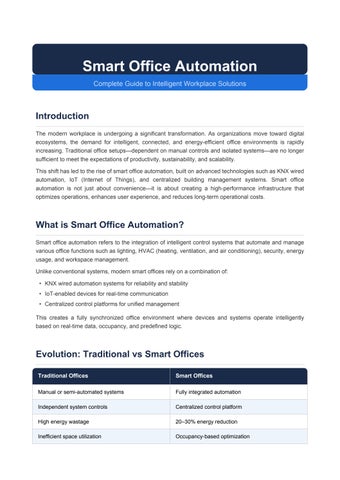
The modern workplace is undergoing a significant transformation. As organizations move toward digital ecosystems, the demand for intelligent, connected, and energy-efficient office environments is rapidly increasing. Traditional office setups—dependent on manual controls and isolated systems—are no longer sufficient to meet the expectations of productivity, sustainability, and scalability.
This shift has led to the rise of smart office automation, built on advanced technologies such as KNX wired automation, IoT (Internet of Things), and centralized building management systems. Smart office automation is not just about convenience—it is about creating a high-performance infrastructure that optimizes operations, enhances user experience, and reduces long-term operational costs.
What is Smart Office Automation?
Smart office automation refers to the integration of intelligent control systems that automate and manage various office functions such as lighting, HVAC (heating, ventilation, and air conditioning), security, energy usage, and workspace management.
Unlike conventional systems, modern smart offices rely on a combination of:
• KNX wired automation systems for reliability and stability
• IoT-enabled devices for real-time communication
• Centralized control platforms for unified management
This creates a fully synchronized office environment where devices and systems operate intelligently based on real-time data, occupancy, and predefined logic.
Evolution: Traditional vs Smart Offices
Core Technologies
KNX Wired Automation
A globally recognized standard for building automation management, preferred in smart offices where precision control and uninterrupted performance are critical.
• Decentralized architecture
• High reliability & long-term stability
• No continuous internet dependency
• Multi-system integration support
Internet of Things (IoT)
IoT enables real-time communication between devices—sensors, actuators, and controllers collect and exchange data, making offices responsive and adaptive.
• Occupancy sensors
• Smart thermostats
• Energy meters
• Connected lighting systems
Centralized Control Systems
A unified dashboard allows facility managers to monitor and control all systems from one interface.
• Lighting control
• HVAC management
• Security monitoring
• Energy analytics
Cloud Computing & Data Analytics
Cloud platforms collect and analyze device data, enabling a data-driven approach to office management.
• Predictive maintenance
• Energy optimization
• Usage pattern analysis
• Performance monitoring
Key Features of Smart Office Systems
Intelligent Lighting Control
HVAC Automation
Smart Security & Access Control
Meeting Room & Workspace Automation
Energy Management Systems
Automated using occupancy detection, daylight harvesting, and scene-based control. DALI lighting systems dynamically adjust brightness, reducing energy consumption without compromising comfort.
Smart HVAC systems maintain optimal indoor conditions by adjusting temperature and airflow based on occupancy and external weather, ensuring energy efficiency and improved air quality.
Includes biometric authentication, RFID-based access, and smart surveillance cameras for real-time monitoring and controlled access.
Room booking systems, occupancy tracking, and automatic device activation eliminate scheduling conflicts and improve space utilization.
Monitor power consumption across the office, identify inefficiencies, reduce operational costs, and support sustainability goals.
Benefits of Smart Office Automation
Operational Efficiency
Energy Savings
Employee Experience
Scalability
Reliability
Automation reduces manual intervention, allowing staff to focus on higher-value tasks.
Smart systems can reduce energy consumption by 20–30%, ideal for sustainability-focused organizations.
Comfortable lighting and temperature, seamless meetings, and personalized workspace settings drive higher productivity.
KNX-based systems are highly scalable, allowing businesses to expand without major infrastructure changes.
Wired automation provides stable communication, minimal downtime, and long-term durability for mission-critical environments.
Real-World Applications
Corporate Offices
Large enterprises use KNX systems for centralized control of lighting, HVAC, and blinds.
Co-working Spaces
IT & Tech Companies
Commercial Buildings
Automation enables flexible workspace management and secure access control.
Data-driven automation improves workspace efficiency and employee productivity.
Full-scale building automation integrates multiple systems into a single platform.
Frequently Asked Questions
Q: What is smart office automation?
A: Smart office automation is the use of intelligent systems like KNX and IoT to automate and manage office operations efficiently.
Q: How does smart office automation work?
A: It works through interconnected devices, sensors, and centralized control systems that automate tasks based on real-time data.
Q: Why is KNX important in smart office automation?
A: KNX provides a reliable, wired communication system that ensures stability, scalability, and seamless integration.
Q: What are the benefits of smart office automation?
A: Key benefits include energy savings, improved productivity, enhanced security, and better workspace management.
Q: Is smart office automation suitable for small offices?
A: Yes, smart automation solutions can be customized and scaled according to business size and requirements.
Smart office automation is redefining how modern workplaces operate. By combining KNX wired automation, IoT technologies, and centralized control systems, businesses can create intelligent environments that are efficient, scalable, and future-ready. Investing in smart office automation solutions is no longer optional—it is a strategic necessity for achieving long-term operational excellence.