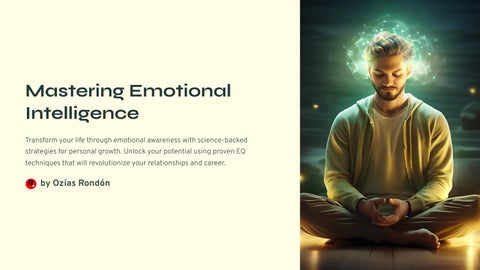
Transform your life through emotional awareness with science-backed strategies for personal growth. Unlock your potential using proven EQ techniques that will revolutionize your relationships and career.
by Ozías Rondón
What is Emotional Intelligence?
Definition
The ability to identify, understand, and manage your emotions and recognize those of others.
Key Components
Self-awareness, self-regulation, empathy, social skills, and motivation form the core pillars.
Impact
High EQ correlates with better relationships, increased career success, and greater life satisfaction.
The Science Behind EQ
Neurological Basis
The amygdala and prefrontal cortex work together to process emotional responses.
Brain Plasticity
Your brain can form new neural pathways through consistent emotional practice.
Research Findings
Studies from Harvard and Yale confirm EQ can be developed at any age.
Self-Awareness: The Foundation
Emotional Clarity
Precisely naming what you feel
Trigger Recognition
Identifying what sparks your emotions
Emotional Mapping
Connecting feelings to thoughts and behaviors
Understanding Your Emotional Patterns
Track Responses
Record emotions as they happen throughout your day
Gain Insights
Use patterns to predict and prepare for emotional responses
Journal Regularly
Write about emotional experiences to spot patterns
Identify Cycles
Recognize recurring emotional sequences
Self-Regulation Strategies
Recognize
Identify rising emotions before they overwhelm
Pause
Create space between stimulus and response
Apply Technique
Use specific regulation methods like deep breathing
Respond
Choose your reaction with awareness and intention
Emotional Regulation in Practice
Box Breathing Technique
Inhale for 4 counts, hold for 4, exhale for 4, hold for 4. Repeat.
Cognitive Reframing
Challenge negative thoughts with alternative, balanced perspectives.
5-4-3-2-1 Grounding
Notice 5 things you see, 4 you feel, 3 you hear, 2 you smell, 1 you taste.
Physical Reset
Splash cold water on your face or take a brief walk outside.
Empathy: Connecting with Others
Active Listening
Focus completely on the speaker without planning your response
Observe Non-Verbal Cues
Notice facial expressions, body language, and tone of voice
Feel With Others
Imagine yourself in their situation without judgment
Social Skills and EQ
Building
Relationships
Create meaningful connections based on authenticity and trust.
Effective
Communicatio
n Express your needs clearly while respecting others' perspectives.
Group Dynamics
Navigate complex social situations with awareness and flexibility.
Conflict Resolution
Address disagreements with emotional intelligence rather than reactivity.
Emotional Intelligence at Work
Personal Performance
Employees with high EQ are more productive and show greater job satisfaction.
Leadership Effectiveness
Emotionally intelligent leaders inspire better team performance and loyalty.
Organizational Culture
Companies valuing EQ experience lower turnover and higher innovation rates.
EQ and Personal Relationships
Emotional Expression
Share feelings appropriately without overwhelming others.
Vulnerability
Allow yourself to be seen while respecting others' boundaries.
Deep Listening
Hear both words and emotions without rushing to respond.
Safe Space
Create environments where authentic feelings can be shared.
Overcoming Emotional Challenges
Identifying Barriers
Childhood emotional patterns
Fear of vulnerability
Automatic negative thoughts
Emotional avoidance habits
Building Resilience
Practice self-compassion
Develop emotional vocabulary
Create support systems
Embrace discomfort as growth
Emotional Intelligence Assessment
Self-AwarenessRate 1-10: Can you name your emotions as they occur?
Self-RegulationRate 1-10: Can you manage strong emotions effectively?
MotivationRate 1-10: Do you pursue goals despite setbacks?
EmpathyRate 1-10: Can you understand others' emotional states?
Social SkillsRate 1-10: Do you navigate relationships with ease?
Advanced EQ Techniques
Advanced practitioners develop capabilities beyond basic emotional management. These include emotional healing, shadow work, and transformative practices.
Transformative EQ Resources
Essential Reading
Books by Daniel Goleman, Brené Brown, and Marc Brackett provide foundational knowledge.
Digital Learning
Online courses offer structured development with flexibility and interactive elements.
Personal Coaching
One-on-one guidance provides customized strategies and accountability for growth.
Your EQ Transformation Journey
Assessment
Determine your current EQ strengths and growth areas.
Goal Setting
Create specific, measurable EQ development objectives.