IN THIS ISSUE
By Elizabeth Goodfellow
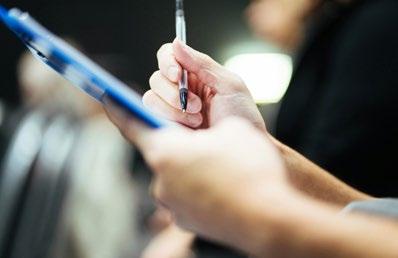
Each year Technology for Living (TFL) engages its members about how we are doing and where we can improve our services, because we want to know what’s working and where we can do better. This year, TFL took a different approach and created a platform where we could directly engage the members, hear their voices, and listen.
Late in 2025 we reached out by email to members, inviting anyone who wanted to participate in a virtually hosted focus group. Starting in January 2026, TFL has so far hosted four 90-minute focus groups, with approximately the same number of responses as our annual surveys see.
Surveys that attempt to capture how services are being provided and where improvements can be made are limited not only by their format (‘yes, no, maybe’), but they can mute the voices and responses of TFL members. Hearing first-hand what members really think, in their own words, is very powerful.
"How do you begin to thank someone for your life?"
With the focus groups completed, TFL is compiling the feedback. As a first
step, we have created two short videos to share internally with those who provide TFL services. The first video communicates what the members who participated in the focus groups feel that TFL does well and what the service provision means to them on a personal level.
"PROP and TIL have given me my independence."
It was wonderful to hear that TFL positively contributes and supports our members, and again, hearing first-hand the impact our services have was very powerful and reinforcing.
88%
PROP's average membersatisfaction score
Continued on page 6 →
BALANCE NEWSLETTER IS PUBLISHED QUARTERLY BY TECHNOLOGY FOR LIVING
#103-366 East Kent Ave. South Vancouver, BC V5X 4N6
604.326.0175 604.326.0176
info@technologyforliving.org Globe technologyforliving.org
EXECUTIVE DIRECTOR
Ruth Marzetti
DESIGN / EDITOR
Taylor Danielson
CONTRIBUTING WRITERS
Olesia Kornienko • Vivian Garcia • Ean Price • Sarah Lapp-Bourne • Evan Mutrie • Elizabeth Goodfellow • Wayne Pogue • Alex Yu Nicole Whitford • Joanne Bengert • Taylor Danielson
Technology for Living does not research, endorse, or guarantee any of the products or services within the newsletter. We strongly recommend investigating products and companies before purchasing or using them.
Permission to reproduce: All Balance articles are copyrighted. Non-commercial reproduction is welcomed. For permission to reprint articles, either in part or in whole, please email info@technologyforliving.org
Technology for Living houses the Provincial Respiratory Outreach Program (PROP 1.866.326.1245) and the Technology for Independent Living Program (TIL 604.326.0175). PROP is funded by the Province of British Columbia Ministry of Health through Vancouver Coastal Health. TIL is funded by the Province of British Columbia Ministry of Health and other independent funders.
Publications Mail Agreement No. 41682526
© 2026 Technology for Living
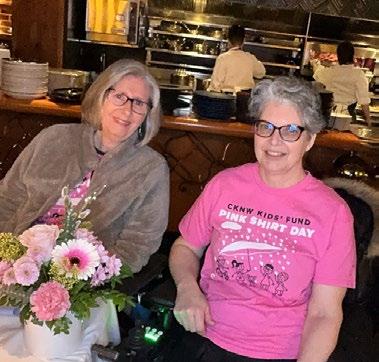
Pink Shirt Day was Wednesday, February 25, 2026, with this year's CKNW Kids' Fund campaign carrying the theme "Sprinkle Kindness." CKNW Kids' Fund has been a long-time supporter of TFL's Youth Assistive Technology (YAT) program, and board members Jane Stillwell (left) and Vivian Garcia (right) represented us at the Pink Shirt Day Luncheon on February 19 at the Blue Water Cafe in Vancouver. Hosted by Chris Gailus and presented by FortisBC, the luncheon brings together community leaders in support of kindness and anti-bullying work. Our thanks to CKNW Kids' Fund for the continued partnership.
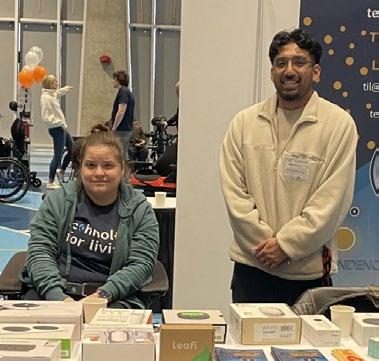
Technology for Living was back at the Rehab Equipment Expo at the Richmond Olympic Oval on Tuesday, March 3, 2026. The Expo brings clinicians and people with disabilities together to try out assistive technology, ask vendors questions, and catch up with colleagues from across BC. Education sessions this year focused on pressure injury prevention and skin health in seating and mobility, blending clinical best practice with the lived experience of spinal cord injury. Thank you to everyone who stopped by the booth—we'll see you next March.
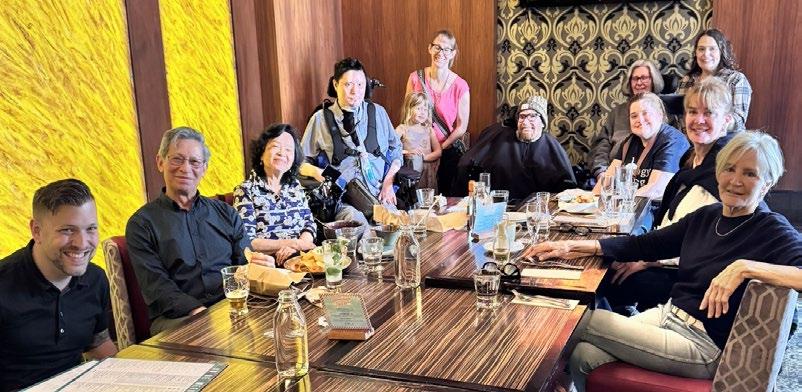
Each year, the TFL peer team gathers for a Sunday lunch the day after the Simon Cox Student Design Competition. It's a relaxed counterpoint to the signature event. This year's gathering took place on Sunday, April 26, 2026, at Rogue Wetbar in Gastown (601 W Cordova St, Vancouver). The team had unanimous praise for the venue. Service was exemplary, accessibility was strong, and Rogue is now firmly on our recommendation list. The peer lunch is a small but meaningful tradition. It's a chance to catch up, enjoy good food, and share company with fellow peers after a busy weekend.
Over the past several months, Technology for Independent Living has been introducing accessible gaming to new members in their homes and to prospective members at locations throughout BC, from Children's Hospital and Ronald McDonald House to the Abilities Expo and the Rehab Equipment Expo.
People are loving accessible gaming controls and the way game developers are building accessibility options right into their games. Did you know that some games can slow down at key action-packed moments, giving the user more time to activate multiple buttons? If you'd like to discuss accessible gaming controls, let's chat!
We are always happy to discuss any member's needs. Simply phone us at:
604.326.0175 or send an email to
info@technologyforliving.org
Do you find your computer more accessible than a smartphone, yet still need to handle calls and messages all day? Microsoft Phone Link is a built-in Windows 10/11 program that syncs Android or iPhone phones with computers, letting users text, call, browse images, and manage alerts straight from their computer. Search "Phone Link" from your Start menu to begin pairing.
By Wayne Pogue
With the evolution of wearable technology, we have seen the technology move from convenience to a life-changing utility. For the disability community, Meta's AI-powered glasses have emerged as a powerful assistive device. By matching high-performance hardware with AI, Meta has created a new way for users with visual, motor, or hearing impairments to connect to the world, hands free.
Visual Assistance and Multimodal AI
The most transformative feature for those with visual impairments is the "Look and Ask" capability, where the glasses act as a second pair of eyes.
Real-Time Descriptions: Users can ask, "Hey Meta, describe what I'm seeing," and receive detailed auditory feedback about their environment, from the contents of a cabinet to the layout of a room.
Reading and Translation: The glasses can read aloud text from menus, mail, or street signs, and offer real-time translation, converting foreign text into spoken English instantly.
Object Identification: From identifying the colour of a shirt to scanning a QR code, the glasses handle micro-tasks that previously required a smartphone or another person.
Meta has partnered with Be My Eyes, which connects users with volunteers who can view what the glasses are seeing and guide them through tasks like setting a thermostat or navigating a new space.
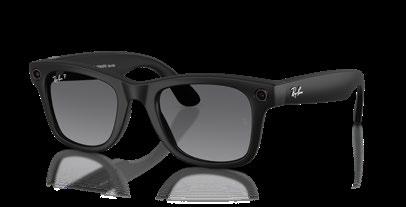
Meta Wayfarer Gen. 2 Glasses
As of 2026, users can also call major brand service specialists (Hilton, Sony, etc.) for technical support or travel assistance through the glasses.
For users with mobility impairments, the glasses eliminate the need to use a smartphone touchscreen.
Voice-First Interface: Nearly every function—calls, messaging, music, and photography—is accessible through "Hey Meta" commands.
Neural Band Support: Meta's Neural Band allows subtle gesture controls, such as pinching or tapping fingers, to trigger the AI. This provides an alternative for users who have speech difficulties or prefer non-verbal input.
Open-Ear Audio: The directional speakers provide clear audio without blocking the ear, so users remain aware of important environmental cues like traffic.
Beyond accessibility, users can also take pictures and videos, set reminders, watch videos, listen to music, and more.
As summer approaches, it's important to plan for power outages at home or while travelling. Many bilevel devices rely on wall power and may not function during an outage without backup. Consider external battery packs or alternative power sources, and know how long they will last. Include backup power in your emergency plan, and identify nearby locations with power if needed. A little preparation can help you stay safe and supported wherever you go.
Scan the QR code below for
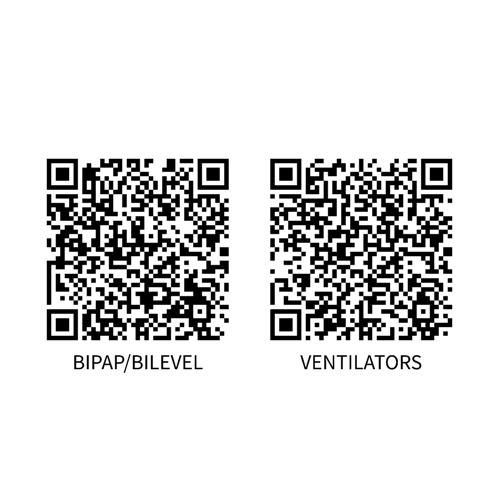
advice or support please contact the PROP team at phone-alt
Summer heat can affect home ventilator performance and increase the risk of overheating or alarms. Keep your device in a cool, wellventilated area away from direct sunlight and heat sources, and avoid soft surfaces that block airflow. A fan or air conditioning helps maintain a stable room temperature.
By Alex Yu, RRT
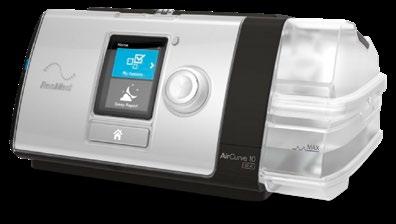
Bilevel Positive Airway Pressure (BiPAP) therapy is a key treatment for people with obesity hypoventilation syndrome (OHS) and neuromuscular disorders. In these conditions, weakened or impaired breathing leads to poor ventilation, especially during sleep. While BiPAP improves respiratory function, its impact on mental health is equally important.
"Individuals may experience discomfort, claustrophobia, or emotional resistance to long-term device use."
People with OHS and neuromuscular disorders often experience chronic fatigue, poor sleep, and reduced oxygen levels. All of these are linked to depression, anxiety, and cognitive difficulties. By supporting ventilation and improving gas exchange, BiPAP helps restore more stable sleep and oxygenation. This can lead to better mood, improved concentration, and increased daytime energy.
In neuromuscular disorders, where progressive muscle weakness can affect independence, mental health challenges such as stress, fear, and low mood are common. Similarly, individuals with OHS may face stigma, social isolation, and reduced quality of life. Effective BiPAP use can alleviate some of these burdens by improving physical symptoms and enhancing overall well-being.
However, adapting to BiPAP can be difficult. Individuals may experience discomfort, claustrophobia, or
emotional resistance to long-term device use, particularly in progressive conditions. These challenges can affect adherence and may increase anxiety if not addressed.
"This can lead to better mood, improved concentration, and increased daytime energy."
Supportive strategies are essential. Proper mask fitting, gradual acclimatisation, patient education, and psychological support can improve comfort and acceptance. Involving caregivers and providing regular follow-up also helps address both physical and emotional needs.
For people with OHS and neuromuscular disorders, BiPAP therapy not only supports breathing but can also improve mental health. An inclusive approach that recognises psychological factors is crucial for optimal care.
If you have any concerns, please reach out to the Provincial Respiratory Outreach Program (PROP) at prop@technologyforliving.org for further support and resources.
Born and raised in Victoria, BC, disabled since childhood, I had to advocate for accessibility and inclusion at a young age. I started writing to cope with my disability and used it as a catalyst for change. I am a teacher, speaker, accessibility consultant, music and nature lover, and adventure seeker. I've been writing for Balance for four years and enjoy helping people connect to information that makes a difference in their lives. I believe in the power of positivity and the importance of having a sense of humour, especially when dealing with the challenges of living with a disability.
We are always happy to discuss any member's needs. Simply phone us at:
604.326.0175 or send an email to peer@technologyforliving.org
Personal Voice in iOS 26 lets your iPhone, iPad, or Mac speak typed messages aloud in your own voice during calls, FaceTime, or in person. Useful for anyone whose voice may change over time. The recording stays the same even if your voice doesn't. Setup takes about a minute and just 10 recorded phrases, down from 15 minutes previously.
By Nicole Whitford and Joanne Bengert
Coffee with CARMA is a monthly gathering that brings coffee, community, and connection to people who live at Cambie Gardens, Oak Care Centre, and Dogwood Care Home. It is hosted by CARMA peers and attended by residents and peers from other organisations.
Coffee with CARMA got its start after residents living at Oak Care Centre were dispersed across a larger area, including new community housing at Cambie Gardens, a newly built care facility at Dogwood Care Home, and those who remained at Oak. People were missing their friends, wanting to hear about life at the other sites, and asking to strengthen ties between all three locations. The idea for Coffee with CARMA was born.
"Strong friendships and connections make us stronger as a community."
The format is simple. We serve Tim Hortons coffee, hot chocolate, and donuts, and we rotate locations between Oak Care Centre and Dogwood Care Home, with occasional outdoor gatherings in the Cambie Gardens courtyard. Everyone is invited. The coffee isn't the point, but it is what brings people through the door.
The real purpose is to address loneliness and isolation. Residents come together to connect and
socialise. Strong friendships and connections make us stronger as a community, and gathering helps everyone feel less alone.
"The coffee isn't the point, but it is what brings people through the door."
Coffee with CARMA is also a space to share knowledge and resources, which is why we invite peers from other non-profit organisations. Spinal Cord Injury BC attends regularly and extends invites to their other peer offerings. Individualized Funding Resource Centre Society members share their expertise on Choice in Supports for Independent Living (CSIL) and home supports, and TFL and CARMA peers back that up with lived experience.
Sharing experiences allows people to better understand that we all face similar challenges and can support each other through them. This builds confidence, and for those who wish to move out into the wider community, the transition is easier when there are people to talk to who have been through it.
Gathering together is more than coffee. It is shared knowledge, lived experience, and support without judgement. The more we support each other, the more we can encourage autonomy and positive ways of living.

Continued from page 1
The second video we created, also to be shared internally, concentrates on where TFL can do better and what members would like to see if there were unlimited resources. There were several common themes:
› Masks: more education on what is available, what parts can be replaced, and how often.
› Initial PROP setup visits (Provincial Respiratory Outreach Program): are long, and most of the information is lost. Shorter initial visits with a followup home visit a few months later would help manage information overload.
› PROP home visits: annual check-ins in the home— more frequent, or when one is really needed.
› Feedback on therapy: clearer ways for members to ask how therapy is going.
› Education and resources: about equipment, what to look out for, conditions, and what other community resources are available.
› An online platform: for requesting equipment and replacement parts, especially for members who find using the phone difficult.
› Practising patience: some members feel that questions are sometimes answered too quickly or not fully, and that there is a lack of patience in helping members understand.
With the above information and feedback in hand, TFL will now start to more closely examine where and how services can be improved and what the priorities are for any improvements or changes to services. For example, one of the most important things we learned is that most members who participated in the focus groups did not know about the Peer Program—admittedly, this took us by surprise because it is a cornerstone of TFL.
TFL’s Peer Program is all about lived experiences and supporting the sharing of information and strategies with others, so that barriers to accessibility can be overcome and independence maximised. It is about TFL’s members helping each other and finding connections to other relevant organisations in the wider community. The Peer Program is also integral to new members who may be wanting or struggling to understand how to live well with their disability—having someone who understands,
who has ‘been there,’ is invaluable.
"Some of the people I deal with have the patience of angels; I ask 800 questions and they sit there and go through 800 answers with me."
So now that we know that the Peer Program is a bit of a mystery to members, the peer team is working to change this. We are asking how we can do better at ensuring that anyone who comes onto TFL as a member knows about this resource that is available to them. Is there something we can do better in terms of what we provide on setup? Would it be possible to have the peer team reach out more often to members?
"TIL has been life-changing because it takes away financial barriers to accessibility."
Finally, one of the main priorities of the focus groups was to see where PROP rates on a 1–10 scale. While this may sound rudimentary, PROP receives funding through a contract with the Ministry of Health, and one of the quality assurance requirements is a member satisfaction score higher than 80%. We are happy to report that PROP scored an average of 88%. As one member relayed, ‘there is always room for improvement,’ and we wholeheartedly agree.

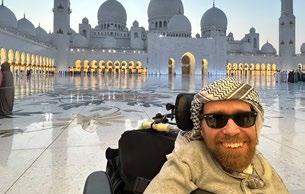
Ihave traveled to Western Europe, the Caribbean, Asia—Japan, Thailand, Cambodia—and across the Western United States. Each trip carries its own logistical weight when you are ventilator dependent and use a power wheelchair.
When my longtime friend and travel companion Jenny and I began dreaming of somewhere completely different, somewhere futuristic, our eyes turned to the Middle East. We had initially considered Egypt, but the United Arab Emirates, with its reputation for world-class accessibility, quickly became the clear choice.
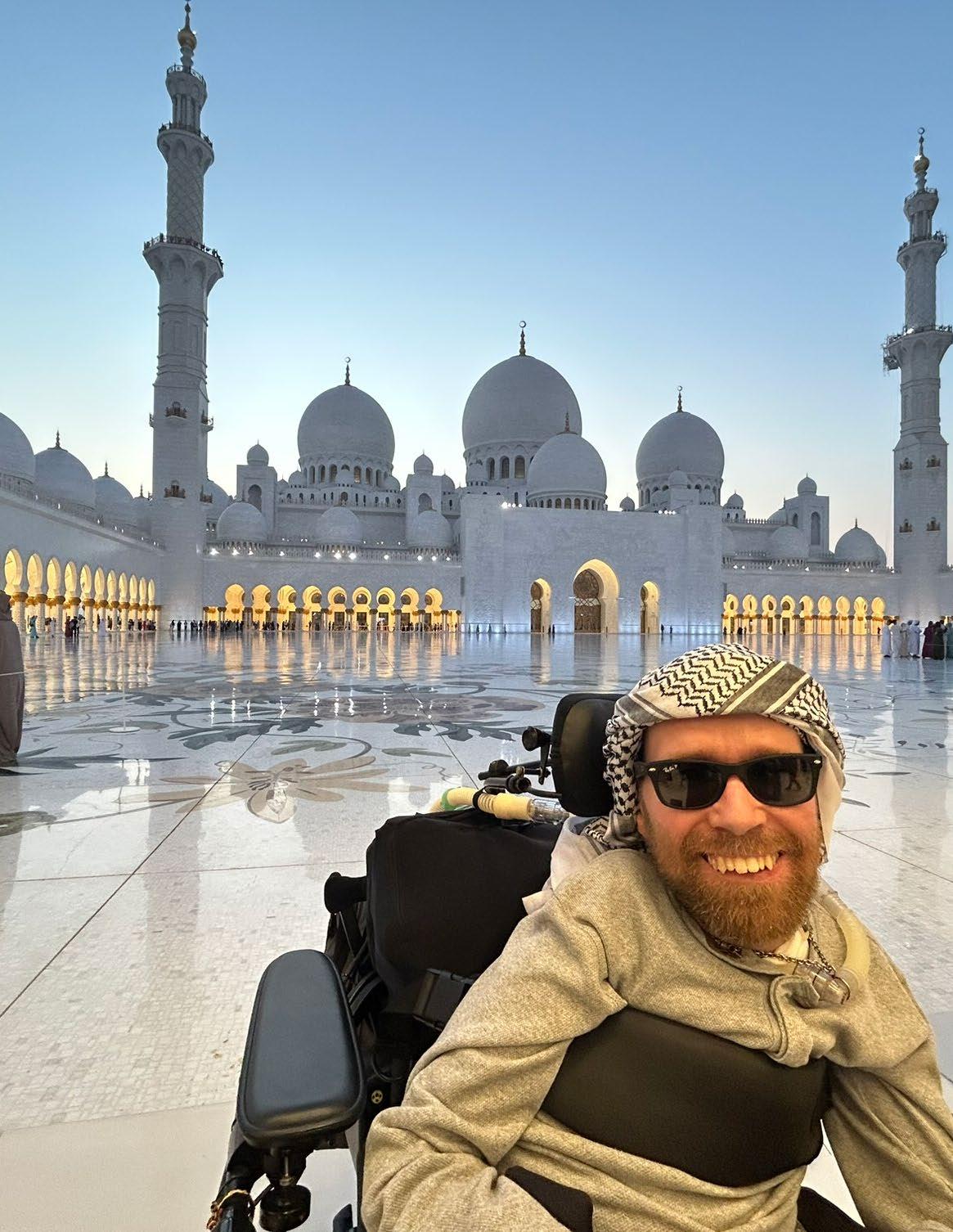
Two weeks in Dubai and Abu Dhabi—the wonder, the logistics, and one very dramatic wheelchair breakdown 10 minutes before the airport transfer.
BY EAN PRICE
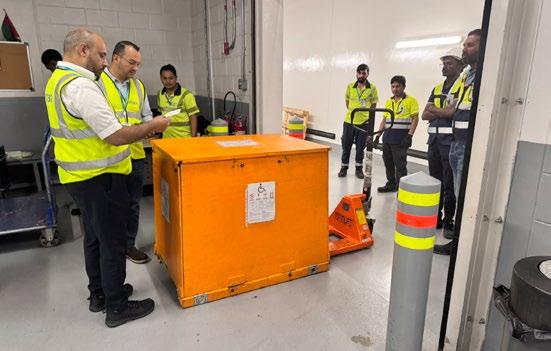
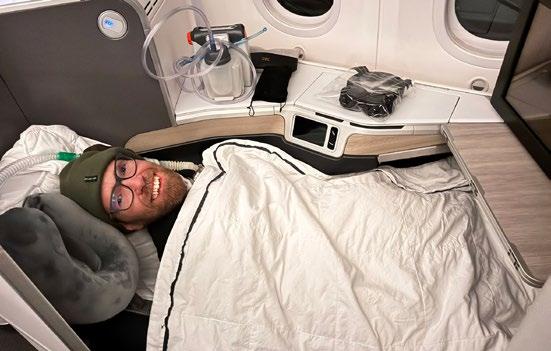
Twenty hours each way: a layered battery strategy keeps the ventilator and suction running between charges.
Our original plan was a direct flight from Vancouver to Dubai. Those flights were cancelled for political reasons, which meant rerouting through Toronto— adding a connection and pushing our total time in the air to roughly 20 hours each way. I would need to power a ventilator and suction machine for the duration of each flight without access to an aircraft outlet. Most airlines do not allow medical devices to be plugged into the plane's power—they can trip airline breakers.
I spoke with the PROP and TIL teams at Technology for Living to brainstorm. The answer was a layered battery strategy built around my Breas Vivo 45 LS, which carries both an internal and a detachable lithium battery. On top of those, a Zopec Explore 5700 portable power station—rated for medical devices— gave us ample breathing time on the long hauls. During our Toronto layover, we charged every device to full.
I travel with two of everything: two ventilators, two suction machines, two feeding pumps. I also carry Jevity formula for my feeding tube, since I cannot eat or drink by mouth, plus a fully stocked emergency bag—Ambu bag, spare trach tube, spare exhalation valve, electrical tape for circuit leaks. One unexpected comfort measure: cabin air is extremely dry, and instilling saline bullets directly into my trach tube made a remarkable difference. Pack them.
"It is a useful reminder to research the specific neighbourhood you are staying in, not just the city's general reputation."
I contacted Air Canada's medical desk months in advance—and again a few weeks before departure— so they had my equipment on file and approved. That includes respiratory gear, battery types, and full details on my power wheelchair (Permobil F5): make, model, dimensions, weight. Airlines maintain databases of approved devices and need time to verify. I also carried a health and safety document signed by my family physician confirming I was fit to travel. Do not skip this step.
For travel insurance, the first two providers denied me outright on learning I use a ventilator. Persistence paid off: I secured comprehensive coverage through TuGo, a Canadian insurer experienced with complex medical needs. Be specific from the very first call.
My chair travels in a custom wooden container my dad built; the Tetra Society builds similar ones. It weighs about 100 lb—the airline needs the dimensions in advance. One challenge: what to do with five sheets of plywood and a pallet on arrival? The Air Canada manager in Dubai arranged storage at the airport for the duration of our trip, for a modest fee.
We were met at Dubai International Airport by a team that included the manager I had been corresponding with for months. Escorted to the carousel, then to a secure area where my wheelchair waited inside its crate. Jenny disassembled it and I transferred back into my chair for the first time in over 24 hours.
My body had spent more than a day in a fixed position. I felt genuinely disconnected—struggling to hold my head up, briefly unable to drive my chair. It passed, but it is worth knowing: your body needs time to readjust after a journey of this length.

Our first Airbnb was not fully accessible—no roll-in shower—but we made it work. We opened the curtains on arrival and sat in silence for several minutes, staring at the Burj Khalifa shining in the dark outside our window.
One early surprise: the streets immediately around our Airbnb in the business district were not particularly accessible, and I found myself driving on the main road at times—passed by Lamborghinis and Ferraris— because the sidewalks were unusable. The more tourist-oriented districts were significantly better.
Visiting the Burj Khalifa was our first adventure. Every viewing platform on the 154th floor was accessible, though I could not locate a single wheelchairaccessible washroom anywhere in the building. We also explored the Dubai Mall, visited its aquarium, and for Halloween attended a DJ night that turned into one of the unexpected highlights of the trip—dancing and talking with people from Scotland, Turkey, and Saudi Arabia until the early hours.
After a few days in Dubai we rented a wheelchairaccessible van through WAV Specialised Transport and Jenny drove us to Abu Dhabi, staying at the Warner Brothers Hilton on Yas Island—a fully accessible room with a roll-in shower and passes to the surrounding theme parks.
"The wheelchair failure was the worst thing that happened on the trip. And we handled it. That is the part worth remembering."
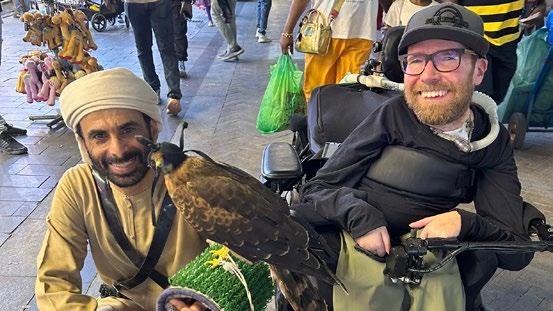
Battery Strategy
Stack layers: vent's internal battery + detachable lithium + a portable medical-rated power station (the Zopec Explore 5700 worked for us). Charge to full at every layover.
Trial Runs at Home
Run your vent and suction off battery for a full day before you leave. Time exactly how long each device takes to charge from zero.
Airline Medical Desk
Call months ahead—not weeks. Confirm devices, batteries, and chair specs. Call again a few weeks out to verify.
Insurance
Be specific about your equipment from the first call. Expect denials. TuGo (tugo.com) covers complex medical needs.
Pack Doubles
Two ventilators. Two suction machines. Two feeding pumps. Ambu bag. Saline bullets for dry cabin air.
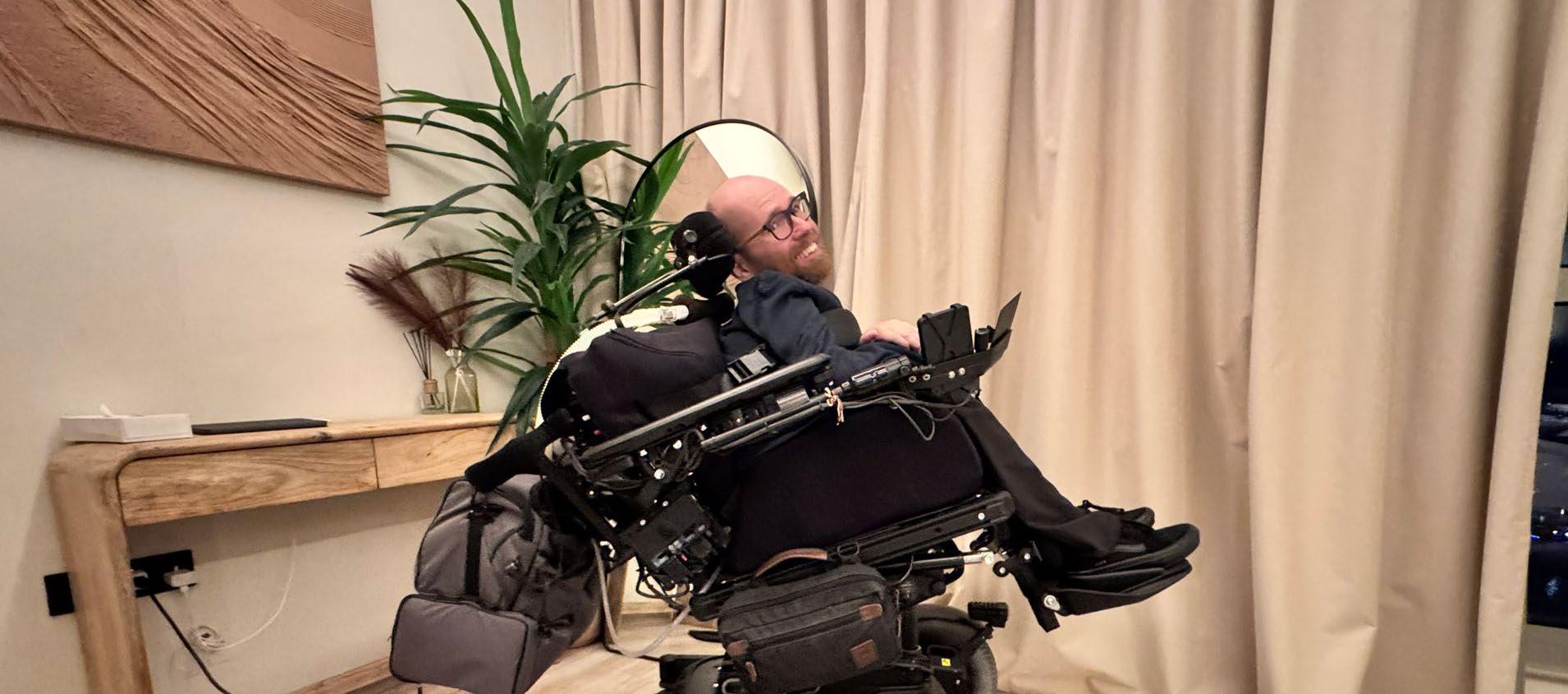
Ten minutes before our wheelchair van was due to arrive on the final day, I tilted back and experienced a complete power failure. The chair stopped responding entirely.
Jenny and I ran through the basics: breaker off and on, checking for loose wires. Nothing. We called the airline immediately to rebook, and they moved us to a flight the following evening, giving us 24 hours to solve the problem.
The immediate issue was that I was partially tilted back and stuck—the geometry of the bedroom made it impossible for Jenny to push me out manually. So there I sat, staring at the ceiling, laughing, trying to come up with a plan. Over the next eight hours, with the help of wheelchair technicians in British Columbia, Jenny disassembled portions of the chair and attempted to manually crank the seat upright using the tools we had on hand. We did not have everything we needed.
The next morning, Omar—owner of WAV Specialised Transport and an engineer—arrived at the Airbnb and saved the day. Air Canada met us curbside in Dubai and pushed me through the terminal. Jenny drove us home to Kelowna, where Motion repaired the chair.
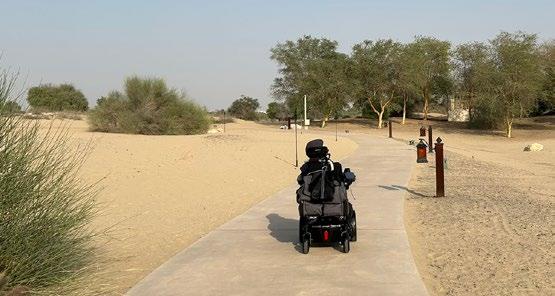
"The country refers to people with disabilities as 'people of determination,' and we felt that ethos in how we were treated everywhere—at the airport, at the hotel, at the mosque, in the van rental company."
If you are ventilator dependent, use a power wheelchair, and have been dreaming about international travel—start smaller. Not because a trip like this is impossible, but because confidence and competence are built through experience. Try shorter trips first. Get comfortable with the equipment management, the airline protocols, the Airbnb workarounds. Let your travel companions build their confidence too. Then, when you are ready—go further!
The United Arab Emirates treated us exceptionally well. The infrastructure is genuinely impressive. It is not a perfect destination for accessibility in every corner, but it is one of the best I have encountered anywhere in the world.
KEY RESOURCES
Wheel the World wheeltheworld.com
Tabifolk tabifolk.com
WAV Specialised Transport wav.ae
Eden Mobility eden-mobility.ae
TuGo tugo.com
Tetra Society tetrasociety.org
Active Healthcare Solutions activehs.ca
Motion motioncares.ca
By Vivian Garcia
Did you know that librarians are masters at finding information and resources? If you are looking for something, ask a librarian. They can find a resource, website, or phone number to help you on your way. Librarians can help you to get a library card. With this mighty card in hand you have access to borrow books, magazines, newspapers, DVDs, music CDs, audio and e-books, online resources, computer classes and clubs, books in other languages, and depending on the location of the library, space rental, computer use, 3D printing, musical instruments, tools, sewing machines, recording studios, and more.
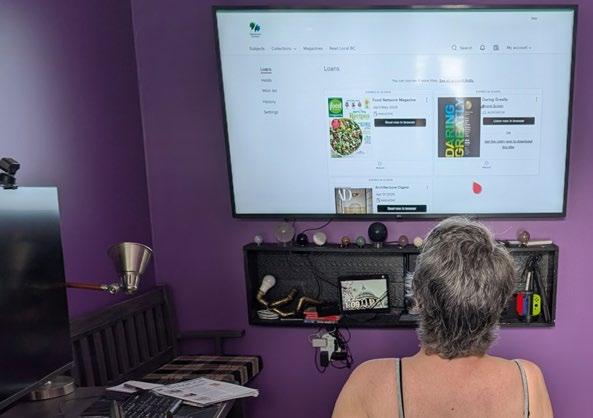
Here is some guidance on using the digital library with your library card:
› Search for your local library's website and open it.
› Look for the Log In button in the top-right corner. It will include your library's abbreviation (for example, "Log In / My NWPL" for the New Westminster Public Library). Click it, then click Log In / Register.
› Enter the barcode from the back of your library card and your PIN, then click Log In.
› From here, you can navigate the library through their website.
Within online resources, go to the RESOURCES tab. (Library regions may use a word similar to RESOURCES.) In the RESOURCES tab, click on ONLINE RESOURCES.
Here you have free access to a variety of resources that cover areas from ancestry, auto repair, BC Codes, laws,
historical and daily world newspapers and crosswords, Consumer Reports, movies, Libby (for audiobooks, e-books, and magazines), online courses and learning, academic journals and data, history, World Book, and more.
The OverDrive/Libby portal may be confusing as they are separate but linked. Click on the OverDrive Web Portal. Sign in through the tab at the top right. Select Your Library on the new page, on the left. Then add your library card number and PIN in the box. From there, check out whatever you like that is available or place something on hold. The download will go through the Libby app, downloadable on the bottom of the page to your device(s). (Librarian's advice: if you are interested in e-books and e-audiobooks, download the Libby app on your device— or go to libbyapp.com if using a computer—and follow the instructions: select your library, then put in your card number and PIN.)
Other content may go through an app which will also be downloadable through the selection you are viewing.
You can go through digital content on smartphones, tablets, computers, or TV via the web. The content will sync on many devices for a seamless experience. The online resource will return to the online collection seamlessly on its own, or you can renew or return it early on your device.
Go to your local library. Ask the person at the desk to sign you up for a library card and PIN. It's free. They will want your identification, including your address, email address, and birthdate. Your PIN is usually the last four numbers of the phone number you used to sign up, and it can be changed.
BC OneCard is free. Go to a library in another city and show your library card and one piece of ID. Ask for a BC OneCard Decal. Now you can return books and other borrowed library items to any BC OneCard library, and you can borrow items and use services at that library. Not all libraries are the same—ask the librarian what is available or check online.
By Olesia Kornienko
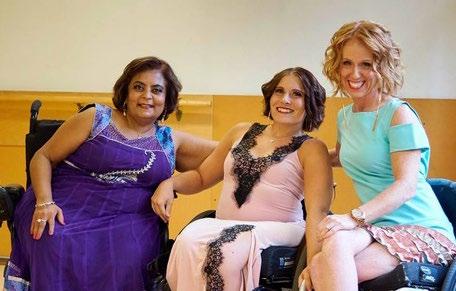
My name is Olesia Kornienko. I was born with cerebral palsy in Russia, in a world that did not know where to place someone like me. I was told I could not learn. I was kept outside of classrooms, conversations, and expectations.
But life moves.
Across countries and years, through persistence and quiet strength, I began to find something that had always been within me: my voice. Not only the words I speak, but the space I occupy, the right to exist fully, not partially.
There is a moment that many women who use wheelchairs know. A moment when someone stops seeing you and begins to see only the chair. It lives in hesitation, in lowered expectations, in the silence where recognition should be. Over time, these moments gather, shaping not only how others see you, but how you begin to see yourself.

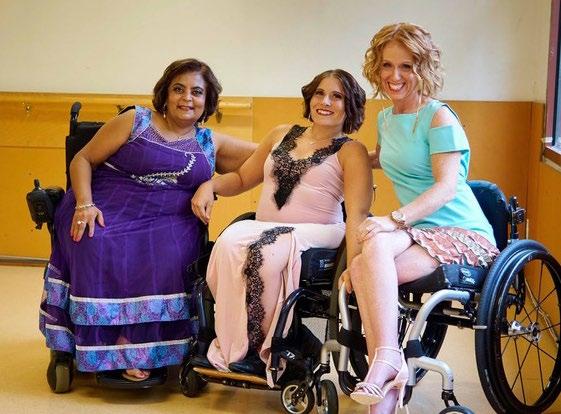
This is where change must begin.
I wanted to create a movement to change that narrative, and Miss Wheelchair Canada was born. It is a national platform where women with disabilities are seen, heard, and valued beyond assumptions, where identity is not reduced but expanded.
For me, this is deeply personal. After a lifetime of proving that I am more than what people see, I wanted to create a space where that proof is no longer required. A space where women arrive as they are and are recognised in their full humanity.
Something powerful happens there. Women begin to stand differently. Speak with confidence. See themselves beyond limitation. And when that shift happens, it reaches beyond the stage, changing perceptions and opening possibilities for others.
To every woman reading this: you belong.
You do not need to feel ready. You do not need to fit an image. You only need to allow yourself to be seen.
Miss Wheelchair Canada is an open invitation to share your story, to step into visibility, and to be part of a growing movement redefining what it means to be seen.
Because a wheelchair may be the first thing people notice.
But it is never the whole story.
By Taylor Danielson
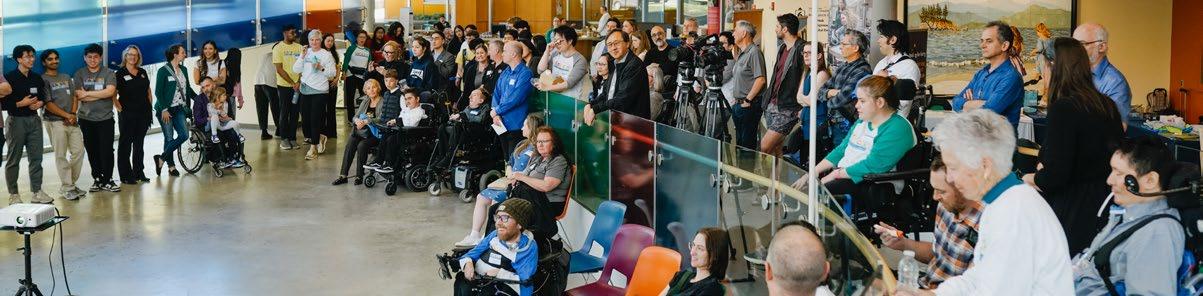
The 11th annual Simon Cox Student Design Competition wrapped up on Saturday, April 25, 2026, at the Blusson Spinal Cord Centre in Vancouver. This year drew 20 teams and 110 students from postsecondary institutions across British Columbia, with six finalist teams from University of Victoria (UVic), University of British Columbia (UBC), UBC Okanagan, and the British Columbia Institute of Technology (BCIT) presenting to a panel of judges and an audience of peers, families, faculty, and supporters.
Every project starts with a peer in our community who submits a design challenge. Student teams pick the challenge up, work alongside the peer who proposed it, and spend months developing a working prototype. The result is assistive technology built around real people instead of theoretical users.
ODIN — Omnidirectional Drive for Independent Navigation (UBC Okanagan) took the Simon Cox Principal Award ($3,000). ODIN is a low-cost, detachable power module designed to transform standard manual wheelchairs into a versatile mobility system. Both powerassisted and full independent drive modes let users navigate the gravel paths and moderate inclines manual chairs struggle with. It is A universal-fit attachment compatible with 90% of existing frames, under 20 lb, and significantly less expensive than current market competitors.
AceLace (UBC Okanagan) was the day's double winner, taking both the Achievement Award in honour of Marco Pasqua ($2,000) and the Peers' Choice Award in honour of Neema Nafisvand ($1,500). AceLace is an open-source device that allows you to fasten your shoes in seconds, one-handed. Iteratively developed and tested over the
course of months, AceLace uses a compliant, printed ratchet mechanism—spin the dial clockwise to tighten the ratchet, and pull up on the dial to release. A pair can be printed in just over an hour using less than 21 g of PETG, and the design is open-source on Printables.
MindTap (UBC) earned the Innovation Award in honour of Ari Kinarthy ($1,500). MindTap is an EEG-powered assistive technology headset that enables individuals with physical disabilities to control their smartphones using brain signals. The headset captures non-invasive EEG signals and processes them through a machine-learning pipeline that detects specific mental patterns, such as focus or intentional thought triggers. These signals are filtered, classified, and mapped to smartphone actions through a custom mobile interface, minimising calibration time and adapting to individual users over time.
Three other finalist teams also presented: UVic's Self-Stabilizing Spoon, designed to help people with Parkinson's disease eat more effectively; BCIT's PuffPilot, a sip-and-puff controlled RC vehicle providing recreational activity for individuals with limited upper-limb mobility; and BCIT's HandiHinge, enabling motorized opening and closing of kitchen cupboard doors for people with restricted mobility.
The Simon Cox steering committee is taking a closer look at where the competition goes from here, and we want to hear from the people closest to it—peers, students, attendees, judges, and anyone who's taken part. Your feedback shapes what next year's competition looks like.
Email Us: infosc@technologyforliving.org
This year's competition also marks Evan Mutrie's last as chair of the Simon Cox steering committee. Ahead of the event, I asked Evan what he's taken from his time on the committee, what's hard about running a competition like this, and what he'd say to a peer thinking about submitting an idea.
"It's refreshing to see people putting their heads together and working closely with the people who are going to use these products."
› How did you first get involved with the Simon Cox competition?
I got involved by sitting on the Simon Cox committee and was asked to judge one year. I think I was intrigued by the atmosphere and the positivity of the event. The possibilities are exciting.
› As someone who uses assistive technology, what's it like watching student teams present devices built with your community in mind?
It's a really cool thing to watch. It's refreshing to see people putting their heads together and working closely with the people who are going to use these products at the end of the day, taking into consideration what's more useful for them.
› Is there a particular project or moment from a past competition that sticks with you?
The wood knitting stand from the 2024 competition sticks with me because it was so practical. It was simple but extremely effective. A couple of years ago one of the student teams came up and gave me a very nice thankyou. That sticks out to me as a nice moment.
› The steering committee has spent a lot of time examining what the competition is really for and where it should go. What prompted that deeper look?
The steering committee puts in a lot of time and effort, and I think that deeper look was prompted by some conversations about what's best for the peers of TFL and how we're able to best do that. What is this competition capable of? That was the main question.
"It can be energising for the peers."
› What's been the hardest part of running a competition like this—the stuff people don't see from the outside?
There are a lot of moving parts that people don't see from the outside. Between our staff, the students, and the yearround effort to plan the event, there are a lot of moving pieces and people to organise. So many little things that have to be lined up. Our team does an excellent job of keeping everything on track and they deserve all the credit.
› What would you say to a student team thinking about entering next year?
I think students should enter if they're interested in the competition. It's a very unique experience and a great thing to have on a resume or in your portfolio. Lots of creative problem-solving and customer relations experience. I encourage students to sign up.
› And what would you say to a peer thinking about submitting a design challenge idea?
If you're a peer with an idea, I hope you submit it. We always need ideas from our peers. The peers and the students benefit from this competition in several ways. The peers get to work on something exciting and potentially useful—it can be energizing for the peers.
The competition runs on ideas from peers. If there's something in your day that doesn't work the way you'd like, whether at home, at work, getting around, or doing something you love, that's exactly the kind of challenge a student team would want to take on next year.
Submit your idea: tinyurl.com/SimonCoxIdea
After more than a decade steering the Simon Cox Student Design Competition, Richard Harrison is retiring this year. Richard has been the engine behind the competition for as long as most of us have been involved—booking venues, wrangling logistics, managing relationships with postsecondary institutions, and quietly making sure everything actually happens on competition day. The competition is what it is in large part because of him.
Thank you, Richard.
By Sarah Lapp-Bourne, PADS Client and Accessibility Advocate
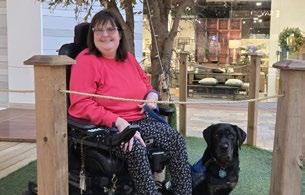
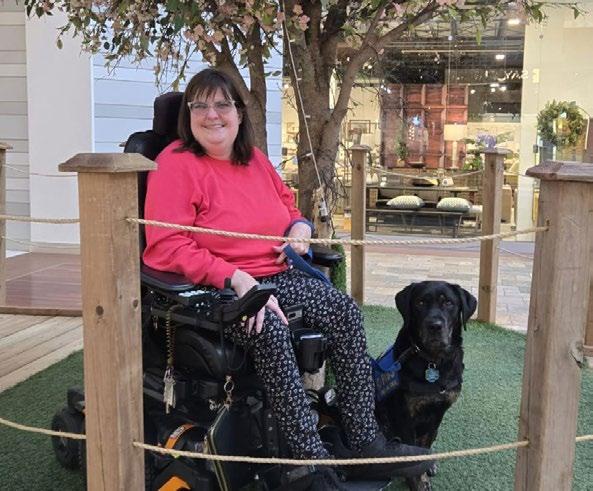
Sarah Lapp-Bourne is an accessibility advocate and longtime service dog handler. She told us about the tools that support her work with Queso, her current mobility service dog.
› Tell us about Queso.
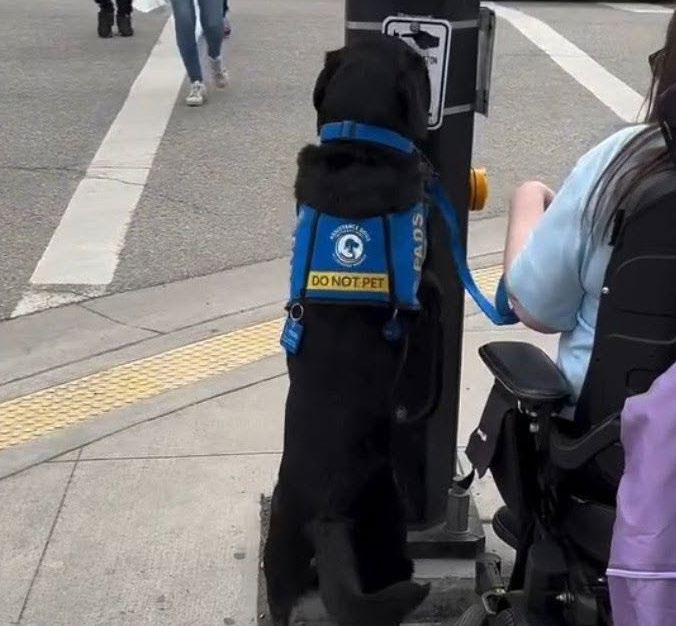
Queso is a five-year-old brindle Labrador Retriever, raised and trained as a mobility service dog by Pacific Assistance Dogs. We have been together since November 2023. Queso is a fun-loving, dedicated partner who loves his job. He helps me by retrieving items I drop or cannot reach, tugging doors open and closing them, and pushing crosswalk and automatic door buttons. He enjoys turning my bedroom lights off and on when needed, because you never know when tech will take a brief break.
› What tech and tools help with his care?
We use a oneisall pet vacuum for brushing. Our water cooler dispenser has a dog bowl attached, so I can push a button to fill it. We also use a Treat & Train remote treat dispenser for training and fun rewards. My vet sends reminders through PetDesk.
› Any creative workarounds you've figured out?
My husband uses a kids' powered vehicle with remote control to carry a waste bucket and pick-up tools around
the yard while he wheels to pick up poop. (I would love to help create a more affordable robot pooper scooper.)
For a while I was using a prototype of a remote-operated treat dispenser attached to my wheelchair, but it had a lot of flaws and was too much of a hassle.
I have a dog treadmill for his exercise in the winter, but it's not ideal.
You never know when tech will take a brief break.
› Anything surprised you?
I have had four service dogs, so nothing really surprises me. But I have lots of ideas to improve dog-related tools.
› Anything you'd want other TFL members thinking about a service dog to know?
Mobility service dogs are incredible companions, but having a dog in public should be taken seriously. It takes dedication and consistency to maintain the training and skills. It is not the same as a pet dog. The waitlists might be long, but it is worth the wait to get a service dog from a certified school.
You don't need a large estate to leave a meaningful charitable gift. Most gifts in wills come from Canadians of average means. A planned gift to Technology for Living helps sustain the assistive technology programs our members rely on. Speak with a financial advisor about your options.

www.technologyforliving.org/ leave-a-gift-in-your-will/
On Thursday, July 9, the Kinsmen Foundation of British Columbia hosts its annual Golf Classic, a day of friendly competition and philanthropy that brings community members together in support of local causes. Technology for Living is grateful to be among the beneficiaries. Funds raised help support our Automatic Door Opener Project and Simon Cox Student Design Competition. We wish all the golfers a wonderful day on the course, and thank the Kinsmen Foundation for its continued generosity.
Join us for the Technology for Living annual BBQ where you can meet our team informally and connect with other members in our community. We'll serve burgers (including vegetarian options) and refreshments around noon on Wednesday, July 15, outside our riverfront offices at #103-366 East Kent Ave. South, Vancouve, BC. The event runs until around 3:00 p.m.
If you're a member of Technology for Living and would like to attend, please RSVP to peer@technologyforliving.org. Please let us know about any dietary requirements and whether you'll be bringing family, friends, or care attendants. We look forward to seeing you there!