THE ENGINEERING SOCIETY OF DETROIT
Fall 2026
FEATURE
Building the Next Generation of Michigan’s Infrastructure
Construction and Design Award Winners 29
America 250: Military Engineers Built Early MI 35
Fishman Stewart: Protecting Innovation 38
ESD’s Student Chapter at Central Michigan University in May with ESD Executive Director Robert Magee (center, in blue).
Technology Century
®
COVER FEATURE
FEATURES
17
29 35
ESD Construction & Design Awards America 250 Journal: Military Engineers Designed and Built Early Michigan and America
38
Protecting Innovation in a Copy-Paste World
40
AI-Proof Your Career: Understanding the Past Is Key to Predicting the Future
3 4 5 6 7 8 10 12 20 24 52
Fruit Ridge Avenue: Building the Next Generation of Michigan Infrastructure
NOTES PRESIDENT’S MESSAGE MEMBERS IN THE NEWS IN MEMORIAM UPCOMING DEADLINES EVENTS AND EDUCATIONAL OPPORTUNITIES ESD HAPPENINGS: GOLF OUTING YOUTH PROGRAMS ESD ANNUAL DINNER: HONORING EXCELLENCE ESD AWARDS ESD CORPORATE & SUSTAINING MEMBERS
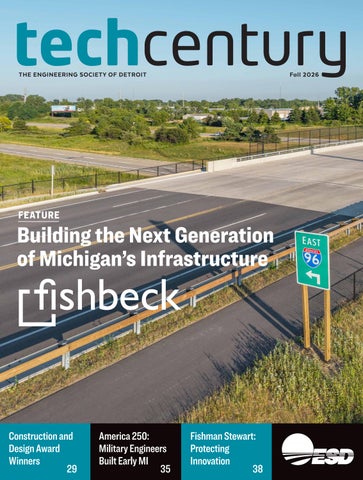
Cover photo: Fruit Ridge Avenue bridge, designed by Fishbeck.
BY JOE NEUSSENDORFER BY MICHAEL STEWART
BY PAUL SGRICCIA
42
Michigan’s Innovation Economy
43
Centrepolis Accelerator: Building American Manufacturing
BY SUSAN THWING
BY MATT ROUSH
45
Michigan’s Transformation from Rust Belt to Tech Belt
46
Book Review—The Algorithm by Jon McNeill
48
Welcome to the Future. Now Where’s My Flying Car?
BY VENU GOPAL THIRAKANAM
REVIEWED BY DR. WILLIAM A. MOYLAN
BY MATT ROUSH
50
From Rust Belt to Tech Belt BY SUSAN THWING
THE ENGINEERING SOCIE T Y OF DE TROIT
esd.org
|
1
techcentury V.31 I N.2 Fall 2026
20700 Civic Center Drive, Suite 450 • Southfield, MI 48076 248–353–0735 • 248–353–0736 fax • esd@esd.org • esd.org
TECHNOLOGY CENTURY® EDITORIAL BOARD CHAIR: Karyn Stickel, FESD, Hubbell, Roth & Clark Utpal Dutta, PhD, FESD, University of Detroit Mercy Richard Hill, PhD, University of Detroit Mercy William A. Moylan, Jr., PhD, PMP, FESD, Retired, Eastern Michigan University Janice K. Means, PE, LEED AP, FESD, FASHRAE, Retired, Lawrence Technological University Olivia Racette, Endo Pharmaceuticals Herschel Rogers, Ghafari Associates Matt Roush, Retired, Lawrence Technological University Rajiv Shah, PE, ACSCM Michael Stewart, FESD, Fishman Stewart Intellectual Property Cyrill Weems, Burns & McDonnell Yang Zhao, PhD, Wayne State University
ESD BOARD OF DIRECTORS Robert A. Richard, Retired / DTE Gas Marc Hudson, Hum Internet Alex F. Ivanikiw, AIA, LEED AP, FESD, OAC Advisors, LLC Robert Magee, The Engineering Society of Detroit Kirk T. Steudle, PE, FESD, Steudle Executive Group Paul C. Ajegba, PE, FESD, Infrastructure Engineering, Inc. Carla Bailo, FESD, ECOS Consulting, LLC Katherine M. Banicki, FESD, Testing Engineers and Consultants Michael Bassier, Stellantis Jeffrey L. Baxa, Barton Malow Company Mike Boss, Dürr Systems, Inc. Louay Chamra, PhD, Oakland University Sean P. Conway Peter Ghafari, Ghafari Associates Dan Milot, ZF Group Claude Molinari, Visit Detroit Scott Penrod, Walbridge Sergio Pujols, DENSO International America, Inc. Trevor Sherts, Ford Motor Company Kristen M. Siemen Jasmine L. Sisson, PE, FESD, WSP USA Inc. Shawn Verlinden, AUCH Construction Terry J. Woychowski, FESD, Caresoft Global PRESIDENT: VICE PRESIDENT: TREASURER: SECRETARY: PAST PRESIDENT:
TECHNOLOGY CENTURY STAFF PUBLISHER: MANAGING EDITOR: EDITOR:
Robert Magee, ESD Executive Director Nick Mason, ESD Director of Operations Susan Thwing
Postmaster, please send changes to: ESD, 20700 Civic Center Drive, Suite 450, Southfield, MI 48076. Technology Century®, also known as TechCentury, is published by The Engineering Society of Detroit (ESD). The authors, editors, and publisher will not accept any legal responsibility for any errors or omissions that may be made in this publication. The publisher makes no warranty, express or implied, with respect to the material contained herein. Advertisements in TechCentury for products, services, courses, and symposia are published with a caveat emptor (buyer beware) understanding. The authors, editors, and publisher do not imply endorsement of products, nor quality, validity or approval of the educational material offered by such advertisements. ©2026 The Engineering Society of Detroit.
Notes Karyn Stickel, PE, FESD
Partner, Hubbell, Roth & Clark Chair, ESD Editorial Board
As fall gets underway, thank you for your continued support. Our cover story features Fishbeck’s work on the Fruit Ridge Avenue bridge and interchange in the City of Walker. The project shows how thoughtful engineering can solve transportation challenges while preparing a growing community for the future—improving safety, connectivity, and access. This issue also showcases the 2026 ESD Construction & Design Award recipients, recognized for teamwork, innovation, and sustainability. We also explore our engineering past and future, including: The role military engineers played in building early Michigan as America marks its 250th anniversary How engineers can “AI-proof ” their careers by understanding the past and anticipating change Michigan’s growing innovation economy and the work of Centrepolis Accelerator The state’s evolution from Rust Belt to Tech Belt, including human-centered innovation and protecting intellectual property. We round out the issue with a review of The Algorithm, with lessons for engineers and project managers. Finally, we highlight all of our award recipients at the 2026 ESD Annual Dinner, including the Rackham Humanitarian Award recipient Frank Venegas, Jr. from the Ideal Group. These are just a few of the topics we’ve packed into this issue. We hope you find plenty to inspire, inform, and engage.
3
P RES IDE N T ’S M ESSAGE
From Michigan's Industrial Legacy to Its Innovation Future
M
ichigan has long been defined by its ability to build. Today, we’re building something new. The Fall 2026 issue of TechCentury explores Michigan’s remarkable evolution from the Rust Belt to the Tech Belt—a transformation fueled by engineering innovation, entrepreneurship, and the talented people who continue to reimagine what’s possible. Across our state, advances in artificial intelligence, automation, mobility, robotics, and advanced manufacturing are creating new opportunities while strengthening the industries that have defined Michigan for generations. This issue highlights the organizations and individuals leading that transformation. From Fishbeck’s cover story to features on the Centrepolis Accelerator, Michigan’s growing innovation economy, intellectual property, and the changing workforce, these stories demonstrate that the future of engineering is built on both technological advancement and human ingenuity. We’re also pleased to recognize this year’s John G. Petty Image Award honoree, Filza Walters, whose leadership exemplifies the innovation and excellence that continue to move our profession forward. At DTE and The Engineering Society of Detroit, we remain committed to supporting this momentum. Through professional development, scholarships, student chapters, and partnerships with industry and academia, ESD is helping prepare the next generation of engineers and technology leaders to thrive in a rapidly changing world. Michigan’s future will not simply be defined by the technologies we develop, but by the engineers, innovators, and problem-solvers who put those technologies to work for our communities. Thank you to our members, partners, and supporters for helping shape that future. Together, we’re building the next chapter of Michigan innovation. Bob Richard President, The Engineering Society of Detroit Retired President and Chief Operating Officer, DTE Gas, DTE Energy
4
|
TechCentury FA L L 2 0 2 6
ESD President Bob Richard (left) congratulating the 2026 ESD Young Engineer of the Year, Jeremy P. Ross, Supervisor, Model-Based Systems Engineering & Quality Tools & Methods, Ford Motor Co. at the ESD Annual Dinner in June.
DTE is proud to be a sponsor of ESD’s Girls in Engineering Academy. Program Director Jason Twymon (right) presents a certificate to a student after the summer program.
MEMBERS IN THE NEWS
Renee Tomina
Brandon Booth
Cesar Diaz
Lindsey Rem
Brandon Yezbick
Jason Twymon
DTE ENERGY PROMOTES RENEE TOMINA TO LEAD DTE GAS
NEW DIRECTOR FOR ESD GIRLS AND BOYS IN ENGINEERING ACADEMIES
DTE Energy has named Renee Tomina president and chief operating officer of DTE Gas, putting the longtime company leader in charge of operations serving approximately 1.4 million Michigan homes and businesses. Tomina joined DTE in 2010 and has held leadership roles spanning electric and gas operations, customer service and enterprise project management, giving her broad experience across the Detroit-based energy company’s operations. In her new position, she will oversee DTE Gas as the utility continues to serve customers throughout Michigan and manage the infrastructure and operations that support natural-gas delivery. Tomina is a graduate of Lawrence Technological University and Oakland University and serves on Lawrence Tech’s Board of Trustees. She succeeds ESD President Robert A. Richard, who retired.
Beginning with the 2026-2027 program year, Jason Twymon has taken over directing The Engineering Society of Detroit’s Girls and Boys in Engineering Academies. The program began in 2017, with the first cohort in the girls program, adding a new cohort every year until a full seven cohorts were running for girls in 6th through 12th grades. In 2024, ESD added a program for boys, now in its third year.
BARTON MALOW EXPANDS LEADERSHIP RESPONSIBILITIES Barton Malow has expanded the responsibilities of four members of its leadership team as the organization positions itself for continued growth. Brandon Booth is now chief strategy + risk officer, overseeing enterprise strategy, innovation, outside investments and growth beyond the company’s core construction business, while continuing to lead risk management, legal, safety and sustainability. Cesar Diaz has been named senior vice president of strategy + investments, with responsibility for disciplined capital deployment and strategic planning. Lindsey Rem is now senior vice president of innovation + project delivery, working with Barton Malow’s Education Group to test new ideas and technologies and scale successful approaches across projects and markets. Brandon Yezbick has become chief financial + administrative officer, leading Finance, HR, Systems + IT, Lean, Field Services, and Real Estate + Facilities. President and CEO Ryan Maibach said the changes are intended to strengthen Barton Malow’s core business while supporting growth in complementary areas.
DETROIT MERCY ENGINEERING STUDENT CROWNED MISS MICHIGAN 2026 University of Detroit Mercy mechanical engineering student Grace Hanke was crowned Miss Michigan 2026. The 19-year-old sophomore, competing as Miss Oakland County, earned $11,000 in scholarship funds as well as the honor of representing Michigan at the Miss America competition. Hanke’s social impact initiative, “Engineer Her Future,” encourages young women to pursue careers in STEM. She has supported STEM outreach through the Society of Women Engineers, the National Society of Professional Engineers and Mind Trekkers, and recently traveled to Washington, D.C., to advocate for increased STEM funding. This summer, she is also completing an internship with Ford while preparing for Miss America.
THE ENGINEERING SOCIE T Y OF DE TROIT
esd.org
|
5
IN TH E N EWS / I N M E M O R I AM BRUCE BURT RETIRES
Ruby + Associates, a Degenkolb Company, has announced the retirement of Senior Principal Bruce Burt, PE, following more than 40 years with the Bingham Farms structural engineering firm. Over four decades, he contributed to complex projects across the country while helping build a culture centered on technical excellence, Bruce Burt leadership and mentorship.
LTU RESEARCH INCREASES OVER 540% Research activity at Lawrence Technological University has increased by more than 540 percent as the Southfield university expands its focus on applied research, technology commercialization and partnerships tied to Michigan’s economy. LTU’s growing research portfolio spans engineering, architecture, computer science, health sciences and emerging technologies, reflecting an effort to connect academic work with practical industry challenges.
MICHIGAN TECH ESTABLISHES DEPARTMENT OF DATA SCIENCE
Michigan Technological University has established a new Department of Data Science within its College of Computing, giving the rapidly expanding field a dedicated academic home. The department officially launched July 1 and places Michigan Tech among a relatively small number of universities nationwide with an academic department devoted specifically to data science.
The contributions of these recently deceased members will not be forgotten: KENNETH R. JENKINS, PE
Senior Associate, Beechwood Engineering, PLC Director of Mechanical Engineering, TMP Associates Member since 1999
CASIMER “CASEY” A. SOBCZAK, PE Retired, Facilities Director, Warren Consolidated Schools Member since 1972
JOSEPH B. UICKER
Retired, Senior Vice President, Smith, Hinchman & Grylls/SmithGroup Member since 1974
G. SHELDON VEIL
Retired, Vice President, Marketing, United Paint Chemical Member since 1965
GERALD YOUNG, PE Electrical Engineer Member since 2010
WADE TRIM CELEBRATES 100 YEARS Wade Trim is marking its 100th anniversary in 2026, celebrating a century of infrastructure work that began in 1926 with a civil engineering business focused on roads and sewers for local communities. The firm’s work spans water, energy, industrial/commercial, community design and transportation markets. President and CEO Andy McCune said infrastructure design remains the connection across the Andy McCune markets Wade Trim serves and has provided a foundation for expanding expertise, geography and client relationships. As part of the centennial, Wade Trim contributed $100,000 to the Wade Trim Foundation, which supports nonprofit organizations and programs aligned with environmental, community and quality-of-life improvements through infrastructure investment. Throughout 2026, the firm is also highlighting defining moments and featured projects from its century of work.
6
|
TechCentury FA L L 2 0 2 6
CORRECTION TO SPRING 2026 ISSUE In Great Lakes States’ Greatest Resource: Abundant Fresh Water (Spring 2026), a numerical figure was misstated and should read “about 1,700 gallons per pound” (not 17,000). In addition, “IPPC” should read “IPCC,” and the image labeled “Vegetated Roof on LTU Campus” should be identified as Figure 5, not Figure 4.
ES D UP COMING DEADLINES
HONORING EXCELLENCE IN ENGINEERING ESD HONOR AWARDS & SCHOLARSHIPS
9th ANNUAL ESD STUDENT WRITING CONTEST Deadline: December 4, 2026
Attention college students: we want to hear from you! The contest is open to all students attending Michigan universities and studying within any of the engineering disciplines or related fields. The first-place winner will receive a $1,000 scholarship sponsored by Fishman Stewart, LLC. For essay topics, contest details and to obtain the application form, visit esd.org/awards/writing. Questions? Contact Susan Thwing at sthwing@esd.org.
JOHN G. PETTY IMAGE AWARD Entry Deadline: February 26, 2027
A r e y o u o r s o m e o n e y o u k n ow making waves in the engineering and technical professions? Nominations are now being accepted for the 2027 John G. Petty Image Award. This is your chance to honor those championing engineering through their exceptional contributions and inspiring efforts. Nomination requirements can be found at esd.org or by contacting Susan Thwing at sthwing@esd.org.
53rd ANNUAL CONSTRUCTION AND DESIGN AWARDS Entry Deadline: February 26, 2027
ESD COLLEGE OF FELLOWS
Nomination Deadline: February 26, 2027 Help us recognize leaders by nominating a Fellow, one of the highest recognitions that ESD can bestow on its members. Candidates are selected based on outstanding professional accomplishments, leadership and service. They must be members in good standing for at least five years at the time of the application deadline. Full details and instructions are at esd.org. Contact Heather Lilley at hlilley@esd. org or 248-353-0735, ext. 120.
The Engineering Society of Detroit Construction and Design Awards are unique in that they honor the three primary members of the building team—owners, designers, and constructors—and recognize outstanding team achievement and innovative use of technology. Su b m i s s i o n s a re a c c e p t e d f ro m project teams composed of owner, designer and constructor. At least one of the primary members of the project team must be a member of ESD. For submission criteria and how to submit entries, visit esd.org/awards/ cd or contact Leslie Smith, CMP, at lsmith@esd.org or 248-353-0735, ext. 152.
Applications Due: February 19, 2027
Outstanding Young Engineer of the Year
This award recognizes a young professional under the age of 35 who has best distinguished him/herself in the engineering and scientific communities. Criteria include education, work experience, and professional and community activities. Applicants must be members of ESD.
Outstanding College Student of the Year
T h i s aw a r d r e c o g n i z e s a n undergraduate student who has best distinguished him/ herself in the engineering and scientific communities. Criteria include academic background, extracurricular activities, and employment experience. The winner(s) will receive a $2,000 scholarship.
Outstanding High School Student of the Year
This award recognizes a graduating high school senior. To be considered, applicants must have at least a 3.0 GPA, plan on pursuing a career in the field of engineering or the life sciences and participate in volunteer activities. The winner(s) will receive a $2,000 scholarship. Applications will be available in December at esd.org. For more information, contact Sue Ruffner at sruffner@esd.org or 248-353-0735, ext. 117.
THE ENGINEERING SOCIE T Y OF DE TROIT
esd.org
|
7
EVE N TS & E DUCAT I O NA L OP P ORTUNITIES ENGINEERS GET HIRED FALL JOB FAIR
SAVE THE DATE 2027
Employers: Meet your next great hire and build your talent pipeline at The Engineering Society of Detroit’s fall job fair! Connect with engineering and tech professionals your company needs, including seasoned and mid-career professionals, college students, and recent grads. ESD job fairs attract motivated candidates seeking full- and part-time positions, internships, and co-op placements.
APRIL 6: SOLID WASTE TECHNICAL CONFERENCE SPRING: SPRING ENGINEERS GET HIRED JOB FAIR JUNE 7: 16th ANNUAL ESD GOLF OUTING JUNE: ESD ANNUAL DINNER
October 29, 2026
Job Seekers: Your next career opportunity awaits! Meet face-to-face with future employers and discover hundreds of exciting job opportunities. Bring your résumé, make valuable connections, and take the next step toward your future career. Also, don’t forget ESD’s job board at jobs.esd.org. The job fair will be held at the Vibe Credit Union Showplace in Novi from 2–7 p.m. Visit esd.org/gethired to register as an attendee or exhibitor, or contact Leslie Smith, CMP, at lsmith@esd.org or 248-353-0735, ext. 152.
8
|
TechCentury FA L L 2 0 2 6
Golf sells out quickly— reserve early!
EV E N TS & EDUCATIONAL OP P ORTUNITIES
BECOME A MENTOR, JUDGE OR SPONSOR 32nd ANNUAL ESD MICHIGAN REGIONAL FUTURE CITY COMPETITION Competition Day: January 19, 2027
This fall, middle school students began preparing for the Future City Competition, a project-based learning program where students work as a team with an educator and volunteer mentor to design a city of the future. Students will take on this year’s challenge, Fire Resilient Future, designing a city that can prevent, withstand and recover from wildfire threats. Teams will use innovative infrastructure, technology, and resilient community planning to create a safer, stronger, and more sustainable future. There are many opportunities to get involved and help inspire students: Mentors: Anyone who works in the engineering community—including engineers, technical professionals, architects and city planners—would be a great mentor. Spend an hour or two a week between now and January coaching and advising a team. Share real-life experiences, offer technical guidance, and help translate academic concepts to the real world of engineering and city design. Contact Allison Marrs at amarrs@esd. org or 248-353-0735, ext. 121. Judges: Share your expertise by evaluating the team’s efforts. Judges are needed to review essays in December and January and/or serve as a judge on competition day, January 19, 2027, at Vibe Credit Union Showplace in Novi, where they will evaluate physical models and oral presentations. Contact Leslie Smith at lsmith@esd.org or 248-353-0735, ext. 152. S p o n s o r s : Support the next generation while increasing your business visibility. With a variety of sponsorship opportunities available, your organization can play a meaningful role in competition day while gaining valuable exposure. Visit esd.org/futurecity for more information or contact Allison Marrs at amarrs@ esd.org or 248-353-0735, ext. 121.
On the day of the competition, teams of judges spend the day talking with students about their projects.
NEW THIS YEAR! Hands-On Student Activity Sponsorships: As part of the event experience, we’re offering interactive stations designed for the students who attend competition day but are not part of the presenting team. These stations allow students to actively engage with the tools, technology, and real-world applications used by engineers and technical professionals every day. The goal is to bridge classroom learning with realworld jobs, helping students better understand how STEM skills translate into meaningful and in-demand careers. To find out more about this sponsorship opportunity, visit esd.org/futurecity or contact Allison Marrs at amarrs@esd.org or 248-353-0735, ext. 121.
THE ENGINEERING SOCIE T Y OF DE TROIT
esd.org
|
9
ES D HA P P E NI NGS
Thank you to all those who supported ESD’s programs by joining us for a fun day of networking and golf. Pictured above are Mike Boss (Dürr), Will Rickert (Ford Motor Co.), Pat McKernan (Ford Motor Co.), and Bob Strebelow (Dürr).
Thank You for Another Great Golf Outing! Thank you to all those who supported ESD’s annual Golf Outing on June 1, 2026, at Oak Pointe Country Club in Brighton, held in memory of David A. Skiven, a strong supporter of ESD’s mission to encourage the next generation of engineers in Michigan. Proceeds from this event fund scholarships for high school and college students, as well as student outreach efforts. Those include the Future City program for middle school students and our two ESD Engineering Academies for girls and boys. Additionally, funds help ESD Student Chapters at 14 Michigan universities. T h e O C C S y s t e m s t e a m ( To m Wo o d b e c k , Mike Sherman, Dave Briggs, and Mark Williams) took top place on the Honors Course, with Ideal C o n t r a c t i n g Te a m 2 ( A l e x O c h m a n , M i c h a e l Penland, Dillon Splude, Derek Woloszyk) coming in
10
|
TechCentury FA L L 2 0 2 6
second. On the Championship Course, the team from Tandem Engineering Group (Darren Roney, Jason Tong, Jonathon Shanahan, Chad Short) placed at the top, with Ideal Contracting Team 1 (Joe Nowakowski, Luke Willoughby, Dale Pisha, and Kevin Inglis) in second place. The Closest-to-the-Pin winners were Derek Woloszyk from Ideal Contracting and Terri Schroeder from DTE Energy on Honors. On Champs, they were Joe Nowakowski from Ideal Contracting and Natalie Haise. Longest Drive prizes went to Adam Tupaney from Adamo Demolition and Theresa Card from Kingscott on Honors and to Brian Miller from Barton Malow and Natalie Haise on Champs. Visit esd.org/golf to see all the photos from the outing. We hope to see everyone back at Oak Pointe on June 7, 2027. Don’t forget to save your spot early—we sell out quickly.
ES D HAP P ENIN GS
THANKS TO OUR GENEROUS SPONSORS! PRESENTING SPONSOR:
DIAMOND SPONSORS:
It was a beautiful day for golf at Oak Pointe Country Club in Brighton.
PLATINUM SPONSORS:
Presenting Sponsor Walbridge hosted the networking reception.
GOLD SPONSORS:
27 YEARS
TRI-TEC
E S T. 1 9 9 9
SILVER SPONSORS: Affiliated Engineers, Inc. AUCH Construction Black & Veatch Corporation Burns & McDonnell Commercial Contracting Corporation ENERCON Giffin, Inc. Gala & Associates, Inc. Hubbell, Roth & Clark, Inc.
Derek Woloszyk (center) from Ideal Contracting accepting his award from Keith Skiven (left) and ESD Executive Director Robert Magee.
IMEG Corp. North American Dismantling Corp Roncelli, Inc. Ruby + Associates, a Degenkolb Company Rudolph Libbe Group Sorensen Gross Construction Services Tandem Engineering Group
PRINTING SPONSOR:
THE ENGINEERING SOCIE T Y OF DE TROIT
esd.org
|
11
YOU TH P RO GRA M S
CONGRATULATIONS TO ACADEMY GRADUATES! GEA Students attending the graduation ceremony in May.
Congratulations to the third graduating cohort of the Girls in Engineering Academy (GEA), who completed seven years in the program this spring. The students were recognized at a May 13 graduation ceremony celebrating their achievements and the next chapter in their education. Members of the class are heading to colleges and universities across the country to pursue a wide range of fields: Areeba Aalam—Michigan State University, Biology/Pre-Med Riya Bagri—Michigan State University, Biology/Business Khyra Baker—Central Michigan University, Computer Engineering
12
|
TechCentury FA L L 2 0 2 6
Nevaeh Day—Michigan State University, Pre-Veterinary Studies Madison Eason—North Carolina A&T State University, Chemical Engineering Lauren Goins—Florida A&M University, Chemical Engineering Kelsey Hall—Grand Valley State University or University of Michigan-Flint, Psychology Kendall Hall—University of Michigan, Biopsychology, Cognition and Neuroscience Yazmine Harris—Wayne State University, Industrial Engineering Mariah Lang—University of Michigan, Computer Science Je’Nia Mills—Wayne State
University, Business Carlie Robinson—Tennessee State University, Nursing Joelle Silver—Hampton University (Virginia), Pharmacy Nina Seaberry—Grand Valley State University, Exercise Science GEA offers sustained STEM education, hands-on learning and mentorship designed to prepare girls for college and introduce them to opportunities in engineering and related fields. The accomplishments of this year’s graduates demonstrate the impact of that long-term investment as they move on to their next academic pursuits.
YOUTH P ROG RAM S
ESD Boys in Engineering Academy Completes Another Successful Summer Program
During the three-week summer program, participants in ESD’s Boys in Engineering Academy visited industry partners like Lear Corporation (shown above) where they often do hands-on activities with working engineers.
BOYS IN ENGINEERING ACADEMY SPONSORS:
ESD’s Boys in Engineering Academy featured two cohorts this year, staying at Oakland University (above) and Lawrence Tech.
UNIVERSITY SPONSORS:
FIELD TRIP PARTNERS:
Students present during the summer closing ceremony.
LIFT Lear Corporation U.S. Army Corps of Engineers
THE ENGINEERING SOCIE T Y OF DE TROIT
esd.org
|
13
YOU TH P RO GRA M S
Students in ESD Girls in Engineering Academy Benefit from an Enriching Summer Experience
Six cohorts of students participated in ESD’s Girls in Engineering Academy, each housed for three weeks on a different campus. The cohort above was at Oakland University.
The summer program isn’t all curriculum—students have lots of fun during their down time doing projects and playing games.
14
|
TechCentury FA L L 2 0 2 6
Amazing instructors like Brittany Rhodes (left), founder of Black Girl MATHgic and Math Equals Me, are part of what makes the GEA experience so fun and enriching for students.
After the three-week summer program of the Girls in Engineering Academy, participants receive a certificate of completion at the closing ceremony. They start back up in the fall with a school year program where they do hands-on activities throughout the school year.
Jason Twymon, Director of ESD’s Girls and Boys in Engineering Academies, addresses students.
Students present on the projects they worked on during the summer program of the Academy.
GIRLS IN ENGINEERING ACADEMY SPONSORS:
UNIVERSITY SPONSORS:
FIELD TRIP PARTNERS: Accenture Alro Steel Barton Malow BorgWarner
DENSO Eli Lilly and Company Ford Performance General Motors
Hazen and Sawyer Marathon Petroleum Corporation Plante Moran
THE ENGINEERING SOCIE T Y OF DE TROIT
esd.org
|
15
The new Fruit Ridge Avenue bridge and interchange designed by Fishbeck.
16
|
TechCentury FA L L 2 0 2 6
Fruit Ridge Avenue BUILDING THE N E X T G E N E R AT I O N OF MICHIGAN I N F R A ST R U C T U R E
W
hen the original Fruit Ridge Avenue bridge opened in 1961, the City of Walker looked much different than it does today. The surrounding landscape was largely farmland and forest, and the two-lane bridge was designed to meet the transportation needs of a developing community. More than six decades later, the corridor serves a region experiencing continued residential, commercial, and industrial growth. Infrastructure projects like the Fruit Ridge Avenue improvements demonstrate how thoughtful engineering can prepare communities for the future while supporting economic development, mobility, and quality of life. Fishbeck specializes in helping communities solve unique challenges with all-in-one services. “This project is very special in how so many pieces fell into place at the right time and came together to provide the community with improved infrastructure that will serve them for years to come,” said Chris Sikkema, PE, Fishbeck Project Manager. “The close coordination between Fishbeck, City of Walker, and MDOT staff was critical to maintain the tight schedule, and the community support (even during construction) was unmatched. I’m proud to be part of a project that solved a critical infrastructure challenge for the continued growth and prosperity of the community.” The transformation of Fruit Ridge Avenue began with the goal of providing the City of Walker with a safer, more efficient connection across Interstate 96. The bridge and interchange had served the region well for decades, but as Walker continued to expand, the limitations of the original design became more apparent. Community leaders recognized the corridor had outpaced the available capacity, as the ramp connections and the narrow bridge near 3 Mile Road had become a pressure point for commuters, residents, and businesses. THE ENGINEERING SOCIE T Y OF DE TROIT
esd.org
|
17
The eastbound off-ramp connected directly to local streets, which is an unconventional interchange design that is not intuitive for non-local motorists. This created confusing movements and traffic conflicts for drivers. Walker and the Michigan Department of Transportation (MDOT) set out to reshape the corridor into infrastructure that reflected both the community’s current needs and its long-term vision for growth. The City worked with state legislators to secure a $25 million grant for the improvements, requiring construction to begin in spring 2025. Fishbeck was selected for design work in early 2024 to help lead that vision from concept to reality on an expedited schedule. As design work began, the Fishbeck team focused on a solution that would serve the full range of users who rely on the corridor. Reconfiguring the interchange ramps created more predictable traffic movement, while widening Fruit Ridge Avenue to five lanes provided the capacity and safety needed for the region. The redesign eliminated confus-
18
|
TechCentury FA L L 2 0 2 6
ing ramp movements that previously required drivers to weave between entering and exiting traffic. Traffic analysis was performed to ensure the design would meet both current and future capacity demands. Aligning the ramps with signalized intersections better conformed to driver expectations, helped reduce dangerous movements, and improved overall traffic flow through the interchange. The bridge itself expanded dramatically, growing from roughly 26 feet wide to nearly 100 feet to accommodate additional travel lanes and dedicated space for nonmotorized users. One significant change implemented during design was replacing the single 370-foot bridge with two 107-foot bridges over I-96. This allowed for placing the crest of the vertical curve between the structures to provide adequate longitudinal drainage and better match the entrance and exit grades both north and south of the structures. This solution also allowed for shallower
“Projects like Fruit Ridge Avenue demonstrate how engineering solutions are best implemented by incorporating community goals with sound engineering for the benefit of all.” — Chris Sikkema, PE
beams to help mitigate grade raise while providing the vertical clearance required for I-96. A geotechnical investigation determined that the existing soil conditions in the median were poor and would compress and settle under the embankment. This required pre-loading and settlement monitoring to ensure the future stability of the road section between the structures. In addition: Poor soil conditions along the alignment of the westbound off-ramp were also addressed with peat excavation. Drainage was also improved by replacing the existing 60-inch CMP culvert with a 9-foot by 6-foot box culvert under Fruit Ridge. Storm sewers were upgraded to meet current serviceability standards and MS4 standards for sediment removal. A combined detention-infiltration basin was designed to control discharge to meet channel protection and flood control requirements. A landscaped floodplain shelf was also incorporated in the design to improve stream function. The project also improved the experience and safety of nonmotorized users, from walking and biking to other forms of personal mobility. A dedicated shared-use path was added along Fruit Ridge Avenue and 3 Mile Road to connect the Musketawa Trail to the Fred Meijer Standale Trail, creating new opportunities to access the broader regional trail system. Sidewalk gaps throughout the project area were also filled, improving local pedestrian connectivity and reinforcing the idea that modern transportation infrastructure should serve all users. Moving from design to construction required close collaboration among design and construction partners. Fishbeck provided assistance to MDOT throughout
construction. Due to the extensive work taking place, local traffic was significantly impacted. Fishbeck developed lane closures and detours that maintained access for motorists and businesses while providing safe working areas for the contractor. Although construction created temporary inconveniences, the community understood the long-term value of the investment. When the new bridge opened, it represented more than the completion of a construction project. It marked a renewed commitment to mobility, accessibility, and longterm investment in northwest Walker. The improvements are particularly important for the City’s growing industrial and commercial corridor, where businesses depend on reliable transportation networks for freight movement, employee commuting, and regional connectivity. As Michigan continues to attract advanced industries and strengthen its manufacturing and logistics economy, transportation infrastructure plays an increasingly important role in supporting that growth. “Projects like Fruit Ridge Avenue demonstrate how engineering solutions are best implemented by incorporating community goals with sound engineering for the benefit of all,” said Sikkema. The project’s recognition as the 2025 APWA Midwest Branch Project of the Year reflects the collaborative engineering and technical problem-solving that made the transformation possible. In 2026, the project earned national recognition from AASHTO with a Quality of Life/ Community Development award for its improvements to safety and operations for vehicles and pedestrians. More than a bridge replacement, the project illustrates how modern engineering is transforming Michigan’s infrastructure to meet the needs of a growing, increasingly connected future. THE ENGINEERING SOCIE T Y OF DE TROIT
esd.org
|
19
HONORING EXCELLENCE
20
|
TechCentury FA L L 2 0 2 6
ES D ANNUAL DINNER
Rackham Humanitarian Award recipient Frank Venegas, Jr. (center) and Sylvia Gucken from Ideal Group (far right) with students from Detroit Cristo Rey school who participate in Robotics Engineering Center of Detroit competitions.
The Engineering Society of Detroit gathered on June 23, 2026, at Vibe Credit Union Showplace in Novi for its Annual Dinner, an evening recognizing outstanding achievement and service across the engineering community. Among the evening ’s highlights was the presentation of the Horace H. Rackham Humanitarian Award to Frank Venegas, Jr., Chairman of The Ideal Group, Inc.
ESD also presented its 52nd Construction and Design Awards, recognizing two outstanding projects, along with one honorable mention. Those projects are featured on the following pages, together with the evening’s other award recipients. Congratulations to all those honored, and thank you to everyone whose attendance and sponsorship helped make the evening a success.
Newly inducted Fellow Tricia Ruby from Ruby + Associates, a Degenkolb Company, is welcomed by current Fellows.
Evan Bahs (center) of Acrisure, with ESD President Bob Richard and Executive Director Robert Magee.
THE ENGINEERING SOCIE T Y OF DE TROIT
esd.org
|
21
ES D A N N UAL D I NNE R
RACKHAM HUMANITARIAN AWARD: FRANK VENEGAS, JR. Frank Venegas, a Detroit, Michigan entrepreneur and the grandson of Mexican immigrants, capitalized a winning raffle ticket and the proceeds of a new 1979 Cadillac to launch his first company in 1979. Today, the Ideal Group, a family-owned company, has evolved into seven nationally recognized companies with annual revenues approaching $605 million, employing approximately 550 people. Over the years, family members Loren (brother), Linzie (daughter), and Jesse (son) joined the Ideal Leadership team as owners. Based on the Venegas family core values, Ideal companies continually meet and exceed customer needs in construction, facilities management,
manufacturing, indirect material management and surplus sales. Known for their philanthropic work in Southwest Detroit, Ideal Group and Frank Venegas focus their efforts on four fundamental pillars: Education, Environmental, Community Sustainability, and Youth Programs. The government of Mexico recognized Frank Venegas with its Ohtli Award, its highest award to a foreign citizen, a tribute to Ideal’s corporate advocacy, mentoring and philanthropic contributions to community schools and organizations that provide pathways to educational and job opportunities illustrating the Venegas family value, “Take care of your community and your community will take care of you.”
ESD ANNUAL DINNER AWARD RECIPIENTS Horace H. Rackham Humanitarian Award
Frank Venegas, Jr., Chairman, The Ideal Group, Inc.
College of Fellows Inductees
Ali Abolmaali, PhD, Dean, James and Patricia Anderson College of Engineering, Wayne State University Shawn P. McElmurry, PhD, PE, Professor and Chair, Civil & Environmental Engineering, Wayne State University Tricia Ruby, Principal / Chief Financial Officer, Ruby + Associates, a Degenkolb Company Michael B. Stewart, MSE, JD, Founding Member and Partner, Fishman Stewart PLLC
Diamond Member Award
James G. Meenahan, PE, FESD, President, Environmental & Energy Consultants
Partners of the Year
Acrisure (Member Benefit Partner) TC Energy (Corporate Partner) National Defense Industrial Association Michigan Chapter (Nonprofit Partner)
22
|
TechCentury FA L L 2 0 2 6
John G. Petty Image Award
Filza H. Walters, FESD, FASHRAE, Director of Mechanical Engineering, Albert Kahn Associates, Inc.
Young Engineer of the Year
Jeremy P. Ross, Supervisor, Model-Based Systems Engineering & Quality Tools & Methods, Ford Motor Co.
ESD Construction & Design Awards
University of Michigan Leinweber Computer Science and Information Building and Hayward Street Geothermal Facility Owner: University of Michigan Designer: Integrated Design Solutions | SmithGroup Contractor: Walbridge Ralph C. Wilson Jr. Centennial Park Owner: Detroit Riverfront Conservancy Designer: Michael Van Valkenburgh Associates | Adjaye Associates | Neumann/Smith Architecture Contractor: Brinker | Christman, A Joint Venture
ESD Construction & Design Honorable Mention
Pine River Solar Park Owner: DTE Energy Designer: Westwood Professional Services Michigan LLC Contractor: Barton Malow
ES D ANNUAL DINNER
THANK YOU, SPONSORS! PLATINUM SPONSORS
ESD President Bob Richard (left) and ESD Executive Director Robert Magee (right) present ESD’s Diamond Member Award to ESD Fellow James G. Meenahan, who has been a member of the Society since 1960.
GOLD SPONSORS
Michael Stewart of Fishman Stewart enjoying the reception before the event where he will be inducted into the College of Fellows.
a Degenkolb Company
Awardees from the Pine River Solar Park project.
Look for more photos online at esd.org! THE ENGINEERING SOCIE T Y OF DE TROIT
esd.org
|
23
ES D AWA R DS
2026 JOHN G. PETTY IMAGE AWARD HONOREE
INSPIRED TO LIFT OTHERS FILZA WALTERS HAS SPENT A CAREER PROVING THAT ENGINEERING IS ULTIMATELY ABOUT PEOPLE
W
h e n F i l z a Wa l t e r s learned she had been selected as the 2026 recipient of the Engineering Society of Detroit’s John G. Petty Image Award, her first reaction wasn’t to think about her own accomplishments. Instead, she thought about the man whose name the award bears. John G. Petty wasn’t simply an admired engineering leader in Walters’ eyes. He was a mentor, encourager and champion of others— the kind of person who quietly saw potential in people before they saw it in themselves. Receiving an award in his honor, she says, is both deeply humbling and profoundly personal. “He just left such a great impression on me,” Walters said. “He was the kind of person everyone should aspire to be. This award means a lot because, in many ways, it feels like honoring him.” That sentiment perfectly reflects the spirit of the John G. Petty Image Award, which recognizes individuals who elevate the engineering profession through mentoring, education, leadership and public engagement. Throughout a career spanning industry, academia and professional service, Walters has done exactly that—expanding not only the reach of engineering, but also who sees themselves belonging in it. To d a y, Wa l t e r s s e r v e s a s Senior Associate and Director of Mechanical Engineering at Albert
24
|
TechCentury FA L L 2 0 2 6
Kahn Associates, leading complex engineering projects while helping shape the next generation of professionals. But those who know her are just as likely to describe her as a teacher, mentor or advocate as they are an engineer. In her nomination, Lawrence Technological University Professor Emerita Janice Means wrote that Walters “not only promotes the engineering fields, but has served as an important role model and mentor,” particularly for women and minorities pursuing engineering careers. That commitment has become one of Walters’ defining characteristics. She never planned on becoming an educator. Instead, it happened organically through a lifelong desire to share the excitement she found in engineering. As a college student studying architectural engineering, Walters volunteered as an engineering ambassador, visiting middle and high schools to introduce students to careers they might never have considered. Looking back, she realizes the seeds had been planted even earlier, when an aunt invited her to speak to an English class overseas while she was still in middle school. “It’s strange how sometimes you have something that’s kind of in your blood, but you don’t really realize it,” she said, noting that her father spent his career as a university professor. Her passion for outreach eventually led her beyond industry
Filza Walters with Abe Walters at ESD’s Annual Dinner
work. Recognizing the shortage of architectural engineering programs nationwide, Walters volunteered her time to help establish a new program at Lawrence Technological University. What began as an effort to serve on a committee evolved into directing the program itself. Later, she expanded that impact through leadership roles at Texas A&M University, helping prepare future engineers at one of the nation’s largest institutions. For Walters, teaching was never simply about delivering lectures. It was about helping students discover where their passions intersected with engineering. “If you have a passion for something,” she said, “there’s a way to make that into your career.” That philosophy extends well beyond the classroom. Throughout her career, Walters has been deeply involved in ASHRAE, The Engineering Society of Detroit and numerous professional organizations. She has organized conferences focused on sustainability
From left, Jacob Smith, associate architect and BIM manager; Filza Walters, senior associate and director of mechanical engineering; and Fejiro “Fefe” Asidi, junior mechanical engineer, collaborate at Albert Kahn Associates. Beyond their project work, all three help strengthen the profession through leadership, teaching and mentorship—from Smith’s national AIA service and university instruction to Walters’ longstanding advocacy for engineers and Asidi’s outreach introducing Detroit students to careers in the built environment.
and renewable energy, collaborated on educational outreach programs, and helped establish the inaugural international Women in ASHRAE Symposium in 2024. One of her proudest initiatives was creating scholarship opportunities that encouraged employers to send young female engineers to professional conferences—opening doors that might otherwise have remained closed. It reflects Walters’ broader belief that professional organizations aren’t simply places to network; they’re places where confidence is built, leaders emerge and careers take shape. That perspective was shaped by mentors like Petty and longtime ESD leader Dr. Donald Marburger, who continually encouraged her to accept new leadership opportunities, even when she questioned whether she was ready. “They would say, ‘Okay, now we need you to do this,’” Walters said. “Sometimes people tell you that you need to learn to say no. I’ve learned
that sometimes you need to not say no. You don’t know what amazing experiences can unfold if you simply believe in the people who believe in you.” T ha t willingness to emb rac e new challenges has carried Walters through an unusually diverse career spanning consulting engineering, facilities management, higher education and executive leadership. Rather than viewing those experiences as separate careers, she sees them as interconnected chapters, each preparing her for the next opportunity. The same outlook shapes how she views the future of engineering. While artificial intelligence dominates conversations across industries, Walters believes the greatest opportunities lie in using t e c h n o l o g y t o c re a t e h e a l t h i e r, smarter and more sustainable buildings and infrastructure. Engineers, she said, will always remain problem-solvers. “No two buildings, no two clients and no two
sites are ever going to be the same,” she explains. “Technology gives us better tools, but it still takes human creativity and critical thinking.” Ultimately, however, Walters hopes her greatest contribution isn’t measured by projects completed or titles earned. Instead, she hopes people remember how she made them feel— and how she encouraged them to see possibilities within themselves. “I hope my legacy is helping lift others up,” she said. “Sometimes all it takes is asking the right questions, really listening, and helping someone recognize talents they don’t yet see in themselves.” It is, perhaps, the greatest tribute possible to John G. Petty himself. Like the man whose name is on the award, Walters has spent a lifetime proving that engineering’s greatest achievements aren’t always measured in buildings or blueprints. Sometimes, they ’re measured in people inspired to build something even greater.
THE ENGINEERING SOCIE T Y OF DE TROIT
esd.org
|
25
ES D AWA R DS
ESD AWARDS $24,000 IN MERIT SCHOLARSHIPS Each year ESD awards $2,000 scholarships for outstanding academic and extracurricular achievement to graduating high school seniors pursuing a career in engineering or the life sciences and to undergraduate students who have distinguished themselves in the engineering or sciences community. Applications are accepted starting in December and are due in February. To find out more, visit esd.org or contact Sue Ruffner at sruffner@esd.org.
2026 HIGH SCHOOL STUDENT RECIPIENTS:
Areeba Aalam
Haley Christian
Alexander Lemon
Nathaniel Loadwick
West Bloomfield High School
Detroit Catholic Central, Novi
Renaissance High School, Detroit
South Lyon East High School
Shaila Cranson
Mercy High School, Farmington Hills
Emma Pagliaroli
Dakota High School, Macomb
Ethan Hays Napoleon High School
Noah Kimbrough
Dakota High School, Macomb
Asia Shi
Huron High School, Ann Arbor
2026 UNDERGRADUATE STUDENT RECIPIENTS:
Yatee Balan University of Michigan
26
|
TechCentury FA L L 2 0 2 6
Yafate Desta University of Michigan
Rory Kauffman
Saginaw Valley State University
We congratulate these top students on all of their hard work and achievement!
ES D AWARDS
CURIOSITY, PURPOSE AND A PASSION FOR ENGINEERING
ESD STUDENT HONOREE RORY KAUFFMAN BEGINS HIS CAREER READY TO HELP SHAPE THE TECHNOLOGIES OF THE FUTURE
F
or Rory Kauffman, engineering began with a question he has been asking for as long as he can remember: Why? Why does something work the way it does? What is happening behind the scenes? Could a system work better? “I’ve always been a naturally curious person,” Kauffman said. “I’ve tended to question why things work the way they do and what’s happening behind the scenes in a system.” Combined with an aptitude for math and physics, that curiosity made mechanical engineering seem like a natural direction. But it wasn’t until Kauffman took his first engineering course at Saginaw Valley State University that curiosity turned into certainty. “Once I took my first college course, Mechanical Engineering 101, I knew I had chosen the right path,” he said. “Sitting in that classroom, everything clicked.” That decision has already taken Kauffman from the SVSU classroom to hands-on engineering projects and professional experience at Hemlock Semiconductor. Along the way, his accomplishments earned recognition from The Engineering Society of Detroit as Outstanding College Student of the Year.
Learning by doing
Some of Kauffman’s most important lessons at SVSU came from putting engineering principles to work. His senior design project brought together many of the skills he developed during his undergraduate years. Working with two other seniors over a full academic year, Kauffman helped design and test a fractal polysilicon clamping fixture. During the first half of the project, the team developed three design concepts, created complete CAD models and selected a final design for fabrication by a local machine shop. The second half focused on testing the finished fixture and conducting a design of experiments to optimize its parameters. “Because of the project’s complexity, the amount of time we invested, and the level of ownership we had from concept through testing, it stands out as the most meaningful engineering experience I had at SVSU,” Kauffman said.
ESD 2026 Outstanding College Student of the Year Scholarship recipient Rory Kauffman
That willingness to dig into a problem rather than look for an immediate answer is part of what attracts him to engineering. Complex problems, Kauffman said, require engineers to look beyond the surface and consider not only how something works, but how it might work better. “I find that kind of deep problem-solving incredibly rewarding,” he said. Even more important is what that problem-solving can accomplish. “I love that our work has a real impact,” Kauffman said. “Whether we’re helping a customer, improving something within our company, or contributing to the broader community, engineering gives us the opportunity to make meaningful, tangible improvements.”
Mentors who made a difference
Kauffman is quick to share credit for his success. He points to SVSU’s mechanical engineering department as an important foundation, particularly Dr. Peggy Jones, who
THE ENGINEERING SOCIE T Y OF DE TROIT
esd.org
|
27
ES D AWA R DS supported him from his first year through graduation. He also credits Jeff Jezowski and Lenard Noel at Hemlock Semiconductor with shaping his development during his internship and co-op experiences. “They didn’t just teach me technical skills, they showed me what it looks like to be a thoughtful, thorough, and effective engineer in the field,” he said. F ro m t h e m , K a u f f m a n l e a r n e d t o b re a k d ow n complex problems, ask meaningful questions, interpret specifications, remain organized and seek the experience of others. “They encouraged me to seek out experienced voices, collaborate openly, and never hesitate to learn from others,” he said.
Looking toward the future
After graduating from SVSU in May, Kauffman joined Hemlock Semiconductor’s capital projects team as an associate mechanical engineer, placing him within an industry he sees as one of engineering’s most exciting frontiers. “As devices become smarter, faster, and smaller, the demands placed on semiconductor materials and manufacturing continue to grow in complexity,” he said. Mechanical engineering plays an important role in that evolution, Kauffman said, spanning materials and manufacturing, equipment design and process o p t i m i z a t i o n . At He m l o c k S e m i c o n d u c t o r, h e i s
28
|
TechCentury FA L L 2 0 2 6
contributing to a company that manufactures polysilicon that forms the foundation of semiconductor chips. “Being part of the supply chain that enables nearly every modern technology is incredibly motivating,” he said. Yet Kauffman’s ambitions are not defined solely by the technologies he hopes to help develop. He also has a clear vision for the kind of engineer and colleague he wants to become. “I want to become the kind of engineer, and teammate, people can rely on,” he said. “Someone who leads by example, communicates well, supports others, and consistently delivers high-quality work and thoughtful ideas.” Like many students choosing a career, Kauffman experienced moments when he questioned whether he was headed in the right direction. What he discovered was that meaningful work does not eliminate challenges; instead, it can give them purpose. “There will always be obstacles, no matter what path you choose,” Kauffman said. “But if you truly enjoy what you’re doing, the trials and setbacks become part of the growth that makes the end result worth it.” For an engineer whose career began with asking why, it seems fitting that Kauffman is entering the profession eager to keep asking questions—and ready to help find the answers.
PINE RIVER SOLAR PARK
RALPH C. WILSON JR. CENTENNIAL PARK
UNIVERSITY OF MICHIGAN LEINWEBER COMPUTER SCIENCE AND INFORMATION BUILDING AND HAYWARD STREET GEOTHERMAL FACILITY
Excellence in Engineering, Construction and Design
ESD Construction and Design Awards
F
or more than half a century, The Engineering Society of Detroit’s Construction and Design Awards have recognized the projects that redefine what’s possible through engineering, innovation, and collaboration. Now in its 52nd year, the program continues to celebrate the people and partnerships behind Michigan’s most significant construction and infrastructure achievements. This year’s award-winning projects span a remarkable range—from transformative public spaces and stateof-the-art educational facilities to renewable energy infrastructure and complex industrial construction. While each project is unique, they share a common thread: exceptional teamwork among owners, architects, engineers, constructors, and trade partners who worked together to overcome challenges and deliver lasting value. Unlike many industry awards that recognize a single
discipline, ESD’s Construction and Design Awards honor the entire project team. Entries are evaluated by a panel of industry professionals for engineering excellence, innovation, quality of construction, sustainability, safety, and the collaborative processes that bring ambitious visions to life. Since 1974, these awards have showcased the ingenuity and technical expertise that continue to shape Michigan’s built environment. The 2026 winners demonstrate how thoughtful engineering, creative problem-solving, and strong partnerships are transforming communities, advancing sustainability, and building the infrastructure that will serve future generations. We invite you to explore this year’s award-winning projects and discover the stories behind some of Michigan’s most outstanding achievements in engineering, construction, and design. THE ENGINEERING SOCIE T Y OF DE TROIT
esd.org
|
29
University of Michigan Leinweber Computer Science and Information Building and Hayward Street Geothermal Facility OWNER: University of Michigan
DESIGNER: Integrated Design Solutions | SmithGroup CONSTRUCTOR: Walbridge
The University of Michigan’s Leinweber Computer Science and Information Building and Hayward Street Geothermal Facility represents more than a new academic facility—it is a blueprint for the future of engineering education, sustainable construction, and collaborative innovation. Designed to accommodate the university ’s rapidly expanding computer science and information programs, the 163,000-square-foot building earned an ESD Construction & Design Award for its innovative engineering solutions, sustainable design, and exceptional teamwork. Located on U-M’s North Campus in Ann Arbor, the facility provides a modern home for the Computer Science and Engineering Division and the School of Information. Light-filled classrooms, research laboratories, lecture halls, maker spaces, faculty offices, and informal collaboration areas were intentionally designed to encourage interdisciplinary interaction among students and faculty. Connected on multiple levels to the existing Bob and Betty Beyster Building, the facility functions as a seamless expansion of one of the nation’s premier computer science programs.
30
|
TechCentury FA L L 2 0 2 6
Built for a Growing Technology Workforce
The project was driven by one simple reality: demand for computer science education has outgrown existing facilities. By expanding instructional and research space, the building enables increased enrollment in high-demand disciplines including artificial intelligence, cybersecurity, data science, and software engineering. Beyond serving students, the building was designed as a community resource, hosting public lectures, outreach programs, and partnerships with schools, nonprofit organizations, and industry. The project reinforces Ann Arbor’s role as a national technology hub while helping strengthen Michigan’s future STEM workforce.
Solving Complex Engineering Challenges
Constructing the building presented numerous technical challenges. Because the structure is built into the side of a steep hillside, engineers developed an innovative split-level design that places the third floor at grade on one side of the building and the first floor at grade on the opposite side.
2026 ESD CONSTRUCTION & DESIGN AWARD WINNER
Supporting that configuration required a permanent earth retention system with tiebacks, massive concrete buttresses, and specialized foundations designed to resist the tremendous lateral forces generated by the surrounding soil. Temperature sensors embedded within massive c o n c re t e f o u n d a t i o n s m o n i t o re d i n t e r n a l c u r i n g temperatures, reducing the risk of thermal cracking and ensuring long-term structural performance. Engineers also designed the building as one continuous structural diaphragm, using extensive steel cross-bracing and mechanically connected concrete floor systems to create a unified structure capable of resisting hillside movement. Another engineering achievement involved custom structural steel. Two-story classroom spaces required exceptionally long spans without sacrificing ceiling height. Engineers designed steel girder beams nearly eight feet deep, incorporating large reinforced openings that allowed major mechanical ductwork to pass directly through the beams without compromising structural integrity.
Sustainability Sets a New Standard
Perhaps the project’s most groundbreaking feature is its geothermal geo - exchange system—the first of its kind on the University of Michigan campus. The closed-loop system consists of 100 vertical wells drilled approximately 700 feet into the ground and connected by more than 150,000 linear feet of underground piping. By taking advantage of the earth’s constant underground temperature, the system heats and partially cools the building while dramatically reducing reliance on fossil fuels. University officials view the project as a model for future campus development, with plans to expand similar systems across campus as part of U-M’s long-term carbon neutrality strategy. The Leinweber Building is also the university’s first large all-electric academic facility. Additional sustainable features include a green roof, permeable pavement, underground stormwater detention capable of managing nearly 9,600 cubic feet of runoff, native landscaping, and lowmaintenance prairie plantings that preserve the natural character of North Campus while supporting local wildlife.
The $116.7 million project remained under strong financial control throughout construction, with increases from the original $109.5 million contract resulting from owner-requested scope additions rather than construction overruns. Despite labor shortages affecting the construction industry, strategic workforce planning, established subcontractor relationships, and technologybased scheduling helped keep the project on track. Safety performance was equally impressive, with more than 630,000 work hours completed and no lost-time incidents.
Lessons for Future Projects
One of the most valuable lessons emerged during construction of the exterior concrete stair systems. Tight code tolerances combined with complex waterproofing requirements left virtually no room for construction variation, ultimately requiring portions of the stairs to be demolished and rebuilt. The experience reinforced the importance of designing reasonable construction tolerances into critical building elements and involving contractors early in design coordination to reduce risk. Today, the Leinweber Computer Science and Information Building stands as a showcase for innovative engineering, sustainable design, and collaborative project delivery. More importantly, it provides the infrastructure needed to educate the next generation of technology leaders while serving as a model for how higher education facilities can combine advanced engineering with environmental stewardship and long-term community impact.
Collaboration Drives Success
The project’s success extended beyond engineering innovation. Walbridge led construction through close collaboration with the University of Michigan, Integrated Design Solutions, SmithGroup, and dozens of specialty contractors. Project leadership brought together more than 160 years of combined construction experience, maintaining regular coordination meetings and daily communication throughout construction. The team successfully delivered the project while working around an occupied neighboring academic building, carefully sequencing demolition, utility tie-ins, and connector construction to minimize disruption to students and faculty. THE ENGINEERING SOCIE T Y OF DE TROIT
esd.org
|
31
Ralph C. Wilson Jr. Centennial Park OWNER: Detroit Riverfront Conservancy
DESIGNER: Michael Van Valkenburgh Associates | Adjaye Associates | Neumann/Smith Architecture CONSTRUCTOR: Brinker | Christman, A Joint Venture
Few projects embody the transformative power of engineering, architecture, and community collaboration quite like Ralph C. Wilson Jr. Centennial Park. Stretching across 22 acres along Detroit’s west riverfront, the awardwinning park has transformed a long-abandoned industrial site into one of the nation’s most innovative urban public spaces—reconnecting Detroiters with the river while showcasing cutting-edge engineering, sustainable design, and world-class placemaking. Completed in October 2025 at a cost of approximately $60 million, the project serves as the crowning achievement of the Detroit Riverfront Conservancy’s decades-long vision to create more than 5.5 miles of continuous public riverfront. More than a traditional park, Centennial Park was conceived as an inclusive civic landscape that welcomes visitors of every age and ability. The site features four distinct yet interconnected experiences: an expansive Play Garden, a rolling central lawn known as the DTE Foundation Summit, the Huron-Clinton Metroparks Water Garden, and the William Davidson Sport House. Together, these spaces blend recreation, ecology, education, and community gathering. More than 900 trees, 85,000 plants and shrubs, accessible pathways, and
32
|
TechCentury FA L L 2 0 2 6
three new public structures have fundamentally reshaped Detroit’s relationship with its waterfront.
Engineering a Park from an Industrial Past
Tr a n s f o r m i n g t h e s i t e p r e s e n t e d ex t r a o r d i n a r y engineering challenges. The property had once been part of the Detroit River before being filled for rail operations and industrial development. Decades of use left behind contaminated soils, unstable fill, buried infrastructure, remnants of seawalls, and sinkholes that required extensive remediation. Complicating matters further, an active Canadian National Railway tunnel runs beneath portions of the site, demanding innovative engineering solutions to protect critical infrastructure while allowing the landscape above to be reimagined. Rather than relying on conventional fill methods, e n g i n e e r s u s e d l i g h t we i g h t g e o f i l l t o m i n i m i z e pressure on the underground tunnel, while vibration monitoring and strict vehicle load restrictions ensured uninterrupted rail operations throughout construction. Extensive earthwork reshaped the flat industrial landscape into rolling hills and natural landforms, with virtually all excavated material reused on-site—
2026 ESD CONSTRUCTION & DESIGN AWARD WINNER
reducing environmental impact while creating the park’s distinctive topography.
An Architectural Landmark
The park’s signature feature is the 28,000-squarefoot William Davidson Sport House, an architectural centerpiece combining sculptural design with sophisticated structural engineering. Designed by Adjaye Associates, the circular pavilion is supported by 33 individually engineered canted columns that appear to lean effortlessly while carrying significant structural loads. A two-way cantilevered steel truss system creates an expansive, column-free interior housing two NBA-sized basketball courts that remain open year-round. Above, an ETFE skylight spans the center of the concrete roof, requiring close coordination among structural engineers, steel fabricators, concrete specialists, and skylight contractors. The project team also developed custom concrete finishes through full-scale mockups to refine color, aggregate exposure, durability, and long-term weathering. Local black trap rock aggregate and heavy sandblasting techniques produced the pavilion’s distinctive appearance while meeting demanding structural and maintenance requirements.
Innovation Throughout the Landscape
Engineering innovation extends well beyond the Sport House. The Huron-Clinton Metroparks Water Garden brings Detroit River water into the park through a system of pumps, liners, and environmental controls while restoring shoreline habitat through softened seawalls and riprap systems. Nearby, the Delta Dental Play Garden features enormous sculptural climbing structures— including a 26-foot-tall otter, a 20-foot bear, and a giant
beaver—that function as both public art and imaginative play spaces. Accessible pathways connect visitors to features throughout the park. Advanced digital modeling played a critical role throughout design and construction. Engineers used three- dimensional structural analysis to evaluate complex geometries, predict long-span truss deformation, analyze unique column loading conditions, and resolve conflicts before fabrication, improving constructability and reducing field modifications.
Collaboration Creates Community Impact
The project’s success depended on extensive collaboration among the Detroit Riverfront Conservancy, Brinker | Christman, Adjaye Associates, Michael Van Valkenburgh Associates, Neumann/Smith Architecture, engineers, contractors, and public agencies. Over three years of construction, ongoing coordination and disciplined project management kept the complex undertaking moving forward despite funding interruptions, pandemic-related delays, and unforeseen site conditions. More than 150,000 labor hours were completed without a single accident or injury. The park was also shaped by Detroit residents. Beginning in 2018, hundreds of community members participated in workshops, advisory groups, school programs, and public meetings, influencing everything from playground features to programming and accessibility. Within two months of opening, Centennial Park welcomed more than 70,000 visitors. Today, the project stands as both a remarkable engineering achievement and an example of how thoughtful design, environmental stewardship, and community engagement can transform neglected infrastructure into a vibrant public asset.
THE ENGINEERING SOCIE T Y OF DE TROIT
esd.org
|
33
2026 ESD CONSTRUCTION & DESIGN AWARD HONORABLE MENTION
Pine River Solar Park OWNER: DTE Energy
DESIGNER: Westwood Professional Services Michigan LLC CONSTRUCTOR: Barton Malow
As Michigan accelerates its transition to renewable energy, the Pine River Solar Park demonstrates how engineering innovation, construction expertise, and sustainable design can come together on a massive scale. Located on 525 acres in Pine River Township near Alma, the utility-scale facility generates 80 megawatts of alternating current (100.8 MW DC)—enough electricity to power approximately 20,000 Michigan homes. Delivered by Barton Malow through a full engineering, procurement, and construction (EPC) approach, the project encompasses 22 power blocks containing nearly 186,700 photovoltaic modules mounted on approximately 2,400 single-axis tracking rows. These trackers follow the sun throughout the day, maximizing energy production. Nearly 30,000 driven steel piles support the system. While the finished project appears simple—a vast landscape of orderly solar panels—the engineering behind it was anything but routine. Construction teams employed LEAN principles across the expansive site, dividing the project into individual inverter blocks so multiple crews could work simultaneously. This phased approach streamlined installation while maintaining strict quality standards.
34
|
TechCentury FA L L 2 0 2 6
Crews also completed more than 500,000 electrical connections, requiring extensive coordination among engineering, procurement, and construction teams to keep materials, labor, and equipment on schedule. Environmental stewardship was central to the project. Stormwater management systems were engineered to protect surrounding natural resources, while driven-pile foundations reduced excavation requirements. Single-axis tracking technology also maximizes renewable energy production without increasing the facility’s footprint. Safety was equally significant. Across approximately 285,000 work hours, Barton Malow achieved a Zero Lost Time Rate, reflecting the disciplined planning, communication, and safety culture required to deliver a project of this scale. Beyond its engineering achievements, Pine River Solar Park strengthens Michigan’s growing renewable energy portfolio while helping reduce carbon emissions and diversify energy generation. The project demonstrates that utility-scale renewable infrastructure can be delivered efficiently, safely, and sustainably—and stands as an example of the engineering and construction needed to build Michigan’s cleaner energy future.
AMERICA 250 JOURNAL
Military Engineers Designed and Built Early Michigan and America BY JOE NEUSSENDORFER
CC BY-SA 3.0 VIA WIKIMEDIA COMMONS / PHOTO BY ANDREW JAMESON
A
s America commemorates its 250th anniversary this year, it is an occasion, I believe, to recognize some of the great contributions made by engineers—especially early military engineers and tacticians who were instrumental in the nation’s progress. I n 1 76 2, L i e u t e n a n t T h o m a s Hutchins explored the Great Lakes region, recording the locations of forts, resident Indigenous Nations, and other strategic information about the British government’s territory. He was a respected cartographer, engineer, geographer, and surveyor. In 1781, he was named the first Geographer of the United States. The Michigan Territory’s first military road, “Hull’s Trace,” was built in 1812 by U.S. troops under the command of General William Hull. The road was designed to move military supplies for the invasion of Canada. It was an engineered “corduroy road,” made of logs laid over swampy land to prevent supply wagons from sinking into the marshy terrain. Soldiers laid cut logs side by side, creating a ribbed surface. A surviving 400-meter section of the log road can still be seen beneath West Jefferson Avenue in Brownstown Township, Michigan. Because the absence of good roads greatly hindered early military efforts and territorial settlement, Michigan Governor Lewis Cass petitioned the federal government for better infrastructure after the War of 1812. As a
Remnants of Hull’s Trace are still visible.
result of his efforts, the Detroit-Fort Meigs Road was authorized in 1816 and completed in 1829, connecting Toledo and Detroit. Additionally, the Territorial Road was originally used by U.S. troops
moving between Indiana and Detroit during the War of 1812. It later evolved into an important pioneer trail connecting Detroit to St. Joseph, Michigan, and Chicago. Pioneers came from the East via the Erie Canal to Buffalo
THE ENGINEERING SOCIE T Y OF DE TROIT
esd.org
|
35
Brig. Gen. Charles Gratiot
and then traveled by boat across Lake Erie to Detroit. Fort Lernoult (also known as Fort Detroit and later Fort Shelby) was constructed in 1778-79, replacing Fort Pontchartrain. Originally a British outpost during the American Revolution, the fort changed hands between British and American forces. During the Revolutionary War, U.S. Colonel George Rogers Clark
was sent to capture Detroit from the British. In response, Captain Richard Lernoult ordered his men to construct a new fort on a hill outside the town because Fort Pontchartrain, built by the French, was in serious disrepair. Construction of Fort Lernoult was completed in April 1779. It housed close to 400 men and was armed with several cannon. Colonel Jean Francois Hamtramck
was later assigned to the fort. The Americans constructed additional buildings and made further improvements. The fort was officially named Fort Detroit in 1805, the same year Detroit was destroyed by fire. Fort Detroit was one of the few structures to survive. The fort later became known as Fort Shelby, named after Colonel Isaac Shelby of Kentucky, who helped lead the American invasion force under William Henry Harrison. It is worth noting that Shelby Township in Macomb County, Michigan, is named after Colonel Shelby, who later became governor of Kentucky. Shelby Township will celebrate its 200-year history in 2027, having been established by the Michigan Territorial Legislature on April 12, 1827. Though Fort Shelby remained in Detroit, the American military presence diminished over time. In 1826, the last troops left Fort Shelby, and it was subsequently demolished. The center of the fort was located at the present-day intersection of West Fort and Shelby streets in Detroit, where a nearby historical plaque commemorates the site. The U.S. Army constructed Fort Gratiot in 1814 as an outpost to guard the juncture of the St. Clair River and Lake Huron. The fort took the name
PUBLIC DOMAIN
Col. Isaac Shelby
Site of Fort Lernoult along the Detroit River.
36
PUBLIC DOMAIN
PUBLIC DOMAIN / MATTHEW HARRIS JOUETT - KENTUCKY HISTORICAL SOCIETY
PUBLIC DOMAIN / JAMES SHARPLES, SR.
Gen. William Hull
|
TechCentury FA L L 2 0 2 6
PUBLIC DOMAIN / AMERICAN SOCIETY OF CIVIL ENGINEERS
PUBLIC DOMAIN / THOMAS SULLY
Alfred Noble
of the engineer who supervised its construction, Charles Gratiot. Soldiers occupied Fort Gratiot until 1822 and then abandoned it. The Army returned in 1828 and rebuilt the fort on a smaller scale than the original, also constructing timber-framed structures on the site. The site was used intermittently until 1879 and closed entirely in 1895. In May 1828, Major General Alexander Macomb, who had served as Chief Engineer since 1821, was elevated to a new post and was replaced as Chief Engineer by Brigadier General Charles Gratiot. Later that year, the new Chief Engineer responded to a request from the U.S. House of
Representatives with a report on the harbors, roads, and other internal improvements undertaken and projected by the Engineering Department since passage of the General Survey Act of 1824. General Gratiot’s 1828 report listed more than 100 works or internal improvements in various stages. Between 1824 and the mid1830s, the Engineer Department of the U.S. Army was involved in the construction of eight roads in the Michigan Territory, including the road from Detroit to Fort Gratiot in the Port Huron area. Present-day Gratiot Avenue, later designated M-3, is a major diagonal thoroughfare stretching from Detroit to northern Macomb County.
PUBLIC DOMAIN / NATIONAL ARCHIVES
Maj. Gen. Alexander Macomb
Opening of Poe Lock at the Soo Locks in 1896.
Authorized by Congress in 1827, it was named after engineer Gratiot. Lastly, I would like to recognize a world-famous civil engineer who was born in Livonia, Michigan, but has been largely overlooked in history. He is often confused with the other Alfred, whose last name is spelled Nobel. I am referring to Alfred Noble. Born in Livonia on August 7, 1844, Noble performed engineering work on canals and bridges, including the Soo Locks and the Panama Canal. He served in the Union Army from 1862 to 1865, including at the Battle of Gettysburg. After his military service, he entered the University of Michigan and graduated in June 1870 with a degree in civil engineering. He later became an early president of the American Society of Civil Engineers (ASCE). On a personal note, I have been researching Alfred Noble’s extraordinary career and accomplishments for many years. During the 100th anniversary of the Panama Canal, I worked to secure numerous resolutions and commendations recognizing his remarkable contributions to the civil engineering profession. As an Affiliate Member of ASCE, I have a particular interest in ensuring that his accomplishments and memory are not forgotten. I recently donated all of my research materials and papers about Noble to the Bentley Historical Library at the University of Michigan in Ann Arbor, providing future researchers with a rich archive for continued study. In closing, it would be an injustice if the contributions of these engineers and military leaders to Michigan and the nation went unnoticed during our 250th anniversary celebrations. Joe Neussendorfer, FESD, is an Engineering Society of Detroit Fellow, a member of the Construction Historical Society of America, and has been writing about construction, engineering, and architectural history for the past 50 years. His email address is jneussendorfer@ mindspring.com.
THE ENGINEERING SOCIE T Y OF DE TROIT
esd.org
|
37
PROTECTING INNOVATION IN A COPY-PASTE WORLD BY MICHAEL STEWART
I
nnovation has always outpaced regulation. Today, however, the gap is widening at an unprecedented rate. Advances in software, artificial intelligence, digital platforms, and data-driven systems have fundamentally changed how innovation is created, deployed, and replicated. Ideas that once took years to develop—and equally long to imitate—can now be analyzed, reproduced, and redistributed almost instantly. For engineering-driven organizations, this shift presents both extraordinary opportunity and significant risk. In this environment, intellectual property (IP) is no longer a secondary legal consideration. It has become a central component of competitive strategy.
A Shift from Discrete Innovation to Continuous Development
Historically, innovation followed a linear model: research, development, launch, and protection. Today, engineering and technological development are characterized by continuous iteration. Consider a hypothetical automotive supplier developing an advanced driver-assistance feature. Rather than delivering a single “finished” product, the system evolves through regular software updates that refine detection algorithms, improve sensor operation, and enhance decision-making logic. Each update may include incremental innovations—none individually transformative, but collectively highly valuable. Without a strategy to capture these incremental developments—such as through some combination of patent, copyright, or trade secret protection—the company risks leaving critical competitive advantages unprotected.
Artificial Intelligence as a Catalyst—Not an Outlier
Artificial intelligence (AI) and machine learning exemplify the broader transformation of innovation. Generative AI systems can now produce text, code, and designs at scale, raising significant IP questions. For example, imagine a software company using a generative AI tool to assist engineers in writing code for a new analytics platform. The AI output accelerates development, but the company later discovers that portions of that code closely resemble third-party proprietary code embedded in the model’s training data.
38
|
TechCentury FA L L 2 0 2 6
This scenario raises multiple issues: Does the company have clear ownership of the generated code? Is there a risk of infringement? Has the use of AI introduced uncertainty into what would otherwise be a protectable asset? Similarly, consider a marketing team using AI tools to generate product descriptions and branding materials. If those outputs unintentionally mimic a competitor’s protected content or distinctive brand voice, trademark and copyright concerns may arise. These examples illustrate that AI is not merely a productivity tool—it is a force multiplier for both innovation and IP risk.
Increased Speed Brings Increased Exposure
The speed of modern innovation also amplifies exposure to imitation. A real-world analog can be seen in consumer electronics and software platforms, where new features are frequently replicated within months by competitors. While specific implementations differ, the underlying functionality often converges quickly. As another example, a startup develops a novel industrial internet of things (IoT) system that optimizes energy consumption in manufacturing plants. Competitors promptly release similar systems with comparable dashboards and reporting features. Upon closer review, the startup realizes that while it may have taken steps to protect its backend computation modeling, it ignored the
“The pace of change has never been this fast, yet it will never be this slow again.” — Former Canadian Prime Minister Justin Trudeau
INTELLECTUAL P ROP ERTY potential value of its front-facing user interface and corresponding workflows, which are now widely imitated. At the same time, internal risks are increasing. Employees may upload proprietary datasets into third-party AI tools for analysis, inadvertently disclosing trade secrets. Contractors working across multiple clients may reuse code or processes in ways that blur ownership boundaries. In many cases, organizations lose control of IP not through intentional misconduct, but through gaps in process and policy.
The Enduring Importance of Core IP Protections
Despite rapid technological change, the foundational categories of intellectual property remain highly effective when used strategically. Patents: Consider a robotics company that develops novel motion control heuristics, which can be reverse engineered. By taking steps to secure patent protection early— hopefully even before public demonstrations or sales—the company can potentially prevent competitors from using the same technical approach, even if those competitors independently develop similar systems. Trademarks: A hypothetical mobility startup launches a digital platform with a distinctive name and interface. Within months, similarly named platforms appear online, some leveraging AI-generated branding elements that closely resemble the original. Without strong trademark protection and enforcement, customer confusion—and reputational harm—can follow. Copyrights: An engineering firm develops a proprietary software tool along with detailed technical documentation and training materials. Portions of these materials are later reused by a former contractor working with a competitor. If ownership and copyright protections are not clearly established, enforcement becomes significantly more difficult. Trade Secrets: A manufacturer relies on proprietary calibration techniques and process parameters to achieve superior product performance. If those methods are shared too broadly internally, or exposed through insufficient safeguards, the company may lose its ability to claim trade secret protection.
Strategic Risk: Misalignment Between Innovation and Protection
A recurring challenge for many organizations is misalignment between technological development and IP protection. For example: An engineering team presents a breakthrough at a conference before filing a patent application, inadvertently jeopardizing patent rights. A company adopts an AI-assisted coding platform without updating internal policies, leading to unclear ownership of resulting code. A product team collaborates across multiple vendors
without clearly defined IP assignment terms, creating ambiguity over who owns key deliverables. These scenarios are increasingly common—and avoidable.
Practical Measures for Engineering Organizations
To address these challenges, organizations should adopt a proactive and structured approach: Conduct a comprehensive IP audit. Catalog innovations, code, data assets, branding, and proprietary processes. Align protection strategies with business objectives. Not every innovation should be or can even be patented; some are better protected as trade secrets. Strategic selection is key. Clarify ownership early and often. Ensure agreements with employees, contractors, and partners clearly define IP ownership and confidentiality obligations. Implement AI governance policies. Define what data and inputs can be used with AI tools, and establish review processes for outputs. Document them. Strengthen trade secret protocols. Use access controls, compartmentalization, and training to reinforce confidentiality. Monitor the competitive landscape. Identify potential infringement or imitation early, when enforcement options are strongest. Regularly revisit IP strategy. As technologies evolve, protection strategies must adapt in parallel.
Intellectual Property as a Strategic Imperative
As then-Canadian Prime Minister Justin Trudeau stated at a recent World Economic Forum: “The pace of change has never been this fast, yet it will never be this slow again.” Artificial intelligence, advanced software systems, and data-centric innovation will continue to reshape the competitive landscape. In this environment, intellectual property is not merely a legal safeguard—it is a strategic asset. Organizations that succeed will be those that integrate IP considerations into their engineering, development, and business processes from the outset—treating protection not as a final step, but as an integral part of innovation itself. Because in a world where ideas can be replicated almost instantly, the ability to protect and control those ideas remains a defining competitive advantage. Michael Stewart is a founding member of Fishman Stewart. He has worked in a wide range of technical areas including information technology, e-commerce, telecommunications, and mechanical, aerospace, computer, and nuclear engineering. Michael’s litigation experience includes both trials and oral arguments before the Court of Appeals for the Federal Circuit. Michael is a frequent author and speaker on intellectual property protection and enforcement.
THE ENGINEERING SOCIE T Y OF DE TROIT
esd.org
|
39
AI-PROOF YOUR CAREER
UNDERSTANDING THE PAST IS KEY TO PREDICTING THE FUTURE
BY PAUL SGRICCIA
H
ow can engineers stay ahead of changes in their profession, including the rise of Artificial Intelligence? By providing what AI can’t: perspective and analysis that can include understanding the past, which helps build insights into the trends of the future. Asking yourself the question “How did we get here?” can be your key to unlocking those career-enhancing insights. Each specialty within the engineering profession— chemical, civil, geotechnical or other—can apply lessons from the past to understand the future. I’ll focus on examples from my own specialty—landfill engineering. Many members of the public, and maybe some engineers as well, are unaware that modern landfills are actually carefully engineered structures. But they weren’t always this way. Human societies used to just deposit their trash in piles. But as trash depositories became a source of disease, smell, and impacts to drinking water supplies, engineering skills came to be applied to landfills. How the modern landfill evolved has followed a fivestage process. In this article, we’ll apply lessons from landfill engineering, following a predictable pattern that you can apply to your own career development.
FIVE-STEP PROCESS OFFERS KEYS TO THE FUTURE 1. Problem identification
The first step is to recognize that there is a problem that needs to be solved. While disposal of solid waste has been a problem for societies since ancient times, the issue became serious as cities grew as part of the Industrial Revolution, and people started producing more waste per person. Some of this waste contained problematic materials like mercury, lead, and hydrocarbons. As rainwater flowed through the waste, these contaminants impacted surface water and underlying groundwater resources. This impacted wastewater is called landfill leachate. The first step in solving a problem is to notice and identify it. Often, this comes from scientists, perhaps university-based, who sound the alarm in professional journals and conferences. This is followed by other
40
|
TechCentury FA L L 2 0 2 6
scientists who verify—or disprove—those findings. The need to protect water supplies from mismanagement of waste came to the forefront with the environmental movement of the 1970s. In many parts of the country, researchers monitored groundwater quality near landfills and found evidence that some of these sites were impacting groundwater. So, that’s the first stage—discovery of a problem and its cause, by scientific researchers.
2. Government and Regulatory Action
The second stage comes when government agencies like the USEPA, or its state equivalents, join in the discussion. Environmental advocacy groups also join in. The news media and the general public start to talk about it. For this example, the second stage involved the establishment of the US Environmental Protection Agency (EPA) in 1970. For landfills, this came in the form of establishing minimum design, siting, construction, operation and closure standards to protect the environment.
3. Taking Action On The Problem
Then comes the third stage of our five-stage process— taking action. Government agencies, with input from industry and professional groups, propose best practices, regulations, acceptable performance standards and limits. Political leaders may get on board and propose legislation. In landfills, this third stage included the passage of government regulations and guidelines. We saw this in the 1976 Resource Conservation and Recovery Act (RCRA), which established minimum federal standards for solid waste management. This included development of composite liner systems—impervious layers that lie under the landfill, preventing leachate from leaving the landfill, so it could be collected and treated before discharge.
4. Making It Work
This stage is making the changes work from a technical and regulatory viewpoint. Government research laboratories, universities, and private industry pioneer and develop technical solutions to deal with these issues. The fourth stage for landfill liners included research by manufacturers to develop new materials for liner systems.
Advances in geosynthetic materials helped transform landfills from simple disposal sites into carefully engineered systems.
Today’s best practices of an engineered, multi-layered landfill liner system didn’t happen by themselves. It took trial and error, in the laboratory as well as in the field, to develop the liner systems that we use today.
5. Implementing New Solutions
Finally comes the fifth stage, which involves implementation—incorporating composite landfill liners into the designs, budgets, schedules, training, and other aspects of landfill management. With regard to landfill liner systems, the fifth stage appeared as landfill owners and operators began constructing composite liner systems, while employing construction quality assurance consultants for monitoring and testing the materials during installation.
APPLYING THE FIVE-STAGE PROCESS TO YOUR CAREER
It’s important to note that this five-stage sequence applies to many aspects of the engineering profession. From the perspective of your own field of engineering, look at the issues it’s facing. Big issues may include adapting robotics or managing automated systems to maintain quality control. Note where your sector is along the five-stage timeline.
Consider in this example, there would not have been much of a market for someone to design landfill liners early in the process, when there were few or no regulations pushing for their adoption. However, there would have been a market for new technologies to measure a landfill’s impacts to the environment. Or adopt a trend that I find particularly gratifying—the growing importance of safety culture. Safety used to be largely reactive and compliance-based, with a “checkthe-box” mentality. Now, there is more of a demand for solutions that are proactive and data-driven. You can build a successful career as an engineer, even in a world where AI is a powerful new reality. Find solutions to problems as they are along the five-stage continuum and keep an eye on the future, and you’ll have a greater chance of success. Go on asking yourself, “How did we get here?” as a way to find out what the future holds. Paul Sgriccia, PE, FESD, holds a BS in Environmental Engineering from the University of Michigan and an MS in Civil and Environmental Engineering from Wayne State University, and for many years he was a WSU Adjunct Instructor in Landfill Design and Sustainable Waste Management. He was elected to the Engineering Society of Detroit’s College of Fellows and Wayne State University’s College of Engineering Hall of Fame. In 2025, Governor Whitmer appointed Paul to the Michigan Board of Professional Engineers.
THE ENGINEERING SOCIE T Y OF DE TROIT
esd.org
|
41
MICHIGAN’S INNOVATION ECONOMY
STARTUPS, RESEARCH AND EXPERTISE ARE CREATING A NEW PIPELINE FOR TURNING IDEAS INTO MICHIGAN COMPANIES BY SUSAN THWING
M
ichigan has always k n ow n h ow t o m a ke things. Now, a growing network of innovation hubs, universities and startup programs is helping entrepreneurs decide what to make next—and how to turn those ideas into companies. Across the state, that ecosystem is connecting startups with engineering expertise, research, investors, manufacturing partners and customers in fields ranging from mobility and robotics to drones, energy, artificial intelligence and advanced infrastructure. The numbers suggest significant momentum. At Newlab Detroit, more than 100 startups now occupy the innovation hub at Michigan Central, up from just over 25 when it opened in 2023. Its 270,000-square-foot facility is designed around companies developing physical technologies in mobility, energy and infrastructure. Newlab is also supporting The 23rd, a 380,000-square-foot manufacturing campus in Southwest Detroit aimed at helping technology startups make the difficult jump from prototype to scaled production. That’s an important distinction in Michigan’s emerging technology economy. Software can be developed almost anywhere. A robot, drone, autonomous vehicle system or new piece of industrial equipment eventually has to be engineered, tested and manufactured.
42
|
TechCentury FA L L 2 0 2 6
Detroit already has people who know how to do that. The region’s dense network of engineers, suppliers, manufacturers and skilled trades gives entrepreneurs access to expertise accumulated over generations of automotive and industrial production. Rather than attempting to recreate Silicon Valley, Michigan can offer something different: a place where technology can move from the computer screen into the physical world. Newlab’s broader network illustrates the investment potential. Its member startups have raised more than $4 billion in venture capital since 2017, while member-company valuations have grown by more than $14 billion.
SUPPORTING THE ENTREPRENEUR
A few miles away, TechTown Detroit fills another role. Wayne State University’s entrepreneurship hub offers more than 20 programs and resources for technology founders, small businesses and entrepreneurs. In 2025 alone, TechTown served approximately 1,200 unique entrepreneurs. Businesses it supported generated $49 million in revenue and created or sustained more than 2,000 jobs. Technology startups reported raising millions in follow-on funding, while TechTown also facilitated $2 million in mobility prototyping grants. Those figures
demonstrate that an innovation economy requires more than laboratories and breakthrough technologies. Entrepreneurs need help identifying customers, developing business models, accessing capital, finding mentors and making industry connections. Organizations such as TechTown provide that connective infrastructure.
UNIVERSITIES BECOME STARTUP ENGINES
Michigan’s universities are another increasingly important part of the equation. In fiscal 2025, University of Michigan researchers submitted a record 673 invention reports. U-M Innovation Partnerships helped launch 31 startups, execute 326 license agreements and generate $31.4 million in licensing revenue. Startups connected to the university raised approximately $663 million during the year. The university’s Accelerate Blue Fund provides another measure of what can happen when research meets capital. As of the end of 2024, the fund had invested more than $6.8 million in 25 U-M startups. Those companies subsequently attracted $347 million in outside investment and generated 367 jobs, including 293 in Michigan. Michigan State University is similarly encouraging students to think beyond earning a degree and joining an existing company. MSU’s Bur-
gess Institute reports that more than 3,000 Spartan entrepreneurs have participated in its programs, launching more than 2,500 startups and securing more than $385 million in follow-on funding. Its Venture Creation program now works with about 700 student entrepreneurs annually. Add commercialization programs at Wayne State, Michigan Tech and other institutions, and universities increasingly become more than sources of talent. They become sources of companies.
FROM IDEA TO INDUSTRY
Then comes one of the hardest steps: actually making the product. As Matt Roush reports elsewhere in this issue, Lawrence Technological University’s Centrepolis Accelerator specializes in helping hard-tech companies move from ideas and prototypes toward commercialization and manufacturing. The economic impact is measurable. Centrepolis-supported companies have generated $159.5 million in revenue, created 728 jobs, attracted $691.3 million in investment and secured $176.1 million in Michigan supplier contracts. Together, these organizations reveal what Michigan’s innovation economy is becoming. An idea might originate in a university laboratory, find business support through an entrepreneurship program, gain access to capital and industry partners at an innovation hub, move through prototype development and eventually land on a Michigan manufacturing floor. The technologies are changing. And Michigan’s ability to turn ideas into things people can actually use may be more valuable than ever.
CENTREPOLIS ACCELERATOR BUILDING AMERICAN MANUFACTURING BY MATT ROUSH
I
n an office building along Civic Center Drive in Southfield, the future of American manufacturing is taking shape. The Centrepolis Accelerator, established by Lawrence Technological University a decade ago, is 6,000 square feet of prototyping, digital manufacturing, and sleek office space. But it’s much, much more than just that. Centrepolis is a pipeline to deep industry research, manufacturing expertise, engineering excellence, and funding for manufacturing, or socalled “hardtech,” companies. Centrepolis helps convert ideas, prototypes, and technical innovation into commercial products, manufacturing growth, investment, and jobs. It supports hardtech startups, hardware entrepreneurs, and small to midsized manufacturers with product development, engineering, manufacturing, funding, commercialization, and supply chain support. Its work has become a major extension of LTU’s “Theory and Practice” mission, connecting innovation with measurable economic outcomes. Centrepolis has become a proven catalyst for Michigan’s hardtech and small manufacturing ecosystem. Over the past four years, Centrepolis has raised $28 million, with 73% of that funding directed to companies. The accelerator serves more than 100 companies annually and provides detailed services to about 60 companies each year.
THE ENGINEERING SOCIE T Y OF DE TROIT
esd.org
|
43
The broader economic impact is substantial. Centrepolis-supported companies have generated $159.5 million in revenue, created 728 jobs, raised $691.3 million in investment, and secured $176.1 million in Michigan supplier contracts. “LTU’s research growth and Centrepolis’ commercialization work are two sides of the same strategy,” said Dan Radomski, the Centrepolis Accelerator’s CEO. “We are building an ecosystem where ideas do not stop at the lab or the prototype stage. They move into production, into supply chains, and into the marketplace.” Radomski said Centrepolis’ impact is particularly important as Michigan and the nation work to strengthen domestic manufacturing, build more resilient supply chains, and accelerate hardtech commercialization. “Michigan has the engineering, product development, and manufacturing DNA to lead the next era of hardtech innovation,” Radomski said. “Our job is to help innovators tap into that strength, get connected to the right resources, and scale in ways that create lasting economic value here.” Two recent examples of Centrepolis’ mission are Modal Motors, an early-stage company in Farmington Hills, and Firefly, an established drone manufacturer in Auburn Hills. Radomski said Modal Motors has developed electric motors that aren’t dependent on rare earth materials. “Lots of people hear we’re compromised by Chinese dominance in rare earths, in both mining and processing,” Radomski said. “Modal has developed a really unique non-rare-earth motor design that doesn’t use neodymium magnets.” Radomski and Centrepolis COO Pedro Guillen, along with Centrepolis’ stable of experts-in-residence, have helped the company with design, engineering, prototyping, and funding. The company has a research agreement with the U.S. Army to explore development of these motors for military vehicles, and is in talks with other customers, from automakers that will use large motors to drone makers that will use smaller ones. Speaking of drones, Centrepolis is also assisting a
44
|
TechCentury FA L L 2 0 2 6
company called Firefly that, in Radomski’s words, “is quietly assembling 20,000 drones a year in Auburn Hills, Michigan.” Most of them are used in drone light shows that have become popular alternatives or additions to fireworks displays. Centrepolis is helping Firefly with planning and engineering on scaling up its operations, and is helping it establish a defense industry offshoot called Swarm Defense. Obviously, the war between Russia and Ukraine has demonstrated the power of drones in modern combat. “We made a major investment into the company, and we’ve involved six of our experts-in-residence in the company,” Radomski said. “We’re helping them develop automated soldering, automated coding, and an automated engineering assembly plan so they can show the military they can fulfill a large order.” Centrepolis also facilitated the establishment of the Autonomous Systems Industry Consortium, a statewide initiative that unites drone manufacturers, material suppliers, and innovation partners. It focuses on addressing domestic supply chain gaps, accelerating technology development, and aligning on workforce priorities. Radomski said Centrepolis has even created its own angel investing group, the Michigan Manufacturing Angel Group, because traditional venture capitalists generally won’t invest in manufacturing. “We do two things,” Radomski said. “We help develop new technologies, and we help companies scale for production, using the latest and greatest Industry 4.0 automation and smart manufacturing technologies.” Radomski said the connection between research, entrepreneurship, manufacturing, and workforce development also assists Lawrence Tech in its value proposition to students, industry, and the community. “When students see research become a product, a company, a supplier contract, or a job, they understand innovation in a very different way,” Radomski said. “That is the power of LTU’s model. It prepares talent while helping companies solve real problems.”
MICHIGAN’S TRANSFORMATION FROM RUST BELT TO TECH BELT
ENSURING INNOVATION REMAINS HUMAN-CENTERED BY VENU GOPAL THIRAKANAM
M
ichigan is no longer just an industrial story— it is a systems transformation story. The shift from “Rust Belt” to “Tech Belt” is not simply about new technologies replacing old industries. It is about redefining how technology is built, trusted, and integrated into people’s lives. While Michigan’s legacy was shaped by manufacturing, its future is increasingly defined by software-defined vehicles, artificial intelligence, advanced manufacturing, semiconductors, and digital infrastructure. Yet the most important question is not whether Michigan can become a technology leader. The real question is how it gets there, and whether that transformation remains grounded in ethical responsibility. Technology is not new to Michigan. What is new is the speed, scale, and complexity of innovation. Vehicles are evolving into computing platforms on wheels. Manufacturing is increasingly driven by automation, AI, robotics, digital twins, and advanced analytics. Research institutions are rapidly translating ideas into real-world applications, while investments in electrification, AI infrastructure, and semiconductors are creating new opportunities across industries. However, these advances also introduce critical ethical responsibilities.
The first responsibility is ensuring that innovation remains human-centered.
Every technological shift brings both opportunity and disruption. Artificial intelligence and automation can improve safety, productivity, and efficiency, but they also reshape job roles and skill requirements. The ethical challenge is not to slow innovation—progress is essential—but to ensure people are not left behind. This requires intentional investment in workforce development. Universities, community colleges, industry, and government must work together to enable continuous upskilling. In a rapidly changing economy, learning cannot end with a degree. Lifelong learning must become embedded in how industries evolve. A true “Tech Belt” is
not defined only by technology, but by the people who can grow with it.
The second responsibility is building technology that people can trust.
As AI becomes embedded in transportation, manufacturing, healthcare, and infrastructure, trust becomes foundational. Intelligent systems increasingly influence safety, privacy, and quality of life. Trust cannot be treated as an afterthought—it must be engineered from the beginning. Michigan’s leadership in mobility offers a powerful example. For more than a century, the state has been at the forefront of designing, manufacturing, testing, and validating transportation technologies that people depend on every day. Today, that leadership extends beyond mechanical systems into software-defined and AI-enabled mobility. Technologies such as advanced driver assistance systems, driver monitoring systems, automated driving features, and connected vehicle platforms illustrate that innovation must be accompanied by rigorous safety validation, cybersecurity protections, and responsible data practices. As multiple workloads increasingly share the same computing platform, engineers must ensure that safetycritical functions remain protected from unintended interference, performance degradation, or cybersecurity risks. In such systems, ethical engineering is not theoretical—it directly influences safety outcomes. Designing for determinism, resource prioritization, cybersecurity, and validation is essential. Trust is not a feature added at the end—it is a requirement built into the architecture.
The third responsibility is ensuring that innovation creates opportunity for everyone.
Michigan’s transformation has not been uniform. While some regions benefit from strong innovation ecosystems, others continue to face the effects of industrial decline. A successful Tech Belt cannot be concentrated in a few corridors—it must expand access to education, technical training, entrepreneurship, and technology careers.
THE ENGINEERING SOCIE T Y OF DE TROIT
esd.org
|
45
ET HICS Broad participation is not just a social goal—it is an economic necessity. Inclusive innovation strengthens resilience, expands talent pools, and sustains long-term growth. Perhaps the most important lesson is that Michigan’s future does not require abandoning its past. The same qualities that defined Michigan’s manufacturing leadership—engineering excellence, problem-solving, and a commitment to improving lives—remain essential today. The tools have changed, but the underlying values have not. The transition from physical systems to digital systems does not replace Michigan’s legacy—it builds upon it.
Michigan’s transformation is still underway.
While it may not yet rival established technology hubs, it possesses a unique combination of manufacturing expertise, engineering talent, and real-world problem-solving experience. This foundation positions the state to lead not just in innovation, but in responsible innovation. Michigan’s future will not be defined solely by how advanced its technologies become, but by how responsibly they are designed, deployed, and shared. The true measure of a Tech Belt is not innovation alone—it is innovation that people can trust, participate in, and benefit from. That is how technology serves society.
Venu Gopal Thirakanam is an automotive technology leader with nearly 20 y e a rs o f e x p e r i e n c e i n embedded software, advanced driver assistance systems (ADAS), and in-cabin sensing. An IEEE Senior Member, he has extensive experience leading global engineering teams and developing safetycritical automotive technologies. His professional interests include automotive innovation, functional safety, embedded systems, and the integration of AI-enabled technologies into automotive systems.
46
|
TechCentury FA L L 2 0 2 6
THE ALGORITHM:
The Hypergrowth Formula That Transformed Tesla, Lululemon, General Motors, and SpaceX BY JON MCNEILL REVIEW BY DR. WILLIAM A. MOYLAN
U
p front, full disclosure by the book reviewer: I am not a fan o f E l o n Mu s k . However, The Algorithm is a rather good book and provides intriguing insights and interesting lessons for engineers, product managers, and entrepreneurs to contemplate. For Detroit’s engineering and design community—where innovation is rooted not just in product development but in collaborative documentation, specs, and proposals—this book offers a straightforward and valuable refresher. It’s not a writing theory tome nor a broad humanities-style guide; rather, it’s a no-nonsense manual with real-world application at its core. The Algorithm, authored by Jon McNeill (a former president of Tesla), explains Elon Musk’s 5-step approach of the same name that “… requires radical thinking to explode the status quo, attack complexity and set seemingly unrealistic goals” (McNeill, 2026). The book includes several cases on automotive product development applications, including from the annals of General Motors. This radical approach of Elon Musk—“The Algorithm”— incorporates the following five steps: Step 1. Question every requirement. Step 2. Delete every possible step in a process. Step 3. Simplify and optimize. Step 4. Accelerate cycle time. Step 5. Automate last.
BOOK REVI EW DR. BILL’S DISSECTION OF THE 5-STEP PROCESS
As noted, the book reviewer considers The Algorithm to offer sound advice. Herein are musings from the reviewer’s project management perspective on each of the five steps. Step 1. Question every requirement. The Algorithm’s Step 1 is reminiscent of the Japanese method of “The Five Whys.” Discerning the critical needs that must be accomplished by a project is the key purpose of the Project Initiation process (PMI, 2026). Following the directive of Step 1 empowers the team to muse through the long list of possibilities they are tasked to consider and distill away any imprudent requirements. The conceptual phase is the appropriate time for the project team to filter out any nonsensical dreams and ludicrous wishes made by the stakeholders. Step 1 of The Algorithm is sound project management practice. Step 2. Delete every possible step in a process. Step 2 is death to the adage “We always did it this way.” Old habits do not open new doors; one must eliminate in order to evolve. The project manager must challenge their team to remove process complexity without sacrificing product quality. Just as the efficiency of computer programs is a function of minimizing the total lines of code, blending two or more steps into a single succinct statement yields simplicity that in turn breeds elegance. Step 2 incorporates the maxim “Less is More” and is in sync with sustainable engineering practice. Step 3. Simplify and optimize. Project success requires a process that is properly simplified and suitably optimized for the particular project team to follow; that is, Step 3. Overly complicated procedures with intense bureaucratic reporting requirements defeat the purpose of autonomous project teams and, ergo, the value of project management. Consequently, it is best to follow Step 3 and simplify and optimize the defined project management process for the team to follow. That is, KISS (Keep It Simple and Straightforward). Step 4. Accelerate cycle time. In 1991, Kim Clark and Takahiro Fujimoto published Product Development Performance, the seminal work on project management in the world auto industry (Clark & Fujimoto, 1991). At that time, the fundamental reason that drove the American automotive industry to integrate project management into its product development process was to achieve Step 4, accelerate cycle time (Chapter 4). Of interest to the reviewer, the project management initiatives of this era incorporated Steps 1, 2, 3, and 4 of The Algorithm. Step 1 included refinements to auto product requirements and mapping the concept-to-market process
development (Chapter 5). Step 2 tackled managing complexity in project strategy (Chapter 6). Step 3 incorporated continuous development process improvements and integrated problem-solving into each cycle of the process (Chapter 8). GM Case Study that parallels the Musk Method. The Algorithm (Chapter 4, pp. 85–91) includes a case study on General Motors’ Electric Hummer. The book’s author Jon McNeill joined the board of GM in 2022. He noted that, although the leadership and management styles between CEO Mary Barra and Elon Musk are starkly different, their approaches are similar. From the beginning of her ascent to the CEO position, Mary Barra has been simplifying, questioning requirements, and setting stretch goals. McNeill notes “her crash project to build an electric truck is a shining example” of Mary Barra’s Musk-ish behavior (p. 86). The bold vision and crazy-fast target for the EH project, empowering a brash young team to freely innovate, and shaking the corporate hierarchy on all fronts—product and process—are all reminiscent of the master disruptive provocateur Elon. Step 5. Automate last. Antonio Nieto-Rodriguez and Ricardo Vargas ( good friends of the reviewer) have widely written and presented how artificial intelligence [AI] will transform Project Management. They noted that AI can be utilized effectively and efficiently to a) improve project selection and prioritization, b) monitor progress, c) speed up reporting, and d) facilitate testing (Nieto-Rodriguez & Vargas, 2023). In essence, AI is a catalyst to automate Project Management, which follows the dictum of Step 5. If you wish to discuss this topic in more detail, please feel free to contact me at wmoylan@ltu.edu.
REFERENCES 1.
Clark, KB & Fujimoto, T. (1991). Product Development Performance—Strategy, Organization, and Management in the World Auto Industry. HBS Press, Cambridge, MA. 2. McNeill, J. (2026). The Algorithm. Portfolio-Penguin, New York. 3. Nieto-Rodriguez, A. & Vargas, R. (2023). “How AI Will Transform Project Management” webinar. 4. Project Management Institute. (2026). The Guide to the Project Management Body of Knowledge—8th Edition. PMI Press, Newtown Square, PA.
William A. Moylan, PhD, PMP, FESD, DTM, is a Professor Emeritus with Eastern Michigan University and instructs on Construction Law. He is also an Adjunct Professor at Lawrence Tech instructing on Ethics for Engineers [EGE3022 Leadership & Professional Development]. He serves part time as a consultant, trainer, educator, expert witness and practitioner in professional Project Management and Construction Engineering. He is a member of the TechCentury Editorial Board.
THE ENGINEERING SOCIE T Y OF DE TROIT
esd.org
|
47
WELCOME TO THE FUTURE. NOW WHERE’S MY FLYING CAR? BY MATT ROUSH
S
eriously, the 2020s were, not so long ago, a futuristic idea. And scientists (and we science writers) have been making fearless predictions about it for, well, a century. Or more. So what did the soothsayers of decades past get right about our shared reality today? And what did they get wrong? This is what I found in a couple of hours noodling around with several AI programs. Let’s go back a century, a nice even number. People in 1926 predicted, correctly, that there would be radical technological advances. But they missed many a critical invention. Illustrations of future cities correctly predicted glass and steel skyscrapers—but between them were flitting amusingly antique multi-winged propeller aircraft. (And by the way, those aircraft were supposed to become so cheap and so safe that every moderately prosperous family could own one. Not so. And that’s not even taking into account the safety risks. Imagine road rage in the skies, with battered commuter aircraft raining down on neighborhoods.) Many futurists also predicted advanced medical science. And indeed, massive improvements have been made in cancer treatment, other pharmaceuticals, heart disease surgeries, and using robots to assist in mobility-improving surgeries like knee replacement. But the human lifespan has barely budged in recent years. Those confident predictions of youth and vigor at age 100, and human lifespans reaching 200 years, were wildly optimistic. (However, one disease finally saw a treatment even back during the decade of the 1920s—diabetes, with the introduction of insulin.) Some seers were scarily accurate. The electrical engineering genius Nikola Tesla, in a 1926 interview in Collier’s magazine, pretty much perfectly described the smartphone, predicting that the world of 2026 would be run on wireless technology, with portable devices that would allow us to communicate instantly with anyone anywhere with both voice and pictures. Check and check! Tesla also predicted the rise of drone technology—radiocontrolled aircraft. The first demonstration of a true working television took place in January 1926, so within months, futurists were predicting the rise of moving pictures to go with the radio that was that decade’s fastest growing industry (along with the automobile). Urban planners like Thomas Adams,
48
|
TechCentury FA L L 2 0 2 6
in a 1926 New York Times essay, predicted widespread suburbanization, and that heavy manufacturing would leave high-priced land like Manhattan, which would favor services like banking and entertainment. Other seers, though, weren’t so lucky, like the real estate moguls who believed the airplane would become the preferred model of even relatively short-distance commuting. Others predicted cities completely dominated by the automobile, with buried multi-level highways. Guess they missed the modern trend toward walkable neighborhoods, with people today desiring shopping and recreation and culture all within a short stroll. Others correctly predicted rapid global travel and much safer and more comfortable air travel than was possible in the 1920s. And while it was sometimes played for laughs, as in the 1926 silent film What’s the World Coming To, many also predicted a rise in gender equity, with women taking more leadership roles and coming closer to achieving economic independence. Given the recent horrors of the First World War, some in the 1920s confidently predicted the end of armed conflict, that science and technology would improve prosperity to the point that future wars would be unthinkable. Sadly… no. And there were also plenty of futurists who predicted an entirely dismal future. Some science writers and even the U.S. Department of Agriculture predicted massive food shortages as global population reached 5 billion in 2026. Actually, now, it’s over 8 billion, and thank goodness, agricultural science has improved to the point that when large numbers of people go hungry, it’s major news. And as some scientists predicted back then, we haven’t had to resort to raising massive herds of caribou and reindeer in the Arctic to provide a hungry world with sufficient protein. Others predicted resource depletion, with the world soon running out of vital materials like copper, tin, lead, and petroleum products. (More recently, in 2024, researchers at the University of Michigan and Michigan Technological University predicted a shortage of copper based on surging demand for electric everything. But a supply squeeze and price increase is a whole lot different than completely running out.)
LOOKING AHEAD Others predicted the emptying out of cities as people headed for the suburbs and the country, a trend that seems to have been reversed by millennials and Generation Z and their desire for closer communities. Others predicted the end of skyscrapers because they’d cause too much traffic. Others accurately predicted the smart home—with electric controls for heating, cooling, entertainment, and more. But they envisioned a wall of buttons, switches, and blinking lights, which were the markers of “high tech” in the 1920s, to run all of it—not voice recognition through wireless devices. As for domestic relations, author Alice M. Williamson (1858-1933) envisioned that married couples of 2026 would enjoy a “dignified separateness” by living in adjoining houses, getting together only occasionally. (She predicted, however, that women would still be expected to care for any children.) The first woman magistrate in New York City, Jean H. Norris, predicted with disgust that “Ceremonious marriages will have been discarded by the majority. Promiscuous relations ‘without book or ring’ will be the mode. Children born of these relations will be placed in the custody of the state shortly after birth and the parents divested of all rights and responsibilities in regard to their upbringing.” English travel writer and explorer Rosita Forbes (1890-1967), speaking at a London symposium, predicted that weddings of the future would be corporate mergers—“a business, not an experiment or an adventure, and as such will be regarded more seriously. A wedding will be like promoting a new company.” Dutch American historian and author Hendrik Willem van Loon (1882-1944) believed that marriages would have much less “obeying” and “honoring” and much more “cherishing.” And that marriage would cease to last until “death,” but would instead be dissolved by “the death of love.” Not far off today’s reality. As for the arts? Russian emigre Ivan Narodny (18701953), a sociologist and musicologist, expressed his disgust with modern music, and said music would be totally dead by 2026. “The people no longer sing: They snort and grunt,” Narodny complained. “If we continue our boasted ‘progress’ in the way of the present order of development, there will be only a memory of melody, say, 100 years from now.” Critics of today’s top 40 and electronica are welcome to chime in. One thing virtually nobody predicted was the rise of social media, the ability to comment on, and sometimes make, the news of the day instantly, and share it with people all over the world. And the rise of things like doomscrolling, digital fatigue, and online loneliness. And, y’know, cat videos. And amusingly, they also predicted the technologies of the future would be seamless and operate perfectly. Which would amuse anyone whose computer ever froze or whose router died in the middle of an inspired essay or an important purchase.
Many futurists also predicted the end of the homecooked meal, saying people would get all the nutrition they needed from pills—or, more revoltingly, by paste from a tube—and that farming would be done only by those who wished to do so as a hobby. Others predicted beef would disappear. (Which is kind of right, at today’s prices.) Luckily for us, the sensual pleasures of a quality hamburger, or a seared bit of salmon, or a really good salad survive. Foodie culture and food delivery apps weren’t on anyone’s list. As for drink, the president of Boston University, Daniel L. Marsh, predicted that “The prohibition of liquor in the United States will be looked on 100 years from now as the greatest economic and social advancement of the present age. Prohibition is here to stay and our descendants will be thankful that we had the courage to inaugurate it.” Yeah. Well. A toast! One optimist, columnist Frank Crane (1861-1928), an American clergyman from Illinois, predicted that by 2026, women would do most governing, wars would be unthinkable, doctors would be public officers, hospitals and sanitariums would replace prisons, and every child would be kept in school until the age of 21, producing a society where there are no untrained citizens. We’re still working on almost all of that. And one universal—and largely incorrect—prediction was that we’d all have more free time in 2026. A little less than a century ago, in 1930, the economist John Maynard Keynes predicted that by the 21st century, people would only work 15 hours a week. What did he miss? Apparently, the fact that the economy would invent new kinds of work—social media manager, anyone?—that were unknown 100 years ago, leaving the standard 40-hour workweek virtually unchanged. And some of the most welcome missed predictions? Hey, we’ve already avoided several fictional Doomsdays. The original Terminator movie predicted that machine intelligence would rain nuclear fire on humans in 1997, a deadline pushed back a couple of times by its sequels. And one of the several Star Trek timelines predicted that World War III would begin with a nuclear exchange in early July 2026, ushering in decades of death and destruction that wouldn’t turn around until First Contact in 2063. Disaster still may loom, but the human race has proven remarkably resilient at muddling through even the worst periods of its history. So… here’s to muddling through! And I’m still waiting for the flying car. M a tt R o u s h h a s s p e n t n e a r l y 5 0 y e a r s i n communications, including writing and editing for newspapers, magazines, radio newsrooms, email newsletters, and websites, as well as working in media relations for The Engineering Society of Detroit and Lawrence Technological University. He is now a freelance writer, editor, photographer, and voice talent based in Dearborn.
THE ENGINEERING SOCIE T Y OF DE TROIT
esd.org
|
49
FROM RUST BELT TO TECH BELT
MICHIGAN DREAMED ABOUT THE FUTURE LONG BEFORE IT BEGAN BUILDING IT
BY SUSAN THWING
T
he year is 1939. Visitors stream into General Motors’ Futurama exhibit at the New York World’s Fair, where they glimpse a startling vision of America’s future: automated highways, sophisticated traffic systems, sprawling cities and vehicles moving efficiently through a connected transportation network. It seemed futuristic. Some of it bordered on science fiction. Nearly 90 years later, many of those ideas are moving from imagination to engineering reality—and Michigan is once again helping build them. The assembly lines that made Detroit the center of the automotive world now coexist with robotics, artificial intelligence, autonomous vehicle testing, advanced manufacturing and sophisticated computer simulations. Michigan hasn’t abandoned the manufacturing expertise that once defined the Rust Belt. Increasingly, it is using that expertise to help create the Tech Belt. And perhaps nowhere is that transition more visible than at the University of Michigan’s Mcity. For more than a decade, Mcity has provided a controlled environment for testing connected and automated vehicle technologies. Today, its work also encompasses artificial intelligence and increasingly sophisticated simulation— technologies that Mcity Research Director Greg Stevens says demonstrate just how quickly yesterday’s predictions are becoming reality. Autonomous vehicles are one example. People have imagined vehicles that could drive themselves for generations. Yet even 20 years ago, when the DARPA Grand Challenge began demonstrating what autonomous vehicles might someday accomplish, Stevens said there was plenty of skepticism. “There was enough progress to fire the imagination of a lot of engineers,” he said, “but I think the world was probably fairly skeptical still at that point.” Today, autonomous vehicles and robotaxis are operating in realworld environments, while researchers continue working to make the technology safer and more capable. Mcity itself has spent 10 years conducting testing and development in the autonomous vehicle space.
From Tools to Partners
Artificial intelligence may represent an even more dramatic leap. The concept has existed for decades, but
50
|
TechCentury FA L L 2 0 2 6
advances in computing power, available digital data and model development have accelerated its capabilities dramatically over roughly the past 10 to 15 years, Stevens said. For engineers, that changes the relationship between people and computers. “It used to be with computers, you would program them, and they would do exactly what you told them to do,” Stevens said. In other words, even a highly sophisticated computer remained essentially a tool—a complicated calculator. AI is beginning to change that equation. Stevens describes an emerging model in which AI can serve almost as a design partner. An engineer can provide a project’s goals, questions and research sources and ask the AI to perform work, evaluate information and return with potential answers. The engineer and AI can then refine those results together. “It’s very much sort of like an iterative co-creation model where you almost think of it as AI being another engineer rather than being just a tool,” Stevens said. At the same time, engineers are building extraordinarily realistic virtual worlds in which technologies can be tested before encountering the unpredictability of the real one. At Mcity, researchers create photorealistic digital twins and place autonomous vehicle software into simulated environments. They can then expose that software to potentially dangerous or unusual situations repeatedly—far more scenarios than researchers could practically encounter simply by putting vehicles on the road and driving. It is another example of manufacturing and engineering becoming increasingly digital. But Stevens believes the next technological shift could play even more directly to Michigan’s strengths.
Giving AI a Body
Much of today’s most familiar AI exists in data centers. Large language models generate text and images, conduct research and manipulate digital information. Now, Stevens said, AI is beginning to move into the physical world. Think autonomous vehicles. Drones. Humanoid robots. Mobile factory robots. Stevens calls it “embodied AI”—intelligence that doesn’t simply process information on a server but inhabits a physical platform capable of moving through and interacting with the world.
And that could give Michigan a distinct advantage. “Michigan has a long history of making really complex physical systems,” Stevens said, “and testing them rigorously.” That history matters because physical AI raises the stakes. A chatbot that produces an incorrect response is a problem. A vehicle or robot that makes an incorrect decision while operating around people presents an entirely different level of risk. Michigan already possesses generations of experience engineering complex, safety-critical systems, manufacturing them at scale and rigorously testing them. Mcity itself represents that combination of old and new engineering expertise. Its proving ground recreates a small urban environment but remains controlled and enclosed, allowing researchers to push emerging technologies without immediately exposing the public to the risk. Stevens has a simple way of describing the purpose of proving grounds: “They’re a safe place to do unsafe things.” That philosophy once applied primarily to automobiles. Increasingly, it could apply to robots and other AI-enabled machines as well.
Reinventing What Michigan Already Knows
That may be the most important distinction in Michigan’s evolution from Rust Belt to Tech Belt. The state isn’t starting over. Michigan’s industrial legacy left behind far more than factories. It created an ecosystem of engineering talent, skilled trades, manufacturing systems, supply chains, research universities and a culture built around solving complicated physical problems. Those capabilities become particularly valuable as the boundary between digital and physical technology begins to disappear. Factories increasingly incorporate robotics, AI, digital twins, predictive technologies and advanced manufacturing. Vehicles are becoming sophisticated software platforms. Engineers can develop and test products in virtual environments before producing physical versions. And AI is beginning to move from computer screens into machines that work alongside people. Michigan’s transition, then, isn’t simply a story about replacing smokestacks with computer chips. It is a story about applying what the state has always done well to an entirely new generation of problems. The Rust Belt never really disappeared. It learned to code. Susan Thwing is the editor of TechCentury magazine and a seasoned communicator with over 30 years of experience in journalism, university communications, healthcare, engineering, and research. She specializes in making complex topics clear, compelling, and human-centered. Her work has supported leading institutions and technical societies across Michigan.
FROM ASSEMBLY LINES TO AI 1908 | The Automobile Changes Everything
Henry Ford introduces the Model T, helping establish Michigan at the center of America’s emerging automotive industry.
1913 | The Assembly Line Revolution
Ford’s moving assembly line transforms mass production. The concept of designing manufacturing around efficiency, repeatability and scale becomes part of Michigan’s industrial DNA.
1939 | Futurama Imagines the Future
At the New York World’s Fair, General Motors presents a vision of automated highways, sophisticated traffic systems and connected cities—concepts that anticipate today’s connected and autonomous mobility research.
1940s | The Arsenal of Democracy
Michigan’s enormous manufacturing capacity is redirected toward wartime production, demonstrating the state’s ability to engineer, manufacture and scale complex products.
1960s | Engineering Enters the Computer Age
Computers increasingly become part of engineering and automation accelerates.
1970s–1980s | Robots Reach the Factory Floor
Industrial robots enter manufacturing. Michigan manufacturers become early adopters, and automation begins creating new engineering specialties.
1990s | The Digital Factory Emerges
Computer-aided design, simulation and advanced manufacturing increasingly move engineering from the drafting table to the computer.
2000s | Reinvention
Michigan begins expanding the definition of its manufacturing economy, with greater emphasis on advanced manufacturing, mobility, clean energy, life sciences and engineering research.
2010s | Mobility Becomes an Ecosystem
The University of Michigan opens Mcity, connected vehicle testing expands and autonomous driving moves from futuristic concept to active engineering challenge.
2020s | The AI Revolution
Artificial intelligence begins transforming engineering and design while digital twins create increasingly realistic environments for developing and testing new technologies.
TODAY | The Tech Belt Takes Shape
Michigan’s manufacturing expertise converges with AI, robotics, autonomous mobility and advanced engineering—positioning the state for a new era in which digital intelligence increasingly moves into the physical world. THE ENGINEERING SOCIE T Y OF DE TROIT
esd.org
|
51
ESD SUSTAINING AND CORP ORATE MEMBER ORGANIZATIONS
AECOM Hunt AKT Peerless Environmental Services Alberici Constructors, Inc. Alfred Benesch & Co. American Cancer Society American Society of Employers Arcadis AUCH Construction Barr Engineering The Bartech Group Barton Malow Family of Companies Burns & McDonnell Central Michigan University The Christman Company Chrysan Industries Civil & Environmental Consultants Clark Hill, PLC Construction Association of Michigan Cornerstone Environmental, a Tetra Tech Co. CPCII Dale Prentice Company Dearborn Mid-West Company DENSO International America, Inc. DTE Energy DTE Energy Gas Operations Dürr Systems, Inc. Eastern Michigan University Electro-Matic Ventures, Inc. Energy Sciences Executive Energy Services, LLC Farbman Group FEV Financial One, Inc. FirstMerit Foundation Fishman Stewart PLLC Frank Rewold & Sons Fusion Welding Solutions
Gala & Associates, Inc. GHD General Dynamics General Motors Company Ghafari Associates, LLC Global Auto Mobility GLOBAL Automation Technologies GZA GeoEnvironmental, Inc. HED Havel, an EMCOR Company Hubbell, Roth & Clark, Inc. Ideal Contracting Innovative Engineered Solutions, Inc. JNE Consulting Kettering University Knovalent, Inc. Kostal North America Lake Superior State University Lansing Board of Water and Light Lawrence Technological University LIFT Limbach Company, Inc. Link Engineering Co. LTI Information Technology Macomb Community College Maner, Costerisan & Ellis, PC MEDA Engineering & Technical Services Metro Engineering Solutions Michigan Lean Consortium Michigan State University Michigan Technological University Midwest Steel Inc. Neumann/Smith Architecture Newman Consulting Group, LLC NexTech Professional Services NorthStar Clean Energy Northern Industrial Manufacturing Corp.
NTH Consultants, Ltd. Oakland University Original Equipment Suppliers Association R.L. Coolsaet Construction Co. ROWE Professional Services Company Rumford Industrial Group Ruby + Associates, Inc., a Degenkolb Company Saginaw Valley State University Savills Detroit SMS Group of Companies Stellantis Step Up Recruiting, LLC System Strategy, Inc. Testing Engineers & Consultants Tetra Tech ThermalNetics Troy Chamber of Commerce Universal Compressed Air University of Detroit Mercy University of Michigan University of Michigan-Dearborn Visit Detroit Vital Tech Solutions, LLC Wade Trim Walbridge Wayne State University The Whiting-Turner Contracting Company Willdan WSP USA ZF Group MEMBER BENEFIT PARTNER:
70 Years of Innovation and Excellence REACHING FOR WHAT’S NEXT
fishbeck.com info@fishbeck.com