Strategic Priorities


Guided by the ASU Charter, Enterprise Technology is advancing the TechEd transformation with a clear purpose: driving student success at scale. Every secure platform, reliable service and AI-enabled capability we deliver is designed to improve the student experience and strengthen their journey from access and learning to persistence, achievement and lifelong opportunity.
The TechEd transformation shifts ASU from an institution organized around administrative functions, dedicated applications that support those functions, and talent to support those applications and functions, toward an enterprise that mobilizes all of our talent, technical knowledge, and organizational capacity to support the capabilities of students, learners, faculty, staff, and researchers. In short, TechEd shifts from an institution organized around systems to an institution organized around learners
Agency, autonomy and aptitude represent our continuing aspirational purpose in the service of the ASU Charter
To accomplish this, TechEd requires us to reframe our strategic priorities from disconnected and fragmented goals into a coherent continuum of four fundamental design principles: Experiences, Intelligence, Foundations and Trust.
This is a moment when technology becomes a proactive engine that enables student success, lifelong opportunity, and institutional discovery. TechEd is about creating connected, human-centered experiences that help students unlock their agency and learn more effectively, navigate the university more easily, and prepare confidently for the future of work and society.
Every secure platform, reliable service and AI-enabled capability we deliver is designed to improve the student experience and strengthen their journey from access and learning to persistence, achievement and lifelong opportunity
To organize and accomplish this reorganization of the technology architecture and infrastructure, we have identified nine FY27 strategic priorities to guide our work and areas of collaboration across the Enterprise:
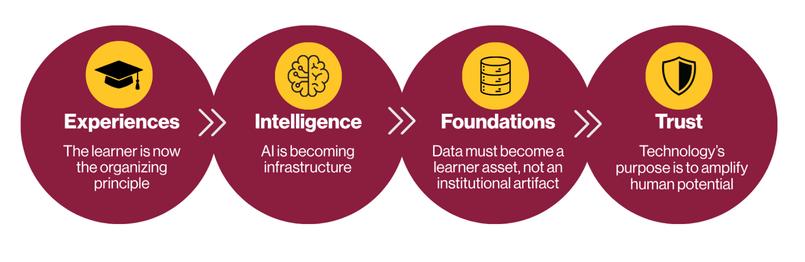
1. Drive purposeful technology innovation for student and learner success. Experiences Foundations Trust
2. Orchestrate and focus on the reliability and responsiveness of the ASU enterprise technical environment .
3. Advance AI-enhanced learning through responsible, sustainable frameworks. Experiences Intelligence
4. Accelerate ET’s AI designs for a future talent configuration, augmenting our human talent with growing machine capabilities. Intelligence Foundations Trust
5. Advance proactive cyber defense and intelligent governance. Foundations Trust
6. Cultivate a future-ready workforce through intelligent operations and communications. Experiences Intelligence
7. Actualize an integrated, AI-ready enterprise data ecosystem. Intelligence Foundations
8. Next-generation digital foundations and autonomous operations. Intelligence Foundations
9. Expand research and discovery through advanced technology. Intelligence Foundations
Drive innovation across a next-generation ecosystem to equip all learners for lifelong student success in partnership with the Office of the University Provost.
Objectives:
Synthesize distributed digital platforms into a seamless, high-accessibility student experience that modernizes the quality of interactions and proactively guides learners through vital academic milestones
Expand AI-powered companions and adaptive learning experiences tailored to students’ individual academic journeys, support networks, and evolving career aspirations, ensuring personalized engagement and timely intervention
Equip all students and learners with foundational AI literacy, onboarding frameworks and trusted guardrails to responsibly leverage agentic tools and enhance learning outcomes
Leverage real-time student data intelligence to transition student support services from reactive responses to predictive actions that identify and address potential obstacles before they impede student progress
Establish a seamless, standardized technology infrastructure and premium support model to ensure a stable inaugural year for the Shufeldt School of Medicine and Mechanical Engineering
Embed cutting-edge, AI-driven technologies directly into the health curriculum and clinical simulation spaces, positioning ASU Health at the forefront of modern medical education and digital patient experience design
Build pathways for students, future-ready learners across ASU and external communities to develop next-generation technologies, skills, leadership capacity
Drive a highly collaborative and agile operating framework that aligns Enterprise
Technology with strategic directives from the President’s Office, University Provost, Office of the Chief Operating Officer, Chief Financial Officer and the ASU Enterprise.
Objectives:
Deliver on specific strategic and tactical directives from the President’s Office, the University Provost, the Office of the Chief Operating Officer, the Chief Financial Officer and the ASU Enterprises
Collaborate with the Office of the University Provost to architect, scale and deliver optimized digital experiences that empower students to navigate the University ecosystem seamlessly
Partner with ASU Health and associated schools and colleges to deliver advanced learning technologies, enhance research capabilities and integrate enterprise data systems to support clinical training models
Collaborate with the Enterprise Brand team to deliver a premium experience in the asu edu web ecosystem, including accessibility, personalization and compliance with web standards
Accelerate coordination across the ASU Public Enterprise to scale core digital products, mature institutional data assets, and continue to unify the University’s stance as an AI-forward organization

Partner with the Office of the University Provost to leverage AI and emerging technologies to transform learning experiences and expand educational reach, ensuring every AI-driven learning solution is responsible, sustainable and scalable.
Objectives:
Drive measurable improvements in teaching, learning and discovery by implementing automated compliance, transparent policies and rigorous evaluation frameworks that protect student interests and ensure trusted, ethical AI use
Empower students, faculty and staff with scalable AI training, support and enablement programs that accelerate responsible adoption and foster a culture of AI fluency and innovation
Expand and scale personalized AI agents for students to integrate academic, institutional and personal knowledge, enhancing learning experiences with accessible onboarding and AI literacy support
Develop secure, interoperable AI systems with standardized protocols and scalable infrastructure to foster resilient educational and operational ecosystems within the University
Deliver personalized, holistic AI experiences across all ASU community members by leveraging modular platforms, cross-system data integration and context-aware AI services tailored to individual needs.
Enhance AI research capacity by upgrading experimental platforms and data workflows, thereby strengthening ASU’s leadership in AI-driven educational innovation and institutional transformation.
Embed AI innovation into healthcare education in partnership with Academic Enterprise and ASU Health on upstream learning goals, building a reliable strategic engagement infrastructure and empowering faculty to drive proactive impactful AI

Accelerate evolution as an AI-centric organization, embedding AI in how we work, research, design, deliver and govern services for the ASU community
Objectives:
Empower the ASU community with tailored development, structured outreach and advanced tools to build foundational AI fluency and confidence in long-term adoption
Pioneer rigorous operational and security frameworks enabling autonomous AI systems to safely manage complex workflows
Set the global benchmark for trusted AI by implementing transparent policies, dynamic oversight models and robust evaluation mechanisms for both internal and third-party technologies
Drive sustainable, campus-wide AI growth through industry-leading onboarding experiences, continuous technical support and stringent consumption governance
Integrate AI-driven intelligence across enterprise structures to refine reporting, bolster cross-departmental collaboration, and enable anticipatory, user-centered service delivery
Co-design experiential opportunities across ASU to facilitate cross-disciplinary collaboration and skill development while maximizing resources for community impact, including AI Day at ASU, Agentic AI and Student Experience Summit, ASU+GSV Summit, and 100 Year EdTech Summit

Establish an advanced, automated and human-centered framework for continuous threat defense, institutional resilience, and trustworthy AI governance that actively safeguards digital trust and privacy across all academic and operational environments.
Objectives:
Mature institutional threat visibility and continuous monitoring capabilities through an enterprise-wide, 24x7x365 threat-hunting ecosystem that scales automated detection and response across all digital assets.
Pioneer a sustainable cybersecurity talent pipeline that bridges institutional defense with academic excellence by embedding hands-on student workforce development directly into our active operational security model.
Transition from reactive cybersecurity measures to a predictive risk management model by embedding automated vulnerability remediation and real-time threat intelligence into departmental decision-making processes.
Construct a unified, leadership-endorsed framework to ensure comprehensive business continuity, disaster recovery preparedness, and annual operational resilience testing across the University.
Establish an enterprise framework for trustworthy AI adoption and data privacy compliance, ensuring the ethical, secure and transparent integration of emerging technologies across teaching, research and operational environments while safeguarding digital trust.
Fortify institutional data integrity and regulatory alignment by embedding advanced technical controls and privacy-by-design principles into the University’s evolving administrative and academic architectures
Activate cross-functional collaboration and responsible AI adoption to build a unified culture that drives operational excellence and strategic alignment.
Continue to foster a unified culture by activating cross-functional collaboration programs and systematically translating culture survey insights into targeted, measurable action plans that enhance belonging, trust and engagement at all organizational levels.
Strengthen external strategic partnerships and executive engagement through the maturation of intelligent assets and standardized frameworks, ensuring more deliberate, consistent and high-value collaborations.
Build continuous capability through data-driven frameworks, anchoring staff growth in practical AI collaboration and transforming traditional roles into high-impact, technologically resilient career paths.
Lead the enterprise in responsible AI adoption by embedding advanced, transparent and sustainable AI workflows into communications processes, piloting agentic automation and fostering cross-functional collaboration to drive operational excellence while safeguarding ethical standards.
Elevate enterprise brand integrity and stakeholder alignment by integrating AIassisted guardrails for messaging and creative deliverables, targeted interdepartmental campaigns and a comprehensive metrics framework that demonstrates the impact and reach across all strategic units.
Mature portfolio management capabilities with AI-driven data insights to ensure full alignment with the University’s strategic priorities to maximize value and impact across investments.
Cultivate a culture of AI-assisted financial management across the organization and foster alignment through shared accountability models

Forge a secure, AI-ready data ecosystem that delivers measurable institutional value.
Objectives:
Architect a scalable, context-rich data distribution framework that empowers both human decision-makers and autonomous AI agents to utilize ASU’s data effectively across operational, analytical, and research contexts.
Standardize metadata management and asset cataloging to automate data provenance, clarify ownership across functions, and facilitate seamless data discovery and utilization.
Operationalize proactive data quality detection to safeguard stakeholder trust and the integrity of downstream analytics.
Mature reporting, metrics and partner intelligence into a single decision-making layer that turns operational data into strategic insight.
Establish an enterprise approach to trusted, well-modeled data products and selfservice analytics patterns that empower colleges and units.
Drive the modernization of enterprise data platforms, ensuring platforms scale to institutional volume, performance and reliability requirements. Design frameworks to measure platform performance, data quality, integration reliability and adoption, and to articulate the quantifiable ROI of data and AI investments.
Evolve the University’s digital foundation into an autonomous, high-performing ecosystem to power the next generation of TechEd.
Objectives:
Modernize the University's core network infrastructure to deliver a secure, resilient and friction-free connectivity experience; expand regional and global campus reach through advanced bandwidth capabilities and modern edge architecture.
Continue to build a unified, scalable service and support model such that every interaction feels seamless and human-centered.
Deploy agentic AI and digital labor to expand institutional capacity across key service channels, including phone, chat, internal operations and HR workflows resulting in more efficient, timely resolution.
Establish a unified configuration management database (CMDB) to provide realtime, authoritative visibility into assets, dependencies and operational risks, powering unified enterprise service management.
Deepen institutional commitment to digital accessibility by scaling automated monitoring systems and compliance training across units..
Implement autonomous, zero-touch deployment methodologies and standardized hardware lifecycle frameworks across the University footprint.
Aggressively eliminate technological redundancy and recover costs to align institutional spending with modern strategic standards.
Modernize financial aid processes and the enabling technology to increase institutional efficiency and deliver a frictionless, supportive experience for students and staff.
Advance digital collaboration through optimized enterprise-scale solutions that if i d h i li i d li i f ff
Advance Enterprise Technology’s research activity by delivering technology, infrastructure, data, AI and partnership capabilities that address local, regional and national priorities.
On July 1, 2026, Enterprise Technology will expand its capacity to support research and development by bringing on an inaugural Deputy Chief Information Officer for Research.
Objectives:
In collaboration with ASU Knowledge Enterprise, expand AIR Platform utilization through CreateAI Builder to support research exploration projects across faculty, staff and students
Launch large-scale interdisciplinary work focused on health, AI and state infrastructure in collaboration with ASU Knowledge Enterprise and ASU Health
Work in collaboration with Sethuraman Panchanathan, engage the Greater Phoenix Economic Council, Arizona Commerce Authority and other area stakeholders to design and advance a regional quantum technology economic development strategy
Guide research and development to mobilize capacity across Enterprise Technology, ASU Knowledge Enterprise and ASU Health to secure external research funding through federal, state, foundation and industry programs
Support tribal community program and partnership development centered around language, culture, environment and health, collaborating to develop and apply infrastructure solutions