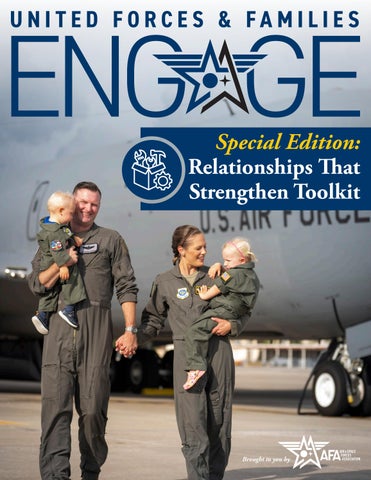
Special Edition: Relationships That Strengthen Toolkit
Brought to you by
Formerly: F2
Mission
To improve the quality of life for Airmen, Guardians, and their Families and ensure the mission effectiveness of our Air and Space Forces – strong Families, stronger Forces.
Vision
A thriving Total Force community where every Airman, Guardian, and Family member is supported and equipped to live well and serve well—today and for generations to come.
Thank You to This Edition’s ENGAGE Team
Senior Manager, Community Outreach: CHRISTINE NDAM • Senior Consultant: LYNDSEY AKERS, AKERS & CO • Graphic Designer: JENN MONTGOMERY, JEMOY CREATIVE • Feature Content Development: BREE CARROLL
2 | ENGAGE
Capt. Aisha Lockett and Capt. Broderick Lockett at Travis AFB, CA. // Airman 1st Class Christian Conrad, 2018.
Table of Contents The AFA Perspective
4
Why Engage?
6
Relationships on the Home Front
8
Military Marriage Resources + Recommendations
10
Relationships Driving Community
14
Partnerships With Purpose
16
Join AFA
23
By Christine Ndam By Lyndsey Akers By Bree Carroll
By Bree Carroll
Cover Art: The Bowman Family poses for a photo at MacDill AFB, Florida // Senior Airman Lauren Diaz, 2023
ENGAGE | 3
The AFA Perspective The Foundation of a Stronger Family Force
At the Air & Space Forces Association (AFA), we believe relationships are at the heart of everything we do. They are the foundation upon which resilient families, connected communities, and a ready force are built. Military life is marked by constant change. Deployments, PCS moves, career transitions, long separations, and evolving family dynamics create unique challenges for service members and their families. Yet through every season of military life, one truth remains constant: relationships matter. When service members and spouses invest in the foundational principles that strengthen their marriages and shape their family values, when military spouses share their experiences, when community partners work together to address local needs, and when leaders create space for meaningful dialogue, new possibilities emerge. Ideas become initiatives. Partnerships become solutions. Communities and relationships become stronger. As AFA’s Senior Manager, Community Outreach, I have had the privilege of witnessing these relationships in action. I have seen marriages strengthened through respite care opportunities that allow families and caregivers to reconnect. I have seen grants do far more than provide funding—they have boosted morale, fostered connection, and strengthened communities on installations across the country. I have seen AFA chapters bring together local leaders, volunteers, and military families to create solutions that improve quality of life and readiness.
strategic partnerships, the program exists to strengthen the relationships that strengthen our Family Force. If we aim to strengthen our Family Force, we must continue to invest in one another. We must create opportunities to connect, listen, collaborate, and build trust. Because when relationships grow stronger, families grow stronger. And when families grow stronger, our communities—and ultimately our force—grow stronger as well. Strong relationships strengthen families. Strong families strengthen communities. Strong communities strengthen readiness.
Conversations create
connections. Connections build
relationships.
Every partnership, support network, volunteer effort, and community solution starts when people come together, listen to one another, build trust, and discover a shared purpose. Conversations create connections. Connections build relationships. Relationships inspire action.
Relationships inspire
This belief is at the heart of AFA’s United Forces & Families program.
action.
From its inception, United Forces & Families was designed with relationships in mind. The program was created to bring together service members, military spouses, families, caregivers, community leaders, and advocates around shared experiences and common goals. Whether through Engage LIVE events, the Engage publication, community grants, leadership development opportunities, or Christine Ndam serves as AFA’s Senior Manager, Community Outreach and Lead for AFA’s United Forces & Families, Wounded Airmen & Guardians, and Community Partner Outreach Programs. She’s worked with AFA for 10 years and is a dedicated advocate to strengthening the Family Force.
4 | ENGAGE
Strong military families do not thrive by accident. They are strengthened through intentional investment in relationships. The same is true for communities, for partnerships.
LEFT: A young spectator waves a flag during an Independence Day parade. // Master Sgt. Jonathon Alderman, 2026. Col. Richard McElhaney gives a child a sticker during the 2026 Friendship Festival at Yokota Air Base. // Airman 1st Class Kayla Karelas, 2026.
ENGAGE | 5
Why Engage?
The Invisible Foundation of Relationships in the Military Community
Col. David Wyrick greets crowd members during an Independence Day parade in Montana. // Senior Airman Teniya Caldwell, 2026.
Human connection is vital. Within the military community, this reality is highlighted by the unique challenges of this lifestyle. While the importance of relationships is a universal truth, our lived experience often provides the most profound evidence of their value. In a community defined by constant change, relationships are the connective tissue that helps us navigate PCS moves, deployments, career transitions, parenting challenges, and the countless moments in between. They are often the difference between feeling isolated and feeling supported, between uncertainty and confidence, between simply enduring military life and thriving within it. Military spouses are cultivators of relational infrastructure. Every day, spouses make introductions, build bridges, and create pathways that help others succeed through connection: •
new families to communities
•
spouses to employment opportunities
•
service members to support networks
•
organizations to the people they are trying to serve
We connect ideas, resources, and solutions. These connections may seem small in the moment, but collectively they create a network that strengthens the entire military ecosystem. The return on relationships can be measured in many ways. In marriages, the return is trust, communication, and resilience through life’s challenges. For military families, the return often shows up as stability during transition, confidence during uncertainty, and access to resources when they are needed most. For service members, strong relationships contribute to family
6 | ENGAGE
readiness, personal resilience, and mission focus. When families are connected and supported, service members are better positioned to perform their duties knowing their support systems are intact. For community partners, relationships create access, credibility, and impact. The most effective organizations understand that meaningful service begins with meaningful connection. This is why relationship-building should not be viewed as a secondary effort or a “nice-to-have” side quest. It is strategic. The strongest communities are not built solely through programs, policies, or funding. They are built through networks of trust by people who invest in one another, share knowledge, create opportunities, and work together toward common goals. In a community built on service, sacrifice, and shared experiences, relationships remain one of our most valuable assets. They are the infrastructure that supports families, strengthens organizations, and sustains communities through change. The relationships we build and nurture today are not simply connections. They are investments that generate lasting returns for military families, service members, and the communities that serve them. And the families that follow in our footsteps.
Lyndsey Akers is a Senior Consultant for AFA’s United Forces & Families Program. She is an Air Force spouse and a strategic communications advisor.
Our Theme for 2026
Ignite the Family Force is a national movement bringing together military families, communities, and partners to build the future of military quality of life. It recognizes families as leaders, readiness enablers, and force multipliers — and creates real, scalable solutions that strengthen the force from the home front forward.
Family members greet Air Commandos upon their return from deployment at Cannon AFB, NM. // Senior Airman Corinna Morlan, 2026
Your Voice. YOUR STORY. ENGAGE features voices from across the military community—real stories, real connection, real impact. Share your story in a future issue of ENGAGE. Apply to Be an Author: AFA.org/ForcesandFamilies
Relationships on the Home Front
If you strip away the rank, the uniform, the duty stations, and the deployments, you’ll find the same thing at the center of the majority of military families: a marriage. It’s easy to overlook a lifestyle that moves as fast and demands as much as ours does, but marriage is the infrastructure holding military families together and military families are the infrastructure holding our force together. That word infrastructure isn’t just a metaphor I reach for casually. By day, I’m a civil engineer with the U.S. Air Force, leading project management and infrastructure initiatives across installations for over a decade. I spend my career thinking about load-bearing capacity, foundations, and what it takes to build something that can withstand pressure far after I’ve retired. The longer I do this work, the more I realize marriage operates the exact same way.
EVERY MARRIAGE LOOKS DIFFERENT (AND THAT’S THE POINT) No two military marriages are built the same. Some couples share the same faith; others are navigating different beliefs under one roof. Some come from similar backgrounds; others are blending cultures, generations, and traditions none of their families have ever seen before. Some have children, some are building toward that, some have made peace with not having them. Some have a cherished dog that’s moved across three time zones with them. Some have a strong preference for routine; others thrive in chaos. None of that variation changes the significance of the marriage itself. Whether your household looks like a recruiting poster or nothing like one at all, your marriage matters. Not just to you, but to the readiness of this force. Strong marriages build strong families. Strong families build a stronger force. That’s not sentiment. That’s structural truth. (See the chart on the next page for Military Marriage Day Survey result data)
8 | ENGAGE
Author Bree Carroll
WHAT ARE YOU ACTUALLY BUILDING? In my engineering career, before a single shovel hits the ground, we ask one essential question: what are we building, and why? You cannot pour a foundation for a building you haven’t defined. You cannot determine the right materials, reinforcement, or design without first understanding the structure’s purpose and mission. Marriage requires that same level of intentionality, and most of us skip right past it. We say “I do” without ever sitting down to clarify what we’re actually building together. What values will frame the design, what’s load-bearing and what’s flexible, what this marriage needs to withstand the unique pressures of military life: distance, deployment, relocation, reintegration, and the quiet erosion of two people slowly losing track of each other inside the busyness of survival mode.
structure is engineered to withstand “I want every stress through reinforcement, redunand design choices made well military couple to dancy, before the storm arrives. Couples who weather deployments, multiple PCS hear clearly: resilience moves, and the relentless unpredictCOMMUNICATION IS THE STARTability of this life well aren’t the ones ING POINT, NOT THE FINISH LINE isn’t a stroke of luck who avoided hardship. They’re the ones who built something durable on We talk a lot in this community about or a personality trait purpose, long before they needed it to communication, and rightfully so. hold. Still, communication without action is just two people describing prob- you’re born with. It is While military marriage was never inlems neither of them is solving. Real tended to be easy, its significance candeveloped.” partnership requires couples to move not be overstated. It represents a vital Without that shared blueprint, couples drift. Not because they stopped loving each other, but because they never defined what they were building toward in the first place.
from naming the issue to building toward the solution together. That might mean adjusting your finances before the next PCS, rather than after the stress hits. It might mean creating a reintegration plan before deployment instead of figuring it out in real time when your spouse walks back through the door. It might mean actually scheduling the hard conversation instead of hoping it happens organically. It also looks like being honest that your relationship may lack the essentials it needs to thrive, like fun, friendship or fondness. Communication opens the blueprint. Action gets it built.
RESILIENCE IS DEVELOPED, NOT INHERITED Here’s something I want every military couple to hear clearly: resilience isn’t a stroke of luck or a personality trait you’re born with. It is developed the same way a
Not At All 6.9%
Career Stress 9.7%
structural element that can impact the entire force, making it well worth the effort of intentional design. Utilize the toolkit in this publication as a resource to help you build and nurture your marriage with purpose. Bree Carroll is an Air Force spouse, mom of three, and founder of Military Marriage Day, observed annually on August 14th to equip couples with research, resources, and real stories — not just celebration. She is also the author of All Things EPIC, which introduces the CARE Blueprint: a framework for designing your life with intention. Bree believes that same blueprint (honest assessment, strong foundations, community support, and consistent engagement) is exactly what it takes to build a marriage that lasts.
STRESSORS IMPACTING MARRIAGE According to respondent results from the 2024 Military Marriage Day Survey
All of These 43.1%
Spouse's Career Stress 29.9%
The survey asked respondents how their marriage has been impacted by career stress, their spouse’s career stress, home stress, and financial stress. This chart illustrates the degree to which respondents felt their marriages were impacted by day-to-day stressors. It’s important to note that respondents were only able to choose one option.
6.9% Financial Stress
The survey received 145 usable, complete results of the 195 respondents (72%). 92% were military spouses and 7% were service members.
Home Stress 3.5% ENGAGE | 9
Military Marriage Resources + Recommendations A note on resources: Our community is fortunate to have access to a wide range of resources, and we encourage you to pursue these independently. Below are a few recommendations to help guide your research. Please note that AFA does not provide this content based on clinical data, and these frameworks are offered as general support, not as professional or therapeutic advice.
*
RECOMMENDED RESOURCES Support Services & Programs Live the Life Relationship enrichment and communication training
Military OneSource Free counseling and family support services
MFLC (Military Family Life Counselors) Confidential, on-installation support
Chaplain Services Pastoral care and confidential counseling
The Seven Principles For Making Marriage Work By John M Gottman
A couple shares a moment during a redeployment event at Spangdahlem AB, Germany. // Master Sgt. Alexander Riedel, 2025
THE 3-QUESTION CHECK-IN MONTHLY RELATIONSHIP CHECK-IN
E Expenses (finances, budget, upcoming costs) N Needs (physical, emotional, practical) G Gratitude (what are we thankful for this month?) A Action items (follow-through on last month’s conversation) G Goals (where are we headed, individually and together?) E Evaluation (what’s working in our marriage, what needs attention?)
10 | ENGAGE
*According to the 2024 Military Marriage Survey conducted by Military Marriage Day and sponsored by Armed Forces Insurance.
Once a month, set aside 20 quiet minutes together. Ask each other these three questions, in order. No phones, no distractions.
Ask Each Other 1. What has felt good between us this month? 2. What has felt hard between us this month? 3. What’s one thing we want more of next month?
Tips for the Conversation • • • •
Let each person finish before responding Listen to understand, not to defend It’s okay if the answers are short — depth matters more than length End by naming one thing you’re grateful for
RELATIONSHIP HABITS HELPER Strengthen your connection with these practical habits: • Prioritize a weekly touch-base (minimum 15 minutes) • Suggested script: “I’d like to check in. I’ve noticed... How are you feeling (physically or emotionally)? One thing I really appreciate about you is...” • Voice your appreciation every single day • Establish a “coming home” transition ritual • Decompress: Spend 2 minutes in the car or practice 4x4 box breathing (inhale, hold, exhale, hold for 4 seconds each) • Internalize a positive mantra: “I am home and I am loved,” or “This is my sanctuary” • Deliberate Greeting: Share a beverage, a joke, or physical affection; avoid immediate venting or criticism • Conduct a quarterly review of shared values and progress • Discuss: What brought us closer to our objectives? What stood in our way? Are we still in sync with our core values? • Proactively access support networks • On-Base: Chaplains, MFLCs, or peer accountability partners • Off-Base: Counselors, church groups, or relationship tools like conversation cards
CONVERSATION STARTERS FOR DAILY DIALOGUE Guided questions designed to open meaningful dialogue between partners: • When do you feel most supported by me? • Is there one small thing I could start doing (or stop doing) to help us feel more connected? • Honestly, do you feel like we’re tackling stress as a team lately, or are we just kind of dealing with it on our own? • If we were “thriving” right now instead of just getting by, what would that actually look like for us? • How are you really feeling about the big stuff—our money, our intimacy, and just the general pace of our life? • If we weren’t a military family, what do you think you’d be doing for work or fun? What’s that “alternate universe” version of you like? • What’s one part of your personality that’s been stretched the most by this lifestyle? Is there anything you wish you could change about how you react to it? • Does it feel like there’s anything missing from your life right now that we should try to make space for? • How do you think you’ve changed over this last season? What feels different about you now compared to a year ago? • When we finally land in our “forever home” after all the moves, what does that place look like to you? • If you could swap lives with anyone for a year, just for the experience, who would it be? • Have any of your big goals or dreams shifted lately? I want to make sure I’m still running in the same direction as you. • What are your dreams for your life right now, regardless of where the orders take us next? • What do you want for us as a family, not just to survive this lifestyle, but to actually thrive in it? • What’s a personal goal you have that’s just for you—not for the military, not for the kids, just for your own growth? • If you could wave a wand and improve one thing about yourself, what would it be? How can I help with that? • Looking back on this past year, what were the highlights, and what were the hardest parts? • What’s one adventure—big or small—that you want us to go on together while we’re at this duty station? • Is there anything currently going on that feels like it’s pulling us apart or hurting our relationship?
ENGAGE | 11
RELATIONSHIP CHECK-IN ASSESSMENT Every relationship moves through seasons: some steady, some strained. This page is a private check-in, just for the two of you. There are no right answers, only honest ones.
Self-Check-In Rate how true each statement feels right now, on a scale of 1 (rarely) to 5 (almost always). Each partner can complete this separately, then compare. RARELY
ALWAYS
We communicate openly, even about hard topics
1
2
3
4
5
I feel emotionally supported by my partner
1
2
3
4
5
We handle stress as a team, not against each other
1
2
3
4
5
We make time for each other despite busy schedules
1
2
3
4
5
I feel known and understood by my partner
1
2
3
4
5
We recover well after disagreements
1
2
3
4
5
We are aligned on what matters most to us right now
1
2
3
4
5
Self-Reflections
Reflect Together
1. What is one thing my partner does that makes me feel loved or supported that I hope they keep doing?
1. Which statement above did you rate highest? What’s working?
2. What is one thing happening in our life right now that I wish my partner understood better?
2. Which statement felt hardest to rate honestly? Why might that be?
3. When I picture us a year from now, what do I hope our relationship feels like? 4. What is one way my partner could show up for me better this month?
Our Commitment Close by writing down one thing, together. Keep this somewhere you’ll see it again — on the fridge, in a planner, or tucked in a wallet.
OUR ONE COMMITMENT Over the next 30 days, we will:
How will we remind each other of this commitment?
Who or what can support us in keeping it?
12 | ENGAGE
Bernkastel-Wittlich County Commissioner visits Spangdahlem Air Base. // Senior Airman Demi M. Ebert, 2026.
WA ANG hosts collaborative training focused on leadership and resilience. // Master Sgt. Brandy Burke, 2026.
Relationships Driving Community Who’s Sitting at Your Table? By Bree Carroll
I love the sentiment that it’s a “small Air Force”, because it’s true - our military community is closer in proximity than we realize. Regardless of the number of moves or career transitions, you will find people who are linked by a common person or a solution that is a short phone call away from resolution due to a relationship. I’ve had the opportunity to see this on the operational side as a GS civilian as well as an Air Force spouse. If you’re connected to this Air Force and Space Force family in any capacity- active duty, retired, spouse, civilian employee, or mission partner- you already know that community isn’t a nice-to-have in this life. It’s infrastructure. 14 | ENGAGE
In my book, All Things EPIC, the acronym stands for Experiences with Purpose, Impact, and Community. The “C” isn’t an afterthought and has tremendously shaped our service life. I define community simply: it’s the support that sustains you right where you are. Not where you used to be stationed. Not where you’re hoping to land next. Right here, in this season, on this installation, in this version of your life and career. For anyone connected to this lifestyle, whether you’re the one in uniform, the spouse managing the home front, the partner navigating a relationship that doesn’t fit a traditional mold, or the civilian employee working alongside Airmen and Guardians every day, that definition matters. We are all, in some way, masters of starting over. PCS moves, deployments, retirements, and career transitions all reshuffle our circles constantly. Somewhere along the way, many of us stop being intentional about who actually has access to “our table”. We default to whoever is geographically closest instead of who is actually needed. Consider this concept: “Guarding the Seats at Your Table.” When I was immersed in the wedding industry, I’d politely poke fun at couples who fight over their reception seating chart but never think twice about who has general admission access to their actual life. If that’s you, it’s time to put up the velvet rope.
THE COMMUNITY AUDIT Let’s put this into practice. Consider running this audit on your own circle regularly, regardless of rank, role, or relationship: Relationship Range: Your table needs range to include friendships across different backgrounds, life stages, and roles within this community. It’s easy to surround yourself with people who look like you, think like you, and serve exactly like you, but there’s real beauty in friendships that stretch you, that bring a different lens to your blind spots. Having that range reminds you this community is bigger than your career field, duty station or limited perspective.
Support Structures. This is where coaching, counseling, and therapy come in. Not every need at your table can be met by a friend or peer, no matter how much they care about you. A therapist supports healing. A coach supports growth and accountability toward a goal. A mentor offers wisdom from lived experience. Knowing the difference and knowing when you need each one is part of being a good steward of your own life and career.
Those above you. Somewhere in your circle should be someone a few steps ahead like a senior leader, a retired member, a longtime spouse, or simply someone who’s already walked the road you’re on and can help you navigate it with less anxiety.
Your peers. These are your battle buddies. The people in the trenches with you right now, who understand the specific weight of this season because they’re carrying something similar.
Those behind you. This is the one we skip most often. Someone a few steps behind you needs what you already have. Your experience, your encouragement, your willingness to reach back. Pouring into them does something for you too. It reminds you how far you’ve actually come. A table missing any of these legs gets unstable fast.
WHAT THIS BUILDS IN US When I think about what a relationship-driven community actually produces, four things come to mind. Belonging
Community building
Advocacy
Connection
The experience and creation of community. Belonging isn’t passive. You create it through consistency, vulnerability, and showing up enough times that trust has room to grow.
How relationships become roots. A friendship that survives one PCS or one deployment is nice. A friendship that survives several, that gets reinforced across time zones, career milestones, and life stages, becomes something closer to family. That’s the difference between a relationship and a root system.
Using connection to advance change. Real community doesn’t stay inward-focused forever. Eventually it turns outward: toward policy, toward resources, toward making things better for those coming behind us.
The practice of showing up for others. Not the performance of it on social media. The actual practice in making the meal you drop off or the text that says “I see you” when someone is clearly struggling. It’s the follow up email after the conference and the warm introduction.
YOUR TABLE IS WORTH PROTECTING This life in any role you hold within it will hand you plenty of people. It won’t hand you community. That part is on you to build, audit, and protect. So look at your table. Who’s sitting in those seats? Who’s missing? Where do you need more range, more support, or simply more intention? You don’t need a packed table. You need the right one (and the commitment to guard it accordingly.) ENGAGE | 15
Partnerships With Purpose Community Connection COMMUNITY CONNECTION AUDIT
A reflective self-assessment to help you understand your current network and identify gaps:
Where I Am Connected • • • •
Where I Am Disconnected
Who supports me in my daily life? Who do I support or pour into? Where do I feel a sense of belonging? Which organizations am I part of?
• Where do I feel isolated or unseen? • Who have I lost touch with? • What communities do I wish I belonged to?
COMMUNITY BUILDING CHECKLIST
Simple, actionable ways to create connection — whether arriving at a new duty station or deepening roots in an existing community:
National Anthem at Elks Rodeo event at Vandenberg SFB, CA. // Airman 1st Class Olya Houtsma, 2026.
• • • • •
Introduce yourself to one new person this week Attend one unit or community event this month Offer help before you need it — build relationships proactively Connect two people who should know each other Follow up: relationships are built over time, not in a single meeting
Spark THE SOLUTION See a need? Be the change: Apply for an AFA Focus Grant that could advance your community efforts.
16 | ENGAGE
CONTACT Christine Ndam CNdam@afa.org
Partnership Spotlights AFA X SPOUSE-LY The Challenge Military spouse entrepreneurs build businesses while navigating deployments, frequent moves, and the instability that often comes with military life. Despite their resilience, these business leaders often struggle for visibility and access to a broader customer base. AFA’s United Forces & Families program has long worked to amplify quality-of-life issues facing military families, recognizing that family readiness and mission readiness are directly connected. The Partnership AFA’s United Forces & Families program teamed up with Spouse-ly, an eCommerce platform built exclusively around goods made by military service members and their families. Spouse-ly is owned and founded by Air Force spouse Monica Fullerton, who built the company to spotlight entrepreneurial talent within the military community. Together, the two organizations launched a curated AFA x Spouse-ly collection of aviation, aerospace, and military-inspired products. The Value With every purchase from the collection, 5 percent of proceeds directly support AFA’s mission to support Airmen, Guardians, and their Families. Spouse-ly gains expanded visibility for its sellers, while AFA strengthens its quality-of-life programming. As Fullerton put it, “When we come together in support, we create impact that reaches far beyond a single purchase.” The Long-Term Vision Military families face unique financial hurdles, and this partnership is designed to grow right alongside those needs. It’s more than just a collaboration; it’s a developing model that becomes an engine for community support and helps our community thrive. By shopping here, you aren’t just making a purchase; you’re fueling support for our families and keeping the spirit of service alive with every item. How to Engage The collaboration between AFA and Spouse-ly offers several meaningful ways for you to directly support military-connected entrepreneurs and the broader mission of family readiness: • Spread the Word: Advocacy is a core value of United Forces & Families. Share information about the Spouse-ly platform with your network to help broaden the customer base for these resilient business owners. • Become a Vendor: If you are a military service member or spouse with an entrepreneurial spirit, consider joining Spouse-ly to showcase your own talent and gain visibility within the community. • Utilize and Share Gift Guides: Use Spouse-ly and AFA resources to find purposeful gifts for holidays and special occasions, ensuring your spending has a positive social impact. • Share Vendor Stories: Amplifying the individual stories of military-connected makers fosters a deeper sense of community and highlights the diverse talent within the force.
ENGAGE | 17
AFA X INDEPENDENT The Challenge Military and veteran spouse wellness has long been an under-researched area, despite the central role spouses play in family and mission readiness. No comprehensive, data-driven picture of the community’s well-being existed, leaving gaps in mental health support, financial stability, and social connection largely undocumented and unaddressed. The Partnership InDependent, a nonprofit run by and for military spouses, partnered with the University of Texas at Austin’s Institute for Military and Veteran Family Wellness to conduct the Military & Veteran Spouse Wellness Survey, polling over 1,100 spouses of active-duty and veteran service members across eight dimensions of wellness. A focus grant from AFA’s United Forces & Families program helped support the survey’s launch, and the findings were unveiled at a daylong hybrid event held at AFA’s national headquarters in Arlington, Virginia. The Value (For Both Parties) For InDependent and IMVFW, AFA’s support provided the platform and a nudge of additional credibility to launch the first national survey of its kind, reaching hundreds of guests in person and online, including senior leadership and their spouses. For AFA, the event reinforced its United Forces & Families mission with hard data while also expanding the military audience beyond the Air and Space Force communities. The collaboration turned research into a shared platform for advocacy. The Long-Term Vision InDependent hopes to repeat the study every two years, if not annually, building a long-term picture of spouse wellness over time. As one researcher noted, insights alone don’t shift culture; it takes sustained action. For AFA and InDependent, the partnership marks the beginning of an ongoing effort to turn data into policy, programming, and support that meets military and veteran spouses where they actually are. How to Engage The findings from the Military & Veteran Spouse Wellness Survey serve as a powerful tool for advocacy and community building. Engagement begins with awareness and moves toward active dissemination of this critical data to ensure it reaches those who can implement systemic change. • Review and Share Findings: Become familiar with the survey results*, which highlight that over 50% of spouses identify finding community and social support as their primary challenge. Share these insights within your local units, chapters, and social networks to normalize the conversation around spouse well-being. • Advocate for Mental Wellness: Reference the data regarding healthcare access—where nearly a quarter of spouses report challenges—to emphasize the importance of proactive mental wellness. Use these statistics when speaking with leadership to advocate for increased resources and reduced barriers to care. • Facilitate Resource Connection: Actively connect spouses in your community with the resources highlighted by the data. By bridging the gap between those in need and established support systems, you help turn research into sustained action that improves the lives of the family force.
18 | ENGAGE
*1,100 military and Veteran spouses were surveyed by InDependent.
AFA X OPERATION CHILD CARE PROJECT The Challenge Reliable child care has long been one of the biggest readiness gaps facing military families. At Eglin Air Force Base and Hurlburt Field in Florida, demand for safe, vetted caregivers far outpaced availability, leaving spouses to navigate shift work, deployments, and child care shortages largely on their own. For some, the gap was significant enough to end their military careers altogether. The Partnership AFA’s United Forces & Families program partnered with Operation Child Care Project (OCC Project), a nationwide nonprofit led by military spouses focused on improving child care access and equity for military families. AFA awarded a $5,000 grant to fund OCC Project’s HomeFront Helpers Pilot, enrolling 25 military spouses at Eglin and Hurlburt in a weekend-long professional training course. The grant provided $250 stipends to each of the 20 participants who completed the training, certifying them to meet and exceed DOW standards for in-home child care. The Value (For Both Parties) For OCC Project, the partnership provided the funding needed to launch a first-of-its-kind training cohort, with nearly 75 percent of participants being military spouses, prior service members, or retired military spouses who understood the challenge firsthand. For AFA, the program embodied its core belief that family readiness is mission readiness, turning a grant into a tangible workforce of trained, vetted caregivers ready to serve Eglin and Hurlburt families. As one newly certified Helper put it, she once left active duty because she lacked reliable child care for her shift work, and the program let her find a new way to keep serving. The Long-Term Vision OCC Project designed the HomeFront Helpers model to be replicated across the force, with plans already underway to scout additional installations for the next rollout. For AFA, the partnership reinforces a commitment to treating child care not as a convenience, but as a mission requirement, one grant and one trained caregiver at a time. How to Engage The success of the HomeFront Help pilot in the Florida panhandle serves as a powerful blueprint for community action. This mission expands to Colorado Springs and beyond and your involvement is key to sustaining this momentum. There are several meaningful ways to support the mission of OCC Project: • Share the Success: Spread awareness of the pilot’s impact within your community. Highlight stories like the recent Colorado Springs launch to show that grassroots, spouse-led solutions are effectively addressing critical child care gaps. • Connect with OCC Project: Follow the organization’s mission and stay informed on new pilot locations and advocacy efforts. Engaging with their resources helps amplify their voice when addressing national leaders and local stakeholders about the child care crisis. • Support Local Families: Actively connect spouses and families in your area to OCC Project’s resources. These vetted caregivers provide essential ad-hoc, emergency, and part-time support that DOW-sponsored programs may not always cover. • Elevate the Workforce: Encourage military spouses, retirees, and community members to apply as HomeFront Helpers. Participants receive compensated training, CPR certification, and specialized behavioral support training, creating new, flexible career pathways that directly strengthen mission readiness. ENGAGE | 19
Partnership Builder
PARTNERSHIP REFLECTION WORKSHEET: HOW TO BUILD A COMMUNITY PARTNERSHIP
STEP 1: IDENTIFY THE CHALLENGE What military family challenge do you care most deeply about?
Who is most affected by this challenge?
Why does this issue matter to you?
STEP 2: FIND SHARED INTERESTS Who is already working on this issue? [ ] Military Families
[ ] Business Partner
[ ] Military Spouses
[ ] School/University
[ ] Installation Leadership
[ ] Community Organization
[ ] AFA Chapter
[ ] Other:
[ ] Nonprofit Organization Specific organizations or individuals:
CONNECTOR MINDSET FRAMEWORK
Strong communities are built by connectors: people who see potential in relationships and invest in them. Understand your opportunity in the ecosystem:
Your Network • Who do you know across sectors?
Who should know each other but doesn’t?
• What organizations are you trusted by?
STEP 3: START THE CONVERSATION
• Who comes to you for connections?
Who is one person or organization you could connect with in the next 30 days?
• Where do you have access others don’t?
What conversation would you like to have?
What do you hope to learn?
Your Influence • What problems do people know you care about? • Where do you have earned credibility? • What ideas or energy do you bring? • How can you amplify others?
20 | ENGAGE
TOP: Chief Master Sgt. Lawton poses with a group of community members during Military Spouse Appreciation day.in Kaiserslautern, Germany. // Airman Paden Henry, 2026.
STEP 4: DEFINE MUTUAL VALUE
YOUR NEXT CONNECTION CHALLENGE
What can you contribute? [ ] Time
[ ] Leadership
[ ] Expertise
[ ] Funding
[ ] Community Connections
[ ] Communications Support
[ ] Volunteer Support
[ ] Other: ___________________
What value could your partner bring?
What shared goal would unite your efforts?
STEP 5: ENVISION SUCCESS What would success look like in 12 months?
What would success look like in 5 years?
How would military families benefit?
Choose one action you will commit to this month: [ ] Meet one new military spouse [ ] Attend one community event [ ] Connect a family to a resource [ ] Start one partnership conversation [ ] Volunteer with a local organization [ ] Share your story [ ] Introduce two people who should know each other [ ] Identify one challenge you want to help solve [ ] Reach out to a potential community partner [ ] Other:
MY COMMITMENT: I will:
COMMUNITY ASSET MAP by (date): People
Organizations
Who can help?
Who can partner?
REFLECTION One relationship I want to strengthen:
Resources
Opportunities
What programs, facilities, funding, or networks exist?
Where could collaboration create impact?
Remember: Strong partnerships begin with conversations. Strong communities are built through relationships. Strong relationships strengthen the Family Force.
One partnership I want to build:
ENGAGE | 21
Family, friends, and fellow Airmen celebrate Col. Garrett Fisher’s fini flight at Joint Base Pearl Harbor-Hickam, HI. // Staff Sgt. Mark Sulaica, 2026
“In a community defined by constant change, relationships are the connective tissue that helps us navigate PCS moves, deployments, career transitions, parenting challenges, and the countless moments in between. They are often the difference between simply enduring military life and thriving within it.” Lyndsey Akers
Air Force spouse, mother, and AFA United Forces & Families Senior Consultant
22 | ENGAGE
Join AFA Joining the Air & Space Forces Association’s Million Member Mission is a free and meaningful way for every member of the military family to strengthen their connection, influence, and impact within the community. Members gain deeper engagement opportunities with AFA’s United Forces & Families program, helping elevate spouse and family perspectives, contribute to solutions that matter, and ensure their voices are heard in shaping programs and priorities. Participation also opens the door to professional development and networking events, access to helpful resources such as grants and community support programs, and direct connections with leaders and peers across the Air Force and Space Force ecosystem. Through local and national engagement opportunities, service members, military spouses, and family members can play an active role in improving quality of life for military families in their communities — all at no cost to join.
Connect With Us @airandspaceforcesassociation @afa_air_space @air-space-forces-association @afa_air_space
Activate Your Mission Membership https://bit.ly/4a8y9rT
SCHOLARSHIPS FOR SPOUSES
Delta Dental Grants • Five $2,000 awards • For spouses, dependents & transitioning service members • Oral health & wellness
Mike & Gail Donley Spouse Scholarships • $2,500 annually • For Air Force & Space Force spouses worldwide • Higher education
Apply Now: AFA.org/Scholarships
An Air Force mother reunites with her Army son while deployed to East Africa, highlighting resilience, sacrifice and family bonds. // 2026
www.AFA.org/ForcesAndFamilies