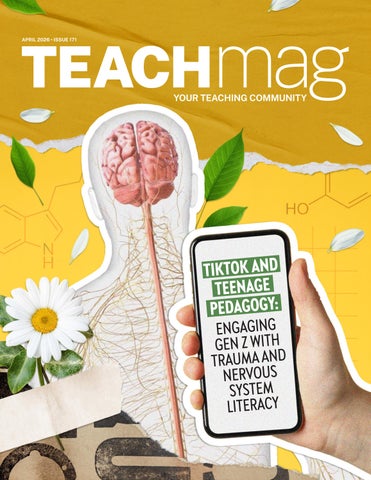
TIKTOK AND TEENAGE PEDAGOGY: ENGAGING GEN Z WITH TRAUMA AND NERVOUS SYSTEM LITERACY

Teaching the Modern-Day Relevance of Fahrenheit 451
BY GLENNA SILK

TIP: If you’re looking for additional real-world situations to connect to the novel, check out this list of supplemental texts.
In today’s society, the need to keep ourselves constantly entertained—whether by scrolling through social media feeds, streaming a never-ending supply of TV shows, or drowning out the world through music and podcasts—has become a topic of frequent discussion, particularly the effect this is having on children.
As adults, many of us can remember a time before Netflix and TikTok, before Google, AirPods, and the rise of AI. Our students, however, do not.
But although this mindless consumption may have taken on new forms over the years, the pattern itself certainly isn’t new. Ray Bradbury noticed it all the way back in 1953, when he took an evening stroll around his neighborhood only to find every single house had their TV turned on. He was the only one outside. This moment is partly what inspired him to write his dystopian novel Fahrenheit 451, a cautionary tale that depicts a world dominated by screens and citizens that follow blindly.
The story focuses on a character named Guy Montag, who lives in a society where people are encouraged to constantly listen to the radio or one of the many television sets throughout their home. In this world, freedom of thought is discouraged and reading is forbidden.
Montag works as a “fireman”—not to put out fires, but to burn and destroy any books that are found. Those who disobey the book law risk capture and even death. But everything begins to shift when Montag witnesses a shocking act of defiance: a woman who chooses to remain in her home, surrounded by the books she loves, as firemen reduce it to ashes.
Staring at the flames, Montag says, “There must be something in books, things we can’t imagine, to make a woman stay in a burning house… You don’t stay for nothing.”
This scene, paired with a simple, unsettling question from his new neighbor Clarisse— “Are you happy?”—sparks the first stirrings of change in Montag. Slowly, he begins his transformation from a blind follower to a free-thinker.
While Bradbury’s novel was originally written over seventy years ago, its themes are more pertinent than ever—especially in the classroom.
CONNECTING IT TO THE PRESENT
Nothing draws students into a lesson more than connecting it to topics they care about and see as relevant to their lives. At first, students and teachers alike might think that Fahrenheit 451 feels outdated, but the reality is, it still ignites conversations that are anything but old-fashioned: class discussions quickly become lively, with kids talking more passionately than ever!
The novel becomes a powerful lens for examining current events, from Elon Musk’s Neuralink to the growing addiction to short-form content. As artificial intelligence tools like Gemini, ChatGPT, and countless others become part of everyday life, students can be prompted to consider what might happen when technology not only assists humanity but begins to take control entirely.
By comparing Bradbury’s dystopia with our own tech-saturated reality, students can take a closer look at how modern innovations shape their attention spans, influence their independent thought, and even challenge their sense of free will. Suddenly, the book doesn’t feel like fiction at all. It feels like a warning.
Keeping students genuinely engaged is every teacher’s goal; there’s nothing better than seeing more than just two kids raising their hands. In my own
TIKTOK AND TEENAGE PEDAGOGY: ENGAGING GEN Z WITH TRAUMA AND NERVOUS SYSTEM LITERACY
By Lesley Machon
As a teacher, when a fifteen-second video clip makes your students lean forward in their seats, listening intently with bright eyes and bated breath, you don’t take that kind of attentiveness for granted. In my case, that’s what happened when I first showed one of Dr. Christine Gibson’s enlightening TikTok videos.
It was an explanation of the nervous system and how somatic techniques can help us attend to our well-being. Easy to understand and digest, without inaccessible jargon, Dr. Gibson’s content cut through the social media clutter to reach my students, meeting them where they were in the vernacular of a generation accustomed to screens.
Engaging with Trauma
When I first began teaching a psychology elective course two years ago, my goal was to cultivate a learning environment that invited students into meaningful engagement with all kinds of personal challenges—from mental health diagnoses and neurodivergence to traumatic experiences and everyday stress. I wanted my classroom to be a space my students could, however briefly, put down all the heaviness they carry with them every day.
Aside from my work in education, I’ve also spent the last several years training and serving as an interfaith chaplain in hospitals, hospices, and addiction centers across my city. I sit with youth and adults in their most tender hours, in the blue glow of ICU monitors, in twilight rooms where their breath becomes laboured. Together, we wade into the quiet that follows confession, hurt, and grief.
I am no stranger to unresolved trauma, caused by anything from environmental catastrophe to personal loss, and how it can transform into a series of sleepless nights, hands that won’t stop moving, or a winter fog of the mind that hangs heavy, enduring. I’ve seen the same thing in my classroom, have watched students become disengaged and disconnected from themselves, from each other, and from the world around them; so many carrying pain that felt illegible to the systems meant to support them.
Although I have witnessed and felt, at the deepest level, how our inner worlds and outer crises are braided together, I didn’t yet know how to work that knowledge into my classroom in a way that would be meaningful to my students.
Then, I came across Dr. Christine Gibson’s content on TikTok.
A New Way to Reach Students
Dr. Gibson is a family physician who addresses trauma and toxic stress. Her TikTok presence (@tiktoktraumadoc) caught my attention because it discussed trauma in safe, accessible ways, and offered a sense of connection at the same time. It served as a reminder that all of us are struggling and that we can learn new ways to express this struggle.
The first thing that came to my mind after watching a few of Dr. Gibson’s videos was, I should show this to my students. Not only did her content embody a sense of psychological safety, it also offered practical skills in a way that kids could relate to. Her framework honoured the intelligence of young people, rather than talking down to them, and it offered a language with which to make sense of and connect to their nervous systems.
These days, the reality is that plenty of young people are learning about mental health online. It’s astonishing how many of them use TikTok for online searches. A UBC qualitative study uncovered that kids find TikTok easy to access, that it gives a sense of connection (and validation) and provides skills to cope with their challenges.
If this was the material my students related to, why not incorporate it into my teaching?
The initial positive reaction from my students after I showed them one of Dr. Gibson’s videos told me I was on the right track. So I took things one step further and tried designing a few lessons based on her book The Modern Trauma Toolkit. It provided just what I needed.
Those lessons were met with such enthusiasm from my students that I pulled apart my entire curriculum (activities, lesson plans, and all) and recreated it. Since then, I’ve had students showing up at lunch, after school, and even waiting outside my door before class begins. Their eagerness speaks to the success of this new approach, and I look forward to continuing on this path.
The River of Life
We started with water. The “River of Life” project, which came from the opening chapter of Dr. Gibson’s book, invited students to trace their life journeys—or those of an ancestor, character, or another figure whom they felt safe to explore.