BC Teachers’ Federation
Sept/Oct 2026
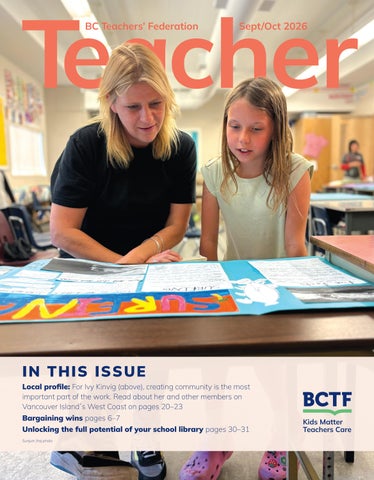
IN T H I S I S SU E Local profile: For Ivy Kinvig (above), creating community is the most important part of the work. Read about her and other members on Vancouver Islandʼs West Coast on pages 20–23 Bargaining wins pages 6–7 Unlocking the full potential of your school library pages 30–31 Sunjum Jhaj photo
IN THIS ISSUE
14
30
32 Volume 39, Number 1 — Sept/Oct 2026 6
Inspiring colleagues
8
Bargaining wins
12 14
16
26
Building resilient educators: The power of mentorship
My six-step lesson/unit planning process: A practical guide to creating a more inclusive classroom
29
Can slang be beneficial? Definitely, bruh!
Creating kinship with the land: Indigenous plants return home at Marlborough Elementary
30
Beyond bookshelves: Unlocking the full potential of your school library
32
A vision for 2030: Hope, community, and action at the BCTF 2SLGBTQIA+ Summit
34
Literacy instruction success stories from across BC
36
Book review: An engaging resource on BCʼs natural world
36
TTOC checklist
From genocide to resurgence: Launching the second edition of Project of Heart: Illuminating the Hidden History of Indian Residential Schools
18
How to create a sensory-aware classroom and why it matters
20
Local profile: Teaching and learning on Vancouver Islandʼs West Coast
24
Getting more men into teaching could help boys and young men
2 TEACHER Sept/Oct 2026
Regular features 4
President's message
5
Message de la présidence
THIS IS YOUR
MAGAZINE BC Teachers’ Federation
Sept/Oct 2026
Do you enjoy writing? Have a story to tell? Know of a project at your school or in your local you want to share with colleagues? Then consider writing for Teacher, the flagship publication of the BCTF! Submission guidelines are available at teachermag.ca. We also welcome letters to the editor. Send your letter to teachermag@bctf.ca.
6 Articles reflect the views of the authors and do not necessarily express official policy of the BCTF. The BCTF does not endorse or promote any products or services advertised in the magazine. Advertisements reviewed and approved by the BCTF must reflect BCTF policy and be politically, environmentally, and professionally appropriate.
I N T HI S I S S U E Local profile: For Ivy Kinvig (above), creating community is the most important part of the work. Read about her and other members on West Coast Vancouver Island on pages 20–23 Bargaining wins pages 6–7 Unlocking the full potential of your school library pages 30–31 Sunjum Jhaj photo
Contact us BC Teachers’ Federation Phone 1-800-663-9163 Email teachermag@bctf.ca Web teachermag.ca Editor Sunjum Jhaj, sjhaj@bctf.ca Assistant Editor/Designer Sarah Young, syoung@bctf.ca Advertising teachermag@bctf.ca ISSN 0841-9574
Teacher reserves the right to edit or condense any contribution considered for publication. We are unable to publish all submissions we receive.
Deadlines Nov/Dec issue Jan/Feb issue March issue May/June issue
September 2025 November 2025 January 2026 March 2026
BCTF Executive Committee Alex Adhikary Jatinder Bir Shannon Bowsfield Brenda Celesta Adrienne Demers Carole Gordon Shawn Holland
Mary Lawrence Frano Marsic Chris Perrier-Evely David Peterson Robin Tosczak Winona Waldron
Teacher Magazine Advisory Board Nandini Aggarwal Alexa Bennett Fox Robyn Ladner Tamiko Nicholson Kristin Singbeil
Sept/Oct 2026 TEACHER 3
W E LCO M E BACK TO A NE W SCHO O L Y EA R A new school year always brings with it a sense of possibility: new students, new relationships, new challenges, and new opportunities to make a difference. The stories written by teachers in each edition of the magazine are a reflection of the extraordinary commitment, creativity, and care that exists in schools across our province. Even in challenging times, our profession is strengthened by the people around us. The colleagues who offer encouragement, share ideas, and step up when help is needed remind us why this work matters. That spirit is at the heart of this issue. On pages 6–7, teachers share stories about colleagues who inspire them. I’m sure these reflections will bring forward memories of our own mentors and show us we are not alone in this important work. This issue also looks back at the last round of bargaining (pages 8–11). Members of our Provincial Bargaining Team reflect on what we achieved together and the important gains won through the collective strength of our membership. Those wins show us that progress is possible when we stand together, organize, and remain focused on improving both our working lives and the learning conditions of our students.
Rich Overgaard photo
PRESIDENT ’ S MESSAGE “School board elections are coming up this October and have a direct impact on our students and our schools. I encourage you to get informed, get involved, and help make public education an important part of the conversation.”
You will also find information about the updated Project of Heart resource (pages 16–17). This resource offers another opportunity to support learning, reflection, and meaningful engagement with Indigenous perspectives, history, and reconciliation. As we begin a new school year, we know there is much work ahead, but there is also much reason for optimism. School board elections are coming up this October and have a direct impact on our students and our schools. I encourage you to get informed, get involved, and help make public education an important part of the conversation. There is something for each of us to act on: whether that means learning about candidates and their positions, encouraging others to vote, or supporting candidates who share a commitment to public education. I wish everyone a wonderful start to the school year. I look forward to all that we will accomplish together. In solidarity,
Carole Gordon BCTF President 4 TEACHER Sept/Oct 2026
MESSAGE DE LA PRÉSIDENCE B IENVE NU E À CE T TE N OUVELLE AN N É E SCO LAIR E Une nouvelle année scolaire est toujours synonyme de nouvelles possibilités : de nouveaux élèves, de nouveaux liens, de nouveaux défis et de nouvelles occasions d’influencer le cours des choses. Les récits rédigés par les enseignantes et les enseignants dans chaque numéro du magazine témoignent de l’engagement, de la créativité et de l’attention extraordinaires qui animent les écoles de notre province. Même en période difficile, notre profession est renforcée par les personnes qui nous entourent. Les collègues qui nous encouragent, partagent leurs idées et se mobilisent lorsque nous avons besoin d’aide nous rappellent pourquoi ce travail est si important. Cet esprit est au cœur de ce numéro. Aux pages 6 et 7, des enseignantes et des enseignants partagent des récits sur des collègues qui les inspirent. Je suis convaincue que ces réflexions feront resurgir des souvenirs de nos propres mentores et mentors et nous montreront que nous n’agissons pas en solo dans cette importante mission. Ce numéro revient également sur la dernière ronde de négociations (pages 8 à 11). Les membres de notre équipe provinciale de négociation réfléchissent à ce que nous avons accompli ensemble et aux acquis importants obtenus grâce à la force collective de nos membres. Ces victoires nous montrent que le progrès est possible lorsque nous sommes solidaires, que nous nous organisons et que nous maintenons notre concentration sur l’amélioration tant de nos conditions de travail que des conditions d’apprentissage de nos élèves. Vous y trouverez également des renseignements sur la version mise à jour de la ressource intitulée Projet du cœur (Project of Heart) (pages 16 à 17). Cette ressource offre une nouvelle occasion de favoriser l’apprentissage, la réflexion et un engagement significatif envers les perspectives et l’histoire des Autochtones et la réconciliation avec ces peuples.
« Les élections des conseils scolaires auront lieu en octobre prochain et auront une incidence directe sur nos élèves et nos écoles. Je vous encourage à vous informer, à vous mobiliser et à contribuer à faire de l’éducation publique un élément central du débat. »
Alors que nous entamons une nouvelle année scolaire, nous savons qu’il y a beaucoup de travail qui nous attend, mais il y a aussi de nombreuses raisons d’être optimistes. Les élections des conseils scolaires auront lieu en octobre prochain et auront une incidence directe sur nos élèves et nos écoles. Je vous encourage à vous informer, à vous mobiliser et à contribuer à faire de l’éducation publique un élément central du débat. Chacune et chacun d’entre nous peut agir à sa manière : que ce soit en se renseignant sur les candidates et les candidats et leurs positions, en encourageant les autres à voter ou en appuyant les candidates et les candidats qui partagent notre engagement envers l’éducation publique. Je souhaite à tout le monde un excellent début d’année scolaire. J’ai hâte de voir tout ce que nous allons accomplir ensemble. En toute solidarité,
Carole Gordon Présidence de la FECB
Sept/Oct 2026 TEACHER 5
INSPIRING COLLEAGUES We asked BCTF members to tell us about a colleague who inspires them, and we received lots of submissions! Watch for more inspiring colleague write-ups in the November/December edition. You can email teachermag@bctf.ca if you have an inspiring colleague you’d like to tell us about. DEB KEENLE YSI DE
n om i n a ted by Gra em e Ross
I work with many incredible teachers but one in particular is Deb Keenleyside in Nanaimo.
My wife is a teacher in Coquitlam; she is thoughtful, engages students at every turn, creates new and original lessons regularly, and always has time to help other teachers, including myself, as I went back to school as an adult to become a teacher in my 40s.
Deb runs our leadership club with another fantastic teacher, Naomi Stussi, and they just reached their years-long journey with leadership club to have made enough money to plant six trees for every person at our school in an effort to reduce global warming — over 2,000 trees worldwide! Deb also finds time in class to do an outdoor ed. program and an absolutely rocking ADST program. She also takes on the entrepreneur fair, engages her Grade 5s with all kinds of experimental science, and is very well-loved by her students (past and present)!
TA M A RA H O LL M AN
nomin ated by J ay lin Re es Tamara Hollman, Grade 1 teacher at Anne Roberts Young Elementary in Fort St. John, inspires me through her ongoing dedication to building a positive school community. She has organized meaningful school events such as a school-wide spaghetti lunch, a Grades 1–2 North Pole Breakfast, and a school-wide “Get Your Ducks in a Row” duck decorating contest.
“Tamara…inspires me through her ongoing dedication to building a positive school community.” These events help bring students, staff, and families together. They create joy, connection, and a stronger sense of belonging in our school. The best part is that Tamara’s ideas always make everyone smile. Tamara is the kind of colleague who reminds us how powerful small moments of community can be. Photos Above: Deb Keenleyside. Above right: Graeme and Kathy Ross.
6 TEACHER Sept/Oct 2026
KAT HY RO S S
n o m in a te d by Ca it l i n Ma rq ui s
Kathy Ross has been a teacher for 20 years, so many students have recognized her as the reason they want to be teachers. She has had books dedicated to her by former students, and she now teaches with a former student who gives her credit for their wanting to be a teacher. I look at her positive attitude, desire to connect with students, and how professional she is as motivation to keep developing as a teacher myself.
J A NE T BO URCHI E R n om i n a ted by Li s a Va nne ss
“Janet has taught me that learning is joyful and messy, and I can take more chances.” Have you ever heard of a marigold teacher? Janet Bourchier is mine. I plant myself beside her as much as possible so I can grow and learn. From building beaver dams with mud and sticks to shadowpuppet theatres, from raising salmon in the classroom to leading choirs and drumming, I am constantly inspired. Janet has taught me that learning is joyful and messy, and I can take more chances. What a gift she is to our whole school community!
D U STIN STOLEN
n o mi n ated by Av i Ya n I would like to honour my good friend and fellow BC teacher, Dustin Stolen. Dustin and I met in 2007 in Iwate Prefecture in northern Japan, where we both worked as assistant language teachers in Japanese elementary and middle schools. We have remained friends since. I curr-ently work as a teacher in Vancouver at École secondaire Jules-Verne in the Conseil Scolaire Francophone and Dustin works at Perley Elementary School in Grand Forks. Although the great distance between Vancouver and Grand Forks impedes our ability to get together often, Dustin and I talk regularly, and he often inspires me with his commitment to his students and community.
“[Dustin] often inspires me with his commitment to his students and community.”
CAT HE RI NE HE NDRY A ND L I SA P RI CE
nom i na ted by J os ep h J effer y I have two colleagues that inspire me I’d like to shout out. Catherine Hendry, Spruceland Community School of the Arts, is a long-time social justice advocate and Black educator who makes sure every student feels seen. She goes above and beyond for her students and colleagues every day. Her energy and passion are evident in every interaction. Lisa Price, Spruceland Community School of the Arts, is a teacherlibrarian maven. In dual roles as her school’s teacher-librarian and as a district teacher-librarian, she brings wisdom and thoughtfulness to both roles. She has created an environment that moves away from colonial systems, such as Dewey decimal, and embraces a decolonized approach built around the Dakelh ways of knowing and being. Lisa’s library is a hub for all things creative: from Lego to art to gardening, she makes sure student passions are always present. •
For the third time, Dustin has led his Grades 6–7 class in a History of Rock concert. In this year’s concert, students performed 13 songs by Canadian artists: from classic legends like Neil Young, Joni Mitchell, and The Tragically Hip, to more contemporary stars like Shania Twain and The Weeknd. Students gave a speech on why these artists are significant, and then performed their song. The class raised $2,000 from the concert, which helped to fund the end-of-year trip to Kelowna. Dustin had a full-circle moment (the kind that teachers cherish as they advance in their careers) when former student Evan Herdman, who is developing his talent on vocals and guitar, performed some of his original songs for the audience of about 200. What made it even more special was when Dustin’s own former junior high school teacher, Richard Van Camp, Evan, and Dustin himself joined together on mandolin, guitar, and vocals, weaving melodies and generations together. After a successful performance in the Grand Forks community for family and friends, the Grades 6–7 class approached Dustin with an idea: why not bring the joy of this concert to elders in the community? Dustin set it up and the class performed for two local senior homes. Dustin quotes the late Gord Downie of The Tragically Hip in stating, “Music brings people together. So, my function in anything I do is to help bring people closer in.”
Photo Lisa Price (centre) and Catherine Hendry (right) admiring the student garden.
Sept/Oct 2026 TEACHER 7
BA RGAIN I N G W I N S We asked BCTF Provincial Bargaining Team members to tell us about their favourite wins from the last round of bargaining. Here’s what they said the newly bargained language means for you. D. 4 PR EPA RATI O N T I M E AN D LOU 18 SE CO NDA RY PR EPARAT I O N TI M E JOINT COMM I T T E E Throughout the process of provincial bargaining, one of the consistent topics I heard members talk about was prep time. The conversations I had with members were often about how an increase to prep time would help with the increasing workload that teachers are facing across the province. As a classroom teacher, prep time is something that I take very seriously. I have felt the overwhelming workload increase each year, and my prep time is the time when I feel like I can finally take a deep breath during my day.
“…increase to preparation time of 10 additional minutes per week for elementary teachers starting July 1, 2027.” The most significant improvement in Article D.4 is the increase to preparation time of 10 additional minutes per week for elementary teachers starting July 1, 2027. This means each full-time elementary teacher will now receive 130 minutes of prep time per week. Another gain this round in relation to preparation time is that the employer will make reasonable efforts to schedule prep blocks no less than 30 minutes. This means that members who currently have their prep time scheduled in small amounts throughout the day can now ask to have it scheduled in blocks that are no shorter than 30 minutes. Although we didn’t see any time increase to secondary prep time this round, we were able to negotiate into the collective agreement a Letter of Understanding (LOU) regarding a joint committee on secondary preparation time. This ensures that representatives from the BCTF, BC Public School Employers’ Association (BCPSEA), and the Ministry of Education and Child Care will meet to discuss potential changes to secondary prep time that will support the provincial parties in the next round of bargaining. This joint committee needs to commence by December 2026 and will be finished no later than December 2027. This joint committee is a chance for the Federation to meet with BCPSEA and the Ministry to really discuss the challenges our secondary members are facing and to work together to come up with strategies for approaching secondary prep time next round. 8 TEACHER Sept/Oct 2026
TREVOR TAKASAKI E .3 V I O L E NCE P RE V EN T I ON I N T HE WO RK P LAC E Too often, a violent incident, or even recurring incidents of violence, happens in a class. What happens next? The teacher may not know how to respond, what resources are available, or what protections they are entitled to through these resources and procedures.
“…language ensures administrators provide information about violence prevention…” The new collective agreement language ensures administrators provide information about violence prevention in staff meetings and allows staff to ask questions where there is inaccurate information or more information is required. By asking questions during staff meeting time, the administrators will be required to clarify their understanding on the violence prevention resources and procedures.
JOANNE HAPKE LO U 1 6 F IRST NATIONS LEAVE FOR EXT ERNAL E MPLOY M ENT This has personal relevance to me and my district. I was aware of an early career teacher who wanted a leave that would allow them to work in a First Nations community and return to their job in an elementary school that had a high percentage of students with an Aboriginal background. They intended to use the knowledge that they would have gained in a First Nations community to enrich the work they did in the classroom. The school district denied their request, and they were forced to resign from their position. That teacher did not return to the district when that assignment was completed.
“Allowing First Nations teachers to access a leave to work in their home territory in BC — and continue to gain seniority — is a big win.” I later found out that a First Nations social worker had made a request to access a leave to allow them to work in their home territory. The district denied this request too. This new article highlights the BCTF’s commitment to truth and reconciliation. Allowing First Nations teachers to access a leave to work in their home territory in BC — and continue to gain seniority — is a big win. The Provincial Bargaining Team was proud to be able to sign off on this language. The employer stated early on in negotiations that they were not interested in any new leaves, yet we were able to convince them that this leave was an important step in the truth and reconciliation process.
CAROLYN PENA
“Improvements made for beginning teachers in Article B.1 Salary will encourage more members to accept contracts and provide a substantial benefit to those members through their early years in the profession.”
B.1 SA LA RY Salary is often the item that members ask about first in bargaining, and as we have seen the cost-of-living increase significantly in the last few years, salary increases that keep pace with inflation are important. But the gains in salary beyond the general wage increase can also have important impacts on all members, beyond those who the various clauses apply to. All members benefit when we can help attract more teachers into public schools across the province. Improvements made for beginning teachers in Article B.1 Salary will encourage more members to accept contracts and provide a substantial benefit to those members through their early years in the profession. Specifically, B.1.6 and B.1.7, which took effect on July 1, 2026, build on the benefit introduced in the previous collective agreement (B.1.5) to place new employees who have less than two years of experience on the third step of the salary grid if they accept a term/temporary or continuing contract. Previously these employees were placed on the second step under B.1.5. When these employees gain a year of experience, they move up the salary grid from that starting place on the third step. These clauses apply to all employees accepting a contract, whether they were previously TTOCs in the district or not. This improvement builds on the work done in the previous round of bargaining and provides a significant boost on the salary grid to beginning teachers who accept contracts. As long as members remain with the district, that boost will continue until they reach the maximum step on the salary grid. Members should be aware that if they move districts, their experience credit will be measured in a new district based on their years of experience. This may mean that this initial boost does not carry over into a new district. Members considering moving districts should ask for clarity from a potential new district on where they would be placed on the salary grid. The local in the new district can also provide assistance in understanding how the local experience recognition language would apply.
Sept/Oct 2026 TEACHER 9
ROBIN TOSCZAK LO U 1 9 ADU LT EDUCATION In this round of bargaining, we made progress on an issue that has stumped us at the table for many rounds. In many local collective agreements, adult educators are treated differently than other members and in some cases are specifically excluded from certain rights. They often have lower pay and job security rights, worse access to leaves, fewer working conditions protections (like class size and composition or access to specialist teachers), and less (or no) access to preparation time or professional development.
“…$300,000 to addressing inequities in a specific list of topics, including pay, job security, preparation time, and access to professional development, for adult educators.” For decades, the BCTF has been fighting for equity for members working in adult education. Because there is such a wide variation in adult education programs and in local collective agreement language, we have been unsuccessful in convincing the employer to make improvements for these members until this round. In this agreement, while we weren’t able to lock down specific gains, we did get an agreement to commit $300,000 to addressing inequities in a specific list of topics, including pay, job security, preparation time, and access to professional development, for adult educators. We will meet with the employer to determine how to allocate these ongoing funds, with any changes being implemented by July 1, 2028. The terms of this agreement are found in LOU 19 of the 2025–2029 collective agreement. Achieving this LOU is significant, even though it will take some time to come to agreement on the specific improvements and the amount of money likely won’t be enough to address all of the issues. This LOU process gives us a path forward and some financial resources to make some meaningful progress toward equity for adult educators, who provide invaluable services and support in the public education system. 10 TEACHER Sept/Oct 2026
WINONA WALDRON B.11 BE NE FI TS A ND LO U 9 P ROV I N C I A L EX T E NDE D HEA LT H BE NE FI T P LA N When we talk about collective bargaining, salary and working conditions often dominate the conversation. While fair pay and reasonable working conditions are critical, improving our provincial extended health benefit plan is a direct investment in the sustainability of our workforce. Teaching has never been more demanding, and a comprehensive health plan ensures that teachers can take care of themselves and their families without facing compounding financial stress. It represents a vital shift toward recognizing that teacher wellness is foundational to student success.
“…improving our provincial extended health benefit plan is a direct investment in the sustainability of our workforce.“ The provincial extended health plan exists to fill the gaps that public health care doesn’t cover. The updates achieved in this round move the needle significantly by reducing out-of-pocket expenses and introducing critical equity-based coverage in three ways: 1. Premium Cost-Sharing and Provincial Equity (Article B.11) Perhaps the most widespread financial relief comes from the new premium cost-sharing structure. Effective July 1, 2026, the employer shall pay 85% of the premium costs of the Extended Health Benefit and Dental Plans for 1.0 FTE employees. Crucially, this change establishes a minimum provincial floor while strictly protecting any and all superior or additional local provisions. This means that in school districts where the employer already pays more than 85%, those superior provisions remain untouched and there will be no reduction in your benefits. However, this change is a massive leap forward for provincial equity. For members currently working in districts where they have had to cover as much as 50% of their own premiums, this new provincial floor represents a huge improvement and a major financial relief.
Furthermore, our Provincial Bargaining Team protected our part-time colleagues through an explicit implementation note — where local provisions already align or connect part-time cost-sharing with full-time arrangements, premium cost-sharing for part-time employees will automatically scale up to follow this new 85% standard. 2. Historic Inclusion of GenderAffirming Care (LOU 9) In a major win for inclusivity and human rights, the agreement introduces comprehensive gender-affirming care. July 1, 2026: Members will have access to equivalent benefits to those included in the PBC Core plus enhanced coverage up to a $30,000 Lifetime Maximum. July 1, 2028: This support expands further, raising the threshold to a $50,000 Lifetime Maximum. 3. Paramedical, Mental Health, and Specialized Care Enhancements (LOU 9) Recognizing the physical and psychological toll of teaching, several key paramedical and health supports are seeing substantial boosts: Counselling services: Access to mental health professionals— including psychologists, registered clinical counsellors, and registered social workers—will see an increase from $1,500 to $1,750, effective July 1, 2028. Hearing aids: The coverage is improving from $3,500 per 48 months to $4,000 per 48 months. Audiologists: To round out hearing health, audiologists have been officially added to the plan as an approved provider effective July 1, 2026. Important caveat: Members should note that the above improvements to extended health benefits apply specifically to those locals that have voted to adopt the Provincial Extended Health Benefit Plan.
SARAH YORK “The negotiated changes to LOU 12 in this collective agreement mark a historic achievement for members, as these are the first improvements to any of the provisions that were stripped from our collective agreement in 2002.” LO U 1 2 R E S T O R AT I O N O F C L A S S S I Z E , CO M P OS I T I O N , R AT I OS , A N D A N C I L L A RY L A N G UAG E The negotiated changes to LOU 12 in this collective agreement mark a historic achievement for members, as these are the first improvements to any of the provisions that were stripped from our collective agreement in 2002. Over the next three years, these changes will roll out across the province and will lead to hundreds of new specialist teachers to support students. Under the changes to LOU 12, the ratio of counsellors to students will improve each year with 213 FTE counsellors added province-wide by 2028. There will be 33 added in 2026; 46 added in 2027; and 134 added in 2028. This new language will apply in 55 out of 60 districts by 2028. The ratios for learning assistance teachers and special education resource teachers will also improve in both 2026 and 2028. Districts typically fulfill these two ratios with a single position with various titles, including resource, learning support, learning services, or inclusion teachers. Any positions previously covered by these ratios will continue to be included but no additional roles can be included. Overall, 89 FTE positions will be created province-wide by 2028. There will be 25 added in 2026 and 64 added in 2028. The addition of these ongoing specialized positions over the next three years will provide teachers and students with more support to allow all students to find success in classrooms. More members who are interested in doing this specialized work will be able to move into these positions, and classroom teachers will benefit from the additional support. Importantly, these improvements also provide a basis to continue to make improvements in future rounds of bargaining. •
M O RE I NFO RM AT I O N The Provincial Collective Agreement 2025–2029 is posted under the “Services and Information” menu on bctf.ca. Login is required. If you have questions about how contract language may affect you, please reach out to your local office.
Sept/Oct 2026 TEACHER 11
THE EARLY YEARS of teaching can be both intimidating and exciting. Most new teachers start with solid training and plenty of enthusiasm, but they quickly see that classroom realities require more than just pedagogical knowledge. Teaching demands adaptability, self-control, perseverance, and the ability to adjust to unavoidable setbacks. These qualities build resilience, a key trait for success in teaching. One of the best ways to grow resilience is through meaningful mentorship. Effective mentorship goes beyond just participating in a program or course. It involves building meaningful relationships. A mentor is usually a more experienced professional who supports a less experienced colleague in both their career and personal development. Through encouragement, honest feedback, shared experiences, and practical advice, mentors help new educators develop essential skills and build 12 TEACHER Sept/Oct 2026
BUILDING RESILIENT E D U CATO R S Th e powe r of me n to rs hi p By Leanne J. Atkinson, teacher, Princeton the resilience necessary to succeed throughout their careers.
observation, and guidance from experienced individuals.
“One of the best ways to grow resilience is through meaningful mentorship.” Mentorship is hardly a modern idea. For centuries, people learned skilled trades through apprenticeship, with knowledge being passed down from experienced practitioners. Professions such as carpentry, metalworking, farming, and masonry were handed down through generations, and surnames like Smith, Mason, Miller, and Leech are reminders of a time when skilled trades were learned through apprenticeship,
Today, mentorship remains an essential part of careers involving hands-on learning, relationships, and significant responsibility. Skilled trades rely on apprenticeships to prepare workers for certification; medical students complete clinical rotations under the supervision of experienced physicians; and new lawyers work alongside seasoned practitioners. These professions recognize that expertise cannot be developed solely through theory.
My husband recently had elective surgery. Although he remembers very little about the procedure, he understood that the surgeon was supervising another practitioner. I believe that, beyond teaching technical skills, the surgeon was demonstrating calm decision-making, adaptability, and professional judgment. Similarly, my son is currently completing his apprenticeship hours to become an electrician. While some days involve the “grunt work” of learning a trade, over time, he is gaining valuable experience that provides the foundation of his skills and confidence as a qualified electrician. As a mentee, learning these lessons helps build resilience as much as it
“Each difficult lesson, tough conversation, or unexpected setback becomes an opportunity for growth when a trusted mentor helps a new teacher reflect, problem-solve, and regain confidence.” builds competence. The same is true in education. While teaching, surgery, and the electrical trade are very different professions, they all rely on experienced professionals guiding novices to develop the confidence to handle situations that university courses, textbooks, or practical experience can’t fully prepare them for. Teaching belongs alongside these professions. While teacher education programs provide a strong theoretical foundation, no university course can fully prepare someone for the complexities of classroom leadership. Just as a surgeon learns by operating under supervision or an apprentice electrician learns by working alongside a journeyperson, new teachers benefit from having experienced educators who can help them navigate the realities of the profession. Mentorship can help develop resilience and ultimately turn classroom challenges into opportunities for professional growth. Most education students complete several practicums before securing their first teaching position. While that provides valuable experience, nothing compares to standing in front of your first Physics 12 class, with students expecting a flawless lesson on circular motion. But your lesson might not (probably won’t) go as planned: lab equipment might fail or you might use a sharpie on the whiteboard (yep — I did that!), forcing you to adapt on the spot. These aren’t signs of failure; they are opportunities to build resilience. A mentor helps new teachers see these experiences as part of learning rather than proof that they are incapable teachers. (Which is exactly how you feel!) Resilience is essential in teaching because no two days are ever the same. Lessons rarely go as planned; students arrive with diverse academic and socialemotional needs; and unexpected challenges are a part of the job. While
these experiences can be overwhelming for new teachers, they become valuable learning opportunities when viewed through the lens of mentorship. Mentors also support new teachers in building resilience by encouraging realistic expectations. Many beginning teachers try to perfect every lesson, coach multiple extracurricular activities, volunteer for committees, and create elaborate classroom experiences all at once. Experienced mentors help them understand that it is crucial to prioritize, set healthy boundaries, and celebrate incremental progress. This can protect against burnout and foster sustainable professional growth. From an educational neuroscience perspective, resilience develops through repeated experiences with manageable challenges combined with supportive relationships. Each difficult lesson, tough conversation, or unexpected setback becomes an opportunity for growth when a trusted mentor helps a new teacher reflect, problem-solve, and regain confidence. Even though it doesn’t feel like it in the moment, trust me, these interactions can strengthen professional skills and a teacher’s belief in their ability to face future challenges. Reflecting on my practicum experience, I realize that my mentor was not just teaching me how to teach senior science. She was teaching me how to recover after, let’s face it, bad lessons. She also showed me how to accept constructive criticism without losing confidence (or bursting into tears) and how to celebrate small victories. Those experiences led me to develop a passion for helping students love science. She gave me permission to make mistakes because she knew those experiences would shape me into a stronger educator. The resilience I developed during that practicum continues to influence my teaching today.
While all educators benefit from this type of support, access to mentorship is not equal across all school communities. In rural districts, there may be only one teacher per grade level or subject area, and opportunities for daily collaboration and informal mentoring can be limited. As a result, intentionally fostering mentoring relationships becomes even more crucial. In a rural community like mine, mentorship opportunities can be rare, but they can have an even greater impact than in larger districts. Without colleagues nearby to reassure them that difficult days are normal, new teachers can feel isolated and frustrated. Rural schools often ask educators to take on many roles, which can increase stress and feelings of isolation. A mentoring relationship fosters a sense of belonging and shared purpose, reminding teachers that they are not navigating the profession alone. This support not only fosters resilience but also increases the chances that teachers will stay in the community, strengthening staff retention and ultimately benefiting students. Years later, I have had the privilege of mentoring student-teachers. Some arrived with remarkable natural ability, while others needed more guidance and reassurance. Regardless of where they started, all of them needed someone who believed in their potential before they believed in themselves, which may be the greatest gift of mentorship. It involves more than just preparing teachers for their first classroom; it helps them build the resilience to develop a career characterized by growth, reflection, and purpose. Over time, those resilient teachers become mentors themselves, creating a cycle of support that strengthens not only individual educators but also the profession. •
Sept/Oct 2026 TEACHER 13
CREATING KINSHIP WITH THE LAND Indigenous plants re turn home at Marlborough Elementar y By Miriam Tratt, teacher, Burnaby FIVE YEARS AGO, my colleague Amelia Dare and I posed ourselves a question: if reconciliation is to become an ordinary part of school life, what kind of changes take place when we start with our relationship to the land? And in what way might students come to realize that learning occurs not only in classrooms but also as a result of lasting relationships with the places where we learn? The school vegetable garden has long served as an outdoor classroom where students engage in planting, harvesting, and exploring nature. Yet, we identified a missing element: native plant kin.
“Paying attention to anything in a sustained way gives rise to kinship.” – Michael Stone, Buddhist teacher, author, and mental health advocate Originally, our goal was to provide students with opportunities to learn about indigenous plants. But recognizing that plants are living relatives of the land rather than mere objects of study, we decided to shift our approach. We started making plans to reintroduce some indigenous plant species. We wanted to begin to integrate them into our school ecosystem. The courtyard at our school provided such an opportunity. It is a public space used by students, teachers, parents, and neighbours every day. Now it is a place that
14 TEACHER Sept/Oct 2026
brings together community, school, plants, and learning. In the spring of 2021, Amelia and I sourced indigenous seedlings from the Environmental Youth Alliance and reclaimed a section of the courtyard for the plants to come “home.” As the plants have grown year by year, students have built close bonds with these living teachers. This space has become a place where students come to understand stewardship as a continuous relationship requiring them to return, observe, and respond.
Photos Above left: Sign created by students to protect the garden. Above: Students watering the garden. All photos provided by author.
For the past three years, my Grade 2 and 3 students have worked in small inquiry groups, learning alongside six indigenous plant species at a time. They learn the plant names in the Skwx̱wú7mesh (Squamish) and Hən’q’əmin’əm (Downriver dialect of Halkomelem) Coast Salish languages, explore traditional, ecological, and medicinal knowledge, and record their observations through detailed drawings. Rather than being taught as separate subjects, science, language, art, and story are woven together through careful observation of living systems. Students gain knowledge through relationships — with plants, with language, with the
Photos Above: A student's field guide. Above right: A Nootka rose. Right: Ditta Cross and Miriam Tratt at the ceremony. community, and with the land. I compile students’ work into small field guides. Each guidebook is then printed and added to the collection in Marlborough’s library. In this way, they become part of the school’s shared memory and are available to future students, teachers, and schools within our district to use. Currently there are three volumes in the collection, with more books planned for the coming years. From the start, we also wanted to have a ceremony to welcome the plants back “home.” Last June, thanks to the Burnaby Teachers’ Association Reconciliation Grant, we were able to carry out that plan. We invited Indigenous Knowledge Keeper
Senaqwila Wyss (daughter of Cease Wyss) to bless the plants and share teachings. The day after National Indigenous Peoples Day and the summer solstice, as the new summer sun shone brightly, Amelia and I gathered students around the indigenous plants and all our other classes joined via livestream. Several of our district’s Indigenous learning teachers and Burnaby’s board of education chair Kristin Schnider were also present. Through song, drumming, ceremony, and story, we participated in a different kind of gathering — one grounded in relationship, gratitude, and respect. After the ceremony, every student and staff member took part in a
procession, walking past the indigenous plants, each holding a personal promise written on a traditional Coast Salish shape that they placed on scrolls of paper spread out on the
ciliation does not mean introducing some-thing new but rather giving relationships that have always been there a chance to thrive. These relationships show up
“…reconciliation does not mean introducing something new but rather giving relationships that have always been there a chance to thrive.” gym floor. These scrolls are now displayed on the bulletin boards in the main foyers and will be there to welcome us in September, serving as a reminder of our promises and of our kinship with the land. These plants are home again. They have belonged to this place since time immemorial. The return of the indigenous plants reminds us that recon-
when students slow down to notice seasonal changes, greet familiar plants as they pass by, share what they have learned with younger students, and keep coming back year after year to look after them. These simple acts remind us that land-based learning is not just a one-off outdoor activity, but an ongoing educational practice. • Sept/Oct 2026 TEACHER 15
FOR MORE than a quarter century, starting with its 1999 Task Force on First Nations Education, the BCTF has been working to end the systemic discrimination facing Indigenous teachers, students, and their families, and striving to build a public education system in which all students see themselves, their histories, and cultures reflected with honesty and dignity. In 2015, to mark the release of the Final Report of the Truth and Reconciliation Commission of Canada, the BCTF launched the first classroom resource focused on the history of residential schools in our province. With more than 45,000 copies in print and thousands more downloads online, Project of Heart: Illuminating the Hidden History of Indian Residential Schools in BC has proven to be a useful entry point for secondary students to the difficult truths of our colonial history and contemporary reality. Now the BCTF is launching a second
FROM GENOCIDE TO RESURGENCE Launching the second edition of Project of Heart: Illuminating the Hidden History of Indian Residential Schools in BC
• In a province that is 95% unceded traditional territory, the ongoing struggle to regain sovereignty and protect Indigenous land, rights, and title through the courts, political action, and advocacy.
By Nancy Knickerbocker (she/her), retired BCTF staff
• Reckoning with the acknowledgment that Canada committed genocide through the residential school system, and how to assert the historical truth in the face of rising denialism and misrepresentation of the facts to undermine reconciliation.
edition to include the many important developments in the past decade, including: • The 94 Calls to Action and how BC students have documented the progress, or lack thereof, on many of these crucial steps toward reconciliation.
• The search for the children who never came home and the efforts in Kamloops and other BC communities to investigate the grounds of residential schools, corroborate oral histories and survivors’ testimonies, and identify students who died there.
• The important findings of the National Inquiry into Missing and Murdered Indigenous Women and Girls, and how the REDress movement has spread across Canada to honour the memories of those no longer with us.
• The need to make meaningful reparations for these missing and disappeared children as outlined in Sites of Truth, Sites of Conscience, the landmark 2024 report by the Special Interlocutor for Missing Children and Unmarked Graves.
16 TEACHER Sept/Oct 2026
leahdecter.com/artwork
Photos Above left: A pair of Project of Heart tiles; Above: detail from an artwork titled (official denial) trade value in progress, a project initiated by artist Leah Decter.
• The role and responsibility of nonIndigenous Canadians to take a stand for truth and against denialism, illustrated through profiles of four courageous allies. • Indigenous resurgence and its transformative change, focusing on some outstanding
Project of Heart Illuminating the Hidden History of Indian Residential Schools in BC Second Edition
jannica@fallenfeatherproductions.com/ FallenFeather-Secwemepc Museum & Archives KIB
British Columbians making profound contributions in the arts, politics, law, education, medicine, and more. The second edition also provides updates to earlier stories. For example, the first edition tells the moving story of Gladys Chapman, a Nlaka’pamux girl who died of tuberculosis at age 12 in Kamloops Indian Residential School (KIRS). After further investigation, family members learned more about Gladys’s sister Maggie, who also didn’t come home from KIRS. School enrolment records show her in attendance from August 1926, but after January 1927 her name simply disappears. The family is left haunted by the question: What happened to Maggie? The first edition also carried a story about Kwantlen Elder Josette Dandurand.
Photos Above centre: Children in front of a church near KIRS; Above right: the second edition of Project of Heart.
Josette was a residential school survivor who shared her story many times with students in Langley. A positive update is that in 2024, the school district announced its newest elementary school would be named after Josette to honour her immense contributions over many years.
done, Celesta brought the BCTF’s Commemoration Canoe to Kamloops. Embellished with thousands of wooden tiles drawn on by students as they learned firsthand about residential schools from survivors, the canoe is a powerful symbol of education for reconciliation.
Brenda Celesta, district Indigenous resource teacher in Kamloops and a member of the BCTF Executive Committee, believes the theme of resurgence is vitally important to highlight; far from being defeated by the past injustices and contemporary racism, Indigenous people are taking positions of leadership in every aspect of society.
“The whole school came out to watch it being brought in, and then four classes did a deep dive into the canoe, looking at the tiles students had drawn, how it was made, and its purposes,” Celesta said, adding that it has inspired many students’ interests in the history of relations between Indigenous Peoples and settler Canadians, the Indian Act, and the governance of Canada.
But she is very concerned about rising denialism, especially after the revelations of suspected unmarked graves at the local residential school. She pointed to Dallas Brodie, the MLA for Vancouver Quilchena well-known for her denialist views, who travelled to Kamloops to stage a publicity stunt on the campus of Thompson Rivers University. To share the deeply authentic and creative learning students have
Penny Carnrite, a resource teacher in Langley, has devoted her career to this work ever since she did her practicum on a reserve in Alberta. “I saw the injustice but also the beauty of the culture, and that’s what I wanted to teach.” When the BC First Nations 12 course came out 30 years ago, right away she asked to teach it. Her department head was skeptical, asking, “Who would want to take it?” But right from the first
Visit bctf.ca/ ProjectOfHeart to find the second edition. year it was successful, and the next year she enrolled four classes. Every year Carnrite takes her students to the annual march held in Vancouver’s Downtown Eastside to honour Missing and Murdered Indigenous Women and Girls. Over time their numbers have grown to two busloads of students accompanied by parents and administrators who have become allies. “It’s not difficult to be outraged when you learn even a bit about residential schools, and we see the kids teaching their parents about this,” she said. It has also become a tradition at her school for students to do land acknowledgments at their graduation ceremonies. This year two students, one Indigenous and one non-Indigenous, shared about their learning journeys. “They really knocked it out of the park!” Carnrite said. “Those two kids are great examples of the goals of reconciliation.” •
Sept/Oct 2026 TEACHER 17
HOW TO CREATE A S EN SO RY-AWA RE C LASSROOM a nd w hy it m atte rs
By Sandy Ewert (she/her), registered clinical counsellor and school counsellor, North Vancouver TWO DECADES AGO, I became a classroom teacher. During my practicum I observed many different types of classroom environments with different styles of teaching. Some teachers had loud, boisterous classrooms and others had classrooms that were so quiet that you could hear a pin drop. Although classroom culture was usually heavily influenced by the age group of students, I decided at the beginning of my career that I was a “pin drop” teacher. I taught the upper intermediate grades and although I didn’t know it at the time, my drive for a quiet environment was part of my own unique 18 TEACHER Sept/Oct 2026
sensory profile. Having a affect students’ regulation quiet classroom wasn’t and capacity to learn. just a preference, it was a This is where I began to necessity examine to being learning “Regulation able to through a must occur before sensory lens focus and regulate and reflected education.” my nervous upon what system. After teaching the words “sensory for over a decade, it aware” meant. became clear that my passion was fostering Having a sensory-aware the social-emotional classroom means that you aspect of learning and are taking multiple facets building emotionally of the environment into safe relationships with account when designing children. This led me to your learning space. complete my master’s in These environmental educational counselling. factors can significantly affect a student’s nervousThe shift from teaching system regulation, which to counselling brought an then directly affects a acute awareness of how child’s capacity to learn different sensory input can and manage their body
in a group environment. Regulation must occur before education. If a child’s nervous system does not feel safe, the higher-thinking areas of their brain will not be accessible for learning. I see children who are regulated, able to follow expectations, and respond to redirection when in the counselling office. These same students are often not yet able to do the same when in the classroom. Like me, some students crave a quiet space to let their nervous system breathe. Let’s look at the different ways we can meet the sensory needs of students within the classroom.
“…the more we adopt the lens of changing the
environment to suit the child, rather than trying to change the child to suit the environment, the more regulated students will be and the greater success they will find in their time at school.”
You can call it a “cozy corner” or a “cooldown corner.” You may have a specific student or two in mind as you read this article, but you may be surprised at the number of students in your class who will use a space like this. When considering sensory needs in the classroom as a whole, you may wish to consider the following categories: lighting, seating, movement, sound, temperature, and providing fidget tools.
Some schools have a “sensory room” where children may go to regulate. This is an excellent resource to have, with the caveat that it requires an adult to take students out of the classroom to directly supervise them. In many instances this is not possible due to staffing and support limitations. Providing students with a safe space within the primary learning space of the classroom allows them to have their sensory needs met, which in turn supports regulation, a greater ability to learn, and a more peaceful classroom. Setting up this space doesn’t need to be complicated. A sensory regulation space within the classroom can be branded many ways.
• Dim the lights, if the lights in your classroom are dimmable; having them on one of the lowest settings can greatly reduce the sensory load for those sensitive to visual stimuli. If dimming the lights is not an option, using lamps can also be very effective. • Open the blinds in the classroom to let in as much natural light as possible. • Open the windows year-round, even if it is just a small crack. This will allow for fresh air to flow, allowing some students to feel less claustrophobic in the classroom. • Offer different seating arrangements: seat cushions, a rocking chair, Hokki or wobble stools, and an option to stand for those who need it. • Allow movement for students who require it to remain focused (stretching, rocking, etc.). • Offer noise-cancelling headphones for those students who have a hard time with noise.
As you think about your classroom and the sensory experience it provides students, I encourage you to reflect on your own unique sensory profile. In my workspace, my lights are dim or completely off, depending on how much natural light the day provides me; I have crystals on my windowsill and plants in the room; I sourced comfortable squishy chairs and an area rug to make my office feel warm and cozy. All of these small, nuanced details affect how I feel in the space. I leave the school building every day, no matter what the weather is, to walk outside and breathe the fresh air and orient myself to the sky. The awareness of our own unique needs can be powerful protection from burnout in a profession that, arguably, asks more of us than ever before. After nearly 20 years in education, one thing I have learned that transcends all learning environments is this: the more we adopt the lens of changing the environment to suit the child, rather than trying to change the child to suit the environment, the more regulated students will be and the greater success they will find in their time at school. Creating space to self-reflect on our own sensory needs may have unintended, significant positive outcomes for us as educators as well. • Sandy Ewert
• Ensure comfortable temperatures in the room with fans in the hotter months and blankets in the cozy corner. • Offer fidget tools for seat work in the cozy corner.
Sept/Oct 2026 TEACHER 19
LOCAL 70 stretches from Port Alberni to Bamfield, Ucluelet, and Tofino; the Alberni District Teachers’ Union (ADTU) and Ucluelet-Tofino Teachers’ Association (UTTA) serve communities shaped by rainforest, ocean, and a legacy of Indigenous stewardship of the land. Living in these communities requires creativity and resilience. Tourism creates transient school populations. Housing shortages and increasing workloads make recruiting teachers difficult. But ADTU Local President Ryan Dvorak believes the challenges are balanced by the region’s unique opportunity to be immersed in nature and community. “Our community is known as the community with a heart,” says Ryan.
R O OT E D I N P L A C E Teaching and learning on Vancouver Island’s West Coast L O C A L He points to the local’s approach to reconciliation to show how teachers bring care and curiosity into their teaching practices. Reconciliation is not an initiative or a one-off learning experience; instead, it’s a daily practice incorporated into multiple aspects of teaching, learning, and leadership. The school board in this region has adopted a cogovernance model where
20 TEACHER Sept/Oct 2026
P R O F I L E
representatives from each of the local nations attend school board meetings and committee meetings with voice at the table. “It’s more than consultation — it’s moving toward relationshipbuilding with Indigenous partners,” said Ryan. That commitment to relationship-building is evident in how schools respond to the community’s needs.
Photos Above: Students conduct an intertidal survey with Sophie Vanderbanck from Redd Fish Restoration. Photo provided by Arran Jackson.
When the nations requested that schools provide alternate pathways to graduation, a new program was created at Ucluelet Secondary School called Huuḥtakšiiḥ?ap̓at nism̓e?i, which translates to “learning from and with the land” in the central Barkley dialect. The semester-long, fourblock program teaches cross-curricular content through culturally relevant, land-based learning.
Photos Left: One of the ways members in Local 70 are working to revitalize local Indigenous languages. Sunjum Jhaj photo. Right: A student fishes off Vancouver Island's West Coast. Photos provided by Arran Jackson.
“The work of members in Local 70 reflects a common understanding: learning is strongest when it is connected to place, culture, and one another.” Students earn all regular course credits as well as independent directed studies course credits in canoe and foods. Arran Jackson and Sheena Charlson have brought the program to life through hands-on, experiential learning informed by decolonial approaches. What might that look like? In science class, it could be working with the local hatchery to fertilize eggs and raise salmon before learning how to release,
harvest, and process the salmon on the land. Students also conduct intertidal surveys as part of local restoration efforts and work with the aquarium to collect samples and identify species. In social studies, students look closely at the systems we work and live within. “We look at systems of control and systems that set you free to understand the frameworks of colonization and its effects on all people,” said Arran. “We also discuss supportive systems that can help us stay organized and disciplined to reach goals and create space for more mental and emotional capacity. Sept/Oct 2026 TEACHER 21
The program gives students an opportunity to engage with the curriculum in a different way that is more in tune with Indigenous ways of knowing and being. “We get to learn while we teach…and we see the difference it makes for students who might struggle to express themselves academically,” said Sheena, who grew up in Tofino and describes the opportunity to connect with her roots and help students connect with the land as a powerful part of the work. The integration of Indigenous teachings is
evident in classrooms across each of the local’s 12 schools. Teachers have found ways to centre relationships and Indigenous ways of knowing and being to meaningfully engage students in reconciliation and decolonization.
She learned of a linguistics course focused on language revitalization and signed up. Through the course, she met instructors and community members who helped her learn the basics of Nuuchah-nulth language.
For Monique Copeland, that work began with a question.
“The first year, I taught students what I had learned and then we learned together,” says Monique.
Monique, a language teacher at Ucluelet Secondary, asked herself what she could do to learn more about the language of the land she lives on when she first started teaching in the area more than 10 years ago.
Now, the language is integrated into the school. Nuu-chah-nulth words are posted around the school, and teachers bring the language into other classrooms regularly.
Photos This page, clockwise from top left: ADTU Local President Ryan Dvorak and VicePresident Wendy Arnett; Monique Copeland working with a student; a drum created by a student; Lucas Anderson, teacherlibrarian.
Monique brings community members, Elders, drummers, and weavers into her classroom to help students learn more about all the cultural knowledge and practices connected to the language. To commemorate the National Day for Truth and Reconciliation, Monique’s students created banners with healing and hopeful Nuu-chah-nulth words. Students recorded the correct pronunciation for each of the words on an iPad that was placed on a stand near the banners. This was part of a broader truth and reconciliation exhibit in the school. Other classes created research projects and orange shirts. After its time at the school, the exhibit traveled to Tofino Tourism, where it stayed on display for two weeks for thousands of people to engage with. The exhibit is an incredible opportunity for students to not only learn about Canada’s history but also share their learning with the wider community, says Lucas Anderson, the teacher-librarian at Ucluelet Secondary. In line with efforts to decolonize school spaces and learning opportunities, Lucas has transitioned the library away from the Dewey decimal system to a thematic organization system. Books are also labelled with stickers that help students find suitable books for all reading levels. This is part of Lucas’s efforts to foster more reading for pleasure in the school, an initiative
22 TEACHER Sept/Oct 2026
the whole school has embraced by allocating time each day for students to read. Teachers’ work on literacy education is one of the things Wendy Arnett, ADTU First Vice-President, is most proud of. “Members have invested incredible amounts of time in literacy education,” said Wendy, and that investment is translating into visible growth for students. That commitment to literacy also creates an entry point for teachers to explore different ways of learning and knowing. April Thompson from Wickaninnish Community School uses literacy as a starting point for her deep dive into oral storytelling with her Grades 2–3 class. The class starts by reading books by Indigenous author and artist Roy Henry Vickers. The students practise retelling the stories orally and create beautiful dioramas in the style of Vickers to show their favourite part of a story. The unit culminates in a gallery showcase where the students, who are referred to as artists-inresidence or storytellersin-residence, share their stories with family members and other classes. “They are witnessing the original story, learning it, and sharing it with community members,” says April.
Photos Above: Ivy Kinvig working with students; Above right: April Thompson in the classroom. Pages 22– 23 photos by Sunjum Jhaj.
The project intentionally moves beyond conventional literacy practices to honour Indigenous approaches to storytelling while allowing students to demonstrate their understanding in different ways. Questions about the stories are written on the board so visitors to the gallery showcase can choose a question to ask. This allows students to feel prepared to answer questions while still creating opportunities for dialogue and discussion. Students attended a storytelling session at the Roy Henry Vickers Gallery, where he praised their work as young artists and storytellers. “The kids were starstruck,” says April. The gallery showcase is in its fourth year now and
has become something families and students look forward to. Bringing families and friends into the classroom is part of an intentional strategy to build community and connection. The same philosophy is at the heart of Ivy Kinvig’s classroom at Ucluelet Elementary School. Ivy’s class begins every Monday morning sitting together in a circle sharing something each person wants the class to know about them. Creating a community of people who love each other is the most important part of the job, says Ivy. Students turn to their peers for help. They share their mistakes with the class because they want everyone to be
able to learn from them. And former students drop by for a moment of regulation and support. In Ivy’s classroom, care and community are the foundation of all learning. That sense of community extends well beyond the classroom walls. Teachers describe the community support as the most valuable part of living and teaching in the region. “People know who you are,” says Ivy, “we are a small group that want to be a part of each other’s lives, it’s the best part of living here.” The work of ADTU and UTTA teachers reflects a common understanding: learning is strongest when it is connected to place, culture, and one another. •
Sept/Oct 2026 TEACHER 23
I’M A HIGH SCHOOL ENGLISH TEACHER, and that — along with being one of a handful of people who can operate my school theatre’s sound board — affords me the pleasure and privilege of attending school and district-wide English events with relative frequency. This year, my school hosted our district’s Spoken Word Festival, which featured the best and brightest student poets and spoken word performers from across Coquitlam, Port Moody, and Port Coquitlam. As I sat in my padded chair behind the glowing lights and sliding faders of our sound board, I noticed a pattern so striking that I would have had to actively ignore it to miss: out of the 14 poets selected for the festival, 13 were girls and only 1 was a boy. I noticed a similar pattern at our school’s English Department Awards ceremony a few months later. In every grade, the top English students were overwhelmingly
G E T TI N G MO RE ME N I NTO TEACHING CO U L D H E LP BOYS AND YO UNG ME N Ryan Cho (he/him), teacher and author, Coquitlam (usually two-thirds) girls. For our graduating Grade 12 class, less than 25% of those recognized for excellence in English were boys. Our school publishes a book of student writing every year and out of the 25 writers included in the anthology, only 2 were male: 1 cis student and 1 trans student. What I noticed in my school and district has been observed by other teachers and academics over the last decade. In almost every OECD country, boys are more likely to fall below basic proficiency levels — especially in reading and writing.1 In the average US school district, boys are about a grade level
24 TEACHER Sept/Oct 2026
“In almost every OECD country, boys are more likely to fall below basic proficiency levels — especially in reading and writing.”1 behind girls in literacy; boys are also 50% more likely than girls to fail in all three key school subjects: math, reading, and science. Boys also make up two-thirds of the lowest-performing students in high schools and less than one-third of the highest-performing ones.2 In Canada, more boys (19%) fail to complete high school on time than girls (13%).3 The roots of these gendered learning gaps start in elementary school when children are young; literacy difficulties and school disengagement compound and make it difficult for young people to flourish in school when they get older.
Over my 20-year career supporting students in and out of the classroom, I’ve sponsored my school’s queer and feminism clubs, been involved with the teachers’ union at the local and provincial levels, am a founding member of two BIPOC teacher groups, and am a former co-chair of the BCTF Committee for Action on Social Justice. I write that to make clear that I see examining and addressing the ways boys and young men are underperforming and underrepresented in the education system as natural extensions of my previous work. Something I’ve said in my feminist, antiracist, and queer-affirming work is that representation matters. The share of men who are teachers has declined over the last 30 years, from 30% to 23%,4 resulting in fewer in-person masculine role models and male mentors
“…the most effective way to counter Andrew Tate online, is to surround boys and young men with positive and caring male role models in real life.” male mentor to help them with schoolwork, relationships, and future plans compared to lowincome ones.6 Increasing the number of male elementary teachers would disproportionately help low-income boys by providing more access to nurturing male role models. I believe doing so would be a feminist act.
in schools. The most recent BCTF membership survey in the 2024–2025 school year found 20.7% of respondents identify as men. Men are especially unlikely to teach young children: fewer than 3% of early childhood educators and Kindergarten teachers are men, compared to 20% in elementary and middle school.5 Increasing the number of male teachers — especially at primary levels — would positively affect the academic, social, and emotional success of boys and young men. Data from the RAND institute reveals that high-income boys and young men are 30% more likely to have a
There is concern right now about the impact of misogynistic influencers, and I want to suggest the most effective way to counter Andrew Tate online, is to surround boys and young men with positive and caring male role models in real life. One obstacle to men becoming primary teachers is the presumption that men who wish to work with young children are predisposed to sexual predation. Queer and trans male teachers experience this more than straight and cis ones, though the stigma is common among men regardless of sexual orientation or trans status.7 Normalizing the idea that people of all genders can and should work with children would help challenge and dismantle this stereotype
and transgress patriarchal norms — for everyone. The shortage of men in teaching is a genderequity issue; however, when I raise the topic in teacher circles, some express concern that supporting more men to be elementary school teachers might result in fewer women as principals and viceprincipals. Barriers to women in leadership exist and we should continue to work on them, but it is also worth noting that women make up the majority of principals and vice-principals in BC at 57%,8 while the gender balance for students is closer to 50/50. With that said, gender equity is not a zero-sum game. We can recruit and retain more male primary teachers and reduce barriers to women’s leadership at the same time. There is a teacher shortage, and we need 20,000 more teachers to enter the education system over the next 10 years. Attracting more men to the profession is one way to address this shortage and reduce pressure on women and non-binary teachers. It would be a win-win. We know the importance of ratios for
counsellors and learning assistance teachers — it was a priority in our last round of collective bargaining. A similar principle applies to ratios for men, women, queer, and BIPOC people within the system. There are concrete steps we can take to recruit more male teachers: hiring targets, mentorship and support programs, and targeted financial aid. We know this works — it’s the model we’ve used to successfully bring more women into STEM. In 2023, the BCTF AGM debated a motion to address the increase in gender disparity in the teaching profession. That motion didn’t pass. Perhaps it is time to revisit the issue of attracting and recruiting more male teachers — specifically at the primary levels — not for the sake of the grown men who might fill those roles, but to better support the boys and young men who are growing up in our care. • ABOUT THE AUTHOR Ryan Cho is the author of Brotherhood is a Constant Possibility: Asian Masculinity in a World Made for Whiteness, to be released September 2026.
1 M. Encinas-Martín & M. Cherian, Gender, Education and Skills: The Persistence of Gender Gaps in Education and Skills, OECD Publishing, 2023: doi.org/10.1787/34680dd5-en 2 R. Reeves, Of Boys and Men: Why the Modern Male Is Struggling, Why It Matters, and What to Do about It, Brookings Institution Press, 2022. 3 Statistics Canada, “High school graduation rates in Canada, 2016/2017 to 2019/2020,” Government of Canada, 2022: www150.statcan.gc.ca/n1/pub/81-599-x/81-599-x2022002-eng.htm 4 R. Reeves, Missing misters: Gender diversity among teachers, American Institute for Boys and Men, 2024: aibm.org/research/missing-misters 5 R. Reeves, Of Boys and Men: Why the Modern Male Is Struggling, Why It Matters, and What to Do about It, Brookings Institution Press, 2022. 6 R. Bozick & J. Wenger, The Limited Presence of Male Mentors in the Lives of Boys and Young Men, RAND, 2025: www.rand.org/pubs/research_reports/RRA4451-1.html 7 C.A. Moss-Racusin & E.R. Johnson, “Backlash against male elementary educators,” Journal of Applied Social Psychology, 46(7), 379–393, 2016: doi.org/10.1111/jasp.12366 8 C. Kennedy, “Gender and the Superintendency,” Culture of Yes, 2021: cultureofyes.ca/2021/07/06/gender-and-the-superintendency
Sept/Oct 2026 TEACHER 25
MY SIX-STEP LESSON/UNIT PLANNING PROCESS A PRACTICAL GUIDE TO CREATING A MORE INCLUSIVE CLASSROOM
By Marcus Lau, district resource teacher (supporting inclusive education), Vancouver; PhD student, Educational and Counselling Psychology, and Special Education, Faculty of Education, UBC UNIVERSAL DESIGN FOR LEARNING (UDL) has become a familiar term across BC schools because it is woven into workshops, professional development days, and curriculum conversations. There are incredible resources available including websites, videos, toolkits, and planning templates. As an inclusive education teacher, despite being surrounded by these materials, I often found myself wondering how to actually start using UDL in real unit or lesson planning with real students and real classroom challenges. This article is not another overview of UDL guidelines. Instead, it is a step-by-step guide to the mindset shifts that helped me move from understanding UDL in theory to applying it meaningfully in the classroom. Let’s walk through the planning process together with UDL in mind.
STE P 1: BE G I N W I T H L EA RNE RS, NOT CO NTE NT In traditional planning, it’s tempting to start by picking a big idea or a content standard. UDL invites a different beginning: Start with the people, not the content. Refl ec ti on q uesti on s • Who are my students culturally, linguistically, socially, and academically? • What identities, experiences, and ways of knowing do they bring into the room? • Whose perspectives have traditionally been missing from this area of learning? • How can I intentionally include missing voices to address systemic biases and barriers? Pra c ti ca l stra teg i es • Use pre-course surveys to welcome student interests, identities, and specific learning needs right from the start. • Facilitate classroom activities like learning maps or all-about-me posters to make student strengths and goals visible. • Ask students directly what they want their teachers to know about them as learners to build immediate rapport and trust. Pl a nn i n g ti p • Taking time to learn about my students first always makes later steps easier. It’s not “extra work”; it’s the essential work. Mi n d s et shi ft • Start with authentic curiosity about your students. Inclusive unit planning begins by designing with the learners in mind, proactively identifying and removing barriers to belonging.
26 TEACHER Sept/Oct 2026
We are not lowering the bar. We are clearing the path. ST EP 2 : CO- CONSTR UCT C L EA R AND MEANINGFUL G OALS Once you have a clearer picture of who is in the room, the next step is setting the destination. What are we learning, and why does it matter? In a UDL classroom, we do not just set goals for students. Instead, we invite them into the process of defining what success looks like. Reflec t i o n q u est i o n s • How can I explain the learning goals in ways that connect to my students’ real-world experiences and interests? • How can I invite students to share what they already know and what they want to learn about this topic? • How can we co-construct success criteria while clarifying the meaning and purpose of our goals together? Prac t i cal st rateg ie s • Introduce the unit’s central concept using accessible and relatable language that avoids jargon and finds a hook that resonates with students’ lives. • Sit down with your students to brainstorm together what doing a great job looks like and use their input to build the success criteria. • Collectively write “I-can” statements to break the goal down into manageable and actionable pieces that students can track. Plann i n g t i p • A unit or lesson where students believe in the goal feels completely different. When they understand the reason for the work, motivation and connection come naturally. Minds et sh i ft • Don’t keep learning goals hidden behind your planning sheets. Set meaningful goals that are co-constructed. Shared purpose drives engagement.
STEP 3: A NTI CI PAT E A ND DESIGN FO R VA RI A BI L I T Y This step is the heart of UDL. It is often where things feel overwhelming at first because we know our classrooms are diverse. UDL asks what flexible pathways we can design so all learners can access information and engage with their learning meaningfully. As a novice teacher, I quickly realized that I cannot do it all at once. I have had to give myself the same grace I give my students. Ref le c t ion q uesti on s • How can I offer choices that help students build persistence and manage their effort even when the work gets hard? • How can I vary how students access information so every learner can reach the same content regardless of their reading level? • Am I cultivating multiple ways for students to show their thinking so every student feels they belong and can express what they know? Pra c t ica l stra teg i es • Build your inclusive library sustainably by adding one high-quality, flexible option each time you plan, to create deep, lasting changes without feeling overwhelmed. • Empower students by making scaffolds like graphic organizers and digital templates available to the whole class to remove the stigma of help. • View your plans as exciting prototypes that grow alongside your students by building in quick moments to tweak the design based on their interactions. P la n n in g ti p • Each flexible choice you design is an act of inclusion and an investment in student success. Every time you offer a choice, you are telling your students that their unique way of learning belongs in your classroom. M in d s et s hi ft • UDL is not about doing everything perfectly at once. It is about anticipating and planning for challenges while treating planning as a living and growing process.
ST E P 4: DES I G N FL EXI B L E A ND E Q UI TA BL E AS S ESSM E NTS Traditional assessments often privilege certain ways of knowing. UDL invites us to think differently. How can every student show what they know in ways that are grounded in the strengths and needs we uncovered in Step 1? Refl ec ti on q uesti ons • Is my goal focused on a specific standard (the what) or is it accidentally tied to a specific method (the how)? • Does the format of this assessment create a barrier that prevents me from seeing what the student actually knows? • Have I provided a range of options for how students can navigate this task so they can lean into their strengths? Pra c ti ca l stra teg i es • Discuss your plan with a colleague to ensure the assessment matches the learning goals and to help identify barriers you might have missed. • Allow varied methods of response like movement, digital tools, or oral storytelling so that the mode of expression does not become a barrier. • Build in specific checkpoints where students can reflect on their progress and show their thinking throughout the process rather than only at the end. Pl a n ni ng ti p • Designing flexible assessments does not mean lowering the bar. It means clearing the path. Focus on removing barriers so that every student has a fair and meaningful way to show what they know. Mi nd s et sh i ft • We are not lowering the bar. We are creating multiple ladders so that every student can reach it. Assessment is about honouring the diversity of human expression and navigation. Sept/Oct 2026 TEACHER 27
STE P 5: R EFLE CT COLLE CT I V E LY AND ITERATIVELY
ST E P 6: RE FI NE , RE I M AG I NE , A N D KE E P GO I NG
Reflection is not an afterthought. It is a vital part of the UDL process. As a beginning teacher, I sometimes thought I had to figure everything out on my own. However, I learned that the most powerful growth happens when we reflect with others.
Inclusive planning is always a work in progress. After completing a unit, I return to it with fresh eyes. Each piece of feedback offers clues for how I can refine and make the next version even stronger.
Ref l ec t io n q ue st io n s • When and where did students seem most engaged, and what was the specific task at that moment? • At what specific point in the lesson did I see students get frustrated or tune out? • What is one thing my teaching partner or educational assistant noticed during the lesson that I might have missed? Prac t ica l st ra te g ie s • Plan quick check-ins during the unit by asking students what helped them learn the most this week to gather real-time feedback. • Meet with support staff and colleagues to share observations and reveal successes or barriers that you might not see alone. • Invite families to share quick observations about how their child is engaging with the learning at home to build a stronger community. Pl an n i n g t ip • Do not leave reflection to chance. Build short and regular moments of reflection into your unit plan so you can gather real feedback when it is most useful. Mi n d set s h ift • UDL is not something we perfect alone. It is about fostering belonging and community through shared and evolving practice.
Refl ec ti on q uesti ons • Now that I have noticed where students got stuck, what specific tool or support can I build into the design next time? • Now that I have seen where my students thrived, how can I use those same successful strategies in other parts of the unit? • Looking back at the glitches, what was a physical, digital, or social barrier that I can remove entirely before I teach this again? Pra c ti ca l stra teg i es • Use the rose, thorn, bud method to quickly identify a design highlight, a specific barrier, and a new idea you are excited to try next. • Keep a notebook specifically for quick reflections and focus on small, actionable notes that you can read a year from now. • Set aside a short block of time after each unit to update just one or two elements like your learning goals or choice options while the experience is fresh. Pl a n ni ng ti p • The best time to plan small improvements is while the experience is fresh. A few minutes of reflection now can save hours of rework later. Mi nd s et s h i ft • UDL is not about getting everything right the first time. It is about continually designing to challenge exclusionary practices and believing that every small revision brings us closer to a truly inclusive classroom.
FI NA L THO UG HTS You do not need a brand-new planning system to begin implementing UDL because you already have the tools. What truly shifts is your mindset. We move from planning for most students to planning for every student. To support this shift, I have created a UDL Mindset Visual. This is a quick reference graphic that lays out each planning step alongside its key question and mindset prompt. It is a guide designed to keep your thinking focused and inclusive at a glance. • 28 TEACHER Sept/Oct 2026
CA N SLAN G BE B E N E FI CI A L? D EFI N ITELY, BRUH! By Allison Hui (she/her), Grade 12 student, and Kish Rama (he/him), teacher, Surrey HOW MANY of us are tired of avoiding the numbers six and seven together? How often have you had to Google terms that sound made up, or do students burst into laughter when you use a phrase that has been given new meaning by that one TikToker almost all of your students know? Our Comparative Cultures 12 class in the 2026–27 school year, while studying linguistics, set out to discuss and learn more about the importance of slang in language and how slang can help to shape language acquisition in students for whom English is not their first language.
SHO UL D W E EX P L I CI T LY TEACH S LA NG ?
O U R C LASS INQUIRY
Don’t immediately shut down slang: While it’s often our role to help shape and scaffold formal communication, sometimes slang has a place in our social conversations. Every generation also has their colloquialisms and so providing space for that can help students interact.
Our study used a quantitative approach to examine themes in societal slang among high school students. We chose this method as it allowed us to gather data from a large group of students and identify common patterns in their word choices. The data was collected through paper surveys distributed to junior classes by members of our group. Students were asked questions about their ethnicity, home language, social groups, and use of popular slang words. These questions helped us understand not only which slang terms were commonly used but also possible influences behind them. By learning about students’ ethnic backgrounds and home languages, we were able to explore how culture may affect the development and use of slang. We also examined social factors, such as friend groups, to see whether different groups of students tended to use different slang terms. This information helped us better understand the relationship between culture and language among high school students to build an evidence-backed study.
These can be difficult conversations to navigate as sometimes students are the experts, and we are the learners! However, here are some ideas: Have students lead: When you overhear a slang term being used, ask students to guide the process and explain meanings for all students so everyone can learn to use it.
Use slang to connect: Within reason, sometimes slang can be a great way to spark engagement with students. What are some examples of historical slang words, or what is the backstory behind phrases we use? These can all be interesting areas of learning! Overall, while the usage of slang words may differ based on your students’ backgrounds, your background, and your own experiences, we hope that you’ll consider the role it can play in our everyday social language.
DO YO U KNOW T HES E PO P ULA R S LA NG WO RDS?
O U R OU TCOMES
Slay: Originally used in BIPOC and 2SLGBTQIA+ communities, “slay” meant to perform exceptionally well or look amazing before becoming mainstream internet slang.
We collected over 310 completed surveys and compiled a database that helped us draw two possible conclusions:
NPC: Short for “non-player character” from video games, “NPC” became slang for someone seen as unoriginal or blindly following others.
1.
2.
Students for whom English is not their home language self-identified with having a “strong friend group” at a higher rate when they also indicated using more slang in everyday life. “Superspreader” students with self-reported high-screen time were knowledgeable of most of the slang terms, while the majority of students identified using nine of fifteen given slang terms and indicated they picked up slang from the usage of their peers.
Brainrot: Emerging from online communities, “brainrot” describes an obsession with a piece of media, trend, or meme that takes over a person’s thoughts. Bet: Originating from African American Vernacular English (AAVE) and popularized by Discord streamers, “bet” is often used as a single-word response to mean “okay,” “agreed,” or “challenge accepted.” Bruh: A variation of “brother” and “bro,” many scholars believe “bruh” originated in AAVE and has become a popular expression of disbelief, frustration, or amusement. • Sept/Oct 2026 TEACHER 29
B E YO ND BOOKS H ELV ES Unlocking the full potential of your school library By Gamelle FitzGibbon (she/her), teacher, and Kat Thomson (she/her), teacher-librarian, North Vancouver THE SCHOOL LIBRARY at Carson Graham Secondary allows for student engagement by offering an intentional, alternate setting to the classroom. The library space and programs are structured around collaboration between students, teachers, and teacherlibrarians. When classes come into the library, we want the space to feel expansive rather than siloed. Learning here is collective, visible, and social.
At our secondary school, staff are constantly devising creative and engaging ways to teach and support students across all subject areas. Our library is an open and welcoming space, both in layout and through our atmosphere. Collaboration is a cornerstone of our practice. As a dedicated teacherlibrarian, I continually look for ways to support and
Students work together in an open, communal space that we refer to as “the racetrack”: a long oval table equipped with laptops. Sitting in a circle allows us to easily communicate ideas, pivot laptop screens to the centre to view each other’s work, and experience the shared momentum that comes from creating together. Heading to the library to start a project feels like a little field trip, and the projects themselves seem to have extra “fizz” when we gather around the library racetrack.
build connections that will foster a relationship with the library. – Kat Thomson Over the years, our school library at Carson Graham has become one of the most powerful teaching partners in my Spanish program. With the support of an engaged and innovative teacher-librarian team, I have been able to move learning beyond my
Collaborating in this space also strengthens us as educators, offering built-in professional dialogue, shared problem-solving, and the creative spark that comes from working alongside colleagues.
classroom and into a space designed for curiosity,
On the opposite page are some examples of how these spatial choices and resources translate into concrete practices that foster collaboration among colleagues and engagement from students.
the library’s physical spaces, curated resources, and
30 TEACHER Sept/Oct 2026
exploration, and connection. At each level of Spanish, I now build projects that intentionally use professional expertise to enrich students’ learning experiences. – Gamelle FitzGibbon
CLASS LE GO SE T
M A KE RO O M FRO M URBA NBA R N
Our library houses rolling carts of multicolored Lego in all shapes and sizes, as well as figures and decor for different settings. Sometimes we think of items like Lego as “toys” or “simplistic,” but real student collaboration and conversation happen in the process of constructing and in the negotiation of ideas.
Students in Grade 11 Spanish learn about housing and architecture, and as a culminating project students go to the library and use the laptops and a free online program to design one-bedroom apartments for themselves that they label with Spanish vocabulary for household items. The fun that ensues, as well as the practical learning about vocabulary related to daily life, is immeasurable! Students love to share their progress around the racetrack. The encouragement students receive from each other and from the teachers make the learning meaningful in a way that applies to real life — shopping within a budget while engaging with new vocabulary. It’s immersive language-learning, using tech, thinking about responsible purchasing, and, overall, having fun with an assignment.
We have flat Lego bases for students to build on and safe places in the library to leave works-inprogress until next class. This allows students time to think about what they’re building together and not have to rush their work to complete it before the bell.
Photos Gamelle FitzGibbon (left) and Kat Thomson (right) in the Carson Graham library. Photos by Sunjum Jhaj.
Students in Grade 12 Spanish do a unit about community and compare and contrast communities in Spanish-speaking places and their lived experiences. As a culminating project in the unit, we travel to the library where the class divides into groups and builds their own “ideal” community out of Lego, then speak about it and share with the other groups in the class. It’s amazing to see how different the communities are and to see different interests and personalities shine through the designs of each community. (And also how silly Grade 12s can be!) Many students have said this is their favourite project of the year.
GR EEN SCR EEN AN D I PA DS Our library has purchased two retractable and portable green screens and a set of iPads that teachers can book and use. This has been very popular with our marketing class for creating and editing advertisement projects. For senior Spanish, students work in small groups to record and edit an international “newscast” presenting on festivals from around the world. Students work on scripts and take turns filming in front of the green screens, then use an app called Do Ink to easily edit all the clips together and download to watch as a class.
G RA DE 8 E NG AG E M E NT W I T H THE L I BRA RY We book different Grade 8 subject areas throughout the school year (with a focus on science blocks and our music rotation) to ensure the 8s are comfortable and confident in using the library (and the teacher-librarian!) as a resource. We show them tools for referencing and constructing a works-cited page, and we make sure they know how to access our districts’ databases and subscriptions and how to collaborate with teachers on resources. With the help of the subject expert, we gather relevant sites and texts that can help students with their research topic and upload them into an online collection. Students and staff can access the collection via our library website; a one-stop shop for subject-specific articles and websites all housed in the same location. We hope these ideas jump-start collaboration between teachers and teacher-librarians at your school. Ask for guidance, make requests for resources that tie into your classroom initiatives, and start making those magical library connections with students. The relationship you help students build now with their school library will be a warm association that extends beyond graduation, establishing a comfortable rapport with post-secondary and public libraries and the resources they have to offer. • Sept/Oct 2026 TEACHER 31
A VISION FOR 2030
“Imagine the year is 2030. Full justice, equity, diversity, decolonization, and inclusion have been achieved in the BC public education system. What does that look like for you?”
Hope, community, and action at the BCTF THIS WAS the question that brought together ten who identify as part of the 2SLGBTQIA+ 2SLGBTQIA+ Summit teachers community, alongside two members of the Committee
Live graphic recording by Sam Bradd, Drawing Change
By David Munro (he/they), teacher, Coquitlam
32 TEACHER Sept/Oct 2026
for Action on Social Justice (CASJ) 2SLGBTQIA+ Action Group. From May 28 to May 30, the BCTF main office in Vancouver transformed into a hub of deep listening, big dreaming, and strategic planning. Our goals were clear: we were there to strengthen our connections, build leadership capacity, and figure out how to keep members meaningfully engaged in union advocacy over the long haul. We rolled up our sleeves to tackle our core question: what does a fully inclusive BC school system look like in 2030? Breaking into groups of four, we engaged in a placemat activity, organizing our collective dreams, frustrations, and demands into four quadrants: mindsets, culture, practices, and systems and structures. The following is what we envisioned for our future.
“True equity requires structural changes, like actual workload reductions, protected prep time, and vastly expanded counsellor-to-student ratios to support kids.” MIND SE TS: RADICAL SELF-WORTH AND RE C LAIM ING OUR JOY
P RACT I CES : RA DI CA L RE P RESE NTAT I ON I N O UR CLAS S RO O M S
We all agreed that we often feel that we are surviving rather than thriving. Internalized and systemic homophobia, transphobia, and racism take a huge toll on the mental well-being of 2SLGBTQIA+ educators. We need our system to provide targeted psychological support — like specialized, identity-affirming counselling — to help queer and trans educators unpack and heal from systemic trauma. Our union advocacy must also be intersectional. We should be committing to centring historically marginalized voices, dismantling cis-heteronormativity, and embedding racial justice into the centre of our organizing.
We highlighted the need for robust, permanent funding for learning materials that authentically reflect queer, trans, and intersectional lives, not only in K–12, but also in continuing education and adult English language learner spaces. Moreover, to build real bridges with all families, SOGI resources must be translated into multiple languages so we can pro-actively educate and engage our diverse public and parent communities.
We want to build school cultures that actively celebrate queer history, diverse family structures, and personal growth. Creating spaces for queer joy is a radical act. There were a lot of vigorous head-nods when we talked about the limitations of token events such as Pink Shirt Day, which we agreed feels completely demoralizing to staff and students alike when folks wear the shirt but offer zero real accountability the other 364 days of the year. We need active solidarity, not performativity. Finally, it is time to do away with the rigid, traditional box of what a “professional educator” looks like. Every single trans, non-binary, and queer staff member deserves the freedom to dress authentically and express who they are without fear of censorship or quiet retaliation.
C U LTU RE : FIND YOUR PE OPLE A ND MAKE A PLAN We also agreed that we have our own work to do as a queer community. We recognize the need for building networks of 2SLGBTQIA+ educators within our locals to stay pro-active and ready for shifting political landscapes. Additionally, sexual orientation and gender identity (SOGI) work has historically been dumped almost exclusively on the shoulders of queer staff in schools across BC. Our administrators should be given the tools and the knowledge to address disinformation regarding SOGI frameworks with the families of students. These issues should be treated with the same gravity, urgency, and institutional weight as racism, as they are all intertwined. We cannot do this all on our own; we need active, everyday allyship from every single educator and administrator in our schools.
We also agreed that it’s high time we moved away from binary honourifics like Mr. and Ms. in our daily school language and transition toward fully co-educational options across all subject areas, elective classes, and school sports. Foundational gender literacy — like understanding umbrella terms and separating identity from expression — needs to become a standard, normalized part of everyday staff discourse and professional development. By sharing our resources and strategies across districts, we can optimize our impact and prevent advocate burnout.
SYST E M S A ND ST RUCTURES: TEACHE RS’ WO RKI NG CO NDI T I O N S A R E ST UDE NTS’ L EA RNI NG CO NDI TI ON S True equity requires structural changes, like actual workload reductions, protected prep time, and vastly expanded counsellorto-student ratios to support kids. We want SOGI and antioppression training institutionalized for all new district hires and administrators. School leads must have fully funded access to professional development, such as the annual BC SOGI Educator Summit. Furthermore, we need funded, permanent SOGI district lead positions across all 60 school districts, ensuring this vital work is properly compensated and supported rather than relying on volunteer labour.
FI NA L THO UG HTS For so many queer and trans teachers — especially those working outside the Lower Mainland — isolation can be an everyday reality. In smaller or more rural communities, finding your people can be incredibly difficult, and the professional journey can feel quite lonely. Having a dedicated space to loosen up, make new friends, and share space with colleagues who truly “get it” was a breath of fresh air. Thank you to the organizers and to everyone who brought their hearts and minds to this space. The 2026 BCTF 2SLGBTQIA+ Summit reminded us all that queer joy is radical and transformational. By organizing across our districts and bringing our lived experiences together, we have a roadmap to make our schools safer, kinder, and more just. • Sept/Oct 2026 TEACHER 33
By Myra-Jade Lui (she/her), PhD, Board Certified Behaviour Analyst, POPARD Consultant WHEN I STARTED in the role of Literacy Consultant at the Provincial Outreach Program for Autism Related Disorders (POPARD) in the fall of 2024, I promptly came down with a serious case of impostor syndrome. I knew on paper I had the skills and experience needed; most of my career has focused on teaching early skills (including literacy) to students with autism, but I didn’t have a roadmap or guide for this role. After a day of mild panic attacks and wondering what I had signed up for, I did what I usually do when I’m not sure of something: I asked. Luckily, Heather Trotter and Kathleen Cherry had just published an article on literacy in this same magazine. I emailed them and received a reply the same day to schedule a 34 TEACHER Sept/Oct 2026
Zoom: this Zoom introduced me to Melanie Raymond, the connector of all things BC literacy, and became the starting point of my roadmap.
leaders who are improving student literacy outcomes across our province. (These stories are linked in the online version of this article at teachermag.ca.)
“…the strategies that help all students learn to read also help students with autism learn to read.” I sent out a survey asking BC educators about literacy and autism broadly: what was working, what were the barriers, and, most importantly, how could POPARD help? Many of the 200 respondents asked for information from fellow educators about “what works.” Armed with numerous contacts from Melanie, the Success Stories series came to life. This series would tell the stories of the teachers, administrators, and district
Before I tell you about the educators I met through this series, let me start by saying that POPARD consultants don’t typically get called in to witness success. While literacy may be an area of concern for many students with autism, there are usually bigger fish to fry when a consult is requested (for example, chair throwing, elopement, spitting, kicking, swearing, refusal to come to school, to name just a few). In these situations, the hard-working
teams look to their POPARD consultant for guidance and problemsolving. So you can imagine how unfamiliar it felt when I arrived in Prince George for the first Success Story with my colleague Peter Jordan (who would document these stories with the care they deserved). I was struck by the distinctly odd feeling of not being needed. The classrooms we saw were running smoothly, the students were learning, and they were living examples of the current consensus in autism and literacy research: the strategies that help all students learn to read also help students with autism learn to read. The educators shared how they had changed their teaching and curricula to support literacy instruction. How explicit instruction and
“This series would tell the stories of…improving student literacy outcomes across our province. ” These success stories are linked in the online version of this article at teachermag.ca.
having honest conversations with students about why it was important to do these hard things mattered. Students shared their experiences with literacy and how proud they were watching their personal graphs climb every week. These Prince George teachers took charge of improving literacy across the district, working independently, yet in unison, to produce classrooms of confident readers. I felt the same sense of uselessness during our other visits: in the Coast Mountain school district we learned about a student with autism, celebrated because of unprecedented gains made in just a few short months, and a grateful mother recalling the frustration they had all experienced before his literacy skills were unlocked. They saw remarkable results district-wide by overhauling a system that was not working to one that offered consistent, structured materials and lessons that gave the learners what they needed to learn and the teachers what they needed to teach. In Cowichan Valley, teachers’ feedback was used to redesign the framework and assessments that are the basis of the district’s literacy strategy, exemplifying collaboration in action. We saw schools giving each student what they really needed in literacy instruction by dismantling age-based groups in favour of skills-based groups, and administrators willing to make these difficult decisions to achieve the literacy outcomes they knew students deserved. In Sooke we saw an action-research model of literacy intervention, starting from the ground up, with an emphasis on professional development that is embedded into their days. We saw how
teachers are given time and space to observe one another and try new ideas without fear of judgment. The relationship with Sooke that started with a success story eventually developed into a deeper dive of a Kindergarten classroom, to demystify screening, data analysis, and strategy selection for other teachers. Some individual schools also appeared on our radar. Bear Valley, a multigrade, remote school in Stewart has been making impressive literacy gains while maintaining the integrity of students’ cultural roots. Using the nature around them to inspire language concepts and journaling, the teachers ensure each student is given rigorous instruction on the core skills they need to transfer from reading to writing about the things they know. Langley Fine Arts, a long-time collaborator with POPARD, shared its story of rethinking literacy instruction when they weren’t seeing the outcomes they wanted for K–12 students. By changing their screening and assessments, they were able to identify the specific underlying skill each student needed to move forward in literacy. The school principal, Adam Moore, captured why these stories matter for students with and without autism, with his simple reminder, “All of our students are all of our students.” While making the Success Stories series, I was still tasked with my actual job of consulting. And if I felt privileged to have been invited as a spectator to these accomplishments, I felt even more so to be asked to support teams who wanted to create their own success stories. One of the first requests came from Prince Rupert and has now reached the end of its second year. I had no idea that an email from an enthusiastic resource teacher would turn into a years-long partnership that we were so kindly
granted permission to document. Here, the library is at the heart of it all, where students come to continue their work on foundational reading and writing skills, and teachers can rely on easily finding quality materials for each student. As we worked through screeners, analyzed data, and developed strategies, I watched a classroom teacher transform from apprehensive and overwhelmed, to confident and ready to tackle the huge range of literacy needs in her classroom. As consultation is typically confidential, I can’t share many details about the other ones I completed. But I will say that each team — from the large ones who scheduled their resource teachers to fill my days with military precision to the smaller ones who broke down barriers for individual students — has made a mark on me. They let me into their schools and classrooms asking for a fresh set of eyes on problems that felt insurmountable. And I got to partner with them, sharing and paying forward the things I had learned and adapting these strategies for their specific students when needed. I wondered when this would start to feel like work. It never did. I can’t wait to see what they will all do next. •
W HAT I S PO PA RD? The Provincial Outreach Program for Autism Related Disorders (POPARD) is a program funded by the Ministry of Education and Child Care that provides consultation and training to increase the capacity of school staff in their support of students with autism spectrum disorder in schools across BC. You can find information on how to access POPARD services at autismoutreach.ca. The Success Stories videos are available under the Reading Reels section of the Literacy Lab tab at autismoutreach.ca.
Sept/Oct 2026 TEACHER 35
JES SICA CORD E I RO’ S I L LU ST RAT E D B O O K I S A N ENGAGIN G RESOU RC E O N B C ’ S N AT U RA L WO R LD A book review by Tarmara O’Brien, teacher, Chilliwack BC IS UNIQUELY WEIRD and wonderful! Jessica Cordeiro is a talented artist who has used her artistic lens to focus on the beauty that hides in plain sight in this province. Her talent as an art teacher and a mother of young children has helped her reduce complex visuals into kid-friendly, eye-catching illustrations that are memorable and easily identifiable in nature. Cordeiro has successfully paired interesting facts that parallel the key visual components of each weird and wonderful creature and plant that she presents, helping children
T TOC C H E C K L I ST By the TTOC Advisory Committee
connect to nature through her art. This book is an engaging introduction to some of BC’s hidden organic kingdom. Cordeiro’s Weird and Wonderful BC is an excellent visual companion for teachers and parents who want to help children engage with nature with an artistic lens. This book relates to BC curricular learning around local environmental knowledge and place-based learning, and it can serve as a helpful resource to engage children in how they look at local flora and fauna. •
WHAT TO DO W HE N YO U A RRI V E AT A J O B Report to the main office and sign in/check in with the office staff. Ask for access to keys and safety plans (and take the time to read them). Ask if there is any supervision duty. Check the teacher’s mailbox for the day plan/lesson plan (or ask office staff for info as some schools have pre-packaged TTOC folders).
WHEN YO U A RRI V E I N THE CLASSRO O M (some items may be classroom specific)
Find and review the emergency procedure books. Review the teacher’s day plan. Review the teacher’s TTOC binder. Read student IEPs (individualized education plans). Login to any necessary technology. Write the daily agenda on the board. Make note of important items: gas valve shut off, electrical shut off, phone (know how to contact the office).
AT THE E ND O F T HE DAY Write and leave behind a day plan for the next day. Set up the classroom (make printed copies of any resources or worksheets for the next day). Write and leave behind a report on how the day went (send a copy to the classroom teacher). Settle up the classroom (erase whiteboards, stack chairs, close technology, turn off lights). Return to the office to return keys and sign out.
36 TEACHER Sept/Oct 2026
MASTER’S DEGREES IN SOCIETY, CULTURE AND POLITICS IN EDUCATION EXPAND what you know with courses in philosophy of education, sociology of education, history of education, cultural studies, Indigenous education, international and comparative education. MEET TQS upgrade requirements; JOIN a community of teachers and learners committed to making more socially, ecologically, and culturally just societies; APPLY BY
February 1st, 2027 (M.Ed.) or November 15th, 2026 (M.A.) to begin classes in September 2027.
VISIT EDST.educ.UBC.ca/SCPE
PE E R S U P P O R T S E R V I C E Peer Support Service (PSS) If you are new to the profession, have a new assignment, are returning from a leave of absence, are in receipt of discipline, or a less than satisfactory evaluation report, and are on a Plan of Assistance, PSS can help. This confidential service is provided, at no cost to you, in your workplace and online. PSS consultants use a trauma informed approach in their coaching, and the BCTF Aboriginal Lens guides our support to members: respect, relationship, relevance, responsibility, reciprocity, reconciliation and resilience. Consultants collaborate; share resources; help with curriculum, planning, and assessment; help support behavioural and varied learning needs; and much more. For more information and to access PSS, contact Sherry Payne, Miranda Light or your local union. Sherry Payne, Assistant Director Professional and Social Issues 604-871-1803 1-800-663-9163 spayne@bctf.ca Miranda Light, Administrative Assistant Professional and Social Issues 604-871-1807 1-800-663-9163 mlight@bctf.ca
iStock
Sept/Oct 2026 TEACHER 37
Empowering Educators: Accessibility and Disability Inclusion E-Learning Every student deserves to feel included. Gain practical knowledge and confidence to support students with disabilities and foster accessibility and inclusion in your classroom and school community. • 4-hour online course • Self-directed • Certificate included Complimentary registrations available for B.C. educators ($75 value).
Claim your complimentary registration today www.RickHansen.com/E-Learning
38 TEACHER Sept/Oct 2026
A Sustainable WORLD An Interactive Learning Platform
EXPLORE
A Sustainable World and inspire your students to shape a more sustainable and inclusive future.
A Sustainable World is a digital experience that helps students ages 12–18 explore global challenges and the United Nations Sustainable Development Goals through interactive maps, real-world data, and powerful stories. With integrated lesson plans on climate change, education, health, gender equality, and more, students discover how local and global issues are deeply connected — and how communities around the world are responding with creativity and resilience. Explore A Sustainable World and inspire your students to shape a more sustainable, inclusive future at sustainableworld.akfc.ca.
iStock
I N T E R N A L M E D I AT I O N S E R V I C E The Internal Mediation Service (IMS) can help manage unresolved conflicts with colleagues and improve professional relationships. IMS mediates member-to-member and small group conflicts and works with support staff and administrators as appropriate.
Sherry Payne, Assistant Director Internal Relations, Professional and Social Issues
Mediators use a trauma informed practice and the BCTF Aboriginal Lens guides our support to members: respect, relationship, relevance, responsibility, reciprocity, reconciliation, and resilience.
Melissa Howell, Administrative Assistant Internal Relations, Professional and Social Issues
The service is confidential, voluntary, and the outcome of mediations are not reported to local unions or school districts. Release time is provided at no cost to members. You may request to work with a mediator who has a similar background and life experience to yours, and mediations can be conducted in French and online upon request.
604-871-1803 | 1-800-663-9163 spayne@bctf.ca
604-871-1823 | 1-800-663-9163 mhowell@bctf.ca
For more information and to access IMS, contact Sherry Payne, Melissa Howell, or your local union.
Sept/Oct 2026 TEACHER 39
Project of Heart Illuminating the Hidden History of Indian Residential Schools in BC Second Edition
PROJECT OF HEART: SECOND EDITION
An anonymous artist painted this image on all of the doors of St. Michaelʼs Residential School in Alert Bay, BC, before its demolition in 2015. One of the doors remains in a permanent exhibition at the U'mista Cultural Centre.
Canada Post Corp. Agreement No. 40062724 Return undeliverable Canadian addresses to BCTF, 100–550 West 6th Avenue Vancouver, BC V5Z 4P2 email: teachermag@bctf.ca
The BCTF is launching the second edition of Project of Heart: Illuminating the Hidden History of Indian Residential Schools in BC to include the many important developments in the decade since this useful learning resource was first published. Read more about the second edition on pages 16–17.