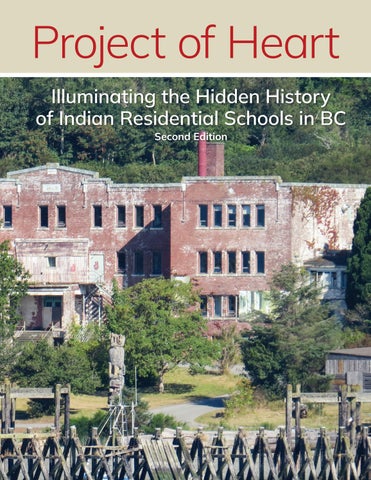
Project of Heart Illuminating the Hidden History of Indian Residential Schools in BC Second Edition
Dedication This publication is dedicated to the more than 150,000 Indigenous children across Canada who endured horrific rights violations in the Indian Residential School system, and to the memory of the untold thousands of children who perished in it. Our goals are to honour the survivors and their families, and to help educate Canadians about the atrocious history and ongoing legacy of residential schools. Only when we understand our shared history and reckon with its hard truths can we move forward together in a good way. Truth before reconciliation.
Revised September 2026 | PSI26-0027
Project of Heart
jannica@fallenfeatherproductions.com / FallenFeather-Secwemepc Museum & Archives KIB
Illuminating the Hidden History of Indian Residential Schools in BC
Children in front of church near Kamloops Indian Residential School.
The BC Teachers’ Federation: Educating for truth before reconciliation
Second Edition 2026
iii
Acknowledgments Above all, deep gratitude to the many residential school survivors who have so generously shared their personal stories in BC classrooms. Your courage and resilience have provided profound and unforgettable learning experiences for thousands of students and teachers across the province. Thanks to all the BCTF leaders and activists over the years who have fought for the significant changes to begin transforming a colonialist public education system. Thanks also to those continuing this important work in a spirit of respect and hope for a better future. Finally, thank you to all the BCTF members committed to teaching about the hard truths of our history as Canadians and who, along with your students, are learning new ways forward together.
Content warning This learning resource deals with genocide. Of necessity, it addresses the historical truths of child abuse of all kinds, destruction of families and communities, and the ongoing consequences of intergenerational trauma. All students and teachers, especially Aboriginal students and teachers, will need extra care when learning and teaching about this material. If you or your students are triggered by anything you read or see here, please reach out to the skilled and compassionate people ready to offer support: • National toll-free crisis line: 24 hours a day, seven days a week at 1-844-413-6649. • Indian Residential School Survivors Society: Toll-free at 1-800-721-0066 irsss.ca/services or email reception@irsss.ca.
Credits
Online Resources
Project leader and curator: Gail Stromquist Writer: Nancy Knickerbocker Graphic design: BCTF staff designers Editorial support: Amy Smart Administrative support: Miranda Light Copyright and permissions: Emily O’Neill
For deeper learning, visit our online edition to access a broad range of supporting resources, including videos, articles, original historical documents, classroom activities, and more.
© BC Teachers’ Federation 100-550 West 6th Avenue Vancouver, BC V5Z 4P2 bctf.ca
bctf.ca/projectofheart
iv
Table of contents Imagine. . . . . . . . . . . . . . . . . . . . . . . . . . . . . . . . . . . . . . . . . . . . . . . . . . . . . . . . . . . . . . . . . . . . . . . . . . . . . . . . . . . . . . . . . . . . . . 2 BC Indian Residential Schools: Introduction and map . . . . . . . . . . . . . . . . . . . . . . . . . . . . . . . . . . . . . . . . . . . . . . . . . . 4 BC teachers’ commitment to truth and reconciliation . . . . . . . . . . . . . . . . . . . . . . . . . . . . . . . . . . . . . . . . . . . . . . . . . . 6 Duncan Campbell Scott: Architect of the residential school system. . . . . . . . . . . . . . . . . . . . . . . . . . . . . . . . . . . . . 8 Peter Henderson Bryce: The doctor who blew the whistle on a national crime. . . . . . . . . . . . . . . . . . . . . . . . . . 10 Gladys we never knew: One child, among thousands, who didn’t survive. . . . . . . . . . . . . . . . . . . . . . . . . . . . . . 12 Where is Maggie? . . . . . . . . . . . . . . . . . . . . . . . . . . . . . . . . . . . . . . . . . . . . . . . . . . . . . . . . . . . . . . . . . . . . . . . . . . . . . . . . . . . 15 Josette: Childhood marked by humiliation and shame. . . . . . . . . . . . . . . . . . . . . . . . . . . . . . . . . . . . . . . . . . . . . . . . 16 Mercy: Students create art from painful truth. . . . . . . . . . . . . . . . . . . . . . . . . . . . . . . . . . . . . . . . . . . . . . . . . . . . . . . . . 18 One priest’s reputation re-evaluated after injustices come to light. . . . . . . . . . . . . . . . . . . . . . . . . . . . . . . . . . . . . 20 “Building hell and putting children into it:” The churches apologize . . . . . . . . . . . . . . . . . . . . . . . . . . . . . . . . . . . 21 One family’s refusal, one little girl kept safe. . . . . . . . . . . . . . . . . . . . . . . . . . . . . . . . . . . . . . . . . . . . . . . . . . . . . . . . . . . 22 Resistance and resilience . . . . . . . . . . . . . . . . . . . . . . . . . . . . . . . . . . . . . . . . . . . . . . . . . . . . . . . . . . . . . . . . . . . . . . . . . . . . 23 Early on, Canadians were in denial about residential schools . . . . . . . . . . . . . . . . . . . . . . . . . . . . . . . . . . . . . . . . . . 24 After the Prime Minister’s apology, calls for action. . . . . . . . . . . . . . . . . . . . . . . . . . . . . . . . . . . . . . . . . . . . . . . . . . . . 26 Grand Chief responds with dignity and pride. . . . . . . . . . . . . . . . . . . . . . . . . . . . . . . . . . . . . . . . . . . . . . . . . . . . . . . . . 27 Commemoration canoe on a journey to justice. . . . . . . . . . . . . . . . . . . . . . . . . . . . . . . . . . . . . . . . . . . . . . . . . . . . . . . 28 Thousands attend Truth and Reconciliation National Event. . . . . . . . . . . . . . . . . . . . . . . . . . . . . . . . . . . . . . . . . . . . 30 Landmark TRC report points the way forward . . . . . . . . . . . . . . . . . . . . . . . . . . . . . . . . . . . . . . . . . . . . . . . . . . . . . . . . 32 Flashpoint of denialism: Genocide . . . . . . . . . . . . . . . . . . . . . . . . . . . . . . . . . . . . . . . . . . . . . . . . . . . . . . . . . . . . . . . . . . . 34 Some calls to action created positive change, others remain stalled . . . . . . . . . . . . . . . . . . . . . . . . . . . . . . . . . . . 36 Indigenous women, girls and Two-Spirit people emerge stronger . . . . . . . . . . . . . . . . . . . . . . . . . . . . . . . . . . . . . 38 Searching for Le Estcwicwéy’, the missing children. . . . . . . . . . . . . . . . . . . . . . . . . . . . . . . . . . . . . . . . . . . . . . . . . . . . 40 Seeking justice for the children who never came home. . . . . . . . . . . . . . . . . . . . . . . . . . . . . . . . . . . . . . . . . . . . . . 42 From land theft to Land Back: The struggle to regain sovereignty and protect the land. . . . . . . . . . . . . . . . . 44 Active allyship: Non-Indigenous Canadians stand up. . . . . . . . . . . . . . . . . . . . . . . . . . . . . . . . . . . . . . . . . . . . . . . . . . 46 Active allies for education: Charlie Angus and Shannen Koostachin. . . . . . . . . . . . . . . . . . . . . . . . . . . . . . . . . . . . 48 Indigenous resurgence is reshaping society . . . . . . . . . . . . . . . . . . . . . . . . . . . . . . . . . . . . . . . . . . . . . . . . . . . . . . . . . . 49 Resurgence in art, literature, music, dance, law. . . . . . . . . . . . . . . . . . . . . . . . . . . . . . . . . . . . . . . . . . . . . . . . . . . . . . . . 50 Resurgence in film, sports, education, medicine, politics, and more. . . . . . . . . . . . . . . . . . . . . . . . . . . . . . . . . . . . 52 What does Indigenous resurgence look like to you?. . . . . . . . . . . . . . . . . . . . . . . . . . . . . . . . . . . . . . . . . . . . . . . . . . . 54
Imagine Imagine that you are five years old. A stranger comes to your home village and seizes you from your mother’s arms. Imagine he takes you hundreds of miles away to a place where white people in black robes cut off your hair and take away your clothes, the ones your mother made especially for you. They also take away your name—you get a number instead. They separate you from your brothers and sisters, and forbid you to speak to one another in your language. Imagine being silenced with shouts. Imagine toiling in field and kitchen yet going hungry all the time. Imagine being hit or strapped for breaking rules you don’t know or understand. Imagine learning that your family traditions and culture are evil and barbaric, while the Christian God is the only true Creator, the God of love. Imagine a heavy hand on your shoulder pulling you away from the dormitory in the night. Imagine running away from it all, desperate to be safe and loved back home. Imagine being hunted and caught, then returned to even harsher punishments. Imagine you’re sick, feverish, and alone. Other children also coughing, gasping. Some are dying and you know it, even though they try to cover it up. Now imagine you are a parent, your child stolen from your embrace and taken to the same cruel place you knew as a child. You could face a jail sentence if you don’t obey their laws that say your child must go and learn the European ways. If you resist, your child will be taken anyway. You worry that your child will reject your teachings and your traditional way of life. But most of all you fear that your child will endure the same abuse you did. The fact you are powerless to prevent that abuse torments you even more. Imagine the unthinkable—your child died, far away, without you there for comfort. Imagine your child is buried in an unmarked grave, in an unknown place. Imagine they don’t even tell you that your beloved child won’t ever be coming home, let alone where their final resting place is. Truth and Reconciliation Commissioner Dr. Marie Wilson has challenged Canadians to try to feel the anguish of the 150,000 Aboriginal children taken from their parents, sometimes forever. “Think of that. Bear that. Imagine that.” 2
3
Kyle Irving / Eagle Vision
150 years of residential schools: 150,000 children taken
For more than a century and a half, Aboriginal children across Canada were stolen from loving homes and healthy communities and forced into residential schools under a government policy to assimilate Indigenous people. As a top government official said at the time, the system was “geared towards the Final Solution to the Indian problem.” It was expressly designed “to kill the Indian in the child.” In British Columbia, there were at least 22 residential schools mandated by the federal government and operated by the Roman Catholic, Methodist, Anglican, Presbyterian, and United Churches of Canada. Attendance at residential schools was made mandatory by law and parents who refused to send their children were threatened with fines or imprisonment. Nonetheless, Aboriginal communities resisted the laws that ripped their families apart. Parents often hid their children deep in forests and on trap lines, anywhere the Indian agents might not go. To avoid capture, they also sent their children away to hide amongst friends or relations in distant communities. They lobbied for schools in their own communities so their children would not be taken away to get an education but their pleas were ignored. Why? Because the government’s aim was to break the bonds between Aboriginal
4
children and their families, communities, and cultures. In residential schools, Aboriginal children were forbidden to speak their native languages, were taught that their cultures were inferior and that they themselves were worthless. They suffered all manner of abuse: physical, emotional, sexual, psychological, and spiritual. Despite these atrocities, some children in residential schools and their families at home continued to maintain their connections to each other and to their cultural heritage. The generations who endured such trauma in childhood were silenced for decades because of the fear and shame instilled in them by cruel treatment and constant deprivation. This led to a fundamental breakdown of communities, and alienated many of the children from their families and cultural traditions. For many children and grandchildren of survivors, intergenerational impacts continue to be felt to this day. Residential schools are not a thing of the distant past. It wasn’t until 1984 that all residential schools in BC were closed down; the last one in Canada didn’t close until 1997. Although the history of residential schools was hidden for decades, our school system no longer censors the past. Finally, this once-hidden history is coming to light and the public
education system is changing to reflect that. As survivors have begun to share their experiences, painful as that is to do, Aboriginal and nonAboriginal teachers are determined to work with them to bring their knowledge into the classroom and help ensure that such massive violations of children’s rights can never again take place. That is one of the ultimate goals of the Project of Heart—to make public education itself a vehicle for healing and reconciliation.
DID YOU KNOW? The school pictured on the cover of this publication is St. Michael’s Residential School, which operated in Alert Bay from 1929–1975. For the next 40 years it stood as a decaying reminder of the injustices suffered by students. On February 18, 2015, survivors and community members gathered for a ceremony to witness its demolition. They sang, prayed, and hurled rocks at the decrepit structure as the bulldozers did their work.
Project of Heart: Illuminating the Hidden History of Indian Residential Schools in BC
BC Indian Residential Schools Indian Day Schools Lower Post
In addition to residential schools, the federal government and Christian churches also ran Indian day schools on reserves across the country from the late 19th Century until 2000. Of the 699 day schools that operated in Canada, 112 were in BC.
British Columbia
Crosby Homes Elizabeth Long
Although day school students got to go home to their families in the evenings, they were still subjected to the same kinds of physical, verbal, and sexual abuse as were residential school students. In 2019, the Federal Court approved a nation-wide class settlement to compensate survivors of day schools.
Lejac
A.L. Dormitory
St. Joseph’s
St. Michael’s St. George’s Ahousat Christie/Kakawis
Kamloops
Sechelt Alberni St. Paul’s Coqualeetza St. Mary’s Kuper Island
St. Eugene’s
These schools have buildings that are still standing as of 2026 Ahousaht
Ahousaht
1903–1907
Presbyterian
Alert Bay
St. Michael’s
1929–1975
Anglican
Mission
St. Mary’s
1861–1984
Roman Catholic
Alert Bay
Alert Bay (Girl’s Home)
1888–1905
Anglican
North Vancouver
St. Paul’s
1898–1959
Roman Catholic
Anahim Lake
A.L. Dormitory
1968–1977
Roman Catholic
Port Alberni
Alberni
1909–1973
United
Chemainus
Kuper Island
1890–1975
Roman Catholic
Port Simpson
Crosby Home for Girls
1893–1920s
Methodist
Crosby Home for Boys
1903–1920s
Methodist
Coqualeetza
1861–1866; 1866–1940
Methodist
Cranbrook
St. Eugene’s
1898–1970
Roman Catholic
Port Simpson
(Ft. St. John) Fraser Lake
Lejac
(1910–1922); 1922–1976
Roman Catholic
Sardis
Kamloops
Kamloops
1890–1978
Roman Catholic
Sechelt
Sechelt
1912–1975
Roman Catholic
Tofino
Christie/Kakawis
1900–1983
Roman Catholic
Williams Lake
Cariboo/St. Josephs Mission
1890–1953; 1953–1981
Roman Catholic
Yale
All Hallows
1884–1920
Anglican
Kitamaat
Elizabeth Long Memorial
1922–1944
Methodist
Lower Post
Lower Post
1951–1975
Roman Catholic
Lytton
St. George’s
1901–1979
Anglican
Project of Heart: Illuminating the Hidden History of Indian Residential Schools in BC
5
BC teachers’ commitment to education for truth and reconciliation
Each child has a gift. Look for that gift and how to help nurture it. Strengthen the spirit of the children and help them to find balance and ways of being that are rooted in land, community, and culture.
This is part of the vision articulated by members of the BC Teachers’ Federation Task Force on First Nations Education, eight BC teachers whose historic report and recommendations were passed overwhelmingly at the 1999 Annual General Meeting. After the vote, they smiled and raised their hands in gratitude for the heartfelt applause and standing ovation from 650 delegates. “When I started this journey a couple of years ago, I was like a single paddler in a small canoe,” said Task Force CoChair Frank Conibear. “Now we need a much bigger canoe so that all our cultures can start paddling together.” The task force members called for a new intercultural understanding in public schools and in teaching practice. They suggested criteria for schools to assess how inclusive they are of Indigenous students, emphasizing that self examination is essential because as long as the mainstream culture and practices remain unchanged, public schools
6
will be unable to fully meet the needs of students from Indigenous cultures. They also urged that new spaces be opened at the tables where education decisions are made—within the BCTF, in each school, in board offices, and at the Ministry of Education and Child Care. In the years since, the BCTF has supported many positive changes in our public education system. We advocated for changes to the provincial curriculum so that all students from Kindergarten to Grade 12 learn about Indigenous history and culture, including the history and legacy of residential schools. Now Indigenous worldviews are embedded across all subject areas. To earn their Dogwood Diploma, students now must complete four credits of Indigenousfocused course work. Education faculties across BC now require all student teachers to complete at least one course on Aboriginal culture and history, regardless of what subject area they plan to teach. As well, the College of Teachers has implemented a new professional standard that requires all K–12 teachers to commit to truth, reconciliation, healing, and integrating Indigenous worldviews into their instruction. The Project of Heart initiative was created in 2007 by Sylvia Smith, a secondary teacher in Ottawa. Dismayed there were only 64 words pertaining to residential schools in her students’ history textbook, she became determined to give
her students a more meaningful education about this dark and hidden chapter in Canadian history. She began to invite residential school survivors into her classroom to share their stories, and students responded with open hearts and minds. Smith is amazed by the impact the project has had. “We’ve had students’ reflections published in United Nations reports,” she said. “When they realize their efforts mean something, it’s really hard to stop them.” BC teachers led the way in the Project of Heart, with the highest level of participation in the country. Like colleagues in all provinces, they found that when Indigenous Elders recounted their experiences of loneliness, hunger, fear, and abuse in residential schools, it was unforgettable learning. They found that children’s sense of justice, so acute and clear, was moved by this learning, and they shared this
Sylvia Smith
Project of Heart: Illuminating the Hidden History of Indian Residential Schools in BC
hidden history with their parents, a history that was censored from the education of earlier generations. Listening to the survivors’ stories, many students channeled their compassion for all that they suffered into tiny but powerful artworks on wooden tiles. Thousands of students’ tiles have been used to make a variety of public art projects in different provinces, like the commemoration canoe that the BCTF commissioned from carvers of the Tsleil-Waututh Nation. It was completely covered in a colourful mosaic of students’ tiles and was unveiled at the Truth and Reconciliation Commission (TRC) hearings in Vancouver in 2015. (See page 28.)
It is a magical canoe because there is room for everyone who wants to come into it to paddle together. The currents against it are very strong but I believe we can reach that destination and this is the reason for our survival. —Wa’xaid (Cecil Paul)
The BCTF strongly supported the work of the Commission and dedicated $100,000 to enable teachers from all over the province to travel to the TRC’s Education Day events in June 2015. They heard testimony from survivors and words of comfort and encouragement from the late Justice Murray Sinclair, Chair of the TRC. These learning opportunities proved to be transformational for students, parents, and teachers alike. More than a quarter century has passed since our first task force report, and while much has been accomplished, there’s much more still to be done. The process of learning the true history and legacy of colonialism, and of unlearning the false stereotypes and conscious or unconscious racism, must continue. It’s a process that will no doubt take generations, but the journey is as important as the destination because, along the way, we are changed. BC teachers remain committed to acknowledging the past, taking action in the present, and making positive change for the future. Please join us on our educational journey to justice.
Project of Heart: Illuminating the Hidden History of Indian Residential Schools in BC
7
Duncan Campbell Scott Architect of the Indian residential school system
Yousuf Karsh / public domain
To achieve this goal, Scott made enrolment in residential schools mandatory, even though at the same time organized delegations of First Nations were appearing before Parliament to urge the government to “make such provisions that we could be given an opportunity under the law to run our own schools in such a way as will meet the desires of the people.”
From 1913 to his retirement in 1932, Duncan Campbell Scott served as federal Deputy Superintendent of Indian Affairs, the highest non-elected position in the department. Scott was a fervent believer in the government’s policy of “civilizing” Aboriginal children by aggressively assimilating them into the white European society. The stated goal was “to kill the Indian in the child.” In 1920, he said: I want to get rid of the Indian problem. I do not think as a matter of fact, that the country ought to continuously protect a class of people who are able to stand alone... Our objective is to continue until there is not a single Indian in Canada that has not been absorbed into the body politic and there is no Indian question, and no Indian Department...
DID YOU KNOW?
Scott ignored their entreaties. What’s worse, he suppressed the government’s own medical health officer’s information about the appalling conditions in the schools, and never changed course even though tremendous numbers of students were dying of tuberculosis, malnutrition, and other causes. He wrote:
Scott’s poetry is still included in literary anthologies and taught in schools, often without any reference to his mission to find “the final solution of our Indian Problem.” The phrase “the final solution” today signifies Adolf Hitler’s genocidal plan to exterminate the Jews of Europe. In Canada, survivors, scholars, and the Truth and Reconciliation commissioners have described the residential school system as a form of “cultural genocide.”
It is readily acknowledged that Indian children lose their natural resistance to illness by habituating so closely in the residential schools and that they die at a much higher rate than in their villages. But this does not justify a change in the policy of this Department which is geared towards a final solution of our Indian Problem.
What do you think?
19 and Discharged Pupils of Indian Industrial and Boarding Schools.
Duncan Campbell Scott amended the Indian Act in 1920 making it mandatory for all Native children to attend residential school, knowing that the mortality rates ranged from 30%–75%.
8
As well as being a top-level bureaucrat, Scott was a famous literary figure in his time and even today is celebrated as one of Canada’s foremost Confederation poets. Some of his poems describe Aboriginal people and places, and reveal his colonialist worldview. For example, in “The Onondaga Madonna” he describes: “This woman of a weird and waning race/The tragic savage lurking in her face...”
Present Condition of all Pupils. Good.
Sick.
Present Condition of Ex-Pupils.
Dead.
Good.
Sick.
Dead.
Number of Number of Number of Number of Number of Number of p.c. p.c. p.c. p.c. p.c. p.c. pupils. pupils. pupils. pupils. pupils. pupils. 112
60
58
9
57
30
99
65
29
15
32
30
8
9
26
30
9
29
Project of Heart: Illuminating the Hidden History of Indian Residential Schools in BC
1
3
21
69
Thomas Moore before 1874
Thomas Moore after 1874
Saskatchewan Archives Board / R-A8223-1
Saskatchewan Archives Board / R-A8223-2
The Canadian government staged dramatic “before and after” photos of Aboriginal children. In the before photo, Thomas Moore, a student in the Regina Indian Industrial School, is dressed as a “savage” holding a revolver. In the after photo, he is “civilized” in his suit. Propaganda like this was used by the Department of Indian Affairs to justify the residential school system. Few knew that both the before and after photos were faked images with no connection to the Cree boy’s real life. Thomas Moore’s “before” clothing includes women’s traditional attire which a male would never wear. —Residential Schools With the Words and Images of Survivors, By Larry Loyie with Wayne K. Spear and Constance Brissenden, Indigenous Education Press, 2014
The General Synod Archives, Anglican Church of Canada / P75-103-S7-184 / Old Sun School, Gleichen, Alta. – Senior classroom, 1945
Project of Heart: Illuminating the Hidden History of Indian Residential Schools in BC
9
Peter Henderson Bryce The doctor who blew the whistle on a national crime Dr. Peter Henderson Bryce was a principled and energetic pioneer of public health in Canada. Trained at the University of Toronto, and later in Edinburgh and Paris, he became a leading expert on tuberculosis (TB). He served as Canada’s first Chief Medical Health Officer from 1904–1921.
longer pretend not to know about the deadly conditions in residential schools, the schools were not closed until 74 years later. Cindy Blackstock, Executive Director of the First Nations Child and Family Caring Society, believes that Dr. Bryce is a true Canadian hero. At a time when many others were silent or complicit, he spoke out fearlessly about the needless suffering of vulnerable children. She said, “Dr. Bryce stood up for First Nations, Métis and Inuit children even when it was a hard thing to do because other people criticized him. He knew what was right and, in a peaceful and respectful way, kept on trying to help the children.”
In 1907, after visiting 35 residential schools across the Prairie provinces, Dr. Bryce issued a damning report that exposed the appalling health standards there. He wrote that “of a total of 1,537 students reported upon nearly 25 per cent are dead, of one school with an absolutely accurate statement, 69 per cent of ex-pupils are dead, and that everywhere the almost invariable cause of death given is tuberculosis.” His report made practical recommendations for improvement, as he was confident that medical science knew how to prevent the spread of the disease and avoid needless deaths. He also noted that the health care funding for residents in the city of Ottawa alone was about three times higher than that allocated for all First Nations people across Canada. Dr. Bryce wrote repeatedly to Duncan Campbell Scott, Deputy Superintendent of Indian Affairs, calling on him to implement his recommendations. Scott replied that there was no need to continue his annual research into tuberculosis rates in residential schools because the information was costly to produce, and the government had no intention of acting on it. Ultimately, Dr. Bryce was let go—his position eliminated and his reputation undermined.
10
openlibrary.org/books/OL7110699M/The_story_of_a_national_crime
It wasn’t until 1922, after he was officially retired, that Dr. Bryce was finally able to publish his landmark study The Story of a National Crime: An Appeal for Justice to the Indians of Canada. In it, he presented irrefutable evidence that TB was killing students, that the government knew about it, and was failing to prevent their deaths. Newspapers across the country published the story that Scott and the Department of Indian Affairs had worked so hard to hide. But even though the government could no
Ironically, Dr. Bryce and his nemesis, Duncan Campbell Scott, are buried not far from one another in Canada’s national cemetery in Ottawa. Blackstock noted that the plaque on Scott’s grave praised him as a poet but didn’t mention his role overseeing the residential school system, so she advocated with cemetery officials to have the wording changed so his notorious legacy is more accurately represented. On the first National Day for Truth and Reconciliation in 2021, she helped install an orange mailbox at Dr. Bryce’s grave so that Canadians can write letters to thank him for taking such a courageous stand for the rights of Indigenous children. You can write to Dr. Bryce c/o Beechwood Cemetery, 280 Beechwood Avenue, Ottawa, Ontario, K1L 8A6. Learn more here: Canadian Medical Association Journal www.cmaj.ca/content/192/9/E223
Project of Heart: Illuminating the Hidden History of Indian Residential Schools in BC
Lessons learned from Duncan Campbell Scott and Dr. Peter Henderson Bryce So what is there to learn from these two men? Ninety years on, the Department of Indian Affairs continues to act as a bureaucratic impediment to basic improvements in education, health and social improvement. There is nothing accidental about this dysfunction. It is the result of decades of deliberate policy choices—the same choices that promoted Duncan Campell Scott while suppressing the work of Peter Henderson Bryce. Ninety years on, we have the job of undoing these wrong choices. It is time that we put our nation back on the right road with our treaty partners. So, it may seem like a century too late, but thank you Peter Bryce for your dedication and public service. — Charlie Angus, MP, Timmins-James Bay, in www.rabble.ca Dec. 20, 2013.
Project of Heart: Illuminating the Hidden History of Indian Residential Schools in BC
11
One child, among thousands, who didn’t survive residential school
So, at the end, a little girl named Gladys endured days of fevered suffering—coughing, bleeding, struggling for breath—all alone, far from home, with no loved one to comfort her. She was one of the thousands of children whose deaths are acknowledged and lamented in the landmark report released in June 2015 by the Truth and Reconciliation Commission of Canada, a report that describes our country’s treatment of Indigenous people as “cultural genocide.” The TRC has established a National Residential School Student Death Register which in 2026 contains the names of more than 4,100 children, although the number of deaths is believed to be much higher. Gladys’s family members believe that she never would have died at such a tender age had she not been
12
Sandra Dickson
According to the Vital Statistics Act document entitled “RETURN OF DEATH OF AN INDIAN,” Gladys Chapman was 12 years, 10 months, and 12 days old on April 29, 1931, when she died in Royal Inland Hospital in Kamloops. Occupation of the deceased was listed as “Schoolgirl.” On her death certificate, Dr. M.G. Archibald reported “acute dilation of heart” as the cause of death, with tuberculosis as the secondary cause. The duration of death was “several days.” L–R: Mrs. Carlson, Charles Stromquist, Matilda Stromquist and two of their children, Harold and Helmer
forced into the Indian residential school system. A member of the Nlaka’pamux Nation, she was part of a large extended family with deep roots in Spuzzum, a small community on the Fraser River north of Hope. Her relations have a deep awareness of the damage inflicted upon generations of children and families. Gladys’s mother, Matilda, had also been taken to residential school as a girl and she knew all too well what took place there. “Just imagine how horrible it would have been for parents and grandparents who themselves had lived through residential school abuse, watching their little ones being taken, knowing what they were going
to go through,” says Gail Stromquist, Gladys’s niece. Gail and her sister Janet, like the vast majority of Canadians both Aboriginal and non-Aboriginal, grew up with no knowledge of the Indian residential school system. “We played skip rope and sang the song about how in fourteen hundred and ninety-two, Columbus sailed the ocean blue,” Gail said. “The myth of Columbus’s ‘discovery’ of the Americas was all we learned in school, nothing about residential schools or the cultures of Aboriginal people before contact.” Even though many people in their family and community were living with the terrible legacy of residential
Project of Heart: Illuminating the Hidden History of Indian Residential Schools in BC
schools, the survivors’ voices were silenced so that the sisters only recently learned about the fate of the auntie they never knew. No photos remain of her and her name was never spoken by her surviving siblings, some of whom have struggled to deal with their own devastating experiences in residential school. Today both Stromquist sisters are public school teachers, passionately involved in the kind of reconciliatory educational work that the late Justice Murray Sinclair called for among the 94 recommendations in the historic TRC report. Janet works as a district teacher for the Aboriginal program in Langley and Gail co-ordinates Aboriginal education initiatives for the BC Teachers’ Federation. The sisters’ need to learn the truth of their own family experience, and their desire to teach the truth about our shared history led them to do extensive research in local archives. It also led them to gently question their relatives about long-buried memories. Little by little, they pieced together Gladys’s story. She was one of seven siblings from the same family taken to residential schools. Even though it was mandatory by law for all Indigenous children to be enrolled and parents who resisted faced prison sentences, their mother Matilda did manage to hide one of her sons from the Indian agent. The boy was in frail health and she feared he would not survive the deprivation and abuse at school. Tragically, and despite her best efforts, she couldn’t save all her children. Widowed at a young age, in 1929 Matilda married a Swedish immigrant named Charles Stromquist, with whom she had a long, happy marriage and 10 more children. “We have often imagined what a comfort it must have been to Nanny after she
Project of Heart: Illuminating the Hidden History of Indian Residential Schools in BC
13
married Grandpa Stromquist to know that no more of her children could be taken away from her to residential school,” Gail said. Gladys was taken to Kamloops Residential School, one of the largest in Canada. An imposing brick institution run by Roman Catholic priests and the Sisters of Saint Ann, it operated from 1890 to 1978 with more than 500 children enrolled at its peak in the 1950s. For girls, mornings were spent in class, while afternoons were spent cleaning or working in the garden or kitchen. They did not get to eat the food they grew and prepared. The boys were taught some carpentry and other trades. All students had heavy religious instruction in English. The children were forbidden to speak their native languages or practice their own spirituality. Families were allowed to visit, but they rarely did so because of the long distances between school and home.
school on the Prairies the death rate was a staggering 75%. Dr. Bryce’s work was suppressed by the government and it wasn’t until 1922 when he retired that he could publish his full report, The Story of a National Crime: An Appeal for Justice to the Indians of Canada.
by rail. Gladys’s gravestone in what the official records called the “Spuzzum Indian Burying-ground” reads:
In 2014, the government of British Columbia released to the TRC more than 4,000 documents, including death records for Aboriginal children aged four to 19. Many families were never informed of the deaths of their children, some of whom were buried in unmarked graves near the schools. No one knows how Matilda learned of the death of her daughter, but it is certain that the only reason she was able to bury Gladys in the community cemetery at Spuzzum was that her husband worked for the CNR and thus could get her body transported home
Tragically, neither Jesus nor her loving family could save Gladys from the racist and assimilationist policies that destroyed her young life.
In loving memory of Gladys Chapman Born June 15, 1918 Died April 29, 1931 Safe in the arms of Jesus
The Kamloops Residential School still stands to this day, a decaying reminder of the dark history we all must confront as Canadians. The last residential school in BC finally closed its doors in 1984, the last in Canada not until 1996. This is not ancient history. It lives on in memory of thousands of Canadians whose childhood was stolen and whose
The federal government had known for decades that such conditions were killing children, but failed to act. In 1907, Canada’s first chief medical health officer, Dr. Peter Henderson Bryce, issued a report that exposed the appalling health standards in residential schools where, on average, TB killed 24% of the children. In one
14
Project of Heart: Illuminating the Hidden History of Indian Residential Schools in BC
Janet Stromquist
Conditions in the Kamloops school were atrocious, but typical of residential schools across Canada. Neglect and abuse—sexual, physical, emotional, and spiritual—were rampant. Many children tried to run away, only to be caught and punished for trying to get home. Some children attempted or committed suicide. But communicable disease was the worst threat. Underfunding, overcrowding, poor sanitary and ventilation systems, inadequate clothing, malnourishment, and a lack of medical care all contributed to epidemic levels of tuberculosis and other illnesses.
education was perverted by the government’s determination to “kill the Indian in the child.” Janet and Gail Stromquist share Justice Sinclair’s conviction that because education was the primary tool of oppression of Aboriginal people and the misleading of all Canadians, education holds the key to reconciliation. They say the most frequent response to their teaching is: “I never knew about any of this.”
“People have told me that they lived right beside one or another of the schools and never knew what went on there. They went through their entire schooling and never learned anything about this,” Gail says. “Some of our secondary students get quite angry about it, feeling their education has been censored.” “Learning directly from a survivor is a powerful and unforgettable experience. We honour the strength and courage
of the many residential school survivors who have come forward to share their stories,” Janet says. For the Stromquist sisters, it’s clear that their life’s work will continue to be educating the next generation about the truths of the past, shining a light on the hidden history, giving voice to those who were silenced, and helping to create the conditions where true reconciliation can take place.
Where is Maggie? This question has weighed upon the Stromquist family for years, ever since they learned that Gladys Chapman, the auntie they never knew, had an older sister who also did not return from Kamloops Indian Residential School (KIRS). While they were able to find documentation of Gladys’s death, there is no evidence of what happened to Marguerite Chapman, known as Maggie. In 2015, sisters Gail and Janet Stromquist applied to the archives at the National Centre for Truth and Reconciliation for information about Gladys and were surprised and grateful to receive 315 pages of documents. Looking deeper into the historical records, they found numerous KIRS attendance registers. For the 1926–27 school year, the records show that Maggie, Gladys, and their younger sister Minnie were all enrolled—three among a class of 42 students. The first day that Maggie was officially noted as present was August 18, 1926. Her last day of school was January 20, 1927. After that, her name simply disappears from the school records, with no explanation whatsoever. Maggie would have been just nine years old at the time.
Vol. 3, 1926–1930, Record No. 001-036 Kamloops Indian Residential School Fonds Secwepemc Cultural Education Society Archives
The website of the National Centre for Truth and Reconciliation has a page for every residential school in Canada with a list officially documenting the names and death dates of the children who never came home from each school. Gladys Chapman is among the 63 names listed for Kamloops Indian Residential School, but Maggie Chapman is not. Why not? Minnie was the only one of the Chapman sisters who survived into adulthood, but like so many residential school survivors, she rarely spoke about her experiences. Janet said, “I remember we were having coffee and Auntie Minnie was teaching us how to do pine needle weaving. I was just learning about residential schools, and so I asked her if she had been made to go to residential school. She said she had, but didn’t say much more about it.” To this day, family members are left wondering: Did Maggie meet the same fate as her sister Gladys and perish from the tuberculosis that was so rampant in the schools? Or did something more unthinkable befall her? So many questions remain that may never be answered.
Project of Heart: Illuminating the Hidden History of Indian Residential Schools in BC
15
Childhood marked by humiliation and shame A First Nations elder shares her experiences of residential school with Brookswood students February 19, 2013 By Heather Colpitts Josette Antone Dandurand held up three sheets of toilet paper.
Heather Colpitts / Langley Advance
Having to go to nuns as a small child and ask for toilet paper and receiving much less than needed for the job remains one of the humiliating memories from her nine years in residential school. And it’s one of the personal stories the 70-year-old shared with Brookswood Secondary students during presentations to four classes on Feb. 14. The classes are taking part in Project of Heart, a residential school healing project that started in Ottawa and spread across the country.
If she ever wet her bed after that, she never told a soul. “I chose to sleep in a wet bed,” Dandurand said.
Her sessions on Valentine’s Day included the many heartbreaking events of her childhood. “I feel that I didn’t have a childhood,” she said.
One morning she could not find her hankie for daily inspections. “I lost my hankie so I was made an example,” she said.
Dandurand, whose mother was Kwantlen First Nation and father was Nooksack, was seven when the Indian Agent and the RCMP arrived to take the children. She came from a family of six children, all sent to residential schools.
The mother superior strapped her in front of the other children. Her older sister’s advice: “You don’t move your hand and you don’t cry. How many times I hear that—you don’t cry.”
A priest at the Kuper Island residential school molested her. It was only in recent times that she won a legal case against him for that abuse. Soon after arriving, a seven-year-old Josette, who had never seen flush toilets, wet her bed at night. In the morning, she told a nun and she was made, along with any other girls who wet their beds, to parade in front of the rest of the students with the soiled bed linens wrapped around their heads.
16
The children were forced to work in the school dairy and orchard but were not allowed to have any of the food which was sold for money. Instead they were fed cheap food like potatoes and peas, although the students did get to watch the staff eat well. Despite not accepting the Catholicism imposed on her as a child, Dandurand said she prays each day because she always wants to express her gratitude for what is good in her life. Prayer and gratitude are some of the tools she uses in her healing. So is
sharing her stories. “I don’t ever want this to happen again,” she said. Residential school students were taught that everything about them was bad or wrong, part of the government’s decision to assimilate Aboriginal peoples. “Never be ashamed of who you are,” Dandurand told the students. Her presentation recounted the broad and lasting impacts of residential schools. In her life, it led to two decades of alcoholism before her adult sons asked her to stop. Within her siblings and their families there have been traumas and scars directly tied to the residential school experiences some six decades ago. One brother was so traumatized by the school dentists that when his teeth failed, he would pull them out himself, until he had none left. There have been suicides, drug and alcohol abuse, and an array of relationship problems. “We never talked about the things that happened to us in residential school,” she said.
Project of Heart: Illuminating the Hidden History of Indian Residential Schools in BC
Dandurand did what she had to do to survive those nine years and found solace in learning. After graduating she went into the Canadian Air Force, where the fighter control operator met her husband of 44 years and lived in various spots around Canada and abroad.
Strutinski said she read a book by a survivor of the residential school so the subject was not new to her, like it was for Dick and Chevrier but all were disheartened to learn that this was a recent part of Canadian history.
Through Dandurand’s presentation, Grade 8 students Lauren Chevrier, Angel Dick and Lee Strutinski got to put a face on what could have just been a paragraph in a textbook.
The students taking part in Project of Heart drew on small wooden tiles in memory of the children who’ve died because of residential schools. Dick and Strutinski made their tiles into a dream-catcher to capture bad dreams created by the trauma the children went through, while Chevrier’s design with a heart was her desire to combat the heartbreaking history she learned.
“We can think about it more and imagine what it was like,” Chevrier said.
Project of Heart tiles will be put on permanent display in Vancouver.
“Air force life was a piece of cake for me compared to residential school,” Dandurand said.
“It’s more personalized,” Strutinski said. She noted that her mom’s generation didn’t learn about residential schools when they were young.
Teacher Larry Goldsack said he invites speakers such as Dandurand because the students gain a deeper understanding of how history and issues impact people.
He took part in Project of Heart when he was at another school last year but didn’t get to complete the several phases. “This whole Project of Heart is something that’s long overdue,” Goldsack said. He said since he introduced it for three of his Brookswood classes, other teachers have joined the campaign. The end result is that these young people are talking about issues raised by the history of this country, and First Nations elders find healing in talking about their experiences and having those acknowledged by the broader society. —hcolpitts@langleyadvance.com Reprinted with permission from The Langley Advance.
Langley elementary school named in honour of Tsakwiah, Josette In December 2024, the Langley School Board announced that its newest school would be named in honour of Josette Dandurand, the Kwantlen Elder, residential school survivor, and cultural presenter who gave so much to children and youth in her community. “Josette was an advocate for social justice and Indigenous rights, and a dedicated leader in the journey of Truth and Reconciliation,” Board Chair Candy Ashdown told the Langley Advance. “We are grateful for her contribution over the years, as she has educated students and staff in classrooms all over the district using the power of story.”
“Her impact on the community is far-reaching and extends beyond our schools,” said Mike Pue, District Principal of Indigenous Education. “She was an inspiring role model, caring matriarch, and community connector, who brought Indigenous and non-Indigenous people together.” Josette’s ancestral name was Tsakwiah, which means “she who always remembers.” She died at the age of 81 on November 13, 2023.
Project of Heart: Illuminating the Hidden History of Indian Residential Schools in BC
17
Students create art from painful truth of residential schools In her native Nisga’a language, her first name meant “pearl skipping on clear blue water.” But that beautiful name was taken away the day she arrived in residential school, where she was called Mercy instead. Sadly, little Mercy Thomas saw no evidence of merciful behaviour from the staff of Crosby Girls School in Port Simpson where strapping, hair-pulling, pushing, name-calling, being made to stand for hours, and other forms of verbal, physical, sexual, and spiritual abuse were common. It was one of 21 residential schools in BC, part of a nation-wide network of schools run by government and churches with the goal of “killing the Indian in the child.” Now, more than half a century later, Mercy and other survivors of residential school injustices are reclaiming the past by telling their stories to students across the country through a remarkable initiative called the Project of Heart.
Mercy Thomas
18
The Project of Heart brings residential school survivors into classrooms to tell their stories and to involve students and teachers in seeking the truth about this atrocious, hidden chapter of Canadian history. Students then draw on what they’ve learned to create images on wooden tiles, which are being collected and used to create large works of art. The students in Larry Goldsack’s Social Studies 8 class at Brookswood Secondary School in Langley listened intently as Mercy told them: “Think back to when you were seven. Your parents
It’s hard to think that these really bad things happened right here in Canada. We’re not perfect, like some people think we are.
were getting you ready to go to school, but you always knew they’d come for you at the end of the day. That didn’t happen for me.” She recalled the constant abuse: “You good-for-nothing, dirty, lazy Indian! If you hear that every day, you start to believe it. Some of us fought against it and we left school stronger. Others fell by the wayside and died.” Mercy was one of 150,000 First Nations children who were forced into the residential school system between the 1870s and 1990s. Recent research reveals more than 6,000 children died in the schools— of tuberculosis and Spanish flu, in fires, by drowning or exposure while fleeing, and by suicide. In the latest shocking revelation, scholars have now shown that the federal government conducted nutritional experimentation on at least 1,300 Aboriginal people, most of them hungry children in six different residential schools across Canada, including the one in Port Alberni. “Our days were punctuated by the supervisors’ whistle. As soon as it blew, we had to be on guard. Whistles to wake up, get up, stand by the bed, go to the washroom, eat your meals, do your chores. The supervisor always had a horsewhip under her arm and if we didn’t get into line fast enough, we’d feel that whip on our ankles.”
Project of Heart: Illuminating the Hidden History of Indian Residential Schools in BC
“What did you learn in residential school?” one Brookswood student wanted to know. “We learned English because we were not allowed to speak our language. We only had classes in the morning, and then we cleaned, cooked, sewed, did laundry, worked in the gardens. But we never saw the vegetables we grew on our table. They were sold in the city.” When she was 14, Mercy was sexually abused by the minister who was also principal of the school. “The rape of a child, male or female, is devastating. It shatters a child’s well-being and future development as a human being. Sexual abuse is a very touchy subject for all former students of residential schools. It is demeaning in the worst way and has long-term impacts.” Did you ever think about running away? “Oh yes, millions of times.” Why didn’t you? “Because the school was 1,500 miles from my home. Years later, they found skeletons beneath the floors. These were of all the children they said had run away. There were rows and rows of graves.” At some level there is no healing for the survivors, Mercy said. “We will go to our graves carrying this hurt. There is not enough money in the world to buy away the hurt, shame, humiliation, loss of identity, and near annihilation of Aboriginal culture. It was nearly genocide.” At Brookswood Secondary School, students’ heads nod around the classroom as one girl said: “It’s hard to think that these really bad things happened right here in Canada. We’re not perfect, like some people think we are.”
UCCA, 93.049P / 181, “Twelve of our girls, with staff,” Crosby Girls’ Home, Port Simpson, [ca. 1947]
Teacher Larry Goldsack says his passion for history fuels his commitment to teaching these painful truths. Charlene Bearhead, program manager of the Project of Heart, says that BC is ahead of other provinces on the issues of Aboriginal education and has a record participation of hundreds of teachers and thousands of students. “The commitment to look at the truth is really exceptional in this province,” she said. The wooden tiles created by BC students will be used to adorn a cedar canoe created especially for the Project of Heart by Tsleil-Waututh carver Derrick George and his sons, and designed by Tahltan artist Una Ann Moyer. It will have an important part in the Truth and Reconciliation Commission national commemorative events taking place in Vancouver in September.
memory of those who did not survive and helping build a better future for First Nations children, their families, and communities. “If not for all the people now telling their stories, all that would remain hidden.” —Reprinted from Teacher, September 2013.
RIP Mercy Evangeline Thomas Mercy passed peacefully over to the spirit world on July 29, 2026. She was 91. Many descendants and friends gathered in her home town of Kincolith, in her beautiful Nisga’a territory, to bid farewell. A beloved and respected matriarch, she will be long remembered for her lifelong commitment to education despite suffering 10 years in residential school, her fierce love of family, her immense contributions to church and community, and her heroic efforts to teach countless BC students about the history and legacy of residential school through her own painful, courageous story.
Mercy Thomas will be among the survivors there, honouring the
Project of Heart: Illuminating the Hidden History of Indian Residential Schools in BC
19
One priest’s reputation re-evaluated after injustices came to light
Photo Jim Cooperman
Father John Fergus O’Grady, a member of the Missionary Oblates of Mary Immaculate, served at three residential schools in BC over his long career. From 1939–1952, he was the principal of Kamloops Indian Residential School (KIRS), Canada’s largest residential school with the highest student population. Overcrowded and underfunded, it was a place of hunger, loneliness, illness, abuse, and death.
KAMLOOPS INDIAN RESIDENTIAL SCHOOL KAMLOOPS, B. C. November 18, 1948. Dear
Parents,
It will be your privilege this year to have your children spend Christmas at home with you. The holidays will extend from DECEMBER 18th. to JANUARY 3rd. This is a privilege which is being granted if you observe the following regulations of the Indian Department. 1. THE TRANSPORTATION TO THE HOME AND BACK TO THE SCHOOL MUST BE PAID BY THE PARENTS. The parents must come themselves to get their own children. If they are unable to come they must send a letter to the Principal of the school stating that the parents of other children from the same Reserve may bring them home. The children will not be allowed to go home alone on the train or bus.
2. THE PARENTS MUST BRING THE CHILDREN BACK TO THE SCHOOL The National Student STRICTLY ON TIME. If the children are not returned to School on time they Memorial Register will not be allowed to go home for Christmas next year. commemorates the names I ask you to observe the above regulations in order that and death dates of children this privilege of going home for Christmas may be continued from year to year. It will be a joy for you to have your children with confirmed to have died in you for Christmas. It will be a joy also for your children and it residential schools across will bring added cheer and happiness to your home. Canada. Its listing for KIRS Yours sincerely, documents the deaths of 63 Rev. F. O’Grady, O.M.I., children between 1898 and Principal. 1964. Seventeen students perished at the school during O’Grady’s 13-year suffered after he was caught running But after the news came out about tenure as principal. The year 1947 away from the school. “I got 50 lashes potential unmarked graves at KIRS, was particularly deadly: six students on my back. And that was Rev. Father there were calls for UBC to revoke died that year, three of them on O’Grady. It’s okay if I say the words his honourary degree. A Senate September 9 alone. because it’s true, it happened. And Sub-Committee investigated and he became a bishop later. But that “considered whether it is possible In the 2007 documentary film The man gave me 50 lashes on my back. O’Grady did not know about the Fallen Feather, the late Ernie Phillip, I couldn’t sit down for three weeks, deaths or that he did not acquiesce in a KIRS survivor and respected Elder maybe more. Right in the dormitory, their burial in what by that time was of the Little Shuswap Lake Band, in front of everybody…took my night most probably recognized/designated described the grievous punishment he shirt up and give it to me.” as a cemetery. Notably, there appears to be no evidence in the materials Despite the abuse and the deaths, provided by the Oblates to indicate O’Grady’s reputation did not suffer. that O’Grady contacted the parents On the contrary, he was held in such of children who had died during his high esteem that he was elevated to tenure as Principal to inform them of Bishop of Prince George, a position he the death of their child.” held for 20 years. Upon his retirement in 1986, the University of BC bestowed In 2022, the UBC Senate voted him with an Honourary Doctorate of unanimously to officially rescind Laws. He went to his grave in 1998, Bishop O’Grady’s honourary doctorate. a respected man of the cloth. Elder Ernie Phillip
20
Project of Heart: Illuminating the Hidden History of Indian Residential Schools in BC
“Building hell and putting children into it” Churches wielded immense power with impunity, apologized much later In its efforts to assimilate Indigenous peoples into the dominant white culture, the government of Canada mandated the churches to undermine Indigenous culture, languages, and spirituality by inculcating English or French, European world views, and the Christian faith, no matter how aggressively they went about it. Of the 21 residential schools that existed in British Columbia, 11 were run by the Roman Catholics, mostly the Missionary Oblates of Mary Immaculate, who were supported in some schools by the Sisters of Saint Ann. The remaining 10 schools in BC were operated by the Anglican, United, and Presbyterian churches. Over time, as more and more survivors’ stories came out in books, documentaries, and news reporting, some people within the churches began to listen and to see that the truly Christian thing to do would be to move from denial to atonement, apology, repentance, and reparations. In 1986, the United Church of Canada became the first denomination to formally apologize to Indigenous peoples for the harms suffered in their residential schools. In 1993, the Anglican Church issued its own apology, followed by the Presbyterian Church in 1994. Despite repeated pleas from Indigenous communities and leaders across the country, the Roman Catholic church remained unapologetic for decades.
Under the same agreement, the churches were obligated to pay a combined total of $108 million through cash, inkind services, and fundraising. The Anglican, United, and Presbyterian churches paid their obligations in full, but the Catholics fulfilled only a fraction of their obligations. Investigations by CBC News and the Globe and Mail revealed how Catholic entities used various strategies to avoid paying in full. For example, they promised to pay $29 million for healing programs, but deducted $2.7 million in legal fees as well as millions more in administration and other expenses from that pot of funds. They also promised $25 million for “in-kind services,” but never provided transparent information on what these services entailed or how Indigenous people benefited. Their “best efforts” commitment to raise $25 million for survivors only realized $3.9 million at a time when they were spending hundreds of millions on church construction and cathedral renovations.
I am more sorry than I could ever, ever begin to express… I am ashamed. I am horrified.
With pressure mounting, Pope Benedict agreed to meet with Indigenous and Catholic leaders in 2009 but his statements still fell short of an apology. In 2015, in Call to Action 58, the TRC called on the Pope to travel to Canada and apologize within one year.
It wasn’t until seven years later that global church leaders made their apologies on Canadian soil. In May 2022, Archbishop of Canterbury Justin Welby visited several Indigenous communities to beg forgiveness on behalf of Anglicans. He told survivors, “For that terrible crime, sin, evil, of deliberately…building hell and putting children into it, and staffing it—I am more sorry than I could ever, ever begin to express…I am ashamed. I am horrified. I ask myself where does that come from, that evil? It has nothing, nothing, to do with Christ.”
. —Archbishop of . Canterbury Justin Welby
Meanwhile, survivors launched the largest class action suit in Canadian history to seek justice for the countless wrongs they endured. In 2006, agreement was finally reached between legal representatives of survivors, the federal government, the churches, and Indigenous organizations. Under the Indian Residential Schools Settlement Agreement (IRSSA), government agreed to issue a formal apology, which Prime Minister Stephen Harper did in 2008. It also agreed to establish the Truth and Reconciliation Commission, to pay reparations to all eligible survivors of residential schools, and to establish an Independent Assessment Process (IAP) “to settle claims of sexual abuse, serious physical abuse, or other wrongful acts suffered by former students while attending a residential school.” According to its final report, the IAP issued more than 27,800 awards and paid $3.23 billion in compensation.
Then, in July 2022, Pope Francis also made a “penitential pilgrimage” to Canada. He said, “I am deeply sorry. Sorry for the ways in which, regrettably, many Christians supported the colonizing mentality of the powers that oppressed the Indigenous peoples. I am sorry. I ask forgiveness...” For some survivors the Pope’s apology was deeply meaningful, but for others it was too little, too late.
Project of Heart: Illuminating the Hidden History of Indian Residential Schools in BC
21
One family’s refusal, one little girl kept safe
© Violator Films / Clique Pictures. Photo by Kris Krug
“When I was seven, the priest came to take me away to Saint Mary’s. But Grandpa saw him far away down the railroad track, so Grandma hid me.” Terrified, the little girl ran with her grandmother out the back door, through the creek, and up the hill to a secret cave. Almost 80 years later, Marion Dixon recalls how that cave was her refuge on many occasions when an Indian agent came to take her away. One time a bear was in the cave, but it didn’t harm her. Another time branches of red huckleberries were laid at the opening. “Grandma said the bear was feeding and protecting me,” she said. “I was brave when I was a kid. I wasn’t scared of nothing.” Raised in a traditional Nlaka’pamux home near Spuzzum, Marion learned from her mother and grandparents how to keep house, forage for berries and other wild foods, make jam, dry and smoke salmon, can fish, tan deer and beaver hides, make moccasins, weave beautiful baskets, do intricate beadwork, crochet, knit, and sew.
22
The family spoke Nlaka’pamuctsin (nɬeʔkepmxcín) and today Marion is one of the few surviving fluent speakers of the language, which is severely endangered. She learned no English until age 10 and had no formal schooling until 14. “We learned our language first, then at school they tried to shame it out of us.” Marion never lost her language but nowadays mostly speaks it to her pets. She did not attend residential school because her family refused to let her be taken. That act of protection—made when refusal carried real danger—shaped her life and safeguarded the teachings she would one day pass on. Even so, the system’s reach touched her home: relatives who never returned, loved ones harmed, and losses held quietly within the family. These truths form part of the wider story of how communities resisted while enduring profound disruption. Raised within the strength of that refusal, Marion carried forward what her family preserved. Raising four sons demanded courage and persistence, and she looks back with pride, knowing she gave them all she could. Now a respected Elder, she continues to share the teachings entrusted to her through beadwork, needlecraft, and medicinal plants. Through her hands, cultural knowledge is renewed, a living testament to resistance, fortitude, and the power of carrying traditions forward.
Project of Heart: Illuminating the Hidden History of Indian Residential Schools in BC
Resistance and resilience Throughout a century and a half of residential school history, Aboriginal children and families across Canada courageously
resisted the policies and laws that tore apart their families and communities. In the early years many parents simply refused to enrol their children but after 1920, when attendance at residential schools was made mandatory by law, parents began hiding their children from school and church officials despite the potential legal repercussions. In other cases, parents withdrew their children en masse to protest terrible conditions or harsh discipline in the schools. They demanded dismissal of abusive or incompetent staff. Later they hired lawyers to press for investigations into the deaths of children who ran away, or on behalf of children who were injured working at the schools. The children themselves also resisted in many ways, both big and small. As the TRC commissioners reported: “We heard about children whose small acts of everyday resistance in the face of rampant abuse, neglect, and bullying in the schools were quite simply heroic. At the TRC British Columbia National Event, Elder Barney Williams said that ‘many of us, through our pain and suffering,
managed to hold our heads up…we were brave children.’” Many students ran away from the deprivation and abuse, often more than once and always at great personal risk. At least 33 runaways died, mostly from exposure. Many more endured severe punishment after being caught and returned to the schools. In the documentary film The Fallen Feather, survivor Dan Saul says: “They would send the police after these little kids, to bring them back. They would shave their heads, starve them, beat them up just because they ran away.... But there were still more runaways, people just wanted to get out of there so bad.” So desperate were they to get out of residential schooling that students made at least 37 attempts to burn down different schools; two of the fires resulted in student and staff deaths. In recent decades, resistance has taken many other forms: legal, political, social, cultural, academic, linguistic, artistic, and more. Despite the emotional costs of revisiting painful memories, thousands of survivors and their descendants now are telling their stories, setting
the historical record straight, and demanding redress. They are speaking out to the media, publishing memoirs, creating works of visual and performance art, reviving almost-lost languages, researching the past, and—perhaps most importantly—testifying in court. Thousands of lawsuits for historical abuses filed against government and churches resulted in the historic Indian Residential School Settlement Agreement and the landmark work of the Truth and Reconciliation Commission. The TRC sponsored many different projects during its mandate, but a digital storytelling project at the
University of Victoria specifically examined the critical role resistance played in the residential schools and beyond. The project co-ordinator concluded: “The passion of resistance that validates the survival and resiliency of First Nations people and communities provides hope for healing and reconciliation over the next seven generations.”
Project of Heart: Illuminating the Hidden History of Indian Residential Schools in BC
23
Early on, Canadians were in denial about residential schools
We often hear the claim that residential schools were run by wellmeaning people who truly believed they were doing the right thing by bringing Christianity and “civilization” to “primitive” people who perhaps didn’t understand it was all for their own good. But at the same time they were in denial about the very humanity of the students they claimed to be educating and bringing to God. (One can easily imagine the reaction of early settlers if First Nations had forcibly taken 150,000 white children far away from their homes to be raised in Aboriginal ways for their own good!) The government and churches also denied the truth about the appalling conditions in residential schools. Officials suppressed Dr. Peter Bryce’s report about the epidemic levels of TB. The fate of children who died
24
https://leahdecter.com/artwork
Canadians generally think of themselves as good, decent, polite people who quietly but firmly do the right thing, play by the rules, stand up for peace, order and good government. However, this benign national self-image is actually in sharp contrast to our colonial history, and we tend to deny any uncomfortable reminders of that. But unless we confront that hidden history, we won’t be able to become the kind of people we think we already are. running away to get back home was hidden. So were the suicides of children in total despair. Priests covered up for sexual predators, often simply transferring them to other schools. Nuns denied that babies were born of rape. No one spoke of the graveyards outside the schoolyards. The culture of denial was so pervasive for so long that most Canadians knew nothing about the existence of residential schools and what went on there, and that lack of awareness continued for decades. This denial made it easy to blame the victims for the inevitable consequences of cultural breakdown, family dysfunction, poverty, addiction, and incarceration. In 1990 Phil Fontaine, head of the Assembly of Manitoba Chiefs, first began speaking out about the prevalence of the abuse he endured
in residential school. His shocking account was met with more denial and skepticism. Subsequently other survivors across Canada launched class action law suits, but the federal government and the churches vigorously denied their testimony, and both institutions devoted vast sums of money and many years to fighting them in court. Plaintiffs were subjected to merciless cross-examination about not only their victimization in the schools, but also every other aspect of their personal and family lives. Over time the evidence mounted, pedophiles who had preyed on students were convicted, and gradually it became impossible to maintain the denials. Facing increasing pressure, by 1998 government had to do something.
Project of Heart: Illuminating the Hidden History of Indian Residential Schools in BC
TRC, and a political commitment by the federal government to deliver a formal national apology. Although fraught with pain, the IRSSA process launched a new chapter of reckoning and restitution.
Survivors who have spoken out say if you file a residential school claim expect your life to get worse before it gets better. Even if you think you put those abuse issues behind you 20 or 40 years ago and you are all right now. You’d better be well along on your healing journey or have a lot of family support, they say, because there’s no telling how many times you are going to have to relive the horror and shame once the church and government lawyers get to you. The official apologies mean nothing, they assert, when you get a church lawyer in your face calling you a liar.
Provincial Archives of Alberta, PR2005.0355/294
Jane Stewart, then Minister of Indian Affairs, made a formal apology to those who were abused at residential schools, and the federal government established a $350 million healing fund for the victims. In reaction, media such as the right-wing Alberta Report didn’t hesitate to deny the truth and inflame the debate. However, most credible media outlets set to work investigating the untold stories of residential schools.
Over time, as more truths came out and the calls for justice grew louder, government and the churches began working with Indigenous organizations to reach a fair and lasting resolution. In May 2006, the Indian Residential School Settlement Agreement (ISSRA) was approved by all parties. Among other things, it included financial compensation to former students, creation of the
—Joan Taillon, Windspeaker, 2001
Project of Heart: Illuminating the Hidden History of Indian Residential Schools in BC
25
After the Prime Minister’s apology, calls for action
Residential school survivors across Canada wept as Prime Minister Stephen Harper apologized for the wrongs they suffered. Bruce Edwards / Edmonton Journal
On Wednesday, June 11, 2008, Prime Minister Stephen Harper rose in the House of Commons to make an extraordinary speech, an historic apology to former students of Indian residential schools. In part, he said: To the approximately 80,000 living former students and all family members and communities, the Government of Canada now recognizes that it was wrong to forcibly remove children from their homes, and we apologize for having done this. We now recognize that it was wrong to separate children from rich and vibrant cultures and traditions, that it created a void in many lives and communities, and we apologize for having done this. We now recognize that in separating children from their families, we undermined the ability of many to adequately parent their own children and sowed the seeds for generations to follow, and we apologize for having done this. We now recognize that far too often these institutions gave rise to abuse or neglect and were inadequately controlled, and we apologize for failing to protect you.
26
Not only did you suffer these abuses as children, but as you became parents, you were powerless to protect your own children from suffering the same experience, and for this we are sorry. The burden of this experience has been on your shoulders for far too long. The burden is properly ours as a government, and as a country. There is no place in Canada for the attitudes that inspired the Indian residential schools system to ever again prevail. You have been working on recovering from this experience for a long time, and in a very real sense we are now joining you on this journey. The Government of Canada sincerely apologizes and asks the forgiveness of the aboriginal peoples of this country for failing them so profoundly. We are sorry....
Project of Heart: Illuminating the Hidden History of Indian Residential Schools in BC
Grand Chief responds with dignity and pride Many of you will know me as Edward John, Grand Chief, Tl’azt’en Nation and an elected member of the First Nations Summit. In days gone by I was #34 at Lejac Indian Residential School where I was sent at a very young age...
We had a dream that one day we would be here. Today we listened intently to the Prime Minister’s statement of apology waiting to hear sincere, meaningful and truthful words which would bring comfort and solace to our peoples and in particular the thousands of residential school survivors.... Today we wanted to hear the Prime Minister say sorry to the countless survivors who suffered serious emotional, cultural, linguistic, spiritual, physical, and sexual abuses at the hands of those in residential schools to whom they were entrusted as children. Today we wanted to hear the Prime Minister say sorry to those courageous survivors who were dragged through the indignities of the criminal and civil courts processes. In short we wanted to hear a full acknowledgment from the Prime Minister of these past injustices, unequivocal acceptance of responsibility, genuine remorse and a sincere commitment not to repeat these traumatic and culturally crippling actions.... Except for the Prime Minister’s apology today, the actions of government and churches were in direct response to criminal and civil actions brought before this country’s courts by survivors. For years prior to these cases we raised this as a political issue with successive governments only to be told that neither the churches nor governments had any legal responsibility or obligation. It wasn’t until the issue came before the courts did they pay any attention.... We collectively owe a deep sense of thanks and respect to all of these courageous women and men whose dignity was put on public display and ridiculed by unbelieving government and churches. Their brave actions paved the difficult road to today’s apology by the Prime Minister. We want all Canadians to know we have survived and that we will celebrate this. We stand on the dignity of our being and on strength of our cultural teachings, beliefs and practices. And we will work on the ongoing development of our individual and collective well being.
“We also have no history of colonialism.” UVic Photo Services
On this day the Prime Minister extends a long overdue apology to us, the Indigenous Peoples, for the fundamentally racist and genocidal policies underpinning the entire residential schools system— “to kill the Indian in the child.”
DID YOU KNOW?
Prime Minister Stephen Harper made this unbelievable statement during the G20 meeting in Pittsburgh in September 2009, just one year after his historic apology to Aboriginal Canadians for the injustices of residential schools. The statement not only reveals that Harper failed to understand the true purpose of residential school policies, it also provides a powerful example of an all-toocommon response from many Canadians when confronted with difficult historical facts: denial.
APOLOGY TO INNU AND INUIT On November 24, 2017, Prime Minister Justin Trudeau formally apologized to former students of residential schools in Newfoundland and Labrador. These survivors were excluded from Harper’s apology because the schools existed before the Atlantic province joined Confederation in 1949.
With the Prime Minister’s commitments, let us move from apology to action with dignity and pride. Project of Heart: Illuminating the Hidden History of Indian Residential Schools in BC
27
Commemoration Canoe on a journey to justice talents and skill to weave together the stories of survivors, Derrick’s family canoe, and the tiles from participating schools to create a powerful healing piece—the Project of Heart Commemoration Canoe. The canoe was blessed in a traditional ceremony in Langley in August 2013, before it was transported to Vancouver to be unveiled at the Tribute to Survivors on Education Day of the TRC National Event on September 19, 2013. The canoe was displayed in the Learning Place over the following three days, offering thousands of Aboriginal and nonAboriginal people the opportunity to view it, touch it and “read”’ the stories in each tile.
In the fall of 2012, the BC Teachers’ Federation was selected by Project of Heart to host the Truth and Reconciliation Commission National Commemoration Project for Indian residential school survivors in BC. The project saw the collaboration of teachers and students from over 270 BC schools, working with Aboriginal artists Derrick George and Una Ann Moyer, to create the beautiful embellished canoe that has come to symbolize healing and reconciliation. Teachers who signed up to do Project of Heart had residential school survivors tell their stories in the classroom. Then their students created artworks on wooden tiles to pay tribute to children who died in residential schools, to honour survivors, and to create awareness for all Canadians. Through the tiles
28
students expressed their learning and their commitment to building respectful relationships and a better future together. Tsleil-Waututh carver Derrick George, an intergenerational survivor, carved a 16-foot dugout canoe with his three sons as a means of bringing back the tradition of carving within his family. Because Derrick’s father went to residential school, this important skill that had been previously passed down from one generation to another was lost. With great pride and generosity, Derrick and his sons donated the canoe to the BCTF as the foundation for the commemoration piece.
The overwhelming message was healing. Without exception, visitors would gently run their hands over the tiles, many expressing the incredible feeling of warmth, calm, and healing that they found in the presence of the canoe. The canoe was transferred to the museum at the U’mista Cultural Centre in Alert Bay, where it went on exhibit along with Speaking to Memory, a photo exhibit by Beverley Brown documenting her childhood experiences in residential school. The journey of this extraordinary canoe, the healing it brings, and the reconciliation it fosters will continue.
Tahltan artist Una Ann Moyer, Aboriginal support worker for Langley School District, utilized her
Project of Heart: Illuminating the Hidden History of Indian Residential Schools in BC
Project of Heart: Illuminating the Hidden History of Indian Residential Schools in BC
29
Thousands attend Truth and Reconciliation National Event
Luis Isidoro
DID YOU KNOW?
Beginning with the lighting of the sacred fire on September 18, 2013, and ending five days later with thousands of people doing the Walk for Reconciliation through the pouring rain, few could have predicted how deeply they would be touched by the Truth and Reconciliation National Event. The sixth of seven major events mandated by the 2007 Indian Residential Schools Settlement Agreement, it was held at the Pacific National Exhibition grounds in Vancouver and included testimony from survivors and their family members, reflections by honourary witnesses, film screenings, church listening circles, expressions of reconciliation, and much more. In preparation for this event the TRC held hearings in Port Hardy, Campbell River, Port Alberni, Duncan (Cowichan), Victoria, Prince George, Williams Lake, Kamloops, and Terrace.
30
The logo of the Truth and Reconciliation Commission is a circle of seven flames, each representing one of the seven sacred teachings: love, respect, courage, honesty, wisdom, humility, and truth. The BC National Event was dedicated to the sacred teaching of honesty.
On Education Day, more than 5,000 BC students participated in this once-in-a-lifetime learning experience. Along with their teachers and school support staff, they learned the truth about residential schools first-hand from survivors and their families. Just as importantly, they also learned why reconciliation, long overdue, must begin now. In a special ceremony, the BCTF’s work on the Project of Heart was showcased and our canoe, beautifully inlaid with colourful tiles decorated by BC students, was proudly unveiled. Some students later were excited to find the tiles they had decorated on the canoe. The BCTF dedicated $100,000 to enable teachers from throughout the province to travel to Vancouver to attend Education Day.
“Teachers are committed to teaching the true history of residential schools and commemorating the lives of the thousands of Aboriginal children who suffered abuse and even died as a result of the residential school experience,” said Jim Iker, then BCTF President. “These teachers will be able to return home to work within their communities to build new relationships and pass on their knowledge to help other teachers and students address this tragic chapter in Canadian history.”
Project of Heart: Illuminating the Hidden History of Indian Residential Schools in BC
Teachers’ reflections At the All Nations Canoe Gathering… I was strongly affected watching canoes swiftly moving by, their paddling often accompanied by singing. I tried to imagine a time centuries ago when such canoes often came great distances through perilous conditions. It’s impossible not to feel that something profoundly important has almost disappeared. —Jack MacDermot, Vancouver teacher, BCTF staff My students learned that there are only two key things needed for the healing process to become truly successful and that is a genuinely compassionate mutual understanding of the destruction caused by the IRS and the constant avnd purposeful use of the most important virtue of all—respect. —John Rowland, Begbie Elementary School, Vancouver As a non-Aboriginal first-generation Canadian, let me say now that this week has taught me that I must be an ally to my students, and learn to repair and transform the institutions that stand around us. —Annie Ohana, LA Matheson Secondary School, Surrey I’d say I am at the truth stage of my own truth and reconciliation process as far as understanding my privilege as a white colonial settler and recognizing my responsibility to infuse Aboriginal content within my own practice. —Mary Berg, Learning Assistance teacher, Kelowna When I returned home, I thought I would get up and go to work just like every other Monday morning. This was not the case. After speaking with fellow colleagues and recapping my experience, I realize that I am not the person I was when I left. —Ilona Weiss, District Aboriginal Culture teacher, Smithers Project of Heart: Illuminating the Hidden History of Indian Residential Schools in BC
31
Landmark TRC report points the way forward
Wab Kinew, later elected Manitoba Premier, joins the celebration
The late Justice Murray Sinclair walks with his family
June 2, 2015 will go down in Canadian history as the day when, for once and for all, the record was set straight and the truth about Indian residential schools was told across the land. The terrible truth is that the goals of the residential school system amounted to nothing less than “cultural genocide.” But truth’s essential partner, reconciliation, cannot be accomplished by a report, no matter how detailed or how powerfully written. Achieving true reconciliation will be an ongoing task for the Canadian people, a crucial part of our history yet to unfold.
Wilson, spoke eloquently of their six-year journey into the past, into the hearts and memories of those whose childhood was forever marked by the residential school experience. To write their report, Honoring the Truth, Reconciling for the Future, they collected 6,740 statements from witnesses and recorded 1,355 hours of testimony. Their work resulted in a 382-page summary report with 94 calls to action. When published in full, the report will eventually span six volumes.
On that landmark day, the late Justice Murray Sinclair and fellow commissioners, Chief Wilton Littlechild and Dr. Marie
The report was officially presented at a ceremony in Ottawa which took place during four days of events attended by thousands of survivors, family members, officials, teachers, students, and concerned citizens.
Key findings Canada committed cultural genocide The policies of aggressive assimilation and forcible removal of Indigenous children from their homes and families were motivated by a desire to “kill the Indian in the child” in order to so severely weaken the First Nations that colonial settlers and Christian churches could more readily take over their vast lands and valuable resources. The late Justice Murray Sinclair, chair of the Truth and Reconciliation Commission, told the CBC that
32
seven generations of Indigenous children were denied their identity and separated from their languages, cultures, spiritual traditions and collective history. “The evidence is mounting that the government did try to eliminate the culture and language of Indigenous people for well over a hundred years. And they did it by forcibly removing children from their families and placing them within institutions that were cultural indoctrination centres,” Justice Sinclair said.
“I think as commissioners we have concluded that cultural genocide is probably the best description of what went on here. But more importantly, if anybody tried to do this today, they would easily be subject to prosecution under the [United Nations] Genocide Convention.”
Conditions in the schools were appalling Because Indigenous children were believed to be of low intelligence, their educational opportunities were limited to mere rote memorization.
Project of Heart: Illuminating the Hidden History of Indian Residential Schools in BC
Commissioner Dr. Marie Wilson
Commissioner Chief Wilton Littlechild
Hundreds welcomed the TRC Final Report
Underfunding of the residential schools meant food rations were meagre and tasteless, leaving children constantly hungry. Overcrowded and unsanitary conditions allowed infectious diseases such as tuberculosis and influenza to flourish. The health conditions were “nothing less than criminal.”
in non-Aboriginal schools. Children were strapped, beaten, kicked, and incarcerated—often for days without food. They were made to endure public humiliations such as having their heads shaved. Worst of all, rampant sexual abuse was often covered up when children summoned the courage to report on their offenders.
are part of the legacy of residential schools, as are the large number of Aboriginal children apprehended by child welfare agencies and the disproportionate rate of incarceration of Aboriginal people.
Indigenous children and families resisted
The death toll was in the thousands
Both children and parents found strategies to resist residential schooling. For students, the most common form of resistance was to run away, a risky option especially in winter. Some parents refused to enrol their children, or to return runaways to the schools. They called upon government to increase funding and to establish day schools in their communities so the children would not have to go so far from home. In at least 37 cases, students attempted to bring their residential schooling to an end by burning down their schools.
The TRC reported that at least 6,000 Aboriginal children died while in the residential school system. That figure is the most accurate estimate to date, but the true death toll is surely much higher and is expected to rise as more research is conducted and new evidence revealed. Many children are still missing and many suspected unmarked graves have recently been discovered.
Children were subjected to all kinds of abuse Children who misbehaved or attempted to escape the schools faced harsh discipline by methods that would never have been tolerated
The legacy of residential schools is felt to this day The loss of language and culture, on top of the systematic rupture of family and community life over 150 years created many intergenerational consequences. The large gaps between Aboriginal people and other Canadians in terms of education, health, and socio-economic status
The challenge of reconciliation is for all Canadians The first steps toward reconciliation began in the 1980s with apologies from some of the churches that ran residential schools. It continued with the Royal Commission on Aboriginal Peoples, the court recognition of the validity of the survivors’ stories, the Indian Residential Schools Settlement Agreement, and the federal government’s apology in 2008. But the next steps are up to us.
The report states: “That process of healing and reconciliation must continue. The ultimate objective must be to transform our country and restore mutual respect between peoples and nations.”
Project of Heart: Illuminating the Hidden History of Indian Residential Schools in BC
33
Flashpoint of denialism: Genocide While many Canadians welcomed the 2015 report of the Truth and Reconciliation Commission as a necessary reckoning and healthy turning point in the relationship between Indigenous and non-Indigenous peoples, others were unwilling to accept the terrible truths it revealed. Some became openly hostile to the TRC, especially to its finding that Canada had committed cultural genocide. It was former Prime Minister Paul Martin who first used that term at the TRC national event in Montreal in April 2013. There, Martin delivered a powerful address in which he explicitly asserted that Canada’s residential school system constituted a form of cultural genocide. “Let us understand that what happened at the residential schools was the use of education for cultural genocide... Call a spade a spade,” Martin said.
Photo by Cecelia Reekie
Two years later, the Chief Justice of the Supreme Court of Canada echoed the former prime minister’s words. In May 2015, Madam Justice Beverley McLachlin said that “Canada’s ethos of exclusion and cultural annihilation” amounted to “cultural genocide.” The next day Murray Sinclair and Paul Martin told the CBC they agreed with McLachlin’s declaration. The backlash was swift and vicious. Days later, right-wing columnist Conrad Black wrote in the National Post that he believed the use of the phrase “cultural genocide” was “deliberately provocative and sensational.” He said that Canada’s Indigenous people had a “stone age” culture before European colonists arrived, and that they should be grateful that “we have made vastly more of this continent than its original inhabitants could have done.” Anti-Indigenous racism, never far below the surface, found new expression in denialism. Despite the overwhelming evidence of systemic violations of the rights of 150,000 children over a century and a half, a small but vocal minority of Canadians continue to deny it. They make common excuses for residential schools, claiming they were just a product of the times, that the staff had the best of intentions, that the students learned new skills, that it all happened a long time ago and survivors should just get over it.
Denialism is gaining ground in Canada In today’s media environment—so full of toxic misinformation and disinformation—it is vitally important for truth-tellers to be outspoken and supported. And although denialism is growing in Canada, so is resistance to it. Dr. Sean Carleton from the University of Manitoba and Dr. Daniel Heath Justice from the University of British Columbia are actively shining the clear light of scholarship into the dark corners of denialism. They note that denialists don’t claim that the residential school system never existed. “Instead, they reject or misrepresent basic facts to undermine truth and reconciliation. The end game is to obscure truth about Canada’s [residential school] system to protect the status quo as well as guilty parties.” Unfortunately, residential school denialists have been found in the Senate of Canada, the House of Commons, the British Columbia Legislature, on municipal councils and school boards, in academia—indeed across society. Some politicians and academics have been censured for their lies by their parties or institutions, but others continue undeterred. For example, Dallas Brodie, MLA for Vancouver-Quichena, was kicked out of the BC Conservative Party caucus for mocking testimony of a residential survivor. In October 2025, she introduced a bill to prohibit land acknowledgements in schools and other public institutions. The bill was defeated with 88 out of 93 MLAs voting against it.
Parliament recognizes Canada’s genocide One Member of Parliament has done more than any other to compel the Government of Canada to reckon with this history. Leah Gazan, a member of the Wood Mountain Lakota Nation, has been inspired by her family: her father was a Holocaust survivor and her mother has Lakota and Chinese heritage. In October 2022, Gazan (NDP–Winnipeg Centre) brought a motion in the House of Commons calling on the government to formally recognize Canada’s residential school system as an act of genocide in accordance with Article II of the 1948 United Nations Convention on the Prevention and Punishment of the Crime of Genocide.
“Genocide?” they cry. “In Canada? Impossible! It’s a hoax!” 34
Project of Heart: Illuminating the Hidden History of Indian Residential Schools in BC
The 10 stages of genocide Article II reads: In the present Convention, genocide means any of the following acts committed with intent to destroy, in whole or in part, a national, ethnical, racial or religious group, as such: (a) Killing members of the group; (b) Causing serious bodily or mental harm to members of the group; (c) Deliberately inflicting on the group conditions of life calculated to bring about its physical destruction in whole or in part; (d) Imposing measures intended to prevent births within the group; (e) Forcibly transferring children of the group to another group. It was an emotional and historic moment when MPs across party lines unanimously passed her motion. In 2023, she made history again when she received unanimous consent for her motion to recognize the ongoing genocide of Missing and Murdered Indigenous Women, Girls and Two-Spirit Individuals as a Canada-wide emergency. Concerned about rising denialism and the hurt it causes, Gazan brought a private member’s bill to help protect survivors from the cruel rhetoric and lies. Bill C-254 proposes to amend the Criminal Code of Canada by treating residential school denialism the same way that Holocaust denialism is treated: as hate speech, punishable by up to two years in prison. Echoing the existing law on Holocaust denialism, the bill would make it illegal to “willfully promote hatred against Indigenous peoples by condoning, denying, downplaying or justifying the Indian residential school system in Canada.” It’s important to note that, because the bill is targeting hate speech and not free speech, it specifically makes exemptions for statements made in private conversation, those based on a belief in a religious text, or those that the accused can establish were true and made in the public interest. Because of this work, Gazan has been severely targeted by denialists, who cast aspersions on her identity and motivation as a social justice advocate. Still, she remains undeterred. “I can’t think of anything more violent than denying somebody’s genocide,” she said. “Survivors gifted us with their stories so that we could reconcile in this country. But if we can’t protect the lives of the very survivors who gifted us with their experiences, we are not ready to reconcile.”
Dr. Gregory Stanton, an eminent American scholar and founder of Genocide Watch, has identified 10 stages of genocide. The stages don’t necessarily take place in numerical order, and several of them can occur simultaneously. 1. Classification: People are divided into “them and us” by ethnicity, race, or religion. German and Jewish, Catholic and Protestant, Indigenous and non-Indigenous, etc. 2. Symbolization: Giving names or symbols to the ethnic, racial, or religious classifications. The Nazi swastika and yellow Star of David are two examples. 3. Discrimination: When a dominant group uses law, custom, or political power to deny the rights of another group. 4. Dehumanization: One group treats another group as second-class citizens, as less than human. Hate speech often describes the targeted people as animals, insects, excrement, or diseases. 5. Organization: Genocide is always organized, usually by the state. 6. Polarization: Extremists drive the groups apart, and hate propaganda is used to reinforce prejudice. 7. Preparation: National leaders plan the “Final Solution” to the targeted group “problem.” Victims are identified and separated because of their ethnic, racial, or religious identity. 8. Persecution: In state-sponsored genocide, victims’ property is often confiscated. They also may be rounded up and forced into ghettos, concentration camps, or confined regions. 9. Extermination: It is deemed extermination, not murder, by the killers because they do not believe their victims are fully human. 10. Denial: Perpetrators cover up evidence, deny they have committed any crimes, often blame the victims. Dr. Stanton has said: “Denial is a continuation of a genocide, because it is a continuing attempt to destroy the victim group psychologically and culturally, to deny its members even the memory of the murders of their relatives.” Do you see any parallels between the various stages of genocide and events in Canadian history?
Project Project of of Heart: Heart: Illuminating Illuminating the the Hidden Hidden History History of of Indian Indian Residential Residential Schools Schools in in BC BC
35
Some Calls to Action created positive change, others remain stalled We have described for you a mountain. We have shown you the path to the top. Now we call upon you to do the climbing. —Honourable Murray Sinclair TRC Chief Commissioner
In the years since the Truth and Reconciliation Commission of Canada issued its 94 Calls to Action, countless Canadians—especially students and teachers—have been “doing the climbing” on the path to truth and reconciliation. Perhaps the most profound impact of the TRC’s work has been raising awareness. In past generations, almost all Canadians, except survivors and their communities, were ignorant of this history. Today, no Canadian can claim not to know about it. The question then becomes: What are we going to do about it? While we can do many things at the individual level, the fundamental systemic changes must be made by governments, churches, and institutions. And while steps have been taken to fulfill some of the Calls to Action, they are far from enough. According to a November 2025 status update by Indigenous Watchdog, work on 16 Calls to Action has not yet started, 22 have stalled, 42 are in progress, and only 14 are complete. Here are some examples of significant actions taken so far: • The federal government established the National Centre for Truth and Reconciliation (NCTR) at the University of Manitoba in 2015. The NCTR houses a vast archive of historical documents related to residential schools, testimonies of survivors, and the National Student Memorial Register, which honours the names of children who never returned from residential schools. • After decades of advocacy by families, survivors, and human rights groups like Amnesty International for an inquiry into the high rates of victimization of Indigenous women and girls, Call to Action 41 pushed the federal government finally to act. The National Inquiry into Missing and Murdered Indigenous Women and Girls (MMIWG) was launched in September 2016 and released its final report in June 2019. • Call to Action 43 urges all levels of government to adopt the United Nations Declaration on the Rights of Indigenous Peoples (UNDRIP) as the international framework for reconciliation. BC’s NDP government passed the Declaration on the Rights of Indigenous Peoples Act (DRIPA) in November 2019, making BC the first jurisdiction in Canada to enshrine the UN Declaration into law. Although the federal government announced its full support for the Declaration in 2016, it did not pass legislation bringing it into law until 2021, and it’s still being challenged to this day. • Calls to Action 74, 75, and 76 address the need for justice for the thousands of children who died at residential schools. In 2022, after the revelations of suspected unmarked graves at Kamloops Residential School shocked Canada and the world, the federal government appointed Kimberly Murray as Independent Special Interlocutor for Missing Children and Unmarked Graves and Burial Sites associated with Indian Residential Schools. Her final report, released in 2024, contains 42 recommendations implicating all levels of government, church entities, and other organizations. • The federal government proclaimed September 30 as the National Day for Truth and Reconciliation in 2021. Even though Call to Action 80 could be seen as the easiest one to comply with since it merely required the government to issue a simple proclamation, it was not accomplished until six years after the call was issued. Then
36
Project of Heart: Illuminating the Hidden History of Indian Residential Schools in BC
Prime Minister Justin Trudeau was sharply criticized for vacationing in Tofino rather than attending commemoration events in Kamloops on the day. • In response to Call to Action 15, the federal government passed the Indigenous Languages Act and appointed Stsmél̓ qen, Ronald E. Ignace, as the first Commissioner of Indigenous Languages to help reclaim and strengthen endangered languages. A survivor of Kamloops Residential School, Ignace is a fluent speaker of Secwépemctsín, a distinguished academic, and a long-time leader within the Secwépemc Nation. • In response to Call to Action 49, many religious denominations and faith groups have repudiated the Doctrine of Discovery and terra nullius, Christian concepts used to justify European sovereignty over Indigenous lands and peoples. Municipal governments have also taken action in response to the Calls to Action. For example, Vancouver declared itself a City of Reconciliation and has adopted a Reconciliation Framework. The city’s efforts are based on a commitment to right relations with urban Indigenous communities and the Musqueam, Squamish, and Tsleil-Waututh Nations, upon whose ancestral and unceded territories the city is located.
• What actions has your city or town taken in response to the 94 Calls to Action? • What steps has your school taken on the path to reconciliation? • Where should you take it from here?
Student research holds government accountable Grade 6 and 7 students at Noel Booth Elementary in Langley monitored the progress on the 94 Calls to Action and considered why each one would be important to residential school survivors, Indigenous peoples, and all Canadians. Teacher Brittany Anderson recalled a Grade 6 student who worked on Call to Action #2, which calls on the federal government to “publish annual reports on the number of Aboriginal children … who are in care, compared with nonAboriginal children…” The student was perplexed as to why this reporting had not yet even begun. He said, “All they need to do is count. How hard is it to hire someone to count the number of Indigenous kids in care? I can count!” The next year, students worked on updating the chart, a task that quickly led to frustration since only three Calls to Action had moved at all and none had moved into the completed category. “We used that frustration to write letters to the Prime Minister, where the students called out the lack of progress and offered their own recommendations about what the government could be doing,” Anderson said.
Project of Heart: Illuminating the Hidden History of Indian Residential Schools in BC
37
Indigenous women, girls, and Two-Spirit people emerge stronger, despite catastrophic losses Hundreds of red dresses hang in the branches of red cedars, Ponderosa pines, and white birches: all swaying gently in the wind, whether salty sea air or dry, interior breeze. Each dress, in its emptiness, powerfully evokes the spirit of a missing or murdered Indigenous woman, girl, or Two-Spirit person. Throughout British Columbia and across Canada, the REDress Project has been mounted to Métis artist Jaime BlackMorsette honour and remember the thousands who are no longer walking this earth, loving and being loved by their families and communities. Conceived by Winnipeg Métis artist Jaime BlackMorsette, it began as a public art piece and grew into a nationwide movement of Indigenous matriarchs and allies united in resistance to the historic and ongoing violence that disproportionately impacts Indigenous women, girls, and Two-Spirit people. According to Statistics Canada data from 2024–25, Indigenous women continue to be 12 times more likely to be murdered or go missing than other women in Canada.
After decades of activism and heartwrenching appeals by grieving Indigenous families and communities, the federal government was finally compelled to call the National Inquiry into Missing and Murdered Indigenous Women and Girls. Commissioners conducted hearings over two years and heard from 2,380 family members, survivors of violence, experts, and Knowledge Keepers. Their 2019 Final Report, entitled Reclaiming Power and Place, concludes that we are facing a “race, identity, and gender-based crisis,” and that the “steps to end and redress this genocide must be no less monumental than the combination of systems and actions that has worked to maintain colonial violence for generations.” The report contains 231 Calls for Justice aimed at governments, institutions, social service providers, corporations, and all Canadians. Chief Commissioner Marion Buller wrote: “The truth is that we live in a country whose laws and institutions perpetuate violations of basic human and Indigenous rights. These violations amount to nothing less than the deliberate, often covert campaign of genocide against Indigenous
Photo by Diane Lake
Every May 5 is marked as Red Dress Day, a time to raise awareness and honour the Missing and Murdered Indigenous Women, Girls, and Two-Spirit people.
women, girls, and 2SLGBTQQIA people. This is not what Canada is supposed to be about; it is not what it purports to stand for.”
What is Canada supposed to be about? What are the values Canada purports to stand for? Despite our cherished national selfimage as a fair-minded people who stand up for equity and justice for all, the reality is far different. In British Columbia the Yellowhead Highway between Prince George and Prince Rupert became known as “The Highway of Tears.” Because public transit was so poor along the remote route, many women had to hitchhike.
Photo by Alana Paterson— Vancouver Indigenous Fashion Week
38
Project of Heart: Illuminating the Hidden History of Indian Residential Schools in BC
With no cell phone service, they were even more vulnerable. The number of women who were murdered or went missing along the route is disputed. The RCMP established a special task force, E-Pana, which investigated 18 cases, but Indigenous groups assert that the number is much higher. Three serial killers were among those charged and convicted of the crimes, but many remain unsolved to this day. Serial killers have also preyed upon Indigenous women in Vancouver’s Downtown Eastside. In two notorious BC cases, men from Vancouver and Port Coquitlam got away with multiple murders even though many women reported them to police and appealed for protection. Both men are believed to have murdered many more women than the number they were charged with and convicted of killing. In a case of retributive justice, the Port Coquitlam killer was himself murdered in prison by another inmate, who said he did it for the victims. In Winnipeg, a serial killer was convicted of murdering four Indigenous women and disposing of their bodies in garbage bins between March and May of 2022. In what many people saw as a shocking example of state indifference and systemic racism, the Manitoba Conservative government refused to search a local landfill for the remains of two women, Marcedes Myran and Morgan Harris. Harris’s daughter Cambria led a fierce
two-year campaign to compel the search, setting up a protest encampment and keeping a sacred fire going night and day, even through the Manitoba winters. Jaime BlackMorsette’s voice is thick with emotion as she says, “I was so moved by Cambria’s power and courage to speak out. She had to go up against the provincial government, the police, the authorities—just for the basic human right to bring her mom home.” Ultimately, Manitobans heard Cambria’s message and repudiated the Conservatives’ heartless stance by electing NDP Premier Wab Kinew, the first Indigenous provincial premier, who made good on his pledge to search the landfill. The remains of three women were recovered, while the search is ongoing for the fourth. Despite the terrible violence Indigenous women continue to face, Black-Morsette rejects the idea that their experience can be reduced to a hashtag: #MMIWG. “Being known as murdered is not what we want! But colonialism is very comfortable with that understanding of who we are. I had to stop thinking of myself as a victim to keep walking this path.”
She knows the fight is far from over and that, indeed, it’s likely to get more difficult. “The stronger I get, the more visible I become, the more I grow, the more pushback I get,” she said. “As Indigenous women, we have been standing up in all our power for more than 200 years, but we are directly targeted because we are standing up.” She takes heart in the work of other Indigenous women across society: in art, academia, law, and education. “How can we create safe spaces in our classrooms, friend groups, and communities?” Because when women feel safe in community, they can find their power and do amazing things. She cites the story of Josephine Mandamin, founder of the Mother Earth Water Walkers, who between 2003 and 2017 walked 17,000 kilometres around all five Great Lakes to bring attention to the threats to the waters. “These are the stories I want us to be telling our young people,” Black-Morsette says. “These women are heroic for the work they do.”
Project of Heart: Illuminating the Hidden History of Indian Residential Schools in BC
39
Searching for Le Estcwicwéy’, the missing children On May 27, 2021, the conscience of people across Canada and around the world was awakened to a horrific truth that had long been shared through Indigenous oral histories and survivor testimonies about Kamloops Indian Residential School (KIRS). “It was with a heavy heart that Tk’emlúps te Secwépemc confirmed an unthinkable loss that was spoken about but never documented,” the nation announced.
Chief Rosanne Casimir, photo Castanet Staff
“We had a knowing in our community that we were able to verify,” said Kúkpi7 Rosanne Casimir, chief of the Tk’emlúps te Secwépemc. At a news conference, Casimir reported that a preliminary investigation using ground-penetrating radar had identified 215 suspected burial sites in the apple orchard of the KIRS, corroborating survivor accounts of children disappearing from the school. Following further analysis, the nation adjusted the count to 200 anomalies. The nation’s archeologist clarified that definitive confirmation of human remains required excavation, but the burial sites were consistent with the size, depth and layout of human burials, and the likelihood of graves is also supported by survivor testimony. The news came as a profound shock to many Canadians, but it shouldn’t
40
have. Over the decades, survivors and their families have told of many children forcibly abducted to residential schools, never to return home. Sadly, the survivors were often not believed, even with the names of more than 4,100 children already documented in the NCTR’s National Student Memorial Register. While the TRC reported more than 6,000 deaths, experts say the true number is likely much higher. The announcement from Kamloops triggered shared grief, national reckoning, and a widespread wave of political protest. Everyday Canadians came out by the thousands to light candles and stand together in silent vigil to honour the missing children, and to express solidarity with the grieving survivors and families. Memorial shrines were created in many public spaces, including at the Vancouver Art Gallery, where Haida artist Tamara Bell and friends tenderly placed 215 pairs of children’s shoes, sandals, and moccasins in rows up the stately staircase. Interspersed with stuffed toys, roses, candles, and messages of love and condolence, each pair of shoes symbolized the path not taken by a child. For the next two years, the gallery steps became a community hub for Indigenous and non-Indigenous people to come together and resolve to seek justice for the children. As Canada Day 2021 approached, some municipalities toned down or cancelled patriotic festivities, which felt deeply wrong to many in that historic moment. The orange shirt, with its slogan of “Every Child Matters,” became a powerful protest symbol. Many actions organized by Indigenous groups such as Idle No More took place under the banner
of #CancelCanadaDay. The statues of Queens Victoria and Elizabeth II at the Manitoba Legislature in Winnipeg were pulled down on Canada Day. Statues of Sir John A. MacDonald, Egerton Ryerson, and other colonial leaders were also toppled, doused with red paint, graffitied or otherwise defaced in Toronto, Ottawa, Montreal, and Victoria around the same time. Prime Minister Justin Trudeau ordered the maple leaf flag to be hung at half-staff, pledged new funding for ground-penetrating radar investigations, more support for survivors, and called on Pope Francis to formally apologize for the Catholic church’s role in the residential school system. The government fast-tracked legislation through the Senate in order to fulfill the TRC Call to Action #80 and declared the first National Day for Truth and Reconciliation would take place on September 30, 2021. But Trudeau’s credibility was severely damaged when he chose to vacation in Tofino instead of attending events commemorating the discovery in Kamloops. On that day, the Tk’emlúps te Secwépemc people invited Indigenous and non-Indigenous allies to a commemoration gathering in their pow wow arbour, situated down a long, grassy slope from the imposing brick residential school building. The event began at 5 a.m. with a sunrise ceremony and continued throughout the day with reflections, hand drummers, music, and a healing dance performed by jingle dress dancers. Addressing the crowd, Casimir explained that, because children were so often assigned numbers instead of names in residential schools, they didn’t want to refer to the suspected
Project of Heart: Illuminating the Hidden History of Indian Residential Schools in BC
remains as “the 215.” Instead, their Elders had given them the term Le Estcwicwéy’, which means “the missing” in their language. Although Kamloops was the largest residential school in Canada, by no means was it the only one where children died. For example, in June 2021, the Cowessess First Nation announced the discovery of a shocking 751 unmarked graves at a cemetery near the school’s former site in Marieval, Saskatchewan. The site is believed to hold children as well as adults and community members. In BC, investigations have been launched at the following sites: • Ahousat Indian Residential School on Flores Island near Tofino • Alberni Indian Residential School in Port Alberni • All Hallows Indian Residential School in Yale • Coqualeetza Industrial Institute in Sardis • Kuper Island Indian Residential School on Penelakut Island • Saint Augustine’s Indian Residential School in Sechelt • Saint Eugene’s Mission School near Cranbrook • Saint Joseph’s Mission Residential School in Williams Lake • Saint Mary’s Indian Residential School in Mission • Saint Paul’s Indian Residential School in North Vancouver While investigations are ongoing, the focus of many nations remains not on the victim count, but on identifying the missing children through a variety of sources.
On the five-year anniversary of her announcement in 2026, Casimir issued a statement saying the nation has made meaningful progress in assembling trusted experts, analyzing extensive records, and working alongside communities to begin identifying children who never returned home, despite the barriers to accessing archival data and records across jurisdictions. “Let me be clear, and it is important for me to share: This work is not about proving whether children died as we know this. This work is about who they were, where they are from, and returning them to their families with dignity,” the statement says. The nation continues to follow a careful, evidence-based approach, guided by Secwépemc law, cultural protocols, and the voices of Survivors and families. This work will take time. It must be done properly, she added. “We also recognize that, at times, the truths of this history are questioned or minimized. We respond with clarity and resolve. The experiences of Survivors, the historical record, and the work underway stand on their own. Our responsibility is to continue forward with integrity, not to be drawn away from the work that honours the children and their families,” Casimir said.
Project of Heart: Illuminating the Hidden History of Indian Residential Schools in BC
41
Kimberly Murray
Seeking justice for the children who never came home I express my deepest respect to each Indigenous family who allowed me to accompany them when, after so many years of searching, they were finally able to visit the burial place of their missing or disappeared family member. I was so honoured to walk with you, to join you in offering prayers, and to stand quietly beside you as you lay Sacred items, Medicines, and flowers on Mother Earth where your little one is buried, letting them know you never forgot about them. May their Spirits now gently rest with the ancestors, knowing that they are loved and remembered. These are some of Kimberly Murray’s words from the preface to her final report as the Independent Special Interlocutor for Missing Children and Unmarked Graves and Burial Sites Associated with Indian Residential Schools. A lawyer and member of
Sites of Conscience
42
the Kanehsatà:ke Mohawk Nation, she was appointed in June 2022, one year after the devastating revelations from Kamloops. Murray traveled across Canada to gather testimony from communities, survivors, and families of children who never returned home. After two years of investigations, she released a landmark report titled Upholding Sacred Obligations: Reparations for Missing and Disappeared Indigenous Children and Unmarked Burials in Canada. Her report states that the need to locate and identify missing and disappeared children and unmarked burials are evidence of one of the most horrendous impacts of genocide. It contains 42 legally, morally, and ethically binding obligations that governments, churches, and institutions must fulfill to deliver truth, accountability, justice, and reconciliation. It calls for a national reparations framework based on the United Nations Declaration on the Rights of Indigenous Peoples and the Convention on the Rights of the Child. Meaningful reparations go beyond mere financial compensation, Murray emphasizes. Other significant measures—including repatriation, return of lands, memorialization, education, scholarships, historical rewriting, trauma-informed health, and formal apologies—should be part of the framework.
The report also calls on the federal government to do the following: • Establish an Indigenous-led commission with a 20-year mandate to investigate the enforced disappearances of children and the unmarked graves. • Grant unrestricted access to archival records held by churches, schools, and government, and ensure an immediate moratorium on the destruction of such records. • Ensure legal protection and designation of unmarked cemeteries as sacred sites. • Provide long-term, flexible funding for Indigenous-led searches, memorial events, and community support. • Criminalize residential school denialism—the distorting or rejecting of survivors’ truths—and strengthen protections against online harms. • Refer the issue of enforced disappearances at residential schools to the International Criminal Court in The Hague, specifically citing it as a crime against humanity.
Project of Heart: Illuminating the Hidden History of Indian Residential Schools in BC
The report asserts that Canada’s failure to act has perpetuated “settler amnesty and impunity,” an ongoing situation in which settlers have historically not been, and are still not, held accountable for their actions in relation to residential schools. For example, over 38,000 claims of sexual abuse were submitted as part of the Indian Residential Schools Settlement Agreement, yet fewer than 50 people have ever been convicted of any of these crimes. Disbelief and denials from some Canadians have caused even greater grief and harm to the families of those whose children never came home. For example, Murray noted, some people even tried to dig up suspected unmarked graves at the former Kamloops Residential School. “Denialists entered the site without permission. Some came in the middle of the night, carrying shovels. They said they wanted to ‘see for themselves’ if children are buried there,” she said. Rather than engage in such disrespectful actions under cover of darkness, Murray called upon Canadians to have the courage to shine a light on the hard truths of the past so we can move forward together.
While it may be tempting for Canadians to believe a mythical and idealized version of national history, denying the painful truths of Survivors and of the missing and disappeared children is a barrier to advancing reconciliation. A mature and healthy democracy is strengthened by its willingness and ability to confront the political, legal, and moral failures of its own past and change accordingly. —Kimberly Murray Independent Special Interlocutor
Project of Heart: Illuminating the Hidden History of Indian Residential Schools in BC
43
From land theft to Land Back: The struggle to regain sovereignty and protect the land ..that land’s my home. That land’s my deepest wish, my wildest dream, the only prayer and the only temple I’m ever gonna need.” —Richard Wagamese, Starlight
For millennia prior to colonization, Indigenous people were stewards of all the territory now known as the Americas. They viewed the land as a living relative, Mother Earth, and their connections to it were inextricably intertwined with their cultures and their kinship with one another and all living creatures. This deep sense of unity with, and sacred responsibility for, all of Creation stands in sharp contrast to the concept of land held by European colonizers. In the European world view, land is a resource to be logged, farmed, fenced, mined, developed, or otherwise exploited: a commodity to be bought and sold for profit. The concept of private property ownership as a right is the opposite of the Indigenous concept of communal responsibility for the land. Unlike in the rest of Canada, Indigenous peoples in British Columbia did not sign treaties ceding their lands to colonizers. As a result, 95% of BC’s total landmass remains unceded Indigenous territory. A scant 1% is set aside as Indian reserves. Since 2000, several BC First Nations, including the Nisga’a, Tsawwassen, Maa-Nulth, and Tla’amin, have finalized treaties with the provincial and federal governments, always after years of negotiations and tremendous cost. Over the last half century, many of the most significant victories for Indigenous peoples in Canada seeking to regain sovereignty over their lands have come from court cases fought by BC First Nations. These include: Calder v. British Columbia (1973): Frank Calder and other Nisga’a Elders sued the BC government saying that title to their lands had never been extinguished. In a landmark decision, the Supreme Court of Canada (SCC) ruled that Aboriginal title existed prior to colonization, leading to creation of the modern land claims process. Delgamuukw v. British Columbia: (1997): Earl Muldoe, a Gitxsan master carver whose hereditary chief name was Delgamuukw, along with Wet’suwet’en Elders, claimed title to over 58,000 square kilometres of northwestern BC. The SCC ruled that BC had no right to extinguish their right to their ancestral territories. It also ruled that Indigenous oral histories must be considered equal to written documents and other types of evidence.
Image below: Freda Huson defending Wet’suwet’en land with courage that echoes across generations. Photo © Amber Bracken
44
Tsilhqot’in Nation v. British Columbia (2014): The Tsilhqot’in Nation took the province to court after BC granted a commercial logging licence on their territory without consultation. For the first time, the SCC granted a declaration of Aboriginal title to more than 1,750 square kilometres.
Project of Heart: Illuminating the Hidden History of Indian Residential Schools in BC
Cowichan Tribes v. Canada (2025): The Cowichan Tribes sued to assert title to parts of their historic village on the Fraser River in Richmond. The Supreme Court of BC ruled that the colonial-era sales of these lands were illegal. It also found that Aboriginal title can co-exist with fee simple title, or private property ownership. The Cowichan Tribes case became a flashpoint for controversy due to misinformation in the media and online, which falsely claimed that private property owners were at risk of losing their homes. The public backlash made the BC NDP reconsider the Declaration on the Rights of Indigenous Peoples Act, their own legislation to advance reconciliation, and it continues to be hotly debated.
Dsta’hyl (Adam Gagnon) was arrested for breaching a court injunction. In 2024, he was convicted of criminal contempt and sentenced to 60 days of house arrest. Days later, Amnesty International took the unprecedented step of naming Chief Dsta’hyl Canada’s first-ever prisoner of conscience, saying that “the Canadian state has unjustly criminalized and confined” him and demanding his immediate release. Amnesty International urged Canada to “stop the criminalization of Wet’suwet’en and other Indigenous defenders during a global climate emergency.”
In tandem with climate campaigns, the growing Land Back movement is advocating for the return of territory, sovereignty, and selfdetermination for Indigenous peoples By contrast to Nch’ḵay̓ Development Corp. An artist’s rendering of the first three towers now under construction across Turtle Island. these adversarial One of the most at Senakw, the ancient village site returned to the Squamish people. legal processes, other dramatic examples advances have been made in BC through negotiation. In of Land Back is the Squamish peoples’ fight to return to their May 2024, the BC government and the Council of the Haida ancestral village of Sen̓áḵw, a vibrant centre of trade and Nation signed a historic agreement officially recognizing culture on the shores of False Creek. In 1877, the site was Aboriginal title over all of Haida Gwaii. This is a precedentdesignated as Kitsilano Indian Reserve No. 6 but came under setting case for recognizing title over a massive territory, increasing pressure from railroads and industry. In 1913, the while specifically protecting existing private property. provincial government illegally sold the land. Residents were forced onto a barge and set adrift in English Bay, watching in Political action has always been key for Indigenous horror as settlers burned their homes to the ground. peoples seeking to protect their land, air, and water from environmental damage. Wet’suwet’en hereditary After decades of legal battles, 10.48 acres of the original chiefs and their supporters fought for years to prevent 80-acre reserve were returned to the Squamish Nation. construction of the Coastal GasLink pipeline from Dawson Today they are developing it as a massive, high-density, Creek to Kitimat through their traditional territory. They net-zero carbon community designed to provide 6,000 set up encampments, blockaded access roads, disabled units of sustainable, affordable, and market housing. Today heavy equipment, risked arrest, and persisted despite Sen̓áḵw stands as a landmark initiative in returning land to violent RCMP crackdowns. In 2021, Hereditary Chief Indigenous hands.
In 2024, the Haida Nation won recognition of its Aboriginal title over all of the lands and waters of Haida Gwaii.
Project of Heart: Illuminating the Hidden History of Indian Residential Schools in BC
45
Active allyship: Non-Indigenous Canadians stand up Charlene Bearhead: Imbued with Indigenous culture by choice, not by birth Charlene Bearhead always knew she wanted to be a teacher. She grew up on Treaty 6 territory in Drayton Valley, Alberta—”a.k.a. redneck central”—but right after high school, she headed out to the University of Alberta to earn her education degree. Early in her teaching career in Winnipeg, she “was shocked at the racist attitudes of the children and how they talked about Indigenous people as if they were all drunks down on Main Street,” she says. “But as Creator would have it,” an opportunity arose to do a cultural exchange with students from Wasagamack First Nation. There, her class was welcomed with kindness, care, and teachings
from Elders. The generosity of the community—culminating in the gift of handmade moccasins—left a lasting impression. Back in Winnipeg, Charlene made sure her students learned about Métis and First Nations cultures from lived experiences rather than inherited prejudices. Over time, Charlene became deeply connected to Indigenous communities, raising four children—two adopted through Native Child Welfare—in the embrace of aunties and Elders on Alexis First Nation. Though nonIndigenous, she was invited to live in community, learning through Sundance, ceremony, and kinship. “My whole life has become imbued with Indigenous culture by choice, not by birth,” she says. “We get all the good parts without ever knowing what the racism feels like. That in itself is privilege.” Her career has reflected that awareness of privilege and responsibility. Charlene
has served in leadership roles with the Truth and Reconciliation Commission of Canada, the National Inquiry into Missing and Murdered Indigenous Women and Girls, the Canadian Museum for Human Rights, and other organizations dedicated to reconciliation and Indigenous education. She now serves on the inaugural National Council for Reconciliation. For Charlene, allyship means humility and accountability. “I should never be taking up space not intended for me,” she says. “Allyship doesn’t mean making a plan for Indigenous people—it means answering the call when you’re invited to do the work.” Today, alongside her husband, respected Nakota Elder Wilson Bearhead, Charlene continues that work through the Roots of Resilience Charter School, which they opened in 2025 back home in Drayton Valley. Grounded in Indigenous pedagogies, the school offers landbased, holistic learning for all students— Indigenous and non-Indigenous alike.
Dr. Sean Carleton: The importance of debunking residential school denialism As a boy growing up in North Vancouver’s Lynn Valley, Sean Carleton biked suburban streets and hiked forest trails, unaware that just down the road once stood St. Paul’s Indian Residential School. From 1899 to 1959, over 2,000 children, mostly from the Musqueam, Squamish, and TsleilWaututh Nations, were forced to attend St. Paul’s. Operated by the Roman Catholic Oblates of Mary Immaculate, the overcrowded school was a “death trap” where children suffered chronic illness, malnutrition, and abuse. Many never returned home. 46
“How could I live down the street from an Indian residential school and not know anything about it?” Sean asked himself years later. “I’m a product of the BC public school system. By 1999, First Nations 12 was optional, but I didn’t take it.” It wasn’t until his undergraduate years at Simon Fraser University that Sean began learning about the violent impacts of colonialism and residential schools—knowledge that shaped his career. Today, he’s an assistant professor of History and Indigenous Studies at the University of Manitoba. “When I was young, people around me were affected by terrible things I didn’t know about. Now, it’s the end of the excuse about not knowing,” he says. The issue is personal. Sean’s father-in-law, Patrick, survived St. Michael’s Residential School in Alert Bay. Patrick once told him:
Project of Heart: Illuminating the Hidden History of Indian Residential Schools in BC
“If by learning from me you know more, how much better a world it could be if you help.”
Because if you know the truth, you won’t be swayed by racist ideas and untruths.”
That’s exactly what Sean strives to do. “As an educator and a new parent, I believe helping the next generation understand the truth is my role.”
Sean speaks out in the media and online, despite threats and harassment. “Some days, I feel it’s going well. Other days, I get death threats. I’ve been sent anonymous letters, slandered in emails, even mailed a rubber rat and labeled as a ‘race traitor.’”
When white people deny the truth, it’s our responsibility to push back. Reconciliation is not an Indigenous problem—it’s a Canadian one. —Dr. Sean Carleton
But such teaching is not always welcomed, and residential school denialism is on the rise, particularly in BC. The solution? Courageous truth-telling—especially by non-Indigenous Canadians. “When survivors’ truths are challenged, I have a responsibility to speak up.
Still, he remains committed. “Ally is not a noun—it’s a verb. When white people deny the truth, it’s our responsibility to push back,” Sean says. “Reconciliation is not an Indigenous problem—it’s a Canadian one.” Sean’s latest book, Truth Before Reconciliation: Confronting Residential School Denialism, Denialism, will be released in September 2026 by University of Manitoba Press. Co-edited with Niigaan Sinclair, it features survivors, historians, archivists and archaeologists.
Dr. Sheelah McLean: Systemic racism benefits settlers—then and now Like many descendants of European settlers, Dr. Sheelah McLean grew up hearing heroic pioneer stories about her ancestors’ struggles and resilience on the homestead. Absent from those stories, however, were the Indigenous peoples whose lands they settled. Raised in Saskatchewan, Sheelah went to school with many Indigenous classmates and learned bits of First Nations history, but not enough to explain the stark inequities or why so many Indigenous students dropped out. “I didn’t question that,” she recalls. At 24, she began teaching near a First Nation reserve and was disturbed by derogatory comments her colleagues made about Indigenous students and families. Determined to learn from and support her students, Sheelah opened her classroom to parents, Elders, and Knowledge Keepers, and gradually became accepted as part of the community. During her master’s research, Sheelah discovered that regardless of their students’ backgrounds, teachers often held harmful stereotypes rooted in white supremacy. When confronted, many defaulted to denial: “We don’t have any racism here.” This work led her to create SAFE—Social Justice Anti-Racism Forum on Education—a program she taught at the University of Saskatchewan for 18 years.
Her historical research also challenged her family’s pioneer narratives. She learned that Canadian government policies had intentionally supported settler success with free land, voting rights, and low-cost loans. “We got ahead because the government gave us everything we needed to thrive.” By contrast, Indigenous peoples faced policies of genocide: land theft, residential schools, starvation tactics, movement restrictions, and disenfranchisement until 1960. In 2012, when the Harper government introduced Bill C-45 to allow resource extraction without Indigenous consent, Cree lawyer Sylvia McAdam Saysewahum enlisted Sheelah’s help. Along with Jessica Gordon and Nina Wilson, they co-founded Idle No More—a powerful grassroots movement to defend Indigenous rights and protect land and water across Canada. Sheelah acknowledges her role as a settler ally with humility and responsibility. “Allyship isn’t about being something— it’s about doing something,” she says. In 2022, she co-edited White Benevolence: Racism and Colonial Violence in the Helping Professions, examining systemic racism in Canadian institutions. In 2025, she appeared in the CBC documentary The Good Canadian, which exposes the ongoing racism and challenges national myths. “There’s still a long way to go,” she says, “but when we work to create justice for the people who face the most injustice, we raise the bar for everybody.”
Project of Heart: Illuminating the Hidden History of Indian Residential Schools in BC
47
Active allies for education: Charlie Angus and Shannen Koostachin in 2000, then replaced with cold, moldy, mouse-infested portables. No wonder children were dropping out as early as Grade 4. Despite repeated promises from Ottawa, no proper school was built. “We’re not giving up,” Shannen told Charlie. “The little brothers and sisters are going to get a new school.”
Photos courtesy Charlie Angus
With Charlie’s support, Shannen and her friends launched Students Helping Students, using social media to raise awareness about the shocking inequities in education. Kids across Canada sent letters and drawings in support and it grew into the largest youth-driven civil rights campaign in Canadian history. In December 2009, public pressure finally forced the government to commit to building a new school in Attawapiskat. “Everything became more urgent when I met 13-year-old Shannen Koostachin from Attawapiskat.” So says Charlie Angus—high school dropout, punk rocker, community activist, and Member of Parliament for Timmins–James Bay from 2004 to 2024. In his book Children of the Broken Treaty: Canada’s Lost Promise and One Girl’s Dream, Charlie exposed how Canada continued to deny Indigenous children quality education long after residential schools closed. He wrote about his constituents who were survivors of the notorious St. Anne’s Residential School, where children suffered every kind of abuse, including being shocked in an electric chair. Generations later, the trauma remained tragically evident in high rates of youth suicide and addiction. In 2007, Charlie met Shannen, a Cree girl determined to create a “safe and comfy school” in her remote community. In the 1980s their old school was contaminated by diesel, causing students and staff to get sick. That building was condemned
48
Then, tragedy struck. On May 31, 2010, Shannen died in a car accident. “It was the worst day of my life,” Charlie said. Devastated as they were by her loss, no one—not Charlie and certainly not the children of Attawapiskat—was giving up. They launched Shannen’s Dream, demanding equal education rights for First Nations children. They lobbied MPs in Ottawa and even spoke at a United Nations Children’s Rights convention in Geneva. Charlie introduced a motion in Parliament affirming that “all First Nation children have an equal right to high-quality, culturally-relevant education.” Finally, in 2012, MPs unanimously passed it. Construction on the new school in Attawapiskat began later that year, ironically on the day Shannen would have graduated. “The fight for a new school had lasted fourteen long years and required the outraged energy of young people across Canada to win it,” he wrote.
Shannen at her first pow wow in Grade 9.
Shannen’s message? “Get up, pick up your books, and keep walking in your moccasins.”
Project of Heart: Illuminating the Hidden History of Indian Residential Schools in BC
Indigenous resurgence is reshaping society In defiance of our long history of colonial violence and racism, today Indigenous peoples are leading a transformative resurgence of nation-building and decolonization. Through immense determination and courage, they are creating profound changes in politics, business, law, medicine, education, environmentalism, sports, the arts, and more. In all areas of society, Indigenous youth, leaders, and Elders are showing the way to a more just, prosperous, heathy, and beautiful way of life.
Many obstacles remain, but it’s worth celebrating the many accomplishments Indigenous people have made, and continue to make, along this journey. The following pages feature a few outstanding Indigenous British Columbians from diverse fields. It’s likely you know of many others. You may want to research more about their lives, cultures, and work. Longer stories and profiles can be found in the online version of this publication.
ART Some of the greatest and most renowned Indigenous artists of Canada hail from the West Coast. These include Robert Davidson (Haida), Susan Point (Musqueam), Beau Dick (Kwakwaka’wakw), Lawrence Paul Yuxweluptun (Cowichan/Syilx), Corrine Hunt (Komoyue/Tlingit), Michael Nicoll Yahgulanaas (Haida), and many more. Here we’re focusing on two artists who have dedicated themselves to mentoring students in BC schools as they developed their own art.
Una-Ann Moyer: Of Tlingit and Tahltan heritage, Una-Ann is an educator and self-taught artist who mentored thousands of secondary school students over her long career as an Aboriginal support worker in Langley schools. As a young single mom, she couldn’t attend art school, but once she retired, she began formal studies at the Freda Diesing School of Northwest Coast Art in Terrace, BC. She graduated at age 65 and continues creating art.
Xwalacktun (Rick Harry): A Squamish and Kwakwaka’wakw carver, sculptor, and mentor, Xwalacktun primarily works in wood, but also metal, concrete, and stone. He was the first Indigenous artist licensed to create designs related to the Vancouver 2010 Winter Olympics. His carvings are displayed in more than 80 BC institutions and schools, where he has worked as a cultural instructor mentoring students through carving. He sees this work as an opportunity to give back to the community and to support reconciliation. Sculpture photo courtesy of Xwalacktun
Salmon Bulge Bowl | 10” x 8” x 4.5” deep Acrylic Paint, Black Mother-of-Pearl on Alder
Project of Heart: Illuminating the Hidden History of Indian Residential Schools in BC
49
ART
LITERATURE
Photo Dan Harasymchuk CC BY-SA 4.0
Richard Wagamese (1955–2017): After a childhood of neglect and abuse in foster care, as well as homelessness and addiction in his teens, Wagamese reconnected with his Ojibway culture in his twenties. There he found healing and beauty in story. He published 14 books, including Indian Horse, about an NHL hockey player haunted by residential school trauma. Wagamese’s estate continues to release his unpublished manuscripts, including spiritual reflections and children’s books.
Formline Barbie Stomps the Patriarchy Guná (Megan Jensen) 2025 | Oil on canvas | 72 x 60 inches
Eden Robinson: An award-winning author of short stories and five novels, Eden is of Haisla and Heiltsuk heritage. Her supernatural coming-of-age novel Son of a Trickster, the first of a trilogy, was made into a CBC TV series. A graduate of UBC’s Master of Fine Arts program in Creative Writing, she was granted an honorary doctorate from UBC in 2018.
Guná is a young Inland Tlingit artist from the Carcross/ Tagish First Nation. Born in Whitehorse, she grew up on her traditional territories, learning the protocols, customs, and ways of being of her people. Trained in formline by masters such as William Wasden and Mike Dangeli and educated at Emily Carr University of Art and Design, she channels her culture into art that challenges and confronts.
Snotty Nose Rez Kids: A Haisla hip-hop duo from Kitimat, BC, composed of rappers Yung Trybez and Young D. They have achieved significant critical acclaim, including Polaris Music Prize shortlistings and Western Canadian Music Awards.
50
Photo by Carla Robinson
Photo Jeremy Chan/Getty Images Entertainment
MUSIC
Project of Heart: Illuminating the Hidden History of Indian Residential Schools in BC
nd/AP TN
Winnipeg Ballet School and has danced with companies across the globe. He has also choreographed works for the National Ballet of Canada, the Royal Winnipeg Ballet (RWB), and many more. In 2024, the RWB premiered his ballet T’əl: The Wild Man of the Woods, based on an Indigenous folk tale.
Justice Leonard Marchand: A member of the Okanagan Indian Band, Marchand first practised law in Kamloops. He represented residential school survivors pursuing civil claims of historic child abuse and helped negotiate the Indian Residential Schools Settlement Agreement. First appointed a judge in 2013, he served at all levels of the courts. In 2023, he was appointed Chief Justice of the British Columbia Court of Appeal, the first Indigenous person to hold that esteemed position.
Photo by Farah Nosh
Cameron Fraser-Monroe: A member of the Tla’amin First Nation, Cameron was trained in Ukrainian dance, Indigenous hoop and grass dance, and classical ballet. Cameron is a graduate of the Royal
n Charla
Lorelei Williams: Hailing from Skatin and Sts’ailes First Nations, Lorelei was inspired to found her dance troupe, Butterflies in Spirit, to honour missing and murdered Indigenous women, including two members of her own family. Incorporating a mix of hip hop, contemporary, and traditional Indigenous dance, the troupe has performed across Canada and in the United States, Mexico, Colombia, and Ireland. They also advocate with and for Mexican women seeking their lost loved ones.
LAW
News
DANCE
mo Photo Si
DANCE
Terri-Lynn Williams-Davidson: A citizen of, and General Counsel to, the Haida Nation, WilliamsDavidson has practised in Indigenous environmental law since 1995. She was lead counsel in litigation to protect the old-growth forests of Haida Gwaii and for the Haida Nation’s Aboriginal title case and related reconciliation negotiations. A multi-award-winning author, Haida dancer, and performer, she has released four studio albums. She is also a PhD candidate at the Peter A. Allard School of Law at UBC.
Project of Heart: Illuminating the Hidden History of Indian Residential Schools in BC
51
DOCUMENTARY FILM Barb Cranmer (1960–2019): A member of the ‘Namgis First Nation of the Kwakwaka’wakw from Alert Bay, Cranmer’s award-winning documentary films share the rich heritage of her people, including their sustainable salmon fishing traditions, the revival of Chilkat weaving, the rebuilding of the ‘Namgis Big House after an arson attack, and the impact of residential schools. Her films screened at Sundance, the American Indian Film Festival, and many other international venues.
Julian Brave NoiseCat: A member of the Canim Lake Band Tsq’escen, Julian’s first book, We Survived the Night, was published in 2025 and became an instant bestseller. It is currently a finalist for the PEN/ John Kenneth Galbraith Award for Nonfiction. His first documentary film, Sugarcane, co-directed with Emily Kassie, investigates abuse and missing children at St. Joseph’s Mission Residential School near Williams Lake, where his father and other family members were sent. Sugarcane has been recognized with over 40 awards and was nominated for the Academy Award for Best Documentary Feature Film in 2025.
Julian and his mother, Alexandra Roddy, on the red carpet at the 2025 Oscars. Photo courtesy of Julian Brave NoiseCat
Photo by Amanda Laliberte
SPORTS
Photo Glenn Cratty /Getty Images Sport
Gino Odjick (1970–2023): Gino was the first Indigenous player for the Vancouver Canucks and quickly became a fan favourite during his time with the team. A proud member of the Algonquin reserve of Kitigan Zibi, he grew up connected to the land and embraced traditional ways, speaking Algonquin, French, and English. Gino was deeply dedicated to mentoring Indigenous youth, encouraging them to pursue a good education and follow their dreams. Gino and Kamloops teacher Brenda Celesta were friends for decades and became life partners in the last three years of his life. “He was like medicine for the young people,” she said.
52
Project of Heart: Illuminating the Hidden History of Indian Residential Schools in BC
MEDICINE
POLITICS
Dr. Jo-ann Archibald: Also known as Q’um Q’um Xiiem in her Stó:lō language, Dr. Archibald nurtured generations of Indigenous teachers as Associate Dean for Indigenous Education in the UBC Faculty of Education. Her concept of Indigenous Storywork serves as a way to pass on cultural wisdom and holistic learning. In 2024, she was appointed Chancellor of the University of the Fraser Valley.
Dr. Nadine Caron: A member of the Sagamok Anishnawbek First Nation, Dr. Caron was the first Indigenous woman to graduate from the UBC Faculty of Medicine and the first Indigenous woman in Canada to become a general surgeon. She is recognized for her work in surgical oncology, championing health equity for First Nations, and establishing the First Nations Health Authority Chair in Cancer and Wellness at UBC.
Melanie Mark: A member of the Nisga’a, Gitxsan, Cree, and Ojibway Nations, Mark was the first Indigenous woman to be elected to the BC Legislature and to serve in cabinet. She was appointed Minister of Advanced Education, Skills and Training in 2017 and Minister of Tourism, Arts, Culture and Sport from 2020 to 2022. Mark resigned her seat in 2023, citing the intense racism she experienced in the Legislature.
Dr. Lorna Williams is a key figure in Aboriginal Education at the University of Victoria, focusing on Indigenous knowledge, language revitalization, and community-rooted pedagogy. As Professor Emerita and the first Canada Research Chair in Indigenous Knowledge and Learning, she developed innovative degrees and helped establish a mandatory Indigenous education course for all teacher candidates in British Columbia, transforming teacher preparation province-wide.
Dr. Evan Adams: A member of the Tla’amin First Nation, Dr. Adams is both a physician and an awardwinning actor. He starred as Thomas Builds-the-Fire in Smoke Signals, the first feature-length film written, directed, and produced by Native Americans. As a doctor, he specialized in Aboriginal family practice and later in public health. He currently serves as the Chief Medical Officer of the First Nations Health Authority in BC.
The Honourable Steven Point, OC, OBC: Point served as chief of the Skowkale First Nation for almost 25 years, and from 1994 to 1999 as Tribal Chair of the Stó:lō Nation. A lawyer, then a provincial court judge, and later Chief Commissioner of the BC Treaty Commission, he was appointed BC’s first Indigenous Lieutenant Governor, serving from 2007 to 2012.
Photo CC BY 2.0/Wikimedia Commons
EDUCATION
Please visit our online edition bctf.ca/projectofheart to read more about these inspiring Indigenous British Columbians and many others.
53
Indigenous resurgence: Transforming today and the future Indigenous peoples have always shaped their futures through deep connections to land, and an unwavering strength of identity that refuses to be erased. Despite the immense harm caused by residential schools and ongoing violence, the colonial government’s goal of “a final solution of our Indian problem” has utterly failed. Instead, First Nations, Metis, and Inuit peoples are reasserting political, cultural, and spiritual sovereignty across all aspects of society. The profound truth-telling around past traumas does not signal a sad ending. Rather it constitutes a call for presence, accountability, and action today and into the future. Across Canada, a powerful resurgence movement is well underway. Indigenous youth dream big, imagining vibrant futures. Around sacred fires, families reclaim once forbidden languages and songs. Knowledge Keepers remind us of
54
the teachings once scorned, but now proclaimed with pride. Outlawed traditions like the powwow are joyfully celebrated across the lands. On rejuvenated waters, communities are reviving canoe journeys to rebuild relations between coastal Nations. In forests, the sacred medicines and native foods are harvested with care. Land Back activists assert jurisdiction and tend to traditional homelands. Indigenous artists express visual and narrative sovereignty, disregarding the colonial lens. On stage and screen, actors, directors, dancers, and musicians shine in their own special light. In the hockey arena, the lacrosse box, and other venues, Indigenous athletes excel. In courtrooms and legislatures, old laws are struck down and inalienable rights are reclaimed.
The impact of this new awareness is also being felt in non-Indigenous communities, where genuine allies stand not for mere recognition but for responsibility, choosing to act, listen, and follow Indigenous leadership. In classrooms where Indigenous knowledge is taught as a living, growing and vital part of education, students are growing up with a new appreciation and respect. This is not just about recovering what was lost; it represents continuity and strength, embodying a movement toward a just future. What that future will look like depends upon all of us.
Project of Heart: Illuminating the Hidden History of Indian Residential Schools in BC
This powerful graffiti image by an anonymous artist was painted on all of the doors of St. Michael’s Residential School in Alert Bay before its demolition in 2015. It is the school pictured on the cover of this publication. One of the doors remains in a permanent exhibition at the U’mista Cultural Centre, the modern building you can see at the left in the back cover photo.
Project of Heart: Illuminating the Hidden History of Indian Residential Schools in BC
55
The BC Teachers’ Federation: Educating for truth before reconciliation