Proceedings of IASDR 2025
11th Congress of the International Association of Societies of Design Research
DESIGN NEXT
December 02–05, 2025
Taipei, Taiwan
Proceedings of the 2025 IASDR Congress
Congress of the International Association of Societies of Design Research
December 02–05, 2025
Taipei, Taiwan
https://iasdr2025.org/
Editors
Chi-Yi Chang
Chien-Hsiung Chen
Yen Hsu
Publication Information
Title
Proceedings of IASDR 2025
Subtitle
Design Next
Conference
11th Congress of the International Association of Societies of Design Research (IASDR)
Dates
December 2–5, 2025
Location
Taipei, Taiwan
Editors
Chi-Yi Chang, Taiwan Design Research Institute (TDRI)
Chien-Hsiung Chen, Chinese Institute of Design (CID)
Yen Hsu, Chinese Institute of Design (CID)
Date of Publication 2026 March
Published by
Design Research Society 85 Great Portland Street London, W1W 7LT
United Kingdom
Conference Website https://iasdr2025.org/
ISBN (Electronic)
ISBN 978-1-912294-64-0
DOI
doi.org/10.21606/iasdr.2025.cv.
License
This proceedings volume is published under the Creative Commons Attribution 4.0 International License (CC BY 4.0).
You are free to share and adapt the material for any purpose, provided appropriate credit is given, a link to the license is provided, and any changes are indicated. Full license terms: https://creativecommons.org/licenses/by/4.0/
Peer Review Statement
All papers included in these proceedings underwent a rigorous double-blind peer review process. Each submission was independently evaluated by at least two expert reviewers. Acceptance decisions were made by the respective Track Chairs and the Program Committee based on reviewer recommendations, with criteria including originality, scholarly rigour, clarity of contribution, and relevance to the congress themes.
Disclaimer
The editors and publishers have taken reasonable care in the preparation of this volume but make no expressed or implied warranty of any kind. The views, findings, and opinions expressed in each paper are those of the individual authors and do not necessarily reflect the views of the editors, the organizing committee, the International Association of Societies of Design Research (IASDR), or the publishers.
Indexing & Availability
These proceedings are made available in electronic format through the IASDR 2025 conference website. Submissions have been processed for potential indexing in academic databases including Scopus and Google Scholar.
IASDR 2025 Organization
Host Organizations
TDRI (Taiwan Design Research Institute)
CID (Chinese Institute of Design)
General Chairs
Chi-Yi Chang President of TDRI
Yen Hsu President of CID
Advisory Committee
Lin-Lin Chen
Shyhnan Liou
Tung-Jung Sung
Chien-Hsiung Chen
Program Committee
Jui-Che Tu
Fang-Wu Tung
Min-Yuan Ma
Operation Committee (TDRI)
Wan-Yu Liu
Ying-Yi Hsieh
Yi-Wen Wang
Tzu-Chun Lin
Hsueh-Han Huang
Yun-Chung Chen
Operation Committee (CID)
Tung-Yi Cheng
Pin-Ling Liu
IASDR Executive Board
President: Peter Lloyd (DRS)
Vice President: Tek-Jin Nam (KSDS)
Secretary-General: Kenta Ono (JSSD)
Treasurer: Fang-Wu Tung (CID)
Board Members: Hua Dong (DRS), Hyunsuk Kim (KSDS), Takeo Kato (JSSD), Lin-Lin Chen (CID)
Advisor (Immediate Past President): Toshimasa Yamanaka (JSSD, non-voting)
Member Societies
Chinese Institute of Design (CID)
Design Research Society (DRS)
Japanese Society for the Science of Design (JSSD)
Korean Society for Design Science (KSDS)
Peer Reviewers
Abbe Winter
Adhityan Raja
Ágnes Karolina Bakk
Akinari Hirao
Akira Ueda
Alessandro Ianniello
Alex Chen
Alexandra Mihai
Ali Ilhan
Allison Hall
Álvaro Sousa
Amy Killen
Anca Serbanescu
Anca Simona Horvath
Andres Ortega
Andrés Téllez
Angela Kilford
Angelina Chen
Angus Campbell
Anna-Mamusu Sesay Wehlitz
Anton Poikolainen Rosén
Arganka Yahya
Armagan Karahanoglu
Asli Günay
Hsueh Yi Lai
Huai-Hsuan Chen
Hui-Jiun Hu
Hui-Ping Lu
Hui-Wen Lin
Hui-Yun Yen
Hyeonjeong Byeon
Ryoichi Tamura
Ryuichi Nambu
Sandy Claes
Sandy Gould
Sara Wilson
Satoru Ooga
Seung Jin Chung
Hyunkyung Lee Seungho Park-Lee
I-Chen Wang Shan-Mei Chang
Ilpo Koskinen
Irina Suteu
Iris Borst
I-Ying Chiang
Jae-yong Woo
Jaime Rivera
Jairo da Costa
James Self
Jaume Gual Ortí
Jeanne Tan
Jeffrey C. F. Ho
Jenn Engelke
Jenny Cheung
Jeong Kim
Jesse Benjamin
Shanshan Chen
Shao Wei Huang
Sharifah Rose Ee
Sheng-Cheng Shih
Sheng-Chih Chen†
Sheng-Chih Chen†
Sheng-Fen Chien
Sheng-Hung Lee
Sheng-Yi Wu
Shih-Cheng Fann
Shih-Chieh Chen
Shu-Wei Huang
Shyh-Bao Chiang
Sina Sareh
Siu-Tsen Shen
Atsuo Tsuchiya
Avsar Gurpinar
Beck Davis
Ben Kirkland
Benson P. C. Liu
Bibi Samshad Duman
Bo Han
Boonanan Natakun
Bowen Kong
Brenda García Parra
Brenda Vertiz Marquez
Bryan Howell
Byoungjae Kim
Byungkeun Oh
Cai-Ling Wang
Camilla Groth
Carlos Aguiar
Cathryn Ploehn
Ceren Ozgen
Chad Hall
Chan Mi Kim
Chang-Gu Lin
Chao Yang Yang
Chao-Ming Yang
Chen Li
Chenhong Xue
Chen-Hsing Yang
Chen-Wei Chiang
Chen-Yuan Huang
Chia Hua Lin
Chia-Huei Sher
Chia-Ling Chang
Chiara Del Gaudio
Chia-Yin Yu
Chien Lee
Chien-Hsiung Chen
Chih-Chieh Yang†
Chih-Chieh Yang†
Chih-Hua Wang
Chih-Long Lin
Chih-Sheng Su
Chih-Shiang Wu
Chi-Hung Lo
Jia Cheng Chang
Jiaan Li
Jia-Haur Liang
Jianming Wang
Jianyou Li
Jiho Kim
Jing Liu
Siyuan Huang
Sofie Hodara
Sophia Njeru
Spencer Williams
Stefania Palmieri
Sukrit Venkatagiri
Sumita Sharma
Jingnan Bian Sunmin May Hwang
Jin-Wei Nie
Jiun Jhy Her
Jiwei Zhou
Suomiya Bao
Suzu Shimada
Svetlana Mironcika
Joanna Saad-Sulonen Szu-Ling Lin
Jodi Sturge
Joep Frens
Jon Pluyter
Takayuki Kumazawa
Takeo Kato
Tamara Pinos Cisneros
Jongik Jeon Ta-Wei Lin†
Jordi Viader Guerrero Ta-Wei Lin†
Jos Kraal
Joseph Schafer
Tetsuaki Baba
Thanathorn Kittikant
Josymar Rodriguez Alfonzo Tien-Li Chen
Jo-Yu Kuo
Juan Salamanca
Jui-Sung Huang
Ju-Joan Wong
Jun Hu
Jung-Joo Lee
Jungmin Choi
Jun-Hua Chiang
Kai-Chieh Lin
Kai-Chun Hou
Karin Bogdanova
Tina Yuan
Tincuta Heinzel
Tingyi S. Lin
Toshiaki Uchiyama
Troels Degn Johansson
Troy McGee
Tsai-Yun Lo
Tseng-Ping Chiu
Tsuei-Ju Hsieh†
Tsuei-Ju Hsieh†
Tsun-Hung Tsai
Katarina Dimitrijevic Tung Yi Cheng
Kate Sangwon Lee
Katelijn Quartier
Tung-Ming Lee
Tzu-Wei Tsai
Khemmiga Teerapong Tz-Ying Lin
Kimmi Ko Valentina Rognoli
Ko-Chiu Wu
Ko-Le Chen
Kosuke Watanabe
Kuang-Yi Ku
Kuan-Ju Wu
Ku-Hsi Chu
Kuoli Huang
Valeria Escobar Molina
Vita Ma
Vlad Morariu
Wan-Chen Lee
Wang-Chin Tsai
Wan-Li Wei
Wan-Ling Chang
Chih-Wen Lan
Ching Lee
Ching-I Chen
Ching-Jung Fang
Ching-Lin Pan
Chinhua Lin
Chi-Sen Hung
Chris Elsden
Christian Wrede
Chun-Ching Chen
Chun-Chun Wei
Chun-Di Chen
Chung-Ching Huang
Kyeunghee Kwack Wanxue Wang
Kyungeun Sung Wei Yue
Kyungho Lee
Wei-Ken Hung
Leandro M Tonetto Wei-Ming Chung
Leandro M. Tonetto Weining Ning
Levi Swann
Wen-Te Chang
Liang Xiao Wenzhi Chen
Li-Chieh Chen Wessel Nieuwenhuys
Li-Hsun Peng William Du
Lishu Lu Wing Chung Wong
Li-Ting Huang Wonsup Kim
Li-Yu Chen Wouter Eggink
Li-Yuan Chiou Xiangyu Xiao
Chung-Sheng Chen Lu Mengyao Xiao Li
Chun-Hsi Wang
Chun-Ming Lien
Chun-Ting Wu
Chun-Yi Wong
Chyun-Chau Lin
Cyril Tjahja
Daijiro Mizuno
Dajung Kim
Daniel Campus Muniz
Danyun Liu
Delia Dumitrescu
Denise Hanssen
Devashree Vyas
Dinah Coops
Ding-Yang Hsu
Dion Tuckwell
Diya Samit
Doenja Oogjes
Dulaj Perera
E Ian Siew
Ege Kokel
Elena Carolina Li
Elena Corina Andor
Elif Sener
Elisa Bertolotti
Emma Wood†
Emma Wood†
Ena Naito
Eunji Woo
Luis Borunda Xiaobo Qian
Mahan Mehrvarz Xiaochao Xi
Mai Hartmann Xiaoneng Jin
Marc Chataigner Xi-Hui Jia
Margherita Ascari Xin Lei
Matheus Tymburibá Xin Liu
Matteo Alteri
Yanfang Zhang
Meaghan Dee Yang Chen
Meg Moldestad Yang-Cheng Lin
Megumi Sumi Yasuaki Kakehi
Meile Le Yating Li
Meng-Cong Zheng Yen-Ching Lin
Miao-Hsien Chuang Yeoreum Lee
Michael Arnold Mages Yi Su
Michelle Miller
Mihnea Calota
Miki Namatame
Yi Xiao
Yi-Fang Tang
Yifei Chen
Mimi Nguyen Yihyun Lim
Min Kyung Lee
Yijia Chai
Minami Tanaka Yikang Sun
Minha Lee
Minhwa Lee
Nai-Yuan Pai
Nan-Wei Wu
Nanyi Bi
Naoto Yoshida
Natsumi Wada
Neng-Hao Yu†
Neng-Hao Yu†
Yi-Lin Le
Ying Liu
Yinghsiu Huang
Ying-Yi Hsieh
Yinman Guo
Yi-Pin Huang
Yipin Lin
Yi-Shiang Lin
Yi-Ting Huang
F.B. Chang
Fang-Ju Chen
Fang-Wu Tung
Fatemeh Alizadeh
Feng-Yu Hsu
Fiona Bell
Fiona Draxler
Francesca Valsecchi
Francesco Galli
Franziska Pilling
Freddie Hong
Fumiya Akasaka
Fu-Song Hsu
Gabriele Ferri
Garoa Gomez-Beldarrain
Gary Hsieh
Goeun Kuu Park
Guanze Liao
Gul Onat
Haena Cho
Han Meng
Hankyung Kim
Haoyu Dong
Hazal Gümüş Çiftçi
Haze Ng
Helen Milne
Hiroki Sato
Hiroko Imaizumi
Hironobu Aoki
Hiroyuki Yamada
Hong-Chun Shi
Hoyoung Youn
Hsiao Chien Kao
Hsien-Hui Tang
Hsi-Hsun Yang
Hsin-Chang Lo
Hsiu Ching Hsieh
Hsuancheng Lin
Hsuan-Chu Chen
Hsu-Cheng Chu
† Same name, different person
Nicholas Bowman Yiwen Tseng
Nick Ruijs
Yong-Ki Lee
Nikita Sharma Yoohyun Jen
Ning Fang Yoonji Lee
Ningyuan Sun
Nuri Kwon
Young Ah Seong
Youngsoo Shin
Ozge Merzali Celikoglu Youn-Kyung Lim
Özge Nilay Yalçın Youyang Hu
Pao-Jui Paul Gong Yoyo Tsung-Yu Hou
Patrick Pradel Yu Chang Chen
Pattamon Selanon Yu Cheng
Paulina Tjandrawibawa Yu-Chen Hsu
Pei-Fen Wu Yu-Cheng Chuang
Pei-Jung Cheng Yu-Chuan Tseng
Pei-Yao Hung Yue Fu
Pei-Yi Lin
Yueh-Hsiu Giffen Cheng
Pei-Ying Lin Yueh-Tuan Li†
Peng-Kai Hung† Yueh-Tuan Li†
Peng-Kai Hung† Yu-Hsu Lee
Peter Dalsgaard Yu-Hua Tsai
Peter Lloyd Yuhui Xu
Petra Cerne Oven Yukari Iwata
Philip Hector Yuki Taoka
Pilar Bolumburu-Perez Yuner Zhu
Ping Chang Yung-Chuan Ma
Po-Chuan Chen
Yuning Chen
Po-Ying Chu Yunwen Lee
Priscilla Chueng-Nainby Yusuke Ashizawa
Qian Ye Yusuke Nagamori
Queena Wang
Yu-Ting Cheng
Rachael Wickenden Zhen-Chi Lai
Raphael Kim Zhuya Wu
Renee Noortman Zi-Fan Hsu
Ricardo Nascimento Zixiao Liu
Rick Knops Ziyao Lin
Rikke Aune Asbjornsen Zoë Breed
Robert G. Harland
Robert Jan den Haan
Rong Anqi
Rowan Page
Welcome to IASDR 2025
As president of IASDR it gives me great pleasure to welcome you to our 11th Congress, Design Next, taking place in Taipei, a vibrant city rich in design and innovation and the centre for our hosts, the Taiwan Design Research Institute (TDRI). The conference marks the 20th anniversary for IASDR and it is fitting that we return to the country of the very first IASDR conference Taiwan. We hope it will be a celebration to remember.
The conference builds on the previous conference theme of ‘life-changing design’ to explore what the future might hold for design research what comes next for design? Over four days packed with exciting new research, keynote speeches, networking events not to mention excellent hospitality we take a hard look at how technology and design are combining to create our future.
This is a pivotal time in design research with AI interactions and entanglements set to be a dominant theme of the conference and many huge challenges for the world for design to address. I hope that this conference can play some part in helping us meet these challenges and move towards a brighter future.
On behalf of IASDR I would like to thank our hosts, TDRI, who have provided the excellent conference team and have worked tirelessly to create a superb conference experience for us thank you! Finally, I’d like to thank the global community of scholars and practitioners who have participated in any way to help make IASDR 2025 a huge success.
Peter Lloyd President of IASDR
Welcome to IASDR 2025
It is my great pleasure to welcome you to IASDR 2025 Design Next, here in Taipei. As design researchers, we gather at a moment when the boundaries between disciplines, technologies, and cultures are dissolving faster than ever. This conference invites us not only to present our latest findings, but to reimagine how design can respond, adapt, and lead in an age of profound change.
May these four days become a fertile ground for meaningful encounters between ideas and practices, between the local and the global, between what is and what might be. I hope you will find inspiration in our city, in each conversation, and in the shared pursuit of designing what comes next. Warmest welcome to Taipei and to IASDR 2025.
Chi-Yi Chang President, Taiwan Design Research Institute
On behalf of the Chinese Institute of Design (CID), it is my immense pleasure to extend the warmest welcome to all our esteemed guests, scholars, and colleagues for the International Association of Societies of Design Research Congress, IASDR 2025, proudly co-hosted with the Taiwan Design Research Institute (TDRI).
This year marks a very special occasion: the 20th anniversary of the first major design research conference event, which took place in Taiwan two decades ago and paved the way for IASDR’s formation. We are thrilled to host this significant return to the capital city of Taipei, a vibrant hub where ancient tradition and cutting-edge innovation seamlessly intersect. Taipei offers a perfect, inspiring backdrop for our collaborative work.
The theme of IASDR 2025 is “Design Next.” This theme serves as a direct call to action, urging us to move beyond past achievements and collectively pioneer the theories, frameworks, and methodologies that will define the future path of design research. Following the profound discussions of Milan’s “Life-Changing Design” in 2023, “Design Next” challenges us to address complex global issues, from ethical AI development to grand challenges in sustainability.
We invite you to engage deeply in the discussions across our twelve tracks and look forward to a week of insightful exchange and fruitful collaboration. Welcome to Taipei!
Yen Hsu Chairperson, Chinese Institute of Design
Conference Papers
More Than Human-centered Design
Track Chairs:
Wei-Chi Chien; Industrial Design, National Cheng Kung University
Yu-Ting Cheng; Design, National Taiwan University of Science and Technology
Gizem Oktay; Eindhoven University of Technology
Joon Sang Baek; Integrated Design, Yonsei University
Nazli Cila; Human-Centered Design, Delft University of Technology
Shinichi Koyama; Design Psychology and Kansei Science, University of Tsukuba
Realm: Design for Meaningfulness; Non-human Agencies; Technological Agencies; Synergistic Design; Field-based/Ethnographical Research; Pluriversal Design; Undesign/Reductive Design
Designing Marine Ranch Complexes for More Than Human-centered Design: a reflective multispecies systems framework
https://doi.org/10.21606/iasdr.2025.8
Designing Exploratory Technologies for Early-Stage Behavior Change
https://doi.org/10.21606/iasdr.2025.50
Reconstructing Feminist Subjectivity through Digital Art Filters: A Neoliberal Perspective
https://doi.org/10.21606/iasdr.2025.70
From Embodiment to Entanglement: Refiguring Symbiosis in Human–Computer Interaction
https://doi.org/10.21606/iasdr.2025.82
The Paradigm Shift of Inclusive Design
https://doi.org/10.21606/iasdr.2025.191
Open-ended Empathy: A Design Philosophy Grounded in Relation and Responsiveness
https://doi.org/10.21606/iasdr.2025.217
Posthuman Emotional Well-being: Rethinking Assistive and Interactive Technologies as Co-agents
https://doi.org/10.21606/iasdr.2025.224
An Intent of Collaboration: On Agencies between Designers and Emerging (Intelligent) Technologies
https://doi.org/10.21606/iasdr.2025.312
Ride Comfort Analysis of Disaster-Resistant Bicycles Based on Vibration Characteristics
https://doi.org/10.21606/iasdr.2025.393
Confucian Ritual Space as More-Than-Human Design: Reframing the Zaojing in the Forbidden City
https://doi.org/10.21606/iasdr.2025.409
Embodied Multispecies Design Workshops: A Movement-Based Method for More-Than-Human Design
https://doi.org/10.21606/iasdr.2025.420
Imagining Sonic Being: Participatory Workshop for Envisioning Sound as an Independent Entity
https://doi.org/10.21606/iasdr.2025.485
A reflective lab journal for biodesign: Navigating more-than-human sensibilities and disciplinary tensions
https://doi.org/10.21606/iasdr.2025.531
The design research of "tema": Exploring intentional acts of taking time and effort in a contemporary society
https://doi.org/10.21606/iasdr.2025.548
Designing Psychological Transformation: Qualitative Insights from Immersive Coffee Tasting
https://doi.org/10.21606/iasdr.2025.572
The Social Dynamics of Campus Spaces: An ethnographic study of lived experiences and student agency.
https://doi.org/10.21606/iasdr.2025.717
Exploration of Enhancing Sitting Experience for Residents with Dementia in UK Care Homes by Emotion-Centred Seating Product Design
https://doi.org/10.21606/iasdr.2025.724
Breathing Beside the Leaf That Guides Us: An Experimental Study on a PlantHuman Symbiotic Meditation System Design
https://doi.org/10.21606/iasdr.2025.741
Sensing Soil Habitability: Relational Data for Multispecies Attunement
https://doi.org/10.21606/iasdr.2025.749
Reactivating the Unseen and Unheard: Posthuman Playfulness as Cultural Agency in Urban Ecologies
https://doi.org/10.21606/iasdr.2025.750
The Integrated Warning Experience (IWE): A Theoretical Framework for Visual Warning Design Based on Biological Warning Signs
https://doi.org/10.21606/iasdr.2025.755
Making the Cabinet of Bureaucratic Wonders: productive encounters with nonhuman public agents
https://doi.org/10.21606/iasdr.2025.763
A Study on Supporting Administrative Procedures Related to Death and Inheritance -Focusing on Entry Items in Ending Notes
https://doi.org/10.21606/iasdr.2025.791
MuSE (Multispecies Sensory Engagement): Enhancing Emotional Bonds with Microorganisms
https://doi.org/10.21606/iasdr.2025.812
Reframing Everyday Accessibility through Inclusive Micro-Design: Empirical Evaluation of Braille Buttons as Socio-Cultural Interfaces
https://doi.org/10.21606/iasdr.2025.850
Development of a Breath-Synchronized Interactive Device for Sensory Rooms
https://doi.org/10.21606/iasdr.2025.925
Embodied vibrational methodologies: Exploring Vibration from a Multispecies perspective in a co-created Summercamp
https://doi.org/10.21606/iasdr.2025.932
Structuring Empathy in Post-Human-Centered Design: A Comparative Framework for Entity Representations
https://doi.org/10.21606/iasdr.2025.942
From Tools to Actors: Understanding Non-human Agencies in Intergenerational Interaction Design for Older Adults
https://doi.org/10.21606/iasdr.2025.990
Sensus Pond: Exploring Water as Sensing Medium for More-than-Human Observation
https://doi.org/10.21606/iasdr.2025.992
Companion Practice in between Dogs and Owners; Co-Designing Urine Marking in Urban Space
https://doi.org/10.21606/iasdr.2025.1068
From Mailbox to Diorama: Designing Reflexive Toolkits for Situated Dialogue with Everyday Objects
https://doi.org/10.21606/iasdr.2025.1090
The Meaningfulness of Place: Evaluating Nature Postcards from Finland, Japan and Generative AI
https://doi.org/10.21606/iasdr.2025.1114
Unraveling Sociomaterial Trajectories: A Qualitative Network Analysis of Material, Human, and Nonhuman Entanglement in the DIY Material Project
https://doi.org/10.21606/iasdr.2025.1131
Avian Experience in Urban Grotto: Ecological Soundscapes as a Biosemiotic Methodology in Multispecies Ethnographic Research and More-than-human Communication
https://doi.org/10.21606/iasdr.2025.1149
Designing LED Expressions in An Interactive AI Product
https://doi.org/10.21606/iasdr.2025.1153
The Choreography of Sympoiesis: A Speculative Design to Reshape Modern Equestrian Concepts
https://doi.org/10.21606/iasdr.2025.1208
2
Design Futuring
Track Chairs:
Rung-Huei Liang; National Taiwan University of Science and Technology
Wenn-Chieh (Joe) Tsai; National Taiwan University
Chang Hee Lee; Korea Advanced Institute of Science and Technology
Tuck Wah Leong; Royal Melbourne Institute of Technology
Yasuaki Kakehi; The University of Tokyo
Realm: Speculative Design; Design Fiction; Participatory Futures; Ethics and Sustainability; Critical Perspectives
"We are all historically constructed": Situating the past in designerly practice
https://doi.org/10.21606/iasdr.2025.29
Hauntological Speculation Device: Designing lost futures with design students and generative AI to explore alternative socio-technological scenarios
https://doi.org/10.21606/iasdr.2025.34
Exploring the future generation-centered design method for public policy: A project case of 2050 policy visioning in a Japanese local municipality
https://doi.org/10.21606/iasdr.2025.94
Co-Living with Intelligent Artifacts: An Experiential Participatory Speculative Design Method
https://doi.org/10.21606/iasdr.2025.154
Symbiotic Morphologies: Visual Experiments in Sci-Fi Concept Art of Natural and Artificial Forms
https://doi.org/10.21606/iasdr.2025.201
The Algorithmic Gift of Error: AI Hallucination as a Catalyst for Speculative Futures and Design Methodology
https://doi.org/10.21606/iasdr.2025.264
Reimagining Speculative Design for Inclusion: An Narrative-Based Prototype for Civic Participation
https://doi.org/10.21606/iasdr.2025.328
Speculating the Past: Recovering Ford-Nucleon through Counterfactual Archives to Open the Possibilities of Nuclear Energy
https://doi.org/10.21606/iasdr.2025.355
From Projecting Futures to Projecting Otherwise: An Anticipatory Archaeology of Emerging Design Epistemologies
https://doi.org/10.21606/iasdr.2025.356
"A second glance": Anthropomorphic tools as speculative companion
https://doi.org/10.21606/iasdr.2025.407
Reimagining AI Futures. Solarpunk Narratives in Design Education
https://doi.org/10.21606/iasdr.2025.523
When Product Use Meets the Future: Proleptic Experiences and NarrativeBased Design Research
https://doi.org/10.21606/iasdr.2025.576
Exploring the Opportunity of Diegetic Prototyping as an Approach to Design Innovation
https://doi.org/10.21606/iasdr.2025.580
From Screen to Street: Insights for Autonomous Mobility Design from Movies
https://doi.org/10.21606/iasdr.2025.761
An Illustrated Guide to Edible Flora in the Neo-Plasticene: From Empirical Research to Sensory Speculation through Design
https://doi.org/10.21606/iasdr.2025.785
Design Futuring through Diegetic Prototypes: Provoking Value Reflection on Emerging Technologies
https://doi.org/10.21606/iasdr.2025.823
Aftermath: Playful Design for a Sustainable Future
https://doi.org/10.21606/iasdr.2025.864
Design Futuring for Menstrual Pain Technologies through a Participatory Workshop
https://doi.org/10.21606/iasdr.2025.983
Designing Experiential Futures through Participatory Practice: Case Studies from Taiwan
https://doi.org/10.21606/iasdr.2025.1002
Discourse through Futures: Expanding the Organisational Foresight Practice with Design
https://doi.org/10.21606/iasdr.2025.1011
Towards the Legibility of AI: Moving Beyond AI Fiction
https://doi.org/10.21606/iasdr.2025.1043
Speculative Filmmaking with Children: Envisioning the Future of Humans, Machines, and Nature
https://doi.org/10.21606/iasdr.2025.1089
Designing With the Unknown: A Speculative Co-creation Workshop on Future Human-Robot Interaction in Space Station
https://doi.org/10.21606/iasdr.2025.1103
Reimagining Death and Rituals through Design: Memorial Diamond Jewellery as a Speculative Probe
https://doi.org/10.21606/iasdr.2025.1125
Research on the Immersive Experience Design of Intangible Cultural Heritage Dance Based on Body Schema Theory
https://doi.org/10.21606/iasdr.2025.1143
Beyond Abstraction: How Cultural Metaphors Ground Participatory Futures in Bandung's Grassroots and Academia
https://doi.org/10.21606/iasdr.2025.1159
From Ontological Critique to Redirective Practice: A Framework for Speculative Design Pedagogy
https://doi.org/10.21606/iasdr.2025.1186
Hypnotic Futuring: SUPERFLEX and the Aesthetic of Induction in Speculative Design Research
https://doi.org/10.21606/iasdr.2025.1211
3
Design, Art & Technology
Track Chairs:
Chun-Cheng Hsu; National Yang Ming Chiao Tung University
Ka-Nin Kenny Chow; Hong Kong Baptist University
Daniel Echeverri; Masaryk University
Sheng-Hung Lee; Industrial Designers Society of America
Yi Su; National Yang Ming Chiao Tung University
Yasuaki Kakehi; The University of Tokyo
Anthony Dunne; The New School / Parsons School of Design
Realm: Novel Experiences; Technology in Art/Design; Digital/Generative Art; Interactive/Immersive Media; Tangible Interactions; AI-Driven Creativity; Speculative Design
Enhancing Cooperative Game Experience: A Comparative Study of Emotion Perception Modalities Through Emojis and Real-Time Video
https://doi.org/10.21606/iasdr.2025.27
Reconnecting Museum Exhibits with the Contemporary Context Through the "Digital Birch Bark Jar": A Postphenomenological Approach to Interactive Digital Visualisation
https://doi.org/10.21606/iasdr.2025.30
A study of audience behaviour and interaction mechanisms in immersive nongallery exhibition spaces: a case study of contemporary exhibition practice in China
https://doi.org/10.21606/iasdr.2025.45
Measuring Creative Displacement Anxiety in the Age of Generative AI: Scale Development and Validation
https://doi.org/10.21606/iasdr.2025.46
Effects of Colored Pavement Line Density on Drivers' Visual Attention Patterns
https://doi.org/10.21606/iasdr.2025.61
Interaction Augmentation: Deepening User Experience to Build Placeness
https://doi.org/10.21606/iasdr.2025.158
A Study of the Application and Experience Differences between Embodied and Non-Embodied Interactive AR in Cultural Tourism
https://doi.org/10.21606/iasdr.2025.168
Haptic Aesthetics in Practice: Investigating How Designers Prioritise and Communicate Tactile Qualities when Crafting Design Experiences
https://doi.org/10.21606/iasdr.2025.175
System-Moderated Immersion: Modeling Presence, Agency, and AI Interaction in VR Learning
https://doi.org/10.21606/iasdr.2025.186
Smart Home Products Purchasing Behavior Based on the AISAS Model: Generational Perspective
https://doi.org/10.21606/iasdr.2025.200
Reimagining Immersive Experience: From Visual Spectacle to Existential Introspection
https://doi.org/10.21606/iasdr.2025.259
Gameful Experiences in VR Game: Comparison between Eye-Gazing and Controller Interaction
https://doi.org/10.21606/iasdr.2025.262
Towards emotional technology: a framework to evaluate culturally resonant immersive storytelling design
https://doi.org/10.21606/iasdr.2025.268
Exploring the Application of Additive Manufacturing Technology and Lattice Structures in Orthotic Insole Design
https://doi.org/10.21606/iasdr.2025.283
Exergaming for Older Adults in China: A Systematic Review of Reviews (2010–2024)
https://doi.org/10.21606/iasdr.2025.286
"MEMORY SPACE": A Spatial Narrative Smart Tourism Design for Generation Z
https://doi.org/10.21606/iasdr.2025.296
Navigating affective haptics towards emotionally valid interaction design: a systematic review
https://doi.org/10.21606/iasdr.2025.319
Visually Impaired Friendly Design – Exploring the Design Concept of Guiding Mobility for People with Visual Impairments Using Subtle Light Cues
https://doi.org/10.21606/iasdr.2025.329
Aesthetic Responses and AI Anxiety: Experimental Analysis of Public Perception toward AI Artworks across Different Styles
https://doi.org/10.21606/iasdr.2025.357
Linking "Reality" through "Virtualization": Validating the Effectiveness of the Experience Design of Digital Farming Charts Based on Embodied Cognition Theory
https://doi.org/10.21606/iasdr.2025.395
Augmenting Artistic Engagement: Developing AI-powered AR application for Personalized Museum Experiences
https://doi.org/10.21606/iasdr.2025.396
Gongbi Artists' Acceptance of AIGC: An Extended TAM Analysis with Qualitative and Quantitative Data
https://doi.org/10.21606/iasdr.2025.397
Squeeze Machine: Designing Uncomfortable Interactions for Critical Heritage
https://doi.org/10.21606/iasdr.2025.412
Research on the Immersive Experience of Ancient Chinese Poems and the Construction of Virtual Scenes from the Perspective of AIGC: A Case Study of Xiangyang City
https://doi.org/10.21606/iasdr.2025.415
Embodied Collaboration Game Design: Exploring Parent-Child Emotional Bonding Through Motion-Based Interaction
https://doi.org/10.21606/iasdr.2025.463
Designing a Distractor as a Reset Mechanism in Virtual Reality: Exploring User Awareness in Redirected Walking
https://doi.org/10.21606/iasdr.2025.465
Internal facial contour (IFC): an exploration of expressive communication approaches for the design of face-worn wearables
https://doi.org/10.21606/iasdr.2025.470
Scent Camera An Aromatherapy-Based Emotional Soothing Device
https://doi.org/10.21606/iasdr.2025.480
Three Locks: Reconstructing Multi-Perspective Narratives with MR–VR Hybrid Interactions
https://doi.org/10.21606/iasdr.2025.516
Designing Interactivity for a Shared Immersive Experience of a Planetarium Dome
https://doi.org/10.21606/iasdr.2025.526
Non-human Rights and Posthuman Governance: How Speculative Design Simulate the Dwelling Politics of 'Cross-species symbiosis lives'?
https://doi.org/10.21606/iasdr.2025.568
Beyond the Interface: How Dyad Gender Composition Shapes UX Across Collaborative Scenarios
https://doi.org/10.21606/iasdr.2025.574
Exploring Aesthetic Interaction in Perfume Experience as a Design Opportunity
https://doi.org/10.21606/iasdr.2025.578
When the Familiar Fades: Designing Immersive VR Narratives for Affective Empathy
https://doi.org/10.21606/iasdr.2025.606
Designing Virtual Reality Grocery Shopping Services for Older Adults: An Exploratory Study
https://doi.org/10.21606/iasdr.2025.644
E-broidery in Wonderland: A pilot study on tangible narratives with interactive e-textile
https://doi.org/10.21606/iasdr.2025.659
Embodying the Digital Breath: A Haptic-Audio Approach to Gamified Mindfulness
https://doi.org/10.21606/iasdr.2025.667
Understanding Imaginative Play and Physical Activity through Tangible Design: A Longitudinal Evaluation of the Bee Buzz Buddy
https://doi.org/10.21606/iasdr.2025.668
Authoring Fashion Materials: Procedural Generation as Design Method for Fashion Design
https://doi.org/10.21606/iasdr.2025.674
PLP-Exhibits: A Human-Centered Adaptive Design Space Based on Geometric Primitives in MR
https://doi.org/10.21606/iasdr.2025.694
Embodied Interaction and Video Re-narration: A Participatory Framework for Script-Based Cultural Heritage -– The Case of Nüshu
https://doi.org/10.21606/iasdr.2025.722
Boundary Conditions and Memory Taxonomy: Creating a VR Space that Contains Memories
https://doi.org/10.21606/iasdr.2025.809
Designing AR-Based Warehouse Management Systems Using the PECI Framework: A Comparative User Study of Interface Performance and Experience
https://doi.org/10.21606/iasdr.2025.818
RBI Based Design Space Exploration for Object-Centered MR User Interactions
https://doi.org/10.21606/iasdr.2025.854
Establishing Generalizable Garment–Body Interaction Models through 4D Biomechanical Analysis
https://doi.org/10.21606/iasdr.2025.855
Heuristic Design Approaches for Humanoid Robots
https://doi.org/10.21606/iasdr.2025.869
Connecting Generations with Asynchronous Messages: Designing Objects for Intergenerational, Asynchronous Communication
https://doi.org/10.21606/iasdr.2025.901
Exploring the Attractive Factors of Augmented Projection Environments
https://doi.org/10.21606/iasdr.2025.914
The Aesthetic Appeal of Visual Flow: A Kansei Engineering Study on Attractive Factors of Motion Graphics in an Immersive Environment
https://doi.org/10.21606/iasdr.2025.938
Attuned Design Practice: a design vocabulary for embodied knowing
https://doi.org/10.21606/iasdr.2025.947
Semantic Sonification of Visual Art: Translating Contextual Information into Structured Musical Layers for Multisensory Exhibition Experiences
https://doi.org/10.21606/iasdr.2025.1017
Exploring Design Opportunities for Positive User Experiences with House Plants in the Context of Smart Technologies
https://doi.org/10.21606/iasdr.2025.1060
Encountering Automation Surprise in Everyday Automated Driving: An Exploratory Phenomenological Inspired Study Using A Wizard‐of‐Oz Vehicle on Real Motorways
https://doi.org/10.21606/iasdr.2025.1080
Analysing Visitor Behaviour in Interactive Immersive Art Experiences and Exploring Their Potential in Art and Design History Education
https://doi.org/10.21606/iasdr.2025.1082
MM-WiMs: A Navigation Interface in ICH Multiscale Virtual Environments
https://doi.org/10.21606/iasdr.2025.1102
Design Considerations for Redefining Vehicle Cabin Comfort: A User-centered Perspective Based on Large-scale Text Mining
https://doi.org/10.21606/iasdr.2025.1111
PairMotion: A Real-time AR System for Enhancing Bodily Expression and Creativity in Dance Novices
https://doi.org/10.21606/iasdr.2025.1120
Research on Facial Expression Design Strategies for Social Robots
https://doi.org/10.21606/iasdr.2025.1124
Exploring Human-AI Differences in Emotional Color Perception: A Pictorial Study on GAI-Generated Cinematic Visuals through Design Research
https://doi.org/10.21606/iasdr.2025.1133
Listening to the City Through Technology: A Low-Tech Perceptive Approach for Shenzhen
https://doi.org/10.21606/iasdr.2025.1155
From Scroll to Space: Reimagining the Spatial Order of Chinese Landscape Painting in VR
https://doi.org/10.21606/iasdr.2025.1160
Designing and Evaluating a Cross-Scale Gamified Learning System for Circuit Education: Bridging Macro-and Micro-Cognitive Levels
https://doi.org/10.21606/iasdr.2025.1167
The Unseen Hand: The Influence of Visual and AI Literacy on AI Text-to-Image Generation
https://doi.org/10.21606/iasdr.2025.1177
Human-Centered AI
Track Chairs:
Yuan-Chi Tseng; National Tsing Hua University
Ya-Liang Chuang; National Tsing Hua University
Dajung Kim; Ulsan National Institute of Science and Technology
Gary Hsieh; University of Washington
Janet Huang; Eindhoven University of Technology
Juan Carlos Chacón Quintero; Chiba University
Mathias Funk; Eindhoven University of Technology
Realm: Design for AI; Design with AI; Agents and Robots; Empirical Studies; Responsible AI; Case Studies
A User Experience Model of Artificial Empathy: Learn from Constructing an Evaluation Scale
https://doi.org/10.21606/iasdr.2025.47
Talaria: Designing Segment-Based Audio Retrieval to Support HumanCentered Music Curation
https://doi.org/10.21606/iasdr.2025.87
Design for All: Mitigating Systemic Bias and Hidden Violence in AI Voice Assistants for Visually Impaired Users
https://doi.org/10.21606/iasdr.2025.110
Tangible AI Interfaces: Research through Design Explorations of Embodied Artificial Intelligence.
https://doi.org/10.21606/iasdr.2025.152
The Impact of AI Chatbot Personality Traits on the Empathize Phase of Design Thinking
https://doi.org/10.21606/iasdr.2025.227
AI as a Healing Companion: Exploring Chatbot Design Strategies for in Nurturing Adolescent Emotional Well-Being
https://doi.org/10.21606/iasdr.2025.272
When Clinics Meet Chatbots: Sociotechnical Reflections on AI Implementation in Primary Care
https://doi.org/10.21606/iasdr.2025.320
FocusGPT: The Design of LLMs-based Focus Group for Empowering Codesign Practice
https://doi.org/10.21606/iasdr.2025.327
Enhancing Self-Awareness through Guided Self-Talk: Designing a Chatbot to Support Mental Health and Counselor Communication
https://doi.org/10.21606/iasdr.2025.360
Bridges of Inspiration: AI-based Search and Generation for Inspiration-Driven Creative Workflow
https://doi.org/10.21606/iasdr.2025.365
What a Look Can Tell? Matching Robot Overall Appearances to Roles for a Safer Robot Design
https://doi.org/10.21606/iasdr.2025.368
Design and Evaluation Method of Museum Cultural and Creative Product Styling Based on Generative Artificial Intelligence
https://doi.org/10.21606/iasdr.2025.384
Mindmesh: A Collaborative Canvas for Designing Generative AI in Creative Context
https://doi.org/10.21606/iasdr.2025.389
How Interaction Modalities Influence Academic Co-Writing with Generative Artificial Intelligence
https://doi.org/10.21606/iasdr.2025.423
Designing for Ethical Friction: Reclaiming Agency and Accountability in AISupported Creativity
https://doi.org/10.21606/iasdr.2025.424
Generative AI-Based Virtual Sportscaster for Baseball: the Influence of InGame Data and Broadcasting Style
https://doi.org/10.21606/iasdr.2025.457
Modeling the Dynamic Agency in Human-AI Collaboration
https://doi.org/10.21606/iasdr.2025.469
Design Asset Formation through AI-Driven Interpretation of Text and Visual Data
https://doi.org/10.21606/iasdr.2025.478
Bridging the Expectation–Reality Gap: A Systematic Design Approach to Facilitate Controllability in Human–Virtual Human Interaction
https://doi.org/10.21606/iasdr.2025.507
Design Research and Exploration of Mandala Art Therapy Intervention Based on AIGC
https://doi.org/10.21606/iasdr.2025.509
From Jugaad to Generative AI: A Framework for Culturally Responsive HumanCentered AI
https://doi.org/10.21606/iasdr.2025.537
Cognitive-affective dynamics in AI eHMI: adaptive language strategy for emotion and attention modulation
https://doi.org/10.21606/iasdr.2025.561
Empowering Novice Users with AI: A Conversational Interface for Complex Product Troubleshooting
https://doi.org/10.21606/iasdr.2025.584
Designing Intuitive Interfaces for Feature Steering of LLMs
https://doi.org/10.21606/iasdr.2025.601
CLIP the Form: A Human-AI Interaction Framework for Retrieving 3D Structural Forms from Textual Prompts
https://doi.org/10.21606/iasdr.2025.603
Design Patterns for AI Curated Content
https://doi.org/10.21606/iasdr.2025.624
Exploring Design Strategies for Generative AI to Support Narrative Identity Construction
https://doi.org/10.21606/iasdr.2025.829
Beyond Active and Passive: A "Middle-Voice" Human–AI Collaboration Framework for Enhancing Creativity through Interdisciplinary Workshops
https://doi.org/10.21606/iasdr.2025.867
Beyond Functional Support: Rethinking AI for Social-Emotional Connectedness in Informal Older Adult Caregiving
https://doi.org/10.21606/iasdr.2025.898
PerceptEmo: Exploring How Generative AI Affects Emotional Data Sensemaking on Human Perception for Academic Procrastination
https://doi.org/10.21606/iasdr.2025.908
FASHIONODE: Reinventing the Design Practice Framework for Intelligent Fashion Design through Node-based Modules
https://doi.org/10.21606/iasdr.2025.920
What can AI-generated 3D objects reveal about myself? Exploring the potential of AI-generated self-images for critical reflection on content consumption shaped by Netflix algorithms
https://doi.org/10.21606/iasdr.2025.941
Creative Frontiers: The Role of Generative AI in Transforming Event and Exhibition Design
https://doi.org/10.21606/iasdr.2025.968
Empathy in the Headset: Exploring Affective Computing through AI in Virtual Reality
https://doi.org/10.21606/iasdr.2025.970
Jokeasy: Exploring Human-AI Collaboration in Thematic Joke Generation
https://doi.org/10.21606/iasdr.2025.991
Exploring User-centred Personality Design Requirements for Service Robots
https://doi.org/10.21606/iasdr.2025.993
History drives recall and exploration: Human-AI collaboration in the design of memory aid recommendation systems
https://doi.org/10.21606/iasdr.2025.995
Journey Creator: An AI-Empowered Journey Mapping Tool for Experience Design Exploration
https://doi.org/10.21606/iasdr.2025.1000
Scientific visual communication and collaboration within text-to-image GenAI: A Scoping Review
https://doi.org/10.21606/iasdr.2025.1007
The Missing Link: Understanding Human-AI Interaction in FDA/CE-Approved Radiology Tools
https://doi.org/10.21606/iasdr.2025.1010
Synthetic Realities: Evaluating Human Ability to Distinguish AI-Generated Videos from Real Footage
https://doi.org/10.21606/iasdr.2025.1050
An Exploratory Research on Empowering the User Interview Process with Generative AI
https://doi.org/10.21606/iasdr.2025.1079
What Do AI-Generated Chairs Look Like? -A Comparative Study of Chair Across Four Countries-
https://doi.org/10.21606/iasdr.2025.1091
Correct to Connect: Exploring AI Hallucination and Bias as Social Glue for Digital Placemaking between Migrants and Locals
https://doi.org/10.21606/iasdr.2025.1142
Brand Identity Design with Generative AI: Between Automation and Authorship
https://doi.org/10.21606/iasdr.2025.1219
5
Design Thinking
Track Chairs:
Min-Yuan Ma; National Cheng Kung University
Chia-Han Yang; National Cheng Kung University
Yuichi Washida; Hitotsubashi University
Peter Lloyd; TU Delft
Realm: Evolving Practices; Interdisciplinary Applications; Technology Convergence; Ethics/Sustainability; Future of Design Thinking Education
Failing through Play: Integrating Iterative Design Methods to Foster Creativity in Primary Education
https://doi.org/10.21606/iasdr.2025.73
IRIS-CEM: An AI-enabled toolkit for visual–verbal collaboration and semantic reframing in design
https://doi.org/10.21606/iasdr.2025.392
The Process of Designers to Motivate Themselves for Their Creative Performance
https://doi.org/10.21606/iasdr.2025.405
Bridging Innovation and Delivery: A Double-Helix Integration of Design Thinking and Lean Thinking in Taiwan's Regional Revitalization
https://doi.org/10.21606/iasdr.2025.416
Scaffolding Metacognition in Design with Generative AI
https://doi.org/10.21606/iasdr.2025.426
Making Meaning Manifest: Communication and Relevance in Design Thinking
https://doi.org/10.21606/iasdr.2025.448
The Impact of Sense of Agency in Intelligent Agent Collaboration
https://doi.org/10.21606/iasdr.2025.459
Designing Interactive Reward Mechanisms Application for Children with Different Learning Motivations and Related Reading Behaviors
https://doi.org/10.21606/iasdr.2025.477
Toward Sustainable Fashion Futures: A Preliminary Study of a User-Centered Framework for Modular Design
https://doi.org/10.21606/iasdr.2025.499
Implementing Design Thinking in Taiwan's Industrial Innovation: Fundamental Know-how for Junior Innovators
https://doi.org/10.21606/iasdr.2025.536
Community Building Through a Design Approach: Perspectives on Design Thinking and Knowledge Co-Creation
https://doi.org/10.21606/iasdr.2025.543
Peacebuilding: scoping an empathic design approach through speculative fiction
https://doi.org/10.21606/iasdr.2025.546
Understanding the Role of Scenario Data in Idea Generation and Problem
Framing: A Qualitative Study in Smart Product Design
https://doi.org/10.21606/iasdr.2025.562
Is Design Thinking Considered a Design KPI? An Empirical Study of Large Taiwanese Corporations
https://doi.org/10.21606/iasdr.2025.577
Uncovering the Role of Silence in the Thinking Shift during Design Collaboration: From the Perspective of Six Thinking Hats
https://doi.org/10.21606/iasdr.2025.581
Research on the Design Method of Cultural and Creative Products of the Palace Museum in Beijing Based on Empathy
https://doi.org/10.21606/iasdr.2025.612
Constructing and Implementing Customer Management: An Exploration from Enterprise Strategy to Customer Experience
https://doi.org/10.21606/iasdr.2025.639
Exploring the Metacognitive Regulation of Emotions During the Design Process
https://doi.org/10.21606/iasdr.2025.641
Exploring Metacognition's Role in Design Process: A Preliminary Study in a Multi-Week Design Course
https://doi.org/10.21606/iasdr.2025.685
Design Exploration of Lightweight Interactions for Awareness-Supporting Technologies in Hybrid Work
https://doi.org/10.21606/iasdr.2025.705
Unleashing Consumer Creativity: Insights from a Furniture Arrangement Task
https://doi.org/10.21606/iasdr.2025.751
Valuing Local Experience at Short-term Stay: A Design Approach for the Young Generation
https://doi.org/10.21606/iasdr.2025.805
Game Experience for Psychological Well-being: Design Translation and Practice Based on the PERMA Model
https://doi.org/10.21606/iasdr.2025.830
Designing Workplace Democracy: Frontline Participation and Organisational Change at JR East
https://doi.org/10.21606/iasdr.2025.847
Exploring the Role of Big Data in Designers' Empathy and Problem Definition
https://doi.org/10.21606/iasdr.2025.924
Kawaii as interface grammar: reframing emotional design in post-usability cultures
https://doi.org/10.21606/iasdr.2025.948
Designing Co-Creation Tools for Interdisciplinary Design Thinking Education
https://doi.org/10.21606/iasdr.2025.961
Design Thinking beyond the hype: organisational barriers and implementation challenges
https://doi.org/10.21606/iasdr.2025.986
Optimistic while cautious: an investigation and reflection on AIGC usage influence on Design Attitude of product design students
https://doi.org/10.21606/iasdr.2025.1056
Redefining the Prototype: Contextualized Design Thinking through Dong Carpentry
https://doi.org/10.21606/iasdr.2025.1118
Bridging Behavioral Theory and Design Practice: A Taxonomy-Driven Framework for Design Ideation Grounded in the Fogg Behavior Model
https://doi.org/10.21606/iasdr.2025.1154
TRACK 6
Co-creation
Track Chairs:
Fang-Wu Tung; National Tsing Hua University
Mei-Chun Liu; University of Washington
Andrea Botero; Aalto University
Bokyung Lee; Yonsei University
Byungsoo Kim; North Carolina State University
Gabriele Ferri; Eindhoven University of Technology
GuanZe Liao; National Tsing Hua University
Isabel Prochner; Virginia Tech
Realm: Theoretical Frameworks; Empirical Research; Methods/Techniques; Case Studies; Justice in Co-Creation; Co-Creating With Diverse Entities
Memories Evoked by Prototypes: Proposal of a Priming-Based Method to Foster Co-Creation
https://doi.org/10.21606/iasdr.2025.32
Who Designs, Who Teaches, Who Knows? Negotiating Co-Creation with Visually Impaired Children
https://doi.org/10.21606/iasdr.2025.43
An AIGC-Integrated Platform and Interior Design Workflow
https://doi.org/10.21606/iasdr.2025.103
Co-Creating Futures of Communication: Three-Phase Speculative Co-Design with Adults of the One-Child Generation
https://doi.org/10.21606/iasdr.2025.123
CAMP: co-designing for anticipatory re-orientations in policymaking practices
https://doi.org/10.21606/iasdr.2025.171
Place Branding and the Dynamics of Co-Creation: An Activity Theory Study of a Creative Marketplace in Chengdu
https://doi.org/10.21606/iasdr.2025.173
Micro to Macro: Co-designing Product and System Level Considerations for Inclusive Sport Technologies
https://doi.org/10.21606/iasdr.2025.194
Micro-animations: Supporting Personal Recollection in Displacement through Participatory Stop-Motion with Cherished Objects
https://doi.org/10.21606/iasdr.2025.230
The institutionalisation of Tactical Urbanism: insights from Genova Street Lab project
https://doi.org/10.21606/iasdr.2025.235
"The Limbs that I Built": Understanding in Co-Creation Human Augmentation Design and User-Driven Testing
https://doi.org/10.21606/iasdr.2025.260
Co-designing Tangible Embedded and Embodied Interaction for Co-located Intergenerational Active Play
https://doi.org/10.21606/iasdr.2025.284
Transition design: a co-vision for sustainable transitions in age-friendly community centres in Denmark
https://doi.org/10.21606/iasdr.2025.336
From Body to Interface: Co-design Gesture-based Interactions with Experts for Immersive Experiences
https://doi.org/10.21606/iasdr.2025.383
Making in Metaphor: Critical Intersectional Outfitting Framework
https://doi.org/10.21606/iasdr.2025.390
Designing Personalized Digital Self-Control Tools to Address Procrastination through Co-Design
https://doi.org/10.21606/iasdr.2025.429
My City Module: A Participatory Tool for City Co-design
https://doi.org/10.21606/iasdr.2025.431
The Creative Process in Interdisciplinary Teams: A Dual Mechanism Model
https://doi.org/10.21606/iasdr.2025.432
Designing Participatory Placemaking: An Image-Based Co-creation Approach in Ichigaya
https://doi.org/10.21606/iasdr.2025.461
Co-designing Tools for Dialogic Learning: Insights from the "Datafy" Project
https://doi.org/10.21606/iasdr.2025.473
From Research Subjects to Active Players: Playful Active Mastery Research for Value Co-creation on C2C Platforms
https://doi.org/10.21606/iasdr.2025.487
Design as a Strategic Catalyst: The Role and Outcomes of the IDDI Initiative in Advancing Innovation within Taiwan's Industrial Sector
https://doi.org/10.21606/iasdr.2025.634
Artifacts as Mediators: Translating Co-Creation into Organizational Well-being in Chinese SOEs
https://doi.org/10.21606/iasdr.2025.680
From Citizens to Continuous Co-designers? – Analyzing the Case of Living Lab in Komae
https://doi.org/10.21606/iasdr.2025.682
Exploring and Co-Designing Typical Collaborative Scenarios in Mixed Reality: A Role-Based Approach
https://doi.org/10.21606/iasdr.2025.704
Community-Based Co-Creation in Social VR: Insights from a Multi-Filmmaker Project in VRChat
https://doi.org/10.21606/iasdr.2025.708
Amplifying Underrepresented Voices in Heritage Storytelling through Generative AI
https://doi.org/10.21606/iasdr.2025.715
Exploring Annotation-Enabled Co-Design in Social VR with Photogrammetric Childcare Rooms
https://doi.org/10.21606/iasdr.2025.729
Insights on Visibility for Social Interaction in Neighbourhood Elderly Centre: Cross-examining Co-Design Outcomes with Visibility Graph Analysis
https://doi.org/10.21606/iasdr.2025.732
Let's Explore Food: Designing Interactions for People with Dementia to Express Food Choices
https://doi.org/10.21606/iasdr.2025.762
Data-Informed Design in Multidisciplinary Collaboration: Empirical Findings and Directions for Generative AI
https://doi.org/10.21606/iasdr.2025.794
Re-Configuring Participation and Engagement in Social Media-Mediated Cocreation
https://doi.org/10.21606/iasdr.2025.803
Beyond Obedient Tools: A Tensional-Field Relational Ontology for Human-AI Co-creation
https://doi.org/10.21606/iasdr.2025.804
Can Digital Parenting Services Be More ‘Democratic’? Exploring Parent-child Digital Mediation Strategies through Co-design workshops
https://doi.org/10.21606/iasdr.2025.837
Growing Together: Designing Green Infrastructure through Co-Creation in Nezu, Tokyo
https://doi.org/10.21606/iasdr.2025.859
The Impact of the Visual Fidelity of Externalized Ideas on Participants' Cognitive Actions and Co-evolution: Focusing on Generative AI-Supported Multidisciplinary Co-design
https://doi.org/10.21606/iasdr.2025.897
Airing Data through Materiality: a Situated Design Approach to Data Physicalization
https://doi.org/10.21606/iasdr.2025.899
Developing publics in companies through infrastructuring for data-driven workplaces in Japan
https://doi.org/10.21606/iasdr.2025.930
Collaborative Learning Experience Design for Kindergarten: The "MaruMaru Play Labo" Wood-Based Learning and Play Program
https://doi.org/10.21606/iasdr.2025.956
Intercultural Design Narratives: A Case of Material Meaning-Making through Narrative-Based Co-Design
https://doi.org/10.21606/iasdr.2025.957
Using Midjourney for ultra-personalization of workwear with multiple selfexpressions – exploring opportunities and risks
https://doi.org/10.21606/iasdr.2025.979
To Play or Not to Play: Ethnographic Insights into Designers' Role Negotiations in Co-Creation Processes at an Adventure Playground
https://doi.org/10.21606/iasdr.2025.1008
Fostering Student Empowerment through Co-Design-Based Learning: An Exploratory Study in Special Schools in Hong Kong
https://doi.org/10.21606/iasdr.2025.1029
Bridging the Gap: A Youth-Centered Co-Design Inquiry into Intergenerational Empathy
https://doi.org/10.21606/iasdr.2025.1036
Co-Designing Futures: Vernacular Knowledge in Kibera's Educational Infrastructure
https://doi.org/10.21606/iasdr.2025.1096
Foregrounding subplots and shifting practices in co-design: an ethnographic journey in a Chinese village
https://doi.org/10.21606/iasdr.2025.1099
Design for Vulnerables: Co-Designing Technological Hubs for SocioEnvironmental Resilience in Mexico's Semiarid Communities
https://doi.org/10.21606/iasdr.2025.1121
A Component-Based Approach for Developing Actions in Non-Humanoid Elderly Care Robots
https://doi.org/10.21606/iasdr.2025.1139
AR-Based Community Public Art Design: A Public Participation Perspective
https://doi.org/10.21606/iasdr.2025.1151
Triadic Co-Creation Model: Redefining Child Participation in Urban Planning in the Majority World
https://doi.org/10.21606/iasdr.2025.1191
"Weaving Home Over Time": Uncovering Layered Narratives of Belonging Through Participatory Homemaking in Dementia Care
https://doi.org/10.21606/iasdr.2025.1194
Service Design for Public Services and Policies
Track Chairs:
Tung-Jung Sung; National Taiwan University of Science and Technology
Anna Whicher; Cardiff Metropolitan University
Jung-Joo Lee; National University of Singapore
Kenta Ono; Chiba University
Seungho Park-Lee; Ulsan National Institute of Science and Technology
Realm: Best Practices in Public Services; Digital Transformation; Citizen Engagement; Service Design with AI
Reframing Smart Parking as Public Service Innovation: Enabling Urban Mobility Reform in Taiwan
https://doi.org/10.21606/iasdr.2025.119
Understanding design careers in Korean local governments: Positioning and institutional conditions
https://doi.org/10.21606/iasdr.2025.138
Integrating Cultural Touchpoints in Service Design: Insights from Culturally Embedded Marathons
https://doi.org/10.21606/iasdr.2025.185
Legal Design for Legal Aid: Rethinking Inclusivity and Trust in the Digital Age
https://doi.org/10.21606/iasdr.2025.228
Mapping Taiwan's Design Ecosystem: A Policy-Oriented Approach
https://doi.org/10.21606/iasdr.2025.433
Service Design in the Public Sector: Applying Experienscape and Nudge Strategies to Animal Adoption Services
https://doi.org/10.21606/iasdr.2025.458
Innovating the Electoral Experience: A Public Service Design Study of Taiwan's Electoral System
https://doi.org/10.21606/iasdr.2025.502
Driving Public Service Reform through Demonstration Design Handbooks
https://doi.org/10.21606/iasdr.2025.503
Utilizing AI-Assisted Service Design to Address the Digitalization Challenges of Religious Services: A Case Study of Taoist Temple Service
https://doi.org/10.21606/iasdr.2025.591
Micro-Innovations in Public Transport Spaces: The Spatial Practice of Service Design Implementation in Taiwan Railways Station
https://doi.org/10.21606/iasdr.2025.797
Institutional Design in Practice: Strategies and Insights from the Design Movement for Public
https://doi.org/10.21606/iasdr.2025.871
Disseminating design for transformation in the public sector
https://doi.org/10.21606/iasdr.2025.903
The Good Move-In: Enhancing Voice and Participation in Transitions to Supported Housing
https://doi.org/10.21606/iasdr.2025.1026
Systemic Facilitation for Execution in Process-Centered Living Labs
https://doi.org/10.21606/iasdr.2025.1073
Enhancing Storyboard Production with Generative AI: A Case Study on Public Sector Digital Transformation
https://doi.org/10.21606/iasdr.2025.1189
Design when Policy Cycle Begins: Participatory Design as Relational Infrastructuring for Local Policy
https://doi.org/10.21606/iasdr.2025.1197
The Internal Meaning-Making of 'Design' by a Design Community of government officials in Japan's Central Government
https://doi.org/10.21606/iasdr.2025.1216
Circular/Sustainable Design
Track Chairs:
Jui-Che Tu; National Yunlin University of Science and Technology
Wan-Ru Chou; Shih Chien University, Department of Industrial Design
Lenneke Kuijer; Design Research Society / Eindhoven University of Technology
Minako Ikeda; Japan Society for the Science of Design / Kyushu University
Young-ae Hahn; Korean Society of Design Science / Yonsei University
Realm: Sustainable Products/Services; Circular Economy; Eco-innovation; Digital Sustainability; Behavioral Change
Integrating Emotional Design into Green Product Strategies: A Case Study on Chair Furniture
https://doi.org/10.21606/iasdr.2025.16
Future Needs and Trends in AI-Driven Design-Manufacturing Collaboration for Circular Economy
https://doi.org/10.21606/iasdr.2025.22
Bacto-Collaborative Design: Growth Phases of Bacterial Cellulose as Framework for Fashion Design Applications
https://doi.org/10.21606/iasdr.2025.106
Emotional Transition and Digital Continuity: Exploring Toy Hibernation in Family Households
https://doi.org/10.21606/iasdr.2025.127
Technical Readiness Level Assessment of Triple-Effect Green Energy Generator: Based on the Results of Quality Function Development
https://doi.org/10.21606/iasdr.2025.129
Integrating Sustainability into a Large Manufacturer's Product Development with Co-Creation
https://doi.org/10.21606/iasdr.2025.160
Urban Furniture Design Strategies Based on the Concept of Circular Economy
https://doi.org/10.21606/iasdr.2025.180
Mapping the potential of smart packaging for sustainable transition in the fashion industry.
https://doi.org/10.21606/iasdr.2025.219
Toward Sustainable Marine Ranching: A Systems-Based Case Study of Guangdong Province, China
https://doi.org/10.21606/iasdr.2025.287
The X_Heal Toolkit: Navigating Temporal and Dynamic Self-Healing Processes in Living Materials
https://doi.org/10.21606/iasdr.2025.304
Enhancing Cyclists' Emotional Well-being: The Impact of Greenery and Road Configuration in Urban Environments
https://doi.org/10.21606/iasdr.2025.305
Examining the boundary infrastructures around 'fair food': The sustainable transition approach of Postane
https://doi.org/10.21606/iasdr.2025.308
A Study on the Teaching Modular for Food and Agricultural Education Based on Circular and Sustainable Design Thinking: An Example of Dapi Elementary School in Yunlin County
https://doi.org/10.21606/iasdr.2025.346
Research Trends and Knowledge Mapping in Sustainable Service Design: A Systematic Literature Review
https://doi.org/10.21606/iasdr.2025.349
The Bidirectional Relationship Between Behavioural Guidance Design and User Behaviour Habits: Implications for Sustainable Packaging
https://doi.org/10.21606/iasdr.2025.350
An Empirical Case Study of Circular Design Strategies: Taking Xiaomi Business Ecosystem as an Example
https://doi.org/10.21606/iasdr.2025.401
Evaluating the role of infrastructure in the city image in relation to the relevant components of traffic routes
https://doi.org/10.21606/iasdr.2025.434
Exploring Fashion Repair through Conscious Design
https://doi.org/10.21606/iasdr.2025.489
From Sustainable Materials to User-Centered Sustainability: Material Experience in Art Healing
https://doi.org/10.21606/iasdr.2025.544
Sustaining Regenerative Design through Systemic Interventions: A Case Study of Fish Cradle Rice Paddies
https://doi.org/10.21606/iasdr.2025.550
Exploring Digital Twins' Opportunities for Home Energy Sustainability: From a Service Design Approach
https://doi.org/10.21606/iasdr.2025.600
From Gaze to Choice: Integrating Wearable Eye-Tracking Technique into Customer Journey Map to Explore How Visual Cues Impact Consumers' Decision-Making Processes in Sustainable Beverage Packaging.
https://doi.org/10.21606/iasdr.2025.602
Design for Sustainability: A Toolkit for Accelerating Sustainable Innovation
https://doi.org/10.21606/iasdr.2025.699
From Waste to Stage: A Stakeholder-Embedded Approach to Sustainable Costume Design with Fish Waste Biomaterials
https://doi.org/10.21606/iasdr.2025.711
Visual Translation of Sustainable Brand Strategy: A Packaging Design Application
https://doi.org/10.21606/iasdr.2025.716
XRecycle: A Gamified XR System for Enhancing Youth Engagement and Learning in Plastic Recycling
https://doi.org/10.21606/iasdr.2025.740
Insights on designing a novel 99% biodegradable FFP2 BioMask through interdisciplinary applied research.
https://doi.org/10.21606/iasdr.2025.748
Reconstruction of Architectural Objects Through AI-Informed Generation and Additive Manufacturing
https://doi.org/10.21606/iasdr.2025.774
Empowering Sustainable Transitions: A Design-Led Capacity-Building Framework
https://doi.org/10.21606/iasdr.2025.836
A Blockchain-based Participatory Design Framework for Sustainable Fashion: Integrating the Digital Product Passport system
https://doi.org/10.21606/iasdr.2025.1013
Designing Wearable-Supported Contextualised Eco-Feedback System for Enhancing Sustainable Office Energy Behaviour
https://doi.org/10.21606/iasdr.2025.1015
Circu.AI: Accelerating Circular Product Design and Material Decision-Making
https://doi.org/10.21606/iasdr.2025.1046
Serenitea: Exploring Tea Clay as a Sustainable Material for Game Design for Visually Impaired People
https://doi.org/10.21606/iasdr.2025.1077
Advancing repair thinking. A conceptual framework to link three dimensions of circular transition accounting for techno-economic, social, and regulatory factors.
https://doi.org/10.21606/iasdr.2025.1181
BloomEco: A Sustainable Flower Wall Developing toward Circular Design with Biomimicry and LCA Simulation
https://doi.org/10.21606/iasdr.2025.1222
Co-Creative Digital Twins: Circular and Sustainable Service Design in Smart Agriculture
https://doi.org/10.21606/iasdr.2025.145
9
Healthcare Design
Track Chairs:
Kevin C. Tseng; National Taipei University of Technology
Geke Ludden; University of Twente, Netherlands
Hwang Kim; Ulsan National Institute of Science & Technology
Shinichi Koyama; University of Tsukuba
Realm: Medical Product/Service Design; Digital Health/AI; Telemedicine; Assistive Technologies; Sustainable Healthcare; Spatial Design; Data-driven Care
Enhancing Comfort at Interaction Points: Optimizing Cushioning Materials in Lower-Limb Rehabilitation Exoskeletons
https://doi.org/10.21606/iasdr.2025.44
Exploring the potential for data storytelling practices in healthcare communication
https://doi.org/10.21606/iasdr.2025.48
Co-designing functional undergarments to enhance wear compliance in adolescents with idiopathic scoliosis
https://doi.org/10.21606/iasdr.2025.56
Heuristic Evaluation of Interaction Structure for a Pediatric Emotional Care
Mobile App
https://doi.org/10.21606/iasdr.2025.157
Balancing aesthetics and function: A visual study of typicality, novelty, and user preferences in rollator design
https://doi.org/10.21606/iasdr.2025.206
Application Study of ADHD Design Based on Kano-QFD-Z-Pareto Methods
https://doi.org/10.21606/iasdr.2025.210
Designing AI Based Service for Dementia Care Through Innovation Management Lens: A Model of Trust through Imperfect Technology
https://doi.org/10.21606/iasdr.2025.211
Blurring Boundaries: A Speculative and Generative Exhibition exploring Hospital in the Home
https://doi.org/10.21606/iasdr.2025.250
The role of Design in the Prosthetic Journey: Insights from a Multi-Stakeholder Focus Group
https://doi.org/10.21606/iasdr.2025.251
The Utilization of Multimodal Interaction in Social Robots for Elderly Care: Interaction types, System Architecture, and Purchasing Motivation
https://doi.org/10.21606/iasdr.2025.277
Designing Information Interventions to Support Infant Feeding Autonomy in Multi-generational Families
https://doi.org/10.21606/iasdr.2025.289
FloMat: A Silent Gas-Liquid Phase-Change Mechanism for Ensuring Infant Sleep Safety
https://doi.org/10.21606/iasdr.2025.294
Toward Robot-Driven Elderly Care Home Services and Systems in Hong Kong: An Ecosystem Perspective
https://doi.org/10.21606/iasdr.2025.297
An Empathic Design Approach to Understanding Caregivers' Perceptions on Multi-modal Behavioral Information of Adults with Intellectual Disabilities
https://doi.org/10.21606/iasdr.2025.406
A Design and Feasibility Study of Virtual Navigation Tasks for Early-Stage Alzheimer's Disease Detection
https://doi.org/10.21606/iasdr.2025.425
Uncovering usability problems of a hospital online appointment platform: insights from hierarchical task analysis and cognitive walkthrough
https://doi.org/10.21606/iasdr.2025.559
HealthClockface: Design of Glanceable Health Data Visualization for Smartwatches
https://doi.org/10.21606/iasdr.2025.583
Co-designing Adaptive Camera Aid: A Collaborative Making Approach
https://doi.org/10.21606/iasdr.2025.585
Dysphagia Dynamics: Momentary Biofeedback and User-Experience-Driven Wearable System for Post-Stroke Swallowing Rehabilitation
https://doi.org/10.21606/iasdr.2025.589
Prioritization of Healing Design Factors in the Spatial Environment of Elderly Rehabilitation Clinics
https://doi.org/10.21606/iasdr.2025.592
Relationship Between Seat Inclination Angles and Physical Strain When Using Sloped Stools
https://doi.org/10.21606/iasdr.2025.607
Optimization of tilt angle for the seat tilting stool based on EMG measurements
https://doi.org/10.21606/iasdr.2025.608
Designing for diversity: identifying Determinants to Guide Personalization of eHealth Tools
https://doi.org/10.21606/iasdr.2025.651
"Feeling" the Game Together: Designing for Tactile Co-Experience among Players with Diverse Visual Abilities
https://doi.org/10.21606/iasdr.2025.666
Reframing Questioning and Interaction Design in Mental Health Chatbots: Toward an Empathic and Contextually Responsive Design Framework
https://doi.org/10.21606/iasdr.2025.671
Speculating Hospital Discharging Experience with the Medical Professionals: Co-design using News and AIGC Stories
https://doi.org/10.21606/iasdr.2025.689
Safety Risks of Elderly Bicyclists: A Systematic Review
https://doi.org/10.21606/iasdr.2025.692
Social Support-Informed Inclusive Design: Research on Assistive System Design for Individuals with Social Anxiety Disorder
https://doi.org/10.21606/iasdr.2025.742
Establishing a Dynamic-Content Educational Website: A Case Study of Independent Community Pharmacists' Dynamic Growth in Taiwan
https://doi.org/10.21606/iasdr.2025.746
Process Designing for Creative Well-being: How Cultural Prescribing Emerges Through Community-Based Art Practice at Machino Zukoushitsu in Nabari City, Japan
https://doi.org/10.21606/iasdr.2025.752
Study on active health service design and participation willingness of older people: types and motivations
https://doi.org/10.21606/iasdr.2025.775
Simulation and Design Analysis of a "Shelf-less Drugstore" Using Virtual Reality with Expert and Non-Expert users
https://doi.org/10.21606/iasdr.2025.778
Improving the User Experience of a Digital Twin-Based Mobile Application for Blood Glucose Management
https://doi.org/10.21606/iasdr.2025.802
Designing for Interprofessional Collaboration: Integrating Data and Communication in Health Care Teams
https://doi.org/10.21606/iasdr.2025.842
No Data, No Time: Designing for Healthcare Using Proxy Datasets and Micro‐workshops with Clinicians
https://doi.org/10.21606/iasdr.2025.881
Adaptive by Design: Rethinking Assistive Technologies for ALS Through Hybrid Manufacturing and Situated Making
https://doi.org/10.21606/iasdr.2025.882
A Pseudo-Haptic Approach to Alleviate Cognitive Fatigue in Virtual Reality Strength Training
https://doi.org/10.21606/iasdr.2025.915
Exploring Design Contributions to Mental Health AI: Structuring Clinical Judgment Through Real-Time Data Labeling Interfaces
https://doi.org/10.21606/iasdr.2025.964
Design Considerations for Ethics of Care of Intimate Care Services in Elderly Nursing Homes: Transparency, Boundaries and Discipline
https://doi.org/10.21606/iasdr.2025.972
Better Usability, Better Training? Applying Usability Evaluation to Rhythmic Auditory Stimulation Interactive System (RASIS) for Therapist-Facilitated Personalized Gait Training
https://doi.org/10.21606/iasdr.2025.1021
"Just Summarize it in a Bite-Sized Way": Evaluating a Conversational Agent to Support Information-Seeking about Motor Neurone Disease Management
https://doi.org/10.21606/iasdr.2025.1072
Gamified Goal Setting in Upper-limb Stroke Rehabilitation: A Motivation-driven Scoping Review
https://doi.org/10.21606/iasdr.2025.1076
The Many Chefs in the AI Kitchen: Collaborative AI Design and Development in Oncology
https://doi.org/10.21606/iasdr.2025.1100
Relationship between Respiration and Reflection -Design for Abdominal Suppleness as a new Healthcare Index
https://doi.org/10.21606/iasdr.2025.1163
Understanding coach–learner Interaction in Fitness Training for NextGeneration Wearables
https://doi.org/10.21606/iasdr.2025.1192
"The Real Patient Often Wonders 'Where is Everybody?'": A Design Ethnography of Remote Patient Monitoring
https://doi.org/10.21606/iasdr.2025.1193
A Smart Interaction System for Mandibular Rehabilitation Training
https://doi.org/10.21606/iasdr.2025.1213
Design Practices & Impacts
Track Chairs:
Tsen-Yao Chang; National Yunlin University of Science and Technology
Ching-Chiuan Yen; National University of Singapore
Joon Sang Baek; Yonsei University
Joyce S.R. Yee; Northumbria University
Miki Imai; Osaka Institute of Technology
Realm: Transformative Design; Empirical Research; Service Design Innovation; Stakeholder Engagement; Social Impacts; Cultural Contexts
Social Influences of Virtual Characters in Virtual Reality-Based Industrial Training: Sense of Being Watched, Social Pressure, and Complacency
https://doi.org/10.21606/iasdr.2025.18
Design-Driven Entrepreneurship: Transforming Design Capabilities into Organizational Strategy
https://doi.org/10.21606/iasdr.2025.28
Rethinking Public Space Design and Assemblage Affordances: A Perspective from China's One-Child Generation and Solitude
https://doi.org/10.21606/iasdr.2025.71
Primary Perspectives on Design Research: Making and Action-Oriented Epistemology in Design.
https://doi.org/10.21606/iasdr.2025.166
Cultural Resonance – understanding food cultures to inform adaptive AI for healthy and sustainable eating
https://doi.org/10.21606/iasdr.2025.178
Transforming Agricultural Waste in Kampung Bukatanah Through Participatory Design
https://doi.org/10.21606/iasdr.2025.190
Ageism, Loneliness, and the Built Environment: Shaping Older Women's Play in Public Housing Estates
https://doi.org/10.21606/iasdr.2025.196
From Function to Culture: Exploring Senior-Centered Design Principles in Korean Context
https://doi.org/10.21606/iasdr.2025.202
Integrating Adaptive Approaches for Color Vision Deficiency with Activity Theory: A Holistic Framework for Inclusive Public Design
https://doi.org/10.21606/iasdr.2025.214
ICMA Cards: Developing a Modular Toolkit for Intelligent Cockpit Scenario Design
https://doi.org/10.21606/iasdr.2025.243
The UK Craft Makers Service Design Innovation and Stakeholder Engagement
https://doi.org/10.21606/iasdr.2025.254
From Complexity to Capability: Design-Led Transformation of a Taiwanese SME under the IDDI Program
https://doi.org/10.21606/iasdr.2025.273
Exploring the Meaning Network in Exhibition Design of Intangible Cultural Heritage
https://doi.org/10.21606/iasdr.2025.280
Interdisciplinary tensions in the integration of strategic design and communityengaged research practices
https://doi.org/10.21606/iasdr.2025.307
The Seven Stages of Entrepreneurship: Analysing Branding Pathways and Resource Needs of Designers in Taiwan's Cultural and Creative Markets
https://doi.org/10.21606/iasdr.2025.321
Is It Still Dyson? Evaluating Brand Identity in AI-Generated Designs Using Machine Learning
https://doi.org/10.21606/iasdr.2025.334
Design Science Impacts Design Practices: Applying Eye-Tracking Technology to Facilitate Food Company to Explore Consumer Visual Perception and Color Semantics on Drip Bag Coffee Packaging Design
https://doi.org/10.21606/iasdr.2025.366
Interactive Feedback Systems in Pre-Vocational Training for Individuals with Intellectual Disabilities: A Pilot Study on Lower Limb Motor Function
https://doi.org/10.21606/iasdr.2025.444
A Study on the Preferences and Design Strategies of Young Consumers for 'Ugly-Cute' Plush Toys
https://doi.org/10.21606/iasdr.2025.471
Design Next: An Emergent Paradigm Shift
https://doi.org/10.21606/iasdr.2025.504
Design Movement on Campus: A Practice-Based Platform for Advancing Educational Space and Innovation through Design Thinking
https://doi.org/10.21606/iasdr.2025.505
Reframing Waste: A Systemic Design Approach to Urban Resource Upcycling and Social Value Creation
https://doi.org/10.21606/iasdr.2025.512
Making a case for handmade observational mark-making in service design insight phases
https://doi.org/10.21606/iasdr.2025.529
Bridging Data Gaps in Automotive HMI: A Triple Diamond Framework for DataDriven Design and Cross-Functional Collaboration through Interactive Dashboard
https://doi.org/10.21606/iasdr.2025.587
Refusing 'one-size-fits-all'; a studio focussed review of futures-oriented approaches to design
https://doi.org/10.21606/iasdr.2025.605
Hybrid Prototyping Design Framework for NPD: A Case Study of IndustryAcademia Collaboration
https://doi.org/10.21606/iasdr.2025.697
Maps That Matter: Design as a Translation tool in Industrial Sustainability Transitions
https://doi.org/10.21606/iasdr.2025.723
Research on Creative Product Design Based on the Commonalities of Minority Cultures in Heilongjiang in China
https://doi.org/10.21606/iasdr.2025.726
Shaping Relaxing Short Videos with Animation Principles: A Preliminary Study on Rhythm and Temporal Expectation
https://doi.org/10.21606/iasdr.2025.727
How Designers Leverage Service Design to Catalyze Strategic Transformation: An Action Research on Third-Party Payment Enterprises Responding to Financial Inclusion Challenges
https://doi.org/10.21606/iasdr.2025.744
Decoding China's Digital Cultural Consumption through Design Lens: Phenomena, Trends, and Critical Reflections
https://doi.org/10.21606/iasdr.2025.758
Strategies to Foster a Collaborative and Sustainable Transformation: A Vietnam Textile & Apparel Case
https://doi.org/10.21606/iasdr.2025.808
Exploring the Dynamic Path of Shifting Customer Loyalty Across NPS Groups Driven by Experience and Value: The Case of Pure Internet Banking
https://doi.org/10.21606/iasdr.2025.810
As a Strategic Tool, How Can Design Revitalize Local Brands and Regional Economies?
https://doi.org/10.21606/iasdr.2025.816
From Styling to Strategy: Cultivating Design Maturity through Taiwan's Design Policy Intervention
https://doi.org/10.21606/iasdr.2025.861
Reflections on participation in fragile urban contexts: the case of città-IN research project
https://doi.org/10.21606/iasdr.2025.865
Petpal+ With You: An Integrated Service Design for Long-Term Pet Care
https://doi.org/10.21606/iasdr.2025.893
Exploring the Factors Associated with the Effectiveness of Airline Safety Briefings: An information design-based perspective
https://doi.org/10.21606/iasdr.2025.895
Taitung Culinary Travelogue: A Cross-Cultural Comic Project for Regional Promotion
https://doi.org/10.21606/iasdr.2025.909
Integrating Eco-Social Justice in Design Education: A Case Study on ObjectBased Learning in the UK
https://doi.org/10.21606/iasdr.2025.916
Cultural background and marketing strategies in the perception of design similarity: A comparison between the Netherlands and Japan
https://doi.org/10.21606/iasdr.2025.927
Bridging UX Design and Industrial Software Development: A UI Toolkit for CNC Controller Interface Design
https://doi.org/10.21606/iasdr.2025.931
From Trauma to Transformation: A Cognitive-Embedded Design Framework for Responsive Healing Environments
https://doi.org/10.21606/iasdr.2025.950
Designing relational employment: supporting employee well-being through onboarding innovation in emerging SMEs
https://doi.org/10.21606/iasdr.2025.981
Making Sense of Transdisciplinary Sensemaking of Behavioral and Engine Data in Production Print
https://doi.org/10.21606/iasdr.2025.1037
How Design Supports Local Governments in Integrating Governance Practices: The Case of the Taiwan Design Expo
https://doi.org/10.21606/iasdr.2025.1039
Wellbeing-based Service Design Pattern for Elderly Wellness Tourism in Taiwan's Aging Society
https://doi.org/10.21606/iasdr.2025.1042
Toward Sustainable Transitions: A Design Ethnographic Study of Volcanic Risk Perception in Ecuador
https://doi.org/10.21606/iasdr.2025.1070
Look Who's Quarrelling: How Role-Playing Can Address Social Conflicts in Local Shop Commons
https://doi.org/10.21606/iasdr.2025.1083
An Alternative Architecture: Condition_Lab's Model of Social Practice in Rural China
https://doi.org/10.21606/iasdr.2025.1095
Exploring the Role and Syntax of User Scenario Elements: Toward a Structured Framework for User-Centered Engineering Specifications
https://doi.org/10.21606/iasdr.2025.1104
Participatory Design Insights from AI Mobility Projects in Amsterdam
https://doi.org/10.21606/iasdr.2025.1145
Empowering through design: Fact-based architectural practices for vulnerable communities
https://doi.org/10.21606/iasdr.2025.1172
Designing Hierarchical Exploratory Experiences for Ethnic Costumes: A Cultural Gene-Based Perspective
https://doi.org/10.21606/iasdr.2025.1179
Dynamic Design Integration: A Model for Trans-disciplinary Innovation and Technology Deployment
https://doi.org/10.21606/iasdr.2025.1184
Lenses on later life: photovoice as a creative method for socially impactful design practice
https://doi.org/10.21606/iasdr.2025.1224
Culture and Craft Design for Regenerative Practices
Track Chairs:
Tien-Li Chen; National Taipei University of Technology
Wei-Ken Hung; National United University
Akira Ueda; Chiba University
Hui-Wen Lin; National Cheng Kung University
I-Ying Chiang; National Tsing Hua University
Jeanne Tan; The Hong Kong Polytechnic University
Liang Jia-Haur; National Taiwan University of Arts
Tincuta Heinzel; Loughborough University
Realm: Regenerative Practices; Innovative Craftsmanship; Experimental Techniques; Cultural Heritage; Regional Revitalization
Hongshan Culture: Controversy, Numbers and a Proto-Industrial Design Society?
https://doi.org/10.21606/iasdr.2025.1
Reconstructing cultural value in teaware design: regional cultural impacts in Zisha and Cizhou ceramics
https://doi.org/10.21606/iasdr.2025.41
Visualization Design of Traditional Chinese Opera Music Based on Chladni Figures: A Case Study of the Yue Opera "The Butterfly Lovers"
https://doi.org/10.21606/iasdr.2025.53
A Study on the Current Status of Technology Application and Learning Models in Senior Citizens' Participation in Ceramic Craft Experience Activities
https://doi.org/10.21606/iasdr.2025.83
A Study on the Design of Tourism Souvenirs Based on Regional Culture: A Case Research of Macau Souvenir Stamps
https://doi.org/10.21606/iasdr.2025.98
AI as Cultural Decoder: Multimodal Analysis of Object Evolution in Chinese Domestic Space
https://doi.org/10.21606/iasdr.2025.102
Experience Economy Theory-Based Brand Design Research: Case studies of Macau Souvenirs
https://doi.org/10.21606/iasdr.2025.240
A Study on Design Expression Methods of the Traditional Japanese Aesthetic Concept "Sabi"
https://doi.org/10.21606/iasdr.2025.324
The Transformative Turn in Folk Craft Production through Giftization Design: A Case Study of Made in Nature Brand
https://doi.org/10.21606/iasdr.2025.335
From Experience to Insight: Entangled Learning in Craft-Based Design Practices
https://doi.org/10.21606/iasdr.2025.347
A Practice-Led Exploration of Bricolage Theory in Micro Craft Branding: The Case of Wings of Pen by MUFUN
https://doi.org/10.21606/iasdr.2025.367
Sustainable Design Through Tradition: Insights from the Cuia Craft of Amazonian Women
https://doi.org/10.21606/iasdr.2025.418
Exploring an Exhibition Model to Create an Accessible Entry Point to Traditional Crafts
https://doi.org/10.21606/iasdr.2025.468
Re-perceiving the Value of Land Systems: A Participatory Design Practice Based on the Xiangli Gongsheng Ecological Farm in Xingang Village, Hangzhou
https://doi.org/10.21606/iasdr.2025.497
Designing for "Authentic" Brands: Exploring Service Design Strategies for Enhancing the Authenticity of Cultural Brands
https://doi.org/10.21606/iasdr.2025.511
Cantonese Cultural Identity and Regional Design in Aging-Friendly Products
https://doi.org/10.21606/iasdr.2025.528
Resonant Bamboo–A Bionic Approach to Musical Furniture Design
https://doi.org/10.21606/iasdr.2025.553
A Typological Approach to Innovative Agriculture Design: Enhancing UrbanRural Interaction
https://doi.org/10.21606/iasdr.2025.557
The Old Hong Kong Style: Preserving the Past in Specialty Coffee Shops
https://doi.org/10.21606/iasdr.2025.598
AI-Empowered Cultural Heritage Integration: A Climate-Responsive Acoustic Design Framework
https://doi.org/10.21606/iasdr.2025.623
Empirical Analysis of the Transformation in the Inheritance Field of Intangible Cultural Heritage Skills from Cultural Capital to Product Application: A Case Study of Zhaoqing Duan Inkstone in China
https://doi.org/10.21606/iasdr.2025.629
Integrating Visual Principles into Traditional Woodcarving Pedagogy: A Case Study of Shih Zhen-Yang's Foundational Drills
https://doi.org/10.21606/iasdr.2025.712
AIGC+ Design Empowerment for Value Reconstruction and Production-Factor Reconfiguration in Rural Handicrafts: The Case of "Prosperous Yongning https://doi.org/10.21606/iasdr.2025.725
Digitalization Methods of Design Cultural Resources from the Perspective of Authenticity: A Case Study of Traditional Chinese Doors and Windows
https://doi.org/10.21606/iasdr.2025.735
Value Framework and Design Implications for Digitizing Intangible Cultural Heritage: A Case of Ronghua
https://doi.org/10.21606/iasdr.2025.738
Hidden Craft: Exploring Material Possibilities of Traditional Bamboo Weaving Waste
https://doi.org/10.21606/iasdr.2025.783
Crafting Playful Data Engagement: Designing Textile-Based Workshops for Participants from Diverse Backgrounds
https://doi.org/10.21606/iasdr.2025.784
Designing a 4D Digital Archive for Ikebana: Toward Scalable and Interpretable Interactive Archiving of Cultural Performance
https://doi.org/10.21606/iasdr.2025.807
Bridging Craft and Technology: Insights from the Perspective of Indian Design Education
https://doi.org/10.21606/iasdr.2025.817
Rediscovering handmade doburoku from the perspectives of brewing, storage, and sharing within the community: Through interviews with elderly women in the Senboku region of Akita Prefecture
https://doi.org/10.21606/iasdr.2025.825
Heritaverse: A Framework Integrating Cultural Heritage in Immersive Interactive Experience
https://doi.org/10.21606/iasdr.2025.841
Urban Cultural Revitalization in Taichung: The Potential of Old Second Mazu's Kin Visitation
https://doi.org/10.21606/iasdr.2025.857
Decoding Intangible Cultural Heritage Ecology: A Co-Creation Framework for Systemic Design --- Insights from the Dali National Eco-Cultural Protection Zone
https://doi.org/10.21606/iasdr.2025.863
Design for Neo-Endogenous Regional Development of Urban-Rural Interfaces in China: A Case of 'Field Design Work' in Zhizigang Village, Changsha City, Hunan Province
https://doi.org/10.21606/iasdr.2025.868
A Service Perspective on Cultural Authenticity: Case Study of Hanbok Rentals for Global Tourists
https://doi.org/10.21606/iasdr.2025.873
A practical introduction to the method of blending through pattern in weftknitted stripe structures to improve the overall tactility of breed-specific wool fibres.
https://doi.org/10.21606/iasdr.2025.936
Interactive and Narrative Design in Local Cultural Curation: A Case Study of Craftmanship Legacy of Yunlin in Beigang Cultural Festival
https://doi.org/10.21606/iasdr.2025.978
Institutional Co-Design for Nishijin Jacquard Weaving: Digital Mediation across a Networked Craft Field
https://doi.org/10.21606/iasdr.2025.1019
The emergence of cultural signals in typographic systems
https://doi.org/10.21606/iasdr.2025.1078
Revitalizing Copper Craft: Exploring Innovative Processes for Contemporary Adaptation and Sustainable Market Integration
https://doi.org/10.21606/iasdr.2025.1109
User Engagement and Continued Learning Intentions in Digital Cultural Heritage Education: Beijing's Central Axis via Bayesian SEM and fsQCA
https://doi.org/10.21606/iasdr.2025.1113
Crafting the In-Between: Weaving with Hybrid Bamboo and 3D Printed Mesh as Regenerative Practice
https://doi.org/10.21606/iasdr.2025.1135
Strategies for Conserving Architectural Environmental Colors in Historic Districts
https://doi.org/10.21606/iasdr.2025.1173
Design Education
Track Chairs:
Yen Hsu; Tatung University
Yu-Hung Chien; National Taiwan Normal University
Cees de Bont; National University of Singapore
Chun-Di Chen; National Taipei University of Education
Erik Bohemia; Western Norway University of Applied Sciences
Kwanmyung Kim; Ulsan National Institute of Science and Technology
Toshimasa Yamanaka; University of Tsukuba
Tsailu Liu; Virginia Tech
Realm: Technology/AI in Education; Sustainability; Interdisciplinary Approaches; Human-Centered Design; Cultural Dimensions
Integrating AR and Concept Mapping in a User-Centered Vocabulary Learning App: Design and Usability Evaluation
https://doi.org/10.21606/iasdr.2025.19
Artificial Intelligence in Higher Education: A Study of the Impact of Creative Mindsets on Design Students' AI Self-efficacy
https://doi.org/10.21606/iasdr.2025.58
Conceptual Bridging & Collaborative Reconfiguration: Exploring Design Thinking-Driven Multidisciplinary Synergy for Wicked Problem Negotiation
https://doi.org/10.21606/iasdr.2025.66
Learning Robot Control through Co-Drawing: An Augmented Reality-based Interactive Robotic Training Platform for Building Foundational Knowledge in Industrial Robotics
https://doi.org/10.21606/iasdr.2025.79
Educating for Longevity: The Role of Immersive Technologies in Service Learning
https://doi.org/10.21606/iasdr.2025.100
Teaching Design in the 21st Century: New Studio Pedagogies for Emerging Challenges
https://doi.org/10.21606/iasdr.2025.135
Design as Practice: A Pedagogical Exploration of Friendly Living Space through Digital Simulation
https://doi.org/10.21606/iasdr.2025.141
A Study on the Correspondence between Industrial Design Education and Professional Competencies in Taiwan
https://doi.org/10.21606/iasdr.2025.142
Internationalization Of Design Program in Chiba University
https://doi.org/10.21606/iasdr.2025.164
Interface Usability of Digital Layout Tools and Learning Outcomes in Technical High School Students
https://doi.org/10.21606/iasdr.2025.189
Fostering Integral Sustainable Design Thinking: A Teaching Strategy for Upcycling Practice
https://doi.org/10.21606/iasdr.2025.204
Scaffolding Somatic Design: Action, Reflection, and Transformation in an Educational Workshop
https://doi.org/10.21606/iasdr.2025.223
Challenges and Opportunities of Teaching Sustainable Interaction Design
https://doi.org/10.21606/iasdr.2025.242
The Impact of AI Tools on Team Creativity: An Empirical Study in a Design Education Setting
https://doi.org/10.21606/iasdr.2025.291
Exploring Image Generation Artificial Intelligence-Assisted Visual Interface Design with Technology Acceptance Model: The Case of Stable Diffusion Online and Uizard Platform
https://doi.org/10.21606/iasdr.2025.310
Knowledge Graph Application in Input-Defined Design Education under Transdisciplinary Contexts
https://doi.org/10.21606/iasdr.2025.311
Transforming Technological Factors into Learning Outcomes of Product Design: The Mediating Role of SoE in IILEs
https://doi.org/10.21606/iasdr.2025.343
Beyond Prefixes and Suffixes: A Systematic Literature Review of Doctoral Education in Art and Design
https://doi.org/10.21606/iasdr.2025.362
Design Critique Reimagined: Instructors' Expectations of AI Feedback
https://doi.org/10.21606/iasdr.2025.394
The Effect of Generative AI on Design Students' Critical Thinking and Creative Achievement
https://doi.org/10.21606/iasdr.2025.439
Mapping the Evolution of Textile Design Pedagogy in the UK: Undergraduate Insights from Loughborough University
https://doi.org/10.21606/iasdr.2025.476
Survey on Employment Status and Perceived Gaps Between Education and Practice Among Design Graduates
https://doi.org/10.21606/iasdr.2025.506
From Practical Implementation to Forward-Looking Vision: An Initial Exploration of Taiwan's Design Industry–Academia Collaboration Models
https://doi.org/10.21606/iasdr.2025.515
Generative AI Meets Creative Design: Shaping a Dynamic Learning Ecosystem
https://doi.org/10.21606/iasdr.2025.520
The Role of Feedback in Design Studio Critiques: An Exploratory Study
https://doi.org/10.21606/iasdr.2025.535
A Generative AI Design Education Paradigm: From Scenario Space to Artifact Space
https://doi.org/10.21606/iasdr.2025.552
Empowering Industry-Academia Collaboration with The Futures Scenario Exploration Toolkit
https://doi.org/10.21606/iasdr.2025.558
Generative AI in Fashion: Revolutionizing 3D Modelling and Creative Learning Experiences
https://doi.org/10.21606/iasdr.2025.560
Sustainability in Japanese Fashion Higher Education: An Evaluation of Pedagogical Approaches.
https://doi.org/10.21606/iasdr.2025.565
Scaffolding the Story: An LLM-Based Assessment of a Next-Generation Narrative Structure Generator
https://doi.org/10.21606/iasdr.2025.579
The Ought-Is Problem: A Foundational Theory for Diagnosing the AI-Driven Crisis in Design Education
https://doi.org/10.21606/iasdr.2025.609
Visual Inclusivity in Typography: Creating a Typeface for Children with Diverse Reading Needs
https://doi.org/10.21606/iasdr.2025.614
Metacognitive Cycle Design Based on AIGC and Science Exploration Autonomous Games
https://doi.org/10.21606/iasdr.2025.619
Evaluating the Role of Narrative Perspective in Chatbot-Supported Academic Procrastination Reduction
https://doi.org/10.21606/iasdr.2025.653
Human-AI Collaboration in Interior Design Education: GPT-Assisted Creativity and Innovation
https://doi.org/10.21606/iasdr.2025.706
Designing an Integrated Mobile and Signage System to Support Creative Learning in University Makerspaces
https://doi.org/10.21606/iasdr.2025.719
Cultivating Critical Design Agency through Serious Game Design: Integrating Systems Thinking and Design Thinking
https://doi.org/10.21606/iasdr.2025.731
World-Building as a Design Framing Tool for Emerging Technologies in Design Studio
https://doi.org/10.21606/iasdr.2025.759
Innovative Teaching and Effectiveness Analysis of Integrating the POGIL Learning Model into Human Factors Design Course
https://doi.org/10.21606/iasdr.2025.765
Asia Design College Consortium: Building Collaborative Design Education Across Asia
https://doi.org/10.21606/iasdr.2025.782
Integrating AI-Enhanced User Research in Industrial Design Education
https://doi.org/10.21606/iasdr.2025.799
Generative AI in Studio-Based Design Education: Human–AI Relationships, Collaboration and Assessment
https://doi.org/10.21606/iasdr.2025.845
The Effects of Short-Term Mindfulness Intervention on Creativity in Novice and Advanced Design Students
https://doi.org/10.21606/iasdr.2025.879
Investigating the Usage of Generative AI in Design Education: Bridging University Policies and Student Practices
https://doi.org/10.21606/iasdr.2025.900
A very precise curvature: A revelatory case study about the studio dialogue on formgiving
https://doi.org/10.21606/iasdr.2025.904
Bridge Builders: A Comparative Study of Arm's Length Bodies' Strategic Role in Design Education-to-Employment Gaps in Asia and Europe
https://doi.org/10.21606/iasdr.2025.929
Ethical Touchpoints: A Tool-Based Framework for Teaching AI Ethics in Design Education
https://doi.org/10.21606/iasdr.2025.954
Cultural Manifestations of Sketch Inhibition in East Asian Design Education: A Grounded Theory Approach
https://doi.org/10.21606/iasdr.2025.1062
The Inside-out and the Outside-in Interpretation: Evoking Personal Perception of A Place
https://doi.org/10.21606/iasdr.2025.1081
From Tick Marks to Crossbones: Designing and Testing Visual Primitives for Medicine Instructions
https://doi.org/10.21606/iasdr.2025.1123
Structural Optimization of CST-Based Design Education Models in the Context of Generative AI
https://doi.org/10.21606/iasdr.2025.1130
Investigating the Application Potential of Smart Wearable Technology in Craft Practical Instruction
https://doi.org/10.21606/iasdr.2025.1156
Designing for Cultural Literacy: Adapting Japanese "Yomikikase" Practices in the Honduran Context
https://doi.org/10.21606/iasdr.2025.1165
Show, Don't Tell: Looking for New/Old Strategies for Assessing Design Work
https://doi.org/10.21606/iasdr.2025.1183
Integrating AI in Design Education: Lessons from a Cross-Disciplinary Curriculum Sprint
https://doi.org/10.21606/iasdr.2025.1215
Appendix -
Doctoral and Postgraduate Consortium Abstracts
Consortium Abstracts
Soft matter: Facing unruliness in growth-based myco-fabrication
46–53
Clara Sofía Fernández; Bauhaus University, Weimar, Germany & Weißensee Kunsthochschule Berlin, Berlin, Germany
Choice of Food, Moment of Autonomy 54–55
Rising Lai; LUCA School of Arts, KU Leuven, Genk, Belgium
Civic Dialogue Experiments: Exploring Mechanisms and Inclusion for E-participation in Urban Climate Policy 56–58
Jia Xin Liu; Politecnico di Milano, Milan, Italy
Putting Wings on AI: A Framework for Human-Centred Design of AI Co-Pilots in Aviation 59–61
W. Dakshina T. Fernando; Monash University, Malaysia
Sharifah Rose Ee; Monash University, Malaysia
Designing Community-Anchored Customer Experiences for Local Shops 62–66
Eunji Woo; KAIST, Daejeon, Republic of Korea
Exploring Cross-Modal Taste Perception Under Coloured Virtual Lighting Environments 67–70
Qu Ying; Department of Mechanical Engineering, Keio University, Yokohama, Japan
Kato Takeo; Department of Mechanical Engineering, Keio University, Yokohama, Japan
Reimagining Public Art Venues as Intergenerational Design Hubs: Pedagogical Practices at Banqiao 435 Art Zone 71–74
Shiang Fu Lu; National Taiwan Normal University, Taipei, Taiwan
Designing Symbiotic Robot Service Ecosystem 75–76
Sanqi Yang; The Hong Kong Polytechnic University, Hong Kong SAR, China
Performative Design: Improving Integration of Service Robots in Social Settings 77–79
Enne Lampe; Industrial Design Engineering, Technical University of Delft, Delft, The Netherlands
Three Meanings of Assistive Design for Successful Aging in the Elderly: A Design Affordance Perspective 80
Fan Zhang; School of Design, The Hong Kong Polytechnic University, Hong Kong, China
The Late Muromachi Period: Activities of The Doboshu and The Formation of Japanese Minimalism 81-82
Wuchen Zhang; Musashino Art University, Tokyo, Japan
Refining Epistemic Behavior in Social Intervention Design with Marginalized Slums Communities through Situated Knowledge Ecosystem 83-84
Savira Aristi; Chiba University, Chiba, Japan
Kenta Ono; Chiba University, Chiba, Japan
Ethical empowerment of digital humans driven by design thinking based on the MASA framework 85-86
Yonglin Dai; School of Fashion and Textiles, The Hong Kong Polytechnic University, Hong Kong, China
Yimin Wang; Faculty of Humanities and Arts, Macau University of Science and Technology, Macau, China
Yu Zou; Faculty of Humanities and Arts, Macau University of Science and Technology, Macau, China
Tactile reality and cross-cultural cultural relics touch experience: a multi-dimensional analysis of users' physiological, psychological and behavioral responses
Yu Zou; Faculty of Humanities and Arts, Macau University of Science and Technology, Macau, China
Yonglin Dai; School of Fashion and Textiles, The Hong Kong Polytechnic University, Hong Kong, China
87
Yimin Wang; Faculty of Humanities and Arts, Macau University of Science and Technology, Macau, China
Relational public AI by critical design
Gul Onat; Delft University of Technology, Delft, The Netherlands
88-90

Doctoral and Postgraduate Consortium |
Soft matter: Facing unruliness in growth-based myco-fabrication
Fernández, Clara Sofía
a Bauhaus University, Weimar, Germany & Weißensee Kunsthochschule Berlin, Berlin, Germany * clara.sofia.fernandez.rodriguez@uni-weimar.de; fernandez@kh-berlin.de
Mycelium-based materials are increasingly explored in design, architecture, and material research as sustainable alternatives to conventional composites. While digital and robotic fabrication have enabled new ways of engaging with living materials, these approaches often remain grounded in formprescriptive control models that prioritize precision, predictability, and predefined outcomes. Such paradigms prove limited when applied to growth-based materials, whose behaviour unfolds through temporal, metabolic, and situated processes. This paper examines unruliness as a central characteristic of mycelial growth, arguing that what is commonly framed as deviation or instability reflects a mismatch between dominant fabrication logics and the immanent dynamics of living matter. Drawing on experimental myco-fabrication, the research combines robotic placement of mycelial inoculation points with extended qualitative observation of growth over time, focusing on asymmetric expansion, filamentation, and spatial negotiation as indicators of healthy, coordinated growth and interprets them as signs of material-immanent form. Conceptually, the paper situates growth-based fabrication within softer epistemological frameworks informed by posthuman, feminist, and crip theory, contrasting embodied understandings of form with externalized, geometrical models of morphology. Soft matter is proposed not only as a material condition but as a softened mode of control and design practice, highlighting the potential of digital fabrication to engage with alternative, non-normative material logics in growth-based processes.
Keywords: mycelium materials; digital fabrication; growth-based design; soft epistemology
1 Introduction
Over the last decade, mycelium-based materials have gained increasing attention across industry, research, and art. Mycelium the vegetative root network of fungi can grow rapidly when combined with wet, nutrient substrates such as wood chips and agricultural waste, binding these particles into composite materials through filamentous growth. After drying, such composites can be used for applications including insulation, lightweight construction, furniture, and packaging. Designers and researchers have explored both mold-based fabrication techniques and digitally mediated approaches such as bio-printing with mycelium-infused pastes, positioning mycelium as a promising material

This work is licensed under a Creative Commons Attribution-NonCommercial 4.0 International Licence. http://creativecommons.org/licenses/by-nc/4.0/
Much of this research, however, remains embedded in efficiency-driven sustainability frameworks that prioritize quantifiable metrics such as carbon reduction, waste minimization, and material substitution. Within this paradigm, mycelium is often framed as a better or greener replacement for non-biological wood-based composites. While such perspectives are important, they risk reducing mycelium to a functional substitute rather than engaging with its specific material, temporal, and epistemic qualities. What remains underexplored are the qualitative properties of mycelium materials: how they grow, adapt, coordinate, and reorganize over time, and how these processes challenge dominant assumptions about control, form, and fabrication.
Beyond technical challenges, this research is motivated by the need to introduce and expand softer frameworks of thought drawing from posthuman, feminist, and crip epistemologies into the field of digital biomaterials to embrace their natural unruly formal qualities as form, not as deform. Contemporary biomaterial research often inherits epistemic assumptions from the life sciences, relying on top-down analytical and quantitative perspectives that position living organisms as objects of detached observation. As Donna Haraway has famously argued, such perspectives enact a “god trick of seeing everything from nowhere,” (Haraway, 1988, p. 581) obscuring situatedness, embodiment, and relationality. These modes of knowledge leave little space for qualitative, sensory, and experiential forms of engagement, including tactile experience, empathy, more-than-human care, and non-linear or asymmetric reproduction.
By contrast, this paper approaches mycelium growth as a situated life process rather than a controllable material reaction. Drawing on Tim Ingold’s understanding of growth as a skill of dwelling (Ingold, 2011), growth is understood here not as linear extension but as an ongoing process of coordination, learning, and decision-making shared across humans, plants, animals, and fungi. Mycelial growth involves metabolic negotiation with its environment: searching for nutrients, establishing connections, differentiating territories, and adapting to changing conditions over time. When observed closely, this process appears uneven, asymmetric, and difficult to anticipate here described as unruly
2 Theoretical Research
2.1 Digital fabrication and form-prescriptive control
Digital fabrication is commonly grounded in paradigms of precision, predictability, and form prescription, where design intent is encoded prior to material execution. Within computational design discourse, material behavior is often framed as a variable to be simulated and managed in advance. As Achim Menges argues, “material behavior is increasingly integrated into computational design processes through simulation and fabrication control” (Menges, 2012). While this represents an important shift away from purely abstract geometry, it nevertheless maintains a model of control in which form is stabilized before material processes unfold.
This understanding resonates with premodern and early modernist notions of Materialgerechtigkeit, in which form is conceived as directly realizable through engagement with material properties, while remaining external to the material itself. Within this framework, form is treated as an exclusive
Such distinctions parallel broader modern regimes of normalization, in which bodies were classified, disciplined, and rendered governable through naturalized structures of sexualization and racialization. As Michel Foucault has shown, these regimes operate not only through overt repression but through subtle processes of categorization, visibility, and control that define what is considered ordered, productive, and legitimate (Foucault, 1977). Read through this lens, form-centered fabrication logics can be understood as part of a wider epistemic framework that privileges normative coherence while marginalizing unruly, processual, and materially immanent modes of becoming.
These failures point not to deficiencies in the materials themselves, but to the inadequacy of universalized, deterministic control models, in which form is conceived as external to and imposed upon matter. Such models obscure the form-giving capacities of materials and position deviation from a prescriptive geometrical model as error, rather than as an expression of material intelligence. Following this critique, it becomes evident that what fails in growth-based fabrication is not the material, but the logic of control imposed upon it. Within this context, unruliness is used as a descriptive term for the spatial and temporal divergence of growth processes from predefined geometries.
2.2 Unruliness and the immanence of form
Already in Aristotle’s account of living beings, form is not separable from matter but unfolds from within as a principle of movement and growth. As Aristotle states in Metaphysics, “the form is not separable from the thing, except in thought” (Metaphysics Z.11, 1037a). From this perspective, uneven, asymmetric, and contingent development does not signal a lack of form, but the presence of form as an ongoing, situated process rather than a predetermined outcome.
This understanding of form differs fundamentally from morphological traditions that interpret natural growth through external geometric schemas. In On Growth and Form, D’Arcy Thompson famously relates biological morphologies to idealized geometries such as symmetry, spirals, and proportional transformations. While analytically powerful, this approach explains form retrospectively by mapping observed growth onto culturally stabilized mathematical models. From the perspective advanced here, such geometric readings do not treat form as immanent to material becoming, but rather appropriate living processes through representational frameworks that abstract away their temporal, metabolic, and situated character. Unruliness becomes visible precisely where such representational models fail to accommodate the non-linear, contingent, and relational dynamics of growth.
2.3
Growth-based fabrication and soft materials
In this context, unruly refers to form as the outcome of ongoing, situated engagement with its environment rather than the execution of a predefined ideal. As such, unruliness does not signal deformation but represents a generative mode of an organism’s existence, shaped over time through environment and livelihood. Projects such as Dirty Mycelium (Ben-Alon & Carcassi, 2024) and Stoppani’s account of earthworms as formless and directionless (Stoppani, 2020) share a critical stance toward deterministic control and Cartesian, universalistic, abstract schemes of thought. These schemes are applied to the segmentation of space or time such as in grid systems and are associated with disembodying narratives of discipline that reduce the broad activities of living
(bio) materials rather than a purely critical position
3 Experimental Research
The experimental research is a fragment of my ongoing PhD-research on the intersection of digital fabrication and mycelium growth as a potential hybrid mode of material co-production. It is based on a small set of exploratory growth experiments designed to examine how inoculation number, spatial positioning, and time influence growth behaviour. The samples are digitally produced in the first partand organically reproduced in the second part of the experimental process (Figure 3), while the overall experimental setting and infrastructure follows a re-/productive and expandable logic
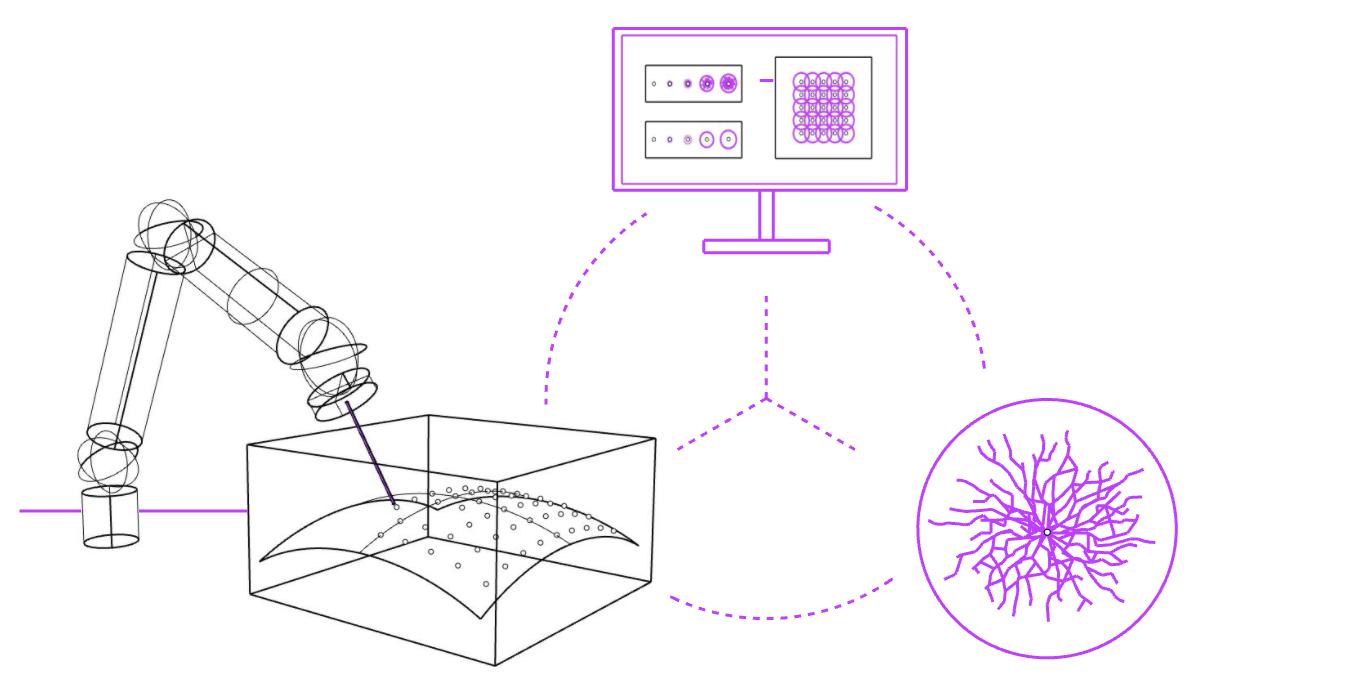
3.1 Facing Unruliness: mycelial growth from single inocula on plane substrate beds
At the beginning of the experimental phase, expectations were more inclined towards ruly, symmetrical growth and were massively challenged by the experiment results (Figure 4).
In this first set of experiments four substrate samples were prepared: three samples contained a single mycelial inoculation point placed at different positions within the substrate, while one sample contained three inoculation points sharing the same growth medium. An additional reference sample with two inoculation points was documented after an extended growth period. Growth was observed and documented at intervals of 0, 5, and 15 days, with the extended sample recorded after 30 days (Table 1, Figure 5)
Figure 3. The samples undergo a hybrid, two-step process of fabrication and growth coordinated by soft control. Source: Authors own image.
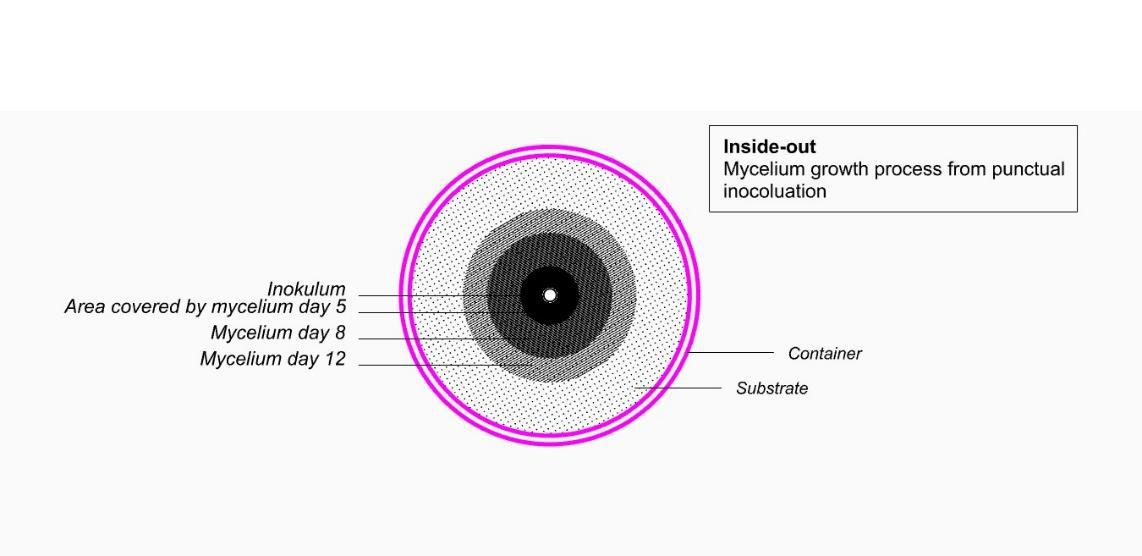
4. Ruly growth expectations of experimental sample from a single inoculum before undergoing the research. Source: Authors own image
3.2 Results: Temporal differentiation of growth outlines
Across all samples, mycelial growth outlines developed markedly over time, revealing increasing differentiation between early and later stages, while showing patterns that differed significantly between samples, even under comparable conditions. These differences manifested not only in the overall shape of the growth outlines but also in variations of density, filament thickness, and local consolidation.. After five days, growth remained relatively compact and localized around the inoculation points, with outlines that appeared tentatively radial and only weakly differentiated. At this stage, expansion was primarily surface-oriented, suggesting an initial phase of spatial probing rather than consolidation. After ten days, growth outlines became more pronounced and uneven, showing asymmetric expansion and localized intensifications along preferred directions. By fifteen days, these tendencies intensified further: growth boundaries no longer followed a coherent or centered expansion pattern but instead displayed pronounced divergence, fragmentation, and directional shifts.

Figure
Figure 5. Unruly mycelial growth of two single inocula after approx. 30 days . Source: Authors own image.
Mycelial Growth Samples
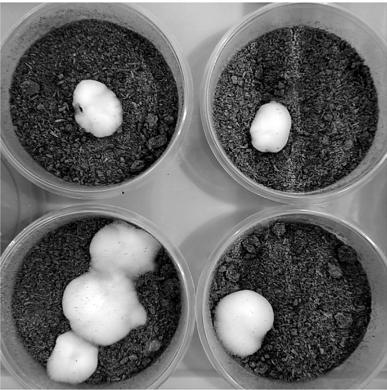
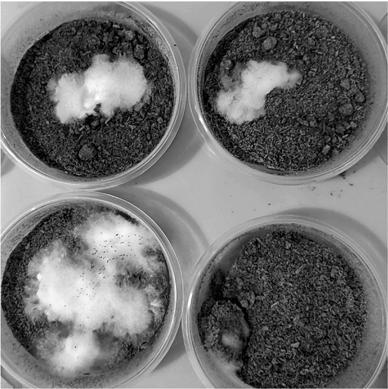

Growth Outlines
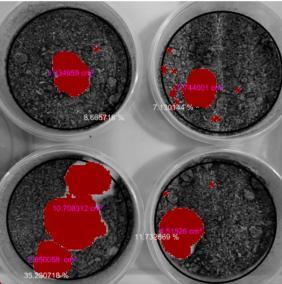
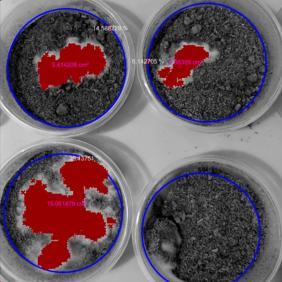
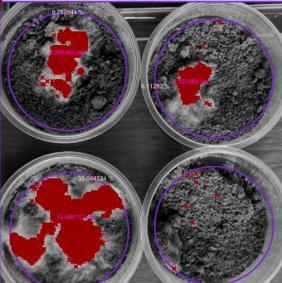
The results reflect a transition from initial exploratory spread toward more complex spatial negotiation, indicating that temporal durations, instable environmental conditions and shifting metabolic processes through ongoing development of the organism conditions. Areas of intensified filamentation coincided with zones of stronger material bonding and stability. The results thus indicate that unruliness is not a transient irregularity but a temporally unfolding condition through which material-immanent form and structural cohesion emerge.
Conclusion
The experiment results and analysis of the samples served to reconceptualize the initial orientation and theoretical framework of the research informed by ruly, symmetrical growth ideals, opening up the door for softer frameworks of thought around living organisms and unruliness as a productive moment within formgiving and design as explained in the theory section of this paper.
That said, the paper argues for an opening of digital fabrication toward growth-based and soft materials, not by rejecting precision or optimization, but by questioning the dominance of hylomorphic, form-prescriptive control models that limit how living materials can be engaged through theoretical reflection and hands-on experimentation Due to the limited sample size, the experiments do not aim to produce generalizable claims about mycelial growth. Instead, they support a qualitative, comparative reading of how growth dynamics diverge over time and (re-)inform normative expectations and conceptualizations of growth by proposing unruliness as a productive term for further practical implementation. Such growth-based systems introduce temporal, metabolic, and situated dynamics into fabrication processes, established notions of control centered on
Doctoral and Postgraduate Consortium
Rather than positioning growth in opposition to the implicitly deterministic norms and ideals within the field of digital fabrication, the research demonstrates how hybrid configurations between growth and fabrication can reframe control as conditional, relational, and time-based. In this context, unruly growth is not treated as a disturbance to be corrected, but as an expression of form in itself that is not dettachable from its material exsitance. Here, form is not the execution of a preconceived ideal, but unfolds temporarily through the particular coordination, adaptation, and transformations of the fungal organism within the environmental living conditions, which by artificially ending its lifecycle becomes fixed as material artefact.
Soft matter thus emerges as a material, procedural, and epistemic category, pointing toward growthoriented fabrication logics, in which form is immanent, negotiated, and co-produced over time through sustained interaction with unruly living materials.
References
Appels, F. V. W., Camere, S., Montalti, M., Karana, E., Jansen, K. M. B., Dijksterhuis, J., & Wösten, H. A. B. (2022). Fabrication factors influencing mechanical, moisture- and water-related properties of myceliumbased composites. Materials & Design, 161, 64–71. https://doi.org/10.1016/j.matdes.2018.11.027
Aristotle. (1998). Metaphysics (H. Tredennick & G. C. Armstrong, Trans.). Cambridge, MA: Harvard University Press.
Ben-Alon, L., & Carcassi, O. B. (n.d.). Dirty mycelium. Natural Materials Lab, Columbia University Graduate School of Architecture, Planning and Preservation. https://www.arch.columbia.edu/research/labs/17natural-materials-lab/dirty-mycelium
Carpo, M. (2011). The alphabet and the algorithm. Cambridge, MA: MIT Press.
Elsacker, E., Søndergaard, A., Van Wylick, A., Peeters, E., & De Laet, L. (2023). Mechanical, physical and chemical characterisation of mycelium-based composites with different types of lignocellulosic substrates. PLoS ONE, 18(2), e0281651. https://doi.org/10.1371/journal.pone.0281651
Fraunhofer UMSICHT. (2025). Mycelium-based materials and biofabrication. Fraunhofer Institute for Environmental, Safety, and Energy Technology. https://www.umsicht.fraunhofer.de
Haraway, D. (1988). Situated knowledges: The science question in feminism and the privilege of partial perspective. Feminist Studies, 14(3), 575–599. https://doi.org/10.2307/3178066
Haraway, D. (1992). The promises of monsters: A regenerative politics for inappropriate/d others. In L. Grossberg, C. Nelson, & P. Treichler (Eds.), Cultural studies (pp. 295–337). New York, NY: Routledge.
Ingold, T. (2011). Being alive: Essays on movement, knowledge and description. London, UK: Routledge. Ingold, T. (2013). Making: Anthropology, archaeology, art and architecture. London, UK: Routledge.
Jones, M., Mautner, A., Bismarck, A., & John, S. (2024). Engineered mycelium composite construction materials from fungal biorefineries: A critical review. Materials Today Bio, 22, 100683. https://doi.org/10.1016/j.mtbio.2023.100683
Press.
Menges, A. (2012). Material computation: Higher integration in morphogenetic design. Architectural Design, 82(2), 14–21. https://doi.org/10.1002/ad.1374
Menges, A., & Ahlquist, S. (2011). Computational design thinking. Chichester, UK: Wiley.
Stoppani, T. (2020). Why earthworms defy architectural logic MIT Press Reader https://thereader.mitpress.mit.edu/why-earthworms-defy-architectural-logic/
Studio Blast. (2020). Lovely Trash column [3D-myco-printed Installation / sculpture]. London, UK. https://www.blast-studio.com/portfolio/lovely-trash-column
Thompson, D. W. (1992). On growth and form (2nd ed.). Cambridge, UK: Cambridge University Press. (Original work published 1917)
Tsing, A. L. (2015). The mushroom at the end of the world: On the possibility of life in capitalist ruins. Princeton, NJ: Princeton University Press.
Wagner, M. (2015). „Materialgerechtigkeit". Debatten um Werkstoffe in der Architektur des 19. und frühen 20. Jahrhunderts https://doi.org/10.11588/IH.2003.0.20984
About the Author:
Clara Sofía Fernández: Sofia Fernández is a German-Uruguayan designer and researcher working at the intersection of digital fabrication, biomaterials, and sustainable design. Currently a PhD candidate at Bauhaus-Universität Weimar and research associate at Weißensee Kunsthochschule Berlin, her work explores growthbased materials and advanced fabrication technologies as speculative and practical frameworks for rethinking material cycles, fabrication & accumulation logics, and the relationship between culture and nature. She approaches technology not as a solution in itself, but as a space of possibility and tool for critical imagination for just socio-ecological futures beyond extractivist paradigms.
Acknowledgement: The author would like to thank Prof. Dr. Jan Willmann and Jun.Prof. Dr. Thomas Pearce for their kind advice and supervision. This research was supported by the Thüringer Graduiertenförderung and the Bauhaus Research School.
Choice of Food, Moment of Autonomy
Lai, Rising
LUCA School of Arts, KU Leuven, Genk, Belgium
1 Abstract
I am a doctoral candidate researching the co-design of communication tools and food-related interactions for people with dementia, focusing on cooking and shared meal experiences. Grounded in Material Engagement Theory (MET), I examine how people with dementia engage with kitchen artefacts to support autonomy, shared decision-making, and social connection. Using a socio-material lens that integrates design-archaeological, anthropological, and art-based methods, I aim to reimagine routine mealtimes as opportunities for co-creation and autonomy.
My primary objectives are to:
1. Explore how kitchen artefacts such as utensils, preprocessing devices, and visual cues afford or constrain agency for people with dementia during food-related activities.
2. Investigate how participatory design workshops surface lived experiences and preferences of both people with dementia and informal caregivers.
3. Develop design guidelines and prototype tools that enhance mealtime autonomy and meaningful engagement.
Methodologically, I employ qualitative methods in two phases. In phase one, I conducted immersive fieldwork in a residential care setting, including ethnographic observation, artefact mapping, and photo-elicitation sessions with residents. I then analysed these data through thematic analysis, guided by MET concepts of materiality and cognitive embodiment. In phase two, I participate in co-cooking workshops at a neighbourhood community centre in collaboration with a regional dementia support organisation. These sessions convene older adults with early-to-middle-stage dementia, informal caregivers, and community volunteers.
By the end of my PhD, I expect to produce:
1. A set of actionable design guidelines for developing kitchen tools and communication supports tailored to cognitive and sensory needs in dementia care.
2. A prototype toolkit comprising low-fidelity artefact prototypes and workshop templates for community implementation.
References (none)

Civic Dialogue Experiments: Exploring Mechanisms and Inclusion for E-participation in Urban Climate Policy
Jia Xin Liu
Politecnico di Milano, Milan, Italy
1 Abstract
Our societies are facing increasingly unpredictable weather patterns as the climate breakdown accelerates. Scholars arguethatclimatepolicyremainsoneofthemostpowerfultoolsforaddressing thesecomplex,systemicchallenges(Edmondsonetal.,2019).
In recent years, design thinking has begun to play a transformative role in shaping public policy. (Christian Bason, 2017; Clarke&Craft,2019;Kimbelletal.,2023;Marianietal.,2023).Thisemerging design orientation emphasizes diverse stakeholder perspectivesandintegratesbehavioralinsightsto better alignpolicieswithsocietalneeds(Clarke&Craft,2019;MichaelHowlett,2014).Whiledebates persist about the appropriateness of design thinking in policymaking, civic involvement is increasingly seen as a center of this shift, promoting policymaking processes that are more democratic and inclusive. (Clarke & Craft, 2019; Kimbell et al., 2023; Mortati et al., 2022; Rowe & Frewer,2000).
To boost the efficiency and overcome the physical limitations of traditional civic involvement methods, governments are progressively turning to electronic participation (e-participation) (Blanc, 2020; Simonofski et al., 2017). The novel digital spaces offer interactive and adaptable mechanisms that can support government-citizens dialogue and interactions towards more ‘co’ relationships (Benlahcene et al., 2024; Christian Bason, 2017; Linders, 2012). However, due to a lack of empirical studies (Adnan et al., 2022; Mariani et al., 2023, 2025), current e-participation mechanisms are not yet proven tobewell-establishedinsupportingeffectiveandinclusivedemocraticknowledgesharing forpolicymaking(Peristerasetal.,2009;andSeeVerovšek,2023).
Most e-participation mechanisms nowadays are predominantly text-based, occasionally supported by visuals, encouraging citizens to share experiences and ideas. Yet, understanding what peoplesay and think at an explicit level is insufficient (B-nSanders, 2002; Peristeras et al., 2009).Inferringfrom Visser (2005), focusing solely on what people “say” mayoverlookthetacitknowledge,whichfosters empathyandmutualunderstandingindeliberativedemocracy(Peristerasetal.,2009).
Building on the idea that the effectiveness of participation depends on the type of mechanism and how it is applied (Rowe & Frewer, 2005), this research investigates whether current “text-based”
This doctoral research will be carried out in collaboration with URBREATH, an EU-funded project aiming to establish collaborative and e-participatory nature-based solutions (NBS) for revitalizing urban spaces in nine European pilot cities. Building on this foundation, thisresearchhasthreemain objectives.
1. Examining the strengthsandweaknessesofcurrente-participationmechanismsusedinnine pilot cities within URBREATH, with a focus on understanding the types of knowledge generatedandinclusivitythroughcasestudies.
2. Co-design new “beyond-text” mechanisms in collaboration with one or two selectedcities. Using a Research through Design (RtD) methodology, thisphasewillgenerateempiricaldata onhowdifferentmechanismsinfluenceparticipationbehaviorsandoutcomes.
3. Synthesize findings and compare them to established participatory frameworks, creating validated guidelines for scaling inclusive civic dialogue mechanisms to broader urban policymakingcontexts.
Aligning with IASDR 2025's DesignNext theme, this research aims to contribute to the next generation ofe-participation,boththeoretically—byextendingparticipatorydesignintodigitalpolicy spaces—and practically—by offering adaptable guidelines for more democratic urban climate policymaking.
References
Adnan, M., Ghazali, M., & Othman, N. Z. S. (2022). E-participation within the context of e-government initiatives: A comprehensive systematic review. Telematics and Informatics Reports, 8, 100015. https://doi.org/10.1016/j.teler.2022.100015
Benlahcene, A., Awang, H., Mansor, N. S., Ghazali, O., Mohd Nadzir, M., Mat Yamin, F., Uba Haruna, I., & Tudu Shehu Malami, S. (2024). Citizens’ E-participation through E-government services: A systematic literature review. Cogent Social Sciences, 10(1), 2415526. https://doi.org/10.1080/23311886.2024.2415526
Blanc, D. L. (2020). E-participation: A Quick Overview of Recent Qualitative Trends (UN Department of Economic and Social Affairs (DESA) Working Papers No. 163; UN Department of Economic and Social Affairs (DESA) Working Papers, Vol. 163). https://doi.org/10.18356/0f898163-en
Brandt, E., Binder, T., & Sanders, E. B.-N. (2012). Tools and techniques: Ways to engage telling, making and enacting. In J. Simonsen & T. Robertson (Eds.), Routledge International Handbook of Participatory Design (0 ed., pp. 165–201). Routledge. https://doi.org/10.4324/9780203108543
Christian Bason. (2017). Leading public design: Discovering human-centred governance (1st ed.). Bristol University Press. https://doi.org/10.2307/j.ctt1t88xq5
Clarke, A., & Craft, J. (2019). The twin faces of public sector design. Governance, 32(1), 5–21. https://doi.org/10.1111/gove.12342
Edmondson, D. L., Kern, F., & Rogge, K. S. (2019). The co-evolution of policy mixes and socio-technical systems: Towards a conceptual framework of policy mix feedback in sustainability transitions. Research Policy, 48(10), 103555. https://doi.org/10.1016/j.respol.2018.03.010
B-nSanders, E. (2002). From user-centered to participatory design approaches. In Contemporary Trends Institute series (pp. 1–8). https://doi.org/10.1201/9780203301302 2
age of social media. Government Information Quarterly, 29(4), 446–454. https://doi.org/10.1016/j.giq.2012.06.003
Mariani, I., Mortati, M., & Rizzo, F. (2023). Strengthening e-Participation through Design Thinking. Relevance for Better Digital Public Services. Proceedings of the 24th Annual International Conference on Digital Government Research, 224–232. https://doi.org/10.1145/3598469.3598494
Mariani, I., Mortati, M., Rizzo, F., & Deserti, A. (2025). Design Thinking as a Strategic Approach to E-Participation: From Current Barriers to Opportunities. Springer Nature Switzerland. https://doi.org/10.1007/978-3-031-72160-1
Michael Howlett. (2014). From the ‘old’ to the ‘new’ policy design: Design thinking beyond markets and collaborative governance. Policy Sciences, 47(3), 187–207. https://doi.org/10.1007/s11077-014-9199-0
Mortati, M., Mullagh, L., & Schmidt, S. (2022). Design-led policy and governance in practice: A global perspective. Policy Design and Practice, 5(4), 399–409. https://doi.org/10.1080/25741292.2022.2152592
Peristeras, V., Mentzas, G., Tarabanis, K. A., & Abecker, A. (2009). Transforming E-government and E-participation through IT. IEEE Intelligent Systems, 24(5), 14–19. https://doi.org/10.1109/MIS.2009.103
Rowe, G., & Frewer, L. J. (2000). Public Participation Methods: A Framework for Evaluation. Science, Technology, & Human Values, 25(1), 3–29. https://doi.org/10.1177/016224390002500101
Rowe, G., & Frewer, L. J. (2005). A Typology of Public Engagement Mechanisms. Science, Technology, & Human Values, 30(2), 251–290. https://doi.org/10.1177/0162243904271724
Sanders, E. B.-N., & Stappers, P. J. (2014). Probes, toolkits and prototypes: Three approaches to making in codesigning. CoDesign, 10(1), 5–14. https://doi.org/10.1080/15710882.2014.888183
Simonofski, A., Snoeck, M., Vanderose, B., Crompvoets, J., & Habra, N. (2017, August). Reexamining E-participation: Systematic Literature Review on Citizen Participation in E-government Service Delivery. AMCIS 2017 Proceedings. 3. Americas Conference on Information Systems. https://aisel.aisnet.org/amcis2017/eGovernment/Presentations/3
Verovšek, P. J. (2023). Authorship and individualization in the digital public sphere. Constellations, 30(1), 34–41. https://doi.org/10.1111/1467-8675.12668
Visser, F. S., Stappers, P. J., Van Der Lugt, R., & Sanders, E. B.-N. (2005). Contextmapping: Experiences from practice. CoDesign, 1(2), 119–149. https://doi.org/10.1080/15710880500135987
About the Authors:
Jia Xin Liu: Jia-Xin Liu is a PhD fellow at the Department of Design, Politecnico di Milano. Her research explores how participatory and digital design can enhance civic engagement and inclusivity in public policy and urban climate transitions.
Acknowledgement: Funded by the European Union under the Marie Skłodowska-Curie Grant Agreement No. 101120074 (CoDesign4Transitions). Views and opinions expressed are however those of the author(s) only and do not necessarily reflect those of the European Union or the Research Executive Agency. Neither the European Union nor the Research Executive Agency can be held responsible for them.
Putting Wings on AI: A Framework for Human-Centred Design of AI Co-Pilots in Aviation
Fernando, W. Dakshina T. Monash University, Malaysia
Ee, Sharifah Rose Monash University, Malaysia
1 Abstract
Artificial intelligence (AI) is transforming aviation by enhancing decision-making, improving situational awareness, and supporting flight operations through AI-powered co-pilots. However, the design of such systems must move beyond automation and towards meaningful human-AI collaboration. In safety-critical domains like aviation, AI systems must support, not supplant, human expertise. This paper presents a human-centred design framework for AI co-pilots that aligns with the broader vision of responsible, cooperative AI integration.
To develop the framework, we analysed sources from current aviation AI initiatives, human-in-theloop system design research, and emerging industry and regulatory guidelines. We examined illustrative cases of AI use in cockpit environments (both successful and problematic) to identify recurring patterns and points of tension in human-AI interaction. Building on interdisciplinary literature from interaction design, cognitive science, and aviation safety, our framework highlights the socio-technical and ethical considerations essential for embedding AI into flight systems. We argue that current trajectories in AI development often prioritise performance and autonomy, yet overlook essential factors such as pilot trust, interpretability, and adaptability. Our proposed framework (Figure 1)organises design principles into three interconnected dimensions: cognitive alignment, system legibility, and contextual fit.
Cognitive alignment focuses on how AI systems can complement and enhance human cognitive processes without increasing workload or inducing over-reliance. This includes supporting pilots in high-stress scenarios by offering timely, adaptive, and context-sensitive recommendations that align with human judgment patterns. System legibility addresses how AI communicates its reasoning, goals, and confidence levels to users. Drawing from principles of explainable AI, this dimension emphasises the importance of making AI decisions understandable and contestable, especially during timesensitive or ambiguous flight conditions. Lastly, contextual fit considers how AI co-pilots can be
agents, mitigating the risk of AI overreliance, and designing for trust without inducing complacency. Structuring these concerns within an integrative framework supports the design of AI systems that are ethically responsible, operationally effective, and cognitively attuned to the real-world needs of pilots.
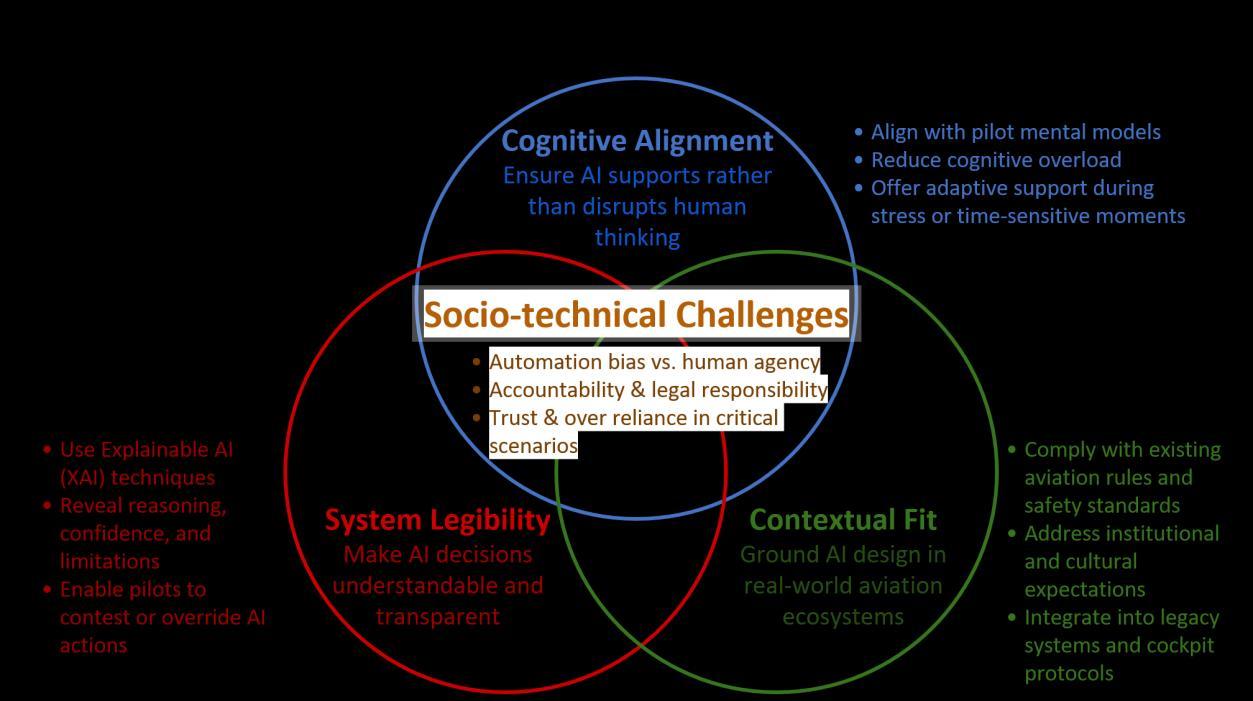
Figure 1: The framework highlights three overlapping design dimensions (Cognitive Alignment, System Legibility, and Contextual Fit) where at the intersection lies key sociotechnical challenges.
Rather than offering a prescriptive checklist, the framework functions as a generative design tool, supporting critical reflection and decision-making in the development of AI co-pilots. This conceptual foundation sets the stage for future empirical validation through participatory design, simulationbased testing, or co-design with aviation professionals. It can be used by design teams, aircraft system engineers, policymakers, and researchers to interrogate assumptions, anticipate ethical concerns, and envision more accountable AI-enabled systems.
Ultimately, this paper contributes to the discourse on human-centred AI by advancing a vision of AI co-pilots as interpretable, cooperative, and context-aware decision partners. Rather than displacing pilot expertise, we argue that AI should act as a cognitive and operational companion that enhances human judgment, respects institutional safeguards, and adapts to real-world complexity. As AI continues to evolve, designing with, and not just for, human users, becomes essential to ensuring safe, ethical, and trustable adoption in high-stakes domains like aviation.
References
Dheu, O., & Emanuilov, I. (2021). Flying High for AI? Perspectives on EASA’s Roadmap for AI in Aviation Air and Space Law, 46(1) 1-28 https://kluwerlawonline.com/journalarticle/Air+and+Space+Law/46.1/AILA2021001
Emanuilov, I., & Dheu, O. (2021). Flying high for AI? Perspectives on EASA’s roadmap for AI in aviation. Air and Space Law, 46(1)
John, R. (2025). Ensemble Machine Learning for Aviation Safety: Boeing Vs Airbus Comparative Study. Acceleron Aerospace Journal, 4(6), 1209-1218
Lauren, D., & Hervé, G. (2023). Symbolic AI for crew assistance: using ontologies in the cockpit. In Proceedings of the 1st International Conference on Cognitive Aircraft Systems, (ICCAS 2022), 88-91 DOI: 10.5220/0011964000003622
Torens, C., Durak, U., & Dauer, J. C. (2022). Guidelines and regulatory framework for machine learning in aviation. AIAA Scitech 2022 Forum https://doi.org/10.2514/6.2022-1132
Würfel, J., Djartov, B., Papenfuß, A., Wies, M. (2023). Intelligent Pilot Advisory System: The journey from ideation to an early system design of an AI-based decision support system for airline flight decks. In: Gesa Praetorius, Charlott Sellberg and Riccardo Patriarca (eds) Human Factors in Transportation. AHFE (2023) International Conference. AHFE Open Access, vol 95. AHFE International, USA. http://doi.org/10.54941/ahfe1003844
Yılmaz, A. A. (2024). Flight in transition: navigating the skies of automation and human judgement. Journal of Aviation, 8(3), 305-314
Zaoui, A., Tchuente, D., Wamba, S. F., & Kamsu-Foguem, B. (2024). Impact of artificial intelligence on aeronautics: An industry-wide review. Journal of Engineering and Technology Management, 71, 101800. https://doi.org/10.1016/j.jengtecman.2024.101800
Zhang, Z. T., Feger, S. S., Dullenkopf, L., Liao, R., Süsslin, L., Liu, Y., & Butz, A. (2024). Beyond Recommendations: From Backward to Forward AI Support of Pilots' Decision-Making Process. Proceedings of the ACM on Human-Computer In Interaction, 8(CSCW2), 1-32
Designing Community-Anchored Customer Experiences for Local Shops
Woo, Eunji
KAIST, Daejeon, Republic of Korea
Abstract
A local shop is a small universe where people interact with neighbours and the like-minded, fostering micro-communities. Traditionally regarded as community hubs where community naturally emerged through everyday encounters, local shops are increasingly evolving into community builders, unconsciously creating experiences to foster connections among customers.
Amid global urban anonymity, digitalisation, and socioeconomic decline, local shops’ role in rebuilding community has become vital for socially sustainable and resilient cities. Despite their economic, social, and cultural impact at both the business and neighbourhood levels, such community-related experiences remain largely unrecognized as legitimate design activities in design discourse. Grounded in field practices with local shops in South Korea, this research examines how innovative local shops, often described as the “K-Local” phenomenon, have rapidly emerged over the past decade. It conceptualizes community-anchored customer experiences (CCX) as intentional and strategic act of design, and proposes how they can be strategically designed and supported. The overall research flow is presented in Figure 1.
Theoretical Underpinning phase. This research explored why communities are significant for local shops, how they can become a design practice, and why design facilitation, technology mediation, and policy support are needed to support and sustain such diffuse design activities.
Formative Study phase. This research identifies how local shop proprietors’ social objectives and the people they seek to connect with give rise to four distinctive personas based on their community aspirations: Social Butterfly, Unique Hipster, Bailiwick Spreader, and Buy-Local Crusader. It then explores how customers form relationships with shops through specific experiential touchpoints, and how proprietors, in turn, strategically design these touchpoints to fulfil customer needs for continued patronage. By modelling proprietors’ everyday practices, the study illustrates how communityanchored customer experiences (CCX) can be created, implemented, and replicated across diverse local shop contexts (see Figure 2).
activity. Additionally, a conceptual model of CCX creation was developed, structured into four phases: Strategize, Design, Experiment, and Implement, with their respective components. Further, how technology, e.g., generative AI recommendation, AR augmentation, location-based technology, could mediate CCX interactions was explored with roles identified in populating a shop-centred community, triggering low-key social interactions, and deepening social bonds.
Implementational Tools phase. The CCX design process model and its accompanying tools were developed, comprising five phases: Anchor Local Shop Identity, Envision Community Relationships and Aspirations, Empathize with Customer Journeys, Diagnose Gaps Between Aspirations and Reality, and Generate Touchpoint Ideas. Figure 3 illustrates the design process model for co-designing CCX with proprietors, while Figure 4 translates this process into a workshop format, specifying activities and participant roles. Through empirical studies, it was found that design facilitation played a critical role as CCX Design Navigator, Local Sense Translator, Community-Fit Coach, and Authenticity Seeker. This research also proposed a policy support framework and a systemic-level governance model, bridging diffuse design practice and policy implementation.
This doctoral consortium focuses on how the CCX design framework can be disseminated into realworld practices, particularly, how local shop proprietors can be enabled to design for their own communities. The discussion will explore possible forms of translation, such as participatory toolkits, services, programs, and digital platforms, and how these may evolve into sustainable mechanisms for community-anchored innovation.
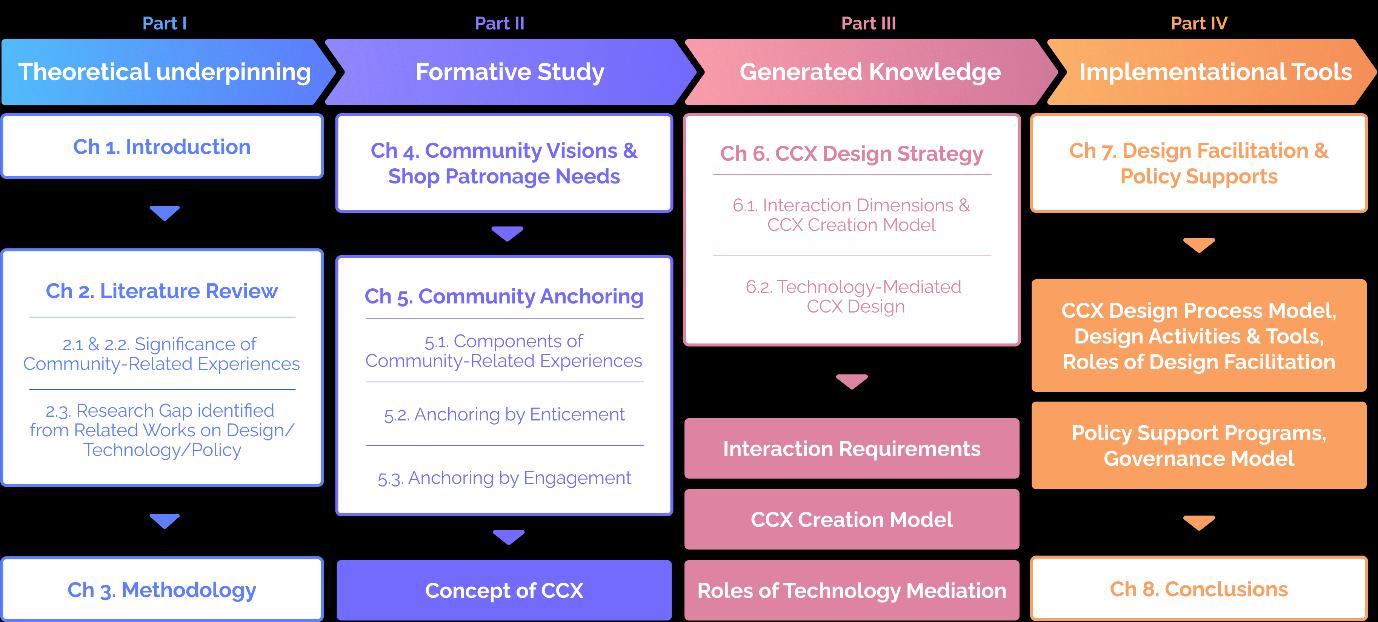
Figure 1. Research Structure.
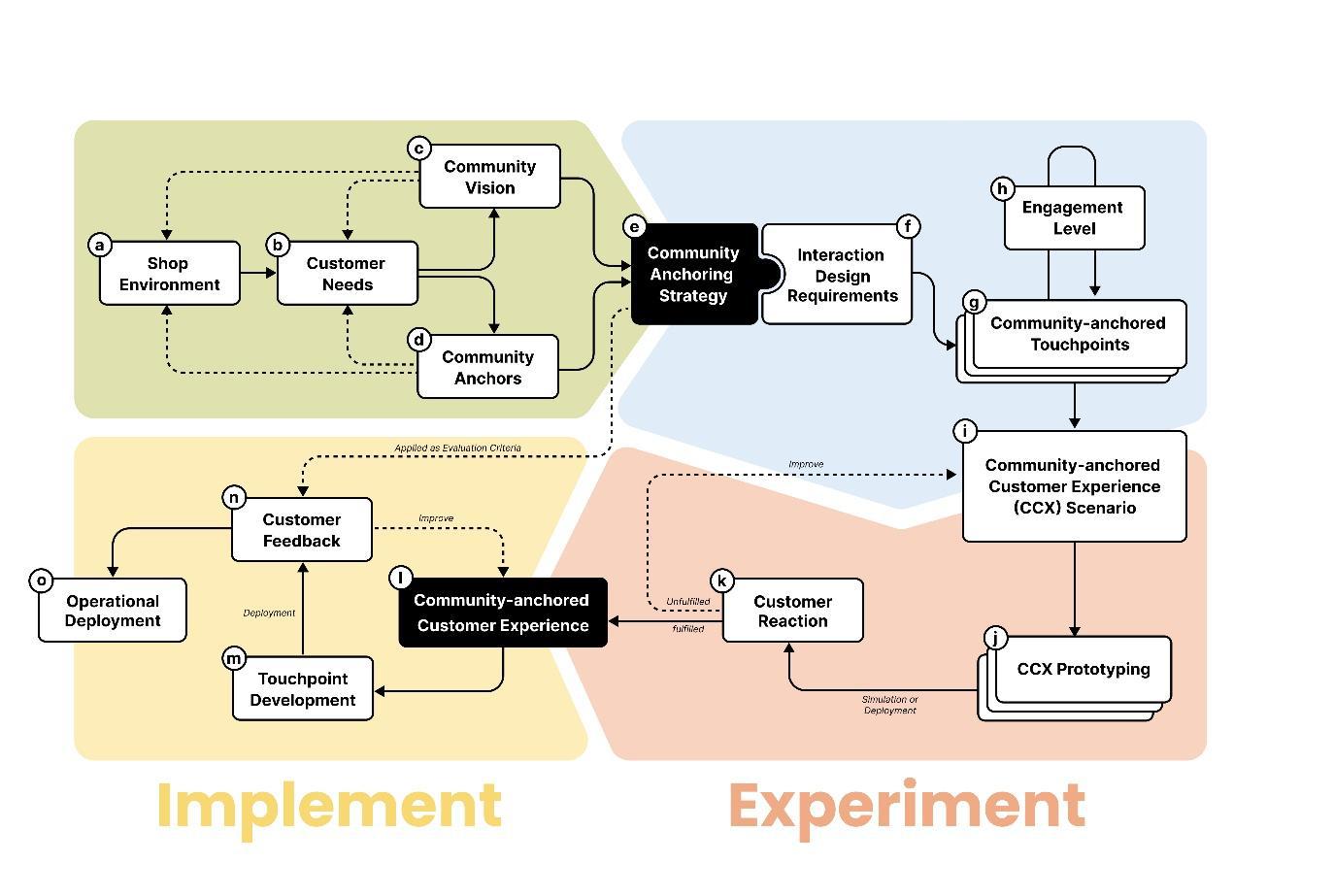
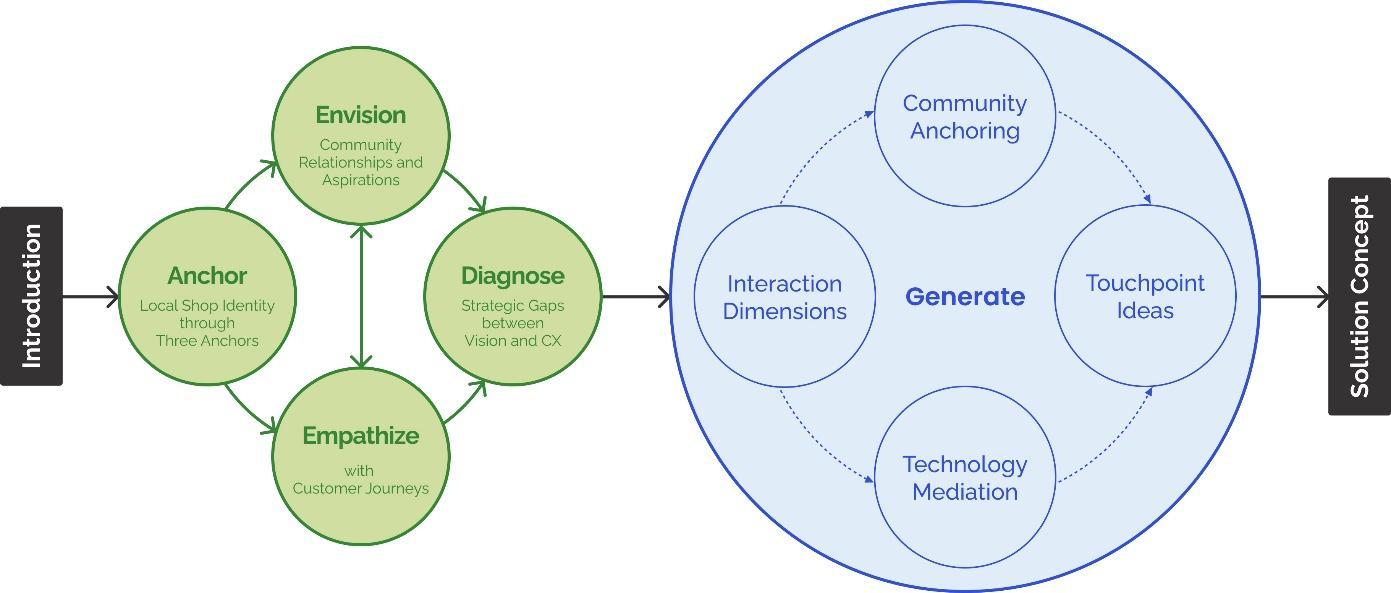
Figure 2 Conceptual Model of CCX
Figure 3 CCX Design Process Model for Local Shop Proprietors
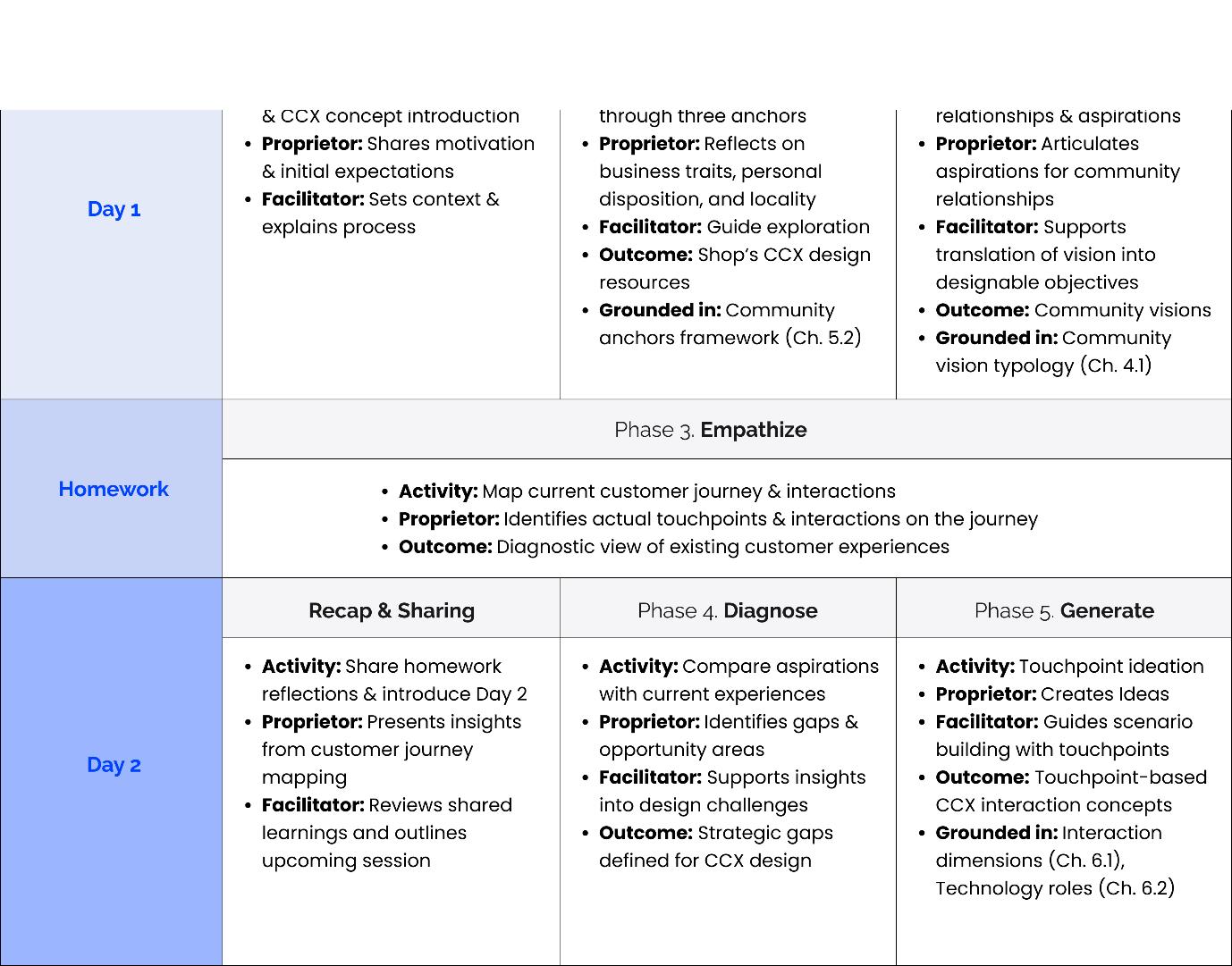
Figure 4. Workshop Format of the CCX Design Process.l
https://doi.org/10.1016/j.geoforum.2020.12.024
Gerosa, A. (2020). The hipster economy (Doctoral dissertation). Università degli Studi di Milano. https://hdl.handle.net/2434/708105
Manzini, E. (2015). Design, when everybody designs: An introduction to design for social innovation. MIT Press. McAlexander, J. H., Schouten, J. W., & Koenig, H. F. (2002). Building brand community. Journal of Marketing, 66(1), 38–54. https://doi.org/10.1509/jmkg.66.1.38.1845
Olsson, T., Jarusriboonchai, P., Woźniak, P., Paasovaara, S., Väätänen, K., & Lucero, A. (2020). Technologies for Enhancing Collocated Social Interaction: Review of Design Solutions and Approaches. Computer Supported Cooperative Work (CSCW), 29, 29–83. https://doi.org/10.1007/s10606-019-09345-0
Woo, E., Kim, C., Kwon, H., Ryu, Y., Choi, Y.,and Nam, K.(2023) Meet me at the local shop: designing community anchors for customer engagement, in De Sainz Molestina, D., Galluzzo, L., Rizzo, F., Spallazzo, D. (eds.), IASDR 2023: Life-Changing Design, 9-13 October, Milan, Italy. https://doi.org/10.21606/iasdr.2023.465
Yoon, H. (2024). Aestheticizing authenticity: Entrepreneurial practices of business owners in Seoul’s gentrifying neighbourhood. Journal of Urban Design, 29(5), 557–575. https://doi.org/10.1080/13574809.2024.2314761
Zukin, S. (2009). Naked city: The death and life of authentic urban places. Oxford University Press.

Exploring Cross-Modal Taste Perception Under Coloured Virtual Lighting Environments
Qu Ying, Kato Takeo Department of Mechanical Engineering, Keio University, Yokohama, Japan
Abstract
Multi-sensory experience (multisensory experience) has received much attention, and Virtual Reality (VR) technology is gradually becoming an important tool for studying human perception (Wan et al., 2022; Yildirim et al., 2025). Taste, as one of the most basic human perceptions, is not only affected by the chemical composition of food itself, but also strongly modulated by other senses such as vision. It has been pointed out that colour, as a significant visual cue, can affect the sense of taste through the “intrinsic colour” of food, and can also change judgment of people on taste through the “extrinsic colour” of the container or the environment (Wu et al., 2022). In physical reality, the colour of ambient light has been shown to significantly affect the perception of sweetness, bitterness, and so on. However, there is a lack of systematic research on how ambient colour affects taste in virtual reality environments. Given the immersive nature of VR environments, it is possible that ambient light colour, as a persistent visual stimulus, plays a key role in perceptual modulation.
In this study, a VR experiment was designed to explore the effects of different virtual environment light colours on taste and olfactory perception of wine. 10 participants tasted the same wine samples in a virtual restaurant rendered by 8 colours of light (white, purple, blue, cyan, green, yellow, orange, red) (wine and glasses were not shown in VR). Participants were immersed in a colour-specific environment for 30 s, then tasted the wine for 10 s when prompted by the experimenter, and rated Sour, Spicy, Bitter, Sweet, Aroma, and Preference using a 10-point Likert scale through the VR interface. The colour order is randomized, and olfactory and gustatory recovery operations were performed after each round to ensure independence of test results.
Data were analysed by non-parametric Friedman ANOVA. The results showed that environmental colour had a significant effect on sourness, sweetness and preference scores. In the Figure 1 (a), Sourness perception was significantly higher in the green environment than in the white and blue environments. The red environment enhanced perception of sweetness in the Figure 1 (e) and overall preference was higher than in the orange environment in the Figure 1 (f). Although it did not reach statistical significance in the other dimensions (spiciness, bitterness, and aroma), the white, blue, and green scores ranked higher than the purple, cyan, yellow, orange, and red scores on spicy perception in the Figure 2 (b). The blue environment was rated higher than all other colour environments for This
for simulating taste in inaccessible settings, such as International Space Station. Based on this, my doctoral research will explore optimizing color and lighting design in space stations to improve dietary experiences for future long-term missions.
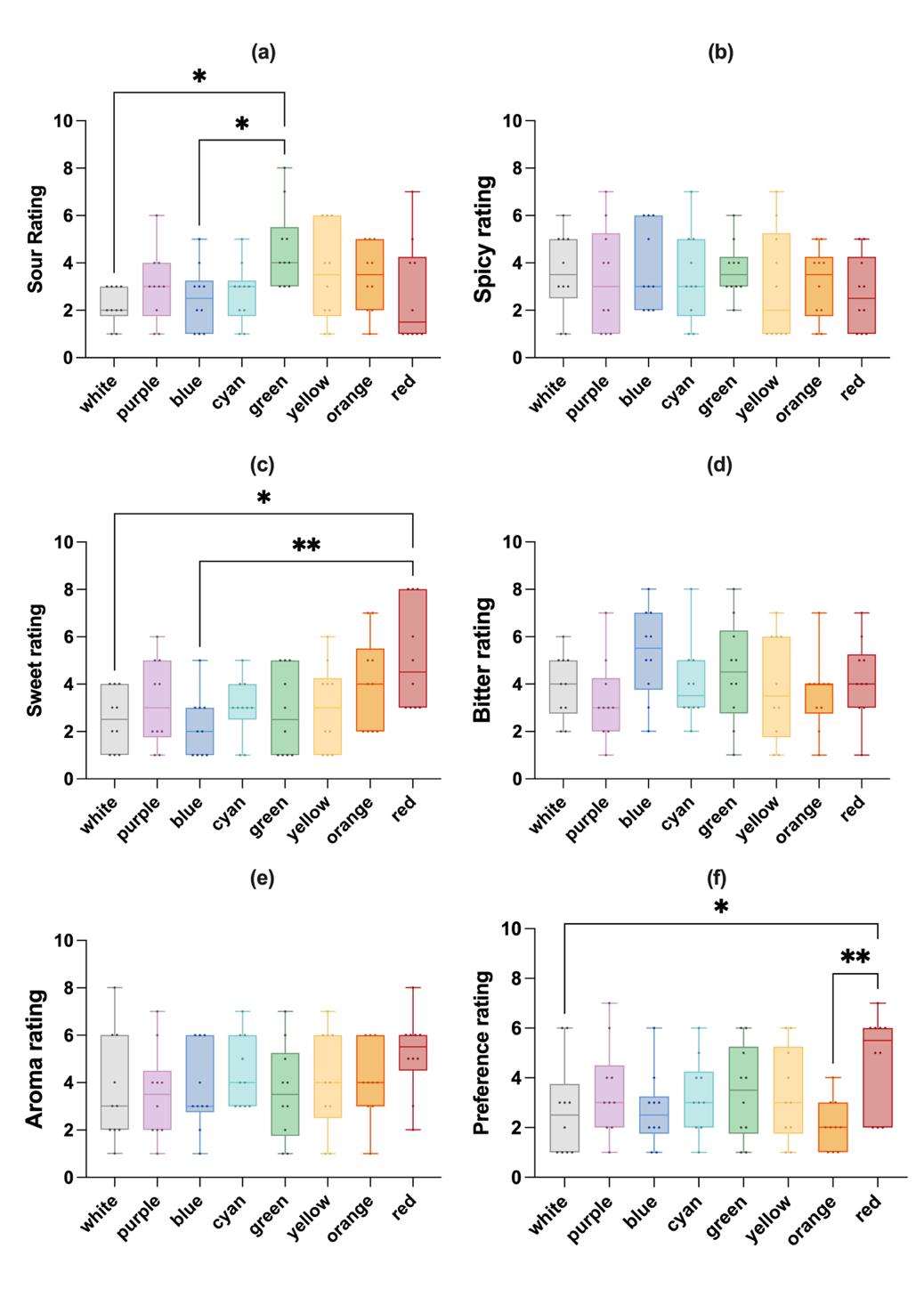
*)
Figure 1. Box plots of flavour sensory scale: (a) sour rating, (b) Spicy rating, (c) Sweet rating, (d)Bitter rating, (e) Aroma rating, (f) Preference rating, Differences between the conditions were significant at p < 0.050 (marked with
and p < 0.010 (marked with **)
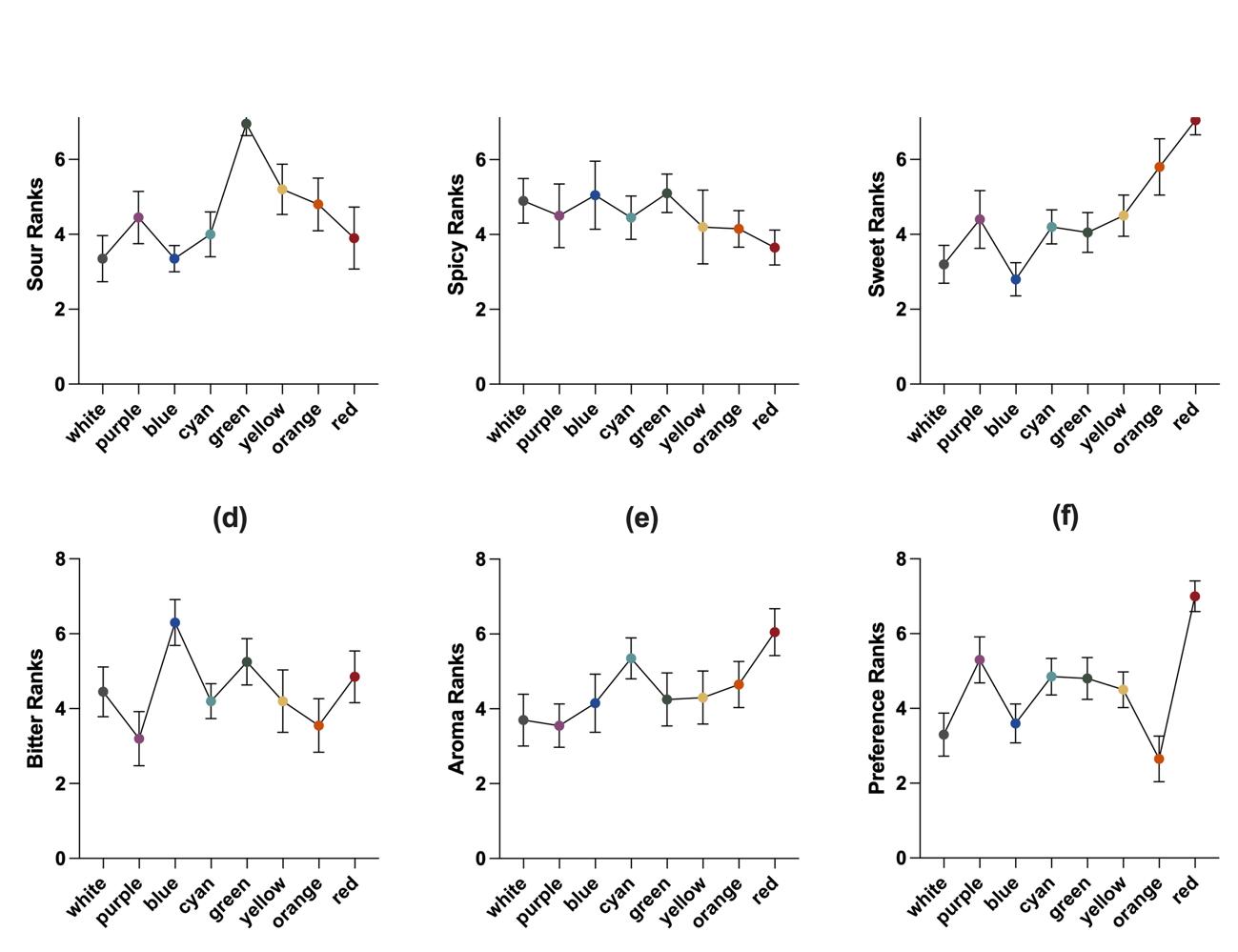
Figure 2. Ranks of flavour sensory scale: (a) Sour Ranks, (b) Spicy Ranks, (c) Sweet Ranks, (d)Bitter Ranks, (e) Aroma Ranks, (f) Preference Ranks.
https://doi.org/10.1111/aphw.12321
Wu, Z., Shi, R., Li, Z., Jiang, M., Li, Y., Yu, L., & Liang, H.-N. (2022). Examining cross-modal correspondence between ambient color and taste perception in virtual reality. Frontiers in Virtual Reality, 3. https://doi.org/10.3389/frvir.2022.1056782
Yildirim, M., Globa, A., Gocer, O., & Brambilla, A. (2025). Digital smell technologies for the built environment: Evaluating human responses to multisensory stimuli in immersive virtual reality. Building and Environment, 271, 112608. https://doi.org/10.1016/j.buildenv.2025.112608
Doctoral and Postgraduate Consortium | 71
Reimagining Public Art Venues as Intergenerational Design Hubs: Pedagogical Practices at Banqiao 435 Art Zone
Lu, Shiang Fu
National Taiwan Normal University, Taipei, Taiwan
1 Background
Amid the transformation of design education and the evolving role of creative clusters as learning environments, the potential of public art spaces has been re-examined(Bakırlıoğlu & McMahon, 2021)
This study focuses on the Banqiao 435 Art Zone in Newthat centers “design” as its core theme. The research highlights that the site was originally established as the Financial Personnel Training Center under the Veterans Affairs Council, R.O.C (Taiwan) After its relocation in 1996, the facility remained vacant until 2012, when its management was transferred to the Cultural Affairs Department of the New Taipei City Government. Since then, it has Taipei City, Taiwan the first artist-in-residence program in the country operated under two major themes: the “Parent-Child Art Park” and the “Artist Residency Base.” Functioning as a quasi-museum institution, its primary roles emphasize exhibition and educational outreach rather than the traditional museum functions of collect ion and research (Liu, 2016; Lin, 2018; Fang, 2022)
Beyond serving as a site of artistic social practice, the Banqiao 435 Art Zone also functions as an experimental platform f or design education. It is further recognized as one of Taiwan’s most concentrated artist residency spaces, accommodating nearly one hundred artists and collectives. This This work is licensed under a Creative Commons Attribution-NonCommercial 4.0 International Licence. http://creativecommons.org/licenses/by-nc/4.0/
Figure 1. Banqiao 435 Art Zone is an innovative hub for family Source: Banqiao 435 Art Zone
2 Objectives
The core objective of this study is to examine how public art spaces can transcend their conventional exhibition functions and be reimagined and structured as dynamic “intergenerational design hubs.” This aim not only responds to the contemporary trend in design education toward more diversified and practice-oriented learning environments but also seeks to explore the potential of art spaces in fostering community connections, supporting lifelong learning, and promoting intergenerational knowledge exchange.
3 Methods
This research adopts a qualitative case study approach to examine five resident design studios: Biothing Design Studio (craft design), Vance Creative Studio (social design and art education), Firework Universe Digital Studio (multimedia design), 111 Plus Design Co. (graphic and exhibition design), and A Touch of Light Design & Production Co. (theater lighting design). Drawing on more than 20 workshops conducted between 2023 and 2024, the study analyzes pedagogical practices through triangulated data sources, including participant observation, instructor interviews, and post-workshop reflections.
4 Results
This study identifies three innovative pedagogical models:
(1) Socially-Engaged Teaching: This model integrates social issues into intergenerational design workshops conducted within community settings. It echoes the emphasis of social design on participation in the public sphere (Markussen, 2017), fostering participatory learning and enhancing social resilience.
Figure 2 The plaster model painting workshop facilitates parent-child co-learning Source: 111 Plus Design Co
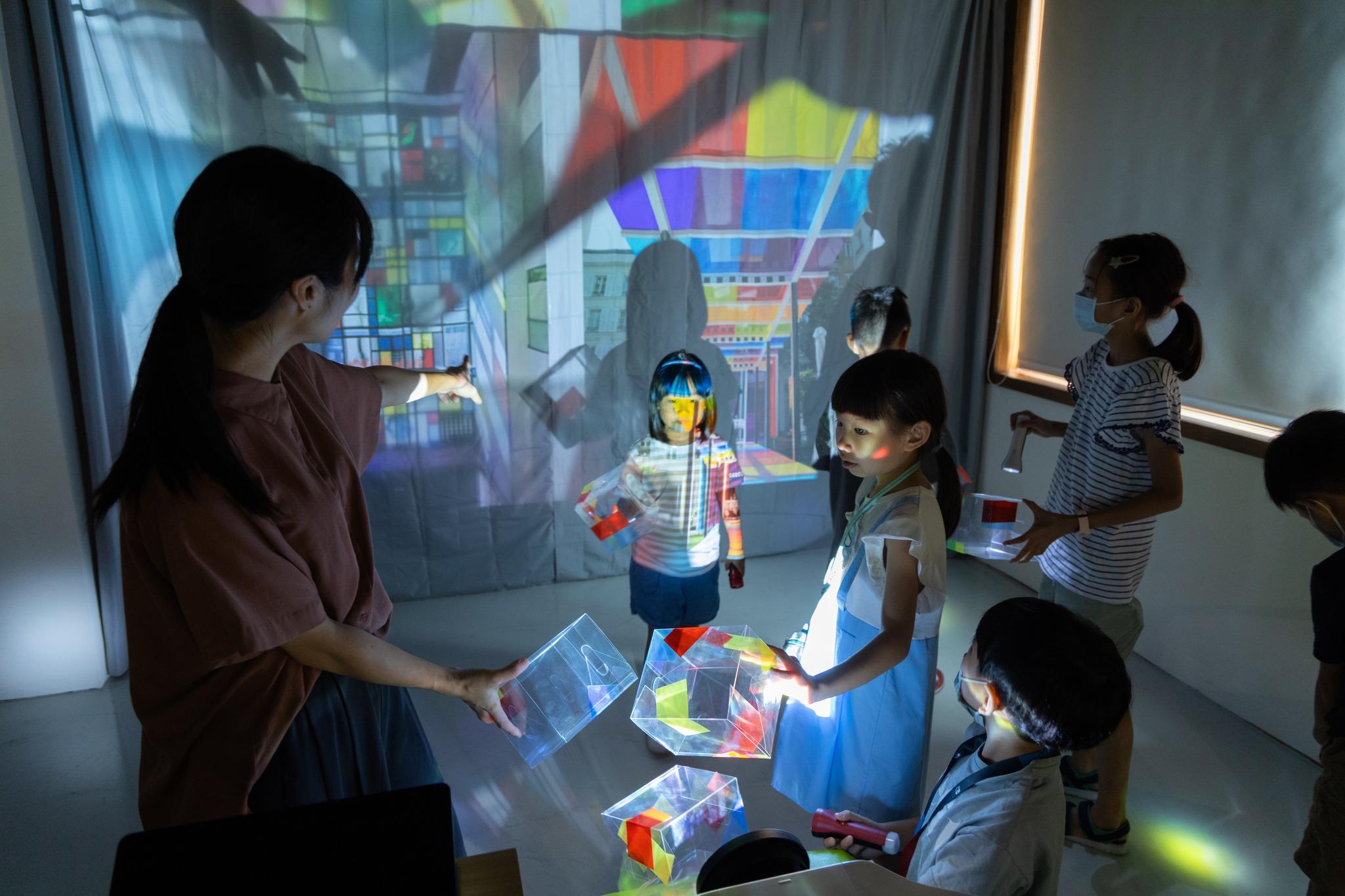
(3) Sustainable Material-Based Practice: This model introduces natural materials such as bamboo, leaves, and pinecones into the creative design process, aligned with pedagogical practices that employ discarded or repurposed materials (Yılmaz Barış et al., 2025). By linking locally sourced renewable resources with traditional craft sensibilities, these workshops promote circular design thinking (Sumter et al., 2020) and ecological ethics.
5 Conclusion
These practices demonstrate how art zones can facilitate intergenerational and community-based design learning (Gross, 2024), including shared parent–child learning experiences (Burke et al., 2021). The diverse and engaging pedagogical activities highlight experimentation, social engagement, aesthetic development, and the transmission of design competencies. This approach transcends the conventional boundaries of formal school education and responds to the ongoing transformation of design pedagogy. The study underscores the potential of public art spaces to function as inclusive, intergenerational, and socially engaged learning platforms, reinforcing their civic role as spaces for community participation and educational innovation.
Figure 3 Guiding children to learn about projection design and media art Source: Firework Universe Digital Studio
friendly materials to echo the concept of sustainability Source: Vance Creative Studio
123474. https://doi.org/10.1016/j.jclepro.2020.123474
Fang, C. Y. (2022). Interdisciplinary educational practice in quasi-museums: A case study of the "Creative-Reuse Art Festival" in Banqiao 435 Art Zone [Master's thesis, Fu Jen Catholic University]. National Digital Library of Theses and Dissertations in Taiwan
Lin, F. W. (2018). Space utilization and activation: A case study in Banqiao 435 Art Zone [Master's thesis, University of Taipei] National Digital Library of Theses and Dissertations in Taiwan
Liu, Y. H. (2016). Artist-in-residence and its cluster effect: A case study of Banqiao 435 Art Studio [Master's thesis, National Taiwan University of Arts]. National Digital Library of Theses and Dissertations in Taiwan
Markussen, T. (2017). Disentangling 'the social' in social design's engagement with the public realm. CoDesign, 13(3), 160-174. https://doi.org/10.1080/15710882.2017.1355001
Sumter, D., de Koning, J., Bakker, C., & Balkenende, R. (2020). Circular Economy Competencies for Design. Sustainability, 12(4), 1561. https://doi.org/10.3390/su12041561
Yılmaz Barış, A. C., Canoğlu, S., Ak, H. Ş., & Eren, G. H. (2025). Creative Sustainability Expressions: Student Projects Crafted from Waste Materials in Basic Design Studios. Journal of Architectural Sciences and Applications, 10(1), 200-215. https://doi.org/10.30785/mbud.1573620
Designing Symbiotic Robot Service Ecosystem
Yang, Sanqi
The Hong Kong Polytechnic University, Hong Kong SAR, China
1 Abstract
Global service industries face unprecedented challenges, including ageing populations, labour shortages, and evolving customer expectations (Chand & Tung, 2014; Fisk et al., 2018). Robots hold transformative potential to increase service delivery efficiency, enhance operational consistency, and provide 24/7 availability (Gonzalez-Aguirre et al., 2021). However, despite advances in technology, many robot-driven services still struggle to deliver meaningful value in real-world settings, often failing to integrate effectively within existing service systems.
Existing research on service robots concentrates on two main areas: 1) technology-driven engineering capabilities (Yang et al., 2025) and 2) efficiency-focused labour availability or substitution (McLeay et al., 2021). While these approaches have yielded valuable insights, they overlook the complex social dynamics and multi-stakeholder interactions that service design identifies as critical for successful service delivery (Blomkvist & Segelström, 2014; Wetter-Edman et al., 2014). Moreover, existing service design approaches typically position robots as passive artefacts rather than active, collaborative agents capable of meaningful participation in service ecosystems. This human-centric paradigm limits understanding of how to create symbiotic relationships in which both human and nonhuman agencies contribute meaningfully to service value. The disconnect between technologyoriented robotics research and human-centred service design creates a critical gap in understanding how to transition from anthropocentric designs toward symbiotic robot service ecosystems.
To address this gap, this study employs service ecosystem theory as a foundation to understand robot service systems as dynamic networks where multiple stakeholders and robots co-create value through resource integration and interactions as equals (Vargo & Lusch, 2016; Wieland et al., 2012). The research methodology unfolds in two phases: first, conducting interviews (Legard et al., 2003) with multiple stakeholders across different service systems to identify needs and desires; second, a series of co-design workshops (Sanders & Stappers, 2008, 2014) based on interview insights, with service design and robot experts to develop symbiotic robot service ecosystems and establish design principles for human-robot collaboration. The expected result is a framework positioning the robot as both boundary spanners and boundary objects (Star & Griesemer, 1989), enabling intentional symbiotic collaboration and fostering meaningful service experiences across the robot service ecosystem.
recognise non-human agencies as legitimate design partners. Practically, it reimagines “Design Next” by moving service design beyond human-centred approaches toward symbiotic robot-service practices. The proposed framework will provide actionable guidance for practitioners to design intentional human-robot partnerships within service ecosystems, offering new pathways to address contemporary workforce challenges while enhancing service experiences that benefit multiple participants in the service ecosystem.
References
Blomkvist, J., & Segelström, F. (2014). Benefits of external representations in service design: a distributed cognition perspective. The Design Journal, 17(3), 331-346. https://doi.org/10.2752/175630614X13982745782849
Chand, M., & Tung, R. L. (2014). The aging of the world's population and its effects on global business. Academy of Management Perspectives, 28(4), 409-429. https://doi.org/10.5465/amp.2012.0070
Fisk, R. P., Dean, A. M., Alkire, L., Joubert, A., Previte, J., Robertson, N., & Rosenbaum, M. S. (2018). Design for service inclusion: creating inclusive service systems by 2050. Journal of Service Management, 29(5), 834-858. https://doi.org/10.1108/JOSM-05-2018-0121
Gonzalez-Aguirre, J. A., Osorio-Oliveros, R., Rodríguez-Hernández, K. L., Lizárraga-Iturralde, J., Morales Menendez, R., Ramirez-Mendoza, R. A., Ramirez-Moreno, M. A., & Lozoya-Santos, J. d. J. (2021). Service robots: Trends and technology. Applied Sciences, 11(22), 10702. hhttps://doi.org/10.1080/02642069.2023.2226596
Legard, R., Keegan, J., & Ward, K. (2003). In-depth interviews. Qualitative Research Practice: A Guide for Social Science Students and Researchers, 6(1), 138-169.
McLeay, F., Osburg, V. S., Yoganathan, V., & Patterson, A. (2021). Replaced by a Robot: Service Implications in the Age of the Machine. Journal of Service Research, 24(1), 104-121. https://doi.org/10.1177/1094670520933354
Sanders, E. B.-N., & Stappers, P. J. (2008). Co-creation and the new landscapes of design. Co-design, 4(1), 5-18. https://doi.org/10.1080/15710880701875068
Sanders, E. B.-N., & Stappers, P. J. (2014). Probes, toolkits and prototypes: three approaches to making in codesigning. CoDesign, 10(1), 5-14. https://doi.org/10.1080/15710882.2014.888183
Star, S. L., & Griesemer, J. R. (1989). Institutional ecology, translations' and boundary objects: Amateurs and professionals in Berkeley's Museum of Vertebrate Zoology, 1907-39. Social Studies of Science, 19(3), 387-420. https://doi.org/10.1177/030631289019003001
Vargo, S. L., & Lusch, R. F. (2016). Institutions and axioms: an extension and update of service-dominant logic. Journal of the Academy of Marketing Science, 44, 5-23. https://doi.org/10.1007/s11747-015-0456-3
Wetter-Edman, K., Sangiorgi, D., Edvardsson, B., Holmlid, S., Grönroos, C., & Mattelmäki, T. (2014). Design for value co-creation: Exploring synergies between design for service and service logic. Service Science, 6(2), 106-121. https://doi.org/10.1287/serv.2014.0068
Wieland, H., Polese, F., Vargo, S. L., & Lusch, R. F. (2012). Toward a service (eco) systems perspective on value creation. International Journal of Service Science, Management, Engineering, and Technology (IJSSMET), 3(3), 12-25. https://doi.org/10.4018/jssmet.2012070102
Yang, S., Park, K., & Lee, M. (2025). Evolution and future agenda of service robot research: a computer-assisted qualitative data analysis approach. Industrial Management & Data Systems. https://doi.org/10.1108/IMDS-09-2024-0950
Performative Design: Improving Integration of Service Robots in Social Settings
Lampe, Enne
Industrial Design Engineering, Technical University of Delft, Delft, The Netherlands
1 Introduction
Doctoral Service robots are increasingly being deployed in work environments that challenge their robotic capabilities. Driven by labour shortages, demands for higher productivity, and the need to alleviate workers’ physical strain, robots need to venture beyond controlled industrial settings into unpredictable and socially complex work environments (Robotics, z.d.). These environments present challenges that robots are yet ill-equipped for. My PhD research aims to address this issue by developing a design methodology that help service robots to become embedded in socially complex work environments.
This PhD research is part of a larger project called, Dramaturgy for devices NWO NWA.1518.22.080, consisting of a transdisciplinary consortium that consists of academics from different disciplines and universities as well as performance artists and robot engineers. The shared mission of this consortium is looking to improve the integration of robotic assistance in social work environments. Which stems from the vision that cross pollination between the performing arts and robotics provide fertile ground for innovations. An example of this is Gemeinboeck’s body-thinging practice which relies on the tacit knowledge of dancers to uncover movement qualities of non-humanoid objects (Gemeinboeck, 2021) The tacit knowledge of performance artists can be valuable to research and design Human-RobotInteraction (Troughton et al., 2022)
My project consists of a Research through Design approach, in which design is an inherent part of doing research (Stappers & Giaccardi, 2014). The design goal is a socially embedded service robot for the hospitality industry. Design activities will focus on the embodiment, framing, and behaviour of the service robot, ensuring it is: desirable to those who work with it, technologically feasible, and organisationally viable. To achieve this the project attempts to acknowledge social complexity and address this complexity with design practices. These practices will be informed by the concept of performativity and inspired by practices and expertise from the performing arts.
different actors together.
I’m in the first year of my PhD and have just finished my first field research which provides an example of how I intend to address complexity in specific contexts. The field research consisted of interviews and speculative enactments (Elsden et al., 2017) with employees of a hotel. The interviews provided the basis for the scripts of the enactments to be performed. The enactments were performed in context with actual employees but also with a method actor. The difference in tacit knowledge of the different participants resulted in strikingly different generated knowledge. The actor was adept to interpret and imagine alternative ways of the robot performing a specific task. Employees of the establishment were more focused on the effect of the robot on their work processes and whether these were still resulting in the expected quality of work. The design methodology this project develops should acknowledge social complexity when integrating a robot. I intend to do this by incorporating the perspectives of the people who will be working with the robot into the design practice and draw on tacit knowledge and practices from performance artist to enhance design practices such as speculative enactments that leave room emergence.
References
Elsden, C., Chatting, D., Durrant, A., Garbett, A., Nissen, B., Vines, J., & Kirk, D. (2017). On Speculative Enactments. Proceedings of the 2017 CHI Conference on Human Factors in Computing Systems, 53865399. https://doi.org/10.1145/3025453.3025503
Gemeinboeck, P. (2021). The Aesthetics of Encounter: A Relational-Performative Design Approach to HumanRobot Interaction. Frontiers in Robotics and AI, 7, 577900. https://doi.org/10.3389/frobt.2020.577900
Figure 1. Speculative enactment in context with service robot on remote control
Troughton, I. A., Baraka, K., Hindriks, K., & Bleeker, M. (2022). Robotic Improvisers: Rule-Based Improvisation and Emergent Behaviour in HRI. 2022 17th ACM/IEEE International Conference on Human-Robot Interaction (HRI), 561-569. https://doi.org/10.1109/HRI53351.2022.9889624
ThreeMeaningsofAssistiveDesignforSuccessful AgingintheElderly:ADesignAffordancePerspective
Abstract
Theglobalriseintheagingpopulationhasintroducedarangeofcomplexdesign challenges.Toaddressthese,designershaveidentifiedspecificissuesfacedbyelderly individualsintheirdailylives,includingtheirpainpoints,needs,anddesires.Theymust thenproposerelevantdesignfeaturesthatimprovetheelderly'shealthmanagement, engagementindailyactivities,anddecision-makingabilitiesthroughcarefullycraftedsociotechnologicalinterventions.Basedonpreviousstudiesindesignandgerontechnology,as wellasexistingassistivetechnology(ATs)solutionsfortheelderly,thisstudyidentifies threekeydesignchallenges:(1)lackofdesignstudiestodeveloprelevanttheories,models, andframeworksfromadesignperspectivetoaddressthesuccessfulagingoftheelderly;(2) existingassistivetechnologiesanddesignsolutions,suchasAIchatbots,smartwatches, andsmartspeakers,donotadequatelyconsidertheelderly'sdesignrequirements;and(3) lackofquantitativestudiestoinvestigatehowthedesignfeaturesofATsfortheelderlycan createdesignaffordancesthatcontributetotheirsuccessfulaging.
Toaddresstheresearchgapidentifiedfromthethreedesignchallenges,thisstudywill explorehowthedesignfeaturesofassistivetechnologies(e.g.,AIchatbots,smartwatches, andsmartspeakers)cansupportsuccessfulagingfortheelderlyfromadesignaffordance perspective.Thestudywillfocusonthreeresearchquestionsandwillconductthree empiricalstudies(Study1-3).Study1willemploySEMmethodtoinvestigatehowthe supportivedesignaffordancesofAIchatbotsenhancetherelationshipbetweenemotional intelligence,health,andwell-beingoftheelderly.Study2willusefsQCAmethodtoexplore whatoptimaldesigncombinationsofsmartwatchcouldinfluencetheelderly’sdailylife engagement.Study3willconductanexperimentalstudytoevaluatehowAIsmart speakers'assistivedesignaffordancesoptimizecognitivedecisioneffortandaffectthe decision-makingperformanceoftheelderlyinbothcomplexandsimpledecision-making scenarios.
Thisstudycontributesby(1)proposingframeworksonhowATdesignfeaturessupport successfulaging;(2)empiricallytestingdesirabledesignfeaturesofATslikeAIchatbots, smartwatches,andsmartspeakers;and(3)providingpracticaldesignguidelinesto enhanceelderly’slifecyclesuccessthroughdesignaffordances.
Keywords:Agingpopulation,Assistivetechnologies(ATs),Human-CenteredAI,Design affordance,Successfulaging,Healthandwell-being,Mixed-methodresearch
The Late Muromachi Period: Activities of The Doboshu and The Formation of Japanese Minimalism
Zhang, Wuchen
Musashino Art University, Tokyo, Japan
Abstract
The late Muromachi period in Japan, especially after the Onin War, saw political instability and major cultural shifts. Existing scholarship often emphasizes institutional changes, military conflict, and developments in architecture and craft tied to cultural practices such as the tea ceremony (Sadou). However, limited attention has been given to the doboshu, a professional group serving the nobility as a coordinator in many ways. Links between their activities and design studies remain underexplored. Some Japanese contemporary designers, like Kenya Hara, have acknowledged the possible relevance of doboshu practices to the historical growth of Japanese design.
This research uses the research through design approach and examines twelve cases from the late Muromachi period. These cases include cultural practices such as the tea ceremony and flower arrangement. They are considered within a broad framework of service design. The analysis also covers related artifacts, interior elements, and spatial compositions. These reflect the aesthetic sensibilities of the period, which stress “subdued refinement”, “withered or aged elegance”, and “subtle profundity through emptiness”. Although these qualities were present before the formalization of wabi, sabi, and yugen, they can be considered foundational. The study also explores whether the doboshu were early forms of roles that is similar to an art and design coordinators or directors in nowadays.
The findings suggest that the late Muromachi period may represent a significant stage in the emergence of what is now often associated with Japanese minimalism (the use of the term “minimalism/minimalist” in this research does not mean Western minimalism but refers to a similar way of thinking that developed in Japan based on its own cultural and aesthetic traditions). A distinction is drawn between the frequently conflated concept of “Simplicity” and “Shiro” (Emptiness), a term employed by Kenya Hara to describe a central aspect of Japanese aesthetics. This conceptual clarification is proposed as useful for understanding the historical continuity and reinterpretation of aesthetic values in Japan.
In addition, the research discusses how aesthetic values from the late Muromachi period have been taken up and adapted in modern and contemporary Japanese design. Through three to six case analyses of selected works by figures such as Yanagi Sori, Nagai Kazumasa, and Kenya Hara, it becomes
the study seeks to contribute to ongoing discussions regarding the historical foundations of Japanese design. By foregrounding cultural and temporal continuities, the research aims to offer an alternative perspective on the development of Japanese design history and to highlight the value of historically informed approaches in the study of Japanese and Asian design traditions.
Keywords
Japanese Design; Japanese Late Muromachi Period; Japanese Design Aesthetics; Onin War (Onin No Ran); Shiro (Emptiness); Japanese Minimalism; Japanese Design History; Contemporary and Modern Japanese Design
Refining Epistemic Behavior in Social Intervention Design with Marginalized Slums Communities through Situated Knowledge Ecosystem
Aristi, Savira; Ono, Kenta Chiba University, Chiba, Japan
Abstract
Addressing complex social challenges in marginalized urban slum communities requires more than conventional top-down planning or one-way data delivery. My doctoral research explores how to refine epistemic behavior in social intervention design by using situated knowledge ecosystems that empower communities to become active agents in defining, sharing, and using local knowledge for problem-solving. This work investigates how participatory methods, behavioral insights, and adaptive AI systems can support communities in making sense of their environments, negotiating shared values, and coordinating collective action.
Fieldwork in urban marginalized areas, including Kampung Gedong Pompa in Jakarta and CampanaAltamira in Monterrey, reveals persistent gaps in how data is communicated and used for local innovation. Communities often face fragmented or inaccessible data, rumors substituting for reliable planning, and distrust born of opaque governance processes. My research responds by developing and testing co-design approaches that explicitly center local epistemologies, including mapping reclaimed materials, envisioning common spaces, and eliciting community narratives about risk, tenure, and resilience.
This research contributes methodologically by integrating community-based participatory action research (CBPAR), photo-elicitation interviews, and behavioral design principles to scaffold community-led sensemaking. It also engages with the design of slow, explainable AI systems that function as non-intrusive, passive presences in shared spaces, gathering local discourse data and returning contextualized insights to the community in accessible forms. This approach treats the knowledge ecosystem not as static infrastructure but as a dynamic social practice: one where the flow of data is mediated, negotiated, and made meaningful through local participation.
offering a practical and theoretical contribution to the challenge of enabling community data empowerment in contexts of vulnerability, informality, and rapid urban change.
Keywords: Knowledge Ecosystem, Community Data Empowerment, Behavioral Design, Marginalized Communities, Situated AI
Key References
Checketts, L. (2022). Artificial intelligence and the marginalization of the poor. Journal of Moral Theology, 11(Special Issue 1), 87–111.
VODÄ‚, A. I. ., BORTOÅž, S. ., & ÅžOITU, D. T. . (2023). Knowledge Ecosystem: A Sustainable Theoretical Approach. European Journal of Sustainable Development, 12(2), 47. https://doi.org/10.14207/ejsd.2023.v12n2p47
Kalenyuk, I., Djakona, A., & Panchenko, Y. (2024). Understanding the knowledge ecosystem: Core and forms. Baltic Journal of Economic Studies, 10(4), 229–244. https://doi.org/10.30525/2256-0742/2024-10-4229-244
Aristi, S., Martinez Nimi, H., Chacon Quintero, J. C., Martinez Baca, A., & Ono, K. (2025). Slow AI in Empowering and Understanding Marginalized Communities: Case Study in Campana-Altamira, Mexico. Communications in Computer and Information Science, 232-242. https://doi.org/10.1007/978-3-03194171-9_20
Kratochwill, T. R., Hitchcock, J. H., Horner, R. H., Levin, J. R., Odom, S. L., Rindskopf, D. M., & Shadish, W. R. (2013). Single-case intervention research design standards. Remedial and Special Education, 34(1), 26–38. https://doi.org/10.1177/0741932512452794
Doctoral and Postgraduate Consortium | 85
Ethicalempowermentofdigitalhumansdrivenbydesign thinkingbasedontheMASAframework
DaiYonglin1;WangYimin2;ZouYu2
1.School of Fashion and Textiles, The Hong Kong Polytechnic Unniversity, HongKong999077,China
2.FacultyofHumanitiesandArts,MacauUniversityofScienceand Technology(MUST),Macau999078,China
Abstract
and carry outrelatedcommercialorpublicwelfareactivitiesasspokespersonsforgreen consumerproducts.Asanemergingformofvirtualentitydrivenbyartificialintelligence(AI)and computergraphics(CGI),digitalhumans,asasocialactionagent,urgentlyneedtoreconstruct theirsystematicrole in promotingconsumers'ethicaldecision-making,prosocialbehaviorand sustainablepracticesthroughdesignthinking.Thisstudytakesvirtualinfluencerasatypical carrierofcontext-baseddigitalhuman,integratesthe MASA(Media-are-Social-Actors) framework(Lombard & Xu, 2021),theoryofmindandtheusermentalmodel,proposesthe ethicallyenhanceddigitalhumandesignparadigm,anddemonstrateshowdesignthinkingcan adapttotechnologyiterationandcross-domainneedstohelppromotethedesignpracticeof
Theory of mind refers to an individual' s ability to understand the psychological state of oneself an d others (such as beliefs, intentions, and emotions), and to predict the behavior of others based on this (Wellman, 2002). When users interact with digital humans, they unconsciously project the human mind onto digital humans. Digital humans based on multimodal data fusion under context perception could better establish emotional connections with consumers through the design of anthropomorphic growth narrative scripts. By concretizing abstract moral issues into actionable scripts, users can convey moral empathy through the expressions, language and story settings of digital humans, even though they know that digital humans are essentially generated by algorith ms, so that the script design becomes real, triggers users' pro-social behavior, and finally forms a closed-loop
Underthedualchallengesofclimatechangeandconsumerismcrisis,itisbecomingmoreand morecommonfordigitalhumanssuchasLil Miquelatoissueenvironmentalprotectioninitiatives sustainableeconomicdevelopmentandethicalbehavior. incentive.
This work is licensed under a Creative Commons Attribution-NonCommercial 4.0 International Licence. http://creativecommons.org/licenses/by-nc/4.0/

Ethicalempowermentofdigitalhumansdrivenbydesign
thinkingbasedontheMASAframework
Based on the different mental abilities of users, designers can combine ethnographic research to build a cross-cultural empathy map, identify the differences in moral cognition among different groups, and adjust the multimodal interaction strategy and scenario design of digital humans. For example, for children who find it difficult to understand abstract concepts, the anthropomorphic image of digital humans and the complete character growth story can be used to demonstrate the plot of plastic recycling to save marine animals, and concretize moral responsibility in specific scenarios. For adult groups, digital humans can first initiate a moral challenge on social platforms (e.g. #7dayzeroplasticlife), and then activate the reflective mental model by visualizing the rewards for consumers' moral behavior (such as virtual medals), thereby building positive feedback on pro-social behavior and better solving negative problems such as moral fatigue.
This research will explore in-depth on how to design digital humans to positively influence the psychological and behavioral mechanisms of consumers’ moral attitudes and decisions. Focus groups and experimental surveys will be used to empirically test the impact of digital humans on prosocial behavior. It will offer novel insights into the strategic application design of digital human s in commercial and social welfare activities, and provide direction for relate d academic research.
Keywords:Digitalhuman;Designthinking;Prosocialbehavior;MASA(Media-are-Social-Actors) framework
Tactilerealityandcross-culturalculturalrelics touchexperience:amulti-dimensionalanalysisof users'physiological,psychologicalandbehavioral responses
YuZOU1,YonglinDAI2,CorrespondingAuthor:YiminWANG*1
1FacultyofHumanitiesandArts,MacauUniversityofScienceandTechnology(MUST),Macau,China
2SchoolofFashionandTextiles,TheHongKongPolytechnicUniversity(PolyU),HongKong,China
1Abstract
Inthedigitaltransformationofculturalheritageconservation,tactileinteractiontechnologyis essentialforimmersiveexperience.Thisstudyexplorestheimpactofthetactilevirtualreality continuum(HVR)oncross-culturaldigitalculturalheritageinteraction,focusingonmultidimensionaluserresponses.Weconstructedavisual-tactilefusioninteractionmethodand conductedacontrolledlaboratoryexperimentwith120participants.Anadvancedphysiological monitoringsystemcapturedbiometricdatainrealtime,includingelectrodermalactivityandheart ratevariability.Psychologicalassessmentsmeasuredimmersionandemotionalengagement,while behavioralanalysistrackedtactilefrequencyandgesturediversity.
Theresultsshowedthatphysiologicalresponsesweresignificantlymodulatedwheninteractingwith virtualobjects.Tactilefeedbackenhancedspatialpresenceandrealism,especiallyforobjectsthat werefamiliarintheculturalcontext.Cross-culturaldifferenceswereevident,withcollectivist culturalframesshowingstrongeremotionalresonancetotactilestimulation.Fromatechnical perspective,thestudyhighlightstheroleoftactilerenderingalgorithmsinsimulatingmaterial propertiessuchastextureandthermalconductivity.
Theoretically,thisstudycontributesto"tactileculturalhermeneutics,"revealinghowtactile interactionsmediateculturalinterpretations.Ourfindingsprovideguidanceforinclusivedigital exhibitionsandoptimizedtactileinterfacedesign.Thisstudyadvancesthedevelopmentofdigital culturalheritagebyillustratinghowtactilevirtualitycanpromotecross-culturalunderstandingand thepreservationofintangiblevalues.Futureresearchcouldexploretheformationoftactilememory andadaptivetactilesystems.
Keywords:Hapticvirtuality-realitycontinuum;Cross-culturalheritageexperience;CulturalHeritage Digitization;HapticCulturalHermeneutics
Relational public AI by critical design
Onat, Gül
Delft University of Technology, Delft, The Netherlands
1 Abstract
As AI systems increasingly shape public life and the planet, rethinking their design has become more urgent than ever. Without intentional intervention, these systems risk reinforcing structural inequalities and ecological degradation, centralizing control, and eroding trust in democratic processes and everyday life (Whittaker, 2018; Coeckelbergh, 2020). This is especially critical for AI operating in public domains such as urban infrastructures, civic platforms, and government systems, where their impacts on democratic values, collective agency, and socioecological relationships are farreaching and deeply political.
Rather than framing AI as a neutral, technical tool that serves a singular vision of the "public good," there is a growing need to approach AI as a situated, contested, and ongoing world-making practice. In response, design scholars have turned to more-than-human design (MtHD) to challenge anthropocentric and technocratic assumptions. MtHD foregrounds relationality, recognizing that humans, non-humans, and environments are entangled in co-constitutive ways (Escobar, 2018; Frauenberger, 2019; Giaccardi et al., 2025; Poikolainen Rosén et al., 2025; Tironi et al., 2024; Tsing, 2015; Wakkary, 2021). This orientation offers an ecologically attuned, inclusive framework for imagining AI systems that better reflect the plurality of needs, values, and experiences across human and non-human worlds (Giaccardi & Redström, 2020).
Yet, the application of MtHD in the design of public AI systems and human-AI interaction remains underexplored. There is a pressing need for concrete examples demonstrating how relational thinking can be operationalized in AI design and development. Moreover, dominant narratives around AI and the “public good” continue to be shaped by data-driven, instrumental, and human-centered paradigms, often neglecting situatedness, plurality, and planetary perspectives (Bondi et al., 2021).
In this Ph.D. research, I investigate how public AI systems such as civic AI platforms and smart urban technologies can be democratically designed and governed from relational perspectives. I aim to challenge universalist and technocratic framings of “AI for the public” by exploring pluriversal, situated, and posthuman approaches to design. Grounded in posthumanist concepts (Braidotti, 2019; Giaccardi & Redström, 2020; Puig de La Bellacasa, 2017; Wakkary, 2021), entanglements (Barad, 2006;
This work is licensed under a Creative Commons Attribution-NonCommercial 4.0 International Licence. http://creativecommons.org/licenses/by-nc/4.0/
Using speculative, participatory, artifact-based, and experimental methods, I position design as a space of critical praxis and public imagination (DelSesto, 2022). My research contributes to reimagining public AI systems that are inclusive, contextually grounded, and ecologically responsible, an urgent and timely pursuit in line with the IASDR 2025 theme, Design NEXT.
References
Barad, K. (2006). Meeting the Universe Halfway: Quantum Physics and the Entanglement of Matter and Meaning. Duke University Press. https://doi.org/10.1215/9780822388128
Bondi, E., Xu, L., Acosta-Navas, D., & Killian, J. A. (2021). Envisioning Communities: A Participatory Approach Towards AI for Social Good. https://doi.org/10.48550/ARXIV.2105.01774
Braidotti, R. (2019). A Theoretical Framework for the Critical Posthumanities. Theory, Culture & Society, 36(6), 31–61. https://doi.org/10.1177/0263276418771486
Cadena, M. de la. (2015). Earth beings: Ecologies of practice across Andean worlds. Duke University Press.
Coeckelbergh, M. (2020). AI ethics. The MIT Press.
DelSesto, M. (2022). Design and the social imagination. Bloomsbury Visual Arts.
Escobar, A. (2018). Designs for the pluriverse: Radical interdependence, autonomy, and the making of worlds. Duke University press.
Frauenberger, C. (2020). Entanglement HCI The Next Wave? ACM Transactions on Computer-Human Interaction, 27(1), 1–27. https://doi.org/10.1145/3364998
Giaccardi, E., & Redström, J. (2020). Technology and More-Than-Human Design. Design Issues, 36(4), 33–44. https://doi.org/10.1162/desi_a_00612
Giaccardi, E., Redström, J., & Nicenboim, I. (2025). The making(s) of more-than-human design: Introduction to the special issue on more-than-human design and HCI. Human–Computer Interaction, 40(1–4), 1–16. https://doi.org/10.1080/07370024.2024.2353357
Poikolainen Rosén, A., Salovaara, A., Botero, A., & Juul Søndergaard, M. L. (Eds.). (2025). More-than-human design in practice. Routledge, Taylor & Francis Group.
Puig de La Bellacasa, M. (2017). Matters of care: Speculative ethics in more than human worlds. University of Minnesota press.
Tironi, M., Chilet, M., Ureta Marín, C., & Hermansen, P. (Eds.). (2024). Design for more-than-human futures: Towards post-anthropocentric worlding. Routledge, Taylor & Francis Group. https://doi.org/10.4324/9781003319689
https://doi.org/10.7551/mitpress/13649.001.0001
Whittaker, M., Crawford, K., Dobbe, R., Fried, G., Kaziunas, E., Mathur, V., West, S. M., Richardson, R., Schultz, J., & Schwartz, O. (2018). AI Now Report. AI Now.