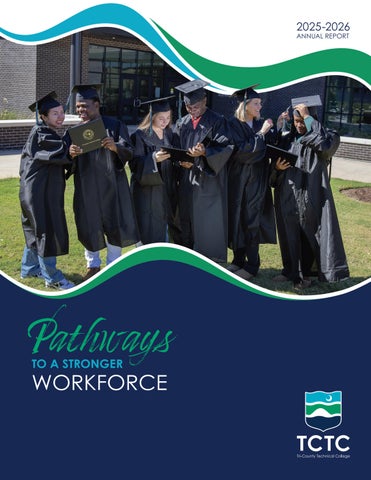
2025-2026 ANNUAL REPORT
Pathways TO A STRONGER
WORKFORCE
VISION
COMMITMENTS
Passionate people transforming lives and building strong communities one student at a time.
To Our Students: Provide a dynamic teaching and learning experience in which every student has an opportunity to grow, succeed and improve their quality of life. To Our Employees: Cultivate a workplace that honors and promotes our values. To Our Community: Serve as a solutions provider in meeting the workforce needs of the tri-county region.
MISSION Tri-County Technical College provides students an exceptional and affordable learning experience that improves their quality of life. The College advances economic development in the tri-county region by preparing a highly skilled workforce.
VALUES Integrity: We lead by example and are steadfast in upholding high ethical standards. Respect: We engage with one another in a manner that promotes civility, trust, openness and understanding. Learning: We promote a growth mindset and use what we learn to deliver a transformative experience for our students and employees. Collaboration: We achieve more when we work together, especially when we bring diverse groups of people together to solve problems and generate change. Innovation: We encourage creative ideas that lead to positive outcomes for our students, our employees and our community. Diversity and Inclusion: We are committed to creating a diverse and inclusive community that fosters a sense of belonging where every individual feels welcome and valued.
ROLE AND SCOPE Tri-County Technical College is a public, two-year community and technical college serving Anderson, Oconee and Pickens counties in South Carolina. As an open-door institution of higher education, the College offers affordable, accessible, collaborative and learner-centered instruction. Offerings include university transfer associate degree programs and applied technical associate degrees, diplomas and certificates in more than 70 majors associated with business, health, public service, and industrial and engineering technologies. The College also offers developmental courses for students who need to improve their basic academic skills as well as a variety of academic and support services. The College promotes economic development in the tri-county region through customized education and training for local businesses and industries through credit and continuing education offerings and a variety of workforce training programs.
A LETTER FROM THE
President
I
t is with great pride that I present Tri-County Technical College’s 2025-2026 Annual Report. This year’s theme, Pathways to a Stronger Workforce, reflects our commitment to helping students chart a course to rewarding careers, economic mobility, and brighter futures for themselves, their families, and their communities.
Throughout this report, you’ll find stories of students advancing through innovative programs such as I-BEST (Integrated Basic Education and Skills Training) and the BASF apprenticeship program, as well as new initiatives like TCTC Dual Enrollment Academy-Clemson Connect and the Precision Meets Healing externship. These programs demonstrate how Tri-County is creating multiple entry points for students to gain skills, earn credentials, and connect with high-demand careers. Perhaps the most exciting news in this report is that Tri-County has been named one of 10 finalists for the 2027 Aspen Prize for Community College Excellence. Backed by $1 million in award funds, the Aspen Prize recognizes colleges that achieve exceptional student outcomes, including credential completion, successful transfer, and employment in careers that provide family-sustaining wages. As a college that consistently leads the South Carolina Technical College System in graduation, success, and transfer rates, we are honored by this recognition and energized by what it says about the impact of our students, faculty, and staff. Being named an Aspen Prize finalist affirms what we have long known at Tri-County: when students are provided clear pathways, strong support systems, and meaningful connections to careers, extraordinary outcomes are possible. These accomplishments reflect the dedication of our faculty and staff and the steadfast support of our business and industry partners, donors, elected officials, and community advocates who invest in our students and our mission every day. As you read this report, I hope you take pride in what we have achieved together and feel inspired by the opportunities that lie ahead. Thank you for your continued partnership with Tri-County Technical College. Together, we are transforming lives, strengthening our workforce, and creating opportunities that will benefit our region for generations to come. In your service,
students are provided clear “ When pathways, strong support systems, and meaningful connections to careers, extraordinary outcomes are possible.
”
Galen DeHay, Ph.D. President ANNUAL REPORT | 3
Anderson County students sign dual enrollment agreements.
BlazingTrails: N
TCTC DUAL ENROLLMENT ACADEMY-CLEMSON CONNECT
othing in life is guaranteed, as the saying goes. Yet right now, 34 area high school students are taking advantage of an opportunity that comes pretty close. They are in the first cohort of a firstof-its-kind educational program: the Tri-County Technical College Dual Enrollment Academy-Clemson Connect. Unique in the nation, the academy provides qualified high school students with a guaranteed path to earn a Clemson University degree, if they meet program requirements. The academy targets high school students in the Anderson, Oconee and Pickens (AOP) county school districts whose parents did not earn a bachelor’s degree. Students take dual enrollment courses through TCTC in their junior and senior years, at little to no cost. “These students are embarking on an incredible academic journey, one that starts with an exceptional learning experience at Tri-County and leads to a guaranteed path to earning a bachelor’s degree at Clemson University,” said President Dr. Galen DeHay. Dr. Sean Brittain, associate provost and dean of undergraduate learning at Clemson University, said the academy “represents access, opportunity and a shared belief in what students can achieve when institutions work together with intention and purpose.”
What Makes the Academy Unique The academy gives participants a headstart toward their B.A. or B.S. degree. They save money on their college education. Still, there are many dual enrollment, transfer and bridge program options that offer similar benefits. How is the academy different?
#1 First-Generation Focus. The academy is designed specifically for first-generation college students. Despite excellent academic abilities and high school achievement, these individuals can face an uphill battle to navigate their way to — and through — college. First-gen students 4 | 2025–2026
graduate at a rate of 24% versus 59% for continuing-generation students (FirstGen Forward). TCTC has developed holistic “wrap-around” services to meet not only academic but also emotional, social and physical needs.
#2 Family Engagement. There is a formal structure for family involvement at every step of the journey. Like their students, parents and guardians have access to support resources, too. They receive customized content that parallels what students are learning about how to navigate college. The academy’s summer programs also offer sessions tailored for parents and guardians. #3 The Clemson Guarantee. Admission to Clemson is highly competitive. Long known for its strong Division 1 sports performance, the university has evolved into an R1 research university. Fewer than 200 U.S. colleges and universities share this academic status. It is remarkable for an R1 school to guarantee a path to admission for a high school sophomore, no matter how talented. Academy students are not contractually bound to attend Clemson; rather, there must be serious interest in doing so. “These students are reaching for big, audacious goals,” said Dr. Mandy Elmore, vice president of academic affairs and workforce development. She described the 2026 academy signing event as a poignant moment in her career, seeing multiple generations present to celebrate the occasion. “There was not a dry eye in the room.”
How It Works H.S. Sophomore Year: Fall Semester. Students are recruited for the academy. To raise awareness, the College collaborates with high school guidance counselors and teachers. H.S. Sophomore Year: Spring Semester. Interested students take the TCTC College Skills 103 course, which they must pass with a B or higher to qualify for academy consideration. It covers practical skills such as stress
management, organization and college resources. Based on their course performance, grades and other factors, the high school recommends students for the academy. TCTC then guides the application process.
Sophia Yatsenyuk: On Fast Track to Automotive Career
Summer Before H.S. Junior Year. Students participate in co-curricular events developed and conducted by the College with participation from Clemson. They have an opportunity to meet peers and delve deeper into the academic path to their specific degree and career goals. H.S. Junior Year: Fall Semester to H.S. Graduation. Students take TCTC courses aligned with their intended Clemson major, alongside their high school coursework. They must earn a 3.0 or higher GPA in their college coursework and a 4.0 or higher in high school classes. Clemson University: Summer or Fall Semester. After earning their high school diploma and graduating from the academy, students are eligible to start at Clemson, assuming they meet all the university’s admission requirements, such as passing a background check. Marla Cobb, director, high school engagement and outreach, herself a first-generation college graduate, sees great things ahead for the academy, the first cohort and those to follow. In fact, recruitment for the second cohort began in October 2026. It is expected to enroll 50 students. “We are coaching them every step of the way so that they can capitalize on this opportunity and make long-term generational changes,” she said.
Pathways Gala a Success Fundraising Hits $1.8 Million of $5 Million Goal The inaugural Pathways Gala held this past February attracted 150 community members to celebrate “An Evening of Opportunity: Opening Doors, Changing Lives.” Hosted in the Ruby Hicks building on the Pendleton Campus, the event offered fundraising and fellowship opportunities, all to raise awareness and financial support for the new TCTC Dual Enrollment Academy-Clemson Connect.
Sophia Yatsenyuk has been fascinated by cars from a very young age.
Sophia Yatsenyuk has dreamed of working in the automotive industry since she was a little girl. As she got older, she began to dream of attending Clemson University to study automotive engineering. “I’ve always been fascinated by cars,” she said. Thanks to the TCTC Dual Enrollment AcademyClemson Connect, she is on the fast track to achieve both goals. An Anderson native and junior at T.L. Hanna High School, Yatsenyuk is one of 34 students in the first cohort. The excitement in her voice is unmistakable. “I feel so grateful for all they have done to help me reach for my dreams and what I want to do with my education,” she said. Her chief cheerleaders and college navigators are Marla Cobb and Ingryd Masters. Cobb is director of high school engagement and outreach; Masters is coordinator of student support for dual enrollment and career pathways. “They told me to go for it and not let anything keep me down from pursuing my dreams. … And to check my email,” she said.
The TCTC Foundation Board has set a goal to raise $5 million over a five-year period to fully endow the academy. To date, the Foundation has raised nearly $1.8 million toward that goal.
Like her academy peers, Yatsenyuk is a first-generation college student. But she is not the first woman in her family to “go for it” with a career in the automotive industry. Her grandmother, Bev Griffin, is president of Griffin International, a full-service training, coaching and development organization. “At an early age, my MiMi brought the automotive world to life for me,” Yatsenyuk said. “She gave me opportunities to experience vehicles on the track, in the dealer showroom, in the service department and much more. The moment I sat in my first car, all I wanted to do was turn the key and see where the road took me.”
The second annual Pathways Gala will be Feb. 13, 2027. For more information or to purchase tickets or a sponsorship package, contact Beth Brown at cbrown63@tctc.edu or 864-646-1372.
With the pathway clear and a strong network of support resources, she is driving full speed ahead toward her career destination.
Jim and Julee Kaplan
Visionary sponsors of the event were TCTC Commissioner Jim Kaplan and his wife, Julee, and Harper General Contractors. Other sponsors included Hamid and KD Mohsseni, Blue Ridge Electric Co-op, Landscape Perceptions, Tom and Debra Strange, Jim and Kim Wanner, and Joe and Cathy Turner. Julio Hernandez, assistant to the president for Community Outreach and Engagement for Clemson University, was the keynote speaker.
ANNUAL REPORT | 5
The I-BEST team
I-BEST CELEBRATES DECADE OF
I
Changing Lives
-BEST, the Integrated Basic Education and Skills Training program, began at Tri-County Technical College in 2016. The single-semester program provides a steppingstone to college — and toward a better life — for the unemployed and underemployed, who might not feel equipped or empowered to engage in higher education.
Since then, I-BEST has touched the lives of more than 400 individuals in Anderson, Oconee and Pickens counties. Almost 300 have graduated from the program, and nearly 50% of graduates have gone on to pursue additional higher education at TCTC or other institutions. But statistics tell a fraction of the story. Enrolling in the program requires a level of courage that's difficult to fathom unless you have walked in their shoes. Many were told they were not “college material.” Some were bullied at school. Others barely graduated from high school or dropped out. Working one job after another with little chance for advancement. Insecure about their academic abilities. “Many I-BEST students carry past educational trauma. Returning to a conventional classroom setting is nerve racking and intimidating,” said 6 | 2025–2026
Catherine DuRant, program director. “They fear that they are not up to date with technology, compare themselves to their classmates or worry that history will repeat itself and their individual needs will not be heard or understood.” They might be the first in their generation to graduate from high school, not to mention college. It can seem like a foreign concept. But they are survivors. “I-BEST students have resiliency and grit in areas we do not always understand,” said Dr. Mandy Elmore, vice president of academic affairs and workforce development. “They use that to make their way in life; yet don’t always have anyone to help them navigate their way to higher education.”
In the Beginning I-BEST was born of necessity. A decade ago, the College’s strategic plan called for engaging and supporting under-resourced and under-prepared student populations. At the time, there was not a formal program or
pathway to address this need. The structure of I-BEST was inspired by a similar program in Washington state. A group of staff and faculty studied that model and formed I-BEST. Among them were President Galen DeHay, then senior vice president; Arts and Sciences Division Dean Jennifer Hulehan, then Comprehensive Studies department head; and Diana Walter, director of Technical Skills for Success. From the outset, a key function of the program has been to partner with adult education campuses across the tri-county area. Through this partnership, I-BEST has become a college on-ramp for GED students. I-BEST also receives referrals from local nonprofit organizations, TCTC employees and the College’s website. Applicants must possess a high school diploma or GED, or be working to earn one or the other, with some credits already under their belts. Lowering financial barriers to college, I-BEST tuition is free for students. The program is funded by the state, local grants and foundations. Just this year, the TCTC Foundation received an $8,000 grant from the Dollar General Literacy Foundation. This money will go toward I-BEST textbooks, classroom materials and other essential instructional supplies.
One Transformation at a Time Students leave I-BEST with a different idea of their own capabilities. When asked about their decision to try the program, many graduates recall being “scared,” “nervous,” even “terrified.” There are deep-seated beliefs that they are not cut out for classroom success. By graduation, “confident” is the most common word they choose to describe themselves. “The start of a semester brings meek, nervous students. Seeing the semester end with confidence, determination and a strong plan is the most rewarding part of I-BEST,” said DuRant. “By the time students graduate from I-BEST, they have developed skills, habits and the confidence necessary to be successful college students and professionals. They leave with a mindset that allows them to believe in themselves and recognize that their dreams are achievable.” The I-BEST program focuses on providing certificates relevant to industries with high workforce demand. Initially there were two pathways.
One was Smart Start, focused on general college and career readiness. The other was Manufacturing Production, developed by Elmore, then dean of the Engineering and Industrial Technology Division. Then in 2018, I-BEST added a Healthcare pathway, through which graduates earned a Personal Care Aid certificate. Regardless of whether I-BEST students continue with further education immediately, they leave the program armed with a certificate that can open doors, plus practical knowledge. For example, they learn how to evaluate a benefits package. Or how to manage a lifestyle with rotating manufacturing shifts. Each cohort completes the program in one semester, which translates into 14 weeks if it is a spring or fall session, or 10 weeks if it is a summer session. One graduate, who is employed with Milliken, said he learned more in 14 weeks than he had learned in the prior 10 years. The Manufacturing Production pathway has become so popular that the College is starting an evening cohort. In the future, it might do the same with the other two pathways. David Moore, dean of the Academic and Career Foundations Division, has seen countless examples of I-BEST graduates who recruit their friends and family to enroll. Boyfriends and girlfriends. Siblings. Coworkers. “We once had four members of the same family come through the program within three consecutive semesters: first the son, then his mother and aunt, then a cousin,” he said. “One of the most encouraging trends we have observed over the life of this program is that our alumni often become our greatest advocates.”
alumni often become our “ Our greatest advocates. ”
David Moore
DEAN OF THE ACADEMIC AND CAREER FOUNDATIONS DIVISION
I-BEST Success Story: Shenika Tate Shenika Tate’s early adulthood got off to a rocky start. With no diploma and plenty of bills to pay, she was working, raising three children and caring for her parents. When she was a little girl, she wanted to be a teacher, but failing to graduate from high school put a damper on that dream. She does not cast blame on others for finding herself in this situation but rather accepts responsibility for poor decisions. In 2022, at age 29, she earned her GED and graduated from I-BEST with a Personal Care Aide 1 certificate. Within two years, in 2024, she earned an associate degree from TCTC in Early Care and Education. In May 2026, she walked the stage at North Greenville University with a bachelor’s degree. She is a first-generation college graduate, well equipped for her dream career. Tate’s journey recently was featured in The Chronicle of Higher Education. “[I-BEST] … accepted me for who I was. … We worked hard together. There was no judgment. It was an opportunity for me to really get to experience college,” she told the Chronicle. “I have made it through a lot, from the street life to being saved and delivered from all blockages. I let go of old karmic patterns and started to walk in my purpose.” ANNUAL REPORT | 7
The seventh cohort pictured with TCTC, BASF and Apprenticeship Carolina leaders.
BASF APPRENTICESHIP REACHES
T
Five -Year Milestone
his past June marked the fifth anniversary for the BASF Environmental Catalyst and Metal Solutions (ECMS) Process Operations Technician Apprenticeship Program. Since the program’s launch, it has been a successful partnership between BASF ECMS, TriCounty Technical College and Apprenticeship Carolina.
“We’re proud to celebrate both this newest cohort and five years of strong partnership with BASF ECMS,” said President Dr. Galen DeHay. “Programs like this create meaningful pathways for individuals while helping meet the growing demand for skilled talent in advanced manufacturing.”
The anniversary coincided with recognition of the program’s seventh* cohort, which included apprentices Nicole Stone, Jo Loewy, Nathan Little, Brennan Fry and Christian Speicha. Like those before them, they applied for the program and were selected by BASF ECMS, which hired them as full-time employees.
Opening Doors to Manufacturing Careers
“The apprenticeship has given me the drive and ambition to continue in the manufacturing world and work toward higher goals for myself and within the company,” said Stone. “It has turned out to be one of the best unexpected turn of events that could have happened for me. It was truly a one-of-a-kind experience, and I am grateful to have had the opportunity.” Apprentices train on the job at BASF ECMS’ Seneca site, attending a weekly class on TCTC’s Oconee Campus. BASF ECMS pays the cost of tuition, books and hours in the classroom. They earn the nationally recognized U.S. Department of Labor OSHA-10 card and a TCTC Process Technology certificate. 8 | 2025–2026
Building those pathways is at the heart of the apprenticeship program. One of BASF ECMS’ main goals is to develop a more diverse workforce by providing opportunities to individuals who are returning to it, such as stay-at-home parents and military veterans, as well as those who want to transition to manufacturing from other fields, such as retail, hospitality and other service industries. Without the apprenticeship, they might not gain skills to secure manufacturing employment. “We want to bring these people into our workforce stream,” said Jim Kilton, continuous improvement manager, BASF ECMS. “Apprentices have advanced in their BASF ECMS careers at a faster rate than others joining the company. They have taken on different leadership roles, such as lead technician and operations coordinator.” Across the first six cohorts, 39% of apprentices were women. From the full participant pool, 32% have been promoted to higher-level roles at BASF.
“We promote economic diversity and prosperity in the communities we serve, and we measure our success by our ability to ensure students earn a high-quality credential that leads to a family-sustaining wage,” said Bryan Manuel, dean of integrated workforce solutions.
A Sustainable Business Solution BASF ECMS’ Seneca site has a fundamental focus on sustainability, recycling specialty chemical catalysts into products that go back into the BASF manufacturing cycle. As a result, fewer precious metals must be extracted from the earth. With the apprenticeship program, building sustainable solutions extends into career opportunities. “This program was a good test for us. Was it sustainable? Was it relevant? The answer is yes,” said Dr. Mandy Elmore, vice president of academic affairs and workforce development. “Apprentices build competency. They gain experience with different BASF ECMS teams. They are fully integrated into the company culture. Moreover, this program has launched student journeys into higher education.” At the capstone presentation, apprentices demonstrated a functioning mini evaporative cooling tower made from a fivegallon bucket and a bilge pump. It highlighted capabilities they developed and honed throughout the apprenticeship: technical knowledge, problem-solving skills, collaboration and a continuous improvement mindset. “BASF does not need people who just do what they are told. They need critical thinkers. The apprenticeship gives students that lens and perspective,” said Dr. Elmore. “This program creates long-term value for the individual and the company. It is a testament that we can create something that is unique, with staying power and positive impact.” The eighth cohort started in July 2026. It is the largest yet. Most past cohorts have had five to six apprentices. The eighth has three times that. “The size of the group is not the most important thing. It is what it represents — the belief that what we are doing creates value for each apprentice and for BASF ECMS. Trust — in the college, in the work that we do, and the impact we have on their employees,” said Manuel. “It’s our responsibility to continue to deliver a high-quality experience.”
The BASF Environmental Catalyst and Metal Solutions (ECMS) Process Operations Technician Apprenticeship Program The BASF ECMS Process Operations Technician registered apprenticeship program launched on June 22, 2021, with its first cohort of six apprentices. The program ran two cohorts per year 2021 - 2023. The program provides under-represented workers, including women and those with limited manufacturing experience, the comprehensive technical and quality/productivity skills, perspective, and confidence needed to be high-performing process operations technicians with the potential for making leadership contributions and advancing in the career field. Apprenticeship training programs meet specific standards established by the U.S. Department of Labor (USDOL) to be registered by a federal or state apprenticeship agency. These programs feature three distinctive components: • On-the-Job Learning (OJL) • Job Related Education (JRE) • Competitive wages with promotion opportunity Apprenticeship Carolina, part of the SC Technical College System, coordinates the BASF ECMS apprenticeship for the Department of Labor and collaborates with BASF to enhance and optimize its program, creating a positive economic impact in the community and for its citizens. The JRE component of the BASF ECMS registered apprenticeship program is co-designed and co-taught by Tri-County Technical College and BASF ECMS. The Cohort 7 apprentices started the classroom (JRE) component of the program on July 24, 2025, and completed their work on June 25, 2026. They have earned and will be awarded a Tri-County Technical College Certificate of Completion. The Cohort 7 apprentices will finish the On-the-Job (OJL) component of the program over the next few months. Upon completion, they will receive a Certificate of Completion of Apprenticeship from the U. S. Department of Labor. The seventh cohort of the apprenticeship program.
Kirsten Pratt, associate vice president of Apprenticeship Carolina, said the apprenticeship program supports workforce development and improves retention within the manufacturing field. “This anniversary celebrates not only individual achievement but also the power of collaboration to create meaningful career pathways and bolster our state’s economy.” The founding partners look forward to the program’s evolution. In the future, BASF ECMS might add more chemicals training. “We cannot say enough about the partnership with TCTC and Apprenticeship Carolina. It is truly a three-legged stool. It would not be successful without all three partners,” said Kilton. “This apprenticeship has made us a better workplace.” *From 2021 to 2023, there were two cohorts per year. Since then, there has been one cohort annually.
ANNUAL REPORT | 9
Twelve students strengthened their skills in the new externship.
New Externship
ENCOURAGES CROSS-DISCIPLINARY COLLABORATION Precision Meets Healing: Manufacturing to Operating Room
T
he first Precision Meets Healing externship brought together 12 students who might not otherwise cross paths at Tri-County Technical College: future surgical technologists and CNC machinists. A ceremony to celebrate the inaugural externship class was held in June at Arthrex, a global medical device company with operations in Pendleton. For the grand finale, an Arthrex manager guided the surgical technology and CNC machining students in a hands-on shoulder labrum repair simulation. Students were paired off to perform the operation. This new opportunity is designed to explore the critical intersection of healthcare and advanced manufacturing. Participants were nominated by their program directors. They served as student ambassadors for their fields of study. Each earned a certificate of completion and a stipend from the TCTC Foundation, acknowledging their engagement and learning achievement. 10 | 2025–2026
The externship took place over four days, totaling 12 hours of structured programming. During this short intensive, surgical technology students learned about the manufacturing process for the surgical instruments they will use in the operating room. Likewise, CNC students learned about how machined products are used during surgical procedures. This innovative approach allowed students to develop a cross-disciplinary range of skills and insights, connecting the production floor to the operating room. By gaining awareness of the process and purpose of one another’s work, participants finished the program able to approach their own specialties with a more informed, holistic view. Students also strengthened their resumes, obtaining knowledge of advanced materials such as medical-grade titanium, plus global quality standards, including ISO 13485. Every tool and implant used during surgery must meet stringent quality requirements and be traceable throughout the supply chain.
Participants gained awareness of the process and purpose of one another’s work.
Leaders of each academic program are enthusiastic about the externship. CNC Programming and Operations Associate Degree Program Director Daniel Harbin said the experience augmented his students’ day-to-day focus on machining skills. It opened new thought processes. Surgical Technology Associate Degree Program Director Miranda Fowler described the externship as a unique opportunity. An active surgical technologist with 28 years of experience, Fowler did not have the benefit of such an externship when she entered the field. Surgical technologists undergo rigorous training in how to use operating room instruments. The externship provided valuable insights about the origins of those tools. Arthrex is known not only for its excellent surgical tools but also its commitment to end-user education. It offers hands-on training, workshops, surgeon observation programs and online resources to support and train surgeons and medical staff worldwide. The company’s core mission statement is: Helping Surgeons Treat Their Patients Better. Bryan Manuel, dean of integrated workforce solutions, said it is rare in higher education for such different academic programs to collaborate. “Pulling together faculty from different disciplines, administration and an employer-partner to build something completely new does not happen every day. What made this work was our people,” said Manuel. “Everyone stayed focused on creating an exciting and rewarding opportunity for students. That is a culture we have worked hard to build at TCTC and aligns well with our vision for the College. This externship is a great example of it.”
“I absolutely expect these boundary-pushing experiences to continue,” said Manuel. “The first externship proved the concept, and we are already talking with other department heads and faculty about future opportunities. I firmly believe that we have built a model that is worth repeating.”
absolutely expect these “ Iboundary-pushing experiences
to continue. The first externship proved the concept, and we are already talking with other department heads and faculty about future opportunities.
”
Bryan Manuel DEAN OF INTEGRATED WORKFORCE SOLUTIONS
With the success of the Precision Meets Healing externship, TCTC is excited to build other opportunities between complementary specialties. “This is part of a shift in higher education. How do we create intentional experiences for students that will apply in the workforce?” said Dr. Mandy Elmore, vice president of academic affairs and workforce development. “For example, TCTC’s business program offers coursework relevant to students in HVAC and automotive programs. Many will start their own businesses. Gone are the days when one person sits down to solve a complex problem without collaboration with others. We must prepare students for jobs that do not exist today.”
ANNUAL REPORT | 11
The new Pickens Hall and Project Nexus on the Pendleton Campus.
Form Follows Function
PENDLETON, ANDERSON CAMPUSES CHANGE WITH THE TIMES
T
ri-County Technical College has embarked on several major construction projects at the Pendleton and Anderson campuses. Each has a distinct objective, aligned with the College’s mission to provide students with an affordable learning experience that improves their quality of life and economic mobility, while advancing economic development. The projects put pragmatism first, focused on the needs of students and staff, per the specifications of business partners, community leaders, and College faculty and leadership. To stay on or below budget, every feature must have a function. “Large multiyear projects of this size require extraordinary collaboration among faculty, staff, contractors, design professionals, administration and other stakeholders,” said Richard Macbeth, director of project management. “This teamwork has enabled us to maintain momentum while keeping the College’s mission, faculty and students at the center of every decision.” 12 | 2025–2026
Pickens Hall and Project Nexus The new Pickens Hall is expected to be occupied in January 2027. It replaces the 63-year-old hall constructed in the days before modern building codes, cell phones and wi-fi. The demolition made room for a two-story structure designed for practicality, energy efficiency and digital connection. It will house academic departments from the Business and Public Services (BPS) Division, Arts and Sciences (A&S) Division, and Academic and Career Foundations (ACF) Division. The latter includes the I-BEST program (see p. 6). By building up instead of out, planners opened land for an outdoor plaza. The effect is beautiful — and part of the bigger picture of Project Nexus. The definition of “nexus” is a connection between two or more things. True to its name, the project provides an accessible pathway connecting different buildings on the Pendleton Campus. Also called “The Spine,” this wends gently across the hilly topography — an engineering feat that has required massive earth displacement at times.
“Pickens Hall and Project Nexus transform the center of campus, creating an accessible, connected and engaging environment for faculty, students and visitors,” said Macbeth. “More than just a structure and some landscaping, they build welcoming spaces that strengthen the sense of community.” The new Pickens Hall, which came in under budget, can accommodate twice as many students. It features plenty of natural light and communal spaces, in addition to classrooms. Faculty offices are grouped together, making it easier for students to meet with professors and adjunct instructors from the three departments. “The original Pickens Hall was constructed when students were wearing ties to class. Students do not learn in the same way today as they did 10, 20 and 30 years ago,” said Dr. Mandy Elmore, vice president of academic affairs and workforce development.
collaborations to common workforce challenges. Together, we can find solutions to continue to drive our economy.” Each career program will have specialized equipment and training space. This requires a robust infrastructure with industrial systems, pneumatics and wiring. For example, the CDL program will have a 30% larger area for tractor-trailer driving practice. After it is finished, almost double the number of students will be able to enroll for CDL training. “Watching the building structures take shape and seeing interior spaces come together has provided a clear picture of how the campus will function once completed,” said Macbeth. “It is particularly rewarding to see spaces designed for hands-on learning and student engagement move from concept to reality.”
In the old days, colleges were known for large auditorium classes with the “sage on the stage.” Now, learning spaces are designed differently, with smaller classrooms and lower student-to-instructor ratios, plus room for teamwork, relaxation and quiet time. In addition, Pickens Hall and Project Nexus foster biophilia, a positive connection between humans and nature, proven to enhance learning.
Anderson Campus Expansion If you blink while driving down Michelin Boulevard, you might miss metal building frames that were not there the day before! That would be the Anderson Campus expansion project. It has been gaining momentum daily since the January 2026 ground-breaking. To be completed on a rolling schedule through August 2027, the project scope includes four new buildings and one existing building expansion. Ultimately, it will create more than 56,000 square feet of new educational space. Most of this will serve as the College’s training and education hub for manufacturing, utilities, transportation and logistics careers. It will include the following programs, some of which have been located on the Pendleton Campus: • • • • • • • •
Classroom and office framing for the Automotive and Diesel Labs at the Anderson Campus.
Power Line Worker Heavy Equipment Operator Commercial Truck Driving (CDL) Forklift Operations and Safety Certified Logistics Technician Mechatronics Technology Automotive Technology Heavy-Duty Diesel Technology
Corporate and Community Education programs already located on the Anderson Campus will have a larger, updated space.
A new lobby is being added to the Corporate and Community Education building at the Anderson Campus.
“This expansion is a gamechanger for our students, our employers and our region,” said President Dr. Galen DeHay. “These programs form the backbone of our economy and provide pathways to great careers with strong earning potential. In total, this expansion will allow us to serve thousands of students across these eight programs.” The project helps to ensure that TCTC meets skilled workforce demands of Anderson and surrounding areas well into the future. Area businesses have been consulted about their need for qualified talent. For example, the diesel program is in direct response to feedback that diesel mechanics are urgently needed to support the transportation industry. “It is about intentionality. This campus is in the community where these jobs are in demand,” said Dr. Elmore. “We want to be connected to the community and our local business partners. This enables interactions and
Curbing and gutters on the Mechatronics building at the Anderson Campus.
ANNUAL REPORT | 13
14 | 2025–2026
Phil Anderson P
hil Anderson sums up his entire life with one sentence: Everything I have achieved in my life is by the grace of God.
Tri-County Technology College’s 2026 Distinguished Alumni Award recipient prefers not to talk about himself. However, ask him about machining, and that is another matter. “If it was not created by God, all things on this earth began in a machine shop,” he said. Generators, auto parts, cell phones, plastic products, office supplies, medical implants, you name it. Virtually every object we see around us went through a machining process. This is one reason Anderson is so committed to the College’s Computer Numerical Control (CNC) machining programs — and passionate about the field. Many people have a mental image of grease and grime when they think about machining. That is a thing of the past, he emphasized. “Our employees leave work as clean as they came in. They are not covered in grease as I was when I got started as a machinist,” he said. “Now, machinists work in a clean setting, using advanced manufacturing equipment and computer technology. They can make a very good living.”
DISTINGUISHED ALUMNI AWARD RECIPIENT Anderson attributes this mindset to his upbringing. He grew up on a family farm in Anderson County. “When you are raised on a farm, you work all the time. My wonderful parents taught me from a young age that if you hit a setback or challenge, you pull up your bootstraps a little higher and work harder,” he said. They also told him that there was no need to talk about yourself to prove yourself. Rather, if you work hard, success will follow. “God has blessed me with Katherine, my family, life-long friends, employees and a good career,” Anderson said. “I like helping people succeed. Helping each other is part of God’s plan for us.”
About the Award
Machinist turned factory owner, Anderson graduated from TCTC in 1984 with an Industrial Electronics Technology associate degree. He worked for the Duke Energy Oconee Nuclear Station and Champion Tooling. Then, in January 1995, he pursued the American Dream and founded Hytech Machining with a partner. Anderson said he could not have achieved this dream, or much else in life, if not for his wife of 38 years, Katherine. “She is the most wonderful woman and has been there every step of the way,” he said. “We are true partners in life.”
The Distinguished Alumni Award is presented annually to an individual who has been awarded a degree, diploma or certificate from Tri-County Technical College and made a significant contribution to the College, the Alumni Association and the community.
The Pendleton business is a specialized job shop. It machines high-quality precision parts for industrial equipment used by manufacturers in the automotive, energy and medical industries. Most parts are made of steel. “There is so much work to go around now. We are very busy,” he said. “TCTC is all about training the workforce, and I want to help them in any capacity that I can.”
Hytech Machining provides machining services using a wide variety of state-of-the-art CNC machines and technology. Operating four facilities at its Pendleton headquarters, it produces high-quality parts for the automotive, energy and medical sectors.
Dr. Mandy Elmore, vice president of academic affairs and workforce development, has known Anderson for 17 years. As an advisory committee member, he has helped steer the CNC machining program to meet industry requirements. “He gives honest feedback and support,” she said. “Phil has a lot of demands on his time, and we are fortunate that he devotes time to the College. He wants something for us and our students, not from us, and that is why he is alumni of the year.” Hytech hires many TCTC graduates and has provided tours for faculty, parents and prospective students. The company also sends some new hires for training and certification. “Phil has made a difference in people’s lives. He knows that the way our community is successful is for people to have good careers with earnings that allow them to support their families,” Dr. Elmore said. “He believes there is no limit to what people can achieve if they set their mind to it.”
About Hytech Machining
The company’s history spans more than 30 years. Each decade the business has continually grown and re-invested in new technology and employee education and training. Customer service, quality and efficiency are top priorities. Hytech is an ISO 9001:2015 certified corporation. To earn this certification, the company established and continually improves upon a quality management system to demonstrate its ability to consistently provide products that meet customer and applicable statutory and regulatory requirements.
ANNUAL REPORT | 15
TCTC A FINALIST FOR $1 MILLION
T
ri-County Technical College is one of 10 U.S. finalists competing for the 2027 Aspen Prize for Community College Excellence. Presented by the esteemed 77-year-old Aspen Institute (Aspen), the honor is the nation’s signature recognition of community colleges that deliver value for their students.
Aspen Prize
The prize is backed by $1 million in award funds from Ascendium Education Group and the Joyce Foundation. The winner, selected by an independent jury, will be announced in April 2027. Finalists were judged to have the strongest outcomes by several key metrics. These are student learning, credential completion, labor market success and transfer/bachelor’s degree attainment. TCTC consistently demonstrates excellence by these criteria, including: • Highest graduation rate, success rate and transfer rate in the South Carolina Technical College System • 90th percentile nationally for student success and transfer • Highest bachelor’s degree completion rate in U.S. for Pell grant recipients who transfer from TCTC to Clemson University
25 national semifinalists in April. Then in June, the College made the cut to the top 10. The selection process began last year, when Aspen reviewed preliminary data and invited 200 U.S. community colleges to apply. From that pool, 170 did so. Of the 10 finalists, Tri-County is among colleges from seven other states: North Carolina (two finalists), Wisconsin, Washington state, Ohio, Mississippi, Virgina, Florida and Alabama. “Student outcomes like those we see at the 10 finalists cannot be achieved without major reforms to programs of study, student advising systems and other college practices that we know make a difference,” said Josh Wyner, executive director of the Aspen Institute College Excellence Program.
The Aspen Institute College Excellence Program aims to strengthen higher education leadership and practice to improve student outcomes. Its ultimate goal is to advance economic mobility and develop talent for the good of each individual and society as a whole. Aspen is a global nonprofit organization whose purpose is to ignite human potential to build understanding and create new possibilities for a better world. Its headquarters are in Washington, D.C. It also has a campus in Aspen, Colorado, and an international network of partners.
• 93% of graduates obtain employment in careers related to their field of study • 72% of graduates work in South Carolina for 10 years after graduation, the second-highest rate across all higher education institutions in the state “We are honored to be named an Aspen Prize finalist and are especially proud of how this recognition reflects our students completing, transferring and launching into careers that sustain families and strengthen our region,” said President Dr. Galen DeHay. “From day one, we focus on clear pathways, strong advising and close alignment with workforce needs to ensure our graduates succeed. This recognition reflects a shared commitment across our college to put student success at the center of everything we do.” Experts are currently conducting in-depth site visits at each finalist institution and reviewing additional data. TCTC was selected as one of
16 | 2025–2026
outcomes like those we “ Student see at the 10 finalists cannot be
achieved without major reforms to programs of study, student advising systems and other college practices that we know make a difference.
”
Josh Wyner
EXECUTIVE DIRECTOR OF THE ASPEN INSTITUTE COLLEGE EXCELLENCE PROGRAM
Accolades AND Awards
Matthew Woodall Receives Presidential Medallion for Instructional Excellence Matthew Woodall, department head for Industrial Technology, was honored with the Linda C. and Dr. Ralph D. Elliott Presidential Medallion for Instructional Excellence, the highest award given for faculty excellence at the College.
The award is presented each year at spring convocation to the instructor who has contributed the most during the academic year to the profession of teaching, to the development of the College and to the students.
Travis Durham Receives Presidential Medallion for Staff Excellence
Travis Durham, former director of student engagement and accountability, was honored with the Linda C. and Dr. Ralph D. Elliott Presidential Medallion for Staff Excellence, the highest award given for staff excellence at the College.
The award is presented each year at fall convocation to the staff member who has contributed the most during the academic year to the development of the College and to student success.
Jennifer Ward Receives Adjunct Faculty Presidential Award Jennifer Ward, who has taught for TCTC’s Criminal Justice program for seven years, received the College’s 2026 Adjunct Faculty Presidential Award.
This award is given annually at spring convocation to the adjunct faculty member who is recognized for excellence in teaching, who has consistently high student evaluations and who supports the philosophy and goals of the College.
Brett Johnson Receives Student Advocate Award
Brett Johnson, an English instructor in the Arts and Sciences Division, received the Student Advocate award in recognition and appreciation of his outstanding vision, commitment to excellence, and dedication to student success. Each year the award is presented by the Student Leadership Council at spring convocation.
TCTC Commissioner, Faculty Member Receive Awards
TCTC Commissioner Hamid Mohsseni (left) and Dr. Stephan Irwin, (right) head of the Associate in Science program, received awards from the South Carolina Association of Technical College Commissioners (SCATCC) in recognition of their outstanding leadership, service and achievements. Commissioner Mohsseni is the recipient of the 2026 Trustee Leadership Award, and Dr. Irwin is the recipient of the 2026 Faculty Award.
President DeHay Honored with Duke Energy Award President DeHay was honored with the Duke Energy Citizenship and Service Award at the Anderson Chamber of Commerce’s annual meeting on May 28. This annual award is a tribute to individuals or groups who make a difference in their communities or places of work by using their time, talents, and compassion to positively impact the lives of others.
ANNUAL REPORT | 17
Media Arts Production Named Advisory Committee of the Year
Tri-County Technical College’s Media Arts Production (MAP) advisory committee was recognized as the Advisory Committee of the Year in honor of its exemplary collaboration with faculty to ensure the program’s curriculum remains both competitive and aligned with industry standards.
TCTC’s AHA Training Center Earns All-Star Recognition
TCTC is among the first group of American Heart Association (AHA) training centers to earn the prestigious AHA All-Star Recognition. TCTC’s training center demonstrated exceptional dedication to the AHA’s mission by consistently delivering high-quality CPR education, following Emergency Cardiovascular Care (ECC) guidelines, and elevating the standard of lifesaving training in the communities it serves.
Campus Police Department Awarded Three-Year Reaccreditation
The TCTC Campus Police Department was awarded a three-year reaccreditation by the South Carolina Law Enforcement Accreditation (SCLEA), the official state accrediting body for law enforcement. The SCLEA Council unanimously granted the TCTC Police Department full accreditation through December 2028. The department officially attained SCLEA on December 8, 2022, making TCTC the first technical college in the system to achieve this gold-standard status. The TCTC Police Department is one of only four college police departments in the state to earn SCLEA.
18 | 2025–2026
I-BEST Receives Program of Promise Award
The I-BEST (Integrated Basic Education and Skills Training) team took home a Program of Promise award at the 50th annual National Organization for Student Success conference. These awards recognize programs implementing effective, innovative, or promising practices that enhance student success. I-BEST is a nationally recognized program designed to meet students where they are and help them achieve their educational and workforce goals.
Daniel Adams Honored by Easley Chamber
Daniel Adams, director of the Easley Campus, was honored by The Greater Easley Chamber of Commerce with a 2026 Young Professional of the Year award. The award honors an emerging leader who strives to meet the highest levels of personal and professional accomplishment, who devotes time and energy to their community, and who serves as a role model for other young leaders and professionals.
Beth Brown Honored by Oconee Chamber
Beth Brown, manager of annual giving for the TCTC Foundation, was honored with the Oconee Chamber of Commerce’s Volunteer of the Year award at an annual meeting held February 3.
Mark Franks Named S.C.’s Postsecondary Teacher of the Year
Mark Franks, TCTC instructor who teaches Mechatronics at the Anderson Career and Technology Center, was named South Carolina’s Postsecondary Teacher of the Year.
Tiffany Blackwell Appointed Parliamentarian for National Organization Tiffany Blackwell, dean of Enrollment Pathways, was appointed to a three-year term as parliamentarian for the American Association of Collegiate Registrars and Admissions Officers (AACRAO). The association provides professional development, guidelines, and advocacy for records management, admissions, and enrollment services.
Three Honored as Educators of the Year
Three employees were honored as TCTC’s Educators of the Year and were recognized, along with other winners from the S.C. Technical College System, at the annual South Carolina Technical Education Association conference. • Robin Long (left), director of the Office of Academic Development, is the College’s outstanding administrator. • Marlo Woodward (center), biology instructor, is the outstanding faculty member. • Melissa Brock (right), administrative assistant for the Business and Public Services Division, is the outstanding staff member.
Sarah Shumpert Honored by Cancer Association of Anderson
Sarah Shumpert, associate vice president of organizational development and planning, was recognized May 12 by the Cancer Association of Anderson (CAA) at its annual Heroes of Hope and Remembrance event. Shumpert, who is a cancer survivor and longstanding CAA board member, was chosen as one of the honorees because her work on the board involved leading strategic planning to help the organization “dream beyond its walls” and establish The Malik Center for Hope and Healing.
Employees Represent TCTC in Local, State Leadership Programs
TCTC employees represented the College in local and state leadership programs. At the local level, Mike Blizzard, director of IT Services and Delivery, participated in Leadership Anderson, and Rhonda Gibby, vice president of Human Resources, participated in Leadership Oconee. At the state level, Dr. Beverly McAdams, director of the Anderson Campus, participated in Leadership South Carolina, and Katy Hardy, department head for the Associate of Arts, and Jonathan Cauthen, director of development for the TCTC Foundation, participated in the S.C. Technical College System Leadership Academy.
Dr. Jackie Blakley Recognized by United Way of Anderson
Dr. Jackie Blakley, dean of the Business and Public Services Division, was recognized at the United Way of Anderson’s annual meeting for her service as board chair in 2024-2025.
Fiscal Affairs Honored for 25th Consecutive Year For the 25th consecutive year, the TCTC Fiscal Affairs Department has earned the highest recognition in governmental accounting and financial reporting.
The team was honored with the prestigious Certificate of Achievement for Excellence in Financial Reporting from the Government Finance Officers Association for their Annual Comprehensive Financial Report for the fiscal year ending June 30, 2025. ANNUAL REPORT | 19
Highlights
STEPS2Clemson Creates Pathway for Aspiring Engineers
Aspiring engineers at TCTC will have a new pathway into Clemson University through STEPS2Clemson, a program that provides significant scholarship and academic support for students with demonstrated financial need. The program offers up to $10,000 in scholarship support during students’ first year at Tri-County. After transferring to Clemson, students are eligible for up to $15,000 per year for up to three years, contingent on maintaining academic progress. STEPS2Clemson is designed to expand South Carolina’s pipeline of engineering talent and increase access to engineering education for students across the state and beyond. It also strengthens the longstanding partnership between Tri-County and Clemson, adding another layer of support for transfer students.
Grant Funds Collaborative Project to Address Rural Healthcare
The Clemson University School of Nursing received a $3.75 million grant from the Health Resources and Services Administration to deliver specialized training in rural healthcare and address the nursing workforce shortage in Upstate South Carolina. The collaborative project includes Clemson University, TCTC and Prisma Health. Expanding scholarship opportunities is a way to build a stronger healthcare workforce while closing the gaps in access to healthcare. The grant will provide financial support for 30 nursing students, 15 Clemson students and 15 TCTC students, over a four-year period.
Fifth Cohort Completes Manufacturing Works Program
College officials and business and industry partners gathered March 20, 2026, to celebrate the fifth cohort to successfully complete the Manufacturing Works program. Twenty-four Anderson County high school seniors completed Manufacturing Works, a workforce development program which allows participants to gain technical skills while exploring career opportunities in manufacturing. They are well-positioned to enter an apprenticeship program, begin a career in manufacturing, and/or continue their education at TCTC.
First Summer Cohort of Associate Degree Nursing Students Kicks Off The first summer cohort of 16 Associate Degree Nursing (ADN) students attended orientation and began classes in May 2026. With support from AnMed, TCTC is offering this option whereby ADN majors begin during the summer term and take four semesters of classes and clinicals, allowing them to graduate in 15 months. Classes are held on the Pendleton Campus, and AnMed will provide the clinical rotation taught by two AnMed nurses who also serve as adjunct clinical instructors. The accelerated program is designed to address a critical shortage of nurses.
CER Team Highlights Successful Collaborations
Career and Employability Resources (CER) team members highlighted TCTC’s successful collaborations during their presentation at the South Carolina Association of Colleges and Employers (SCACE) annual conference. Ellen Pate, director of CER, and Jennifer Darlak, work-based learning coordinator, hosted a session where they showcased TCTC’s strategic approach to workforce readiness through targeted, intimate career events.
20 | 2025–2026
Black History Month
TCTC recognized the achievements, contributions, and culture of African Americans through relevant workshops and presentations during Black History Month. The True Black History Museum, a traveling Black history exhibit with artifacts dating from the late 1700s to the 21st century, was on the Pendleton Campus February 5, 2026.
Raeneeva Davis Presents at National Conference Raeneeva Davis, learning strategist in the Learning Commons and certified coach, delivered a presentation at the Association for the Coaching and Tutoring Profession conference.
A Powerful Return on Investment A recent independent study by the University of South Carolina’s Darla Moore School of Business found that the South Carolina Technical College System generates $6.4 billion annually and supports more than 38,000 jobs. Within this impact, Tri-County Technical College contributes $348.6 million in added income and supports 2,458 jobs through its operations, student spending, and successful graduates. The study also highlights strong returns for both students and taxpayers, reinforcing the value of technical education as a driver of economic growth and opportunity. TCTC plays a vital role in preparing a skilled workforce and retaining talent within South Carolina. More than 81% of technical college graduates remain in-state one year after graduation, far exceeding retention rates at four-year institutions. The College’s high-demand programs in fields such as manufacturing, healthcare, and skilled trades directly support regional industry needs, with areas like mechatronics and welding experiencing strong enrollment growth. TCTC’s commitment to student success is reflected in its top performance within the state system and nationally, including high graduation, transfer, and success rates.
Her session, “Elevating Academic Coaching: Cognitive Science Strategies to Foster Persistence and Student Success,” showcased the evidencebased strategies she regularly shares with students through academic coaching and the Learning Commons Skillshop series.
Food Lion Donates Freezer to Student Support Pantry
Food Lion continued its support of the College’s Student Support Pantry by donating a new freezer. The pantry supports students in need with short-term food assistance. The Student Support Pantry is open yearround.
Lakesha Quarles Presents at American Medical Technologists Meeting
Medical Assistant Program Director Lakesha Quarles was a featured speaker for the 2026 American Medical Technologists Annual Meeting. During this national conference, she presented, “Teaching the Next Generation: Elevating Clinical Medical Assistant Instruction through Engagement, Simulation and Certification Readiness.”
Business Affairs Supports Brighter Christmas for Children
For the fifth consecutive holiday season, the Business Affairs team supported a brighter Christmas for children at Homeland Park Primary School in Anderson. The Business Affairs Division sponsored three children from Homeland Park Primary School. ANNUAL REPORT | 21
Entrepreneur Jeff Witherspoon Is Guest Speaker at Pathway to Success Luncheon
The College hosted the Helen Rosemond-Saunders Pathway to Success Luncheon on November 6, 2025. The event is named in honor of TCTC Commissioner and long-time educator Helen Rosemond-Saunders and is targeted to male and female high school students, primarily those who are under-resourced and may be the first in their families to attend college. Jeff Witherspoon, retired U.S. Army Lieutenant Colonel, award-winning fitness entrepreneur, and founder and CEO of E2M Fitness, was the keynote speaker. Witherspoon urged the students in the audience to make every day count, to be solution oriented, and to find activities without using their cell phone. “Let your mind decompress. Start looking at people you admire. Those people are ready to be your mentors. That kind of knowledge is deeper than what you will find on social media. Ask someone you admire to be your mentor. That person will accelerate your life.”
Diane Lee of WSPA interviews Jeff Witherspoon.
22 | 2025–2026
Students Learn Valuable Information at BudgetCon
Three hundred and forty students participated in the fifth annual BudgetCon, a simulation workshop held each fall and spring where students work through various stations to create a monthly budget based on the entry-level pay for their chosen career field.
Student Successes Welding Students Take Home Four Awards at State Competition
TCTC Welding students took home four awards, including a first-place trophy, at the 42nd Annual South Carolina Technical College Welding Skills Competition. Seven technical colleges participated with a total of 35 competitors. TCTC hosted the event at its Industrial Technology Center in Sandy Springs.
TCTC Students Achieve Perfect Pass Rates on National Exams
Tri-County Technical College students achieved 100% pass rates on multiple national credentialing and licensing exams in 2025, demonstrating exceptional student success. The Veterinary Technology program reported a 100% pass rate on the Veterinary Technician National Examination (VTNE), with all 10 graduates from the Class of 2025 successfully passing the national credentialing exam. The achievement marks the first perfect pass rate in the program's history. TCTC's Associate Degree Nursing (ADN) and Practical Nursing (PN) programs also earned 100% first-time candidate pass rates on the Next Generation National Council Licensure Examination (NCLEX). These results reflect student performance during the first two quarters of 2025. In addition, Expanded Duty Dental Assisting students achieved a 100% pass rate on the Dental Assisting National Board exam, with every student passing on their first attempt. The results exceeded both state and national pass-rate averages.
Tech-to-Teach Scholars Travel to Columbia In May 2026, eight TCTC Early Care and Education students and recent graduates representing the Tech-to-Teach Scholars pilot program were invited to the S.C. Department of Education as guests of South Carolina Superintendent of Education Ellen Weaver. TCTC was one of seven state technical college Scholars programs invited. The S.C. Tech-to-Teach Program is a new education workforce initiative of the South Carolina Technical College System Foundation and eight innovative technical colleges across South Carolina. Designed to address the growing teacher shortage across South Carolina, especially in rural communities, the SC Tech-to-Teach program helps aspiring educators to begin their journey at a technical college and continue to earn a bachelor’s degree in education. ANNUAL REPORT | 23
Student Characteristics FALL 2025 FALL 2025 ENROLLMENT STATUS FULL-TIME
PART-TIME
55.3%
44.7%
ENROLLMENT TYPE
1.1% 3.6%
Transient Re-admit First-time Transfer Dual Enrollment First-time Freshmen Continuing
4.5%
16.8% 33.9% 40%
1.1% 3.6% 4.5% 16.8% 33.9% 40%
RACE STUDENT STATUS
AGE
2+ Races African American American Indian/Alaskan Asian/Pacific/Islander Hispanic Unknown White
4.6% 10.8% 0.2% 1.5% 8.1% 2.1% 72.7%
24 and under
FEMALE
10%
84%
35–49
5%
50+
1%
Dependent Independent
GENDER 52.6% 54.7%
25–34
FALL SEMESTER HEADCOUNT 2025
45.3%
47.4% MALE
FEMALE
1,299
MALE
72
2,938
806
FINANCIAL AID 89.4% 39.6% 9.3%
WORKING STATUS
FIRST-GENERATION COLLEGE STUDENT
41% Yes
Not working Part-time Full-time
n Arts and Sciences n Business and Public Services n Career Development n Engineering and Industrial n Health Education
2,938 1,016 72 806 1,299
TOTAL
6,131
1,016
All Aid Pell Grants Federal Student Loans
59% No
25.58% 40.15% 34.27% Source: Institutional Research Office, July 2026
24 | 2025–2026
61% 39%
DIPLOMA OR GED
Received Diploma Received GED
97% 3%
FIGURES, CHARTS AND GRAPHS TRI-COUNTY TECHNICAL COLLEGE 2025-2026 BUDGET Operations Budget
$67,173,212
Restricted Budget (Federal/State/Other)
$66,796,998
Total Budget
$133,970,210
OPERATIONS REVENUE BY SOURCE n Credit Tuition and Fees n State Appropriations n Corporate and Community Education n County Appropriations n Auxiliary Enterprises n Miscellaneous
50.4% 26.7% 6.7% 6.0% 5.8% 4.4%
6.0%
45.7% 22.9% 10.9% 9.8% 5.6% 5.1%
50.4% 26.7%
5.1%
5.6% 9.8%
45.7% 10.9%
22.9%
OPERATIONS BUDGET BY CATEGORY n Salaries and Benefits n Contractual Services n Purchases for Resale (Bookstore) n Supplies and Materials n Fixed Charges n Faculty/Staff Development & Travel
73.2% 13.5% 4.4% 4.4% 3.8% 0.7%
4.4%
6.7%
OPERATIONS EXPENDITURE BY FUNCTION n Instruction n Academic and Student Support n Administrative and General n Operations and Maintenance of Plant n Corporate and Community Education n Auxiliary Enterprises
5.8%
4.4%
3.8%
0.7%
4.4%
13.5%
73.2%
JOBS FROM NEW AND/OR EXPANDING INDUSTRIES 721 persons trained for new jobs in the 2025-2026 fiscal year
Arthrex Manufacturing, Inc. Cornell Dubilier CurTec USA, LLC Daedalus Industrial ElringKlinger South Carolina LLC Halton MEI USA, Inc. Meyn America Michelin - Starr US8 Mojave Energy Systems Peabody Engineering
353 61 9 23 12 13 12 37 18 13
PMW Aero, LLC Pregis LLC Schneider Electric Smurfit Westrock Southern Wall Products, Inc. YH America (dba Yokohama Industries Americas SC)
8 28 15 11 38
Total
721
70
Source: readySC Office, August 2026 TM
ANNUAL REPORT | 25
FIGURES, CHARTS AND GRAPHS MORE THAN $2 MILLION IN GRANTS AWARDED TO TCTC
STUDENTS RECEIVED MORE THAN $39 MILLION IN FINANCIAL AID
TITLE
AWARDED
STUDENTS 2025-2026
Calibration of APA Values to Hamburg Values for SC Asphalt Mixes - Research Grant
$472,358
71
Tuition Waivers
$256,297.16
44
Private Scholarships
$74,796.16
S.C. Department of Transportation
Contractor Performance Evaluation 2.0 (Sub-awardee for Clemson University)
$68,000
110
Tuition Grants to Children of Certain Veterans
$558,605.17
2
SC Vocational Rehabilitation & SC Commission for Blind
$3,028.50
National Institutes of Health
Nurse Education, Practice, Quality and Retention Workforce Expansion Program (Sub-awardee for Clemson University)
$532,440
Perkins
$425,841
FUNDING AGENCY S.C. Department of Transportation
S.C. Department of Education S.C. Institute on the Prevention of Sexual Violence on College Campuses
S.C. Sexual Violence Prevention Grant
National Science Foundation
STEPS2Clemson (Sub-awardee for Clemson University)
$834,481
S.C. Technical College System Foundation
Tech to Teach
$33,600
U.S. Department of Labor
Mine, Safety and Health Administration (MSHA)
$111,787
TOTAL AWARDED
$3,500
$2,482,007
Source: Grants Office, July 2026
2025-26 CORPORATE AND COMMUNITY EDUCATION STUDENTS Enrollment by County
402
OTHER STATES
1,027
ANDERSON
626
PROGRAM
Foundation Scholarships (Endowed and Restricted)
1,914
491
OCONEE
616
PICKENS
Note: The majority of the registrations outside the three-county area participated in state-wide training programs taught at TCTC or were involved in an international conference that was delivered by TCTC during the year. Source: Corporate and Community Education, August 2026
26 | 2025–2026
$737,258.99
1
SC Academic Endowment
$161.19
17
Veterans Administration
$79,402.27
107
Post 911 GI Bill
$333,722.16
8
Army IgnitEd (GoArmy) and Air Force TA
$23,555.09
9
TEACH Early Childhood Development
$3,986.34
17
National Guard Cap
$108,000
2926
PELL
$14,715,949.81
1985
Life
$8,835,000
2440
Lottery
$2,456,930.66
888
SCNBG
$1,986,746.55
176
SEOG
$237,463
69
CWS
$190,352.59
3266
SCWINS (credit)
$5,778,046.30
1075
SCWINS (non-credit)
$3,403,112.20
22
Palmetto Fellows
$138,400
14
High School EFA Funding
$5,212.57
TOTAL AMOUNT OF AID OTHER SC COUNTIES
AMOUNT DISBURSED
Source: Business Office, August 2026
$39,926,026.71
Dear Friends OF THE TCTC FOUNDATION, W hat a difference a year can make. While fundraising totals are often the headline, what matters most to us is what those gifts make possible. Every dollar entrusted to the TCTC Foundation creates opportunities, such as removing financial barriers for students, providing professional development for employees, purchasing equipment that enhances learning, and strengthening programs that prepare students for successful careers. In FY26, our generous donors contributed $1,574,557, making it the third-highest fundraising year in the Foundation’s history. We are incredibly proud of that achievement, but even more proud of the lives and opportunities that were transformed because of it. The past year was also marked by meaningful engagement with our community. We hosted the inaugural Pathways Gala, benefiting the TCTC Dual Enrollment Academy-Clemson Connect, and celebrated the tremendous success of 100 Women: One Vision, which raised more than $100,000 to support TCTC’s expanding nursing program. These efforts, and incredible donor support, helped the Foundation award $741,382 in scholarships, giving students greater confidence and less financial stress as they pursue their educational goals. I am continually inspired by the compassion and commitment of our donors who believe in the power of education to change lives. Because of your support, students are gaining the skills, confidence, and credentials they need to build brighter futures for themselves and their families. Thank you for making these successes possible. Your generosity is transforming lives today and creating opportunities for generations to come. With gratitude,
Courtney White Executive Director
TCTC Foundation Financials REVENUE
EXPENSES
Contributions................................... $1,574,557 Investment Income......................... $2,066,162 Other Income.........................................$89,654 Realized Gains..................................... $739,885
Scholarships........................................ $741,382 Professional Development . ............. $165,060 Programs and Other Educational Support..................... $748,641 Administrative ................................... $228,449 Investment Fees.....................................$59,193
$4,470,258
$1,942,725
EXCESS REVENUE OVER EXPENSES
$2,527,533
ANNUAL REPORT | 27
Family and Friends Remembered The Tri-County Technical College Foundation received $22,717 in honor/memorial gifts for the following individuals during 2025-2026.
GIFTS IN HONOR
GIFTS IN MEMORY
Brooks Cannon Ross Cannon Dan Cooper Galen DeHay Mandy Elmore Rhonda Gibby Cara Hamilton Brittany Kennedy Betty McAbee Bebe McMeekin Ashley Miller Gwendolyn B. Owens Bitsy Pickens Sarah Shumpert Kim Stewart Courtney White
Nina Cioffi Peggy G. Deane Alma D. Gordon
2021-22 2022-23 2023-24
Charles T. and Mollie B. King
2024-25
Sandra Williams and her canine companion Lindy Lou
2025-26
D. Pruitt Martin Robert L. Sherard Earl White
$31,124,446
n Total Assets n Total Endowment Assets
$36,341,280
Bruce Kalley
$34,147,290 $39,855,738 $37,387,762 $45,298,540 $42,074,291 $50,599,865 $47,228,378 $10 Million $20 Million $30 Million $40 Million $50 Million $60 Million
Kay F. Wilson
The Tri-County Technical College Foundation is grateful to donors who support the College and its vision to transform lives and build strong communities. Here are some of the ways you can contribute to the overall success of our students, employees and communities: Cash Online Giving Non-cash (goods and services) Employer Matching Gift Securities Real Estate Life Insurance Retirement Plans Trusts and Annuities Bequests Naming Opportunities Scholarships Endowments
To learn more, visit tctc.edu/give or call 864-646-1372.
28 | 2025–2026
$33,056,847
Ashley Gillespie
Ways To Give
• • • • • • • • • • • • •
TOTAL ASSETS AND TOTAL ENDOWMENT ASSETS
Delta Dental Grant Enables Dental Lab Modernization The Tri-County Technical College Foundation is the recipient of a $50,000 grant from Delta Dental of South Carolina. The College will use the gift to strengthen education and training for students who are pursuing dental care careers. The grant is part of a recent $271,000 investment by Delta Dental in five South Carolina organizations. All are working to expand access to oral healthcare, build the dental workforce and improve treatment outcomes. “Dental assistants are in high demand across our region, and we are grateful for Delta Dental’s continued support of our Expanded Duty Dental Assisting program,” said Dr. Mandy Elmore, vice president of academic affairs and workforce development. “This investment will allow us to enhance our lab with modern equipment, including new dental chairs, thereby strengthening hands-on training for our students and preparing them for careers in dental assisting.” Left to right: Dr. Mandy Elmore, TCTC vice president of academic affairs and workforce development; Dr. Ahmad Chaudhry, former dean of the Health Education Division; and Courtney White, executive director, TCTC Foundation.
TCTC FOUNDATION, INC. $800 K
n 2021-22 n 2022-23 n 2023-24 n 2024-25 n 2025-26
$700 K $600 K $500 K
Scholarship Assistance Provided to Students
Professional Development Provided to TCTC Employees
$748,641
$580,359
$557,835
$346,234
$249,514
$165,060
$196,557
$160,373
$147,393
$124,059
0
$741,382 (620 students)
$100 K
$749,899 (642 students)
$200 K
$691,766 (587 students)
$566,861 (503 students)
$300 K
$625,664 (567 students)
$400 K
Other Educational Support Provided to TCTC
TOTAL HISTORICAL CONTRIBUTIONS FY22 TO FY26
TOTAL EMPLOYEE CONTRIBUTIONS FY22 TO FY26
2021-22
$925,682
2021-22
$47,285
2022-23
$1,029,180
2022-23
$46,557
2023-24
$1,200,894
2023-24
$48,664
2024-25
$2,652,118
2024-25
$70,000
2025-26
$1,574,557
2025-26
$62,713
0
$500 K
$1 Million $1.5 Million $2 Million $2.5 Million $3 Million
0
INVESTMENT RETURNS
FUNDING SOURCES 16.55%
n Companies n Faculty/Staff n Individuals n Foundations
16.55% 3.98% 40.66% 38.81%
$10 K $20 K $30 K $40 K $50 K $60 K $70 K $80 K
3.98% 38.81%
40.66%
2021-22
-14.10%
2022-23
12.52%
2023-24
13.08%
2024-25
12.06%
2025-26
14.47% ANNUAL REPORT | 29
Becky Jo Davis Clark
NAMED PHILANTHROPIST OF THE YEAR
T
CTC instructor. Certified financial planner. Mobile healthcare advocate. Pioneer of modern daycare. Political influencer. Consensus builder. Generous philanthropist.
One remarkable woman, Becky Jo Davis Clark, has worn each of these hats. She recently donned her philanthropist cap to help fund construction of the Oconee Hall open-air terrace. Named in her honor, the terrace patio is a place for students to gather, catch their breath between classes and enjoy views of the surrounding landscape. Her gift also has created an endowment, which will support staff professional development for years to come. One to work behind the scenes, Clark now receives the spotlight as the 2026 Tri-County Technical College Foundation Philanthropist of the Year. “For more than five decades, spanning a diverse career that started at TCTC, Becky Jo has continued to recognize the College’s significance to our community and workforce,” said Courtney White, executive director of the TCTC Foundation. “She has always wanted to be part of our forward momentum.” Just as TCTC has been a supporting thread in the Upstate tapestry, so too has Clark. She joined TCTC in the early 1970s as a math and English instructor. Many students were Vietnam veterans. Home from the ravages of war, they went back to school with tuition support from the U.S. Veterans Educational Assistance program. “It was a means to create a better life for themselves and their families,” she said. “I was happy to be a part of that.” This commitment carried her to the classroom on evenings when she could have given in to exhaustion. Clark was a working mom. She put her baby to bed, leaving her husband in charge on the home front so she could teach in TCTC’s night school. In this way, Clark identifies with TCTC students and staff who are juggling myriad demands on their time and energy. If the terrace can provide a brief respite, if the endowment can help break down financial barriers, it is money well spent in her book. “She knows first-hand about the pressures on someone when they are working and raising a family,” White said. “She has been there.” Perhaps it was no coincidence that Clark’s next professional role after TCTC would be to start up the Clemson Child Development Center. The center provided education-based programming for children ages 4 to 5 as a private enterprise funded by public grants. In those days, churchrun daycare programs were one of the only options for working parents. 30 | 2025–2026
The center would later become one of the first in the state and nation to offer childhood development programs for children younger than 4. Clark advocated for this progressive model alongside Steve Tipps, then TCTC Director of Early Childhood Education, who integrated the program’s curriculum with hands-on learning at the center. “I was so proud of what we achieved,” said Clark. “We had started from scratch with nothing.” The center’s initial years required grants — and grit. A woman on a mission, Clark fought to secure and keep vital funding. She organized a letter-writing campaign that flooded the desk of former S.C. Gov. James B. Edwards, who became one of the center’s strongest advocates, along with the late U.S. Sen. Fritz Hollings. Dr. Robert C. Edwards, president of Clemson University at the time, also lent crucial support. The university sent nursing students for on-the-job training at the center. An in-kind donation, these students filled a need for
qualified personnel. On the board of a Greenville carpet business, he asked the company to donate labor and materials to upgrade flooring at the center, which was housed in a former WWII GI barracks. Today, the center is still going strong, supported by the City of Clemson and federal grants. It has a permanent location in a former schoolhouse that was recently renovated and enlarged. Clark’s next professional role would take her to the farthest rural reaches of the Upstate for the Appalachia I Public Health District. Once again, families were the focus. And once again, her tenacity for winning people over would make all the difference. She built grassroots support for a mobile health clinic to provide checkups and care for children and pregnant women. One memorable day, she discussed the project with an Oconee County leader at a country club, then did a quick outfit change before she left to meet the owner of a small general store in another part of the county. One lent political and financial clout; the other promised to find local support for the clinic. From both, Clark secured a parking spot for the clinic van. Before long, a full-time nurse was driving the van to care for patients at five locations across the district. Recognizing needs. Rolling up her sleeves. Identifying the influencers. Raising awareness. Getting the job done. Clark has touched thousands of lives, and her work all started at TCTC. “I have been so impressed by the relationship between the students, administration, faculty and community,” Clark said. “The College has always been able to make good things happen for people, and that inspired me.”
Johnson Scholarship Foundation Creates Endowment Gift Will Fuel Dual Enrollment Academy The Johnson Scholarship Foundation (JSF) established an endowment to support the Tri-County Technical College Dual Enrollment AcademyClemson Connect, a precedent-setting program for first-generation college students.* The endowment will be seeded with $170,000 annually for three years, for a total of $510,000. It is structured so that JSF matches every dollar contributed by other donors. The College is the first in the state to receive an award from JSF, which was founded in 1991 by Theodore R. Johnson, and his wife, Vivian Chesley Macleod Johnson. In the 1920s, Mr. Johnson worked his way through college and the ranks of UPS. He passed in 1993. With headquarters in Florida, JSF is known for catalyst funding. It is not afraid to take risks on promising initiatives that align with its core values. “They historically have not created an endowment as their first gift,” said Courtney White, executive director of the TCTC Foundation. “They recognized that the Dual Enrollment Academy is the first of its kind.” Bobby Krause, JSF CEO, said the academy is a compelling investment. “We love collaborative efforts [such as this one] to join with a top-tier university like Clemson along with a locally grounded institution like TCTC, which knows the community well,” he said. “They have made it a real priority to serve first-generation students, creating a model that potentially could be leveraged across the country.”
JSF endowment funds go strictly to TCTC. Clemson University is developing its own scholarships and pathways for first-generation college students.
Becky Jo Davis Clark’s Educational and Career Chapters • Mississippi State University, Bachelor of Science with Distinction • Clemson University, Master of Education • Tri-County Technical College, 1970-1973, Math and English Instructor • TCTC Advisory Committee, 1973-1978 • Clemson Child Development Center, 1973-1978, Project Director • United Way, 1975-1982, Board of Directors
“[JSF] looks for creative pathways to better college outcomes, especially for disadvantaged students,” said Jonathan Cauthen, director of development, TCTC Foundation, and lead liaison with JSF. The investment decision came after a rigorous vetting process. The TCTC Foundation sent a letter of inquiry to JSF in summer 2025. Weeks later, JSF got back in touch. From there, a virtual meeting led to a campus visit. “We laid out the full scope of the Dual Enrollment Academy,” said Cauthen. “We did a deep dive, and they were very interested.” Then the TCTC Foundation was invited to Florida to present before the JSF board of directors. “They saw that the Dual Enrollment Academy was intentionally built to serve a demographic they too wanted to reach,” Cauthen said. “The greatest factor was that we aligned in our purpose.” *See also: Blazing Trails: TCTC Dual Enrollment Academy-Clemson Connect, p. 4. Left to right: Dr. Mandy Elmore and Dr. Galen DeHay, TCTC; Lisa Loomis, JSF; Tiffany Blackwell, TCTC; Bobby Krause, JSF; Sharon Nagy, Clemson University; David Blaikie, JSF Board; and Jonathan Cauthen, TCTC Foundation.
• Pickens County Planning and Development Commission, 1977‑1985, Board of Directors, 1981-1984, Chairman • Appalachia I Public Health District, 1978-1981, Project Administrator, 1981-1984, District Planner • Ronald McDonald House, 1989-1992, Board Member • Clemson University, College of Nursing, 1984-1985, Project Director • American Express, IDS Division, 1985-2004 (Retirement), Certified Financial Planner ANNUAL REPORT | 31
A pinning ceremony was held March 12 to celebrate the first 100 women to donate to the 100 Women: One Vision initiative.
100 Women: One Vision T he Tri-County Technical College Foundation has a new endowment to support the next generation of nurses. This is thanks to the “100 Women: One Vision” initiative, through which 100 women united to contribute $1,000 each.
Within a year, $101,735 was raised in pledges and gifts. One scholarship has already been awarded, and the Foundation expects to be able to offer multiple scholarships within three years. “We want to begin making an impact right away,” said Courtney White, executive director of the TCTC Foundation. TCTC Foundation Board Vice Chair Emily Holland, owner of H3 Marketing, said the 100 Women: One Vision project aligns with the College’s plans to double the size of the nursing program over the next three years. “We know that expanding seats alone is not enough,” said Holland. “We must also ensure that students who feel called to serve as nurses can afford to begin that journey.” Also, the initiative took root, in part, due to the special connection between women and the nursing profession. Despite a gradual increase in male nurses — climbing from about 2% in the 1970s to more than 11% today — the profession remains predominantly female. In fact, there are multiple nurses among the 100 donors. Moreover, women have relied on nurses to help them and their families through the happiest and hardest times of their lives. Childbirth. Miscarriage. Breast cancer. Elder care. And much more.
Carrying on Their Family’s Legacy One of the 100 women is Alexandria Stathakis. The College has touched her life in many ways: adjunct instructor; aunt of TCTC graduates; daughter of an original TCTC Foundation board member; and herself a former board member. Her father, who was an industrial job recruiter, 32 | 2025–2026
INITIATIVE LAUNCHES
saw the College’s importance to local manufacturers. She, too, has seen this need firsthand at her former employer, Robert Bosch Co. “The College is and always has been an institution that my family has respected, admired and supported,” said Stathakis. “When I was invited to participate in the 100 Women: One Vision initiative, I knew I wanted to support it. The need for nurses in our community is well known, and I love that this initiative highlights the philanthropy of women.” Another supporter of the initiative is Mary Pickens, vice president of the Foothills Community Foundation. In the early 1960s, her grandparents were proponents of the state’s technical college system, firmly behind this pioneering work by the late U.S. Sen. Ernest “Fritz” Hollings, who was S.C. governor at that time. “My grandfather believed that not everyone needed to go to a four-year college, but that our community needed an educated and trained workforce,” Pickens said. “Long before it was a common idea, he believed that a strong community needs more than one path to opportunity.” Her grandmother became one of the first women to serve on the TCTC Foundation board, and her mother continued that tradition with her own service. When Pickens learned about the 100 Women: One Vision initiative, she saw it as a perfect way to honor her family’s legacy of giving and the community’s present needs. “It is incredibly rewarding to be part of generations of women coming together to ensure the future of nursing in our community,” Pickens said. “I am proud to honor the legacy and vision of those who came before me, starting with my grandfather’s early support for technical education in our area, and continuing with my grandmother and mother on the TCTC Foundation board.” To learn more about 100 Women: One Vision, please contact Jonathan Cauthen at jcauthe3@tctc.edu.
Hayden Abney Fulp Memorial Scholars gathered to celebrate Abney Day with Abney Foundation and TCTC leaders.
Dollar General $8,000 Grant to Benefit I-BEST The TCTC Foundation received an $8,000 grant from the Dollar General Literacy Foundation. The funds will be used to purchase textbooks, classroom materials and other essential instructional supplies for students enrolled in I-BEST, the Integrated Basic Education and Skills Training program. This one-semester program celebrates its 10th anniversary this year (see p. 6). It opens college and career opportunities for the unemployed and underemployed who might not feel equipped or empowered to engage in higher education. By doing so, it supports economic mobility across generations of families in the tri-county area. “We are grateful for the support from the Dollar General Literacy Foundation, as it will help remove financial barriers, enhance instructional delivery, and foster a consistent learning environment for our students,” said Courtney White, executive director of the TCTC Foundation.
This $60,000 check presentation brought together Duke Energy professional power line workers and TCTC students training to join their ranks. The Duke Energy gift will be used to buy equipment and fund scholarships for the College’s Power Line Worker certificate program.
Abney Foundation Gives $200,000 $100K Goes to Dual Enrollment Academy Since 1989, the generosity of The Abney Foundation has helped students to thrive at Tri-County Technical College. The Andersonbased organization continued that tradition last fall with a $200,000 donation, $100,000 of which will fund an endowment to support the new TCTC Dual Enrollment Academy-Clemson Connect. The remaining $100,000 will support the Hayden Abney Fulp Memorial Scholarship endowment. “Supporting the Dual Enrollment Academy and investing in firstgeneration college students is a very natural evolution of our strong partnership,” said Dr. Lisa McWherter, executive director of the Abney Foundation. “There is no school better than Tri-County for meeting students where they are and getting them where they want to be.” The College’s largest donor, the Abney Foundation has contributed more than $5 million in student scholarships, technology upgrades and professional development.
The Clemson Downs retirement community made a 2026 donation to the nursing program, funding a scholarship for a Certified Nurse Aide (CNA) student. Left to right, Shelia Owens, Clemson Downs office manager and TCTC Board of Visitors member; Carolyn Stewart, former TCTC Corporate and Community Education department head; Galen DeHay, TCTC president; James Hill, executive director, Clemson Downs; and Jonathan Cauthen, TCTC Foundation director of development.
ANNUAL REPORT | 33
FOUNDATION DONORS The Tri-County Technical College Foundation Board and staff are grateful to you, our donors, for the support you have given us. This list recognizes donors who made gifts to the Tri-County Technical College Foundation between July 1, 2025, and June 30, 2026.
Benefactor’s Club ($100,000 and Over) Abney Foundation AnMed Johnson Scholarship Foundation Jim and Julee Kaplan The Charles A. Cannon Charitable Trust Partner’s Club ($50,000 - $99,999.99) David and Claudia Boles Ray and Lucia Cohen Delta Dental South Carolina Elite Integrated Therapy Centers Ambassador’s Club ($25,000 - $49,999.99) Blue Ridge Electric Cooperative Bosch Community Fund on behalf of Local Bosch Partners Duke Energy Foundation Gene Haas Foundation Harper Corporation Pete and Sally Smith Foundation Trust W. C. English Foundation David C. Wakefield, III Pacesetter’s Club ($10,000 - $24,999.99) Anne J. Gambrill Foundation Century Contractors Kym and Kelly Cleveland Development Corporation of Anderson County Carol S. Garrison Grant and Brenda Mattison McMillan Pazdan Smith Architects Hamid and KD Mohsseni Oconee Federal Charitable Foundation Thomas and Susan O’Hanlan Prisma Health Oconee Memorial Hospital Jim and Jane Reeves Thomas and Debra Strange The Foundation for Geriatric Education Joe and Cathy Turner Kevin B. Van Romer Jim and Kim Wanner
34 | 2025–2026
Honors Club ($5,000 - $9,999.99) Arthrex, Inc. Jon and Bonnie Bachman BASF ECMS Amy Chapman Dr. Galen DeHay Dodge Mechanical Power Transmission Co., Inc. Dollar General Literacy Foundation Downing-Nix Trust DP3 Duke Energy First Citizens Bank Greg and Vicki Force Butch and Beth Harris Butch and Cindy Hughes William and Carol Kenley Charles and Janet King Ron King Meyn America Rita Rao Robinson Funeral Homes Judy Schneider Johnny and Jeanette Scotland South State Bank Thrift Brothers Tri-County Entrepreneurial Development Corporation Vermeer MV Solutions Marilyn Yeske Youngblood Development Corporation Merit Club ($2,500 - $4,999.99) Advanced Video Group, Inc. Atlanta Consulting Group Julie M. Beard Mike and Brenda Cannon Craig and Ala Chappelear Dan and Missy Cooper Craig Gaulden Davis/PBK Lucas and Ashley Durham Encore Technology Group Curt and Alice Evatt Joe and Rhonda Gibby H3 Marketing Taylor Haigler Cara Hamilton Angela Hecker Emily Holland Itron Lift-tek Elecar Lyn Merchant Kevin and Gloria Minton Oconee Federal Savings & Loan Association Jim and Marjorie Smith
Every effort has been made to correctly list each donor. If you find an omission or incorrect listing, please call the Foundation Office at 864‑646‑1809 or 1-866-269-5677 (within the 864 area code), ext. 1809. You also can send an email to dnelms@tctc.edu.
South Carolina Technical College System Foundation Student Nurses Association Thompson Construction Group, Inc. Vertiv Janice B. Yost President’s Club ($1,000 - $2,499.99) Trent and Erica Acker Anderson County Woman’s Club Julie Barton Dr. Jackie Blakley BorgWarner David and Patricia Bradham Carol E. Burdette Martha Burriss C1 Insurance Advisors Karen J. Calhoun Julie Capaldi Carolina Beer Company, Inc. Jonathan and Lucy Cauthen Clemson Area Retirement Center, Inc. Clemson University Foundation Cathy C. Cole Cromer Food Services, Inc. Custom Dock Systems, Inc. D. L. Scurry Foundation Rhetta Evatt Dalton Deep Well Services - Sun Energy Services Rebecca Eidson Diemer Ed and Barbara Donnelly Ashley Ellison Karen and Ashley Enderle Faison Enterprise, Inc. Fetch Specialty and Emergency Veterinary Center Lisa R. Finley Dr. Henry and Virginia Fleishman Food Lion Feeds Erin Fredericks Gas and Supply Marsha Dean McCoy Gaston Dr. Gary and Amy Goudelock Kathryn G. Heeney Greenwood Capital Ben and Sally Hagood Tom and Sherrill Hall Hampton Furniture Co., Inc. Mikkel A. Hansen Bill and Becky Harley Drs. Charles and Corky Harmon Dr. Bry Hobbs Home Builders Association of Anderson
Horton, Inc. Alvin and Sandra Hurt J. A. Piper Roofing Company Julie Jacoby Kathie O. Jones Richard and Janet Kay Karla Kelley James Kenyon Luanne Kerrigan Chip and Jean Kidd David and Sheila King James R. King Robert B. King Dr. Theresa Knoepp Liquid Properties, LLC Lt. Colonel and Mrs. Brock M. Lusk Mike and Alicia Mansuetti Dr. Timothy R. Marshall Mary R. Ramseur Charitable Foundation Michelin Miller Electric John and Julie Miller Neil and Renee Monaghan Moore & Balliew Oil Company, Inc. MRB Group Ted and Veta New Ralph E. Nix Oconee Economic Alliance Hugh O. Pearson Sandra Peirce Annette Penley Mary R. Pickens Brad and Anne Pittman PMC Commercial Interiors Karen K. Potter John and Joyce Powell Robert Rao Angela Reeves Reliable Automatic Sprinkler Co., Inc. Senator Rex and Ruth Rice Ruth Harbin Counseling Segra Norman C. Sharp Carol Smith Terri Smith Connie Spencer Joseph and Becky Stone Dan and Alisa Suddeth Mildred Smith Sutton David and Mary Swain The Farm Center Dr. Jennifer Thomas Thompson Turner Construction Timken Company Charitable and Educational Fund Kimberly Trammell
Louise Trammell Dr. Michelle Tucker Sue Tuten Upstate Federal Credit Union Upstate Vet Brian and Courtney White Dr. Tandy Wickiser Gene and Earnestine Williams Mike Worley Al and Judith Young Danny and Lynn Youngblood Cornerstone Club ($500 - $999.99) Colonel James and Martha Alexander Beth Brown Dave Bucy Richard and Tina Burton Ben and Shirley Cagle Dr. Mark Dougherty Dr. Amanda L. Elmore Cynthia Fisher Dr. Stacey D. Frank Melanie Gillespie Brandie Greer Heather Jones Grayson Kelly Dr. Thomas O. Lawrence Darren Lipscomb Lorraine Harding Real Estate Heidi Mathis Debbie Maupin James and Dr. Beverly McAdams Richard and Cheryl McRae Debbie Nelms Elma A. Norris Paul R. Phelps Dr. Valerie Ramsey Hendricks Mark and Heidi Reeves S. C. Association of Veterinarians Sarah J. Shumpert Eileen Simollardes Larry and Judy Smith Susan Stamey Alexandria Stathakis Walhalla Woman’s Club Colonel and Mrs. Lawrence B. Wilkerson Tasheka Wright Century Club ($100 - $499.99) Advanced Metalworks, LLC Cheryl Aguero Anderson Beverage Outlet Myra Armistead L. Curtis and Maranda Arnold
Richard and Mary Ballenger Andrea W. Barnett Jim Beal John F. Beleskas Terri Ann Belk Carolyn Bennett George and Nancy Bennett Amanda Blanton Mike D. Blizzard James T. Boseman Freda Brock Karen C. Bryson Lori Burkett David and Mary Carter Lisa Cioffi Dr. Erin Cleveland Marla Y. Cobb Kelly Coffin Dr. Hannah Collier Linda M. Conwell Mary Corley James and Jane Current Sandra E. Dacus Raeneeva Davis Meredith Dickens Summer Dorn Shelby Duffy Duke Energy – Station Sciences Kimberly P. Dyar Jimmy and Betty Edmonds Eileen Edmondson Joe and Jamie Ellers Tracy L. Ethridge Corey H. Evans Carolyn Fleming Candi Forester-Smith Joshua and Taylor Fox Virginia Gamble Golden Corner Veterinary Hospital, LLC Grand Oaks Dental, LLC Ashley Harbin Katy Hardy Glenn and Nancy Hellenga Lew Holton Paul Hyde Linda Jameison Amy Jennings Ellen Johnson Ruthena Johnson Tomeka Johnson Kari Jones Craig Kalley Mandy Karaganov Suzanne Konieczny Ken and Lisa Kopera Jeff and Stacy Kubu Launch Success Group Christy S. Lawless Casey Renee Lewis Som Linthicum Robin Long Angel S. Luper Kimberly Macaulay Richard Macbeth Carolyn Maddox Bryan and Tracy Manuel Ingryd Masters Ruth Masters Matson Atlantic, LLC Harlan Mattison Gerald Maxie Dari Mullins McBride Carrie McCaslin
Hubert McClure Valerie Meador Tasha N. Morgan H. Steve and Quinnette Morrison Daphne Murphree Dr. Laneika K. Musalini Johnna Neri Amber O’Shields Conswella Owens Donna S. Palmer Barbara Peck Krystal Perez Sean Pittman Tommy Pittman Rebecca A. Pokorny Jennifer Porter Pennie Roberts Emma J. Robinson Edward and Margaret Rodelsperger John Ross, Jr. Lula Sanders James Satterfield Stacey Schiff Roy Simmons Dr. Brian Smith Jessica R. Smith Phil S. Smith South Carolina Dental Assistants Association Hope Stacy Carolyn Stewart Cicily Stoddard Dr. and Mrs. Russell K. Street Angie Stringer Mia Tensley Terence Hassan State Farm Insurance Shera Ann Turner Precious Vandiver Joan Venet Jeremiah W. Vissage Diana M. Walter Robyn Westmoreland Scott Wheeler Bob and Nancy White Shallin Suber Williams Matthew Woodall John W. Woodson, II Marlo Woodward Loyalty Club ($.01 - $99.99) Daniel Adams Janet Addis Billy Albert Elaine Alexander Katie Anderson Gayle Arries Victoria Atkinson Attaway Printing Kate Baggett Lillian Barfield Robert Barkley Leslie Batman Christian Beam Lalita Behura Selena Berardi Katelin Bloom David Bolding Amy Borders Francis Boyce Scott Brabham
Melissa Brock Fran Broome Cynthia Bryson Coni Campbell Jessica Campbell Rachel Campbell Alicia D. Cantu Billy Carson Courtney Carter Val Cela Chet Ceren Katelyn Chappell Jonathan Chastain Suzette Christopher Leanne Cobb Madeline Compton Leanne Cooper Isabella Cosby Tessa Cothran Maggie Coughlin Janis F. Cox Marsha Cox Lamorriss Criswell Amy Cromer Brady C. Cross Catherine Crouch Jennifer Darlak Abigail Daschbach Letitia Davis Davis Woodworking Denise Day Jimmy and Betty Dean Katelyn Derr Randee Dorontich Sam and Judy Dubose Catherine DuRant Rachel Durant Travis Durham Carol Dyar Alex Eaton William N. Epps, Jr. Martha Ervin Rodney Estrada Hailey Evans Jo Ann Fant Katee Fletcher Beverly Franklin Natasha Franklin Josie Franzese Elizabeth K. Gambrell Elizabeth Y. Gambrell Cynthia H. Gantt Thomas P. Gantt Lisa T. Garrett Megan Gaston Dr. Mohammad Ghobadi Mollie-Kate Gilmer Dan and Margaret Gissendanner Veronica Glanton Dr. Chad Gregory Dana Griffith Greg Grogan Lacy Gunter Samantha Hamby Mandy G. Hanks Daniel Harbin Chanda Harkins Jessica Haning Chanda Harkins Hope Harrison Janice Hartsoe Sage Hedrick Vickie Henderson Spencer Heringa
Tracey Herlong Savana Hernandez Michelle Herndon Micheal Higgins Justin Holliday Brittney Hoover Julie Horton Jennifer B. Hulehan Stephan and Heather Irwin Cathey Jenkins Brett K. Johnson Kayla Johnson Tanna Johnson Wanda Johnson Samantha Jones Mystic Jordan Dr. Laura Kaufmann Wadreama King Logan Kipling Tammy Kropidlowski Cynthia Kwietniewski Nora Lane Bill Leverette David Little Sidney Looper Tyler Lowe Chris Maddox Ken Mann T. C. and Linda Mathews Callie Mauldin Amanda McAbee Erin McAleer Laura McClain Jeremy McCracken Tanty Meier Clorissa Miller Mary Daphney Miller Payton Miller David Moore Lou Moritz Amber Mulkey Julie Nelson Meghan Nelson Michael D. Nemchek Kelsey A. Newman Vicky Norbert Jason Norton Martin Offield Susanna Powers Orr Salley Ouellette Mya Ourada Brent Oxley Mourning Pace Ellen Pate Judith Paulus Michael and Dru Perry Tyler Phelps Dakota Phillips Kyle Powell Dr. April White Pugh Lisa Rall Sergio Ramirez Rivera Faith Rankin Jessica H. Raymond Steve and Jeanette Rice Asjana Robertson Sandra N. Roddey Lisa Roseberry Megan Ross Rana Sargent Lisa B. Saxon Matthew Simon Alan Smith Alex Smith
South Carolina Treasurer’s Office Griffin M. Specht Standris Medical Supply Joseph Stephens Cathy Strasser Tony Striner Tammy Strite Samantha Stuart Anna Sutton Robert Sweatman Dylan Talbert Josh Taylor Kitzie Taylor Leslie Thrasher McKinsey Threlkeld Breanna Tirado Alan Tomkins Devona Tucker Chalmers Van Deusen Luke VanWingerden Tara Vaughan Mary Anne Vaughn Tracy Wactor Angela Ward Jennifer Ward Brandon Watt Carol S. Watts Taliah Wheatley Cory Wheeler Meredith Wheeler Laurel Whisler Matthew Whitten Franklin Williams Donny and Stephanie Winkler Abbigail Woods Michael Wright Josh and Lara Wrightson Michael Yammine Marianne A. Yohannan Maria Clemencia ZambranoWilson Joan Zangas Dr. Kyra Zhang Matching Gift Donors Chevron Duke Energy Johnson & Johnson In-Kind Donors Anderson County Fleet Services Division Carolina Handling, LLC Clemson Area Retirement Center, Inc. Coca Cola Bottling Company Consolidated Dillon Supply Laura O. Harwood JDI Industrial Services Lincoln Electric Miller Electric Nathan S. Newton, Jr. Thomas and Susan O’Hanlan Roberts Oxygen Brian Sherman SMF, Inc. Vermeer MV Solutions
ANNUAL REPORT | 35
TRI-COUNTY TECHNICAL COLLEGE FOUNDATION, INC. BOARD MEMBERS, 2025-2026
Kym Cleveland (Chair) President/Owner, Liquid Properties, LLC
Emily Ballenger Holland (Vice Chair) President and CEO, H3 Marketing
Bill Harley (Treasurer) Senior Vice President, First Citizens Bank
Trent Acker Government and Community Relations District Manager, Duke Energy
Cara Hamilton (ex officio) Vice President for Business Affairs, TriCounty Technical College
Susan Borcherts Personnel Development Partner, Michelin
Lorraine Harding Owner, Lorraine Harding Real Estate
Craig Chappelear Realtor, Chappelear & Associates, Inc.
Marcia Hydrick President, Thrift Brothers, Inc.
Galen DeHay, Ph.D. (ex officio) President, Tri-County Technical College
Grayson Kelly Senior Vice President for Government and Public Relations, Blue Ridge Electric Cooperative
Dial DuBose Managing Partner, Nalley Commercial Properties Lucas Durham President, Landscape Perceptions Dave Eldridge Chief Executive Officer, Tri-County Entrepreneurial Development Corporation Ben Hagood Retired Senior Vice President, South State Bank
William Kenley CEO, AnMed Teddy Martin, DMD Dentist, Hare & Martin, PA Melanie McLane (ex officio) Director of Human Resources, Arthrex Hamid Mohsseni (ex officio) President, Anderson Restaurant Group
Curtis T. Evatt (Secretary) President, Oconee Federal Savings and Loan Association
Veta New, Ph.D. Chief Academic Officer, Virtucom Tom O’Hanlan CEO, Sealevel Systems, Inc. Chris Robinson President, Robinson Funeral Homes and Memorial Gardens Ted Spitz Retired Attorney at Law Alisa Suddeth Realtor/Broker Associate Jim Wanner (ex officio) Chairman, KeyMark Mike Worley Senior Product Development Manager, Itron Danny Youngblood President, Youngblood Development Corporation
TRI-COUNTY TECHNICAL COLLEGE FOUNDATION, INC. The Foundation works to create awareness within the community of the financial needs of the College not met by state or federal support and to implement a plan by which these financial needs can be met through private gifts. To fulfill these purposes, the Foundation institutes an organized program for obtaining support from alumni, friends, faculty and staff, corporations, organizations, and private foundations. In addition to soliciting major gifts for the College, the Foundation accepts, holds, invests, reinvests, and administers any gifts, bequests, and grants in money or property given to the Foundation.
36 | 2025–2026
Leadership South Carolina Class of 2026 members raised $62,500 as part of their Tree to Table service project, which addresses student food insecurity among the state’s technical college students. The TCTC Foundation received $3,905 from the service project to support TCTC students.
ADVISORY COMMITTEE CHAIRS 2025-2026 ADMINISTRATIVE OFFICE TECHNOLOGY Odeidra Williams, Economic Consultant/ Founder, Good Data, LLC
ENGINEERING DESIGN TECHNOLOGY Bryan Batten, Owner, Palmetto Precision Machining, Inc.
ALCOHOL & OTHER DRUGS Laneisha Searles-Davis, Manager, Wellness Programs, Tri-County Technical College
ENGINEERING SYSTEMS TECHNOLOGY Dorian McIntire, Program Director, Engineering Systems Technology, Tri-County Technical College
ARTS & SCIENCES Matthew Simon, Department Head for Internal Partnerships, Tri-County Technical College AUTOMOTIVE TECHNOLOGY Bill Leverette, Program Director, Automotive Technology, Tri-County Technical College BUSINESS TECHNOLOGY Dr. Kimberly Whitehead, Associate Professor of Quantitative Management, Anderson University CNC PROGRAMMING AND OPERATIONS Truman Nicholson, Engineering Associate, Machining and Technical Services, Clemson University COMMERCIAL TRUCK DRIVING Ron Bryant, Transportation Program Director, Tri-County Technical College COMPUTER AND INFORMATION TECHNOLOGY John Morrison, Security Engineer, Cisco CRIMINAL JUSTICE Jesus De Luna Soto, Corporal, Oconee County Sheriff’s Office EARLY CARE AND EDUCATION Shannon Vaughn, Director, SHARE Head Start, TCTC ECE adjunct faculty
EMERGENCY MEDICAL TECHNOLOGY Ryan Nix, Program Director, Emergency Medical Technology, Tri-County Technical College EXPANDED DUTY DENTAL ASSISTING Kaitlyn Coggins, CDA, Cambridge Dental Associates HEATING, VENTILATION & AIR CONDITIONING Charlie Dickerson, Executive Director of Facilities and Campus Safety, Anderson University HEAVY EQUIPMENT OPERATOR Ron Bryant, Transportation Program Director, Tri-County Technical College INSTITUTIONAL ANIMAL CARE AND USE Dr. Mark Moore, DVM, Seneca Animal Hospital MANUFACTURING MANAGEMENT AND LEADERSHIP James Beal, Program Director, Manufacturing Management and Leadership, Tri-County Technical College
MEDIA ARTS PRODUCTION Michael “Pork Chop” Branch, Morning Show Host/Operations Manager, 92.1 WLHR Georgia Carolina Radiocasting MEDICAL ASSISTING Jan Haguewood Gibbs, CMA (AAMA), ST, Lecturer, Tri-County Technical College MEDICAL LABORATORY TECHNOLOGY Emily Southerland, Lab Education and Safety Coordinator, AnMed NURSING Lori Burkett, Interim Nursing Department Head, Tri-County Technical College POWER LINE WORKER Ron Bryant, Transportation Program Director, Tri-County Technical College PRE-PHARMACY Dr. Katelyn Tinsdale, Program Director, TriCounty Technical College SURGICAL TECHNOLOGY Sandra Williams, AS, CST, Lecturer, Surgical Technology Program, Tri-County Technical College VETERINARY TECHNOLOGY Dr. James Mullikin (Retired) WELDING Scott Hightower, Welding Instructor, Hamilton Career and Technology Center
MECHATRONICS Trent McJunkin, Senior Project Manager, Isuzu North America
ANNUAL REPORT | 37
TCTC COMMISSION, 2025-2026
James D. “Jim” Wanner
Chair, Oconee County
Hamid R. Mohsseni Anderson County
James P. “Jim” Kaplan
Vice Chair, Pickens County
John M. Powell Oconee County
Melanie H. McLane
Secretary, Pickens County
Helen P. Rosemond-Saunders Oconee County
Leon “Butch” Harris Anderson County
Thomas F. Strange Pickens County
J. Allard “Al” Young Anderson County
TRI-COUNTY TECHNICAL COLLEGE EXECUTIVE STAFF Members of the Executive Staff (standing from left) are Dan Cooper, executive director of external affairs; Courtney White, executive director of the TCTC Foundation; Cara Hamilton, vice president of business affairs; Rhonda Gibby, vice president of human resources; Dr. Darren Lipscomb, vice president of student affairs; (seated from left) Sarah Shumpert, associate vice president of organizational development and planning; Dr. Galen DeHay, president; Karen Potter, associate vice president of marketing, communications and executive operations; and Dr. Mandy Elmore, vice president of academic affairs and workforce development.
38 | 2025–2026
TOP 5 REASONS TO ATTEND TCTC
1 2
Highest student success rate among the state’s 16 technical colleges.
Ranked in the top 1% nationally for successful student transfer to four-year colleges/universities.
4
Lowest tuition in the Upstate and second lowest in the S.C. Technical College System.
3
Financial aid packages that cover nearly the full cost of tuition.
5
Support services that help students balance school and work.
ANNUAL REPORT | 39
tctc.edu
Mailing Address Tri-County Technical College P. O. Box 587 Pendleton, SC 29670
FOLLOW US
@tctcedu
Pendleton Campus 7900 SC Highway 76 Pendleton, SC 29670 864-646-TCTC (8282)
Anderson Campus 511 Michelin Boulevard Anderson, SC 29625 864-260-6700
Easley Campus 1774 Powdersville Road Easley, SC 29642 864-220-8888
Oconee Campus 552 Education Way Westminster, SC 29693 864-613-1900
Tri-County Technical College is accredited by the Southern Association of Colleges and Schools Commission on Colleges (SACSCOC) to award associate degrees. Tri-County Technical College also may offer credentials such as certificates and diplomas at approved degree levels. Questions about the accreditation of Tri-County Technical College may be directed in writing to the Southern Association of Colleges and Schools Commission on Colleges at 1866 Southern Lane, Decatur, GA 30033-4097, by calling (404) 679-4500, or by using information available on SACSCOC’s website (www.sacscoc.org). Tri-County Technical College does not discriminate on the basis of race, color, national origin, sex, disability, or age in its admissions policies, programs, activities, or employment practices. TCTC will take steps to assure that the lack of English language skills will not be a barrier to admission and participation in vocational education programs.