Connection July/August 2026
In this Issue …
Johnson Scholarship Foundation Creates Endowment.............................3
Katee Fletcher Receives Presidential Medallion for Staff Excellence.......................................4
BASF Apprenticeship Celebrates 5 Years.................................5
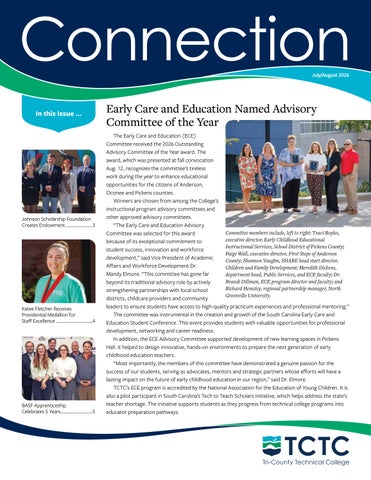
Early Care and Education Named Advisory Committee of the Year The Early Care and Education (ECE) Committee received the 2026 Outstanding Advisory Committee of the Year award. The award, which was presented at fall convocation Aug. 12, recognizes the committee’s tireless work during the year to enhance educational opportunities for the citizens of Anderson, Oconee and Pickens counties. Winners are chosen from among the College’s instructional program advisory committees and other approved advisory committees. “The Early Care and Education Advisory Committee members include, left to right: Traci Boyles, Committee was selected for this award executive director, Early Childhood Educational because of its exceptional commitment to Instructional Services, School District of Pickens County; student success, innovation and workforce Paige Wall, executive director, First Steps of Anderson development,” said Vice President of Academic County; Shannon Vaughn, SHARE head start director, Affairs and Workforce Development Dr. Children and Family Development; Meredith Dickens, Mandy Elmore. “This committee has gone far department head, Public Services, and ECE faculty; Dr. Brandi Dillman, ECE program director and faculty; and beyond its traditional advisory role by actively Richard Hemsley, regional partnership manager, North strengthening partnerships with local school Greenville University. districts, childcare providers and community leaders to ensure students have access to high-quality practicum experiences and professional mentoring.” The committee was instrumental in the creation and growth of the South Carolina Early Care and Education Student Conference. This event provides students with valuable opportunities for professional development, networking and career readiness. In addition, the ECE Advisory Committee supported development of new learning spaces in Pickens Hall. It helped to design innovative, hands-on environments to prepare the next generation of early childhood education teachers. “Most importantly, the members of this committee have demonstrated a genuine passion for the success of our students, serving as advocates, mentors and strategic partners whose efforts will have a lasting impact on the future of early childhood education in our region,” said Dr. Elmore. TCTC’s ECE program is accredited by the National Association for the Education of Young Children. It is also a pilot participant in South Carolina’s Tech to Teach Scholars initiative, which helps address the state’s teacher shortage. The initiative supports students as they progress from technical college programs into educator preparation pathways.
Connection is published six times each year by the Office of the President and the Public Relations Department. Mailing Address (All Campuses) P. O. Box 587 Pendleton, SC 29670 Pendleton Campus 7900 Highway 76 Pendleton, SC Anderson Campus 511 Michelin Blvd. Anderson, SC Easley Campus 1774 Powdersville Rd. Easley, SC Oconee Campus 552 Education Way Westminster, SC Main Number (864) 646-TCTC (8282) Toll-free 1-866-269-5677 tctc.edu Tri-County Technical College is accredited by the Southern Association of Colleges and Schools Commission on Colleges (SACSCOC) to award associate degrees. Tri-County Technical College also may offer credentials such as certificates and diplomas at approved degree levels. Questions about the accreditation of Tri-County Technical College may be directed in writing to the Southern Association of Colleges and Schools Commission on Colleges at 1866 Southern Lane, Decatur, GA 30033-4097, by calling (404) 679-4500, or by using information available on SACSCOC’s website (www.sacscoc.org). Tri-County Technical College does not discriminate on the basis of race, color, national origin, sex, disability, or age in its admissions policies, programs, activities, or employment practices. TCTC will take steps to assure that the lack of English language skills will not be a barrier to admission and participation in vocational education programs. Tri-County Technical College’s nondiscrimination policy and grievance procedures can be located at tctc. edu/TitleIX. To report information about conduct that may constitute sex discrimination or make a complaint of sex discrimination under Title IX, please refer to tctc.edu/TitleIX.
Connecting A New Academic Year Filled with Purpose
T
Dr. Galen DeHay here is something special about the beginning of a new President academic year. As students return to our campuses and classrooms come alive with activity, we are reminded why Tri-County Technical College exists: to provide opportunities that change lives, strengthen communities, and prepare people for meaningful careers. This fall, that mission feels especially relevant. At our summer commencement on August 3, keynote speaker Dr. Laura Ullrich, director of economic research in North America at Indeed Hiring Lab, shared an encouraging message about the future of work. While many conversations about the workforce focus on uncertainty and the impact of artificial intelligence, Dr. Ullrich offered a different perspective. She noted that the greatest challenge of the coming decades will not be a shortage of jobs but a shortage of skilled people to do them. She emphasized that the work most resistant to automation and most critical to our economy is work that requires human expertise, adaptability, and presence: caring for patients, teaching students, securing networks, manufacturing products, and maintaining the systems that keep our communities running. Dr. Ullrich reminded graduates that the ability to adapt may be the most important workforce skill of their lifetime. That message resonates deeply at Tri-County, where learning extends beyond technical competencies to include what we call workplace skills: the ability to think critically, communicate effectively, and connect intentionally. These qualities have always been valuable, but they are becoming increasingly important as industries evolve and new opportunities emerge. As we begin this new semester, I am grateful for the role each of you plays in advancing our mission and vision. Whether you teach, advise, support operations, contribute as a retiree, or champion the College in the community, your efforts help create opportunities for students and strengthen the workforce of our region. Thank you for all you do. I look forward to another year of helping students discover their potential and preparing them for careers and lives of purpose. In your service,
Galen DeHay, Ph.D. President
Summer Commencement
Indeed’s Ullrich Discusses Adaptability in AI Era Summer commencement was a day filled with celebration and hard-hitting facts from a world-leading economist. The resounding message was clear: Tri-County Technical College graduates know how to make smart choices, manage life’s complexities and adapt to evolving circumstances. These are the capabilities most needed in today’s workforce, which is seeing mass retirement among Baby Boomers and the expansion of artificial intelligence (AI), according to Laura Ullrich, Ph.D., who delivered the commencement address. Dr. Ullrich is director of economic research in North America at the Indeed Hiring Lab. She is a foremost authority on the job market. “What we have found is that the defining challenge of the next 15 years is what we economists call agility — the economy’s need for people who can move toward where they are needed, learn something new and adapt,” she said. Dr. Ullrich should know. After all, her team analyzes millions of data points about global labor market conditions, including hiring trends, salary information, popular skills and employer benefits. She also has a local, national and international perspective, having taught at Winthrop University for more than a decade before joining the Federal Reserve Bank of Richmond and then Indeed. She acknowledged that AI is a real threat to high-paid “desk jobs,” but said there will be severe labor shortages in careers where work is hard to automate. “That work needs a human being in the room,” she said. “Caring for a patient. Wiring a building. Running a classroom. Fixing the thing that broke. Providing security both on the ground and in the cloud.”
Dr. Ullrich credited the graduating class for seeing the writing on the wall and acting upon it with wise educational and career decisions. “The world is going to spend the next few years telling you the future is scary. Some of that Dr. Laura Ullrich addresses graduates. will be true,” she said. “But the economy that is coming does not need people who have never struggled. It needs people who know how to keep going when things get hard, who can adapt, who show up for the work that only a human can do. It needs, quite literally, people like you.” Kenneth “Mac” McIntyre, president of the College’s Student Leadership Council, also offered inspiring remarks. He described the TCTC student body as a cross-section of individuals who defy stereotypes and are united by a determination to improve their lives and those of their families. “We have adults, parents, business owners, full-timers and veterans like me,” he said. “Some of you came here straight out of high school, and some of you came back after years away. However, between work schedules, families, responsibilities, bills, sleepless nights and those discussion boards due at 11:59 p.m. … you made it.” “You fought and conquered, and that is deserving of respect — most importantly, respect for yourselves,” McIntyre said. “That’s what tonight represents. Not perfection but perseverance. It represents every moment you wanted to quit but didn’t.”
Johnson Scholarship Foundation Creates Endowment The Johnson Scholarship Foundation (JSF) has established an endowment to support the Tri-County Technical College Dual Enrollment Academy-Clemson Connect, a precedent-setting program for first-generation college students. The endowment will be seeded with $170,000 annually for three years, for a total of $510,000. It is structured so that JSF matches every dollar contributed by other donors. With headquarters in Florida, JSF is known for catalyst funding. It is not afraid to take risks on promising initiatives that align with its core values. “They historically have not created an endowment as their first gift,” said Courtney White, executive director of the TCTC Foundation. “They recognized that the Dual Enrollment Academy is the first of its kind.” Left to right: Dr. Mandy Elmore and Dr. Galen DeHay, TCTC; Lisa Loomis, JSF; Tiffany Blackwell, TCTC; Bobby Krause, JSF; Sharon Nagy, Clemson University; David Blaikie, JSF Board; and Jonathan Cauthen, TCTC Foundation. July/August 2026 | 3
Student Emergency Fund Update Thanks to the generosity of faculty and staff, the Student Emergency Fund balance has grown to more than $19,850. This summer, the fund provided $8,000 to help with textbook costs. The fund helps to alleviate expenses for students who are struggling with unexpected hardships. Every semester, donations from faculty, staff and others make the difference between students staying in school and dropping out.
As needs continue to grow, ongoing support is essential. The TCTC community wants to ensure help is available when students need it most. If you are not currently supporting the Student Emergency Fund, please consider making a gift through payroll deduction or a one-time contribution. Even a small gift can have a meaningful impact. To donate, visit tctc.edu/donate.
Katee Fletcher Receives Linda C. and Dr. Ralph D. Elliott Presidential Medallion for Staff Excellence Katee Fletcher, academic resource departments to create a more seamless specialist in the Engineering and and supportive student experience,” Industrial Technology (EIT) Division, is he said. the recipient of the highest award given Fletcher’s colleagues describe her as to TCTC staff: the Linda C. and Dr. Ralph the person who always has an answer, D. Elliott Presidential Medallion for Staff finds a solution and puts students first. Excellence. Her professionalism, compassion, Presented to Fletcher at TCTC’s fall collaborative spirit and positive attitude convocation Aug. 12, the medallion have earned the trust and respect award is named for the Elliotts in of faculty, staff, administrators and recognition of their commitment students throughout the College. to higher education and generous “Katee consistently delivers premier contributions to the College. Each year, service through her responsiveness, the award goes to one staff member who accuracy and proactive support of best exemplifies the TCTC philosophy faculty, students and administration,” and has contributed the most during the said Paul Phelps, dean of the EIT academic year to the development of the Division. “She approaches every College and students. interaction with a high level of care and “Katee exemplifies Tri-County’s professionalism, ensuring that students commitment to student success through feel supported and that faculty needs her unwavering dedication to students, Katee Fletcher poses with her husband and daughter. are met. Whether assisting a student faculty and staff,” said TCTC President navigating the enrollment process or Dr. Galen DeHay. “Known across the College for her responsiveness, supporting faculty with complex scheduling needs, Katee’s service expertise and willingness to help, Katee consistently goes above and is both timely and thoughtful, reflecting a genuine commitment to beyond to remove barriers, solve complex challenges and ensure student and institutional success.” students have the support they need to achieve their educational and An Oconee County resident, Fletcher has an Associate of Arts career goals.” degree from Patrick & Henry Community College in Virginia, Dr. DeHay said Fletcher’s impact extends far beyond her daily a Bachelor of Science degree in psychology from Georgia responsibilities. She has led initiatives to improve dual enrollment Southwestern State University, and a Master of Arts degree in students’ transition to college programs. In addition, her work has teaching from National University in California. strengthened advisement and registration processes and supported Prior to joining TCTC, she served as an admissions advisor for outreach and recruitment efforts. “Katee has taught workforce military and veterans’ programs at National University for three years. readiness and employability skills and collaborated across She joined TCTC in 2015 as a success coach and transitioned to her current role as academic resource specialist in 2021.
4 | CONNECTION
BASF Apprenticeship Celebrates 5 Years It is the fifth anniversary of the BASF Environmental Catalyst and Metal Solutions (ECMS) Process Operations Technician Apprenticeship Program. Since the program’s launch, it has been a successful partnership between BASF ECMS, Tri-County Technical College and Apprenticeship Carolina. The anniversary coincided with recognition of the program’s seventh cohort, which included apprentices Nicole Stone, Jo Loewy, Nathan Little, Brennan Fry and Christian Speicha. Like those before them, they applied for the program and were selected by BASF ECMS, which hired them as full-time employees. “The apprenticeship has given me the drive and ambition to continue in the manufacturing world and work toward higher goals for myself and within the company,” said Stone. “It has turned out to be one of the best unexpected turn of events that could have happened for me.” Apprentices train on the job at BASF ECMS’ Seneca site, attending a weekly class on TCTC’s Oconee Campus. BASF ECMS pays the cost of tuition, books and hours in the classroom. They earn the nationally recognized U.S. Department of Labor OSHA-10 card and a TCTC Process Technology certificate. “We’re proud to celebrate both this newest cohort and five years of strong partnership with BASF ECMS,” said Dr. Galen DeHay, president of TCTC. “Programs like this create meaningful pathways for individuals while helping meet the growing demand for skilled talent in advanced manufacturing.” Building those pathways is at the heart of the apprenticeship program. One of BASF ECMS’ main goals is to develop a more diverse workforce by providing opportunities to individuals who are
The seventh cohort is pictured with TCTC, BASF and Apprenticeship Carolina leaders.
returning to it, such as stay-at-home parents and military veterans, as well as those who want to transition to manufacturing from other fields, such as retail, hospitality and other service industries. Without the apprenticeship, they might not gain skills to secure manufacturing employment. “We want to bring these people into our workforce stream,” said Jim Kilton, continuous improvement manager, BASF ECMS. Across the first six cohorts, 39% of apprentices were women. From the full participant pool, 32% have been promoted to higherlevel roles at BASF. The eighth cohort started in July 2026. It is the largest yet. Most past cohorts have had five to six apprentices. The eighth has three times that. “The size of the group is not the most important thing. It is what it represents — the belief that what we are doing creates value for each apprentice and for BASF ECMS. Trust — in the College, in the work that we do, and the impact we have on their employees,” said Bryan Manuel, dean of integrated workforce solutions.
Fiscal Affairs Honored for 25 Straight Years For 25 consecutive years, the College’s Fiscal Affairs Department has been recognized for excellence by the Government Finance Officers Association (GFOA), which has represented public finance officials throughout the United States and Canada since 1906. This year the team once again earned the association’s highest recognition, the Certificate of Achievement for Excellence in Financial Reporting. GFOA bestowed the honor to acknowledge the outstanding quality of the TCTC Annual Comprehensive Financial Report (ACFR) for the fiscal year ending June 30, 2025. “This recognition reflects the hard work and dedication of the Fiscal Affairs team,” said Cara Hamilton, vice president of business affairs.
July/August 2026 | 5
Our College Family
Dr. Fleming Honored with Teaching Excellence Award
in transition TCTC Welcomes New Faculty and Staff Ben Lange is the controller/director of Fiscal Affairs. In this role, Lange oversees the College’s fiscal operations and ensures financial integrity, compliance and long-term financial sustainability. Most recently, he served as controller for Maplehurst Farms, Inc., in Rochelle, Ill. He brings extensive experience in financial reporting, general ledger operations and data analytics. Mackenzie Mullikin is a success coach in the Advising and Student Coaching office. In this role, she assists students with first semester advising and provides early alert response and support. She also facilitates campus connections and helps students build foundational skills, such as a growth mindset and self-advocacy. Mullikin has been a high school and middle school agriculture teacher for 10 years. She received her bachelor’s degree from Clemson University and her MBA from Liberty University. Andrea “Gabie” Sears is the director of customer relationship management (CRM) optimization and strategy. In this role, she is responsible for maintaining and driving the growth and utilization of TriView as the College seeks to serve students in the most efficient way. Sears graduated from the College of Charleston in 2022 and spent the past five years working there, where she processed transcripts, created data analysis tools through reports and dashboards, and automated and enhanced the TargetX CRM. Anna Lee Travis, DPT, returns to the College as department head for Health Professions and program director for Physical Therapy Assisting (PTA). In this role, she is responsible for leadership of the Health Professions department and the development and implementation of the PTA program on the Easley Campus. Dr. Travis most recently worked at Anderson University as a full-time faculty member.
6 | CONNECTION
excellence through service Congratulations to Dr. Carolyn Fleming, Business Technology department head, who was honored by the Accreditation Council for Business Schools and Programs (ACBSP) with its Region 3 Teaching Excellence Award (Associate Degree). Dr. Fleming received the award at the ACBSP national conference in Phoenix, Ariz.
Anderson Sheriff Donates Four Police Vehicles Campus Police accepted the donation of four law enforcement vehicles from the Anderson County Sheriff’s Office. The vehicles’ standard service life was over with the county, but they remained fully operational. The College made a minimal investment to add TCTC-branded decals. Each year, the College’s Criminal Justice program graduates qualified students who fill roles in the Upstate law enforcement community. TCTC has a strong partnership with the sheriff’s office.
Grant Will Support Sexual Violence Prevention Sexual violence and related safety issues are foremost concerns on U.S. college campuses. TCTC has received a grant of $3,500 to strengthen student education, awareness and prevention initiatives. The grant was awarded by the South Carolina Institute on the Prevention of Sexual Violence on College Campuses. The funds will be used to purchase materials to educate students about how to recognize warning signs, respond to attacks, access support services, and understand their rights and reporting options. The grant also will support TCTC’s annual Alcohol and Other Drugs Awareness Event, which addresses substance misuse, addiction prevention, personal safety and sexual violence prevention.
Precision Meets Healing: Cross-Disciplinary Collaboration at Its Best The first Precision Meets Healing externship united 12 students who might not otherwise cross paths at Tri-County Technical College: future surgical technologists and CNC machinists. It did the same for faculty and staff. Add to the mix a business partner, Arthex, and you have a unique recipe for success. This new opportunity is designed to explore the critical intersection of healthcare and advanced manufacturing. Participants were nominated by their program directors. These are Daniel Harbin for the CNC Programming and Operations Twelve students strengthened their skills in the new externship. associate degree program, and Miranda Fowler for the Surgical Technology associate degree program. The externs served as to approach their own specialties with a more informed, holistic view. ambassadors for their fields of study. Each earned a certificate of Students also strengthened their resumes, obtaining knowledge completion and a stipend from the TCTC Foundation, acknowledging of advanced materials such as medical-grade titanium, plus global their engagement and learning achievement. quality standards, including ISO 13485. Every tool and implant used The externship took place over four days, totaling 12 hours during surgery must meet stringent quality requirements and be of structured programming. During this short intensive, surgical traceable throughout the supply chain. technology students learned about the manufacturing process for Leaders of each academic program are enthusiastic about the the surgical instruments they will use in the operating room. Likewise, externship. Harbin said the experience augmented his students’ dayCNC students learned about how machined products are used during to-day focus on machining skills and opened new thought processes. surgical procedures. Fowler described the externship as a unique opportunity. Surgical A ceremony to celebrate the inaugural Precision Meets Healing technologists undergo rigorous training in how to use operating externship class was held in June at Arthrex, a global medical device room instruments, but the externship provided valuable insights company with operations in Pendleton. The company is known for about the origins of those tools, she said. its commitment to end-user education. Its core mission statement is Bryan Manuel, dean of integrated workforce solutions, said it “Helping Surgeons Treat Their Patients Better.” is rare in higher education for such different academic programs This innovative approach allowed students to develop a crossto collaborate. “Pulling together faculty from different disciplines, disciplinary range of skills and insights, connecting the production administration and an employer-partner to build something floor to the operating room. By gaining awareness of the process and completely new does not happen every day. What made this work purpose of one another’s work, participants finished the program able was our people,” said Manuel.
Vet Tech Student Exam Pass Rate 95.6% 26.6 Percentage Points Above U.S. Average Veterinary Technology students achieved a 95.6% pass rate on the Veterinary Technician National Examination (VTNE). Over the past three years, TCTC students have maintained an average VTNE pass rate of 92.5%, significantly exceeding the national average of 67%. Students must pass the VTNE before they can sit for the state licensure exam, and they must pass both exams to become licensed veterinary technicians. Congratulations to our Vet Tech students, faculty and staff on this outstanding achievement!
July/August 2026 | 7
P. O. Box 587 Pendleton, SC 29670 tctc.edu
Future Power Line Workers Show Their Skills
Students Demonstrate Skills at Heavy Equipment Rodeo Students of the TCTC Heavy Equipment Operator (HEO) program displayed their skills in front of potential employers during a recent outdoor rodeo. Six students received certificates at the event. Through the HEO program, the College offers short-term training that can lead to long-term careers for area residents. Students learn about equipment applications, attachments, operating controls, preventive maintenance requirements and basic operating techniques through a combination of classroom and hands-on training. 8 | CONNECTION
A rodeo demonstration marked the culmination of the most recent 11-week TCTC Power Line Worker program. Students had an opportunity to demonstrate their skills in front of an audience of potential employers. The program includes 412 hours of training on skills such as basic construction, electrical current and aerial framing. Students also learn how to safely climb poles and structures made of wood and other materials.