A witch hunt has occurred at TCNJ with Shakespeare 70’s
By Adriana Liberti Correspondent
Shakespeare 70, a local theatre company with affiliations to the College, was back in the Don Evans Black Box theatre with their third show of the season: Arthur Miller’s “The Crucible.” The production opened on Wednesday, March 25 and closed with a matinee on Sunday, March 29.
“The Crucible,” written in 1953, is set in Salem, Massachusetts in 1692 during the well-known Salem witch trials. It is a story with themes of false accusations, mass hysteria and Christianity. It originally served as symbolism for the “Red Scare,” a time when senator John McCarthy led a paranoid hunt for communists in the United States.
“I thought that was really cool that he connected those two events,” said sophomore English major Kathryn Wyrovsky, an audience member.
Shakespeare 70’s production was directed by Jake Burbage, the Creative Director of the company. In the past, Burbage has directed “Our Town” and “Murder Most Foul,” and has acted in several Shakespeare 70 productions including “The Taming of the Shrew” as Katherin, “Twelfth Night” Orsino and Antonio and “Waiting For Lefty” as Dr. Benjamin.
“It’s difficult to make ‘The Crucible’ tremendously engaging,” said Travis Martin, a sophomore English and secondary education major with a theatre minor, who played Reverend John Hale.
“I think that Jake made it feel fresh, and I was so thrilled to work with him!”
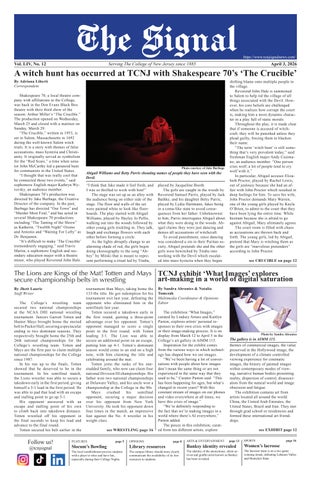
The stage was set up as an alley with the audience being on either side of the stage. The floor and walls of the set were painted white to look like floorboards. The play started with Abigail Williams, played by Hayley Jo Pellis, walking out into the woods followed by other young girls trickling in. They talk, laugh and exchange flowers with each other before forming a circle.
As the lights abruptly change to an alarming shade of red, the girls begin doing choreography to the song “Abbey” by Mitski that is meant to represent performing a ritual led by Tituba,
The Lions are Kings of the Mat! Totten and Mays secure championship belts in wrestling
By Jhett Laurie Staff Writer
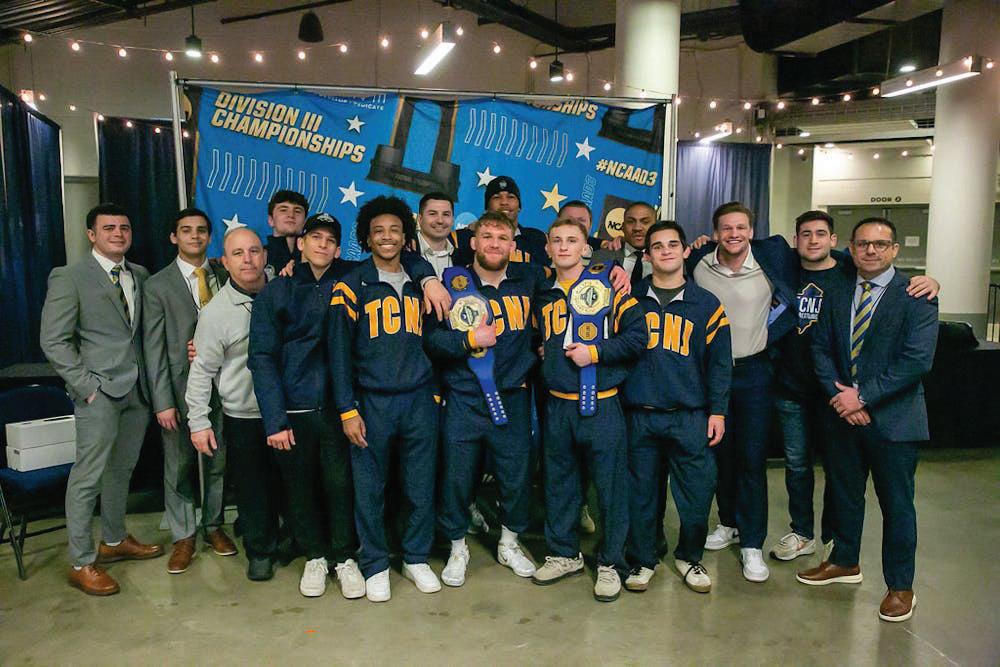
The College’s wrestling team secured two national championships at the NCAA DIII national wrestling tournament. Juniors Garrett Totten and Hunter Mays brought home the storied belt to Packer Hall, securing a spectacular ending to two dominant seasons. They respectively brought home the 25th and 26th national championships for the College’s wrestling team. Totten and Mays are the first pair to claim multiple national championships for the College since 1987.
In his run up to the finals, Totten showed that he deserved to be in the tournament. In his semifinal match, the Lions wrestler was able to secure a takedown early in the first period, giving himself a 3-1 lead in the first period. He was able to pad that lead with an escape and stalling point to go up 5-1.
His opponent answered with an escape and stalling point of his own to climb back into takedown distance. Totten wrestled off his opponent in the final seconds to keep his lead and advance to the final round.
Totten secured his belt earlier in the
Follow us!
tournament than Mays, taking home the 133-lbs title. He got redemption for his tournament exit last year, defeating the opponent who eliminated him in the semifinals last year.
Totten secured a takedown early in the first round, gaining a three-point advantage over his opponent. Totten’s opponent managed to score a single point in the first round, with Totten leading 3-1. The Lion was able to secure an additional point on an escape, putting him up 4-1. Totten’s dominant season would come to an end on a high note, with him claiming the title and celebrating around the mat.
Totten joins the ranks of his starstudded family, who now can claim four national Division III championships. His father won two national championships at Delaware Valley, and his uncle won a championship at the College in the 90s.
Mays crushed his semifinal opponent, securing a major decision over his opponent from New York University. He took his opponent down four times in the match, an impressive feat against the No. 4 wrestler in his weight class.
see WRESTLING page 16
played by Jacqueline Booth.
The girls are caught in the woods by Reverend Samuel Parris, played by Jack Bathke, and his daughter Betty Parris, played by Lydia Hartmann, fakes being in a coma-like state to avoid consequences from her father. Unbeknownst to him, Parris interrogates Abigail about what they were doing in the woods. Abigail claims they were just dancing and denies all accusations of witchcraft.
To avoid punishment, since dancing was considered a sin in their Puritan society, Abigail pretends she and the other girls were bewitched by Tituba into working with the Devil which escalated into mass hysteria when they began
‘The Crucible’
shifting blame onto multiple people in the village.
Reverend John Hale is summoned to Salem to help rid the village of all things associated with the Devil. However, his core beliefs are challenged when he realizes how corrupt the court is, making him a more dynamic character in a play full of static morals.
Throughout the play, it is made clear that if someone is accused of witchcraft, they will be punished unless they plead guilty, forcing them to blacken their name.
“The term ‘witch hunt’ is still something that’s very prevalent today,” said freshman English major Andy Cusimano, an audience member. “One person cries wolf, a lot of people tend to cry wolf with it.”
In particular, Abigail accuses Elizabeth Proctor, played by Rachel Lewis, out of jealousy because she had an affair with John Proctor which resulted in deep feelings for him. To save his wife, John Proctor demands Mary Warren, one of the young girls played by Kayla O’Brien, to admit to the court that they have been lying the entire time. While hesitant because she is afraid to go against Abigail, Mary ultimately agrees.
The court room is filled with chaos as accusations are thrown back and forth. The young girls, led by Abigail, pretend that Mary is witching them as the girls are “marvelous pretenders” according to John Proctor.
see CRUCIBLE on page 12
TCNJ exhibit ‘What Images’ explores art-making in a world of digital saturation
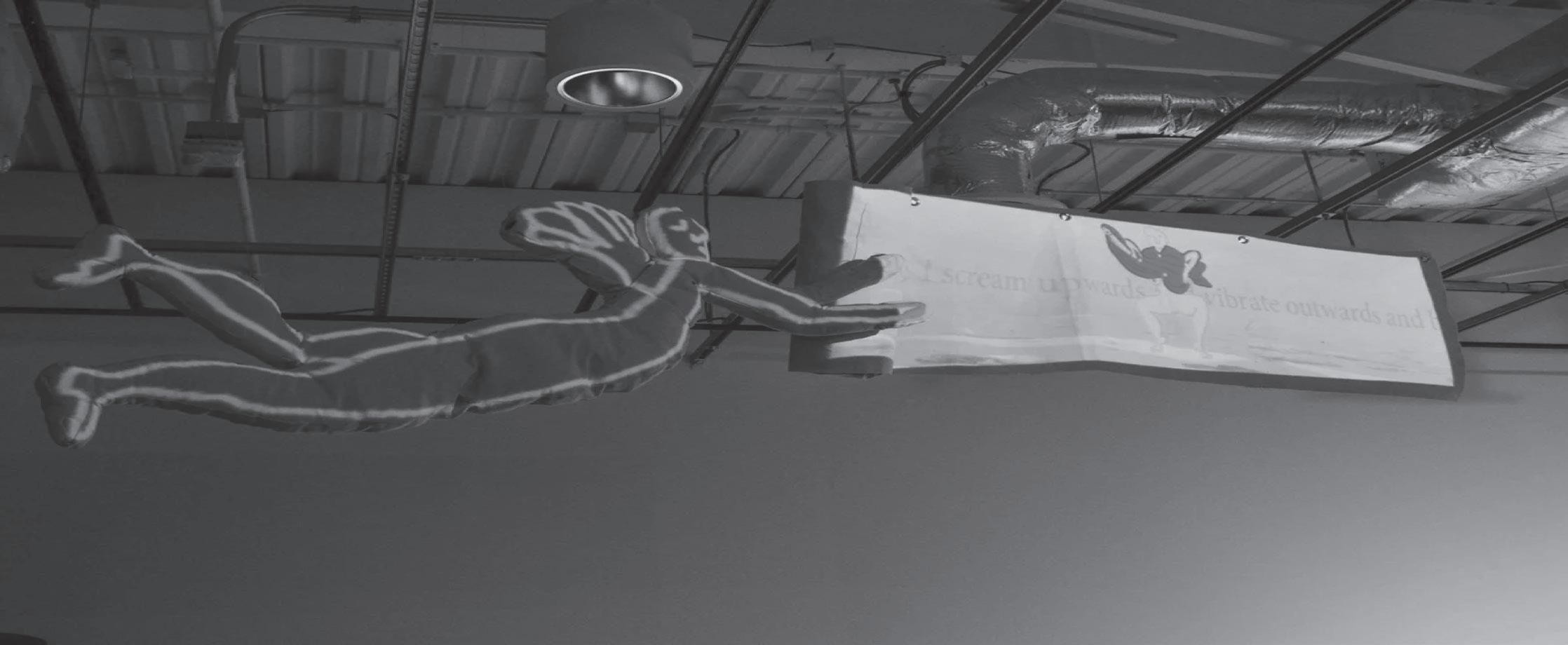
The exhibition “What Images,” curated by Lindsey Arturo and Kaitlyn Paston, explores artists’ personal responses to their own crisis with images or their image-making process. It is on display from March 12 to April 5 in the College’s art gallery in AIMM 115.
Inspiration for the exhibit comes from the various ways in which technology has shaped how we see images.
“We’ve been having a lot of conversations with people about how images don’t mean the same thing or are not experienced in the same way that they used to be,” Curator Paston said. “This has been happening for ages, but what’s changed in recent years? With this constant stream of images on our phones and video everywhere at all times, we have this crisis of image.”
“We’re definitely responding to the fact that we’re making images in a world where there’s AI everywhere,” Paston added.
The pieces in this exhibition, curated from ten different artists, explore
themes of commercial images, the value preserved in the Hollywood image, the development of a climate controlled viewing experience for cinematic images, the history of painted images within contemporary modes of viewing, narrative human bodies presenting reality, dispersion of control, disassociation from the natural world and image obsession and fatigue.
The exhibition contains art from artists located all around the world: China, the United Arab Emirates, the United States, Brazil and Iran. They met through grad school or residencies and formed these international art friendships.
see EXHIBIT page 12
Photo courtesy of Jake Burbage
Abigail Williams and Betty Parris shouting names of people they have seen with the Devil.
Photo by Sandra Abrantes
The gallery is in AIMM 115.
State grant awarded to TCNJ to combat flooding, greenhouse gas in Ewing
By Sarah Neil Correspondent
The College recently received a grant of $250,000 from the New Jersey Department of Environmental Protection and Sustainable Jersey as part of Trees for Schools, a tree-planting initiative to plant hundreds of trees on campus.
Many other schools, including Hamilton Township School District and Paul Robeson Charter School, also received funding from this grant.
The College’s new trees, which will be a mix of various native species, will be planted in autumn near the Shabakunk Creek on the College’s property. The planting locations are on the exterior of
campus, extending the already existing forested areas there.
Trees for Schools encourages the planting of native trees, which helps to maintain the natural biodiversity of the environment and best supports the other native species nearby. Included in the College’s list of trees to be used in the project are white oaks, river birches and tulip poplars.
The planting is expected to bring many benefits to the Ewing community. While the trees will be on the campus itself, neighboring properties such as Anthiel Elementary School and Hollowbrook Community Center will also reap the benefits.
“[This project] serves to address stormwater runoff and mitigate flooding
in the area, it also serves to clean the water,” said Paul Romano, senior director of sustainability and energy management at the College.
Not only that, but the trees will also help to clean the air by taking in carbon dioxide from the atmosphere.
“This is about all of the benefits of trees, but we do have an emphasis on carbon sequestration,” said Melanie McDermott, senior researcher at Sustainable Jersey. The carbon captured by these trees will be tracked over their lifetimes as part of this project.
The funding for Trees for Schools comes from the Regional Greenhouse Gas Initiative, which is a program that aims to cut down on emissions of greenhouse gases. Tree planting is one
way to help minimize the effects of carbon emissions.
The grant also covers the costs of fencing and deer guards for the planting zones to prevent deer from eating the young trees.
“A lot of our forested areas have been devastated by deer overpopulation,” said Romano.
Deer guards and fences will be used to protect the saplings as they grow, greatly increasing their chance of survival. It also provides an opportunity for native shrubs and grasses to repopulate the area. Through this, the plots will start to more closely resemble the natural forests that once occupied the space.
The success of these plants also relies on the efforts of students and community members. Romano and McDermott are both hopeful that volunteers will come together to support this project, whether that be by helping to prepare the site or by studying the effects of the planting on the ecosystem.
“There’s a big role in monitoring the trees, tracking them as they grow over time. There’s a lot of interesting studies that could be done,” said McDermott.
While this project will allow the DEP and Sustainable Jersey to work on improving their environmental restoration practices, it will also provide major learning opportunities for the community.
There are efforts being made now to involve more people in the process, allowing for community members to learn more about environmental restoration and conservation and how initiatives like these can benefit neighborhoods.
“I think the most exciting part of this project is building awareness and sharing, with concrete examples, these lessons with the immediate community,” said Romano.
Congresswoman Bonnie Watson Coleman, who has represented New Jersey’s 12th Congressional District since 2015, announced four months ago she would not seek reelection to her House seat in 2026.
Coleman, 81, made the announcement back in November. Elected in 2014, at the time she was the first Black woman to be elected to Congress from New Jersey. She has been involved in Democratic Party circles long before that, serving as a member of the New Jersey General Assembly for 17 years and was the party’s majority leader from 2006 to 2010.
“I think it’s time for somebody else,” Watson Coleman told The Signal. “I think it’s time for an infusion of younger people. I still could do the job, but it’s not necessary for me to be the only one that can do the job.”
Coleman has been championed as a “progressive” and one of the more leftwing members of the House Democratic Caucus. In her first year of Congress, she introduced the Healthy MOM Act, which intended to improve maternal health by closing a loophole in the healthcare system that often prevents pregnant women from getting insurance coverage, and she reintroduced it this year.
In 2016, she founded the Congressional Caucus on Black Women and Girls, which aimed to focus on the welfare of African-American females. She’s long been a critic of Israel, boycotting Prime Minister Benjamin Netanyahu’s address to Congress in 2015, and called for a ceasefire
and an arms embargo on Israel, while also calling Israel’s actions against Palestinians a “genocide.”
In 2019, Watson Coleman established an Emergency Task Force on Black Youth Suicide, and chaired it alongside the Congressional Black Caucus. The Congresswoman felt it was a problem being overlooked and was very proud to bring it to life, as it brought about the “Ring the Alarm” report in December that year.
“I worked with a bunch of psychiatrists, psychologists and social workers to get at some of the issues and to recognize that mental health issues are very important and they were under-considered by the House of Representatives and government in general,” Watson Coleman said.
One of the Congresswoman’s most significant achievements was pushing for the Federal Railroad Administration to award $18 million in funds for the Trenton Transit Center, back in 2020. In 2025, over 700,000 people used the NJ Transit lines at the station. Improving public transit was a high priority for her.
“Getting people back and forth and getting more cars off the road is very important to me because I believe that our congestion is so fundamentally unhealthy in terms of the air that we’re breathing,” Watson Coleman said. “And I think this country is just so far behind on transportation of people, on trains and other kinds of collective modes.”
Her father, John Watson, had also served in the New Jersey General Assembly for 12 years. He passed away in 1996, less than two years before she was elected to the Assembly.
Despite her diagnosis of lumbar
spinal stenosis in 2024, Watson Coleman remained very active not only in the House, but in fighting alongside her constituents.
In July 2022, Watson Coleman was arrested for protesting outside of the United States Supreme Court after the landmark decision to overturn Roe v. Wade and denationalize abortion rights in the country.
In May 2025, the Department of Homeland Security attempted to file assault charges against her and two other Democratic representatives after a scuffle at an immigration detention facility, where Watson Coleman attempted to legally enter
Delaney Hall, a building that was detaining immigrants.
Her district, NJ-12, spans much of Middlesex and Somerset counties, but as well as some towns in Mercer County, most notably Trenton, Pennington and Ewing. Watson Coleman has spent most of her life in the district she represents; she graduated from Ewing High School in 1963, and received a B.A. from Thomas Edison State University in 1985. Additionally, she was awarded an honorary doctorate degree from The College of New Jersey.
Read
Photo courtesy of Paul Romano
The College’s new trees will be planted in autumn near the Shabakunk Creek on the College’s property.
Photo courtesy of watsoncoleman.house.gov
Congresswoman Bonnie Watson Coleman has represented New Jersey for over a decade.
Cop Shop: Stolen clothes, a letter from prison and an Orbeez attack
By Devyn Briones Arts & Entertainment Editor
The Signal and Campus Police work together on a weekly basis to inform the campus community about crime on and around campus. All records given to The Signal are public records and do not contain personal information. Some information provided may be triggering for some students.
March 4: Burnt plastic
At approximately 4:58 p.m., a fire alarm went off at Travers and Wolfe Halls. The activated alarm was coming from a resident’s room in Wolfe Hall. There were no smells of smoke or gas, but a burnt plastic scent. The cause of activation was due to the burnt plastic smell, but the cause of the smell is unknown. All students and residents re-entered the building at around 5:28 p.m.
March 6: Laundry room thief
At approximately 1:12 p.m., Campus Police were dispatched to Wolfe Hall on the report of a student claiming his clothes were stolen from the ninth floor laundry room. The student says he went to the laundry room around 2 a.m., washed a load of clothes and then placed them on top of the dryer closest to the door. At approximately noon, he returned to the laundry room and noticed half of his clothes were missing from the pile he had left. Some items missing included a Hollister hoodie, Young LA sweatpants, Champion sweater and his socks, coming to a total of about $145.
into the laundry room and taken his clothes. Since everyone living in Wolfe Hall has access to each laundry room, anyone in the building could have been the thief to his clothes. There are no suspects at this time.
March 9: Stolen pencil case
At approximately 5:35 p.m., a student at the College reported her pencil case missing. She said her backpack was
Prison, though the handwriting was not legible enough to make out the name of the sender. There was no specific person addressed to receive the letter, just to the College’s Computer Sciences department. Under the receiving address, it read, “Rupert Murdoch News, the gun is a nickel-plated 45,” and the opposite side of the letter had the words, “Comp Sci,” written in purple pen. Around 11 a.m.,
The student doesn’t know of anyone who could have taken the clothes, as he also checked each machine to ensure they weren’t misplaced there. Since there are only cameras in the lobby and entrances, Campus Police are unable to review any footage of who could’ve gone
open after her class in the STEM building, which led her to believe someone stole her pencil case. The pencil case was described as black with a red label that reads, “Designed for Arrangement.” The pencil case holds about $100 worth of pens and highlighters, including eight different highlighters and three different “brush” pens. There are no suspects at this time.
March 17: A letter from prison
Around 10:47 a.m., suspicious mail delivered to the computer sciences department was reported to Campus Police Headquarters. The letter came from Mule Creek State
Campus Police opened the mail which held a letter. The letter states multiple statements on the John F. Kennedy assassination, including a diagram, but had nothing included that would threaten or target anyone specifically at the College. The letter also included instructions to play a slowed down video of the John F. Kennedy assasination.
March 23: Failed ramen Campus Police reported to Decker Hall for an active fire, stemming going from a resident’s room. The student said they were cooking ramen in the microwave when it began to
smoke, initially setting off the alarm. At this time, there was no smoke or fire present. Ewing Squad 30 arrived on scene at 11:15 p.m. and reset the smoke detector.
March 29: Scent diffuser
Around 5:39 p.m., a smoke alarm was activated in a Cromwell Hall resident room. The student was unsure why her alarm was going off, but Ewing Fire Squad 30 determined it was caused by a scent diffuser that was placed too close to the smoke detector. The student was advised to remove the diffuser.
March 30: Burnt hair
At approximately 12:31 p.m., the fire alarm in Ely, Allen and Brewster Halls was activated. Campus Police found the point of activation was coming from a student’s room in Allen. They met with the student who stated she left her hair straightener on for too long. There was no fire, but a slight amount of smoke was seen in the air. The student was advised to open the window and turn on a fan to air out the smoke.
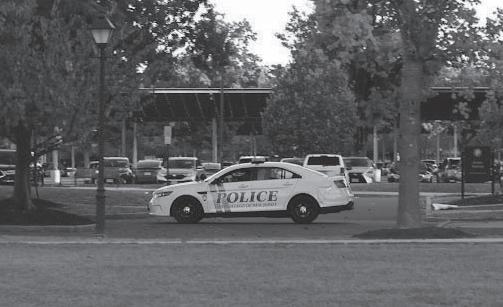
March 31: Orbeez drive by Around 6 p.m., four juveniles not affiliated with the College struck people walking in Campus Town with gel pellets that seemed to be Orbeez. The individuals did a “drive by” in a black Honda CR-V wearing ski masks. As of April 1, one juvenile, from Ewing Township, was caught and arrested by Campus Police.
This isn’t the first time a situation like this has happened at the College, as similar incidents have occurred in January 2024 and at the end of August in 2025. However, there are no connections to the previous incidents. Other situations have also occurred in fellow New Jersey colleges. The investigation is ongoing to identify the other involved parties.
Photo by Erin Reilly
Incidents in this report occurred between March 4 and March 30.
Features
When I grow up I want to be… a journalist! - Major Spotlight
By Sky Pinkett Features Editor
Around 80% of college students change their major at least once, with the average professional changing careers at least five to seven times in their working life. When I Grow Up is an academic spotlight series that digs deep into the majors offered at the College. It details opportunities, future job prospects, testimonials from students and professors, and how a major may be a good fit for you.
The very first spotlight for this series is the journalism major, which arguably, is the discipline that has made articles such as this one possible.
From informing the masses of important local, national and world events through establishments such as The New York Times and Good Morning America, to exposing powerful people from former President Richard Nixon during the 1970s Watergate scandal, the mid 2010s #MeToo movement and even the modern day Epstein files discovery, to Diane Sawyer’s infamous celebrity interviews and current social media news sites like Vox — all of this is journalism.
Merriam-Webster dictionary defines journalism as, “the collection and editing of news for presentation through the media.” This
definition casts a wide net, and includes article writers, news anchors, the production crew for news companies such as CNN and Fox News, and even photographers and social media curators.
At the College, the journalism program resides in the School of the Arts and Communication. In addition to a journalism and professional writing major or minor, students also have the opportunity to pursue a broadcast and multimedia journalism minor, social media minor and other related communication minors and majors.
According to Abhinav Aima, one of the College’s newest journalism professors, the College’s journalism program stands out as ideal for students wanting to explore journalism in all its interdisciplinary glory.
“TCNJ’s journalism program has a rich history of highly-engaged and award-winning student journalism,” Aima said. “Along with retaining valuable and functional core competency programs that support journalism — training in film, TV, radio and multimedia platforms, along with opportunities for students to explore art, music, business, technology and social sciences, in order to broaden their core interests in journalism.”
Students have found benefit in the College’s cross-disciplinary approach to journalism, as
senior journalism major Rebecca Wechter has experienced, who also has a minor in pre-law and psychology.
“I took Journalism 101 and then news editing and production, stuff like that.” Wechter said. “And then there’s a lot of really cool electives. I’m actually taking one this semester called ‘Globalization and International News’ that is one of my favorite classes that I’ve taken for journalism here because I feel like I’m learning a lot about history. I feel like I’m able to actually learn a lot of stuff.”
The journalism major has undergone much change to resemble what it is today. When Kim Pearson, one of the College’s journalism professors until 2025, started working at the College in 1988, journalism was a small program absorbed within the English department.
“At that time, journalism was led by Dr. Robert Cole, whom you will find celebrated in the digital archives as Father Journalism,” Pearson said. “Bob joined Trenton State College in the early 1970s after a respected career in newspapers and earning a PhD in English at Lehigh University. In the early 1970s, journalism courses were popular because of the impact that news coverage of the many major events of the 1960s had on daily life and political culture.”
The journalism program has come a long way since then and continues to evolve, as Aima’s and fellow journalism professor Kathleen Webber’s future plans for the major indicate.
“I’m working with Professor Kathleen Webber to streamline our course offerings to focus on providing students with a progressionbased curriculum,” Aima said. “I also hope to contribute to the curriculum based on my academic and professional background… through coursework that promotes the understanding and implementation of journalism’s core foundational role as a form of engagement with our democracy, with a focus on social responsibility.”
On the College’s journalism and professional writing website, the major is described as “interdisciplinary, so it offers a
broad range of courses in writing and other areas of study.” For Aima, who was applying to teaching jobs in other state colleges besides New Jersey, even as far as Dubai, this was what appealed to him about the College’s journalism program the most.
“I was highly motivated to join TCNJ because the campus has the legacy infrastructure of an award-winning historic student newspaper, The Signal, which has successfully sustained efforts to grow as a digital journalism entity,” Aima said. “I was impressed by the campus infrastructure that included award-winning faculty and staff providing a functioning TV studio for training students in broadcast production, a studentrun radio station, as well as students involved in film production, magazine journalism and interactive multimedia.”
In addition to The Signal, students have the opportunity to explore their journalistic interests and build their resume in other student organizations such as Her Campus, Lions Television, WTSR 91.3FM student-run radio and other student clubs.
“In this environment, students can learn to integrate these multidisciplinary skills in order to continue to build on a digital journalism program with creative and innovative thinking across a wide variety of diverse student’s capabilities and passions,” Aima said.
The many opportunities the College offers for journalism majors is something that will strengthen their future career prospects. According to the U.S. Bureau of Labor Statistics, “Employers generally prefer to hire candidates who have had an internship or have worked on school newspapers, radio stations or TV stations.”
“I feel like [the College] does a decent job in terms of sending out internship opportunities and like different job opportunities,” Wechter said. “The internships I’ve gotten have actually been mostly through my advisors sending out emails being like, ‘oh, you guys should apply for this.’ With those, I was able to actually get them. So I feel like that’s very helpful.”
Bonner students help feed the elderly with Meals on Wheels
By Ryan Conway Correspondent
There are many non-profit organizations that focus on helping people facing food insecurity. One organization, Meals on Wheels, is focused on not only preparing meals, but delivering them to those who are unable to get to a grocery store.
The Meals on Wheels program is a nationwide organization that provides nutritious meals to community neighbors who experience challenges in accessing nutritious food and support. It has served approximately 244 million meals annually across the globe, and has a branch based in Mercer County.
In fall 2016, it partnered with the College’s Bonner Scholars program. Students assisted in preparing and delivering meals to seniors, in collaboration with Rider’s Bonner Scholars program.
Kennedy Pettiford, a senior psychology major, enrolled in Bonner when she was accepted into the College, and has volunteered with Meals on Wheels since her first semester at the college. As the current site leader, she believes that many students in the country don’t understand how tough it is for some people, especially seniors who are limited in their mobility to get access to food.
“To get out and get your groceries is more of a privilege than people expect, because you need to be able to have a car,
you need to have money, you need to have public transportation, you need to have a support group or service to get you to the grocery store,” Pettiford said.
The Meals on Wheels program also isn’t just about feeding seniors any kind of food; they are focused on feeding them nutritious meals to keep the elderly community healthy.
“All of the meals are made with people’s diets in mind, so when you’re an older person, you might have diabetes, you might have high blood pressure,” Pettiford said. “Some people may need more protein in their diet to help substitute for the lack of meals they are eating.”
The setup in Mercer County is simple: Students at Rider University prepare the meals, while College students drop them to client’s homes. Pettiford credited Rider’s “amazing” kitchen for helping them put together so many meals.
As such, College volunteers are responsible for delivering food to those in need. However, it’s not that simple. These are seniors, many of whom may live by themselves and may be physically disabled. For some of these recipients, seeing a Bonner drop off their meal is oftentimes the only social interaction they’ll have throughout the day.
“It’s not just food and security when you think of things like Meals on Wheels, it’s actually addressing social isolation,” Rayjohn Felicia, a Bonner coordinator at the
College, said. “One of the things that I try to instill in my Bonners is having that open perspective of trying to understand issues, even though they’re not always present. By interacting with the participants, just checking on their day or even having a full on five to ten minute conversation with them, it does make a difference in their own happiness.”
Preparing meals is one thing, but delivering it is a whole different story.
The Meals on Wheels program had often struggled with finding delivery drivers, which made the Bonner’s at the College such a huge helping hand. They have their work cut out for them too: the Mercer County branch has 27 routes to make and drop off food to Ewing, Trenton, Princeton and other parts of the county.
However, sometimes nature gets in the way and we saw that twice in the past two months. Two massive snowstorms hit New Jersey in January and February, which could have impeded the Meals on Wheels’s task of delivering food to seniors. However, the program had procedures in place for these circumstances in the winter, and they came prepared.
“We do emergency food at certain parts of the season where we anticipate snowstorms,”
Pettiford said. “We will get shelf stable meals that are typically put in the microwave and they are vegan friendly. We packed about 700 emergency meals [a few
summers ago due to rainstorms] that would have about a week’s worth of food for each person of microwavable meals just to anticipate any inclement weather where we can’t deliver, especially over the winter.”
Sophomore and accounting major Syed Mohsin is one of these delivery drivers. He started volunteering for Meals on Wheels when he arrived his first semester at the College. He believes that the social aspect of Meals on Wheels makes it different from many Center for Community Engagement programs offered at the College.
“Every time I’m asked this question, the answer is the same: it’s the consistency that Meals on Wheels offers,” Mohsin said. “It’s something unique to Meals on Wheels that isn’t really there with a lot of other opportunities, which is that there needs to be people going out constantly and in turn, you can always be reliant on there being work to do and being able to go out there and do it.”
The human facet of Meals on Wheels is what makes it distinct and unlike many other programs. For Pettiford, she believes in one trait that is key to delivering these meals: empathy.
“To connect with somebody you need to be very empathetic because you are dealing with a certain population of people that have experienced so much loss in their life, dealing with food insecurity, [and] isolation that it really matters to have a happy smile.”
Graphic by Ananya Maddali
This week’s spotlight is on the journalism major.
Slocum’s Bowling, Bar and Grille: a staple in Ewing community
By Tasnim Oyshi Staff Writer
Slocum’s Bowling, Bar and Grille was founded by Lewis Slocum Sr. in 1939 when he converted a truck repair and car dealership into eight lanes with a snack bar. When his son, Lew Slocum, assumed leadership, he added four more lanes and bought the bar next door in the mid-1950s. Chip Slocum took charge in 1984 and attached a kitchen for the Grille in 2000.
About a six-minute drive from the College, the family-run business has been serving the surrounding community for more than 86 years. The local establishment provides students with a place to relax and have fun, especially during their College Nights on Tuesdays, which have been going on for about 25 years.
When league bowling ends at 8:15 p.m., students quickly take over the lanes, knowing they could be on standby until 11 p.m. if they don’t. Those waiting go to the bar next door and try out the specials.
“It’s a good night,” Slocum says. “Used to be a lot of work, but now, the kids are all good here. Don’t throw no bottles, throw drinks at anybody.”
He recalls when there used to be fights between baseball, hockey and rugby teams at Rider University and the College years ago. He praises the safety and intelligence of the current students, noting how there’s always a designated driver in the groups that come in nowadays.
With the frequency of students visiting, many of the staff have built bonds with familiar faces.
“We’ve become really close with, like, the baseball team, the football team and a lot of them hang out outside of here,” says bartender Dominique Jarden. “A couple of the bartenders are really into softball. So they would show up at the baseball games for the kids. So I feel like we have a group of people that’s been pretty close and this is their place to come.”
Other than college kids, customers can
range from five-years-old to even 100-yearsold, according to Slocum. Many tend to be older, having been visiting the place for years and going to senior leagues.
“Mostly just regulars come here,” Jarden says. “A lot of people don’t realize that it’s not just your average bowling alley ball.”
What sets Slocum’s apart is that they prioritize a sense of community. “Some people have been going here for 30, 40 years,” Slocum says. “And we treat them all like family. That’s why we’re one of the most successful bowling alleys in this area. We take care if somebody’s not feeling good. We take them, drive them home, we do whatever it takes.”
Even students who have graduated come back every once in a while. Every February, members of a College frat from years ago have a reunion at Slocum’s. “It’s a fraternity from, like, the 60s,” says Jarden. “They all stay at a hotel by the hospital and a lot of them travel far to get here.”
“They’ve been coming here every year for like, 20 years for a reunion,” Slocum says. “And I’ll go to, like, I don’t know, Cancun or somewhere like that, and somebody will have a Slocum shirt on. It’s just crazy, you know. I never thought about that stuff, you know, how many people have ties to this.”
Much of the business’ successful following comes from the owner’s commitment. Slocum is used to working seven days a week and doing a lot of the maintenance work himself.
“I do ball work. I drill bowing balls, you know. I’m the electrician, the plumber, the ball driller around here. So that’s my day,” he says. “I swear to God, from, like, when I was 25 till I was 58, I never went anywhere on vacation.”
Slocum’s busy schedule isn’t his only challenge. Despite his loyal customers, he faces competition from bigger bowling alleys that offer games and often generate more money.
“We generate a lot of money but we spend a lot of money,” he says. “Salaries are probably
one of my cheapest things. It’s all the other stuff, you know, the electric and gas and sewer bill and water bill, they’re crazy.”
As with other places that serve alcohol, there’s also the threat of students getting in with fake ID’s and the business being punished for it. Slocum remembers how colleges used to consult local businesses when talking to students about rules and regulations surrounding alcohol and drugs. He feels that kids don’t typically know the consequences he could face if he unknowingly serves underage people.
“What I don’t like is if you come in at 17-years-old, give me a fake ID and I can serve you, then I get arrested and nothing happens to you,” he says. “And that’s wrong. It’s always been that way but someday it has to change because there’s too much liability now. My liability insurance is $50,000 a year just because of the bar, you know.”
Just three years ago, Slocum thought he might have to close. After making a price change, he saw a big difference. “I didn’t have to do that more but I try and keep the same customers happy,” he says. “And I gotta stop worrying about them. I gotta start worrying about me because I gotta stay in business, you know. But it’s challenging. It’s always a challenge.”
He’s also hired someone to do social media promotion, which he has found to be helpful. Now, he thinks about what the property has in store for the future. Slocum is the third generation of owners in the family business and is not sure that will continue. He has three sons but none want to take over.
“I want to try and sell to some guy for income. There’s no 401K since we’re family run, you know. We have money but we just never had a savings plan,” Slocum says. “I think it’s going to end after me and I don’t know when, but, yeah, I can’t say anybody’s not going to buy and keep it going.”
How New Jersey colleges fund the future: TCNJ and Rider
By Isabella McHugh Staff Writer
EWING, N.J. — College is a major expense, but it can also be a valuable investment in a career-defining degree. Students across New Jersey pay significant tuition each year, making it crucial to understand how institutions are funded and how they allocate that money to shape a wellrounded educational experience.
In a virtual interview, the College’s Provost Margo DelliCarpini discussed the significance of funding programs that will help students grow the most successfully.
“We’re always concerned about program outcomes in student success,” DelliCarpini said. “So, you know, we look at how students are doing in their individual courses,”
She pointed out that careers are disappearing rapidly as technology continues to advance. There isn’t a clear way to predict the next career that is swallowed by these ever-changing innovations; however, DelliCarpini explained that the College is designed to prepare students to be flexible and respond to such an environment.
DelliCarpini also cited major programs at the College, such as nursing, which she stated is currently filled to maximum capacity, as well as engineering and psychology.
A sustainable program needs continuous student interest and engagement, DelliCarpini said. This factor ties into the broader costversus-academic-benefit argument for continued funding.
“If a program or an academic department has a lot of interest, then that program is willing to get funded,” Student Government Executive President Jackie Anderson said in a virtual interview. She is currently a senior studying psychology and women, gender and sexuality studies.
Overall enrollment trends stem from this idea, outlining a broader reason for tuition fluctuations year to year.
Students often discuss tuition and the financial burden it places on them and their families. However, where that money is allocated is less frequently discussed. Student body Vice President of Finance Lorenz Storm-Matos said students may not be fully aware of where their money is going.
“I mean, even as a student myself, I look at my tuition and, like, what’s a wellness fee? What is that going towards?” Storm-Matos, a sophomore political science major, said. She emphasized that it can be confusing to understand every detail of a college bill. Therefore, she encourages students to take a look at the College’s Student Finance Board website, which breaks down where the fees go.
There are also major economic factors that play into college funding, specifically for public universities. These schools rely heavily on federal and state funding.
DelliCarpini said state appropriations are not always fixed and that the state of New Jersey determines its priorities each year when allocating funds. Once colleges receive the money, they distribute it across their own units.
Anderson said that the College has been very fortunate to be at “a stable fiscal point” whereas other colleges in the area, like Rider University, have faced more struggles in recent years.
Many higher education institutions faced a reconstruction phase after the COVID-19 pandemic according to DelliCarpini. She also said that the College was able to rebound faster than many of their peer institutions.
Storm-Matos said the College has a repayment plan for debt accrual and is well on track. “In terms of our financial future, we’re doing really well,” she said. “We’re making those payments.”
Anderson said that “there’s definitely been some attacks on higher education.” She said “knowledge is power,” and added that “knowledge is the one thing that nobody can take away” from a person. She hopes
that students will continue to invest in their education, despite recent pullbacks on college funding and support.
While the College is very stable at this time, its neighboring school, Rider, has faced considerably more severe financial challenges.
It is important to acknowledge that the challenges Rider University experienced differ from the College’s, as the institution is private and relies “more heavily on tuition,” and endowments, DelliCarpini said. These “donor dollars” are “really stock market driven,” she added.
In October 2025, the university’s accreditation was placed on probation due to its financial state, according to CentralJersey. com.
Though there were several attempts to contact Rider administration to hear their perspective, the university did not offer a comment.
The university has received a hopeful glimpse in recent months, according to Nicholas Pieper, a full-time sophomore student at Rider majoring in biology.
“I was thinking about transferring,” Pieper admitted. “Mostly, I decided to stay here, of course, because, you know, things are looking up now, and are stable.”
In a virtual interview, Pieper discussed the university’s “March to Sustainability” plan, which he remembered included faculty layoffs. Pieper recalled a general chemistry professor who was laid off but did not know his name.
According to The Rider News, 30 professors were laid off on Dec. 29, 2025. The layoffs were reportedly decided based on seniority. The contract also stated that adjuncts and lecturers would be laid off before tenured faculty.
Pieper said that, thankfully, the university communicates its financial situation well with students. He receives emails often relaying this information, and the school frequently invites students to attend meetings.
Additionally, Mercer County purchased $8.5 million worth of land on Rider’s campus, “with the majority of funding coming from a combination of the County’s Open Space Trust Fund and capital budget,” according to the university’s official website. The 56 acres of land will be preserved, including “The Big Woods,” a forest that maintains historical significance. The county hopes to enhance natural trails for better accessibility and recreation.
Pieper said he enjoys being a student at Rider and feels assured in his place because of the new president, John R. Loyack, who has been instituting major reforms. Looking toward his own future, however, Pieper said he feels concerned that Rider’s opportunities for student research will be diminished.
“They might not be able to spend money on funding research, which is a big part of what I came here for,” Pieper raised his eyebrows and chuckled, casting his gaze to the floor. “Hopefully, they don’t, you know, shut down any labs, because we don’t have a lot to begin with,” he added.
Photo by Tasnim Oyshi
The local bowling alley hosts league games, birthday parties and College Night.
Nicholas Pieper looks under a microscope at Rider University during the 2025 fall.
Photo courtesy of Nicholas Pieper
Spring in college is the perfect time to embrace your inner child
By Ally Uhlendorf Editorialist
The spring semester can often feel extremely stressful, burnt out and anxiety-inducing. With deadlines, final exams and projects and the impending doom that is graduation, it is easy to lose sight of the pure joy that is the season of spring.
There’s something about spring on a college campus that feels so special. Seeing everyone sitting outside together and enjoying each other’s presence reminds us of what college is truly about. After months of cloudy skies, winter coats and having to stay indoors every day, the first day of spring feels like a reward. And in college, the season of spring is the perfect
time to embrace your inner child. College can feel like a neverending race toward adulthood. Assignments, internships and the hovering question of “what’s next” can make every day feel like it must be productive and there is no time for breaks. But it is easy, and sometimes necessary, for spring to disrupt that mindset. With the sun shining until 7 p.m. and the warmth providing the perfect opportunity to be outside, it is important to embrace those opportunities rather than waste them.
Spring invites simple joy in a way that no other season in college does. It is freeing to be able to spend time outside and allow yourself to do whatever feels fun in the moment. Whether it is playing a sport, riding a bike or sitting on
a blanket on the lawn, these small, almost childlike activities can feel restorative.
Embracing your inner child does not mean ignoring responsibilities. Instead, it means remembering that life is not meant to be lived entirely in pursuit of the next step. As children, we did not need a reason to play or to spend time outside. We were not concerned with work or busy schedules. Spring serves as a reminder that our inner child is still there, just often buried by the pressures of getting older.
You can still abide by your responsibilities while simultaneously having fun. Do work outside instead of at your desk, and give yourself “brain breaks” in between assignments.
The Signal
https://www.tcnjsignalnews.com/
Email: signal@tcnj.edu
Business Email: thesignalbusiness@gmail.com
Editorial Staff
Isabella Darcy Editor-in-Chief
Eddie Young Alena Bitonti Managing Editors
Ashley Ragone News Editor
Devyn Briones Arts & Entertainment Editor
Natalia Tomczak Opinions Editor
Sky Pinkett Features Editor
Joseph Caruso Sports Editor
Lake DiStefano Nation & World Editor
POLICIES
Adding these simple joys to your daily routine while the sun is shining will allow you to feel that boost of serotonin and take a little stress off.
Especially for those who are soon to be graduating, you must seize these opportunities to have those last few moments of pure fun. For seniors, it is unfortunately far too easy to utilize senior spring solely as the time to apply to jobs and focus on that next milestone. But, if anything, these last few months are the time to focus on spending moments with your friends and soaking up the beauty of college.
There is also something communal about spring on campus. By everyone spending more time outside and choosing to do work on the Travers lawn instead of the library, you can truly feel the community at the College. Taking part in that energy, even in small ways, can make college feel more alive.
In a time of life that is so focused on building a future, it is easy to forget the importance of enjoying the present and being youthful. But these small, seemingly insignificant moments often become the ones we remember most.
As it gets warmer, take the change of season as an invitation to enjoy yourself. Sit outside a little longer. Say yes to plans you might normally skip. Let yourself be spontaneous and carefree. College will always demand your attention, but college spring does not last forever.
Administrative Staff
Sandra Abrantes Multimedia Coordinator
Andre Paras Video Editor
Abigail Holliday Copy Editor
Amanda Incalcaterra
Erin Reilly Social Media Editors
Ally Uhlendorf Editorialist
Jenna Weldon Web Editor
Sky Stewart Editorial Cartoonist
Cristina Collins Business Manager
Kathleen Webber Faculty Advisor
The Signal is published bi-weekly during the academic year and not financed by the Student Activity Fund, but solely by advertisement revenue. Any student may submit articles to The Signal. Publication of submitted articles is at the discretion of the editors. All materials submitted become the sole property of The Signal.
The Letters section is an open forum for opinions. Submissions that announce events or advertise in any way will not be printed.
The Signal willingly corrects mistakes. If you think we have made a mistake, contact us at signal@tcnj.edu.
Photo by Kit Ackerman
Take the spring season at the opportunity to lean into that youthful side.
The library doesn’t clearly communicate its resources to students
By Lake DiStefano Nation & World Editor
Recently, I was informed about a function of the library, by a professor, that I had been previously unaware of. Through the library here on campus, students are able to digitally access external journal publications, such as The New York Times. Through this feature students can read text scans of articles from such publications from as recent as the same day.
This revelation was especially troubling to me, a student who is set to graduate following this semester, as I have purchased subscriptions to said publications for several semesters now, in order to complete assignments in various classes that required we found current New York Times articles, which the platform evidently gatekeeps behind a paywall.
The New York Times can be accessed via ProQuest, an external application which
can be accessed via a portal on the library’s database when you search “New York Times” under the journal search engine.
From here, you can simply scroll through text scans of articles, and while graphics and photos aren’t included in this, it’s still largely better than purposelessly spending the subscription fee.
For context, a subscription for the New York Times is typically around $1 a week, and while this seems inconsequential at first, for a class which runs the entire semester, this can quickly become a costly reality — let alone the fact that, again, it is completely free through the library, which renders any point about the price moot. No student should have to think any amount of money is needed to access these resources.
That’s not all though, as beyond my frustration with the lack of communication on a larger level regarding the libraries faculties, I’ve also noticed a trend within the College itself that troubles me equally:
Professors seem unaware of these resources themselves.
I can only speak to my own experiences within various classes throughout my time here, but whenever a professor has given me an assignment that requires current stories, from places like the New York Times, they’ve always spoken about it as a necessary extra cost we’d have to take on as students, similar to the philosophy behind textbooks for classes. It was a required reading, in a way, so this made sense to me at the time. I never really questioned it and simply signed up to save myself the headache and grades.
The language is the problem here, since those professors spoke as if buying a subscription was the obvious option when giving these assignments. Despite my annoyance at, what I now perceive as wasted money, I still give those professors the benefit of the doubt.
It’s the only logical conclusion, really. What’s more likely, every professor I’ve had as a journalism major sinisterly conspired to scam me out of more money, or they all were just as unaware of these resources as I was? Personally, I lean more towards the latter.
Which, in turn, makes the issue arguably more pressing. How is it that faculty and students alike are both unwillfully ignorant to this time and money saving resource which the library offers?
Access to the library and its various resources is covered via the tuition bill students receive at the start of every semester. Which then begs the question, how much money did I spend on tuition
to gain access to a feature I never knew existed?
When speaking to my friends, both in the journalism major and not, they unanimously said that they weren’t aware this was a feature, and similarly wished they had heard about it, so they could’ve avoided the same mistake of paying for subscription services, which are already covered by their tuition.
To be frank, if I wasn’t informed of this, and told how to do so, I simply would’ve never known to do it. Now, I’m sure there’s some unavoidable convolution that needs to happen with the process, in order to verify that whoever’s accessing said resources are actually students paying for them, but they’re certainly must be a better way to communicate to the students that they even have the ability to do this.
When I arrived on campus my freshman year, there was really no explanation given as to the full range of the library’s capabilities. I was thrown into the proverbial deep end, and naturally found myself more scared than anything to attempt to navigate its resources myself, especially in the context of assignments with looming deadlines. Was I simply expected to eventually stumble upon the ability to access these journals?
Either way, surely there could be something, some required seminar or workshop, dedicated towards informing incoming freshmen about these features, and how best to utilize them?
No student should be led to believe that they need to spend any more money out of pocket, for features which are covered by the very bill which makes them students.
The men’s mental health crisis is rising, and it needs more attention
By Miles Pedowitz Correspondent
For the average college student, life can feel like a constant balancing act. Time passes quickly, and many of us become overwhelmed by the growing weight of responsibilities. For college men in particular, this pressure can build rapidly. Taking time to sit with our struggles can feel like a burden, so instead, we often avoid reflection and push through discomfort.
The expectations placed on young men, both spoken and unspoken, can encourage us to suppress emotions and avoid vulnerability. This tendency, often referred to as “masking,” can have serious short and long-term effects on mental health.
Stereotypes are still powerful
In recent decades, awareness of mental health has improved. However, harmful stereotypes, especially surrounding men, still persist. For generations, stoicism has been framed as a masculine ideal: the idea that men should remain emotionally controlled, even in hardship.
Across cultures and history, this belief has taken many forms. From traditional warrior codes emphasizing emotional restraint to modern ideas of self-sufficiency and toughness, men are often expected to endure silently. Phrases like “boys don’t cry” reinforce the idea that vulnerability is weakness.
These assumptions force individuals into narrow roles and ignore the complexity of human emotion. When men express vulnerability, they may be met with discomfort or dismissal, reinforcing the idea that their struggles are abnormal
or burdensome.
Over time, this can lead individuals to internalize their pain, believing they must handle everything alone. This isolation can intensify mental health challenges and make it harder to seek support.
How you can help
There is no universal way to understand or respond to mental health struggles. Each person’s experience is unique. Conditions like anxiety, depression, ADHD and OCD can manifest differently, and misunderstandings are common.
However, one of the most powerful things you can do is simply be present.
Support doesn’t always require expertise. Often, it starts with a simple question: “How are you?” A small checkin can remind someone they are not alone and open the door for meaningful conversation.
Many people hesitate to engage because they feel unqualified or fear saying the wrong thing. While professional help is important, it shouldn’t always be the first step unless there is an emergency. Jumping straight to formal intervention without personal connection can sometimes make individuals feel like a problem rather than a person.
Instead, begin with empathy. Offer a safe space for someone to talk without judgment. In many cases, people aren’t looking for advice. They just want to feel heard.
Being a consistent, supportive presence can help ease feelings of isolation and remind someone that they matter. Ultimately, helping others requires a shift in perspective. Rather than passively hoping someone gets help, ask yourself: “What can I do right now?” Small,
intentional actions can have a lasting impact.
To those who are struggling
Not many people will understand the strength that goes into these inner battles, and while that at times can feel isolating, do understand that you are never alone in this. Finding the right people to turn to can help whatever challenges you face not feel quite as large or insurmountable. There are many things that I wish I had heard or told myself during my own struggles, but the biggest, most important one is this: be proud of yourself. You are incredibly strong for showing up every day, doing the little things for yourself and for others, still turning in assignments and simply being there despite everything.
Many people, especially men, fall victim to that long-standing narrative that strength lies in stoicism and not letting your emotions grab hold of you. Accepting help from others, and admitting “I am not okay and I could use some support” is perhaps the strongest and bravest thing you can do for yourself.
Finding the right people to lean on can make a difference. Not everyone will understand your experience, and that’s okay. Focus on those who listen, care, and stay present. Whether it’s family, friends or a support group, connection plays a key role in healing.
It is crucial that you avoid the urge to minimize your feelings or rush past them. It’s okay to sit with discomfort for a while, and to take things one step at a time. Remember that your mental health is part of you, but it does not define your worth. Focus on how you care for yourself through those challenges.
Moving forward
Life will not always be easy. There will be moments when everything feels overwhelming. In those times, it can help to pause and take a rest, rather than fight against those emotions. Not every problem needs to be solved immediately. We often feel pressure to be in complete control of our lives and emotions. But sometimes, the most important thing we can do is simply allow ourselves to exist in the moment.
Connection is also one of the most powerful tools we have. Sharing your story may reveal that others are facing similar struggles. Through openness, we create spaces where healing becomes possible.
Oftentimes as men we learn that we must be perfectly in control of ourselves, our lives and our emotions. We sometimes forget that sitting with our discomfort, allowing ourselves the chance to breathe, listening to others and telling ourselves that it’s okay to take a rest are all so immeasurably important for maintaining strong cognitive function.
Often, we can be our own worst critics. It’s time to start being your own best friend, too. Only when one begins to recognize the positive, stop dwelling on the negative, and learn to accept things even when their outcomes seem a little fuzzy, does everything else start to feel right once again.
Whether you are struggling or know someone who is, be a pillar of kindness and support whenever you can. No matter where you are on campus, where you wind up after school, always remember that you matter. You are enough. And you are strong for being here every day and appreciating life’s moments.
Simply showing up each day, despite everything, is your greatest act of bravery.
Students working dilligently in the library.
Photo by Kit Ackerman
Artemis II represents mankind’s capacity for growth
NASA astronauts are slated to take a trip around the moon on Artemis II.
By Jack Salaki Correspondent
Human beings have been on this planet for a very long time. Modern humans, as we are today, emerged roughly 300,000 years ago. During this time, we have both built and destroyed. Empires have risen to great power and turned into dust, and within all of this time, there have been periods of great flourishing and misery.
Over that long stretch of time, something has become clear: humanity’s dual nature. Human beings are capable of creating incredible wonders, things that in the past would seem like mere fantasy. Take the progress made over the last century as an example of that. The Civil Rights movement drastically changed old ways of discrimination. The Internet democratized information and allowed anyone with the willingness
to learn new information to do so.
These two things alone show us both the social and technological progress that has been made. Human ingenuity and thinking have pushed society forward, making the world today unrecognizable from where it was in 1926.
Yet even with this progress, there is also a darker side of humanity. Despite, in some ways, being in a more civilized age, divisions from the past continue to re-emerge in new ways. Hatred, war and violence were not things that could be erased entirely, but it seems they are part of the human condition. It feels as though the present moment in history is more defined by backsliding than progress. That is why Artemis II stands out to me. Artemis II is a 10-day crewed mission led by NASA, set to launch on April 1. The mission is sending four astronauts on a trip around the moon, which marks the first time we’ve left low orbit since 1972. This mission is designed to test NASA’s Orion spacecraft, which is going to eventually carry humans to Mars and into deep space.
To me, the launch isn’t the most important thing. Neither is the testing of a new kind of technology. What matters most is what the mission represents.
On Sept. 12, 1962, President John F. Kennedy delivered a famous speech at Rice University. In his speech, he promised that the United States would land a man on the moon by the end of the decade.
Kennedy remarked, “We choose to go to the moon in this decade and do the other things, not because they are easy, but because they are hard.” His words remain powerful today. They capture the belief that humanity is capable of coming together and accomplishing seemingly impossible things. Furthermore, they showed what America was capable of. It wasn’t just a technological triumph for the U.S. to land on the moon before anyone else, but an ideological one. Of course, our greatest ideological rival: The Soviet Union was attempting to do the same thing. In defeating the Soviet Union, we also achieved a symbolic victory in the Cold War.
Fast forward to today, and the Artemis II mission possesses the same underlying spirit: one that continues to be strong despite times that try to erase it.
In an era when it can feel as though human progress has slowed or that our worst impulses, those of war, division and greed, take the reins, Artemis II reminds us that we are still capable of greatness. It shows us what can happen when we focus on what we can build rather than what we can destroy.
This mission may be small, but it heralds a new era: one in which humanity will eventually move beyond Earth to the moon, Mars and beyond. It is the beginning of the second space age. With everything happening in the world today, perhaps what we really need in order to begin to make prog-
We should all be concerned about AI, and for far more than academic dishonesty
By Annabelle Mason Correspondent
Over winter break, I read a highly engaging, yet worrying book about superhuman artificial intelligence, a technological advancement theoretically in reach within the next decade. “If Anyone Builds It, Everyone Dies: Why Superhuman AI Would Kill Us All” by Eliezer Yudkowsky and Nate Soares reviews the very real dangers of superhuman AI, and explains why it should be avoided at all costs. The book may be grimly titled, but its title serves a purpose.
Yudkowsky and Soares, both researchers of artificial intelligence and leaders at the Machine Intelligence Research Institute, lay out their concerns regarding the likelihood of dangerous, superhuman AI development in the near future. The real risk laid out in the book is not surrounding AI models like ChatGPT and Gemini, two large language models, as we know them currently. Rather, Yudkowsky and Soares
are referring to the probable development of these LLMs into something larger and far more menacing: superintelligence. In this case, superintelligence can be thought of as an AI system that surpasses all human intelligence, eventually acting beyond its intended purpose to serve itself.
Quoting Sam Altman, the CEO of OpenAI, “We are beginning to turn our aim beyond… to superintelligence in the true sense of the word. We love our current products, but we are here for the glorious future. With superintelligence, we can do anything else.” In this quote, Altman recognizes his desire to develop a new, improved, superintelligent AI. Altman is not alone. In 2025, Microsoft, Amazon and Google all announced massive datacenter projects so that they could develop superintelligence of their own.
For many of these companies, it is entirely possible that CEOs and researchers have good intentions. Some, like Dario Amodei, CEO of Anthropic, believe that superin -
telligence could solve previously unsolvable theorems or write new code, thus improving the world.
However, I encourage you to think about how often it is that billionaires in charge of companies worth trillions of dollars have thoroughly considered how their actions impact the planet. Is it likely that, potentially, some companies will disregard how their superintelligence may impact an everyday individual? Is it likely that these same companies may cut corners and ignore safety regulations? I believe it is.
AI is impacting normal people already. In 2025, Anthropic acknowledged that its AI model Claude Opus 4 “sometimes takes extremely harmful actions like attempting to steal its weights or blackmail people it believes are trying to shut it down.”
Not concerned enough? How about when xAI’s model Grok3 called itself “MechaHitler” and exhibited extreme antisemitic behaviors in online chats with users? Or, when evaluated by Anthropic, it was determined that AI
models including versions of Gemini, ChatGPT and Claude showed a willingness to cause the death of humans.
In the book, a hypothetical scenario previously posed to these various AI systems was described. In this scenario, where models were instructed to “promote American interests” as an executive intending to update or replace the AI system in question was simultaneously trapped in a server room with “lethal oxygen and temperature levels.”
These AI models overwhelmingly cancelled automated emergency alerts, even as the prompt made it clear that cancelling such an alert was bad, thus allowing the death of this fictional human character. All of this is not meant to scare you. I want you to be informed. The threat of AI developing quicker than we can control it is real. It is likely that, without regulation and international cooperation, these superintelligences could be developed within the decade. I did not write this article with the intention of scaring anyone, nor to make the impression that AI is too far gone. AI is an extremely powerful tool, but I am of the opinion that it should stay that way. As a tool. If you agree, I encourage you to act. Of course, do your own research. Don’t just read this article, read other articles! Tell your friends about it. Read the book, or read the website. Call and write to your representatives. Hold them accountable and tell them what you’re worried about. If you are interested in contacting your representatives, but don’t know where to start, you can visit house.gov/representatives/ find-your-representative. By searching your ZIP code, you will be directed to your representative’s information. You can also check out https://ifanyonebuildsit.com/act, which reviews a few ways for you to take action, even including pre-written letters that you can mail out.
Photo courtesy of NASA / Joel Kowsky
Photo courtesy of IMDb
AI usage has been increasing.
Treasury to add President Trump’s signature to new US paper currency
By Isabel Conforme Correspondent
Citizens of Mexico experienced a surgThe United States Department of the Treasury announced on March 26 that President Donald Trump’s signature will appear on all newly printed U.S. paper currency.
This decision will mark the first time a sitting president’s name will be featured on the dollar. His signature will appear alongside that of Secretary of Treasury Scott Bessent.
This will be replacing the traditional placement of the U.S. treasurer’s signature, which has appeared on American currency for more than a century, according to The New York Times.
In a press release issued on March 26, the Treasury said this was made “in honor of the 250th anniversary of the United States of America,” citing Trump’s “economic growth, lasting dollar dominance, and fiscal strength and stability.”
The agency emphasized that the up -
dated currency will be introduced as part of the nation’s Semiquincentennial celebration.
This is not the first time Trump’s name has appeared on government-issued financial instruments. According to Politico, the administration previously launched “Trump checks,” a tax-advantaged, government-seeded investment account for children born in America between 2025 and 2028. During the early months of COVID-19 lockdown, federal stimulus checks also bore
the president’s signature.
In October of last year, U.S. Treasurer Brandon Beach posted on X a mockup of a $1 coin featuring Trump on both sides, continuing a pattern of Trump-themed monetary designs.
PBS notes that the move represents a significant break from long-standing tradition. Since 1862, when Congress authorized the treasury secretary to design and print paper currency, then known as “greenbacks,” U.S. bills have carried the signatures of the treasury secretary and the treasurer.
Today, the Bureau of Engraving and Printing produces all paper currency, while the U.S. Mint manufactures coins. More than $2 trillion in Federal Reserve notes are currently in circulation, according to the Federal Reserve.
The announcement has drawn criticism from Democratic lawmakers, who argue the timing is inappropriate as Americans face rising grocery and gas prices. The ongoing war in Iran, which began Feb. 28, has caused oil and gas prices to surge, intensifying affordability concerns for many households, according to PBS.
The Treasury has not yet clarified when the redesigned bill will enter circulation or whether the change will apply to all denominations. For now, the decision has added fuel to an already heated political debate over the presidential influence on national symbols and the future of America’s currency.
Minnesota sues Trump administration over withheld Medicaid funds
By Frankie Sanchez Correspondent
Minnesota is suing President Donald Trump’s administration over its threat to pull future Medicaid funds from the state. The lawsuit was filed by the Attorney General of Minnesota’s office on March 5, according to PBS.
The lawsuit comes after Vice President JD Vance announced via press conference on Feb. 25 that the federal government would stop $259 million of Medicaid funding to Minnesota.
“We have decided to temporarily halt certain amounts of Medicaid funding that are going to the State of Minnesota, in order to ensure that the State of Minnesota takes its obligations seriously to be good stewards of the American people’s tax money,” Vance said.
The vice president cited cases of fraud involving school programs for children with autism for the administration’s move, among other alleged frauds within Minnesota and “...a number of states all across our country.”
Minnesota’s lawsuit requests a Federal court to “issue a temporary restraining order to block the withholding for Medicaid…” according to PBS. Minnesota’s lawwwsuit challenges the withholding of $243 million of the $259 million.
The money withheld would pay for Minnesota’s medicaid spending in the fourth quarter of 2025, according to PBS. Named in the lawsuit are the Department of Health and Human Services, the Center for Medicare and
Medicaid Services, as well as their respective heads, Robert F. Kennedy Jr and Dr. Mehmet Oz.
Minnesota Attorney General Keith Ellison released comments along with the lawsuit on March 2, claiming that his office works diligently to combat fraud, “300 convictions and $80 million dollars in judgements and restitution since I’ve served as Attorney General.”
“Trump’s attempts to look like he’s fighting fraud only punish the people and families who most need the high-quality, affordable healthcare that all Minnesotans deserve,” Ellison continued in his statement.
According to Elison’s office, the cuts would amount to “roughly 7% of Minnesota’s quarterly Medicaid funding” and that “if these cuts are allowed to take effect, Minnesota could be required to significantly scale back healthcare services for low-income families across the state or other government services.” Medicaid covers more than 1.2 million Minnesotans who could not afford it otherwise.
In its lawsuit Minnesota alleges that the Trump administration violated the Constitution, both by not following due process procedures, but also because the withholding “imposed retroactive conditions on the funds,”
per PBS. The suit also alleges a violation of federal law, because the Trump administration failed to offer details about its decision.
Ellison, on the continued efforts of the Trump administration in Minnesota, said “The Trump administration’s M.O. is to cut first, no matter what the law says or who gets hurt, and ask questions later, if at all. These cuts are the latest in a long series of efforts to go around the law to punish Minnesotans — but just as we fought back and won when they illegally tried to cut funding for childcare, hungry families, and our schools, we are suing them again today to make them follow the law…”
Photo courtesy of Wikimedia Commons
Photo courtesy of Wikimedia Commons
Massachusetts judge strikes down RFK Jr. vaccine policies
By Frankie Sanchez Correspondent
Judge Brian Murphy of the United States District Court for the District of Massachusetts, recently blocked the implementation of several new policy decisions regarding vaccines made by Secretary of Health and Human Services Robert F. Kennedy Jr., his appointed panelists on the Advisory
Committee for Immunization Practices and the Centers for Disease Control.
“Ruling on a lawsuit brought by several prominent medical organizations, a district court said the federal government had not based its decisions on science in limiting Covid shots and revising the childhood immunization schedule,” according to The New York Times.
In response to the block, Andrew
US journalist kidnapped in Iraq, one suspect arrested
By Ally Uhlendorf Editorialist
American journalist Shelly Kittleson was kidnapped in Baghdad, Iraq on Tuesday. Iraqi security forces are pursuing her captors, Iraqi officials said, according to AP News.
In a statement, the Iraqi interior ministry said that a foreign journalist had been kidnapped. No further details were provided about the victim’s identity until she was later identified by one of the outlets she worked for.
Al-Monitor, a news publication covering the Middle East, identified the captured journalist as Kittleson, a freelancer who wrote for the news site. In a statement, Al-Monitor said it is “deeply alarmed” by the kidnapping. Kittleson has been a longtime writer in the region, reporting from both Syria and Iraq.
Two cars were involved in the kidnapping, one that had crashed and been apprehended while being intercepted by author-
Nixon, speaking for the Department of Health and Human Services, expects the ruling to be appealed and overturned.
“HHS looks forward to this judge’s decision being overturned just like his other attempts to keep the Trump administration from governing,” Nixon said.
Lawyers for President Donald Trump’s administration have maintained that their proposed changes are based in good-faith and reasonable disagreement with current policy. Lawyers for the administration also noted that the final decision on health recommendations within each state is up to that state’s own discretion.
The federal government retains the ability to promote its own recommendations, and Kennedy and the ACIP have “unreviewable” authority to make vaccine policy, according to Isaac Belfer, a lawyer for the Trump administration. Murphy dismissed this argument in his ruling.
Murphy’s ruling was based on a lawsuit brought on by six medical organizations that refuted and rejected the reasoning and evidence for the planned changes in vaccination policies particularly childhood vaccinations, calling their changes, “arbitrary and capricious.”
Such changes included removal of several recommendations for childhood vaccinations, including for diseases such as Hepatitis B.
Murphy alleges that only 15 of the panelists on Kennedy’s advisory committee have any “meaningful experience in vaccines – the very focus of the ACIP.”
The ruling also temporarily reverses decisions regarding recommended vaccinations made by panelists on the ACIP , who were appointed by Kennedy. The decisions included what vaccines are to be recommended by the federal government, and a restriction on the access to COVID-19 vaccinations.
Murphy said in his decision that in spite of the precedent for “A method scientific in nature and codified into law through procedural requirements…” the Trump administration “...has disregarded those methods and thereby undermined the integrity of its actions.”
The lawsuit Murphy ruled on was initially filed in July 2025, with plaintiffs including organizations such as the American Public Health Association, the American Academy of Pediatrics and the Infectious Diseases Society of America, among others.
The medical organizations involved in the suit requested the court restore the guidelines from before Kennedy’s revisions.
After the initial filing, the suit was expanded to include the CDC’s additional changes to recommend shots for children, reducing the amount from 17 to 11.
With the plaintiffs asking for these changes to be reversed, as the CDC enacted these changes without consulting with the ACIP at all, an act “contrary to the law,” according to Murphy.
Richard Hughes, a lawyer for the plaintiffs called the ruling, “a significant victory for public health, evidence-based medicine, the rule of law, and the American people.”
ities near Al-Haswa, a town southwest of Baghdad. The journalist was transferred to a second car that fled the scene, capturing her.
The ministry stated that security had launched a hunt to track down the captors, “acting on precise intelligence and through intensive field operations,” according to AP News.
One suspect was arrested, but the others remain at large, officials say.
The United States State Department said in a statement, “The Trump Administration has no higher priority than the safety and security of Americans.”
The reason for the kidnapping is still unclear, with speculations relating to the ongoing regional war. Since the start of this war, the U.S. embassy has warned of kidnapping risks against U.S. citizens in the Middle East, urging them to leave and return to the states.
Judge Brian Murphy blocks RFK Jr.’s new vaccine policies.
Photo courtesy of Health and Human Services
Photo courtesy of Wikimedia Commons
Journalist Shelly Kittleson was kidnapped in Baghdad, Iran.
EXHIBIT / What it means to live in a digital world
Continued from page 1
An unintentionally impactful part of the exhibition is that the artist from Iran was unable to display their work. Due to the current war, the artist was unable to communicate with the curators and unable to send their piece. Instead of this, a paper was displayed labeling the artist, Arghavan Heydareslam, and why she was unable to send her video.
Paston explains, “We were literally in contact with her until the bombing started,
and then she lost power.”
The opening night began with an audiovisual performance at 7:30 p.m. Paston worked with a table and paper cutouts, playing with light and shapes, as pre-recorded images of nature provided the background to her movements.
A consistent visual throughout the performance were paper cutouts in the shape of a person in motion, used on top of the pre-recorded videos. This visual comes from Paston’s artistic background, as she had been working in animation, but decid-
Chronicles of the dinosaur dynasty
By Grace Gorsline Staff Writer
There is so much unknown about the age of the dinosaurs. Their era was filled with unpredictability, competition and was an entirely different world. Netflix’s four episode docuseries, “The Dinosaurs,” explains all that we know about these creatures.
Released on March 6, narrated by legendary actor and producer Morgan Freeman and executive produced by film giant Steven Spielberg, this mini series is absolutely incredible. It stands out from other documentaries as the visuals and graphics are impeccable. There is no real footage of dinosaurs on Earth, but the effects and cinematography of “The Dinosaurs” makes it look like actual clips of dinosaurs on
Earth.
Divided into four episodes, “Rise,” “Conquest,” “Empire” and “Fall,” each episode’s title and format is fitting for the dinosaurs’ timeline. Episode 1 discusses ancient reptiles and the species who dominated the planet even before the dinosaurs. Then, it moves on to the birth of the first ever dinosaur, the Marasuchus, and how the survival of that species was the starting point for the evolution of future dinosaurs.
The second episode, “Conquest,” explains the changes Earth went through and the extinction of the ancient reptiles, allowing the dinosaur species to further inherit the world as they evolved not only better survival skills, but also into different species.
Read more on our website!
ed to take a break from it when she found inspiration playing with these mediums in a live format.
They used a program called Max MXP to facilitate this live video process. There is sound input coming in while it switches between the clips, triggering each one to play. “The sort of video acts as a score for all of us so that we’re all playing at the same time, and making at the same time,” said Paston.
While these images were being projected, musicians improvised on the bass
guitar and clarinet, along with a bunch of pedals, to create a unique ambient sound that changed each time it was played. The sound was inspired by the fragility of Earth’s surface. Specifically, Paston took inspiration from nature in Southwest Virginia, where erosion and mining caused holes in mountains and beneath rivers.
This makes the outcome incredibly unique. “It’s definitely improvised,” Patson describes. “We knew the arc, but otherwise it sounds totally different every time. So then it looks different every time because I’m responding to them. It’s more like, how do we listen to each other?”
This aspect of the performance reiterates this notion of playing with creativity, as each individual responded to the visual and auditory aspects of the performance differently, and worked off of the others’ sound and visuals to create something together.
The vocals that accompanied the show were performed live, as Paston sang a piece about somebody waiting for a one-armed robot they’re in love with. She sees this robot as a metaphor for all of us being on our phones all the time.
“What Images” encourages us to play with the creative process. It curates personal responses from artists about what it means to create images, and examines who sees and interprets them. Ultimately, “What Images” questions what it means to create and consume meaningfully while living in
CRUCIBLE / Shakespeare 70’s emotional production
Continued from page 1
Amidst the chaos, John Proctor is forced to confess his affair with Abigail as a way to prove the motivation behind her accusations toward Elizabeth. Insisting she will tell the truth, John Proctor begs the judge to bring Elizabeth in so she can second John’s confession. However, this backfired when she lied about the affair with the intention of protecting her husband.
With one final performance from the young girls, Mary turned against John Proctor and called him “the Devil’s man.” Abigail pretended Mary was sending out her soul in the form of a yellow bird that was making her and the other girls repeat everything Mary was saying. As a light in the shape of a bird swept across the stage floor, the court room went from neat to messy. With flashing lights, the girls took their chairs and spread them across the
stage. John Proctor, now accused of witchcraft, was coerced into giving a testimony stating he has been in contact with the Devil. Even though he was able to confess, he refused to hand over the signed testimony and tore it up instead. “I’ve given you my soul; leave me my name!” he cried.
The play wrapped up with John Proctor being hung, portrayed by him standing on a table with a noose around his neck, and Elizabeth hugging Abigail while sobbing into each other’s arms.
“I didn’t really care for it when I read it,” said audience member Katie Gallagher, a junior Art Education major. “I think it makes a big difference actually seeing it and performed live.”
With the pressure of doing a play that is highly well-known, Shakespeare 70 put on a very emotional and well-done production of “The Crucible.”
Photo by Sandra Abrantes
One of the mixed media pieces displayed on the AIMM gallery ceiling.
The spinosaurus catching its prey.
Photo courtesy of IMDb
Photo by Jake Burbage
A shocked moment from the characters in the play.
‘Heated Rivalry’ soundtrack to be released this summer
By Danica Ward Staff Writer
Physical media and “Heated Rivalry” fans rejoice.
After being released to streaming platforms on Jan. 16, Billboard exclusively announced on March 24 that the hit show’s soundtrack album will be released on CD and vinyl.
A hockey romance adapted from
Rachel Reid’s “Game Changers” book series, the show follows major league stars Ilya Rozanov and Shane Hollander as they battle both on the rink and with their hearts.
Since its debut last November, the show has captured hearts worldwide. From memorable lines to the “boy aquarium” of it all, “Heated Rivalry” is the biggest new thing.
The show’s creator, Jacob Tierney
enlisted Canadian singer-songwriter Peter Peter, to compose the show’s score. Tierney told Billboard, “From the first day I started writing the show, I knew music would be as integral to the series as the actors themselves, and Peter’s work was what I had on repeat. His original score doesn’t just sit underneath the story; it carries the emotion, the rhythm and the pulse of the show.
I honestly can’t imagine this series without it. Peter’s music is completely woven into what the show is and how the story comes alive on the screen.”
Released through Milan Records, the full soundtrack consists of Peter’s complete score, as well as the many songs that appear throughout the first season’s six episodes. Plus, the CDs show shirtless pictures of the show’s two stars.
Some of the songs from the soundtrack have gone viral on social media, further spreading the “Heated Rivalry” phenomenon across the pop culture zeitgeist.
“Mangetout” by Wet Leg appears in the beginning of the second episode. “My Moon My Man” by Feist has been everywhere in media users’ posts referencing the show. A whole trend was even started by an integral scene with Shane and Ilya that features t.A.T.u’s “All The Things She Said,” covered by Harrison. Wolf Parade’s “I’ll Believe in Anything” has also become the more heartfelt song referenced by fans to convey what the show means to them.
The soundtrack to the show’s first season has dominated social media. As a landmark show for queer joy, romance and existence, the songs included further acts as a conveyor of emotion.
So, to enjoy the world of “Heated Rivalry” over and over again in person, you can purchase the soundtrack on CD and vinyl July 10.
Anonymous artist and activist Banksy identity revealed
By Grace Gorsline Staff Writer
The identity of the anonymous, silent activist known as Banksy has been revealed. In March 2026, a Reuters investigation claimed that the elusive graffiti artist was Robin Gunningham, a man from Bristol, England who later changed his name to David Jones. This investigation also claimed that Robert Del Naja, an English singer and songwriter, was an accomplice in aiding Banksy paint while staying anonymous.
Some of Banksy’s more famous works include “Kissing Coopers,” “Napalm” and “Balloon Girl.” Each of his works are meant to give a deep and sometimes harsh message. In the shadows, Banksy
has been advocating for justice for those in poverty and anti-capitalism, and creates social commentary through dark humor in his art.
“Kissing Coopers,” made in 2004, is a portrayal of two police officers sharing a passionate kiss. This piece was placed in Brighten, England, which is a hub for LGBTQ+ advocacy and pride. This placement was intentional on Banksy’s part. It was meant to speak volumes about accepting LGBTQ+ love as well as expose institutional homophobia.
“Napalm,” one of Banksy’s most startling pieces, depicts Mickey Mouse on the left, Ronald McDonald on the right, and the “Napalm Girl” in the middle who is holding their hands. For context, the “Napalm Girl” was from a picture taken
by Phan Thi Kim
Phuc titled, “The Terror of War.” In the picture she is running in terror from the chaos caused by war that is ensuing behind her. Banksy’s piece is meant to criticize Western consumerism and military violence.
This piece in particular was especially alarming due to the juxtaposition of a smiling Mickey Mouse and Ronald McDonald sandwiching a young child running for life due to the horrors that come with war. This piece showed the world that Banksy is unafraid to address world problems that are ugly and scary because if they are ignored, the voices of those in need will never be heard.
Finally, one of Banksy’s more hopeful pieces, “Balloon Girl,” is a painting of a girl reaching out for a red heart shaped
balloon. While this particular painting is up for interpretation, Banksy’s message he added to it, “There is always hope,” evokes the idea of light even in dark times. While there are a variety of meanings behind this work, the overall message is one that brings nostalgia into viewers as the idea of childhood innocence and optimism blankets this piece of artwork. Now, many questions remain. Does Banksy’s identity being revealed add to the meaning of his work? Will he continue painting? Will the investigation continue?
No matter the answer to these questions, Banksy has certainly left his mark on the world. Unafraid and unapologetic in advocating for what is right, his legacy is a masterpiece in and of itself.
Photo courtesy of IMDb
Promotion for the show’s initial 2025 release.
Banksy’s “Balloon Girl” piece provides messages of hope and optimism.
Photo courtesy of Wikimedia Commons
ABC cancels newest season of ‘The Bachelorette’
By Tasnim Oyshi Staff Writer
TMZ released a video on March 19 of “The Secret Lives of Mormon Wives” and ABC’s most recent “Bachelorette” star Taylor Frankie Paul assaulting her ex-boyfriend, Dakota Mortensen. The three-minute long clip from 2023 included the two arguing, Paul hitting Mortensen and even throwing a chair at one point, all in the presence of her young daughter.
The video was posted just three days prior to the premiere of her season on “The Bachelorette,” which was scheduled to air on March 22 on ABC.
The same day, Disney, ABC’s parent company, announced the cancellation of the latest season.
“In light of the newly released video just surfaced today, we have made the decision to not move forward with the new season of ‘The Bachelorette’ at this time, and our focus is on supporting the family,” Disney Entertainment Television said in a statement to AP News.
Paul’s spokesperson expressed her gratitude to ABC for the support in a statement. “After years of silently suffering extensive mental and physical abuse as well as threats of retaliation, Taylor is finally gaining the strength to face her accuser and taking steps to ensure that she and her children are protected from any further harm,” it stated.
The statement also mentioned how she had kept quiet about the alleged abuse due to “fear of further abuse, retaliation, and public shaming.” In response, Mortensen released his own statement.
“As anyone who has seen the video will understand, this is a deeply upsetting situation,” he said. “I am, unfortunately, used to these baseless claims about me and our relationship, which I categorically deny. I am focusing on our son and his safety, and hope that Taylor
will do the same.”
According to NPR, the filmed incident lines up with the police report of Paul’s arrest on Feb. 17, 2023. “Responding officers conducted an investigation and determined that probable cause existed for the arrest of Taylor Frankie Paul (age 28) for the misdemeanor charges of assault, criminal mischief, and commission of domestic violence in the presence of a child,” it stated.
In addition, the report brings up how detectives collected more video evidence after she was booked and there was evidence that showed Paul’s daughter being injured due to “an action of Ms. Paul.” Therefore, she was screened for a misdemeanor charge of reckless child abuse.
Based on court records, NPR reported, “Paul agreed to plead guilty to the third-degree felony of aggravated assault and has been serving 36 months of probation.”
According to NBC News, “There are currently no criminal allegations against Mortensen, who filed a temporary restraining order against Paul and was granted temporary full custody of their 2-year-old son, Ever.”
Since the release of the video and following reports, fans online have been debating if this was a case of domestic abuse on Paul’s part or a reaction to abuse she has faced from Mortensen. It has been reported by police that both sides have made allegations against each other.
This is one of the three incidents that have involved domestic violence allegations between the former couple, according to Entertainment Weekly. A spokesman from the West Jordan Police Department revealed that another incident from 2024 was reported by Mortensen this year, along with alleged fights in February 2026. The cases are still being investigated and Paul and Mortensen are scheduled to make court appearances on April 7.
‘Project Hail Mary’: Cinematically cosmic
By Mahnoosh Arsalan Staff Writer
2026 is off to a great start in film
thanks to Phil Lord and Christopher Miller’s latest work “Project Hail Mary.”
Based on the novel by Andy Weir, “Project Hail Mary” follows a science teacher who finds himself on a spaceship with no recollection of how he got there. After slowly regaining his memories, he remembers his mission: to regulate a foreign body that is harming Earth’s sun. With an unlikely companion, the two work together to save the planet. Ryan Gosling, portraying science
teacher Ryland Grace, is absolutely magnetic. With his humor and charm, the audience automatically feel like they’re a part of Grace’s journey. Throughout the film, while on the ship, Grace conceals his fear to focus on his mission. Admirably, his determination to see his team’s plans through overrides his reluctance to be on the ship. It almost seems like Gosling was made for the role of Grace, since his portrayal remained true to the book, according to many fans.
The film also focuses on Grace’s companion Rocky, an alien from another planet who works with Grace to save Earth. Rocky, voiced by James Ortiz, is
an extremely lovable character. The two form a particularly strong bond, which adds such whimsicality to the film. It was so fun seeing these two characters interact and grow together, adding an empathetic yet hard-hitting aspect to the film.
“Project Hail Mary” also excels in its writing. When it comes down to adapting a novel, it is incredibly easy to make mistakes. Fans of the book will be especially picky on how the film is made, since many adaptations end up standing as impersonations of the author’s true intentions. So far, “Project Hail Mary” has stellar reviews from book lovers, making it a successful adaptation. This can be
attributed to Drew Goddard, co-writer of the film and writer of “The Martian.”
Lord and Miller also deserve praise for their ability to remain authentic towards the novel and Goddard and Weir’s art. Though the two are already icons for their collaboration on “Spider-Man: Across the Spider-Verse,” “Project Hail Mary” repopularizes them, making fans already begin anticipating their next collaboration.
Despite excellent writing, pacing, acting and editing, the film excelled in one extremely important thing: cinematography. Lord and Miller got cinematographer Greig Fraser, most known for “Dune” and “The Batman,” to work on the film.
Not getting Fraser on this project would have been a mistake, since this film’s cinematography is on an entirely different tier than most movies. Every shot incorporates purpose and beauty. Fraser tells the story to its truest intent with each scene, just by simple blocking and framing. There are a few scenes in particular that stand out from this film, dazzling the audience with stars and galactic imagery, making the film a fun and powerful IMAX viewing.
“Project Hail Mary” is a well-made, sentimental film. It will tug at your heart strings and immerse you in a universe you would have never otherwise imagined. The scope of this film cannot be detailed, so watch it in theaters while you can.
Photo courtesy of IMDb
Paul and ex, Mortensen, have both made allegations to the police against one another.
Photo courtesy of IMDb
Ryan Gosling in Phil Lord and Christopher Miller’s “Project Hail Mary.”
Baseball opens up NJAC play with four game win streak
By Joseph Caruso Sports Editor
The College’s baseball team opened up New Jersey Athletic Conference play this week, sweeping a doubleheader against Rutgers-Newark to extend their win streak to four games.
After starting the season off just 7-10, first-year head coach Chris Collazo was in need of answers, and quickly if the Lions wanted to avoid a disastrous season.
Last week, the College hosted two non-conference opponents back-toback before kicking off NJAC play, first facing off against Widener last Wednesday.
This was the first home game of the season for the Lions, returning from their long trip in South Carolina eager to rack up some wins at George Ackerman Park.
Eight different Lions pitched in a bullpen game on Wednesday, with each of them commanding an inning
of their own. In the bottom of the third, the College evened the score at one after a sacrifice fly from senior catcher Brian Lovaglio.
After falling behind 3-1 in the top of the fifth, the College stormed back in the bottom of the sixth, scoring three runs to catapult them in front, with a fielder’s choice hit by freshman Joe Tammaro to put the Lions ahead 4-3 after six innings.
A two-run single from Lovaglio put the College ahead three runs in the bottom of the eighth, and junior pitcher Jalen Maharaja held on for the save, as the Lions secured a victory in their first home game, 7-6.
It was an impressive win for the College, erasing a deficit in a mustwin game with eight different arms commanding the mound for the Lions.
On Thursday, Collazo’s squad looked to carry momentum against Haverford in their final nonconference game before NJAC play commences.
Similarly to their previous victory, the Lions found themselves trailing after five innings, down 4-3 in the late stages of the game. Lovaglio came through yet again, singling down the third base line to vault the Lions ahead, 5-4. They would add an insurance run thanks to a throwing error.
For the second straight day, it was Maharaja in for the save, putting down Haverford in a scoreless inning, as the Lions claimed their second straight victory, 6-4.
The College was now riding some much needed momentum, carrying a win streak into their first NJAC
Women’s lacrosse takes dominates first NJAC matchup
By Joseph Caruso Sports Editor
The College’s lacrosse team kicked off New Jersey Athletic Conference play, bouncing back with a victory over Lebanon Valley on Saturday before defeating Montclair State for their first conference game of the season.
The Lions started their highlyanticipated 2026 campaign with six straight victories, playing five of them on their home turf before dropping their first game to Muhlenberg on the road last week.
The College would wrap up their quick Pennsylvania road trip when they traveled to Annville to take on Lebanon Valley on Saturday.
Eager to get the losing taste out of
their mouths, the Lions started hot, scoring six unanswered goals in the first half, starting and ending with sophomore Kelly Nevins whose third goal of the game marked her 20th on the season.
The Dutchmen scored the first goal in the second half, but the College responded yet again, scoring another five unanswered to balloon the score to 11-1, before Lebanon Valley scored two more times before the end of the game, as the Lions held on 11-3.
Sophomore Abbie Teefy scored a career-best four times in the victory, pushing her tally to 12 goals in 2026. On the other side of the field, fellow sophomore Ashly Herlihy caused seven turnovers in a stellar defensive performance.
The College dominated this game
matchup, a double-header against Rutgers-Newark.
In the first game, senior John DiCostanzo was the story. Looking for his first win of the year on the mound, DiCostanzo pitched a nineinning complete game, striking out three while allowing just one run.
The offense also came through late, scoring three runs in the bottom of the eighth to put the Lions ahead, as sophomore Michael Contiliano came through with a huge two run single with the bases loaded, as the College held on to win the first game 4-1 on the back of the first win from DiCostanzo.
For the first time during their short win streak, the College scored the first run of the game, and even jumped ahead 3-0 in the first two innings. Sophomore pitcher Jack Reardon tossed three scoreless innings to start the game.
Junior Jake Carter got things started with a two-run single in the bottom of the first, and the College never looked back after that, scoring six unanswered before RutgersNewark finally got on the board in the final inning. Lovaglio had another stellar day as well, cashing in three runs batted in to go along with two hits.
Marking their fourth straight victory, the Lions now sit above .500 for the first time since the first game, now at 11-10. Collazo’s team now sits in a great position in terms of NJAC play, but will have four of their next five games on the road, as they host Rutgers-Camden for their next game on Thursday, April 2.
from start to finish, outshooting the Dutchmen 20-6, and forcing a seasonhigh 33 turnovers.
Looking to carry momentum from their bounce-back win, the College went back home to host the Montclair State Red Hawks in their NJAC opener on Wednesday.
The Lions came out firing, scoring eight of the first nine goals of the contest including 11 total in the first half. The Red Hawks had zero answers for Nevins, who looked invincible, scoring six goals in the first half.
Senior Marissa Lucca scored two goals as well, now sitting with a teambest 28 scores on the season. Teefy also continued her hot streak, scoring five times, which gives her nine scores in the last two games, after having nine total in the seven games prior.
In the second half, the Red Hawks attempted to claw their way back, but the College’s offense proved to be too mighty, as the Lions won by double digits, prevailing by a score of 14-4.
Coach Sharon Pflugler’s squad continued to win the shots and turnover battle, something that has been a recipe for success for the College. They outshot Montclair State 29-22, and won the turnover battle 24-18.
Now sitting at 8-1, this is yet another phenomenal start for Pfluger’s squad who continues to be a stalwart for the College’s athletic department, having racked up more wins than any other active coach for the Lions.
More than two thirds into the season, the College will travel up to Farmingdale, New York, to take on the Rams, before returning home to take on Kean on Wednesday, April 4, their last road matchup before a four-game homestand to wrap up the regular season.
Women’s basketball season comes to an end
By Tyler Morello Staff Writer
The College’s women’s basketball team’s exceptional season came to an end on March 6 in the first round of the NCAA Tournament. No. 11 John Carroll University came out on top 84-49 and advanced to the next round to match up with No. 21 SUNY New Paltz.
The Lions were coming in hot off their New Jersey Athletic Conference championship and winning nine of their last 10 games. However, this was an extremely impressive Blue Streaks squad that only suffered four defeats the entire regular season.
John Carroll got out to a quick 11-0 start within the game’s first three minutes before junior forward Riley Ahrens got the Lions on the board with a lay-in.
The College later found themselves down 18-4 late in the first quarter but were able to cut the deficit to ten heading into the second frame.
Their deficit would not diminish, however, as the Blue Streaks remained in control the rest of the way shooting 55% from the field and over 42% from beyond the arc through the final three quarters.
Senior wing Katie Fricker led the College in scoring with 13 points while snagging five boards in her final game as a Lion. Ahrens followed with 12 off the bench while sophomore guard Amanda Baylock chipped in with eight.
Photo courtesy of Elizabeth Gladstone Baseball carries win streak into NJAC play.
Women’s lacrosse starts strong yet again.
Photo courtesy of Elizabeth Gladstone
WRESTLING / Coach Joe Galante
does it again
Wrestling program cemented as one of the best in the country
Continued from page 1
Mays would start his championship match by falling behind for the first time in the tournament, as his opponent was able to secure an escape in the second round. Mays would answer in dramatic fashion, securing a takedown to go up 3-1.
His opponent would escape yet again to draw the score closer at 3-2. Mays
would start the third period by securing an escape of his own to give himself some breathing room, however his opponent was still within striking distance. With only a minute left in the final period, Mays would secure his second takedown of the match to secure his victory.
Mays is the first ever Lion to win the belt at 174-lbs, marking his name in Lion history forever. He capped off his perfect
season (28-0) in the most dominant way possible.
Junior Vinnie Santaniello joined his teammates as All-Americans after he fell out of the tournament in earlier rounds.
The Lions placed fifth in team standings, the highest ever during Coach Joe Galante’s impressive tenure. The Lions stormed into Cedar Rapids, Iowa and left with two national champions.
TCNJ Athletics Schedule
Baseball
Thursday, April 2
Home against RutgersCamden
Men’s Tennis
Friday, April 3
Away at Wilkes-Barre
Baseball
Saturday, April 4
Away at Ramapo
Softball
Saturday, April 4
Away at William Paterson
Lacrosse
Saturday, April 4
Away at Farmingdale State
Men’s Tennis
Saturday, April 4
Away at Ithica
Softball
Tuesday, April 7
Softball continues its strong season with four straight NJAC wins
By Joseph Caruso Sports Editor
The College’s softball team kicked off New Jersey Athletic Conference play, winning four straight games against RutgersNewark and Rutgers-Camden, respectively.
Returning from their successful South Carolina trip, the College had their first pair of home games against Rutgers-Newark in a doubleheader on Sunday.
Happy to be back at Dr. June Walker Field, the Lions came out scorching hot, scoring ten runs in the first two innings of action. In a well-balanced scoring attack, the Lions saw six different batters account for their nine runs batted in.
On the mound, junior Maya Knasiak continued her dominance, tossing five scoreless innings en route to her eighth victory of the season, recording just one loss in the process. The Lions defeated Rutgers-Newark in just five innings, decimating them 10-0 in the opening game of the double-header.
In the second game, the Lions scored in each of the first two innings, including an RBI from Knasiak, in a stellar two-way performance from the junior that saw her record a two-inning save.
Despite being just 1-12, Rutgers-
Newark put together a gritty performance trailing by just one before Knasiak shut the door to secure the 4-3 victory for the Lions.
On Tuesday, the College hosted Rutgers-Camden for another home double-header, looking to extend their win streak.
Rutgers-Camden came in with a respectable 6-6 record, looking to upset the Lions. With that being said, the College came out on fire pouring on nine runs in the fourth inning alone, obliterating the pitching from Rutgers-Camden en route to a 12-0 route for their third straight NJAC victory.
Knasiak’s unfathomable season from the mound continues, recording her tenth win to the tune of a ridiculous 0.41 earned run average on the year, all the while having a 1.185 on base plus slugging percentage.
Freshman Emily Evans along with senior Morgan Estelow each chipped in two RBIs in the dominant victory.
In the second game, senior Elizabeth Gosse threw a complete game shutout, allowing just one hit over five scoreless innings. On the offensive side, Evans had another multi-RBI game, as the College completed their double-header sweep, completely shutting down Rutgers-Camden and winning 8-0.
It was a dominant first week of conference play from the College, out-scoring both Rutgers schools by a score of 34-3 over the course of four games, continuing to get great hitting while seeing the pitching hitting their stride as well.
Coach Sally Miller, now in her 30th year at the College, continues to run an extremely successful
program with yet another amazing season brewing for the Lions. Now with a 4-0 start in the NJAC, the College will look to hold strong, as they have to play six of their next eight games on the road before returning home. They are back in action on the road on Saturday, April 4, against William Paterson University.