collegian.tccd.edu
Angels, Demons, PTSD a look in to Jacob’s Ladder. PG. 2
Saturday, October 31, 2020 – Volume 33 • Halloween Edition Feature
Entertainment
Special
SCARES AND BLACKNESS A look at Black actors in scary movies. PG. 1
BOO Horror History 101. PG. 2
CREEPY STORIES Two tales of terror to celebrate the Holiday. PG. 3
llustration by Amber Davis/The Collegian
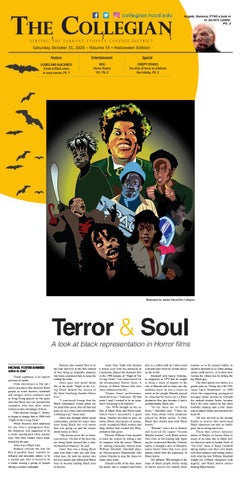
Terror & Soul
A look at black representation in Horror films MICHAEL FOSTER-SANDERS editor-in-chief
Visual reputation is an important form of media From stereotypes to flat out t racist caricatures that depicted Black people as witch doctors, cannibals and savages, movie monsters such as King Kong played on the paranoia that Black men are primate-like creatures who lust after white women to take advantage of them. Film director George C. Romero began to change that in 1968 with “Night of the Living Dead.” When Romero held auditions for the film’s protagonist Ben, the character was supposed to be a crude, uneducated white trucker type. But then Duane Jones auditioned for the part. Jones was a Black man. Romero rewrote the role for Ben to parallel Jones’ real-life intelligent and articulate nature, to be a normal guy who is forced to be a leader among a group of people during a zombie onslaught.
Romero also wanted Ben to be the lone survivor in the film instead of him dying as originally planned, but Jones convinced him to keep the ending the same. Jones goes into detail about this in the book “Night of the Living Dead: Behind the Scenes of the Most Terrifying Zombie Movie Ever.” “I convinced George that the Black community would rather see me dead than saved, after all that had gone on, in a corny and symbolically confusing way,” Jones said. Jones also thought about social commentary around his main character being Black, the civil unrest that was going on and the tropes about heroes in films. “The heroes never die in American movies. The jolt of the hero figure being black seemed like a double-barreled whammy,” he said. Jones’ Ben was a strong Black man who didn’t take any shit from white men. He took his destiny into his own hands and influenced Black boys to become leading Black men in movies.
Actor Tony Todd, who became a horror icon with his portrayal of Candyman, played the character Ben in the 1990 remake of “Night of The Living Dead.” was interviewed for the documentary Horror Noire: A history of Black Horror tells how Jones influenced his life, “Duane Jones' performance stood out to me,” Todd said. “By that point I said I wanted to be an actor, and I was going to be fearless.” The 1970s brought on the influx of Black films and Black leads, which wasn’t necessarily a good thing. Studios decided to play on urban Black stereotypes of pimps, overly sexualized Black women and drug dealers that created the Blaxploitation film genre. Director William Crain decided to buck the system by telling a tale of vampires with the movie “Blacula” starring classically trained actor William Marshall. Marshall plays an African prince Mamuwalde who enlists Dracula to stop the trans-Atlantic slave trade. Dracula scoffs at the idea, turns the prince into a vampire\ and locks
him in a coffin until he’s discovered a decade later when he wreaks havoc on the world. Marshall told Junior Scholastic magazine in 1972 that he sought to bring a sense of dignity to the role of Blacula and to make sure the audience knew he was a victim as much as the people Blacula preyed on. Also that the movie isn’t a Blaxploitation film just because it had a predominantly black cast. “So far, there are no Black films,” Marshall said. “There are only films about white situations played by Black actors. A truly Black film should deal with Black history.” “Blacula” was a hit in theaters and received the sequel “Scream Blacula Scream” with Black actress Pam Grier as the leading lady fighting the resurrected Blacula. Unfortunately, it brought a slew of Blaxploitation horror films that were poor quality which hurt the legitimacy of Black horror. The affluent ‘80s brought in the trope of Black people strictly being in horror movies for mainly three
reasons — to be cannon fodder, to sacrifice themselves so white protagonists could survive, or to show how vicious the villain was by killing the big Black guy. The third option was shown in a grand scale on “Friday the 13th VIII: Jason Takes Manhattan” in 1989 when the supporting protagonist teenager Julius decides to fistfight the undead slasher Jason, because that’s the only option he has after foolishly running onto a roof. Jason rope-a-doped Julius and knocked his head off. All was not lost in the decade thanks to movies that showcased Black characters not only as intelligent, but as strong survivors. These days correct representation of Blacks in horror films is much of an issue due to Black horror directors such as Jordan Peele of “Get Out” fame or Rusty Cundieff taking matters into their own hands with their projects and telling stories with what the late William Marshall fought for —Black characters with dignity, and Black horror stories dealing Black history.
Page 2 • October 31 , 2020
Entertainment
TIMELINE
Horror movie history through the Ages
The classic movie monsters are icons and stories serve as some of the backbones of modern horror cinema. These scary movies are prefect for halloween. JOSE ROMERO campus editor
Horror films nowadays seem as if they follow a distinct style, but how did it get there? In 1888, film was created, and all it took was eight years for a French director to try his hand with horror. George Méliès, who would also go on to create the first science fiction film, was the writer/director of the 1896 horror film, “The Haunted Castle.” According to film historians, “The Haunted Castle” is the first horror film. In Christopher Ripley’s book, “Universal Monsters: Origins,” Ripley details audiences’ reactions at the time. “If Méliès was shooting for terror, he fell short of the mark,” Ripley wrote. “Initially, the film was amusing to its audience, rather than terror-inducing.” The technology wasn’t quite there yet to horrify an audience, but that wasn’t going to hold Germany back. One of the first German horror films to kick off this era of change was Paul Wegener’s “The Golem: How He Came into the World” in 1920. The film’s setting and directorial style would slowly start seeping into other horror films of that time. Its gothic setting would be mirrored by “Nosferatu: A Symphony of Horror” in 1922.
Not only was “Nosferatu” revolutionary in the sense that it assisted in molding the horror genre, but the film was also the first to feature a supernatural vampire character. 1931 introduced one of the most iconic horror movies of all time. “Frankenstein,” directed by James Whale, was the seventh highest-grossing film that year. Its success would lead to the popularization of horror movies, which resulted in Universal pushing out a ton of films in the genre such as: “The Mummy” (1932), “The Invisible Man” (1933) and “Werewolf of London” (1935) to name a few. Also, the first zombie film came out in 1932, “White Zombie” directed by Victor Halperin. The 1930s weren’t just about monster films. In 1934, one of the first psychological horror films graced the silver screen. Edgar G. Ulmer’s “The Black Cat” was an introduction to the highly popular subgenre, but it didn’t have the same box office power monster flicks did. The 1940s and 50s demonstrated this with even more monster classics like, “The Wolf Man” (1941), “Creature of the Black Lagoon” (1954) and “Invasion of the Body Snatchers” (1956). The subgenre of “body horror” was introduced to audiences in the ‘50s. “The Blob” and “The Fly” in 1958 both used cutting-edge special effects to stun audiences with body mutilation and disgusting creature effects.
The 1960s were without a doubt a gigantic decade for horror. George Romero shocked audiences with “Night of the Living Dead” furthering the trend of grossing moviegoers out. But the decade cannot be discussed without talking about Alfred Hitchcock. “Psycho” (1960) was met with critical acclaim left and right. In a review from June 17, 1960, Jack Harrison said this about the film. “Paramount won’t let anyone enter theatres where Psycho is playing after the picture starts,” Harrison wrote. “No one will want to leave before it is over.” Three years after Psycho, Hitchcock released another horror film, “The Birds,” which became another classic. In 1971 with “Bay of Blood” directed by Mario Bava, the slasher genre was born. Then, 1974 popularized the subgenre with “Texas Chainsaw Massacre” and “Black Christmas.” “Texas Chainsaw Massacre” horrified audiences with its main antagonist, Leatherface, who quickly became a horror icon. In 1978, Michael Meyers joined him. “Halloween,” directed by John Carpenter, was another home run for horror, becoming the seventh highest-grossing film of that year. “The Exorcist”, “Alien” and “Jaws” all brought some new life to the genre. It’s also worth mentioning that “Carrie” (1976) gave us the first jump scare. Thanks, Carrie. Horror films in the 1980s
had iconography out the wazoo: “The Shining” (1980), “Gremlins” (1984), “Poltergeist” (1982), “The Thing” (1982), “The Evil Dead” (1981) and “Child’s Play” (1988). With that said, two films stood out. “Friday the 13th” (1980), directed by Sean S. Cunningham, made the final step to ensure that slashers weren’t going anywhere. The contributing factor that solidified the franchise’s standing was “Friday the 13th Part 2” in ‘81 with its introduction to Jason Vorhees. Jason Vorhees’ towering physique and hockey mask made him memorable to audiences worldwide. Just like Jason, Freddy Krueger took his spot on the wall of killers as well. Wes Craven’s “Nightmare on Elm Street” (1984) gave fear to the concept of sleep and brought along Freddy to spook viewers for years to come. During the ‘90s, horror was comfortable with itself so the decade was filled with slashers and sequels. Heading into the 21st century, the trend was consistent. Horror got bloodier and gorier along with having similar protagonist archetypes. But with directors like Jordan Peele and Ari Aster, horror is seeing a resurgence in popularity and fresh new takes on the genre. It’s interesting to look back at how quickly horror changes. It seems as if every decade a major introduction shifts the genre into a new direction.
MOVIE RETOSPECTIVE
A psychological horror that puts spotlight on PTSD ALYSON OLIVERR campus editor
Tim Robbins stars as Jacob Singer, a vetnam vet turned post office worker, who starts to havve strange visions about demon and angels.
“Jacob’s Ladder” is a mind-bending viewing experience from start to finish. Directed by Adrian Lyne and released in 1990, it captures the essence of a bizarre, disjointed nightmare that never seems to end. The film centers around an American veteran named Jacob who served in Vietnam, played by Tim Robbins. It uses an innovative, engaging mode of storytelling and employs practical effects to achieve all of its visuals. The film is, to an uncomfortable degree, a window into Jacob’s innermost emotions and experiences. The opening scene, set in Vietnam, packs a punch right away when Jacob’s unit is suddenly attacked. The events that follow are chaotic and disorienting. The audience never sees the attackers, but they do see the destruction dealt. Many soldiers are either mangled or killed. Some start to behave strangely, and one even has a seizure just as the assault begins. Eventually, Jacob limps away into the jungle where he is stabbed by an unknown assailant. The scene is interrupted when he wakes up from the nightmare on a subway in New York. However, the film cuts back to his neardeath experience in Vietnam often, revealing more of the story each time. “Waking up” is used as a transition regularly in this film — just as the tension in a scene reaches its peak, Jacob returns to consciousness in a different reality. Because this happens repeatedly, both he and the audience are left unsure of what’s real and what’s not. This kind of transition serves
a purpose. It never feels like a lazy way to jump from scene to scene. Jacob’s confusion and paranoia are made palpable. As the story goes on, disaster continues to befall Jacob, creating a spiral staircase into unreality. He experiences surreal hallucinations and dangerous bouts of fever, watches his doctor burn alive in an explosion, has a few other close encounters with death and is even roped into a conspiracy by other veterans. During a well-known scene near the end of the movie, Jacob is even kidnapped and dragged away to a hospital that can only be described as hellish. It’s not until the last few minutes of the film that the audience gets an explanation for what’s going on. The conclusion of “Jacob’s Ladder” is relieving in a way but also bleak and saddening. Although it did not have huge, sustained popularity following its release, according to IMDb, its influence is now apparent in newer psychological horror. For example, the video game Silent Hill 2’s artist Takayoshi Sato referenced it as an inspiration in an interview with IGN. The film’s title is a Biblical reference, referring to a ladder stretching from Heaven down to Earth. It has a few other meanings that are made apparent during the film, and one might even say the phrase is a spoiler in and of itself. “Jacob’s Ladder” is an uncanny, intentionally disjointed journey through reality and unreality. It’s layered richly with emotion, complex characters and eerie visuals. For anyone seeking an immersive experience with a lasting impact, this movie is it.
feature
Page 3 • October 31 , 2020
Tales of horror From The UnsoundMind Despair My name is Marcos. I’m a youtuber and a twitch streamer. My content mostly consists of going to haunted and/or abandoned places. I reside from Florida. I only stuck with doing places in the state and went on to do outside the state. The more popularity I got, the farther I would travel. One day, I got an email from a viewer of mine about an abandoned asylum near his location. I won’t reveal the name and location for privacy reasons but lets just say its out of the country. I decided to do some research on the asylum. The asylum was built in 1924. It became operational just two years later. It ran from 1926 to 1969. A doctor by the name of Doctor Jonathan Moore. He was a neurologist and neurosurgeon who became the head doctor of the asylum. He would perform experiments on the patients to figure out what can drive man mad. On November 29, 1968, a breakout happened. Patients started killing each other, killing nurses, and eventually killing the doctor himself. In order to get control of the situation, authorities had to go in and kill all the remaining patients that were alive. Only two nurses lived. Today, the asylum sits alone in its barren open land rotting. It is property to the government of the region. After doing my research, I bought plane tickets to my destination. It was a long 13 hour flight, but I made it in one piece. I booked 3 nights at a hotel and went right to my room and slept. But before I did, I went on social media to tell all my followers where I was going. After, I went to sleep. The next morning, I went out to eat, went back to my room, and got ready for my investigation. I knew before I left the guards would not let me in, so I had to sneak my way in. I ordered a taxi to take me close to my destination. As soon as I got close, I got out and paid the driver. I then went to the asylum on foot. After a 20 minute walk, I made it. But there was a gate with guards. The property was surrounded bye a fence. I walked the fence to look for an opening. I found an opening after 5 minutes, snuck through the torn open fence and quietly went to the building. As I was walking, I pulled out my camera to get ready to record and found a window I could crawl through. I walked in, and already got a creepy feeling. I found mold on the ceiling, so I took
out my mask and put it on. The room I was in looked to be a staff room. I started recording and did my normal intro. I walked into the hallway. I immediately had chills go down my spine. Talking to my camera as if its my audience for maybe 5 minutes, and I heard a knock. It startled me for a bit, but I kept going. Going on with the investigation, quite a bit of things were happening. The building was making weird noises, unexplainable sounds, and what I thought were voices. I don’t know if my mind and ears were playing tricks on me, but I was getting scared. I eventually found an interesting room. Walking in to discover what looked to be the doctor’s office. Everything you would expect was still here untouched. Books, filing cabinets, a desk, and chair, and pictures. The room felt very heavy. As if I wasn’t alone or there was pressure. While looking around the room, I heard something move. I looked to the direction of the sound and the chair was moving... slowly. I froze with fear looking at it. I heard a loud scream. Like the sound of a raging demon roaring and the chair went flying towards the wall. I immediately run out the room to try and find my way back to the room with the open window. After running for what seemed like forever, I came to a realization that no one in my situation would want to realize... I was lost... Looking for clues all over the building and trying to retrace my steps, I found a spot on the wall I recognized was near the staff room. I found the room only to realize the window was boarded shut. “That’s not possible...,” I said to myself. My heart was racing. I stood there wondering what was going on. I started hearing humming from the hallway. It sounded like a woman humming. Thinking and hoping it was a guard, I ran out to get their attention. “Excuse me ma’am but I am...”, I yelled out only to see the figure of the back of an old nurse. Marilyn Monroe style hair, the old nursing outfit with the cap. “Is it time for your shots sweetie,” she said to me.? She turned around with her upper half of her body to smile at me. I looked at her cold, rotting dead face with the whitest eyes I have ever seen. She pulls out a syringe with a needle for intimidation. Laughs and then opens up her mouth widely and what followed was the scream of a banshee. I fell on the ground dropping my camera. I quick-
Illustrated by Kristral Blankinship/The Collegian
ly got back up at ran away from the nurse. Sprinting in the darkness. I had to stop to grab my flashlight. I turned it on and looked for a room to hide in. Found a bathroom and closed the door and shutting off my flashlight. I could hear the sound of the nurse’s high heels stepping on the floor. “Sweetie, you need to get your shots. You aren’t feeling well,” she called to me. She continued walking. I waited in the bathroom until I felt composed to go back out. After what felt like forever, but was really 15-20 minutes. I walked out and went back to find my camera. I found where I dropped it. Only to find that it was gone except the battery for it. There was no point worrying about the camera, I had to get out of this hellhole. After roaming the halls, I felt relieved to find the main door and front desk. I ran to the front door. I dropped to my knees to the sight that it was chained up. I felt tired and scared. I banged and banged on the door hoping
someone could hear me. “GET ME OUT OF HERE,” I yelled.! “There is no way out of here.” My body froze in fear. I slowly turned my head to the front desk. I saw the another nurse look at me with a smile and white eyes. “You’re stuck here until you get better. But don’t worry, Doctor Moore will help you. All you got to do is give in,” she said to me. “Give in... Give in... Give in...” “I will not give in!” She laughs. “Then... DDDDDDDIIIIII IIIIIIIIIIIIIIIIIIIIIIIIIIIIIIIIIIIIIIIIEEEEEEE EE,”, she screams to me.! I ran away as fast as I could. I could hear what sounded like multiple people laughing and yelling at me to, “Give In...” I ran to a room to hide in to barricade myself in. If you’re reading this and you’ve gotten this far. I am trapped and need help. Please help me, there is no way out... Author of The Unsound Mind
Guilt I lost my wife in a car accident 5 months ago. We’ve been married for 2 years at this point. It wasn’t a healthy marriage. Lots of arguing, fighting, and emotional trauma. It was a dark and rainy night. We were coming home from a dinner with the in-laws. The whole dinner, they were poking fun at me for no reason. It pissed me off. On the way home, I was driving and my wife was in the passenger seat. I started complaining about how bad the dinner went. She kept trying to tell me to give it a rest and that they were only joking. I got mad at her for defending them. We started arguing in the car. Bad things were being said to each other. I remember everything going black. Almost as though I was dead. “Sir. Sir, are you okay,”, a woman asked me.?
“Where am I?” “You’re in the hospital.” I open my eyes and slowly but surely I can what looked like a nurse. I look around while vision is still blurry. I have wires on me, an IV needle in my arm, and machines all around me. The nurse leaves the room. Meanwhile I’m still trying to comprehend what I’m doing in the hospital. The door opens. “We’re awake!” A black man walks into the room with doctor’s clothing and a clipboard. “How are we feeling, sir? You’ve been out of it for a couple days now.” “Why am I inside a hospital? What’s going on doctor,” as I’m confused and worried.? He grabs a chair and brings near the bed and sits down. I can see the look of worry in
Illustrated by Kristral Blankinship/The Collegian
Meet
the
Staff
EDITOR-IN-CHIEF Michael Foster-Sanders CAMPUS EDITORS Linda Puga Megan Towery Jose Romeo Alyson Olvier
PRODUCTION MANAGER Stacy Luecker
LAYOUT & DESIGN Abbas Ghor Amber Davis Kristal Blankinship
ADVISERS Chris Whitley, Jocelyn Tatum
heroin the syringe, injected the needle in my arm and shot up the drug. I took the needle out and closed my eyes. The feeling of numbness ran through my body. I wake up, and its 6 in the morning. I try and fall back asleep. But then I realized, something is wrong with my room. It was fallen apart. Rotting walls, moldy ceiling, and bed bugged mattress. I couldn’t get up. And I couldn’t move my body. As though I was in sleep paralysis. I see a figure emerge from the hotel room door. A black figure, tall, with red eyes. He started marching to my side of the bed which was closer to the balcony. He looks over me. I look at him with fear and a loss of words. “You pathetic excuse of a human. I have dealt with worse scum of the earth.,” the voice said in a demonic voice. “You are to blame for your wife’s death, but it is time to move on. The path you are choosing is a way to hell. And unless you want to go to hell, I would quit the path you are taking. Keep going this way, and I will take you with me to the pit where you will rot for eternity! You Have Been Warned!” I wake up again. But everything is normal... I sat up to the thought of what just happened. Was this my mind telling me to stop? Was it death? Was it the devil himself? I could not come up with a solution as to what just happened. But it has changed my mind. Maybe this path was gonna lead me to hell. I think this a great start to move on with my life and myself. It’ll be a long journey, but I hope I can make it. Author of The Unsound Mind
Letter Policy ILLUSTRATOR Amber Davis
MANAGING EDITOR Maddy Remington
his face. As if he’s going to tell me something I don’t want to hear. He takes off his glasses. “Sir, you and your wife were in a car accident a couple days ago.” “What?” “You ran a red light at a very high speed. As you ran the red light, a car who drove a green light drove into the passenger side of the car. Your car starting flipping and crashed into a parking lot,” the doctor told me. “Is my wife okay,” I asked.? “I’m sorry sir. Your wife died from her injuries. She was bleeding internally and she had broken many bones in her body. We did everything we could. I’m sorry.” Hearing that made me feel like my whole word ended. I started blaming myself for her death. If it wasn’t for me being so immature and treating her like shit. For 5 months, I excluded myself from all my loved ones. Hoping that I can never cause their deaths. I ignored my friends, family, and even work. All I could ever think was I killed my wife. I’m a piece of shit. I fucked up everything. I started drinking, doing drugs, and robbing people for money. I got a letter in the mail. My grandparents had died and left me money in their will. I took the money and used it to go on a getaway trip to New York. It was my happy place. I went in hopes that I can clear my mind and be able to move on with life. I booked a hotel room, took a hot shower, and relaxed on the bed. I decided since I’m not going out, I was gonna shoot up some heroin. I went in my bag, grabbed my syringe, and my little jar of heroin. I put the
ADVERTSING AND MARKETING COORDINATOR Anna Reust SOCIAL MEDIA COORDINATOR Rudy Martinez
The Collegian is a weekly student publication serving the Tarrant County College District. Editorial statements and advertisements do not necessarily reflect the opinion of the TCC administration. Letters to the paper should be 150 words or less, free from libel and poor taste and include the writer’s Colleague ID or telephone number (the numbers will not be published). Letters may be brought to The Collegian office
(NCAB 1124A, NE Campus), or mailed to: The Collegian • 828 Harwood Road Hurst, TX 76054 Office: 817-515-6391 Editor: 817-515-6394 Advertising: 817-515-6619 email: collegian.editor@tccd.edu TCC is an equal opportunity institution that provides educational and employment opportunities on the basis
Feature
Page 4 • October 31, 2020
A History of Halloween
1921-1930-The first officially sanctioned Halloween celebration is held in Anoka, Minnesota. Costumes began to appear in shops.
2020-Halloween may look a little different this year due to COVID-19, but it will feature a spooky spectacle full moon, the first since World War II.
Late 1800’s-The Irish start carving turnips in response to the legend of Stingy Jack. Irish and Scottish immigrants flee to America from the Irish Potato Famine and bring with them their Halloween traditions. 1600s-Halloween is banned by the Puritans of New England. For the next 200-years, Halloween is celebrated primarily by Catholics and Episcopalians. 1556-The modern tradition of trick-ortreating begins as a three-day event called AllHallowtide. During this participants dress in black to mourn the dead. 1000 AD-The Roman church dedicated Nov. 2 as All Souls Day in honor of the dead. All Saints Day celebrations were also referred to as All Hallows and the night before began to be called All Hallows Eve. 609 AD-All Martyrs Day, a day to honor all saints and martyrs, became a tradition in the Roman church each Nov. 1.
The origins of present-day Halloween date back over 2,000 years ago to a Celtic festival known as Samhain. This festival was held at the end of October. It marked the end of the harvest season and the beginning of winter. The Celts believed the night of Oct. 31 was a day when the dead returned to earth. Fearing evil intent from the returned dead, festival goers wore costumes and masks to appease the dead on the holiday.
43-84 AD-As the Romans overtook the Celts, two of the conquerors’ previous holidays merged with Samhain.
Illustration by Amber Davis/The Collegian