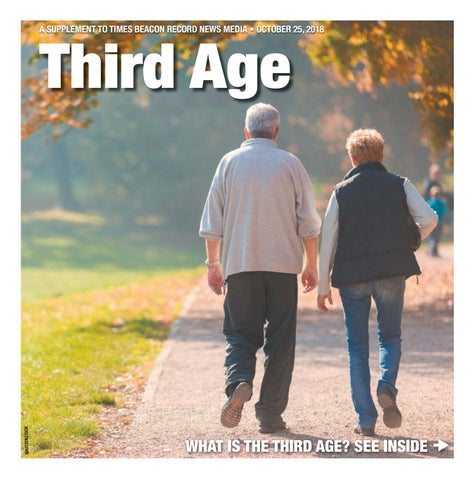
Third Age
SHUTTERSTOCK
A SUPPLEMENT TO TIMES BEACON RECORD NEWS MEDIA • OCTOBER 25, 2018
WHAT IS THE THIRD AGE? SEE INSIDE
Third Age
Third Age unplugged: What’s next in later years Fountain of Age,” an extraordinary chronicle of her search for meaning and purpose in what “What’s next?” That was the question I was I would call, the Third Age. wrestling with in my 50s when I attended the Now that people are living longer, the Third Emerging Women Conference in San Francisco Age is a term used to describe the period bea few years ago. The keynote speaker walked tween middle age and old age. This can be a into the room filled with more than 1,000 at- time of growth and continued success. Friedan tendees and gave me powerful clues about worried that this stage of development was what was next for me. She wore not a hint of associated with a decline rather than a time makeup — at least that’s how she appeared to of opportunity and growth. Preoccupied with me. She had gray hair pulled staying young, she warned that back in a bun and wore a simwe could miss the opportunity ple black dress with an elegant to discover our mature selves scarf. She was 81 years old, and therefore fail to enjoy and you could hear a pin drop what could be the best years of as she spoke. At 59 years old, I our lives. was struggling with, “Who do Individuals in their Third I want to be when I grow up?” Age are hungry for enlightAfter watching and listening, ened experiences and eager to I thought: “I want to be like learn new things. According to Jane Goodall.” the “Longevity Economy” by Goodall left the jungle Joseph F. Coughlin, in many at around my age with two cases retired or semiretired causes: one to save the gorillas professionals such as engiand two to save the rain forest. neers, scientists, nurses, venThe enthusiasm she displayed Nancy Burner, Esq. ture capitalist, etc. will form was incredible. There was no startups of their own, using doubt that she was fully entheir innovation and experigaged in her cause and she wore it well. Clearly, ence to solve problems. As reported by Encore. she had put these years to good use and showed org, an innovative hub tapping the talent of no sign of giving up. people 50+ as a force for good, older entreBetty Friedan took what the younger gener- preneurs now have the highest rate of any age ations might call a “gap year” when she was 59 group of opportunity entrepreneurship. years old and went to Harvard University. Yes, I may not be going to Harvard or taking the same Betty Friedan who wrote the “Femi- a gap year — yet — but I certainly can fight nine Mystique” that fired up the feminist move- ageism at every turn. Maybe I can start a conment in the 1960s. In 1993, she published “The sciousness-raising group to push and inspire BY NANCY BURNER, ESQ.
SHUTTERSTOCK
People in their Third Age are hungry for new life experiences.
others to fight age bias. I may not be saving gorillas or saving the rain forest, but that doesn’t mean I cannot have a cause that is greater than myself. As CEO of AARP, Jo Ann Jenkins reminds us in her novel “Disrupt Aging,” boomers, as they move into their 50s and 60s, are disrupting aging every day, just as they have done in every other phase of their life. Furthermore, millennials, as she also states, are disrupting aging by demanding a work-life balance and showing us the benefits of shared communities and a shared economic model. To that end, it reminds me that the key to the Third Age is to use the same tools that got me through every other important transition in my life. 1. Find a cause that is bigger than yourself.
2. Use your time and resources to further that cause. 3. Reject distractions that deter you from your cause. 4. Be enthusiastic and learn everything you can. 5. Develop routines and practices that further your cause. Many 50-year-olds could feasibly expect to live another 40 years. The question is: What will you do with all these years? For me, what’s next is to use my voice, my time and my resources to change the way we think, talk and live in our Third Age. The time is now, and we are just getting started. Nancy Burner, Esq. practices elder law and estate planning from her East Setauket office.
Inside FEATURES What is the Third Age? . . . . . . . . . . . . . . . . . . . . . . . . . . . . . . . . . . . . . . .2 Alzheimer’s patients, caregivers . . . . . . . . . . . . . . . . . . . . . . . . . . . . . .3 Financial advice . . . . . . . . . . . . . . . . . . . . . . . . . . . . . . . . . . . . . . . . . . . . .4 What is WMHO? . . . . . . . . . . . . . . . . . . . . . . . . . . . . . . . . . . . . . . . . . . . . .5 Events Calendar . . . . . . . . . . . . . . . . . . . . . . . . . . . . . . . . . . . . . . . . . . . . .5 A look at MIT AgeLab . . . . . . . . . . . . . . . . . . . . . . . . . . . . . . . . . . . . . . . .6 The benefits of exercising . . . . . . . . . . . . . . . . . . . . . . . . . . . . . . . . . . . .7
PUBLISHER Leah S. Dunaief
ART/PRODUCTION DIRECTOR Beth Heller Mason
GENERAL MANAGER Johness Kuisel
ART DEPARTMENT David Ackerman Janet Fortuna Sharon Nicholson
MANAGING EDITOR Alex Petroski EDITOR Rita J. Egan ADVERTISING DIRECTOR Kathryn Mandracchia ADVERTISING Elizabeth Bongiorno Robin Lemkin Laura Johanson Jackie Pickle Michael Tessler Minnie Yancey
INTERNET STRATEGY DIRECTOR Rob Alfano BUSINESS MANAGER Sandi Gross BUSINESS OFFICE Meg Malangone CIRCULATION MANAGER Courtney Biondo
Third Age METRO
got a will? #beneficiary #burnerlaw #adulting
There are steps caregivers can take to help those with Alzheimer’s.
Advice for caregivers: The reality of Alzheimer’s and dementia BY MICHELE BIGGART Author Dan Gasby in his co-written novel with wife and business partner B. Smith, “Before I Forget,” states that an Alzheimer’s disease diagnosis is like running a race — the gun goes off and you begin your lap around the track. As you continue your journey, spectators in the stands start to leave, and you are left going around and around with no one to notice, much less tell you where the finish line is. He states that you are simply there to pass the time, Alzheimer’s time. For many caregivers and Alzheimer’s patients in our community, this is a harsh reality. According to the National Institute of Aging, 5.4 million Americans have Alzheimer’s disease — 200,000 of them with early onset, meaning the diagnosis was made before the age of 65. Physicians and researchers continue to work toward finding a cure, noting that the lack of funds and participants in clinical trials have immensely slowed their progress. As real as the need is to find a cure is a need for our society to become more educated and informed about Alzheimer’s and dementia. For example, you may know that there are three main stages of Alzheimer’s progression: mild, moderate and severe. But also understand that these three stages can be broken up into seven defined phases that can better assist the caregiver in identifying where a loved one stands. Those seven stages are: Stage 1– no impairment Stage 2 – very mild cognitive decline Stage 3 – mild cognitive decline Stage 4 – moderate cognitive decline Stage 5 – moderately severe cognitive decline Stage 6 – severe cognitive decline Stage 7 – late-stage dementia Often, it is the realistic solutions for caregivers
that can make a significant impact on the day-today management of the disease. First and foremost, education and planning can never start too early. If you or a loved one is diagnosed with Alzheimer’s, explore what community resources may be available to you such as local chapters and associations dedicated to Alzheimer’s and dementia. These resources can also provide support and respite for the caregiver. It is important to visit your elder law attorney to complete the proper estate planning as well. As far as daily communication, limit choices for your loved one, encourage two-way conversations, reminisce about the past and stick to routines. Eating healthy, exercise and social stimulation are also vital factors in managing Alzheimer’s. In addition, safety in the home for your loved one should become a priority. Safety proofing cabinets and stove tops, placing door locks above eye level and investing in a tracking device can ease caregiver anxiety and protect your loved one. It is essential to keep in mind that a diagnosis of Alzheimer’s or form of dementia does not come with a clear road map. The more we share our experiences, knowledge and findings, the more doors we will open to educate and support those impacted by the disease. It is time to change the conversation about Alzheimer’s and dementia and embrace our current reality — that people are living longer and living otherwise healthy lives with cognitive impairments. Our caregivers will continue to need support and resources. We can run this journey together as a community, ensuring that the stands are filled with cheers of encouragement and hope along the way. Michele Biggart is director of business and community development for Burner Law Group and a certified geriatric care manager.
Paid Attorney Advertising
Elder Law, Estate Planning, Guardianships, Trusts & Estates
(631) 941-3434 www.burnerlaw.com
Third Age
Avoiding financial exploitation Elder Law, Estate Planning, Guardianships, Trusts & Estates
Senior Scams
November 8 at 10:00 am Ward Melville Heritage Organization Educational and Cultural Center 97 Main Street, Stony Brook Paid Attorney Advertising
Please RSVP at (631) 941-3434 or email info@burnerlaw.com
The National Center on Elder Abuse defines financial exploitation as the “illegal or improper use of an elder’s funds, property or assets.” Exploitation tends to be more prevalent in the aging community, specifically targeting those that are over 65 years old and have some form of mental or physical incapacity. Many older adults have spent their entire lives accumulating assets and building up their estate. This, coupled with the fact that they have some form of mental impairment making it difficult to fully understand and appreciate their finances, makes members of the elder community ideal victims of financial exploitation. Additionally, those with a physical impairment may be forced to rely on the aid and assistance of others, opening the door for others to take advantage of the situation. Individuals without close family or friends are forced to rely on professionals to take care of them and their assets. Elder financial exploitation comes in many forms. It includes, but is not limited to, false or misleading solicitation by hired professionals such as a financial adviser trying to sell products that are not financially beneficial to the client; email and telemarketing scams such as a fake charity requesting a donation; misuse of estate planning documents like a power of attorney; and abuse by close family or friends with access to your accounts. One common and current scam is called the “grandparent scam.” In this scheme, the victim receives a call or email from someone pretending to be their grandchild and asking them to wire transfer money due to some emergency. The scammer is an expert at pulling on the victim’s heartstrings and gaining enough sympathy and trust for the grandparent to act on the request. The effects of financial exploitation go well beyond the loss of money. Victims tend to experience shame, fear and depression. Their new financial status may also make it difficult to keep up with expenses or pay for services they may require, such as a visit to the dentist or hiring a gardener. As a result, victims may become reliant on others, both financially and emotionally, taking away whatever little independence they had left. How can you be proactive now to avoid financial abuse in the future? As a starting point, know your finances. Keep track of all your accounts and the expenses you incur every month. Pay attention to any unusual wactivity in your accounts, no matter how slight. For example, look for variations to your bank account balance that are out of the norm or changes in ownership that were done without your authorization. These are red flags that should be addressed upon discovery.
METRO
BY NANCY BURNER, ESQ.
Keep track of all your accounts and expenses and pay attention to any unusual activity in your accounts.
When it comes to in-person or online scams, such as requests for money or the sale of goods and services, it is important to think before acting. Ask more questions or get a second opinion, seek advice from a known professional or loved one, and withhold personal and financial information from potential scammers unless you are sure it is necessary, especially if the seller reached out to you first. It is also important to know and understand any estate planning documents you have in place, such as a power of attorney, health care proxy and last will and testament. Not only should you be able to comprehend the provisions of each document, but you should also know who has the power to act and the extent of the powers being given. For example, your agent under your power of attorney should be someone you trust unequivocally. Under a power of attorney, you are authorizing your agent to act on your behalf with regard to your finances and day-to-day decision making. Lastly, be wary of individuals who are trying to convince you to alter your existing estate planning documents. Unless something in your life has shifted where you feel it is necessary to make changes to your appointed agents or the distribution of assets under your will, do not be quick to change your documents without first consulting an estate planning professional. Most incidents of elder financial exploitation go unreported. If you suspect elder financial exploitation has occurred, please contact Suffolk County Adult Protective Services to report the abuse. You may also want to contact an estate planning and elder law attorney to ensure you and your loved ones have the proper estate planning tools in place to help prevent elder financial exploitation in the future.
Third Age
The Ward Melville Heritage Organization and the 55+ Club BY GLORIA ROCCHIO
Estate Planning vs. Guardianship
Join us for breakfast as we gather to discuss estate planning and important special needs issues including: • • • • •
Guardianships Supplemental needs trusts Government benefits Medicaid waiver programs Inheritance provisions
Estate Planning vs. Guardianship will be taking place at 9:30 a.m. Tuesday, Oct. 30 at the Hauppauge Palace Diner located at 525 Smithtown Bypass, Hauppauge.
Medicaid Basics
Are you a caregiver? Join us for breakfast as we gather to discuss Medicaid options and the resources available to help you care for your loved one! Medicaid Basics will be taking place at 9:30 a.m. on Thursday, Nov. 1 at the California Diner
Ward Melville, left, stands in front of the WMHO-owned Thompson House in an undated photo. Right, participants in a 55+ Club program discuss Asian crabs at the Ernst Marine Conservation Center.
mid-1930s, Mr. and Mrs. Frank Melville discovered a little, quaint community that seemed to be lost in time. The Melvilles had become successful in shoe manufacturing, and they were looking for a location on Long Island to spend the sum-
mers. The rest is history. But, the greater part of this story began when their son Ward decided to fulfill his mother’s dream to invest in the community in order to improve the quality of life for its residents. Ward, being a student of architecture
Calendar of events
located at 570 Sunrise Highway, Patchogue.
Senior Scams
WMHO
Burner Law Group invites residents to upcomimg seminars and events sponsored by the firm.
WMHO
“The Ward Melville Heritage Organization? Doesn’t it own the Stony Brook Village Center?” Yes, you are correct, but it’s so much more. WMHO offers over 70 programs year round at its 8,800-square-foot state-of-the-art Educational & Cultural Center and Stony Brook environs. That includes live theater, festivals, summer-long exhibits, children’s workshops, free summer concerts on the Village Green and more, including its new groundbreaking program — the 55+ Club — a collaboration with the Burner Law Group offering various events such as master classes, distance learning, virtual travel and more. Our next 55+ Club program is Nov. 28 — Master Class /Giving Back with Bernadette Castro, a true renaissance woman — beginning with demonstrating the Castro Convertible sofa at the age of 4 to becoming CEO of the company and now a television host dealing with youth. WMHO also hosted the annual “Walk for Beauty … in a beautiful place” 4k/6k Walk and 10k Run to benefit breast cancer research at Stony Brook Medicine Oct. 21. It was the 25th anniversary of the Walk for Beauty. WMHO has a Youth Corps that helps young students fulfill community projects while gaining self-esteem too. This is how it began. Sometime during the
It happens every day. You receive a letter saying, “You’ve won a free prize …” But read the fine print. Learn how to protect yourself against the many fraud schemes and senior scams. Senior Scams will be taking place at 10:00 a.m. Thursday, Nov. 8 at The Ward Melville Heritage Organization Educational & Cultural Center located at 97 Main St., Stony Brook.
Irrevocable vs. Revocable Trusts 101
Confused about the differences between a revocable trust and an irrevocable trust? Join us for breakfast as we gather for an informative discussion about revocable and irrevocable trusts. Irrevocable vs. Revocable Trusts 101 will be taking place at 10:00 a.m. Tuesday, Nov. 27 at the Lake Grove Diner located at 2211 Nesconset Highway, Lake Grove.
55+ Club: Master Class – Giving Back
Bernadette Castro is a true renaissance woman — beginning with demonstrating
and a marketing genius, created the first planned business community in the United States — the Stony Brook Village Center. He gathered all affected merchants in the community and moved them into the new facility positioned the same as they were relative to the old post office. Melville protected his and his mother’s dream by establishing The Stony Brook Community Fund, a nonprofit organization, and created a board of directors made up of prominent citizens, now known as WMHO. The list of properties and historic natural resources owned by the organization include the Stony Brook Grist Mill, c. 1751; the Thompson House, c. 1710; the Brewster House, c. 1665; the 11-acre T. Bayles Minuse Mill Pond Park and two-acre Upper Pond; The Educational & Cultural Center; Hercules Pavilion, c. 1820; the Ernst Marine Conservation Center and 88-acre Wetlands Preserve; and “Discovery” Wetlands Cruises. The organization leases buildings to the following organizations for $1.00 per year: Three Village Society for Lending Aids to the Sick; The Long Island Museum; The Jazz Loft and the Hawkins-Mount House, c. 1725. That’s the short story. WMHO is still nonprofit and dedicated to the preservation of all aspects of the Melville legacy. Please visit www. wmho.org to learn more. Gloria Rocchio is the president of WMHO.
In addition to hosting Burner Law Group’s 55+ Club seminars, WMHO will present events for the whole family in November and December.
Diwali Festival of Lights
The Nartan Rang Dance Academy of Bharatiya Vidya Bhavan will perform at the Educational & Cultural Center in Stony Brook Nov. 4.
the Castro Convertible sofa at the age of 4 to becoming CEO of the company, with many productive careers. The Master Class — Giving Back event will be taking place Wednesday, Nov. 28 from 1 to 2:30 p.m. at The Ward Melville Heritage Organization Educational & Cultural Center located at 97 Main St., Stony Brook. For more information about the law firm’s seminars and events, visit www.burnerlaw.com.
Performance by Nartan Rang Dance Academy of Bharatiya Vidya Bhavan, food tastings and much more. Admission is $15 for adults and $12 for children and seniors. The festival begins at 11 a.m. Sunday, Nov. 4 at The Ward Melville Heritage Organization Educational & Cultural Center located at 97 Main St., Stony Brook.
Holiday Festival 2018
The WMHO will hold its second annual Legends and Spies puppet parade with two new puppets this year on Sunday, Dec.2. After the parade, there will be a visit from Santa and the annual tree lighting. Festivities start at 11 a.m. and last until 6 p.m. in the Stony Brook Village Center. For more information about WMHO events, visit www.stonybrookvillage.com or call 631751-2244.
#trustplanning #grandparents #burnerlawgroup
Paid Attorney Advertising
Elder Law, Estate Planning, Guardianships, Trusts & Estates
(631) 941-3434 www.burnerlaw.com
BY ANTHONY FRASCA
METRO
got a trust?
Third Age Massachusetts Institute of Technology looks at aging In the past century the life expectancy of humans has increased from less than 50 years of age to more than 80 years. That increase in life expectancy has created challenges that call for forward thinking and technical innovation. To that end the Massachusetts Institute of Technology started AgeLab. “AgeLab is comprised of a multidisciplinary team,” said Julie Miller, a research associate affiliated with AgeLab. “We work with engineers, psychologists, public policy makers and other disciplines.” As life expectancy increases, studies conducted at AgeLab look Joseph Coughlin founded AgeLab in 1999. into how the aging body changes, aging in place and more. “His background was in transportation and the idea of AgeLab began as studying the effects of Texting and phone use while driving are clearly dangerous.” aging on driving,” said Miller. Miller said the lab is also looking at retireCoughlin has written numerous articles ment planning and how individuals plan and on the economics of longevity. He also has published a number of books including, “The perceive retirement. With an increasing desire to age through retireLongevity Economy” and “Aging America and ment in their homes, AgeLab studies innovative Transportation” with Lisa A. D’Ambrosio. The various disciplines of AgeLab include approaches to social services and technologyinitiatives such as OMEGA, which is a program aided home services. The facilitation of aging in designed to bridge the generation gap created place is the desired result of this AgeLab research. Transportation, age-friendly homes and by longevity. OMEGA conducts annual sumin-home technology are also mits with high school students areas where AgeLab works to encourage the students to ‘Ninety percent with community planners and connect with older generations local governments. and to plan intergenerational of aging people “Ninety percent of aging activities. wish to age in people wish to age in their own AGNES (Age Gain Now Empathy System) is a suit their own homes homes rather than in assisted living or other caregiving facilworn by developers, engineers, ities,” Miller said. “People are planners, architects and those rather than in in other disciplines to help un- assisted living or able to install home monitors, motion detectors, wall and derstand the physical challengfloor sensors. There is a great es that the aging population en- other caregiving desire now to age in their own counters. AGNES is calibrated facilities’ homes. But there are questions to approximate the motor, —Julie Miller of ethics and privacy.” visual, strength and dexterity The concept of retirement of a person in their mid-70s. planning has morphed into Understanding the physical longevity planning as more of challenges of daily activities in this age group allows the various disciplines to today’s aging population is reinventing life after design products and other services that are com- age 65. AgeLab works with banks and financial patible with the physical challenges encountered institutions to try to understand the financial challenges of increasing longevity. Are we financially in the aging population. AgeLab also uses a high-fidelity driving prepared to live into our 90s? To that end AgeLab simulator to evaluate the effects of audito- established the 85+ Lifestyle Leaders Panel. ry and visual stimuli on driving in the aging The demographic of people living past 85 is population. Called Miss Daisy, the simulator is expected to triple worldwide by 2050. The challenges of this coming demographic include equipped to record physiologic functions. “Miss Daisy allows us to bring in more caregiving, technology adoption, mobility, semi-autonomous components,” Miller said. transportation and financial planning. AgeLab is asking the question, are we “More and more the AgeLab is collecting data through Miss Daisy and in vehicles on the road. prepared? Coming up with the answers is the Our question is how do we design vehicles challenge. For more information, visit agelab.mit.edu. to mitigate issues such as distracted driving.
Third Age
Physical activity: Even more important as we age METRO
BY JOANNE LEHMANN We’ve all seen that older person who not only looks terrific but can walk the boardwalk at the beach on a beautiful spring day without breaking a sweat. They seem to have energy to do all sorts of wonderful things from hiking in the woods to playing with grandchildren on a family vacation.
got a pet trust? #petparent #burnerlaw #protectyourpet
Just a number?
So is age just a number? While it’s certainly good to exercise regularly beginning at an early age, it’s never too late to start being more physically active, thereby reaping the many benefits, even for those 55 years of age and older. And while we can’t completely prevent age-related declines in cognitive and physical function, as a 2016 article in the periodical “Biogerontology” points out, “evidence shows that regular physical activity helps to improve physical and mental functions, as well as reverse some effects of chronic disease, thereby keeping older people mobile and independent. In addition, the risks of developing major cardiovascular and metabolic diseases, obesity, falls, cognitive impairments, osteoporosis and muscular weakness are decreased by regularly completing activities ranging from low intensity walking to more vigorous sports and resistance exercises.”
Tips on aging and physical activity
According to the Centers for Disease Control and Prevention, the loss of strength and stamina attributed to aging is in part due to reduced physical activity. And inactivity increases with age (by age 75, about one in three men and one in two women engage in absolutely no physical activity). To avoid this, start moving now. Here are some tips: • First off, it’s important to remember that physical activity need not be strenuous to achieve health benefits. • Doing any physical activity is better than doing none. • Be active on most, preferably all, days of the week. Health professionals and researchers recommend a minimum of 30 minutes of moderate intensity physical activity. • Increases in daily activity can come from small changes made throughout one’s day, if possible. These can include taking the stairs instead of an elevator, walking instead of using the car, parking a distance from the store or movie theater and limiting the time you spend sitting in front of a computer screen. • When a person reaches 40 years of age or above, they start to lose muscle (sedentary people lose about 15 percent of their muscle mass each decade after 50 and 30 percent each decade
Exercise can lead to increased energy and a greater sense of well-being.
after 70). Also, bone density reduces and one’s metabolism slows down resulting in weight gain as we start to store fat more easily. • Having an active social circle helps. Studies show that participation in a physical activity is more likely when significant others approve and when people have larger social networks.
Get moving to improve your mood
A number of studies have found a powerful connection between mental and physical fitness and that exercise helps reduce symptoms of anxiety and depression and fosters improved selfesteem. When you exercise your body releases chemicals called endorphins, which interact with the receptors in your brain triggering a positive feeling. Even more beneficial than exercising alone is exercising with a group, as it’s a terrific opportunity for increased social contact which can also enhance a feeling of well-being and be mentally stimulating. It’s a win-win! Many communities offer inexpensive and age-appropriate fitness classes for older adults.
Recreational outlets are key
It’s vital that retirement communities provide indoor and outdoor recreational outlets and activities for residents. Many life plan retirement communities offer indoor fitness classes taught by a certified senior fitness professional ranging from gentle to advanced, including chair yoga, mat Pilates, stretching and relaxation, dance, ping pong and walking and swim programs. In the warmer months, residents flock to the outdoor recreation areas for croquet, bocce, shuffleboard and a putting green. Whether you reside in a life plan or other retirement community or a single-family home, start investing in your future now. Become physically active and incorporate exercise into your daily routine. Before you know it, you will have increased energy and will enjoy a greater sense of well-being and you will be able to hike that trail or climb those steps without feeling winded. Joanne Lehmann, LPN is the health and wellness manager at Jefferson’s Ferry Life Plan Community in South Setauket.
Paid Attorney Advertising
Elder Law, Estate Planning, Guardianships, Trusts & Estates
(631) 941-3434 www.burnerlaw.com
We’ll stand on our heads for you. #BLG
Amanda Gabrell
Rachel Kernisant
Paralegals at Burner Law Group, P.C Paid Attorney Advertising
Elder Law, Estate Planning, Guardianships, Trusts & Estates
(631) 941-3434 • www.burnerlaw.com