Sample Read
Contents RIGHT TO INFORMATION ACT, 2005 PAGE
CHAPTER I PRELIMINARY 1.
Short title, extent and commencement
1
2.
Definitions
2 CHAPTER II
RIGHT TO INFORMATION AND OBLIGATIONS OF PUBLIC AUTHORITIES 3.
Right to information
6
4.
Obligations of public authorities
6
5.
Designation of Public Information Officers
9
6.
Request for obtaining information
10
7.
Disposal of request
11
8.
Exemption from disclosure of information
14
9.
Grounds for rejection to access in certain cases
19
10.
Severability
19
11.
Third party information
20
CHAPTER III THE CENTRAL INFORMATION COMMISSION 12.
Constitution of Central Information Commission I-5
21
CONTENTS
I-6 PAGE
13.
Term of office and conditions of service
23
14.
Removal of Chief Information Commissioner or Information Commissioner
25
CHAPTER IV THE STATE INFORMATION COMMISSION 15.
Constitution of State Information Commission
25
16.
Term of office and conditions of service
26
17.
Removal of State Chief Information Commissioner or State Information Commissioner
28
CHAPTER V POWERS AND FUNCTIONS OF THE INFORMATION COMMISSIONS, APPEAL AND PENALTIES 18.
Powers and functions of Information Commissions
29
19.
Appeal
30
20.
Penalties
32 CHAPTER VI MISCELLANEOUS
21.
Protection of action taken in good faith
32
22.
Act to have overriding effect
33
23.
Bar of jurisdiction of courts
33
24.
Act not to apply to certain organisations
33
25.
Monitoring and reporting
34
26.
Appropriate Government to prepare programmes
35
27.
Power to make rules by appropriate Government
36
28.
Power to make rules by competent authority
37
29.
Laying of rules
37
30.
Power to remove difficulties
37
31.
Repeal
37
FIRST SCHEDULE
38
SECOND SCHEDULE
38
SUBJECT INDEX
41
I-7
CONTENTS PAGE
RIGHT TO INFORMATION RULES, 2012 1. Short title and commencement
43
2. Definitions
43
3. Application Fee
43
4. Fees for providing information
44
5. Exemption from Payment of Fee
44
6. Mode of Payment of Fee
44
7. Appointment of Secretary to the Commission
44
8. Appeal to the Commission
44
9. Return of Appeal
45
10. Process of appeal
45
11. Procedure for deciding appeals
45
12. Presence of the appellant before the Commission
46
13. Presentation by the Public Authority
46
14. Service of notice by Commission
46
15. Order of the Commission
46
APPENDIX
46
CENTRAL INFORMATION COMMISSION (MANAGEMENT) REGULATIONS, 2007 CHAPTER I 1. Short title and commencement
48
2. Definitions
48 CHAPTER II
OFFICERS OF THE COMMISSION AND THEIR FUNCTIONS 3. Appointment of Registrar
50
4. Powers and functions of the Registrar
50
CHAPTER III WORKING HOURS, SITTINGS AND VACATIONS, ETC. 5.
51
6.
51
CONTENTS
I-8 PAGE
CHAPTER IV REGISTRATION, ABATEMENT OR RETURN OF APPEAL 7. Appeal or complaint etc. to be in writing
51
8. Contents of appeal or complaint
51
9. Documents to accompany appeal or complaint
52
10. Service of copies of appeal/complaint
53
11. Presentation and scrutiny of appeal or complaint
53
12. Filing of counter statement by the Central Public Information Officer or the First Appellate Authority
54
13. Posting of appeal or complaint before the Information Commissioner
54
14. Amendment or withdrawal of an appeal or complaint
55
15. Personal presence of the appellant or complainant
55
16. Date of hearing to be notified
55
17. Adjournment of hearing
55
18. Evidence before the Commission
55
19. Issue of summons
56
20. Conduct of an enquiry
56
21. Award of costs by the Commission
56
22. Communication of decisions and orders
56
23. Finality of decision
57
24. Abatement of an appeal/complaint
57
CHAPTER V MISCELLANEOUS 25. Seal and Emblem
57
26. Language of the Commission
57
Right to Information Act, 2005 [22 OF 2005]
An Act to provide for setting out the practical regime of right to information for citizens to secure access to information under the control of public authorities, in order to promote transparency and accountability in the working of every public authority, the constitution of a Central Information Commission and State Information Commissions and for matters connected therewith or incidental thereto. WHEREAS the Constitution of India has established democratic Republic; AND WHEREAS democracy requires an informed citizenry and transparency of information which are vital to its functioning and also to contain corruption and to hold Governments and their instrumentalities accountable to the governed; AND WHEREAS revelation of information in actual practice is likely to conflict with other public interests including efficient operations of the Governments, optimum use of limited fiscal resources and the preservation of confidentiality of sensitive information; AND WHEREAS it is necessary to harmonise these conflicting interests while preserving the paramountcy of the democratic ideal; NOW, THEREFORE, it is expedient to provide for furnishing certain information to citizens who desire to have it. BE it enacted by Parliament in the Fifty-sixth Year of the Republic of India as follows:— CHAPTER I PRELIMINARY
Short title, extent and commencement. 1. (1) This Act may be called the Right to Information Act, 20051. (2) It extends to the whole of India 2[***]. (3) The provisions of sub-section (1) of section 4, sub-sections (1) and (2) of section 5, sections 12, 13, 15, 16, 24, 27 and 28 shall come into force at once, and the 1. Dated 15-6-2005 2. Words “except the State of Jammu and Kashmir” omitted by the Jammu and Kashmir Reorganisation Act, 2019, w.e.f. 31-10-2019.
1
S. 2
RIGHT TO INFORMATION ACT, 2005
2
remaining provisions of this Act shall come into force on the one hundred and twentieth day of its enactment3. Definitions. 2. In this Act, unless the context otherwise requires,— (a) “appropriate Government” means in relation to a public authority which is established, constituted, owned, controlled or substantially financed by funds provided directly or indirectly— (i) by the Central Government or the Union territory administration, the Central Government; (ii) by the State Government, the State Government; (b) “Central Information Commission” means the Central Information Commission constituted under sub-section (1) of section 12; (c) “Central Public Information Officer” means the Central Public Information Officer designated under sub-section (1) and includes a Central Assistant Public Information Officer designated as such under sub-section (2) of section 5; (d) “Chief Information Commissioner” and “Information Commissioner” mean the Chief Information Commissioner and Information Commissioner appointed under sub-section (3) of section 12; (e) “competent authority” means— (i) the Speaker in the case of the House of the People or the Legislative Assembly of a State or a Union territory having such Assembly and the Chairman in the case of the Council of States or Legislative Council of a State; (ii) the Chief Justice of India in the case of the Supreme Court; (iii) the Chief Justice of the High Court in the case of a High Court; (iv) the President or the Governor, as the case may be, in the case of other authorities established or constituted by or under the Constitution; (v) the administrator appointed under article 239 of the Constitution; (f) “information” means any material in any form, including records, documents, memos, e-mails, opinions, advices, press releases, circulars, orders, logbooks, contracts, reports, papers, samples, models, data material held in any electronic form and information relating to any private body which can be accessed by a public authority under any other law for the time being in force; (g) “prescribed” means prescribed by rules made under this Act by the appropriate Government or the competent authority, as the case may be;
3. With effect from 12-10-2005.
3
RIGHT TO INFORMATION ACT, 2005
S. 2
(h) “public authority” means any authority or body or institution of self-government established or constituted,— (a) by or under the Constitution; (b) by any other law made by Parliament; (c) by any other law made by State Legislature; (d) by notification issued or order made by the appropriate Government, and includes any— (i) body owned, controlled or substantially financed; (ii) non-Government organisation substantially financed, directly or indirectly by funds provided by the appropriate Government; (i) “record” includes— (a) any document, manuscript and file; (b) any microfilm, microfiche and facsimile copy of a document; (c) any reproduction of image or images embodied in such microfilm (whether enlarged or not); and (d) any other material produced by a computer or any other device; (j) “right to information” means the right to information accessible under this Act which is held by or under the control of any public authority and includes the right to— (i) inspection of work, documents, records; (ii) taking notes, extracts, or certified copies of documents or records; (iii) taking certified samples of material; (iv) obtaining information in the form of diskettes, floppies, tapes, video cassettes or in any other electronic mode or through printouts where such information is stored in a computer or in any other device; (k) “State Information Commission” means the State Information Commission constituted under sub-section (1) of section 15; (l) “State Chief Information Commissioner” and “State Information Commissioner” mean the State Chief Information Commissioner and the State Information Commissioner appointed under sub-section (3) of section 15; (m) “State Public Information Officer” means the State Public Information Officer designated under sub-section (1) and includes a State Assistant Public Information Officer designated as such under sub-section (2) of section 5; (n) “third-party” means a person other than the citizen making a request for information and includes a public authority.
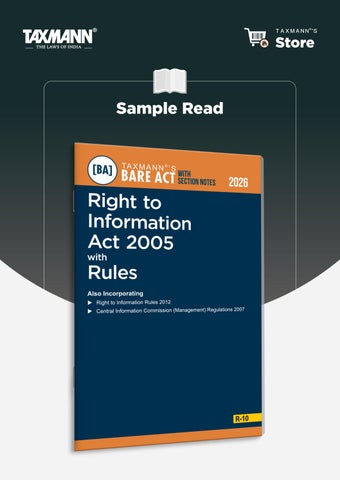
Right to Information Act 2005 with Rules – Bare Act with Section Notes AUTHOR : PUBLISHER : DATE OF PUBLICATION : EDITION : ISBN NO : No. of Pages : BINDING TYPE :
Taxmann’s Editorial Board Taxmann December 2025 2026 Edition 9789371263351 68 Paperback
Rs. 125 DESCRIPTION Right to Information Act 2005 with Rules [Bare Act with Section Notes] by Taxmann is a concise and authoritative compilation of the statutory framework for transparency and accountability in India. It presents the complete and updated text of the RTI Act, supported by well-structured, sectionwise notes, explanatory commentary, and selective judicial references, for a clear and practical understanding. The publication also incorporates the Right to Information Rules 2012 and the Central Information Commission (Management) Regulations 2007, offering a consolidated reference to the entire RTI regime. Serving both as a Bare Act and a practical reference, the book explains citizens’ rights, duties of public authorities, procedural requirements, exemptions, appeals, and penalties under the Act in a clear and accessible manner. This book is intended for the following audience: • Legal Practitioners & Academicians • Public Administrators & Government Officials • Journalists, RTI Activists & Civil Society Organisations • General Citizens The Present Publication is the 2026 Edition, covering the amended and updated text of the Right to Information Act [Act No. 22 of 2005] and Rules, with the following noteworthy features: • [Complete Statutory Text] Verbatim reproduction of the Right to Information Act 2005 • [Pre-amendment Provisions] Earlier versions of amended provisions provided through footnotes for contextual clarity • [Section Notes & Commentary] Concise explanatory notes clarifying legislative intent, procedure, and application • [Allied Rules & Regulations] Includes the RTI Rules 2012 and CIC (Management) Regulations 2007 • [Case Law References] Select judicial and Supreme Court rulings referenced for interpretative support • [User-friendly Layout] Clear chapter structure, schedules, and a comprehensive subject index
Buy Now