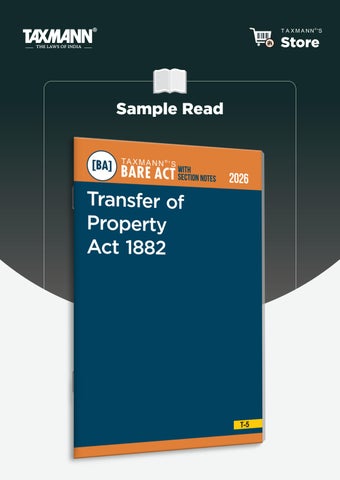
Sample Read
Contents TRANSFER OF PROPERTY ACT, 1882 PAGE
CHAPTER I PRELIMINARY 1. Short title
1
2. Repeal of Acts—Saving of certain enactments, incidents, rights, liabilities, etc.
2
3. Interpretation clause
3
4. Enactments relating to contracts to be taken as part of Contract Act and supplemental to the Registration Act
6
CHAPTER II OF TRANSFERS OF PROPERTY BY ACT OF PARTIES (A) Transfer of Property, whether movable or immovable 5. “Transfer of property” defined
6
6. What may be transferred
7
7. Persons competent to transfer
8
8. Operation of transfer
9
9. Oral transfer
10
10. Condition restraining alienation
10
11. Restriction repugnant to interest created
10
12. Condition making interest determinable on insolvency or attempted alienation
11
13. Transfer for benefit of unborn person
11
I-5
CONTENTS
I-6 PAGE
14. Rule against perpetuity
11
15. Transfer to class some of whom come under sections 13 and 14
12
16. Transfer to take effect on failure of prior interest
12
17. Direction for accumulation
12
18. Transfer in perpetuity for benefit of public
13
19. Vested interest
13
20. When unborn person acquires vested interest on transfer for his benefit
13
21. Contingent interest
13
22. Transfer to members of a class who attain a particular age
14
23. Transfer contingent on happening of specified uncertain event
14
24. Transfer to such of certain persons as survive at some period not specified
14
25. Conditional transfer
15
26. Fulfilment of condition precedent
16
27. Conditional transfer to one person coupled with transfer to another on failure of prior disposition
16
28. Ulterior transfer conditional on happening or not happening of specified event
17
29. Fulfilment of condition subsequent
17
30. Prior disposition not affected by invalidity of ulterior disposition
18
31. Condition that transfer shall cease to have effect in case specified uncertain event happens or does not happen
18
32. Such condition must not be invalid
18
33. Transfer conditional on performance of act, no time being specified for performance
18
34. Transfer conditional on performance of act, time being specified
19
Election 35. Election when necessary
20
Apportionment 36. Apportionment of periodical payments on determination of interest of person entitled
21
37. Apportionment of benefit of obligation on severance
21
(B) Transfer of Immovable Property 38. Transfer by person authorised only under certain circumstances to transfer
21
39. Transfer where third person is entitled to maintenance
22
I-7
CONTENTS
PAGE
40. Burden of obligation imposing restriction on use of land
22
41. Transfer by ostensible owner
23
42. Transfer by person having authority to revoke former transfer
23
43. Transfer by unauthorised person who subsequently acquires interest in property transferred
23
44. Transfer by one co-owner
24
45. Joint transfer for consideration
24
46. Transfer for consideration by persons having distinct interests
25
47. Transfer by co-owners of share in common property
25
48. Priority of rights created by transfer
25
49. Transferee’s right under policy
25
50. Rent bona fide paid to holder under defective title
25
51. Improvements made by bona fide holders under defective titles
26
52. Transfer of property pending suit relating thereto
26
53. Fraudulent transfer
27
53A. Part performance
27 CHAPTER III
OF SALES OF IMMOVABLE PROPERTY 54. “Sale defined”
29
55. Rights and liabilities of buyer and seller
30
56. Marshalling by subsequent purchaser
34
Discharge of Encumbrances on Sale 57. Provision by Court for encumbrances and sale freed therefrom
35
CHAPTER IV OF MORTGAGES OF IMMOVABLE PROPERTY AND CHARGES 58. “Mortgage”, “mortgagor”, “mortgagee”, “mortgage-money” and “mortgage-deed” defined
37
59. Mortgage when to be by assurance
40
59A. References to mortgagors and mortgagees to include persons deriving title from them
41
Rights and liabilities of mortgagor 60. Right of mortgagor to redeem 60A. Obligation to transfer to third party instead of re-transference to/ mortgagor
41 41
CONTENTS
I-8 PAGE
60B. Right to inspection and production of documents
42
61. Right to redeem separately or simultaneously
42
62. Right of usufructuary mortgagor to recover possession
42
63. Accession to mortgaged property
42
63A. Improvements to mortgaged property
43
64. Renewal of mortgaged lease
43
65. Implied contracts by mortgagor
43
65A. Mortgagor’s power to lease
44
66. Waste by mortgagor in possession
44
Rights and Liabilities of Mortgagee 67. Right to fore-closure or sale
45
67A. Mortgagee when bound to bring one suit on several mortgages
45
68. Right to sue for mortgage-money
45
69. Power of sale when valid
46
69A. Appointment of receiver
47
70. Accession to mortgaged property
49
71. Renewal of mortgaged lease
49
72. Right of mortgagee in possession
49
73. Right to proceeds of revenue sale or compensation on acquisition
50
74. [Omitted by the Transfer of Property (Amendment) Act, 1929, w.e.f. 1-4-1929]
50
75. [Omitted by the Transfer of Property (Amendment) Act, 1929, w.e.f. 1-4-1929]
50
76. Liabilities of mortgagee in possession
50
77. Receipts in lieu of interest
51 Priority
78. Postponement of prior mortgagee
51
79. Mortgage to secure uncertain amount when maximum is expressed
51
80. [Repealed by the Transfer of Property (Amendment) Act, 1929]
52
Marshalling and Contribution 81. Marshalling, securities
52
82. Contribution to mortgage-debt
52
I-9
CONTENTS
PAGE
Deposit in Court 83. Power to deposit in Court money due on mortgage
52
84. Cessation of interest
53
Suits for foreclosure, sale or redemption 85. [Omitted by the Code of Civil Procedure, 1908, w.e.f. 1-1-1909]
53
Foreclosure and sale 86. to [Omitted by the Code of Civil Procedure, 1908, w.e.f. 1-1-1909] 90.
53
Redemption 91. Persons who may sue for redemption
54
92. Subrogation
54
93. Prohibition of tacking
54
94. Rights of mesne mortgagee
54
95. Right of redeeming co-mortgagor to expenses
54
96. Mortgage by deposit of title-deeds
55
97. [Omitted by the Code of Civil Procedure, 1908]
55
Anomalous mortgages 98. Rights and liabilities of parties to anomalous mortgages
55
Attachment of mortgaged property 99. [Omitted by the Code of Civil Procedure, 1908, w.e.f. 1-1-1909]
55
Charges 100. Charges
55
101. No merger in case of subsequent encumbrance
55
Notice and tender 102. Service or tender on or to agent
55
103. Notice, etc., to or by person incompetent to contract
56
104. Power to make rules
56 CHAPTER V
OF LEASES OF IMMOVABLE PROPERTY 105. Lease defined
56
106. Duration of certain leases in absence of written-contract or local usage
57
107. Leases how made
59
CONTENTS
I-10 PAGE
108. Rights and liabilities of lessor and lessee
60
109. Rights of lessor’s transferee
62
110. Exclusion of day on which term commences
63
111. Determination of lease
63
112. Waiver of forfeiture
64
113. Waiver of notice to quit
65
114. Relief against forfeiture for non-payment of rent
65
114A. Relief against forfeiture in certain other cases
66
115. Effect of surrender and forfeiture on under-leases
66
116. Effect of holding over
66
117. Exemption of leases for agricultural purposes
67
CHAPTER VI OF EXCHANGES 118. “Exchange” defined
67
119. Right of party deprived of thing received in exchange
68
120. Rights and liabilities of parties
68
121. Exchange of money
68 CHAPTER VII OF GIFTS
122. “Gift” defined
68
123. Transfer how effected
69
124. Gift of existing and future property
70
125. Gift to several of whom one does not accept
70
126. When gift may be suspended or revoked
70
127. Onerous gifts
71
128. Universal donee
72
129. Saving of donations mortis causa and Muhammadan law
72
CHAPTER VIII OF TRANSFERS OF ACTIONABLE CLAIMS 130. Transfer of actionable claim 130A. [Omitted by the Marine Insurance Act, 1963, w.e.f. 1-8-1963]
73 74
131. Notice to be in writing, signed
74
132. Liability of transferee of actionable claim
75
I-11
CONTENTS
PAGE
133. Warranty of solvency of debtor
75
134. Mortgaged debt
75
135. Assignment of rights under policy of insurance against fire
75
135A. [Omitted by the Marine Insurance Act, 1963, w.e.f. 1-8-1963]
75
136. Incapacity of officers connected with Courts of Justice
75
137. Saving of negotiable instruments, etc.
76
SCHEDULE
76
SUBJECT INDEX
77
Transfer of Property Act, 1882 [4 OF 1882] An Act to amend the law relating to the Transfer of Property by act of parties. Preamble.—WHEREAS it is expedient to define and amend certain parts of the law relating to the transfer of property by act of parties; it is hereby enacted as follows:— CHAPTER I PRELIMINARY Short title. 1. This Act may be called the Transfer of Property Act, 1882*. Commencement. It shall come into force on the first day of July, 1882. Extent. 1
[It extends2 in the first instance to the whole of India. except 3[the territories which, immediately before the 1st November, 1956, were comprised in Part B States or in the Sates of], Bombay, Punjab and Delhi.]
*Dated 17-2-1882. 1. Substituted by the Adaptation of Laws Order, 1950, w.e.f. 26-1-1950. 2. Extended as whole to the Union territories of Jammu and Kashmir and Ladakh by the Jammu and Kashmir Reorganisation Act, 2019, w.e.f. 31-10-2019. The application of this Act was barred in the Naga Hills District, including the Mokokchung Sub-division, the Dibrugarh Frontier Tract, the North Cachar Hills, the Garo Hills, the Khasi and Jantia Hills and the Mikir Hills Tract, by notification under section 2 of the Assam Frontier Tracts Regulation, 1880. Partially extended to Berar Laws Act, 1941, w.e.f. 1-8-1941. Extended to Manipur by Act 68 of 1956; to Dadra and Nagar Haveli by the Dadra and Nagar Haveli (Laws) Regulation, 1963, w.e.f. 1-7-1965, to Goa, Daman and Diu by the Goa, Daman and Diu (Laws) No. 2 Regulation 1963, w.e.f. 19-12-1963 to Lakshadweep by the Laccadive, Minicoy and Amindivi Islands (Laws) Regulation, 1965, w.e.f. 1-10-1967, to Pondicherry by the Pondicherry (Extension of Laws) Act, 1968, w.e.f. 24-5-1968, to the presidency of Bombay (expect Scheduled Districts), w.e.f. 1-1-1893; to Mehwassi Estate by Bom. Regulation 1 of 1949; and to former princely area, w.e.f. 1-4-1951; now applicable to whole of Maharashtra; Gujarat (Saurashtra area) by Saurashtra Ordinance 25 of 1949, and to Kutch area w.e.f. 1-11950; Mysore, w.e.f. 1-4-1951; Rajasthan, w.e.f. 1-7-1952; The Act has been declared in force in the State of Sikkim on 1-9-1984 vide Notification No. S.O. 643(E), dated 24-8-1984. (Contd. on page 2)
1
S. 2
TRANSFER OF PROPERTY ACT, 1882
2
3a
[But this Act or any part thereof may by *notification in the Official Gazette be extended to the whole or any part of the 4[said territories] by the 5[State Government] concerned.] And any 5[State Government] may 5a[***]from time to time, by notification in the Official Gazette, exempt, either retrospectively or prospectively, any part of the territories administered by such State Government from all or any of the following provisions, namely:— Section 54, paragraph 2 and sections 3, 59, 107 and 123. Notwithstanding anything in the foregoing part of this section, section 54, paragraphs 2 and 3, and sections 59, 107 and 123 shall not extend or be extended to any district or tract of country for the time being excluded from the operation of the Indian Registration Act, 1908, (16 of 1908), under the power conferred by the first section of that Act or otherwise. Repeal of Acts.—Saving of certain enactments, incidents, rights, liabilities, etc. 2. In the territories to which this Act extends for the time being the enactments specified in the Schedule hereto annexed shall be repealed to the extent therein mentioned. But nothing herein contained shall be deemed to affect— (a) the provisions of any enactment not hereby expressly repealed; (b) any terms or incidents of any contract or constitution of property which are consistent with the provisions of this Act, and are allowed by the law for the time being in force; (c) any right or liability arising out of a legal relation constituted before this Act comes into force, or any relief in respect of any such right or liability; or (d) save as provided by section 57 and Chapter IV of this Act, any transfer by operation of law or by, or in execution of, a decree or order of a Court of competent jurisdiction, (Contd. from page 1)
This Act has been extended to the former State of Travancore-Cochin, w.e.f. 1-5-1952, now applicable to whole of Kerala. The provisions of sections 54, 107 and 123 were extended to— Delhi, w.e.f. 30-5-1939, section 129 was extended to certain areas of Delhi, w.e.f. 16-11-1940 and to the remaining areas 1-12-1962, the remaining provisions were also extended to the Union territory of Delhi, w.e.f. 1-12-1962: Himachal Pradesh, w.e.f. 7-12-1970; Punjab, w.e.f. 1-4-1955 and to former princely area w.e.f., 15-5-1957. (Section 59 was enforced in Haryana area, w.e.f. 5-8-1967). 3. Substituted for “Part B States” by the Adaptation of Laws (No. 2) Order, 1956, w.e.f. 1-11-1956. 3a. Substituted by the Government of India (Adaptation of Indian Law) Order, 1937, w.e.f. 1-41937. 4. Substituted for “said States”, by the Adaptation of Laws (No. 2) Order, 1959, w.e.f. 1-11-1956. Earlier, “said States” was substituted by the Part B States (Laws) Act, 1951, w.e.f. 1-4-1951. 5. Substituted for “Provincial Government” by the Adaptation of Laws Order, 1950, w.e.f. 26-11950. 5a. Words “with the previous sanction of the Governor General in Council” omitted by the Devolution Act, 1920, w.e.f. 14-9-1920. *See footnote 2 ante.
3
TRANSFER OF PROPERTY ACT, 1882
S. 3
and nothing in the second Chapter of this Act shall be deemed to affect any rule of Muhammadan law. Interpretation clause. 3. In this Act, unless there is something repugnant in the subject or context,— “immovable property” does not include standing timber, growing crops or grass; “instrument” means a non-testamentary instrument; “attested”, in relation to an instrument, means and shall be deemed always to have meant attested by two or more witnesses each of whom has seen the executant sign or affix his mark to the instrument, or has seen some other person sign the instrument in the presence and by the direction of the executant, or has received from the executant a personal acknowledgement of his signature or mark, or of the signature of such other person, and each of whom has signed the instrument in the presence of the executant; but it shall not be necessary that more than one of such witnesses shall have been present at the same time, and no particular form of attestation shall be necessary; “registered” means registered in 6[7[any part of the territories] to which this Act extends] under the law8 for the time being in force regulating the registration of documents; “attached to the earth” means— (a) rooted in the earth, as in the case of trees and shrubs; (b) imbedded in the earth, as in the case of walls or buildings; or (c) attached to what is so imbedded for the permanent beneficial enjoyment of that to which it is attached; “actionable claim” means a claim to any debt, other than a debt secured by mortgage of immovable property or by hypothecation or pledge of movable property, or to any beneficial interest in movable property not in the possession, either actual or constructive, of the claimant, which the Civil Courts recognise as affording grounds for relief, whether such debt or beneficial interest be existent, accruing, conditional or contingent; “a person is said to have notice” of a fact when he actually knows that fact, or when, but for wilful abstention from an enquiry or search which he ought to have made, or gross negligence, he would have known it. Explanation I.—Where any transaction relating to immovable property is required by law to be and has been effected by a registered instrument, any person acquiring such property or any part of, or share or interest in, such property shall be deemed to have notice of such instrument as from the date of registration or, where the property is not all situated in one sub-district, or where the registered instrument has been registered under sub-section (2) of section 30 of the 8Indian Registration Act, 1908 (16 of 1908), from the earliest date on which any memorandum of such 6. Substituted for “a Part A State or a Part C State” by the Part B States (Laws) Act, 1951, w.e.f. 1-4-1951. 7. Substituted for “any State” by the Adaptation of Laws (No. 2) Order, 1956, w.e.f.1-11-1956. 8. Now see the Indian Registration Act, 1908 (16 of 1908).
S. 3
TRANSFER OF PROPERTY ACT, 1882
4
registered instrument has been filed by any Sub-Registrar within whose sub-district any part of the property which is being acquired, or of the property wherein a share or interest is being acquired, is situated: Provided that— (1) the instrument has been registered and its registration completed in the manner prescribed by the 9Indian Registration Act, 1908 (16 of 1908), and the rules made thereunder, (2) the instrument or memorandum has been duly entered or filed, as the case may be, in books kept under section 51 of that Act, and (3) the particulars regarding the transaction to which the instrument relates have been correctly entered in the indexes kept under section 55 of that Act. Explanation II.—Any person acquiring any immovable property or any share or interest in any such property shall be deemed to have notice of the title, if any, of any person who is for the time being in actual possession thereof. Explanation III.—A person shall be deemed to have had notice of any fact if his agent acquires notice thereof whilst acting on his behalf in the course of business to which that fact is material: Provided that, if the agent fraudulently conceals the fact, the principal shall not be charged with notice thereof as against any person who was a party to or otherwise cognizant of the fraud. COMMENTS SECTION NOTES
If any provision in this Act uses any word or expression defined by this section, the same will be understood as defined in this section unless there is something repugnant in the subject or context. All definitions in the section are subject to the qualificatory phrase “In this Act, unless there is something repugnant in the subject or context,—”
The expression “transfer of property” is not defined in this section, but in section 5.
Immovable Property
“immovable property” does not include standing timber, growing crops or grass:
Instrument
“instrument”, means a non-testamentary instrument:
Attested
The term “attested” is defined in relation to an instrument
The term “attested” means attested by two or more witnesses each of whom has seen the executant sign or affix his mark to the instrument, or has seen some other person sign the instrument in the presence and by the direction of the executant, or has received from the executant a personal acknowledgement of his signature or mark, or of the signature of such other person, and each of whom has signed the instrument in the presence of the executant;
but it shall not be necessary that more than one of such witnesses shall have been present at the same time, and no particular form of attestation shall be necessary:
5
TRANSFER OF PROPERTY ACT, 1882
S. 3
Registered
“registered” means registered under the law for the time being in force regulating the registration of documents.
Actionable claim (A) “actionable claim” means
a claim to any debt, other than a debt secured by mortgage of immovable property or by hypothecation or pledge of movable property, or
a claim to any beneficial interest in movable property not in the possession, either actual or constructive, of the claimant,
(B) The claim is such that the Civil Courts recognise as affording grounds for relief (C) It does not matter whether such debt or beneficial interest be existent, accruing, conditional or contingent. When a person is said to have notice “A person is said to have notice” of a fact
when he actually knows that fact, or
when, but for wilful abstention from an enquiry or search which he ought to have made, or gross negligence, he would have known it.
The following points are noteworthy:
Where any transaction relating to immovable property is required by law to be and has been effected by a registered instrument, any person acquiring such property or any part of, or share or interest in, such property shall be deemed to have notice of such instrument as from the date of registration
where the property is not all situated in one sub-district, or where the registered instrument has been registered under sub-section (2) of section 30 of the Indian Registration Act, 1908 , any person acquiring such property or any part of, or share or interest in, such property shall be deemed to have notice of such instrument as from the earliest date on which any memorandum of such registered instrument has been filed by any Sub-Registrar within whose sub-district any part of the property which is being acquired, or of the property wherein a share or interest is being acquired, is situated:
The above principles of notice shall apply provided that— (1) the instrument has been registered and its registration completed in the manner prescribed by the Indian Registration Act, 1908 (16 of 1908) and the rules made thereunder, (2) the instrument or memorandum has been duly entered or filed, as the case may be, in books kept under section 51 of that Act, and (3) the particulars regarding the transaction to which the instrument relates have been correctly entered in the indexes kept under section 55 of that Act.
Any person acquiring any immovable property or any share or interest in any such property shall be deemed to have notice of the title, if any, of any person who is for the time being in actual possession thereof.
A person shall be deemed to have had notice of any fact if his agent acquires notice thereof whilst acting on his behalf in the course of business to which that fact is material:
if the agent fraudulently conceals the fact, the principal shall not be charged with notice thereof as against any person who was a party to or otherwise cognizant of the fraud.
TRANSFER OF PROPERTY ACT 1882 – BARE ACT WITH SECTION NOTES AUTHOR : PUBLISHER : DATE OF PUBLICATION : EDITION : ISBN NO : NO. OF PAGES : BINDING TYPE :
Taxmann's Editorial Board Taxmann December 2025 2026 Edition 9789375611097 96 Paperback
Rs. 155 DESCRIPTION Transfer of Property Act 1882 [Bare Act with Section Notes] by Taxmann is a definitive legal resource presenting the full text of the Act, enhanced by detailed section annotations and commentary. Reproducing the original enactment and enriched with decades of judicial interpretations, amendments, and scholarly insights, this volume offers clear guidance on complex property law matters. This book is intended for the following audience: • Law Students & Academics • Legal Practitioners & Advocates • Judges & Government Officials • Real Estate & Property Professionals The Present Publication is the 2026 Edition, covering the amended and updated text of the Transfer of Property Act [Act No. 4 of 1882], with the following noteworthy features: • [Complete Statutory Text] Provides the full, unabridged text of the Transfer of property Act 1882 • [Up-to-date Amendments] Incorporates all amendments, modifications, and judicial interpretations up to date • [Pre-amendment Provisions] Includes footnotes with the text of provisions as they existed prior to amendments for historical context • [Comprehensive Section Notes] Offers detailed annotations explaining legislative intent, significant judicial decisions, and practical implications • [Cross-referencing & Indexing] Features an exhaustive subject index and cross-references to simplify navigation of complex topics • [User-friendly Design] Employs clear headings, sub-headings, and a structured layout for quick reference and efficient study
Buy Now