
Sample Read

© All rights reserved
Price : ` 545
Fifth Edition : June 2026
Published by :
Taxmann Publications (P.) Ltd.
Sales & Marketing : 59/32, New Rohtak Road, New Delhi-110 005 India
Phone : +91-11-45562222
Website : www.taxmann.com
E-mail : sales@taxmann.com
Regd. Office : 21/35, West Punjabi Bagh, New Delhi-110 026 India
Printed at :
Tan Prints (India) Pvt. Ltd.
44 Km. Mile Stone, National Highway, Rohtak Road Village Rohad, Distt. Jhajjar (Haryana) India
E-mail : sales@tanprints.com
Disclaimer
Every effort has been made to avoid errors or omissions in this publication. In spite of this, errors may creep in. Any mistake, error or discrepancy noted may be brought to our notice which shall be taken care of in the next edition. It is notified that neither the publisher nor the author or seller will be responsible for any damage or loss of action to any one, of any kind, in any manner, therefrom.
No part of this book may be reproduced or copied in any form or by any means [graphic, electronic or mechanical, including photocopying, recording, taping, or information retrieval systems] or reproduced on any disc, tape, perforated media or other information storage device, etc., without the written permission of the publishers. Breach of this condition is liable for legal action.
For binding mistake, misprints or for missing pages, etc., the publisher’s liability is limited to replacement within seven days of purchase by similar edition. All expenses in this connection are to be borne by the purchaser. All disputes are subject to Delhi jurisdiction only.

4
CHAPTER

STRATEGIC ANALYSIS & PLANNING
Q1. What do you understand by Situation Analysis? Also state the need and suitability of Situation Analysis.
Ans.: Situation Analysis – Meaning: Situational analysis is the starting point for developing strategy. Before we can develop strategies for the future, however, we need to understand the present. Situational analysis is the process we use to gain understanding and insight into our present situation.
A situation analysisor environmental analysis is an essential component of strategy formulation. Such analysis is conducted periodically to keep the strategies up to date.
A complete situation analysis focuses on four areas i.e.:
The problem [its severity and its causes]
The people [potential stakeholders]
The broad context [in which the problem prevails]
Factors [facilitating behavior change]
A situational analysis takes into account the internal and external environment of an entity or organization andclearly identifiesits own capabilities, customers, potential customers, competitors and the business environmentand the impact they are going to have on the entity or organization.
Need of situation analysis: While formulating a business plan, a situation analysis paves the way for strategy development by identification of priorities by bringing out a clear, detailed and realistic picture of the –
Opportunities
Resources
Challenges
Barriers
The quality of the Situation Analysis will affect the success of whole plan.
Suitability of Situation Analysis: A small, well knitted and focused team from different functional areas of the organization should conduct the situation analysis. Throughout the data collection process, team members should also consider about engagement of concerned stakeholders including opinion leaders, service providers, policy makers, partners, and potential beneficiaries to reap maximum output. It may be done by conducting in-depth interviews, focus group discussions, community dialogues, small group meetings, taskforce engagements or participatory stakeholder workshops.
Timing of conducting situation analysis: A situation analysis should be conducted at the beginning of any program or project but before developing a strategy.
Q2. SWOT analysis is a tool used by organizations for evolving strategic options for the future. Explain.
Ans.: The comparison of Strengths, Weaknesses, Opportunities & Threats is normally referred to as SWOT Analysis.
Originated by Albert S Humphrey in the 1960s, SWOT Analysis is as useful now as it was then. SWOT analysis is a tool used by organizations for evolving strategic options for the future. The term SWOT refers to the analysis of strengths, weaknesses, opportunities and threats. Strengths and weaknesses are identified in the internal environment, whereas opportunities and threats are located in the external environment.
Strength: Strength is an inherent capability of the organization which it can use to gain strategic advantage over its competitors.
Weakness: A weakness is an inherent limitation or constraint of the organization which creates strategic disadvantage to it.
Opportunity: An opportunity is a favourable condition in the organization’s environment which enables it to strengthen its position.
Threat: A threat is an unfavourable condition in the organization’s environment which causes a risk for, or damage to, the organization’s position.
There are four components to this analysis. Strengths and weaknesses are often internal to your organization, while opportunities and threats generally relate to external factors. For this reason the SWOT Analysis is sometimes called Internal-External Analysis and the SWOT Matrix is sometimes called an IE Matrix. All four components cover certain basic questions that need to be answered. These are as follows:
Strengths (A)Weaknesses (B)
Potential resource strengths & competitive capabilities
Potential resource weaknesses & competitive deficiencies
Opportunities (C)Threats (D)
Potential company’s opportunities
Potential external threats to company’s well-being
Importance of SWOT Analysis: It helps managers to craft a business model that will allow a company to gain a competitive advantage in its industry. Competitive advantage leads to increased profitability and this maximizes a company’s chances of surviving in the fast-changing, competitive environment.
Key reasons for SWOT analysis are –
It provides a logical framework.
It presents a comparative account.
It guides the strategist in strategy identification.
Q3. STU’s association with India goes back to 1967, when it played a key role in constructing a very long highway in India spreading over multiple states. Since then, it is contributing in many ways to the country’s growth story. Now it is looking at playing an active role in the key projects taken up by the central government. Suggest few Opportunities and Threats that the company should consider. [Nov. 2021 (5 Marks)]
Ans.: Faced with a constantly changing environment, each business unit needs to develop a marketing information system to track trends and developments, which can be categorized as an opportunity or a threat. The company has to review its strength and weakness in the background of environment’s opportunities and threat, i.e., an organization’s SWOT analysis.
STU is looking at playing an active role in the key projects taken up by the central government. Following are the potential opportunities and threats to STU:
Potential Opportunities for STU:
Alliances or joint ventures with central government that expand the STU’s market coverage or boost its competitive capability.
Possibilities of working on the future projects of central government. Serving additional customer groups or expanding into new geographic markets.
Utilizing existing company skills or technological know-how to enter new projects.
Openings to take market share away from rivals.
Openings to exploit emerging new technologies.
Integrating forward or backward.
Potential Threats for STU:
Due to COVID-19 pandemic, companies may face the lockdown situation.
Economic factors such as recession etc.
Likely entry of potent new competitors.
Technological changes/innovations in construction equipment.
Costly new regulatory requirements.
Growing bargaining power of suppliers.
Vulnerability to industry driving forces.
Q4. What is the purpose of SWOT Analysis? Why is it necessary to do a SWOT analysis before selecting a particular strategy for a business organization? [June 2024 (5 Marks)]
Ans.:
The comparison of Strengths, Weaknesses, Opportunities & Threats is normally referred to as SWOT Analysis.
Originated by Albert S Humphrey in the 1960s, SWOT Analysis is as useful now as it was then. SWOT analysis is a tool used by organizations for evolving strategic options for the future. The term SWOT refers to the analysis of strengths, weaknesses, opportunities and threats. Strengths and weaknesses are identified in the internal environment, whereas opportunities and threats are located in the external environment.
Strength: Strength is an inherent capability of the organization which it can use to gain strategic advantage over its competitors.
Weakness: A weakness is an inherent limitation or constraint of the organization which creates strategic disadvantage to it.
Opportunity: An opportunity is a favourable condition in the organization’s environment which enables it to strengthen its position.
Threat: A threat is an unfavourable condition in the organization’s environment which causes a risk for, or damage to, the organization’s position.
Every manager is entrusted with the responsibility of setting-up organization mission and goals and creating a strategic plan that will guide the company to achieve its goals. For doing this, managers make use a variety of tools and methods to make a basis for decision making that includes SWOT and TOWS analysis, which are two closely related brainstorming exercises.
SWOT is a tool for strategic analysis of any organization, which takes into account examination of the company’s internal as well as its external environment. It consists in recognition of key assets and weaknesses of the company and marching them to exploit future opportunities and combating threats. SWOT is quite helpful in formulating a company’s strategy (Jezerys, 2000).
Q5. Go-Fast is a very small company in Amravati, operating its business of repairing electric-two-wheeler. It has a reputation for its fair charges and speedy delivery. For the next five years, a market study offers the following information:
Many college students are being given e-bike by the college authorities themselves and this trend is likely to continue for another five years. Coaching centers provide new e-bikes to all the students during the admission. The fees are inclusive of these costs.
LiFePO4 batteries are fast replacing lead acid batteries in certain market segments and models change every six months. In case of major repairs, affluent people discard the old lead acid batteries e-bike and go in for
new LiFePO4 batteries e-bike. However, there are rural markets and certain parts of urban markets which will still be interested in the low-cost lead acid batteries e-bike repaired and re-sold the e-bikes. Considering the gravity of the above situation Go-Fast plans to limit its operations to only one city.
You are required to give:
(i) A vision statement
(ii) A mission statement
(iii) SWOT analysis
(iv) Some parameters that could be used in above situation relating to the financial and growth perspectives in a Balance Score Card (BSC).
[Dec. 2024 (1 + 2 + 4 + 3 = 10 Marks)]
Ans.:
(i) Vision statement for Go-Fast:
“To deliver the fastest and highest quality repair of lead-acid e-electric two-wheeler at the most reasonable prices, anywhere in the city”.
(ii) A mission statement is an enduring statement of purpose that distinguishes one business from other similar firms. A mission statement identifies the scope of a firm’s operations in product and market terms.
Mission Statement for Go-Fast, a company running business of repairing electric two-wheeler:
“Committed to provide speedy, simple and cost effective repairing solutions to electric two-wheeler”
(a) Timely delivery as promised
(b) Reasonable charges
(c) Good quality of services
(d) Replacement of parts by genuine parts based on genuine needs
(e) Pick-up and delivery facility
(f) Offer stand by electric two-wheeler as per customer requests.
(iii) SWOT Analysis: Comparison of Strengths, Weaknesses, Opportunities & Threats is normally referred to as SWOT Analysis.
SWOT Analysis for Go-Fast:
(a) Strengths: Access to standard parts that normally fail in electric two-wheeler, network of trained employees who have thorough job knowledge, available loyal customers, less time in delivery and perfect commitment.
(b) Weakness: Going beyond the scope of faults recognized by the customers, often leading to cost over runs while preventing future repairs calls.
(c) Opportunities: Branches may be opened in schools/colleges/big coaching centres. Business can be extended to sale of reworked computers in ready and going markets, preventing maintenance services, annual maintenance contracts, upgrades and compatibility addition with new peripherals, etc.
(d) Threats: Unless electric two-wheeler markets also are created to, there is a threat to long term survival. Threats from one stop shops for repairing all types of two electric two-wheelers. Threats of obsolescence resulting in non-availability of spares.
(iv) Balance Score Cards (BSC):
(a) Financial perspective: Revenue from repairs, average job order cost, total spares purchases, delivery costs, (revenue per jobless variable cost per job) as a % of revenue par job, debtors management (target nil), etc.
(b) Learning/innovation/growth perspectives: Number of employees trained, number of new products repaired, number of new spares used, machinery used for cleaning/servicing, new logistics management, service call tracking, repair status on-line tracking, etc.
Q6. Briefly discuss ‘TOWS Matrix Model’ developed by the American international business professor Heinz Weirich. Or
“The TOWS Matrix is a tool for generating strategic options/choices.” Do you agree with this statement? How it can help a strategist in decision making? Or
“TOWS strategies are a product of the trade-off between internal and external factors.” Do you agree with this statement? How can this approach help a strategist in decision making? [Dec. 2024 (5 Marks)]
Ans.: The TOWS Matrix is derived from the SWOT Analysis model, which stands for the internal Strengths and Weaknesses of an organization and the external Opportunities and Threats that the business is confronted with.
The acronym TOWS is a variant of this and was developed by the American international business professor Heinz Weihrich.
The TOWS Matrix is aimed at developing strategic options from an external-internal analysis and is a practical tool, particularly in the fields of business administration and marketing.
Whereas SWOT Analysis starts with an internal analysis, the TOWS Matrix starts with an external environment analysis; the threats and opportunities are examined first.
The TOWS Matrix is tool for generating strategic options. Through TOWS matrix four distinct alternative kinds of strategic choices can be identified.
(1) SO – Maxi-Maxi [Aggressive Strategy] (Strategies that use strengths to maximize opportunities):
SO is a position that any firm would like to achieve. The strengths can be used to capitalize or build upon existing or emerging opportunities. Such firms can take lead from their strengths and utilize the resources to build up the competitive advantage.
Therefore, maxi-maxi refers to an organization, within which the synergy effect is present and opportunities are dominating in the environment. It consists in strong expansion and development, with maximum application of strengths and available opportunities.
(2) ST – Maxi-Mini [Conservative Strategy] (Strategies that use strengths to minimize threats): ST is a position in which a firm strives to minimize existing or emerging threats through its strengths.
(3) WO – Mini-Maxi [Competitive Strategy]: (Strategies that minimizes weakness by taking advantage of opportunities): The firm needs to overcome internal weaknesses and make attempts to exploit opportunities to maximum.
(4) WT – Mini-Mini [Defensive Strategy]: (Strategies that minimizes weakness and avoid threats): WT is a position that any firm will try to avoid. A firm facing external threats and internal weaknesses may have to struggle for its survival. WT strategy is a strategy which is pursued to minimize or overcome weaknesses and as far as possible, cope with existing or emerging threats.
Internal Elements
Organizational Strengths
External Elements
Environmental opportunities (and risks)
Environmental threats
(Strategies that use strengths to maximize opportunities)
Organizational Weaknesses
(Strategies that minimizes weakness by taking advantage of opportunities)
(Strategies that use strengths to minimize threats)
(Strategies that minimizes weakness and avoid threats)
By using TOWS Matrix, a strategist can look intelligently at how he can best take advantage of the opportunities open to him, at the same time that he can minimize the impact of weaknesses and protect himself against threats. Used after detailed analysis of threats, opportunities, strength and weaknesses, it helps the strategist to consider how to use the external environment to his strategic advantage, and so he can identify some of the strategic options available to him.
From that standpoint, an organization gets a clear picture of its environment and the opportunity to think about strategy and what direction the company will go in. Next the company’s strengths and weaknesses are considered; what it’s good at internally and what it’s not so good.
The external analysis is linked to the analysis and the resulting TOWS Matrix can help an organization to make decisions better, seize opportunities and protect itself better against threats.
Benefit & Importance: The TOWS Matrix helps businesses to identify their strategic options. An organization gets the opportunity to make the most of its strengths and get around its internal weaknesses and learn to deal with them properly. Externally, an organization learns to carefully look for market opportunities and recognize possibilities. And they learn how to control and overcome potential threats.
The TOWS Matrix can also help with brainstorming and developing great ideas to generate effective marketing strategies and tactics. Furthermore, the model goes beyond merely finding out the strengths and weaknesses within an organization and what opportunities and threats there are in its environment. It forces organizations to really think about how they can improve themselves, how they can guard against threats and become more aware of their expertise and potential shortcomings.
The incremental benefit of the TOWS matrix lies in systematically identifying relationships between these factors and selecting strategies on their basis. Thus TOWS matrix has a wider scope when compared to SWOT analysis. TOWS analysis is an action tool whereas SWOT analysis is a planning tool.
Q7. Apply TOWS Matrix Model for world famous Apple Inc.
Ans.: TOWS Matrix is an analytical tool that helps build over your strengths and make the best use of available opportunities while also minimizing the threats.
TOWS Matrix of Apple: Apple is the maker of I-phone, I-Pad and Mac book and is known for innovation and premium quality products. It has a strong brand image and is a market leader across several product categories. It means high profit margins on its products which are highly popular. The premium quality of its products is the reason that Apple enjoys high customer loyalty. However, the falling demand of PC’s and Laptops has led to a decline in the markets share of Apple.
Strengths:
- Market leader in a range of products and services
- Highly strong brand image
- Financial strength
- Innovative and highly sophisticated supply chain
- High profit margins
- Large and loyal customer base
Weaknesses:
- Products not priced competitively
- Narrow product range compared to the rivals
- Products and services incompatible with the other brands
Opportunities:
- Increasing demand for the mobile gadgets and technology
- Product diversification
- Make compatible products
Threats:
- Increased competition
- Rising costs of input and manufacturing
- Jobs’ demise a major loss
APPLE TOWS MATRIX
StrengthsWeaknesses
Opportunities SO
- Use strengths to capitalize on available opportunities.
- Use brand image to diversify and develop partnership with other brands.
ThreatsST
- Use strengths to avoid threats.
- Control cost to beat competition.
- Focus on cultural change.
- Overcome weaknesses to capitalize on opportunities.
- Attract middle class customers by reducing price.
- Find new customer segments and introduce new products tailored for them.
- Reduce weaknesses to avoid threats.
- Exploit existing supply chain capabilities to reduce costs.
- Introduce competitively priced products.
Q8. Discuss in detail “Project Evaluation & Review Technique (PERT)” a statistical tool used in project management along with its advantages and disadvantages.
Ans.: The Project Evaluation & Review Technique (PERT) is a statistical tool used in project management, which was designed to analyze and represent the tasks involved in completing a given project. It was first developed by the United States Navy in the 1950s.
Project management can be understood as a systematic way of planning, scheduling, executing, monitoring, controlling the different aspects of the project, so
as to attain the goal made at the time of project formulation. PERT and CPM are the two network based project management techniques, which exhibit the flow and sequence of the activities and events. Project Evaluation and Review Techniques (PERT) are appropriate for the projects where time needed to complete different activities are not known.
PERT was developed primarily to simplify the planning and scheduling of large and complex projects. In a PERT diagram, the main building block is the event, with connections to its known predecessor events and successor events.
Advantages of PERT:
PERT chart explicitly defines and makes visible dependencies between the work breakdown structure elements.
PERT facilitates identification of the critical path and makes this visible.
PERT facilitates identification of early start, late start, and slack for each activity.
PERT provides for potentially reduced project duration due to better understanding of dependencies leading to improved overlapping of activities and tasks where feasible.
The large amount of project data can be organized and presented in diagram for use in decision making.
PERT can provide a probability of completing before a given time.
Provides management a tool for forecasting the impact of schedule changes.
A considerable amount of data may be presented in a precise manner. The task relationships are presented graphically for easier evaluation.
The network will highlight areas that require attention of higher priority to the key jobs without ignoring the lower priority tasks.
Disadvantages of PERT:
There can be potentially hundreds or thousands of activities and individual dependency relationships.
PERT is not easily scalable for smaller projects.
The network charts tend to be large and unwieldy, requiring several pages to print and requiring specially-sized paper.
Uncertainly about the estimate of time and resources due to being based on assumptions.
Q9. “PERT and CPM are two complementing statistical techniques utilized in project management. They exhibit the flow and sequence of activities and events”. In this context mention the types of projects where these techniques are used. What are the steps involved in PERT/CPM?
[Dec. 2024 (5 Marks)]
Ans.: Project Evaluation & Review Technique (PERT) is a statistical tool used in project management, which was designed to analyze and represent the tasks involved in completing a given project. It was first developed by the United States Navy in the 1950s.
Project management can be understood as a systematic way of planning, scheduling, executing, monitoring, controlling the different aspects of the project, so as to attain the goal made at the time of project formulation. PERT and CPM are the two network based project management techniques, which exhibit the flow and sequence of the activities and events. Project Management and Review Techniques (PERT) are appropriate for the projects where time needed to complete different activities are not known.
PERT was developed primarily to simplify the planning and scheduling of large and complex projects. In a PERT diagram, the main building block is the event, with connections to its known predecessor events and successor events.
Steps are involved in PERT/CPM: Following steps are involved in PERT/CPM
1. Identify and distinguish the various activities required for completing the project and list them separately.
2. Clearly lay down the jobs that are to be carried simultaneously, in sequence etc. All such relationships between jobs be clearly laid down.
3. Picture/graph portraying each of these jobs should be drawn showing predecessor and successor relations among them. The graph shows the time required for completion of each job. This is known as the project graph or the arrow diagram.
10. Distinguish between: PERT & CPM
Meaning PERT is a project management technique, used to manage uncertain activities of a project.
What is it?
PERT is technique of planning and control of time.
CPM is a statistical technique of project management that manages well defined activities of a project.
CPM is a method to control cost and time.
Orientation PERT is event oriented.CPM is activity oriented.
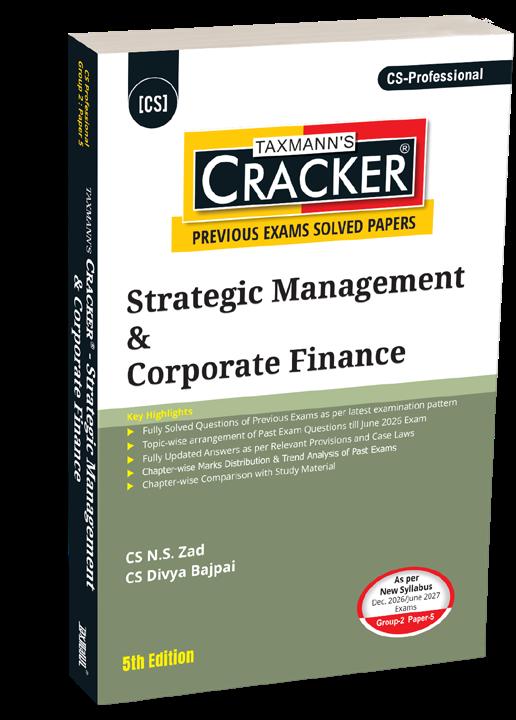
Strategic Management & Corporate Finance (SMCF) | CRACKER
AUTHOR : N.S. Zad, Divya Bajpai
PUBLISHER : Taxmann
DATE OF PUBLICATION : June 2026
EDITION : 5th Edition
ISBN NO : 9789375618737
No. of Pages : 512
BINDING TYPE : Paperback
Rs. 545
DESCRIPTION
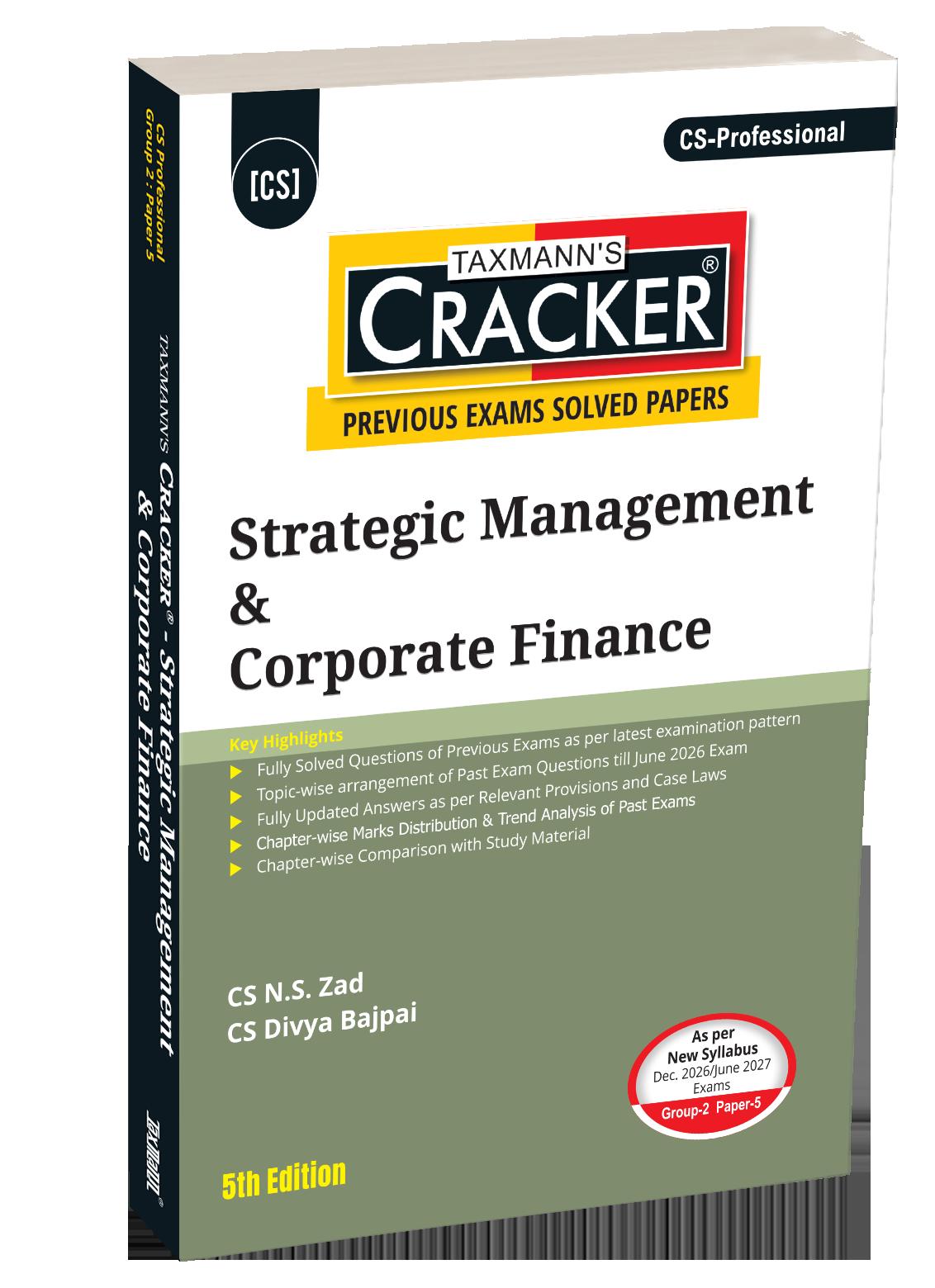
Strategic Management & Corporate Finance – CRACKER is an examination-focused question bank and answer-writing companion for Paper 5 of the CS-Professional programme. Rather than reteaching the syllabus, it assembles the questions actually set by the ICSI—drawn from over a decade of past papers—and pairs each with a model answer in the form the examiner expects. It trains candidates across both halves of the paper: the application-led reasoning of Strategic Management and the provision-heavy discipline of Corporate Finance—making it a single resource for revision, self-testing and answer-writing practice before the examination.
The Present Publication is the 5th Edition | June 2026, authored by CS NS Zad and CS Divya Bajpai, with the following noteworthy features:
• [Fully Solved Previous Exams, Arranged Topic-wise] Fully solved past-exam questions, as per the latest pattern, arranged topic-wise and updated to the June 2026 examination
• [Examination-Oriented Model Answers] Answers written to examination depth and form, structured under clear headings for reproduction under time pressure
• [Answers Anchored to the Governing Law] Every answer tied to the precise provision in force (e.g., Companies Act 2013, Companies (Share Capital & Debentures) Rules 2014, SEBI ICDR and LODR Regulations) and fully updated
• [Complete Worked Solutions for Problem-based Questions] Numerical and project-appraisal questions solved step-by-step, with working notes, present-value tables and a reasoned decision
• [Scenario Questions Resolved through Tabular Analysis] Application and eligibility-based questions set out in clean, reproducible tabular form
• [Chapter-wise Marks Distribution & Trend Analysis] A built-in apparatus for targeted, high-yield revision
• [Chapter-wise Comparison with the Study Material] Each chapter mapped to the corresponding ICSI Study Material chapter
• [Diagrams, Flowcharts & Comparative Tables] Used throughout to aid understanding and recall