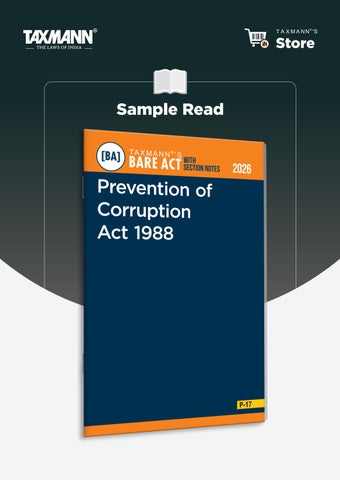
Sample Read
© Taxmann Price : ` 105 Law stated in this book is as updated till 1st December, 2025 Published by : Taxmann Publications (P.) Ltd. Sales & Marketing : 59/32, New Rohtak Road, New Delhi-110 005 India Phone : +91-11-45562222 Website : www.taxmann.com E-mail : sales@taxmann.com Regd. Office : 21/35, West Punjabi Bagh, New Delhi-110 026 India Printed at : Tan Prints (India) Pvt. Ltd. 44 Km. Mile Stone, National Highway, Rohtak Road Village Rohad, Distt. Jhajjar (Haryana) India E-mail : sales@tanprints.com Disclaimer Every effort has been made to avoid errors or omissions in this publication. In spite of this, errors may creep in. Any mistake, error or discrepancy noted may be brought to our notice which shall be taken care of in the next edition. It is notified that neither the publisher nor the author or seller will be responsible for any damage or loss of action to any one, of any kind, in any manner, therefrom. It is suggested that to avoid any doubt the reader should cross-check all the facts, law and contents of the publication with original Government publication or notifications. No part of this book may be reproduced or copied in any form or by any means [graphic, electronic or mechanical, including photocopying, recording, taping, or information retrieval systems] or reproduced on any disc, tape, perforated media or other information storage device, etc., without the written permission of the publishers. Breach of this condition is liable for legal action. For binding mistake, misprints or for missing pages, etc., the publisher’s liability is limited to replacement within seven days of purchase by similar edition. All expenses in this connection are to be borne by the purchaser. All disputes are subject to Delhi jurisdiction only.
Contents PREVENTION OF CORRUPTION ACT, 1988 PAGE
CHAPTER I PRELIMINARY 1. Short title and extent
1
2. Definitions
1 CHAPTER II APPOINTMENT OF SPECIAL JUDGES
3. Power to appoint Special Judges
4
4. Cases triable by Special Judges
5
5. Procedure and powers of Special Judge
6
6. Power to try summarily
9 CHAPTER III
OFFENCES AND PENALTIES 7. Offence relating to public servant being bribed 7A. Taking undue advantage to influence public servant by corrupt or illegal means or by exercise of personal influence
10 13
8. Offence relating to bribing of a public servant
14
9. Offence relating to bribing a public servant by a commercial organisation
16
10. Person in charge of commercial organisation to be guilty of offence
19
I-5
CONTENTS
I-6 PAGE
11. Public servant obtaining undue advantage, without consideration from person concerned in proceeding or business transacted by such public servant
19
12. Punishment for abetment of offences
20
13. Criminal misconduct by a public servant
20
14. Punishment for habitual offender
23
15. Punishment for attempt
24
16. Matters to be taken into consideration for fixing fine
24
CHAPTER IV INVESTIGATION INTO CASES UNDER THE ACT 17. Persons authorised to investigate 17A. Enquiry or Inquiry or investigation of offences relatable to recommendations made or decision taken by public servant in discharge of official functions or duties 18. Power to inspect bankers’ books
24 25
28
CHAPTER IVA ATTACHMENT AND FORFEITURE OF PROPERTY 18A. Provisions of Criminal Law Amendment Ordinance, 1944 to apply to attachment under this Act
29
CHAPTER V SANCTION FOR PROSECUTION AND OTHER MISCELLANEOUS PROVISIONS 19. Previous sanction necessary for prosecution
29
20. Presumption where public servant accepts any undue advantage
31
21. Accused person to be a competent witness
32
22. The Code of Criminal Procedure, 1973 to apply subject to certain modifications
32
23. Particulars in a charge in relation to an offence under section 13(1)(a)
33
24. [Omitted by the Prevention of Corruption (Amendment) Act, 2018, w.e.f. 26-7-2018]
34
25. Military, Naval and Air Force or other law not to be affected
34
26. Special Judges appointed under Act 46 of 1952 to be Special Judges appointed under this Act
34
27. Appeal and revision
35
I-7
CONTENTS PAGE
28. Act to be in addition to any other law
35
29. Amendment of the Ordinance 38 of 1944
35
29A. Power to make rules
36
30. Repeal and saving
36
31. [Omitted by the Repealing and Amending Act, 2001, w.e.f. 3-9-2001]
36
SUBJECT INDEX
37
Prevention of Corruption Act, 1988 [49 OF 1988*]
An Act to consolidate and amend the law relating to the prevention of corruption and for matters connected therewith. Be it enacted by Parliament in the Thirty-ninth Year of the Republic of India as follows:— CHAPTER I PRELIMINARY Short title and extent. 1. (1) This Act may be called the Prevention of Corruption Act, 1988. (2) It extends to the whole of India 1[***] and it applies also to all citizens of India outside India. Definitions. 2. In this Act, unless the context otherwise requires,— (a) “election” means any election, by whatever means held under any law for the purpose of selecting members of Parliament or of any Legislature, local authority or other public authority; [(aa) “prescribed” means prescribed by rules made under this Act and the expression “prescribe” shall be construed accordingly;]
2
(b) “public duty” means a duty in the discharge of which the State, the public or the community at large has an interest; Explanation.—In this clause “State” includes a corporation established by or under a Central, Provincial or State Act, or an authority or a body owned or controlled or aided by the Government or a Government company as defined in section 617† of the Companies Act, 1956 (1 of 1956); *Dated 9-9-1988. 1. Words “except the State of Jammu and Kashmir” omitted by the Jammu and Kashmir Reorganization Act, 2019, w.e.f. 31-10-2019. 2. Inserted by the Prevention of Corruption (Amendment) Act, 2018, w.e.f. 26-7-2018. † Now see Section 2(45) of the Companies Act, 2013.
1
S. 2
PREVENTION OF CORRUPTION ACT, 1988
2
(c) “public servant” means— (i) any person in the service or pay of the Government or remunerated by the Government by fees or commission for the performance of any public duty; (ii) any person in the service or pay of a local authority; (iii) any person in the service or pay of a corporation established by or under a Central, Provincial or State Act, or an authority or a body owned or controlled or aided by the Government or a Government company as defined in section 617† of the Companies Act, 1956 (1 of 1956); (iv) any Judge, including any person empowered by law to discharge, whether by himself or as a member of any body of persons, any adjudicatory functions; (v) any person authorised by a court of justice to perform any duty, in connection with the administration of justice, including a liquidator, receiver or Commissioner appointed by such court; (vi) any arbitrator or other person to whom any cause or matter has been referred for decision or report by a court of justice or by a competent public authority; (vii) any person who holds an office by virtue of which he is empowered to prepare, publish, maintain or revise an electoral roll or to conduct an election or part of an election; (viii) any person who holds an office by virtue of which he is authorised or required to perform any public duty; (ix) any person who is the president, secretary or other office-bearer of a registered co-operative society engaged in agriculture, industry, trade or banking, receiving or having received any financial aid from the Central Government or a State Government or from any corporation established by or under a Central, Provincial or State Act, or any authority or body owned or controlled or aided by the Government or a Government company as defined in section 617† of the Companies Act, 1956 (1 of 1956); (x) any person who is a chairman, member or employee of any Service Commission or Board, by whatever name called, or a member of any selection committee appointed by such Commission or Board for the conduct of any examination or making any selection on behalf of such Commission or Board; (xi) any person who is a Vice-Chancellor or member of any governing body, professor, reader, lecturer or any other teacher or employee, by whatever designation called, of any university and any person whose services have been availed of by a university or any other public authority in connection with holding or conducting examinations; (xii) any person who is an office bearer or an employee of an educational, scientific, social, cultural or other institution, in whatever manner † Now see Section 2(45) of the Companies Act, 2013.
3
PREVENTION OF CORRUPTION ACT, 1988
S. 2
established, receiving or having received any financial assistance from the Central Government or any State Government, or local or other public authority. Explanation 1.—Persons falling under any of the above sub-clauses are public servants, whether appointed by the Government or not. Explanation 2.—Wherever the words “public servant” occur, they shall be understood of every person who is in actual possession of the situation of a public servant, whatever legal defect there may be in his right to hold that situation. [(d) “undue advantage” means any gratification whatever, other than legal remuneration.
3
Explanation.— For the purposes of this clause,— (a) the word “gratification” is not limited to pecuniary gratifications or to gratifications estimable in money; (b) the expression “legal remuneration” is not restricted to remuneration paid to a public servant, but includes all remuneration which he is permitted by the Government or the organisation, which he serves, to receive.] COMMENTS SECTION NOTES
2.1 Public Servant [Section 2(c)] u
Section 2(c) gives an exhaustive definition of “public servant”.
u
Explanation 1 and Explanation 2 below section 2 further clarify the definition.
u
Public servant means a person falling under any of the 12 enumerated descriptions in the definition.
u
One is a public servant only if one falls within any of the 12 categories/descriptions of public servants enumerated in the definition in section 2(c).
u
persons falling under any of the 12 descriptions are public servants, whether appointed by the Government or not. [Explanation 1]
u
every person who is in actual possession of the situation of a public servant, whatever legal defect there may be in his right to hold that situation is a public servant. [Explanation 2]
CASE LAWS u
Definition of ‘Public Servant’ Extended to Private Bank Employees - In this case, the Supreme Court clarified that the definition of ‘public servant’ under the Prevention of Corruption Act, 1988, is broader than the definition under the Indian Penal Code and includes certain private sector roles. The respondent, Ramesh Gelli, an executive director in a private bank, argued he was not a public servant under section 2(c) of the Act. However, the Court ruled that the intent of the Prevention of Corruption Act is to cover a wider range of individuals in positions of trust and influence over public
3. Inserted by the Prevention of Corruption (Amendment) Act, 2018, w.e.f. 26-7-2018.
S. 3
PREVENTION OF CORRUPTION ACT, 1988
4
resources, thereby classifying executives in licensed private banking institutions as public servants under this Act for prosecution purposes. — Central Bureau of Investigation v. Ramesh Gelli AIRONLINE 2023 SC 1261.
CHAPTER II APPOINTMENT OF SPECIAL JUDGES Power to appoint Special Judges. 3. (1) The Central Government or the State Government may, by notification in the Official Gazette, appoint as many Special Judges as may be necessary for such area or areas or for such case or group of cases as may be specified in the notification to try the following offences, namely:— (a) any offence punishable under this Act; and (b) any conspiracy to commit or any attempt to commit or any abetment of any of the offences specified in clause (a). (2) A person shall not be qualified for appointment as a Special Judge under this Act unless he is or has been a Sessions Judge or an Additional Sessions Judge or an Assistant Sessions Judge under the Code of Criminal Procedure, 1973† (2 of 1974). COMMENTS SECTION NOTES u
Section 4(1) mandates that the following cases are triable by Special Judges only: (a) any offence punishable under this Act; (b) any conspiracy to commit any offence in (a) above; (c) any attempt to commit any offence in (a) above; and (d) any abetment of any offence in (a) above.
u
This section empowers the Central Government or any State Government to appoint Special Judges.
u
The power is to be exercised by notification in the Official Gazette.
u
The government can designate Special Judges for specific geographical areas or specific cases or groups of cases as required. STATE AMENDMENT ARUNACHAL PRADESH
n Section 3
In sub-section (2) after the words “Code of Criminal Procedure, 1973” the words “or a Deputy Commissioner preferably with legal background and sufficient judicial experience” shall be inserted.—[Vide Arunachal Pradesh Prevention of Corruption (Amendment) Act, 1989, w.e.f. 6-6-1990.]
† Now Bharatiya Nagarik Suraksha Sanhita, 2023 (46 of 2023).
PREVENTION OF CORRUPTION ACT 1988 – BARE ACT WITH SECTION NOTES AUTHOR : PUBLISHER : DATE OF PUBLICATION : EDITION : ISBN NO : NO. OF PAGES : BINDING TYPE :
Taxmann's Editorial Board Taxmann December 2025 2026 Edition 9789371261395 48 Paperback
Rs. 105 DESCRIPTION Prevention of Corruption Act 1988 [Bare Act with Section Notes] by Taxmann is an authoritative and updated volume on one of India's pivotal anti-corruption legislations. This Edition offers the Act's text, detailed commentary, case law references, and judicial insights. It incorporates the latest amendments—including key updates from the Prevention of Corruption (Amendment) Act 2018 This book is intended for the following audience: • Legal Practitioners & Advocates • Judges and Magistrates • Government Officials & Policymakers • Compliance Officers & Corporate Legal Advisors • Law Students and Academicians The Present Publication is the 2026 Edition, covering the amended and updated text of the Prevention of Corruption Act [Act No. 49 of 1988] with the following noteworthy features: • [Authoritative Content] Full text of the Prevention of Corruption Act 1988, including all subsequent amendments • [Updated Amendments] Reflects the latest changes, notably from the Prevention of Corruption (Amendment) Act 2018 • [Pre-amendment Provisions] Footnotes include texts as they existed before amendments for historical context • [Comprehensive Section Notes] Detailed annotations on key concepts, definitions, and legal nuances • [Judicial Commentary & Case Laws] Landmark judgments and case law excerpts illustrating practical application • [User-friendly Format] Clearly organised chapters, sections, and sub-sections for quick reference • [Cross-references & Indexing] A thorough index and cross-references for in-depth legal research
Buy Now