Sample Read
© Taxmann Price : ` 135 Law stated in this book is as updated till 1st December, 2025 Published by : Taxmann Publications (P.) Ltd. Sales & Marketing : 59/32, New Rohtak Road, New Delhi-110 005 India Phone : +91-11-45562222 Website : www.taxmann.com E-mail : sales@taxmann.com Regd. Office : 21/35, West Punjabi Bagh, New Delhi-110 026 India Printed at : Tan Prints (India) Pvt. Ltd. 44 Km. Mile Stone, National Highway, Rohtak Road Village Rohad, Distt. Jhajjar (Haryana) India E-mail : sales@tanprints.com Disclaimer Every effort has been made to avoid errors or omissions in this publication. In spite of this, errors may creep in. Any mistake, error or discrepancy noted may be brought to our notice which shall be taken care of in the next edition. It is notified that neither the publisher nor the author or seller will be responsible for any damage or loss of action to any one, of any kind, in any manner, therefrom. It is suggested that to avoid any doubt the reader should cross-check all the facts, law and contents of the publication with original Government publication or notifications. No part of this book may be reproduced or copied in any form or by any means [graphic, electronic or mechanical, including photocopying, recording, taping, or information retrieval systems] or reproduced on any disc, tape, perforated media or other information storage device, etc., without the written permission of the publishers. Breach of this condition is liable for legal action. For binding mistake, misprints or for missing pages, etc., the publisher’s liability is limited to replacement within seven days of purchase by similar edition. All expenses in this connection are to be borne by the purchaser. All disputes are subject to Delhi jurisdiction only.
Contents POLICE ACT, 1861 PAGE
1. Interpretation clause
1
2. Constitution of the forces
3
3. Superintendence in the State Government
5
4. Inspector-General of Police, etc.
6
5. Powers of Inspector General Exercise of power
7
6. [Omitted by the Code of Criminal Procedure, 1882]
7
7. Appointment, dismissal, etc., of inferior officers
7
8. Certificates to police officers
10
9. Police-officers not to resign without leave or two months’ notice
12
10. Police-officers not to engage in other employment
12
11. [Omitted by the Repealing Act, 1874]
12
12. Power of Inspector-General to make rules
12
13. Additional police-officer employed at cost of individuals
13
14. Appointment of additional force in the neighbourhood of railway and other works
14
15. Quartering of additional police in disturbed or dangerous districts
14
15A. Awarding compensation to sufferers from misconduct of inhabitants or persons interested in land
15
16. Recovery of moneys payable under sections 13, 14, 15 and 15A, and disposal of same when recovered
18
17. Special police-officers
18
18. Powers of special police-officers
18
I-5
CONTENTS
I-6 PAGE
19. Refusal to serve as special police-officers
18
20. Authority to be exercised by police-officers
18
21. Village police-officers
19
22. Police-officers always on duty and may be employed in any part of district
19
23. Duties of police-officers
19
24. Police-officers may lay information, etc.
20
25. Police-officers to take charge of unclaimed property, and be subject to Magistrate’s orders as to disposal
20
26. Magistrate may detain property and issue proclamation
20
27. Confiscation of property if no claimant appears
20
28. Persons refusing to deliver up certificate, etc., on ceasing to be police-officers
20
29. Penalties for neglect of duty, etc.
21
30. Regulation of public assemblies and processions and licensing of the same
23
30A. Powers with regard to assemblies and processions violating conditions of license
24
31. Police to keep order in public roads, etc.
24
32. Penalty for disobeying orders issued under last three sections, etc.
24
33. Saving of control of Magistrate of district
26
34. Punishment for certain offences on roads, etc.
26
35. Jurisdiction
34
36. Power to prosecute under other law not affected
35
37. Recovery of penalties and fines imposed by Magistrates
35
38. [Repealed by the Police Act (1861) Amendment Act, 1895 (8 of 1895)]
36
39. [Repealed by the Police Act (1861) Amendment Act, 1895 (8 of 1895)]
36
40. [Repealed by the Police Act (1861) Amendment Act, 1895 (8 of 1895)]
36
41. [Omitted by the Government of India (Adaptation of Indian Laws) Order 1937, w.e.f. 1-4-1937]
36
42. Limitation of actions
36
43. Plea that act was done under warrant
36
44. Police-officers to keep diary
37
45. State Government may prescribe form of returns
38
46. Scope of Act
38
47. Authority of District Superintendent of Police over village police
39
I-7
CONTENTS PAGE
FORM
39
SUBJECT INDEX
41
POLICE ACT, 1949 1. Short title, extent and commencement
43
2. Definition
43
3. Constitution of general police-district embracing two or more Union territories
43
4. Constitution of one police force for general police-district
43
5. Superintendence and administration of police
44
6. Application of the Police Act, 1861
44
7. Saving
44
SUBJECT INDEX
45
POLICE (INCITEMENT TO DISAFFECTION) ACT, 1922 1. Short title, extent and commencement
47
2. Definition
47
3. Penalty for causing disaffection etc.
47
4. Saving of acts done by police associations and other persons for certain purposes
50
5. Sanction to trial of offences by Subordinate Courts
50
6. Trial of cases
51
SCHEDULE
51
SUBJECT INDEX
53
POLICE-FORCES (RESTRICTION OF RIGHTS) ACT, 1966 1. Short title, extent and commencement
55
2. Definitions
55
3. Restrictions respecting right to form association, freedom of speech, etc.
56
4. Penalty
56
5. Power to amend Schedule
57
6. Power to make rules
57
CONTENTS
I-8 PAGE
SCHEDULE
58
SUBJECT INDEX
61
STATE ARMED POLICE FORCES (EXTENSION OF LAWS) ACT, 1952 1. Short title and extent
63
2. Definition
63
3. Extension of disciplinary laws of any State to members of the armed police force of that State when serving outside that State
63
4. Power to add to, or omit from, the Schedule
63
5. [Omitted by the Repeating and Amending Act, 1957]
63
SCHEDULE
64
SUBJECT INDEX
65
SAMPLE CHAPTER
Police Act, 18611 [5 OF 1861]2 An Act for the Regulation of Police. Preamble.—WHEREAS it is expedient to re-organise the police and to make it a more efficient instrument for the prevention and detection of crime; It is enacted as follows: — Interpretation clause. 1. The following words and expressions in this Act shall have the meaning assigned to them, unless there be something in the subject or context repugnant to such construction, that is to say— the words “Magistrate of the district” shall mean the chief officer charged with the executive administration of a district and exercising the powers of a Magistrate, by whatever designation the chief officer charged with such executive administration is styled: the word “Magistrate” shall include all persons within the general police-district, exercising all or any of the power of a Magistrate: the word “police” shall include all persons who shall been rolled under this Act: the words “general police-district” shall embrace any3 presidency, 4[State] or place, or any part of any presidency, 4[State] or place, in which this Act shall be ordered to take effect: the words ‘District Superintendent’ and ‘District Superintendent of Police’ shall include an Additional District Superintendent or Joint District Superintendent or Assistant District Superintendent or other person appointed by general or special order of the 5[State Government] to perform all or any of the duties of a District Superintendent of Police under this Act in any district. 1. Short title given by the Indian Short Titles Act, 1897 (14 of 1897). This Act has been Extend to– (1) Dadra and Nagar Haveli by the Dadra and Nagar Haveli (Laws) Regulation, 1963 w.e.f. 1-7-1965. (2) Laccadive Minicoy and Amindivi Islands by the Laccadive, Minicoy and Amindivi Islands (Laws) Regulation, 1965, w.e.f. 1-10-1967. (3) Goa Daman and Diu by the Goa Daman and Diu (Laws) Regulation,1962, w.e.f. 22-11-1962. 2. Dated 22-3-1861. 3. Under section 2 of the Police Act, 1888 (3 of 1888). 4. Substituted for “Province” by the Adaptation of Laws Order 1950, w.e.f. 26-1-1950. 5. Substituted for “Provincial Government” by the Adaptation of Laws Order 1950, w.e.f. 26-1-1950.
1
S. 1
2
POLICE ACT, 1861
the word “property” shall include any movable property money, or valuable security: **
**
**
the word “person” shall include a company or corporation: the word “month” shall mean a calendar month: the word “cattle” shall, besides horned cattle, include elephants, camels, horses, asses, mules, sheep, goats and swine. References to the subordinate ranks of a police force shall be construed as references to members of that force below the rank of Deputy Superintendent. COMMENTS SECTION NOTES
1.1 Definition of “Magistrate of the district”
The words “Magistrate of the district” shall mean the chief officer charged with the executive administration of a district and exercising the powers of a Magistrate.
This definition applies by whatever designation the chief officer charged with such executive administration is styled.
1.2 Definition of “Magistrate”
The word “Magistrate” shall include:
All persons within the general police-district exercising all or any of the powers of a Magistrate.
1.3 Definition of “police”
The word “police” shall include:
All persons who shall have been enrolled under this Act.
1.4 Definition of “general police-district”
The words “general police-district” shall embrace:
Any presidency in which this Act shall be ordered to take effect;
Any State in which this Act shall be ordered to take effect;
Any place in which this Act shall be ordered to take effect;
Any part of any presidency in which this Act shall be ordered to take effect;
Any part of any State in which this Act shall be ordered to take effect;
Any part of any place in which this Act shall be ordered to take effect.
1.5 Definition of “District Superintendent” and “District Superintendent of Police”
The words ‘District Superintendent’ and ‘District Superintendent of include:
Police’ shall
An Additional District Superintendent,
A Joint District Superintendent,
An Assistant District Superintendent, or
Other person appointed by general or special order of the State Government to perform all or any of the duties of a District Superintendent of Police under this Act in any district.
3
POLICE ACT, 1861
S. 2
STATE AMENDMENT PUDUCHERRY Section 1
Section 1 shall be renumbered as sub-section (1) thereof and after sub-section (1) as so renumbered, the following sub-section shall be inserted,— “(2) Unless the context otherwise requires, --(a) ‘public place’ means a place (including a road, street or way, whether a thoroughfare or not, and a landing place) to which the public are granted access or have a right to resort, or over which they have a right to pass; (b) ‘State Government’ means the Central Government and includes the Administrator of the Union territory of Puducherry appointed by the President under article 239 of the Constitution;”. [Vide the Police (Puducherry Amendment) Act, 1966 w.e.f. 10-3-1966.] TAMIL NADU Section 1
After the definition of the word “cattle”, the following definition shall be inserted, namely:— “the words ‘public place’ shall mean a place (including a road, street or way, whether a throughfare or not, and a landing place) to which the public are granted access or have a right, to resort or over which they have a right to pass”; - [Vide the Police (Tamil Nadu Amendment) Act, 1955, w.e.f. 14-9-1955.] UTTAR PRADESH Section 1
In section 1, for the existing fifth clause defining the words ‘District Superintendent’, the following clause shall be substituted,:— “the words ‘District Superintendent’ and ‘District Superintendent of Police’ shall include an Additional District Superintendent or Joint District Superintendent or Assistant District Superintendent or other person appointed by general or special order of the State Government to perform all or any of the duties of a District Superintendent of Police under this Act in any district.’’ – [Vide the Police (Uttar Pradesh Amendment) Act, 1984, w.e.f. 29-4-1984.] After the definition of the word “property”, the following definition shall be inserted,— “The expression ‘civil aviation personnel’ shall mean such officers and employees of the Civil Aviation Department posted in the maintenance, security and general administration wing of the Civil Aviation Directorate, Uttar Pradesh immediately before the commencement of the Police (Uttar Pradesh Amendment) Act, 2001, as may be specified in this behalf by the State Government by notification, and shall include any person appointed as a civil aviation personnel after such commencement.” - [Vide the Police (Uttar Pradesh Amendment) Act, 2001, w.e.f. 10-8-2001.]
Constitution of the forces. 2. The entire police-establishment under a 6[State Government] shall for the purposes of this Act, be deemed to be one police force, and shall be formally enrolled; and shall consist of such number of officers and men, and shall be constituted in such
6. Substituted for “Provincial Government” by the Adaptation of Laws Order 1950, w.e.f. 26-1-1950.
S. 2
POLICE ACT, 1861
4
manner, 7[***] as shall from time to time be ordered by the 7a[State Government] 8 [***]. [Subject to the provisions of this Act the pay and all other conditions of service of members of the subordinate ranks of any police force shall be such as may-be determined by the 7a[State Government.]]
9
COMMENTS CASE LAWS
Primacy of Police Act Over General Rules - The Allahabad High Court held that the Police Act, 1861, as a special statute, takes precedence over the U.P. Recruitment to Services (Age Limit) Rules, 1972, which is general legislation. The Court emphasized that appointments to subordinate police services must adhere to government orders issued under section 2 of the Police Act, which have statutory force and govern service conditions, including age limits. The doctrine of implied repeal was ruled out, as the Police Act had not been expressly repealed or overridden by the Rules of 1972. - Vijay Singh v. State of Uttar Pradesh 2005 LAB. I.C. 505. Policy Validity and Right to Privacy - The Allahabad High Court upheld the validity of the U.P. Director General of Police’s 2020 policy of listing “top 10 criminals” at police stations, finding it aligned with the objectives of the Police Act, 1861. However, it ruled that publicly displaying such names violated the constitutional right to privacy and dignity under Article 21. The Court emphasized that police regulations authorize confidential records but do not permit publicizing criminal identities without judicial authority. Public shaming practices, though intended to deter crime, were deemed arbitrary and ultra vires. - Jeeshan Alias Jaanu v. State of U.P. 2021 (3) ALJ 197. Separation of Police Cadres - Wireless Wing and General Police - The Supreme Court upheld the Patna High Court’s decision denying the petitioner’s request to opt for the general police cadre after joining the wireless wing post-1970. The Court ruled that the option to choose between cadres applied only to personnel recruited before the separation of the wireless and general police cadres on May 6, 1970. The petitioner, recruited in 1972-73, was not entitled to exercise the option. Noting the absence of promotional opportunities in the wireless wing, the Court directed the State of Bihar to either provide promotions within six months or allow wireless personnel to opt for the general cadre. - Raghunath Prasad Singh v. Secretary, Home (Police) Department, Govt. of Bihar 1988 LAB. I.C. 1507.
STATE AMENDMENT UTTAR PRADESH Section 2A
After section 2 insert :-— “2A Civil aviation personal to be police force—(1) The provisions of this section shall have effect notwithstanding anything contained in any other provisions of this Act or any other law for the time being in force. 7. Words “and the members of such force shall receive such pay” and omitted by the Government of India (Adaptation of Indian Laws) Order, 1937, w.e.f. 1-4-1937. 7a. Substituted for “Provincial Government” by the Adaptation of Laws Order 1950, w.e.f. 26-1-1950. 8. Omitted by the Government of India (Adaptation of Indian Laws) Order, 1937, w.e.f. 1-4-1937. 9. Inserted, ibid.
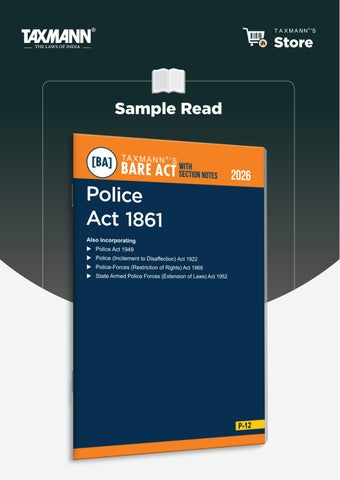
POLICE ACT 1861 – BARE ACT WITH SECTION NOTES AUTHOR : PUBLISHER : DATE OF PUBLICATION : EDITION : ISBN NO : NO. OF PAGES : BINDING TYPE :
Taxmann's Editorial Board Taxmann December 2025 2026 Edition 9789371268073 68 Paperback
Rs. 135 DESCRIPTION Police Act 1861 [Bare Act with Section Notes] by Taxmann is a comprehensive statutory compendium on police law and the regulation of police forces in India. This Edition consolidates the full, amended text of the Police Act 1861—the cornerstone legislation governing the organisation, administration, powers, and discipline of police forces—alongside key allied statutes and all significant state-specific amendments. Enriched with detailed section-wise notes, expert commentary, leading case law, and practical insights, this publication serves as an indispensable legal reference for law enforcement, governance, and criminal justice administration. This book is intended for the following audience: • Legal Practitioners, Judges & Judicial Officers • Police Officers & Law Enforcement Agencies • State & Central Government Departments • Academicians & Law Students • Researchers & Policy Analysts • Human Rights Organisations & NGOs The Present Publication is the 2026 Edition, covering the amended and updated text of the Police Act [Act No. 5 of 1861], with the following noteworthy features: • [Comprehensive Bare Act Text] Complete and updated text of the Police Act 1861 with all amendments and allied, state-specific modifications integrated up to date • [Updated & Amended] Incorporates all recent legislative changes, judicial pronouncements, and notifications • [Pre-amendment Provisions] Includes pre-amendment texts in relevant footnotes for historical and practical clarity • [Section-wise Notes & Expert Commentary] Detailed statutory notes, explanations, case law, and judicial precedents for each section • [Incorporation of Allied Acts] Covers Police Act 1949, Police (Incitement to Disaffection) Act 1922, Police-Forces (Restriction of Rights) Act 1966, and State Armed Police Forces (Extension of Laws) Act 1952 • [Coverage of State Amendments] Exhaustive notes on all relevant state and union territory amendments for jurisdiction-specific guidance • [Practical Tools] Ready reference tables, prescribed forms, subject index, and summaries for easy use • [Judicial Case Law] Leading and recent judgments interpreting major provisions, aiding both practice and research • [Clarity & Usability] Clear, concise drafting and user-friendly structure for seamless consultation
Buy Now