Sample Read
© Taxmann Price : ` 1795 Law stated in this book is as updated till 26th August, 2026 Published by : Taxmann Publications (P.) Ltd. Sales & Marketing : 59/32, New Rohtak Road, New Delhi-110 005 India Phone : +91-11-45562222 Website : www.taxmann.com E-mail : sales@taxmann.com Regd. Office : 21/35, West Punjabi Bagh, New Delhi-110 026 India Printed at : Tan Prints (India) Pvt. Ltd. 44 Km. Mile Stone, National Highway, Rohtak Road Village Rohad, Distt. Jhajjar (Haryana) India E-mail : sales@tanprints.com Disclaimer Every effort has been made to avoid errors or omissions in this publication. In spite of this, errors may creep in. Any mistake, error or discrepancy noted may be brought to our notice which shall be taken care of in the next edition. It is notified that neither the publisher nor the author or seller will be responsible for any damage or loss of action to any one, of any kind, in any manner, therefrom. It is suggested that to avoid any doubt the reader should cross-check all the facts, law and contents of the publication with original Government publication or notifications. No part of this book may be reproduced or copied in any form or by any means [graphic, electronic or mechanical, including photocopying, recording, taping, or information retrieval systems] or reproduced on any disc, tape, perforated media or other information storage device, etc., without the written permission of the publishers. Breach of this condition is liable for legal action. For binding mistake, misprints or for missing pages, etc., the publisher’s liability is limited to replacement within seven days of purchase by similar edition. All expenses in this connection are to be borne by the purchaser. All disputes are subject to Delhi jurisdiction only.
Contents PAGE
Division One LABOUR LEGISLATION - OVERVIEW
CHAPTER 1 Background of Labour Legislation
3
CHAPTER 2 Constitutional Background of Labour Laws
17
CHAPTER 3 %QOOQP &GſPKVKQPU KP .CDQWT %QFG
23
Division Two CODE ON SOCIAL SECURITY, 2020
CHAPTER 4 Background of Code on Social Security, 2020
67
CHAPTER 5 Social Security Organisations
83
I-5
CONTENTS
I-6 PAGE
CHAPTER 6 Social Security Schemes
117
CHAPTER 7 Employees’ Provident Fund Scheme, 2026
138
CHAPTER 8 Employees’ Pension Scheme, 2026 (EPS, 2026)
177
CHAPTER 9 Employees’ Deposit Linked Insurance Scheme, 2026
196
CHAPTER 10 Employees’ State Insurance Corporation (ESIC)
208
CHAPTER 11 Payment of Gratuity to Employee
266
CHAPTER 12 Special provision in respect of women employees
288
CHAPTER 13 Employees’ Compensation
302
CHAPTER 14 Social Security to Building and construction workers
338
I-7
CONTENTS PAGE
CHAPTER 15 Social security for unorganised workers
352
CHAPTER 16 Administration of Code on Social Security
363
CHAPTER 17 Offences and Penalties under Social Security Code
378
CHAPTER 18 Employment Information and Monitoring
385
CHAPTER 19 Other Provisions under Social Security Code
392
Division Three CODE ON WAGES, 2019
CHAPTER 20 Overview of Code on Wages
409
CHAPTER 21 Gender equality
417
CHAPTER 22 Minimum Wages
421
CONTENTS
I-8 PAGE
CHAPTER 23 Payment of Wages
432
CHAPTER 24 Payment of Bonus
441
CHAPTER 25 Responsibilities and liabilities of Employer under Code on Wages
454
CHAPTER 26 Administration of Code on Wages
462
CHAPTER 27 Offences and Penalties under Code on Wages
468
Division Four INDUSTRIAL RELATIONS CODE, 2020
CHAPTER 28 Overview of Industrial Relations Code, 2020
475
CHAPTER 29 Trade Unions
496
CHAPTER 30 Standing Orders and Notice of Change
513
I-9
CONTENTS PAGE
CHAPTER 31 Mechanism for resolution of industrial disputes
528
CHAPTER 32 Strikes and Lockouts
548
CHAPTER 33 Lay-off, Retrenchment and Closure
552
CHAPTER 34 Special provisions relating to lay-off, retrenchment and closure in establishments with 300 or more workers
568
CHAPTER 35 Offences and Penalties under Industrial Relations Code
578
CHAPTER 36 Other Provisions in Industrial Relations Code
587
Division Five OCCUPATIONAL SAFETY, HEALTH AND WORKING CONDITIONS CODE, 2020
CHAPTER 37 Overview of Occupational Safety, Health and Working Conditions Code
603
CHAPTER 38 Registration of establishment under Occupational Safety Code
615
CONTENTS
I-10 PAGE
CHAPTER 39 General duties of Employer and Employees under Occupational Safety Code
620
CHAPTER 40 5CHGV[ %QOOKVVGGU CPF 5CHGV[ 1HſEGT
641
CHAPTER 41 Health, safety and working conditions
649
CHAPTER 42 Welfare Provisions in establishment under Occupational Safety Code
668
CHAPTER 43 Hours of work and annual leave with wages
684
CHAPTER 44 Inspector-cum-Facilitators and other authorities under the Occupational Safety Code
703
CHAPTER 45 Contract Labour and Inter-State migrant labour
718
CHAPTER 46 5RGEKſE RTQXKUKQPU KP TGNCVKQP VQ #WFKQ XKUWCN YQTMGTU
738
CHAPTER 47 5RGEKſE RTQXKUKQPU KP TGNCVKQP VQ OKPGU
741
I-11
CONTENTS PAGE
CHAPTER 48 5RGEKſE RTQXKUKQPU KP TGNCVKQP VQ $GGFK CPF EKICT YQTMGTU
772
CHAPTER 49 5RGEKſE RTQXKUKQPU KP TGNCVKQP VQ $WKNFKPI QT QVJGT EQPUVTWEVKQP YQTMGTU
776
CHAPTER 50 5RGEKſE RTQXKUKQPU KP TGNCVKQP VQ HCEVQTKGU
777
CHAPTER 51 5RGEKſE RTQXKUKQPU KP TGNCVKQP VQ RNCPVCVKQP
783
CHAPTER 52 Offences and Penalties under Occupational Safety Code
786
CHAPTER 53 Other Provisions of Occupational Safety, Health and Working Conditions Code
803
Division Six MISCELLANEOUS SOCIAL WELFARE LEGISLATION
CHAPTER 54 Apprentices Act, 1961
817
CHAPTER 55 Child and Adolescent Labour Prohibition and Regulation
836
CONTENTS
I-12 PAGE
CHAPTER 56 Sexual Harassment of Women at Workplace Act, 2013
845
CHAPTER 57 Miscellaneous Social Security Laws
862
Division Seven DISCIPLINARY ACTION AGAINST EMPLOYEES AND PUNISHMENTS TO EMPLOYEES
CHAPTER 58 Disciplinary Action against Employee
873
CHAPTER 59 Domestic Enquiry
880
CHAPTER 60 Removal, Resignation, Probation and transfer of employee
905
CHAPTER 61 Appeal and judicial review against order of punishment SUBJECT INDEX
931 953
CHAPTER
11
Payment of Gratuity to Employee
11.1 Background of gratuity The provisions relating to payment of gratuity to employee are contained in Chapter V of Code on Social Security, 2020 [sections 53 to 58]. These provisions replace Payment of Gratuity Act, 1972. Common provisions in respect of all Social Security Schemes - Provisions relating to following are common for all Social Security Schemes (a) constitution and operation of Social Security Organisations (b) Administration (provisions relating to administration, inspection, inquiry, assessment, compliance, recovery etc.) (c) Offences and penalties. - - These are discussed under separate chapters. What is ‘gratuity’ - Gratuity is a lump sum payment to employee when he retires or leaves service. It is basically a retirement benefit to an employee so that he can live life comfortably after retirement or superannuation. However, under Payment of Gratuity Act (Now Code on Social Security, 2020), gratuity is payable even to an employee who resigns after completing at least 5 years of service. It is a social welfare legislation. Pension and gratuity coupled with contributory provident fund are well-recognised retirement benefits governed by various statutes - Sudhir Chandra Sarkar v. TISCO Ltd. (1984) 3 SCC 369 - quoted with approval in Allahabad Bank v. All India Allahabad Bank Retired Employees Association (2010) 2 SCC 44 = 2010 LLR 193 (SC). In DTC Retired Employees v. Delhi Transport Corporation (2001) 6 SCC 61 = 2001 AIR SCW 2005, it was observed that gratuity is essentially a retiring benefit which as per Statute has been made applicable on voluntary resignation as well. Gratuity is reward for good, efficient and faithful service rendered for a considerable period. In Ahmedabad Private Primary Teachers’ Association v. Administrative Officer 2004 AIR SCW 356 = 2004(1) SCC 755 = 2004 LLR 97 (SC), it was observed, ‘Payment of Gratuity Act is a piece of social welfare legislation and deals with payment of Gratuity which is a kind of retrial benefit like pension, provident fund etc. Gratuity is a gift, especially for services rendered, or return for favours received. The provisions of the Act are in nature of social security measures. Thus, the main purpose of Act is to help workman after retirement. ’Gratuity’ means gratuitous payment made to employee freely, voluntarily or without recompense. 266
267
CH. 11 : PAYMENT OF GRATUITY TO EMPLOYEE
Para 11.1
Gratuity is earned by an employee for long and meritorious service rendered by him. Gratuity is not paid to the employee gratuitously or merely as a matter of boon. It is paid to him for the services rendered by him - Garment Cleaning Works v. Its Workmen (1962) 1 SCR 711 = AIR 1962 SC 673 - quoted with approval in Secretary, ONGC Ltd. v. V U Warrier AIR 2005 SC 3039. In Burhanpur Tapti Mills v. Burhanpur Tapti Mills Mazdoor Sangh AIR 1965 SC 839, it was observed, ‘Gratuity is a lump sum payment considered necessary for an orderly and humane elimination from industry of superannuated or disabled employees. In D S Nakara v. UOI AIR 1983 SC 130 = 1983(1) LLN 289 (SC), it was observed that gratuity is a social welfare measure rendering socio-economic justice by providing economic security in the fall of life when physical and mental process is ebbing corresponding to ageing process. Such payment cannot be withheld unless specifically permitted by statutory provisions. Gratuity and pension is right, not bounty - In R Kapur v. Director of Inspection (1994) 6 SCC 589, it was held that pensions and gratuity are not bounties but valuable rights and property in hands of employee. If payment is delayed, interest will be payable - same view in State of Kerala v. M Padmanabhan Nair AIR 1985 SC 356 = 50 FLR 145 (SC) * D.D. Tiwari v. Uttar Haryana Bijli Vitran Nigam Ltd. 2015 LLR 126 and 2014 LLR 964 (SC). Payment of Gratuity Act (now Chapter V of Social Security Code) has overriding effect - Payment of Gratuity Act is a special provision and will have overriding effect over any scheme adopted by any employer - Municipal Corporation of Delhi v. Dharam Prakash Sharma AIR 1999 SC 293 = (1998) 7 SCC 221. Gratuity is statutory provision and is payable even if other benefit (like pension) is given and that scheme is more attractive, unless an exemption is obtained under section 5. Pension and gratuity are two separate elements of retirement benefits. It was also held that a remedial statutes like welfare, beneficent or social justice oriented legislation should always receive a liberal construction - Allahabad Bank v. All India Allahabad Bank Retired Employees Association (2010) 2 SCC 44 = 2010 LLR 193 (SC).
11.1-1 Applicability of provisions relating to gratuity As per First Schedule to Code on Social Security, 2020, provisions of gratuity apply to (a) every factory, mine, oil-field, plantation, port and railway company; and (b) every shop or establishment in which ten or more employees are employed, or were employed, on any day of the preceding twelve months; and such shops or establishments as may be notified by the appropriate Government from time to time. Shop - “Shop”, in respect of a State, means a shop as defined in any law for the time being in force dealing with the shop in that State - Section 2(76) of Code on Social Security, 2020. Oilfield - “Oilfield” shall have the meaning assigned to it in section 3(e) of the Oilfields (Regulation and Development) Act, 1948 - Section 2(53) of Code on Social Security, 2020.
Para 11.2
DIV. 2 : CODE ON SOCIAL SECURITY, 2020
268
Port - “Port” shall have the meaning assigned to it in section 3(4) of the Indian Ports Act, 1908 - Section 2(62) of Code on Social Security, 2020. Railway company - “Railway company” includes any persons whether incorporated or not, who are owners or lessees of a railway or parties to an agreement for working a railway - Section 2(67) of Code on Social Security, 2020.
11.1-2 No wage limit for eligibility of gratuity Gratuity is payable to an employee/workman irrespective of his salary/wages.
11.2 When gratuity is payable Gratuity shall be payable to an employee on the termination of his employment after he has rendered continuous service for not less than five years - (a) on his superannuation; or (b) on his retirement or resignation; or (c) on his death or disablement due to accident or disease; or (d) on termination of his contract period under fixed term employment; or (e) on happening of any such event as may be notified by the Central Government - Section 53(1) of Code on Social Security, 2020. Superannuation - “Superannuation”, in relation to an employee, means the attainment by the employee of such age as is fixed in the contract or conditions of service, as the age on the attainment of which the employee shall vacate the employment - Provided that for the purposes of Chapter III (EPF), the age of superannuation shall be fifty-eight years - Section 2(82) of Code on Social Security, 2020. Retirement - “Retirement” means termination of the service of an employee otherwise than on superannuation - Section 2(70) of Code on Social Security, 2020. Fixed term employment - “Fixed term employment” means the engagement of an employee on the basis of a written contract of employment for a fixed period - - Provided that—(a) his hours of work, wages, allowances and other benefits shall not be less than that of a permanent employee doing the same work or work of a similar nature; and (b) he shall be eligible for all benefits, under any law for the time being in force, available to a permanent employee proportionately according to the period of service rendered by him even if his period of employment does not extend to the required qualifying period of employment - Section 2(34) of Code on Social Security, 2020. Time limit three years for working journalists - In case of working journalist as defined in section 2(f) of the Working Journalists and Other Newspaper Employees (Condition of Service) and Miscellaneous Provisions Act, 1955, the expression “five years” occurring in section 53(1) shall be deemed to be three years - first proviso to section 53(1) of Code on Social Security, 2020. Five years’ service not required in specified cases - The completion of continuous service of five years shall not be necessary where the termination of the employment of any employee is due to death or disablement or expiration of fixed term employment or happening of any such event as may be notified by the Central Government - second proviso to section 53(1) of Code on Social Security, 2020.
269
CH. 11 : PAYMENT OF GRATUITY TO EMPLOYEE
Para 11.2
Meaning of disablement - For the purposes of section 53, disablement means such disablement as incapacitates an employee for the work which he was capable of performing before the accident or disease, resulting in such disablement - Explanation 2 to section 53 of Code on Social Security, 2020.
11.2-1 Payment of gratuity to nominee in case of death of employee In the case of death of the employee, gratuity payable to him shall be paid to his nominee or, if no nomination has been made, to his heirs, and where any such nominees or heirs is a minor, the share of such minor, shall be deposited with the competent authority as may be notified by the appropriate Government who shall invest the same for the benefit of such minor in such bank or other financial institution, as may be prescribed by the appropriate Government, until such minor attains majority - third proviso to section 53(1) of Code on Social Security, 2020.
11.2-2 Amount of gratuity payable For every completed year of service or part thereof in excess of six months, the employer shall pay gratuity to an employee at the rate of fifteen days’ wages or such number of days as may be notified by the Central Government, based on the rate of wages last drawn by the employee concerned - Section 53(2) of Code on Social Security, 2020. Completed year of service - “Completed year of service” means continuous service for twelve months - Section 2(17) of Code on Social Security, 2020. Mode of calculation of 15 days wages in case of monthly rated employee - For the purposes of section 53, it is clarified that in the case of a monthly rated employee, the fifteen days’ wages shall be calculated by dividing the monthly rate of wages last drawn by him by twenty-six and multiplying the quotient by fifteen - Explanation 3 to section 53 of Code on Social Security, 2020. Amount of gratuity in case of piece-rated employee - In the case of a piece-rated employee, daily wages shall be computed on the average of the total wages received by him for a period of three months immediately preceding the termination of his employment, and, for this purpose, the wages paid for any overtime work shall not be taken into account - first proviso to section 53(2) of Code on Social Security, 2020. Amount of gratuity in case of employee in seasonable establishment - In the case of an employee who is employed in a seasonal establishment and who is not so employed throughout the year, the employer shall pay the gratuity at the rate of seven days’ wages for each season - second proviso to section 53(2) of Code on Social Security, 2020. Employee working in seasonal establishment for full year - Even in case of seasonable establishment, some employees are employed for the whole year. In Coorg and Mysore Coffee v. Dy. Lab Commissioner 2001 LLR 214 (Kar HC DB), it was held that an establishment can be ‘seasonal establishment’ if two conditions co-exist i.e. (i) It should be a seasonal establishment and (ii) The employee should not have been employed throughout the year. Thus, even if an establishment is seasonal, employee will get full gratuity @ 15 days, if he works throughout the year.
Para 11.3
DIV. 2 : CODE ON SOCIAL SECURITY, 2020
270
Pro-rata gratuity in case of fixed term or deceased employee - In the case of an employee employed on fixed term employment or a deceased employee, the employer shall pay gratuity on pro rata basis - third proviso to section 53(2) of Code on Social Security, 2020.
11.2-3 Ceiling on quantum of gratuity The amount of gratuity payable to an employee shall not exceed such amount as may be notified by the Central Government - Section 53(3) of Code on Social Security, 2020. Maximum gratuity payable - Maximum gratuity payable under the Act is ` 20 lakhs w.e.f. 29-3-2018 [It was ` 10 lakhs w.e.f. 24-5-2010] [section 4(3) of Payment of Gratuity Act read with notification No. SO 1420(E) dated 29-3-2018]. Limit for income tax exemption under section 10(10) of Income Tax Act has also been increased to ` 20 lakhs w.e.f. 29-3-2018 - CBDT Notification No. 16/2019 and SO 1213(E) dated 8 March 2019.
11.2-4 Gratuity amount after disablement For the purpose of computing the gratuity payable to an employee who is employed, after his disablement, on reduced wages, his wages for the period preceding his disablement shall be taken to be the wages received by him during that period, and his wages for the period subsequent to his disablement shall be taken to be the wages as so reduced - Section 53(4) of Code on Social Security, 2020.
11.2-5 Employee can receive better amount as gratuity Nothing in section 53 shall affect the right of an employee to receive better terms of gratuity under any award or agreement or contract with the employer - Section 53(5) of Code on Social Security, 2020.
11.2-6 No gratuity to Government or Central Government employee For the purposes of this Chapter [Chapter V - Gratuity], employee does not include any such person who holds a post under the Central Government or a State Government and is governed by any other Act or by any rules providing for payment of gratuity Explanation 1 to section 53 of Code on Social Security, 2020.
11.3 Forfeiture of gratuity Notwithstanding anything contained in section 53(1), gratuity payable can be reduced or forfeited in following situations. (a) the gratuity of an employee, whose services have been terminated for any act, wilful omission or negligence causing any damage or loss to, or destruction of, property belonging to the employer, shall be forfeited to the extent of the damage or loss so caused - Section 53(6)(a) of Code on Social Security, 2020. (b) the gratuity payable to an employee may be wholly or partially forfeited— (i) if the services of such employee have been terminated for his riotous or disorderly
271
CH. 11 : PAYMENT OF GRATUITY TO EMPLOYEE
Para 11.3
conduct or any other act of violence on his part, or (ii) if the services of such employee have been terminated for any act which constitutes an offence involving moral turpitude, provided such offence is committed by him in the course of his employment - Section 53(6)(b) of Code on Social Security, 2020. The forfeiture is permissible only if there is valid order of dismissal for moral turpitude or riotous and disorderly behaviour. Thus, mere act of violence or riotous behaviour or moral turpitude is not sufficient. The termination of employment should be for that reason. In Management of Tournmulla Estate v. Workmen (1973) 2 SCC 502 = AIR 1973 SC 2344, it was held that if workman is guilty of serious misconduct such as acts of violence against the management or disorderly behaviour in or near place of employment, which though not directly causing damage, is conductive to grave indiscipline, then his gratuity can be forfeited in its entirety - quoted with approval in Bharat Coking Coal Ltd. v. Bihar Colliery Kamgar Union 2005 AIR SCW 1149 = AIR 2005 SC 2006 = 2005 LLR 373 (SC). If resignation is accepted, gratuity cannot be withheld on grounds of negligence and causing damage to property of company - Dunlop India Ltd. v. UOI 2003 LLR 1004 (Del HC) * Gujarat State Road Transport Corporation v. Devendrabhai Mulvantrai Vaidya 2007 LLR 407 (Guj HC) In Union Bank of India v. C.G. Ajay Babu 2018 LLR 1051 (SC), it was held that (i) forfeiture of gratuity is permissible if the termination of an employee is on account of riotous or disorderly conduct or any other act of violence on his part or (ii) if the act constitutes an offence involving moral turpitude and that too committed in the course of his employment - - It is for the Court apart from disciplinary proceedings to decide whether an offence involving moral turpitude has been committed or not - - Employer itself has no authority to decide that delinquent employee committed an offence involving moral turpitude. In the absence of conviction to the employee for offence of moral turpitude, by the criminal court, forfeiture of his gratuity is not justified. In order to deny gratuity to an employee, it is not enough that the alleged misconduct of the employee constitutes an offence involving moral turpitude as per the report of the domestic inquiry. There must be termination on account of the alleged misconduct, which constitutes an offence involving moral turpitude - Jorsingh Govind Vanjari v. Divisional Controller, Maharashtra State Road Transport Corporation 2017 LLR 200 (SC). Provision of forfeiture of gratuity under the Act does not speak of a conviction in a criminal proceedings, for an offence involving moral turpitude. Conviction in Criminal proceedings is not required. The Act provides for such forfeiture; in cases where the delinquent employee is terminated for a misconduct which constitutes an offence involving moral turpitude - Western Coal Fields Ltd. v. Manohar Govinda Fulzele 2025 LLR 361 (SC). In Abdul Rowther v. Appellate Authority 2007 LLR 1250 (Mad HC), it was held that for forfeiture of gratuity, there has to be positive termination of service for misconduct as stipulated in section 4(6) of Payment of Gratuity Act. Otherwise, forfeiture of gra-
Para 11.3
DIV. 2 : CODE ON SOCIAL SECURITY, 2020
272
tuity is not justified - same view in Karnataka State Road Transport Corpn (KSRTC) v. Mahadev 2009 LLR 138 (Karn HC DB) * Karnataka State Road Transport Corpn v. Mahadev 2009 LLR 978 (Karn HC) * Amod Prasad Rai v. State of UP 2009 LLR 1004 (All HC) * Vinod v. State of Maharashtra 2011 LLR 343 (Bom HC DB) * Maharashtra State Road Transport Corpn v. Maruti Ramchandra Mastud 2011 LLR 397 (Bom HC) * Jorsingh Govind Vanjari v. MSRTC (2017) 2 SCC 12. Gratuity cannot be withheld unless the employee was dismissed for riotous behaviour, even if employee was guilty of misconduct subversive to good behaviour - Jaya Hind Industries v. Vilak Vithalrao Takale 2011 LLR 638 (Bom HC). Gratuity can be forfeited only if service of employee was terminated for act causing damage, loss or destruction to employer’s property after giving him opportunity to employee and that the damage is quantified - Vijaya Bank v. Sri Mohan Das Ramana Shetty 2009 LLR 198 (Karn HC DB). Specific order of forfeiture of gratuity is required. Mere dismissal of an employee for riotous and disorderly behaviour will not justify forfeiture when there is no separate order of forfeiture - Manager, Park Side Estate v. Appellate Authority 2011 LLR 416 (Mad HC). Gratuity cannot be forfeited/withheld merely because a criminal case is pending Rajnagar Textile Mills v. Gunvant Lalchanddas 2010 LLR 869 (Guj HC) * New India Assurance Co. v. Ashwin Chimanlal Sheth 2011 LLR 66 (Guj HC). If there was no financial loss, forfeiture of gratuity is not permissible - Union Bank of India v. C G Ajay Babu (2018) 9 SCC 529. Gratuity cannot be forfeited for not vacating quarters. Further, before passing order under section 4(6), opportunity of personal hearing is required to be given to employee - Jehangir Textile Mills v. Sahebsingh Chotesingh 2011 LLR 265 (Guj HC). Forfeiture for loss or damage to company - Employer can forfeit gratuity if employee is terminated on charges of theft - Bharath Gold Mines v. Regional Labour Commissioner 1987 I LLN 308 = ILR 1986 Kar 2755 (Kar HC). In Mathew v. Plantation Corporation 2000(3) KLT 107 = 2001 LLR 123 (Ker HC DB), it was held that forfeiture only to the extent of loss or damage caused can be done where services of an employee are terminated for wilful omission or negligence causing damage to property belonging to employer. It was also held that gratuity is a statutory right and it can be withheld only in circumstances enumerated in section 4(6) of Gratuity Act. Bank can forfeit gratuity for loss caused to Bank by misconduct of the employee Ramchandra S Joshi v. Bank of Baroda 2010 LLR 1255 (Bom HC DB). In J P Micheal v. Appellate Authority 2002 LLR 7 (Kar HC), it was held that since gratuity only upto loss or damage can be deducted, it is necessary to issue notice to employee to assess the loss or damage, before passing order of forfeiture. In D S Chauhan v. Food Corporation of India 2009 LLR 499 (P&H HC DB), Assistant Manager was dismissed after enquiry for failure to maintain supervisory control,
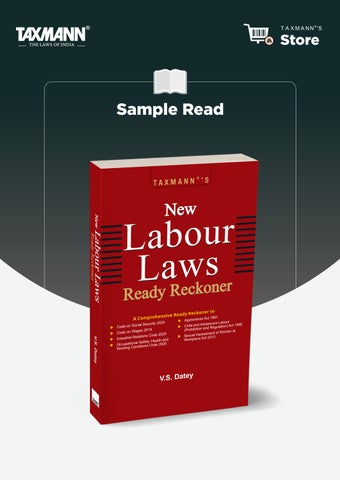
NEW LABOUR LAWS READY RECKONER AUTHOR : PUBLISHER : DATE OF PUBLICATION : EDITION : ISBN NO : NO. OF PAGES : BINDING TYPE :
V.S. Datey Taxmann September 2026 2026 Edition 9789375617402 976 Paperback
Rs. 1,795 DESCRIPTION New Labour Laws Ready Reckoner is a practitioner's desk reference to the four Labour Codes as they now operate. Each proposition is stated, sourced to the proviso or Explanation, and supported by judicial authority. Where the drafting is deficient, the author records it. This critical element sets the work apart. The author identifies provisions that appear to contradict their evident intent, requirements that cannot be met in practice, and definitions likely to generate litigation. The book proceeds on one premise: the Codes consolidate rather than reform. Precedent under the repealed Acts therefore remains good law, and the book makes it traceable under the new numbering. The law is updated to 26th August 2026, after the Codes came into force, the Central Rules were notified and the three provident fund schemes were replaced. This book is intended for the following audience: • HR and Industrial Relations Managers • Payroll and Compensation Teams • Chartered Accountants and Finance Controllers • Company Secretaries and In-House Counsel • Advocates Appearing Before Tribunals, Insurance Courts and the High Courts • Labour Law Consultants • Inspector-cum-Facilitators and Labour Department Officers • Aggregators and Platform Businesses • Employers' Associations and Trade Union Office Bearers • Faculty and Students The Present Publication is the 2026 Edition, authored by V.S. Datey, with the following noteworthy features: • [Rules Integrated, Not Appended] The 2026 Central Rules appear alongside the provisions they implement, not in an annexure • [Authority Cited to the Proviso] Every proposition closes with its source, down to the sub-section, proviso, Explanation, rule or scheme paragraph • [Section-wise Migration Charts] Each Code opens with tables mapping new sections to the provisions they replaced, so existing precedent, manuals and standing orders can be re-anchored without fresh research • [Extensive Case Law] Over 1,700 citations from more than 1,000 decisions, reported across LLR, AIR, SCC, FJR, FLR, LLJ and Lab IC, from the 1950s to 2026, with Bench strength noted • [Critical Assessment of Drafting] Defective, unworkable and litigation-prone provisions are identified with reasons, notably the common definition of wages • [Dedicated Chapters on the 2026 Schemes] The new EPF, EPS and EDLI Schemes are examined paragraph by paragraph, including the transition from the schemes they replaced • [Accounting Consequences] The seven FAQs issued in December 2025 on the financial reporting impact of the wage definition are reproduced, from past service cost to deferred tax • [Historical Limits Retained] Superseded wage ceilings and monetary limits are kept with their effective dates, for proceedings concerning earlier periods • [Rates Traced to Notifications] Every rate and threshold is traced to the notification that fixed it, with its exceptions • [Disciplinary Practice Included] A full division, built on Supreme Court and High Court authority, covers misconduct, domestic enquiry, punishment and judicial review, which the Codes omit • [Common Definitions in One Chapter] Terms shared across the Codes are treated once, with variations flagged • [Provisions Not Yet in Force Identified] Un-notified provisions and matters awaiting notification are identified, not presented as settled law
Buy Now