Sample Read
Contents LIMITATION ACT, 1963 PAGE
PART I PRELIMINARY 1. Short title, extent and commencement
1
2. Definitions
2 PART II
LIMITATION OF SUITS, APPEALS AND APPLICATIONS 3. Bar of limitation
4
4. Expiry of prescribed period when court is closed
5
5. Extension of prescribed period in certain cases
6
6. Legal disability
8
7. Disability of one of several persons
9
8. Special exceptions
10
9. Continuous running of time
10
10. Suits against trustees and their representatives
11
11. Suits on contracts entered into outside the territories to which the Act extends
11
PART III COMPUTATION OF PERIOD OF LIMITATION 12. Exclusion of time in legal proceedings
I-5
12
CONTENTS
I-6 PAGE
13. Exclusion of time in cases where leave to sue or appeal as a pauper is applied for
13
14. Exclusion of time of proceeding bona fide in court without jurisdiction
14
15. Exclusion of time in certain other cases
15
16. Effect of death on or before the accrual of the right to sue
17
17. Effect of fraud or mistake
17
18. Effect of acknowledgement in writing
19
19. Effect of payment on account of debt or of interest on legacy
20
20. Effect of acknowledgement or payment by another person
21
21. Effect of substituting or adding new plaintiff or defendant
22
22. Continuing breaches and torts
22
23. Suits for compensation for acts not actionable without special damage
22
24. Computation of time mentioned in instruments
22
PART IV ACQUISITION OF OWNERSHIP BY POSSESSION 25. Acquisition of easements by prescription
22
26. Exclusion in favour of reversioner of servient tenement
23
27. Extinguishment of right to property
23
PART V MISCELLANEOUS 28. [Repealed by the Repealing and Amending Act, 1974, w.e.f. 20-12-1974]
24
29. Savings
24
30. Provision for suits, etc., for which the prescribed period is shorter than the period prescribed by the Indian Limitation Act, 1908
25
31. Provisions as to barred or pending suits, etc.
26
32. [Repealed by the Repealing and Amending Act, 1974, w.e.f. 20-12-1974]
26
SCHEDULE: Periods of Limitation
27
SUBJECT INDEX
43
Limitation Act, 1963 [36 OF 1963]
An Act to consolidate and amend the law for the limitation of suits and other proceedings and for purposes connected therewith. BE it enacted by Parliament in the Fourteenth Year of the Republic of India as
follows:— PART I PRELIMINARY Short title, extent and commencement. 1. (1) This Act may be called the Limitation Act, 1963.* (2) It extends to the whole of India 1[***]. (3) It shall come into force on such date2 as the Central Government may, by notification in the Official Gazette, appoint. COMMENTS SECTION NOTES
1.1 Territorial Extent
This Act extends to the entire territory of India.
See Section 11 for applicability of this Act to contracts entered outside India
1.2 Suits, applications and appeals to which this Act applies
All suits and applications must be filed within the limitation periods specified respectively for them in the Schedule to this Act [See First Division (Articles 1 to 113), and Third Division (Articles 118 to 137), of the Schedule]
Appeals specified in the Schedule must be filed within the limitation periods specified respectively for them. [See Second Division of the Schedule (Articles 114 to 117)]
*Dated 5-10-1963. 1. Words “except the State of Jammu and Kashmir” omitted by the Jammu and Kashmir Reorganisation Act, 2019, w.e.f. 31-10-2019. 2. With effect from 1-1-1964.
1
S. 2
LIMITATION ACT, 1963
2
Every suit instituted, application made and specified appeal preferred after the prescribed period shall be mandatorily dismissed [Section 3]. This is so even if limitation is not pleaded as a defence by defendant/respondent.
1.3 Applicability of this Act to suits, applications & appeals under special law/local law
Where any special or local law prescribes for any suit, appeal or application a period of limitation different from the period prescribed by the Schedule, such suit, appeal or application must be filed within the limitation prescribed by the special or local law. If not so filed, same will be liable for mandatory dismissal as time-barred under section 3 [Section 29(2)]
However, for the purpose of determining any period of limitation prescribed for any suit, appeal or application by any special or local law, the provisions contained in sections 4 to 24 (inclusive) shall apply only in so far as, and to the extent to which, they are not expressly excluded by such special or local law. [Section 29(2)]
1.4 Non-applicability of this Act to any suit or other proceeding under any marriage or divorce law
Nothing in this Act shall apply to any suit or other proceeding under any law for the time being in force with respect to marriage and divorce. [Section 29(3)]
The above provision applies save as otherwise provided in any such law. In other words, this Act shall apply to suits or proceedings under such law if and to the extent such law provides so. [Section 29(3)]
Definitions. 2. In this Act, unless the context otherwise requires,— (a) “applicant” includes— (i) a petitioner; (ii) any person from or through whom an applicant derives his right to apply; (iii) any person whose estate is represented by the applicant as executor, administrator or other representative; (b) “application” includes a petition; (c) “bill of exchange” includes a hundi and a cheque; (d) “bond” includes any instrument whereby a person obliges himself to pay money to another, on condition that the obligation shall be void if a specified act is performed, or is not performed, as the case may be; (e) “defendant” includes— (i) any person from or through whom a defendant derives his liability to be sued; (ii) any person whose estate is represented by the defendant as executor, administrator or other representative; (f) “easement” includes a right not arising from contract, by which one person is entitled to remove and appropriate for his own profit any part of the soil belonging to another or anything growing in, or attached to, or subsisting upon, the land of another;
3
LIMITATION ACT, 1963
S. 2
(g) “foreign country” means any country other than India; (h) “good faith”— nothing shall be deemed to be done in good faith which is not done with due care and attention; (i) “plaintiff” includes— (i) any person from or through whom a plaintiff derives his right to sue; (ii) any person whose estate is represented by the plaintiff as executor, administrator or other representative; (j) “period of limitation” means the period of limitation prescribed for any suit, appeal or application by the Schedule, and “prescribed period” means the period of limitation computed in accordance with the provisions of this Act; (k) “promissory note” means any instrument whereby the maker engages absolutely to pay a specified sum of money to another at a time therein limited, or on demand, or at sight; (l) “suit” does not include an appeal or an application; (m) “tort” means a civil wrong which is not exclusively the breach of a contract or the breach of a trust; (n) “trustee” does not include a benamidar, a mortgagee remaining in possession after the mortgage has been satisfied or a person in wrongful possession without title. COMMENTS SECTION NOTES
2.1 Application [Section 2(b)]
This term includes petitions.
This term covers applications for leave to appeal, applications for review, applications for revision also.
However, this term does not cover suits and is to be distinguished from suits. [See Section 2(e)]
See Third Division of the Schedule to this Act (Articles 114 and 117)
2.2 ‘Period of Limitation’ and ‘Prescribed Period’ [Section 2(j)]
The term ‘period of limitation’ refers to the time frame specified in the Schedule of the Act for filing suits, appeals, or applications.
The “prescribed period” refers to this timeframe calculated according to the Act’s guidelines, ensuring standardized timing for the initiation of legal actions. [See Sections 4 to 24]
2.3 Suit [Section 2(e)]
This term is defined exclude appeals or applications.
This term would cover set-off claims & counter claims also [See Section 3(2)]
See Division A of the Schedule to this Act [Articles 1 to 113]
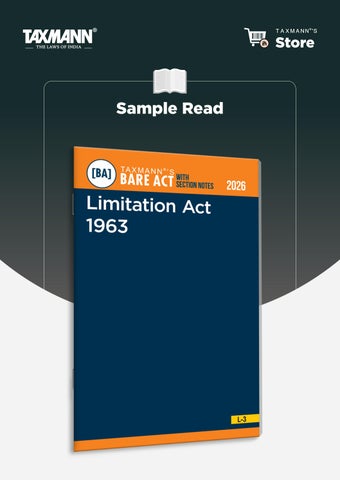
Limitation Act 1963 – Bare Act with Section Notes AUTHOR : PUBLISHER : DATE OF PUBLICATION : EDITION : ISBN NO : No. of Pages : BINDING TYPE :
Taxmann’s Editorial Board Taxmann December 2025 2026 Edition 9789371264884 52 Paperback
Rs. 120 DESCRIPTION Limitation Act 1963 [Bare Act with Section Notes] by Taxmann consolidates the law on the limitation of suits, appeals, and applications in Indian civil proceedings. It provides the full, updated text of the Limitation Act 1963, complemented by concise section notes that clarify terminology, highlight key legal concepts, and illustrate judicial interpretations. This publication offers a clear view of legislative intent and case law on the law of limitation. This book is intended for the following audience: • Lawyers & Advocates • Judges & Judicial Officers • Academics & Law Students • Corporate & Legal Departments • Litigants & General Readers The Present Publication is the 2026 Edition, covering the amended and updated text of the Limitation Act [Act No. 36 of 1963], with the following noteworthy features: • [Full Bare Act Text] Presents the verbatim text of the Limitation Act 1963 • [Section Notes] Offers concise explanations and commentary under each section • [Case Law References] Includes landmark Supreme Court and High Court decisions for key provisions • [User-friendly Format] Employs structured headings and numbering for efficient navigation • [Updated with Amendments] Integrates all relevant amendments (including State Amendments) up to date • [Tables & Schedules] Encloses the complete Schedule of Limitation Periods with quick-reference tables
• [Subject Index] Provides a comprehensive index for easy cross-referencing of sections and concepts
Buy Now