
Sample Read

© All rights reserved
Price : ` 3295
Law stated in this book is as amended by the Finance Act, 2026
Published by :
Taxmann Publications (P.) Ltd.
Sales & Marketing : 59/32, New Rohtak Road, New Delhi-110 005 India
Phone : +91-11-45562222
Website : www.taxmann.com
E-mail : sales@taxmann.com
Regd. Office : 21/35, West Punjabi Bagh, New Delhi-110 026 India
Printed at :
Tan Prints (India) Pvt. Ltd.
44 Km. Mile Stone, National Highway, Rohtak Road Village Rohad, Distt. Jhajjar (Haryana) India
E-mail : sales@tanprints.com
Disclaimer
Every effort has been made to avoid errors or omissions in this publication. In spite of this, errors may creep in. Any mistake, error or discrepancy noted may be brought to our notice which shall be taken care of in the next edition. It is notified that neither the publisher nor the author or seller will be responsible for any damage or loss of action to any one, of any kind, in any manner, therefrom. It is suggested that to avoid any doubt the reader should cross-check all the facts, law and contents of the publication with original Government publication or notifications.
No part of this book may be reproduced or copied in any form or by any means [graphic, electronic or mechanical, including photocopying, recording, taping, or information retrieval systems] or reproduced on any disc, tape, perforated media or other information storage device, etc., without the written permission of the publishers. Breach of this condition is liable for legal action.
For binding mistake, misprints or for missing pages, etc., the publisher’s liability is limited to replacement within seven days of purchase by similar edition. All expenses in this connection are to be borne by the purchaser. All disputes are subject to Delhi jurisdiction only.



CHAPTER 3
UNDISCLOSED INCOME, DEFINITIONS OF (SECTION
CHAPTER 4
ASSESSMENT OF TOTAL UNDISCLOSED INCOME AS A RESULT OF SEARCH (SECTION 292)
CHAPTER 5
COMPUTATION OF TOTAL UNDISCLOSED INCOME OF BLOCK PERIOD (SECTION 293)
CHAPTER 6
PROCEDURE FOR BLOCK ASSESSMENT (SECTION 294)
6.13
6.14
6.15
6.16
6.45
CHAPTER 7
UNDISCLOSED INCOME OF “OTHER PERSON” (SECTION 295)
Interpretation of “Belongs to”, “Pertains to” and “Relates to”
CHAPTER
8.6
8.7
8.8
8.28
CHAPTER 9
CHAPTER 10
LEVY OF INTEREST AND PENALTY IN CERTAIN CASES
CHAPTER 11
AUTHORITY COMPETENT TO MAKE ASSESSMENT OF BLOCK PERIOD (SECTION 299)
CHAPTER 12
APPLICATION OF OTHER PROVISIONS OF THIS ACT (SECTION 300)
12.2 Chapter XVI-B as a self-contained code and the supplementary role of section 300 of the IT Act, 2025
12.3 Application of time-limit provisions through section 300: Principle from CIT v. Paul Noel Rodrigues [2015] 57 taxmann. com 12 (Karnataka)
12.4 Inapplicability of reassessment provisions to block assessments under Chapter XVI-B
12.5 Block assessments under Chapter XVI-B and the role of procedural safeguards (Section 300, IT Act 2025)
12.6 Interpretation and scope of section 300: Applicability of other provisions to block assessments (IT Act, 2025)
12.7 Other provisions applicable to block assessment proceedings by virtue of section
12.8 Provisions not applicable to block assessments even under section 300 (IT Act, 2025)
CHAPTER 13
SEARCH AND SEIZURE (LAW AND PROCEDURE)
Where or at what places authorised officers
CHAPTER 14
REQUISITION
CHAPTER 15
STATEMENT U/S
CROSS EXAMINATION AND RETRACTION
of producing a third-party witness for cross-examination when the Revenue relies on their
gation
CHAPTER 16
PRESUMPTIONS UNDER IT ACT,
and
16.5 Comparison between section 292C of IT Act, 1961 and section 524 of IT Act,
16.6
16.17
16.22 Is the presumption u/s 247(7) absolute, or does it require corroboration?
16.23 The presumption u/s 247(7) does not automatically validate a document as proof of undisclosed income. The revenue needs corroborative evidence
“Information” for the purpose of presumption u/s 524 in a requisition u/s 248
Information that justifies the belief that the assets are undis-
Judicial review of information whether sufficient and relevant u/s 524 when applied via section 248
CHAPTER 17
ASSESSMENT
CHAPTER 18 ASSETS (STOCK)
CHAPTER 20
ASSET (VIRTUAL DIGITAL ASSETS)
20.6
20.7 Provision of Taxation of VDAs
20.8 Person Liable for TDS on transfer of VDAs
20.10 Investigation of Virtual Digital Assets in searches
20.11 Application of Sections 102-105 of the IT Act, 2025
20.12
20.13
CHAPTER 21
BURDEN OF PROOF
21.16 Indian Evidence Act (Bharatiya Sakshya Adhiniyam, 2023 (BSA)) in IT proceedings
21.17 Burden of proof as per Indian Evidence Act (now BSA)
21.18 Section 106 of Indian Evidence Act, 1872 and its application in IT proceedings
21.19 Section 68 of the IT Act, 1961 and Section 106 of the IE Act in IT proceedings
Onus to prove source of source
Distinction in burden u/s 68 of the IT Act, 1961, and u/s 102 of the IT Act, 2025
21.44 Burden of proof under section 103 of Income-tax Act, 2025
21.45 Burden of proof under section 69 of the Income-tax Act, 1961
21.46 Burden of proof when unexplained credits are found in an individual’s bank account
21.47 Burden of Proof – Section 69 (Income-tax Act, 1961) vs. Section 103 (Income-tax Act, 2025)
Burden of proof under section 104 of the Income-tax Act, 2025
Burden of proof u/s 104 when an assessee is found in possession of unexplained money
21.51 Comparison of burden of proof under section 69A of the Income-tax Act, 1961 and section 104 of the Income-tax Act, 2025
Burden of proof requirement when an assessee claims that an investment was made from known sources of
CHAPTER 22
where the Courts have considered proper, the application of section 65B of Indian Evidence Act, 1872
where the Courts
considered improper or incorrect, the application of section 65B of the Indian Evidence Act, 1872
CHAPTER 23
BLOCK ASSESSMENTS AND COMMON ERRORS IN ACCOUNTS (INTEGRITY IN ACCOUNTING-PITFALLS, PATTERNS, AND PRECAUTIONS)
CHAPTER 24
CHAPTER 25
TAXABILITY OF INCOME ARISING FROM ACCOMMODATION ENTRIES
25.10
25.11
CHAPTER 26
CONCEPT
CREDIT
BOGUS SALES
CHAPTER 28
DEEMED INCOME UNDER SECTION 102
28.20 Addition of cash credits u/s 102 as business income or as income from other sources
28.21 Cash deposit in the bank out of sale proceeds of immovable property
28.22 Applicability of other provisions like section 195 and section 443 in respect of addition made u/s 102
28.24
28.25
CHAPTER 29
DEEMED INCOME UNDER SECTION 103
‘if any’ occurring in section
29.7
29.8
29.13 Section 92(2)(m) to apply in addition to section 103 of the IT Act, 2025, (Equivalent to section 56(2)(vii)/(x) and section 69 of the IT Act, 1961
CHAPTER 30
30.9
CHAPTER 31
DEEMED INCOME UNDER SECTION 105

COMPUTATION OF TOTAL UN-



DISCLOSED INCOME OF BLOCK
PERIOD (SECTION 293)
5.1 Introduction
5.1-1
Background
Section 293 of the Income-tax Act, 2025, read with the governing framework under Section 292, prescribes the methodology for computing the total undisclosed income of the block period in cases where search or requisition has been initiated under Chapter XVI-B. Under the new regime, the total undisclosed income comprises: (a) undisclosed income declared in the return furnished under Section 294, and (b) undisclosed income determined by the Assessing Officer under Section 293(4), based upon evidence unearthed during search, requisition, or search connected survey proceedings.
However, Section 293(2) carves out defined exclusions. Income already assessed under regular provisions—such as Sections 270(1), 270(10), 271, 279 or 294(1)(c) of the 2025 Act or under earlier law (Sections 143, 144, 147, 153A, 153C, 158BC, 245D(4) of the 1961 Act)—is excluded from block computation. Likewise, income declared in valid returns under Section 263 (or under Section 139 of the 1961 Act), or in response to notice under Section 268(1) (or earlier Section 142(1)), before the date of search or requisition, is kept outside the purview of block computation.
Further, income supported by entries in books of account, recorded in the ordinary course before the date of search, also stands excluded. This exclusion covers: (i) income of a completed tax year for which the return due date had not expired before the search (ii) income from the beginning of the tax year up to the day immediately preceding the search; and (iii) income during the period from search till the last authorisation, provided such entries existed in regular books of accounts before execution of the final warrant.
Statutorily protected incomes—such as those under Sections 207(8), 216, 393(1) of the 2025 Act as well as those earlier governed by Sections 115A(5), 115G or 194P(1) of the 1961 Act—are similarly excluded.
Importantly, income relating to international transactions or specified domestic transactions within the period defined in Section 293(5) must be assessed separately under Section 166, and cannot be included in the block computa-
tion, notwithstanding Section 292(6). The provision provides that specialised transfer-pricing adjudication remains outside undivided block taxation.
For a firm, Section 293(6) mandates computation of undisclosed income prior to partner-level deductions, except where the partner is a working partner. The section also applies the provisions of Sections 102–105 for unexplained credits or investment or expenditure and recognises interaction with Section 166 for transfer-pricing purposes.
Further, brought-forward losses or unabsorbed depreciation under Section 33(11) (or those relatable to pre-block tax years) cannot be set off against undisclosed block income, though they may be carried forward for adjustment in later tax years under Section 293(9).
Undisclosed income computed under Section 293 is chargeable to tax at the special rate prescribed in Section 192, as mandated by Section 292(7), treating such income as that of the block period irrespective of the particular tax years involved.
5.1-2 The provision
Computation of total undisclosed income of block period.
293. (1) The total undisclosed income of the block period referred to in section 292(1) shall be the aggregate of the following:—
(a) undisclosed income declared in the return furnished under section 294;
(b) undisclosed income determined by the Assessing Officer under sub-section (4).
(2) The following income shall not be included in the total undisclosed income of the block period:––
(
a) the total income determined or assessed, as the case may be, under section 270(1) or (10) or section 271 or 279 or 294(1)(c) of this Act or section 143 or 144 or 147 or 153A or 153C or 158BC or 245D(4) of the Income-tax Act, 1961, prior to the date of initiation of the search or the date of requisition, in respect of any of the tax year falling within the block period;
(
b) the total income declared in the return of income filed under section 263 of this Act or section 139 of Income-tax Act, 1961, or in response to a notice under section 268(1) of this Act or section 142(1) of Income-tax Act, 1961, prior to the date of initiation of the search or the date of requisition, in respect of any of the tax year falling within the block period, and not covered under clause (a);
(c) the income computed by the assessee, in respect of––
(i) a tax year, where such tax year has ended and the due date for furnishing the return for such year has not expired prior to the date of initiation of the search or the date of requisition, on the basis of entries relating to such income or transactions as recorded in the books of account and other documents maintained in the normal course before the date of initiation of search or the date of requisition;
(ii) the period commencing from the 1st April of the tax year in which the search is initiated or requisition is made and ending on the day immediately preceding the date of initiation of search or requisition, on the basis of entries relating to such income or transactions as recorded in the books of account and other documents maintained in the normal course for such period on or before the day immediately preceding the date of initiation of search or the date of requisition;
(iii) the period commencing from the date of initiation of the search or the date of requisition and ending on the date of the execution of the last of the authorisations for search or requisition, on the basis of entries relating to such income or transactions as recorded in the books of account and other documents maintained in the normal course for such period on or before the date of the execution of the last of the authorisations;
(d) the total income referred to in section 207(8) or section 216 or section 393(1) [ Table: Sl. No. 8(iii)] of this Act, or section 115A(5) or section 115G or 194P(1) of the Income-tax Act, 1961.
(3) For the purposes of sub-section (2)(c), where the Assessing Officer is of the opinion that any part of the income as computed by the assessee under the said sub-section is undisclosed, he may recompute such income.
(4) The undisclosed income falling within the block period, shall be computed on the basis of following:––
(
a) evidence found as a result of search or survey or requisition;
(b) any other material or information as are either available with the Assessing Officer or comes to his notice during the course of proceedings under Part B.
(5) Where any income required to be determined —
(a) as a result of search or requisition of books of account or other documents, or based on any other material or information as are either available with the Assessing Officer or comes to his notice during the course of proceedings under this Part; or
(b) based on entries relating to income or transactions as recorded in books of account and other documents maintained in the normal course on or before the date of the execution of the last of the authorisations, relates to any international transaction or specified domestic transaction referred to in section 166, and pertains to the period beginning from the 1st April of the tax year in which last of the authorisations was executed and ending with the date of execution of the last of the authorisations, then irrespective of provisions of section 292(6)—
(i) such income shall not be considered for the purposes of determining the total undisclosed income of the block period; and
(ii) such income shall be considered in the assessment made under other provisions of this Act.
(6) For the purposes of determination of undisclosed income,––
(a) of a firm, such income assessed for each of the tax years falling within
the block period shall be the income determined before allowing deduction of salary, interest, commission, bonus or remuneration, by whatever name called, to any partner not being a working partner;
(
b) the provisions of sections 102, 103, 104 and 105 shall, so far as may be, apply and reference to tax year in those sections shall be construed as references to the relevant tax year falling in the block period;
(
c) the provisions of section 166 shall, so far as may be, apply and reference to tax year in that section shall be construed as reference to the relevant tax year falling in the block period excluding the period referred to in sub-section (5).
(7) The tax referred to in section 292(7) shall be charged on the total undisclosed income pertaining to the block period determined in the manner specified in sub-sections (1), (2) and (3).
(8) For the purposes of assessment, losses brought forward from the tax year (prior to the first tax year comprising the block period) under Chapter VII or unabsorbed depreciation under section 33(11) shall not be set off against the undisclosed income determined in the block assessment under this part.
(9) Losses or unabsorbed depreciation as referred to in sub-section (8) may be carried forward for being set off in the tax year subsequent to the tax year in which the block period ends, for the remaining period, taking into account the block period and such tax year, and as per the provisions of this Act.
5.1-3 Scope and analysis of section 293
(
Computation
of Total Undisclosed Income of the Block Period)
(1) Legislative Purpose and Position of Section 293 in the Block Assessment Scheme:
Section 293 constitutes the computational backbone of the block assessment framework under the Income-tax Act, 2025. While Section 292 establishes the jurisdictional and procedural machinery for block assessment arising out of search or requisition, Section 293 operationalises that framework by prescribing how the “total undisclosed income of the block period” is to be computed.
(2) Aggregate Method of Computation under sub-section (1):
Sub-section (1) adopts a two-component aggregate model for determining total undisclosed income of the block period. It provides that such income shall be the sum of:
(a) undisclosed income voluntarily declared by the assessee in the block return filed under Section 294; and
(b) undisclosed income determined by the Assessing Officer under sub-section (4).
(3) Exclusion of Income Already Assessed or Determined Prior to Search:
Sub-section (2)(a) embodies a critical safeguard against double taxation and re-assessment of concluded matters. It excludes from block income
any total income that has already been determined or assessed under specified provisions of the 2025 Act or corresponding provisions of the 1961 Act prior to the date of initiation of search or requisition. This includes assessments under regular, reassessment, settlement, and prior block-assessment provisions.
The legislative intent is explicit: block assessment is not a mechanism for reopening completed assessments, but a special procedure confined to income that escaped disclosure and assessment before the search.
(4) Exclusion
of Income Declared in Returns Filed Prior to Search:
Sub-section (2)(b) further excludes income that was already declared in a return of income filed before the date of search or requisition, whether under voluntary filing provisions or in response to statutory notices. This exclusion applies even if such income had not yet been assessed, provided it was properly disclosed in the return.
(5) Treatment of
Recorded Income for Years Where Return Due Date Had Not Expired:
Sub-section (2)(c)(i) addresses a nuanced situation where the tax year had ended but the due date for filing the return had not expired prior to search. Income computed by the assessee on the basis of entries already recorded in books maintained in the normal course is expressly excluded from block income.
(6) Recorded Income of the Pre-Search Portion of the Search Year:
Sub-section (2)(c)(ii) excludes income relating to the period from 1 April of the search year up to the day immediately preceding the date of initiation of search, provided such income is recorded in the regular books before search. This ensures that income accrued and duly recorded before search is segregated from income detected during search, preserving the distinction between regular and undisclosed income.
(7) Recorded Income up to Execution of Last Search Authorisation
Sub-section (2)(c)(iii) extends similar protection to the period between the initiation of search and the execution of the last authorisation, provided entries are recorded in the normal course on or before such execution. This clause acknowledges that searches may extend over multiple days and that genuine business transactions recorded contemporaneously cannot automatically be branded as undisclosed merely due to search continuity.
(8)
Exclusion of Income Subject to Special Final-Tax Regimes
Sub-section (2)(d) excludes income covered by certain special charging or final-tax provisions, both under the 2025 Act and the 1961 Act. Such income, by legislative design, is subject to distinct computation
and taxation mechanisms, and its inclusion in block income would disrupt the integrity of those regimes.
This reflects the principle that block assessment does not override all special charging provisions, unless expressly stated.
(9) Power of Re-computation by the Assessing Officer
Sub-section (3) empowers the Assessing Officer to recompute income claimed as excluded under sub-section (2)(c), if he forms an opinion that such income, or part thereof, is in fact undisclosed. This provision acts as a counter-balance to misuse, ensuring that mere book entries are not used as a shield for camouflage of undisclosed income.
However, the power is not automatic; it requires formation of opinion based on material, thereby preserving procedural fairness.
(10) Evidentiary Basis for Computation under sub-section (4):
Sub-section (4) defines the permissible evidentiary universe for computing undisclosed income. It restricts computation to:
(a) evidence found as a result of search, survey, or requisition; and
(b) other material or information available with or coming to the notice of the Assessing Officer during proceedings under Part B.
(11)
Exclusion
of Transfer Pricing Income from Block Computation:
Sub-section (5) carves out a significant exception for international transactions and specified domestic transactions falling within the purview of Section 166. Income relating to such transactions, even if detected during search, is expressly excluded from block computation for the specified period and is to be assessed under regular provisions.
(12) Determination of Undisclosed Income in the
Case of Firms
:
Sub-section (6)(a) lays down a special rule for firms, providing that undisclosed income shall be computed before allowing deductions for payments to non-working partners. This ensures uniformity and prevents manipulation of distributive mechanisms to reduce block income.
The focus remains on entity-level concealment, not post-determination allocation.
(13) Application of Clubbing and Anti-Avoidance Provisions:
Sub-section (6)(b) applies certain clubbing and anti-avoidance provisions to block assessments, with necessary adaptation of references to tax years within the block period. This ensures that substantive anti-avoidance principles continue to operate, even within the special block regime.
(14) App lication of Transfer Pricing Provisions for Non-Excluded Periods:
Sub-section (6)(c) clarifies that Section 166 applies, mutatis mutandis, to block periods except for the portion excluded under sub-section (5). This maintains coherence between block assessment and transfer pricing law without overlapping jurisdictions.
(15) Charging of Tax on Computed Undisclosed Income:
Sub-section (7) links computation under Section 293 directly with charging under Section 292(7). It provides that tax shall be charged on undisclosed income determined in accordance with sub-sections (1), (2), and (3), reinforcing that charging follows computation, and not vice versa.
(16) Prohibition on Set-off of Brought-Forward Losses:
Sub-section (8) bars the set-off of brought-forward losses or unabsorbed depreciation against undisclosed income determined in block assessment. This provision reinforces the penal-deterrent character of block assessment and ensures that concealed income is taxed independently of prior losses.
(17) Preservation of Carry-Forward Rights Post Block Period:
Sub-section (9) balances the harshness of sub-section (8) by allowing such losses or unabsorbed depreciation to be carried forward and set off in subsequent years after the block period ends.
(18) Integrated Reading with Section 292 and Section 294:
Section 293 must be read as an integral part of the block assessment code comprising Sections 292 to 296. While Section 292 governs jurisdiction and abatement, and Section 294 governs filing and assessment procedure, thus only legally permissible income enters the computation base.
(19) Jurisprudential Significance of Section 293:
The structure of Section 293 reflects judicial learning from litigation under Chapter XIV-B of the 1961 Act. Courts have consistently held that block assessments are confined to undisclosed income supported by evidence.
(20) Safeguard Against Arbitrary Expansion of Block Income:
By expressly listing inclusions, exclusions, evidentiary limits, and computational prohibitions, Section 293 prevents the Assessing Officer from artificially inflating block income.
5.1-4 Evolution of the provision for “Computation of Total Undisclosed Income of the Block Period” during four phases:
(1) Background and Legislative Trajectory:
The statutory method for computing undisclosed income in search cases has evolved through four distinct phases, moving from the original Chapter XIV-B regime (1995–2003), to its revival in 2024, followed by technical alignment in 2025, and finally codification in the Income-tax Act, 2025 as Section 293 operative from 1 April 2026. Across these phases, the computation framework has progressively shifted from a broad aggregation model prone to interpretational disputes toward a more structured mechanism that clearly separates (i) what constitutes block undisclosed income, (ii) what must be excluded to avoid duplication, and (iii) what must be assessed under normal provisions due to conceptual or technical incompatibility with block assessment.
(2) Phase I (1995–2003):
(i) Section 158BB as an Aggregation-and-Reduction Model: Phase I began with the insertion of Chapter XIV-B, with Section 158BB becoming the core computation provision. The basic approach was to compute the undisclosed income of the block period as the aggregate of total income of previous years falling within the block period, computed on the basis of evidence found during search/requisition and other materials available with the Assessing Officer, and then reduce that aggregate by already-determined incomes (or adjust for losses) for those years. This produced a hybrid model: block income was not simply “what is found,” but “aggregate total income,” recalibrated by prior assessed/disclosed figures.
(ii) Prior Assessment Status and Return-Filing : A defining feature of old Section 158BB(1) was its classification by procedural status of each year—concluded assessments, filed returns but pending assessments, no returns filed despite due date expiry, and years where return due date had not expired. In effect, the computation mechanism embedded procedural logic into the definition of what should be considered undisclosed for each year. This structure attempted to ensure fairness by granting credit to what was already assessed or disclosed, but it also invited litigation because the computation depended heavily on how far the regular assessment cycle had progressed on the date of search.
(iii) Exclusions and Set-off Rules: The Explanation to Section 158BB introduced important restrictions: aggregation was to be done without giving effect to set-off of brought-forward losses and unabsorbed depreciation, signalling a deterrent character.
Yet, it still allowed certain adjustments for Chapter VI-A deductions, reflecting a partial accommodation of normal computation principles. Additionally, specific rules were framed for firms (income before partner remuneration etc.). The regime also placed the burden of proof on the assessee to show that income had already been disclosed in a prior return. In practice, these features demonstrated an enforcement-centric design, but the complexity of applying these rules year-by-year under a “block period” umbrella contributed to prolonged litigation, culminating in the eventual repeal of Chapter XIV-B in 2003.
(3) Phase II (01-09-2024 to 31-01-2025):
(i) Revival and Structural Recasting of Section 158BB: After two decades, block assessment was revived by Finance (No. 2) Act, 2024 effective 1 September 2024. Computation under Section 158BB was no longer framed as a single aggregation-reduction formula. Instead, it adopted a clear two-limb structure: (a) undisclosed income declared in the block return; and (b) undisclosed income determined by the Assessing Officer. This was a major conceptual reorientation: computation was now rooted in the idea that block income is a combination of voluntary disclosure plus departmental determination, rather than an aggregate of “total income of years” adjusted by prior outcomes.
(ii) Explicit Exclusion List to Prevent Double Counting: A decisive development in Phase II was the introduction of a detailed negative list of incomes that shall not be included in block income. Income already determined or assessed under regular provisions (e.g., concluded assessments, reassessments, earlier block assessments, settlement orders) prior to search was excluded. Similarly, income declared in returns filed before search (even if not assessed) was excluded unless already covered. This reform directly addressed the most litigated aspect of the older regime: whether and how disclosed/assessed income can be reintroduced into block computation. The Phase II drafting reduced ambiguity by expressing exclusions in direct statutory language rather than relying mainly on computational adjustments.
(iii) Book-Entry Safe Harbour with AO Re-computation Power: Phase II also introduced refined treatment of the “current previous year” and pre-return-due-date situations. Income computed by the assessee on the basis of entries recorded in books maintained in the normal course—covering (i) a year ended but return due date not expired, (ii) the pre-search portion of the search year, and (iii) the period from search initiation to last authorisation execution—was excluded. Importantly, a safeguard was retained: if the Assessing Officer believed that any part
of such computed income was actually undisclosed, he could recompute it. This arrangement shows legislative balancing: recorded entries are respected, but the revenue is not barred from examining whether such entries are genuine or merely post-facto camouflage.
(iv) Evidence-Based Computation and Transfer Pricing CarveOut: Phase II formally stated that undisclosed income is to be computed on the basis of evidence found as a result of search/ survey/requisition and other material available to or noticed by the Assessing Officer during proceedings. This reinforced the “evidence nexus” principle. Additionally, Phase II introduced a specific carve-out for income relating to international transactions or specified domestic transactions involving transfer pricing (then linked to section 92CA), excluding such income from block income for a part-period and directing it to normal assessment. This acknowledged that transfer pricing methodology and partyear arm’s length determinations are structurally unsuitable for block computation.
(4) Phase III (01-02-2025 to 31-03-2026):
(i) Technical Alignment and Litigation-Reduction Amendments: Phase III, effective from 1 February 2025, did not rewrite the computation philosophy but fine-tuned the revived framework to close drafting gaps and reduce interpretational friction. One major change was the expansion of the definition of “undisclosed income” to include “virtual digital asset,” reflecting the evolving asset landscape in search cases. Although this change is conceptually located in the definitional provision, its practical impact is computational: VDAs discovered during search now fit clearly within the block income architecture, preventing arguments that digital assets fall outside the intended scope.
(ii) Clarifying “Undisclosed Income” v. “Total Income Disclosed”: Phase III proposed amendments to align language within Section 158BB of IT Act, 1961, so that references to “total income disclosed” were substituted with “undisclosed income declared” in the return. This linguistic adjustment is legally meaningful. It emphasised that the declared component under block return is not a general “total income” of the period, but specifically the part declared as undisclosed for block purposes.
(iii) Refinements in Treatment of Pre-Search Returns and Current-Year Periods: Phase III proposed clarifications that income declared in returns filed before search would form part of the total income of the block period for which credit would be given while charging tax, and also refined language in clauses dealing with periods and book-based computation. The legisla-
tive aim was to ensure that recorded/book-based incomes for a year where the return due date had not expired are taxed under normal provisions, not swept into block computation.
(iv) Recasting the Transfer Pricing Exclusion Logic: Phase III also proposed to amend the transfer pricing-related sub-section to clarify that it is the income pertaining to international/ specified domestic transactions that shall not be considered in block income (rather than focusing on “evidence” as the earlier drafting may have implied). This shift matters because block assessment is evidence-driven, but transfer pricing adjustments are methodology-driven; the amendment aligns the text with the underlying rationale: such income is excluded because it is computationally unsuitable for block determination for a part-period.
(5) Phase IV (From 01-04-2026):
(i) Codification as Section 293 of the IT Act, 2025: Phase IV marks the formal transplantation and codification of the computation framework into the Income-tax Act, 2025 as Section 293, applicable from 1 April 2026. The structure substantially preserves the Phase II–III approach: total undisclosed income equals (a) undisclosed income declared in the block return under Section 294 plus (b) undisclosed income determined by the Assessing Officer under sub-section (4).
(ii) Expanded Cross-Referencing and Systemic Integration:
Section 293(2) contains an expanded and updated exclusion list that references both 2025 Act provisions and legacy 1961 Act provisions, covering various assessment routes, reassessment routes, prior search assessments, and settlement orders. This cross-referencing is not merely transitional; it is a deliberate integration mechanism ensuring that whatever route was used to determine income prior to search, such income does not get re-taxed as block undisclosed income.
(iii) Evidence Base and “Other Material” Formulation: Section 293(4) expressly recognises two computation bases: evidence found from search/survey/requisition and other material/information available to the AO or coming to notice during proceedings. This codifies the workable reality that search assessments often involve both seized evidence and corroborative material gathered during proceedings.
(iv) Transfer Pricing Exclusion with Reference to Section 166: Section 293(5) continues the special treatment of international and specified domestic transactions, now linked to Section 166 under the 2025 Act. It provides that such income for the
specified period is not to be considered for determining total undisclosed income of the block period and must be assessed under other provisions. This provision clarifies that, irrespective of Section 292(6), the transfer pricing domain remains outside block computation for the sensitive part-period.
(v) Loss Set-off Bar and Post-Block Carry-Forward: Section 293(8) and (9) provide a strong deterrent rule (no set-off of brought-forward losses or unabsorbed depreciation against undisclosed block income) while preserving economic fairness by allowing those losses to be carried forward and set off in later years after the block period ends. Compared to Phase I, this arrangement is clearer and better structured. It preserves the principle that concealed income must bear tax independently, but it avoids permanently extinguishing legitimate loss attributes, thus balancing deterrence and neutrality.
(6) Overall Conclusion:
From Complex Year-Wise Adjustments to Structured Inclusion-Ex-
clusion Architecture: Across four phases, the computation provision has evolved from an intricate aggregation-reduction model (Phase I) into a structured architecture based on: (i) two-source computation (declared + determined), (ii) explicit statutory exclusions for assessed/ declared/recorded income, (iii) evidence-based determination with defined scope, (iv) special carve-outs for transfer pricing complexity, and (v) a deterrence-oriented but balanced loss treatment. Phase IV (Section 293) represents the culmination of legislative learning—preserving the enforcement strength of block assessment while significantly improving clarity, administrability, and litigation resilience in the computation of total undisclosed income of the block period.
CONCEPTUAL FOUNDATIONS AND STATUTORY FRAMEWORK
5.2 Legal requirement of computing undisclosed income in block
assessments
Undisclosed income under Section 293 must be based strictly on evidence found during the search or requisition, or material or information that relates to such evidence. Income cannot be treated as undisclosed unless it is supported by seized books, documents, valuables, or other verifiable assets. Courts have emphasized that mere statements or post-search enquiries that are not linked to material found during the search cannot be the basis for block additions. For example, where additions were made only on the basis of entries traced from bank statements filed subsequently and not traceable to seized material, such additions were held invalid.
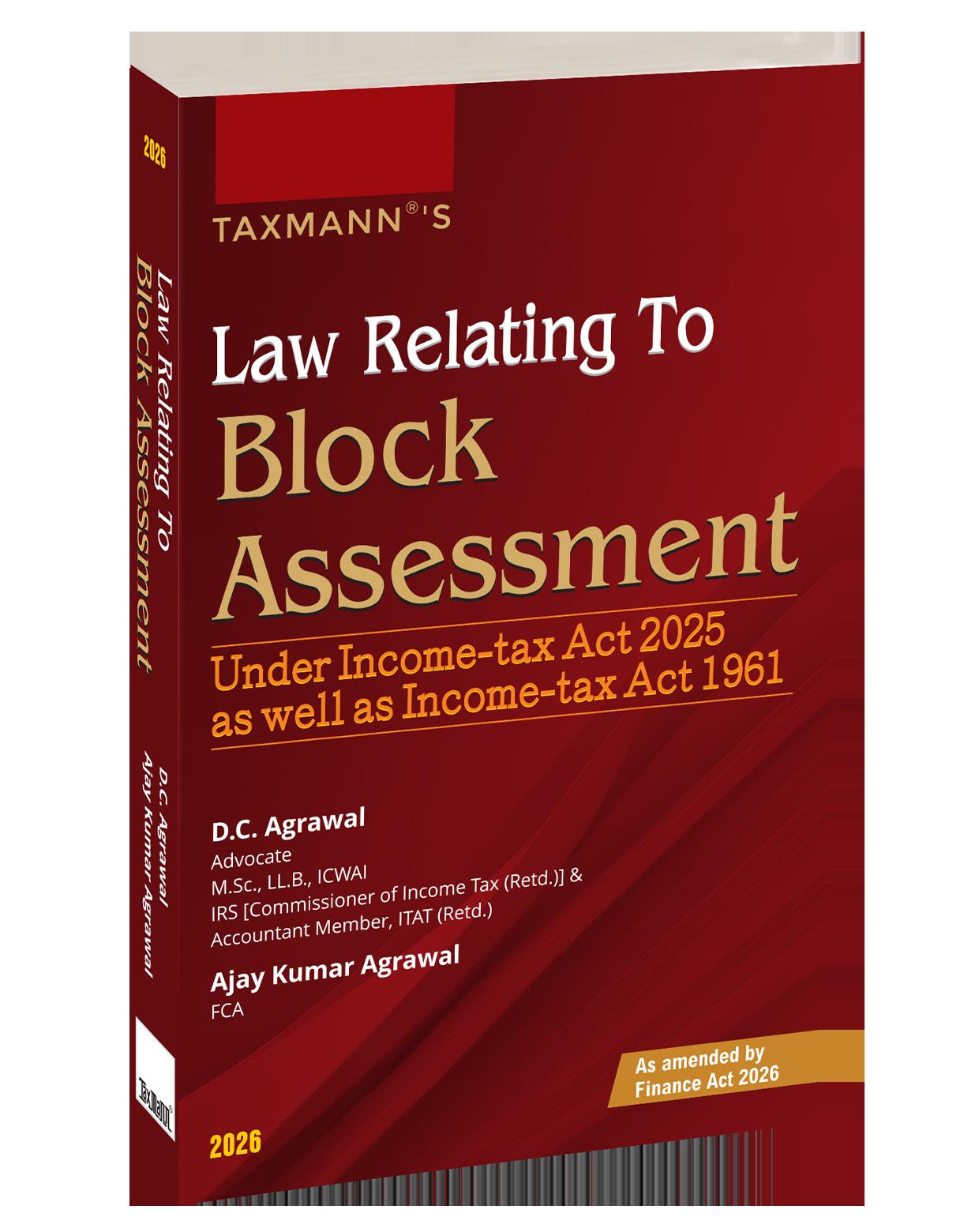
Law Relating To Block Assessment
AUTHOR : D.C. Agrawal, Ajay Kumar Agrawal
PUBLISHER : Taxmann
DATE OF PUBLICATION : April 2026
EDITION : 2026 Edition
ISBN NO : 9789375617990
No. of Pages : 1192
BINDING TYPE : Paperback
Rs. 3,295
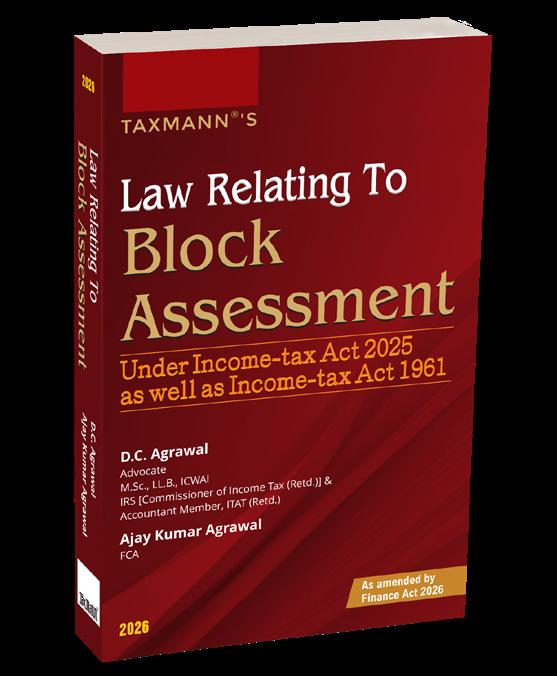
DESCRIPTION
Law Relating To Block Assessment is the leading contemporary work on India’s revived block assessment regime. The book’s distinguishing position is that it does not treat block assessment under the 2025 Code as a stand-alone subject. Instead, it reads the new framework against the entire body of Chapter XIV-B jurisprudence developed between 1995 and 2003 and refined through subsequent litigation, and asks, provision by provision, which doctrines survive, which evolve, and which are displaced. The result is the only block assessment treatise that serves as both a working manual under the 2025 Code and a continuing reference to the 1961 Act for ongoing litigation, appellate proceedings, and pre2026 search cycles.
The volume is intended as a definitive working reference for:
• Tax Litigators and Senior Advocates
• Chartered Accountants and Tax Consultants
• Assessing Officers, Investigation Wing Officers, Departmental Representatives and Commissioners (Appeals)
• Corporate Heads of Tax, CFOs and In-house Counsel of Business Groups
• Members of the Income Tax Appellate Tribunal and Judicial Officers
• Forensic Accountants, Certified Fraud Examiners, and Investigation Wing Analysts
• Academicians, Post-graduate Law and Accountancy Researchers
The Present Publication is the 2026 Edition, amended by the Finance Act 2026. It reflects the Income-tax Act 2025 framework, effective from 1st April 2026, alongside the corresponding jurisprudence under the 1961 Act. It is authored by D.C. Agrawal and Ajay Kumar Agrawal, with the following noteworthy features:
• [Statutory Text-and-Analysis Format] Every key provision is reproduced verbatim, followed by a clause-by-clause ‘Key Features’ exposition covering purpose, mechanics, evidentiary basis, exclusions, charging linkage, procedural safeguards, and taxpayer and administrative implications
• [1961 2025 Section Mapping] Explicit cross-walks across the entire Code in tabular and narrative form
• [Over 2,500 Judicial Precedents] Supreme Court, High Court and Tribunal decisions integrated by ratio under each sub-issue, with explicit testing of pre-2025 Chapter XIV-B authorities for continued applicability
• [Manner-of-Operation/Example/Defence Treatment] For each manipulation pattern in the forensic and financial transactions chapters, the modus operandi, a worked rupee-denominated example, and the documentary defence package
• [Dual-Lens Drafting] Every chapter reflects both the assessing-authority view and the taxpayer-defence view, driven by the authors’ combined Tribunal-bench and litigation-practice experience
• [Comparative Tables and Illustrative Situations] Embedded throughout for rapid navigation across the two regimes
• [Digital Evidence Taxonomy] Separate compilations of decisions where Section 65B/Bharatiya Sakshya Adhiniyam certification was correctly invoked, where it was absent or improperly invoked, and where it was held not to be required
• [Practitioner-Ready Apparatus] Each chapter concludes with ‘Guidelines’ synthesising actionable principles and a ‘Conclusion’ crystallising the doctrinal position; rebuttal templates and CBDT instruction summaries are embedded where relevant
• [Consolidated List of Cases and Subject Index] Over 80 pages of case citations and a granular subject index keyed to paragraph numbers