Sample Read
© Taxmann Taxmann © Price :: `` 3895 795 Price Law by30th the Finance Act, 2026 2026 Law stated stated in in this this book book is is as as amended updated till September, Published by : Published by : Taxmann Publications Publications (P.) (P.) Ltd. Ltd. Taxmann Sales Sales & & Marketing Marketing :: 59/32, New New Rohtak Rohtak Road, Road, New New Delhi-110 Delhi-110 005 005 India India 59/32, Phone Phone :: +91-11-45562222 +91-11-45562222 Website :: www.taxmann.com www.taxmann.com Website E-mail :: sales@taxmann.com sales@taxmann.com E-mail Regd. Office Office :: Regd. 21/35, 21/35, West West Punjabi Punjabi Bagh, Bagh, New New Delhi-110 Delhi-110 026 026 India India Printed at at :: Printed Tan Tan Prints Prints (India) (India) Pvt. Pvt. Ltd. Ltd. 44 Km. Km. Mile Mile Stone, Stone, National National Highway, Highway, Rohtak Rohtak Road Road 44 Village Village Rohad, Rohad, Distt. Distt. Jhajjar Jhajjar (Haryana) (Haryana) India India E-mail :: sales@tanprints.com sales@tanprints.com E-mail Disclaimer Disclaimer Every effort effort has has been been made made to to avoid avoid errors errors or or omissions omissions in in this this publication. publication. In In spite spite Every of of this, this, errors errors may may creep creep in. in. Any Any mistake, mistake, error error or or discrepancy discrepancy noted noted may may be be brought brought to to our our notice notice which which shall shall be be taken taken care care of of in in the the next next edition. edition. It It is is notified notified that that neither the the publisher publisher nor nor the the author author or or seller seller will will be be responsible responsible for for any any damage damage or or neither loss of of action action to to any any one, one, of of any any kind, kind, in in any any manner, manner, therefrom. therefrom. It It is is suggested suggested that that loss to to avoid avoid any any doubt doubt the the reader reader should should cross-check cross-check all all the the facts, facts, law law and and contents contents of of the the publication publication with with original original Government Government publication publication or or notifications. notifications. No No part part of of this this book book may may be be reproduced reproduced or or copied copied in in any any form form or or by by any any means means [graphic, electronic electronic or or mechanical, mechanical, including including photocopying, photocopying, recording, recording, taping, taping, or or [graphic, information retrieval retrieval systems] systems] or or reproduced reproduced on on any any disc, disc, tape, tape, perforated perforated media media information or or other other information information storage storage device, device, etc., etc., without without the the written written permission permission of of the the publishers. publishers. Breach Breach of of this this condition condition is is liable liable for for legal legal action. action. For For binding binding mistake, mistake, misprints misprints or or for for missing missing pages, pages, etc., etc., the the publisher’s publisher’s liability liability is limited limited to to replacement replacement within within seven seven days days of of purchase purchase by by similar similar edition. edition. All All is expenses in in this this connection connection are are to to be be borne borne by by the the purchaser. purchaser. expenses All disputes disputes are are subject subject to to Delhi Delhi jurisdiction jurisdiction only. only. All
CONTENTS PAGE Foreword
I-5
About the Author
I-7
Preface
I-9
Table showing sections of Industrial Relations Code, 2020
& corresponding provisions of repealed laws
I-19
Table showing sections of Industrial Disputes Act, 1947 &
corresponding provisions of Industrial Relations Code, 2020
I-29
Table showing sections of Industrial Employment (Standing
Orders) Act, 1946 & corresponding provisions of Industrial Relations Code, 2020
I-36
Table
showing sections of Trade Unions Act, 1926 & corresponding provisions of Industrial Relations Code, 2020
I-38
List showing Acts repealed by Industrial Relations Code, 2020
I-41
List of cases
I-43
INDUSTRIAL RELATIONS CODE, 2020 CHAPTER I PRELIMINARY 1.
Short title, extent and commencement
1
2.
Definitions
14 CHAPTER II BI-PARTITE FORUMS
3.
Works Committee
259
4.
Grievance Redressal Committee
267
I-11
CONTENTS SECTION
I-12 PAGE
CHAPTER III TRADE UNIONS 5.
Registrar of Trade Unions
281
6.
Criteria for registration
287
7.
Provisions to be contained in constitution or rules of Trade Union
294
Application for registration, alteration of name and procedure thereof
301
9.
Registration of Trade Union and cancellation thereof
309
10.
Appeal against non-registration or cancellation of registration
320
Communication to Trade Union and change in its registration particulars
325
12.
Incorporation of a registered Trade Union
328
13.
Certain Acts not to apply to registered Trade Unions
334
14.
Recognition of negotiating union or negotiating council
337
15.
Objects of general fund, composition of separate fund and membership fee of Trade Union
351
16.
Immunity from civil suit in certain cases
358
17.
Criminal conspiracy in furtherance of objects of Trade Union
371
18.
Enforceability of agreements
380
19.
Right to inspect books of Trade Union
384
20.
Rights of minor to membership of Trade Union
386
21.
Disqualification of office-bearers of Trade Unions
389
22.
Adjudication of disputes of Trade Unions
395
23.
Proportion of office-bearers to be connected with industry
400
Change of name, amalgamation, notice of change and its effect
404
25.
Dissolution
411
26.
Annual returns
414
27.
Recognition of Trade Unions at Central and State level
423
8.
11.
24.
I-13
CONTENTS
SECTION
PAGE
CHAPTER IV STANDING ORDERS 28.
Application of this Chapter
427
29.
Making of model standing orders by Central Government and temporary application
443
Preparation of draft standing orders by employer and procedure for certification
448
Certifying officer and appellate authority to have powers of civil court
476
32.
Appeals
481
33.
Date of operation of standing orders and its availability
485
34.
Register of standing orders
489
35.
Duration and modification of standing orders
491
36.
Oral evidence in contradiction of standing orders not admissible
497
37.
Interpretation, etc., of standing orders
499
38.
Time-limit for completing disciplinary proceedings and liability to pay subsistence allowance
504
Power to exempt
513
30. 31.
39.
CHAPTER V NOTICE OF CHANGE 40.
Notice of change
515
41.
Power of appropriate Government to exempt
532
CHAPTER VI VOLUNTARY REFERENCE OF DISPUTES TO ARBITRATION 42.
Voluntary reference of disputes to arbitration
536
CHAPTER VII MECHANISM FOR RESOLUTION OF INDUSTRIAL DISPUTES 43.
Conciliation officers
548
44.
Industrial Tribunal
551
CONTENTS SECTION
I-14 PAGE
45.
Finality of constitution of Tribunal
571
46.
National Industrial Tribunal
575
47.
Decision of Tribunal or National Industrial Tribunal
586
48.
Disqualifications for members of Tribunal and National Industrial Tribunal
589
Procedure and powers of arbitrator, conciliation officer, Tribunal and National Industrial Tribunal
592
Powers of Tribunal and National Industrial Tribunal to give appropriate relief in case of discharge or dismissal of worker
653
51.
Transfer of pending cases
743
52.
Adjustment of services of presiding officers under repealed Act
746
53.
Conciliation and adjudication of dispute
748
54.
Reference to and functions of National Industrial Tribunal
772
55.
Form of award, its communication and commencement
780
56.
Payment of full wages to worker pending proceedings in higher courts
793
57.
Persons on whom settlements and awards are binding
802
58.
Period of operation of settlements and awards
819
59.
Recovery of money due from employer
833
60.
Commencement and conclusion of proceedings
865
61.
Certain matters to be kept confidential
871
49. 50.
CHAPTER VIII STRIKES AND LOCK-OUTS 62.
Prohibition of strikes and lock-outs
877
63.
Illegal strikes and lock-outs
899
64.
Prohibition of financial aid to illegal strikes or lock-outs
905
CHAPTER IX LAY-OFF, RETRENCHMENT AND CLOSURE 65.
Application of sections 67 to 69
907
66.
Definition of continuous service
916
67.
Rights of workers laid-off for compensation etc.
929
I-15
CONTENTS
SECTION
PAGE
68.
Duty of an employer to maintain muster rolls of workers
937
69.
Workers not entitled for compensation in certain cases
939
70.
Conditions precedent to retrenchment of workers
951
71.
Procedure for retrenchment
982
72.
Re-employment of retrenched worker
989
73.
Compensation to workers in case of transfer of establishment
994
Sixty days’ notice to be given of intention to close down any undertaking
1003
Compensation to workers in case of closing down of undertakings
1011
Effect of laws inconsistent with this Chapter
1029
74. 75. 76.
CHAPTER X SPECIAL PROVISIONS RELATING TO LAY-OFF, RETRENCHMENT AND CLOSURE IN CERTAIN ESTABLISHMENTS 77.
Application of this Chapter
1034
78.
Prohibition of lay-off
1039
79.
Conditions precedent to retrenchment of workers to which Chapter X applies
1065
80.
Procedure for closing down an industrial establishment
1081
81.
Duty of an employer to maintain muster rolls of workers
1098
82.
Certain provisions of Chapter IX to apply to industrial establishment to which this Chapter applies
1101
CHAPTER XI WORKER RE-SKILLING FUND 83.
Worker re-skilling fund
1103
CHAPTER XII UNFAIR LABOUR PRACTICES 84.
Prohibition of unfair labour practice
1107
CONTENTS SECTION
I-16 PAGE
CHAPTER XIII OFFENCES AND PENALTIES Power of officers of appropriate Government to impose penalty in certain cases
1117
86.
Penalties
1123
87.
Cognizance of offences
1138
88.
Offences by companies
1146
89.
Composition of offences
1152
85.
CHAPTER XIV MISCELLANEOUS Conditions of service, etc., to remain unchanged under certain circumstances during pendency of proceedings
1159
Special provision for adjudication as to whether conditions of service, etc., changed during pendency of proceedings
1208
92.
Power to transfer certain proceedings
1223
93.
Protection of persons
1231
94.
Representation of parties
1235
95.
Removal of doubts in interpretation of award or settlement
1261
96.
Power to exempt
1267
97.
Jurisdiction of civil courts barred
1274
98.
Protection of action taken in good faith
1279
99.
Power of appropriate Government to make rules
1281
100.
Delegation of powers
1305
101.
Power to amend Schedules
1317
102.
Amendment of Act 7 of 2017
1321
103.
Power to remove difficulties
1322
104.
Repeal and savings
1327
90. 91.
FIRST SCHEDULE
1339
SECOND SCHEDULE
1339
THIRD SCHEDULE
1342
I-17
CONTENTS
SECTION
PAGE
APPENDICES Appendix 1 : Industrial Relations (Central) Rules, 2026
1347
Appendix 2 : Provisions of other Acts referred to in Industrial Relations Code, 2020
1403
Appendix 3 : Notifications
1425
Subject Index
i
INDUSTRIAL RELATIONS CODE, 2020* [35 OF 2020]
An Act to consolidate and amend the laws relating to Trade Unions, conditions of employment in industrial establishment or undertaking, investigation and settlement of industrial disputes and for matters connected therewith or incidental thereto. BE it enacted by Parliament in the Seventy-first Year of the Republic of India as follows:— COMMENTS 0.1 Industrial Relations Code, 2020 (No. 35 of 2020) (in short IR Code) received the assent of President on September 28, 2020. Industrial Relations Code, 2020 has been enacted to amend, consolidate and simplify three Labour Laws namely: (i) Trade Union Act, 1926 (No. 16 to 1926); (ii) Industrial Employment (Standing Orders) Act, 1946 (No. 20 of 1946); (iii) Industrial Disputes Act, 1947 (No. 14 of 1947); By the Industrial Relations Code, 2020 Parliament amended and consolidated: (i) Laws relating to Trade Union, (ii) Conditions of employment in industrial establishments or undertakings, (iii) Investigation and settlement of industrial disputes and laws connected and incidental thereto.
CHAPTER I PRELIMINARY Short title, extent and commencement. 1
1. (1) This Act may be called the Industrial Relations Code, 2020. * Dated 28-9-2020. 1. Enforced with effect from 21-11-2025.
1
S. 1
INDUSTRIAL RELATIONS CODE, 2020
2
(2) It shall extend to the whole of India. (3) It shall come into force on such date* as the Central Government may, by notification in the Official Gazette appoint; and different dates may be appointed for different provisions of this Code and any reference in any such provision to the commencement of this Code shall be construed as a reference to the coming into force of that provision.
OVERVIEW OF SECTION 1 COMPARATIVE STUDY OF PROVISIONS OF INDUSTRIAL RELATIONS
CODE, 2020 & OLD LABOUR LAWS SECTION NOTES COMMENTS
Application (see Para 1.1)
Central Labour Laws (Extension to Jammu and Kashmir) Act, 1970 (Act No. 51 of 1970) (see Para 1.2)
Legislative History of J and K Act of 2019 (see Para 1.3)
Scrapping of special status to State of Jammu and Kashmir (see Para 1.4)
Affect of Jammu and Kashmir Reorganisation Act, 2019 (see Para 1.5)
Amendment of First Schedule to the Constitution (see Para 1.6)
Commencement of the Industrial Relations Code, 2020 (see Para 1.7)
Evolution of Industrial Disputes Act, 1947 (see Para 1.8)
Evolution of Trade Unions Act, 1926 (see Para 1.9)
Evolution of Industrial Employment (Standing Orders) Act, 1946 (see Para 1.10)
Relevant Rules Framed by Central Government (see Para 1.11)
Relevant Rules Framed by Appropriate Government (see Para 1.12)
COMPARATIVE STUDY OF PROVISIONS OF INDUSTRIAL RELATIONS CODE, 2020 & OLD LABOUR LAWS Corresponding provisions
Section 1 of Industrial Relations Code, 2020 corresponds to section 1 of Industrial Employment (Standing Orders) Act, 1946/section 1 of Industrial Disputes Act, 1947/section 1 of Trade Unions Act, 1926.
* For text of Notification No. S.O. 5320(E), dated 21-11-2025, see Appendix 3.
3
CH. I : PRELIMINARY
S. 1
Comparative Study of provisions of Industrial Relations Code, 2020 & Old Labour Laws
Section 1 of Industrial Relations Code, 2020 Short title extent and commencement.
Section 1 of Industrial Employment (Standing Orders) Act, 1946 Short title, extent and application.
1. (1) This Act may be called the Industrial 1. (1) This Act may be called the Industrial Employment (Standing Orders) Act, 1946. Relations Code, 2020. (2) It shall extend to the whole of India.
(2) It extends to the whole of India.
(3) It shall come into force on such date as the Central Government may, by notification in the Official Gazette appoint; and different dates may be appointed for different provisions of this Code and any reference in any such provision to the commencement of this Code shall be construed as a reference to the coming into force of that provision.
(3) It applies to every industrial establishment wherein one hundred or more workmen or employed, or were employed on any day of the preceding twelve months : Provided that the appropriate Government may, after giving not less than two months’ notice of its intention so to do, by notification in the Official Gazette, apply the provisions of this Act to any industrial establishment employing such number of persons less than one hundred as may be specified in the notification. (4) Nothing in this Act shall apply to— (i) any industry to which the provisions of Chapter VII of the Bombay Industrial Relations Act, 1946 (11 of 1947), apply; or (ii) any industrial establishment to which the provisions of the Madhya Pradesh Industrial Employment (Standing Orders) Act, 1961 (26 of 1961) apply : Provided that notwithstanding anything contained in the Madhya Pradesh Industrial Employment (Standing Orders) Act, 1961 (26 of 1961), the provisions of this Act shall apply to all industrial establishments under the control of the Central Government. Section 1 of Industrial Disputes Act, 1947 Short title, extent and commencement. 1. (1) This Act may be called the Industrial Disputes Act, 1947. (2) It extends to the whole of India. (3) It shall come into force on the first day of April, 1947.
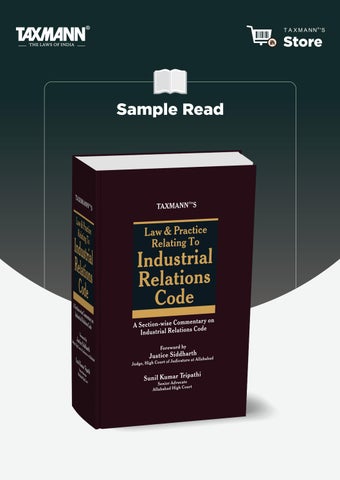
LAW & PRACTICE RELATING TO INDUSTRIAL RELATIONS CODE AUTHOR : PUBLISHER : DATE OF PUBLICATION : EDITION : ISBN NO : NO. OF PAGES : BINDING TYPE :
Sunil Kumar Tripathi Taxmann October 2026 2026 Edition 9789375617549 1592 Hardbound
Rs. 3,895 DESCRIPTION Law & Practice Relating to Industrial Relations Code is a one-volume, section-wise commentary on the Industrial Relations Code 2020. It covers all 104 sections in order and supports the transition from the old labour laws to the Code. The book is organised around two questions: how a provision compares with the three Acts the Code replaced, and what the courts have said about it. The rules, forms and notifications needed alongside the commentary are in the same volume. This makes it a practical reference for advice, compliance and litigation. This book is intended for the following audience: • Advocates and Legal Practitioners • Members of the Bench and Judicial Officers • HR and IR Managers • Employers, Including Industries and Commercial Establishments • Employees and Trade Union Leaders • Corporate Professionals and Consultants • Academicians and Students of Law The Present Publication is the 2026 Edition. The law stated in it is updated till 30th September 2026. It is authored by Sunil Kumar Tripathi, Senior Advocate, Allahabad High Court, with the following noteworthy features: • [Old and New, Linked Both Ways] Four tables, running to more than 20 pages, map the Code against the Industrial Disputes Act 1947, the Industrial Employment (Standing Orders) Act 1946 and the Trade Unions Act 1926. They work in both directions, down to individual definition clauses • [Every Definition on Its Own] Each of the 44 defined terms is a separate unit that can be read by itself, and the definitions take up nearly 250 pages. A short note first explains how definitions, provisos, explanations and schedules are read • [Nearly 1,500 Cases, Updated to 2026] The 55-page List of Cases has nearly 1,500 entries, mainly from the Supreme Court and the High Courts, including rulings reported in 2025 and 2026. The commentary covers decisions as recent as the nine-judge Constitution Bench ruling of 20th August 2026 • [Key Passages Quoted] Key passages of judgments are often set out as indented extracts. The relevant text of other statutes, such as the Code of Civil Procedure, the Indian Penal Code and the General Clauses Act, is often reproduced in place • [Rules Where They Apply] The Industrial Relations (Central) Rules 2026, notified on 8th May 2026, are referred to in the discussion of more than 20 sections. The rules on recovery of dues and on notices of strike and lock-out are printed below their sections. Those on retrenchment and closure are printed at the start of Chapter IX • [Procedures and Distinctions Signposted] Nearly 30 paragraphs are headed as procedures, and a few explain how two related terms differ • [A Handbook on Disciplinary Proceedings] At about 90 pages, the commentary on Section 50 is the longest after the definitions. It works as a handbook on disciplinary proceedings, from the preliminary enquiry to the relief the Tribunal can grant • [Background Where It Helps] Where history explains the present text, the commentary traces it, including how each of the three repealed Acts came about • [Plain Language] As the Preface explains, many readers are not law graduates, so the author uses simple language and avoids needless jargon
Buy Now