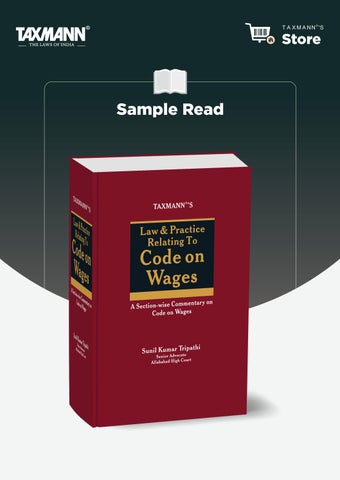
Sample Read
© © Taxmann Taxmann Price :: `` 1995 795 Price Law stated stated in in this this book book is is as as updated amendedtill by20th the Finance Act, 2026 Law July, 2026 Published by : Published by : Taxmann Publications Publications (P.) (P.) Ltd. Ltd. Taxmann Sales Sales & & Marketing Marketing :: 59/32, New New Rohtak Rohtak Road, Road, New New Delhi-110 Delhi-110 005 005 India India 59/32, Phone Phone :: +91-11-45562222 +91-11-45562222 Website :: www.taxmann.com www.taxmann.com Website E-mail E-mail :: sales@taxmann.com sales@taxmann.com Regd. Office Office :: Regd. 21/35, 21/35, West West Punjabi Punjabi Bagh, Bagh, New New Delhi-110 Delhi-110 026 026 India India Printed at : Printed at : Tan Prints Prints (India) (India) Pvt. Pvt. Ltd. Ltd. Tan 44 Km. Km. Mile Mile Stone, Stone, National National Highway, Highway, Rohtak Rohtak Road Road 44 Village Village Rohad, Rohad, Distt. Distt. Jhajjar Jhajjar (Haryana) (Haryana) India India E-mail :: sales@tanprints.com sales@tanprints.com E-mail Disclaimer Disclaimer Every effort effort has has been been made made to to avoid avoid errors errors or or omissions omissions in in this this publication. publication. In In spite spite Every of this, this, errors errors may may creep creep in. in. Any Any mistake, mistake, error error or or discrepancy discrepancy noted noted may may be be brought brought of to to our our notice notice which which shall shall be be taken taken care care of of in in the the next next edition. edition. It It is is notified notified that that neither neither the the publisher publisher nor nor the the author author or or seller seller will will be be responsible responsible for for any any damage damage or or loss of of action action to to any any one, one, of of any any kind, kind, in in any any manner, manner, therefrom. therefrom. It It is is suggested suggested that that loss to avoid avoid any any doubt doubt the the reader reader should should cross-check cross-check all all the the facts, facts, law law and and contents contents of of to the the publication publication with with original original Government Government publication publication or or notifications. notifications. No No part part of of this this book book may may be be reproduced reproduced or or copied copied in in any any form form or or by by any any means means [graphic, [graphic, electronic electronic or or mechanical, mechanical, including including photocopying, photocopying, recording, recording, taping, taping, or or information retrieval retrieval systems] systems] or or reproduced reproduced on on any any disc, disc, tape, tape, perforated perforated media media information or other other information information storage storage device, device, etc., etc., without without the the written written permission permission of of the the or publishers. publishers. Breach Breach of of this this condition condition is is liable liable for for legal legal action. action. For For binding binding mistake, mistake, misprints misprints or or for for missing missing pages, pages, etc., etc., the the publisher’s publisher’s liability liability is is limited limited to to replacement replacement within within seven seven days days of of purchase purchase by by similar similar edition. edition. All All expenses in in this this connection connection are are to to be be borne borne by by the the purchaser. purchaser. expenses All disputes disputes are are subject subject to to Delhi Delhi jurisdiction jurisdiction only. only. All
CONTENTS PAGE u About the Author
I-5
u Preface
I-7
u Table showing sections of Code on Wages, 2019 & corres-
ponding provisions of Repealed Laws
I-15
u Table showing sections of Equal Remuneration Act, 1976 &
corresponding provisions of Code on Wages, 2019
I-23
u Table showing sections of Minimum Wages Act, 1948 &
corresponding provisions of Code on Wages, 2019
I-25
u Table showing sections of Payment of Bonus Act, 1965 &
corresponding provisions of Code on Wages, 2019
I-28
u Table showing sections of Payment of Wages Act, 1936 &
corresponding provisions of Code on Wages, 2019
I-32
u List showing Acts repealed by Code on Wages, 2019
I-35
u List of Cases
I-37
CODE ON WAGES, 2019 CHAPTER I PRELIMINARY 1. Short title, extent and commencement
1
2. Definitions
14
3. Prohibition of discrimination on ground of gender
117
4. Decision as to disputes with regard to same or similar nature of work
131
I-9
CONTENTS SECTION
I-10 PAGE
CHAPTER II MINIMUM WAGES 5. Payment of minimum rate of wages
134
6. Fixation of minimum wages
147
7. Components of minimum wages
180
8. Procedure for fixing and revising minimum wages
194
9. Power of Central Government to fix floor wage
200
10. Wages of employee who works for less than normal working day
203
11. Wages for two or more classes of work
207
12. Minimum time rate wages for piece work
209
13. Fixing hours of work for normal working day
211
14. Wages for overtime work
224 CHAPTER III
PAYMENT OF WAGES 15. Mode of payment of wages
227
16. Fixation of wage period
236
17. Time limit for payment of wages
238
18. Deductions which may be made from wages
242
19. Fines
259
20. Deductions for absence from duty
264
21. Deductions for damage or loss
274
22. Deductions for services rendered
279
23. Deductions for recovery of advances
283
24. Deductions for recovery of loans
287
25. Chapter not to apply to Government establishments
289
CHAPTER IV PAYMENT OF BONUS 26. Eligibility for bonus, etc.
291
27. Proportionate reduction in bonus in certain cases
326
28. Computation of number of working days
328
29. Disqualification for bonus
333
I-11
CONTENTS
SECTION
PAGE
30. Establishments to include departments, undertakings and branches
343
31. Payment of bonus out of allocable surplus
347
32. Computation of gross profits
352
33. Computation of available surplus
359
34. Sums deductible from gross profits
363
35. Calculation of direct tax payable by employer
370
36. Set on and set off of allocable surplus
379
37. Adjustment of customary or interim bonus against bonus payable under this Code
386
38. Deduction of certain amounts from bonus payable
395
39. Time limit for payment of bonus
397
40. Application of this Chapter to establishments in public sector in certain cases
401
41. Non-applicability of this Chapter
404
CHAPTER V ADVISORY BOARD 42. Central Advisory Board and State Advisory Boards
420
CHAPTER VI PAYMENT OF DUES, CLAIMS AND AUDIT 43. Responsibility for payment of various dues
439
44. Payment of various undisbursed dues in case of death of employee
444
45. Claims under Code and procedure thereof
449
46. Reference of disputes under this Code
467
47. Presumption about accuracy of balance sheet and profit and loss account of corporations and companies
471
48. Audit of account of employers not being corporations or companies
479
49. Appeal
485
50. Records, returns and notices
490
CONTENTS SECTION
I-12 PAGE
CHAPTER VII INSPECTOR-CUM-FACILITATOR 51. Appointment of Inspector-cum-Facilitators and their powers
497
CHAPTER VIII OFFENCES AND PENALTIES 52. Cognizance of offences
512
53. Power of officers of appropriate Government to impose penalty in certain cases
522
54. Penalties for offences
527
55. Offences by companies
537
56. Composition of offences
544 CHAPTER IX
MISCELLANEOUS 57. Bar of suits
550
58. Protection of action taken in good faith
556
59. Burden of proof
558
60. Contracting out
562
61. Effect of laws agreements, etc., inconsistent with this Code
567
62. Delegation of powers
571
63. Exemption of employer from liability in certain cases
580
64. Protection against attachments of assets of employer with Government
587
65. Power of Central Government to give directions
590
66. Saving
591
67. Power of appropriate Government to make rules
594
68. Power to remove difficulties
613
69. Repeal and savings
618
I-13
CONTENTS PAGE
APPENDICES Appendix 1 : Wages (Central) Rules, 2026
633
Appendix 2 : Provisions of other Acts referred to in Code on Wages, 2019
677
Appendix 3 : Notifications
689
Subject Index
i
S. 5
CODE ON WAGES, 2019
134
CHAPTER II MINIMUM WAGES Payment of minimum rate of wages. 5. No employer shall pay to any employee wages less than the minimum rate of wages notified by the Appropriate Government.
69
OVERVIEW OF SECTION 5 COMPARATIVE STUDY OF PROVISIONS OF CODE ON WAGES, 2019 &
OLD LABOUR LAWS
SECTION NOTES FAQs COMMENTS u
Prelude to section 5 of Code on Wages, 2019 (see Para 5.1)
u
Object and policy of Minimum Wages Act (see Para 5.2)
u
Mandatory to pay minimum rates of wages (see Para 5.3)
u
Historical background of Minimum Wages Act, 1948 (see Para 5.4)
u
International Labour Standard on Wages (see Para 5.5)
u
International Labour Organization (ILO) on Wages (see Para 5.6)
u
Role of ILO in development of minimum wages (see Para 5.7)
u
Expanding coverage of minimum wage after the second world war (see Para 5.8)
u
Directives under Constitution of India (see Para 5.9)
u
Role of ILO in fixing working conditions of labour (see Para 5.10)
u
The main ILO conventions (see Para 5.11)
u
Living wage, fair wage and minimum wage (see Para 5.12)
u
Supreme Court on minimum wage, fair wage and living wage (see Para 5.13)
u
Minimum rate of wages under Minimum Wages Act, 1948 (see Para 5.14)
u
Notification of Schedule Employment is not required (see Para 5.15)
u
Supreme Court on minimum wages (see Para 5.16)
69. Enforced with effect from 21-11-2025.
135
CH. II : MINIMUM WAGES
S. 5
COMPARATIVE STUDY OF PROVISIONS OF CODE ON WAGES, 2019 & OLD LABOUR LAWS n Corresponding provisions u
Section 5 of Code on Wages, 2019 corresponds to section 12 of Minimum Wages Act, 1948.
n Comparative Study of provisions of Code on Wages, 2019 & Old Labour Laws
Section 5 of Code on Wages, 2019 Payment of minimum rate of wages
Section 12 of Minimum Wages Act, 1948 Payment of minimum rates of wages
5. No employer shall pay to any employee 12.(1) Where in respect of any schedwages less than the minimum rate of wages uled employment a notification under notified by the Appropriate Government. section 5 is in force, the employer shall pay to every employee engaged in a scheduled employment under him wages at a rate not less than the minimum rate of wages fixed by such notification for that class of employees in that employment without any deductions except as may be authorized within such time and subject to such conditions as may be prescribed. (2) Nothing contained in this section shall affect the provisions of the Payment of Wages Act, 1936 (4 of 1936).
SECTION NOTES n Obligation of an employer to pay minimum rate of wages u
Section 5 of the Code provides that no employer shall pay to any employee wages less than the minimum rate of wages notified by the appropriate Government.
u
The following are the ingredients of section 5: l
Obligation is on every employer i.e. employer is exempt from it.
l
Obligation is towards every employee (not merely employees engaged in scheduled employments as was the case in the Minimum Wages Act).
l
Obligation is to pay wages not less than the minimum rate of wages notified by the appropriate government.
n Universal minimum wages to all employees u
Section 5 of the Code provides for universal minimum wages to all employees irrespective of sector and wage ceiling.
S. 5
CODE ON WAGES, 2019
136
u
Section 5 of the Code provides that no employer shall pay to any employee wages less than the minimum rate of wages notified by the appropriate Government.
u
Section 43 of the Code provides that :
u
l
Every employer shall pay all amounts required to be paid under this Code to every employee employed by him.
l
Where such employer fails to make such payment in accordance with this Code, then, the company or firm or association or any other person who is the proprietor of the establishment, in which the employee is employed, shall be responsible for such payment.
Para 2 of the Central Govt.’s Clarification on Code on Wages clarifies as follows: “2. At present, the provisions of the Minimum Wages Act and the Payment of Wages Act do not cover substantial number of workers, as the applicability of both these Acts is restricted to the Scheduled Employments/Establishments. However, the new Code on Wages will ensure minimum wages to one and all and timely payment of wages to all employees irrespective of the sector of employment without any wage ceiling.”
u
The PIB Press Release, dated 23-7-2019, clarifies as under: “The Code on Wage visualizes the provisions of minimum wages and timely payment of wages to all employees irrespective of the sector and wage ceiling. At present, the provisions of both Minimum Wages Act and Payment of Wages Act apply on workers below a particular wage ceiling working in Scheduled Employments only. This would ensure “Right to Sustenance” for every worker and intends to increase the legislative protection of minimum wage from existing about 40% to 100% workforce. This would ensure that every worker gets minimum wage which will also be accompanied by increase in the purchasing power of the worker thereby giving fillip to growth in the economy.”
FAQs FAQ 1 issued by Central Govt. reads as follows: ‘Q1. Whether Data Entry Operators and employees in similar categories are included under the minimum wage provisions of the Code on Wages, 2019? Ans: Yes. The concept of scheduled employment has been done away under the Code on Wages. The Code is now universally applicable to all employees, irrespective of their sector or category.’
137
CH. II : MINIMUM WAGES
S. 5
COMMENTS 5.1 Prelude to section 5 of Code on Wages, 2019 Minimum Wages Act, 1948 (in short Act of 1948) has been subsumed in the Code on Wages, 2019. Chapter II of Code on Wages, 2019 comprises of important provisions with certain modifications of the erstwhile Minimum Wages Act, 1948. Chapter II comprises of sections 5 to 14 of Code on Wages, 2019. International Labour Organization (in short ILO) played important role in affecting the working conditions of labour including wages. Article 43 of Part IV of the Constitution gives directives to ensure living wage and fair working conditions. There are three categories of wages, namely, Living wage, Fair wage and Minimum wage. In order to understand the concept of minimum wage, it would be proper to have a brief knowledge of three categories of wages: (i) Living Wage, (ii) Minimum Wage & (iii) Fair Wage.
5.2 Object and policy of Minimum Wages Act Constitution Bench of Supreme Court stated that object of the Minimum Wages Act, 194870 are: (i) to prevent exploitation of the workers, and (ii) for that purpose, fixation of minimum wages which the employers must pay. The legislature undoubtedly intended to apply the Act to those industries or localities in which by reason of causes such as unorganised labour or absence of machinery for regulation of wages, the wages paid to workers were, in the light of the general level of wages, and subsistence level, inadequate. Conditions of labour vary in different industries and from locality to locality and the expediency of fixing minimum wages and the rates thereof depends largely upon diverse factors which in their very nature are variable and can properly be ascertained by the Government which is in charge of the administration of the State. It is to carry out effectively the purpose of this enactment that power has been given to the Appropriate Government to decide, with reference to local conditions, whether it is desirable that minimum wages should be fixed in regard to any scheduled trade or industry, in any locality, and if it be deemed expedient to do so, the rates at which the wages should be fixed in respect of that industry in the locality. Constitution Bench of Supreme Court stated that object is to prevent exploitation of labour and for that purpose authorises the Appropriate Government to take
70. Bhikusa Yamasa Kshatriya v. Sangamner Akola Taluka Bidi Kamgar Union 1963 Supp (1) SCR 524
S. 5
CODE ON WAGES, 2019
138
steps to prescribe minimum rates of wages in the scheduled industries.71 In under developed country which faces the problem of unemployment on a very large scale, it is not unlikely that labour may offer to work even on starvation wages. The policy of the Act is to prevent the employment of such sweated labour in the interest of general public and so in prescribing the minimum wage rates, the capacity of the employer, need not be considered. What is being prescribed is minimum wage rates which a welfare state assumes every employer must pay before he employs labour. This principle has been settled by Apex Court72
5.3 Mandatory to pay minimum rates of wages Section 5 captioned as “Payment of minimum rate of wages” preambled with the words “No employer shall pay to any employee wages less than the minimum rate of wages notified by the Appropriate Government”. The question arises as to whether obligation to pay minimum rate of wages is mandatory or directory. The question as to whether a statute is mandatory or directory depends upon intent of legislature and on the language in which intention is clothed. If a provision is mandatory, an act done in breach thereof will be invalid, but if it is directory, the act will be valid although non-compliance may give rise to some other penalty if provided by the statute. A mandatory must be obeyed or fulfilled exactly but it is sufficient if directory enactment be obeyed or fulfilled substantially. Intention of legislature when clothed with command in negative form is mandatory in nature. As observed by Subbarao J Negative words are clearly prohibitory and are ordinarily used as legislative device to make a statute imperative.73
5.4 Historical background of Minimum Wages Act, 1948 First initiative was taken in April, 1946 in the direction of fixing of minimum wages by introducing a bill for fixing minimum wages in certain employments to prevent exploitation of sweated labour in employment where such labour are large in number. Bill was passed by Dominion Legislature, which received the assent of Governor General on 15th March, 1948. The bill was finally known as Minimum Wages Act, 1948. This Act was passed in pursuance of the resolution passed by Minimum Wages Fixing Machinery Convention held at Geneva, 1948.
5.5 International Labour standard on wages With working time, wages are among conditions of work that have the most direct and tangible effect on the everyday life of workers. Although wages are necessary for the maintenance of workers and their families, yet in many parts of the world adequate and regular wages is not guaranteed.
71. U. Unichoyi v. State of Kerala (1962) 1 SCR 946 : AIR 1962 SC 12. 72. Crown Aluminium Works v. Workmen (1958) SCR 651. 73. Nassiruddin v. Sita Ram Agrawal (2003) 2 SCC 577.
139
CH. II : MINIMUM WAGES
S. 5
In certain countries wage arrears continue to be a problem. In some cases workers who have not received their wages, are never paid due to the bankruptcy of the enterprise. Problems can also arise in cases where part of wages and sometimes a large part, are paid in kind. Such situations push the workers concerned into poverty. In certain cases these practices may even expose them to the risk of debt bondage or forced labour. The principle of the provision of an adequate living wage was already set out in the Treaty of Versailles. Following the erosion of purchasing power as a result of the 2008 economic crisis, the ILO considered it important to emphasize on the link between minimum wage-fixing and action to combat poverty. Accordingly, the Global Jobs Pact, adopted by the International Labour Conference in 2009, makes several references to minimum wages as one of the means of responding to the international economic crisis. The regular adjustment of wages, in consultation with the social partners, is identified in the Pact as one of means of reducing inequality, increasing demand and contributing to economic stability.
5.6 International Labour Organization (ILO) on Wages C026 - Minimum Wage-Fixing Machinery Convention, 1928 (No. 26) - the International Labour Organisation, convened at Geneva a general conference by the Governing Body on 30 May, 1928, and decided to adopt certain proposals with regard to minimum wage-fixing machinery. ILO determined that these proposals should take the form of an international Convention and adopts on 16-6-1928, which may be cited as the Minimum Wage-Fixing Machinery Convention, 1928. Articles 1, 2 and 4 being relevant, are as under to understand the objective of the C026 - Minimum Wage-Fixing Machinery Convention, 1928 (No. 26): “Article 1 1. Each Member of the International Labour Organisation which ratifies this Convention undertakes to create or maintain machinery whereby minimum rates of wages can be fixed for workers employed in certain of the trades or parts of trades (and in particular in home working trades) in which no arrangements exist for the effective regulation of wages by collective agreement or otherwise and wages are exceptionally low. 2. For the purpose of this Convention, the term trades includes manufacture and commerce. Article 2 Each Member which ratifies this Convention shall be free to decide, after consultation with the organisations, if any, of workers and employers in the trade or part of trade concerned, in which trades or parts of trades, and in particular in which home working trades or parts of such trades, the minimum wage-fixing machinery referred to in Article 1 shall be applied. Article 4 1. Each Member which ratifies this Convention shall take the necessary measures, by way of a system of supervision and sanctions, to ensure that the employers and workers concerned are informed of the minimum rates of wages in force
S. 5
CODE ON WAGES, 2019
140
and that wages are not paid at less than these rates in cases where they are applicable. 2. A worker to whom the minimum rates are applicable and who has been paid wages at less than these rates, shall be entitled to recover, by judicial or other legalised proceedings, the amount by which he has been underpaid, subject to such limitation of time as may be determined by national laws or regulations.”
5.7 Role of ILO in development of minimum wages Initially, minimum wages covered relatively few categories of workers and sought to protect those considered to be especially vulnerable. New Zealand was the first country to implement a minimum wage in 1894, followed by the Australian state of Victoria in 1896, and the United Kingdom in 1909. Frequently, minimum wages were considered as a temporary measure, to be phased out once wage bargaining between social partners would be established.
5.8 Expanding coverage of minimum wage after the second world war After the Second World War, the number of countries with liability to pay minimum wages expanded. Newly independent countries such as India (1948) and Pakistan (1961) were among those adopting minimum wages. The legal coverage of minimum wages was progressively expanded as it was increasingly felt that all workers, as a matter of right, should receive protection against unduly low wages. Nationally applied minimum wages appeared in the Netherlands (1969), France (1970) and Spain (1980). In the United States, coverage expanded from about 20 per cent of the workforce in the early years to nearly 80 per cent in 1970. States in India, gradually expanded the number of sectors and occupations by notifying them as “schedule employment” for minimum wage coverage.
5.9 Directives under Constitution of India Article 43 of the Part-IV of the Constitution of India, gives directives for securing living wage and conditions of work ensuring a decent standard of life and full enjoyment of leisure and social and cultural opportunities, to all agricultural, industrial or other workers. The specific directive has been given to States who shall endeavour to promote cottage industries on individual and co-operative basis in rural areas. Part-IV of the Constitution deals with directive principles of State policy. Provisions contained in Part-IV shall not be enforceable by any Court but the principles enshrined under this Part shall play fundamental role in governance of the country. It is the duty of the State to apply these principles in making the law. The difference between fundamental rights and directive principles are primarily aimed at assuring political freedom to the citizen by protecting them against excessive state action while the directive principles are aimed at securing social and economic freedom by appropriate state action. Directive principles, though not enforceable in Court of Law, yet directive principles are not less important than fundamental rights.
141
CH. II : MINIMUM WAGES
S. 5
5.10 Role of ILO in fixing working conditions of labour The ILO was founded in 1919, in the wake of a destructive war, to pursue a vision based on the premise that universal, lasting peace can be established only if it is based on social justice. The ILO became the first specialized agency of the UN in 1946. The main aims of the ILO are to promote rights at work, encourage decent employment opportunities, enhance social protection and strengthen dialogue on work-related issues. The unique tripartite structure of the ILO gives an equal voice to workers, employers and Governments to ensure that the views of the social partners are closely reflected in labour standards and in shaping policies and programmes.
5.11 The main ILO conventions Minimum wages has always remained in focus of ILO since its creation in 1919: u
In view that “universal and lasting peace can be established only if it is based upon social justice”, the 1919 ILO Constitution called in its Preamble for an urgent improvement of conditions of labour, including “the provision of an adequate living wage”.
u
In 1944, the ILO Declaration of Philadelphia, referred to the importance of “a minimum living wage to all employed and in need of such protection”. This was reiterated in the 2008 ILO Declaration on Social Justice for a Fair Globalization.
In 1928, the ILO adopted the Minimum Wage Fixing Machinery Convention, 1928 (No. 26). In line with the prevailing philosophy of the time, this Convention encouraged member States to implement minimum wages “for workers employed in certain trades or parts of trades (and in particular in home working trades) in which no arrangements exist for the effective regulation of wages by collective agreement or otherwise and wages are exceptionally low”. Agriculture was excluded. With more than 100 ratifications, Convention No. 26 remains to this day one of the most widely ratified ILO Conventions. It is complemented by Recommendation No. 30, which calls for the participation of women in wage-fixing bodies and for strong enforcement measures to protect law-abiding employers from unfair competition. In 1951, the ILO adopted the Minimum Wage Fixing Machinery (Agriculture) Convention, 1951 (No. 99). By the end of 2015, Convention No. 99 had 54 ratifications. It is complemented by Recommendation No. 89. In 1970, ILO adopted the Minimum Wage Fixing Convention, 1971 (No. 131), which is considered to offer broader protection than that envisaged by ILO Convention No. 26 Convention No. 131 encourages member States which ratify to establish a system of minimum wages which:
S. 5
CODE ON WAGES, 2019
142
u
offers a broad scope of application and where exclusions made are kept to a minimum;
u
establishes a machinery to fix and adjust minimum wages from time to time;
u
is based on the principle of full consultation with social partners;
u
involves social partners, on an equal footing, as well as independent experts in the design and operation of the system;
u
sets minimum wage levels that take into account the needs of workers and their families, as well as economic factors;
u
Includes appropriate measures to ensure the effective application of minimum wages.
The objective of a generally applicable lower limit under which wages are not permitted to fall, reflects the view that all workers as a matter of right should receive protection against “unduly low wages”. However, Convention No. 131 does not prescribe a single national minimum wage. The Minimum Wage Fixing Recommendation, 1970 (No. 135), which accompanies the Convention, makes it clear that broad coverage can be achieved “either by fixing a single minimum wage of general application or by fixing a series of minimum wages applying to particular groups of workers”. By not seeking to impose a single model on all ILO member States, Convention No. 131 allows for the existence of different national circumstances and different levels of economic and social development. By the end of 2015, Convention No. 131 had been ratified by 52 member States, including 11 countries since 2000.
5.12 Living wage, fair wage and minimum wage Wages have been classified into three categories: 5.12(i) Living wages; 5.12(ii) Minimum wages; 5.12(iii) Fair wages.
5.12(i) Living wages Living wages have been defined differently by different people in different countries. The best definition is given by Justice Higgins which reads Living wage is a wage sufficient to ensure the workman food, shelter, clothing, frugal comfort, provision for evil days etc. as regard for the skill of an artisan. According to Fair Wages Committee Report: The living wage should enable the male earner to provide himself and his family not merely the basic essentials of food, clothing and shelter but a measure of frugal comfort including education for the children, protection against ill-health, requirement of essential social needs and measures of insurance against old age.” Thus living wages means the provision for the bare necessities plus certain amenities considered necessary for the wellbeing of the workers in terms of his social status.
143
CH. II : MINIMUM WAGES
S. 5
Article 43 of the Constitution of India states that the state shall endeavour to secure by suitable legislation or economic organisation or in any other way to all workers a living wage, conditions of work ensuring a decent standard of life, full enjoyment of pleasure, and social and cultural opportunities. Thus, Government of India has adopted as one of the directives of the principle of state policy to ensure living wages.
5.12(ii) The minimum wage Minimum wages may be defined as the lowest wage necessary to maintain a worker and his family at the minimum level of subsistence, which includes food, clothing and shelter. When the Government fixes minimum wage in a particular trade, the main objective is not to control or determine wages in general but to prevent the employment of workers at a wage below an amount necessary to maintain the worker at the minimum level of subsistence. The authority entrusted with the task of fixing of minimum wage, should consider such factors as local economic conditions, transportation cost and the size of the units in the industry in fixing minimum wages.
5.12(iii) Fair wages A fair wage is something more than the minimum wages. Fair wage is a mean between the living wage and the minimum wage. While the lower limit of the fair wage must obviously be the minimum wage, the upper limit is the capacity of the industry to pay fair wage compared reasonably with the average payment of similar task in other trades or occupations requiring the same amount of ability. Fair wage depends on the present economic position as well as on its future prospects. Thus the fair wages depends upon the following factors: (a) Minimum wages. (b) Capacity of the industry to pay. (c) Prevailing rates of wages in the same or similar occupations in the same or neighbouring localities. (d) Productivity of labour. (e) Level of national income and its distribution. (f) The place of the industry in the economy of the country.
5.13 Supreme Court on minimum wage, fair wage and living wage Constitution bench of Apex Court elaborating on concept of wage clarified that “fair wage” is, a mean between the living wage and the minimum wage.74 The minimum wage more than the bare minimum or subsistence wage which would be sufficient to cover the bare physical needs of the worker and his family, a wage which would provide also for the preservation of the efficiency 74. Express Newspaper (P.) Ltd. v. Union of India 1959 SCR 12 : AIR 1958 SC 578.
S. 5
CODE ON WAGES, 2019
144
of the worker and for some measure of education, medical requirements and amenities. Observation of Apex Court are as under: u
This concept of minimum wage is in harmony with the advancement of thought in all civilised countries and approximates to the statutory minimum wage which the State should strive to achieve having regard to the Directive Principle of State Policy.
u
The enactment of the Minimum Wages Act, 1948 (11 of 1948) affords an illustration of an attempt to provide a statutory minimum wage.
u
It will also be noticed that the concept of the expressions “minimum wage” “fair wage” and “living wage” is not fixed and static. It varies and is bound to vary from time to time. With the growth and development of national economy, living standards would improve and so would our notions about the respective categories of wages expand and be more progressive.
Apex Court75 stated as under: u
In 1947 a Central Advisory Council was appointed which in its turn set-up a committee to deliberate upon and report on fair wages for workmen. The report of that committee has been cited over and over again. The Apex Court elaborately analysed the concept of wages as stated by the Committee.76
u
The Committee divided wages into three kinds, i.e., living wage, fair wage and minimum wage. Minimum wage, as the name itself implies represents the level below which wage cannot be allowed to drop. It was universally recognised that a minimum wage must be prescribed to prevent the evil of sweating and for the benefit of workmen who were not in a position to bargain with their employers.
u
This received immediate attention in India, though there was an international convention as far as back as 1928 and the demand for fixation of minimum wages extended even to non-sweated industries. The result was the Minimum Wages Act, 1948. The Fair Wages Committee understood the term minimum wage as the lowest wage in the scale below which the efficiency of the worker was likely to be impaired. It was described as the “wage floor” allowing living at a standard considered socially, medically and ethically to be the acceptable minimum.
u
Fair wages by comparison were more generous and represented a wage which lay between the minimum wage and the living wage. The United Provinces Labour Enquiry Committee classified the levels of living as: (i) poverty level; (ii) minimum subsistence level;
75. All India Reserve Bank Employee’s Assn. v. Reserve Bank of India (1966) 1 SCR 25. 76. Standard Vaccum Refg. Co. v. Its Workmen (1961) 1 LLJ 227.
145
CH. II : MINIMUM WAGES
S. 5
(iii) subsistence plus level, and (iv) comfort level. u
The concept of fair wages involves a rate sufficiently high to enable the worker to provide “a standard family with food, shelter, clothing, medical, care and education of children Appropriate to his status in life but not at a rate exceeding the wage earning capacity of the class of establishment concerned”. A fair wage thus is related to a fair workload and the earning capacity.
u
The living wage concept is one or more steps higher than fair wage. It is customary to quote Mr. Justice Higgins of Australia who defined it as one Appropriate for “the normal needs of average employee, regarded as a human being living in a civilized community”. He explained himself by saying that the living wage must provide not merely for absolute essentials such as food, shelter and clothing but for “a condition of frugal comfort estimated by current human standards” including “provision for evil days etc. with due regard for the special skill of the workman”. It has now been generally accepted that living wage means that every male earner should be able to provide for his family not only the essentials but a fair measure of frugal comfort and an ability to provide for old age or evil days. Fair wage lies between the concept of minimum wage and the concept of living wage.
u
Our political aim is “living wage”, though in actual practice living wage has been an ideal which has eluded our efforts like an ever receding horizon and will remain so for some time to come. Our general wage structure has at best reached the lower levels of fair wage though some employers are paying much higher wages than the general average.
5.14 Minimum rate of wages under Minimum Wages Act, 1948 In section 12 of the Act of 1948, the employers are under an obligation to pay minimum wages to employees of those employments which have been notified as Schedule Employment and for such Schedule Employment minimum wages has been fixed by notification u/s 5 of the Act of 1948. The Act of 1948 shall continue to apply until fixed under Code on Wages, 2019 is notified.
5.15 Notification of Schedule Employment is not required Under the Code on Wages, 2019 section 5 imposes the same obligation on the employer with modification to pay minimum wages in all the employments and now as per section 5 there is no need to notify Scheduled Employment for payment of minimum wages. Under this section minimum wages is payable to employees of every employment without there being any necessity to notify the employment as Schedule Employment.
LAW & PRACTICE RELATING TO CODE ON WAGES AUTHOR : PUBLISHER : DATE OF PUBLICATION : EDITION : ISBN NO : NO. OF PAGES : BINDING TYPE :
Sunil Kumar Tripathi Taxmann August 2026 2026 Edition 9789375610328 784 Hardbound
Rs. 1,995 DESCRIPTION Law & Practice Relating to Code on Wages is a section-wise commentary. Three characteristics distinguish the work. It states the law after enforcement and after the Rules. The Code came into force on 21st November 2025 and the Wages (Central) Rules 2026 were notified on 8th May 2026; this volume is written after both, states the law as on 20th July 2026, and already considers the earliest judicial pronouncements upon the transition, delivered in 2026 by four High Courts and by the Supreme Court. Its organising method is comparison. Each unit sets the Code's text beside the full text of the provision it has replaced, in a two-column table prefaced by a statement of corresponding provisions; thirteen provisions are recorded as having no antecedent, four of them designated New Section. For the reader determining how much of nearly nine decades of authority survives re-enactment, this is the principal aid the work affords. It is arranged as ninety-five self-contained commentary units rather than sixty-nine: each of the 69 sections, and each of the 26 terms defined in Section 2. All ninety-five carry a boxed Overview and analytical Comments; ninety-four further carry a comparative table and Section Notes. The commentary extends to 625 decimal-numbered paragraphs, numbered continuously across all sixty-nine sections so that any proposition may be cited with precision, and is supported by a List of Cases of 344 entries and more than 430 footnoted citations. This book is intended for the following audience: • Judges, Judicial Officers and Presiding Officers of Labour Courts and Industrial Tribunals, and Authorities and Appellate Authorities • Senior Advocates and Legal Practitioners • Academicians, Law Students and Candidates for the Judicial Service • Company Secretaries, Chartered Accountants, Cost Accountants and Labour Law Consultants • Employers, Occupiers, Managers, Directors and Principal Employers • Inspectors-cum-Facilitators and Officers of the Labour Department • Heads of Human Resources, Industrial Relations, Personnel, Compensation and Payroll • Statutory and Internal Auditors • Contractors and Staffing and Manpower-supply Undertakings • Public Sector Undertakings, Multinational Corporations and Large Enterprises • Trade Union Office-bearers, Works Committee Members and Employees The Present Publication is the 1st Edition, updated till 20th July 2026. It is authored by Sunil Kumar Tripathi, with the following noteworthy features: • [Ninety-five Self-contained Commentary Units] All 69 sections and all 26 terms defined in Section 2, each with its own Overview box and Comments; ninety-four also carry a comparative table and Section Notes • [A Two-column Comparative Table in Almost Every Unit] The Code set against the full text of the superseded provisions, every predecessor identified—Section 26 is mapped to six sections of the Payment of Bonus Act 1965, and Section 45 to all four repealed enactments • [Express Identification of New and of Omitted Provisions] Four provisions designated New Section and thirteen recorded as having no antecedent; the introductory tables disclose equally what the Code has not carried forward • [Five Bidirectional Concordance Tables] From the Code to the repealed enactments, and from each repealed Act back to the Code • [The Earliest Judicial Consideration of the Transition] Six decisions of 2026 upon what survives the repeal, including Tech Mahindra Ltd. v. Union of India (Bom. HC) and Union of India v. Heavy Vehicles Factory Employees' Union (SC) • [A Full Interpretive and Constitutional Apparatus] Eight opening paragraphs furnish the interpretive tools before the definitions—definition clauses, provisos, exceptions and saving clauses, explanations, schedules and transitional provisions; Section 62 adds ten paragraphs upon delegated legislation and Section 69 eleven upon repeal and savings • [The Central Rules Placed at the Point of Use] Nine inline Relevant Rules blocks reproduce the operative rule immediately beneath the section it implements • [Dates of Enforcement Recorded on the Face of the Text] Seventy-seven footnotes record when each provision came into force—seventy-three at the general date, four at the earlier commencement of the Advisory Board provisions • [Overview Boxes as a Navigational Layer] Each unit opens with a boxed map of its contents, with the paragraph reference of every numbered Comment • [Cross-Code Treatment Where the Definitions Require It] Each borrowed definition traced into the OSH, Industrial Relations and Social Security Codes 2020 • [The Central Government's Clarifications] Nine blocks carry the clarifications Q1 to Q12 against the sections to which they relate, with the Government's worked illustration of the fifty per cent allowance rule • [Forty-nine Summaries and Nineteen Worked Examples] A bulleted statement of requirements before every provision, and worked examples on the provisions of greatest computational difficulty • [A Ten-year Set-on and Set-off Computation] Appendix A to the Central Rules set out in full and traced year by year, including years of loss • [Annexures for Practical Use] The Wages (Central) Rules 2026 with all nine Forms; extracts from eleven further enactments; and twelve notifications • [Three Modes of Access] A List of Cases of 344 entries across fourteen pages, a Subject Index of eighteen pages, and the section-wise arrangement itself
Buy Now