Sample Read
© Taxmann Taxmann © Price Price :: ` ` 795 4595 Law by20th the Finance Act, 2026 Law stated stated in in this this book book is is as as amended updated till July, 2026 Published Published by by :: Taxmann Publications Taxmann Publications (P.) (P.) Ltd. Ltd. Sales & & Marketing Marketing :: Sales 59/32, New 59/32, New Rohtak Rohtak Road, Road, New New Delhi-110 Delhi-110 005 005 India India Phone :: +91-11-45562222 +91-11-45562222 Phone Website Website :: www.taxmann.com www.taxmann.com E-mail :: sales@taxmann.com sales@taxmann.com E-mail Regd. Regd. Office Office :: 21/35, 21/35, West West Punjabi Punjabi Bagh, Bagh, New New Delhi-110 Delhi-110 026 026 India India Printed Printed at at :: Tan Prints Tan Prints (India) (India) Pvt. Pvt. Ltd. Ltd. 44 Km. Km. Mile Mile Stone, Stone, National National Highway, Highway, Rohtak Rohtak Road Road 44 Village Rohad, Distt. Jhajjar (Haryana) India Village Rohad, Distt. Jhajjar (Haryana) India E-mail :: sales@tanprints.com sales@tanprints.com E-mail Disclaimer Disclaimer Every Every effort effort has has been been made made to to avoid avoid errors errors or or omissions omissions in in this this publication. publication. In In spite spite of this, errors may creep in. Any mistake, error or discrepancy noted may be brought of this, errors may creep in. Any mistake, error or discrepancy noted may be brought to to our our notice notice which which shall shall be be taken taken care care of of in in the the next next edition. edition. It It is is notified notified that that neither the publisher nor the author or seller will be responsible for any neither the publisher nor the author or seller will be responsible for any damage damage or or loss loss of of action action to to any any one, one, of of any any kind, kind, in in any any manner, manner, therefrom. therefrom. It It is is suggested suggested that that to to avoid avoid any any doubt doubt the the reader reader should should cross-check cross-check all all the the facts, facts, law law and and contents contents of of the publication with original Government publication or notifications. the publication with original Government publication or notifications. No No part part of of this this book book may may be be reproduced reproduced or or copied copied in in any any form form or or by by any any means means [graphic, electronic or mechanical, including photocopying, recording, [graphic, electronic or mechanical, including photocopying, recording, taping, taping, or or information retrieval retrieval systems] systems] or or reproduced reproduced on on any any disc, disc, tape, tape, perforated perforated media media information or other other information information storage storage device, device, etc., etc., without without the the written written permission permission of of the the or publishers. Breach Breach of of this this condition condition is is liable liable for for legal legal action. action. publishers. For binding binding mistake, mistake, misprints misprints or or for for missing missing pages, pages, etc., etc., the the publisher’s publisher’s liability liability For is limited limited to to replacement replacement within within seven seven days days of of purchase purchase by by similar similar edition. edition. All All is expenses in in this this connection connection are are to to be be borne borne by by the the purchaser. purchaser. expenses All disputes disputes are are subject subject to to Delhi Delhi jurisdiction jurisdiction only. only. All
CONTENTS PAGE Foreword
I-5
About the Author
I-7
Preface
I-9
Table showing sections of Code on Social Security, 2020 &
corresponding provisions of repealed laws
I-21
Table showing sections of Building and Other Construction
Workers’ Welfare Cess Act, 1996 & corresponding provisions of Code on Social Security, 2020 Table showing sections of Cine-Workers Welfare Fund Act, 1981 & corresponding provisions of Code on Social Security, 2020 Table showing sections of Employee’s Compensation Act, 1923 & corresponding provisions of Code on Social Security, 2020 Table showing sections of Employees’ Provident Funds and Miscellaneous Provisions Act, 1952 & corresponding provisions of Code on Social Security, 2020 Table showing sections of Employees’ State Insurance Act, 1948 & corresponding provisions of Code on Social Security, 2020 Table showing sections of Employment Exchanges (Compulsory Notification of Vacancies) Act, 1959 & corresponding provisions of Code on Social Security, 2020 Table showing sections of Maternity Benefit Act, 1961 & corresponding provisions of Code on Social Security, 2020 Table showing sections of Payment of Gratuity Act, 1972 & corresponding provisions of Code on Social Security, 2020 I-11
I-44
I-46
I-47
I-51
I-57
I-67
I-69
I-72
CONTENTS
I-12 PAGE
Table
showing sections of Unorganised Workers’ Social Security Act, 2008 & corresponding provisions of Code on Social Security, 2020 List showing Acts repealed by Code on Social Security, 2020 List of Cases
I-74 I-76 I-77
CODE ON SOCIAL SECURITY, 2020 CHAPTER I PRELIMINARY 1. 2. 3.
Short title, extent, commencement and application Definitions Registration and cancellation of an establishment
1 33 239
CHAPTER II SOCIAL SECURITY ORGANISATIONS 4. 5. 6. 7. 8. 9. 10. 11.
12. 13.
Constitution of Board of Trustees of Employees’ Provident Fund Constitution of Employees’ State Insurance Corporation National Social Security Board and State Unorganised Workers’ Board Constitution of State Building Workers’ Welfare Boards Disqualification and removal of a member of any Social Security Organisation Procedure for transaction of business of Social Security Organisation, etc. Executive Heads of Central Board and Corporation Supersession of Corporation, Central Board, National Social Security Board or State Unorganised Workers’ Board or the Building Workers’ Welfare Board State Board, Regional Boards, local committees, etc. Entrustment of additional functions to Social Security Organisations
252 267 288 313 323 335 348
352 359 362
CHAPTER III EMPLOYEES’ PROVIDENT FUND 14. 15. 16. 17. 18.
Appointment of officers of Central Board Schemes Funds Contribution in respect of employees and contractors Fund to be recognised under Act 43 of 1961
366 382 399 411 418
I-13
CONTENTS
SECTION
PAGE
19.
Priority of payment of contributions over other debts
421
20.
Chapter not to apply to certain establishments
425
21.
Authorising certain employers to maintain provident fund accounts
441
22.
Transfer of accounts
447
23.
Appeal to Tribunal
451 CHAPTER IV
EMPLOYEES STATE INSURANCE CORPORATION 24.
Principal Officers and other staff
471
25.
Employees’ State Insurance Fund
484
26.
Purposes for which Employees’ State Insurance Fund may be expended
490
27.
Holding of property, etc.
498
28.
All employees to be insured
505
29.
Contributions
510
30.
Administrative expenses
519
31.
Provisions as to payment of contributions by employer, etc.
523
32.
Benefits
532
33.
Corporation’s power to promote measures for health, etc., of Insured Persons
557
Presumption as to accident arising in course of employment
559
35.
Accidents happening while acting in breach of law etc.
566
36.
Occupational disease
569
37.
References to medical board
574
38.
Dependants’ benefit
585
39.
Medical benefit
590
40.
Provision of medical treatment by State Government or by Corporation
603
41.
General provisions as to benefits
615
42.
Corporation’s rights when an employer fails to register, etc.
626
Liability of owner or occupier of factories, etc., for excessive sickness benefit
632
Scheme for other beneficiaries
638
34.
43. 44.
CONTENTS SECTION
I-14 PAGE
Schemes for unorganised workers, gig workers and platform workers
641
Exemption of factories or other establishments belonging to Government or any local authority
643
Contributions, etc., due to Corporation to have priority over other debts
647
48.
Constitution of Employees’ Insurance Court
649
49.
Matters to be decided by Employees’ Insurance Court
653
50.
Powers of Employees’ Insurance Court
664
51.
Proceedings of Employees’ Insurance Courts
669
52.
Appeal to High Court
678
45. 46. 47.
CHAPTER V GRATUITY 53.
Payment of gratuity
684
54.
Continuous service
708
55.
Nomination
719
56.
Determination of amount of gratuity
726
57.
Compulsory insurance
753
58.
Competent authority
761 CHAPTER VI
MATERNITY BENEFIT Employment of, or work by, women prohibited during certain period
765
60.
Right to payment of maternity benefit
775
61.
Continuance of payment of maternity benefit in certain cases
785
Notice of claim for maternity benefit and payment thereof
787
Payment of maternity benefit in case of death of a woman
796
64.
Payment of medical bonus
798
65.
Leave for miscarriage, etc.
800
66.
Nursing breaks
806
59.
62. 63.
I-15
CONTENTS
SECTION
PAGE
67.
Creche facility
809
68.
Dismissal for absence during pregnancy
815
69.
No deduction of wages in certain cases
821
70.
Forfeiture of maternity benefit
823
71.
Duties of employer
825
72.
Power of Inspector-cum-Facilitator to direct payments to be made
827
CHAPTER VII EMPLOYEE’S COMPENSATION 73.
Reports of fatal accidents and serious bodily injuries
836
74.
Employer’s liability for compensation
841
75.
Compensation in case of death of or injury in plantation
861
76.
Amount of compensation
865
77.
Compensation to be paid when due and damages for default
888
Method of calculating monthly wages for purposes of compensation
895
79.
Review
901
80.
Commutation of half-monthly payments
905
81.
Distribution of compensation
907
82.
Notice and claim
922
83.
Special provisions relating to accidents occurring outside Indian territory
934
84.
Medical examination
945
85.
Contracting
955
86.
Remedies of employer against stranger
962
87.
Insolvency of employer
964
88.
Power to require from employers statements regarding fatal accidents
973
89.
Registration of agreements
979
90.
Reference to competent authority
986
91.
Appointment of competent authority
989
92.
Venue of proceedings and transfer
993
93.
Form of application
1003
78.
CONTENTS SECTION
I-16 PAGE
Power of competent authority to require further deposit in cases of fatal accident
1007
95.
Powers and procedure of competent authority
1010
96.
Appearance of parties
1014
97.
Method of recording evidence
1017
98.
Power to submit cases
1021
99.
Appeal against order of competent authority
1022
94.
CHAPTER VIII SOCIAL SECURITY AND CESS IN RESPECT OF BUILDING AND OTHER CONSTRUCTION WORKERS 100.
Levy and collection of cess
1036
101.
Interest payable on delay in payment of cess
1050
102.
Power to exempt from cess
1053
103.
Self-assessment of cess
1055
104.
Penalty for non-payment of cess within the specified time
1058
105.
Appeal to appellate authority
1062
106.
Registration of building workers as beneficiaries
1068
107.
Cessation as a beneficiary
1074
108.
Building and other Construction Workers’ Welfare Fund and its application
1078
CHAPTER IX SOCIAL SECURITY FOR UNORGANISED WORKERS, GIG WORKERS AND PLATFORM WORKERS 109.
Framing of schemes for unorganised workers
1082
110.
Funding of State Government schemes
1092
111.
Record keeping
1095
112.
Helpline, facilitation centre, etc., for unorganised workers, gig workers and platform workers
1097
Registration of unorganised workers, gig workers and platform workers
1100
Schemes for gig workers and platform workers
1109
113. 114.
I-17
CONTENTS
CHAPTER X FINANCE AND ACCOUNTS SECTION
PAGE
115.
Accounts
1122
116.
Audit
1123
117.
Budget estimates
1127
118.
Annual report
1130
119.
Valuation of assets and liabilities
1133
120.
Holding of property, etc., by Social Security Organisation
1136
121.
Writing off of losses
1140 CHAPTER XI
AUTHORITIES, ASSESSMENT, COMPLIANCE AND RECOVERY Appointment of Inspector-cum-Facilitators and their powers
1143
123.
Maintenance of records, registers, returns, etc.
1162
124.
Employer not to reduce wages, etc.
1173
125.
Assessment and determination of dues from employer
1177
126.
Appeal against order of Authorised Officer relating to Chapter IV
1195
127.
Interest on amount due
1199
128.
Power to recover damages
1202
129.
Recovery of amount due
1216
130.
Validity of certificate and amendment thereof
1231
131.
Other modes of recovery
1239
132.
Application of certain provisions of Income-tax Act
1259
122.
CHAPTER XII OFFENCES AND PENALTIES 1262
135. 136.
Penalty for failure to pay contributions, etc. Enhanced punishment in certain cases after previous conviction Offences by companies Cognizance of offences
137.
Prior opportunity before prosecution
1305
133. 134.
1278 1282 1292
CONTENTS SECTION
138.
I-18 PAGE
Compounding of offences
1308
CHAPTER XIII EMPLOYMENT INFORMATION AND MONITORING 139.
Reporting of vacancies to career centres
1317
140.
Exclusions from application of this Chapter
1328
CHAPTER XIV MISCELLANEOUS 141. 142. 143. 144. 145.
Social Security Fund Application of Aadhaar Power to exempt establishment Power to defer or reduce Liability in case of transfer of establishment
1333 1337 1341 1365 1367
146.
Members, officers and staff to be public servants
1372
147. 148. 149.
1376 1381
150. 151. 152.
Protection of action taken in good faith Misuse of benefits Power of Central Government to give directions to State Government and Social Security Organisations Power to frame schemes Protection against attachment, etc. Power to amend Schedule
1384 1386 1388 1394
153.
Transitional provisions
1397
154.
Power of appropriate Government to make rules
1401
155.
Power of Central Government to make rules
1412
156.
Power of State Government to make rules
1431
157.
Power of Corporation to make regulations
1438
158.
Prior publication of rules, regulations, etc.
1447
159.
Rules to give effect to arrangements with other countries for the transfer of money paid as compensation
1449
160.
Laying of rules, regulations and schemes, etc.
1452
161.
Effect of laws and agreements inconsistent with this Code
1457
162.
Delegation of powers
1462
163.
Power to remove difficulties
1473
164.
Repeal and savings
1480
I-19
CONTENTS
SCHEDULE
PAGE
FIRST SCHEDULE
1495
SECOND SCHEDULE
1496
THIRD SCHEDULE
1501
FOURTH SCHEDULE
1504
FIFTH SCHEDULE
1507
SIXTH SCHEDULE
1510
SEVENTH SCHEDULE
1512
APPENDICES Appendix 1 : Social Security (Central) Rules, 2026
1515
Appendix 2 : Employees’ Provident Funds Scheme, 2026
1671
Appendix 3 : Employees’ Deposit-Linked Insurance Scheme, 2026
1747
Appendix 4 : Employees’ Pension Scheme, 2026
1763
Appendix 5 : Provisions of other Acts Referred to in Code on Social Security, 2020
1801
Appendix 6 : Notifications
1841
Subject Index
i
S. 4
252 CODE ON SOCIAL SECURITY, 2020
CHAPTER II SOCIAL SECURITY ORGANISATIONS Constitution of Board of Trustees of Employees’ Provident Fund. 50
4. (1) The Central Government may, by notification, constitute, with effect from such date as may be specified therein, a Board of Trustees of the Employees’ Provident Fund to be called the Central Board, for the purposes of Chapter III and the provisions of this Code relating to that Chapter, for the administration of the funds vested in it in such manner as may be prescribed by the Central Government, consisting of the following members, namely:— (a) a Chairperson and a Vice-Chairperson to be appointed by the Central Government; (b) not more than five persons appointed by the Central Government from amongst its officials; (c) not more than fifteen persons representing Governments of such States as the Central Government may specify in this behalf, to be appointed by the Central Government; (d) ten persons representing employers of the establishments to which the schemes referred to in sub-section (1) of section 15 applies, to be appointed by the Central Government after consultation with such organisations of employers as may be recognised by the Central Government in this behalf; (e) ten persons representing employees in the establishments to which schemes referred to in sub-section (1) of section 15 applies, who shall be appointed by the Central Government after consultation with such organisations of employees as may be recognised by that Government in this behalf; and (f) the Central Provident Fund Commissioner, ex officio. (2) The Central Board shall be a body corporate by the name of Board of Trustees of the Employees’ Provident Fund, having perpetual succession and a common seal and shall by the said name sue and be sued. (3) The Central Government may, by notification, constitute, with effect from such date as may be specified therein, an Executive Committee from
50. Enforced with effect from 21-11-2025.
253
CH. II : SOCIAL SECURITY ORGANISATIONS
S. 4
amongst the members of the Central Board to assist the Central Board in performance of its functions in such manner as may be prescribed by the Central Government. (4) The Central Board may, by order, constitute one or more committees of such composition as may be specified in the order to assist it in the discharge of its functions. (5) The Central Board may, by order, delegate to its Chairperson or to its Executive Committee or to any of its officers and a State Board constituted under section 12 may, by order, delegate to its Chairperson or to any of its officers, subject to such conditions and limitations, if any, as it may specify in such order, such of its powers and functions under this Code as it may deem necessary for efficient administration of the schemes referred to in sub-section (1) of section 15. (6) The terms and conditions, including tenure of office, subject to which a member of the Central Board and Executive Committee shall discharge their respective duties may be such as may be prescribed by the Central Government: Provided that a member of the Central Board shall, notwithstanding the expiry of the tenure of his office, continue to hold office until his successor is appointed. (7) The Central Board, apart from the functions specified in this Code, shall also perform such other functions in such manner as may be prescribed by the Central Government. OVERVIEW OF SECTION 4 COMPARATIVE STUDY OF PROVISIONS OF CODE ON SOCIAL SECU-
RITY, 2020 & OLD LABOUR LAWS SECTION NOTES COMMENTS
Prelude to section 4 of Code on Social Security, 2020 (see Para 4.1)
Analysis of section (see Para 4.2)
Constitution of the board (see Para 4.3)
Appointment of Chairman and Vice Chairman of the board (see Para 4.4)
Representation of Central Government (see Para 4.5)
Representation of State Government (see Para 4.6)
Representation of employer (see Para 4.7)
S. 4
CODE ON SOCIAL SECURITY, 2020
254
Representation of employee (see Para 4.8)
Executive Committee (see Para 4.9)
Body Corporate (see Para 4.10)
Constitution of other committees (see Para 4.11)
Delegation of power by Central Board (see Para 4.12)
Manner of administration of fund (see Para 4.13)
Constitution of Executive Committee (see Para 4.14)
Election of the member of Executive Committee (see Para 4.15)
Executive committee to assist the board (see Para 4.16)
Terms & conditions of the members of the board & Executive Committee (see Para 4.17)
Functions of the board (see Para 4.18)
Other committees of the Central Board (see Para 4.19)
Sub-committees of the Executive Committee (see Para 4.20)
Secretary of the Central Board or the Executive Committee (see Para 4.21)
COMPARATIVE STUDY OF PROVISIONS OF CODE ON SOCIAL SECURITY, 2020 & OLD LABOUR LAWS Corresponding provisions
Section 4 of Code on Social Security, 2020 corresponds to sections 5A, 5AA, 5C and 5E of Employees’ Provident Funds and Miscellaneous Provisions Act, 1952.
Comparative Study of provisions of Code on Social Security, 2020 &
Old Labour Laws Section 4 of Code on Social Security, 2020
Sections 5A, 5AA, 5C and 5E of Employees’ Provident Funds and Miscellaneous Provisions Act, 1952
Constitution of Board of Trustees of Central Board. Employees’ Provident Fund. 5A. (1) The Central Government may, by 4. (1) The Central Government may, by notification in the Official Gazette, constinotification, constitute, with effect from tute, with effect from such date as may be such date as may be specified therein, specified therein, a Board of Trustees for a Board of Trustees of the Employees’ the territories to which this Act extends Provident Fund to be called the Central (hereinafter in this Act referred to as the Board, for the purposes of Chapter III Central Board) consisting of the following and the provisions of this Code relating to persons as members, namely:–
255
CH. II : SOCIAL SECURITY ORGANISATIONS
S. 4
Section 4 of Code on Social Security, 2020
Sections 5A, 5AA, 5C and 5E of Employees’ Provident Funds and Miscellaneous Provisions Act, 1952
that Chapter, for the administration of the funds vested in it in such manner as may be prescribed by the Central Government, consisting of the following members, namely:—
(a) a Chairman and a Vice-Chairman to be appointed by the Central Government; (aa) the Central Provident Fund Commissioner, ex officio;
(a) a Chairperson and a Vice-Chairperson to be appointed by the Central Government;
(b) not more than five persons appointed by the Central Government from amongst its officials;
(b) not more than five persons appointed by the Central Government from amongst its officials;
(c) not more than fifteen persons representing Governments of such States as the Central Government may specify in this behalf, appointed by the Central Government;
(c) not more than fifteen persons representing Governments of such States as the Central Government may specify in this behalf, to be appointed by the Central Government; (d) ten persons representing employers of the establishments to which the schemes referred to in sub-section (1) of section 15 applies, to be appointed by the Central Government after consultation with such organisations of employers as may be recognised by the Central Government in this behalf; (e) ten persons representing employees in the establishments to which schemes referred to in sub-section (1) of section 15 applies, who shall be appointed by the Central Government after consultation with such organisations of employees as may be recognised by that Government in this behalf; and
(d) ten persons representing employers of the establishments to which the Scheme applies, appointed by the Central Government after consultation with such organisations of employers as may be recognised by the Central Government in this behalf; and (e) ten persons representing employees in the establishments to which the Scheme applies, appointed by the Central Government after consultation with such organisations of employees as may be recognised by the Central Government in this behalf.
(2) The terms and conditions subject to which a member of the Central Board may be appointed and the time, place and procedure of the meetings of the Central Board shall be such as may be provided (f) the Central Provident Fund Commis- for in the Scheme. sioner, ex officio. (3) The Central Board shall, subject to the
(2) The Central Board shall be a body corporate by the name of Board of Trustees of the Employees’ Provident Fund, having perpetual succession and a common seal and shall by the said name sue and be sued.
provisions of section 6A, and section 6C administer the Fund vested in it in such manner as may be specified in the Scheme.
(4) The Central Board shall perform such other functions as it may be required to (3) The Central Government may, by perform by or under any provisions of notification, constitute, with effect from the Scheme, the Pension Scheme and the such date as may be specified therein, an Insurance Scheme.
S. 4
CODE ON SOCIAL SECURITY, 2020
Section 4 of Code on Social Security, 2020
256
Sections 5A, 5AA, 5C and 5E of Employees’ Provident Funds and Miscellaneous Provisions Act, 1952
(5) The Central Board shall maintain proper accounts of its income and expenditure in such form and in such manner as the Central Government may, after consultation with the Comptroller and Auditor-General (4) The Central Board may, by order, of India, specify in the Scheme. constitute one or more committees of (6) The accounts of the Central Board shall such composition as may be specified in be audited annually by the Comptroller the order to assist it in the discharge of and Auditor-General of India and any expenditure incurred by him in connecits functions. (5) The Central Board may, by order, tion with such audit shall be payable by delegate to its Chairperson or to its the Central Board to the Comptroller and Executive Committee or to any of its officers Auditor-General of India. Executive Committee from amongst the members of the Central Board to assist the Central Board in performance of its functions in such manner as may be prescribed by the Central Government.
and a State Board constituted under section 12 may, by order, delegate to its Chairperson or to any of its officers, subject to such conditions and limitations, if any, as it may specify in such order, such of its powers and functions under this Code as it may deem necessary for efficient administration of the schemes referred to in sub-section (1) of section 15.
(7) The Comptroller and Auditor-General of India and any person appointed by him in connection with the audit of the accounts of the Central Board shall have the same rights and privileges and authority in connection with such audit as the Comptroller and Auditor-General has, in connection with the audit of Government accounts and, in particular, shall have the right to demand the production of books, accounts, connected vouchers, documents and papers and inspect any of the offices of the Central Board.
(6) The terms and conditions, including tenure of office, subject to which a member of the Central Board and Executive Committee shall discharge their respective duties may be such as may be prescribed (8) The accounts of the Central Board as certified by the Comptroller and Audiby the Central Government: Provided that a member of the Central tor-General of India or any other person Board shall, notwithstanding the expiry of appointed by him in this behalf together the tenure of his office, continue to hold with the audit report thereon shall be forwarded to the Central Board which shall office until his successor is appointed. forward the same to the Central Govern(7) The Central Board, apart from the ment along with its comments on the report functions specified in this Code, shall of the Comptroller and Auditor-General. also perform such other functions in such manner as may be prescribed by the Central (9) It shall be the duty of the Central Board to submit also to the Central Government Government. an annual report of its work and activities and the Central Government shall cause a copy of the annual report, the audited accounts together with the report of the Comptroller and Auditor-General of India and the comments of the Central Board thereon to be laid before each House of Parliament.
257
CH. II : SOCIAL SECURITY ORGANISATIONS
Section 4 of Code on Social Security, 2020
S. 4
Sections 5A, 5AA, 5C and 5E of Employees’ Provident Funds and Miscellaneous Provisions Act, 1952 Executive Committee. 5AA. (1) The Central Government may, by notification in the Official Gazette, constitute, with effect from such date as may be specified therein, an Executive Committee to assist the Central Board in the performance of its functions. (2) The Executive Committee shall consist of the following persons as members, namely:— (a) a Chairman appointed by the Central Government from amongst the members of the Central Board; (b) two persons appointed by the Central Government from amongst the persons referred to in clause (b) of sub-section (1) of section 5A; (c) three persons appointed by the Central Government from amongst the persons referred to in clause (c) of sub-section (1) of section 5A; (d) three persons representing the employers elected by the Central Board from amongst the persons referred to in clause (d) of sub-section (1) of section 5A; (e) three persons representing the employees elected by the Central Board from amongst the persons referred to in clause (e) of sub-section (1) of section 5A; (f) the Central Provident Fund Commissioner, ex officio. (3) The terms and conditions subject to which a member of the Central Board may be appointed or elected to the Executive Committee and the time, place and procedure of the meetings of the Executive Committee shall be such as may be provided for in the Scheme.
S. 4
CODE ON SOCIAL SECURITY, 2020
Section 4 of Code on Social Security, 2020
258
Sections 5A, 5AA, 5C and 5E of Employees’ Provident Funds and Miscellaneous Provisions Act, 1952 Board of Trustees to be body corporate. 5C. Every Board of Trustees constituted under section 5A or section 5B shall be a body corporate under the name specified in the notification constituting it, having perpetual succession and a common seal and shall by the said name sue and be sued. Delegation. 5E. The Central Board may delegate to the Executive Committee or to the Chairman of the Board or to any of its officers and a State Board may delegate to its Chairman or to any of its officers, subject to such conditions and limitations, if any, as it may specify, such of its powers and functions under this Act as it may deem necessary for the efficient administration of the Scheme, the Pension Scheme and the Insurance Scheme.
SECTION NOTES Provisions in a nutshell
Section 4 of the Code provides for the manner of constitution and composition of the Central Board of Trustees of the Employees’ Provident Fund for the purposes of Chapter III and the provisions of the Code relating to that Chapter.
COMMENTS 4.1 Prelude to section 4 of Code on Social Security, 2020 Chapter II deals with Social Security Organisation which incorporate six organisations established under the Code on Social Security, 2020, namely: Central Board of Trustee, EPF, ESIC, National Social Security Board for unorganised workers, State unorganised workers Social Security Board, State Building and other Construction Workers Welfare Board and Other Organisations or Special Purpose Vehicle declared as Social Security Organisations. Section 4 deals with constitution of Central Board of Trustee of Employees Provident Fund.
259
CH. II : SOCIAL SECURITY ORGANISATIONS
S. 4
4.2 Analysis of section Section 4 of Chapter II provides for constitution of Board of Trustee’s of Employees Provident Fund. (1) Constitution of the board (i) The Central Government may, by notification, constitute, with effect from such date as may be specified therein, a Board of Trustees of the Employees’ Provident Fund to be called the Central Board for the purposes of Chapter III, and (ii) The board is constituted for other provisions of the Code on Social Security, 2020 relating to Chapter III, for the administration of the funds vested in it in such manner as may be prescribed by the Central Government. (iii) The Central Board consists of following members, namely:— (a) a Chairperson and a Vice-Chairperson to be appointed by the Central Government; (b) not more than five persons appointed by the Central Government from amongst its officials; (c) Representation by State Government - Representation by State Government not more than fifteen persons representing Governments of such States as the Central Government may specify in this behalf, to be appointed by the Central Government; (d) Representation by employer - Ten persons representing employers of the establishments to which the schemes referred to in sub-section (1) of section 15 applies, to be appointed by the Central Government after consultation with such organisations of employers as may be recognised by the Central Government in this behalf; (e) Representation by employees - Ten persons representing employees in the establishments to which schemes referred to in sub-section (1) of section 15 applies, who shall be appointed by the Central Government after consultation with such organisations of employees as may be recognised by that Government in this behalf; and (f) the Central Provident Fund Commissioner, ex officio. (2) Body corporate The Central Board shall be a body corporate by the name of Board of Trustees of the Employees’ Provident Fund, having perpetual succession and a common seal and shall by the said name sue and be sued. (3) Executive Committee The Central Government may, by notification, constitute, with effect from such date as may be specified therein, —
S. 4
CODE ON SOCIAL SECURITY, 2020
260
(a) An Executive Committee from amongst the members of the Central Board. (b) Executive Committee- to assist the Central Board in performance of its functions in such manner as may be prescribed by the Central Government. (4) Other committees The Central Board may, by order, constitute one or more committees of such composition as may be specified in the order to assist it in the discharge of its functions. (5) Delegation of powers and functions by Central Board The Central Board may, by order, delegate to its Chairperson or to its Executive Committee or to any of its officers and a State Board constituted under section 12 may, by order, delegate to its Chairperson or to any of its officers, subject to such conditions and limitations, if any, as it may specify in such order, such of its powers and functions under this Code as it may deem necessary for efficient administration of the schemes referred to in sub-section (1) of section 15. (6) Terms & conditions The terms and conditions, including tenure of office, subject to which a member of the Central Board and Executive Committee shall discharge their respective duties may be such as may be prescribed by the Central Government: Provided that a member of the Central Board shall, notwithstanding the expiry of the tenure of his office, continue to hold office until his successor is appointed. (7) The Central Board, apart from the functions specified in this Code, shall also perform such other functions in such manner as may be prescribed by the Central Government.
4.3 Constitution of the board Central Government is vested with power to constitute a Board of Trustee of Employees Provident Fund which shall be referred as the Central Board for the purposes of Chapter III, Employees Provident Fund. The Central Government for constituting the board shall issue a notification specifying a date and the board shall consist of following members appointed by Central Government: (a) a Chairperson and a Vice-Chairperson to be appointed by the Central Government; (b) not more than five persons appointed by the Central Government from amongst its officials; (c) Representation by State Government - Representation by State Government not more than fifteen persons representing Governments of such
261
CH. II : SOCIAL SECURITY ORGANISATIONS
S. 4
States as the Central Government may specify in this behalf, to be appointed by the Central Government; (d) Representation by employer - Ten persons representing employers of the establishments to which the schemes referred to in sub-section (1) of section 15 applies, to be appointed by the Central Government after consultation with such organisations of employers as may be recognised by the Central Government in this behalf; (e) Representation by employees - Ten persons representing employees in the establishments to which schemes referred to in sub-section (1) of section 15 applies, who shall be appointed by the Central Government after consultation with such organisations of employees as may be recognised by that Government in this behalf; and (f) the Central Provident Fund Commissioner, ex officio.
4.4 Appointment of Chairman and Vice-Chairman of the board Central Government is vested with power to appoint a Chairperson and ViceChairperson for Board of Trustee of Employees Provident Fund.
4.5 Representation of Central Government Central Government while exercising power for constitution of Central Board, is empowered to appoint not more than five persons from amongst the Central Government officials.
4.6 Representation of State Government The Central Government is empowered to appoint not exceeding 15 persons to represent the State Government in the Central Board. It shows that it is not necessary to give representation to every State. The Central Government has discretion to appoint not exceeding 15 persons representing the State in the Central Board.
4.7 Representation of employer Central Government is empowered to appoint ten persons representing employers of different establishments to which scheme framed under section 15(1) of the Code on Social Security, 2020 are applicable. The persons representing employer shall be appointed after consultation with such organisations of employers which are recognized by the Central Government for the purpose.
4.8 Representation of employee Central Government is empowered to appoint ten persons representing employees of different establishments to which scheme framed under section 15(1) of the Code on Social Security, 2020 are applicable. The persons representing employees
S. 4
CODE ON SOCIAL SECURITY, 2020
262
shall be appointed after consultation with such organisations of employees which are recognized by the Central Government for the purpose. The representation of employer and employees are equal in Central Board.
4.9 Executive Committee Section 4(3) empowers Central Government to constitute Executive Committee by issuing notification, which shall be constituted from amongst the members of Central Board. The purpose of constituting Executive Committee is to assist the Central Board in performance of its functions in a manner prescribed by Central Government.
4.10 Body Corporate Section 4(2) declares that Central Board constituted under section 4(1) shall be body corporate by the name of Board of Trustee of Employees Provident Fund. Therefore the Central Board shall have perpetual succession and a common seal. The Central Board may sue or be sued by their name in court of law.
4.11 Constitution of other committees Central Board after its constitution by Central Government, may by order constitute one or more committees to assist in discharge of its functions. The composition of committee may be specified by the Central Board in the order for constitution of such committees.
4.12 Delegation of power by Central Board The Central Board has power to delegate its functions. As such Central Board may by order delegate to Chairperson or its Executive Committee or any of its officers such of powers and functions under the Code on Social Security, 2020 as deem necessary for efficient administration of the scheme framed under section 15(1). Likewise State Board, constituted under section 12 may also by order delegate its Chairperson or to any of its officer such of powers and functions under the Code on Social Security, 2020 as deem necessary for efficient administration of the scheme framed under section 15(1). The delegation shall be subject to such conditions and limitations as are specified in the order.
4.13 Manner of administration of fund Rule 6 of the Social Security (Central) Rules deals with manner of administration of the funds vested in the Central Board under section 4(1). Rule 6 provides — (1) The Central Board shall administer the funds vested in it in accordance with the guidelines issued by the Central Government. (2) The Central Board for the efficient administration of the schemes may open as many accounts as it may consider necessary or as specified in the schemes.
263
CH. II : SOCIAL SECURITY ORGANISATIONS
S. 4
(3) All moneys belonging to the funds shall be deposited in the Reserve Bank of India or the State Bank of India or in such other Scheduled Banks as may be approved by the Central Government from time to time or shall be invested as the Central Government may, by notification in the Official Gazette, Specify. (4) All expenses incurred in respect of, and loss, if any, arising from any investment shall be charged to the funds. (5) The funds, not including therein the administration account, shall not be expended for any purpose other than the payment of the sums standing to the credit of individual members of the funds or to their nominees or heirs or legal representatives in accordance with the provisions of respective schemes. (6) The funds shall be operated upon by such officers as may be authorised in this behalf by the Central Board.
4.14 Constitution of Executive Committee Rule 7(2) framed under section 4 of the Code on Social Security, 2020 confers power on the Central Government to constitute Executive Committee by issuing notification in the Official Gazette and specifying the date for constitution of an Executive Committee. The purpose of the constitution of the Executive Committee is to assist the Central Board in the performance of its functions: (b) Composition of Executive Committee - The Executive Committee shall consist of the following persons as members, who shall be appointed by the Central Government— (i) a Chairperson appointed by the Central Government from amongst the members of the Central Board; (ii) Representation of Central Government - two persons appointed by the Central Government from amongst the persons under section 4(1)(b) of the Code; (iii) Representation of State Government - three persons appointed by the Central Government from amongst the persons referred to in section 4(1)(c) of the Code; (iv) Representation of employer - three persons representing the employers elected by the Central Board from amongst the persons referred to in section 4(1)(d) of the Code; (v) Representation of employees - three persons representing the employees elected by the Central Board from amongst the persons referred to in section 4(1)(e) of the Code; and (vi) the Central Provident Fund Commissioner, ex officio.
S. 4
CODE ON SOCIAL SECURITY, 2020
264
4.15 Election of the member of Executive Committee Rule 7(3) of the Social Security (Central) Rules, 2026 provides procedure for election of the members of the Executive Committee. The members of the Executive Committee shall be elected as per the procedure specified hereunder: (3) (a) The Chairperson of the Central Board shall call a meeting of the Board for the purpose of election to the Executive Committee of the members representing the employers or, as the case may be, the employees referred to in sub-clauses (iv) and (v) of sub-rule (2). (b) The Chairperson of the Central Board may invite the members to propose the names of those members who represent the employers or, as the case may be, the employees and every such proposal shall be duly seconded by another member of the Board. (c) In case where the number of persons proposed and seconded for election under clause (a) does not exceed the number of vacancies to be filled up from amongst the persons representing the employers, or, as the case may be, the employees, the persons whose names have been so proposed and seconded in relation to the category of employers or employees, shall be declared elected to the Executive Committee. (d) In case where the number of persons proposed and seconded for election under clause (a) exceeds the number of vacancies to be filled up from amongst the persons representing the employers or, as the case may be, the employees, each member of the Board present at the meeting, other than the Chairperson, shall be given a ballot paper containing the names of all the candidates so proposed and seconded and he may record his votes thereon for as many candidates belonging to the categories of employers or employees, as there are vacancies to be filled up in relation to each such category, but not more than one vote shall be given in favour of any one candidate. (e) In case where any member votes for more candidates than the number of vacancies in relation to the categories of employers or employees or gives more than one vote in favour of any one candidate, all his votes shall be deemed to be invalid. (f) The persons getting the highest number of votes shall be declared by the Chairperson as duly elected to the Executive Committee at the same meeting or as soon thereafter as possible: Provided that where there is an equality of votes between candidates, the Chairperson shall have a casting vote. (g) In case where any question arises as to the validity of any election, it shall be referred to the Central Government, which shall decide the same.
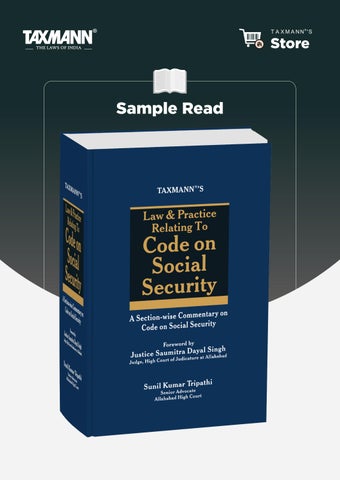
Law & Practice Relating to Code on Social Security AUTHOR : PUBLISHER : DATE OF PUBLICATION : EDITION : ISBN NO : No. of Pages : BINDING TYPE :
Sunil Kumar Tripathi Taxmann August 2026 2026 Edition 9789375616030 2040 Hardbound
Rs. 4,595 DESCRIPTION Law & Practice Relating to Code on Social Security is the flagship commentary on the new labour codes—a section-wise treatment of all 164 sections, seven Schedules and the allied 2026 Rules and Schemes, written by a Senior Advocate with nearly five decades at the labour bar. Its organising idea is comparison. The Code subsumes nine of India’s most heavily litigated welfare statutes, and with enforcement from 21-11-2025 a vast body of accrued rights and part-heard litigation still runs on the repealed Acts. So for every provision with a predecessor, the book prints the Code’s text and the old text side by side in a two-column table—showing at once what has been carried over, reworded, dropped or newly added. Where a provision has no ancestor, the book says so expressly. Nine Act-wise concordance tables run the mapping in reverse, so a practitioner holding a 1952 or 1948 authority can find where it now lives. Around that spine sits a consistent apparatus: a boxed roadmap at the head of every section, a bulleted digest under Provisions in a Nutshell, and decimal-numbered Comments carrying the case law—with a 30-page List of Cases and a 49-page Subject Index both keyed to paragraph numbers, so a query resolves to the exact discussion. The book is pitched at the specialist and the practitioner-user at once: • HR, IR and Personnel Managers • Employers, Occupiers, Principal Employers and Contractors • Builders, Developers and Infrastructure Contractors • Advocates and Senior Counsel • Judicial Officers and Tribunal Members • Corporate Legal Departments, Company Secretaries, Chartered Accountants and Labour Law Consultants • PSUs, MNCs and Industry Associations • Payroll and Compliance Service Providers • Trade Union Leaders, Workers and Employees • Academicians, Research Scholars and Students The Present Publication is the 1st Edition, updated till 20th July 2026. It is authored by Sunil Kumar Tripathi, with the following noteworthy features: • [The Comparative Study—The Book’s Defining Feature] Under the heading ‘Comparative Study of Provisions of Code on Social Security, 2020 & Old Labour Laws,’ every provision sits in a two-column table against the provision it replaces. Where one Code section absorbs several, all are set out in sequence—section 133 is compared against nine provisions from seven repealed Acts. Even the Schedules get this treatment • [Nine Act-wise Concordance Tables] Each repealed statute mapped into the Code section by section, with blank entries marking provisions that have no counterpart—the key page-turn for anyone carrying forward a pending matter. A master table runs the mapping the other way • [206 Pages on the Definitions Alone] Section 2’s 91 definitions treated clause by clause, each with its own Overview box, comparative table, Section Notes and Comments—the depth this battleground of coverage litigation warrants • [An ‘Overview of Section’ Box for Every Provision] A boxed roadmap listing each discussion point against its paragraph number, so a 2,000page volume opens at exactly the right paragraph • [Section Notes: ‘Provisions in a Nutshell’] A crisp bulleted digest of every section, with the author’s own summary tables where the statute is hard to hold in the head—a four-row compensation matrix under section 76 with nine explanatory Notes, and a table under section 133 setting each offence against its punishment and compoundability • [Paragraph-numbered Analytical Comments] Decimal-numbered paragraphs opening with a Prelude and an Analysis of Section, then each practical theme in turn, with the authority footnoted on the page • [Deep Judicial Support] A 30-page List of Cases keyed to paragraph numbers, from foundational Supreme Court authority to High Court decisions of 2026, with parallel citations across the standard labour reporters • [Legislative Intent, Quoted] On contested questions the author reproduces the Ministry of Labour’s clarifications to the 9th Report of the Standing Committee on Labour verbatim • [Interpretive Scholarship Where It Matters] Repeal and savings drawn from Halsbury’s Laws of England, Maxwell on the Interpretation of Statutes and Crawford on Statutory Construction; definitions tested against P. Ramanatha Aiyar’s Concise Law Dictionary and The Law Lexicon • [Rules Printed with the Section] The applicable rule of the Social Security (Central) Rules 2026 sits below the parent section with its Form named, so statute, machinery and paperwork are read as one • [Alert to Collateral Change] Cross-references track the replacement of the IPC and CrPC by the Bharatiya Nyaya Sanhita and Bharatiya Nagarik Suraksha Sanhita 2023, and align registers and returns with the Code on Wages 2019 and the OSH Code 2020 • [Six Appendices] The complete allied subordinate legislation, the text of other Acts the Code refers to, and 43 notifications • [Subject Index] Indexed by section heading with paragraph-level references
Buy Now