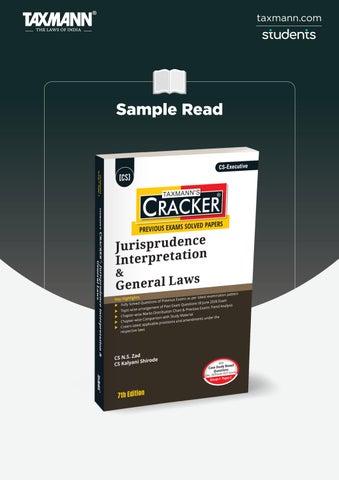
Sample Read


© All rights reserved
Price : ` 395
Seventh Edition : June 2026
Published by :
Taxmann Publications (P.) Ltd.
Sales & Marketing : 59/32, New Rohtak Road, New Delhi-110 005 India
Phone : +91-11-45562222
Website : www.taxmann.com
E-mail : sales@taxmann.com
Regd. Office : 21/35, West Punjabi Bagh, New Delhi-110 026 India
Printed at :
Tan Prints (India) Pvt. Ltd.
44 Km. Mile Stone, National Highway, Rohtak Road Village Rohad, Distt. Jhajjar (Haryana) India
E-mail : sales@tanprints.com
Disclaimer
Every effort has been made to avoid errors or omissions in this publication. In spite of this, errors may creep in. Any mistake, error or discrepancy noted may be brought to our notice which shall be taken care of in the next edition. It is notified that neither the publisher nor the author or seller will be responsible for any damage or loss of action to any one, of any kind, in any manner, therefrom. It is suggested that to avoid any doubt the reader should cross-check all the facts, law and contents of the publication with original Government publication or notifications.
No part of this book may be reproduced or copied in any form or by any means [graphic, electronic or mechanical, including photocopying, recording, taping, or information retrieval systems] or reproduced on any disc, tape, perforated media or other information storage device, etc., without the written permission of the publishers. Breach of this condition is liable for legal action.
For binding mistake, misprints or for missing pages, etc., the publisher’s liability is limited to replacement within seven days of purchase by similar edition. All expenses in this connection are to be borne by the purchaser. All disputes are subject to Delhi jurisdiction only.

CHAPTER
NATURE OF LAW
1.Write a short note on: Classification of definition of law
Ans.: For the purpose of clarity and better understanding of the nature and meaning of law, definitions of law can be classified into five broad classes: Natural Positivistic Historical Sociological Realistic.
2.Write a short note on: Positivistic definition of law
Ans.: Natural law theory exaggerates the relation of law and morality. Positive law is a reaction against particularly that aspect of natural law theory. It insists on a distinction between human law, which they call positive law and moral and scientific laws.
According to John Austin, “law is the aggregate of rules set by man as politically superior, or sovereign, to men as political subject.”
In other words, law is the “command of the sovereign”. It obliges a certain course of conduct or imposes a duty and is backed by a sanction. Thus, the three elements of law are: (1)Command, (2)Duty and (3)Sanction.
Kelsen gave a ‘pure theory of law’. According to him, law is a ‘normative science’. The legal norms are ‘Ought’ norms as distinct from ‘Is’ norms of physical and natural sciences.
Law does not attempt to describe what actually occurs but only prescribes certain rules. The science of law to Kelson is the knowledge of hierarchy of normative relations.
3. Distinguish between: Prohibitive Law & Permissive Law
Ans.: Prohibitive Law: A prohibitive law requires negative conduct. Example: Law prohibiting the carrying of concealed weapon or running a lottery are prohibitive laws.
Permissive Law: A permissive law is one which neither requires nor forbids action, but allows certain conduct on the part of an individual if he desires to act.
4. Natural law says that certain rights are inherent by virtue of human nature and can be understood universally through human reason. Explain. [June 2021 (5 Marks)]
Ans.: Natural law says that certain rights are inherent by virtue of human nature and can be understood universally through human reason. Under this school fall most of the ancient definitions given by Roman and other ancient Jurists.
Ulpine defined Law as “the art or science of what is equitable and good”. Cicero said that Law is “the highest reason implanted in nature”.
Justinian’s Digest defines Law as “the standard of what is just and unjust”. In all these definitions, propounded by Romans, “justice” is the main and guiding element of law.
Ancient Hindu view was that ‘law’ is the command of God and not of any political sovereign. Everybody including the ruler, is bound to obey it. Thus, ‘law’ is a part of “Dharma”. The idea of “justice” is always present in Hindu concept of law. Salmond, the prominent modern natural law thinker, defines law as “the body of principles recognized and applied by the State in the administration of justice”. In other words, the law consists of rules recognized and acted upon by the courts of Justice. It may be noted that there are two main factors of the definition. First, that to understand law, one should know its purpose: Second, in order to ascertain the true nature of law, one should go to the courts and not to the legislature.
SOURCE OF INDIAN LAW
5. Write a short note on: Sources of Law
Ans.: The modern Indian law as administered in courts is derived from various sources and these sources fall under the following two heads:
(A) Principle sources of Indian law:
Customs or Customary Law
Judicial Decision or Precedents
Statutes or Legislation
Personal Law
(B) Secondary source of Indian Law: Justice, Equity & Good Conscience
English Law
6. ‘The main body of rules and principles of Indian law is an adaptation of English law’. Discuss the various sources of English Law. [Dec. 2025 (5 Marks)]
Ans.:
Sources of English Law
The Indian legal system is largely an adaptation of the English legal system. The major sources of English law which have influenced Indian law are as follows:
1. Common Law
Common law is based on customs and judicial decisions developed by English courts. It evolved through precedents and laid down fundamental legal principles relating to contract, tort, property, agency and trusts, which are extensively followed in India.
2. Equity
Equity developed to remove the rigidity of common law and is based on principles of fairness, justice and good conscience. Remedies such as injunction, specific performance, trust, fiduciary relationship and equitable estoppel are derived from equity.
3. Statute Law
Statute law consists of laws enacted by the British Parliament. Many Indian statutes such as the Indian Contract Act, Sale of Goods Act, Companies Act, and Negotiable Instruments Act are based on English statutes.
4. Judicial Precedents
Decisions of English courts, particularly the House of Lords, serve as persuasive precedents for Indian courts, especially where Indian statutes are silent.
5. Customs and Usages
Local customs recognised by English courts also formed a source of English law and influenced personal laws and customary practices in India.
Conclusion
Thus, Indian law is deeply rooted in English law, drawing mainly from common law, equity, statutes, precedents and customs, making it an adaptation of the English legal system.
7. What do you understand by the term custom? Describe the reasons for binding force of customs.
Ans.: A custom is rule which in a particular family or district or particular sect, class or tribe has from long usage obtained force of law.
Custom is the most ancient of all the sources of law and has held the most important place in the past, though its importance is now diminishing with the growth of legislation and precedent.
A study of the ancient law shows that in primitive society, the lives of the people were regulated by customs which developed spontaneously according to circumstances. It was felt that a particular way of doing things was more convenient than others. When the same thing was done again and again in a particular way, it assumed the form of custom.
Customs have played an important role in moulding the ancient Hindu Law. Most of the law given in Smritis and the Commentaries had its origin in customs. The Smritis have strongly recommended that the customs should be followed and recognized. Customs worked as a reorienting force in Indian Law.
8. What are the essential conditions of valid custom? Discuss, Explain any four. [June 2021 (5 Marks)]
Or
“All customs cannot be accepted as sources of law, nor can all customs be recognized and enforced by the courts.” Discuss the essential tests for customs to be recognized as valid sources of law. [Dec. 2021 (8 Marks)]
Or
‘A custom will be valid and will have binding force only if it fulfils certain essential conditions.’ Elucidate. [Dec. 2023 (5 Marks)]
Ans.: A custom is rule which in a particular family or district or particular sect, class or tribe has from long usage obtained force of law.
Requisites of a valid custom: A custom will be valid at law and will have a binding force only if it fulfils the following essential conditions, namely:
(1) Immemorial (Antiquity): A custom to be valid must be proved to be immemorial; it must be ancient. A custom, in order that it may be legal and binding must have been used so long that the memory of man runs not to the contrary, so that, if anyone can show the beginning of it, it is no good custom.
(2) Certainty: The custom must be certain and definite, and must not be vague and ambiguous.
(3) Reasonableness: A custom must be reasonable. It must be useful and convenient to the society. A custom is unreasonable if it is opposed to the principles of justice, equity and good conscience.
(4) Compulsory observance: A custom to be valid must have been continuously observed without any interruption from times immemorial and it must have been regarded by those affected by it as an obligatory or binding rule of conduct.
(5) Conformity with law and public morality: A custom must not be opposed to morality or public policy nor must it conflict with statute law. If a custom is expressly forbidden by legislation and abrogated by a statute, it is inapplicable.
(6) Unanimity of opinion: The custom must be general or universal. If practice is left to individual choice, it cannot be termed as custom.
(7) Peaceable enjoyment: The custom must have been enjoyed peaceably without any dispute in a law Court or otherwise.
(8) Consistency: There must be consistency among the customs. Custom must not come into conflict with the other established customs.
9. Explain: Precedent as source of law.
Ans.: Precedent literally means a rule followed or a principle applied previously by a competent authority under similar facts and circumstances. If a previous decision by a Court is taken as a basis or source for deciding the case under similar facts and circumstances, it is called judicial precedent.
In general use, the term “precedent” means some set pattern guiding the future conduct. In the judicial field, it means the guidance or authority of past decisions of the Courts for future cases. Only such decisions which lay down some new rule or principle are called judicial precedents.
Judicial precedents are an important source of law. They have enjoyed high authority at all times and in all countries. This is particularly so in the case of England and other countries which have been influenced by English jurisprudence. The principles of law expressed for the first time in court decisions become precedents to be followed as law in deciding problems and cases identical with them in future. The rule that a court decision becomes a precedent to be followed in similar cases is known as doctrine of Stare Decisis. [Stare Decisis, means “to stand by decided matters”]
The practice of following precedents creates confidence in the minds of litigants. Law becomes certain and known and that in itself is a great advantage. Administration of justice becomes equitable and fair.
10. Judicial precedents are an important source of law. Discuss various kinds of precedents. [Dec. 2024 (5 Marks)]
Or
Define and distinguish between declaratory and persuasive precedents. [June 2022 (4 Marks)]
Ans.: Various types of precedents are as follows:
Original Precedents:
An original precedent is one which creates and applies a new rule.
The number of original precedent is small.
In the case of an original precedent, it is law for the future because it is now applied.
The number of original precedents is small but their importance is very great.
Declaratory Precedents:
A declaratory precedent is one which is merely the application of an already existing rule of law.
Declaratory precedents merely follow the original precedents.
Declaratory precedents are numerous. A declaratory precedent is as good a source of law as an original precedent.
The legal authority of both declaratory and original precedents is exactly the same.
Persuasive Precedents:
A persuasive precedent is one which the judges are not obliged to follow but which they will take into consideration and to which they will attach great weight as it seems to them to deserve.
In India, the decisions of one High Court are only persuasive precedents in the other High Courts.
The rulings of the English and American Courts are persuasive precedents only.
Obiter dicta also have only persuasive value.
Absolutely Authoritative Precedents:
An authoritative precedent is one which judges must follow whether they approve of it or not. Thus, decisions of Supreme Court are binding force on High Courts and District Courts.
Its binding force is absolute and the judge’s discretion is altogether excluded as he must follow it. Such a decision has a legal claim to implicit obedience, even if the judge considers it wrong.
Unlike a persuasive precedent which is merely historical, an authoritative precedent is a legal source of law.
Conditionally Authoritative Precedents:
A conditionally authoritative precedent is one which, though ordinarily binding on the Court before which it is cited, is liable to be disregarded in certain circumstances.
The Court is entitled to disregard a decision if it is a wrong one i.e. contrary to law and reason.
Example: The decision of a single Judge of the High Court is absolutely authoritative so far as subordinate judiciary is concerned, but it is only conditionally authoritative when cited before a Division Bench of the same High Court.
11. Write a short note on: Doctrine of Stare Decisis
Ans.: Stare Decisis means ‘to stand by decided cases’
Doctrine of Stare Decisis means, “adhere to the decision and do not unsettle things which are established”. In simple words, the principle means that like cases should be decided alike.
Important points relating to doctrine of Stare Decisis:
This doctrine brings certainty and uniformity in the law.
As per the stare decisis doctrine, a principle of law which has become settled by a series of decisions generally is binding on the courts and should be followed in similar cases.
Doctrine of Stare Decisis is based on public policy and expediency. Doctrine of Stare Decisis should be strictly adhered to by the Courts, but it is not universally applicable. Certain exceptions do exist for the doctrine. For example, Supreme Court may change its earlier decision.
Doctrine should not be regarded as a rigid and inevitable doctrine which must be applied at the cost of justice.
12. Distinguish between: ‘Ratio Decidendi’ & ‘Obiter Dictum’. [Dec. 2018 (4 Marks)]
Or How ratio decidendi differs from obiter dicta? [June 2022 (4 Marks)] Or
Distinguish between Ratio decidendi and Obiter dicta. What are the rules governing binding force of judicial precedents. [June 2023 (4 Marks)]
Ans.: The decision or judgment of a judge may fall into two parts: the ratio decidendi (reason for the decision) and obiter dictum (something said by the way).
RATIO DECIDENDI – The ratio decidendi of a case is the principle of law on which a decision is based. When a Judge delivers judgment in a case he outlines the facts which he finds have been proved on the evidence. Then he applies the
law to those facts and arrives at a decision, for which he gives the reason (ratio decidendi).
Thus, the underlying principle of a judicial decision, which is only authoritative, is termed as ratio decidendi. The abstract ratio decidendi alone has the force of law as regards the world at large. In other words, the authority of a decision as a precedent lies in its ratio decidendi.
OBITER DICTUM – The Judge may go on to speculate about what his decision would or might have been if the facts of the case had been different. This is an obiter dictum.
In simple words, obiter dictum is nothing but the supplementary opinion by a judge that is not essential to the actual decision.
The binding part of a judicial decision is the ratio decidendi. An obiter dictum is not binding in later cases because it was not strictly relevant to the matter in issue in the original case. However, an obiter dictum may be of persuasive value in later cases.
It is the ratio decidendi or the general principle which has the binding effect as a precedent, and not the obiter dictum.
13. ‘Justice, Equity and Good Conscience’ is the main Secondary Source of Indian Law. Explain it. [Dec. 2020 (5 Marks)] Or
The Charters of the several High Courts established by the British Government has laid down the rule to decide a case where the law on a matter is silent. Explain with the help of Supreme Court of India’s view in similar situation. [Dec. 2022 (5 Marks)]
Ans.:
The concept of “Justice, Equity & Good Conscience” was introduced by Impey’s Regulations of 1781.
The general idea behind “Justice, Equity & Good Conscience” doctrine was that if on a particular point of dispute before the Court there was no express/parliamentary law, no regulation and if it fell outside the heads for which Hindu and Mohammedan laws were prescribed, then the Court was to decide the matter according to “Justice, Equity & Good Conscience”.
It was applied by the Courts only for few topics, viz. inheritance, marriage, caste, and other religious usages and institutions. It was introduced to cover gaps left in law.
The concept of “Justice, Equity & Good Conscience” also means application by Indian Courts rules of English Law insofar as they are applicable to Indian society and circumstances. In other words, “Justice, Equity & Good Conscience” is generally interpreted to mean rules of English law on an analogous matter as modified to suit the Indian conditions and circumstances.
The Ancient Hindu Law had its own versions of the doctrine of justice, equity and good conscience. In its modern version, justice, equity and good conscience as a source of law, owes its origin to the beginning of the British administration of justice in India.
The Charters of the several High Courts established by the British Government directed that when the law was silent on a matter, they should decide the cases in accordance with justice, equity and good conscience. The Supreme Court has stated that it is now well established that in the absence of any rule of Hindu Law, the courts have authority to decide cases on the principles of “Justice, Equity & Good Conscience” unless in doing so the decision would be repugnant to, or inconsistent with, any doctrine or theory of Hindu Law.
14. The modern Indian law as administered in courts is derived from various sources and these sources fall under two heads i.e. Primary Sources and Secondary Sources. Judicial precedents are considered as primary source of Indian laws. What do you mean by Judicial Precedents?
Read the following statements. Determine and explain what kind of precedent it is:
(i) ‘Vishaka guidelines’ were stipulated by the Supreme Court of India, in Vishaka and others v. State of Rajasthan case in 1997, regarding prevention of sexual harassment at workplace. They acted as precedent for many cases during 1997-2013 until Protection of Women from Sexual Harassment Act, 2013 was enacted.
(ii) The decision of one High Court may not be binding on other High Court. But the decisions can give a principle which may be helpful for the other High Court. The other High Court may or may not follow the principle of the decision. [Dec. 2023 (5 Marks)]
Ans. Precedent: In general use, the term “precedent” means some set pattern guiding the future conduct. In the judicial field, it means the guidance or authority of past decisions of the courts for future cases.
Judicial Precedents: Only such decisions which lay down some new rule or principle are called judicial precedents. Judicial precedents are an important source of law. They have enjoyed high authority at all times and in all countries.
Doctrine of stare decisis: Stare decisis means “to stand by decided matters”. The principles of law expressed for the first time in court decisions become precedents to be followed as law in deciding problems and cases identical with them in future. The rule that a court decision becomes a precedent to be followed in similar cases is known as doctrine of stare decisis.
Original Precedents:
An original precedent is one which creates and applies a new rule. In the case of an original precedent, it is law for the future because it is now applied.
LAWS (JIGL) | CRACKER
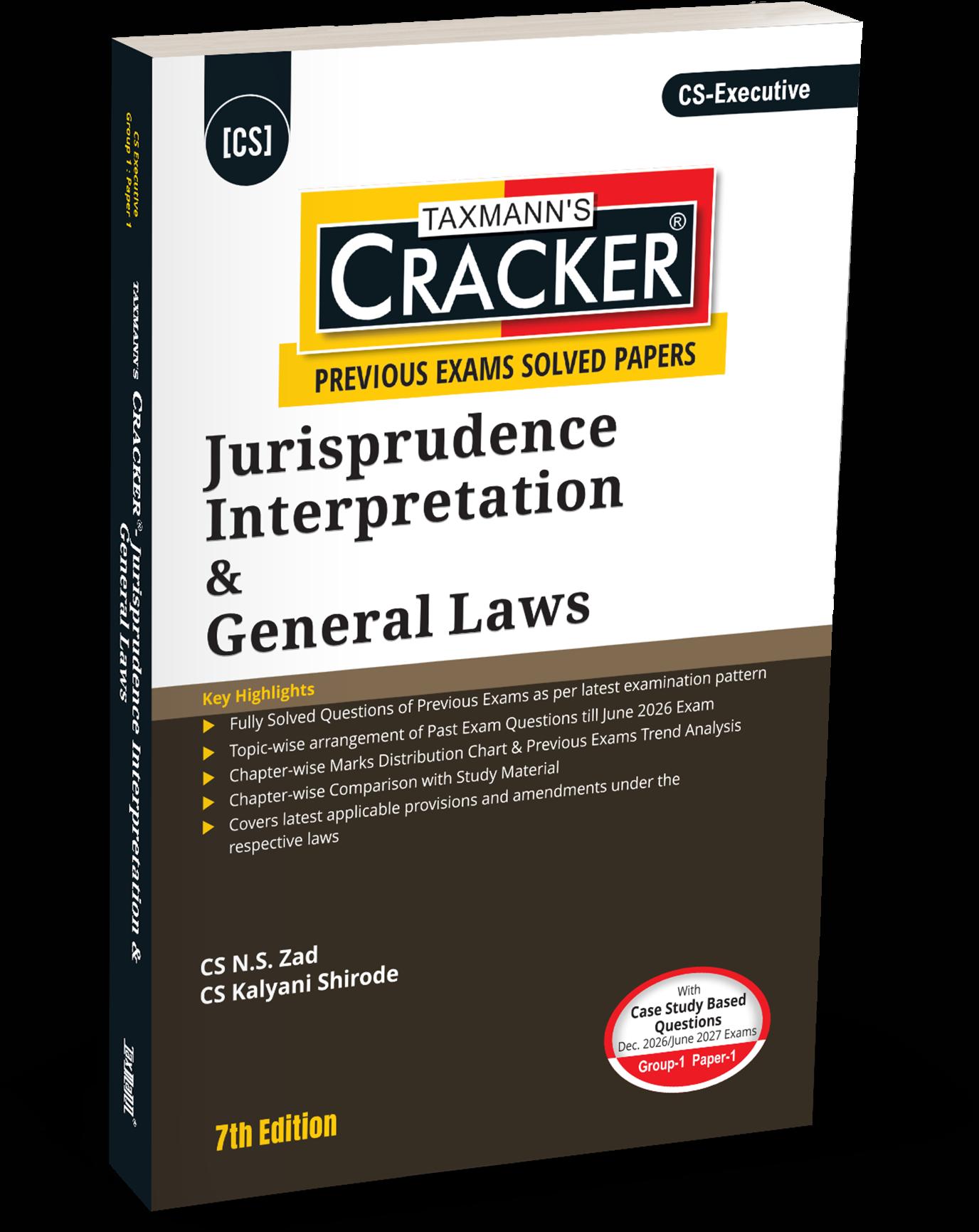
AUTHOR : N.S. Zad, Kalyani Shirode
PUBLISHER : Taxmann
EDITION
ISBN NO
NO. OF PAGES
DATE OF PUBLICATION : June 2026 : 7th Edition : 9789375616870 : 396
BINDING TYPE
Rs. 395
: Paperback
DESCRIPTION
Jurisprudence, Interpretation & General Laws – CRACKER is prepared exclusively for the Executive Level of the Company Secretary Examination requirement. It is a question-and-answer companion for Paper 1 of Group 1 that reproduces past examination questions—each tagged with its session and marks—and follows every question with a complete, model answer in the form the examiner expects. Across fourteen subject chapters and a dedicated case-study chapter, it consolidates over six hundred past questions, regrouped concept-by-concept and updated to the law as it now stands, with the emphasis squarely on answer-writing.
This Edition has been recast for the revised ICSI syllabus and rewritten around the new criminal-law framework—the Bharatiya Nyaya Sanhita 2023, the Bharatiya Nagarik Suraksha Sanhita 2023 and the Bharatiya Sakshya Adhiniyam 2023. Reflecting the decisive shift towards application-based questions, it pairs the topic-wise question bank with a separate chapter of fact-pattern problems and the fully solved June 2026 paper.
The Present Publication is the 7th Edition June 2026, authored by CS N.S. Zad & CS Kalyani Shirode, with the following noteworthy features:
•[Comprehensive Solved Question Bank] Over six hundred fully solved past questions, presented as per the latest examination pattern
•[Topic-wise Arrangement of Questions] Questions up to June 2026 grouped by the concept they test and ordered chronologically, each carrying its session and marks
•[Dedicated Case-Study Chapter] Twenty-two multi-issue fact patterns modelled on the paper's high-mark opening question, answered with reference to case law and statutory provisions
•[Latest Solved Paper (June 2026)] The complete paper with suggested answers, cross-referenced to the solved questions elsewhere in the book
•[Chapter-wise Marks Distribution] A marks chart from June 2021 to June 2026, with per-chapter averages
•[Previous Exams Trend Analysis] A question-by-question breakdown of recent papers, classifying each question as Practical or Descriptive
•[Comparison with ICSI Study Material] A chapter-wise mapping to the corresponding study-material chapters
•[Updated for the Latest Laws & Amendments] Latest provisions under each law, including deep integration of the BNS 2023, BNSS 2023 and BSA 2023, plus the Commercial Courts Act 2015 and the Arbitration Council of India
•[All Examination Question Formats] Short notes, 'distinguish between', practical/case-based and descriptive questions, each labelled with its session and marks
•[Weightage-Aligned Depth] Deepest coverage in the highest-scoring chapters—Crime & its Procedure, Constitution of India and Negotiable Instruments